







Abstract
Realist evaluation is a theory-driven approach used to explore how and why an intervention is effective. One method for collecting qualitative data is realist interviewing. While guidance exists on designing and conducting realist interviews, this guidance can be difficult to apply when several team members are involved. The aim of this study is to report on the collective experience of a research team applying the principles of realist interviewing to evaluate a complex intervention. Drawing on team-based reflections on the application of realist evaluation in the PriCARE research program, we highlight the methodological challenges encountered when preparing for realist interviews and propose lessons that may guide other research teams. This article outlines the importance of collaborative preparation and training of team members with diverse backgrounds, knowledge, and skills in designing and conducting realist interviews, as well as collective learning to promote rigorous and reliable studies.
Introduction
In 2021, the UK's Medical Research Council (MRC) updated its guidelines on the evaluation of complex interventions. The MRC continues to advocate for randomized trials to test effectiveness when possible but also emphasizes the importance of utilizing evaluations to develop theory and better understand the contextual factors that influence change and the change process (Craig et al., 2008; Skivington et al., 2021). Program evaluation should concentrate on how and why an intervention is effective, rather than simply determining whether it works. Theory-driven evaluation approaches, such as realist evaluation, are particularly useful for identifying the mechanisms and contextual factors that contribute to program effectiveness (Marchal et al., 2012).
Realist evaluation aims to develop, test, and refine a program theory to explain for whom the program works, under what circumstances, and why (Pawson & Tilley, 1997; Westhorp, 2014; Wong et al., 2012, 2016, 2017). The program theory is expressed in terms of context (C), mechanism (M), and outcome (O). The term “context” refers to the background of the intervention, including factors such as informants’ characteristics, existing or long-standing relationships, as well as social, economic, political, and institutional structures and circumstances (Jagosh et al., 2015). The term “mechanism” is defined as actors’ reasoning, attitudes, and behaviors with respect to the program resources (Pawson & Tilley, 1997). Mechanisms are activated by context, but are usually hidden. They explain why and how outcome patterns occur (Lacouture et al., 2015). The “outcome” occurs when a mechanism is triggered by a particular context (Pawson & Tilley, 1997). These interactions can be captured using CMO configurations as a heuristic analytical tool (Mukumbang et al., 2020; Mukumbang & Wong, 2025). “Demi-regularities” highlight recurring patterns of CMO interactions, indicating programs often work in semipredictable ways (Vareilles et al., 2017).
Realist evaluation encourages the utilization of a range of evidence types and data source, including both qualitative and quantitative methods (Pawson & Tilley, 1997; Renmans & Castellano Pleguezuelo, 2023). Research teams need to carefully consider which data sources will best facilitate the testing and refinement of the program theory (Dada, 2025). Among the various approaches to qualitative data collection in realist evaluation, realist interviewing is particularly noteworthy (Manzano, 2016; Pawson, 1996). Practical guidelines on how to design and conduct interviews according to a realist approach are present in the literature. Manzano (2016) proposed a set of guiding principles for realist interviewing, encompassing information regarding sampling strategy and the formulation of an interview guide in accordance with the distinct phases of realist interviews (theory gleaning, refinement, and consolidation). Drawing upon their expertise in public health studies, Mukumbang et al. (2020) delineated the methodology for implementing realist interviewing throughout these phases of formulating a program theory. Brönnimann (2022) presented a guiding framework to assist social science researchers in using interview questions that are more consistent with the realist theory and more likely to explore key information about the program. Rees et al. (2024) identified five stages of realist interviewing (developing an initial program theory, determining sampling, conducting the interview, analyzing the data, and reporting realist interviews) based on their own realist evaluations in health research and provided recommendations to facilitate the data collection. The above authors provide guidelines that are of benefit to researchers interested in realist evaluation. However, the application of these methods can present challenges when multiple interviewers take part in the data collection process.
The paucity of literature on the subject is striking, with few studies describing experiences of realist interviewing through collaborative teamwork. Bailey and Harris (2021) explored the learning process involved in comprehending the realist approach within a team, with a particular focus on the domains of data collection and analysis. Francis-Auton et al. (2022) initiated a reflection on the potential of a dialogical approach to realist evaluation. They highlighted the significance of team discussions in the development of interview guides, emphasizing their role in facilitating the creation of effective evaluation frameworks. Given growing interest in the realist approach, more detailed accounts of the challenges encountered by research teams, along with clearer explanations of how team members collaborate to address these challenges, are needed to support its practical application and to enhance the understanding, reporting, and critical appraisal of realist interviews. In this article, we describe our collective experience as a research team applying the theoretical guidelines of realist interviewing in the evaluation of a complex intervention and highlight lessons learned.
The Realist Interviewing Approach
Realist evaluation is driven by the principles of realism, a philosophical stance in which the social world is viewed as real (Mukumbang et al., 2020). Scientific realism, as defined by Pawson and Tilley (1997), recognizes that there is a “real world” and that our understanding of it is processed through human senses, language, and culture (Wong et al., 2013). In line with this philosophy, realist interviewing is a theory-driven approach where informants’ stories of how and why a program works are treated as evidence of its success (Manzano, 2016). The aim of realist interviewing is to explore a program theory by gathering accounts from informants, as they can shed light on the various contexts, mechanisms, and outcomes associated with program implementation (Greenhalgh et al., 2017). Interviewers must take an active role, using a two-way teacher–learner approach. This dynamic approach requires the interviewer to alternate between two roles: learner and teacher. As a teacher, the interviewer actively presents and explains the initial program theory, whereas as the learner, the interviewer seeks to gather insights from informants about specific concepts or experiences (Brönnimann, 2022; Manzano, 2016; Mukumbang et al., 2020; Rees et al., 2024). Realist interviewing is changing and evolving with theory according to the three phases described by Manzano (2016), typically transitioning from exploratory, theory-generating inquiries to confirmatory questions aimed at testing and refining theoretical propositions.
The Program
PriCARE is a research program on the implementation of a case management intervention in five Canadian provinces for individuals with complex needs. A case manager collaborates with individuals, families, and other health and social services providers to deliver four key components: (1) evaluation of needs and preferences; (2) development and maintenance of an individualized service plan; (3) coordination of care; and (4) education and self-management support. A full description of our case management intervention is available elsewhere (Danish et al., 2020). The intervention has been proven to be effective in several reviews (Di Mauro et al., 2019; Joo & Liu, 2017; Kumar & Klein, 2013). The facilitators and barriers to implementing case management have also been identified (Teper et al., 2020). However, as a complex intervention that has rarely been implemented in primary care in Canada, more than descriptive evaluations of implementation processes were needed. Before scaling up case management in primary care settings across different Canadian provinces, there was a need to understand how specific mechanisms were triggered—or not—within particular contexts to produce varying outcomes. A realist evaluation of the case management intervention was conducted in seven primary care clinics across four Canadian jurisdictions. The study aimed to explain how and why case management works (or not). Realist interviewing was conducted with case managers, patients, clinic managers, and providers who participated in individual semistructured interviews and focus groups. While preparing for and conducting the realist interviews, the team confronted a multitude of challenges pertaining to their research background and paradigm, experience with the realist approach, and divergent interpretations of key concepts. In order to address these challenges, team members held several meetings to discuss the approach and work on strategies. The challenges and lessons learned from this process are presented in this article.
Lessons Learned in Using Realist Interviewing
Building a Common Understanding of Realist Concepts Among Team Members
The team consisted of members from four distinct Canadian provinces with varying levels of experience with the realist approach. Since the study was conducted within each province, it was crucial for all participants to be trained in the realist approach and to establish a common understanding of key concepts. A significant investment in time and effort was made to train team members in the realist approach. At the beginning of the study, members participated in training and working sessions to become familiar with realist principles and key concepts, including CMOs. A 90min virtual training session was facilitated by an expert in realist evaluation. The session covered philosophy, key concepts, and theory, and included practical activities and enabled team members to become familiar with realist terminology and to participate—to varying degrees—in data collection and analysis.
The interviewers (CS, MB, and DH) faced several challenges in conducting realist interviews. Some were experienced with the realist approach, while others had minimal or no previous exposure. This imbalance led to several challenges at the outset of the study. For example, identifying contexts and mechanisms proved challenging for less experienced members. Some team members had difficulty distinguishing between the intervention's resources and the mechanisms, which include actors’ reasoning, attitudes, and behaviors. Importantly, the interviewers came from a constructivist qualitative background, a paradigm emphasizing individuals’ construction of reality and theory building through interpretation and induction (Greenhalgh et al., 2017a; Jagosh, 2019). In contrast, realism focuses on matching perceptions to objective reality. The interviewers had to shift from one paradigm to another in order to conduct interviews using the realist approach. Furthermore, the role of the interviewers also differed from what they had learned through academic training and professional experience. In realist interviewing, the interviewers are active participants in shaping the direction of the discussion. The interview focuses not only on the program, but also its underlying theories, structuring questions to examine contexts, mechanisms, and outcomes (Greenhalgh et al., 2017a; Manzano, 2016). The interviewers present theories to informants for refinement, modification, or rejection. They may be directive, respectfully interrupting informants to clarify aspects of the theory or probing on specific topics (e.g., “Do you think this element could impact the intervention, and why?”). The relationship between the interviewers and the informants is deliberately established to investigate and discuss how the program operates, rather than occurring naturally (Manzano, 2016). In our study, this transition between interview approaches often caused discomfort for the interviewers in the early stages.
To establish a shared understanding of key concepts and to acquire the skills necessary to conduct interviews in accordance with realist principles, team members engaged in a collaborative learning process. Interviewers were supported by two team members experienced in the realist approach (ML and M-CC). A series of working sessions was conducted to improve interviewers’ skills in identifying CMOs, using practical exercises as learning tools. Interviewers were also provided with key publications defining realist concepts and examples of studies.
These sessions continued until interviewers reached a shared understanding of CMOs. Before conducting the realist interviews, experienced team members reviewed the interview guides with the interviewers, explained the overall purpose of the interviews, and went through each question and probe. The session allowed interviewers to ask questions and suggest revisions to the guide. Interviewers then conducted mock interviews to develop realist interviewing skills, become familiar with the guides, and learn how to probe participants to elicit CMOs. After completing their first interviews with informants, interviewers shared the transcripts with experienced team members, who provided feedback to further improve their realist interviewing skills and help them elicit CMO configurations during interviews. This iterative process also provided opportunities to revise the interview guides, thereby improving informant comfort and comprehension and ensuring that emerging elements of the theory were thoroughly explored.
In the literature, establishing a shared understanding of realist concepts is important in promoting a consistent interpretation within the team. Such collective conceptual clarity ensures that data collection, analysis, and the development of explanatory configurations are grounded in a common theoretical foundation. Without this shared understanding, team members may have asked questions that were not aligned with the mechanisms being investigated, coded or interpreted data inconsistently, and confused contexts with mechanisms (Lacouture et al., 2015). In a realist evaluation of a large-scale health program in Australia, Francis-Auton et al. (2022) demonstrated how collaborative interactions between team members during the identification of CMOs contributed to the development of a robust initial program theory and a comprehensive understanding of the program, as well as anchoring CMO configurations within the program theory. The article showed that collaboration among team members enabled the development of a shared understanding of CMOs, thereby improving the quality of theories and analysis. Similarly, in our realist evaluation, fostering a common understanding of realist concepts strengthened the abilities of team members, streamlined collaborative work, and supported collective reflexivity. This shared conceptual grounding ultimately enhanced the coherence and quality of the evaluation process.
Determining Categories of Informants and Selecting Knowledgeable Informants
Initially, the team planned to interview most of the case managers, clinic managers, and providers involved in the intervention to learn how and why the intervention succeeded, or not, from different perspectives. However, due to differing levels of participation among informants, some struggled to explain the contexts and mechanisms underlying the intervention outcomes. Moreover, the interviewers expressed concerns regarding their ability to engage in discussions with patients about mechanisms that were not directly observable nor within the patients’ conscious awareness. The team therefore decided to use a purposive sampling strategy following the guidance of Pawson and Tilley (1997) and Manzano (2016). The interviewers also targeted different categories of informants (i.e., patients, case managers, primary care providers, and healthcare managers) to gain insight into various dimensions of the intervention (Manzano, 2016). The informants were selected based on their ability to provide insights into the theory. All case managers were interviewed due to their direct involvement in the implementation and extensive knowledge of the program. Managers and professionals were only interviewed if they were directly involved in program implementation. Patients were selected based on recommendations from case managers.
While guidance is essential for conducting realist interviews, balancing scientific rigor with practical considerations is critical. Unlike Manzano’s (2016) recommendations, the team decided not to begin interviews with case managers, those most familiar with the intervention. Following group discussions, the team determined that interviews with case managers would be deferred until the interviewers gained sufficient familiarity with realist interviewing techniques in practice. This collective decision aimed to help interviewers build confidence and foster a supportive learning environment.
The selection of informants who were truly knowledgeable about the program made it possible to collect more in-depth data, while facilitating the exploration of contextual variations that trigger the mechanisms (Manzano, 2016). These informants had in-depth knowledge of the program, experienced or directly observed contextual variations, and could explain the reasons for success, failure, or unexpected results. Interviews with this type of informant provided rich explanations focused on mechanisms and a diversity of contextual perspectives. The sequence in which informant interviews are conducted should be thoughtfully planned as a team, considering both the setting of the study and the experience, background, and interviewer comfort. This can influence the quality of data collected as more confident and experienced interviewers are better equipped to probe complex issues, prompt responses, and connect experiences, leading to richer and more coherent data.
Drafting Realist Interview Questions
The realist interview guide should focus on a program theory, a set of assumptions about how and why a program is or is not effective (Rees et al., 2024). In our study, the guide was based on an initial program theory on case management developed during the first phase of the study, a realist synthesis of the literature (Hudon et al., 2020). A comprehensive literature review identified 21 peer-reviewed articles and 89 additional documents relevant to the subject. Nineteen different types of interventions were evaluated, and 11 CMO configurations were identified. The development of a trusting patient–provider relationship and the engagement of both patients and providers were identified as demi-regularities because they emerged as common patterns across many configurations. An initial program theory was proposed (Figure 1), which was tested and refined during the second phase of the study—the realist evaluation.
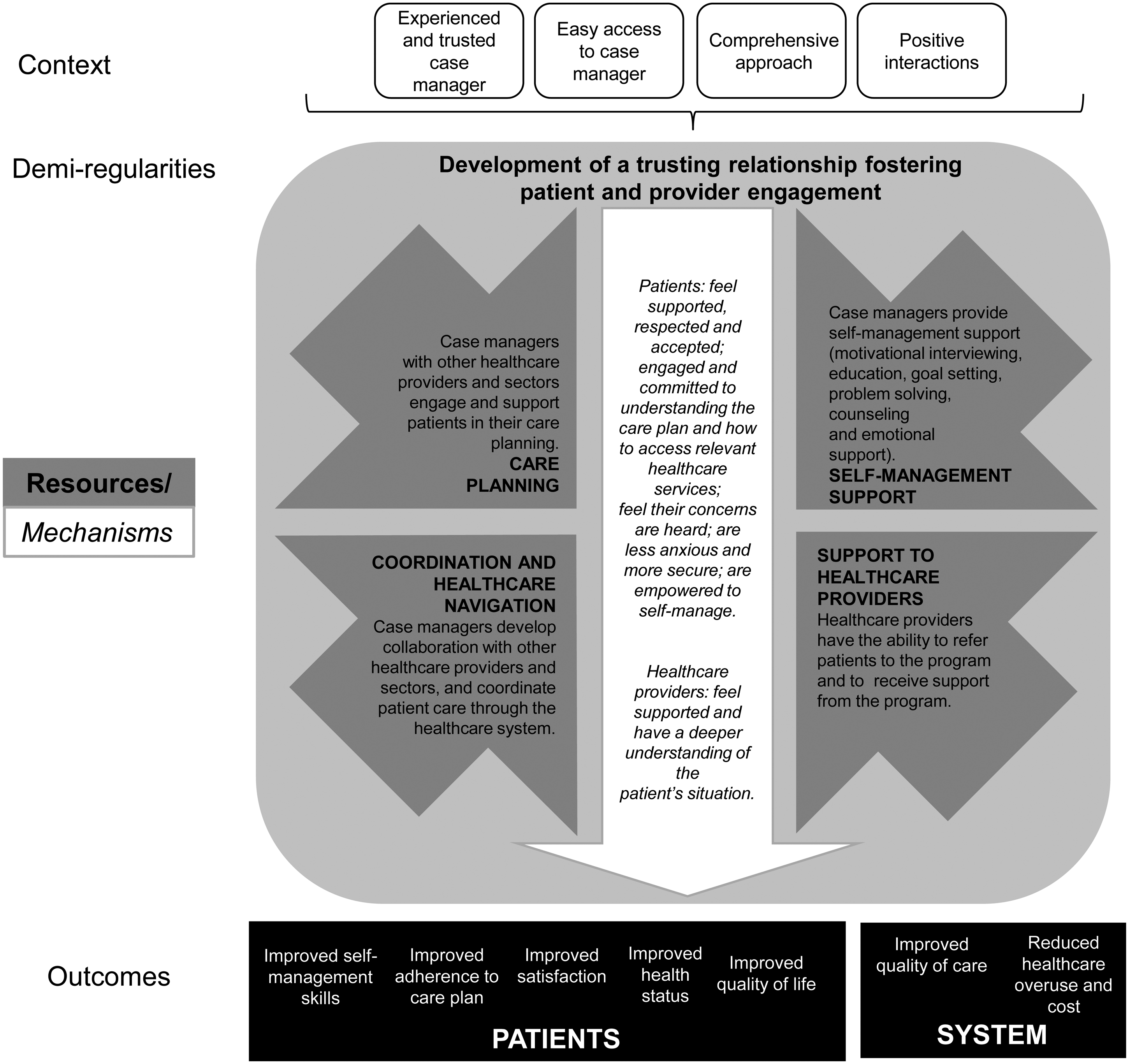
Program theory on CM in primary care for individuals with complex needs. Note. CM = case management. Source: Hudon et al. (2020). © American Academy of Family Physicians. All Rights Reserved.
To develop the interview guide, the team examined the initial program theory to highlight strengths, weaknesses, and knowledge gaps regarding the program being evaluated. Following a thorough review, key elements and missing components were identified. The patient–provider relationship appeared to play a key role in the intervention's effectiveness and was included as a major theme in the interview guide. Conversely, the program theory on case management included numerous individual-level components but lacked organizational-level insights. Therefore, the team members decided to explore organizational CMOs during interviews with healthcare managers. They also found that the contexts identified in the initial program theory did not align with the definitions provided by Pawson et al. (2004)—which included stakeholder skills, interpersonal dynamics, institutional context, and broader infrastructure and welfare systems—or Greenhalgh et al. (2017b), which defined context as preexisting conditions for an intervention. As a result, the team was unable to rely on the contexts outlined in the initial theory during the interview and instead adopted an exploratory approach based on the theory-gleaning phase.
In a realist interview, the approach to questioning differs from traditional qualitative interviews (Manzano, 2016; Rees et al., 2024). Questions are designed to examine hypotheses, with theories serving as the focal point of discussion; these hypotheses are elicited, developed, refined, and evaluated throughout the interview process. The process moves from theory-building to theory-testing, with questions evolving from exploratory to confirmatory as the interview progresses (Rees et al., 2024). To inform the development of the interview guide, the team searched for examples of realist interview questions. However, they found few examples, aside from academic publications from Manzano (2016), Mukumbang et al. (2020), and a starter guide published by Westhorp and Manzano (2017). To contribute to this literature, Table 1 proposes examples of general questions adapted from these publications, which may be useful to other research teams drafting realist interview questions. These examples are presented according to the different phases of the interview process described by Manzano (2016).
Example of General Questions Which Could Be Used at Different Phases of the Interview Process.
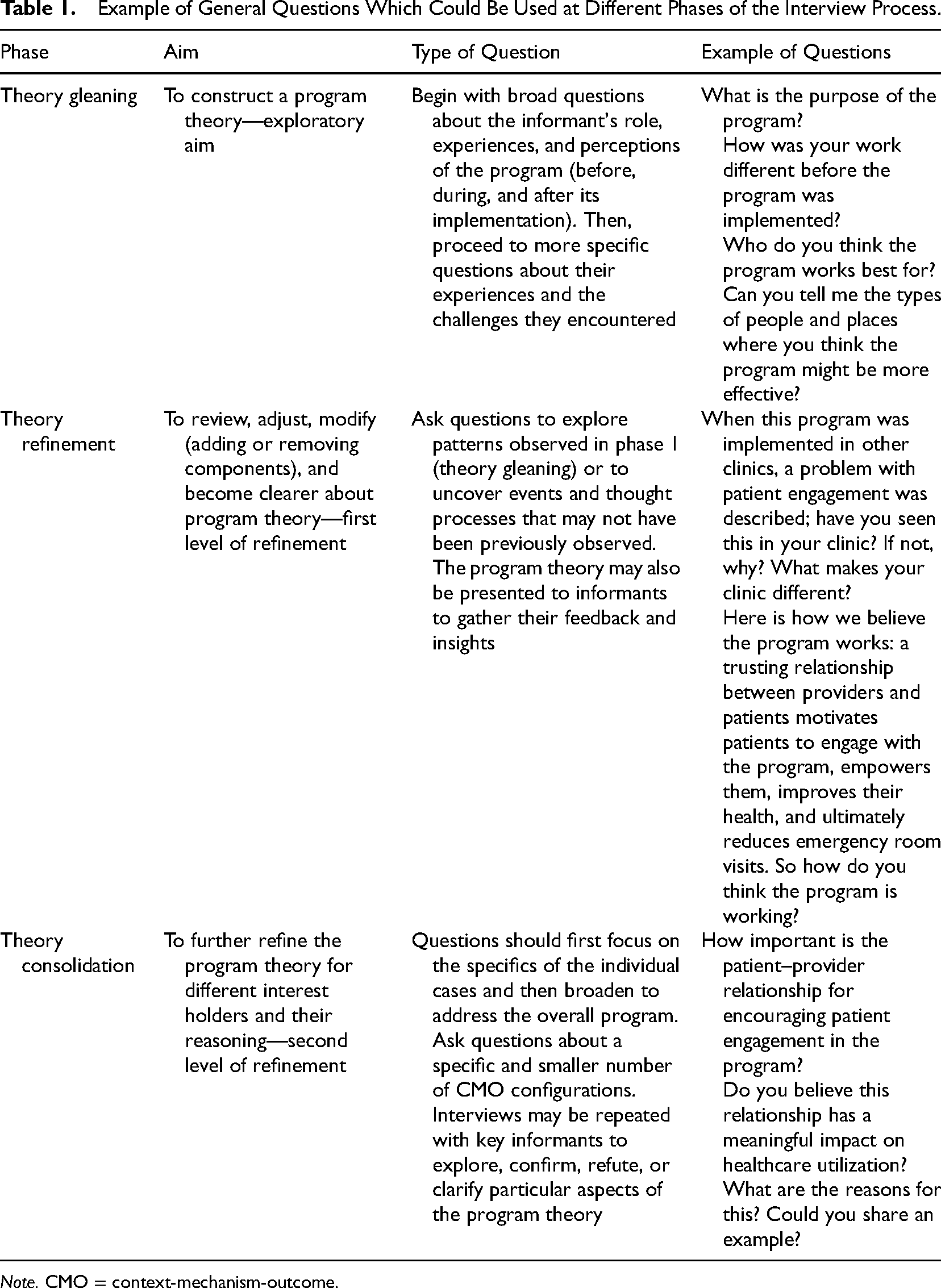
Note. CMO = context-mechanism-outcome.
In the realist evaluation study, the team created two interview guides: one for patients (Supplemental Appendix 1) and another for interviews with case managers, healthcare providers, and clinic managers (Supplemental Appendix 2). Team members experienced in the realist approach prepared the initial drafts regarding the theory-gleaning phase. The guides were designed to explore certain aspects of the initial theory to explain how and why case management works. Accordingly, the interview guides began with broad questions about how case management works, the informant's role in the intervention, and any observed effects. The latter part of the guides focused on specific questions relating to demi-regularities identified in the initial program theory, such as the relationship of trust and the stakeholders’ engagement. The wording, phrasing, and structure of the questions were carefully designed to elicit CMO configurations. Following Brönnimann’s (2022) recommendation, the team used “why” (or for what reasons) and “how” questions to help interviewers gather data related to informants’ reasoning. The team also used targeted probes and asked informants to provide examples from their experience to illustrate CMO configurations. Asking informants to compare their practices before and during the intervention (e.g., “What has changed with this intervention?”, “Why is it different now?”, and “How did you do it before the intervention was implemented?”) proved useful in understanding how the intervention works (Rees et al., 2024). The team also explored informants’ feelings to gain insight into their attitudes toward the intervention. The interview guides were revised based on feedback and suggestions from a realist evaluation expert (ER) and the interviewers.
To support team members in conducting interviews that would elicit CMOs, guidance was included in the interview guides. Each question and its corresponding probes indicated the intended focus—whether it aimed to capture context, mechanism, or outcome. For example, a general question might be used to identify outcomes, while follow-up probes would help clarify the context in which those outcomes occurred. This approach enabled informants to provide sufficient detail to generate either a dyad (e.g., CO configuration) or a full CMO configuration. The guidance also helped interviewers assess whether a response was relevant or if further clarification was needed to obtain the desired information.
During the interviews, weekly meetings were organized to bring all interviewers together, providing a key opportunity for collaborative learning. These meetings created a space for team members to share field insights, discuss strategies that worked well, and collectively identify areas for improvement. Interviewers were also encouraged to reflect on what they had learned from their conversations with informants, which further enriched group discussions and deepened the team's shared understanding of the evaluation context. This ongoing collaborative process enabled continuous refinement of the interview process throughout the project.
Formulating interview questions explicitly aligned with the principles of the realist approach enhances the relevance of the data obtained by guiding informants toward explaining causal processes rather than simply providing factual descriptions. The quality of the data collected is significantly enhanced because the information becomes richer and more explanatory, with a clear focus on how and why the intervention works. This also improves the evaluation process, as analysis becomes more efficient with data already organized around the key CMOs. It streamlines the refinement of the initial theory, with each question directly contributing to the testing or adjustment of a specific component. Ultimately, this method could be used as a model for other projects, ensuring methodological continuity and clarity.
Conclusions
This article makes a significant contribution to methodological literature by offering a reflexive and collective account of the challenges and learning processes involved in designing and conducting realist interviews within a research team with diverse backgrounds, knowledge, and skill sets. By explicitly documenting the shift from a constructivist paradigm to a realist approach, our findings go beyond technical guidance to demonstrate that this transition represents a substantial epistemological and practical collective learning process. Navigating this shift requires deliberate investment in time, resources, and structured support.
Findings also highlight the ongoing tension between methodological rigor and pragmatic constraints. Rather than advocating for a rigid application of realist principles, this article underscores the importance of aligning methodological decisions with both the context of the study and the team members’ prior experience with realist evaluation. The use of interview guides explicitly structured around CMO configurations, combined with mentorship from experienced realist researchers, proved instrumental in enhancing interviewers’ confidence and supporting the identification of theoretically meaningful CMOs.
Finally, our pragmatic journey through realist interviewing highlights collaborative experience as a key methodological resource. Collective learning, fostered through collaboration, knowledge sharing, and reflexivity, enabled team members not only to deepen their understanding of the realist approach but also to develop new methodological competencies. By making visible the role of teamwork and mutual support in producing rigorous and reliable realist studies, this article offers practical and transferable lessons for research teams engaging in realist interviewing.
Supplemental Material
sj-docx-1-aje-10.1177_10982140261454370 - Supplemental material for The Use of Interviews in Realist Evaluation: Lessons Learned From the Evaluation of a Complex Intervention
Supplemental material, sj-docx-1-aje-10.1177_10982140261454370 for The Use of Interviews in Realist Evaluation: Lessons Learned From the Evaluation of a Complex Intervention by Mireille Lambert, Maud-Christine Chouinard, Dana Howse, Émilie Robert, Mathieu Bisson, Alannah Delahunty-Pike, Olivier Dumont-Samson, Charlotte Schwarz and Catherine Hudon in American Journal of Evaluation
Footnotes
Acknowledgments
We would like to acknowledge all team members and partners who were engaged in the PriCARE program. We would also like to thank Paula L. Bush for providing training to the PriCARE team on the realist approaches.

Ethical Considerations
Given the nature of this manuscript, specific ethical approval was not required. However, the broader project on which this manuscript is based obtained ethical approval from the research ethics boards in all four participating provinces as part of the realist evaluation: Comité d'éthique du Centre intégré universitaire de santé et services sociaux (CIUSSS) de l'Estrie- CHUS; Research Ethics Boards Horizon Health Network; University of New Brunswick Research Ethics Board; Newfoundland and Labrador Health Research Ethics Board, and Nova Scotia Health Research Ethics Board.
Author Contributions
ML proposed a first draft of the manuscript. CH, MCC, and DH substantially contributed to subsequent drafts. All authors read and approved the final manuscript.
Funding
The authors disclosed receipt of the following financial support for the research, authorship, and/or publication of this article: This study was supported by the Canadian Institutes of Health Research (CIHR)—Operating Grant: SPOR PIHCI Network: Programmatic Grants (grant number 397896).
Declaration of Conflicting Interests
The authors declared no potential conflicts of interest with respect to the research, authorship, and/or publication of this article.
Data Availability Statement
The authors confirm that the data supporting the findings of this study are available within the article (and/or) its supplementary materials.
Supplemental Material
Supplemental material for this article is available online.
References
Supplementary Material
Please find the following supplemental material available below.
For Open Access articles published under a Creative Commons License, all supplemental material carries the same license as the article it is associated with.
For non-Open Access articles published, all supplemental material carries a non-exclusive license, and permission requests for re-use of supplemental material or any part of supplemental material shall be sent directly to the copyright owner as specified in the copyright notice associated with the article.
