







Abstract
Positionality statements challenge the notion of objectivity in evaluation, recognizing that evaluators are shaped by their identities and experiences. From their distinct lived experiences and intersecting identities, the authors realized that their positionality is malleable and changes over time. In this manuscript, three emerging evaluators share how positionality and social location shape their evaluation practices and the decisions that they make in their work. The authors offer reflections about how engagement with positionality statements in their own practice falls along a continuum of awareness, experimentation, and integration. The proposed continuum ranges from evaluators who have yet to integrate positionality into their deliverables to evaluators who have fully incorporated positionality into their professional practice. Intentional self-reflection and self-awareness is present at every stage of the continuum. We conclude by inviting evaluators to critically examine how they use positionality as a tool to advance more just evaluation practices.
Understanding Positionality and Social Location
Positionality refers to the influence our backgrounds, beliefs, and experiences have on how we conceptualize and understand the world (Holmes, 2020). Positionality also considers how facets of our identities—our experiences, cultures, privileges, and sense of self—shape the perspectives we bring into our personal and professional lives (Daly et al., 2023). Reflecting on positionality means staying aware of how our relative power and privilege move with us and how those shifts affect our relationships, assumptions, and decisions. It also challenges us to recognize that our identities overlap and intersect, influencing how we uniquely experience the world (Puttman, 2025). Although positionality is often made visible through written statements, scholars increasingly caution against treating positionality as a static disclosure or “shopping list” of identity characteristics (Folkes, 2023). Positionality can shape research and evaluation more deeply, including the topics we pursue, the methodologies we use, the relationships we build, and the ways we communicate our work (Secules et al., 2021). We argue that positionality is not only something evaluators disclose in a written statement, but an ongoing, relational practice shaped by social location, power, risk, agency, and context. Drawing on our experiences as three early-career researchers and practitioners of evaluation, we propose a continuum of engagement—awareness, experimentation, and integration—as a reflective tool for evaluators, teams, and educators to consider how positionality informs relationships, decisions, and accountability in practice.
In this article, we understand positionality as the identities, experiences, values, and assumptions evaluators bring to practice; social location as how those identities are situated within systems of power, privilege, and marginalization; reflexivity as the ongoing practice of examining how these factors shape relationships and decisions; agency as the choices evaluators make about how, when, and whether to engage their positionality; and risk as the potential relational, professional, or ethical consequences of disclosure or nondisclosure.
While positionality can be an avenue for us to reflect on who we are and how we show up (Cadman et al., 2024), social location pushes us to consider where we are situated within systems of power. In evaluation, power shapes who participates, what questions are asked, whose knowledge is prioritized, and how findings are used (Hanberger, 2022). Social location helps us examine how privilege and marginalization shape evaluators’ authority, relationships, and choices in these processes. As Hall (2020) reminds evaluators, our professional roles can carry social power, even when we enter the work with equity-centered intentions. Social location helps us examine how privilege and marginalization shape evaluators’ authority, relationships, and choices in these processes. As emerging practitioners and scholars who identify as women from low socioeconomic backgrounds, we have often experienced our pathways into evaluation and doctoral training as less represented in the professional spaces we occupy. At the same time, we recognize the privilege that comes with doctoral training and the authority evaluators may hold in relation to clients, funders, communities, and interest holders.
Our positionalities also differ from one another and shift across contexts. For example, Rebecca, a U.S.-born, native English-speaking, White evaluator, holds identities that implicitly align with dominant expectations of who is recognized as an evaluator. Vanessa and Sonia, whose roots are in Latin America, have found that shared language, cultural references, or lived experience can sometimes create initial points of connection with community partners. Yet shared identity does not automatically produce trust, and difference does not automatically prevent connection. These dynamics can also create risks, including tokenization, assumed sameness, overidentification, or distancing (Merriam et al., 2000). For this reason, we understand positionality as relational and contextual rather than fixed.
We cannot understand our positionality and social location without first engaging in self-reflection and reflexive approaches (Holmes, 2020). Reflexivity pushes us to confront and disclose aspects of ourselves in the evaluation process and to acknowledge the intentional or unintentional influence we carry (Cohen et al., 2011, as cited in Holmes, 2020). However, recent scholarship cautions that requests for positionality statements may create uneven burdens, especially when scholars or practitioners are expected to publicly disclose experiences tied to marginalization, trauma, stigma, or oppression (Duran et al., 2025). These cautions do not lead us to reject positionality; rather, they underscore the need to treat positionality as an ongoing reflexive practice rather than a one-time statement (Martin et al., 2022). Reflexivity requires evaluators to examine how values, identities, lived experiences, and power shape our assumptions, relationships, communication, and decisions over time.
As we reflected on our own experiences with positionality in evaluation practice, we realized that people do not all engage with positionality in the same way or at the same point in their professional journeys. Building on those reflections and on scholarship that frames positionality as fluid, relational, and embedded throughout practice (Folkes, 2023; Secules et al., 2021), we began to see engagement with positionality as something that can shift and evolve over time depending on context, relationships, power dynamics, and professional experiences. That is, positionality and social location in evaluation practice do not occur in fixed or uniform ways.
A Continuum of Engagement With Positionality
These reflections led us to conceptualize engagement with positionality as occurring along a fluid continuum rather than as a fixed endpoint or binary practice. We therefore describe engagement with positionality across three interconnected stages: Awareness, Experimentation, and Integration. As shown in Figure 1, awareness involves recognizing how identity, social location, and power shape assumptions, relationships, and evaluation practice. Experimentation involves trying context-sensitive ways of making positionality visible, whether through writing, dialogue, facilitation, team reflection, or relationship-building. Integration involves embedding reflexivity and relational accountability into ongoing evaluation decisions, relationships, and communication. We do not treat integration as a universal endpoint; rather, each stage may be appropriate depending on role, context, risk, and relationship.
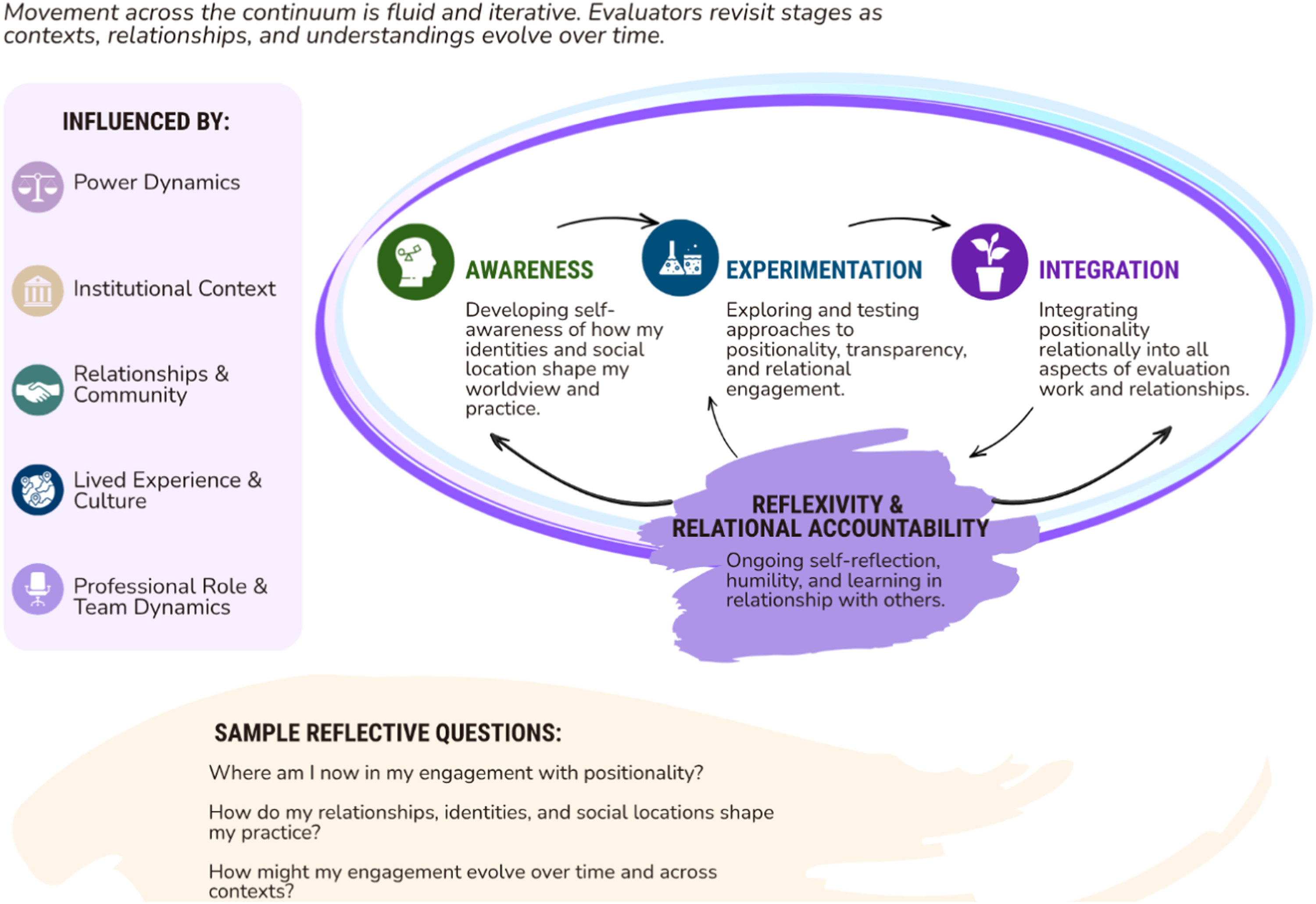
Reflection tool: positionality as a continuum.
We encourage using this continuum as a reflective tool for considering how evaluators engage with self-awareness, reflexivity, transparency, and relational accountability within their practice. An evaluator's positionality and social location may influence where they situate themselves along the continuum at a given moment. Factors such as institutional constraints, power dynamics, professional vulnerability, team relationships, and cultural expectations around disclosure may influence how positionality is engaged across contexts (Daly et al., 2023).
We do not view the continuum as a framework for positionality statements, but as a broader reflective and relational tool for examining how positionality informs interpersonal relationships, communication, power-sharing, decision-making, and engagement throughout the evaluation process. The continuum invites evaluators to reflect on questions such as: Where am I now in my engagement with positionality? How do my relationships, identities, and social locations shape my practice? How might my engagement evolve over time and across contexts? We also believe these questions extend beyond individual evaluators to the profession itself. As evaluation increasingly engages with equity-centered and justice-oriented approaches, the field may benefit from collectively reflecting on where it currently stands and where it hopes to move in its engagement with positionality.
Experiences Across a Continuum
In discussing our respective engagements with positionality, we came to recognize that this engagement unfolds along the continuum. We describe our engagement with positionality across the three stages: Awareness, Experimentation, and Integration.
Navigating Risk and Building Trust When Using Positionality in Practice
Although written positionality statements are one visible form of engagement, evaluators may also practice positionality through dialogue, facilitation choices, team reflection, community introductions, storytelling, visual methods, meeting design, and shared decision-making. Outlined in our examples above, the continuum helped us see that positionality is relational rather than solely individual. Across the continuum, we each encounter various challenges ranging from uncertainty, internal team power dynamics, institutional resistance, fear of tokenization or harm, or lack of guidance. Our engagement shifted depending on role, audience, institutional context, perceived risk, and the quality of relationships in the evaluation setting. Movement across the continuum was supported by practice, mentorship, team dialogue, and opportunities to test what level of transparency was useful and ethical in context. This framing helped us move away from asking whether evaluators do or do not “have” positionality statements and toward asking how positionality shapes choices, relationships, and accountability.
Conclusion
Reflecting on positionality and social location encourages greater transparency about the ways evaluators’ identities, lived experiences, and relationships to power influence evaluation practice (Thomas & Bledsoe, 2023). Rather than assuming evaluation is fully neutral or objective, self-reflexive practice acknowledges the influence evaluators carry throughout the evaluation process. Engaging in these practices and, when appropriate, sharing positionality can build trust and strengthen relationships with clients and communities. By acknowledging that our identities influence every stage of the evaluation process, we create a more authentic, human-centered approach. This practice does not guarantee that all voices are heard or valued, but it can create conditions for more transparent, reflexive, and relationally accountable evaluation practice.
For us, sharing positionality is one possible expression of a larger practice of self-reflection, power analysis, and human connection. As more evaluators identify and reflect on where they are and what shapes their practice, we believe the field can better support multiple entry points into equity-centered evaluation. We offer two calls to action. First, to our fellow scholars, we encourage others to expand upon the continuum of engagement with positionality. Future research could assess and expand the types of reflective prompts within each stage to encourage reflective practice, whether scholars see these stages as mutually beneficial or exclusive from one another, and how the continuum might be employed differently among evaluators of different backgrounds. Second, to practitioners of evaluation, we advocate for individuals and teams of evaluators to use the continuum in practice. Document how its use can support project planning, team dialogue, and decisions about when and how to make positionality visible.
For researchers and scholars, the continuum of engagement with positionality offers a conceptual model for how evaluators can engage with positionality in practice and poses new lines of inquiry to explore. For educators and mentors, the continuum offers a way to teach positionality as an iterative practice rather than a one-time written assignment. For early-career evaluators, it validates awareness and experimentation as meaningful forms of engagement, not simply as incomplete steps toward integration.
Footnotes

Funding
The authors received no financial support for the research, authorship, and/or publication of this article.
Declaration of Conflicting Interests
The authors declared no potential conflicts of interest with respect to the research, authorship, and/or publication of this article.