







Abstract
As evaluators navigate the 2025–2026 context of funding disruptions, shifting institutional priorities, accelerating technology, and changing expectations for evidence, this essay argues that Evaluation Across Boundaries is more than the 2026 American Evaluation Association conference theme. It is a practical strategy for strengthening rigor, relevance, and reach and thereby building a more resilient future for evaluation. Crossing boundaries across sectors, disciplines, methods, communities, cultures, and generations can deepen rigor through fit-for-purpose inquiry and transparent reasoning; increase relevance through closer connection to real questions, real decisions, and real lives; and expand reach through learning that travels beyond a single project, report, or funding stream. The essay frames evaluation as a natural human need and a societal necessity—essential to sound judgment, responsible decision making, and collective progress—and calls the field to stand fully in its professional maturity, consider responsible innovation including artificial intelligence, and commit to practical actions for evaluators, organizations, and professional communities.
Introduction: Why “Unshakable” Now
Evaluation is unfolding in a period of unusual instability, especially during 2025 and into 2026, across many of the systems that support evaluation work. In the United States, nonprofit and public-sector organizations have faced government funding disruptions, delayed or canceled awards, stop-work orders, staffing cuts, and intensified demand for services. A 2025 Urban Institute report found that one-third of nonprofits experienced at least one government funding disruption in the first 4 to 6 months of that year (Tomasko et al., 2025). The Center for Effective Philanthropy later reported that many nonprofits were navigating a more difficult and unpredictable funding environment, with two-thirds of nonprofit CEOs expressing concern about their organizations’ financial stability (Center for Effective Philanthropy, 2026). These conditions matter for evaluation because evaluation often depends on the same funding streams, institutional capacities, and decision systems that are now under strain.
This instability is not abstract. In November 2025, an evaluator who runs a consulting practice told me she was considering leaving evaluation for other forms of work in order to survive. She was not being dramatic; she was being practical. The pain in that story is not that other work lacks dignity. The pain is that someone with advanced training and hard-won expertise in evaluation felt pushed to abandon that craft because the surrounding conditions had become too unstable.
By mid-2025, evaluation was facing a sharply changed professional environment. Federal funding disruptions, agency reorganizations, contract cancellations, and employment instability were affecting evaluators, consulting practices, nonprofit partners, public agencies, universities, and the communities they serve. American Evaluation Association (AEA) acknowledged these pressures in its May 2025 newsletter, noting unexpected employment disruptions among members and adjusting Evaluation 2025 to provide greater accessibility and support (American Evaluation Association, 2025). In this context, the field needs both perspective and purpose. We cannot control every political, fiscal, or institutional pressure facing evaluation, but we can strengthen what remains within our professional responsibility: the rigor of our methods, the trustworthiness of our partnerships, the public value of our work, and our collective capacity to adapt. The disruptions of 2025 are serious, but they are not the whole story of evaluation.
Several deeper questions, however, cannot be avoided: What does this moment reveal about the conditions evaluation has relied on? Where has the field been more vulnerable than we realized? Are evaluators still needed? Is evaluation still necessary? If evaluation is merely an optional add-on, then it is not surprising that it recedes when conditions change. But if evaluation is more fundamental—something closer to disciplined common sense—then its future cannot depend on whether it is highly valued in any single moment.
This essay argues that Evaluation Across Boundaries should be understood not merely as a conference theme—as it is for the 2026 AEA Conference—but as a practical strategy for strengthening rigor, relevance, and reach—and thereby building a more resilient and unshakable future for evaluation. When evaluators cross boundaries intentionally—across methods, disciplines, sectors, communities, cultures, and generations—they strengthen rigor by improving the fit, completeness, and transparency of inquiry; strengthen relevance by connecting evidence more closely to real decisions and lived realities; and strengthen reach by helping learning travel across settings and endure beyond a single project or funding cycle. The task is not to defend evaluation as an optional add-on, but to strengthen it as a disciplined form of learning that helps people act more wisely, more effectively, and more ethically.
A Brief Vignette: Evaluation as a Natural Human Need
My earliest encounter with evaluation's necessity came before I knew the term. On a snowy day in northern China, about three decades ago, I rode my bicycle to an elementary school to observe a moral education lesson taught by a principal. I was 21 years old. By then, I had taught for 4 years, received national recognition as a teacher, and been asked to support teaching and learning across 88 schools in my district. After the lesson, I was expected to provide feedback—what the principal should continue and what he should change.
As I began offering critique, I stopped. I did not stop because I lacked opinions. I stopped because a deeper question interrupted me: How do I know the advice I am giving is sound? Do credentials and confidence alone authorize me to judge and advise educators with far more experience than I had? In that moment, I recognized that if I was going to judge practice and recommend change that affected students and teachers, credentials were not enough. I needed evidence. I needed standards. I needed a reliable way to understand quality, improvement, and progress.
I did not know the term evaluation then, but I knew clearly that responsible judgment required a systematic way to make judgments and recommendations. The labels came later; the need was immediate. That realization propelled me to teach myself English, pass the TOEFL and GRE, and move across the globe to the United States to learn the craft of research and evaluation.
That experience reflects a larger point: evaluation is not a luxury. It is a natural human need—and a societal necessity—whenever decisions affect other people. In that sense, evaluation is common sense made systematic through methodology. If that is true, then our task is clear: we must ensure that evaluation is not treated as optional, expendable, or easy to dismiss. This is a challenge—and a call to strengthen evaluation's foundations, broaden its roots, and make its value more visible across society.
A Field Ready for Professional Maturity
Evaluation is not a new field without history. Modern evaluation has more than six decades of practice, scholarship, standards, methods, and professional community behind it. That does not mean the field is finished growing. It means we have enough history, practice, and intellectual depth to speak with professional confidence.
The language of “emerging” can give a field grace for a time, but it cannot be our permanent frame. If evaluation remains forever “new,” it risks never being fully trusted as mature. A mature profession strengthens its foundations, clarifies its standards, earns trust, and adapts without losing its identity. The challenge before us is not simply to get through this moment. It is to use this moment to become less fragile, more grounded, and more durable. It is time for evaluation to stand fully in its professional maturity.
A Resilience Model: Roots, Soils, and the Three R's
The tree metaphor used in this essay is not intended to replace existing evaluation theory taxonomies, but to extend a resilience argument. Alkin and Christie's evaluation theory tree helps locate theorists and intellectual lineages in the field (Alkin & Christie, 2004). My use of roots and soils is different: it is a practical metaphor for the field's dependence on the contexts that sustain evaluation work. A tree can be beautiful and still be fragile. It becomes vulnerable when its roots are too few, too shallow, or too concentrated in one patch of soil. In many settings, evaluation has been rooted narrowly—often in soils such as grant cycles, compliance requirements, or a small set of institutional homes where evaluation is treated as a specialized service rather than a shared capacity. These soils can produce important work, but they are not stable enough or broad enough to carry the entire field.
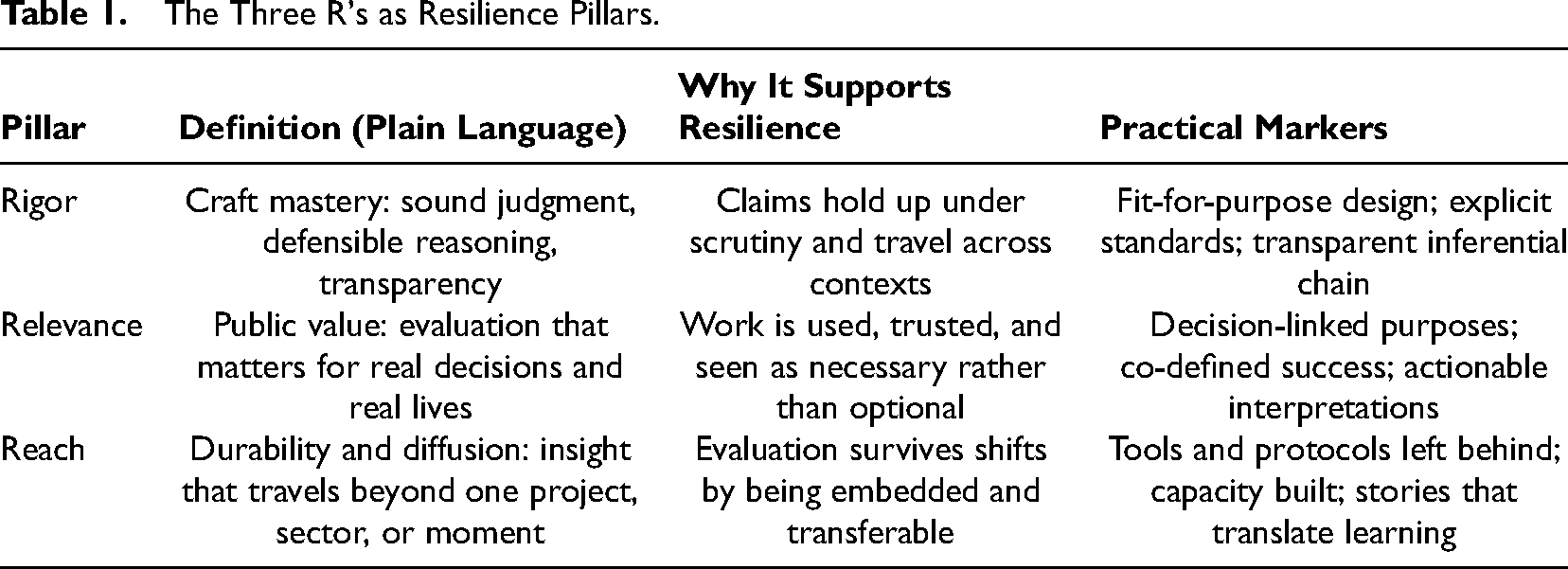
Unshakable does not mean unchanging; it means resilient: able to adapt without losing identity. An unshakable evaluation field therefore requires a root system that is deeper, wider, and more connected. This is why Evaluation Across Boundaries matters. It is a strategy for root growth across soils, sectors, methods, cultures, communities, and generations. Within that wider root system, rigor, relevance, and reach are not competing aims, but interdependent strengths of a more resilient field (Table 1).
The Three R's as Resilience Pillars.
Evaluation Across Boundaries as a Strategy for Resilience
Evaluation Across Boundaries is the central strategy of this essay. It is not a slogan. It is a practical way of diversifying the field's root system—expanding the constituencies that experience evaluation's value, the contexts in which evaluation is embedded, and the methods and frameworks used to address complex questions. When evaluators cross boundaries intentionally, they increase the probability that evaluation remains credible, useful, and viable even when one environment becomes less supportive.
Evaluation Across Boundaries operates at multiple levels. At the project level, it can mean integrating qualitative and quantitative evidence with explicit points of integration, or bringing disciplines into the same design so explanations match the complexity of the problem. At the organizational level, Evaluation Across Boundaries can mean moving evaluation closer to decision cycles through learning routines and decision calendars, rather than positioning evaluation only as compliance reporting. At the field level, Evaluation Across Boundaries can mean creating and sharing reusable tools, protocols, and exemplars that allow evaluation learning to travel beyond a single contract.
In short, Evaluation Across Boundaries grows resilience by distributing roots across sectors, methods, communities, cultures, and generations. It helps evaluators avoid “single-soil” dependence and builds an ecosystem in which evaluation is harder to marginalize because its value is experienced in more places and expressed in more languages (Cash et al., 2003; Rogers, 2003).
Strengthening Rigor Through Evaluation Across Boundaries
Rigor is often reduced to narrow notions of technical correctness or academic strictness. Here, rigor is framed more broadly as craft mastery: methodological judgment, defensible reasoning, and transparency under real-world constraints. Rigor is quiet strength. It is not showy, quick, or performative. It is the disciplined habit of doing the work well enough that claims can stand and travel. Rigor is what makes truth portable.
Craft mastery is built one careful stitch at a time. I learned this lesson from my mother. I was born and raised in a small farming village where life was hard and resources were scarce. After my father passed away, my mother raised four children on her own. She had no formal education; in fact, she never had the privilege of going to school, not even for a single day. During the day, she worked in the fields. At night, after long hours of labor, she lit a kerosene lamp and embroidered by hand—one needle, one thread, one stitch, one leaf, one flower at a time. She made handkerchiefs, lampshades, tablecloths, and bedcovers, each piece created with patience, precision, and beauty. Her embroidery was so exquisite that people came from miles away to buy it. Stitch by stitch, night after night, year after year, she supported four children through college.
My mother's craft created quality, and it built trust. Evaluation is the same. When our craft is strong, our claims hold. When our reasoning is transparent, our learning travels—across audiences and sectors, and under scrutiny. In a time of transformation, rigor grows when evaluators cross boundaries with discipline rather than superficially: the boundary of method choice, the boundary of perspective, and the boundary between evidence and reasoning.
Boundary Crossing 1: Method Choice With Integrity
Rigor grows when evaluators use methods that fit the question rather than methods that fit comfort zones. A practical first prompt is: “What kind of evidence does this question actually require?” Another is: “If we are wrong, what would we expect to see?” Writing and testing such sentences encourages evaluators to seek disconfirming evidence and strengthens inferential integrity. Mixed methods, qualitative and quantitative approaches, academic and applied traditions, and both established and emerging tools can be integrated when the rationale is explicit and quality criteria are clear (Fetters et al., 2013).
Boundary Crossing 2: Perspective With Humility
Many evaluation problems are inherently multidisciplinary and multistakeholder. Rigor increases when evaluators ask, “What is the strongest perspective missing from this room?” and then invite it in—through collaboration, advisory input, or community expertise. This practice improves construct validity, challenges assumptions, and reduces blind spots (Cash et al., 2003; Cousins & Whitmore, 1998).
Boundary Crossing 3: Evidence and Reasoning
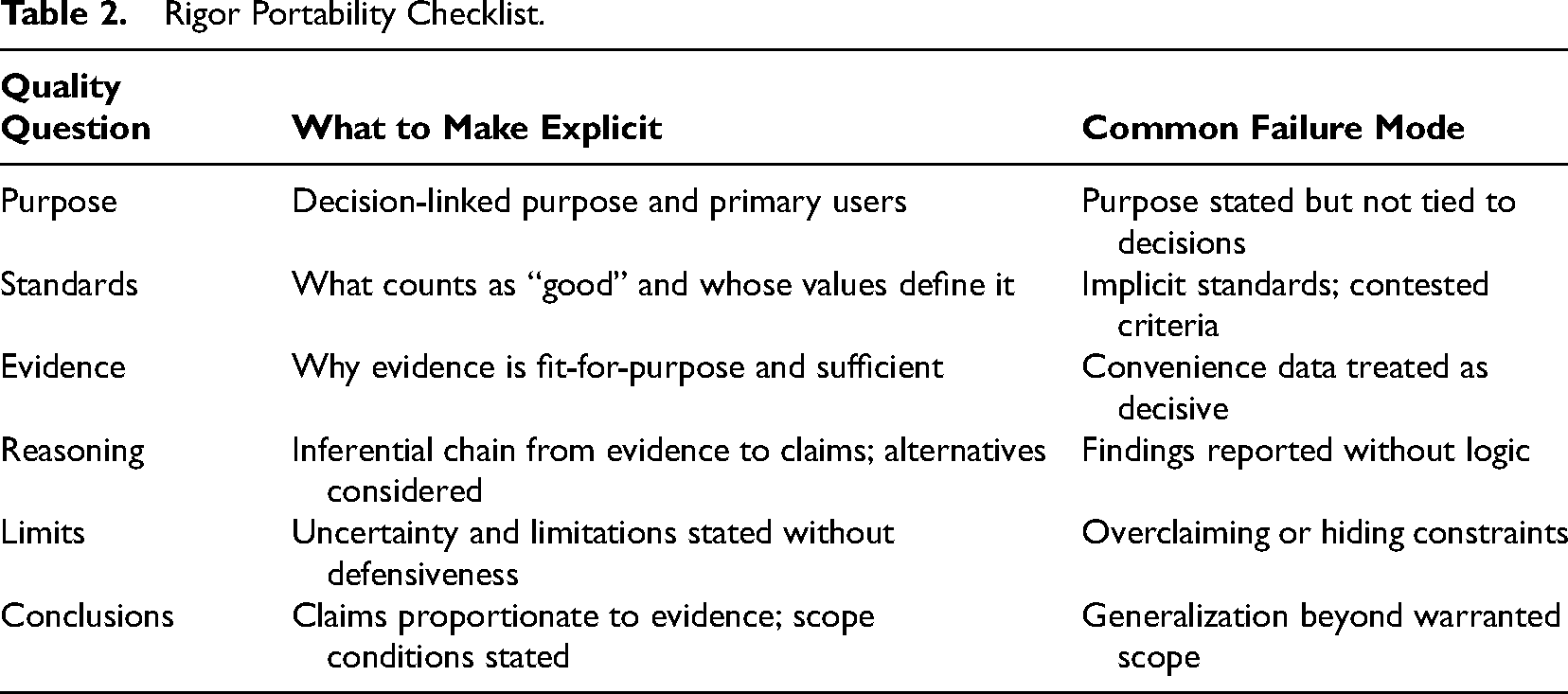
Evidence does not speak for itself. Evaluators must make reasoning visible: how data support a claim, how alternative explanations were considered, what was ruled out, what remains uncertain, and why. Transparent reasoning is also an ethical stance. It respects audiences by making evaluation auditable. It is the bridge between data and decision (Table 2).
Rigor Portability Checklist.
Across Method Boundaries: Strengthening Approaches by Combining Strengths
Evaluation Across Boundaries also means crossing methodological traditions with discipline rather than treating them as competing camps. Many evaluation approaches share common questions—purpose, standards, credible evidence, use, and sustainability—while offering distinct strengths. The task is not to defend one camp against another, but to integrate strengths intentionally when the design calls for it.
For example, the Context, Input, Process, Product (CIPP) Model contributes a systematic structure—context, inputs, process, and outcomes—that supports completeness and disciplined judgment (Stufflebeam & Zhang, 2017). Utilization-focused evaluation clarifies intended use and primary users, helping evaluators design for decisions and intended use (Patton, 2008). Empowerment evaluation emphasizes ownership, capacity, and voice, which can increase legitimacy and sustain learning after the evaluation ends (Fetterman & Wandersman, 2005).
These approaches are not mutually exclusive. A coherent design might use CIPP to structure inquiry, utilization-focused evaluation to define use and decision needs, and empowerment principles to build capacity and shared interpretation. The goal is not eclecticism; it is a disciplined combination that strengthens evidence, reasoning, relevance, and staying power. Crossing method boundaries well can therefore deepen rigor while also laying groundwork for relevance and reach.
Strengthening Relevance Through Evaluation Across Boundaries
Rigor alone is not enough. Rigor that people cannot use becomes a beautiful artifact rather than a force for improvement. Years ago, when I accompanied my daughter, artist Sarah Wall, to a live television studio where her artwork was being featured, I asked a gallery executive what she should always keep in mind if she wanted her art to endure. I expected him to say that her work needed to be more unusual, more dramatic, or more appealing to high-end collectors. Instead, he said something beautifully simple: “Her art needs to tell a story, and it needs to connect with ordinary people.”
I have never forgotten that. Story gave viewers an accessible way into the meaning of the artwork and a reason to care about the piece. Evaluation is not art, but the lesson carries: if evaluation does not connect with people's real questions, real decisions, and real lives, it may be rigorous, but it will not be truly relevant. Relevance is public value: evaluation that people can use to guide action, improve practice, and make a real difference.
One line is central to this argument: in evaluation, if intended users cannot understand and apply the findings, conclusions, and recommendations, the work is not finished. Academic evaluation often emphasizes contribution to knowledge; applied evaluation often emphasizes contribution to decisions. An unshakable field needs both forms of contribution: trustworthy knowledge and decision-useful evidence. Across boundaries, we can bridge the two.
Three boundary crossings are particularly important for relevance: crossing the boundary between evaluator and community, crossing the boundary between findings and decisions, and crossing the boundary between what is measurable and what is meaningful.
Boundary Crossing 1: Evaluator and Community
Relevance is strengthened when interest holders are partners in learning rather than an audience for a report. Partnership clarifies context, improves interpretation, and increases legitimacy. This is not merely a procedural stance; it is a stance of respect. It recognizes that evaluation is conducted in lived systems, where meaning and value are often co-defined (Cousins & Whitmore, 1998; Hood et al., 2014).
Boundary Crossing 2: Findings and Decisions
Relevance is inherently time-bound: evidence matters when it meets decisions at the moment decisions are made. A practical tool is a Decision Calendar that specifies the top decisions the evaluation must inform, who makes them, when they will be made, and what “good enough evidence” looks like for each decision. The calendar approach shifts evaluation from reporting to improvement (Patton, 2008).
Boundary Crossing 3: Measurable and Meaningful
Some of the most important outcomes—dignity, belonging, trust, and opportunity—require evaluators to listen deeply and measure responsibly. A simple early question can recalibrate relevance: “What does success look like to you—and what would make you say, ‘This is not working’?” That question clarifies standards, signals respect, and reduces the risk of measuring the wrong thing very precisely.
Extending Reach Through Evaluation Across Boundaries
Rigor is necessary for an unshakable field, but it is not sufficient. Relevance is necessary too, but even a robust and useful evaluation can disappear if it remains trapped inside one project, one report, or one moment. Reach refers to transferability and diffusion: learning that travels across settings, sectors, and time. If evaluation is truly valuable, it should not disappear when a project ends.
By reach, I mean the capacity of evaluation to generate insight with life beyond its original setting—insight that can inform new questions, strengthen future decisions, and shape practice over time. Reach is the difference between a report and a ripple. Evaluation Across Boundaries strengthens reach by helping learning move across projects, institutions, audiences, and generations rather than remaining trapped in a single setting. Reach increases when evaluation produces transferable assets and builds capability, not only reports.
Three boundary crossings are central to reach: from one project to the broader field, from evaluation to capacity, and from findings to narrative translation.
Boundary Crossing 1: From Project to Field
Evaluation can produce at least three products: a report that documents what was learned, a tool that helps others apply the learning, and a story that conveys why it matters. When evaluations leave behind tools and stories in addition to reports, learning becomes more transferable and more likely to persist (Rogers, 2003).
Boundary Crossing 2: From Evaluation to Capacity
Capacity building extends reach. When organizations build routines for evidence and reflection, evaluation becomes a shared habit rather than a purchased product. Drawing on evaluation capacity-building scholarship, I offer a practical principle for applied work: every evaluation should leave behind at least one capability—such as a dashboard routine, a reflection protocol, a measurement guide, or a learning meeting structure (Preskill & Boyle, 2008).
Boundary Crossing 3: From Findings to Narrative Translation
Narrative communication in evaluation is not marketing; it is translation. It helps learning travel by making meaning accessible and memorable for diverse audiences. Reach also depends on mutual learning across generations: experienced evaluators contribute judgment and ethics, while early-career evaluators often bring new tools, questions, and energy. When these strengths meet, the field becomes more resilient.
Evaluation Across Boundaries and Responsible Innovation
Evaluation Across Boundaries also shapes how the field engages transformation and innovation. Artificial intelligence (AI) illustrates the point. Used responsibly, AI can support rigor, relevance, and reach by helping evaluators analyze data more systematically, improve accessibility across languages and audiences, and support translation and diffusion. But AI cannot replace evaluative judgment. It cannot decide what matters, determine what is fair, or carry responsibility for what should be done. That responsibility remains with us—as evaluators, as professionals, and as human beings.
Three principles are especially useful across settings: transparency, verification, and protection. Transparency means disclosing when and how AI is used. Verification means treating AI outputs as hypotheses or drafts rather than findings. Protection means refusing to trade confidentiality, consent, and contextual integrity for convenience (National Institute of Standards and Technology [NIST], 2023; Organisation for Economic Co-operation and Development [OECD], 2019). AI's presence does not make evaluators less necessary; it makes professional identity and ethical reasoning more important. AI is a tool; evaluators must still provide direction.
A Note on Scope
This essay is intentionally a position paper rather than an empirical study. Its purpose is to offer a unifying frame and a practical set of moves that can guide evaluators and organizations as they navigate uncertainty. “Unshakable” is used as a metaphor for resilience, not as a claim that evaluation can be insulated from all external pressures. The argument is narrower: Evaluation Across Boundaries can help make the field less dependent on any single environment by strengthening rigor, relevance, and reach across different settings. Future scholarship can operationalize and test the framework—for example, by examining which forms of boundary crossing most strengthen rigor, which most increase relevance and use, and which best expand reach and durability in different sectors (Patton, 2008; Preskill & Boyle, 2008; Rogers, 2003). Readers are encouraged to adapt the framework in ways consistent with professional principles and standards in their contexts (American Evaluation Association, 2018; Yarbrough et al., 2011).
Implications and Commitments
If Evaluation Across Boundaries is to function as more than a conference theme, then it must shape evaluation practice. Building an unshakable future is not a single technique; it is a pattern of choices that distributes roots more widely and strengthens rigor, relevance, and reach. This framework suggests practical implications for four groups.
For practitioners: cross boundaries intentionally to strengthen craft mastery, make reasoning visible, and design for use and diffusion. Convert at least one deliverable into a transferable tool or routine.
For organizations and funders: treat evaluation as a capability, not a compliance expense. Invest in internal learning routines, not only external reporting. Protect time and roles for reflection and evidence use.
For training programs: teach evaluation across methodological, disciplinary, and cultural boundaries, including transparent inference, integration of approaches, and ethical reasoning in public-impact systems.
For professional associations and communities of practice: elevate public value narratives, support early-career pathways, and create shared resources that help learning travel. In a shifting environment, the field's resilience depends on shared commitment across boundaries.
These implications can also be expressed as three commitments. First, craft: strengthen rigor so our work is sound, credible, and worthy of trust. Second, people: pursue relevance so our work connects with real questions, real decisions, and real lives. Third, travel: expand reach so our work moves beyond our own circles and makes a difference where it is needed most. When evaluation is rigorous, it earns trust. When evaluation is relevant, it earns attention. When evaluation has reach, it carries its value forward.
Conclusion
When the ground shifts, the task is not to argue with the earthquake. The task is to send roots deeper, spread them farther, and connect them more strongly. Evaluation Across Boundaries gives the field a way to do that.
By crossing boundaries intentionally—across methods, disciplines, sectors, communities, cultures, and generations—the field can strengthen rigor, relevance, and reach. Rigor is quiet confidence: craft mastery that holds under scrutiny. Relevance is public value: work that matters to real decisions and real lives. Reach is durability and diffusion: learning that travels and does not disappear when conditions change. Together, these three concepts point toward a more resilient and unshakable future for evaluation.
A butterfly does not become what it is by staying what it was. Neither does a field. Growth is not the end of the story; it is the transformation. Struggle is not the end; it is part of the becoming. For evaluation, this is a moment of becoming: not a call to remain what the field has been, but an invitation to grow through Evaluation Across Boundaries into a powerful and unshakable future.
Footnotes
Declaration of Conflicting Interests
The author declared no potential conflicts of interest with respect to the research, authorship, and/or publication of this article.
Funding
The author received no financial support for the research, authorship, and/or publication of this article.
