






Abstract
Evaluators can better communicate and work with groups, individuals, and communities when operational definitions exist as a source of providing a shared understanding of concepts, particularly complicated dynamics within intersectionality theories. This article investigates privileged positionalities and how these identities impact evaluation work, as well as how and in what ways marginalized identities coexist with privileged layers of identity. Within this investigation, the construction and personal example of the author's “positionality wheel” allows for the identification of contextual interactions, hidden and relatively unobservable identities, and more directly observable layers. This breakdown of identity and position allows for a humanistic conversation about where these interactions fit as a part of interpersonal communication. The article also allows for reflection and mindfulness, so evaluation work can cater to a large array of experiences and communicate the strengths and limitations of interactions between privileged and marginalized identities.
Positionality, as a concept of self-identification and disclosure when engaging in evaluation work, offers certain complications when attempting to communicate the intersectional nature of privilege (McCall, 2005; Reed, 2011; Thomas et al., 2021). One complication involves the reality that individual human beings have different layers of identities and positions in their lives, leading to the need to recognize the fluidity of privileged and marginalized experiences that vary from person to person. Within evaluation contexts, where evaluators often have varying layers of power and privilege due to their roles as investigators and change agents, positionality, as understood through layers of identity, becomes particularly important in navigating relationships with stakeholders and the social environments and cultural dynamics within organizations and communities.
As this journey of understanding, for me, has been best guided through reflection and personal analysis, throughout this article, I will reflect on my layers of positionality, what they mean in my life, how they impact my work, and how and in what ways I applied my own reflective practice into my positionality research. In addition, the process followed within this article builds justification for the methods of utilizing positional analysis to amplify and improve evaluation efforts working on social justice and human rights issues.
During the American Evaluation Association conference in 2021, a colleague and I presented about the use of reflective practice for understanding positionality, and as a way to communicate our own layers of identity, we discussed the creation of a graphic display of our humanity. The end result was to construct a “Positionality Wheel” (Figure 1) for each of us as a way to demonstrate how we “locate ourselves.”
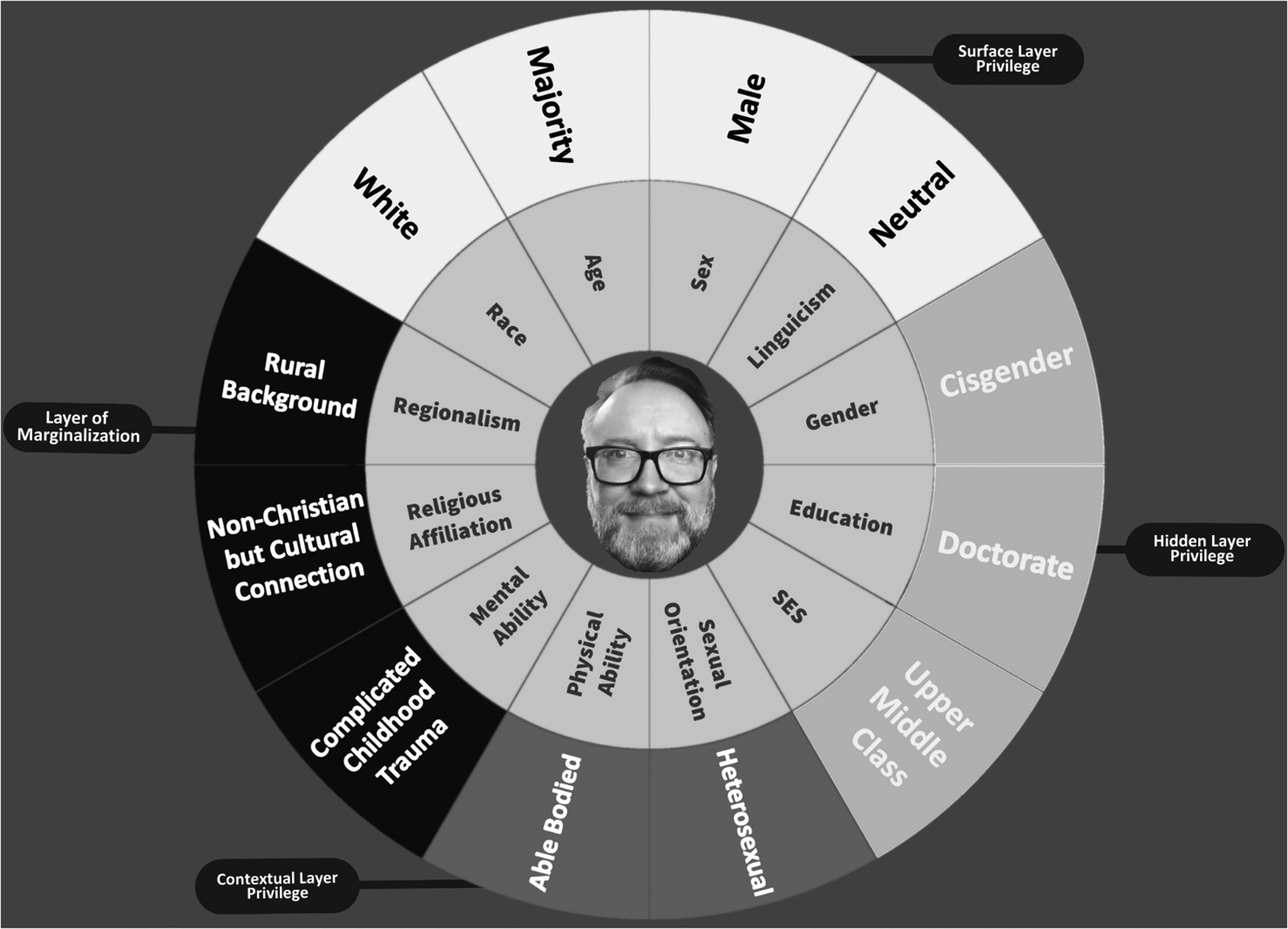
Author's personal positionality wheel.
Identity is highly variable and can be considered in intimate details or in broad societal swaths of relationships within systems. I decided to include a mix of identity categories that I believed explored different themes of how privilege manifests in ways that are more readily obvious to others, and in ways where I may make decisions on how to disclose details about myself and my life during social interactions, negotiation of systems and bureaucracies, and within professional contexts.
One caveat to this categorical creation: the process involved in thinking through these “layers” and how they exist within my life is inherently personal, and others’ experiences will likely vary in what positionalities are more surface, hidden, or contextual (and in what ways).
The more readily identifiable areas of my categorical grouping, which I labeled as “surface layers of privilege,” included my race, my age, my sex, and my linguistic vocal patterns. While some of these layers of identity might be less obviously recognizable for others in their own lives, for me, these are things I understand about how other people experience and recognize me and my identity without knowing me as an individual.
After thinking through these “surface” identities, I began to consider that there are parts of who I am that I can usually keep hidden and undisclosed. For instance, I have known many transgender individuals who, on a surface layer look like their gender identity even when their birth-assigned sex identity is different. People may assume that I am cisgender, but the reality is that this privilege is typically assumed in me by others, and even if that assumption is correct, it is only an identity that can be known directly by me disclosing it.
While each of these examples of my “hidden” identities demonstrates my ability to choose when and at what time to disclose my positionality, there are some layers of identity that are more situated within a context that may be exposed regardless of my desire or ability to disclose. Sexual orientation is an identity that some people choose to directly discuss, disclose, or display through iconography; however, some of these ways in which people assume sexual identity have shifted during societal changes. For example, prior to the case ruling of Obergefell v. Hodges (Supreme Court of the United States, 2015), making nonheterosexual marriage legal in the United States, if someone wore a wedding ring, it was assumed they were married and in a heterosexual relationship. If someone wears a rainbow flag pin, people may assume that the individual is a part of the LGBTQ+ community, and therefore not heterosexual. These are assumptions, however, and until (and if) someone wants to move toward an intimate partnership, their sexual orientation may be kept hidden. If that context comes up, however, unless an individual is deceptive about their identity, their sexual orientation is revealed within that context.
Likewise, while some individual physical difficulties are more directly obvious due to supportive tools and mobility or other physical aids, when someone experiences a physical disability without any external clues, a context during which they may be asked or need to perform a physical task they are unable to complete may expose that identity they may otherwise be able to keep hidden. Since ableism includes both physical, emotional, and mental elements, while physical disabilities may sometimes be more within the surface layer identity, emotional or mental disabilities might be only revealed during contextual moments (with exceptions noted for supportive aids used for developmental disabilities).
After doing extensive self-reflection on these layers of privilege in my life and considering how these privileges may be perceived by others, I believe it was also important to explore elements of my identity that are marginalized. Since I have extensive amounts of privilege in my life and identities, it can be simple to ignore or minimize my experiences of marginalization, and since they are all within areas I can hide or only contextually reveal, I need to be mindful and intentional in how I discuss and explore these elements.
During a small training conference I attended in West Virginia with colleagues working in social justice fields, as we discussed the ways in which rural communities throughout the state faced exploitation by corporations, reduced services, and many judgmental assumptions of identity based on living rurally, I began to realize that while I have lived in more urban environments during different times of my life, my foundational experience of growing up in a rural area meant that I not only understood the experiences my peers were disclosing but I also remembered many early life experiences of oppression that were tied to my rural identity.
My non-Christian status is complicated to reflect upon, as during my childhood and early adult years, I grew up within Christian churches and communities (within the United States, Christianity is the dominant religious group, and has various historical ties to power and privilege as a result). Since I had connections to these experiences of privilege and identity early in life, I can understand the ways in which non-Christian identities can be oppressed and experience judgmental attitudes and behavior. Kivel, a social justice activist, has worked to articulate this dynamic of privilege as a part of his work, stating, I define Christian hegemony as the everyday, systematic set of Christian values, individuals and institutions that dominate all aspects of US society. Nothing is unaffected. Christian dominance is a complex and shifting system that benefits all Christians, those raised Christian and those passing as Christian. However, the concentration of power and wealth accumulates to a predominantly Christian ruling elite. All Others experience exploitation and constant vulnerability to violence (Kivel, 2020).
My marginalized identity of being non-Christian overlaps with a more pressing experience within my life, which concerns my complicated post-traumatic stress due to the abuse and violence I experienced from my father throughout my childhood. Part of that abuse involved my father using Christianity as a form of coercion and threat. This experience of marginalization has come across directly from some individual Christians who have invalidated my experiences as not being tied to Christianity as much as to my father's violence and abuse. This is part of what complicates my experiences of trauma—the ways in which patriarchal support of my father by various churches and church leaders enabled his ongoing hurtful, abusive, and violent behavior toward us.
I am fortunate that, again, these layers of marginalization are things that I can hide, things that I can usually only reveal when contextually relevant. These experiences of harm and pain are also a part of my humanization, a part of my life's experience, and ultimately can serve as a source of understanding the multitude of ways that privilege can easily cause toxic responses, unintended harm, and directly toxic judgmental attitudes toward people who are marginalized.
At the same time, I also understand that privileged identities can be sources of empowerment, can be leveraged to create access and accompany marginalized people to make community change, and can often access other privileged people in ways that are nearly impossible for marginalized people. In many ways, this is where evaluation can serve as a powerful tool of social justice and human rights.
Privileged Evaluators and Utilizing Positionality for Social Justice and Human Rights
I was inspired to explore privileged identities when I conducted a literature review in an attempt to find an operational definition of privilege within evaluation scholarship. I found a few short examples, but nothing that offered a concrete description of the phenomenon that could assist with targeting research and investigation strategies. To this end, when working on my dissertation (Hall, 2022), my advisor greatly assisted me in thinking through connecting all of my study participants to an identical layer of privileged identity through being White, and in being an experienced evaluator (for details on evaluator privilege, see Hall, 2019). This allowed me to ask specific questions in how my participants identified and defined privilege in their lives, as well as allow opportunities for humanization through discussions of the varied marginalized layers of identity each participant had in their life.
After compiling and sorting through all of the interviews, I used an inductive content analysis to determine the thematic categorization of privileges participants brought forward, including (1) status-based privileges, (2) knowledge-based privileges, and (3) identity-based privileges.
Status-based privileges: This grouping of privileges has to do with the specific status an individual has within a layer of analysis. Educational status requires analysis of both the level of achievement (degree completed) and the context or focus of the achievement (location of degree program, type of degree obtained). Economic status may be broken down between various levels, but typically compared between higher-than and lower-than positioning. Nationality is often layered as someone who is a “natural born” citizen compared to a naturalized immigrant, legal resident immigrant, or illegal immigrant. Religion may be categorized as a privilege by in-group and out-of-group comparisons, or higher status based may be dictated by judgment between different denominations or practice of beliefs. Each of these statuses has a continuum of achievement where a certain level is considered to be superior and holds advantages over a lesser obtained status or level. Knowledge-based privileges: Knowledge-based privileges exist based on what specific knowledge has more advantages or benefits within a given context. Linguistic privilege often goes to those who speak English as the global lingua franca, however, in regions where English may not be the predominant language, the privilege may have different connotations or advantages. Social-based privileges are advantages held for understanding and knowledge of certain social practices. This may involve the ability to navigate social structures, understanding of hierarchies, emotional intelligence within social gatherings, presentation and oral skills, or other specific knowledge that may apply within social settings. Identity-based privileges: These privileges tend to be identities that an individual was assigned or was born with, although some dynamics include the way identities may be hidden due to the appearance of a privileged identity. Race often involves the dynamic of skin color, with a gradation of privilege based on lighter skin tones (Spiegel, 2022). Gender is associated with identities within a spectrum. These are often ranked based on cisgender having the most privilege, and transgender or nonbinary gender having societal marginalization. Sex-based privilege is often based on dichotomous male-female identities, where male identities tend to have greater privilege. Sexual orientation can also be analyzed from identity-based privilege, where heterosexuality has amplified ability and agency, and then within nonheterosexual identities, there is a contextual analysis based on various factors within LGBTQ+ communities.
Privileged identities can be discussed by bringing forward a comparison to marginalized identities (“I’ve always been housed, I’ve never had housing issues or housing insecurity issues”), listing specific advantages gained from privilege (“a safe neighborhood with access to a good public-school education”), reflecting on ancestral privilege (“my parents had access to a college education, they had access to get a mortgage to buy a house”), and an understanding of how historical dynamics of colonialism play out in privileged perspectives (“my great grandparents that were the settler colonialists”).
The dialogue with my research participants ended up exploring even more potential categorizations of identity, and provided me with personal insight into how the process of developing an understanding of positionality is a very human activity, and one which can ultimately contribute to advocating for individuals, groups, and communities.
Self-reflection is critical to the ability to work beyond privileged ignorance of marginalized perspectives and experiences. Reflective Practice within the evaluation field has gained growing attention over the years for its value in gaining understanding of ways to improve evaluation research (Peters, 1991; Schön, 1983; Tovey & Skolits, 2022; van Draanen, 2017), and some participants directly credited their reflective practice in how they were able to gain understanding of their privilege and how it applied to their work in evaluation.
One participant referenced “spillover effects” when discussing the murder of George Floyd and media influence on gaining a personal understanding of privilege and also referenced “Faultline Theory” (Lau & Murnighan, 1998) in understanding conflict and mediation approaches to intercultural conflict. This participant also made a reference to “implicit leadership theory” (Eden & Leviatan, 1975) that sets the stage for stereotypes and privileged groupings of individuals, and reflected that accessing fields outside of evaluation is often a product of evaluators having training in other fields before entering evaluation.
Other examples of how participants learned to reflect on their privileged identities involved expressions of empathy for marginalized individuals and groups, having experiences of gaining privilege over time as a part of various contextual factors of growth in life, and recognizing how access to advantages might be useful for those who lack relevant privilege.
Privilege also operates as a protective factor for several layers of identity. One participant discussed this dynamic as it applied to having the ability to pursue higher education due to access to financial resources. In the discussion of my layers of marginalization, I recognized that the protective factors behind my privileged identities often keep me from experiencing the negative dynamics from my marginalized statuses.
This analysis can be applied to most layers of privilege—while the problems behind marginalization often are blamed on marginalized populations themselves, privileged identities have the ability to distribute access, advantage, and status to those who lack them. Much of my professional career involved direct service work as an intervention counselor. The harms I experienced from my father, while intimately damaging to me and my family, also allowed me a deep insight into abusive, controlling, and violent behavior, which allowed me to do extensive work in intimate partner violence intervention with (mostly) men who had been hurtful to their female partners. I was able to access my own experiences of pain to focus on opportunities for repairs, healthy and respectful relationship development, and in providing supportive, empowering care for victims and survivors of intimate partner violence.
Along the way, as I developed my skills in counseling and education, I was also able to reflect and learn about intersectionality in myself and others. It has been these many years of reflection and taking opportunities to learn about myself that have also allowed me to hone my program evaluation skills, and my ability to use the privilege I have as an evaluator to work toward social justice and human rights, regardless of the evaluation context I find myself investigating.
Footnotes
Declaration of Conflicting Interests
The author declared no potential conflicts of interest with respect to the research, authorship, and/or publication of this article.
Funding
The author received no financial support for the research, authorship, and/or publication of this article.
