







Abstract
Kindergarten Peer Assisted Learning Strategies and directly teaching and reinforcing behavioral expectations are empirically supported interventions for building early literacy skills and increasing on-task behavior, respectively. Previous research has not investigated the application of both academic and behavior interventions simultaneously to prevent reading failure. The purpose of this study was to examine the effectiveness of KPALS with and without a classroom management strategy (CMS) consisting of posting and teaching classroom expectations and reinforcing them via a token economy for 20 kindergarten students from an urban elementary school in the northeastern United States. Results indicated an increase in the level of active engagement and teacher-directed instruction with the implementation of KPALS and CMS. Moreover, a clear improvement in students’ academic skills occurred with the addition of the CMS. Future research and practical implications are discussed.
In recent years, federal legislation such as No Child Left Behind and the Individuals with Disabilities Education Improvement Act has emphasized the importance of effectively teaching early literacy skills to young children. Such efforts are supported by longitudinal studies demonstrating that children who are poor readers at the end of first grade are unlikely to reach an average reading level by the end of elementary school (Francis, Shaywitz, Stuebing, Shaywitz, & Fletcher, 1996; Juel, 1988). Moreover, approximately 75% of students who are identified as having reading problems in elementary school will continue to have difficulties as they enter high school and are at increased risk for school failure and drop out (National Reading Panel, 1999).
Reading failure often can be prevented by the implementation of empirically supported reading instruction early in kindergarten and first grade (e.g., Vellutino, Scanlon, Pratt, Chen, & Denckla, 1996). Such reading instruction typically involves systematic and explicit teaching of phonological awareness, decoding skills, and the alphabetic principle (McMaster, Fuchs, Fuchs, & Compton, 2005; Snow, Burns, & Griffin, 1998).
Although several investigators have delineated effective strategies for building early literacy skills (e.g., Blachman, 1994; D. Fuchs et al., 2001), a significant minority of children do not respond to even highly intensive interventions. In general, between 2% and 6% of all students do not make significant improvements in response to evidence-based early literacy interventions (Torgesen, 2000). However, certain groups of children include a higher proportion of nonresponders. For example, between 20% and 30% of children who are at risk for reading difficulties (Al Otaiba & Fuchs, 2002; Mathes, Howard, Allen, & Fuchs, 1998) and between 50% and 100% of children with reading and/or emotional behavioral disorders are not responsive to empirically based early literacy interventions (Al Otaiba, 2001; Nelson, Benner, & Gonzalez, 2003). The association between attention problems and reading difficulties is well documented (e.g., Frick et al., 1991; Lonigan, Bloomfield, & Anthony, 1999; Rowe & Rowe, 1992). Teacher ratings of inattention have been found to be significant predictors of reading problems, even after controlling for prior reading level, IQ, and other demographic variables (Rabiner, Malone, and the Conduct Problems Prevention Research Group, 2004). In a meta-analysis of 30 intervention studies, Nelson et al. (2003) found that problem behaviors (including attention problems) were as predictive of early literacy outcomes as phonologic skills.
Children from economically disadvantaged families score significantly lower than more advantaged students in reading. On the 2007 National Assessment of Educational Progress (NAEP) reading test for children in fourth grade, children who were not eligible for free/reduced-price lunch scored 27 percentage points higher than children who qualified. Fifty percent of children in the more disadvantaged group performed below basic on the NAEP national yardstick of reading performance (Lutkus, Grigg, & Donahue, 2007). Children from low-income homes are more likely to exhibit delays in the development of oral language, letter knowledge, vocabulary, and phonological processing skills due largely to meager experiences and opportunities to learn (Lonigan & Whitehurst, 2001).
Urban schools serve high concentrations of children from ethnically diverse and economically disadvantaged backgrounds and have great potential to enhance key protective factors (secure attachment, academic success, norms supporting academic success, and positive social behavior) and buffer the effects of risk factors (Walker & Shinn, 2002). Unfortunately, urban schools themselves face challenges not equally shared by their suburban and rural counterparts. For example, even after controlling for concentrations of poverty, teachers in urban schools reported higher rates of both student and teacher absenteeism and lower availability of resources, and they reported spending more time managing student misbehavior than did teachers in rural and suburban schools (U.S. Department of Education, 1996).
Academic and Behavioral Interventions
Typical efforts to improve outcomes for students who are not responsive to early literacy interventions have involved the implementation of intensive, teacher-led, small group, or one-on-one instruction in addition to, or in place of, lower intensity early literacy interventions (McMaster et al., 2005). Unfortunately, this approach of systematically increasing the intensity of academic intervention may be challenging for many urban schools with limited resources because it invariably involves additional personnel, and does not fully address the attention and behavior problems associated with reading failure. Although academic interventions are designed to increase exposure and practice to key academic skills, problems attending to such exposure can moderate the effects on learning (e.g., Greenwood, Delquardri, & Hall, 1984). Additional opportunities to respond offered by academic interventions often are diminished by intrusive problem behaviors. This frequently forces teachers to concentrate on managing classroom behaviors instead of explicitly teaching reading.
An alternative approach is to supplement empirically supported early literacy intervention with a low intensity behavioral intervention targeting academic engagement during early literacy instruction. The growing body of evidence identifying attention and behavior problems as strong predictors of children’s poor response to early literacy interventions point to the need for research focused on the development of early literacy programs designed for children with both academic and behavioral concerns. Indeed, the relationship between behavior problems and reading failure is well established (e.g., Velting & Whitehurst, 1997). However, no studies have investigated the application of both academic and behavior interventions simultaneously to prevent reading failure in young school-aged students.
Classwide peer tutoring has been found to benefit both children with disabilities and their typically developing peers (e.g., DuPaul, Ervin, Hook, & McGoey, 1998; Greenwood, Delquadri, & Hall, 1989). Several studies have demonstrated the effectiveness of classwide peer tutoring for children with attention problems on both academic (DuPaul et al., 1998; DuPaul & Henningson, 1993) and behavioral outcomes (DuPaul et al., 1998; DuPaul & Henningson, 1993; Locke & Fuchs, 1995). Kindergarten Peer Assisted Learning Strategies (KPALS; D. Fuchs et al., 2001) for reading is a classwide peer tutoring program designed to target phonological awareness, sound–symbol correspondence, decoding, and word recognition, which have been demonstrated to be key skills in the acquisition of literacy (e.g., Snow et al., 1998). A series of large-scale studies has indicated that KPALS is a feasible program to accelerate development of beginning reading skills in students with and without disabilities and students from both middle-class and low-income families (see D. Fuchs & Fuchs, 2005).
Directly teaching behavioral expectations is a universal prevention approach to minimizing the amount of disruptive classroom behavior and maximizing academic engagement and should involve posting, teaching, reviewing, monitoring and reinforcing the classroom expectations (Simonsen, Fairbanks, Briesch, Myers, & Sugai, 2008). Expectations should be stated objectively to facilitate monitoring, should be stated positively (e.g., “Do your best work” rather than “don’t daydream”), and the number of expectations should be manageable (Kamps, 2002). To be most effective, teachers should consistently and immediately acknowledge students for meeting expectations (Witt, VanDerHeyden, & Gilbertson, 2004). Token economies or awarding tokens (points, checkmarks, chips) contingent on desired behavior have a long history of efficacious use in public school classrooms (see O’Leary & Drabman, 1971) and have been found to decrease inappropriate behavior (e.g., O’Leary & Becker, 1967) and increase the appropriate behavior, achievement, and self-esteem of students (Nevin, Johnson, & Johnson, 1982).
The purpose of the current study was to examine the effectiveness of KPALS with and without a CMS consisting of posting and teaching classroom expectations and reinforcing student appropriate behavior via a token economy. We were principally interested in the effects of the KPALS with and without a CMS on early literacy skills and the incremental effects of a CMS on the classroom behavior of teachers and students.
Method
Participants
Participants consisted of 20 kindergarten students (9 boys and 11 girls) from one classroom in an urban elementary school in the northeastern United States. The sample accounted for all but one student in the classroom who was excluded from this report because he or she was receiving additional reading support outside of the parameters of the present investigation. Participants in the study were either African American (n = 11) or Hispanic. All students were between 4 and 6 years of age. Although we did not collect data on the SES of participants, the majority of children attending the school qualified for free or reduced-price lunch. The class was lead by one teacher, and a teacher’s aide was present 2 days each week.
The participants were divided into two groups, responders and nonresponders. Children who were below the 25th percentile for the class based on the winter benchmark for letter sound fluency (LSF) were determined to be nonresponders (cf. L. S. Fuchs, 2003). The cutoff for the 25th percentile was six correct letter sounds per minute. The nonresponder group was composed of four participants (1 boy and 3 girls). All of the children were 5 years old. One of the girls was Hispanic and the remainder of the children was African American.
Measures
Early literacy skills
LSF probes from AIMSweb® Test of Early Literacy (NCS Pearson, Inc., 2005) were used to measure the number of letter sounds children could correctly articulate in 1 min. Children were presented with a standard sheet of paper containing 100 lowercase letters and asked to say the sounds of as many letters as possible while being timed for 1 min. These measures have been specifically designed for frequent assessment in monitoring prereading and early reading skills. Highly similar instruments have demonstrated moderate to strong correlations with the Comprehensive Test of Phonological Processing (Hintze, Ryan, & Stoner, 2003) and have demonstrated strong alternate form reliability (range between .74 and .89).
Student and teacher behaviors
A modified version of the Behavior Observation System for Students (BOSS; Shapiro, 2004) was used to obtain estimates of the level of academic engagement for all children in the classroom as a group during KPALS sessions and to estimate the amount of time the classroom teacher was engaged in academic instruction (see Volpe, DiPerna, Shapiro, & Hintze, 2006 for a review of the psychometric properties of the standard BOSS). Teacher and student behavior were recorded in 15-s intervals. A momentary time sampling procedure was used to code student active engaged time (AET; e.g., answering teacher questions or writing) and passive engaged time (PET; e.g., listening to teacher directions or reading silently). Teacher-directed instruction (TDI; e.g., academic instruction such as talking about an academic lesson, asking students questions about lesson content, reading to students) was coded every fourth interval (e.g., one 15-s interval per minute) using the partial interval method. Hence, if the teacher was engaged in directed instruction during any segment of an interval it was coded as an occurrence for that interval. On entering the classroom, the observer chose students at random to observe. Children were observed one at a time for 3 min each, with the exception of every fourth interval wherein teacher behavior was recorded. After the first student was observed, the observer would begin to record the behavior of the next selected student, and so on until the KPALS lesson was over. Typically, five or six children were observed during each observation session, with observation sessions lasting between 15 and 24 min (M = 18 min). Interrater reliability was assessed for 38% of sessions, with total agreement ranging from 89% to 92%.
Treatment fidelity
Checklists were completed approximately each week to examine the treatment fidelity of KPALS and the CMS respectively. Checklists contained all components of implementation. For the KPALS, the Kindergarten Reading PALS Implementation Checklist was used to record the utilization of each component of the KPALS intervention (e.g., “Teacher introduces the new sound,” “Most students are responding during choral responses”). For the CMS, a checklist was developed by the investigators that contained 10 essential teacher-performed components of the intervention (e.g., “Rules are explained with examples,” “The ‘good model’ is used if a student is off-task for the first time”). While observing intervention sessions, research assistants coded whether each component was performed by the teacher or student. In all 10 KPALS checklists were completed. The average treatment fidelity for KPALS was 77.30% (range = 50.97–92.82). For the CMS component, four checklists were completed. The average fidelity of CMS sessions was 82.5% (range = 60–100).
Treatment acceptability
A nine-item teacher rating scale was adapted from the Intervention Rating Profile–15 (Witt & Elliot, 1985) to measure the social validity of the KPALS with and without the token economy component. Each item (e.g., “I would suggest the use of this intervention to other teachers”) was rated on a 6-point Likert-type scale ranging from 1 (strongly disagree) to 6 (strongly agree).
Children were asked to complete a three-item rating scale during each intervention condition. Research assistants read each item and asked children to circle one of three faces that best described how they felt. For each item (e.g., “It is fun to do KPALS”), the child could circle a frowning, neutral, or smiling face, which were depicted in a simple line drawing.
Experimental Design and Conditions
Experimental design
The current study involved three conditions (baseline, KPALS only, KPALS + CMS). During each phase, student progress in LSF was assessed each week. LSF probes were administered to each participant by graduate student research assistants. All probes were administered on Mondays and Tuesdays in quiet rooms in the school building. Classroom observations were conducted one time each week for the last 3 weeks of the KPALS condition and the first 4 weeks of the KPALS + CMS condition.
Baseline
During the 5 weeks of baseline, the classroom teacher administered the school’s existing reading curriculum. This curriculum consisted of the Harcourt Trophies Reading Series.
KPALS
KPALS for reading (D. Fuchs et al., 2001) is a classwide peer tutoring program designed to target phonological awareness, sound–symbol correspondence, decoding, and word recognition, which have been demonstrated to be key skills in the acquisition of literacy (e.g., Snow et al., 1998). A series of large-scale studies has indicated that KPALS is a feasible program to accelerate development of beginning reading skills in students with and without disabilities and students from both middle-class and low-income families (see D. Fuchs & Fuchs, 2005). The classroom teacher attended a half-day KPALS training conducted by a certified KPALS instructor. In addition to this training, the first author provided coaching in the implementation of KPALS until 100% integrity was achieved. Coaching consisted of modeling KPALS procedures, and performance feedback on adherence to the steps in the KPALS intervention manual. Thereafter graduate research assistants collected weekly treatment fidelity checks and provided the teacher with brief constructive feedback based on their observations. KPALS was administered by the classroom teacher in the morning, three times a week. Throughout this condition, the teacher continued to provide instruction as usual in the core reading curriculum. Each session lasted for between 20 to 50 min and was administered for 11 weeks before the CMS component was added.
K-PALS + CMS
In the KPALS + CMS condition the KPALS and core reading instruction was implemented as usual but several enhancements were added to KPALS sessions to increase the academic engagement of students. This third phase was implemented to address teacher concerns with high levels of off-task behavior during the KPALS lesson. The KPALS manual includes a set of seven classroom expectations; however, these were considered too elaborate for these young students. Based on informal classroom observations and teacher interview, a short list of three classroom expectations were designed to address the barriers to the implementation of KPALS (Table 1).
Modified KPALS Rules
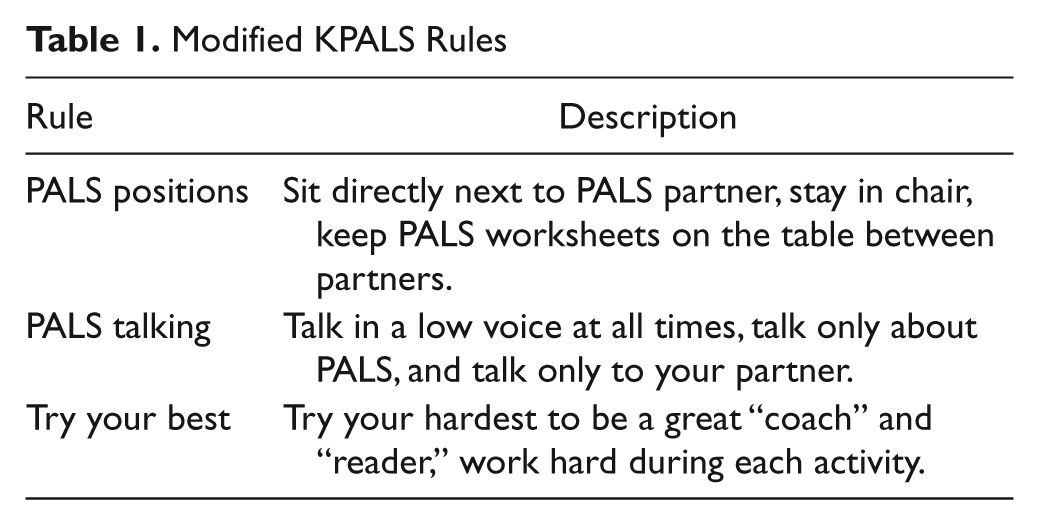
The teacher was trained in the administration of the CMS through a brief 15-min training session, then modeling and coaching was provided by the first author during the first teacher-led session. Subsequently, weekly feedback was provided by graduate research assistants. The CMS intervention consisted of three principal components. First, at the beginning of each KPALS session the teacher reviewed the classroom expectations and asked students questions involving naming expectations, asking for examples, and providing positive and negative exemplars of each. A large poster with icons representing each expectation was posted on the classroom wall and was used to orient the students to each expectation. Second, once students formed pairs for peer tutoring, each student was provided with a feedback sheet (a sheet of paper printed with a six-by-four grid). The classroom teacher and teacher’s aide provided feedback on student behavior by explicitly naming the expectation that was being followed and placing a mark on student’s feedback sheet. The teacher was instructed to circulate through the classroom and reward students liberally for meeting expectations. When a student was not following a rule, teachers provided verbal praise to a student modeling incompatible behavior (e.g., “I like how Sam is in PALS position”). Finally, once each student received 24 marks filling up their feedback sheet, they were able to choose a prize from a prize chest. The prize chest was a clear plastic box containing brightly colored party favors.
Materials
The teacher was provided with a KPALS manual, a folder for each student pair including pencils, and feedback sheets and a prize chest (described earlier). The teacher was responsible for creating the student work packets for each student pair and larger work sheets for whole class instruction.
Results
Because of student absences, on average 3.4 data points on the LSF measure were missing for each student (range = 0 to 7). Missing data were replaced with the average LSF score from adjacent assessments. No data were missing for observations of classroom behavior.
Classroom Behavior
Classroom observation data are summarized in Figure 1. In the baseline condition classroom active engagement (M = 26.57, SD = 4.67) and passive engagement (M = 20.90, SD = 5.99) was consistently low. Teacher-directed instruction likewise was consistently low (M = 38.87, SD = 9.64). Visual inspection of the data indicate an immediate increase in the level of active engagement (M = 51.36, SD = 13.16) and teacher-directed instruction (M = 75.78, SD = 5.65) with the implementation of the CMS. Passive engaged time remained somewhat consistent across conditions. Effect sizes were calculated for each student by subtracting mean scores in the baseline condition from mean scores in the IR condition and dividing the difference by the standard deviation of the baseline data (see Busk & Serlin, 1992). The resultant effects sizes for active engaged time, passive engaged time, and teacher-directed instruction were 5.3, 0.08, and 3.8, respectively.
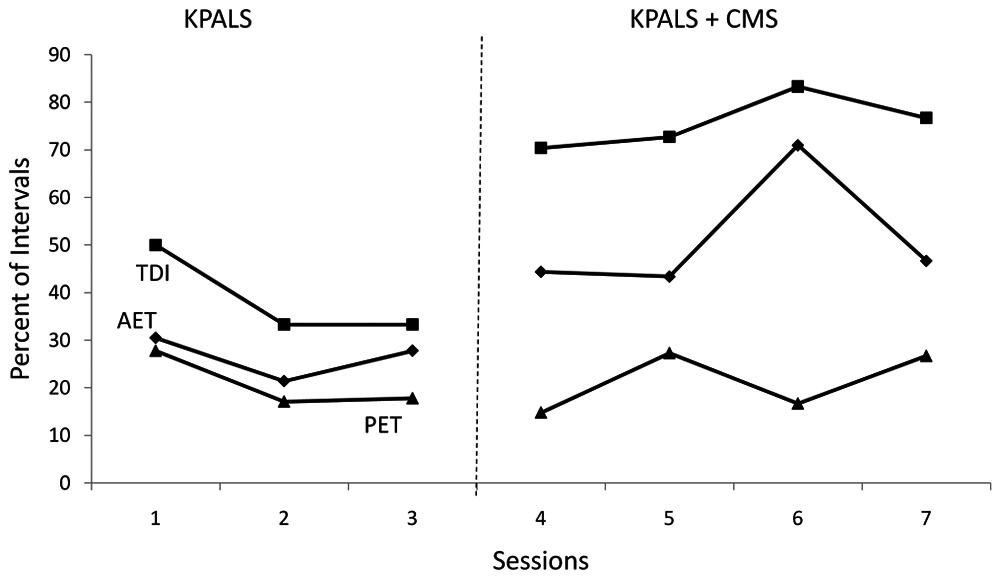
Summary of direct observation of student and teacher classroom behavior
Early Literacy Skills
Progress on early literacy skills for responders and nonresponders is summarized in Figure 2. In the baseline condition, average LSF scores were notably higher and more variable for the responders (M = 11.79, SD = 13.45) than the nonresponders (M = 0.35, SD = 0.75). Moreover, responders demonstrated a positive trend while the trend for nonresponders was flat. Visual inspection of the data indicated positive changes in level and trend were associated with the implementation of KPALS. In addition, the gap between the responders (M = 22.70, SD = 15.76) and nonresponders (M = 4.58, SD = 4.28) widened. The five baseline data points and the first five KPALS data points (responders M = 18.44, SD = 15.04; nonresponders M = 1.93, SD = 2.02) were used to calculate effect sizes for each group. Resultant effect sizes were 0.49 for responders and 2.11 for nonresponders. When the CMS was added to the KPALS, visual inspection of the data indicated that the responders demonstrated immediate positive changes in level (M = 41.44, SD = 17.55) and trend. Likewise, nonresponders demonstrated an immediate improvement in level (M = 22.88, SD = 7.94) and trend. Effect sizes were calculated for each group by using the last five data points of the KPALS (responders M = 27.17, SD = 15.98; nonresponders M = 7.5, SD = 4.43) condition and the first five data points from the KPALS + CMS condition (responders M = 40.61, SD = 18.53; nonresponders M = 19.45, SD = 7.19). Resultant effect sizes were large for both the responders (effect size = 0.84) and nonresponders (effect size = 2.7).
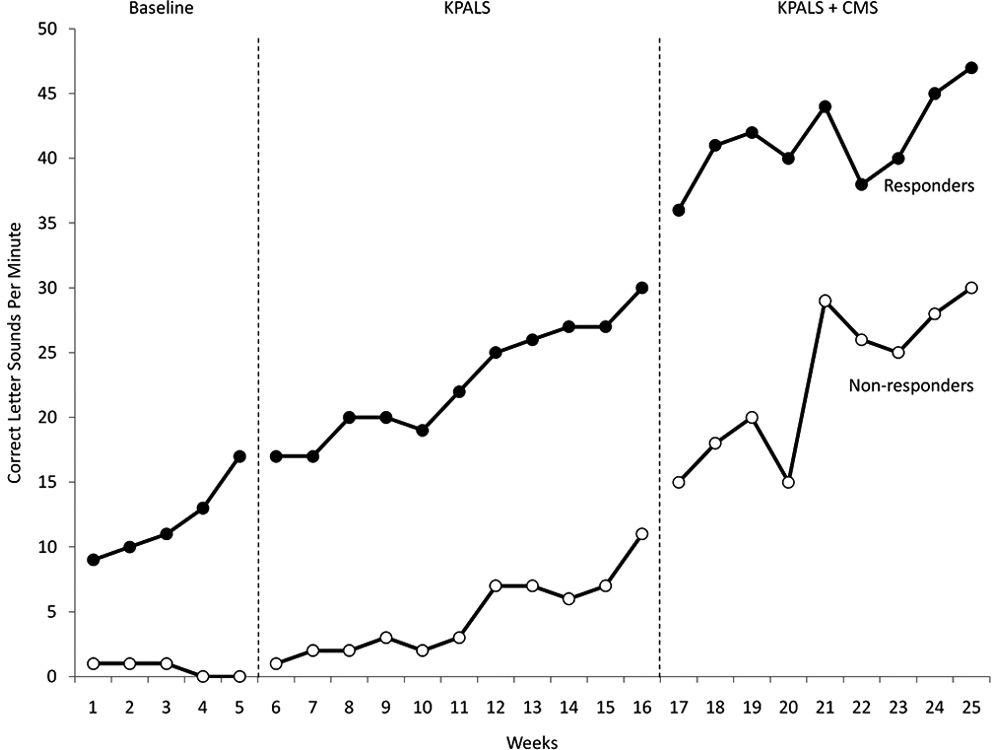
Summary of letter sound fluency data
Teacher and Student Acceptability
Mean item scores were used to summarize teacher and student acceptability for the KPALS alone and the KPALS + CMS. An average item score of 6 would indicate the highest possible acceptability for the teacher, and an average item score of 3 would indicate highest possible acceptability for students. Treatment acceptability data for the classroom teacher indicated a slightly positive attitude toward the KPALS (M item score = 3.67) and was only slightly higher for the combined KPALS + CMS intervention (M item score = 3.89). Students found both interventions acceptable, finding the KPALS + CMS slightly more acceptable (M = 2.67) than the KPALS alone (M = 2.31).
Discussion
The purpose of this study was to examine the effectiveness of KPALS with and without a CMS. Consistent with prior studies (see Fuchs & Fuchs, 2005), KPALS alone appears to have been an effective early literacy intervention for the overwhelming majority of students. Although both groups demonstrated a positive response to KPALS alone, the gap between responders and nonresponders widened over the course of the KPALS intervention (without CMS). At the end of the KPALS alone condition, responders were well on track to meet the spring LSF benchmark of 35 correct letter sounds per minute. However, the trajectory for the nonresponders suggested that they would fall far short of reaching the benchmark.
The addition of positive behavior supports was associated with noteworthy improvements in both active student engagement and teacher-directed instruction. Students worked hard to earn points and awarding points to students increased the teacher’s movement around the classroom. Moreover, a clear improvement in students’ academic skills occurred with the addition of positive behavior supports. Overall student engagement (active engagement + passive engagement) increased from 47% to 73%. Although this represents a notable improvement, engagement remained low compared to previous studies (cf. Downer, Rimm-Kaufman, & Pianta, 2007). Moreover, active engagement only increased to 51%, which is particularly low given that data were collected during activities that should have involved much higher rates of active responding. Because both responders and nonresponders were grouped together in estimates of classroom behavior, it is not possible to examine the behavioral effects of CMS on either group individually. It is likely that the nonresponders showed lower rates of academic engagement that would have suppressed the overall estimate of engagement across conditions. However, it appears that the observation measure was sensitive to the effects of intervention because the addition of the CMS appeared to have an immediate impact on engagement in the appropriate direction. Visual inspection of the data indicated clear improvements in the level and trend of LSF scores and with the combination of KPALS and CMS for both groups of students. Moreover, nonresponders began to make adequate progress toward the spring benchmark and appeared to make gains toward closing the gap with responders.
Limitations
Because of several limitations, the findings of the current study are best viewed as preliminary. First, this study was conducted in a single kindergarten classroom. Because a reversal would have been unethical and because both the KPALS and CMS were classwide interventions, more robust experimental designs were not possible in the current study. Hence, this study does not control for history or maturation, which are possible alternative explanations for the noted changes in behavior and early literacy skills. Future studies of these interventions should use a multiple-baseline design across schools or classrooms or group designs to provide greater experimental control. Next, demonstration of experimental control was limited by the jump in LSF scores for the responders just prior to the implementation of KPALS. Because there was a week’s delay between didactic teacher training on the KPALS and the official start of the KPALS condition, it is possible that the teacher began implementing some of the instructional strategies in the last week of the baseline condition. When possible, all training activities should be scheduled together to avoid such contamination of conditions. Treatment fidelity for both KPALS and CMS was relatively low. Although, teachers received coaching for both interventions until they could complete the intervention steps with high fidelity, it is clear that this was not adequate to sustain high treatment integrity. More frequent integrity checks with performance feedback likely would have improved treatment integrity and treatment outcomes (see Noell et al., 2005). Finally, because the study initially was designed to examine the effects of intervention for the classroom as a whole, observation data were collected to obtain an estimate of the academic engagement of the entire classroom. This precluded parsing these data by group (responders vs. nonresponders). Future studies should investigate the academic behaviors of both groups separately to better study the effects of academic and behavioral interventions both on children who readily respond to academic interventions and those who do not.
Conclusions
Although preliminary, the current study has important implications for research and practice. The prevailing wisdom in efforts to prevent reading failure has been to increase the intensity of academic interventions for students who are not responsive to less intensive academic interventions (e.g., Torgesen et al., 2001; Vaughn, Linan-Thompson, & Hickman, 2003; Vellutino et al., 1996). There are two notable problems encountered with this approach—particularly in urban schools. First, students may not be responding to academic interventions because the intensity of intervention is mediated by levels of student engagement (e.g., Ponitz, Rimm-Kaufman, Grimm, & Curby, 2009). That is, academic interventions that do not occur in the context of good behavior management may not meet the needs of students with academic delays and behavior problems, and indeed may be the very cause of such problems. Likewise, good behavior management is unlikely to result in positive academic outcomes in the absence of high-quality instruction. Although several studies have documented positive effects on academic productivity resulting from behavioral interventions (e.g., Pelham, Fabiano, Gnagy, Greiner, & Hoza, 2005), no studies have documented long-term benefits for academic skills. This may be due to an absence of quality instruction during the behavioral intervention. More broadly, this may be due to a failure to adequately consider both academic and behavioral domains simultaneously. Needed is an integrated approach wherein high-quality instruction occurs in the context of good behavior management. In urban schools, another barrier to tiered models of intervention is access to the resources necessary to provide small-group individualized instruction. This problem is exacerbated by the high proportion of students at risk for academic failure and behavior problems. One potential method for reducing the burden on limited resources is to reduce the number of students who require higher intensity interventions by combining classwide programs that address both academic and behavioral/social concerns, such as the KPALS + CMS intervention examined in this study.
Footnotes
The authors declared no conflicts of interests with respect to the authorship and/or publication of this article.
The authors received no financial support for the research and/or authorship of this article.