







Abstract
A brief training package consisting of pre-teaching of appropriate grocery item–gathering skills and reinforcement for appropriate behavior was used to teach a child diagnosed with autism to remain in a store and participate in shopping without exhibiting tantrums. The training package began with teaching the necessary component skills and expectations in the participant’s home, and these skills were then established at a local supermarket.
Problem behavior exhibited by individuals with intellectual disabilities often hinders the opportunity to participate in community outings and events. Decades of research suggest that problem behavior can interfere with skill acquisition, thus inhibiting independence in the community (i.e., Eyman, Borthwick, & Miller, 1981; Hieneman & Dunlap, 2000). A study on ecological features of a supermarket determined that highest levels of problem behaviors occur in areas of the store that have toys on display (Sanders & Hunter, 1984).
Research has been conducted on overcoming grocery store problem behaviors through contingency management alone (i.e., Barnard, Christophersen, & Wolf, 1977). Whereas contingency management may be beneficial for reducing problem behavior, teaching grocery shopping skills to children with intellectual disabilities is important for future independent living (Morse & Schuster, 2000). In addition, most of the literature involves in situ parent training for reducing grocery store problem behavior (i.e., Barnard et al., 1977; Carr & Carlson, 1993). However, in situ training in the community has several limitations that should be considered. When teaching within a controlled environment, problem behavior is tolerable. Research indicates that there is no such tolerance for severe disruptive or dangerous problem behavior in public community settings (i.e., Hieneman & Dunlap, 2000). Parents and caretakers often report embarrassment while community members often report fear or disturbance in the presence of severe problem behavior (i.e., Carr & Carlson, 1993).
Notwithstanding these difficulties, it is necessary to teach life skills to people with disabilities. A clinical case study was conducted to reduce tantrums in a supermarket first by teaching appropriate behaviors at home, then promoting these behaviors in the supermarket. Consideration of contextual fit is discussed with regard to the success of this intervention.
Method
Jaycee was a girl with a diagnosis of autism and was 8 years of age at the time of the intervention. Jaycee had a very limited verbal repertoire consisting of approximately 25 one-word requests, engaged in high rates of problem behavior when denied access to preferred items, and required prompting to complete her daily living skills (i.e., dressing, eating, bathing).
Jaycee enjoyed going to the supermarket with her parents, especially considering that she was homeschooled during the daytime and would get very excited at the opportunity to go out into the community. Jaycee’s parents also really enjoyed taking Jaycee to the supermarket because it was one place in the community that they could all go together and where they felt welcomed. The biggest barrier to these shopping trips was Jaycee’s behavior in the store when she saw a preferred item and was denied access to it. Jaycee’s parents reported that other customers would stare and make unfair comments to the family, without understanding their situation. These behaviors also interfered with Jaycee’s opportunity to learn prosocial behaviors in the natural community setting.
This intervention took place in both Jaycee’s home and in a local supermarket. Jaycee’s mother was trained (through modeling and feedback during one home and one supermarket session) to assist in the implementation of this clinical intervention. It took only one learning trial to teach Jaycee’s mother to implement this intervention, as she already spent many hours per day teaching Jaycee using a discrete trial method.
Behavior data were recorded using 1-min partial interval recording. Tantrum was defined as any occurrence of screaming, crying, dropping to the floor, kicking, hitting, and/or running. Independent item gathering was defined as the reading aloud of the word written on an index card, walking to the identified item, picking it up, and placing it in the cart. Data were collected on supermarket performance once per week over 3 months. Maintenance data were collected 4 weeks post intervention as well as 1 year following completion of the intervention.
During baseline sessions, Jaycee was taken into the supermarket and given verbal prompts to participate in the shopping task (i.e., “Jaycee, get the milk”), as per what her parents typically did. Noncompliance resulted in no consequence. Tantrums resulted in leaving the store, again per her parents’ typical response.
An interview with Jaycee’s parents indicated that the tantrums were most likely to occur while walking past or through the cereal aisle, and descriptive assessment confirmed that the tantrums were maintained by access to tangible items (cereal).
At the time training began, Jaycee could sight-read about 15 common household words. An errorless teaching procedure, beginning with physical prompts, faded to gestures and then verbal prompts, was used to teach Jaycee to match a word card to the correct item and then gather the item and place it in a plastic play grocery shopping cart. Jaycee’s mother was taught how to implement the procedure and worked daily with Jaycee, systematically increasing the number of grocery items gathered in her home from 1 to over 15 items within a 2-week period.
After Jaycee mastered gathering 15 items in her home, the intervention was transferred into the supermarket. Jaycee was required to gather a certain number of items, predetermined by the first author, beginning with 3 items then systematically increasing the number as Jaycee met an 80% correct criterion. Given that the number of items was systematically increased, so too was duration of time spent in store. The first author and the parents agreed upon a crisis procedure in which Jaycee would be removed from the store contingent upon a tantrum; however, it was never needed during intervention. When Jaycee successfully gathered at least 80% of her items without engaging in problem behavior, she was given a preferred edible upon exiting the supermarket, just as her behavior was reinforced during the home component.
Outcomes and Discussion
Results indicate that components of the in-home shopping behavior generalized to the supermarket where Jaycee was relatively quickly and easily taught to gather the same number of items in the store that she had learned to collect at home (see Figure 1). Throughout the item-gathering intervention, Jaycee’s time in the store increased from the initial 3 min 41 s to gather 3 items to 22 min 36 s to gather 15 items, while exhibiting zero levels of problem behavior. Generalization can be said to have had occurred given that following the home teaching component, Jaycee immediately correctly collected 2 of the 3 items in the store without prompting. At the 4-week follow-up, Jaycee remained in the store without any occurrence of problem behavior for more than 20 min, successfully gathering all items. At 1 year following the start of the intervention, Jaycee was still able to gather her items without engaging in problem behavior.
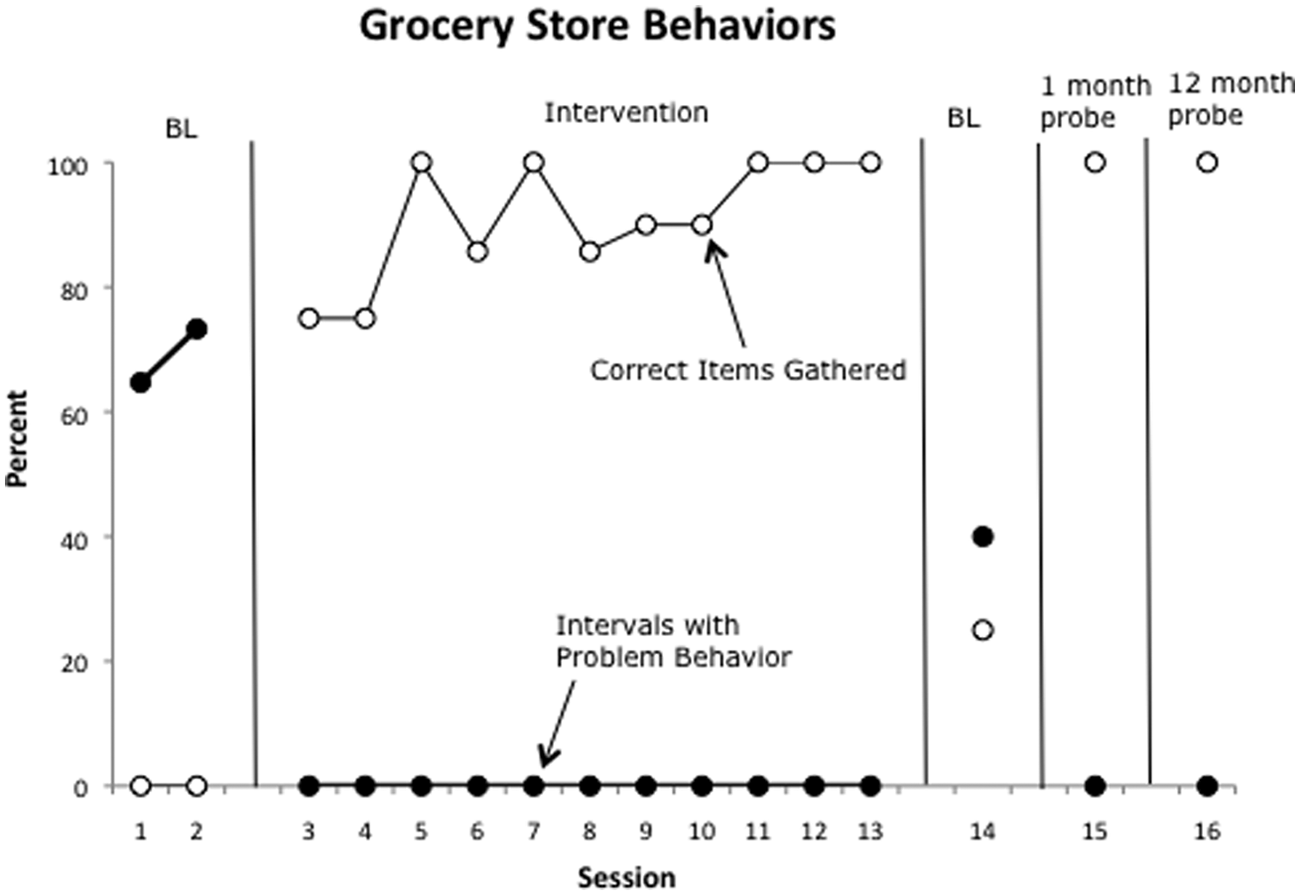
Percentage of intervals with problem behavior and percent correct of successful items gathered during baseline, treatment and maintenance.
Community interventions are often challenging for parents and practitioners to implement given the limited control over the environment and the high likelihood of fear and misunderstanding by community members. However, teaching in the natural environment is of utmost importance for full inclusion in the community. Hieneman and Dunlap (2000) explain the importance of conducting interventions in natural settings in terms of achieving broad and durable changes in a person’s lifestyle. This model of pre-teaching of appropriate community skills to replace or compete with disruptive problem behavior is a desirable initial alternative to attempting to teach while in the actual community setting (in situ teaching). Often times, interventions in the community must first focus on reducing disruptive problem behavior to maintain the safety of the learner or other community members. Therefore, an intervention such as this one may be preferred and more widely accepted by community members given its focus on teaching new behaviors as opposed to focusing on reducing inappropriate ones.
Teaching skills such as involvement in the shopping tasks enhances the independence of the participant but also competes with community problem behaviors given that initially higher levels of reinforcement presumably are unintentionally provided for inappropriate behavior. A person in the community that is not actively participating in the activity or task may be receiving low rates of reinforcement, thereby increasing any possible motivating operation (Michael, 1982) for problem behavior. However, if the person is pre-taught to engage in appropriate activities and tasks, the person will likely receive more reinforcement in community settings, making the outing more enjoyable for the individual and for the caregivers.
Contextual fit, defined as the correspondence between the intervention and the skills and resources available to those who implement it, has been shown to be a major variable in the successful outcome of a behavior support plan, especially when family members are involved (McLaughlin, Denney, Snyder, & Welsh, 2012). It can be concluded that there was a good contextual fit in this study given that the family participated in the collaboration of the intervention planning and valued independence for their daughter in activities of daily living, including shopping for her own food. Although the family did participate to an extent in the assessment and intervention planning phases, it may be that a key element in the contextual fit of this intervention was the buy-in that the family had prior to implementing this approach in the community as a result of the pre-teaching done at home. The family was able to try out the intervention in the privacy and comfort of their own home and watch as Jaycee learned to use the cards to collect groceries. Family members reported that the success in the home environment contributed to their confidence in the implementation of the intervention in the supermarket. It can be concluded that contextual fit for this family was in part achieved through the pre-teaching component of this intervention in that the family had an existing skill set with regard to implementing the intervention prior to bringing it into the community setting.
By using pre-teaching methods to first teach a skill set in the home and then establish that new skills set in the natural environment, children have the opportunity to learn the community setting expectations and how to complete them. The child can then go into the natural environment with a history of reinforcement for following such expectations. Pre-teaching in the home, or a controlled context, also allows for a reduced likelihood of problem behavior occurring in the natural environment, where the criteria for meeting the expectation may not yet be known by the child if pre-teaching had not occurred. Finally, pre-teaching of skills can increase the contextual fit for a family. Future research might continue to investigate the value of and variables involved in pre-teaching a skill in a controlled environment to improve the contextual fit for family members implementing community interventions.
Footnotes
Declaration of Conflicting Interests
The author(s) declared no potential conflicts of interest with respect to the research, authorship, and/or publication of this article.
Funding
The author(s) received no financial support for the research, authorship, and/or publication of this article.