







Abstract
Individuals with developmental disabilities sometimes lack functional skills such as asking for help. Sometimes these deficits can extend into the adult years. Although there is an abundance of research on teaching such skills to children, there is a dearth of such research involving adults. Three adult participants diagnosed with disabilities that impaired independent functioning were taught to request help when needed using an electronic activity schedule using a multiple-baseline across participants design conducted in the U.S. state of New York. Each participant was given two electronic activity schedules delivered via PowerPoint on an iPad tablet. The activity schedules were based on tasks that resulted in naturally occurring reinforcers for the participants. While participants independently navigated the activity schedules and completed steps in the activities, they did not request help during steps when materials were unavailable. The addition of interactive prompts to the activity schedules increased help requests from all participants. These prompts consisted of questions with interactive choices for answers that lead to prompts to ask for help as needed. Generalization of asking for help was shown across tasks for one participant, and within tasks for two participants. The implications for continued future research on using electronic activity schedules to present choices for greater independent functioning are discussed.
Keywords
A primary goal for the education and support of individuals with disabilities is to promote and foster independence in as many areas of life as possible. Independence may be defined as initiating and carrying out a task without assistance from another person (Reinecke, 2019). A further refinement can specify that not only can these actions be completed independently, but they usually are done independently. That is, it may not be enough to have demonstrated the ability to be independent, if one does not behave independently in their life. Unfortunately, research shows that many adults with disabilities remain dependent on others for a variety of needs (e.g., Billstedt et al., 2005; Roux et al., 2015). The impact of this dependence is seen in limited opportunities (Billstedt et al., 2005) and potentially minimized personal freedom, dignity, and achievement of personal goals (Reinecke, 2019).
Lack of independence in any given area may be due to a lack of motivation, a skill deficit, or a missing prompt (Reinecke, 2019). Preference assessments can be used to add reinforcing consequences to improve motivation. When a skill is missing, it can be taught, and that may lead to more independent performance. If, however, the skill is intact and motivation is present, but the needed independent behavior is still not happening, the issue may be missing prompts. Prompts are external, extra stimuli that lead to the occurrence of behavior (Cooper et al., 2020). Note that prompts are not naturally occurring cues for behavior, but rather stimuli that control behavior instead of the naturally occurring cues. Naturally occurring cues for making coffee might be feeling thirsty for coffee or having company over for a visit. A prompt for making coffee could be someone telling or asking you to make coffee. When making coffee, the naturally occurring cue for pouring water into the coffee pot is the empty coffee pot. Prompts for pouring water are someone telling you to pour the water, or a picture schedule that shows when to pour the water. Prompts are very useful for teaching new skills, but if they remain a necessary condition for the behavior to happen, prompt dependence may be a problem and independence may be limited. This is especially true if the prompts are delivered by other people (e.g., someone telling you to pour the water into the pot versus a visual cue that is always displayed near the coffee pot).
Requesting Help as a Behavioral Repertoire
Requesting help is a skill that may be missing in individuals who are prompt-dependent. In the absence of an independent repertoire for help-seeking behavior, the individual is dependent upon others to notice when they need help, which can be a source of difficulty. For example, someone who doesn’t know how to ask for help may engage in unsafe or inappropriate behavior to resolve problems or may prematurely give up on whatever task they need help with. This can result in problematic behavior such as verbal or physical aggression or task refusal, and a reluctance to try to do things independently.
Fortunately, requesting help is a skill that can be taught. There are several examples in the literature that show that children with disabilities can be taught to ask for help when needed. Bergstrom et al. (2012) taught three children with autism to ask for help from store employees when separated from parents. The authors created probes before and after training in environments where parents were “lost” (out of sight). The children were observed for safety and data collection through the study. Following intervention, which was a treatment package including rules, role-playing, and praise, all participants demonstrated the skill in untrained, natural environments during contrived situations.
Reichle et al. (2008) also used contrived situations to demonstrate that a 5-year-old boy with autism and severe language delay could be taught to conditionally ask for assistance with fine motor tasks like opening a jar or wrapper, and unfastening pants. Verbal prompts with time-delay were used to teach him to ask for help. He was also taught to complete the activities independently, under progressively more difficult conditions. For example, the jar would be loosened as a step toward independently opening the jar. Thus, he was able to open it on his own when it was loosened, and to ask for help when needed (the jar was tightened). The child continued to produce requests for assistance under the appropriate conditions after the intervention, but the newly acquired requests did not generalize across activities.
Talkington et al. (2013) taught a 5-year-old preschooler with developmental delays to request assistance during a daily routine and to request attention using a “Flip ‘n Talk” Augmentative and Alternative Communication (AAC) device using Boardmaker symbols. Prior to intervention, the child was unable to request help or attention independently. To teach these requests, the authors used least-to-most prompting using an AAC device. Not only did this child learn to ask for help and attention using AAC, but spoken language emerged and increased with this intervention.
Other researchers have taught adolescents with disabilities to request assistance. Chadsey-Rusch et al. (1993) used general-case instruction in which stimulus conditions were varied to teach three students with severe disabilities to spontaneously request help across situations such as opening food containers, opening doors, unfastening coats, overcoming barriers (e.g., stairs), and using the water fountain. In this study, not only did participants increase requests for help, but they also demonstrated generalized responding. Dotto-Fojut et al. (2011) demonstrated generalization of help-requesting skills across settings in their study with four adolescents with autism. These individuals were taught to approach an instructor in a simulated vocational setting, describe a work-related problem, and ask for help. The researchers found that participants learned the skills and generalized them in a different setting not associated with training.
These studies provide promising support for teaching help-seeking behavior as a discrete skill that may be generalized. This research has not yet expanded to include adults with disabilities, and the results are mixed in terms of generalization of skills. The goals of the current study were to demonstrate that adults with disabilities can be taught to ask for help, and to assess for generalization of help-seeking behavior within and across tasks. It is crucially important for adults to be able to ask for help when needed as they are often assumed to be competent in many areas and therefore may not be offered help. In addition, procedures used to teach adults to ask for help should be delivered in ways that are socially appropriate and acceptable to adults. This study was conducted to fill a gap in research on ways to support adults in learning the important repertoire of asking for help when needed.
Activity Schedules to Promote Independence
Research on teaching individuals to ask for help has used most-to-least prompting (Chadsey-Rusch et al., 1993; Reichle et al., 2008; Talkington et al., 2013); rules, role-playing, and praise (Bergstrom et al., 2012); and graduated guidance, scripts, and script fading (Dotto-Fojut et al., 2011). While these strategies are all effective, prior research also strongly supports the use of activity schedules to facilitate independence across a variety of areas for individuals with disabilities of different ages. An activity schedule is an arrangement of stimuli, typically pictures and words, indicating what activities should be completed and in what order. Activity schedules have been shown in several studies to produce independent, generalized responding, but there have not yet been demonstrations of using activity schedules to teach help-seeking behavior.
Early research demonstrated that children with autism could be taught to use photographic activity schedule books, resulting in increased on-task and on-schedule leisure skills (MacDuff et al., 1993). Photographic activity schedules helped children to independently engage in leisure activities, and to change between activities on their own (MacDuff et al., 1993). Krantz et al. (1993) expanded this research to show that parents could be taught to introduce activity schedules to their children with autism, increasing participation in family activities and reducing disruptive behavior.
Later demonstrations showed that activity schedules could be used for a variety of skills and in different settings, and even to promote social skills. For example, Betz et al. (2008) used activity schedules to increase peer engagement of preschoolers with autism. In this study, photographic schedules were used to prompt interactive play between children in dyads, and generalization of schedule-following to new games was shown in two of the three dyads who participated. Importantly, the activity schedules did not include programmed reinforcement, so it is assumed that the children enjoyed playing with each other and that the activity itself was reinforcing. In another demonstration, Brodhead et al. (2014) used linked activity schedules to teach children with autism to play hide-and-seek with each other.
Electronic Activity Schedules
Although activity schedules have been demonstrated to be effective at increasing independence, the traditional format of book-based photographic activity schedules could be cumbersome, difficult to use, and potentially stigmatizing (Carlile et al., 2013). With the advent of affordable, flexible, and intuitive consumer technology, however, activity schedules and other similar supports have become much more accessible and acceptable (Laskowski et al., 2018). There is evidence to suggest that electronic activity schedules are as effective as traditional activity schedules and may result in decreased problematic behavior and increased motivation (Goldsmith & LeBlanc, 2004). Cited benefits of technology-based instruction include consistency or systematic variation in presentation of materials, as well as increased acceptability as technology becomes more mainstream (Goldsmith & LeBlanc, 2004).
In a review of 15 studies that demonstrated the effectiveness of technology such as iPods, iPads, and iPhones in programs for individuals with developmental disabilities, Kagohara et al. (2013) noted that such devices could be used for a variety of purposes including as speech-generating devices for AAC, prompting, and video modeling. In addition, the studies reviewed showed that devices could be used to teach skills across different skill areas, such as academics, communication, employment, leisure, and transitioning between physical locations. Kagohara et al. (2013) also noted that individuals with significant challenges such as profound intellectual disability and/or multiple physical disabilities could learn to use technology effectively.
Further literature describes ways that technology can be used to deliver effective activity schedule interventions. In 2004, Rehfeldt and colleagues introduced the idea of using PowerPoint to deliver activity schedules, presenting a tutorial for creating such schedules and describing pros and cons of this method. They described varied ways to use PowerPoint to create and deliver activity schedules for both closed- and open-ended activities, and using a range of strategies including videos, still pictures, audio, and text. Cited benefits include ease of construction and effectiveness for a variety of skills and ages. Potential drawbacks that were noted when implementing an activity schedule via computer included difficulty with portability and availability (Rehfeldt et al., 2004), but the more recent introduction of hand-held consumer technology like smartphones and tablets has greatly reduced these limitations.
One such example is presented by Carlile et al. (2013), who taught children with autism aged 8 to 12 to increase on-task behavior in leisure activities using activity schedules on an iPod touch. The intervention was described as prompts, reinforcement, and instructor proximity to engage in activities and to use an activity schedule delivered on an iPod touch. All components of the intervention were faded over time. All participants had more on-task and more on-schedule behavior during intervention and as the intervention was faded. When given a choice, all participants chose the iPod over the traditional book format. The authors also found that community members rated the iPod touch as more similar to what would be used by same-age peers and more acceptable than book format, demonstrating further social validity for the intervention.
In another example of a tablet-delivered activity schedule, Brodhead et al. (2018) demonstrated that children with autism could be taught to use the tablet itself effectively. Prior to intervention, all participants only engaged with one app on the tablet. The researchers then added a schedule to the tablet to prompt timing of app engagement and switching between apps, but they found that participants still did not vary their engagement. After they were taught via prompting to use the schedule, all participants increased the variety of their play across apps. When the schedule was removed during a probe, children returned to engaging with only one app. When the schedule was reintroduced with novel apps, the participants again varied their engagement.
Research in technology-based activity schedules with adults is limited. Soldner and colleagues (2005) demonstrated increased engagement in leisure and other activities for an adult with an acquired brain injury, using a computer-delivered PowerPoint activity schedule. Similar to the research conducted by Carlile et al. (2013) and Brodhead et al. (2018), the activity schedule was available but not used by the participant during baseline conditions. After prompting was used to teach the participant to navigate the computer-based activity schedule, he continued to use the activity schedule independently and to engage in independent leisure activities during maintenance and generalization phases. In another study, a young adult diagnosed on the autism spectrum was taught to grocery shop independently using an activity schedule delivered via iPad (Burckley et al., 2015). The schedule included picture cues and video prompts and did increase independence in the skills associated with shopping. These skills were maintained when the schedule was withdrawn and generalized across novel items. More recently, Nepo and colleagues (2020) demonstrated that adults with disabilities learned to engage in independent iPad-based leisure activities such as puzzle and game apps, using activity schedules to promote engagement with and transition between leisure apps. For two of the six participants, the activity schedule was delivered on the same iPad that they were using for leisure apps, and for the remaining four participants, a paper schedule was used to avoid incompatibility between the schedule and the leisure apps.
Electronic activity schedules have many advantages and have been demonstrated to be both effective and preferred. Given the success of activity schedules for increasing independence in a variety of areas, it is reasonable to assume that this strategy may be useful for teaching help-seeking behavior. In addition, electronic versions of activity schedules allow for embedding choice-making opportunities, which can be used to promote assessment of needs during a task.
The current study expands the research on activity schedules to the skill set of asking for help, by using a schedule to teach adult individuals with disabilities to decide when they do and do not need help. Sabotaged steps, in which certain items were purposefully hidden from participants, were embedded in each activity schedule to make the step more difficult to complete without asking for help. The capability of the electronic activity schedule to embed interactive choices and branching instructions was used to develop a help-requesting repertoire that was based on the individual’s assessment of the need for help, further promoting generalization. Most of the research on activity schedules involves children and adolescents as the participants. The current study is unique in that it included adults with developmental disabilities, a population that has not received a great deal of attention in the applied behavior analysis literature in general and in the research on electronic activity schedules in particular (Chan et al., 2014; Spriggs et al., 2017). In addition, this study expands the use of activity schedules to include interactive prompts designed to teach participants to evaluate whether they need help and to ask for help if they do. The primary research question that the current study sought to answer was:
Method
Participants and Setting
Three adults who attended a Day Habilitation Program (Day Hab) in upstate New York participated in this study. Individuals were invited to participate because it was determined that they did not ask for help when needed. This determination was based on interviews with staff and family as well as direct observation of participants by the first author. None of the participants could read written words as per their records and the first author’s observations. The two targeted tasks for each participant were chosen based on the participant’s activity preferences, determined by interviewing the participants, staff, and family members. The goal was to choose two activities for each participant that resulted in preferred outcomes and natural reinforcers, so that participants would be motivated to engage in the research sessions.
Ellen was a 45-year-old White female who was diagnosed with impulse control disorder, epilepsy, and moderate intellectual disability. She had no prior experience using an iPad or tablet, and no prior experience with the two targeted tasks, making coffee (Task 1) and making a phone call (Task 2), although she enjoyed both drinking coffee and talking on the phone. Ellen had vocal verbal skills with a large vocabulary.
Roger was a 32-year-old Latino male who was diagnosed with intermittent explosive disorder and severe intellectual disability. He had prior limited experience using an iPod shuffle with staff assistance, but no prior experience using an iPad. He had no prior experience with the two targeted tasks, making iced tea (Task 1) and growing lentil sprouts (Task 2). Growing lentil sprouts involved adding water to a jar containing dried lentils and soaking them overnight. Roger had limited vocal verbal skills and could speak in one-to-three-word sentences prior to the study.
Scott was a 29-year-old White male who was diagnosed with autism and intellectual disability. Prior to this study he engaged in very little verbal/vocal or sign language communication. Scott had prior experience with using a tablet to play games. He had experience with the targeted task of wiping tables (Task 1), which was a preferred activity for him, but no prior experience with the other targeted task of making a sandwich (Task 2).
The baseline and intervention phases of the study took place the participants’ naturalistic settings of the Day Hab building: In a Day Hab break room (for Scott’s table wiping task), a Day Hab kitchen (for Ellen’s coffee task; Roger’s iced tea and lentil tasks; and Scott’s sandwich task), and the first author’s office (for Ellen’s phone call task).
Materials
Microsoft PowerPoint (PPT) software was used to create electronic activity schedules on still slides. Each activity schedule included the steps needed to complete the task, with a picture and text for each step of the task on a separate still slide. See Table 1 for the task analyses used to develop each activity schedule. The activity schedules were presented on the PPT app, downloaded to three iPads (Model A1566). Participants could navigate through the slides by swiping on them in presentation mode. OtterBox cases were used to protect the iPads during use. The iPads had other downloaded apps, but participants did not interact with or request to interact with these other apps. Other materials were used as needed for the tasks that were taught (e.g., coffee pot, measuring cup, telephone, lentils, peanut butter).
Task Analyses for Each Activity.
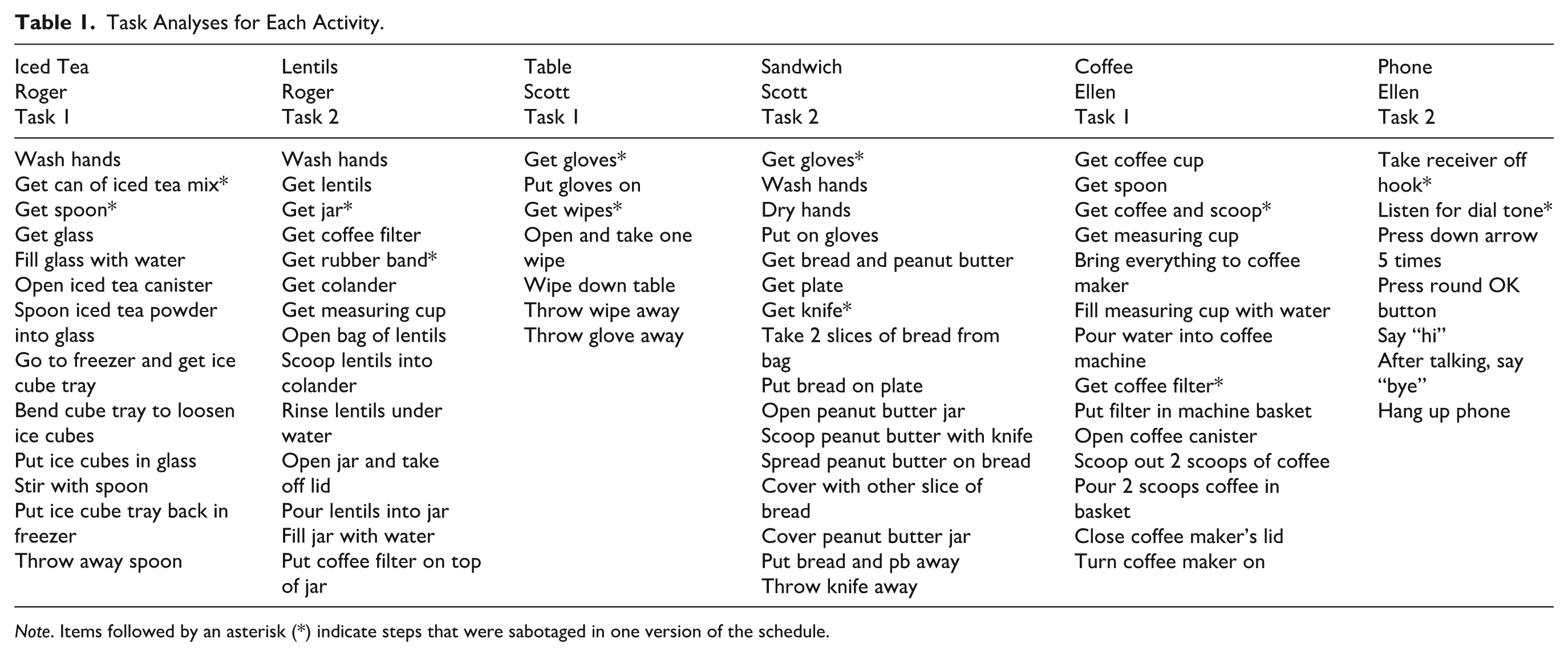
Note. Items followed by an asterisk (*) indicate steps that were sabotaged in one version of the schedule.
Dependent Variable
The dependent variable of asking for help was operationally defined as looking at the experimenter or saying the experimenter’s name, and then requesting assistance by either saying “help” or asking for an item by name. Requests for help were recorded as appropriate if there was a motivating condition for the requested items or assistance, for example, if the object was missing or the participant was unable to complete the step independently. Requests for help were recorded as inappropriate if there was no motivating condition, for example, if the requested item was present or if the participant was doing or had already done the step. Trained appropriate help requests were preceded by an interactive prompt, and untrained appropriate help requests were not preceded by an interactive prompt. Asking for help was recorded as independently occurring if it occurred within 5 s of the iPad picture prompt, or within 5 s of the natural cue for the response involving the need for help. A 5-s latency was chosen based on prior literature (Schoen, 1983; Shriver & Allen, 1997) and the researchers’ knowledge of the participants’ usual latency to respond to familiar antecedent stimuli.
Examples of asking for help were the participant vocally saying or signing the word “help,” saying “I need help,” or requesting the item by saying “Get me a spoon,” or “Where’s the spoon?” Nonexamples included commenting about the item missing, for example, “There’s no spoon.”
Independent Variable
The independent variable was the addition of interactive prompts to the activity schedule delivered via a Powerpoint slideshow on an iPad. These prompts consisted of slides with questions that also displayed answer choices to guide assessment of needed items, followed by a prompt to ask for help when needed. The prompt consisted of a slide on which text and pictures asked a question such as “Do I have a coffee filter?” A green circle was presented on the left of the picture of the item, and a red octagon was presented on the right of the picture of the item. Each symbol was hyperlinked to another slide in the PPT. Tapping on the green circle led to the slide depicting the next step in the task analysis to use that item, and tapping on the red octagon led to a slide saying, “Ask for help” with further instructions and a red icon for “help.”
Experimental Design
A concurrent multiple-baseline across participants design was used to evaluate the effect of adding interactive prompts to the iPad-delivered electronic activity schedule on the skill of asking for assistance when needed of three adult participants. The independent variable was introduced across two tasks for each participant as needed. Introduction of the independent variable to each participant occurred upon observation of steady-state responding in each participant’s baseline and evidence of behavior change for participants for whom intervention had been introduced. Steady-state responding was determined through visual analysis of the data. No participant engaged in the target behavior during baseline conditions, thus steady-state responding was clear for all participants’ baselines and evidence of behavior change was easily observed.
Measurement
Data were collected on the cumulative frequency of participants’ trained and untrained appropriate and inappropriate help requests. In addition, data were collected on the percentage of steps in the task analysis independently completed without experimenter prompting.
Randomly selected sessions across phases were video recorded and reviewed later by a second observer for interobserver agreement (IOA). Total count IOA for help requests was calculated by dividing the number of agreements by the number of agreements plus disagreements and multiplying by 100. Mean total count IOA for help requests was 93% across 15% of all sessions. Interobserver agreement was calculated for help requests for 19% of baseline sessions, 8% of intervention condition sessions, and 33% of fading sessions across participants. Opportunities to gather IOA were limited due to staffing and technology availability.
Procedures
iPad Training
Prior to baseline, verbal prompts, modeling, and praise were used to teach participants how to swipe on the iPad to advance the slides. Prior to introduction of the intervention phase, verbal prompts, modeling, and praise were used to teach participants how to tap the green circle for “Yes” and the red octagon for “No” on the question slides to advance to the next slide.
Activity Schedule
In all conditions, the PPT schedule containing images and text instructions associated with the steps of a task analysis for completing the targeted activity was presented along with a verbal instruction to engage in the activity. The required items for the activity were available in the setting where the activity schedule and instruction were presented, but one step during each activity schedule session was sabotaged such that an item that was needed to complete a step was missing. This provided a planned opportunity for the participant to ask for help. The non-sabotaged steps could pose a natural opportunity to ask for help if the participant had difficulty completing that step (e.g., Ellen sometimes had difficulty putting the coffee filter in the basket) or if an item was unintentionally misplaced. The activities that participants engaged in alternated across sessions.
There were two versions of presentation for each task analysis, with a specific step sabotaged in each version. For example, in the activity of making iced tea for Roger, a spoon was missing in one version, and the tea canister was missing in the other version. Different versions of the task analyses were presented in alternating fashion. The specific steps sabotaged for each schedule can be seen in Table 1. The versions of task analysis were alternated across sessions in which those activities were completed, so that participants were exposed to both opportunities to ask for help across every two sessions.
At the start of each session, the iPad with the open PPT schedule was presented to the participant with the verbal instruction, “Time to (engage in task).” Participants navigated the schedule by swiping on each slide as they completed the task shown on the slide. Least-to-most (verbal to gestural to physical) prompting was provided if a participant did not initiate a correct response within 5 s or did not advance the slide as needed within 5 s. Natural verbal praise was embedded throughout the activity for correct task completion as well as for navigation of the schedule. For activities that resulted in an immediate product (e.g., iced tea, coffee, a sandwich), participants were able to consume the item at the end of the activity. No other programmed reinforcement was provided.
Baseline Condition
In the baseline condition, the Powerpoint schedule containing images and text instructions associated with the steps of a task analysis for completing the targeted activity was presented as described above. During baseline, there were no prompts to ask for help. If a participant did not ask for help during a sabotaged step or another step in which they had difficulty, the experimenter waited 5 s and then provided the necessary item or other form of help. If a participant had asked for help at any time, the researcher would have provided the missing items or other form of help. No help requests occurred during baseline, however.
Intervention Condition
All procedures remained the same in the intervention condition, except that interactive prompts to ask for help were embedded in the Powerpoint schedule. These prompts were added at two points of each schedule, just before the planned sabotaged steps. As described previously, the prompts consisted of slides containing the question “Do you have (item)?” with a green circle to symbolize “yes” and a red octagon to symbolize “no.” These symbols were hyperlinked to later slides in the schedule. Tapping on the green circle led to the next step in the schedule and tapping on the red octagon led to a slide prompting asking for help with words and an icon. As two different steps were sabotaged in two different versions of each task analysis, one of these prompts would be correctly answered “yes” and one would correctly be answered “no” in every version. Thus, participants were required to discriminate the correct answer to the question based on whether the item was indeed present.
If the participant did not choose the correct yes or no symbol on the interactive prompt slide within 5 s, the experimenter used least to most (verbal to gestural) prompting to support the correct response. If the participant did not ask for help upon receiving the prompt to do so within the schedule, the experimenter used verbal prompting to indicate the correct response. When the participant asked for help, with or without prompting, the experimenter provided the missing item or other needed help.
The interactive prompt condition was implemented for one of the activities (Task 1) for each participant, while the other activity (Task 2) continued under baseline conditions until stable responding was noted in both activities. If asking for help did not generalize to the activity that remained in baseline conditions, the intervention condition was eventually implemented for that activity as well. For example, for Roger, the intervention condition was introduced after a stable pattern of responding in baseline for making iced tea. Baseline conditions (i.e., no interactive prompts embedded in the activity schedule) continued for growing lentils. Asking for help did not generalize to growing lentils, so the intervention phase was implemented for growing lentils. For Ellen, after stable responding in baseline, the intervention condition for making coffee was introduced while the conditions for making a phone call remained as they were in baseline. Unlike Roger, Ellen did generalize asking for help during making a phone call and hence there was no need to introduce the interactive prompt condition for making a phone call.
Generalization and Maintenance
Generalization was assessed by recording all occurrences of requests for help, whether or not they were programmed by sabotaging a step, across baseline and intervention conditions. For example, if Ellen had difficulty with putting the coffee filter in and spontaneously asked for help, this was recorded as an appropriate untrained help request.
The iPad activity schedule was faded for Ellen by presenting a baseline version of the schedule for two maintenance sessions (no interactive prompts were contained in the schedule), and then no iPad at all for the last session. Time constraints prevented fading for Roger and Scott.
Results
The dependent variable assessed in this study was independent and appropriate requests for help, as influenced by an intervention to teach this specific skill. Cumulative number of appropriate requests for help during baseline and intervention conditions across two activities for each participant is presented in Figure 1. Cumulative requests were graphed rather than frequency per session due to the low potential for multiple responses in each session. As only one step was sabotaged in each session, participants could only be expected to ask for help once. The presentation of cumulative data allows for an analysis of trend by showing continued occurrence of behavior as an increasing trend, and nonoccurrence of behavior as a flat trend. In baseline, the participants did not request help during any of the sabotaged or non-sabotaged steps for either activity as indicated by the flat trend. When the interactive prompts intervention condition was introduced, in which there were questions and interactive choices of “Yes-No” responses leading to prompts during certain steps for an activity, all three participants asked for help during most or all of the sessions, as indicated by an increasing trend in the data path.
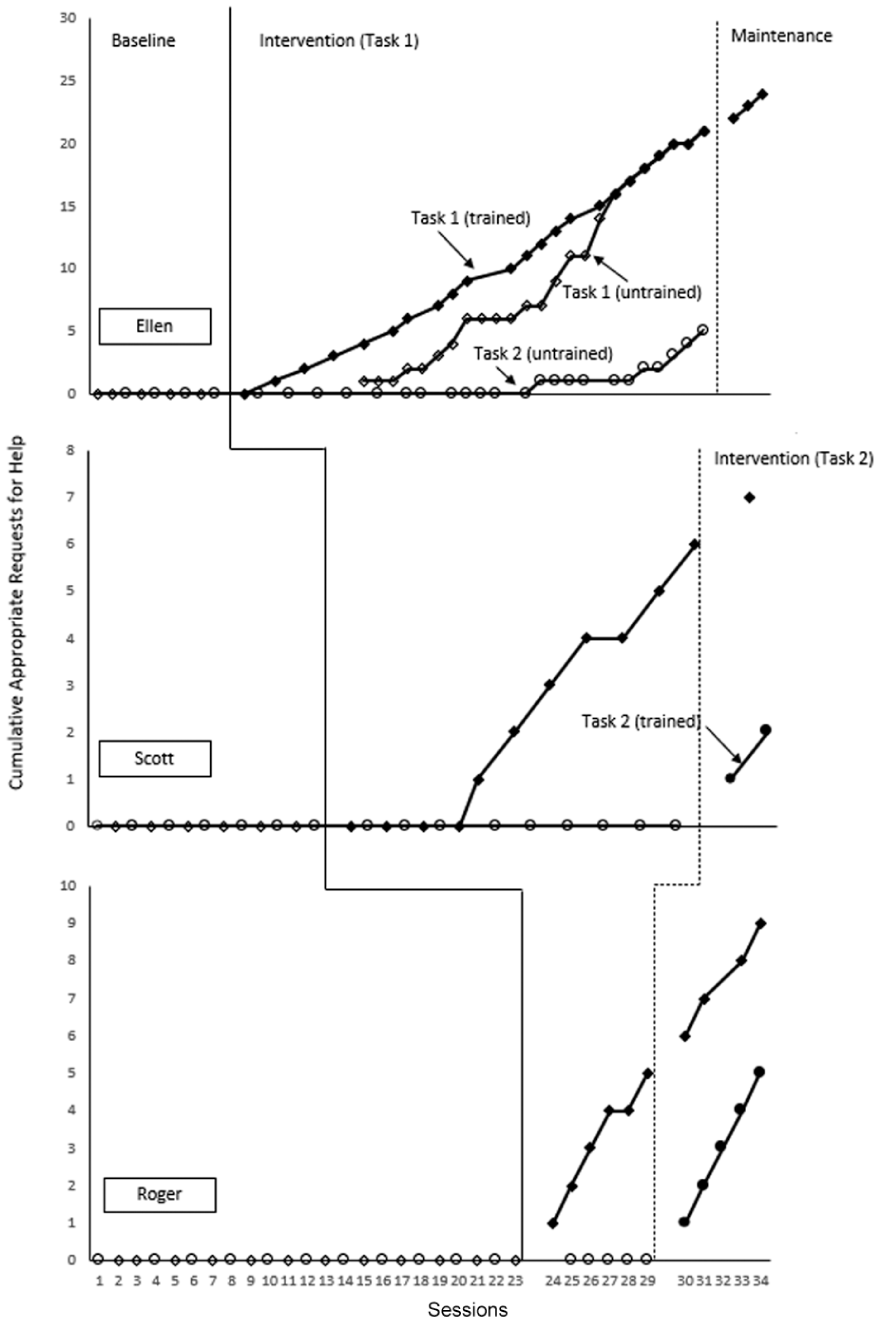
Cumulative Appropriate Requests for Help Across Baseline and Intervention Conditions.
Ellen did not ask for help during any sessions in baseline conditions for Task 1 (making coffee). During the second intervention session in which the interactive prompt was present in the iPad activity schedule for Task 1, Ellen asked for help during a sabotaged step and continued to ask for help during sabotaged steps when making coffee during subsequent sessions. On the fifth session of the intervention phase, Ellen appropriately asked for help during another step of making coffee that was not deliberately sabotaged, but in which she did need help. Requests for help that were not preceded by the interactive prompt are identified as “untrained” on Figure 1. On the 13th session of Task 2 (making a phone call) after the intervention for coffee was introduced, Ellen also made an untrained help request on a sabotaged step for making a phone call in the absence of the interactive prompt for this task. After seven more sessions, she again made an untrained help request when making a phone call, and then continued to ask for help during Task 2. Because asking for help generalized to Task 2, there was no need to introduce the interactive prompts intervention for making a phone call. Ellen asked for help when making coffee a total of 42 times (on 21 trained, sabotaged steps, and 21 untrained steps that were not sabotaged) over 22 sessions in the intervention condition. She also asked for help when making a phone call five times without any interactive prompts over 41 total sessions. All requests for help made by Ellen were considered appropriate; she made no requests for help that was not actually needed.
For the last three sessions of making coffee with Ellen, interactive prompts were removed, thus returning to baseline conditions for a maintenance phase. The iPad was completely absent in the very last session for Ellen. During the return to baseline sessions in which there were no interactive prompts, Ellen continued to ask for help appropriately twice during two sessions of making coffee. During the last session in which there was no iPad at all, Ellen asked for help appropriately once. Moreover, she was able to complete all but one step of the activity correctly and fluently. The only step incorrectly completed was the step involving inserting the coffee filter for which she needed help and appropriately asked for help.
Scott received the interactive prompts intervention for the activities of wiping the table (Task 1) and making a sandwich (Task 2). During baseline there were no requests for help during any session. When the interactive prompt condition was introduced to Scott for Task 1, Scott did not ask for help during the first three sessions of this intervention condition. Scott did appropriately ask for help during the third session of the interactive prompt condition for Task 1, by both signing “help” and vocalizing an approximation of the word “help.” Scott continued to appropriately ask for help during every intervention session of wiping the table except for one session. Scott asked for help seven times over 11 sessions in the intervention phase.
While the intervention condition was in progress for wiping the table, the baseline condition remained in effect for eight sessions for Task 2. Scott did not ask for help during any session in which he was making a sandwich under baseline conditions. It was only when the interactive prompts condition was introduced for Task 2 that Scott began appropriately asking for help when making a sandwich. Scott asked for help twice when making a sandwich over two sessions. Scott never asked for help when it wasn’t needed, nor did he ask for help when needed during non-sabotaged steps.
Roger did not request help for any of the steps for making iced tea (Task 1) or growing lentils (Task 2) in baseline. When the intervention condition was introduced in which there were interactive prompts during two steps for Task 1, Roger immediately asked for help during the sabotaged steps. Roger also made an untrained request for help in the interactive prompts condition for making Task 1 during one non-sabotaged step. Over 10 sessions in the interactive prompt condition for making iced tea, Roger made 10 total requests for help.
When the interactive prompts condition was introduced to Roger for Task 1, the baseline condition remained in place for Task 2. Roger did not ask for help during the baseline condition. When the interactive prompts were presented for steps during Task 2, Roger began to immediately ask for help for all remaining sessions during the sabotaged steps. In addition, Roger made untrained requests for help in two sessions when completing a non-sabotaged step for growing lentils. Roger made seven total requests for help over five sessions while growing lentils in the intervention condition. Roger never asked for help when it was not needed.
Although the percentage of steps completed independently (no prompting) was not the dependent variable under investigation, data were collected on participants’ independent completion of each step of the activity during the baseline and intervention phases. These results are depicted in Table 2.
Percentage of Task Analysis Steps Completed Independently.
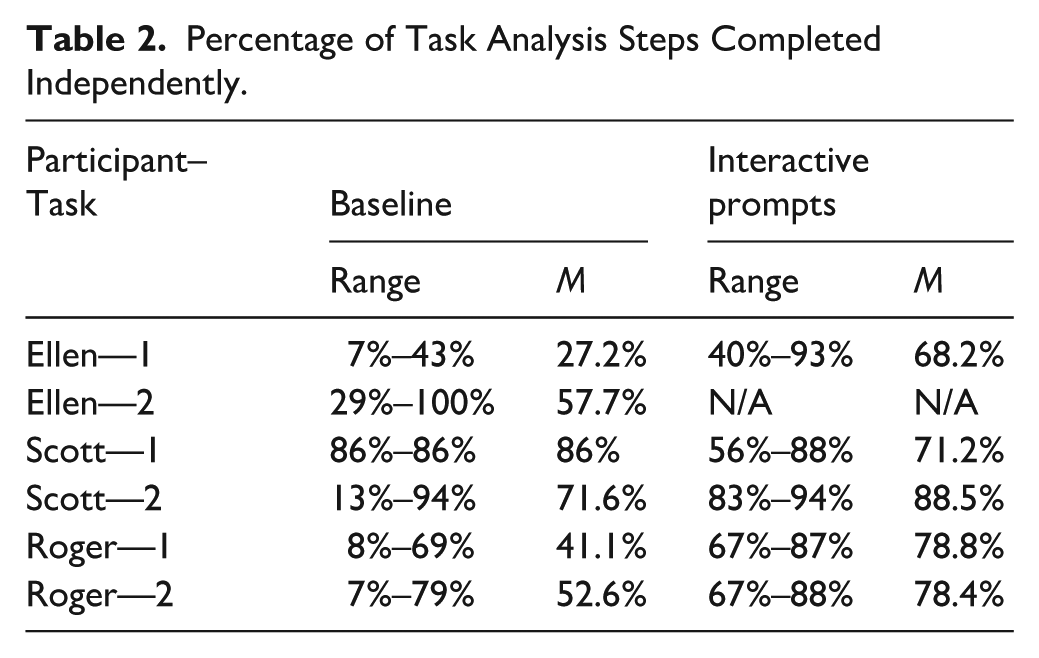
Ellen averaged 27.2% (range = 7%–43%) of steps completed independently when making coffee under baseline conditions. The percentage of steps completed independently when making coffee increased for Ellen in the intervention condition to a mean of 68.2% (range = 40%–93%). For phone calls, Ellen’s mean percentage of steps completed independently was 57.7% (range = 29%–100%).
Scott completed all 86% of steps correctly in each baseline session of wiping the table. In the interactive prompt condition, Scott engaged in an average of 71.2% of steps independently (range = 56%–88%) when wiping the table. Under baseline conditions for making a sandwich, Scott completed an average of 71.6% of steps independently (range = 13%–94%). In the interactive prompts condition for making a sandwich, Scott completed an average of 88.5% of steps independently (range = 83%–94%).
Roger averaged 41.1% of steps completed independently when making iced tea under baseline conditions (range = 8%–69%). He averaged 78.8% of steps completed independently when making iced tea under the interactive prompts condition (range = 67%–87%). When growing lentils under baseline conditions, Roger completed an average of 45.4% of steps independently (range = 7%–71%). When growing lentils under the interactive prompts condition, Roger completed an average of 78.4% of steps independently (range = 67%–88%).
Discussion
This study expands the research on using an electronic activity schedule to teach adults with disabilities to assess a situation and determine whether they need help within a meaningful, socially significant task of individual interest and then seek help appropriately. Prior to the study, none of the adults had the skill of asking for help in their behavioral repertoire. The results of this study showed that embedding interactive prompts into an electronic activity schedule led to adults with disabilities asking for help when needed. In addition, there were no instances of asking for help that was not needed. Data also showed evidence of generalization of asking for help in untrained steps and situations for two of the three subjects.
All participants learned to ask for help when needed during programmed opportunities and two participants generalized this skill to unprogrammed opportunities as well. Asking for help occurred during both tasks for which each participant was given a schedule. Ellen generalized asking for help from one task to the other without the addition of interactive prompts to the schedule, while Roger and Scott both required the interactive prompts to be added to the schedule for both activities to facilitate asking for help.
Ellen demonstrated many instances of generalization once the interactive prompts condition was introduced. Ellen began asking for help during steps in the activity schedule that did not include an interactive prompt but for which she did indeed need help. For instance, even though the step of inserting the coffee filter was not sabotaged and did not have an interactive prompt, Ellen often asked the experimenter for help during this step as she had difficulty inserting the coffee filter correctly. In addition, even though Ellen was not specifically taught to ask for assistance during any of the steps of making a call, and even though the intervention phase in which there were interactive prompts was never implemented for making a call, she nonetheless began to ask for help during the sabotaged steps.
Anecdotally, Ellen demonstrated other instances of behavioral variability during the study. Although the schedule never prompted gathering two cups, two spoons, and two packets of sweetener, she nonetheless began to do this, asking if the experimenter would like to have a cup of coffee also with her. It is likely that the activity began to be associated with powerful social reinforcement. The way she began to prepare coffee toward the end of the study had very close parallels to the way any person in the general community would prepare coffee for a guest or a friend. Although these anecdotal observations were not formally documented or tested in the current study, and therefore cannot be presented as evidence of response generalization or pivotal behavior, they speak to the social significance of the study: Ellen not only learned to make coffee and ask for help for the steps that were sabotaged or difficult, but she also used these new skills to socialize with others in a new way.
Limitations and Future Directions
There were several challenges with carrying out the current study in the natural setting of the individuals’ Day Hab program. Participants were not always available for sessions due to the Day Hab’s busy activity and outing schedule. There were times when individuals were absent from Day Hab and therefore not available on certain days. Participants were also always given the right to assent to participate in research, and sometimes did withdraw assent. A participant’s wish to not participate in a session was not viewed as noncompliance; rather it was viewed as the participant’s right to dissent (Morris et al., 2021). To improve motivation for participation, future researchers might consider pairing preferred outcomes with research activities early in the study for less response effort. For example, backward chaining could be used by having the first several steps of the activity schedule completed for the participant during the early part of baseline, such that they could quickly access the reinforcer for completing the last step rather than needing to complete the whole schedule. The chain of required behavior could gradually be lengthened over the course of baseline.
Another limitation is that although generalization was noted in the current study, generalization measures were not well-controlled or experimentally demonstrated. In fact, generalization opportunities within activities were largely due to the unintended sabotaging of steps that took place due to the natural environment. While not preferred from a standpoint of experimental control, this reality does highlight the applied and socially valid nature of this research. In future studies, researchers might deliberately sabotage more and varied steps, gradually building up the opportunities to measure generalization in a more systematic way.
Ability to collect sufficient IOA data was limited due to staffing and technology availability, presenting another limitation in the presentation of these results. Finally, there was no opportunity to collect data across settings or to thoroughly measure maintenance due to time constraints. Future studies should evaluate the effectiveness of using electronic activity schedules to teach adult individuals to ask for help in various settings such as the home and community.
Practical Implications
As discussed previously, requesting for help when needed may be a difficult skill for individuals with disabilities. While there are studies in the literature that indicate that asking for help is a skill that can be taught, there is a dearth of such research that includes adults with disabilities. In the current study, adults with developmental disabilities were taught to ask for help via the use of an electronic activity schedule containing embedded, interactive prompts that enabled them to decide whether help was needed and provided the guidance to ask for help if it was needed. Moreover, for two of the participants, the ability to ask for help generalized to steps of the activity schedule for which asking for help was not specifically trained. These findings have important practical implications for adult individuals with disabilities who attend adult day programs or who live in group homes. Learning to ask for help, or even learning a new skill via activity schedules with embedded prompts, could foster more independent skills in such settings, leading to less reliance on the limited number of staff available. Moreover, collateral changes in behavior such as reduction in aggression and task refusal have socially significant implications for more independent functioning. An increase in independent functioning can, in turn, help to maximize achievement of personal goals and possibly lead to a better quality of life in all settings.
Footnotes

Consent for Publication
The participants in this research study provided assent, and informed consent was provided on their behalf by their legal guardians.
Funding
The authors received no financial support for the research, authorship, and/or publication of this article.
Declaration of Conflicting Interests
The first author is employed by the research setting. No other conflicts of interest exist.
Research Involving Human Participants
The research described was approved by a University Institutional Review Board.