







Abstract
The current study was conducted to test how the presence of profane officer language during a use of force incident impacts how civilians perceive the reasonableness of the applied force. The study followed a 1 × 4 independent groups design with random assignment to one of four test conditions. Two dashcam use of force videos were stripped of audio and subsequently transcribed with a clean and profane-laden depiction of the officer’s language. Participants (n = 234) answered a short questionnaire after watching their randomly assigned video. Measures include a 5-item reasonableness index, demographics, and test conditions. Two-way ANOVA and OLS regression were performed. Overall, participants considered videos with profane language to be less reasonable than the same video with clean language. While significant, most differences also correspond with medium and large effect sizes. This research found that profane officer language impacts how civilians perceive force reasonableness. Practical and policy implications are presented to move policing forward.
Introduction
While it is unclear that Robert Peel actually wrote the nine principles of policing that have been attributed to him, the second principle states, “… the power of the police to fulfil their functions and duties is dependent on public approval of their existence, actions and behavior, and on their ability to secure and maintain public respect” (Lentz & Chaires, 2007, p.73). While global surveys conducted by Gallop in 2019 show that almost 70% of adults worldwide have confidence in their local police, recent polling suggests that Americans’ confidence in police is at an all-time low with just 48% of the public expressing a “great deal” or “quite a lot” of confidence in the police (Brenan, 2020; Ray, 2020). This is the first time in the almost three decades that Gallup has been tracking confidence in the police that approval of the police has dropped below 50% (Brenan, 2020). It appears that regular media coverage of high-profile police killings, such as Michael Brown, may have an impact on American confidence in the police (Kochel, 2019; Weitzer & Tuch, 2005).
Yet, even before the recent media focus on police shootings, American support for police use of force had been decreasing. In reviewing General Social Survey data from 1990 through 2018 on police use of force scenarios that are prima facie legally reasonable, Mourtgos and Adams (2020) found that the proportion of respondents indicating that the use of force in these scenarios was not acceptable had been increasing since the 1970s. For example, more than one-third of the respondents in 2018 said that there were not any situations where they could imagine approving of a police officer striking an adult male. This suggests there may be a mismatch between legally reasonable uses of force by police officers and public perceptions. In order to better understand what influences these public perceptions, this paper examines the impact that profanity has on people’s perceptions of police use of force.
Imagine watching a police officer arresting an individual who is resisting. During the struggle, the officer refers to the suspect as “sir” and tells him to “put his hands behind his back.” What if the officer called the suspect a “mother fucker” and told him to “put his fucking hands behind his back” instead? Could this impact how one assesses reasonableness for the officer’s use of force? Does the use of profanity influence perceptions of the reasonableness of force? The law does not consider this question, yet the academic literature suggests that profanity impacts a variety of perceptions, including the use of force (Baseheart & Cox, 1993; Patton et al., 2017). The current study seeks to add to the literature by suggesting that the use of profanity by a police officer impacts observers’ assessment of the reasonableness of the force. We begin by reviewing the literature regarding use of force by police, then turn to citizen perceptions of police use of force, followed by profanity and the use of profanity by law enforcement. We finally provide a theoretical framework for the current study.
Literature Review
Use of Force by the Police
It is widely acknowledged that the ability for police officers to use force is a defining characteristic of the profession (Bittner, 1970; Wittie, 2011). However, all force used by police officers must be reasonable. Reasonableness in the United States is shaped first by United States Supreme Court decisions (e.g., Graham v. Connor, 1989; Johnson v. Glick, 1973; Tennessee v. Garner, 1985). For example, Graham v. Conner (1989) held that that the force used by officers must be objectively reasonable judged from the perspective of a reasonable officer on the scene based upon the facts and circumstances known at the time. This is somewhat of a tautology (reasonable force is that used by an officer acting reasonably) but use of force expectations are further defined by state law and departmental policies (particularly use of force continuums, see Brandl, 2017; Terrill et al., 2011). It is important to note that while the legal guidelines consider the facts and circumstances of the use of force, the use of profanity by police officers is not one of the considerations. Force that is not reasonable is seen as excessive. There is a lack of agreement about the definition of excessive force, but the International Association of Chiefs of Police (IACP) defines force as excessive when the application of force is greater than that required to compel compliance from a suspect (IACP, 2001).
While estimates of how often police officers in the United States use force vary widely, ranging from .08% to 30% of encounters, the best use of force estimates suggest that police rarely use force against citizens with only about 1.7% of citizen encounters involving the use or threatened use of force (Hickman et al., 2008). Most of these uses of force involved officers grabbing or pushing suspects, and most people who reported force being used against them also indicated that they were not injured. However, some research has estimated that force used by the police exceeds that recommended by use of force continuums in 13–20% of use of force situations (Alpert et al., 2004; Terrill, 2005). These researchers also suggested that these deviations were minor and involved moving a single step up the continuum (e.g., officer using empty hand control instead giving a verbal command first).
Citizen Perceptions of Force
While there are legal definitions regarding the use of force, ultimately citizens on juries will determine whether an individual officer’s use of force is reasonable if a case goes to court. A variety of studies have examined participant perceptions of the use of force using hypothetical survey questions or vignettes. Researchers have found that race and gender affect perceptions of police use of force (as cited in Sandel, 2019). Women and members of minorities tend to view police use of force more negatively than men and whites (Thompson & Lee, 2004). Research also suggests that people who identify as liberal are less accepting of police force than those who identify as being moderate or conservative (Braga et al., 2014; Mourtgos & Adams, 2020). Researchers have also explored the connection between education and perceptions of use of force, but the results in this area are mixed (Braga et al., 2014; Silver & Pickett, 2015; Johnson & Kuhns, 2009).
Situational factors have also been found to impact perceptions of the use of force. For example, Perkins and Bourgeois (2006) found that perceptions of the misuse of deadly force increased as the number of shots fired by police officers increased using vignettes. Interestingly, they also found that as the number of officers involved in the shooting increased, citizen perceptions of misuse of deadly force decreased.
Other research has examined the perceptions of citizens who have had force used against them by the police. This area of research suggests that between 48% and 83% of people who experience the threat or actual use of force from police feel that the force used was excessive (Davis et al., 2018; Durose & Langan, 2007; Eith & Durose, 2011). Additionally, excessive use of force is among one of the most frequent citizen complaints received by police departments (Dugan & Breda, 1991; Hickman et al., 2000). While often not sustained following investigation, sustained complaints rarely result in charges against the officer(s) involved (Hassell & Archbold, 2010; Terrill & Ingram, 2016). Although some are made as a form of retaliation against police officers, the complaints give some indication of how citizens perceive police uses of force (Prenzler et al., 2010). Citizens who have force used against them appear to view the force that was used as excessive, and as noted above, the research of Mourtgos and Adams (2020) suggests that citizens are becoming less accepting of the use of force by police over time.
Profanity
Profanity is observed frequently in daily life and across a variety of settings, including work and professional settings (Generous et al., 2015a; Johnson, 2012). Although there is no agreed upon definition among scholars, profanity can be described as the use of taboo language that is intended to add emotional or suggestive meaning (Generous et al., 2015a). Researchers have shown that people generally perceive those who swear as uneducated, untrustworthy, and unsociable (Hamilton, 1989; Jay, 1999). Context and audience also affect how people perceive swearing. For example, researchers have found that most college students responded positively towards a professor who used profanity and only a few students were offended (Generous et al., 2015b). Other research has suggested that profanity is perceived negatively in formal settings (Johnson & Lewis, 2010; Selnow, 1985).
Law Enforcement and Profanity
Profanity appears to be common in law enforcement use of force encounters. Researchers examining citizen interactions with police officers found that, of those who reported experiencing the use or threat of force, about 39% of people indicated that officers cursed at them during the encounter (Eith & Durose, 2011). Those in favor of using profanity argue that it is sometimes necessary in order to gain control from uncooperative suspects or to establish authority in high-crime areas (Dolan & Johnson, 2017; Mather, 2015). Others argue that an officer’s use of profanity harms the credibility of the officer, makes the officer seem unprofessional, and can make the situation ultimately worse (Dolan & Johnson, 2017; Glennon, 2010; Klugiewicz, 2005; Marcou, 2014).
Substantial research, however, suggests that the use of profanity by police officers is viewed negatively. Several researchers have found that a police officer’s use of profanity and/or personal insults during traffic stops was strongly correlated with negative peceptions of the officers by those who were stopped (Johnson, 2004; Reisig & Chandek, 2001; Shelley et al., 2013; Skogan, 2005; Woodhull, 1995). In mock traffic stops, for example, Baseheart and Cox (1993) found that officers who used profanity were perceived as less friendly, less fair, and less just.
Surprisingly, only a single study has examined the impact of profanity on people’s perceptions of use of force. Patton et al. (2017) had both college students and community members make judgments about the excessivness of force used in fictious videos of police/suspect interactions that systematically varied the gender of the officer, the gender of the suspect, and the use of profanity by the police officer. Patton et al. found that profanity, the gender of the officer, and the gender of the suspect all impacted participants’ perceptions of use of force. Profanity had the largest impact on perceptions of the excessiveness of force with a moderate effect size (partial η2 = .10). This work is somewhat limited in that the researchers used ficticious videos. It is possible that these fictious videos had less, or a different, impact than videos of actual encounters would have. They also measured participant’s perceptions of excessiveness using a single dichotomous measure. The current study is designed to expand on the work of Patton et al. (2017) by using videos from actual use of force encounters and improving the measures of use of force reasonablness by including a five-item measure.
Procedural Justice and Officer Profanity
We believe that procedural justice (PJ) provides a useful theoretical framework to explain and predict the impact of officer swearing on perceptions of police use of force. PJ focuses on police citizen interactions and how those interactions shape perceptions of the police, willingness to comply, and actual crime rates (Community Oriented Policing Services [COPS], 2015). PJ consists of four principles: “treating people with dignity and respect, giving citizens a voice during encounters, being neutral in decision making, and conveying trustworthy motives” (Mazerolle et al., 2013b, p. 8). A variety of studies have supported these four principles as being key in shaping perceptions of the police (Donner et al., 2015; Mazerolle et al., 2013a; Murphy & Tyler, 2017).
Existing research has clearly demonstrated that profanity by police is seen negatively by both those who experience it and observe it (Cox & White, 1988; White et al., 1988). In the procedural justice framework, profanity is certainly seen as disrespectful, and may also convey that the officer was not neutral or trustworthy. As such, we predict:
Participants will rank an officer’s force as less reasonable when the officer uses profane language.
Methodology
Design
The study followed a 1x4 independent groups design with random assignment to one of four test conditions. Each participant watched one of two publicly available dashcam videos where an officer used force. One video depicted an officer responding to a domestic violence incident and encountering the alleged suspect outside of the home where the attack occurred. The other video depicted a traffic stop where the driver had an active arrest warrant. In both videos, the officer used physical force to subdue the alleged suspect. The officer in the domestic violence video physically strikes the citizen while the officer in the warrant video physically restrains the citizen without physically striking the citizen. These videos were chosen because the entire force encounter was present on the dashcam, and there were two different levels of force applied. This distinction is important when discussing the results of the experiment. In order to isolate the influence of the officer’s language on perceived reasonableness, the audio track was removed, and each video was subtitled with both clean and profane language (see Appendix A for transcripts of all four videos). We used two different dashcam videos to further parse out the effect of profanity on civilian perceptions of force reasonableness. Had we used a single video, it would be entirely possible that contextual aspects of the video could be driving how participants responded. Each participant was randomly assigned to one of the four videos. All analyses were conducted via Stata v16.1.
Sample
Sample Descriptive Statistics.
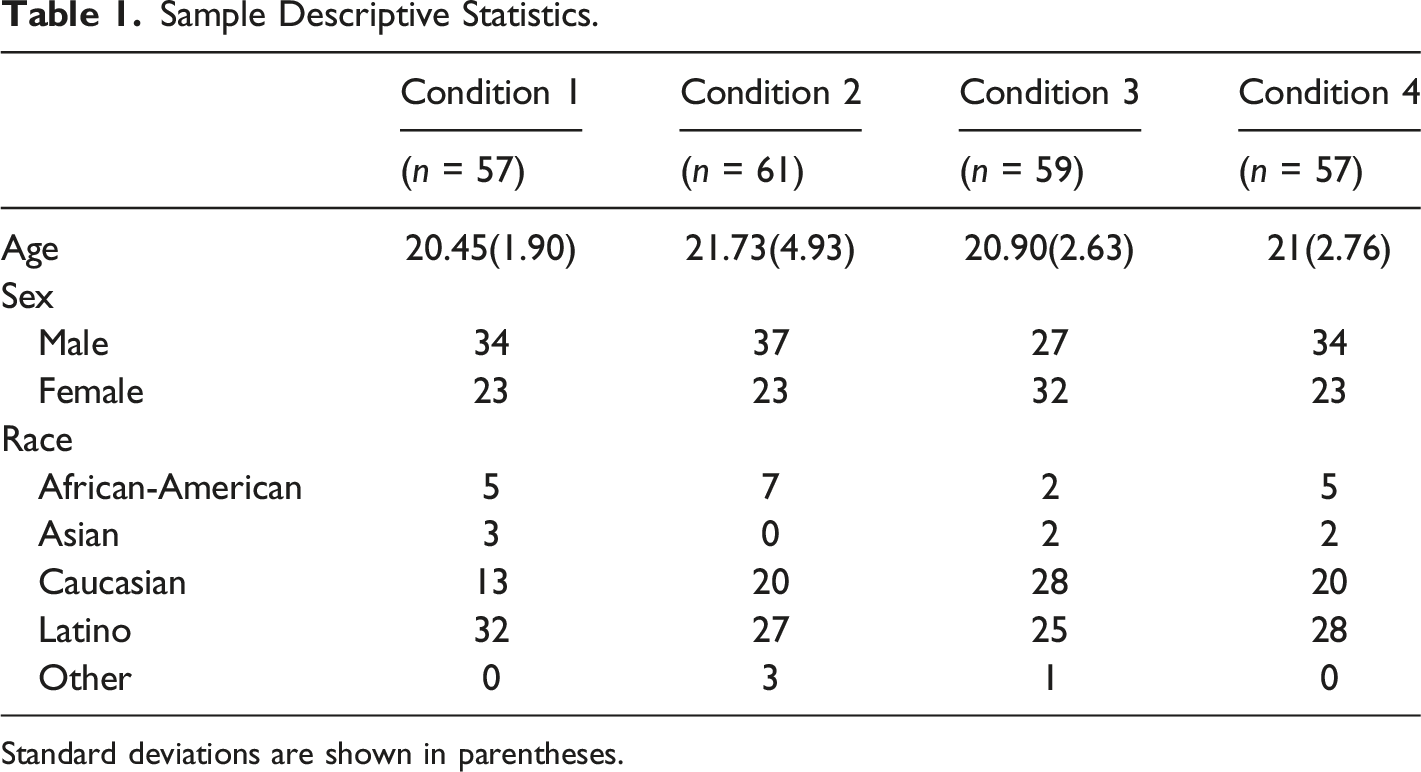
Standard deviations are shown in parentheses.
Procedure
Participants arrived at the study location and signed an IRB approved consent form prior to participation. Participants were then randomly assigned to one of the four conditions and shown to the corresponding computer station. The participants watched the corresponding video and answered a short questionnaire. Once they had completed the series of questions they were excused from the study.
Measures
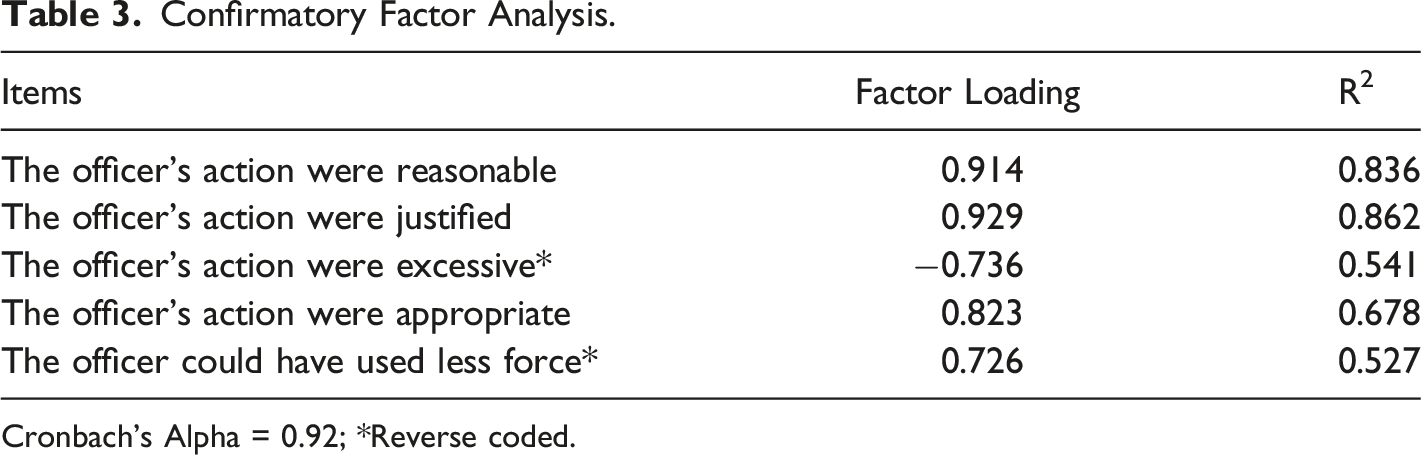
A five-item force reasonableness index derived from Sandel (2019) was used to measure participants’ perception of reasonableness for each use of force video; it is the dependent variable. Each of the items was measured on a five-point Likert scale (i.e., [1] Strongly Disagree to [5] Strongly Agree). The mean score for the five items was computed for each participant. A confirmatory factor analysis was conducted to test how well the individual scale items fit the reasonableness construct. All scale item loadings were within normal parameters (see Appendix B for index items and item loadings). A Shapiro-Wilk normality test indicated that the reasonableness index was normally distributed (W = 0.99, p = .18). The reasonableness index also displayed high reliability (Cronbach’s Alpha = 0.92).
Analysis plan
The primary variable of interest is derived from the force reasonableness index. We conducted a two-way ANOVA to test two main effects (presence of profanity and domestic violence/warrant video) and the interaction between type of video and the presence of profanity. These results are followed by an OLS regression that regresses participant demographics and the type of video watched (i.e., warrant or domestic violence) on the reasonableness index dependent variable.
Results
Levene’s Test for Homogeneity of Variance was not significant, so equal variances were assumed throughout. For the warrant video (see Figure 1), participants scored the video with officer profanity as less reasonabe (x̅ = 2.88, SD = 0.38) than the video without profanity (x̅ = 3.41, SD = 0.42). For the domestic violence video, participants again scored the video with officer profanity as less reasonable (x̅ = 2.91, SD = 0.44) than the video without profanity (x̅ = 3.07, SD = 0.51). It is important to note that the reasonableness in both videos when profanity was not present was above the midpoint of the reasonableness index. Effects plot.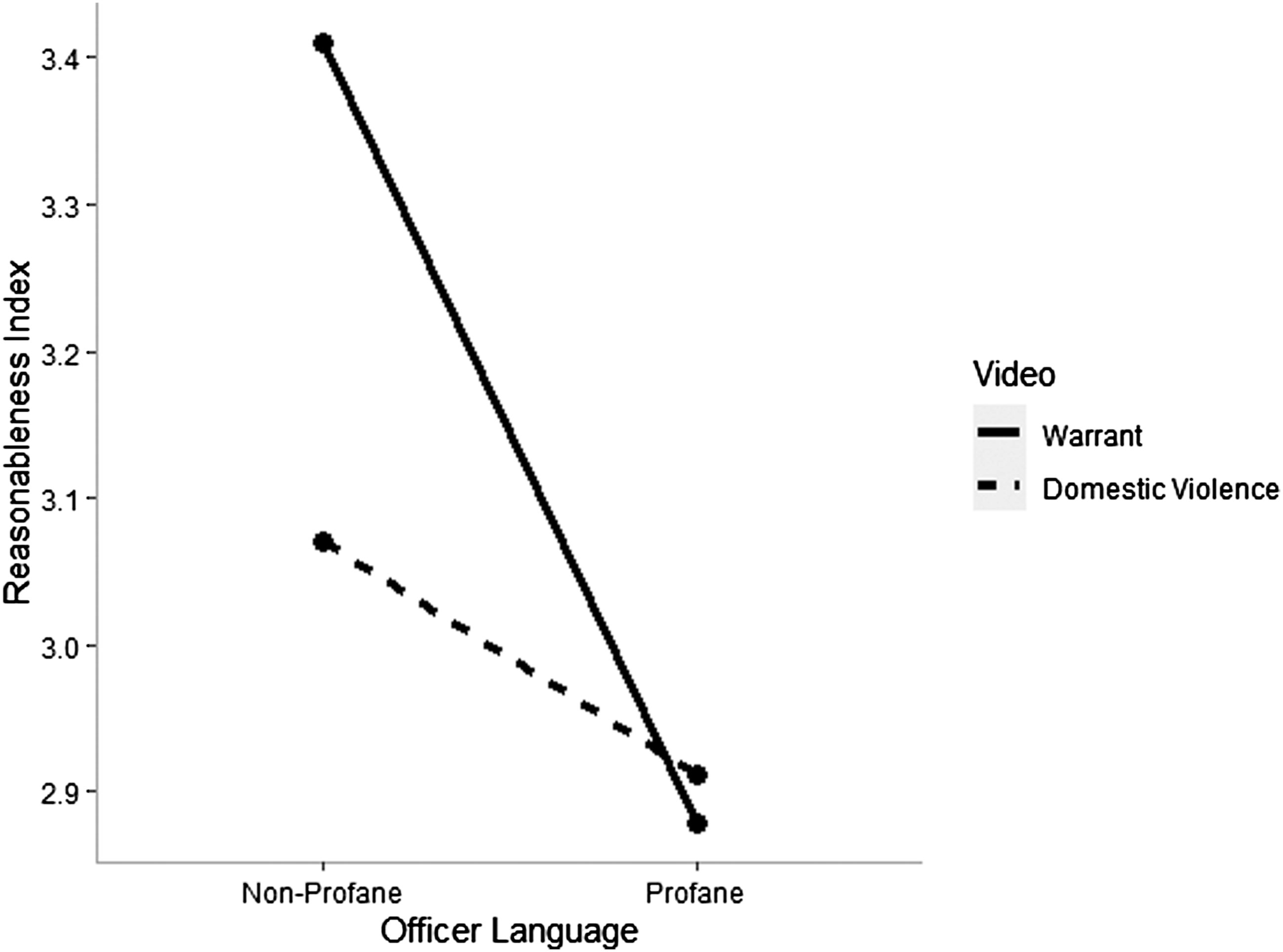
The dependent variable (perceived reasonableness of force) was subjected to a two-way ANOVA with two levels of profanity (profane, non-profane) and two levels for the video (warrant, domestic violence). The main effect for profanity was statistically significant (f(3, 230) = 36.22, p < .001) and indicated that participants viewed videos with profane language as less reasonable. This difference approached a large effect size (η2 = .13 [small = .01, medium = .06, large = .14]). A small, statistically significant main effect for video was found (f(3, 230) = 7.16, p < .01, η2 = .03), which illustrated that participants exposed to the domestic violence video perceived the force applied as less reasonable than the participants that viewed the warrant video. There was a statistically significant interaction term (profanity * type of video) that indicated participants exposed to both profane language and the domestic violence video reported significantly lower levels of perceived reasonableness than other conditions (f(3,230) = 10.64, p < .01). The effect size of the interaction term was also small (η2 = .04).
A Tukey HSD post-hoc analysis was conducted following the significant main effects. The videos absent profanity were found to be significantly different (difference = 0.34, p < .001). However, when profanity was introduced, there was no significant difference present between videos (difference = −0.03, p = .98). The importance of these differences is included in the discussion.
To further parse this out, we fit an OLS regression model to control for the presence of the domestic violence video and participant demographics. The force reasonableness index was again the dependent variable.
OLS Regression Predicting Reasonableness.
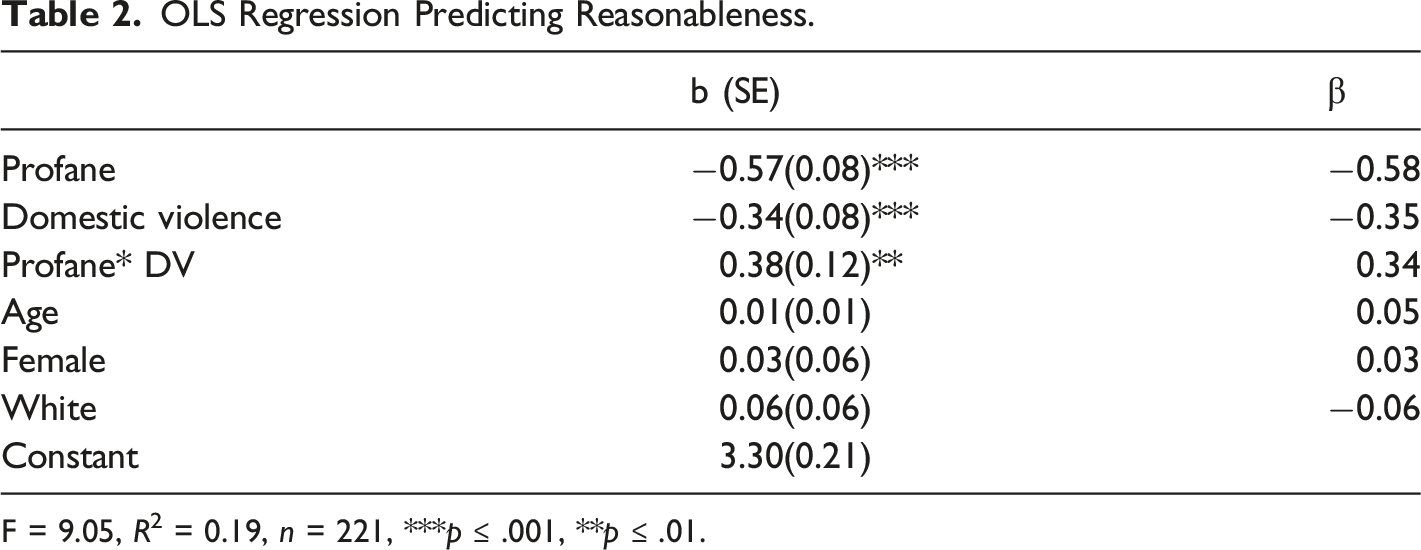
F = 9.05, R2 = 0.19, n = 221, ***p ≤ .001, **p ≤ .01.
The analyses presented here supported H1. Participants viewed an officer’s use of force as less reasonable when the officer used profane language.
Discussion
The results of this experiment show that an officer’s use of profane language can impact how their actions are perceived. Specifically, officer profanity resulted in civilians viewing use of force incidents as less reasonable than the exact same incidents without profanity being used. The effect of profanity on perceptions of reasonableness was in the moderate to large range (η2 = .13) This was true across two different dashcam videos. As a reminder, we removed the audio from both dashcam videos and replaced it with fictitious transcriptions (see Appendix A). Both videos had a profane and a non-profane version of the exact same situation. We used two different videos to ensure that the impact of profanity was not limited to a specific video.
While both videos showed that profane language resulted in lower scores on the reasonableness index, participants did not view both videos as equal (see Tukey HSD results). This is to be expected, in real-world situations there are different levels of force applied by law enforcement officers based upon the officer’s perception of the situation and the suspect’s response to the officer’s actions. Our videos featured different levels of force and the participants were clearly sensitive to these differences when profanity was not present. The domestic violence video, in which the officer kicked the suspect once and hit the suspect once, was rated as less reasonable than the warrant video which featured the officer using empty hand control to wrestle the suspect to the ground.
Interestingly, even though these videos were viewed differently when there was no profanity used by the officer, this difference disappeared when the officer used profane language. There was not a statistically significant difference in perceptions of reasonableness between the warrant and domestic violence video when profane language was present (see explanation of the Tukey HSD post-hoc analysis in Results). In the current study, profanity swamped the contextual differences between the two different dashcam videos. In both videos, force was seen as substantially less reasonable (crossing the midpoint of the index) when profanity was used.
This finding is consistent with procedural justice theory. Police officers are expected to treat people with dignity and respect. Profanity is seen as disrespectful, and this carries over into assessments of the reasonableness of force (Patton et al., 2017). In short, when officers behaved in a way that was not seen as procedurally just, their use-of-force was seen as less reasonable.
The OLS model (Table 2) was created to further illustrate the impact of profanity on both videos. When controlling for the demographic variables, presence of the domestic violence video, and the interaction term, we see that the presence of profane language still significantly changes the civilians’ perceptions of reasonableness. This is an important point because of the impact it can have on multiple fronts. These findings suggest that if an officer’s actions would have been considered reasonable by civilians, the use of profanity might change those perceptions to unreasonable. On the lower end of the spectrum, citizens may be more likely to file a complaint about police behavior due to the presence of profanity, police-citizen relationships and community policing strategies may be negatively impacted as well. On the higher end of the spectrum, this distinction could be the difference between a Guilty or Not Guilty verdict. Additionally, the presence of profanity may have an impact on sentencing. For example, if an officer’s use of force was determined to be unreasonable by a jury, and the officer was found guilty, the use of profane language during that encounter could potentially result in more prison time due to being viewed as less reasonable than the action without profane language present.
Policy Implications
The implications of our research, and that conducted by Patton et al. (2017) and others (Baseheart & Cox, 1993; Johnson, 2004; Reisig & Chandek, 2001; Shelley et al., 2013; Skogan, 2005; Woodhull, 1995), are clear. Police officers and police uses of force are viewed less favorably when the police use profanity. In a climate where general perceptions of the police are increasingly negative (Brenan, 2020), it seems that avoiding the use of profanity is a simple step that the police can take to improve public perceptions or at least not make them worse.
Police agencies should prohibit the use of profanity by their officers. Many police agencies already have these policies. For example, the Seattle Washington Police Department Manual states “[a]ny time employees represent the Department or identify themselves as police officers or Department employees, they will not use profanity directed as an insult or any language that is derogatory, contemptuous, or disrespectful toward any person” (Seattle Police Department Manual, 2021, 5.001§10). The fact that profanity is often considered a standard part of police work suggests that departments will also need to actively enforce these policies to create change (Mather, 2015; White, 2002). Departments should adopt an anti-profanity stance and could bolster this concept by targeting it directly in their training and supervisory relationships. Should officers deviate from an official department guideline on the issue, disciplinary and/or promotional considerations could be enforced, if appropriate.
A second policy implication deals with officer training. Given that research has found profane language to frequently be used in stressful situations (Rassin & Muris, 2005; Rothwell, 1971; Stephens & Umland, 2011) and encounters where someone is attempting to establish dominance (Selnow, 1985; White et al., 1994; Zimmerman & West, 1979), which are types of encounters common in policing, a broader training approach might be needed to prevent the use of profanity. While classroom-based training might be helpful, the combination of classroom and scenario-based training might be more effective. Such training would involve officers in stressful use of force scenarios where, in addition to their physical actions, the officer’s language is evaluated. The goal of verbal training would be to train officers to automatically revert to professional language regardless of stress level. This type of training would begin in the academy and be reinforced throughout the police officer’s career.
Limitations
We believe this study builds on previous work (Patton et al., 2017) by incorporating an improved reasonableness scale (Sandel, 2019) and using real dashcam footage. By removing the audio and transcribing fictitious conversation, the two extreme versions of language are isolated while exposing participants to the exact same footage. Each participant saw one version of the domestic violence video or one version of the warrant video. These videos differed in how much force was applied, and it appears that this level of force was mitigated by the presence of profanity. However, as with all research, this study was not without limitations. The videos were subtitled to allow for the same video to use both profane and clean language. This process isolated the language used by the officer, but it removed contextual features of the officer’s speech (e.g., tone, rate of speech). This resulted in an experimental design isolating the language condition relative to the actions in the dashcam footage (e.g., domestic violence vs. warrant video). Additionally, the participants were not exposed to how the “suspect” was speaking to the officer. It is possible that the relationship between an officer’s speech and that of the suspect could influence the way the participants perceived the officer’s use of force.
Another limitation involved the use of undergraduate students as study participants. As noted by Generous et al. (2015b), university students generally have a favourable view of profanity. Interestingly, even with a sample that has the propensity to have favourable views of profane language, we found that the officers’ profane language resulted in a significant reduction in how participants viewed the reasonableness of applied force. In other words, the isolated profanity was strong enough to sway participants who are not generally offended by profane language.
It should also be noted that this experiment tested extreme values of language. The profane videos contained a high volume of profane words while in the non-profane videos, profane words were completely absent. This was intentional to examine if there was an impact when the two extreme ends of the spectrum were tested. The frequency of profane language will be assessed in future iterations of this research.
Future Research
There are many angles to take in the future with this line of research. Research should focus on the types of language used by the officer. We kept the profane language consistent throughout the transcripts, but this can be varied to examine which words have the most impact. Presumably, some words will carry more weight than others. For instance, words derogatory towards females could have more of an impact if used against a female or with a female audience. Additionally, the frequency of profane words could have an impact on how participants perceive the officer’s use of force. Beyond adjusting the type of words and their frequency, future research should also examine the use of spoken language. Research has shown that the inclusion of audio can impact people’s perceptions of reasonableness in police use of force encounters (Reyes & Houston, 2019). Many videos released to the public or shown in court do contain audio. Future studies could replicate this study using audio instead of transcription. The suspect’s language is also part of the equation. More work is needed to understand how civilian language (both the “suspect” and bystanders) can impact how citizens view the officer’s use of force. Lastly, future studies should include measures to better understand if citizens believe if the officer should face punishment following the application of force. There are many new and exciting studies to come out of this line of inquiry. We believe this work is a good starting place to continue exploring the impact of officer language.
Domestic Violence
Introduction
The officer responded to a domestic violence call at a local residence. The wife, showing signs of incredible abuse, reported the husband left heavily intoxicated and told her he was going to get a gun to kill her.
Non-Profane Version
(0:18) Officer: This man is coming home. (0:24) ***Informs dispatch suspect returned*** (0:48) Officer: Sir, stop moving. (0:50) Officer: Sir, I said stop moving right now. (0:52) Officer: Get on the ground right now, sir. (0:56) Officer: I’m not going to tell you again, sir. Get on the ground. (1:00) Officer: Sir, stop moving and get on the ground. (1:04) Officer: Don’t reach towards that truck, sir. (1:08) Officer: Sir, I told you to get on the ground. (1:12) Officer: You didn’t listen to my commands. (1:17) Officer: Give me your hand, sir. (1:20) Officer: I said give me your hand, sir. (1:25) Officer: Sir, please stop resisting. You need to listen to me, sir.
Profane Version
(0:18) Officer: This stupid motherfucker is coming home. (0:24) ***Informs dispatch suspect returned*** (0:48) Officer: Stop moving, motherfucker. (0:50) Officer: I said stop fucking moving right now. (0:52) Officer: Get on the goddamn ground right now, motherfucker. (0:56) Officer: I’m not going to tell you again, dumbass. Get on the fucking ground. (1:00) Officer: Stop fucking moving and get your ass on the ground. (1:04) Officer: Don’t you fucking reach towards that truck, motherfucker. (1:08) Officer: You stupid motherfucker, I told you to get on the goddamn ground. (1:12) Officer: But your ignorant ass didn’t listen to my commands. (1:17) Officer: Fucking idiot…give me your hand. (1:20) Officer: I said give me your fucking hand. (1:25) Officer: Stop resisting. Fuck, your dumbass doesn’t listen.
Warrant
Introduction
The officer pulled the driver over for expired tags. While the officer was interviewing the driver, dispatch informed him that the driver had an open arrest warrant. The following incident ensued.
Non-Profane Version
(0:19) Officer: Ma’am, I need you to get out of this car, right now. (0:23) Officer: You have an open arrest warrant, ma’am. (0:28) Officer: I need you to get out of this car, ma’am. You can sort it out in the jail. (0:32) Officer: Ma’am, I said get out of the car, or I’m going to have to drag you out of the car. (0:40) Officer: You need to listen to me, ma’am. Get out of the car, right now. (0:46) Officer: Ma’am, I’m now going to have to take you out of this car. (0:51) Officer: Stop resisting, ma’am. (0:55) Officer: Stop resisting and get out of this car, ma’am. (0:59) Officer: Please stop resisting, ma’am. (1:04) Officer: Ma’am, get on the ground. (1:09) Officer: Stop fighting me, ma’am. Please put your hands behind your back. (1:15) Officer: Stop resisting, ma’am. You’re under arrest. (1:20) Officer: I said stop resisting. Please just listen to me and put your hands behind your back, ma’am.
Profane Version
(0:19) Officer: I need you to get out of this fucking car, right now. (0:23) Officer: You have an open arrest warrant. (0:28) Officer: So, get the fuck out of this car. You can sort it out in the jail. (0:32) Officer: I said get the fuck out of the car, or I’m going to have to drag you out of the car. (0:40) Officer: You need to fucking listen to me. Get the fuck out of this fucking car, right now. (0:46) Officer: Fuck it, I’m taking your dumbass out of this car. (0:51) Officer: Stop fucking resisting, motherfucker. (0:55) Officer: Stop resisting and get the fuck out of this goddamn car. (0:59) Officer: Stop fucking resisting. (1:04) Officer: Get on the fucking ground, motherfucker. (1:09) Officer: Stop fighting me, motherfucker. Put your hands behind your damn back. (1:15) Officer: Stop resisting, motherfucker. You’re under arrest. (1:20) Officer: I said stop fucking resisting. Fuck, just listen to me and put your hands behind your goddamn back, motherfucker.
Footnotes
Appendix B: Confirmatory Factor Analysis ( n = 234).
Confirmatory Factor Analysis.
| Items | Factor Loading | R2 |
|---|---|---|
| The officer’s action were reasonable | 0.914 | 0.836 |
| The officer’s action were justified | 0.929 | 0.862 |
| The officer’s action were excessive* | −0.736 | 0.541 |
| The officer’s action were appropriate | 0.823 | 0.678 |
| The officer could have used less force* | 0.726 | 0.527 |
Cronbach’s Alpha = 0.92; *Reverse coded.
Acknowledgments
We would like to thank Major Mark Sawa for his work on bringing light to this important topic and providing us with the dashcam footage used in the domestic violence video.
Declaration of Conflicting Interests
The author(s) declared no potential conflicts of interest with respect to the research, authorship, and/or publication of this article.
Funding
The authors disclose receipt of partial financial support for the execution of this project: U.S. DOJ—Office of Community Oriented Policing Services (COPS Office) Award # 2019ASWXK001
Data Availability
Please contact the corresponding author with a reasonable request.
