







Abstract
Some proponents of the “war on cops” thesis have suggested that the Black Lives Matter (BLM) movement encourages people to murder police officers and is responsible for many civilian-on-police homicides. To evaluate such claims, this study examines all homicides of on-duty police officers by civilians from 2008 to 2021 (n = 595) for ideological motives, and uses interrupted times series analysis to test for post-Ferguson trends. Ideological motivations were present in 12% of civilian-on-police homicides, and only 3% constituted terrorism. Right-wing motivations were far more common (6%) than left-wing motives (3%). Most analyses showed no significant increase in ideological civilian-on-police homicides after Ferguson. Although homicides with left-wing motives unconnected to personal revenge significantly increased after Ferguson, this only accounts for a small proportion of post-Ferguson homicides (4%). In short, there is no evidence that BLM unleashed a “war on cops” in which officers are increasingly targeted in ideological homicides.
Introduction
The murder of police officers by civilians has become a highly politicized issue in recent years. Indeed, opponents have labeled Black Lives Matter (BLM) activists as “domestic terrorists” and accused them of encouraging supporters to murder officers (National Association of Police Officers, 2016; Foley, 2020). Even an internal FBI report (2016) leaked to the public suggested that several of the civilian-on-police homicides in 2016 were influenced by unfair criticisms of police on social media. 1 A majority of the public, and most police as well, believe there is a “war on cops,” and civilian-on-police homicides are often presented as illustrating this “war” (Mac Donald, 2017; Moule, 2020; Nix et al., 2018; Rasmussen, 2015).
It is important for researchers to evaluate these claims. Previous studies have examined, and failed to support, the “war on cops” narrative by analyzing temporal trends in civilian-on-police homicides and nonfatal assaults as well (Maguire et al., 2017; Shjarback & Maguire, 2021; White, 2020). Yet these studies have not determined the extent to which civilian-on-police homicides are motivated by ideology, and whether this has changed over time.
To fill this gap in the literature, this study examines all civilian-on-police homicides from 2008 to 2021 for ideological motivations, and uses two forms of interrupted time series analysis, among other statistical tests, to evaluate whether ideological civilian-on-police homicides have increased since the emergence of the BLM as a national movement. The results shed light on the debate about the impact of BLM on civilian-on-police homicides, and indicate the need for further research on the role of ideology and mental illness in civilian-on-police homicides and in homicide more generally.
The Politicization of Civilian-On-Police Homicides
Since the politicization of civilian-on-police homicides is major motivator of this study, I begin by reviewing the ways these murders have been portrayed by the media, politicians, and police organizations. BLM arose as a national movement in August 2014 in reaction to the killing of Michael Brown by a Ferguson police officer. The movement was founded in 2013 but gained national prominence after widespread protests in Ferguson. Subsequent civilian-on-police homicides were often used as political ammunition against the movement. When Ismaaiyl Brinsley murdered two New York Police Department (NYPD) officers in revenge for police killings, many blamed protesters and their supporters. For example, a NYPD police union said, “There’s blood on many hands,” including those of Mayor De Blasio (Altman, 2014), and former NYC mayor Rudy Giuliani told Fox News, “We’ve had 4 months of propaganda, starting with the president…that everybody should hate the police” (Lee, 2014).
After Micah Xavier Johnson killed five officers at a Dallas BLM protest in 2016, the National Association of Police Officers (NAPO) claimed that “persistent and nationwide calls for the killing of officers, coupled with the deafening silence of America’s elected and appointed officials, has led to another cowardly assassination of five of our finest” (2016). NAPO bewailed the “war on cops,” and blamed President Obama for “foster [ing] the climate that made this war possible” (NAPO, 2016). Gavin Long’s murder of three officers shortly afterward in Baton Rouge prompted an officer who survived the attack to file a lawsuit against BLM claiming it incited the homicide.
Perhaps more surprising is the fact that individual civilian-on-police homicides have been widely portrayed as illustrating a “war on cops,” or as resulting from a BLM-fomented “hatred” of police, despite the lack of any proven or established ideological motivation for the murders. For example, in the wake of the killing of Houston officer Darren Goforth in 2015, many explicitly blamed the movement and its supporters in the absence of any evidence. Senator Ted Cruz said at the time that President Obama had been “vilify [ing] law enforcement,” thus “endangering the safety and security of us all,” and said, “Cops across this country are feeling the assault,” including “from the president” (Weigel & Zezima, 2015). A Fox News pundit even claimed that BLM’s “agenda is it’s OK to go ahead and kill cops” (Lussenhop, 2015).
Those who claim that the movement encourages anti-police violence tend to rely on misleading anecdotes, such as the chanting of “Oink, bang!” or “What do we want? Dead cops! When do we want it? Now!” and “Pigs in a blanket, fry ‘em like bacon!” by a few protesters. While videos of such chants can be found online, they are exceedingly rare, and employed by only a handful of protesters. In 2020, President Trump tweeted that “Black Lives Matter” should not be written on Fifth Avenue in Manhattan because “Pigs in a blanket, fry ‘em like bacon” is “their chant.” In reality, that chant had not been documented at a BLM protest since 2015 in Minnesota (Dale, 2020). Moreover, fact-checkers debunked false stories that such chants immediately preceded civilian-on-police homicides in the same location (Lacapria, 2016). In reality, they have not been tied to any particular killing. Perhaps ill-informed reactions to civilian-on-police homicides are commonplace because, as journalists have observed, these killings “prove so unsettling they cast statistics to the wind” and “destabilize our sense of order,” since the public feels that “to attack police is to assault a community” (Armstrong & Martin, 2010: 124).
More importantly, none of the manifestos and policy statements of the major BLM organizations advocate violence against the police. The “Blue Lives Matter” campaign, and BLM critics more generally, have been analyzed as exemplifying “cop fragility,” or a hypersensitivity to criticism in which police portray themselves as the real victims and mischaracterize the movement as pro-violence or animated by “hatred,” rather than addressing the movement’s substantive claims (Cooper, 2020).
Some within the FBI apparently believe that BLM is fostering anti-police violence, as shown in an internal document released to the public. The document, “Assailant Study—Mindsets and Behaviors (2016),” is an analysis of all 2016 civilian-on-police homicides, which was compiled based on interviews with police in affected departments. This report has been cited by police safety researchers (Peace Officer Safety Institute, 2020) and some academics (e.g., Cortright et al., 2020), and has been widely disseminated by critics of BLM, since aside from its discussions of civilian-on-police homicides, it also discusses post-Ferguson de-policing. However, the report does not necessarily represent the views of the FBI as a whole, since it was produced by a police-outreach unit within the FBI (the Office of Partner Engagement) for internal use only. The report is also methodologically weak, relying largely on the subjective impressions of officers they interviewed and lacking even basic descriptive statistics.
The report purportedly found that 28% of 2016 civilians who killed police officers “expressed a desire to kill law enforcement officers prior to carrying out their attacks,” and without specifying how many, said that some of these offenders were motivated by “social and/or political reasons or they had a hatred of law enforcement” (Federal Bureau of Investigation, 2016: 2). The FBI report saw these attacks as encouraged by “a singular narrative by news organizations and social media of police misconduct and wrong-doing,” since without exposure to an “alternative narrative” from the police perspective, “assailants developed a distrust of law enforcement, and felt emboldened and justified in using violence against police” (2016: 3). While the report’s phrasing is imprecise, the FBI report seemed to suggest that several 2016 civilian-on-police homicides could be attributed to BLM-related messages about police misconduct. This is similar to how critics of BLM have blamed increases in civilian-on-police homicides on the “demonization of the police” (Mac Donald, 2022). This article’s methodology is designed to evaluate such claims. That is, how many offenders kill police for ideological reasons, and has this changed since the rise of BLM?
Police Officers Murdered by Civilians: Previous Research
While there has been considerable research on civilian-on-police homicide, little of this research examines ideological motives. One early exception was a study by Margarita (1980), which categorized 13% of New York City civilian-on-police homicides from 1844 to 1978 as motivated by “contempt” for police. Even so, the nature of this contempt was left unexamined. More recently, Stone (2015) analyzed each line-of-duty homicide in 2013 and 2014, noting that some perpetrators were motivated by a hatred of police or by far-right ideology. In addition, Lankford (2021) documented multiple similarities in the backgrounds of two ideologically-motivated civilians who killed police officers. Carson et al. (2019) examined the radicalization of a father-son pair whose killing of police was motivated by anti-government ideology. Schouten and Brennan’s (2016) analysis of attacks targeting officers includes a case study of an ideological homicide by Christopher Montfort.
Gruenewald et al. (2016) analyzed police killings by US far-right extremists between 1990 and 2014, classifying each attack into one of four storylines, from avoiding arrest to ideological “missions.” Another study compared civilian-on-police homicides by right-wing extremists to all civilian-on-police homicides, identifying several similarities and differences (Suttmoeller et al., 2013). Without releasing its findings in detail, The Anti-Defamation League (ADL) (2022) reports that between 2001 and 2018, left-wing extremists killed 10 officers, while right-wing extremists killed 36.
Maguire et al. (2017) found there was no increase in civilian-on-police homicides after Ferguson, though their study ended in March 2016, four months before a spike in civilian-on-police homicides in July 2016. Even including this latter period, Bejan et al. (2018) found no quantitative evidence minorities killed officers in retaliation for police shootings in 2015 and 2016, though increased tweets about BLM predicted civilian-on-police homicides. White et al. (2019), using time series analysis to compare pre- and post-Ferguson civilian-on-police homicides, actually found a significant decline in civilian-on-police homicides after Ferguson. Like most research in this area, these studies do not distinguish between ideological and non-ideological civilian-on-police homicides.
White’s (2020) study of ambush attacks on police between 1970 and 2018 found no statistically significant increase in ambushes after Ferguson, though 2016 and 2018 had the highest rate of ambushes in 20 years. As White (2020: 3) notes, “The ‘war on cops’ thesis implies a very specific motivation for an ambush: hatred of police and/or desire to seek vengeance in response to police killings of citizens.” Focusing on ideologically-motivated civilian-on-police homicides, as does this article, is the logical next step in evaluating the “war on cops” thesis. White (2020: 3) argues that is important to study ambushes because these attacks “are shocking to the conscience,” “carry a symbolic weight,” “threatens a community’s conception of law and order,” and could “dramatically alter police attitudes and behavior.” These are all true of ideologically-motivated civilian-on-police homicides as well. Studying these homicides also allows us to directly evaluate the notion of an ideologically-driven “war on cops,” rather than relying on indirect measures.
Some studies found fewer civilian-on-police homicides in cities with Black mayors (Jacobs & Carmichael, 2002; Kent, 2010). Another study found that police homicides of civilians increased the overall murder rate, for all races before Ferguson, and only for African-Americans after Ferguson (Vandegrift & Connor, 2020). Boylen and Little (1990: 62) argue that officers are often murdered because they are “symbolic of a cruel and oppressive society” by the “economically dispossessed.” These studies suggest that ideology may influence even seemingly run-of-the-mill civilian-on-police homicides, which may be detected through case-by-case analysis.
Contradicting the “war on cops” thesis, studies of long-term trends have shown that civilian-on-police homicides have decreased sharply since the 1970s (Batton & Wilson, 2006; White et al., 2019). This drop was caused by a variety of factors, including the increased use of body armor (White et al., 2019). According to one analysis, the homicide rate for police officers was actually lower than the national US rate in the decade before 2016 (Olson, 2017). Even so, police worldwide are often targeted by terrorists because they are an accessible symbol of the state, and due to police-related grievances (Gibbs, 2018). Gibbs (2018) found that 14% of all terrorist attacks worldwide since 1970 were directed against police. Yet there has been little research on such attacks, and no previous research has evaluated a large sample of civilian-on-police homicides to evaluate offenders for terrorist intent or other ideological motives.
Data and Methodology
To examine the prevalence of ideological civilian-on-police homicides, including post-Ferguson trends, the author built a database of all civilian-on-police homicides occurring between 2008 and 2021. As have several other studies, this study used the Officer Down Memorial Page to identify police victims of homicide (Maguire et al., 2017; White, 2020; White et al., 2019). Perpetrators were identified through subsequent Internet searches. Deaths caused by attacks that occurred over a year before the officer’s death were excluded, as were cases from Puerto Rico and other US territories. Automobile fatalities were only included if there was evidence the perpetrator struck the officer intentionally.
Cases involving correctional officers were excluded, since they are not police officers. Thus, a 2013 case in which a white supremacist assassinated the head of the Colorado Department of Corrections is not included. Homicides of officers covering an extremely limited jurisdiction were excluded because they were not covered by the ODMP. This excludes an offender motivated by jihadist ideology who killed a Denver transit officer in 2017 (Azani & Koblentz-Stenzler, 2022).
Coding was based on publicly-available information about each case using news coverage, court decisions, government reports, and previous research. One government report not released to the public was obtained from a journalist. Each case was coded for mental illness, veteran status, whether the police contact was domestic abuse-related, and whether the perpetrator was intoxicated. Cases were coded for mental illness if available information sources mentioned serious psychological conditions. These were included to determine whether ideological homicides may have had other influences as well.
Each case was coded for whether the attack was premeditated, as opposed to an impulsive decision in response to a quickly-evolving situation. Thus, attacks in which offenders angry about domestic disputes kill police upon arrival, or in which offenders kill police during traffic stops, are not coded as premediated unless they previously spoke of plans to kill police.
Each homicide was coded as either non-ideological or ideological based on whether the offender’s statements or behaviors prior to the homicide indicated an ideological motive. Ideological sub-categories included: 1) general hatred for police, 2) right-wing extremism (including racist, anti-government (e.g., sovereign citizen), or pro-life ideologies), 3) left-wing ideologies (including critiques of government racism or such ideologies as socialism or anarchism), 2 4) personal revenge for incidents involving perpetrators or their friends or family, or 5) Islamist extremism.
While it is debatable whether hatred or revenge motives should qualify as ideological, many assert that “hatred” of police is driving civilian-on-police homicides, a claim that should be empirically evaluated. Moreover, revenge killings derive from moral judgements and ideas of justice, and may often be linked to ideologies. After all, in empirical research on terrorism, hatred and revenge are understood to be common motives for terrorists (McCauley & Moskalenko, 2008; Post, 2010). Nevertheless, due to uncertainty about whether hatred or revenge ought to qualify as ideological, a narrower definition excluding these motives was also used in some analyses.
Coding for ideological motive occurred in two stages. In the first stage, various news articles and other news sources were reviewed for any evidence of ideological motive. If no potential ideological motive was identified, the case was coded as non-ideological. For cases in which ideological motives were suspected during the first stage, a second stage of analysis was performed. This second stage involved compiling all available sources of information about the incident and the suspect. All sources of information (even social media posts by the perpetrator, if available) were then analyzed to determine whether an ideological motive was present. If ideological motives were suspected by not confirmed by more thorough analysis of all sources, the case was not coded as ideological. For example, one offender, Mario Garnett, was initially suspected of ideological motives because he had previously been sentenced for threatening to kill President Obama if he ordered a strike on Iran (Claiborne & Mohney, 2013). However, further analysis showed no evidence of ideological motives in his civilian-on-police homicide, so the case was coded as non-ideological.
The revised “consensus” definition of terrorism (Schmid, 2012) was used to determine whether each case would qualify as terrorism. This definition describes terrorism as a “calculated, demonstrative, direct violent action … performed for its propagandistic and psychological effects on various audiences and conflict parties … in the hope of achieving … a favourable power outcome, e.g. obtaining publicity,” etc. (158–159). In short, if the homicide was meant to send a message to the government or civilians in an attempt to advance ideological goals, it would qualify as terrorism. Some civilian-on-police homicides were driven by ideology but were committed impulsively, such as in reaction to a traffic stop. This includes, for example, the murder of two Arkansas officers by antigovernment extremists (Carson et al., 2019). Because there is no evidence their attack was calculated to advance their ideological agenda, this case does not qualify under the terrorism definition above.
To determine whether the rise of BLM led to a statistically significant increase in ideologically-motivated civilian-on-police homicides, I use time series analysis with the August 2014 death of Michael Brown—called “Ferguson” in the paper, as shorthand for the subsequent protests—as a cutoff. Both ARIMA and Bayesian structural times series analyses are employed as alternative methodologies. Other statistical techniques are also utilized to provide additional tests when appropriate.
Results
This section first outlines general results regarding the overall prevalence of ideological civilian-on-police homicides over time. Second, the results of interrupted time series analyses and other statistical techniques are presented, showing whether there were significant increases after Ferguson. Third, supplementary analyses on particular types of ideology and other offense characteristics are reviewed. A fourth section discusses civilian-on-police homicides motivated by hatred of police. Finally, the sharp spike in civilian-on-police homicides in 2021 is briefly analyzed, focusing on whether it can be attributed to ideological motives.
General Findings
Descriptive Statistics, Ideological Civilian Homicides of Police Officers, 2008–2021 (n = 595).
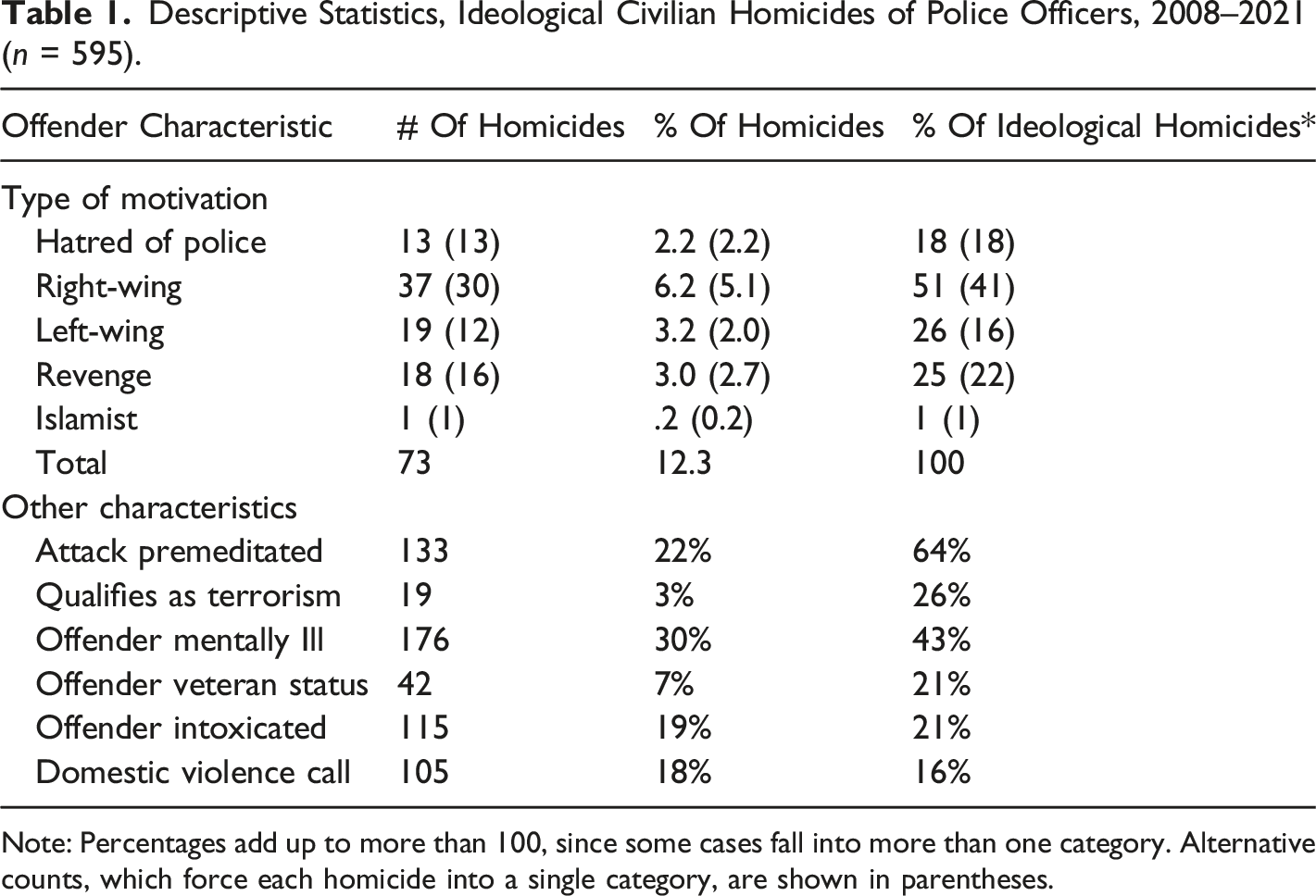
Note: Percentages add up to more than 100, since some cases fall into more than one category. Alternative counts, which force each homicide into a single category, are shown in parentheses.
Killings by right-wing extremists range from clearly premediated, targeted attacks to seemingly spontaneous shootings in reaction to traffic stops or domestic situations. Examples of premeditated attacks include Robert Dear, who killed an officer at Planned Parenthood in Colorado; Lloyd and Marshall Barrus, anti-government extremists who went on a self-described “suicide mission” to kill police; and Amanda and Jerad Miller, who killed two officers in a pizza restaurant, which they believed would somehow spark an anti-government revolution. An example of a more spontaneous attack is Richard Poplawski’s murder of three officers in reaction to a domestic incident, which was unplanned but was nonetheless motivated by his fervent white supremacist views (Hamm & Spaaij, 2017).
The left-wing category incorporates those who were motivated by opposition to racism, ideologies such as anarchism, or by other ideas associated with the left. Among the 19 offenders in this category, eight appeared primarily concerned about police killings, five were motivated by general anti-racist views, two were responding to police brutality against minorities, two were angry about racism in non-criminal justice institutions, one was avenging his own experience of racism in the justice system, and one was influenced by anarchism and the “Occupy” movement.
Seven of the 19 left-wing offenders were also classified as right-wing because they expressed “sovereign citizen” beliefs or other far-right ideologies in addition to left-wing beliefs. Table 1 also provides alternative counts for each category assigning each offender to the single category that most closely fits the offender’s ideology.
The general hatred of police category includes offenders who hated police for unknown reasons, or for reasons unrelated to specific ideologies. Offenders were only coded for this category if there was no evidence for other ideological motives. This motivation is discussed in detail in a sub-section below.
The next category, personal/family revenge, includes cases in which the killing was intended as revenge for an incident that happened to the offender or their friends or family. Three of the 18 cases in this category related to police shootings, and the remaining cases varied widely. For example, one offender was upset about his father’s life-without-parole sentence. The Islamist extremism category includes only Dzhokhar Tsarnaev, who killed an officer days after bombing the Boston Marathon.
Table 1 also summarizes other offender characteristics. Some of the results, such as the higher rate of premeditation among ideological offenders, are unsurprising. Yet several of these findings suggest mixed personal and political motives rather than purely ideological motives, in line with the literature on lone wolf terrorism (Spaaij, 2011). That is, sizable proportions of ideological perpetrators were intoxicated during the incident (21%), were mentally ill (43%), committed the homicide in reaction to domestic incidents (16%), or killed in response to a traffic stop or other police activity with no clear signs of premeditation (36%).
Figure 1 shows the yearly count of ideological civilian-on-police homicides, using two measures: the broad measure including all four types of ideology and a narrower one excluding attacks motivated solely by hate or revenge. For the broader category, there was a sharp increase in the number of ideological killings in 2016 (a total of 11 that year), which was also the year in which Johnson and Long each killed several officers in reaction to police shootings. However, there was only one additional left-wing perpetrator that year, and he was motivated by general left-wing views, not BLM-related concerns. Ideological civilian-police homicides by year, 2008–2021.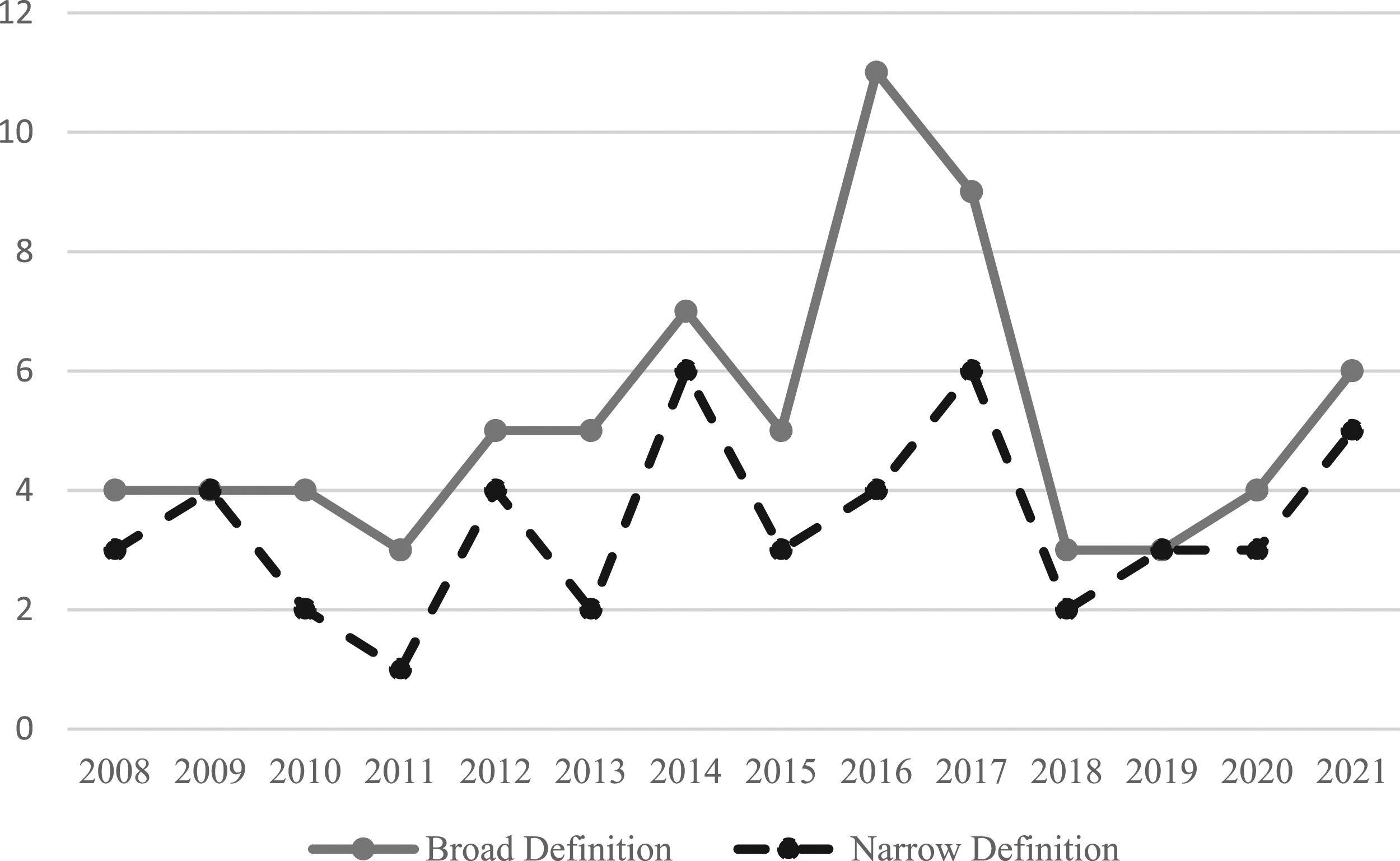
The elevated number of ideological killings in 2016 is due to the higher-than-usual number of hatred and revenge killings, as shown in Figure 2, which displays yearly trends by ideological type. One of the 2016 killings was in revenge for a friend who was killed by police, but there is no indication that the perpetrator was inspired by BLM. Overall trends in Figure 1 appear rather stable, particularly for the narrow definition. Using the narrower definition, every year between 2008 and 2021 had 2, three or four ideological shootings, with the exceptions of 2011, which only had one, and 2014 and 2017, which each had 6. The vast majority of killings in those 2 years were by right-wing extremists and cannot be attributed to BLM. Ideological civilian-police homicides by type and year, 2008–2021.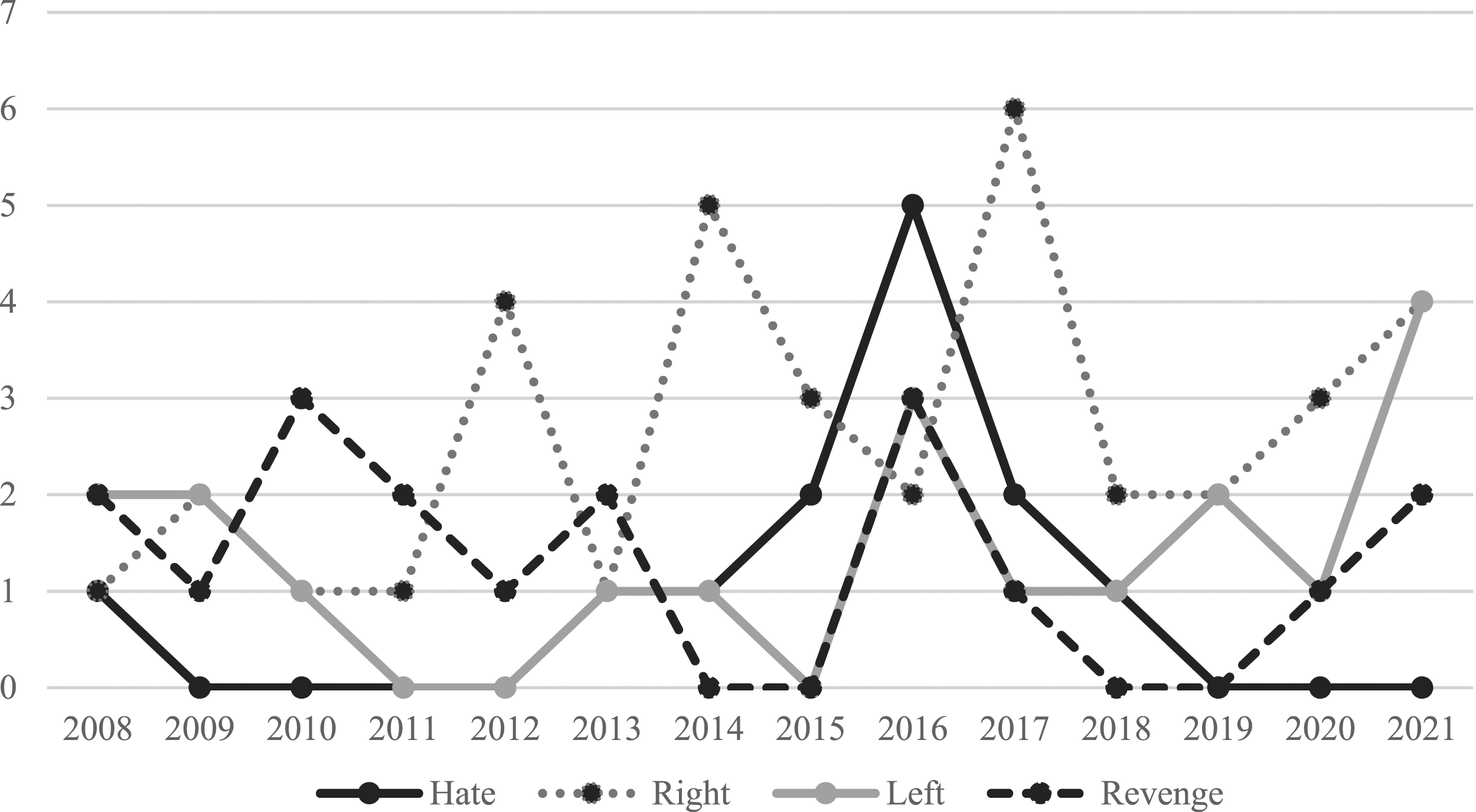
As noted above, an internal FBI report (2016) suggested that several 2016 civilian-on-police homicides were encouraged by anti-police views on social media. In contrast, this study found that only two of these killings (4% of the 2016 killings) were in reaction to the high-profile shootings of unarmed men: the homicides by Micah Johnson and Gavin Long.
Did Ideological Civilian-on-Police Homicides Increase After Ferguson?
Preliminary Analysis of Changes in the Number of Ideological Civilian-Police Homicides.
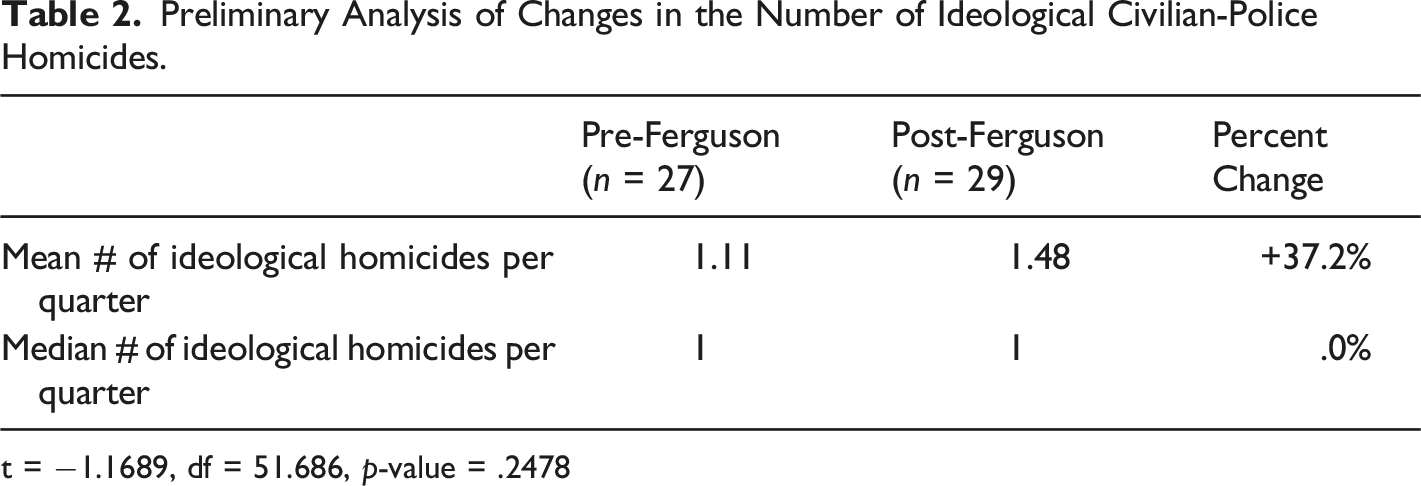
t = −1.1689, df = 51.686, p-value = .2478
ARIMA Analysis
A t test is an imperfect test of time series data, since it does not account for sources of bias such as serially correlated errors. Similarly, regression analyses are not the first choice for time series analysis, because residuals in time series data are frequently correlated with those in adjacent data points, contrary to the independence assumption in regression analysis. Interrupted time series analysis using autoregressive integrated moving average (ARIMA) models are thus appropriate to account for such correlations (Box & Jenkins, 1976). ARIMA interrupted time series analysis is often used in criminal justice research to evaluate the effect of an intervention at particular point in time. ARIMA analyses for this study were performed using the R package “forecast” (Hyndman & Khandakar, 2008).
To select the most appropriate ARIMA model, three components (p, d, and q) must be specified. The autoregressive aspect of the model is represented by p, d refers to the trend or “differencing” component, and q refers to the moving average aspect of the model. A number of tests are available to determine these values, which are employed in this paper. In addition, the auto. arima function in R’s “forecast” package automatically selects these values based on unit root tests and the Akaike or Bayesian Information Criteria.
Both “abrupt, permanent” change and “gradual, permanent” change models were tested. The abrupt model involved a predictive variable coded as zero before the intervention and one after the intervention, while the gradual variable begins with one in the quarter after the intervention and increases by one each quarter (Schaffer et al., 2021).
Visual inspection of the autocorrelation plots revealed no evidence of an autoregressive component, such as geometrically declining values in the ACF plot (Vasileiadou & Vliegenthart, 2014). Similarly, the Ljung-Box Q-statistic was non-significant (Q = 4.7, p = .59), further indicating the absence of autocorrelation. Therefore, p was set to zero. As for d, the trend component, visual evaluation suggests the series is stationary. A Phillips-Perron test (Z = −62.4, p < .01) confirmed that the series is stationary, as did a Kwiatkowski–Phillips–Schmidt–Shin (KPSS) test. Thus, d is set to zero as well. The autocorrelation plots also show no need for a moving average component to the model, which means that q is set to zero as well.
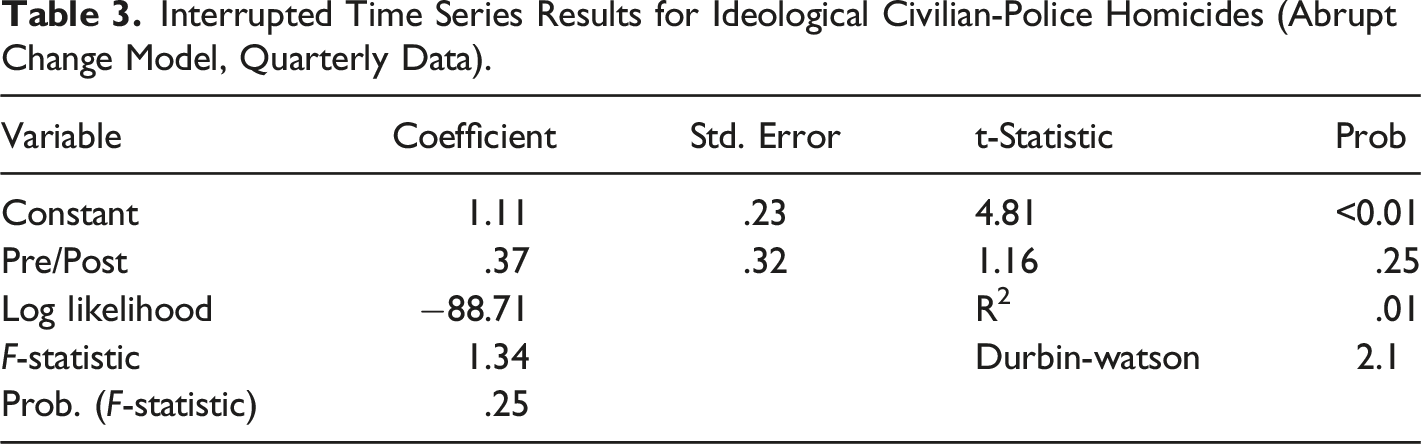
We are left with a (0,0,0) or “white noise” ARIMA model. This is also the model selected by the auto. arima function. The lack of a significant coefficient for either the abrupt (b = 0.37, SE = 0.32, p = .24) or gradual (b = 0.002, SE = 0.02, p = .89) variable means that the hypothesis that there was a statistically significant impact of Ferguson on ideological civilian-on-police homicides can be rejected. In other words, there is no evidence of a significant post-Ferguson increase in ideological civilian-on-police homicides.
Interrupted Time Series Results for Ideological Civilian-Police Homicides (Abrupt Change Model, Quarterly Data).
Bayesian Structural Time Series Analysis
Some researchers prefer Bayesian structural time series analysis (BSTS), which tests the effect of an intervention over time using a different methodology. BSTS has been used to study a variety of criminal justice topics, such as the impact of COVID lockdown policies on crime (Campedelli et al., 2021), the impact of a “gang takedown” on violent crime (Ratcliffe et al., 2017), and the effect of a deterrence intervention on parolees (Clark-Moorman et al, 2019).
This method generates predictions based on pre-intervention data and compares the post-intervention results to this synthetic control, in place of using actual controls as in difference-in-differences designs (Broderson et al., 2015). Synthetic controls are generated using a minimum of 1000 Markov chain Monte Carlo (MCMC) samples. BSTS employs a state-space model, which, in contrast to difference-in-differences and ARIMA methods, can detect latent variables affecting the observations. The difference between the observed post-intervention values and the projected counterfactual values is calculated to estimate the impact of the intervention.
Recent research compared the accuracy of Bayesian structural time series (BSTS) analysis and ARIMA models and found that BSTS models tend to be more accurate (Thorakkattle et al., 2022). In addition, some have argued for using BSTS rather than ARIMA for examining trends in relatively rare events, such as serious crimes, since such data may violate ARIMA’s underlying assumptions (Ratcliff et al., 2017; Quddus, 2008). The “CausalImpact” R package (Broderson et al., 2015) was used for these analyses.
As with the ARIMA analysis, the BSTS results show no significant effect of Ferguson on ideological civilian-on-police homicides (Rel. Eff. = 33%, p = .09). Alternative BSTS analyses using only the narrow definition of ideology, which excludes hatred or personal revenge-based killings, also showed no significant impact (Rel. Eff. = 28%, p = .16). Similar analyses using ARIMA and regressions to test Ferguson’s effect on the narrow definition of ideological homicides also yield non-significant results. In addition, further analyses focused on civilian-on-police homicides that qualify as terrorism failed to detect a statistically significant increase after Ferguson. In short, regardless of the specific measure or type of analysis used, overall measures of ideological civilian-on-police homicides show no significant increase after Ferguson.
Do Results Differ by Type of Ideology or Other Characteristics?
Other than the total number of ideological civilian-on-police homicides, various other outcome variables were analyzed to test for significant post-Ferguson changes. These variables include ideological categories, the concept of premeditation, and whether the homicides were in response to police killings. Additional analyses explored whether results vary based on different time increments.
Ideological Categories
First, analyses were performed for four types of ideological killings, excluding the Islamist category, which only included one homicide. Results were non-significant for right-wing, left-wing, and revenge-based homicides. 5 For killings inspired by hatred of police, Bayesian structural time series analysis (Rel. Eff. = 364%, p = .001) and ARIMA (b = 0.34, SE = 0.10, p < .001), but not t-tests or regressions, showed a significant increase after Ferguson.
Next, another version of the left-wing variable, in which cases featuring personal revenge were excluded, was tested as well. This narrower definition of left-wing homicides was created following the observation that left-wing cases prior to Ferguson tended to involve personal revenge, while this was not the case after Ferguson. Generally speaking, many of the ideological homicides in this study appear to have been influenced by both personal and political factors, consistent with the literature on lone wolf terrorism and ideological mass shootings (Capellan & Anisin, 2018). However, this personal/political mix shifted after Ferguson.
Before Ferguson, all but one of the homicides coded as left-wing were in response to an injustice affecting themselves or someone they knew. After Ferguson, none of the left-wing cases related to personal revenge, and several were inspired by high-profile police shootings. In other words, the mixture of personal and political motives was more “personal” before Ferguson and more “political” after Ferguson. Yet even among the more “political” post-Ferguson homicides, personal considerations played important roles. To illustrate, one of these offenders (Ismaaiyl Brinsley) was suicidal and shot his ex-girlfriend on the same day he killed officers. In total, there was one non-revenge left-wing homicide before Ferguson, and 12 after Ferguson.
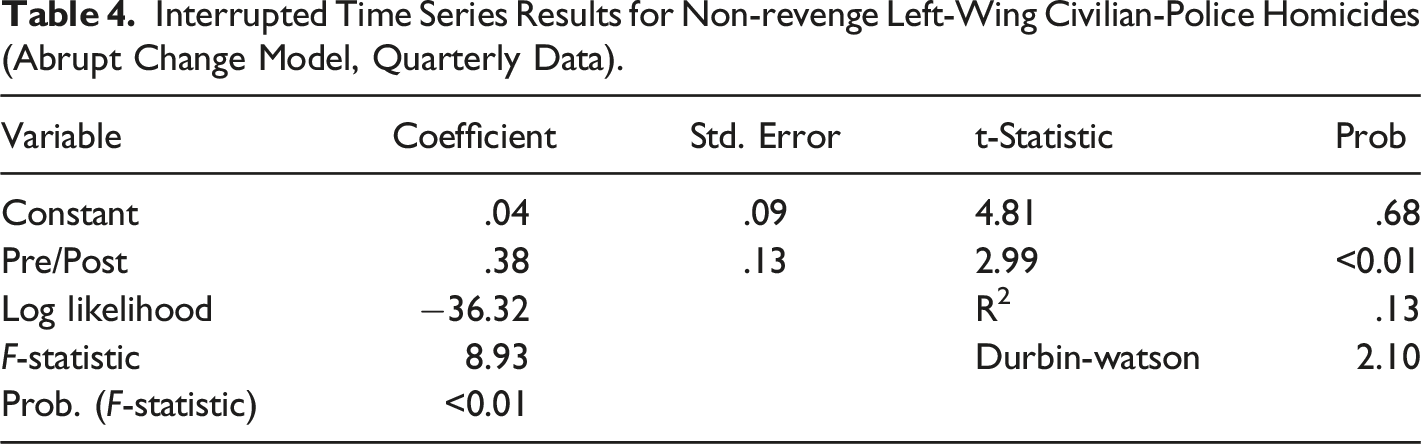
Analyses testing the effect of Ferguson on left-wing non-revenge killings were significant in all analyses, including a t test (t = −3.1, p = .004), Bayesian structural time series analysis (Rel. Eff. = 1035%, p = .001), and both abrupt (b = 0.41, SE = 0.32, p < .001) and gradual (b = 0.03, SE = 0.004, p < .001) change ARIMA models. In negative binomial regressions, both gradual (b = 0.08, SE = 0.03, p = .003) and abrupt (b = 2.4, SE = 1.0, p = .02) models were significant as well. A comparison of abrupt and gradual models in ARIMA and regression analyses using such criteria as AIC, BIC, R-squared and several pseudo R-squared measures was ultimately inconclusive, as the models’ performance is extremely similar.
Interrupted Time Series Results for Non-revenge Left-Wing Civilian-Police Homicides (Abrupt Change Model, Quarterly Data).
Bayesian Structural Time Series Analysis, Non-revenge Left-Wing Civilian-Police Homicides (Quarterly Data).
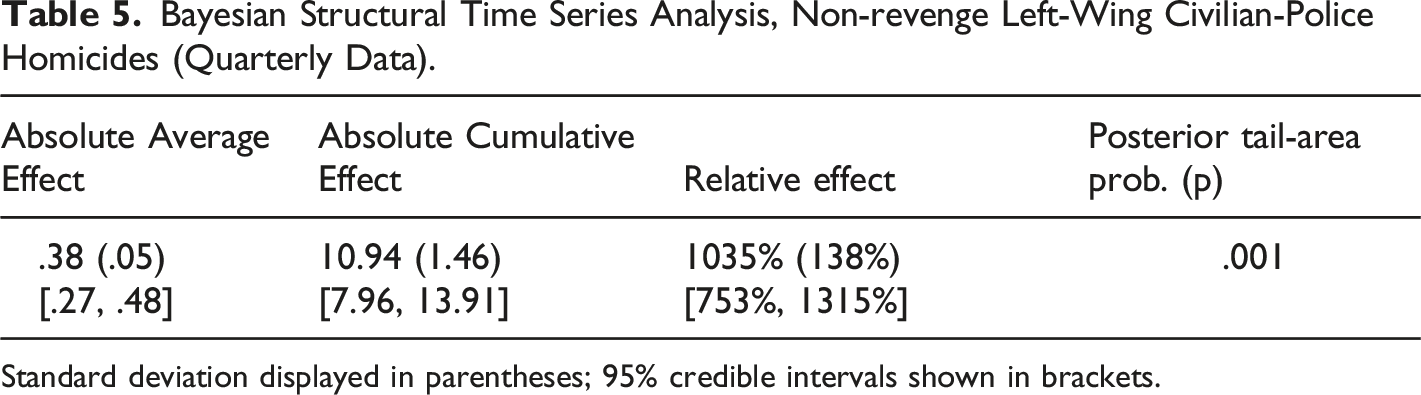
Standard deviation displayed in parentheses; 95% credible intervals shown in brackets.
Different specifications of the Bayesian model were tested, adjusting the standard deviation of the Gaussian random walk from 0.01 to 0.1, for example, which is considered more appropriate for volatile data, but this did not significantly change the results. Neither did incorporating seasonality in the models or increasing the number of MCMC samples to 10,000.
To further illustrate these results, Figure 3 includes three plots of the BSTS results for the narrow definition of left-wing motives, which excludes left-wing cases with a personal revenge motive. The first plot includes both the predicted values and the actual values, the second plots the difference between them, and the third displays the intervention’s cumulative effect. Bayesian structural times series plots, left-wing civilian-police homicides (narrow definition, quarterly data). Note: Shaded gray area illustrates credible intervals. y = incidence, x = quarters (1–56).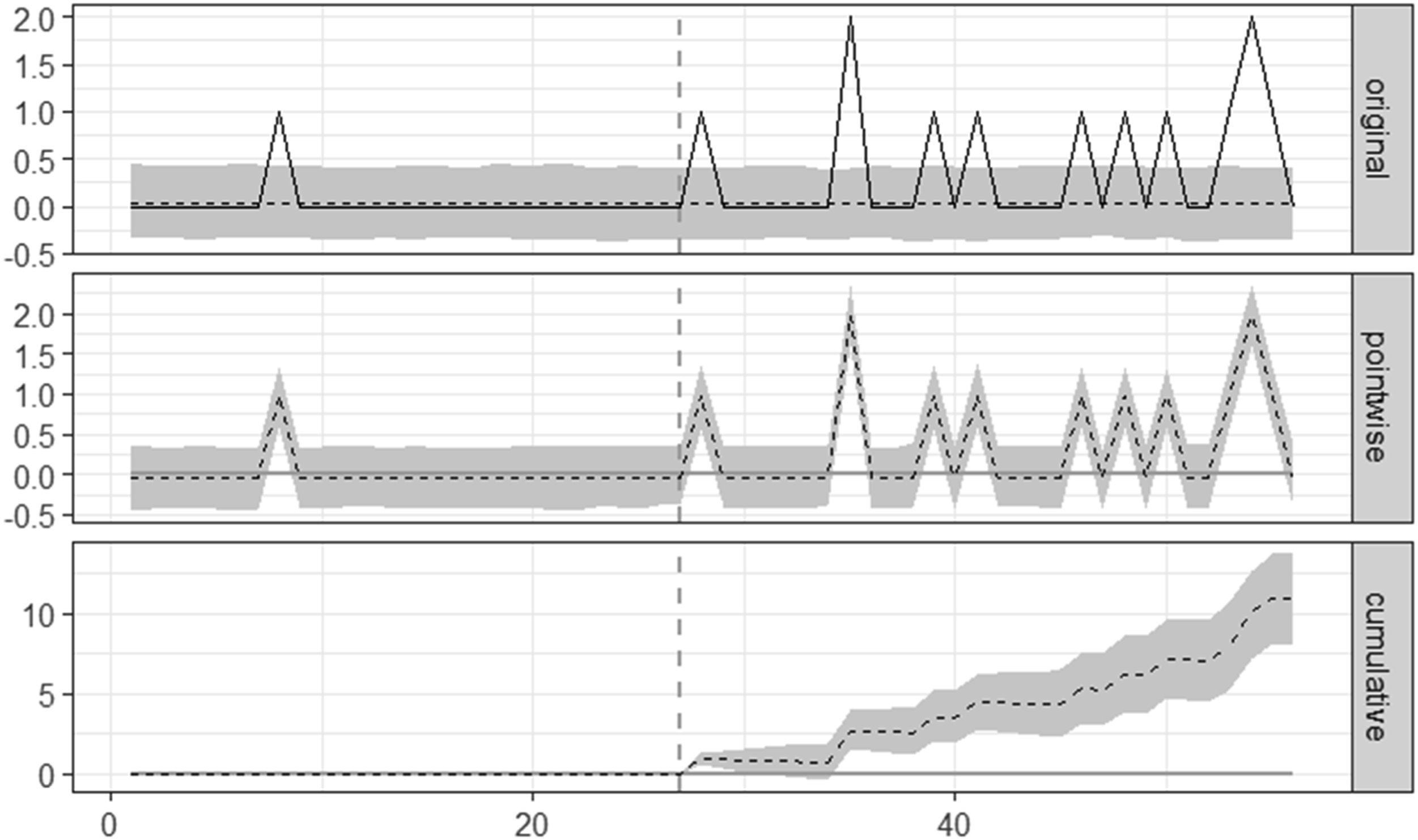
Homicides in Response to Police Shootings
An additional variable was created including only ideological homicides that were in response to police killings of civilians, whether the shooting was in reaction to police killings in general or to a particular killing. This analysis, which features two before Ferguson and eight after, necessarily includes personal revenge-based shootings because there were no non-revenge killings related to police killings of civilians before Ferguson in this dataset. The pre- and post-Ferguson difference is statistically significant in BSTS analysis (Rel. Eff. = 331%, p = .002) and ARIMA (b = 0.31, SE = 0.08, p < .001) but not in other analyses.
Premeditated vs. Spontaneous Homicides
I also tested whether civilian-on-police homicides were more likely to be premeditated after Ferguson, but the results were non-significant in all analyses. As a broader point, it should be noted that even though some observers might assume that premeditated attacks indicate ideological motivations, this is usually not the case. In fact, the majority (64%) of premeditated homicides were non-ideological. Many of these non-ideological premeditated homicides involve offenders who had vowed to kill an officer to avoid jail or planned “suicide by cop.”
Alternative Time Increments
I also performed multiple tests with different time increments. Most of the above analyses used quarterly data, but analyses were also performed based on monthly and yearly data to test for different results. Broadly speaking, results remained similar across different time increments.
Civilian-on-Police Homicides Motivated by “Hatred of Police”
The number of civilian-on-police homicides motivated only by a general hatred of police increased from three before Ferguson to nine after Ferguson. This change appears quite large, and as noted above, this is statistically significant in some but not other statistical tests. Some might be tempted to conclude from this increase that movements against police misconduct have inspired more killings by influencing people to “hate” police.
However, there are multiple reasons to doubt this conclusion, aside from uncertainty about whether the change represents random fluctuation. First, there is no indication that any of these nine hate-motivated offenders were influenced by BLM. Second, it was only after Ferguson that the alleged problem of “hatred” for police became commonly discussed in the media, particularly after Trump and police organizations portrayed BLM as fueled by animus (Drakulich et al., 2020). Thus, information about an offender’s hatred for police may have been more likely to come to light after Ferguson. Third, those who kill police often have a lengthy criminal history, and thus may well hate police because of resentment for their arrests. Moreover, repeat offenders often have antisocial personality disorder, which is associated with hostility and contempt toward authority figures (DeLisi et al., 2019). Thus, the available data does not support the notion of an upward trend in hatred-motivated homicides influenced by protests against police.
To illustrate some of this hatred for police, one offender, Trenton Forster, said he wants “F--- the police” written on his gravestone, and believed all officers are “bullies” (State v. Forster, 616 S·W.3 d 436 (2020)). One said, “the only good cop is a dead cop” (Associated Press, 2017) and another had an “RIP Cops” tattoo (Eaton, 2017). After killing an officer, Brian Fitch told an officer, “I hate cops and I’m guilty” (Associated Press, 2014). Jeremy Goulet, who strangely enough had a criminal justice degree, “had contempt for the cops and hated our justice system,” according to his father (Associated Press, 2013). Another offender, John Highnote, wrote a note saying, ALL COPS ARE EVIL, STUPID, LAZY and live off the backs of everyday people. And yet they get six figure a year incomes and pat each other on the back and praise themselves as first responders. EVIL PIGS AND LEACHES (Swirko, 2018).
Further research revealed that his hatred derived from personal disputes with officers.
Interestingly, a study of NYC police homicides from 1844 to 1978 found 13% of were motivated by “contempt” for police (Margarita, 1980). This is approximately the same as the percentage of ideological civilian-on-police homicides in this study. Perhaps a small proportion of civilian-on-police homicides, relatively constant across time and place, is inspired by hate or other ideological motives. The rise and fall of different ideological motives over time may simply reflect how popular these ideologies are in society in general.
The 2021 Spike in Civilian-on-Police Homicides: An Ideological Link?
The murder of George Floyd by an officer in May 2020 set off months of BLM protests, of far greater magnitude than those of previous years. Subsequently, from 2020 to 2021 there was a dramatic spike in civilian-on-police homicides, from 43 in 2020 to 59 in 2021. This is a single-year 37% jump, or a 43% increase from the pre-2021 average. Pundits predictably claimed that this resulted from the BLM’s “demonization of the police” (Mac Donald, 2022).
Yet the data in this study provides no evidence for such a conclusion. The number of ideological civilian-on-police homicides in the last 2 years, four in 2020 and six in 2021, is in line with the pre-2020 average of 5.25 ideological killings per year. Moreover, time series analyses using May 2020 as a cutoff generally failed to achieve significant results.
A closer examination of the data shows that there were 11 more mental illness-linked civilian-on-police homicides in 2021 than the pre-2021 average. It may be that the mental health crisis during the COVID-19 pandemic was the main driver behind the 2021 increase in civilian-on-police homicides. 6 Random variation is a likely explanation; a similar jump from 45 to 59 occurred in 2010–2011 without any apparent cause. The 30% increase in the nationwide murder rate in 2020 could also be responsible; Parkin et al. (2020) show that increases in the murder rate increases the number of officers killed in future months.
In any case, there is no indication that ideologically-driven homicides were responsible for the increase. After all, the vast majority of civilian-on-police homicides have nothing to do with ideology, and only a tiny percentage derive from concerns about police shootings. One offender, Ralph Elrod, even had a pro-police thin blue line sticker on his mailbox (WMAZ., 2016).
Discussion/Conclusion
This study found that about 88% of civilian-on-police homicides between 2008 and 2021 were non-ideological, and only 3% constituted terrorism. Contrary to the “war on cops” narrative in which BLM is portrayed as responsible for anti-police violence, right-wing extremists committed far more civilian-on-police homicides (6%) than did offenders reacting to police racism or other left-wing concerns (3%), and analyses show no significant overall increase in ideological civilian-on-police homicides after Ferguson.
While some analyses show a significant post-Ferguson increase in killings motivated by hatred for police, this is unlikely to represent a real trend due to reporting effects, and the offenders’ hatred appears unrelated to outrage about police shootings. Civilian-on-police homicides motivated by left-wing ideology and unrelated to personal revenge did significantly increase after Ferguson. Yet this accounts for a small proportion of post-Ferguson civilian-on-police homicides (4%), and most of these offenders were influenced by far-right ideology and mental illness as well. As shown by prior research on “lone wolf” terrorism, many solo offenders develop their own idiosyncratic ideological mixtures (Norris, 2020; Spaaij, 2011).
Concern about unjustified police killings played a major role in eight of the 12 left-wing non-revenge homicides, consistent with research showing an increase in homicides linked to left-wing ideology in the last 5 years (Duran, 2021). Yet this does not mean the BLM movement is somehow to blame for (or even the cause of) these homicides. As illustrated in the “pyramid” model of radicalization, even overwhelmingly peaceful movements tend to have small numbers of supporters, typically “lone wolves” acting without external direction, who perpetrate violence on behalf of the cause (McCauley & Moskalenko, 2017). Perhaps when any movement becomes mainstream, and its ideas are held by a large proportion of the population, as in this case, it is almost inevitable that some troubled individuals will engage in violence influenced in part by the movement’s ideas.
Moreover, nine of the 12 were mentally ill, at least two were paranoid and delusional, and six were veterans (several of whom had PTSD). Even clearly ideological homicides often were driven by personal factors as well. It is also possible that other factors unrelated to BLM (such as increased political polarization and the rise in political violence caused by President Trump’s rhetoric) partially explain the limited increases in ideological civilian-on-police homicides identified in this study (Nacos et al., 2020). More generally, due to the low base rate of left-wing civilian-on-police homicides (both before and after Ferguson) and the small numbers of cases involved, it is open to question whether the statistically significant increase is substantively meaningful. 7 For all these reasons, these findings should not be interpreted as indicating a widespread new phenomenon of ideological civilian-on-police homicides inspired by recent protests, let alone a “war on cops.”
In terms of policy implications, police and policymakers should refrain from furthering the “war on cops” narrative in any fashion, including by suggesting that those protesting against police are somehow the cause of civilian-on-police homicides. Moreover, police departments, unions and other organizations should avoid responding to movements in an adversarial, us/them fashion, and instead present themselves as being open to working together with activists to further reduce instances of police misconduct. Such responses could potentially foster public trust and cooperation, while also facilitating meaningful reform.
The concept of “stochastic terrorism,” which describes how demonization of a group can incite violence against members of the group (Amman & Meloy, 2021), should not be abused to hold movements responsible for murders when they did not call for violence. Thus, authorities should not begin investigating movements such as Black Lives Matter as “domestic terrorists” simply because a small number of civilian-on-police homicides occur that happen to be influenced by the same grievances.
At the same time, individuals known to be fixated on police and calling for violence against them, regardless of their ideology or lack thereof, should be investigated and taken seriously as potential threats. After all, as this study shows, ideological civilian-on-police homicides occur every year and make up about one 10th of all civilian-on-police homicides. As documented by the literature on lone-actor terrorism, attacks are often preceded by warning signs ignored by family or members of the public (Gill et al., 2014). Though further research would be necessary to confirm this, such findings may well hold true for ideological civilian-homicide offenders.
This study’s findings also underscore the importance of preventing unnecessary shootings by police. For example, outrage over the police shootings of Alton Sterling and Philando Castile led to two mass shootings against police by Micah Johnson and Gavin Long, killing a total of eight officers. Such incidents can have reverberating effects and even influence non-ideological civilian-on-police homicides. One non-ideological offender, for example, threatened to “Gavin Long” police if they intervened in a domestic dispute, and later killed an officer (WBRZ, 2020). Even one or two unnecessary police shootings can have unpredictable effects, potentially influencing multiple lethal attacks on police.
One limitation of this study is the lack of comprehensive information about some of the homicides. To correct for this in future research, in-depth qualitative case studies of ideological civilian-on-police homicides could generate insight into the precise ways ideology influences violence in conjunction with other factors (such as mental illness), while also helping inform strategies for preventing such homicides. Another limitation is this study’s reliance on the intent of offenders as indicated in news reports, government press releases, social media or elsewhere; this approach could potentially overlook or misidentify some ideological homicides. Future studies based on complete police records, and additional data-gathering on all ideological offenders (including any psychiatric diagnoses), performed by a research team involving multiple coders, would enable more comprehensive analyses of these homicides.
Footnotes
Acknowledgement
I would like to thank Brandon Vogel and Kyle MacDonald for valuable assistance in the early stages of this project.
Declaration of Conflicting Interests
The author(s) declared no potential conflicts of interest with respect to the research, authorship, and/or publication of this article.
Funding
The author(s) received no financial support for the research, authorship, and/or publication of this article.
