







Abstract
Little is known about the decision-making processes used when police encounter suspects who have never previously been stopped or about how police decide who to question in the first place. Literature suggests suspect race plays a role, but findings are contradictory, perhaps due to the confounding effects of prior records. We therefore focus here on a suspect’s first police stop. Drawing on three theoretical accounts—focal concerns, benign neglect, and de-policing—we identify plausible explanations for racial differences in self-reported police contact and arrest outcomes. We use Add Health data and matched logistic regression to examine race effects. We find that black respondents were less likely than white respondents to be stopped, but there was no disparity in arrest. Although suspect race was associated with the decision to stop a suspect, the association’s direction did not align with that of the traditional focal concerns perspective.
Introduction
Police have immense discretionary decision-making power. When they suspect an individual of committing a crime, they may decide to arrest that individual. But they also have alternative legal and extralegal options available, such as writing a citation, counseling and releasing an individual, or bringing a minor home to their parents. Researchers have found that police tend to under-arrest—that is, they tend to choose not to arrest a suspect, even when sufficient probable cause exists to make an arrest (Engel & Tillyer, 2008; Smith & Gartin, 1989; Terrill & Paoline, 2007; Wilson, 1968).
Although arrests should ideally be influenced solely by legal factors, like the severity of the offense or the amount of available evidence, research indicates that extralegal factors play a substantial role in the decision to arrest (see generally, National Research Council, 2004). In the literature on police decision-making, one factor that has received substantial empirical attention is the role of suspect race. Studies show that suspect race can affect policing outcomes (see generally, Kochel et al., 2011), though the findings are often mixed. Scholars have called for going beyond an exclusive focus on traditional criminal justice decision points, such as conviction (Baumer, 2012), and emphasize the need for work that is grounded in theoretical accounts of what might contribute to differential arrest outcomes (Ishoy & Dabney, 2017; Tillyer & Hartley, 2010). Indeed, five decades ago, Skolnick (1966) highlighted that a great deal of justice occurs at the street level and does not appear in official statistics. There remains, however, a need to understand how race features in police decision-making not only when making an arrest but also in the earlier decision to stop and question an individual.
This study seeks to contribute to scholarship on policing and efforts to understand the discretionary decision-making processes that may contribute to disparities in the criminal justice system. More specifically, we examine the effects of suspect race on two key police decision-making points: first, the decision to stop and question suspects and, second, the decision to arrest those who have been stopped. We focus on self-reported contact outcomes that occur in instances where suspects have never been previously stopped and questioned by the police, which allows us to account for any confounding effects between race and a suspect’s prior record. Few studies examine first contact, even though doing so provides a unique opportunity to understand decision-making that occurs without any prior information that might shape discretion; in so doing, it also permits a more nuanced investigation of how race may inform officer decisions to stop or arrest individuals. We argue that there are reasons to anticipate racial disparities at these two points. To this end, we draw on three theoretical perspectives—focal concerns, benign neglect, and de-policing—to generate expectations about potential racial differences in the likelihood of individuals having any first contact with the police or, in turn, being arrested. In what follows, we discuss relevant background literature, the current study’s data and methods, and the findings. We then conclude by discussing key implications for theory, research, and policy.
Background
Police Contact and Arrest Decisions
The decision to arrest a suspect may be based on a variety of factors. For example, legal factors like offense seriousness, probable cause, and the wishes of the victims often drive police decision-making (National Research Council, 2004; Terrill & Paoline, 2007). However, extra-legal factors, like suspect demographic characteristics, suspect demeanor, and neighborhood characteristics have also been shown to matter (Bender et al., 2010; Mastrofski et al., 2002; Mears, 1998; Miller et al., 2007; Manning & Van Maanen, 1978; Schulenberg, 2015; Stolzenberg & D’Alessio, 2004; Worden & McLean, 2018). An especially relevant legal factor that has been consistently shown to influence police decision-making is a suspect’s prior record. Put simply, individuals with prior records are more likely to be arrested (Ishoy & Dabney, 2017; Mastrofski et al., 2002, 2016; Pollock, 2014; Schulenberg, 2015).
Scholars have sought to understand racially disparate treatment and negative relations between police and minority communities (see generally, Kochel et al., 2011; Lytle, 2014; Mekawi & Bresin, 2015). One of the central explanations for disparities in arrests is that the police may be biased against racial minorities. Another is that differential treatment occurs because of differential offending. 1 Over time, these possibilities—which are not mutually exclusive—would create differences in prior records for white and nonwhite suspects (Caudill et al., 2013; Stolzenberg et al., 2021). If prior record is then used by police to make decisions about stopping or arresting a suspect, it might lead to a further enhanced likelihood of arrest for nonwhite suspects. Prior record might be used to justify an arrest that appears race-neutral, but it may be confounded or embedded with prior racialized decision-making.
One way to address this limitation is to consider the outcomes of police interactions for suspects who have never been previously arrested. In such an encounter, the suspect has no prior record on which the police can rely to make their decisions. Two substantial advances in this literature have come from Lau and colleagues (2017) and Liberman and colleagues (2014), both of whom examined outcomes associated with an individual’s first time being arrested. Neither study focused directly on race effects. However, in descriptive models, Lau and colleagues (2017) found that black youth had a lower age at first arrest compared to white youth. In addition, Liberman and colleagues (2014), in analyses using propensity score matching, presented pre-matching analyses that showed that “arrested youth were significantly more likely to be . . . African American” (p. 354). Although both studies focused on examining outcomes associated with a first arrest, a related but distinct focus is to examine first contact and what drives the decision to make an initial stop, and, in turn, to arrest a suspect with no prior record.
Even if someone has not previously been arrested, the police may still have had prior contacts with that individual that may inform decision-making. For example, Engel and Silver (2001) found that officers were more likely to arrest someone who was previously questioned by the police, even if they were not arrested during that earlier contact. In addition, Tillyer and Hartley (2010) found that prior contacts with a suspect are especially important in determining arrest likelihood for suspects who have no prior arrest record. Ishoy and Dabney (2017, p. 894) found that police relied more on their own knowledge of an individual’s prior crimes—information gleaned from prior contacts with that suspect—than on “abstract events documented on a rap sheet.” Having prior contact with the police—regardless of whether that contact ended with an arrest or if the suspect was released without an arrest—can increase the likelihood of an arrest in future police encounters.
A starting point for extending prior work is to examine the factors that may contribute to first contact with the police. One benefit of this approach is that it avoids the confounding relationship between suspect race and prior records. Stops are, as well, important in their own right, as several studies have documented negative outcomes associated with earlier police stops (see generally, Wiley et al., 2013; Wiley & Esbensen, 2016). A police stop (even without an arrest) is increasingly understood to constitute a potentially adverse childhood experience that can negatively impact future attitudes and behaviors (Chenane et al., 2020; Del Toro et al., 2019; Geller, 2021; Jackson et al., 2022; Wiley et al., 2013), especially among marginalized groups (Del Toro et al., 2019; Geller, 2021; Novak & Gilbreath, 2023). Even so, little is known about the factors that predict who will be stopped and questioned by police in the first place (for exceptions that do not focus on examining suspect race, see Fagan & Davies, 2000; Schulenberg, 2015; Williams, 1980). This gap is notable because the decision to stop someone is intimately tied with their likelihood of being arrested and the ways police may view that suspect again in future encounters. It is notable, too, because the decision to stop and question someone involves even more discretion than the decision to arrest someone 2 (Tillyer, 2014). These insights underscore the importance of understanding the decision to initiate contact versus the decision to arrest.
The Effects of Race on Police Decision-Making
Suspect race has long been a focus of research on police decision-making. Studies have found that nonwhite suspects are often disadvantaged compared to white suspects. They have found, too, that nonwhite suspects—especially black or Hispanic suspects—are more likely to be arrested than white suspects with similar levels of offending (Crutchfield et al., 2012; D’Alessio & Stolzenberg, 2003; Lytle, 2014; Medina & Jose, 2014; Mitchell & Caudy, 2015; Novak & Gilbreath, 2023). A meta-analysis of 40 studies by Kochel and colleagues (2011) found that racial and ethnic minority suspects were 30% more likely to be arrested than white suspects, though they emphasized that the effect sizes, but not their direction, varied substantively across studies.
However, broadly, studies do not always find evidence of discriminatory treatment towards nonwhite suspects. For example, some scholars who have examined the effect of race on the likelihood of being searched during a traffic stop have identified null effects (Brunson, 2007; Brunson & Weitzer, 2009; Fallik & Novak, 2012; Paoline & Terrill, 2005; Rosenfeld et al., 2012; Smith & Petrocelli, 2001), while others have found that black and Hispanic suspects may actually be less likely to be searched in cases where officers had the discretion to administer a search (Schafer et al., 2006). Studies of arrest likelihood also have identified seemingly contradictory results, with some finding null effects (Bender et al., 2010; Robinson & Chandek, 2000; Smith et al., 1984) or that blacks may be less, rather than more, likely to be arrested than similar white suspects (D’Alessio & Stolzenberg, 2003). In a meta-analysis of 51 studies, Ferguson and Smith (2024) found that bias was most likely to be identified for minor crimes (like drug offenses), and that higher quality studies were less likely to identify evidence of racially disparate treatment. Notably, however, studies have also found that racial disparities may be more evident at earlier stages of the criminal justice system processing and may disappear or even reverse at later stages of court processing (Caudill et al., 2013).
Against this backdrop, scholars have called for more nuanced accounts of how race may play a role in criminal justice (Baumer, 2012), and for carefully considering different theoretical explanations for its role (Ishoy & Dabney, 2017; Tillyer & Hartley, 2010). This study responds to these calls both by examining race and first contact with the police and by grounding our discussion in three theoretical traditions or perspectives—focal concerns, benign neglect, and de-policing—that can illuminate potential ways in which race and first contact may be linked. Although we do not test the causal mechanisms that may be involved, we identify that plausible grounds exist to anticipate how and why race and first contact may be associated.
The Focal Concerns Perspective
One theoretical perspective that can help explain the influence that suspect race may have on police decision-making is the focal concerns perspective. This perspective was first articulated by Steffensmeier (1980) to explain the sentencing decisions of judges. Tasked with making decisions quickly, judges may use “cognitive heuristics,” or perceptual shortcuts (Hartley et al., 2007; Kahneman, 2011). This perspective (Steffensmeier, 1980; Steffensmeier et al., 1998) suggests that judges use three perceptual shortcuts that focus on assessing an individual’s blameworthiness, their potential danger to the community, and practical constraints within the criminal justice system. Any demographic characteristic—like race—that judges associate with these factors might influence their decisions. Focal concerns theorists generally find that nonwhite defendants experience more negative outcomes within the criminal court system. For example, Cochran and Mears (2015) found that black youth received more punishments and fewer rehabilitative interventions compared to white youth, and Spohn and Holleran (2000) found that black males received harsher sentences than white females. Researchers have found similar biases among prosecutors (Albonetti & Hepburn, 1996) and juvenile probation officers (Bridges & Steen, 1998).
Following the initial focus on judicial decision-making, the focal concerns literature has been extended to examine police behavior. Tillyer and Hartley (2010), for example, highlighted similarities between the roles of police and judges. Both actors are expected to make complex and life-altering decisions repeatedly with high levels of discretion. Judges have extensive case histories to review while sentencing someone. Similarly, police have access to extensive arrest records via their mobile computer systems. As they try to make decisions, both judges and police may rely on similar mental shortcuts, or assumptions, about the individual’s risk or criminality.
There are, however, key differences between the decision-making processes of police and judges. For example, research indicates that police are more present-oriented in their decision-making (Ishoy & Dabney, 2017). They are concerned about a suspect’s immediate dangerousness and any potential for a short-term threat, rather than their likelihood of long-term recidivism. Police, compared to judges, may be less focused on the practical implications of an arrest for a suspect. If someone loses their job due to an arrest, for example, this outcome may be seen by police as a natural consequence for the person’s behavior. Finally, police may be less constrained by some focal concerns, as they “can always fall back on the letter of the law and let entities further downstream parse the issue of blameworthiness should they deem it necessary” (Ishoy & Dabney, 2017, p. 890). The ways that focal concerns influence police actions may, therefore, differ substantially from the ways they influence judges and other actors in the criminal justice system.
Few studies have examined how suspect race directly influences officers’ perceptions of suspect dangerousness. One exception is a study by Alpert and colleagues (2005). They suggest that white officers may be more suspicious of black suspects, who may use different nonverbal communication methods than the predominantly white officers. In addition, Tillyer and Hartley (2010) note that, like all people, police are influenced by media portrayals of minorities as criminals. Racialized stereotypes may play into their perceptions of a particular individual as more or less dangerous.
There are logical reasons to suggest that officers may react differently when they perceive a suspect to be more dangerous. On the one hand, officers might be more likely to stop or arrest suspects who they see as dangerous because they may perceive them to be more “deserving” of an arrest. For example, Smith and Alpert (2007) propose that traffic stop disparities are associated with officers’ racial stereotypes in ways that lead to more stops among minority drivers. Dabney and colleagues (2017) find that black suspects who display appearance characteristics consistent with hip-hop culture—like cornrows or saggy pants—will be more aggressively targeted by police. On the other hand, officers might be less likely to stop or arrest suspects who they perceive as dangerous if they fear for their own safety. Indeed, numerous studies have found that officers consider their own personal safety when making decisions about who to stop (Skolnick, 1966; Smith et al., 2006; Tomkins, 1992; Van Maanen, 1974).
The traditional focal concerns literature suggests that nonwhite respondents might face more negative treatment, and there are reasons to believe this same pattern may occur when focal concerns processes are extended to the police. However, an interesting and neglected implication from focal concerns theory—especially when considering police decision-making—is that the result of stereotyping racial and ethnic minorities as more “dangerous” may not necessarily be a greater likelihood of tougher treatment for nonwhite suspects. In a courtroom, a suspect who is viewed as more dangerous may be targeted by a judge for more sanctions because they are presumed to be more guilty. However, in the context of policing, a more dangerous suspect may be viewed as posing a greater physical threat to officers, so officers may choose to avoid stopping that suspect. Put differently, the police may rely on the same racialized stereotypes of dangerousness as judges, but the outcome may be substantively different.
The Benign Neglect Hypothesis
Another potential explanation for racially disparate treatment is what can be termed the benign neglect hypothesis. This hypothesis says that social control (like police stops and arrests) may be less likely to be used with racial minorities. In this view, the lesser use of social control by the police arises because they may care less care for nonwhite victims (whose perpetrators are usually nonwhite as well), they may view intra-racial (“black-on-black”) crime as less concerning, or minority communities may be viewed as warranting less support from the police to fight crime (Andersen, 2015; Myer & Chamlin, 2011; see also Cochran & Mears, 2015).
Some studies find support for this hypothesis and, for example, find lower arrest rates among black or nonwhite citizens. Stolzenberg and D’Alessio’s (2004) study is illustrative. The authors found that black respondents were less likely to be arrested in communities with larger black populations; this finding was replicated by Andersen (2015). Further, Myer and Chamlin (2011) found that benign neglect explained disparities in treatment at the neighborhood level, but not at the city level. More specifically, they found that benign neglect only explained outcomes in the poorest of predominantly black neighborhoods. In contrast to such studies are some that find no support for the benign neglect hypothesis (Ousey & Lee, 2008).
The De-Policing Hypothesis
Finally, a third theoretical explanation for potential differential treatment of racial and ethnic minorities is the de-policing hypothesis. As with the benign neglect hypothesis, the key prediction is that the police may be less likely to arrest blacks. The explanation is rooted in recognition that officers may be concerned about how they will be perceived by their community or in the media. In particular, they may be fearful of being falsely accused of wrongdoing or racism; a simple step to avoid this problem is to make fewer stops and arrests, especially of minority suspects (see generally, Nix & Pickett, 2017).
Although recent research has drawn attention to studying the “Ferguson Effect”—a phenomenon of de-policing that has been proposed following high profile incidents like the police killing of Mike Brown in Ferguson, Freddy Gray in Baltimore, or George Floyd in Minneapolis (Cheng & Long, 2022; Morgan & Pally, 2016; Morin et al., 2017; Shjarback et al., 2017)—researchers have hypothesized and identified similar effects for decades (Shi, 2008; Wortley & Tanner, 2004). Indeed, the time period under examination for this study occurred shortly after the beating of Rodney King in Los Angeles in 1991 and the ensuing protests and riots in 1992, a time period that, as with Ferguson, presented challenges to the police and heightened officer concerns about how their day-to-day decisions would be construed.
Research on de-policing has produced mixed findings. Shjarback and colleagues (2017) found that de-policing—measured by a reduction in traffic stops—occurred in predominantly black communities. Notably, this effect was only noted for traffic stops, which permit more discretion; there were no overall changes in arrests for violent or property crimes. Likewise, Cheng and Long (2022) found that police were less likely to self-initiate a stop and make an arrest following high-profile police killings. However, Campbell and colleagues (2018) found that the number of police shootings of suspects did not vary after the protests in Ferguson, and Koslicki (2021) found that police increased their use of force against citizens following high-profile accusations of misconduct.
Summary
It can be anticipated that a connection exists between race and police first contact and, in particular, that blacks may potentially be more likely—or less likely—to experience a first contact with the police relative to whites. At least three perspectives provide explanations for why and how. The focal concerns perspective suggests that blacks may be more likely to be stopped and arrested than whites due to racialized perceptions of dangerousness, yet the theoretical logic can also be viewed as predicting the opposite. Concerns about suspect dangerousness may lead officers to refrain from contact or arrests that might result in harm to themselves. Similarly, the benign neglect and de-policing hypotheses both suggest that racial minorities may have a lower likelihood of police contact or an arrest. In short, ample grounds exist to anticipate that race and first police contact may be associated, and not necessarily in the direction suggested by work on race and criminal legal system involvement. The goal of this study is to examine the end result of these predictions—that is, whether there are observable racial differences in self-reported first contact or arrest, the direction of the differences, and whether these are consistent or inconsistent across the two decision-making points.
Data and Methods
Overview of Data
This study uses data from the National Longitudinal Study of Adolescent to Adult Health, also known as Add Health. Detailed information regarding the sample selection is described in other reports (Harris et al., 2009). In brief, researchers drew a nationally representative in-school sample of approximately 90,000 students in grades 7–12 at 132 U.S. middle and high schools. These schools were selected to be representative of the United States, and oversampling and weighting procedures were also used to improve generalizability. Researchers conducted more detailed in-home questionnaires with 20,745 of these students.
Add Health consists of five waves of data which were collected over a period of 24 years. The control variables used in this study were obtained from data collected from in-home questionnaires administered during the first wave in 1994–1995. At this time, subjects ranged in age from 11 to 21. During the third wave of the study—conducted in 2001–2002 when subjects ranged in age from 18 to 28—respondents were asked to retrospectively provide data about any prior police contacts. To preserve temporal order, we removed respondents whose contacts preceded the first wave of the study. The police contact variables that are of interest to this study therefore refer to a seven-year period between the first and third waves of data collection.
Variables
Weighted Descriptive Statistics by Police Contact Type.
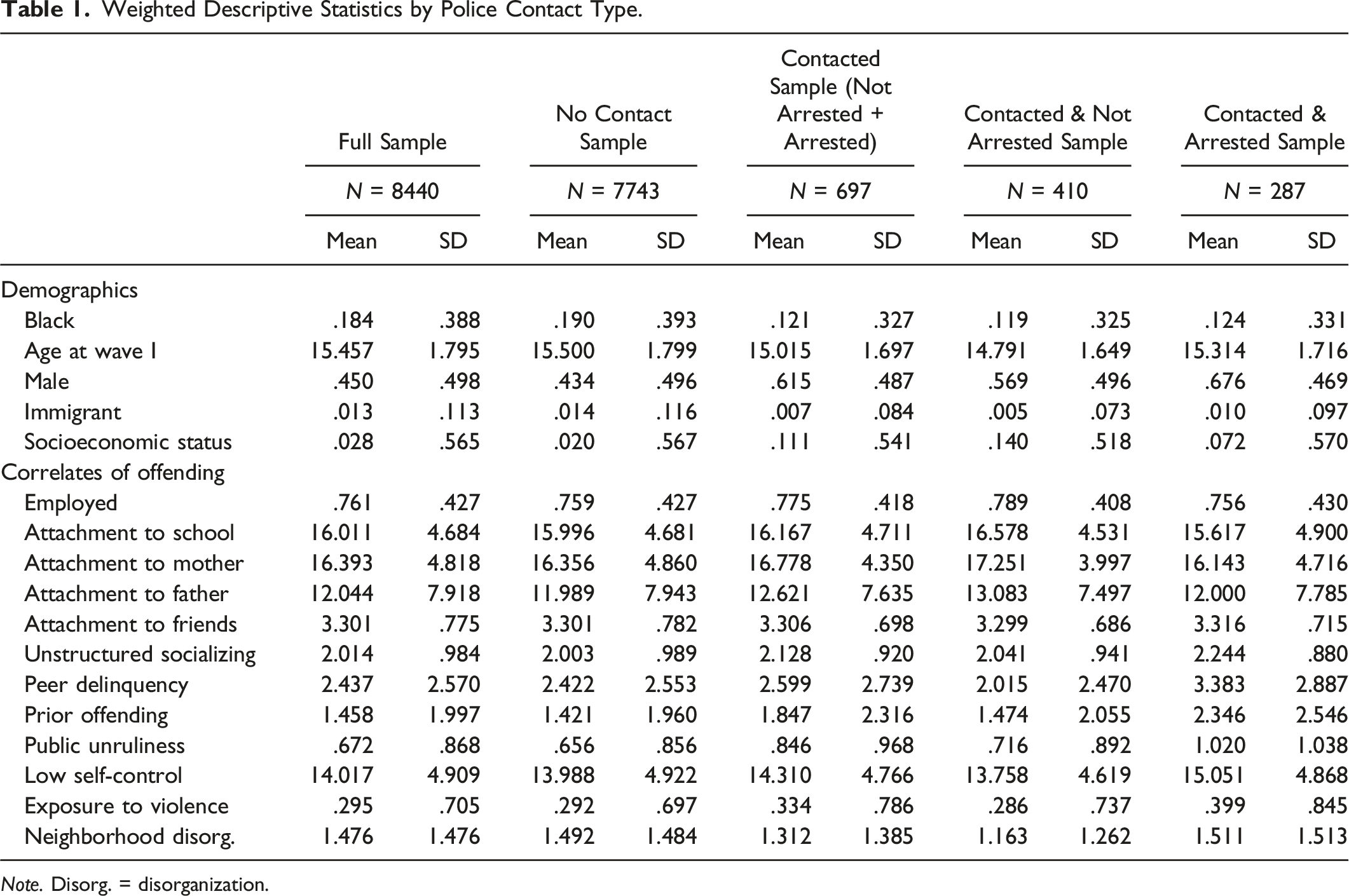
Note. Disorg. = disorganization.
The independent variable of interest is the respondent’s race, which was self-reported in the first wave of data collection. We focus here on white and black suspects, as this comparison is expected to have the greatest disparity in treatment. Supplemental analyses also make comparisons between white and nonwhite respondents, the latter of which includes respondents who identified as black, Hispanic, Asian, or “other.”
Because we do not have any measures that control for the offense for which an individual may have been stopped and questioned, we include variables that control for confounders that could predict someone’s overall likelihood of offending or whether they would be likely to have committed contactable offenses that might attract police attention. The two variables that most directly control for overall offending likelihood are the prior offending and public unruliness measures. Prior offending has, of course, been identified as one of the most consistent predictors of future offending (Blumstein et al., 1985; Kurlychek et al., 2006; Paternoster et al., 1997). In Wave I of the Add Health Survey, respondents were asked whether they had engaged in any of 13 different age-appropriate delinquency offenses (such as running away from home, stealing something, or getting into a physical fight, among other offenses). Their responses were compiled in an additive variety index, with their score indicating the number of different offenses they reported committing. The public unruliness measure is used as a proxy for the likelihood that an individual’s behavior might be noticed by police. Respondents were asked how often, in the prior year, they were “loud, rowdy, or unruly in a public place.” Respondents chose between never, 1 or 2 times, 3 or 4 times, or 5 or more times, with higher scores indicating a greater likelihood of attracting police attention.
We draw from several other theoretical traditions that point to additional measures that might increase overall offending likelihood. For example, we included controls for various indicators of a respondent’s social bonds, as research has found that prosocial bonds can reduce the likelihood of both offending and police contact (Liberman et al., 2014; Pollock, 2014; Yun & Lee, 2013). Employed is dichotomous and indicates whether an individual was employed at any time during the prior year, as employment during adolescence and young adulthood has been shown to be associated with offending at later ages (Eggleston & Laub, 2002; Lustig & Liem, 2010; Wright et al., 2002). School attachment is likewise included. Respondents were asked six questions about their level of attachment to their school (such as how close they feel to people at school and whether they feel that their teachers care about them), with higher scores on the additive index (Cronbach’s alpha = .80) indicating a higher level of attachment to their school. Attachment to mother and attachment to father were two separate 5-item additive indices (Cronbach’s alphas of .94 and .98, respectively) that were compiled in similar ways. Respondents were asked how close they feel to their mother figure and father figure and how satisfied they are with their relationships with these individuals, among other questions. Respondents without a mother or father figure scored zero on that respective index. Attachment to friends is based on a single question, where respondents were asked how much they feel their friends care about them. This measure ranged from 0 to 4, with higher scores indicating more attachment to their friends. Finally, unstructured socializing was also created from a single variable where respondents indicated how much time they spent socializing with their friends. Higher scores reflect more time spent in unstructured socialization with friends.
The social learning literature finds that peer delinquency should increase one’s likelihood of offending (Liberman et al., 2014; Ouellet et al., 2013; Pratt et al., 2009; Wiley & Esbensen, 2016; Wiley et al., 2013), and researchers have likewise found that youth who commit delinquency with peers are more likely to attract police attention (Ouellet et al., 2013; Pollock, 2014; Pollock et al., 2012). For these reasons, a measure of peer delinquency was also included as a control (Cronbach’s alpha = .75). Respondents were asked how many of their three closest friends either smoked at least one cigarette a day, drank alcohol in the past month, or used marijuana within the past month. Scores ranged from 0 to 9, with a score of 9 indicating that all three of the respondent’s closest friends committed each of the three delinquent acts. Although these items relate only to substance use, research has found that substance use is closely associated with general offending (D’Amico et al., 2008; Ford, 2005).
The self-control literature suggests that self-control may affect both the likelihood of offending and the likelihood of being caught and arrested by police (Beaver et al., 2009; Hay et al., 2018; Liberman et al., 2014; Pratt & Cullen, 2000; Wiley & Esbensen, 2016; Wiley et al., 2013). The low self-control measure included here is an additive index derived from 11 items (Cronbach’s alpha = .66), 4 which measure both behavioral and attitudinal dimensions of self-control (Wolfe & Hoffman, 2016). Respondents were asked to agree or disagree with statements like “when making decisions, you usually go with your ‘gut feeling’ without thinking too much about the consequences of each alternative,” and they also indicated how frequently they had trouble getting along with teachers or other students or how often difficult problems made them upset. This variable was operationalized such that higher scores indicate lower self-control.
Strain theorists have found that various forms of strain are associated with the likelihood of offending (Becker et al., 2011; Kochel et al., 2011; Lau et al., 2017; Lee et al., 2014; Schulenberg, 2015). In this study, we include an individual’s exposure to violence and victimization in a 5-item index (Cronbach’s alpha = .61). Respondents reported whether they felt fearful, saw another person get shot or stabbed, or experienced a number of types of victimization themselves. A higher score indicates more exposure to violence.
Social disorganization theorists posit that neighborhood-level characteristics further influence offending likelihood (Kirk, 2008, 2009; Liberman et al., 2014; McAra & McVie, 2007). For the neighborhood disorganization measure respondents indicated whether they agreed or disagreed with statements like “you know most of the people in your neighborhood” and “you usually feel safe in your neighborhood.” These responses were dichotomized, and some were reverse coded, so that a score of “1” was indicative of a disorganized neighborhood. The variables then were added together in a 6-item index (Cronbach’s alpha = .62), with higher scores indicating that the respondent came from a more disorganized neighborhood.
Finally, several demographic variables were also included as controls. Age is a continuous variable marking the respondent’s age during the first wave of data collection. Male is dichotomous, with males (1) compared to females (0). Immigrant status is dichotomous, with first-generation immigrants (1) compared to non-immigrants (0). Socioeconomic status is the mean of four z-scores reflecting the educational attainment of both the mother and the father and the occupational type of both the mother and the father. A higher score reflects a higher SES.
Analytic Approach
Our full eligible sample size includes 8440 respondents who were interviewed at both Wave I and Wave III of the survey, who self-identified as either black or white, whose police contact experiences (if they had any) did not precede the first wave of data collection, and who did not have multiple contacts with the police prior to the third wave of the study (to allow us to focus only on the first contact). Because missingness was just under 10% and did not appear to be patterned, we used full case analysis for this study.
Due to the dichotomous nature of the two dependent variables, we use logistic regression to examine the predictors of both first police contact and a first arrest. There were no issues with heteroskedasticity or multicollinearity. All analyses were weighted using Add Health’s “gswgt3_2” variable, which generalizes to the full population based on individuals who took both wave I and wave III of the survey. In the results presented below, we use propensity score matching to create similar groups of white and black respondents. These matching analyses reduce the confounding effect of third variables and more precisely identify the effect that race may play in the decisions that police make at these two critical junctures.
Results
First Police Contact: Pre-and Post-matching Balance Statistics for Racial Comparisons.
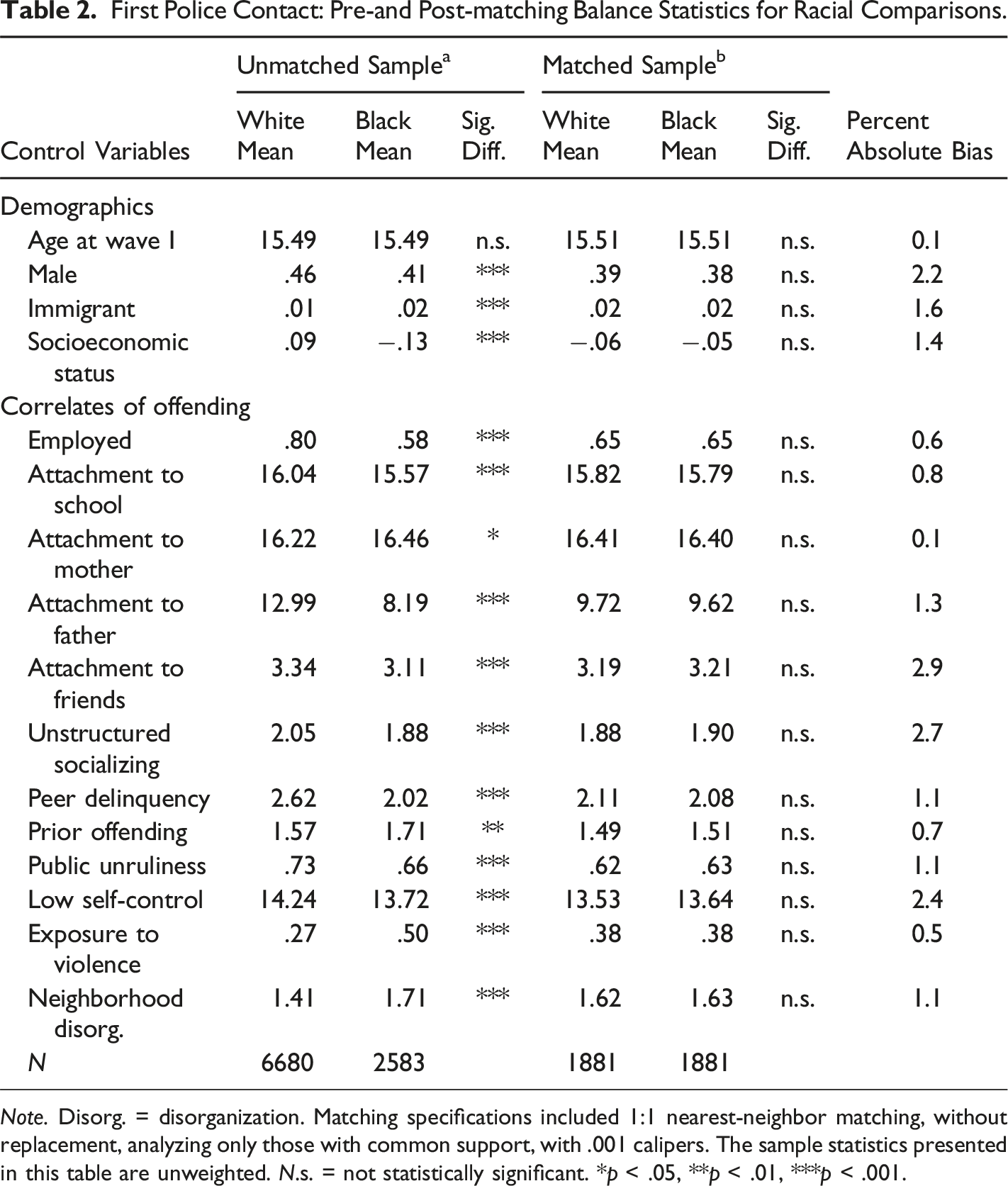
Note. Disorg. = disorganization. Matching specifications included 1:1 nearest-neighbor matching, without replacement, analyzing only those with common support, with .001 calipers. The sample statistics presented in this table are unweighted. N.s. = not statistically significant. *p < .05, **p < .01, ***p < .001.
One of the benefits of matching analyses is the ability to ensure comparability across two groups on all observed dimensions. We see evidence of this comparability between the matched samples listed in Table 2. After creating propensity scores and using them to match respondents, the matched groups of 1881 black and 1881 white respondents are almost identical across every dimension. Any remaining differences are not statistically significant.
First Arrest: Pre-and Post-matching Balance Statistics for Racial Comparisons.
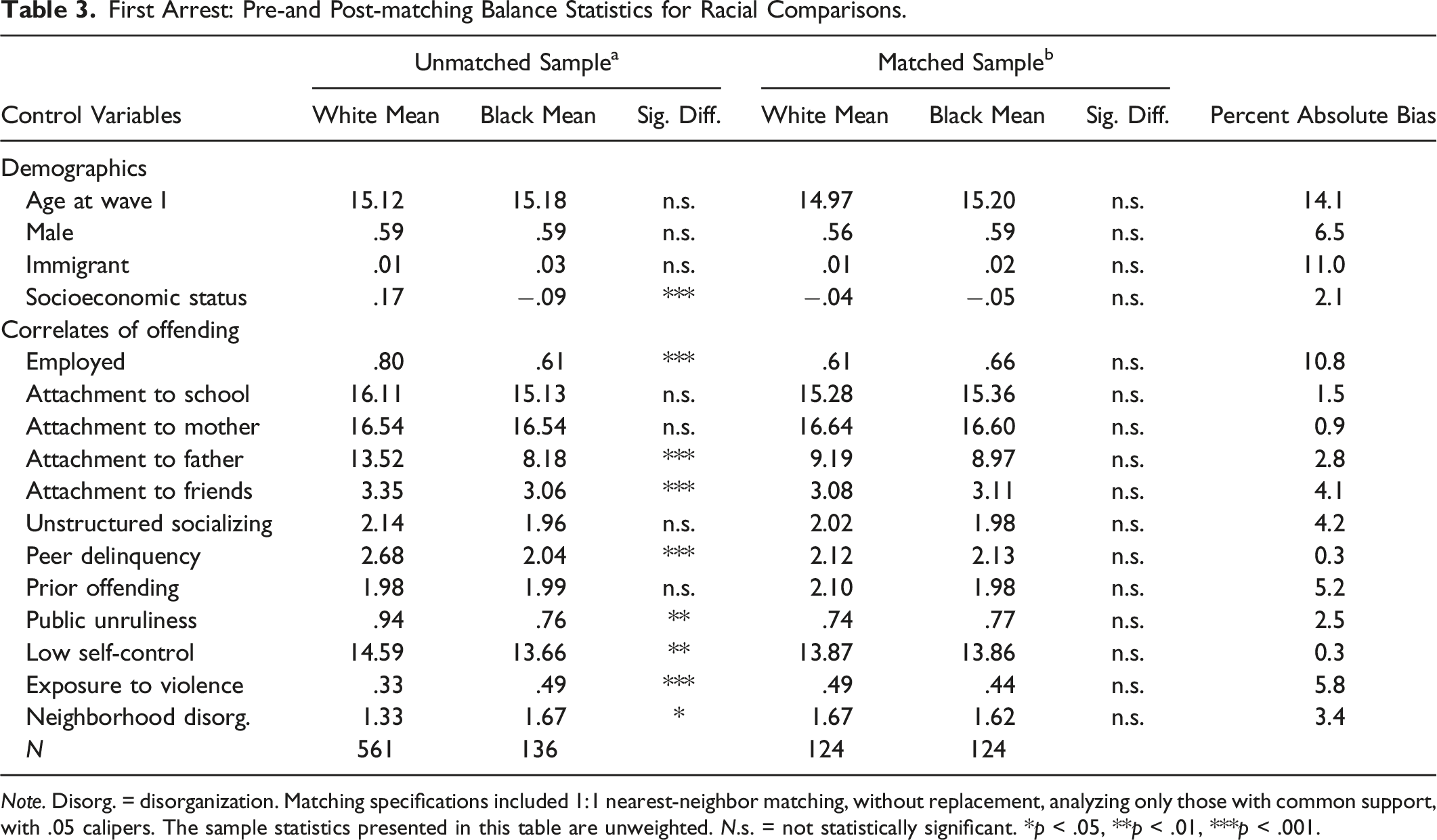
Note. Disorg. = disorganization. Matching specifications included 1:1 nearest-neighbor matching, without replacement, analyzing only those with common support, with .05 calipers. The sample statistics presented in this table are unweighted. N.s. = not statistically significant. *p < .05, **p < .01, ***p < .001.
Logistic Regression Examining Race as a Predictor of First Police Contact and First Arrest, Based on Propensity Score Matched Groups of Black and White Respondents.
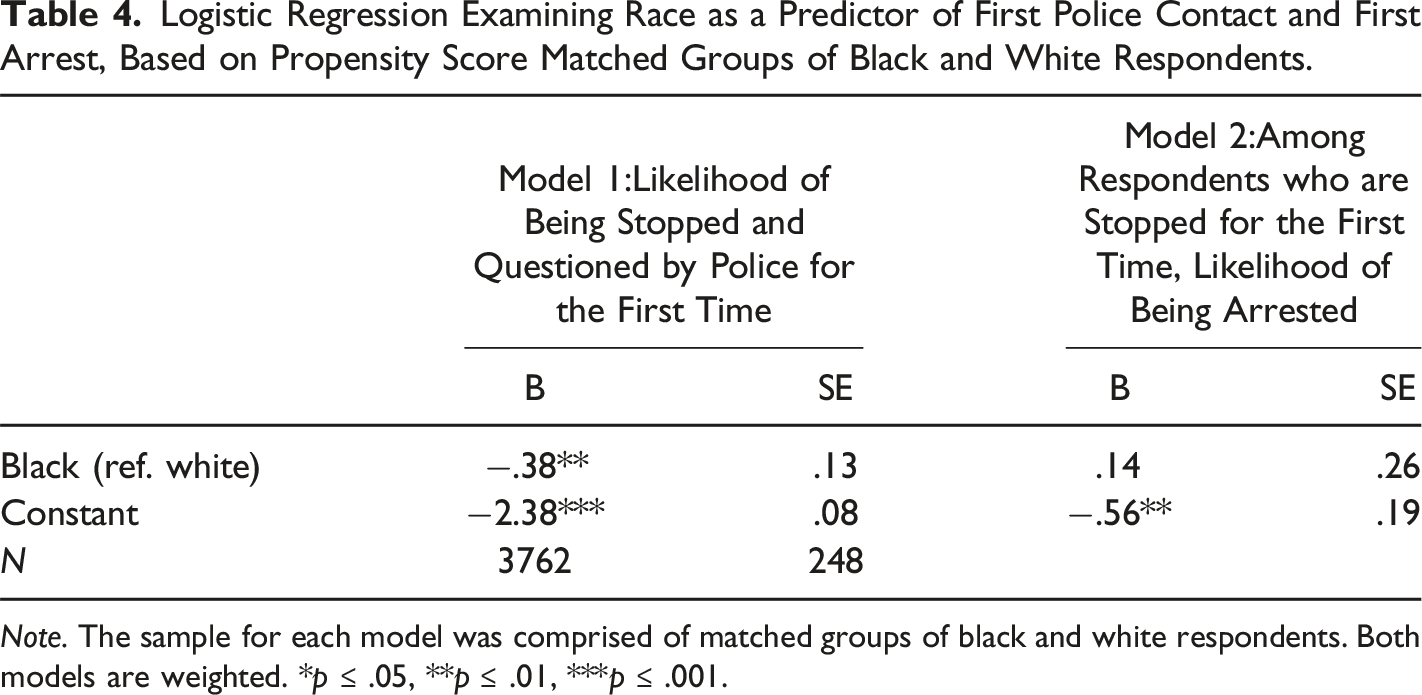
Note. The sample for each model was comprised of matched groups of black and white respondents. Both models are weighted. *p ≤ .05, **p ≤ .01, ***p ≤ .001.
Among suspects who are stopped and questioned by the police, does race influence whether they will be arrested? The second model in Table 4 answers this question by focusing on the 248 matched respondents who had a first contact. We can see that there is no statistically significant difference in arrest likelihood for black and white suspects. This finding accords with prior studies that suggest that suspect race does not influence police behavior (Bender et al., 2010; Brunson, 2007; Brunson & Weitzer, 2009; Fallik & Novak, 2012; Paoline & Terrill, 2005; Robinson & Chandek, 2000; Rosenfeld et al., 2012; Smith et al., 1984; Smith & Petrocelli, 2001). A critical difference in this study is the focus on first arrest, which finds that when the police do not have information about an individual, at least based on a prior record or any prior contacts with the suspect, they do not appear to be any more or less likely to arrest blacks as compared to whites.
Several supplementary analyses were conducted. First, these analyses were repeated using conventional regression with controls for the full unmatched sample; the pattern of results and the statistical significance levels were the same. Black respondents were significantly less likely to be stopped and questioned by police (B = −.41, p ≤ .01), but, among the stopped subsample, there was no statistically significant differences among the probability of arrest for the white or black respondents. Second, matched sample analyses that moved beyond the black-white suspect dichotomy were also conducted. These additional analyses matched white respondents with respondents who identified as black, Hispanic, Asian, or other non-white ethnicities. In logistic regression models that used the matched groups, nonwhite suspects had a lower likelihood of being stopped and questioned (B = −.19, p ≤ .05) but there were also no significant differences in arrest. Additional research with larger samples of nonwhite respondents is needed to observe differences more directly for each of the individual racial groups. Finally, several supplementary analyses that included youth with multiple police contacts and/or arrests were also conducted. These analyses consistently showed no evidence of a racial effect at either decision-making point.
Discussion
Previous scholarship has provided conflicting accounts of the effects of suspect race on police decision-making (see generally, Ferguson & Smith, 2024; Kochel et al., 2011; Sohoni et al., 2021). We argue that the influence of suspect race might be confounded by a suspect’s prior record. In fact, supplementary analyses found no evidence of any racial differences in outcomes when respondents with multiple police contacts and arrests were included. Accordingly, we disentangled these effects by focusing only on a suspect’s first police contact. We add further nuance to the discussions and accounts of racialized police outcomes by acknowledging that the decision-making processes—and the factors that influence them—may play out differently during the decision to stop a suspect compared to the decision to arrest them. Indeed, this study found that the effect of race varied for the two decision-making points under examination: Black respondents were less likely than their white peers to have a first contact with the police, but there were no differences in the likelihood of being arrested.
These findings underscore the importance of illuminating in more detail how race may vary in its influence on different criminal justice decision-making points (Caudill et al., 2013), including contact that does not involve an arrest, a central type of “justice without trial” (Skolnick, 1966) that has not been well-examined in research to date. This insight has implications that extend beyond a focus on the police. It is, for example, reasonable to anticipate that racial effects may vary in ways that are more nuanced than traditional outcomes indicate. Many sentencing studies focus only on the decision to incarcerate or not, but more refined classifications may yield insights into what this coding decision may obscure. For example, one study found that black youth were both more likely to receive punitive sanctions and to have their cases dismissed, and less likely to receive diversion (Cochran & Mears, 2015). Likewise, other studies suggest that the effect of race may vary at different points of the criminal justice system process (Caudill et al., 2013). We echo calls by other researchers for revisiting criminal justice decision-making using more granular representations of decision-making options available to law enforcement and court actors (Baumer, 2012; Zane et al., 2022).
It is notable that after removing the confounding influence of prior record, the study finds that black suspects were less likely than white suspects to self-report being stopped and questioned by police for the first time, even after controlling for various factors that might overlap with their propensity to offend or their likelihood of coming to the attention of the police. Though this finding diverges with some of the existing literature, this is one of only a few studies that focus on racial effects during a first police contact (Lau et al., 2017; Liberman et al., 2014). Indeed, our own supplementary analyses that included youth with multiple contacts found no significant race effects, suggesting the that predictors of a first contact may differ from those of a later contact. This first contact—and the way both police and the citizen interact during it—appears to be a unique decision-making point that warrants study.
The current findings suggest that Black respondents were less likely to be stopped, which appears to constitute a benefit, and thus to contradict accounts that point to systemic racism in criminal justice. That interpretation is reasonable. At the same time, given the abundance of research that points to pervasive racism in criminal justice, an alternative interpretation may be that the effect reflects a different type of discrimination, such as increased fear among police due to concerns about suspect dangerousness, less interest in intervening or helping minority populations, or a fear of how intervention may adversely affect the reputations of police officers.
This study lacks the data necessary to unpack these possibilities, but they are a critical area that future research should examine. Doing so will require going beyond what can be assessed with extant data. Studies are needed that merge official arrest record data with survey, interview, and observational data collected directly from both the police and citizens. This information should include accounts of actual offending, perceptions that the police have of citizens, concerns that they may have about different types of decisions (e.g., a stop vs. an arrest), information about the neighborhood context and neighborhood trends in arrest, and so on. An additional focus should be on creating data that can tie a particular officer decision to a particular incident to better create comparability in assessing racial differences in the probability of a stop. Following other research (e.g., Liberman et al., 2014), we controlled for offense by including measures that serve as proxies for an individual’s likelihood of offending and their likelihood of attracting police attention. A more direct measure of the offense for which they were stopped would be invaluable. In this vein, more information is needed about specific characteristics of stops, and the factors in those stops that lead to an arrest.
This study was limited by several features of the Add Health data that warrant mention. For example, the large gap between the waves of the survey meant that the controls—including prior offending—may have changed by the time the respondent reported a police contact. Although prior behavior is the best predictor of future behavior, adolescence and young adulthood is also a time of frequent change, and more recent measures of these changes may lead to more precise estimation of potential racial effects. Additional covariates—such as educational attainment and employment at the time of police contact, and other measures of more adult-oriented social bonds—were unavailable in this study but should also be considered by future researchers using other data sets. These data are also fully based on self-reports by respondents, with no information directly from the police about their decision to stop or arrest a suspect. Self-reported data may be inaccurate—especially if a respondent misunderstands a police contact or arrest, or if respondents of various races disclose contact at different rates—but neither of these possibilities can be tested with the current data. Future studies could include records checks of any formal arrests to better assess the accuracy of respondents’ self-reported police contacts. Despite the limitations of the Add Health data set, it has been used by many researchers to examine a range of adult outcomes that may be affected by various behaviors, attitudes, and environments in one’s youth. Notably, some of these studies have found evidence that, like ours, suggests racial disparities are muted or even non-existent (Beaver et al., 2013; Gase et al., 2016).
Although this study could not test the theoretical mechanisms involved with the three different perspectives, it is notable that the perspectives generate different predictions. It is also notable that the focal concerns perspective accords with predictions that police might be either more likely or, contrary to typical sentencing-focused accounts, less likely to intervene with black suspects. The essential insight here is that on the street, perceptions about dangerousness may signal not only criminality but also a risk to the lives of officers. Accordingly, we suggest a fruitful avenue of inquiry for illuminating officer decisions, and racial disparities in these decisions, lies in employing several theoretical perspectives. And we submit that renewed attention to focal concerns theory and unpacking its implications for predicting criminal justice decision-making points other than court sentencing may generate new insights.
The potential for both racial differences in offending and differences in responses to black versus white offending will continue to make it difficult to isolate precisely how race influences officer discretion and decisions to stop or arrest individuals. The present study addressed this problem by focusing on respondents’ self-reported first contact. But, of course, how race plays a role in officer decision-making vary across subsequent contacts. It, therefore, is important that future research systematically unpack this variation. Doing so will require more complex and rich data, but it will enable scholars to transcend the persistent dilemma of distinguishing offending behavior from officer perceptions in empirical accounts of police decision-making.
We see no basis for strong policy implications based on the present study. That is because there is, quite simply, a need for many more studies to identify if the observed patterns hold across other populations, settings, and sources of data. In addition, the precise policy implications would depend on the particular causal mechanisms that influence the specific decision-making points. Nevertheless, the importance of police decisions as a form of justice in their own right and as actions that may contribute to court sentencing points to the need to minimize racial disparities in officer interactions. As courts continue to address concerns about disproportionate minority contact (Piquero, 2008; Zane & Pupo, 2021), an obvious takeaway from this research is that these efforts need to occur not only within courtrooms, but also among police.
Footnotes
Acknowledgements
This research uses data from Add Health, a program project directed by Kathleen Mullan Harris and designed by J. Richard Udry, Peter S. Bearman, and Kathleen Mullan Harris at the University of North Carolina at Chapel Hill, and funded by grant P01-HD31921 from the Eunice Kennedy Shriver National Institute of Child Health and Human Development, with cooperative funding from 23 other federal agencies and foundations. Special acknowledgment is due Ronald R. Rindfuss and Barbara Entwisle for assistance in the original design. Information on how to obtain the Add Health data files is available on the Add Health website ( ).
).
Declaration of Conflicting Interests
The author(s) declared no potential conflicts of interest with respect to the research, authorship, and/or publication of this article.
Funding
The author(s) disclosed receipt of the following financial support for the research, authorship, and/or publication of this article: No direct support was received from grant P01-HD31921 for this analysis.