






Abstract
American police are often described as experiencing a public confidence crisis that affects police-civilian relationships and community safety. Erosion is sometimes ascribed to a de-policing effect, wherein negative public scrutiny limits police proactivity. However, if the public exhibits a negative attitude toward police, the public may also avoid contact with law enforcement. This paper examines this possibility by analyzing longitudinal data from the National Crime Victimization Survey (NCVS) to see if periods of negative scrutiny affect the public’s willingness to call police. Findings from an interrupted time series analysis shows crime reporting rates stayed constant over the last 30 years. But, starting in the mid-2000s, people are twice as likely to cite the police as the most important reason for not reporting a crime, predating prominent negative scrutiny events. Additional analyses show substantive changes across other demographics. Implications for theory and practice are discussed.
In 2025, the Los Angeles Police Department (LAPD) was subjected to strong public criticism after three police officers shot and killed a civilian who held a replica rifle inside of a van (Jany, 2025). Officers ordered the person to lower the weapon and exit the vehicle, but opened fire after the civilian raised the replica rifle. Community members later attended public meetings and decried the officers’ actions, stating the police should have employed better de-escalation techniques. One person later said the officers’ decision to shoot represented LAPD’s propensity for violence and cited the shooting as an exemplar for why the public no longer calls the police (Jany, 2025).
Stories like this exemplify a crisis in American police, wherein adolescents and adults express more displeasure with law enforcement and less faith in police competence (Fine et al., 2018, 2019; Peyton et al., 2019). Some allege that widespread negative sentiment contributes to a de-policing effect that inhibits police willingness to engage in proactive crime prevention efforts and, subsequently, endangers communities (Kim, 2023; Powell, 2023; Rosenfeld & Wallman, 2019; Shjarback et al., 2017). Negative public scrutiny toward law enforcement, then, threatens effective policing practices.
A similar effect may present itself in civilian populations who may display avoidance behavior toward law enforcement (Jany, 2025) to limit police contact. One might expect fewer calls to law enforcement due to police legitimacy erosion after widely publicized negative scrutiny events. Should such an effect exist, the public may not alert police to criminal activity and, consequently, hamper crime control efforts.
To explore this possibility, data from the National Crime Victimization Survey (NCVS) are used to generate national-level estimates of crime reporting to police from 1992–2023. Using an interrupted time series design, NCVS data are examined to determine if crime reporting patterns have changed, and whether the public cites police-related issues as a reason for non-contact more often. The results demonstrate that crime reporting has changed little, but police-related reasons for non-contact have doubled since the mid-2000s. A discussion of the background, methods, results, and implications of the study completes this paper.
Background
De-Policing
Law enforcement practices draw widespread public attention after notable law enforcement-involved deaths of civilians, particularly unarmed minority men. The civilian deaths (including, but not limited to, Michael Brown and George Floyd) sparked public protests across the country, directing persistent criticism toward law enforcement. News stories about injustices committed by police, coupled with invective social media posts, amplify distrust of law enforcement.
Some believed the widespread negative scrutiny could create undesirable outcomes for communities through a “de-policing” effect (Rosenfeld & Wallman, 2019; Shjarback et al., 2017). De-policing occurs when officers disengage from proactive policing practices due to adverse negative external scrutiny, which is created after notable events “such as a riot, consent decree, civil lawsuit, or high-profile deadly force incident” (Shjarback et al., 2017, pp. 43). Although negative scrutiny may highlight areas of improvement for law enforcement, it may also instill fear of making a mistake in police officers due to concerns about possible public backlash. Strong, public critiques of police may discourage proactive policing efforts and possibly endanger the public (Rosenfeld & Wallman, 2019).
Several studies suggest the presence of a de-policing effect, wherein crime appears to fluctuate after notable negative scrutiny events. For example, some research shows national-, state-, and city-level crime rates increased after Brown’s death, while others show marked increases in crime after George Floyd’s murder (Capellan et al., 2020; Kim, 2023; Powell, 2023; Rosenfeld & Wallman, 2019; Shjarback et al., 2017). De-policing does not appear to occur while an agency experiences intensive oversight from the federal government (Chanin & Sheats, 2018; Rushin & Edwards, 2016). Additional evidence of a de-policing effect is buttressed by observed declines in police proactivity during periods of negative scrutiny. Officer-level survey data suggest police officers often feel their relationship with the public has changed after key events (e.g., Michael Brown) and hampers positive police-civilian relationships (Deuchar et al., 2019; Gau et al., 2022; Marier & Fridell, 2020; Nix et al., 2018; Nix & Wolfe, 2017).
The available de-policing literature, then, provides plausible support for the idea that crime may increase after intense periods of negative public scrutiny. Police personnel may ascribe degraded civilian relationships as a reason for decreasing proactive efforts related to crime. Although a direct causal relationship was not measured in any of the cited studies, altogether the evidence points to proactivity declines and crime increases.
Civilian Avoidance of Police
Much of the prior literature emphasizes police behavior in the wake of negative scrutiny and its subsequent effects on the community. Police pullback, however, is one part of the police-civilian equation. Civilians may choose to limit contact with law enforcement due to outstanding concerns about police behavior. A choice to limit contact with law enforcement may reflect a dislike for police and, in some cases, signal one’s distrust of law enforcement to handle crime problems.
Civilian avoidance of police may appear due to ongoing fear of law enforcement actions derived from personal or vicarious experiences (Adolphs, 2008; April et al., 2022; Cintron et al., 2019; Graham et al., 2020; Miller & Vittrup, 2020; Phelps et al., 2021; Tankebe, 2010). Media portrayals of police may introduce ideas of police violence and inculcate a fear of law enforcement (Boivin et al., 2022; Intravia et al., 2020; Miethe et al., 2019; Ouss & Rappaport, 2020; Pickett et al., 2022; Ralph, 2022; Simckes et al., 2021; Simmons, 2017; Weitzer & Tuch, 2004a, 2004b). Exposure to media content depicting police misbehavior may lead to civilian reappraisal of law enforcement attitudes (e.g., police legitimacy) and impact civilian behavior (Graziano, 2019; Tankebe, 2010). This effect may be especially salient for people who are exposed to widespread and abundant media coverage of negative police behavior and result in the overestimation in the frequency of high-profile police misconduct issues (Chermak et al., 2006; Dowler & Zawilski, 2007; Graziano, 2019; Roche et al., 2016). Access and consumption to this material may downgrade one’s attitudes of police and stimulate distrust in law enforcement actions.
Legitimacy and Civilian Cooperation
From a philosophical point of view, the police and public should work together to co-produce crime prevention strategies to safeguard communities (Goldstein, 1979). Under this framework, the police are a part of the public, and through the establishment of trust, one can induce “policing by consent” (Hanway & Hambly, 2023; Home Office, 2012). Policing by consent emphasizes the importance of law enforcement to demonstrate prowess through crime reduction (not police actions), cultivating public trust through fair application of the law, and accepting that favorable public opinions grant legitimacy to law enforcement actions (Hanway & Hambly, 2023; Home Office, 2012). Without strong, close connections with the public, the police compromise their legitimacy and, by extension, their effectiveness (Jackson et al., 2012).
A wide body of literature suggests public cooperation (e.g., compliance, cooperation) increases with law enforcement if the public perceives police as fair and legitimate in their authority (Bottoms & Tankebe, 2012; Mazerolle et al., 2013a; Sunshine & Tyler, 2003; Tankebe, 2010; Tyler, 2003). Law enforcement actions and behavior perceived as unfair and unlawful erode police legitimacy and correspond with less compliance and cooperation. Research in this area often examines how one can build legitimacy by following procedural justice principles (e.g., remaining neutral, giving civilians a voice, communicating trustworthy motives, and treating people with respect) during civilian encounters (Bottoms & Tankebe, 2012; Mazerolle et al., 2013a, 2013b; Tankebe, 2013). Employing these tactics can smooth over hostility during police-civilian encounters and encourage civilian cooperation and compliance. Taking these steps, then, can better police-civilian relationships and improve the co-production of crime prevention.
A separate area of research delves into the primary factors that erode legitimacy and complicate law enforcement’s ability to secure compliance and cooperation. Encounter eroders include police officers speaking in a disrespectful tone, not explaining decision-making or actions to a civilian, or using force in an abusive manner (Engel, 2005; Gerber & Jackson, 2017; McLean, 2020, 2021; Reisig et al., 2018; Tankebe, 2013; Tyler, 2003, 2004). Evidence from adolescent respondents shows that each negative interaction possesses the power to alter one’s idea of police for a prolonged period, and it may take several years or many possible positive encounters to combat the negativity of a poor engagement (Fine et al., 2018, 2019).
In most situations, the police are advised to use procedural justice principles during civilian interactions. However, despite over 50 million encounters between the police and public each year (Tapp & Davis, 2022), not everyone will encounter the police, and if they do, not all will have a positive interaction. A lack of public contact inhibits law enforcement’s ability to establish a positive encounter built on procedural justice as there is no opportunity for the police to practice those tactics. Instead, one’s idea of police may be informed more through vicarious experience.
Media advertisement of police violence or other misconduct may function as a facilitator of legitimacy erosion. Although one may not have direct contact with law enforcement, one’s vicarious exposure to law enforcement abuses does increase (Cintron et al., 2019; Tankebe, 2010). Police violence viewed as unnecessary, cruel, or inhumane may downgrade legitimacy evaluations and limit civilian cooperation with law enforcement.
One might expect civilians to cooperate less with police through crime-reporting patterns after periods of intense negative scrutiny (McLean et al., 2024; Tyler, 2003, 2004). The most notable cases of negative scrutiny toward police often feature unlawful use of force, which may illustrate an image of police dangerousness. Empirical evidence suggests people are less inclined to call the police after significant stories showcase law enforcement brutality (Bates et al., 2024; Desmond et al., 2016; Drolc & Shoub, 2024; Laniyonu, 2022; McLean et al., 2024).
Although one might suspect crime reporting to decrease after prominent negative scrutiny events, people may call the police, even if they are disinclined to do so (Lum et al., 2022; Rouhani et al., 2025; Zoorob, 2020). 911 systems are ubiquitous in the United States, and there are few alternatives to law enforcement when one becomes a crime victim (Lum et al., 2020, 2022; Rouhani et al., 2025; Uding et al., 2024). A lack of reporting or emergency service options forces one to call the police (even if they are unwelcome). Prior research, however, shows police-cited nonreporting trends in major metropolitan areas may have decreased over time (Xie et al., 2024). Although there are competing expectations of a possible effect, the crime reporting and de-policing literature allows one to hypothesize:
Crime reporting should decrease after negative scrutiny events.
Regardless of actual crime reporting trends, one might expect prominent negative scrutiny events to shape public attitudes. Widespread media coverage that highlights unlawful law enforcement behavior, whether through racial profiling, invasive searches and seizures, or abusive use of force, augments one’s view of police and may predispose people to believing the police are corrupt, incompetent, and/or otherwise untrustworthy (Nix et al., 2017; Roche et al., 2016; Weitzer, 1999, 2015; Weitzer & Tuch, 2004b). Should this effect occur, one might expect the public to exhibit law enforcement avoidance from an attitudinal perspective.
In particular, the analytical focus should change to understand why people do not report crimes to the police. Although myriad reasons for non-reporting exist (e.g., fear of reprisal, could not identify an offender), the public may also indicate one’s beliefs about the police contributed to a non-reporting decision (Knoth & Ruback, 2019; Ruback et al., 1984; Xie & Baumer, 2019). Assuming one’s attitudes toward police are shaped by negative public opinion, one may state that a lack of faith in law enforcement shaped their non-reporting decision (Xie et al., 2024). Therefore, the literature on civilian avoidance of police, crime reporting, and de-policing suggests:
After negative scrutiny events, people should cite the police more often as a reason for non-reporting.
Outside of crime type differences, demographic changes in crime reporting are also worth examination. Communities of color often report poor police experiences, greater law enforcement stress, and an inclination to avoid law enforcement contact (Alang et al., 2022; April et al., 2022; Carr et al., 2007; Cintron et al., 2019; DeVylder et al., 2017; Giuffre & Huebner, 2023; McCarthy et al., 2020; McLeod et al., 2020; Miller & Vittrup, 2020; Pickett et al., 2022), so one might not expect profound changes in police reporting attitudes from these groups. However, a new law enforcement disillusionment effect may grow for White Americans as media coverage of police misconduct increases (Pickett et al., 2022; Roche et al., 2016), which may partially explain shifts in police-centered reasons for non-reporting.
Outside of race/ethnicity differences, one may also expect age-related gradation with respect to crime reporting. Younger people tend to avoid contact with the police (Xie & Baumer, 2019) often due to a distrust of law enforcement (Fine et al., 2019; Sunshine & Tyler, 2003; Tankebe, 2013) and a proclivity to limit law enforcement exposure. Older people tend to trust the police more and are more likely to call the police for assistance with crime-related issues (Xie & Baumer, 2019). However, during periods of negative scrutiny, one might expect younger and older people to cite concerns about law enforcement when making non-reporting decisions. Any observed effect should stem from widespread concerns about law enforcement activity due to protests about police power papering media discourse spaces.
One may also expect a general aggravating effect across gender. Although the decision to report a crime tends to be larger for female victims (Xie & Baumer, 2019), the reasons for non-reporting may shift in the context of negative scrutiny events. Large protests condemning police misconduct draw widespread attention and should impact anyone’s views of law enforcement, regardless of gender identity. Thus, after consulting the literature on de-policing and crime reporting, the following hypotheses were formed:
After negative scrutiny events, White Americans should be more likely to cite the police as a primary reason for non-reporting
After negative scrutiny events, all age groups should be more likely to cite the police as a primary reason for non-reporting
After negative scrutiny events, men and women should be more likely to cite the police as a primary reason for non-reporting
Current Study
Given the important linkages between one’s idea of police and basic cooperation with law enforcement, this paper considers three research questions: (1) have crime reporting rates changed after negative public scrutiny events? (2) are people more likely to cite the police as a reason for not reporting a crime? and (3) do police-cited reasons for nonreporting differ across age, sex, and race/ethnicity?
Data and Methods
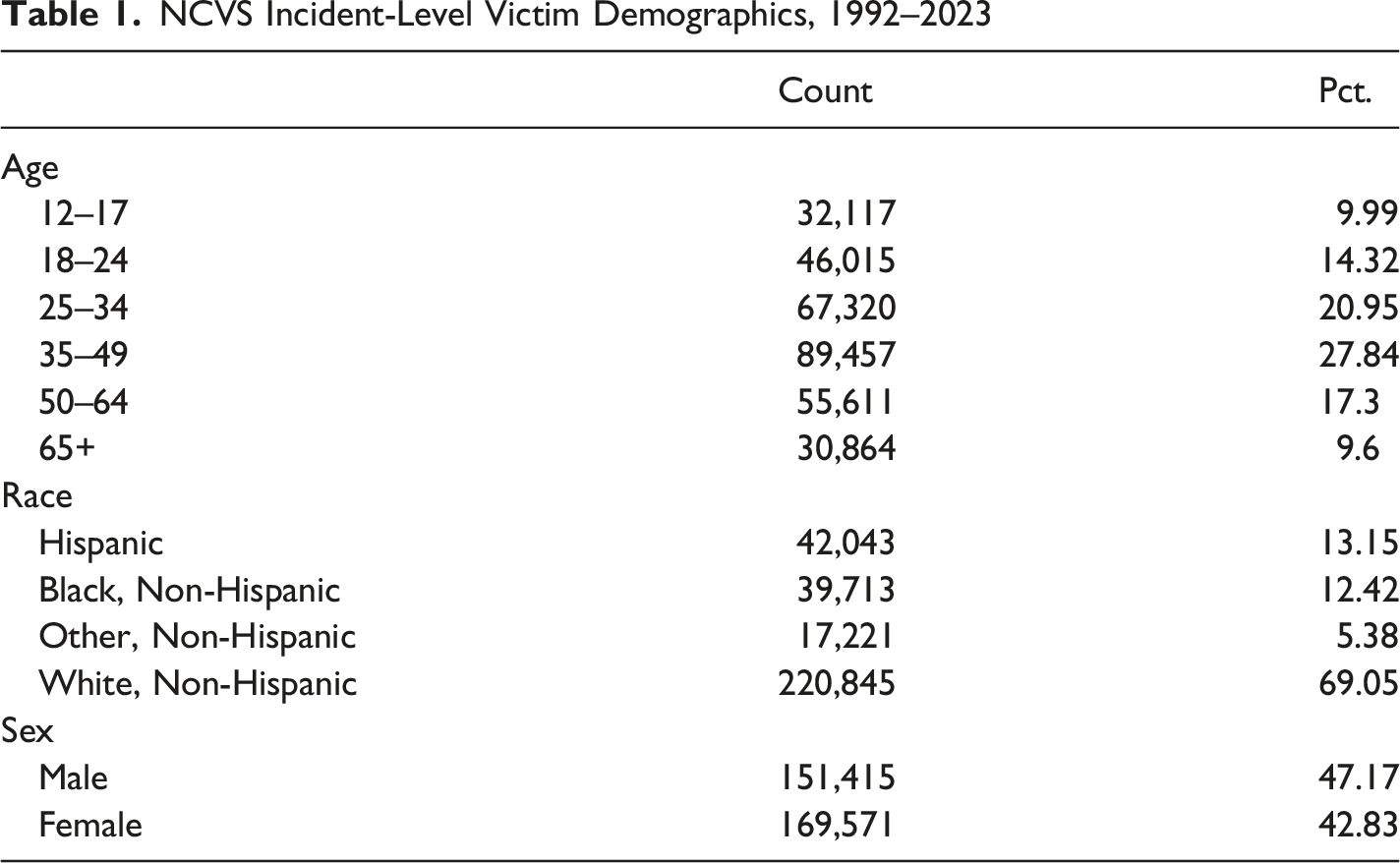
Data from the 1992-2023 NCVS (BJS, 2024) are used to create nationally representative time series of the public’s crime reporting decisions. The NCVS uses multi-stage cluster sampling to interview respondents (age 12 or over) within households. Respondents are kept in the panel for three years and answer questions from survey staff every six months. Weighted data from the NCVS allow one to infer about national-level trends in personal and property victimization and crime reporting (Baumer & Lauritsen, 2010; Lynch et al., 2025).
Over the life of the NCVS, the federal government has changed the collection method for the survey to improve data quality and manage costs (Cantor & Lynch, 2005; Langton et al., 2017; Lynch et al., 2025; Truman & Morgan, 2025). Since 1992, the NCVS has used paper-and-pencil interviewing (PAPI), computer-assisted telephone interviewing (CATI), and computer-assisted personal interviewing (CAPI). The pandemic also modified NCVS data as the government used a mix of techniques to guard against COVID-19 infection, with most interviews occurring over the telephone (Morgan & Thompson, 2021). Changes in survey mode may influence estimates in subtle ways over the life of the survey, so one should bear this effect in mind when evaluating the results.
Using these data, one can create annual-level time series to track emerging trends in crime victimization reporting during periods of negative scrutiny which allows one to conduct an interrupted time series analysis (Shadish et al., 2002). As outlined in the de-policing literature, negative scrutiny may occur during pronounced periods of police criticism through public protests (Kim, 2023; Rosenfeld & Wallman, 2019; Shjarback et al., 2017), with recent scholarship suggesting the biggest instigators of law enforcement criticism happened after the deaths of Michael Brown or George Floyd (Capellan et al., 2020; Kim, 2023, 2024; Powell, 2023; Shjarback et al., 2017). Therefore, one might expect breaks in police-cited non-reporting to occur after these events.
NCVS Incident-Level Victim Demographics, 1992–2023
Measures
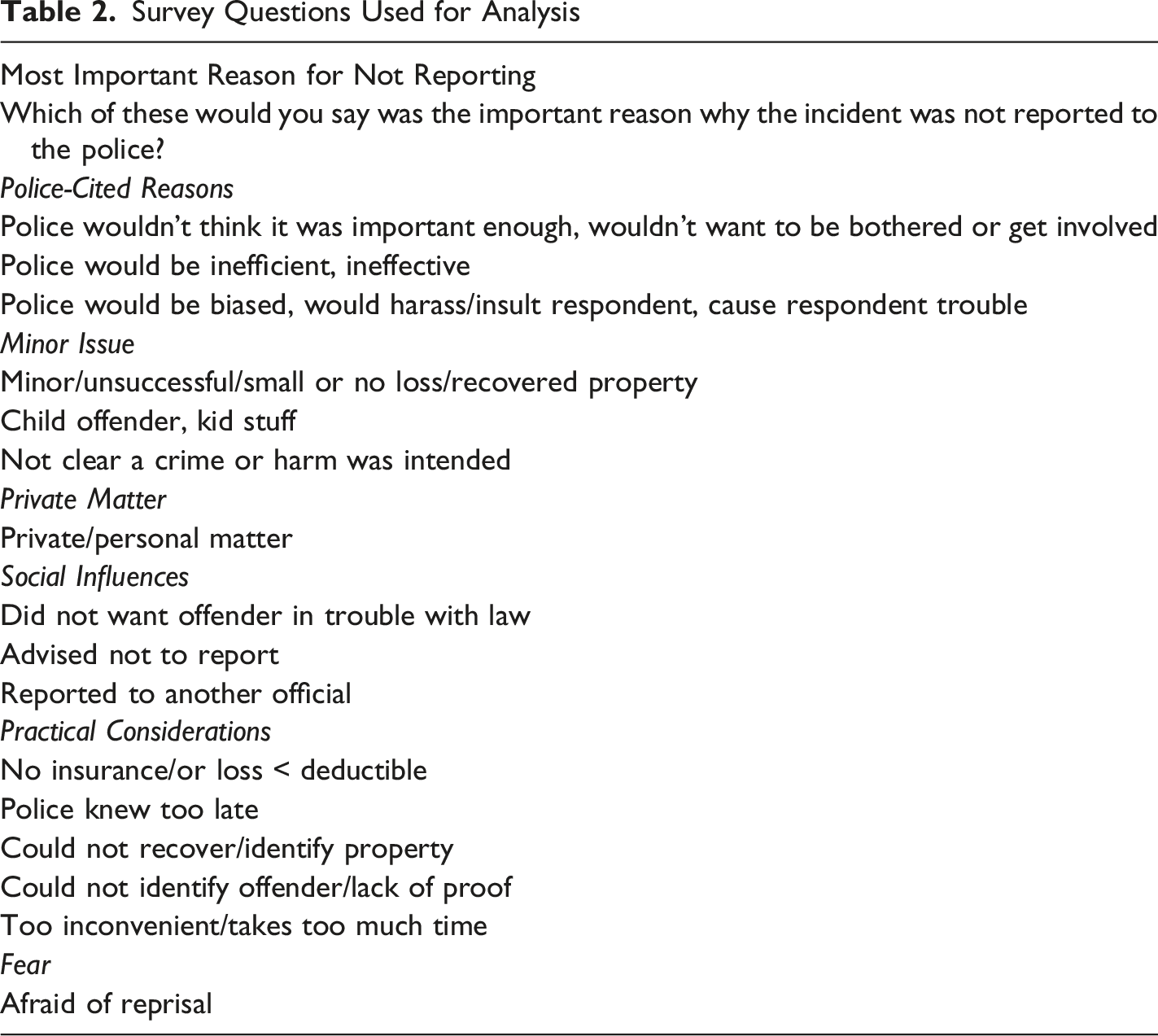
In line with the hypotheses, two primary measures are used for analysis. First, as a measure of baseline civilian behavior, the Report Rate was created from responses that asked whether the police were notified of a crime and represents the share of reports divided by the sum of reports and non-reports. Second, Police-Cited Non-Reporting is measured by examining non-reported incidents that indicated the police were the most important reason for not reporting a crime to law enforcement. These include respondents stating the police are ineffective, biased, or would not bother with a crime. Police-related non-reporting answers were summed together and divided by the non-reporting rate to represent the share of law enforcement-aligned non-reporting reasons.
Survey Questions Used for Analysis
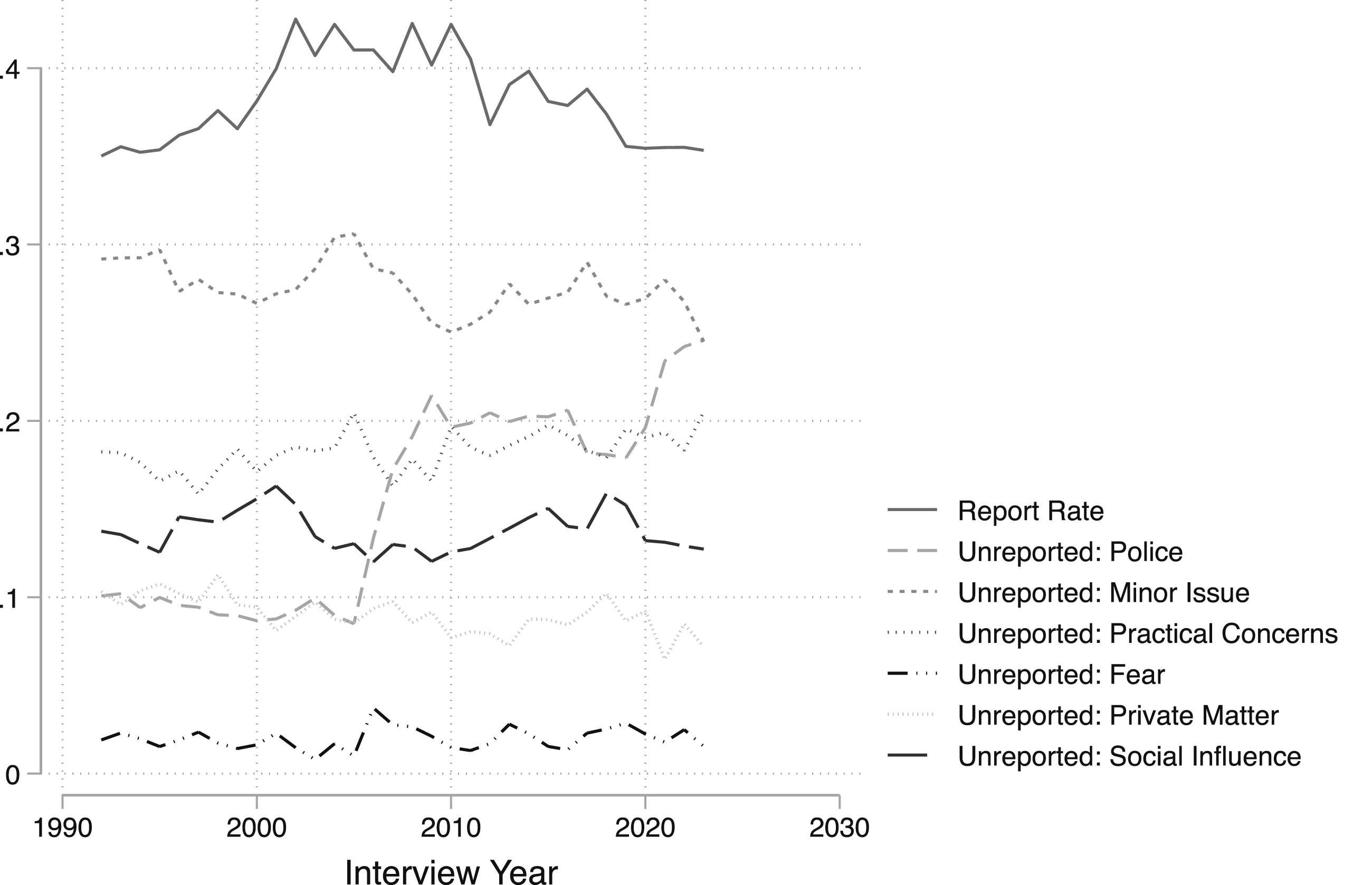
Reporting rates and reasons for non-reporting in the NCVS, 1992–2023
Analytical Method
An interrupted time series analysis was conducted by examining changes in the mean level of reporting over the time series (Andrews, 1993; Quandt, 1960). Using this method allows one to search for specific dates where police-cited reporting changed. As noted before, changes in police-cited non-reporting may occur near the deaths of Michael Brown and George Floyd (Capellan et al., 2020; Kim, 2023; Powell, 2023; Rosenfeld & Wallman, 2019; Shjarback et al., 2017). The method outlined by Andrews (1993) and Quandt (1960) was chosen because it works relatively well with short time series (such as the NCVS, post-revision). The data and code used for the analysis are available online (Powell, 2026).
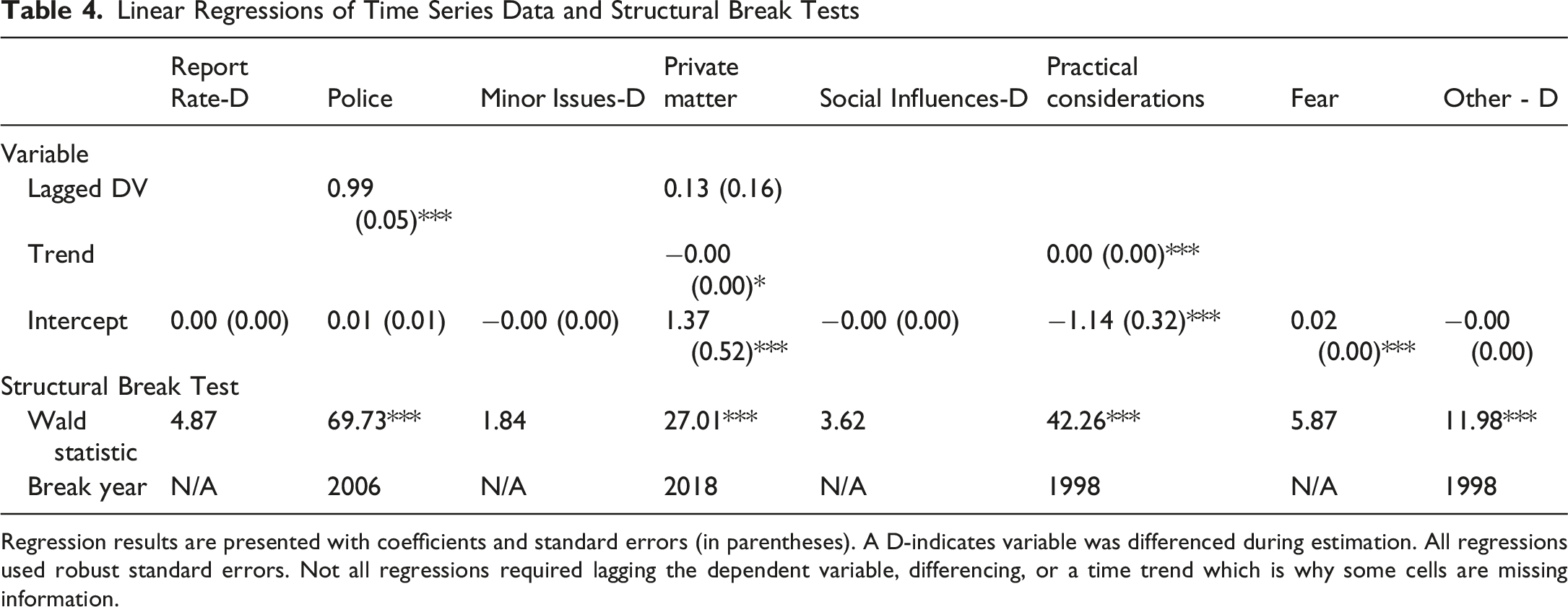
Before analyzing the data, each time series was plotted and examined for stationarity and autocorrelation issues. Standard tests (e.g., Dickey-Fuller, Phillips-Perron, and Zivot-Andrews) were used to assess possible stationary issues, and autocorrelation and partial autocorrelation plots were examined for autoregressive behavior. Time series were differenced (if needed), regressions included lagged dependent variables if autocorrelation was an issue, and a linear time trend was also included if a deterministic trend was present. Test results are presented in Table 2. Linear regression with robust standard errors was used for estimation, and structural breaks were detected using the Quandt (1960) and Andrews (1993) methods.
Results
Stationarity Tests for Time Series
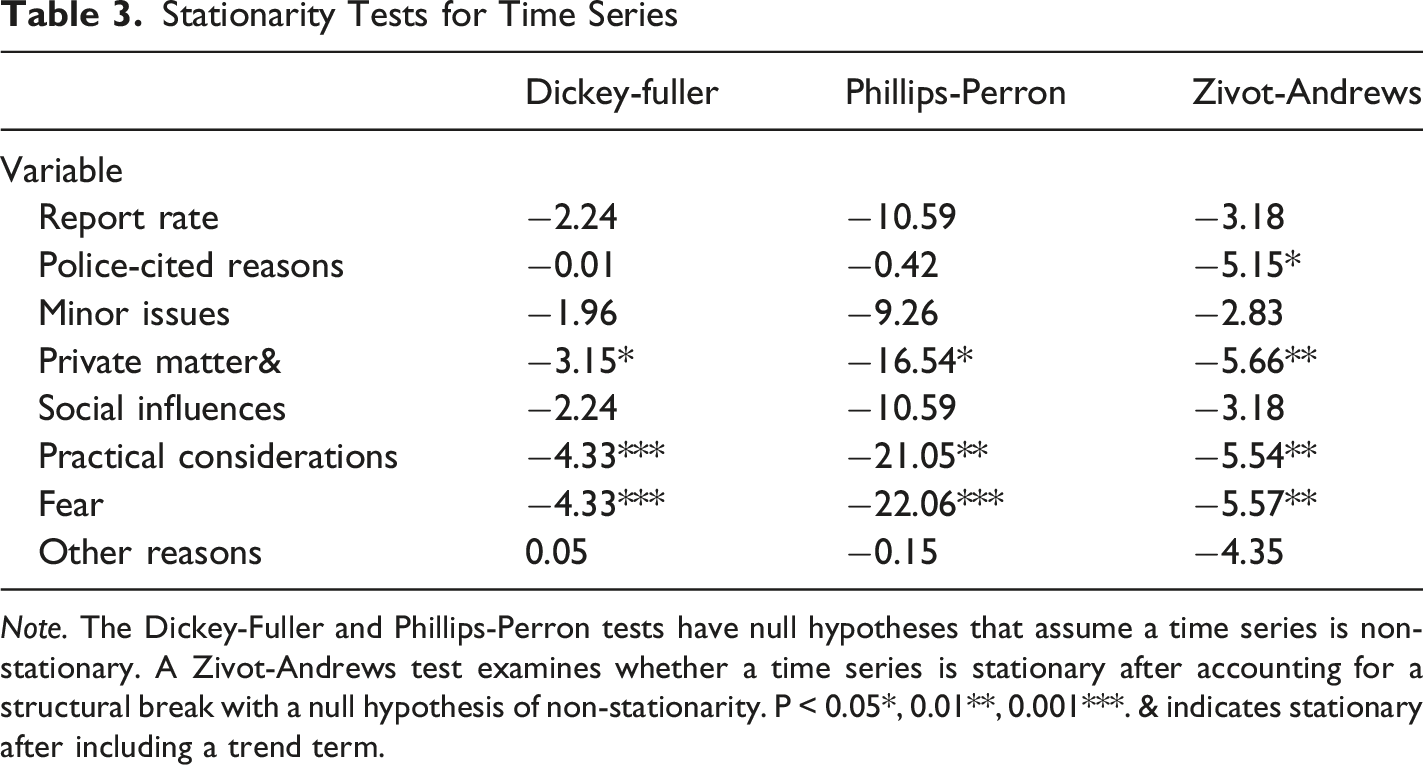
Note. The Dickey-Fuller and Phillips-Perron tests have null hypotheses that assume a time series is non-stationary. A Zivot-Andrews test examines whether a time series is stationary after accounting for a structural break with a null hypothesis of non-stationarity. P < 0.05*, 0.01**, 0.001***. & indicates stationary after including a trend term.
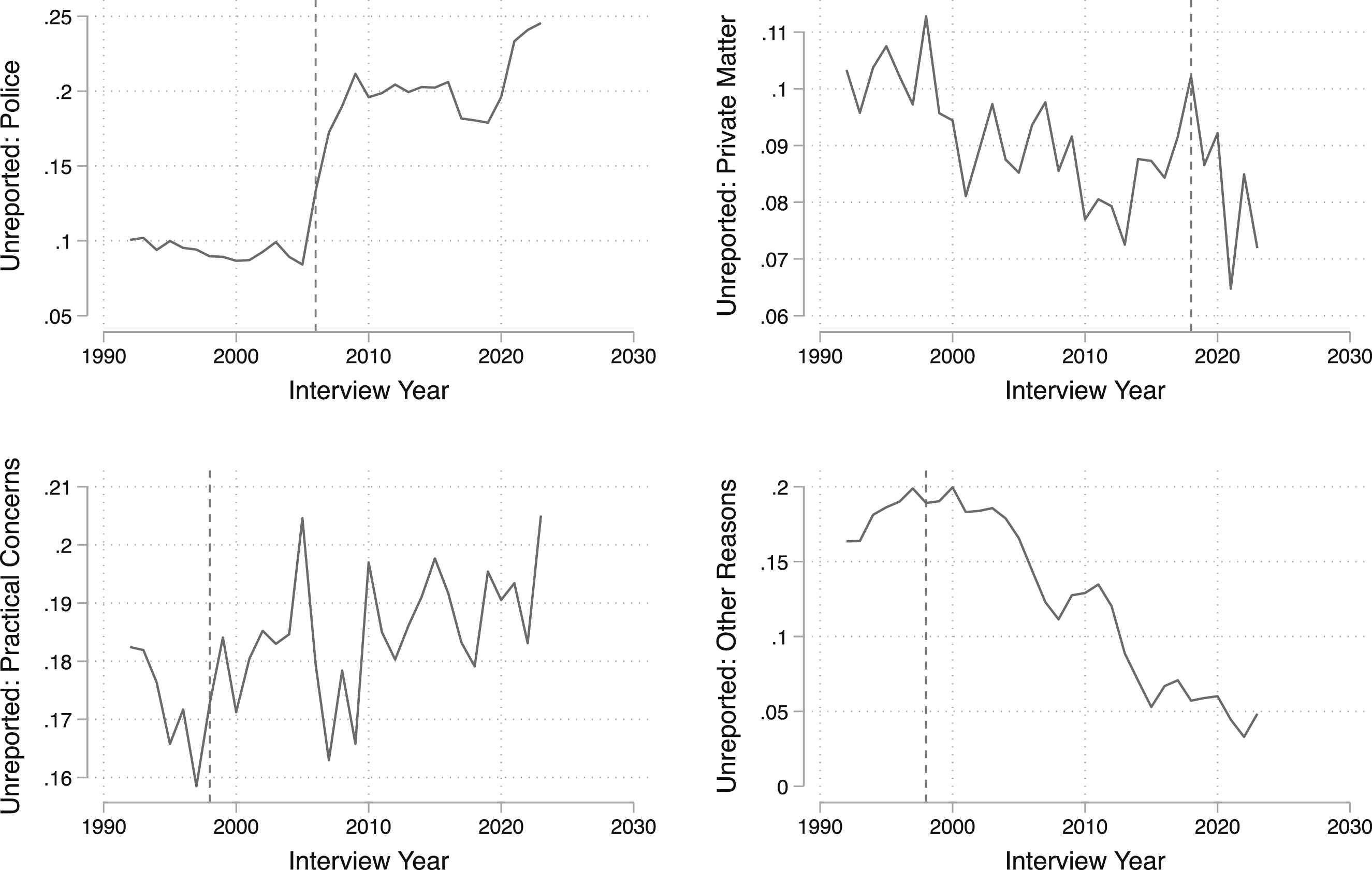
Police-cited, private matter, practical considerations, and other reasons for non-reporting, 1992–2023
Private matters are on a downward trend, and a break is predicted in 2018 (although 8-9% people say this was the most important reason for non-reporting). Around 18% of people cite practical concerns as the most important reason for non-reporting (and has stayed around that level since the late 1990s). Contrary to expectations, changes in police-cited reasons predate major negative scrutiny events, and have doubled since the mid-2000s. People are also less likely to cite “other reasons” for non-reporting.
Prior to the mid-2000s, 10% of people stated the police were the biggest reason why they chose not to report, but now one in five (20%) say that was the most important reason for non-reporting. It is remarkable that the time series has not regressed to a lower value, and that this effect is prevalent in the policing series alone. Put another way, police-cited reasons for non-reporting across the nation have worsened and shown no signs of improvement for about 20 years, even though reporting rates for crime victimization have not substantially changed in the same time span.
The previous figures and analyses focus on police-cited reasons for non-reporting across all offenses. One might argue that the public does not report certain crime types to the police, but otherwise believes the police are competent to handle problems. For example, some literature demonstrates that one may be more likely to call the police for less serious crimes if one perceives the police well (Garofalo, 1977; Xie & Baumer, 2019). As a sensitivity check against crime type issues, the police-cited reasons for non-reporting across crime type (property, violent, and violent crimes excluding simple assaults) and plotting the series in Figure 3 (regression results and stationarity tests are available in the Supplemental Appendix). Although the reporting rate patterns across each crime type are visually similar to the aggregated ones mentioned earlier, property crimes are the only time series with statistically significant differences in police-cited non-reporting over time. Structural break in police-cited nonreporting reasons for property crimes, 1992-2023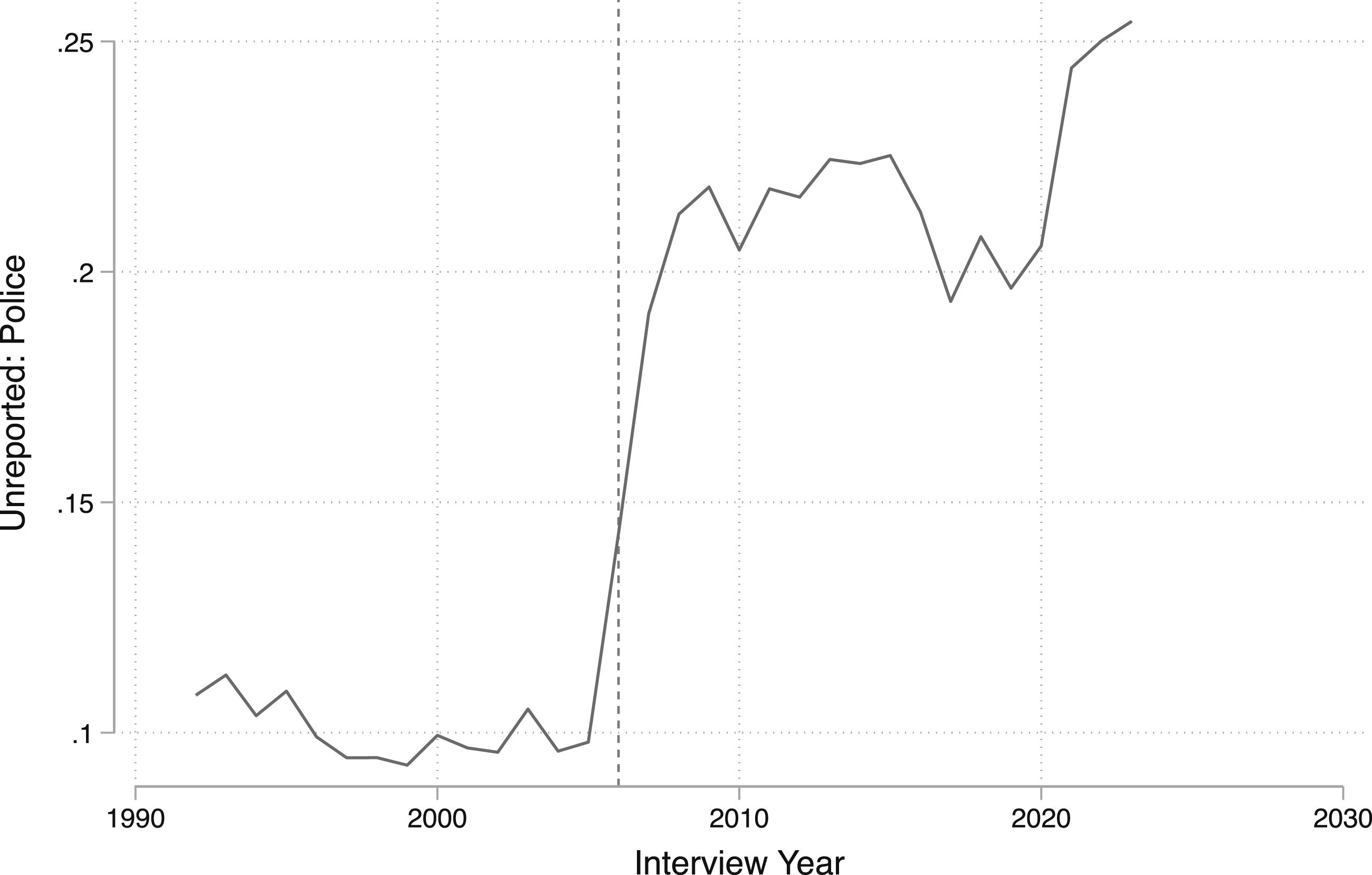
Differences Across Age, Race, and Sex
The previously reported analyses focus on general crime reporting patterns without disaggregating by important demographic subgroups that may show different police-cited reasons for non-reporting. In the interest of space conservation, the bulk of the tables and figures supporting the additional analyses are presented in the Supplemental Appendix. Highlights of the analyses are presented in the rest of this section.
Age
Using age categories used by the Bureau of Justice (Tapp & Coen, 2025), a few patterns emerged from the data. Results from interrupted time series analyses show that certain age groups were more likely to cite the police as the most important reason for not reporting a victimization. Statistically significant results were found in younger respondents (12–17, 18–24, and 65+), and estimated breaks are shown in Figure 4. Panels without vertical lines are shown for comparison, but do not have statistically significant breaks in police-cited non-reporting. Structural breaks in police-cited nonreporting reasons across age categories (12–17, 18–24, 65+), 1992-2023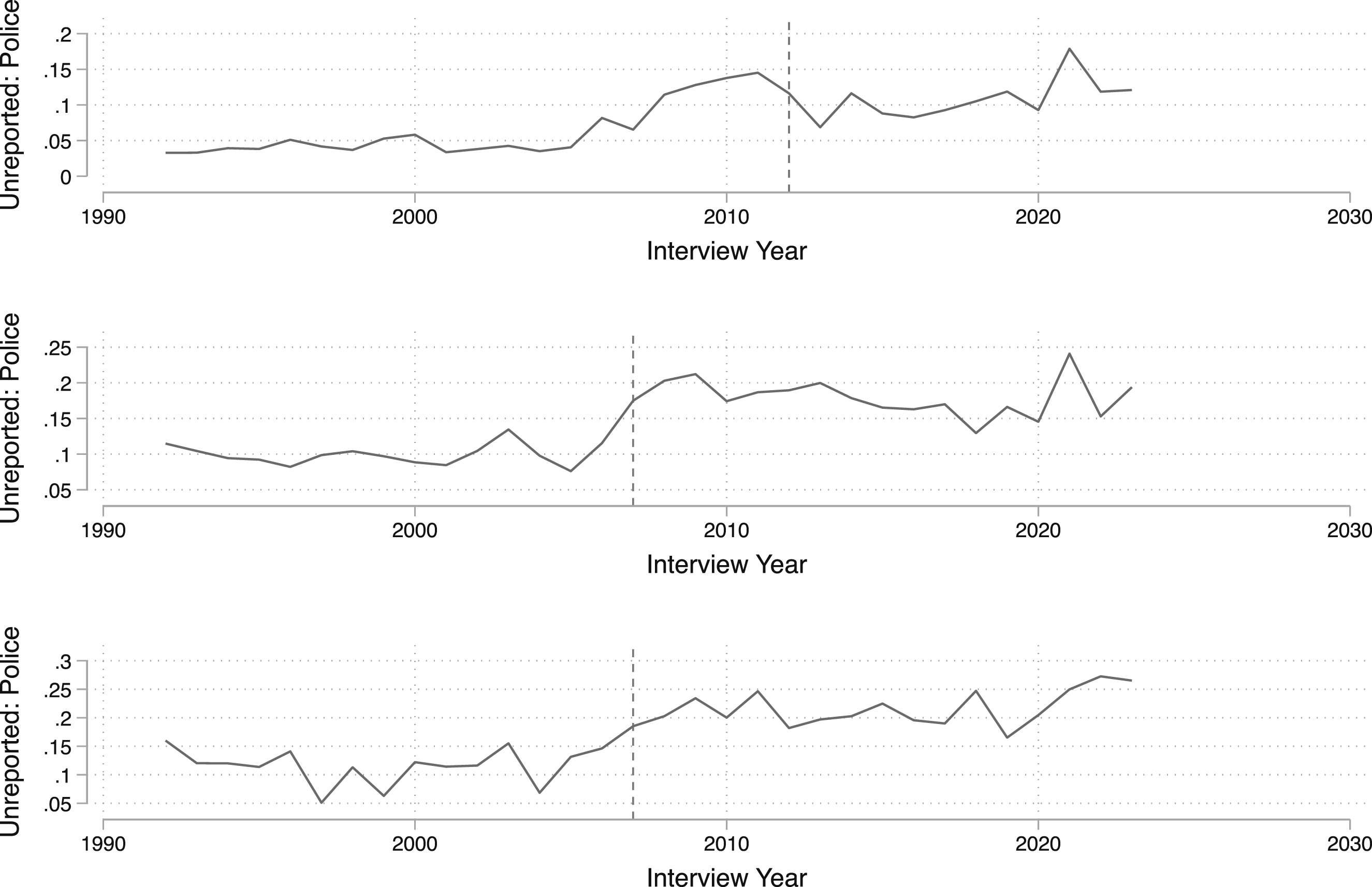
Race
Figure 5 shows the results of statistically significant patterns in police-cited non-reporting across race. As shown in the graph, Black, Non-Hispanic and Other, Non-Hispanic people were more likely to indicate the police as the most important reason for not reporting crime relative to Hispanic and White, Non-Hispanic respondents. Similar to the main analyses, this break appears in the mid-2000s. Structural breaks in police-cited nonreporting reasons across race categories (Black, Non-Hispanic and Other, Non-Hispanic), 1992–2023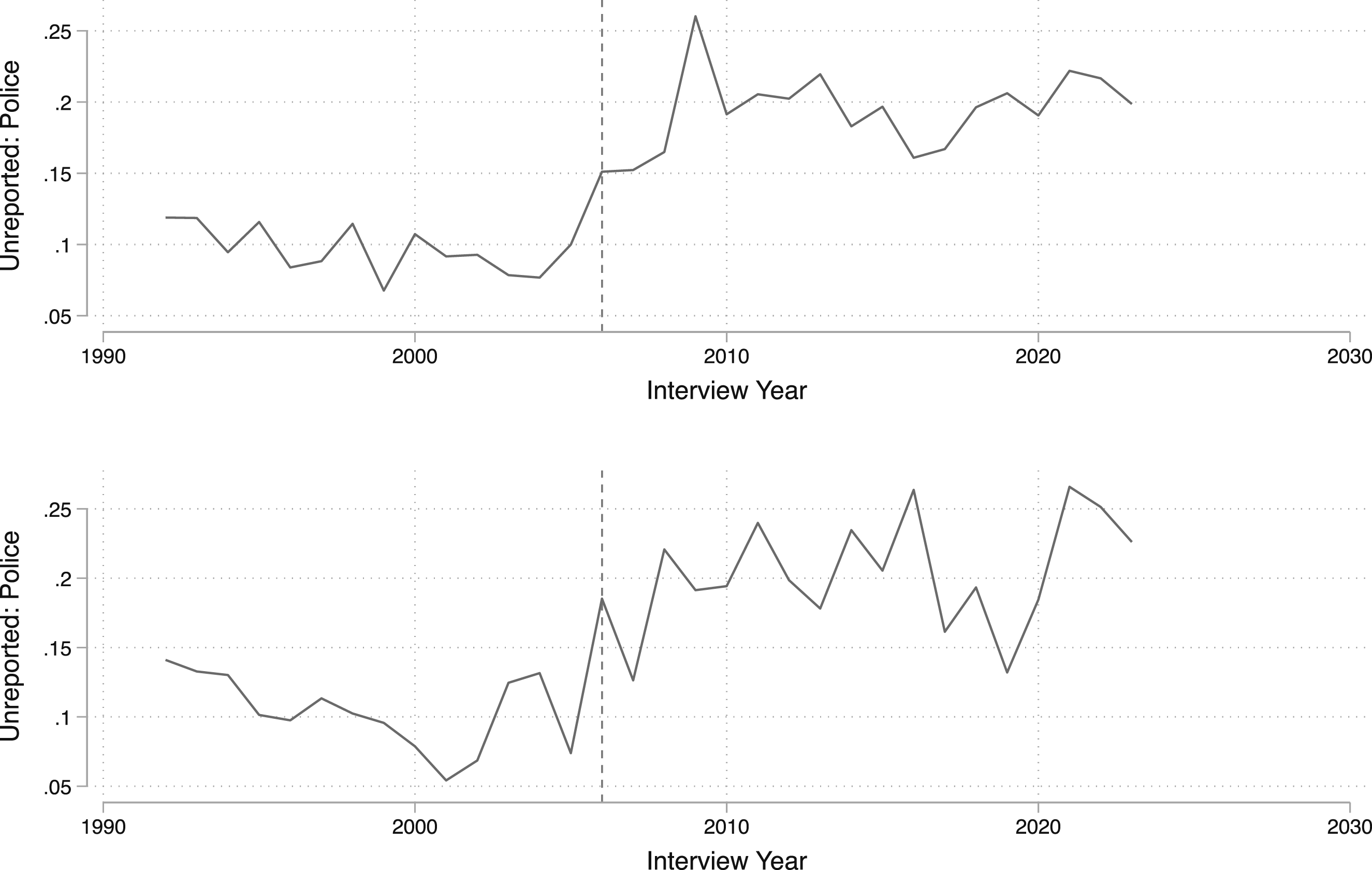
Sex
Finally, Figure 6 shows police-cited non-reporting differences between male and female respondents. According to the statistical analysis, female respondents have not experienced a statistically significant change in police-cited non-reporting reasons. However, male respondents experienced a shift in this area, with a notable break shown in 2006. Structural breaks in police-cited nonreporting reasons for male respondents, 1992–2023 Linear Regressions of Time Series Data and Structural Break Tests Regression results are presented with coefficients and standard errors (in parentheses). A D-indicates variable was differenced during estimation. All regressions used robust standard errors. Not all regressions required lagging the dependent variable, differencing, or a time trend which is why some cells are missing information.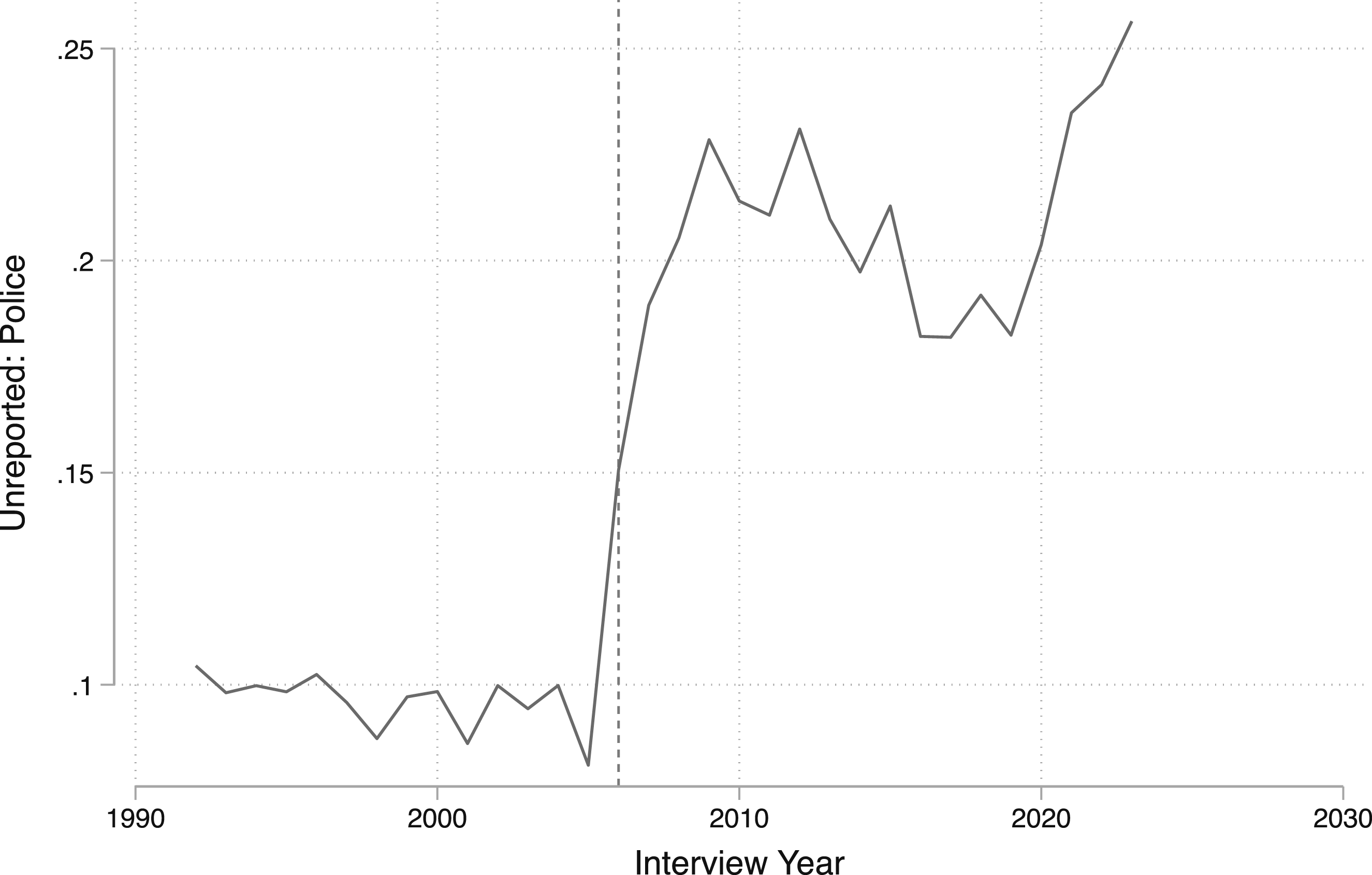
Discussion
Not everyone may like the police, but calling the police to report a crime represents a basic trust exercise in law enforcement’s ability to address a civilian’s concerns about criminal activity. This paper demonstrates that there are no substantive changes in crime reporting behavior - people still call the police, reporting crimes at a similar rate over time. However, survey takers are twice as likely to cite concerns about law enforcement as the primary reason for non-reporting and, notably, this has persisted for the last twenty years. This translates to about 20% of people do not report a crime to police because of law enforcement.
After disaggregating by age, offense type, race, and sex, one can find similar effects across demographic groups. Notably, male respondents, younger people, and Black, Non-Hispanic and Other, Non-Hispanic, and victims of property crime roughly doubled their likelihood of stating the police were the most important reason for not reporting their victimization. The observed effects predate the deaths of Michael Brown and George Floyd which was contrary to expectations.
As noted before, this effect is somewhat surprising as this shift in public confidence occurred before some of the most recent police misconduct stories in America (e.g., Michael Brown, George Floyd) which have been widely studied (Capellan et al., 2020; Kim, 2023, 2024; Powell, 2023; Rosenfeld & Wallman, 2019; Shjarback et al., 2017). Coupled with the initiation of the change, the effect appears permanent and persistent over time with no sign of regression to a lower value. These data, then, suggest a long-standing new norm for non-reporting reasons.
Using an interrupted time series approach allows one to build upon prior literature that focuses on trends of crime nonreporting (Xie et al., 2024). Moreover, the emphasis on national-level time series estimates that cover the last thirty years and other non-reporting reasons allow one to assess whether any observed effect is unique to policing or is part of a broader trend in reason shifting. And, as shown by the analysis of age, sex, and race/ethnicity trends, the police-cited nonreporting trend appears across various demographics. Thus, the study adds to a growing evidence base that shows substantive changes in the reasons for not calling the police (even though people call the police at a similar rate).
As with any survey, one should evaluate whether responses reflect the true views of survey takers or if some external force changes public opinion. One might assume a social desirability bias made police disillusionment a fashionable choice for stating why someone did not report a crime. However, even if many responses are driven by a social desirability bias, the persistent citation of police-related reasons for non-reporting over the last 20 years is still remarkable.
The reporting rates offer an opportunity to unpack why the trends appear this way. One possibility lies in the public’s overreliance on police to address a growing array of issues (Lum et al., 2022; Rouhani et al., 2025). Calling the police has become easier with increased access to mobile phones in the United States, which enables the public to call anytime from anywhere (Lum et al., 2020, 2023). Further, the advent of security systems placed in homes and businesses has pressured police to attend to burglar alarms, creating a new demand on police resources to respond to outstanding security alerts (Farrell et al., 2011, 2014). Public disbelief in police caring about crime, or law enforcement’s ineffectiveness to address offending, may reflect the implicit recognition of law enforcement’s resource scarcity problem and inability to address all civilian concerns.
The growing discontent with police as it relates to crime reporting presents an opportunity to examine other public responses to police behavior. For example, a large body of research emphasizes the need for the police to work with the public to solve crime problems and foster strong community relationships (Braga et al., 2015; Gill et al., 2014; Goldstein, 1979, 1987; Hinkle et al., 2020; Weisburd et al., 2010). In some ways, the onus is placed upon police to seek out connections with the public, even though the public must also choose to cooperate with law enforcement. If one assumes that more positive attitudes correspond with a greater willingness to work with police, then one might assume negative attitudes chill public cooperation with law enforcement (McLean et al., 2024; Sunshine & Tyler, 2003; Tyler, 2004). A natural extension of this study, then, is to examine how public participation with police has changed over time. Studying this effect may illustrate whether the public, which still appears to report crimes to police at a consistent level, has chosen to disengage with law enforcement in other ways.
Public participation may take myriad forms. The public can choose to attend community policing events, report crime and other disorder to law enforcement, engage in casual conversations with law enforcement, or find another form of connection with law enforcement. Public participation patterns with law enforcement are largely unknown, along with any knowledge about public participation engagement changes after negative scrutiny events. If other forms of engagement follow a similar pattern to the findings presented in this paper, one might expect other forms of public aversion toward police.
Further, as noted by a reviewer, the study uses crime reporting as a proxy for willingness to call the police for assistance with crime problems using responses from a victimization survey. Using the incident-level file constrains the population to crime victims who may be predisposed to asking for assistance. Victim reporting may differ from other calls to police related to crime (e.g., reports of suspicious behavior, shots fired), so a more holistic measure of civilian perceptions and cooperation could use a mix of public-instigated contact with police as a measure of law enforcement avoidance.
The findings show a national-level negative shift in policing sentiment affected the reasons why people do not report crime to the police. Observing this shift in negative sentiment raises the question of an opposite effect, where positive opinions of police may transform civilian attitudes and behaviors related to law enforcement. Much of the de-policing literature examines how negative scrutiny curtails police proactivity with potentially community-endangering effects (Capellan et al., 2020; Kim, 2024; Rosenfeld & Wallman, 2019). However, if negative scrutiny can predict negative behaviors, then the opposite effect may occur if law enforcement is viewed in a positive light (say, “re-policing”). Positive views of the police may signal an endorsement of law enforcement activities and imbue the police with the security to proactively police the community to reduce crime. This effect would differ from a normal regression effect where community sentiment reverts to a baseline level where police continue a “normal” amount of proactive policing. Studying these effects would allow law enforcement to better understand how public sentiment directly impacts police department performance and improvements to police-civilian interactions.
However, the national-level aggregation used in this study does not permit such an analysis and necessarily conceals agency-level variation in the hyper-decentralized American police system. Positive effects may be most prevalent if agencies adopt community policing practices or commit to procedural justice principles (Gill et al., 2014; Mazerolle et al., 2013a; Peyton et al., 2019). Traditional survey methods may unmask trends in sentiment across the United States, but incur substantive costs and take several years to collect data. Instead, one might employ sentiment analysis techniques of police social media accounts to understand community-level variation in police sentiment and how it relates to successful policing (Fallik et al., 2020; Intravia et al., 2020; Ralph, 2022). Using these methods, then, enables one to parse out sentiment changes and police-related outcomes over time.
Although this was not the focus of the study, one should note that important variations in call reporting may occur across demographics and the lifecourse. For example, it is well-known that younger people often commit more crime and are victimized most often (Hashima & Finklehor, 1999; Johnson & Lazarus, 1989; Menard, 2012). At the same time, younger people show a greater distrust of law enforcement relative to older peers (Murphy, 2015; Sindall et al., 2017), despite a larger exposure risk to law enforcement contact. This suggests that some individuals later in life choose to either trust the police or revise their perspective on law enforcement and may be subject to a “turning point.” A change in attitudes may be ascribed to one’s willingness to trust law enforcement to protect one’s spouses and children, one’s perceived change in vulnerability to criminal activity, or one’s acquisition of property and assets that need protection. In short, one might expect a developmental process of police reliance tied to the development of one’s social ties, stakes in conformity, maturation, or some mix of these factors (Laub & Sampson, 1993; Menard, 2012; Sampson & Laub, 1992, 2016).
Independent of one’s reliance on police, the public’s ability to recognize crime may change over time. A greater awareness of potential crimes, their associated impacts to the public, and law enforcement’s role in addressing these crimes. Studying changes in this behavior is important because one can assess whether education efforts (local, state, or national) broaden awareness of emerging crimes and enable crime prevention efforts (Goldstein, 1979, 1987). This may prove especially important as one grows familiar with conventional street crimes but loses sight of new offenses on the horizon (e.g., identity theft). Exposing the gaps between public knowledge and reactions to crime may spotlight new areas for law enforcement authorities to improve crime education.
The NCVS collects survey data to unmask lurking crime trends in the United States and necessarily creates American-centric estimates. However, the focus on American–related attitudes limits the ubiquity of these findings to the broader international community. As outlined earlier in the discussion, changes in attitudes toward police may coincide with security infrastructure investments and new demands on law enforcement. Yet, despite these changes, it remains unknown whether police-attributed reasons for non-reporting have grown in other countries. This is an important question since it allows one to compare national trends in reporting practices and assess the universality of police-cited reasons for non-reporting.
Police-public partnerships have changed in a way where people often say the police themselves are the most important factor for not reporting crime. Given law enforcement’s mission to protect and serve the public, this paper shows a sort of public disillusionment with police that has persisted for several years. One of the biggest challenges for police, then, is to define the future of police-civilian relationships and gain more public trust in basic police functions, despite persistent downturns in public attitudes toward law enforcement.
Supplemental Material
Supplemental Material - When Victims Don’t Call: Police-Cited Nonreporting in the NCVS, 1992–2023
Supplemental Material for When Victims Don’t Call: Police-Cited Nonreporting in the NCVS, 1992–2023 by Zachary A. Powell in Police Quarterly.
Footnotes

Funding
The author received no financial support for the research, authorship, and/or publication of this article.
Declaration of Conflicting Interests
The author declared no potential conflicts of interest with respect to the research, authorship, and/or publication of this article.
Supplemental Material
Supplemental material for this article is available online.
Author Biography
References
Supplementary Material
Please find the following supplemental material available below.
For Open Access articles published under a Creative Commons License, all supplemental material carries the same license as the article it is associated with.
For non-Open Access articles published, all supplemental material carries a non-exclusive license, and permission requests for re-use of supplemental material or any part of supplemental material shall be sent directly to the copyright owner as specified in the copyright notice associated with the article.
