







Abstract
Objectives
The aim of the present study was to evaluate the prevalence of haemoplasma infection in cats in Portugal and to assess risk factors for infection.
Methods
Real-time polymerase chain reaction techniques were used to assess 236 urban and rural cats from central and southern Portugal.
Results
The overall prevalence of haemoplasma in the target population was 27.1% (64/236), with individual species’ prevalences as follows: 17.8% (42/236) ‘Candidatus Mycoplasma haemominutum’ (CMhm), 14.4% (34/236) Mycoplasma haemofelis (Mhf) and only 5.9% (14/236) ‘Candidatus Mycoplasma turicensis’ (CMt). Multiple infections were detected in 8.1% (19/236) of the samples, with triple and double infections with Mhf and CMhm being most commonly detected (5.9% [14/236] of cats). Haemoplasma infection was significantly higher in shelter cats (P = 0.015) than in cats with other lifestyles (eg, free-roaming/house pet/blood donors). Haemoplasma prevalence was also higher in cats with feline immunodeficiency virus infection (FIV; P = 0.011). Although sex was not significantly associated with haemoplasma infection (P = 0.050), CMt was predominantly found in males (P = 0.032). Also, the presence of haemoplasma multiple infections was statistically associated with being in a shelter (P = 0.021), male (P = 0.057) and with FIV co-infection (P = 0.004). No evidence of an association between haemoplasma infection and geographical location, age or feline leukaemia virus co-infection was found.
Conclusions and relevance
The results obtained in our study are consistent with the documented worldwide prevalence of feline haemoplasma infections, suggesting that the three main feline haemoplasma species are common in Portugal.
Introduction
Haemotropic mycoplasmosis (haemoplasmosis) is a bacterial disease of cats that can also be found in a variety of other mammalian species, including humans.1–5 Three major haemoplasma species have been described in cats; namely, Mycoplasma haemofelis (Mhf), ‘Candidatus Mycoplasma haemominutum’ (CMhm) and ‘Candidatus Mycoplasma turicensis’ (CMt).6–8 These bacteria attach to and grow on the surface of red blood cells, causing clinical illness, especially when associated with other disorders or immunosuppressive diseases such as feline immunodeficiency virus (FIV) or feline leukaemia virus (FeLV) infection. 9
The route of transmission is still unknown, although arthropod vectors, blood transfusions without prior screening and/or aggressive interactions between cats, resulting in exposure to contaminated blood, have been suggested.10,11
European haemoplasma prevalence varied between 7.2 and 43.4%, with CMhm infections being most common (found in 5.3–41.6%), followed by Mhf (1.4–12.8%) and CMt (0.3–1.7%).2,12–19 These data have to be interpreted with caution owing to the heterogeneity of the sample size and animal populations tested.
Haemoplasma infection has been identified in healthy and ill cats. Disease caused by CMhm and CMt is more frequently related to concomitant infections with other haemoplasma species or retrovirus infection, while Mhf is considered to be a primary pathogen. 18 CMhm is often found in single or multiple infections in chronic carrier cats, while CMt is commonly found in multiple infections with other haemoplasma species, particularly CMhm.14,18,20 These double and triple infections have also been documented in different cat populations,19,21,22 particularly in free-roaming males, shelter animals and immunosuppressed/sick cats. 23
To the best of our knowledge, only one study has been published regarding haemoplasma prevalence in client-owned cats from north-central Portugal. 19 However, a nationwide comprehensive evaluation is needed to assess the prevalence and epidemiology of these bacteria species in our cat populations. A total of 236 domestic, stray and feral cats from Lisbon and southern Portugal were tested by quantitative polymerase chain reaction (qPCR) in order to determine the prevalence of haemoplasma infection and to assess the correlations between infection and geographic location, confinement/housing environment, age, sex, and FIV and/or FeLV infection status.
Materials and methods
Study samples
Two hundred and thirty-six blood samples were collected between 2006 and 2012 from domestic, stray and feral cats, of both sexes, ranging in age from 1–25 years. The animals presented in this study were divided according to their lifestyle: a group of free-ranging feral cats (n = 21) from Alentejo; a group of stray cats from shelters, including urban (Lisbon; n = 66) and rural (Setúbal; n = 50) cats (total = 116 cats); a group of client-owned cats (n = 50) attending the Teaching Veterinary Hospital, FMV/University of Lisbon; and a group of blood donor cats (n = 49) (Figure 1).
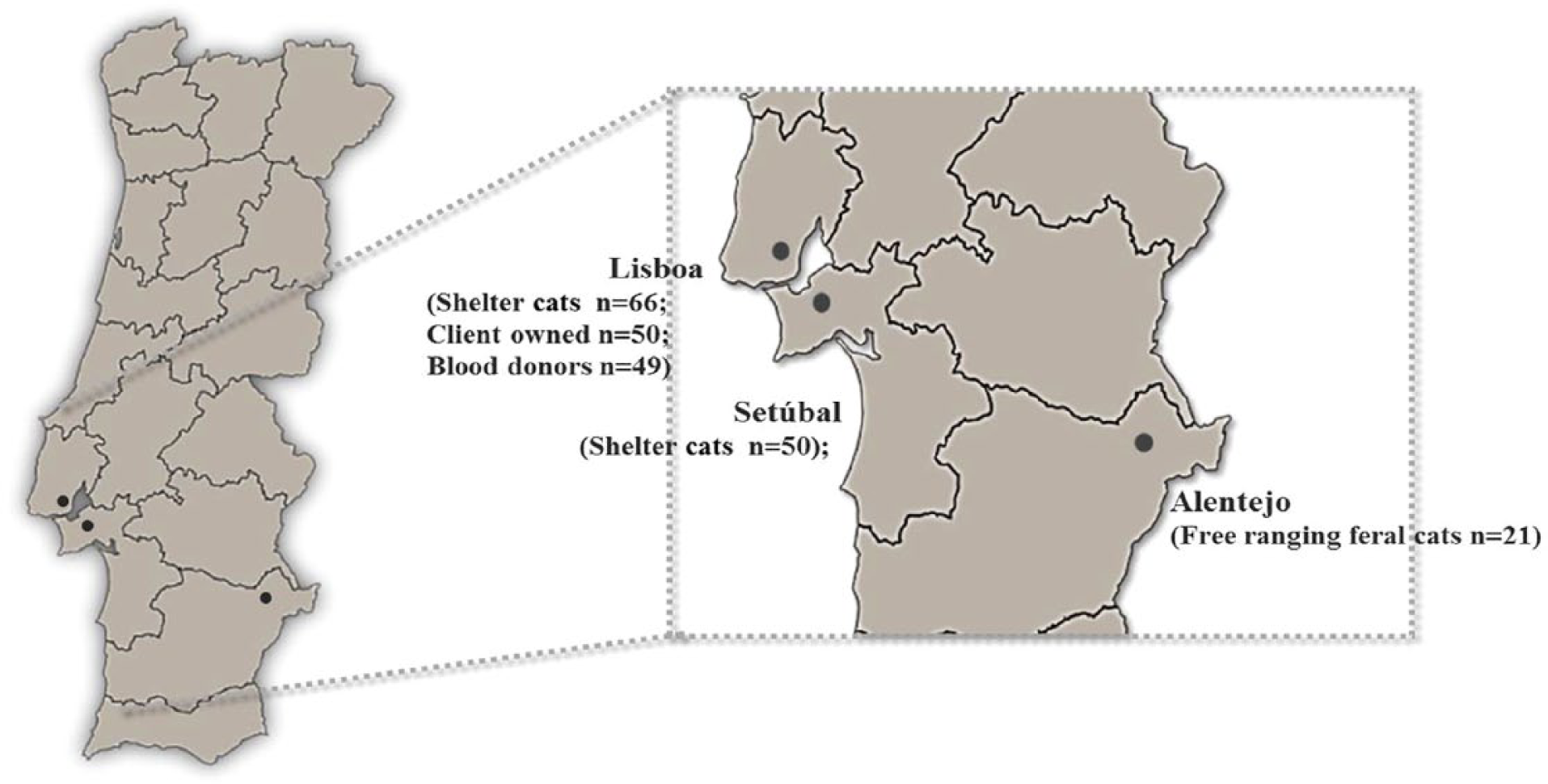
Geographical distribution of the sampled animals
Sample collection
Venous blood was collected into ethylenediaminetetraacetic acid tubes and brought to the laboratory refrigerated. Total DNA extraction was performed with the commercial DNeasy Blood and Tissue Kit (Qiagen), according to the manufacturer’s instructions, and stored at −20ºC.
Whenever possible, information regarding the geographical region, lifestyles, sex and age was collected. The serological diagnosis of FIV antibodies and FeLV antigens was determined by indirect ELISA (Viracheck/FeLV, Viracheck/FIV Synbiotics) in 206/236 and 203/236 cats, respectively.
Detection of haemoplasma DNA using qPCR
The primers and TaqMan (Life Technologies) probe used for the detection of Mhf were based on the nucleotide sequence of the 16S RNA gene (Genbank Accession Number AF178677.1), using the National Center for Biotechnology Information’s primer designing tool program (http://www.ncbi.nlm.nih.gov/tools/primer-blast/). For detection of CMhm and CMt, two previously reported methods were used (Table 1).8,24
Nucleotide sequence of primers and probes used in quantitative polymerase chain reaction

The amplification of feline haemoplasma DNA was carried out in a final volume of 20 µl, containing 2× TaqMan Gene Expression Master Mix (Applied Biosystems), 0.9 µM of forward and reverse primers, 0.25 µM of probe and 10–50 ng of DNA. The reactions were performed in a Step One Plus thermocycler (Applied Biosystems) using the standard amplification protocol, including two initial steps at 50°C for 2 mins and 95°C for 15 mins, followed by 50 cycles at 90°C for 15 s and 60°C for 1 min.
The positive amplicons were purified with the commercial DNA Clean and Concentrator kit (Zymoresearch) and directly sequenced. An Mhf recombinant plasmid was constructed in pGEM (Promega), according to the manufacturer’s instructions, and later used as the positive control. For screening of CMhm and CMt, a positive sample from each species, previously confirmed by direct amplicon sequencing, was used. Negative controls were always included in the amplification reactions.
Statistical analysis
The Fisher’s exact test was used to investigate for associations between positive haemoplasma qPCR results and qualitative variables selected as infection risk factors. A 95% confidence interval (CI) was calculated for the haemoplasma prevalence obtained in our sample, as well as the odds ratio (OR) with its 95% CI. Data from animals with no available information for the selected risk factors were excluded, and results were assumed to be statistically significant when the P value was <0.05. IBM SPSS Statistics version 20 was used for data analysis. OR calculations were performed using Richard Lowry’s VassarStats online calculators (http://www.vassarstats.net/). The lower and upper limits of the 95% CIs for proportions were calculated by the Wilson score interval method without correction for continuity, using the online calculator for the CI of a proportion (http://vassarstats.net/prop1.html).
Results
Within the sampled animals, 21.2% (50/236) corresponded to client-owned cats attending the Teaching Veterinary Hospital, FMV/University of Lisbon; 20.8% (49/236) included blood donor cats periodically examined at the blood bank (FMV/University of Lisbon); 8.9% (21/236) were feral cats from Alentejo; and 49.2% (116/236) were stray cats, kept in animal shelters in Lisbon and Setubal. The geographic distribution of the cats included Lisbon (75.8% [179/236]), Setúbal (21.2% [50/236]) and Alentejo (8.9% [21/236]). Similar numbers of males (36.0% [85/236]) and females (35.2% [83/236]) were sampled; information regarding sex was not available for 28.8% (68/236) of the cats. The ages of the cats were classified for 150/236 animals, using the age classification system of the Feline Life Stage Guidelines. 25 The majority of cats [26.7% (63/236)] were 3–6 years old; 15.7% (37/236) were 7–10 years old; and 13.1% (31/236) were 7 months to 2 years old. The animals aged 0–6 months, 11–14 years and 15–25 years were only represented in 2.1% (5/236), 3.4% (8/236) and 2.5% (6/236) of the sample, respectively. Retrovirus infection status was also evaluated, with 19.4% (40/206) of cats infected with FIV, 8.4% (17/203) with FeLV and 1.5% (3/203) co-infected with both viruses.
The overall prevalence of haemoplasma infection in the study was 27.1 % (64/ 236), with 7.6% (18/236) of the cats infected with Mhf, 10.6% (25/236) with CMhm and 0.8% (2/236) with CMt alone. Data analysis also revealed the presence of double and triple infections in 8.1% (19/236) of the cats (Table 2).
Haemoplasma prevalence by quantitative polymerase chain reaction detection

95% confidence interval (CI) calculated by Wilson score method
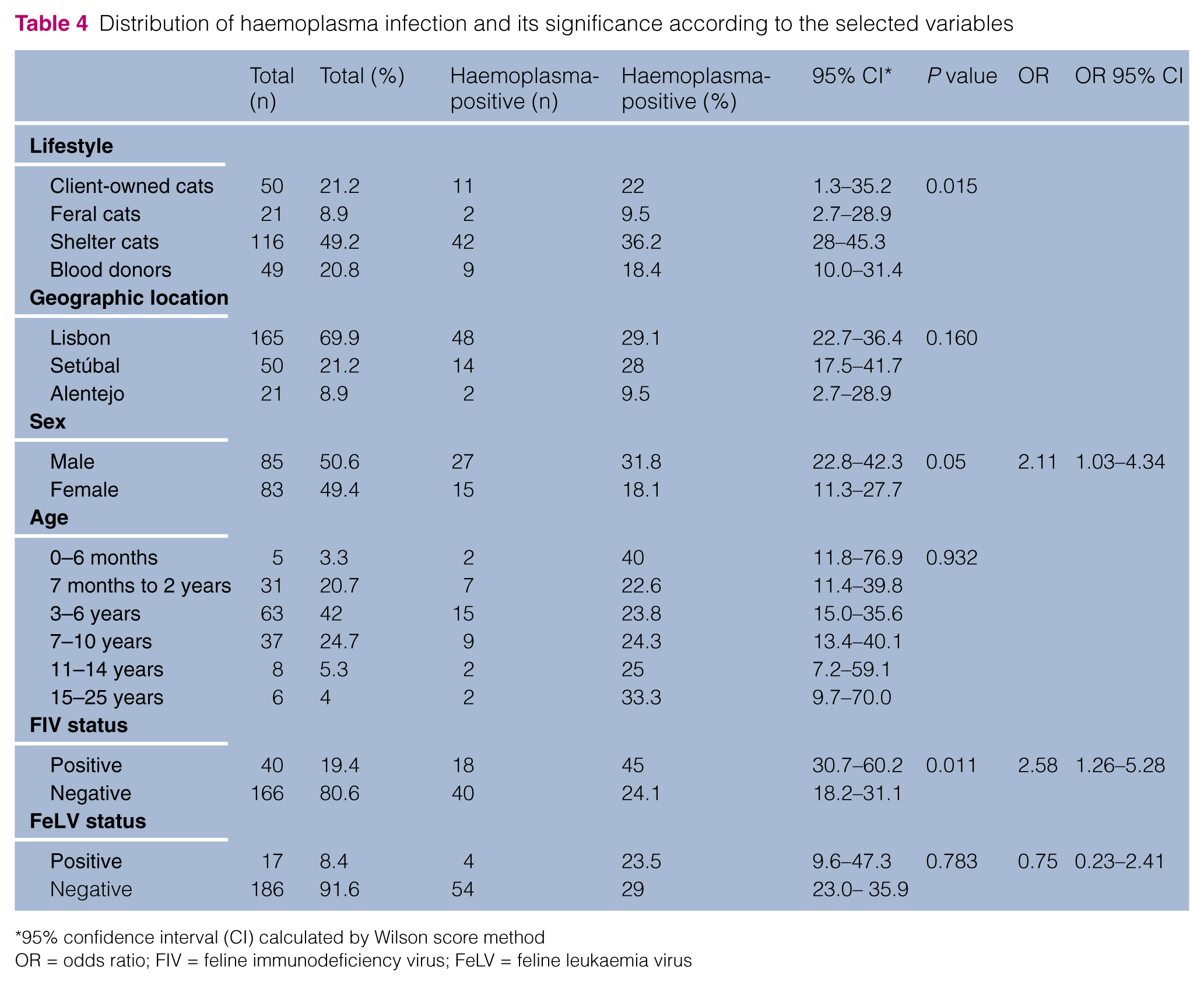
Haemoplasma infection prevalence was higher in shelter animals, with 36.2% (42/116) of cats positive, while infection in client-owned, blood donor and feral cats was 22.0% (11/50), 18.4% (9/49) and 9.5% (2/21), respectively. These differences represented a significant association between haemoplasma infection and lifestyle (P = 0.015), particularly for Mhf infection rates, which varied markedly among these groups (P = 0.004) (Table 3).
Haemoplasma prevalence according to lifestyle

Mhf = Mycoplasma haemofelis; CMhm = ‘Candidatus Mycoplasma haemominutum’; CMt = ‘Candidatus Mycoplasma turicensis’
P value calculated using Fisher’s exact test
Animals from Lisbon (29.1%; 48/165) and Setúbal (28.0%; 14/50) had a higher prevalence of haemoplasma than animals from Alentejo (9.5%; 2/21); however, the data did not provide evidence of an association between any of these geographic regions and the presence of haemoplasma infection (P = 0.160).
Regarding sex, 31.8% (27/85) of the males had haemoplasma infections, whereas only 18.1% (15/83) of the females were infected. This represented a non-significant increased haemoplasma prevalence in males (P = 0.05); however, for the individual haemoplasma species, only CMt infections were significantly associated with male sex (P = 0.032).
Considering the age classification, the highest proportion of infected cats was seen in younger (0–6 months) and older cats (15–25 years): 40% (2/5) and 33.3% (2/6), respectively. The remaining age groups showed values ranging from 22.6% (7/31) to 25.0% (2/8). Mhf infection was mostly detected in younger cats, while CMhm and CMt infections were mainly found in younger and older cats, respectively. However, no statistical association was found between age and haemoplasma infection (P = 0.932).
Regarding retrovirus positive cats, 45% (18/40) of FIV-positive animals (40/206) were co-infected with haemoplasma species, revealing a statistical association between FIV and haemoplasma infection (P = 0.011). This significance was most associated with Mhf (P = 0.024), CMhm (P = 0.021) and Mhf/CMhm multiple infection (P = 0.028). In contrast, FeLV-positive cats (17/203) had only 23.5% (4/17) of co-infection with haemoplasma species and no statistical association was detected (P = 0.783).
Data analysis also revealed evidence of a relationship between the type of infection (single or multiple) and risk factors analysed, with higher multiple infection rates in shelter animals (P = 0.021), males (P = 0.057) and FIV-positive cats (P = 0.004).
OR results showed that both sex (OR = 2.11) and FIV infection (OR = 2.58) were associated with a higher risk of haemoplasma infection (Table 4).
Distribution of haemoplasma infection and its significance according to the selected variables
95% confidence interval (CI) calculated by Wilson score method
OR = odds ratio; FIV = feline immunodeficiency virus; FeLV = feline leukaemia virus
Discussion
A prevalence of haemoplasma infection of 27.1% (64/236) was found in the cats (from Lisbon and southern Portugal) sampled in the current study, which is lower than the prevalence of 43.43% (139/320) reported in a recent study that included domestic cats from north-central Portugal. 19 This divergence may be due to the sampled population, sample size and geographical variations. Geographical location comparisons have to be interpreted with caution owing to microclimate variations within the same area and other cofactors that may affect the results, such as the habitat and lifestyle of the cats sampled. 13 Despite the variability found in haemoplasma prevalence between studies and countries, our rates of infection do not differ substantially from those reported in southern and northern Europe.4,11,13,14,19–21 These other studies found a higher prevalence of CMhm, followed by Mhf and CMt. Conversely, we detected a higher frequency of CMt infections (5.9%) than reported in other European countries.2,13,14,17,18
A significant association was found between haemoplasma infection and lifestyle (P = 0.015), which revealed higher rates of these microorganisms in shelter animals, particularly Mhf (P = 0.004). This finding has already been documented in outdoor animals, including stray cats and client-owned animals with outdoor access.2,14,18
With respect to the blood donor group, we found a haemoplasma prevalence of 18.4%, which is higher than previously reported. 26 This may be due to the fact that the blood donor cats were predominantly from cat colonies. Appropriate haemoplasma screening should be implemented in healthy animals likely to be used as blood donors, as already recommended. 27
Regarding geographical location, and although distinct rates of infection were observed for Lisbon (29.1%; 48/165), Setúbal (28%; 14/50) and Alentejo (9.5%; 2/21), no significant association was found (P = 0.160). This could be owing to the discrepancy between sample sizes among these groups and/or the randomised nature of the sampling.
Haemoplasma infection was detected in all ages, with a higher prevalence seen in both younger and older cats, although no significant associations were identified between haemoplasma infections and age intervals (P = 0.932). We also observed a progressive increase in prevalence with age. This may be owing to the increased exposure to infection throughout life, as other authors have already suggested. 28 Increased infection rates in both younger and older cats may be explained by the lower competence of the immune system that occurs in younger and older cats, especially with the emergence of other diseases in the latter group.12,18,20,29 Mhf infections were mainly found in younger cats, unlike CMhm and CMt, which appeared more frequently in both younger and older cats. Although no statistical significance was found for any age intervals, these data are consistent with the literature, as some studies revealed a significant association between Mhf infection and younger animals; however, others have shown some significant associations between CMhm infections and older cats.20,28,30,31
Male sex has been widely associated with haemoplasma infection;11,18,29,32 however, in our study, despite a higher prevalence in males (P = 0.05), a significant association was only detected for CMt infections (P = 0.032). Nevertheless, we found an increased risk of infection in males (OR = 2.11). According to some authors, an increased prevalence of infection in adult males can be attributed to their free lifestyle and aggressive behavior, resulting in increased exposure to haemoplasma-infected cats.33–35
Haemoplasma infection was also significantly associated with FIV (P = 0.011), but not with FeLV (P = 0.783). Although haemoplasma infection is largely associated with the presence of retrovirus, the relationship between different haemoplasma species and retrovirus is still poorly understood.23,31,34–36 In our study, FIV-positive cats had higher CMhm infection rates, while FeLV-infected cats had higher rates of Mhf infection, but without a significant association. This may be related to age, as FIV and CMhm co-infected cats were older than FeLV and Mhf co-infected animals, as already identified in other studies. 20
As expected, the presence of multiple infection was mainly detected in the major risk groups; in our study, multiple infection was significantly associated with stray cats (P = 0.021), males (P = 0.057) and FIV positivity (P = 0.004). Double infections with Mhf and CMhm were more frequent, in accordance with previously published studies,17,19,37 although we also detected triple infections at similar rates (3% [7/236]). Multiple infection with CMhm and CMt has been identified in sick animals,11,17,18,20 and, although we could not evaluate this association, higher detection of these haemoplasma species in older cats may possibly be related to the existence of co-pathology.
Conclusions
This study allowed the detection of Mhf, CMhm and CMt in naturally infected cats from Lisbon and southern Portugal, adding epidemiological information to that previously documented. This information may contribute to a better characterisation of the role of risk factors in haemoplasma infection, namely lifestyle, habitat, sex and immunological status, as well as retrovirus infection. A worldwide analysis of risk factor traits may be of value in providing further enlightenment on the transmission mode of these pathogens in the feline population.
Footnotes
Acknowledgements
We thank the veterinarians, cat owners, FMV-UL hospital and Veterinary Blood Bank, professors and MSc students that provided the samples necessary for the development of our study.
Conflict of interest
The authors do not have any conflicts of interest to declare.
Funding
We acknowledge the financial support of PEst-OE/AGR/UI0276/2014, which enabled this work.