







Abstract
The sandwich structures with aluminum foam core and metal surfaces have widespread use in the absorption of energy, because they are light weighted with high performance in dissipating energy. The cell structure of the foam core is subjected to plastic deformation in the constant compression level that absorbs a lot of kinetic energy before destruction of the structure. In this research, experimental tests of low-velocity impact on the sandwich structure by a drop machine are simulated by LS-DYNA software. Numerical results are obtained for different velocities and weights of projectile on samples of aluminum foam core sandwich panels with relative density (the ratio of the density of aluminum foam to the density of solid aluminum) of 18, 23, and 27. The results are compared with experimental results which reveal a good conformity. As well, from the numerical simulations, the effect of weight, velocity and energy of the projectile and the density of the foam core on the global deformation and energy loss rate of projectile have been studied.
Introduction
Sandwich panels with composite face sheets and foam core are widely used in lightweight constructions, especially in aerospace industries due to their advantages over the conventional structural constructions, such as high specific strengths and stiffness and good weight saving [1]. An early study [2] has indicated that using composite materials instead of aluminum for the face sheets results in higher performance and lower weight. In the meanwhile, as a new multi-functional engineering material, aluminum foam has many useful properties such as low density, high specific stiffness, good impact resistance, high-energy absorption capacity, easy to manufacture into complex shape, and good erosion resistance [3,4], so it is usually used as core material of sandwich panels. However, it has also been found that composite sandwich panels are susceptible to impact damage caused by runway debris, hailstones, dropped tools, and so on [2]. The resulting impact damage to the sandwich panel ranges from face sheet indentation to complete perforation, with the strength and reliability of the structures dramatically affected. Unlike for their solid metallic counterparts, making predictions of the effects of low-velocity impact damage are difficult and are still relatively immature. Hence, the behavior of sandwich structures with aluminum foam core under low-velocity impact has received increasing attention.
A number of studies have shown that localized impact loading on a sandwich structure can result in the generation of local damage, which can lead to significant reductions in its load-carrying capacity [5]. Investigations have been carried out on sandwich panels with foam core under quasi-static and impact loadings to explore the perforation energy absorbing mechanisms, mostly on sandwich structures with polymeric foam cores [6–8]. Wen et al. [6] have analyzed marine sandwich construction and they have identified the major energy absorbing modes as fragmentation under the penetrator and global panel deformation. Mines et al. [7] conducted a series of quasi-static perforation tests and low-velocity impact tests on square panels based on polymer composite sandwich structures. They suggested that higher impact velocities tend to increase the energy absorption, which is attributed to an increase in the core crush stress and skin failure stress at high strain rates. More comprehensive and detailed summaries of previous experimental studies can be found in a thorough review article of the impact response of sandwich structures given by Abrate [8]. While polymeric foams have been applied for many years, metallic foams have gained a significant and growing interest for applications in sandwich structures currently, for the reason that in comparison with polymer foams they exhibit excellent recycling efficiency, high specific stiffness, good thermal conductivity, and high melting point. Kiratisaevee and Cantwell [9] investigated the impact response of sandwich panels with ALPORAS® foam cores and fiber-reinforced thermoplastic or fiber–metal laminate (FML) face sheets. Impact tests were conducted by using a drop hammer at velocities up to 3 m/s. The resistance of these sandwich panels was found to be rate sensitive over the full range of conditions examined. Ruan et al. [10] have experimentally investigated the mechanical response and energy absorption of sandwich panels subjected to quasi-static indentation, which consist of aluminum face sheets and ALPORAS® foam core. The effects of several parameters, such as face sheet thickness, core thickness, boundary conditions, adhesive and surface condition of face sheets on the mechanical response and energy absorption during indentation are identified. Beixin et al. [11] studied the energy absorption properties of aluminum foam composite panels with enhanced ribs using the experimental impact tests at a velocity of 4 m/s and a finite element code ABAQUS/Explicit. They showed that, compared with conventional sandwich panels, aluminum foam composite panels with enhanced ribs have better energy absorption.
While most of the existing investigations into the impact responses of composite sandwich structures with metallic foam cores have focused on high-velocity impact [12–17], only minimal attention has been paid on low-velocity tests, and few detailed parametric studies have been reported yet.
Simulation of impact is made with either analytical models or numerical methods. In numerical simulations, the continuum equations are solved for each element to obtain the history of stress, strain, velocity, etc. in both the structure and projectile.
In the present study, the impact tests conducted by the authors in Nouri and Mohammadzadeh [18] are simulated in LS-DYNA and after the verification of the results, new virtual tests are performed to investigate the other parameters associated with the impact event. This matter causes reduction of time and cost required for the real test operation.
Discussion of simulation process
This section is intended to give a brief review on the capabilities of LS-DYNA finite element code for simulation of impact event. The numerical simulation is used for interaction between a rigid impactor and a sandwich structure with aluminum foam core during impact. The impactor is modeled using the material type 20 (rigid) as shown in Figure 1. Material constants for the steel impactor are presented in Table 1 based on the data reported in Nouri and Mohammadzadeh [18].
A view of steel impactor model in LS-DYNA. Properties of steel impactor.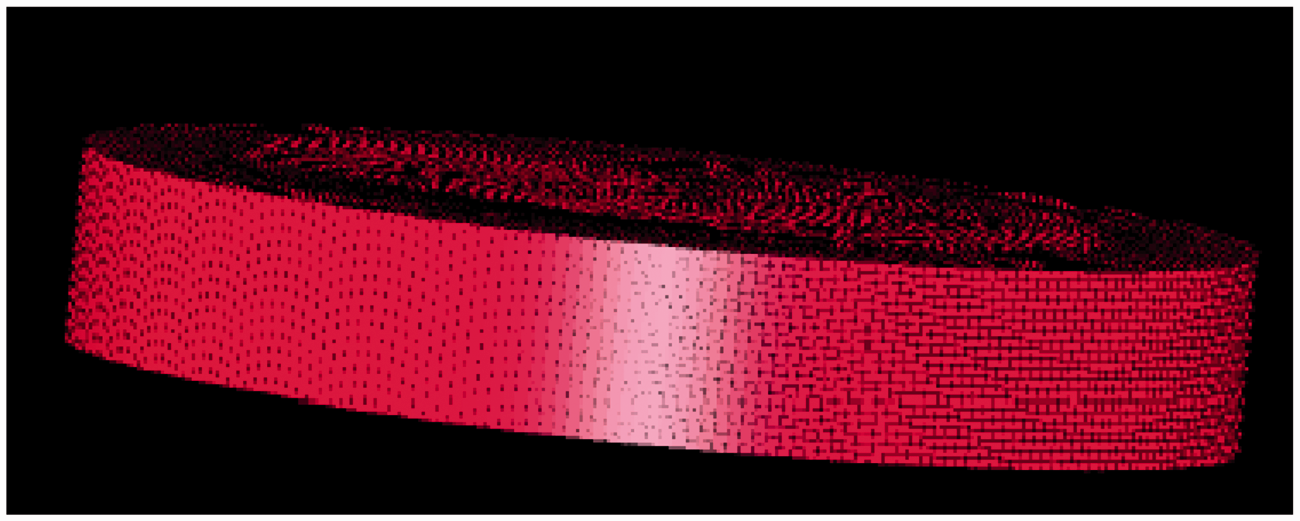

Plastic-kinematic model with material number 3 is used for Aluminum plate while Aluminum foam is modeled using the Deshpande-Fleck foam model by choosing material number 154 in LS-DYNA [19–21]. Figure 2 shows the model of aluminum plate in LS-DYNA. Material constants for the aluminum are presented in Table 2 [18]. Material properties of aluminum foam are derived by curve fitting on experimental date based on the Deshpande-Fleck foam model (material model 154) [22] and presented in Table 3.
A view of aluminum plate model in LS-DYNA. Properties of aluminum. Properties of aluminum foam.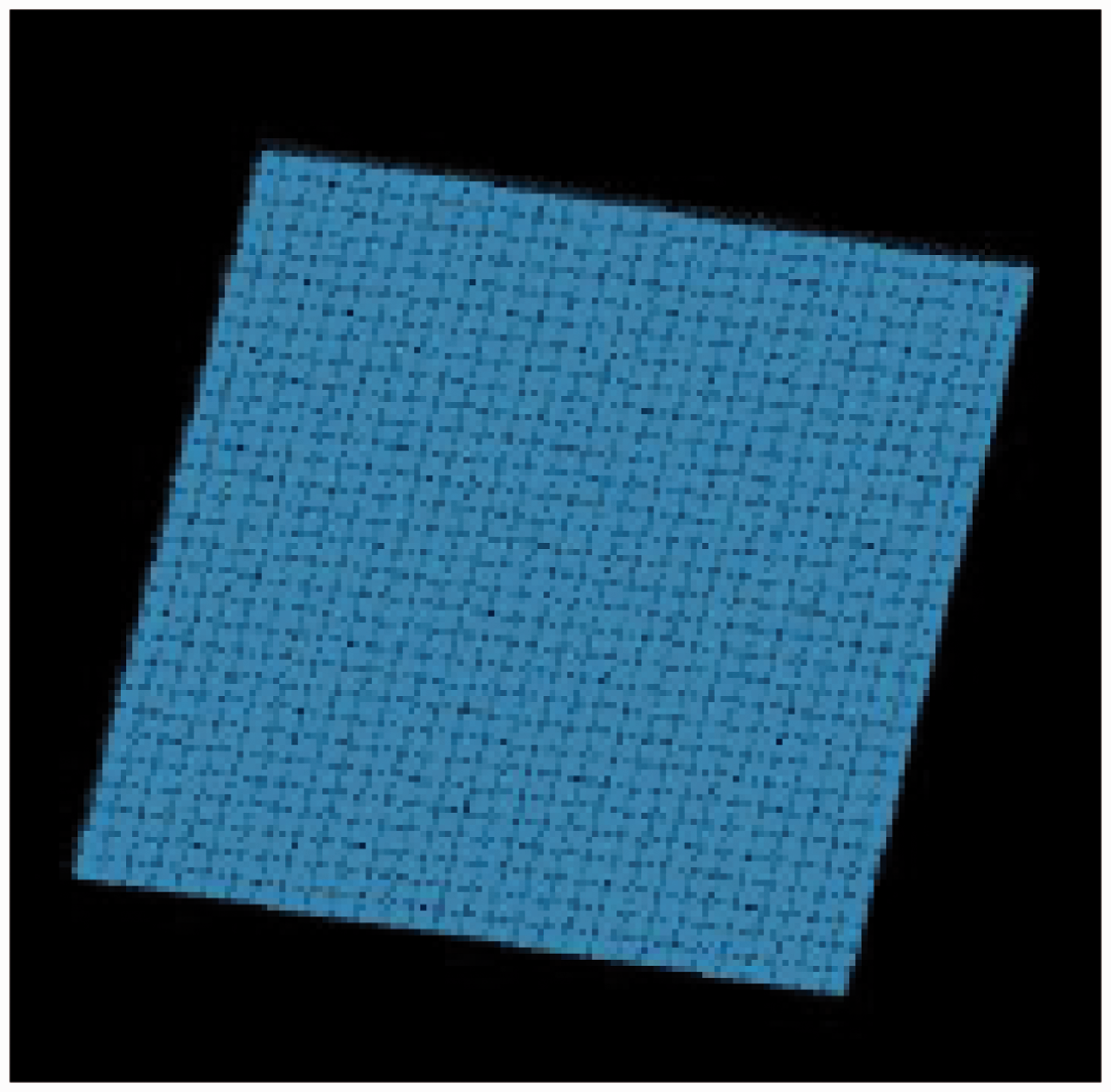

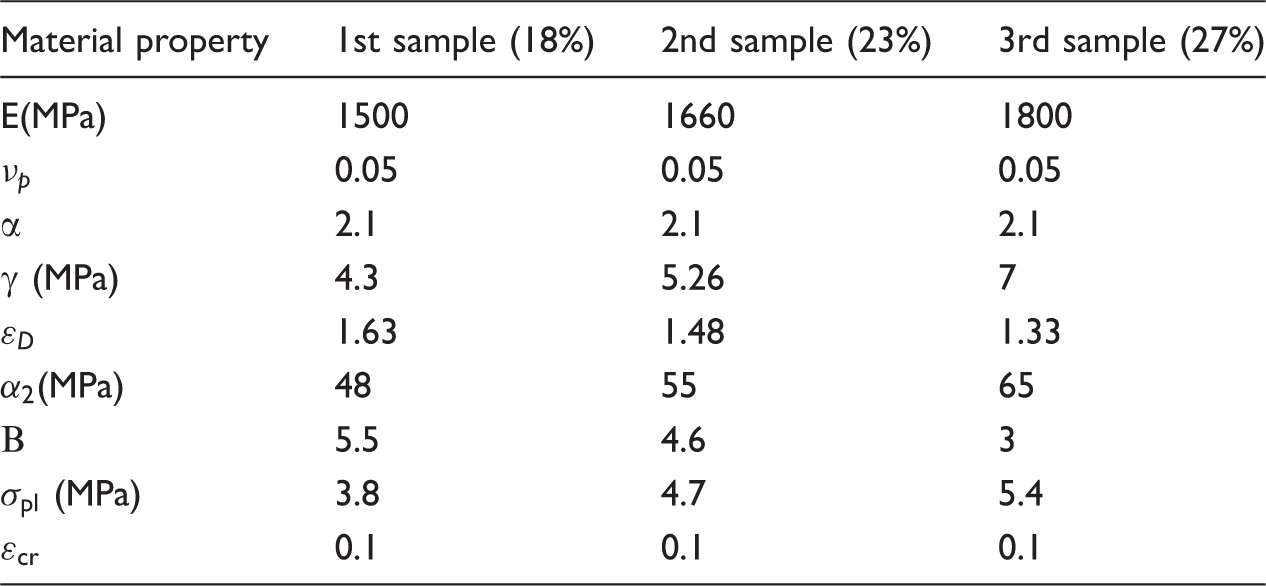
Figure 3 shows the model of aluminum foam in LS-DYNA. Material constants for the Aluminum foam are presented in Table 3.
A view of aluminum foam model in LS-DYNA.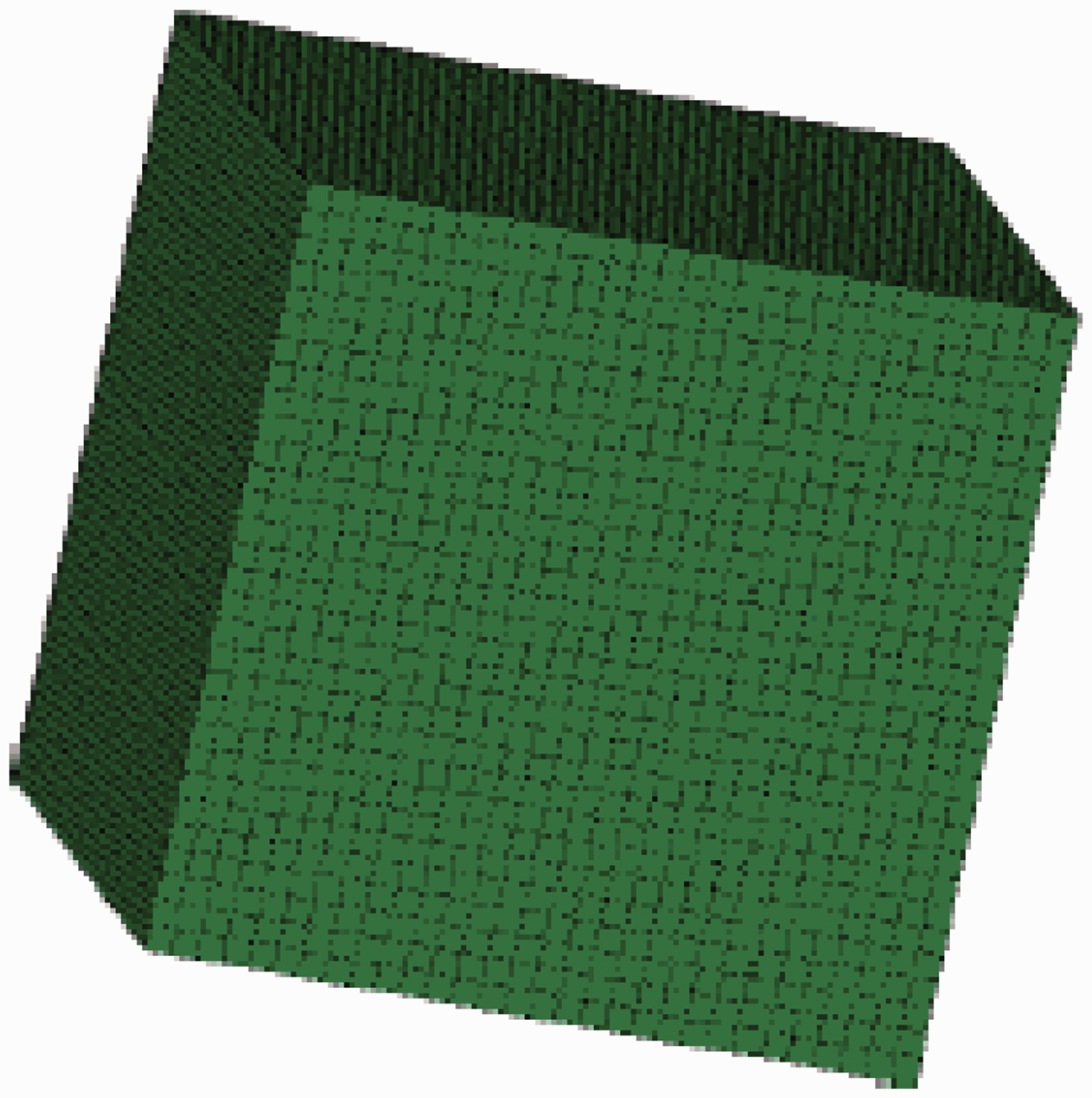
In some models such as Deshpande-Fleck foam model, it may be not possible to reduce the step time. In order to solve this problem in LS-DYNA, the element erosion method is used to remove the heavily distorted elements. Several criteria are used to this end. Although in the present work, the maximum strain criterion is utilized, the maximum stress criterion is also applicable. For the case of aluminum foam, the maximum strain of 0.3 is used from the experimental results [18].“MAT-add-erosion” is an auxiliary tool to remove to remove the elements of impressed region [23–25].
Simulated experiments
In this section, the behavior of a sandwich structure with dimensions of 20 × 20 × 22 cm and different foam core densities under the impact of a rigid impactor with constant velocity is simulated and the effect of foam core density on the energy absorbed by the whole structure is studied. Three different values, i.e. 18%, 23%, and 27% are considered for the foam core density.
Verification of the numerical results
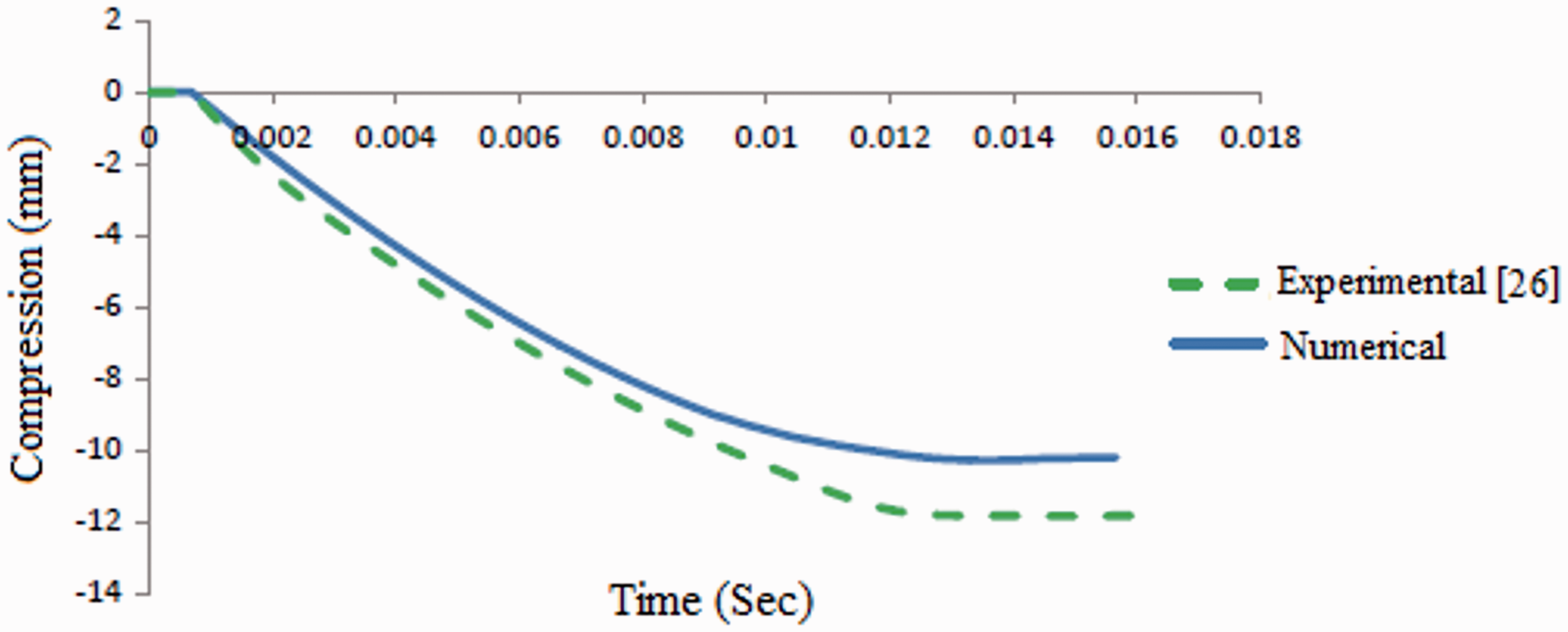
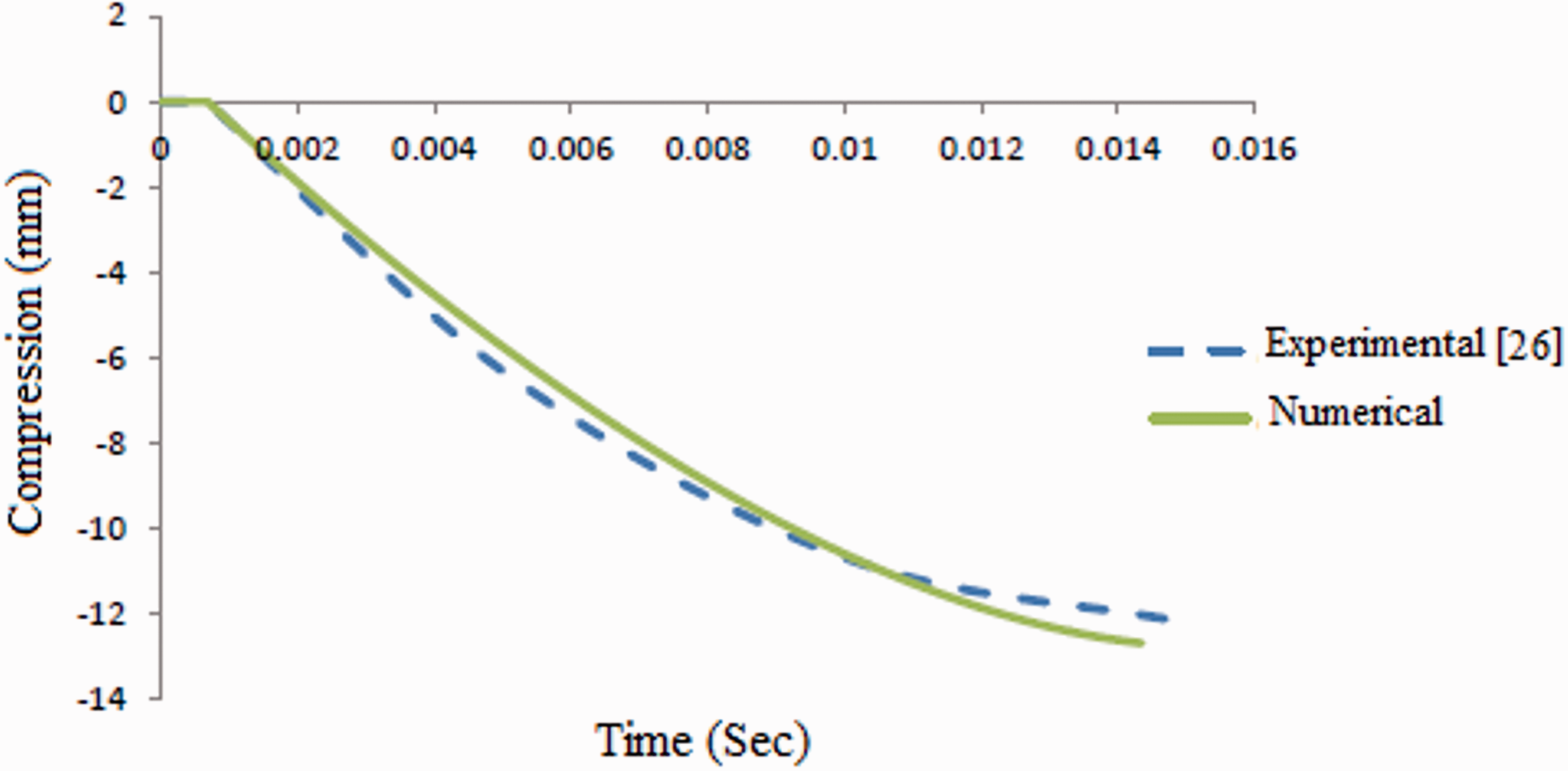
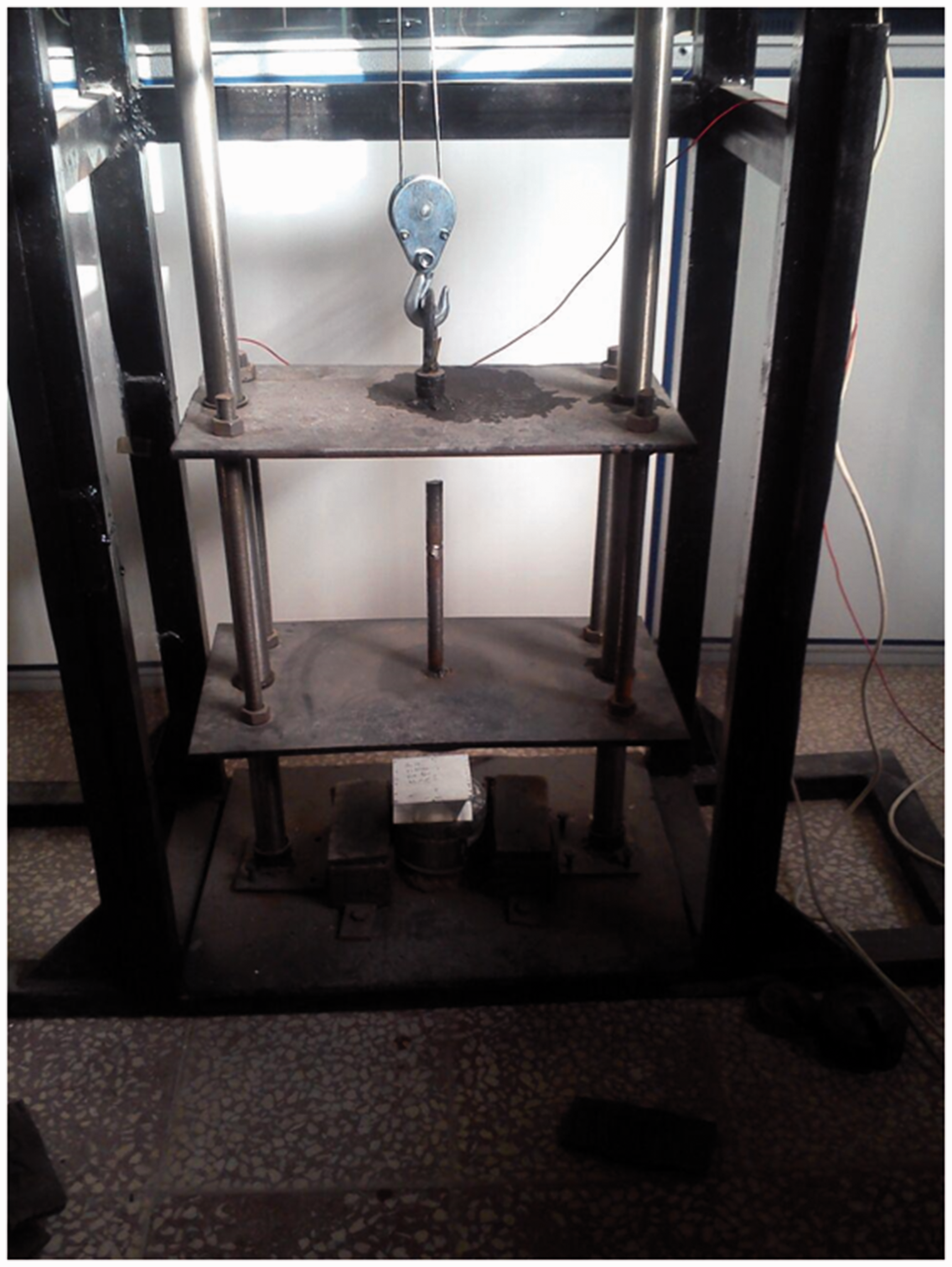
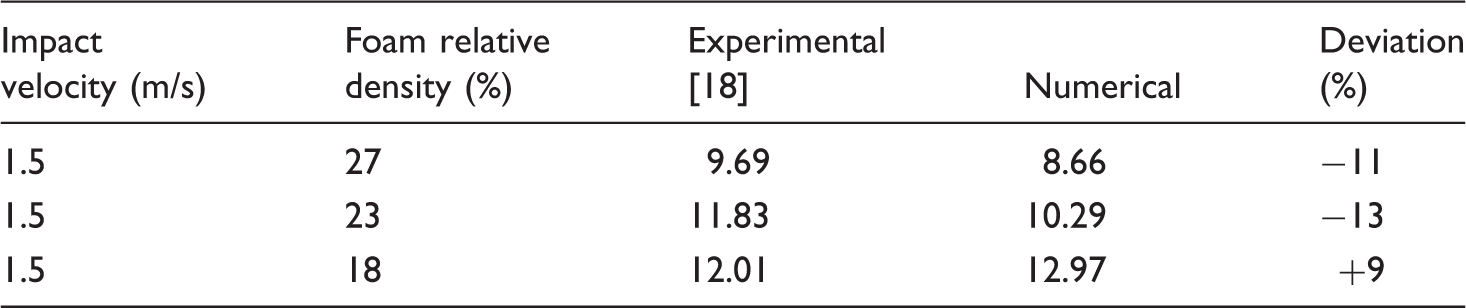
In order to ensure the validity and reproducibility of the results, the time–displacement data extracted from the experimental tests [18] are compared with those obtained by numerical simulations in Figures 4 to 6. Experimental setup is shown in Figure 7.
Time–displacement curves for the impact velocity of 1.5 m/s, foam core relative density of 27% and impactor mass of 25 kg. Time–displacement curves for the impact velocity of 1.5 m/s, foam core relative density of 23% and impactor mass of 25 kg. Time–displacement curves for the impact velocity of 1.5 m/s, foam core relative density of 18% and impactor mass of 25 kg. Experimental setup for low-velocity impact.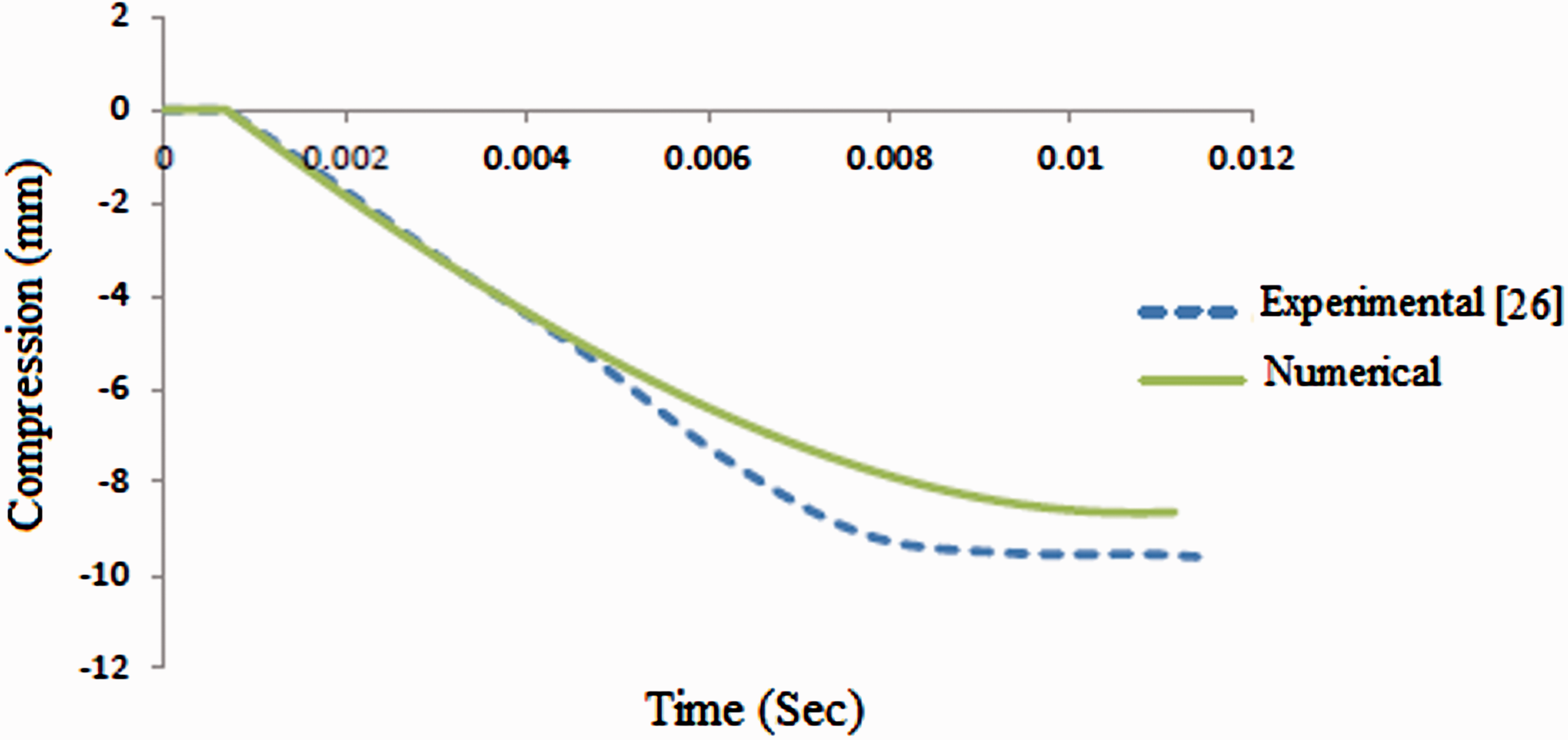
The effect of aluminum skins on the impact behavior of sandwich structure
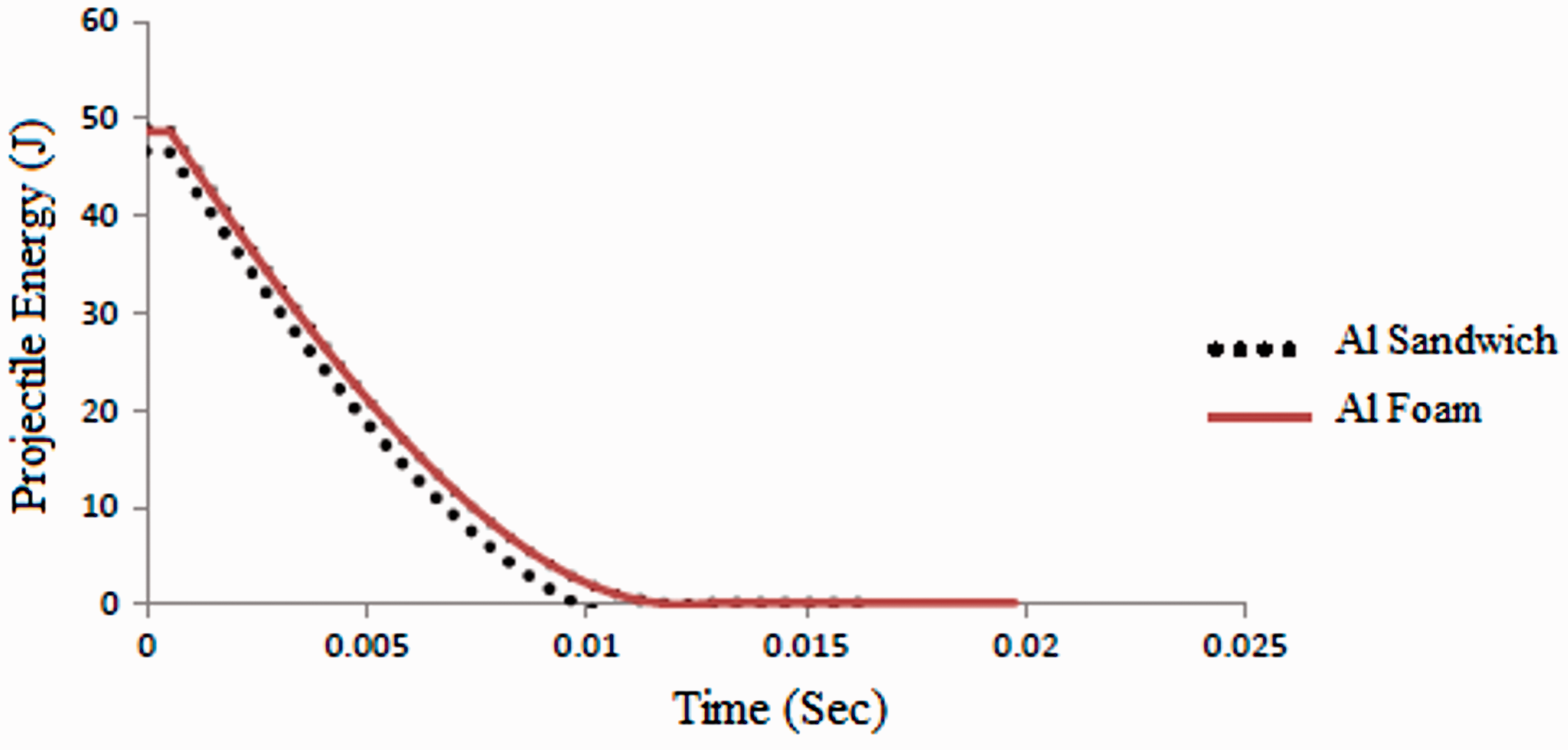
In order to assess the influence of aluminum skins on the behavior of a sandwich structure under low-velocity impact, time-variation of impactor displacement and its kinetic energy for two cases, i.e. the foam core and the whole sandwich structure are obtained. Figure 8 shows the compression of sandwich structure in comparison with its foam core. As seen, the compressive behavior is improved up to 12% in the presence of solid skins. Also, Figure 9 shows the process of impactor energy dissipation during its contact with the sandwich structure or its foam core. The rate of energy loss for foam core is about 3971, whereas its counterpart for the sandwich structure is about 5081 that represents up to 34% improvement in energy absorbability of sandwich structure. In other words, the time of energy absorption is reduced about 0.002 s in the presence of solid skins.
Time–displacement curves for the impact velocity of 2 m/s, foam core relative density of 18% and impactor mass of 25 kg. Time–energy curves for the impact velocity of 2 m/s, foam core relative density of 18% and impactor mass of 25 kg.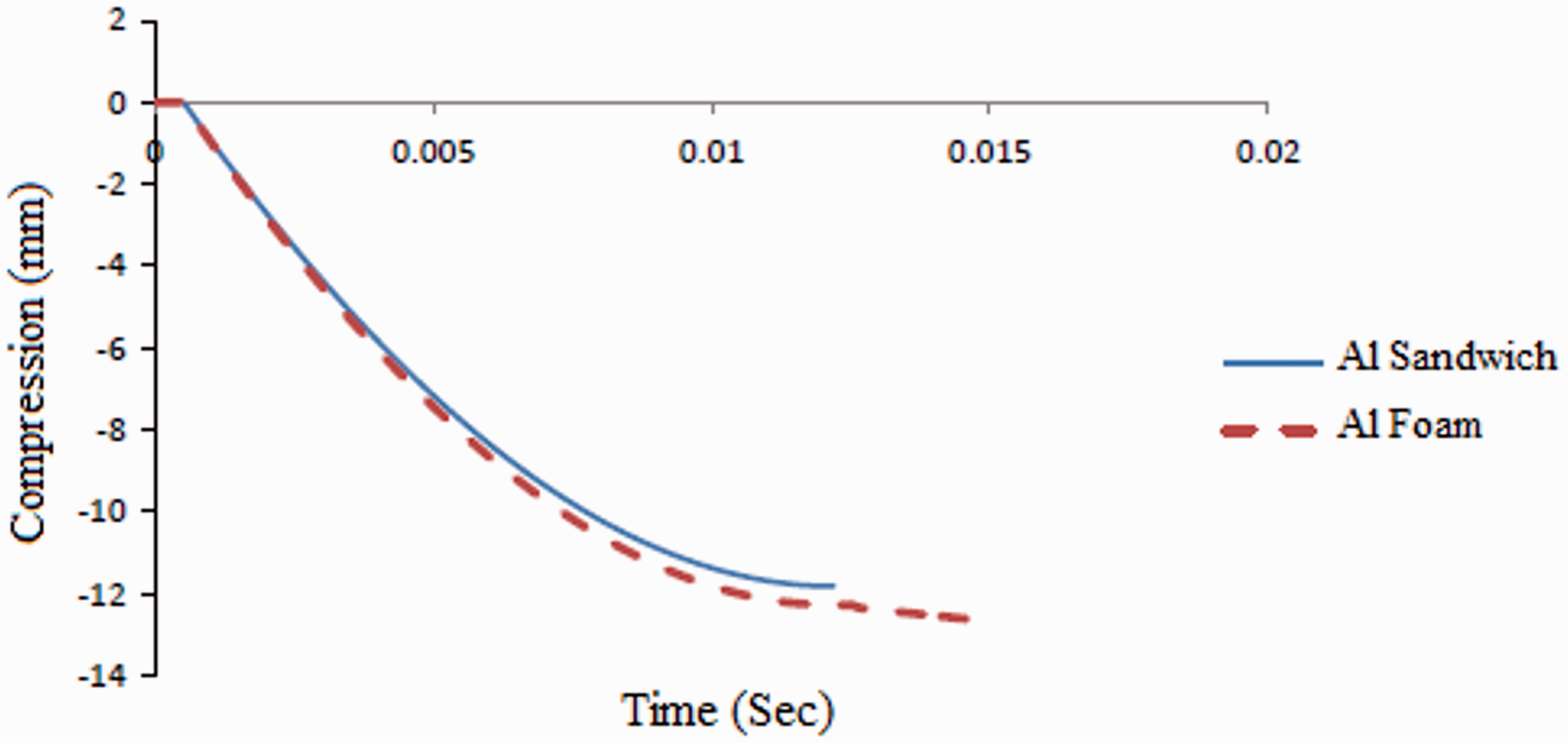
The effect of aluminum foam core density on the impact behavior of sandwich structure
Time-variation of sandwich compression under the impact of rigid mass with 25 kg and initial velocity of 1.5 m/s is plotted for different values of foam core relative density in Figure 10.
Time–displacement curves for different values of foam core relative density in the case of impact velocity of 1.5 m/s and impactor mass of 25 kg.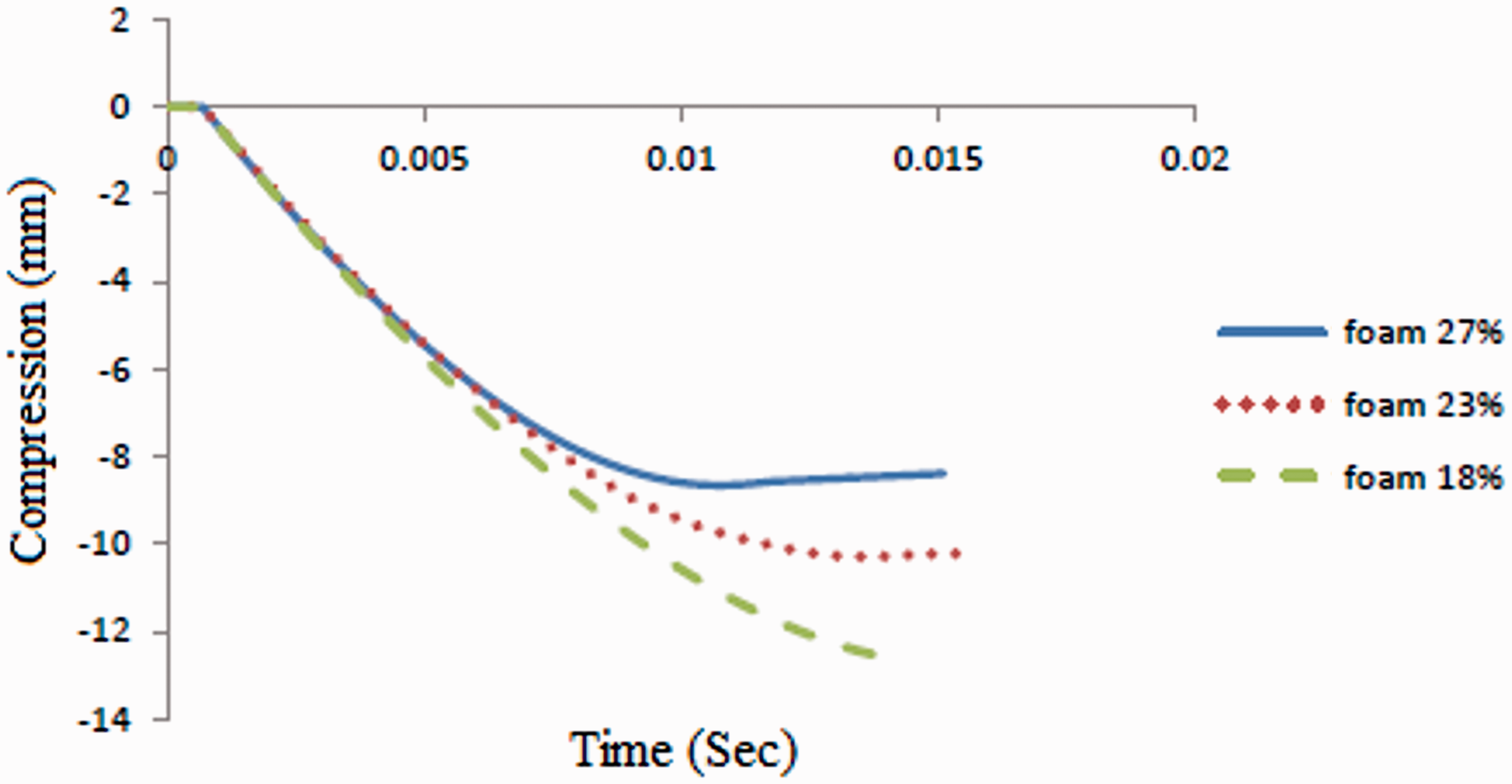
Experimental and numerical values of total compression of sandwich aluminum.
Time-variation of the kinetic energy of impactor with the same properties is plotted for different values of foam core relative density in Figure 11. The results depict that with increasing the foam core density, the duration of contact between impactor and specimen gets reduced.
Time–energy curves for different values of foam core relative density in the case of impact velocity of 1.5 m/s and impactor mass of 25 kg.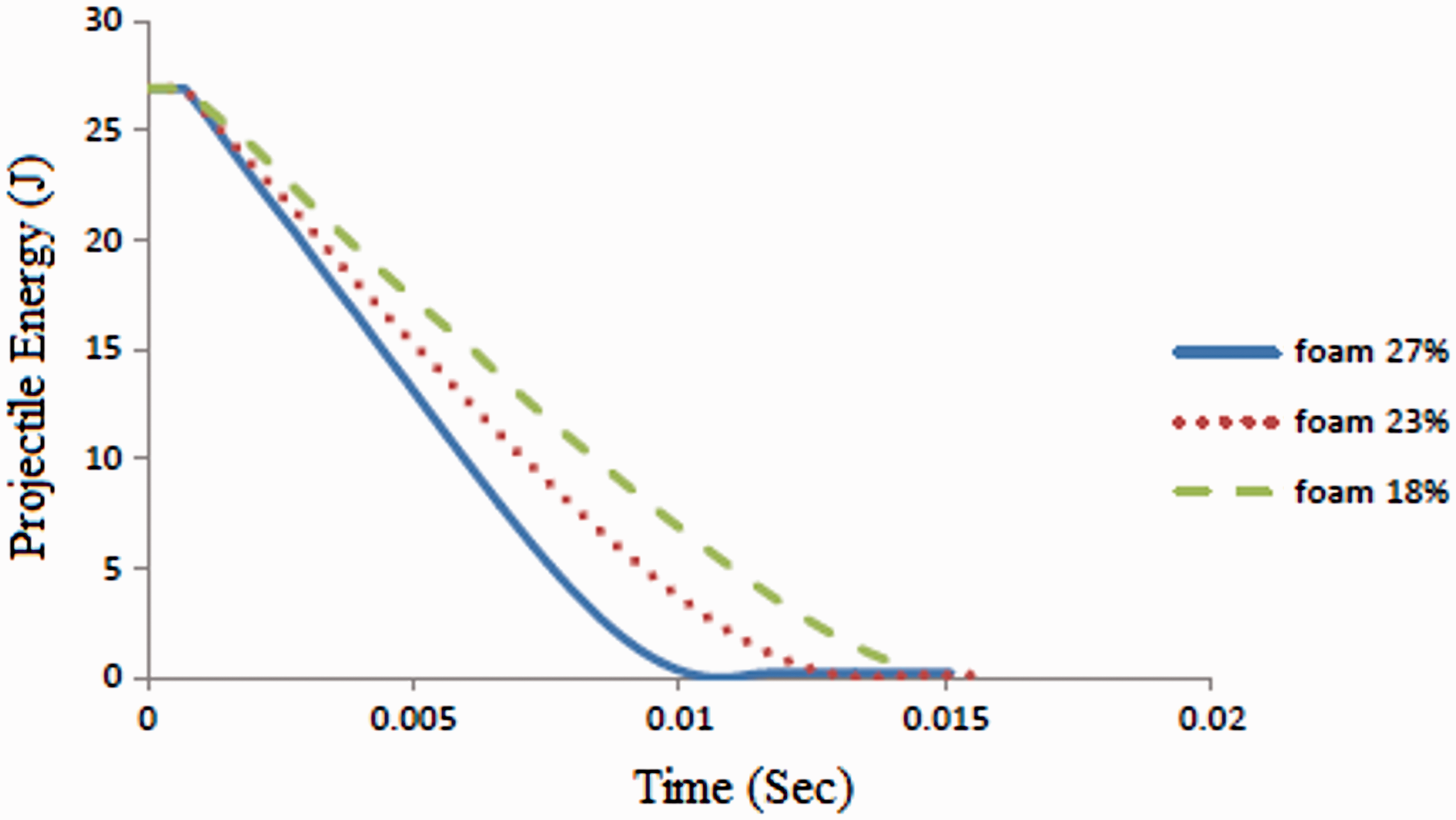
Rate of energy loss for different values of foam core relative density.

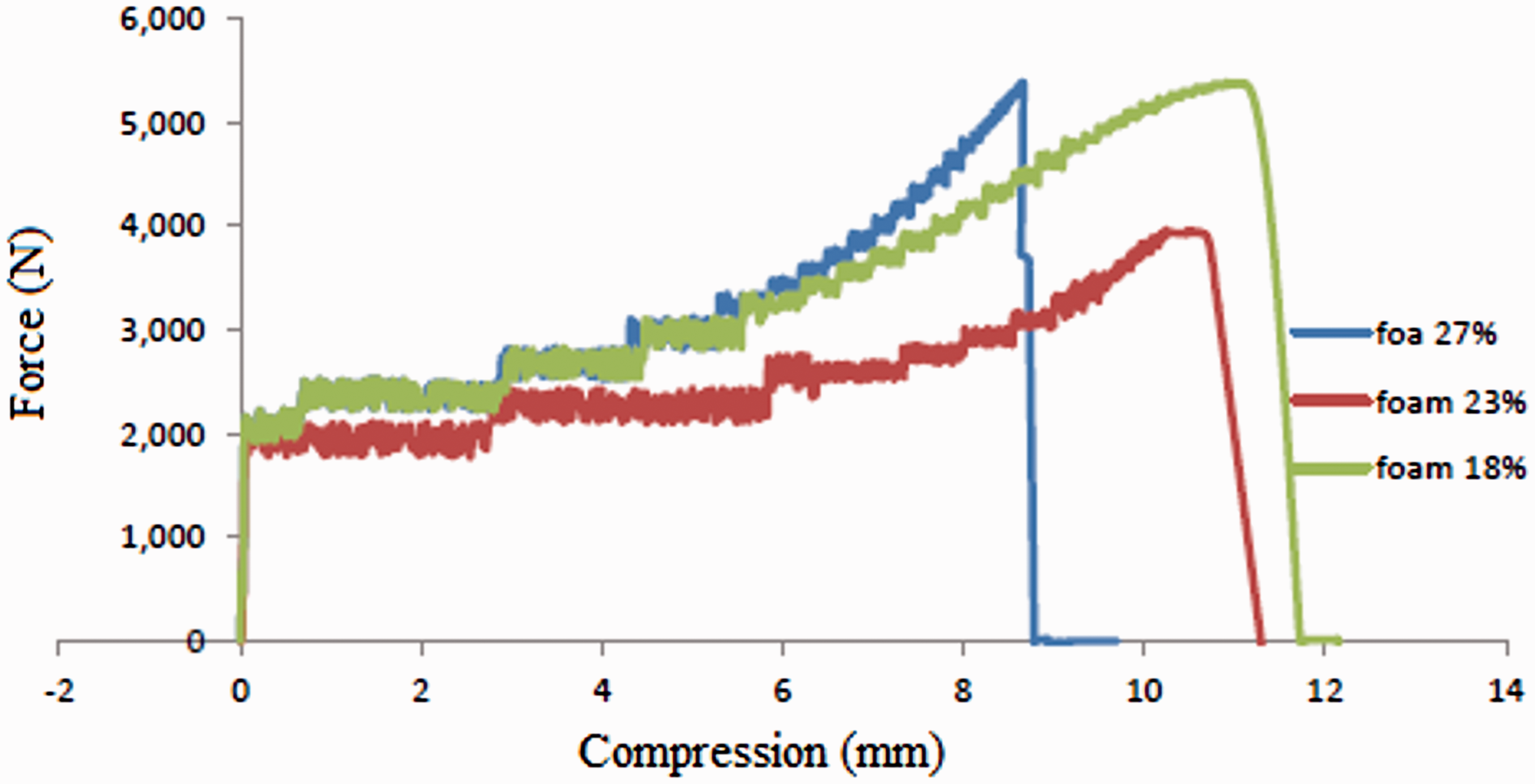
Variation of exerted force on the impactor versus its position for different values of foam core relative density in the case of impact velocity of 1.5 m/s and impactor mass of 25 kg.
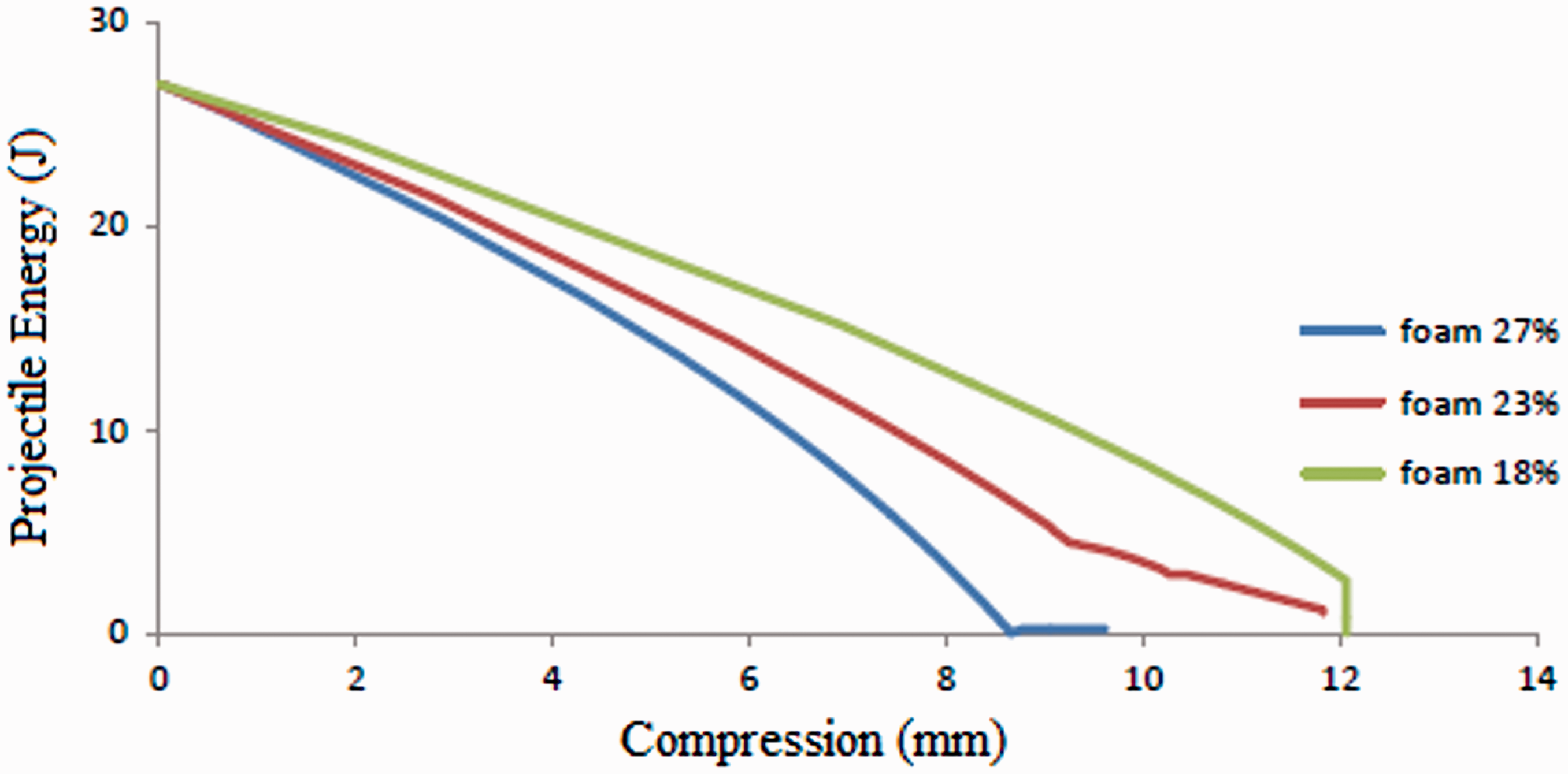
Variation of kinetic energy of the impactor versus its position for different values of foam core relative density in the case of impact velocity of 1.5 m/s and impactor mass of 25 kg.
The effect of impact velocity on the impact behavior of sandwich structure
In order to study the effect of impactor velocity at the beginning of contact, three different values, i.e. 1, 1.5, and 2 m/s are considered as the impact velocity. Time-variation of the position of impactor with mass of 25 kg on the sandwich structure with core relative density of 18% is plotted in Figure 14. The results signify that increasing the impact velocity significantly increases the compression depth and compression duration of sandwich structure.
Time–displacement curves for different values of impact velocity in the case of foam core relative density of 18% and impactor mass of 25 kg.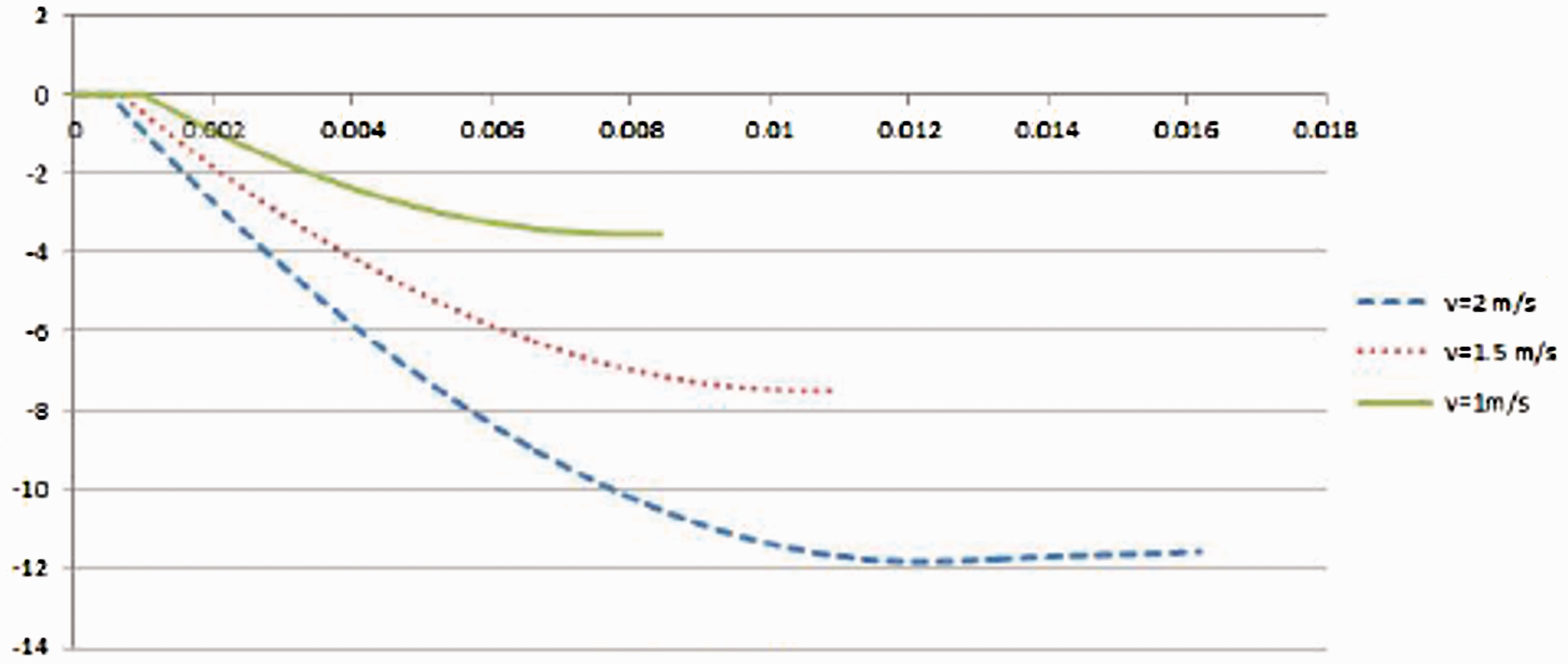
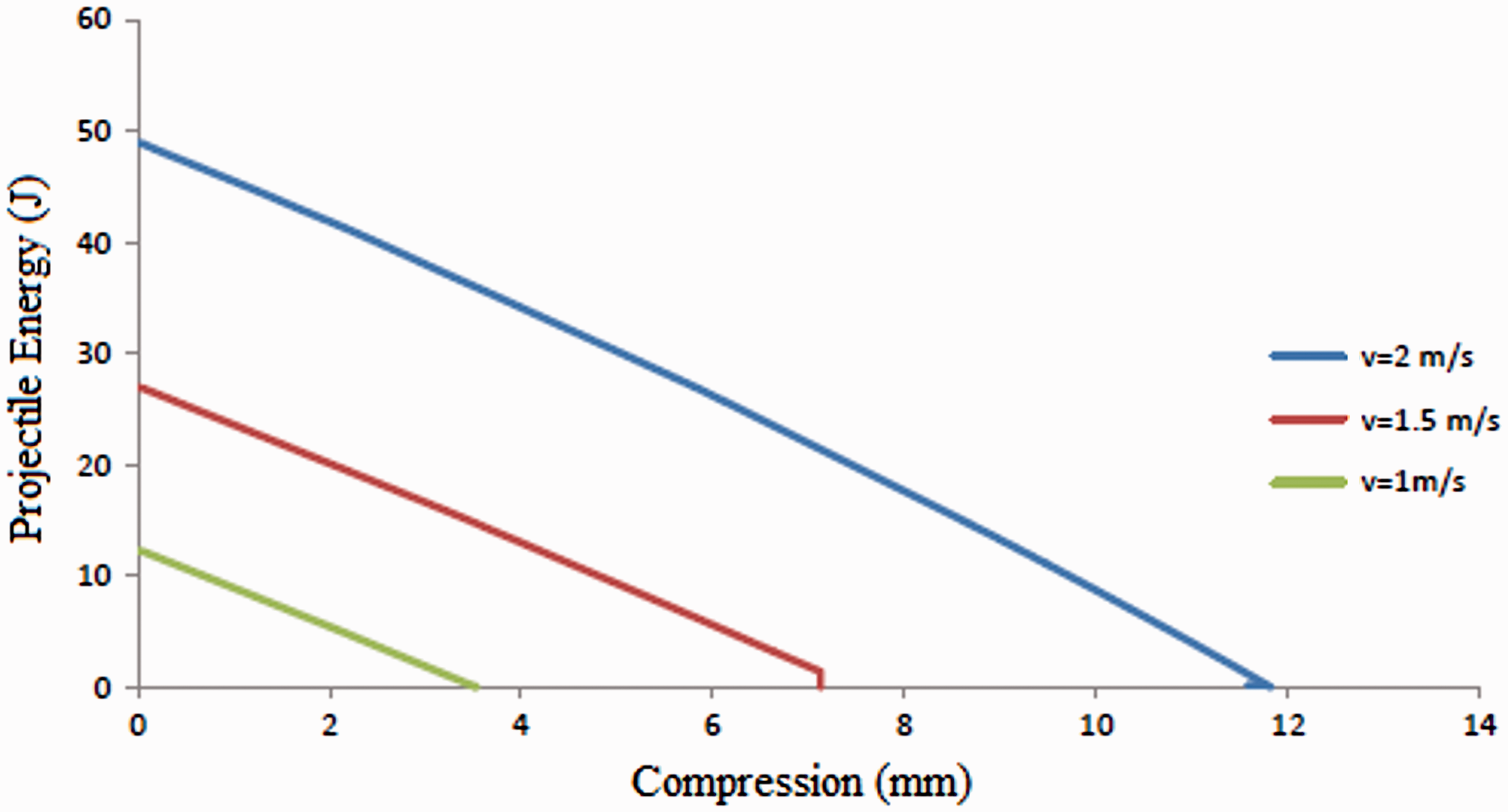
The process of impactor energy loss in terms of time as well as impactor position is shown in Figures 15 and 16, respectively. As shown in Figure 15, the rate of energy loss is increased with increasing the impact velocity. Figure 16 depicts that the impactor kinetic energy has a linear relation with the compression of sandwich panel.
Time-variation of projectile kinetic energy for different values of impact velocity in the case of foam core relative density of 18% and impactor mass of 25 kg. Variation of kinetic energy of the impactor versus its position for different values of impact velocity in the case of foam core relative density of 18% and impactor mass of 25 kg.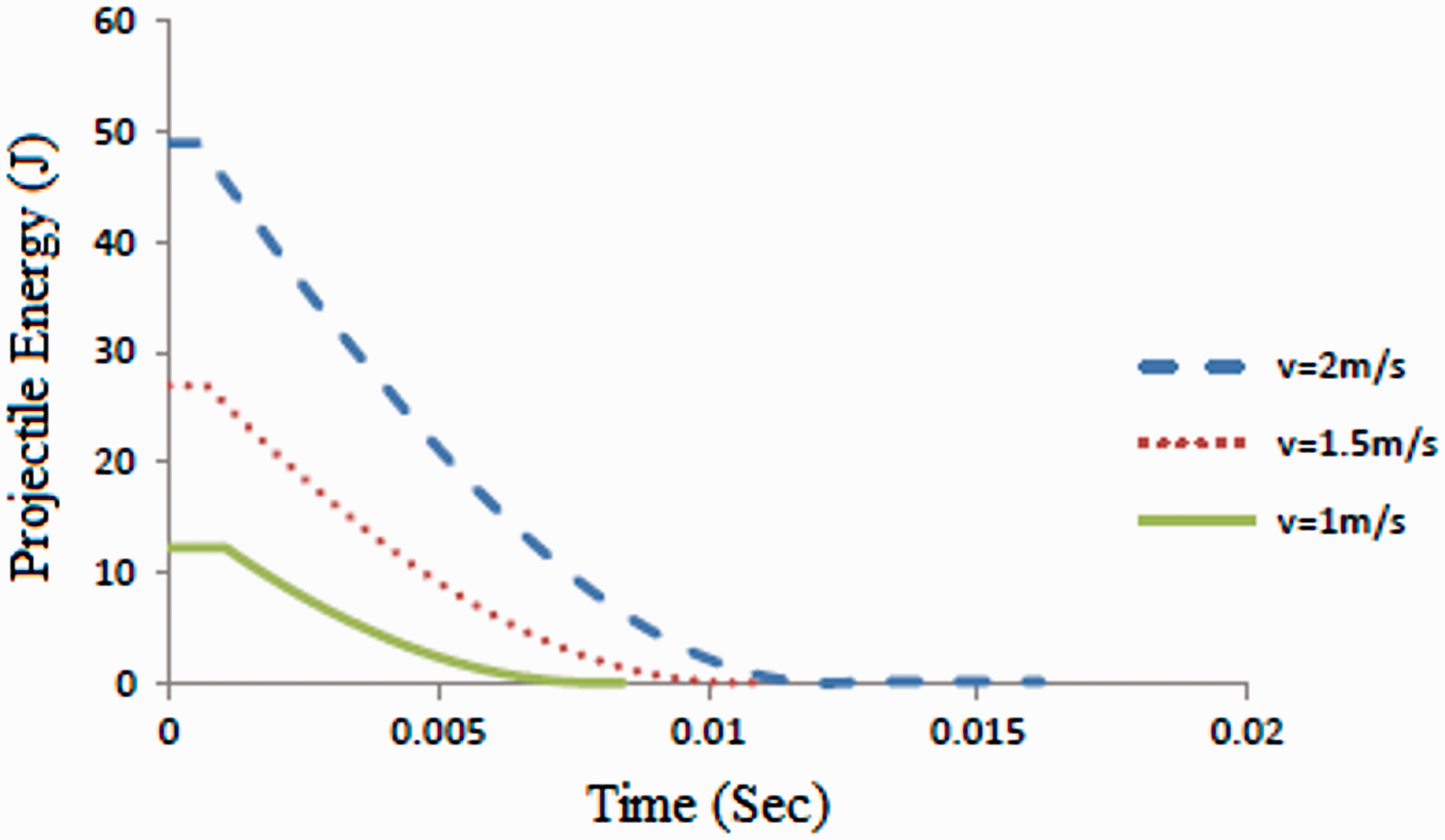
The variation of impactor force in terms of its position is also plotted in Figure 17 which signifies the improvement of sandwich strength under impact with higher velocity.
Variation of exerted force on the impactor versus its position for different values of foam core relative density in the case of impact velocity of 2 m/s and impactor mass of 25 kg.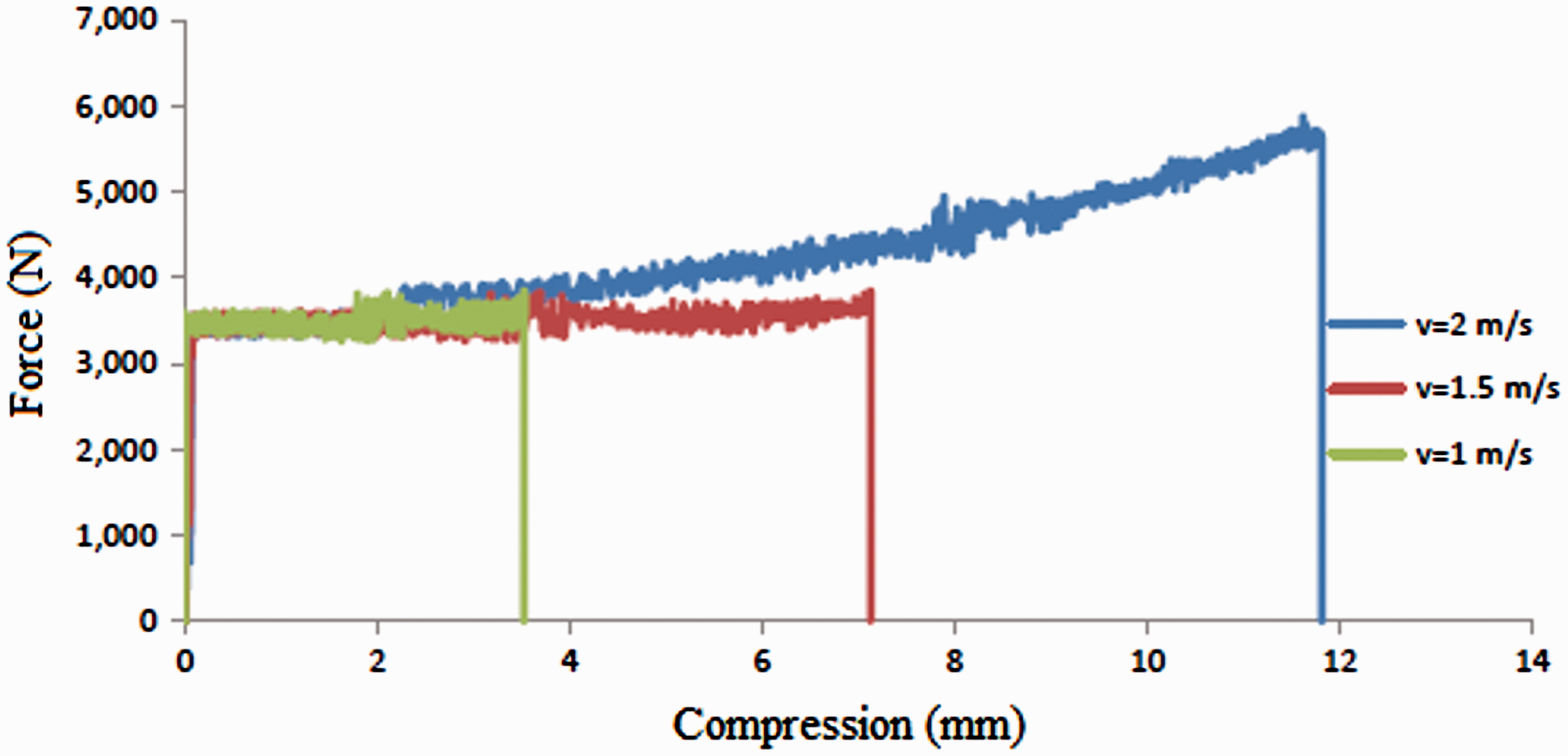
The effect of impactor mass on the impact behavior of sandwich structure
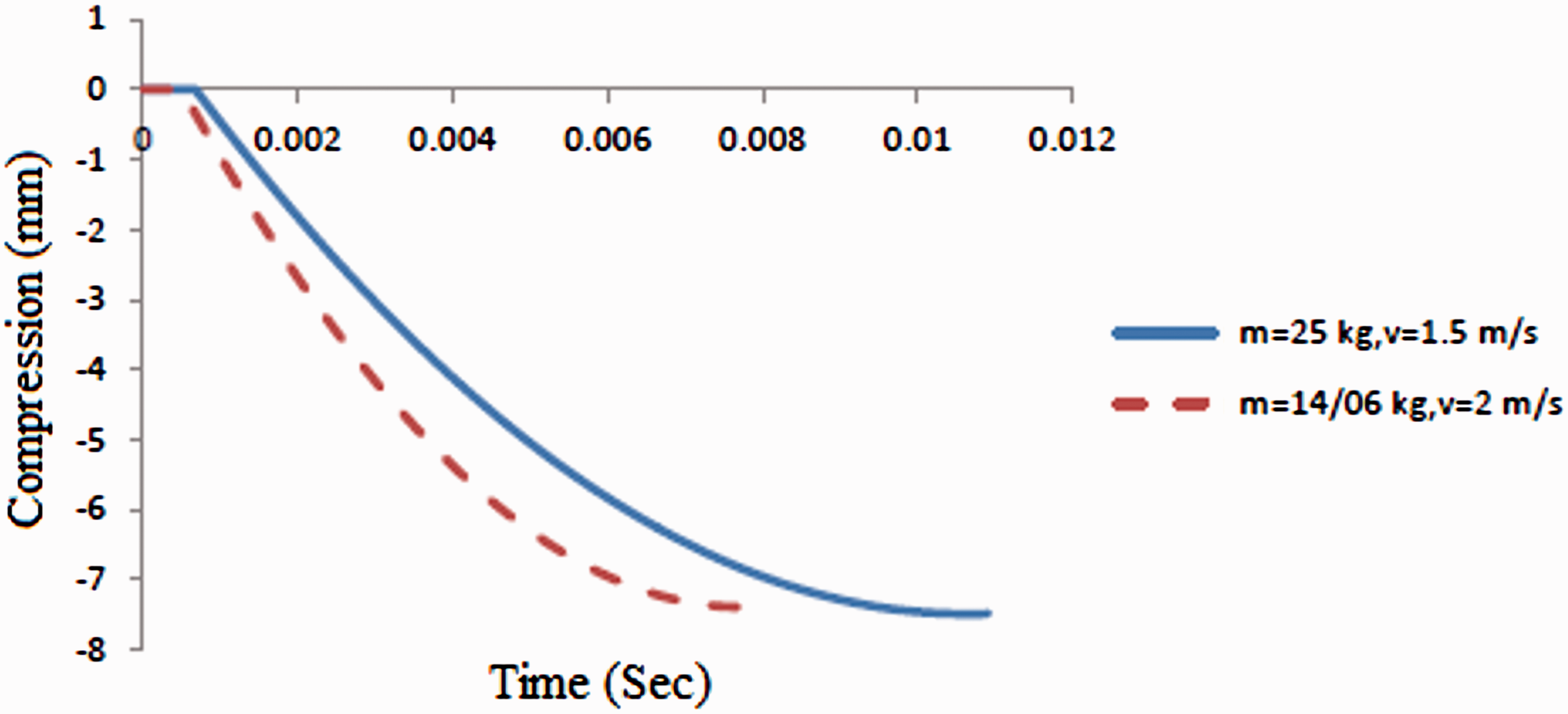
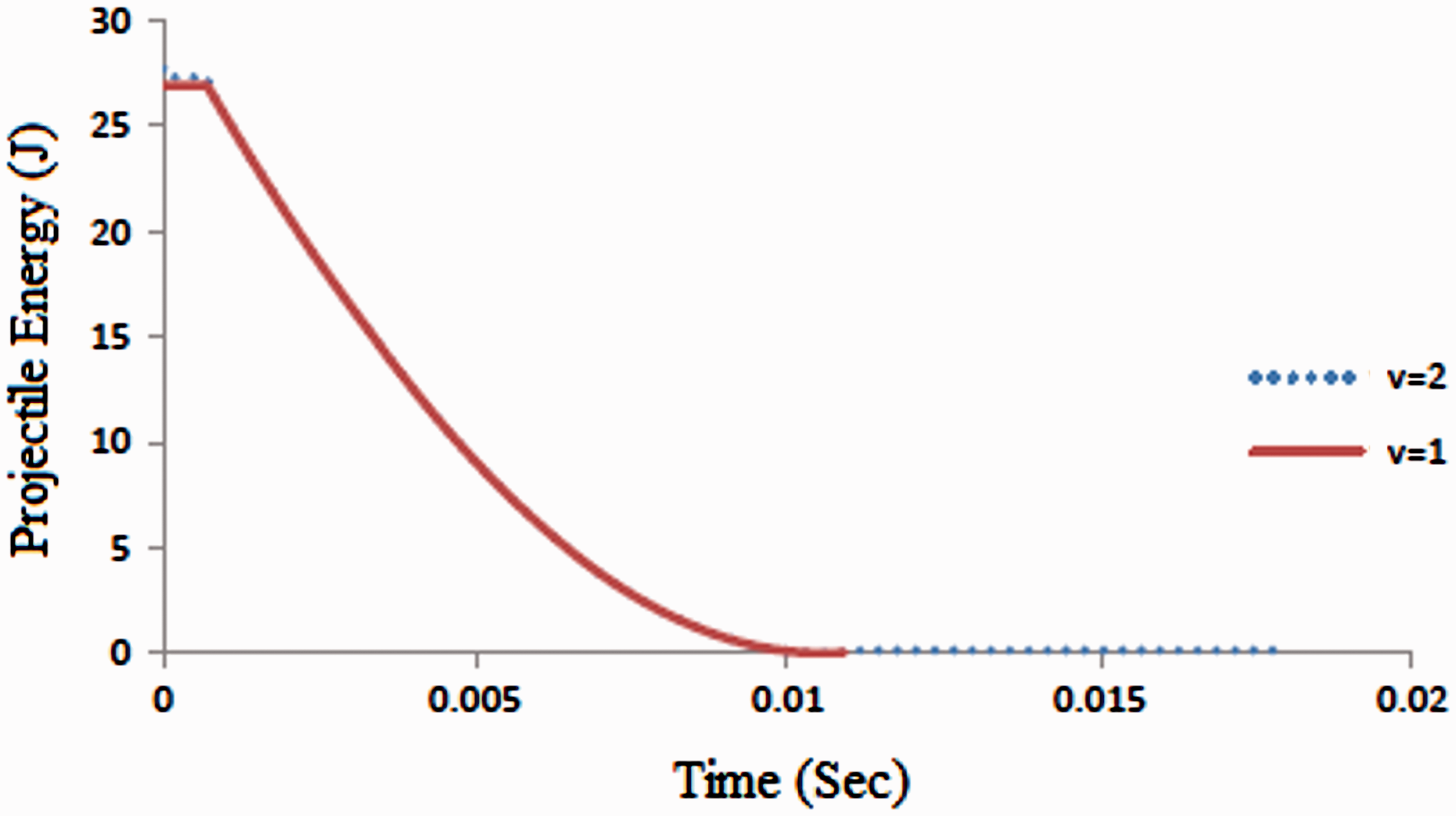
To study the effect of impactor mass on the behavior of sandwich structure, two different cases are considered. In the first case, two impactors with the same shape but different densities are intended to be dropped on the specimen with the same velocity. In the second case, the velocities of impactors with the same shape are chosen based on their densities to have the same kinetic energy at the beginning of contact. Figures 18 and 19 show the compression behavior of structure under the impact of two distinct masses for above two cases, respectively. It is obvious from Figure 18 that heavier mass causes more compression. By comparing this figure with Figure 14, it is concluded that the impactor velocity has more effect than its mass on the sandwich compression. Also Figure 19 signifies that the two different masses with the same kinetic energy have the same damaging influence on the structure. Figure 20 which shows the process of impactor energy loss for the second case verifies this important matter.
Time–displacement curves for different values of impactor mass in the case of the impact velocity of 1.5 m/s, foam core relative density of 18%. Process of sandwich compression under the impact of two different masses with the same energy for foam core relative density of 18%. Time-variation of projectile kinetic energy under the impact of two different masses with the same energy for foam-core relative density of 18%.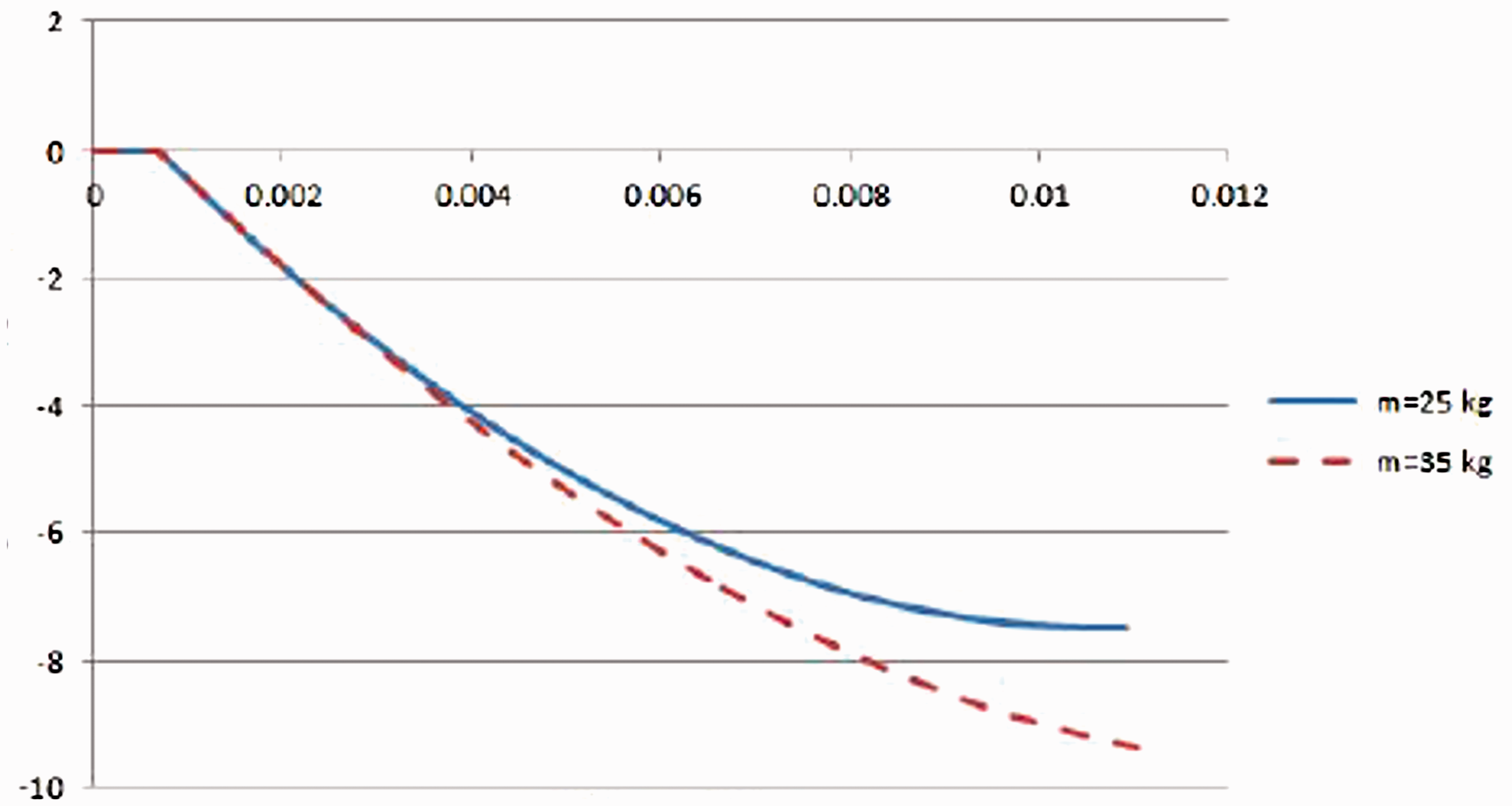
Conclusions
In this article, the behavior of aluminum foam core sandwich panels under the low-velocity impact is simulated and the effect of foam density as well as the impact velocity and the weight of projectile are investigated. Main results of the present research are as follows:
Comparing of numerical and experimental results reveals a good agreement between them. Rate of energy loss and total compression are directly dependent on the projectile energy. In other words, different projectiles with the same shape and initial energy have the same effect on the impact behavior of sandwich structure. The effect of projectile velocity on total compression is more dominant than that of its mass. Increasing the rigidity of structure leads to reduction of its time contact duration with the projectile.
Footnotes
Declaration of Conflicting Interests
The author(s) declared no potential conflicts of interest with respect to the research, authorship, and/or publication of this article.
Funding
The author(s) received no financial support for the research, authorship, and/or publication of this article.