







Abstract
This research develops a guided wave technique to quantitatively characterize the adhesive interface properties of a nuclear radiation protection structure. The numerical model is established to investigate the propagation of laser-generated guided waves in a nuclear radiation protection structure that is composed of a 1045 steel sheet connected with a lead alloy (Pb-Sb-Sn) sheet by using an epoxy resin adhesive. The finite element method has been adopted to calculate the characteristics of laser-generated guided waves interaction with the adhesive interface. The propagation of structural guided waves in a single lead sheet and a multi-layered adhesive structure is analyzed and compared to explain the role of the adhesive layer. The investigation quantifies the influence of the relevant adhesive interface properties (bond thickness, Poisson’s ratio and Young’s modulus) on time- and frequency-domain characteristics of structural guided waves in the adhesive structure. The features of laser-generated guided waves interaction with interfacial defects are investigated to identify the discontinuity of the adhesive layer. The numerical results indicate that the characteristics of laser-generated guided waves would vary with different adhesive interface properties. Therefore, the research results would provide guidance for evaluating adhesive interface properties.
Keywords
Introduction
Multi-layered adhesive structures have been applied to weapons and aviation industries widely, due to light weight, excellent mechanical performance and low manufacturing costs. A nuclear radiation protection structure is composed of a 1045 steel sheet connected with a lead alloy (Pb-Sb-Sn) sheet by using an epoxy resin adhesive served as an important adhesive structure, which is used to prevent the radioactive leakage. Therefore, the integrity of adhesive interfaces in a nuclear radiation protection structure is extremely important to guarantee the reliability of products. However, owing to improper selection of adhesives, pretreatments of adhesive parts and adhesive technologies, typical defects such as local debondings, poor adhesives and voids appear in the adhesive structure, which affects the bonded strength. Local debondings occur after the adhesive interface has been damaged. Void defects originate from the remnants of air layers resulting in inferior mechanical properties in the adhesive interface. The epoxy resin absorbs various rays, which destroys its molecular chain to cause embrittlement of adhesion, so detection of poor adhesives is indispensable for the safety of nuclear radiation protection structures. However, they are known as the most challenging problems in the detection of adhesive structures. Therefore, novel nondestructive testing methods need to be developed to detect the discontinuities of the adhesive layer. The traditional acoustic methods are very sensitive to the void defects, but it needs couplants to decrease the loss of incident acoustical energy [1,2]. Unfortunately, these methods are not suitable for detection of a nuclear radiation protection structure because couplants may pollute the products. As a consequence, it is important for characterization of adhesive interfaces of a nuclear radiation protection structure using non-contact inspection methods. However, some non-contact inspection methods also have drawbacks. Electromagnetic ultrasonics tests the materials with the small standoff distance [3], and air coupled ultrasonics has disadvantages for detecting metallic materials [4].
The laser ultrasonic technique on basis of lasers for the generation and detection of ultrasonic waves, possessing the features of non-contact and broadband, has been demonstrated its great potential for nondestructive testing of thin aluminum sheet adhesive structures [5]. A nuclear radiation protection structure is manufactured by bonding together with four layers of a lead alloy sheet, a 1045 steel sheet, a lead alloy sheet and a 1045 steel sheet, and their thicknesses are 1 mm, 4 mm, 1 mm and 4 mm, respectively. The adhesive structure should be initially detected after bonding two layers, and then inspected the adhesive interface after bonding one layer again. The earlier research mainly concentrated on investigating the characteristics of the adhesive interface of steel-epoxy resin using laser-generated body waves [6], but it did not characterize the complete adhesive interface. Generally, laser-generated longitudinal waves and shear waves with the thermoelastic regime can detect the adhesive interface of steel-epoxy resin or lead-epoxy resin, but it is unable to detect the entire coupled interface of a lead-steel adhesive structure owing to high reflection of ultrasonic energy in the adhesive interface. As a result, this paper discusses the characteristics of the adhesive interface of a lead-steel adhesive structure under different conditions using laser-generated guided waves. Laser-induced guided waves with the thermoelastic regime have a lot of advantages besides smaller attenuation, such as non-contact and simple modes, which is beneficial to identify the integrity of large bonded structures. Characterization of the thin aluminum sheet adhesive structure using guided waves was investigated to explain the propagation of waves [7–9], but the quantitative relationship between guided waves’ features and the adhesive interface has not been established. Ultrasonic methods based on Lamb wave inspection are of great interest to inspect the wide range of materials and configurations used in the multi-layered adhesive structures. However, with the interpretation of the ultrasonic signals, understanding guided wave propagation in adhesive structures and interaction with discontinuities is often difficult [10,11]. The finite element method (FEM) is versatile in dealing with laser-generated ultrasonic waves due to its flexibility in modeling complicated geometries and its capability in obtaining full field numerical solutions. Many researchers utilized FEM to analyze the laser-generated ultrasound in different occasions, and their numerical results are in good agreement with the experimental data [10–12]. In this work, the propagation problems about laser-generated guided waves in multi-layered adhesive structures have been solved with the FEM based on an implicit integration rule to integrate the thermoelastic coupled equations in a dynamic analysis. Moreover, this paper mainly investigates the quantitative relationship between laser-generated guided waves and the adhesive interface by the numerical method.
Theoretical model
Laser-generated ultrasonic waves with the thermoelastic regime
A pulsed laser irradiating on an isotropic metallic material generates ultrasonic waves that involve both heat transfer in the solid and thermo-acoustic interaction mechanism. In the thermoelastic regime, laser-induced ultrasound in the metal can be described by the thermal diffusion equation and thermoelastic displacement equation [13]







The elastic wave equation is then obtained from Newton’s second law

Numerical method
The classical thermal condition equation for elements with heat capacity matrix




By choosing
For the implementation of equation (10), an implicit time integration scheme based on Newmark’s algorithm has been selected. Therefore, equation (10) is converted into

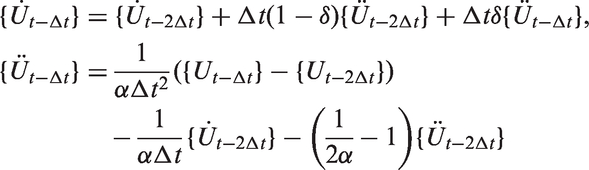
By choosing
Temporal and spatial resolution of the finite element model is critical for the convergence of these numerical results. Choosing an adequate integration time step is very important for the accuracy of the solution. In general, the solving accuracy would be increased with increasingly smaller integration time steps. The high-frequency components are not resolved accurately enough resulting from too long time steps, and a very small time step will be a waste of computing time. Thus, when the rise time of the laser pulse is in the order of nanosecond, a compromise should be taken into account [9]

The element is defined by four nodes with two degrees of freedom at each node in the current coordinate system. The rule of element size is that there are more than 10 nodes in a wavelength generally. To ensure the propagation of energy between two successive nodes in the mesh, the recommended mesh size can be expressed as [9]
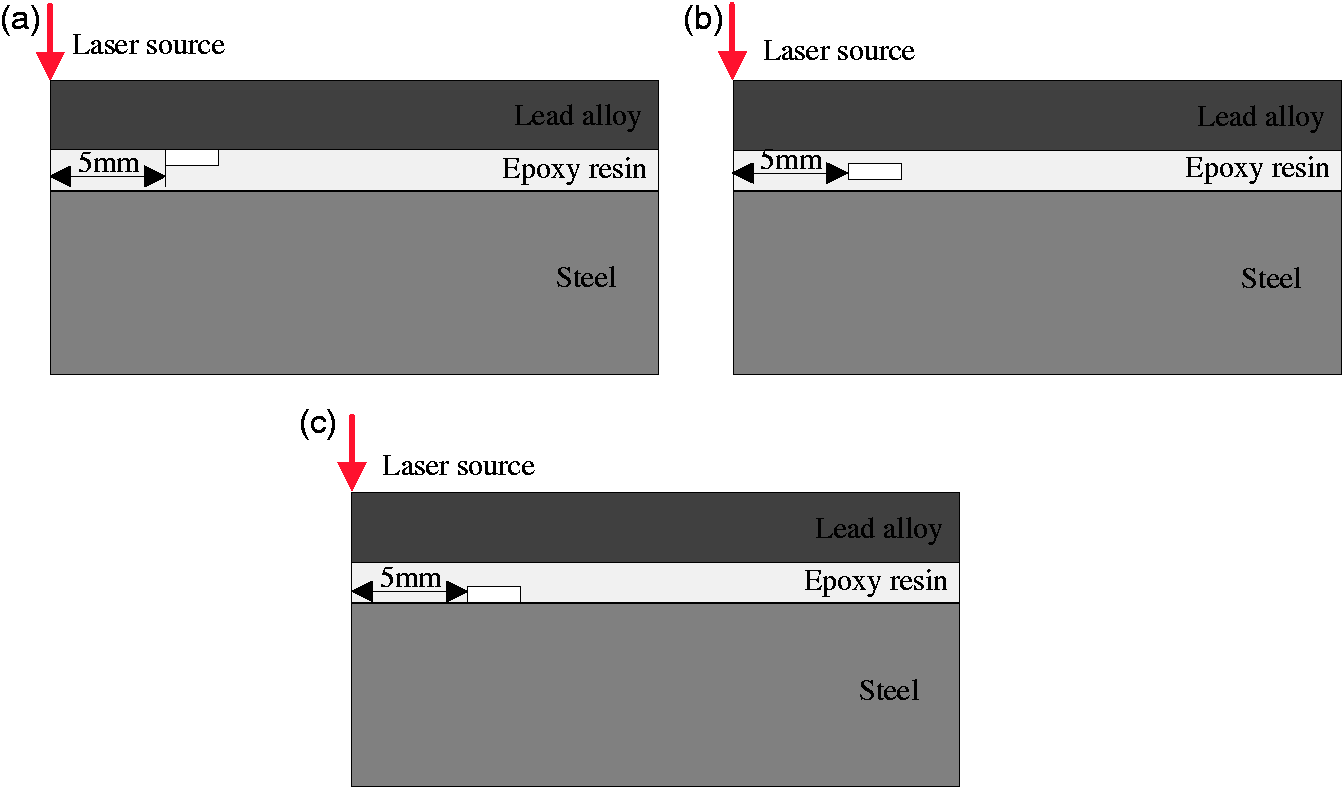
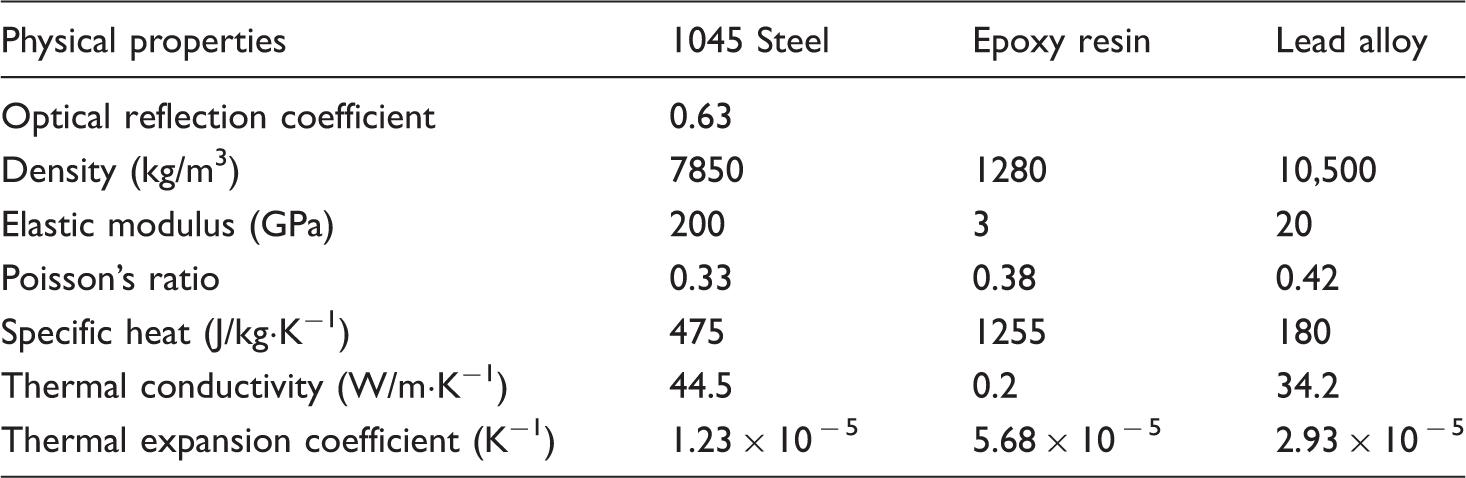
Schematic diagram of the numerical model. Layout and position of defects inserted in the sample at the lead-epoxy resin interface (a), the middle of the adhesive layer (b) and the steel-epoxy resin interface (c). The FEM model of a lead-steel adhesive structure. Thermo-physical parameters of materials used in calculation.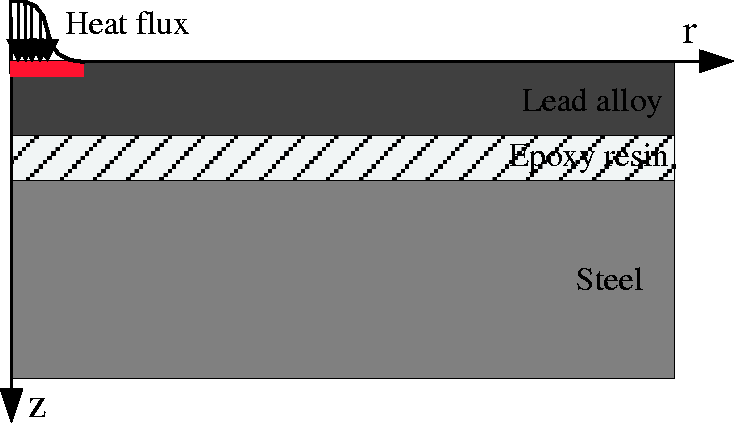
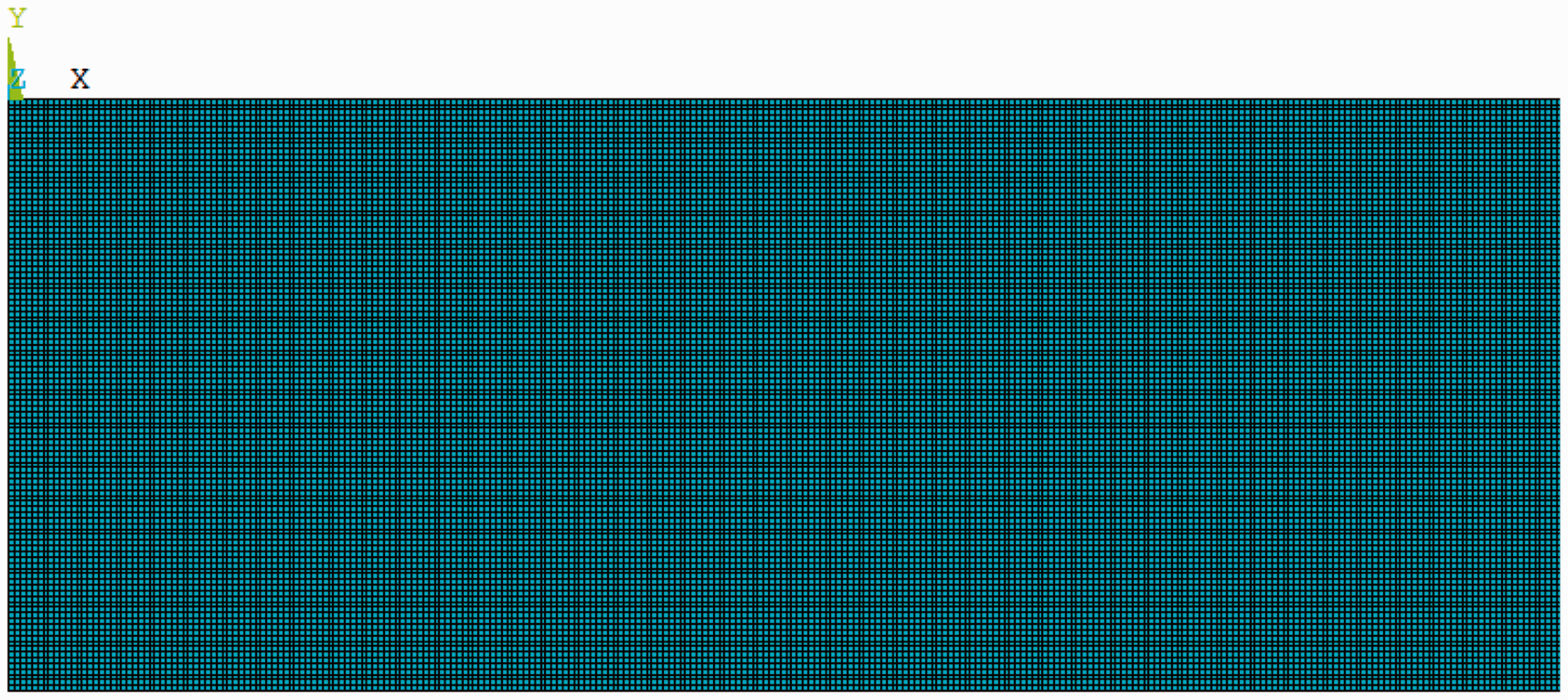

According to the analysis above, the mesh size and time step of the finite element model have an important effect on the accuracy of calculation. The mesh size is set to 20 µm, and the time step is 1 ns, which can guarantee the precision of numerical calculation based on equations (14) and (15).
Results and discussion
Laser-generated guided waves in the lead-steel adhesive structure
Laser-generated ultrasonic waves in a thin lead sheet with the thickness of 1 mm have been calculated to display the characteristics of structural guided waves. The source to receiver distance is denoted as SRD, and the out of plane displacements of various nodes on the top surface of a lead sheet, with the SRD = 3 mm, 6 mm and 9 mm, respectively, have been shown in Figure 4(a) to (c). With the increase of propagation distances, laser-generated ultrasonic waves present the features of dispersion in the thin lead sheet. As shown in Figure 4(d), their frequency characteristics remain the same. Due to constraint of the adhesive layer, the adhesive interface would play an important role in the propagation of ultrasonic waves in a lead-steel adhesive structure.
Laser-generated guided waves in a 1-mm thin lead sheet with different SRDs (a) 3 mm, (b) 6 mm and (c) 9 mm and (d) corresponding frequency spectrums.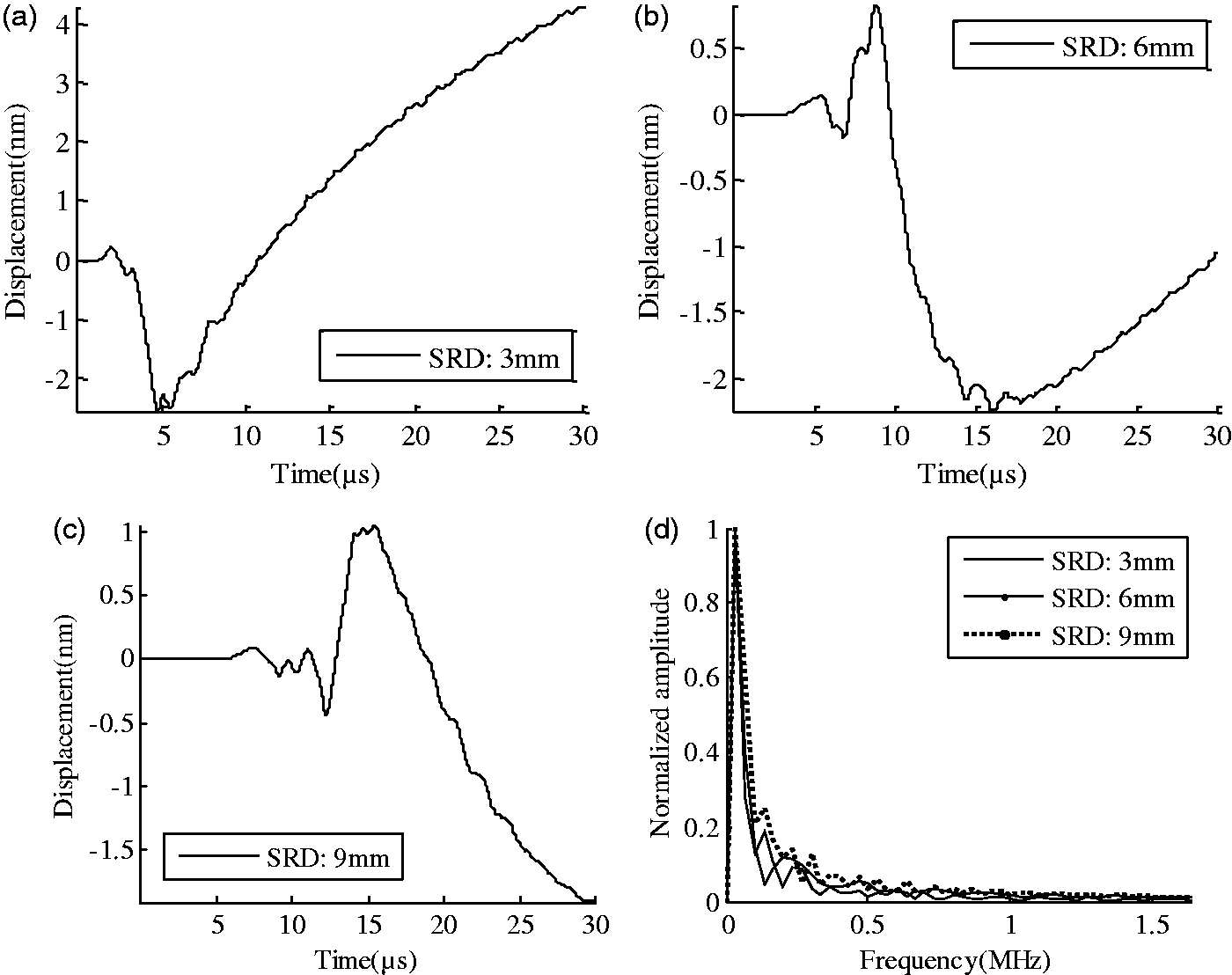
Simultaneously, laser-generated ultrasonic waves in a lead-steel adhesive structure have been calculated to explain the interaction of the adhesive interface with structural guided waves. In comparison Figure 4 with Figure 5, the two waveforms are drastically dissimilar. The two types of wave modes appear in Figure 5(a) to (c), where the low-frequency components of the symmetrical mode (s0) and the antisymmetrical mode (a0) are dominant in the lead-steel adhesive structure based on the frequency contents of ultrasonic signals and corresponding dispersion curves. Moreover, the high-order modes have little influence on the waveforms because laser-generated guided waves with the thermoelastic regime in the lead-steel adhesive structure have the less high-frequency components.
Laser-generated guided waves in the lead-steel adhesive structure with different SRDs (a) 3 mm, (b) 6 mm, (c) 9 mm and (d) corresponding frequency spectrums.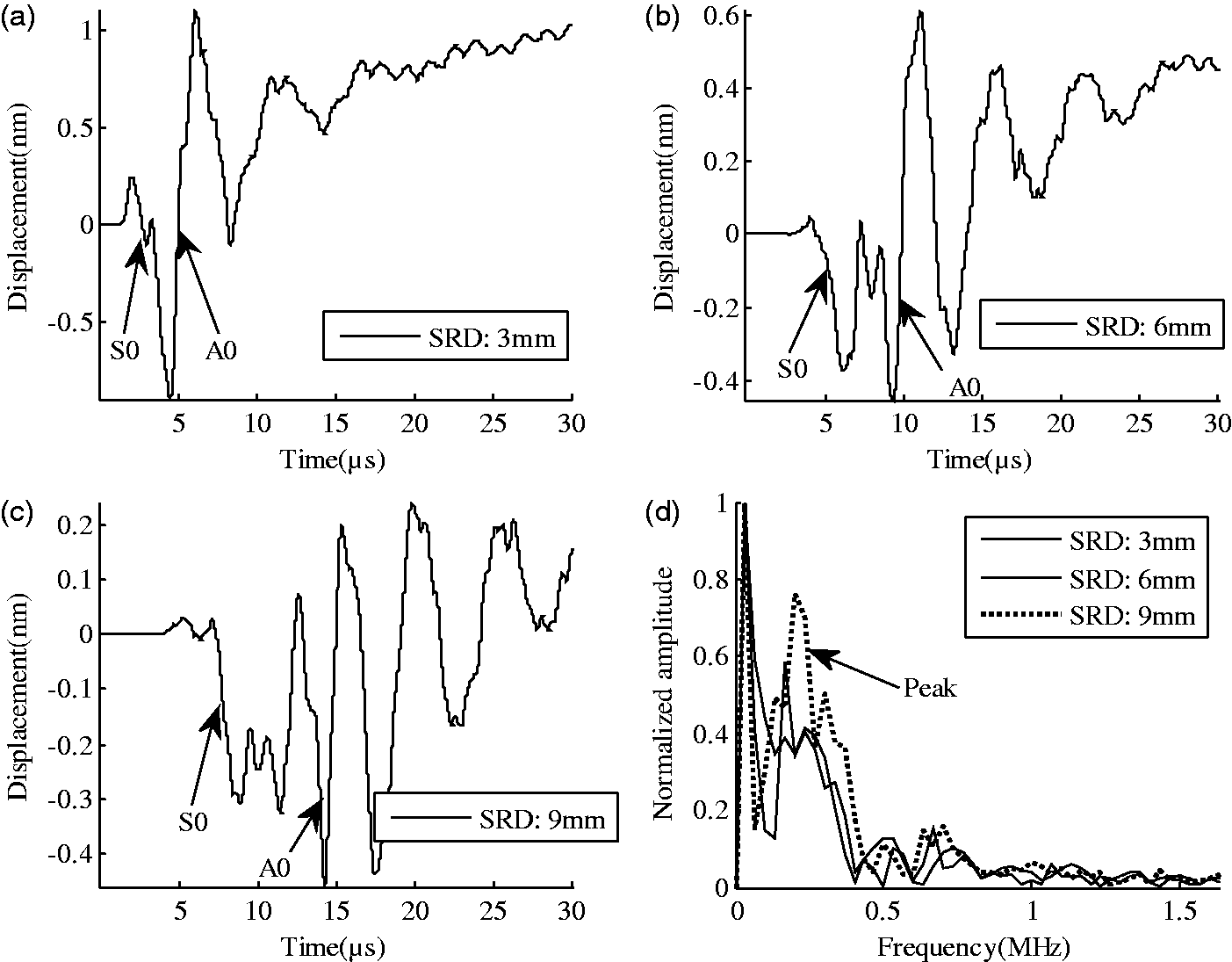
The s0 mode exhibits a non-dispersive waveform. The propagation velocity of the s0 mode in a single sheet can be given by

According to the parameters given in Table 1, the propagation velocity of the s0 mode is 1230.91 m/s. However, the factual propagation velocity of the s0 mode is about 1014.74 m/s shown in Figure 5. The difference of propagation velocity in a single sheet and an adhesive structure again explains the influence of the adhesive interface. The arrival time of the a0 mode at 3 mm, 6 mm and 9 mm is 4.43 µs, 9.33 µs and 14.26 µs, respectively, as shown in Figure 5(a) to (c), which suggests the a0 mode is slightly dispersive. Figure 5(d) shows the frequency characteristics of laser-generated guided waves in a three-layered adhesive structure with the SRD = 3 mm, 6 mm and 9 mm. It can be seen from Figure 5(d) that the energy of laser-generated guided waves in the lead-steel adhesive structure mostly distributes in the frequency band below 0.5 MHz, and a peak nearly appears at 0.2 MHz. The peak increases with the increase of the SRD.
Characteristics of laser-generated guided waves with different adhesive layer thicknesses
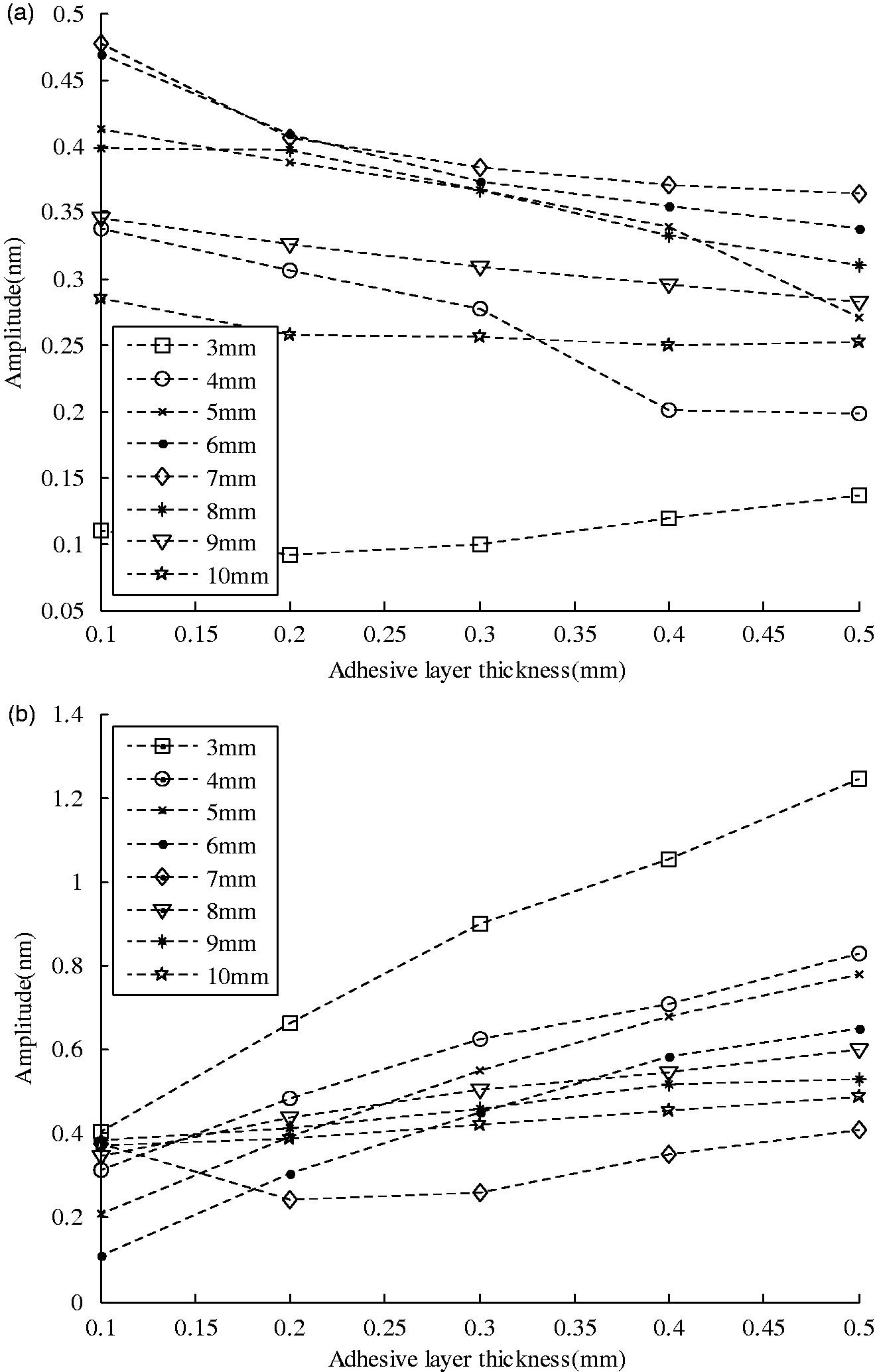
The adhesive layer thickness is an important factor, which influence the adhesive strength, so it is significant to investigate the characteristics of laser-generated guided waves interaction with the adhesive interface with different adhesive layer thicknesses. Figure 6(a) shows the characteristics of guided waves interaction with the adhesive interface with the adhesive layer thickness of 0.1 mm to 0.5 mm and the SRD = 6 mm. The s0 mode would arrive later, and its amplitude reduces with the increase of the adhesive layer thickness. On the contrary, the a0 mode would come earlier, and its amplitude increases with the increase of the adhesive layer thickness. This phenomenon can be utilized to solve the inverse problem for the unknown adhesive layer thickness. The frequency characteristics of guided waves are shown in Figure 6(b), where the peak increases and drifts the lower frequency with the increase of the adhesive layer thickness. It can be seen from Figure 7 that the amplitude of the s0 mode slightly fluctuates at a certain SRD with the increase of the adhesive layer thickness, while the amplitude of the a0 mode evidently increases at a certain SRD with the increase of the adhesive layer thickness. Furthermore, the amplitude of the s0 mode gradually increases and then decreases at a certain thickness with the increase of the SRD, but the amplitude of the a0 mode declines at a certain thickness with the increase of the SRD. Laser-generated ultrasonic waves in the near field present the relative complication due to superposition of various modes, but their amplitude in the far field displays the quite simple relationship with different adhesive layer thicknesses.
Laser-generated guided waves in the lead-steel adhesive structure with different adhesive layer thicknesses: (a) time-domain signals and (b) corresponding frequency spectrums. Amplitude variations of (a) the s0 mode and (b) the a0 mode with different adhesive layer thicknesses and SRDs.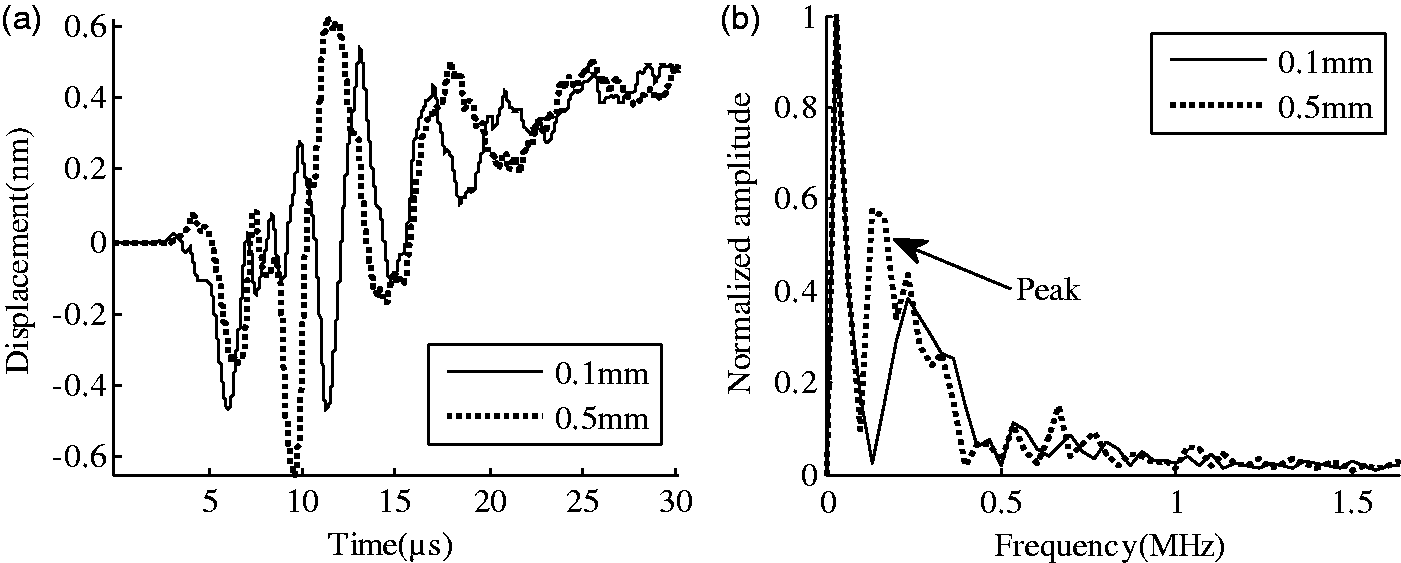
Characteristics of laser-generated guided waves with different adhesive layer properties
The lead-steel adhesive structure has been used for nuclear radiation protection. Unfortunately, the epoxy resin absorbs various rays that would destroy its molecular chain to cause adhesive layer ageing. The adhesive layer ageing would influence the interfacial strength, and its evolution reflects the variations of Poisson’s ratio and Young’s modulus. Therefore, the characteristics of guided waves interaction with the adhesive interface with different Poisson’s ratios and Young’s modulus are investigated to understand the evolution of adhesive status. Figure 8 shows the laser-generated guided waves interaction with the adhesive interface with different Poisson’s ratios and the SRD = 6 mm. The amplitude of guided waves has slight variations, and their frequency spectrums are nearly unchanged. Therefore, the variation of Poisson’s ratio of an epoxy resin adhesive may have slight influence on the responses of laser-generated guided waves interaction with the adhesive interface.
Laser-generated guided waves in the lead-steel adhesive structure with different Poisson’s ratios: (a) time-domain signals and (b) corresponding frequency spectrums.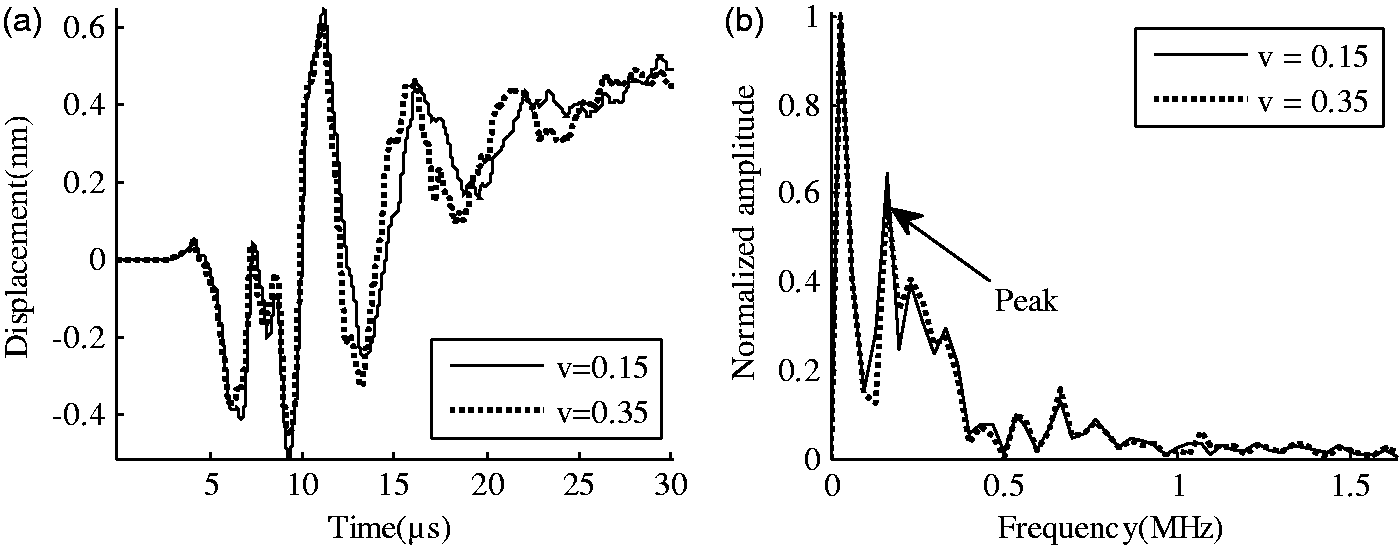
As can be seen from Figure 9, the amplitude of the s0 mode and the a0 mode slightly fluctuate at a certain SRD with different Poisson’s ratios. Moreover, the amplitude of the s0 mode would gradually increase and then decrease, and the amplitude of the a0 mode shows a dip at a certain Poisson’s ratio with different SRDs. Besides, the amplitude of the s0 mode and the a0 mode would stay the same with the increase of Poisson’s ratios at a certain SRD. As a result, the s0 mode and the a0 mode may be insensitive to the variation of Poisson’s ratio of an epoxy resin adhesive.
Amplitude variations of (a) the s0 mode and (b) the a0 mode with different Poisson’s ratios and SRDs.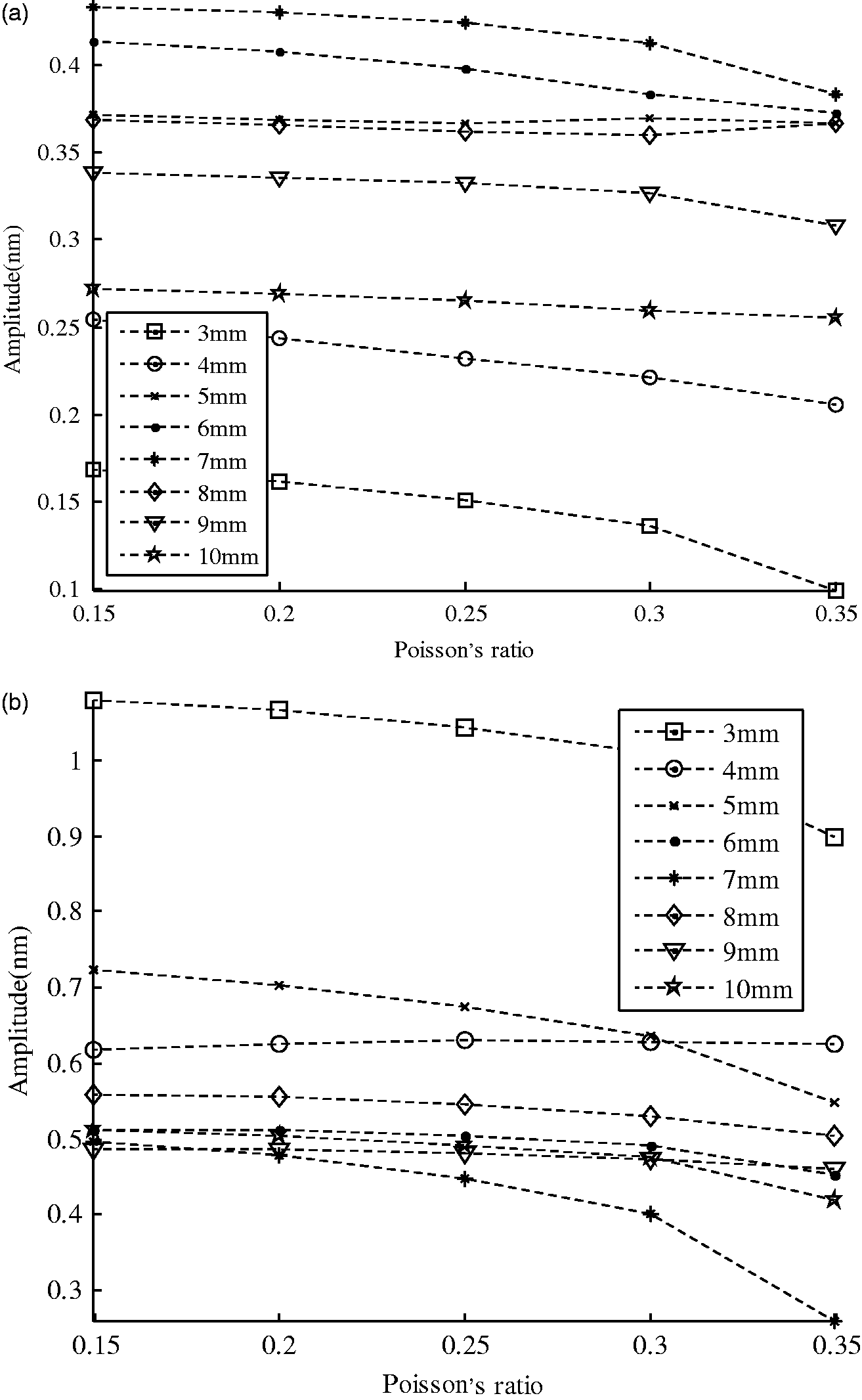
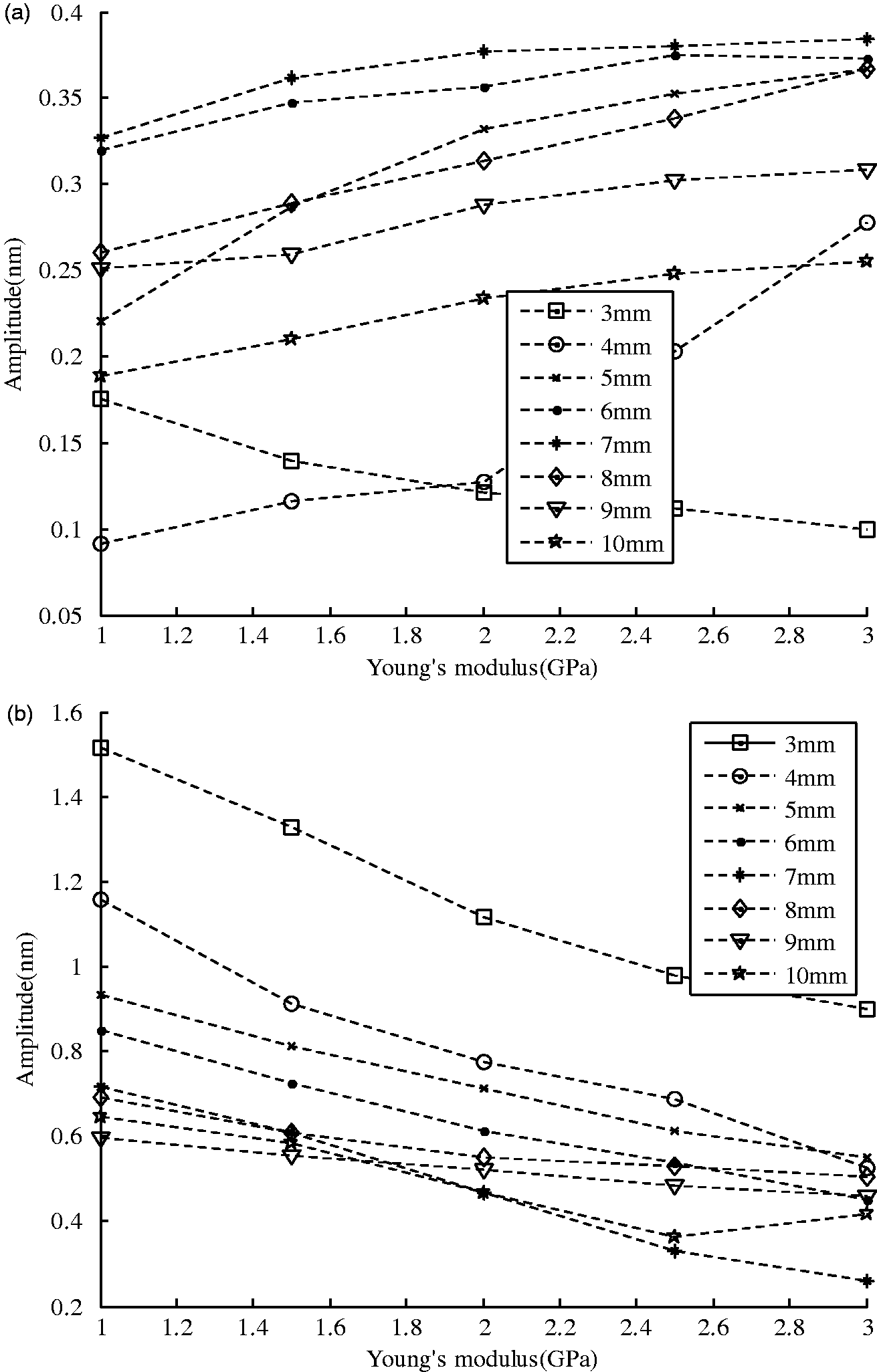
Although the responses of laser-generated guided waves interaction with the adhesive interface are not intense for different Poisson’s ratios shown in Figures 8 and 9, the amplitude variations of the s0 mode and the a0 mode may be used to test other adhesive layer properties. Figure 10 shows the characteristics of laser-generated guided waves in the adhesive structure with different Young’s modulus and the SRD = 6 mm. The amplitude of the a0 mode with Young’s modulus of 1 GPa is obviously higher than that with Young’s modulus of 3 GPa, and the peaks in the frequency-domain signals present the same results. Figure 11 shows the amplitude variations of the s0 mode and the a0 mode with different Young’s modulus and SRDs. The amplitude of the s0 mode increases at a certain SRD except the SRD = 3 mm with different Young’s modulus, but the amplitude of the a0 mode approximately linearly decreases under the same condition.
Laser-generated guided waves in the lead-steel adhesive structure with different Young’s modulus: (a) time-domain signals and (b) its corresponding frequency spectrum. Amplitude variations of (a) the s0 mode and (b) the a0 mode with different Young’s modulus and SRDs.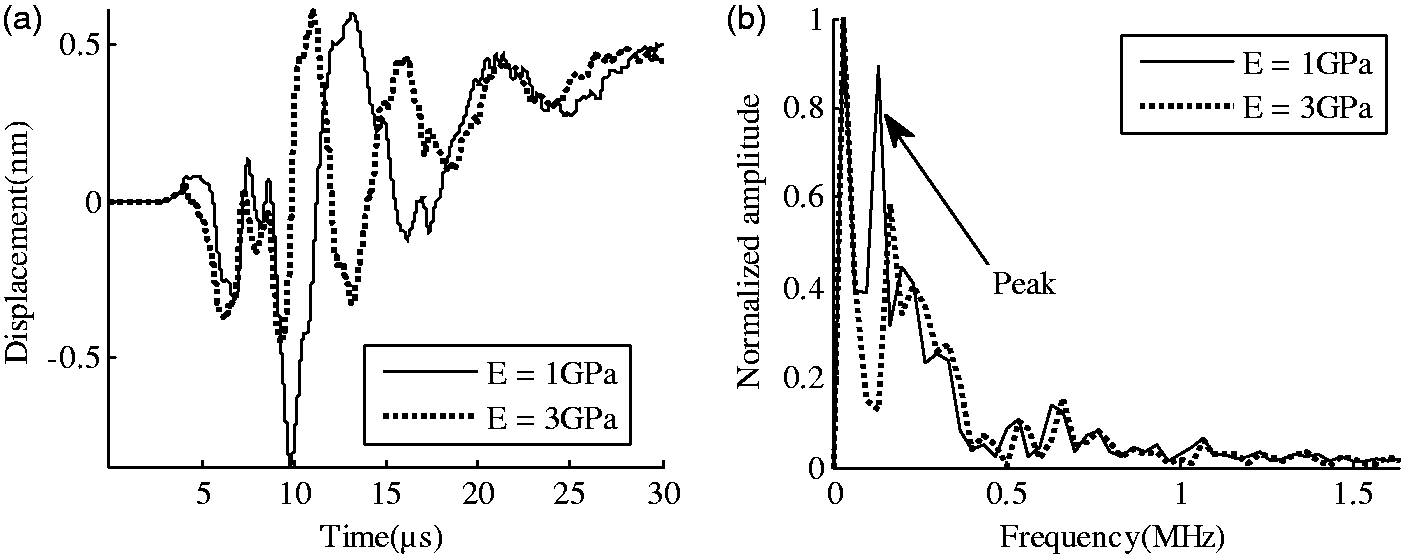
Characterization of adhesive defects
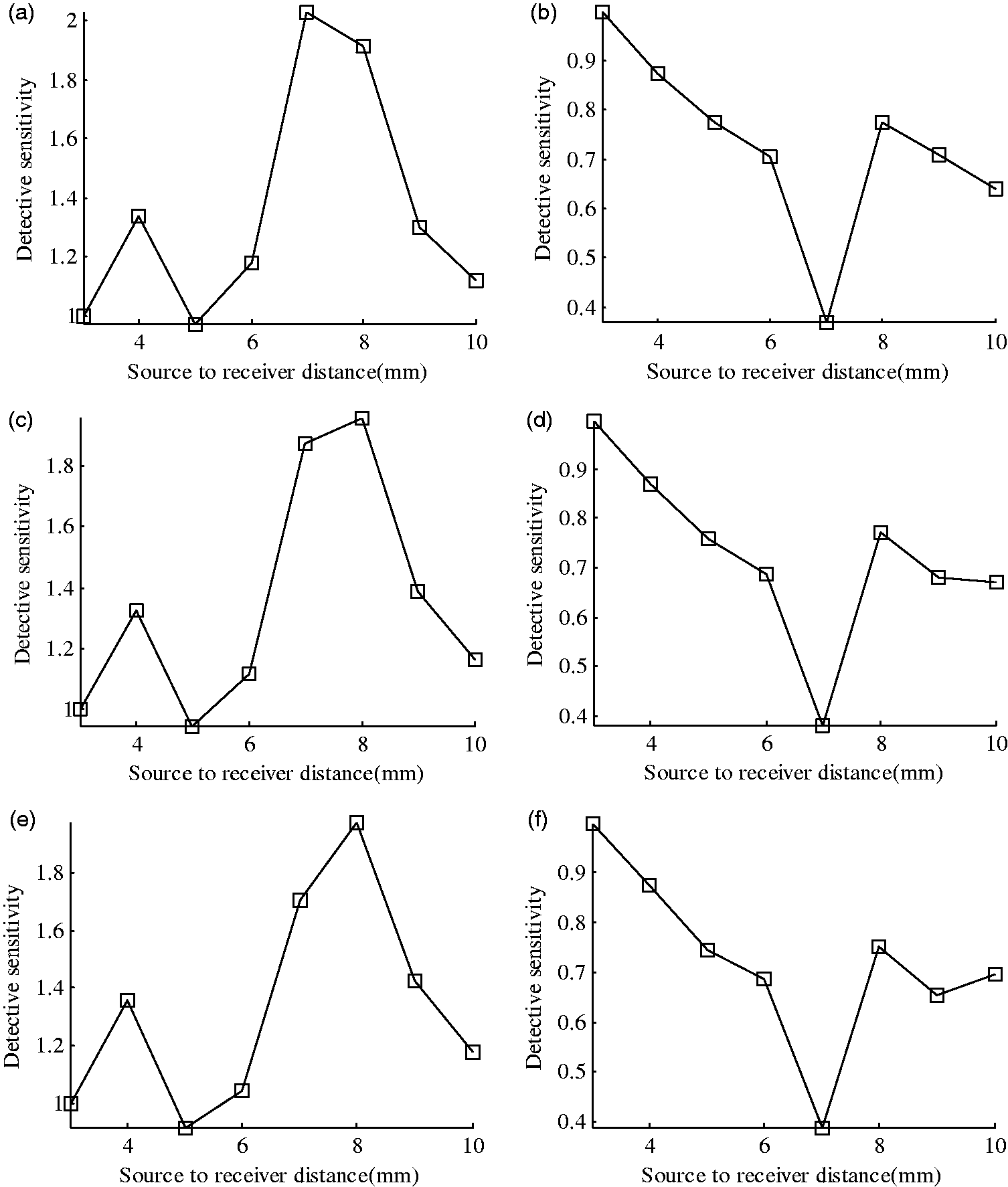
Characteristics of laser-generated guided waves interaction with the good adhesive interface and the defective interface are compared to investigate the influence of adhesive defects on the adhesive interface. Adhesive defects are located at the lead-epoxy resin interface, the middle of the adhesive layer and the steel-epoxy resin interface, respectively. Figure 12 shows the comparison of laser-generated guided waves in the good and defective adhesive structure with the SRD = 6 mm. It can be seen from Figure 12 that the amplitude of the a0 mode presents the difference between the good adhesive structure and the defective adhesive structure, and frequency-domain signals also reflect the influence of defects on adhesive integrity. Although layout and position of defects are different, the responses of laser-generated guided waves interaction with defective adhesion possess the similarity. Detective sensitivity is defined by the ratio of the amplitude of the s0 mode and the a0 mode in a good adhesive structure to that in a defective adhesive structure. Figure 13 shows the detective sensitivity with different SRDs, where the detective sensitivity of the s0 mode presents fluctuation, but the detective sensitivity of the a0 mode shows decrease in all SRDs. The optimum detective sensitivity of the s0 mode appears at the SRD = 7 mm or 8 mm, and the optimum detective sensitivity of the a0 mode appears at the SRD = 7 mm.
Laser-generated guided waves interaction with (a) the defective lead-epoxy resin interface, (c) voids of the adhesive layer and (e) the defective steel-epoxy resin interface and (b), (d) and (f) corresponding frequency spectrums. Detective sensitivity variations of (a), (c) and (e) the s0 mode and (b), (d) and (f) the a0 mode with (a) and (b) disbonds located at the lead-epoxy resin adhesive interface, (c) and (d) disbonds located at the middle of the adhesive layer, and (e) and (f) disbonds located at the steel-epoxy resin adhesive interface.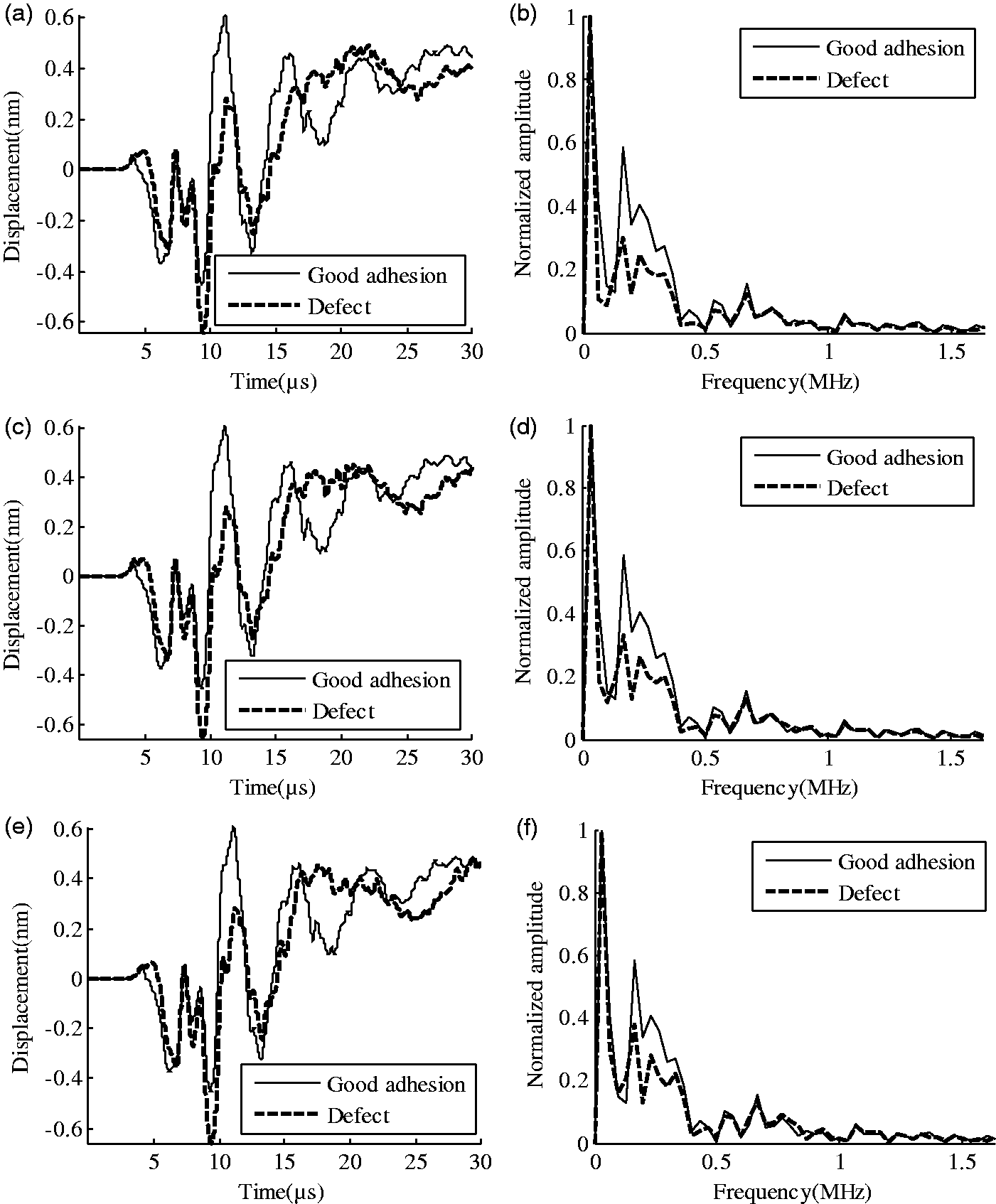
According to the analysis above, the time- and frequency-domain characteristics of laser-generated guided waves in the lead-steel adhesive structure are different from the thin lead sheet due to the influence of the adhesive interface. The adhesive layer bonded with the substrates produces the special zones that have different features compared with substrate materials. The special zones can reflect and transmit the ultrasonic energy. Laser-generated ultrasonic waves in the lead-steel adhesive structure include various modes compared with the traditional ultrasonic methods, but the simple guided wave modes in the adhesive structure can be produced by controlling the laser spot size and energy. Laser-generated guided waves with the thermoelastic regime mainly including the s0 mode and the a0 mode in the lead-steel adhesive structure would be favorable to characterization of adhesive quality. The parameters of the adhesive layer are the adhesive thickness, the Poisson’s ratio and the Young’s modulus. The adhesive layer thickness can influence the amplitude and phases of laser-generated guided waves, but it has the opposite effect on the features of the s0 mode and the a0 mode due to different vibrational modes of guided waves. The Poisson’s ratio of an epoxy resin adhesive would have slight influence on the features of laser-generated guided waves in the lead-steel adhesive structure, but the Young’s modulus would have evident influence on time- and frequency-domain characteristics of laser-generated guided waves. Therefore, the Young’s modulus of an epoxy resin adhesive has more influence on the reflection and transmission of ultrasonic waves than the Poisson’s ratio. Moreover, the responses of laser-generated guided waves interaction with disbonds present the similarity, thus laser-generated guided waves can characterize the integrity of adhesive quality.
Conclusions
Laser-generated guided waves have been developed to characterize the properties of the adhesive interface in the nuclear radiation protection structure. The adhesive layer evidently plays an important role in laser-generated guided waves in the adhesive structure compared with a single thin sheet. The adhesive interface would constrain the propagation of structural guided waves according to the theoretical analysis. The time- and frequency-domain characteristics of laser-generated guided waves interaction with the adhesive interface with different adhesive layer thicknesses, the Poisson’s ratios and the Young’s modulus have been analyzed to solve the inverse problems for the unknown adhesive layer parameters. The amplitude of the a0 mode and the s0 mode present different trends with different source to receiver distances. Although layout and position of defects are different, the responses of laser-generated guided waves interaction with defective adhesion possess the similarity. The research results would provide guidance for establishing the quantitative relationship between laser-generated guided waves and the adhesive interface.
Footnotes
Declaration of Conflicting Interests
The author(s) declared no potential conflicts of interest with respect to the research, authorship, and/or publication of this article.
Funding
The author(s) disclosed receipt of the following financial support for the research, authorship, and/or publication of this article: This work is supported by National Natural Science Foundation of China (No.U1430120) and the Academic Excellence Foundation of BUAA for PhD Students.