







Abstract
The nonlocal thermo-magneto-electro-mechanical bending behaviors of a three-layered nanoplate are presented in this study. The three-layered nanoplate includes a nano-sheet and two piezo-magnetic face-sheets at the top and the bottom. Temperature distribution is assumed linear along the thickness of the plate. The piezo-magnetic face-sheets are subjected to three-dimensional electric and magnetic potentials. The applied electric and magnetic potentials are applied at top of the face-sheets. The constitutive thermo-electro-magneto relations are derived based on the sinusoidal shear-deformation plate theory and nonlocal electro-magneto-elasticity. Using the principle of virtual work seven equations of the equilibrium are derived. The numerical results of this research indicate that some parameters have considerable effect on the bending behavior of three-layered nanoplate. Nonlocal parameter, applied electric and magnetic potentials, and temperature distribution are important parameters in this analysis.
Keywords
Introduction
Analysis of different structures subjected to multi-field loads has attracted various researchers for further study and investigation. The combination of different types of loading leads to complex problems, hence it is difficult to interpret how problem parameters affect the response. Considering the multi-field problems in nano-scales can present new and novel issues that lead to important output. Furthermore, analytical method of the plates has been developed for better prediction. After presentation of Kirchhoff-love theory, some new theories have been developed to exactly predict the behavior of plate. The Shear deformation theory was developed in the decade of 1960s for this purpose. A comprehensive study is performed to mention the application of sinusoidal shear-deformation plate theory and nonlocal elasticity for a three-layered nanoplate containing a nano-core and two piezo-magnetic face-sheets subjected to thermo-electro-magneto-mechanic loads. This structure is applicable as sensor and actuator in nano-electro-magneto-mechanical systems. A literature review can present the novelty of present paper and the importance of this issue to the designers and researchers.
The nonlinear dynamic stability of laminated composite cylindrical and spherical shells integrated with piezoelectric layers was investigated based on the finite element method by Pradyumna and Gupta [1]. First-order shear deformation theory and nonlinear von-Karman strain–displacement relations were derived for constitutive relations. Galerkin’s method was used for obtaining the amplitude equation of nonlinear matrix. The problem of a curved functionally graded piezoelectric (FGP) actuator with sandwich structure under electrical and thermal loads was investigated by Yan et al. [2]. The governing equations of the system were derived using the theory of linear piezoelectricity, and analytical solutions were obtained using airy stress function. It is found that the material gradient and thermal load have significant influence on the electro-elastic fields and the mechanical response of the curved FGP actuator. Electro-elastic responses of FGP materials were studied by Kargarnovin et al. [3]. The properties of the material vary based on the exponentially distribution. Using the basic piezoelectric relations, a system of fourth-order inhomogeneous partial differential equations was derived and a closed-form solution was derived. The obtained results and formulation were validated with the existing results in the literatures.
Thar et al. [4] studied the thermo-magneto-electro-elastic analysis of a piezo-laminated shell based on the first-order transversally shear deformation theory. The governing equations of motion and required boundary conditions were derived using Hamilton’s principle with cooperation of Gibbs free energy functions. To ensure a conventionally effective model, a rectangular plane shell of zero and large curvatures was selected for analysis. Free vibration of magneto-electro-elastic nanoplates was studied based on the nonlocal theory and Kirchhoff plate theory by Ke et al. [5]. The used model was subjected to biaxial force, external electric and magnetic potentials, and temperature rise with simply supported boundary conditions. The natural frequencies of the nanoplate were derived based on Hamilton’s principle. The effect of some important parameters of the system such as the nonlocal parameter, thermo-magneto-electro-mechanical loadings, and aspect ratio was investigated on the vibration characteristics of the nanoplates. Akbarzadeh and Chen [6] studied the multi-physical responses of a functionally graded, thermo-magneto-elastic rotating hollow cylinder subjected to thermo-magneto-electro-mechanical loads. The coupled differential equations were solved in an exact form using the successive decoupling method. The properties of the material of FG hollow cylinder were assumed to obey the power law along the radial direction. Zhou and Cui [7] studied the tri-layer symmetric magneto-electric laminated composites made of giant magnetostrictive materials and piezoelectric materials. To derive the vibration equation of the model, magnetostrictive constitutive relations with variable coefficients and the linear piezoelectric constitutive relations were employed. The obtained results were compared with the experimental results. The present results provide a theoretical basis for the design and application of high-performance and miniaturized magneto-electric devices, operating under extreme temperature conditions.
Tri-layer symmetric magneto-electric laminates were made up of giant magnetostrictive materials and piezoelectric materials by Zhou and Cui [8]. The model used in this study was adopted to predict the influences of the temperature, interface coupling factor, and thermal expansion coefficient of the giant magnetostrictive materials. The influence of thermal, electrical, magnetic, and mechanical loads has been investigated on the bending behaviors of a three-layered nanoplate using trigonometric plate theory [9]. Transient analysis of a micro rod due electric potential based on strain gradient theory has been studied by Arefi and Zenkour [10]. Buckling and vibration analysis of triple-walled ZnO piezoelectric Timoshenko beam was studied by Mohammadimehr et al. [11] based on the nonlocal elasticity theory. The model was placed on the Pasternak foundation and subjected to magneto-electro-thermo-mechanical loads. The effects of various parameters including the elastic medium, small scale, length, thickness, van der Waals force on the critical buckling load, and non-dimensional natural frequency of the nanobeam were investigated. The results of this study show that the critical buckling load reduces by increasing the change in temperature, direct electric field, magnetic field, and length of nanotube, and vice versa for thickness of nanotubes, and two parameters of elasticity. Some of the useful references for this paper are Zenkour [12], Farajpour et al. [13], Liu et al. [14], Mohammadimehr and Mostafavifar [15], and Akavci [16]. Bending responses of a FG sandwich plate using a simple four-unknown shear and normal deformations theory were studied by Zenkour [17]. Tounsi and his colleagues [18–20] have presented the thermomechanical and hygrothermal bending analysis of FG sandwich plates using various plate theories. Arefi and Zenkour [21] presented the bending analysis of a FG piezo-magnetic sandwich nanobeam.
In this study, we present a comprehensive study on the influence of multi-field loads and nonlocal elasticity on the bending behaviors of a three-layered nanoplate integrated with piezo-magnetic face-sheets kept on Pasternak’s foundation. This study is performed based on higher order shear-deformation plate theory and nonlocal elasticity of a nanostructure. The main objective of this research is to study the application of a nano-electro-mechanical system used as sensor and actuator. The influence of thermal, electrical, mechanical, and magnetic loads on the structure is studied by the results of electro-magneto-mechanical bending analysis. A comprehensive parametric analysis is performed in this paper to discuss the influence of important parameters such as applied electric and magnetic potentials, temperature rising, parameters of Pasternak’s foundation, and nonlocal parameter on the mechanical, electrical, and magnetic components. This parametric study is presented to notify the researchers that how bending responses of the three-layered nanoplate change with the change in the important parameters of the problem.
Basic equations
A nanoplate including a graphene sheet and two integrated piezo-magnetic face-sheets is employed in our analysis. The rectangular Cartesian coordinates The schematic figure of a sandwich nanoplate integrated with two piezo-magnetic layers.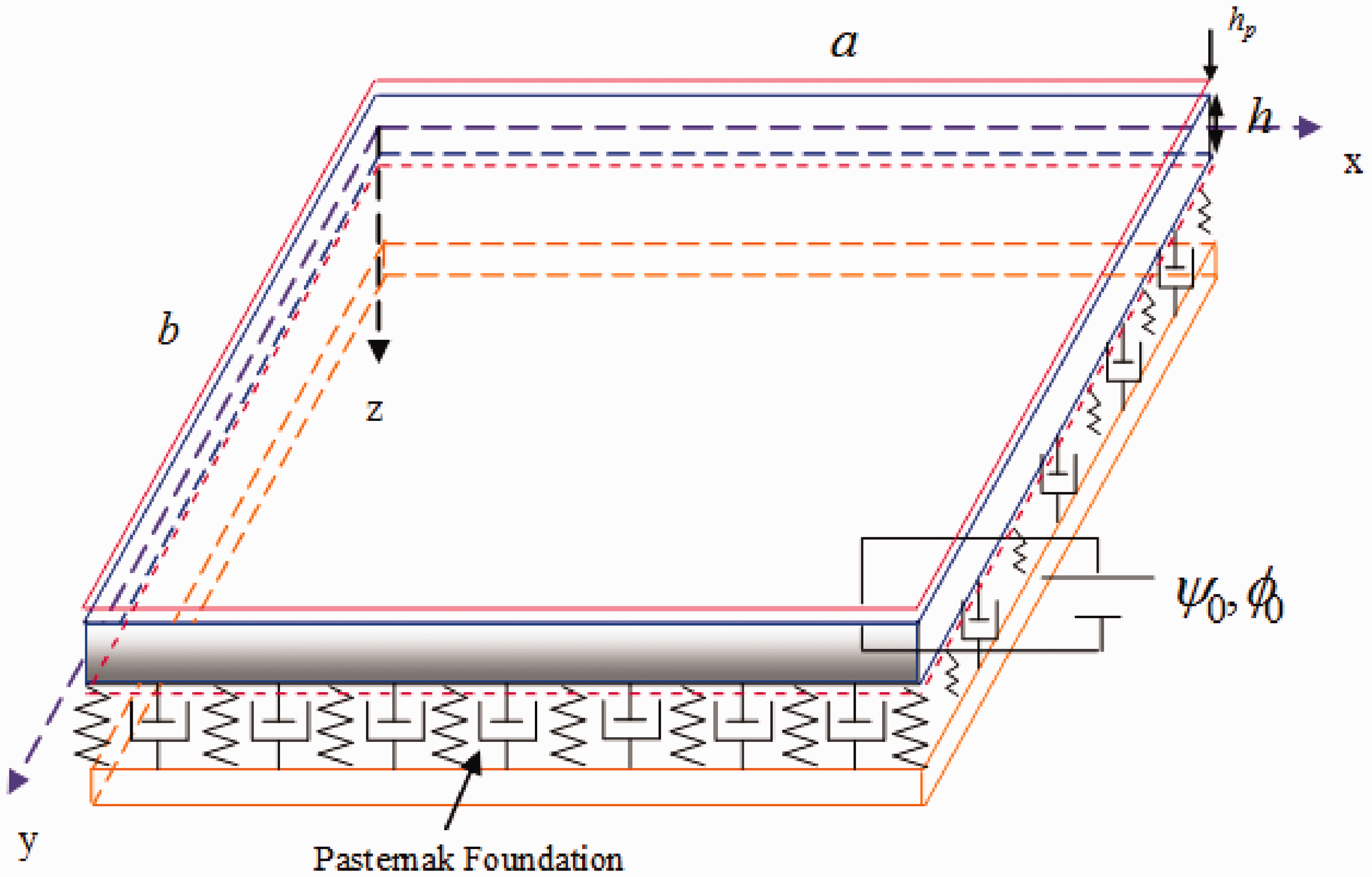
To describe displacement field, sinusoidal shear-deformation plate theory is used in this study. This theory contains the classical and shear or higher-order plate terms. This theory is described as [12]
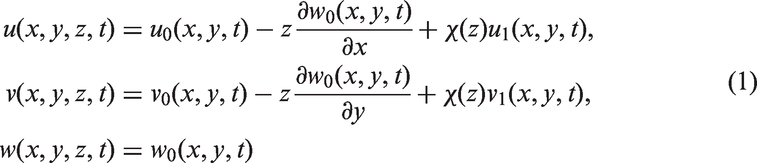
In this study, based on the sinusoidal shear-deformation plate theory,

Using the displacement field described in equation (1), the strain components
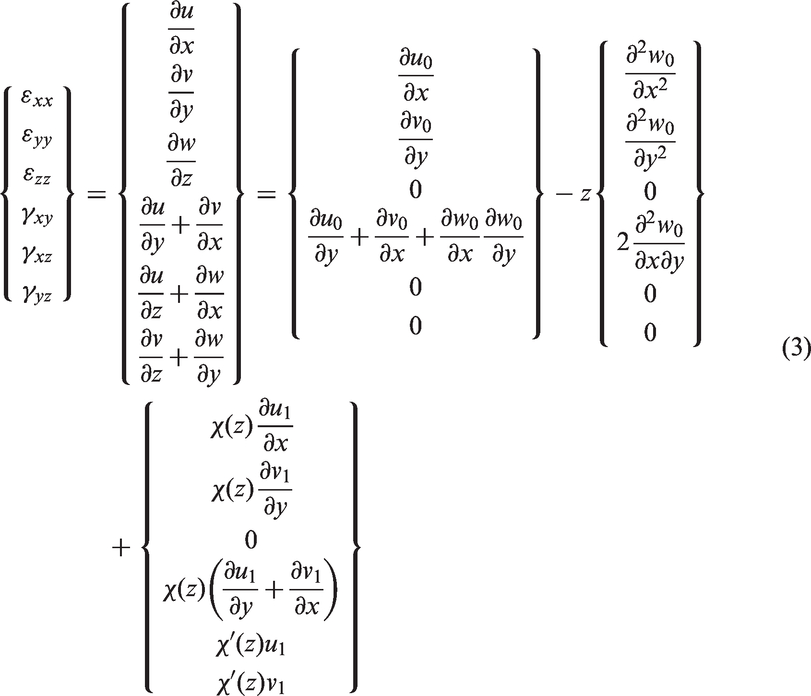
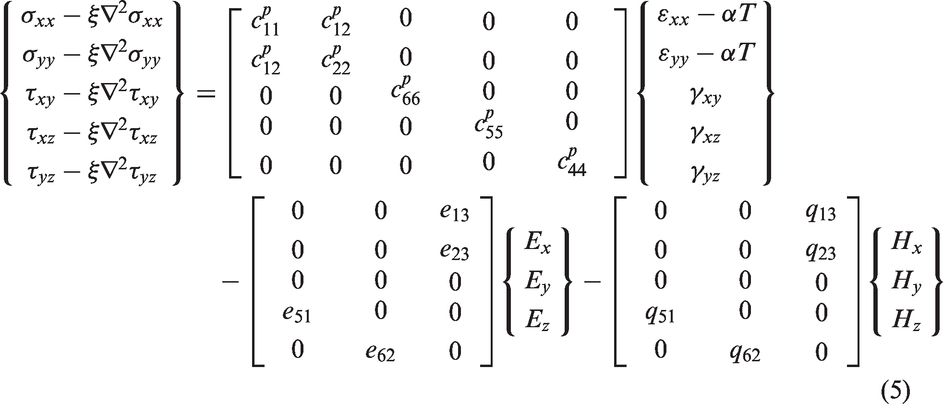
After derivation of strain components, in this section, the nonlocal constitutive relations of core and two integrated piezo-magnetic face-sheets are derived based on Eringen’s theory. Stress–strain relations for core are presented as
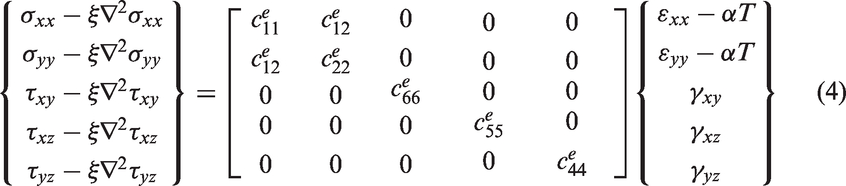
For an electro-mechanical system, the electric displacements are defined as [13, 21–24, 26]
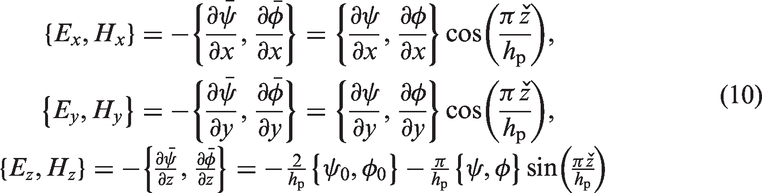
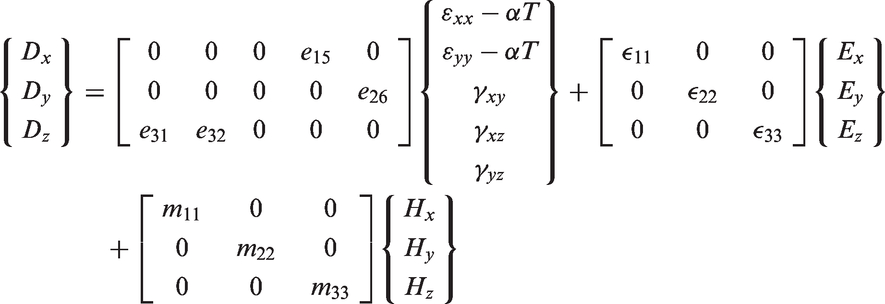
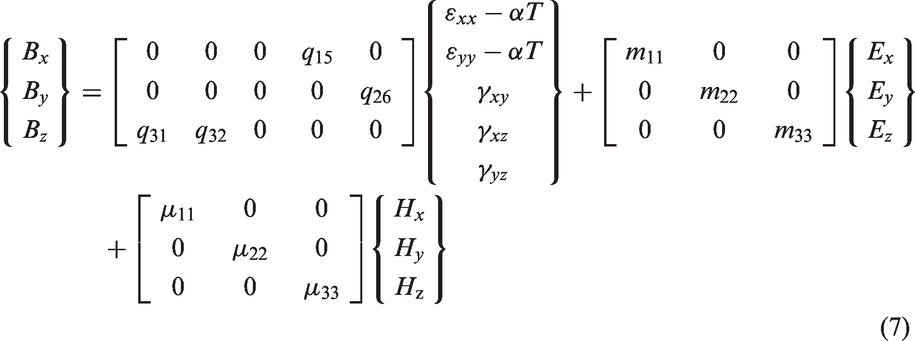
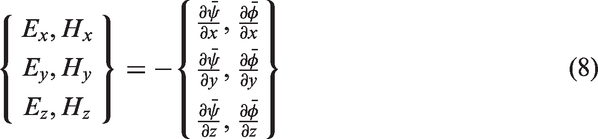

Substitution of electric and magnetic fields and strain components into stress–strain relations, electric displacement, and magnetic induction yields





For piezo-magnetic layers we assume
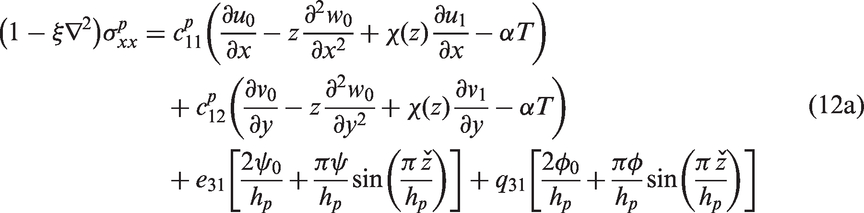
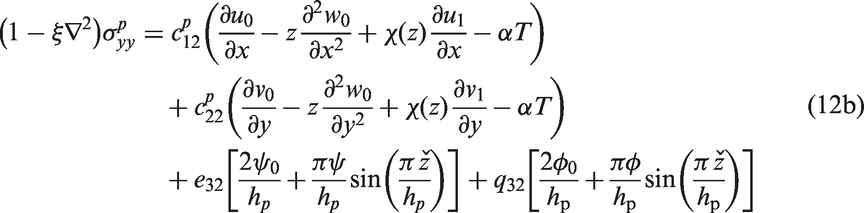



In addition


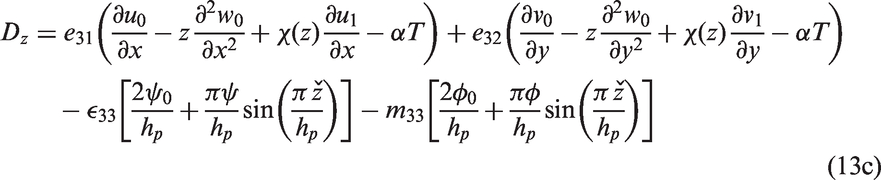


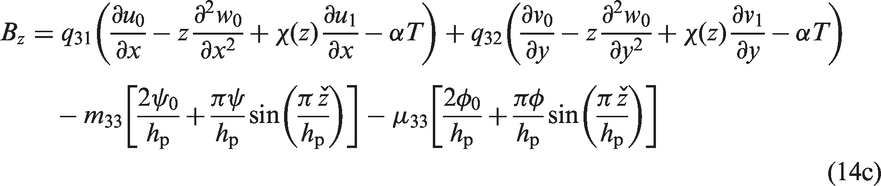
After completing the stress, strain, electric displacement, magnetic induction, electric, and magnetic fields, the strain energy of the sandwich nanoplate can be calculated.
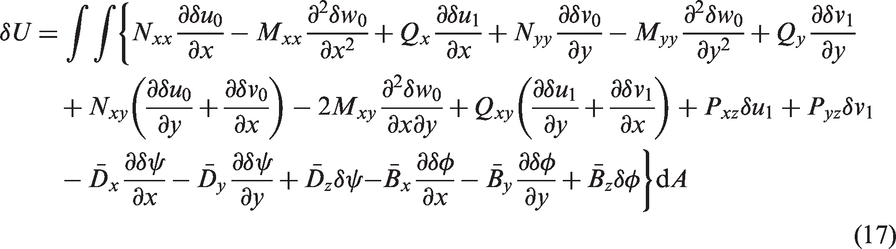
By substituting stress, strain, electric displacement, and electric field components, we will get the variation of U in the following form [22–24, 26]

In addition, the variation of energy due to the external works is given by












Solution for the problem
Before presentation of solution for the problem, the applied thermo-electro-mechanical loadings must be defined. In order to define these loadings, we can use the following distributions for mechanical, thermal magnetic, and electrical loadings as [15, 16, 22–24]

To satisfy the simply supported boundary conditions of the nanoplate and zero electric and magnetic potentials along the four boundaries of the system, the following solution is proposed [15, 16, 22–24]

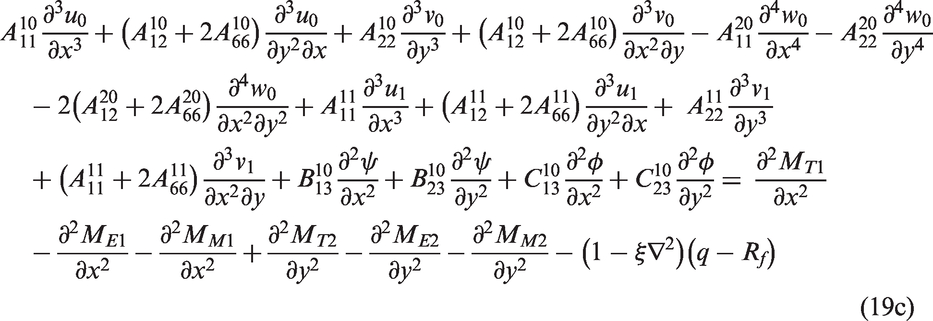
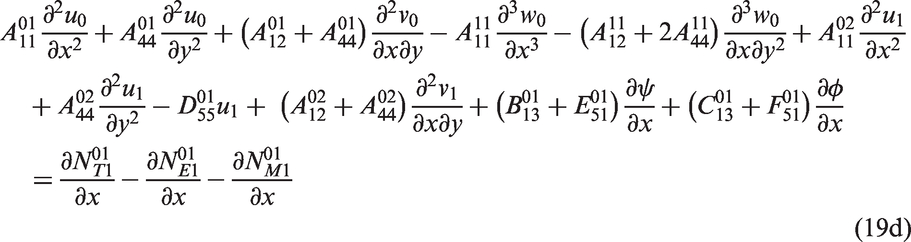
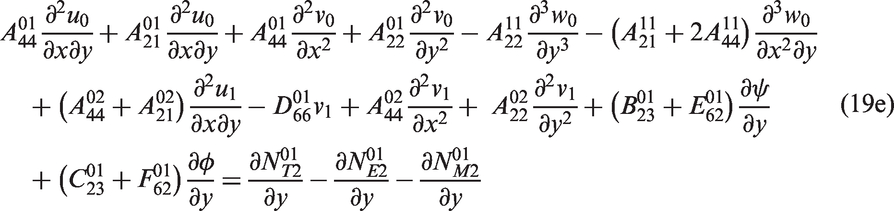
Based on the assumed solution, the governing equations, equation (19), are converted to the following format

Numerical results and discussion
Temperature distribution along the direction of thickness can be derived using the Fourier heat conduction equation. For one-dimensional steady state heat transfer along the direction of thickness with no heat generation, the heat conductive equation is presented as

Applying constant temperature at the top and bottom of the plate (

The numerical results of this paper are presented in this section. Before the presentation of the results, material properties and geometries of the plate must be considered. The dimensions of three-layered nanoplate are assumed as:
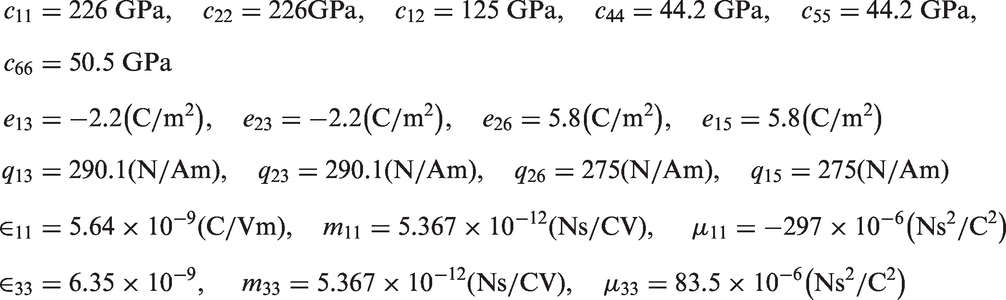
The integrated piezo-magnetic layers of BiTiO3–CoFe2O4 have the following material properties
The effect of two parameters of temperature risings T0 and T1 on the dimensionless deflection Distribution of maximum dimensionless deflection of nanoplate in terms of T0 and T1.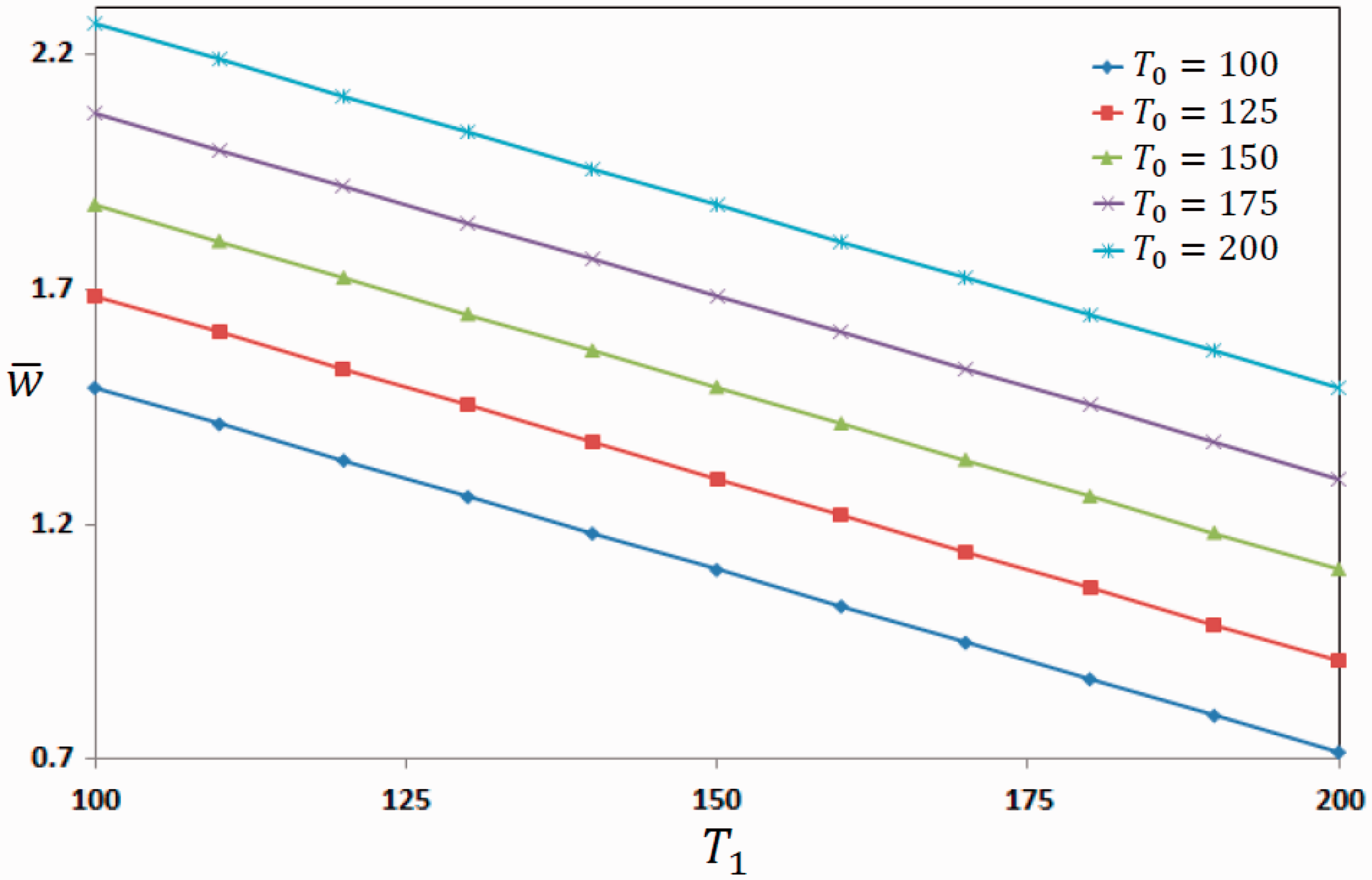
The influence of applied electric and magnetic potentials on the dimensionless deflection of nanoplate Distribution of maximum dimensionless deflection of nanoplate in terms of applied electric and magnetic potentials 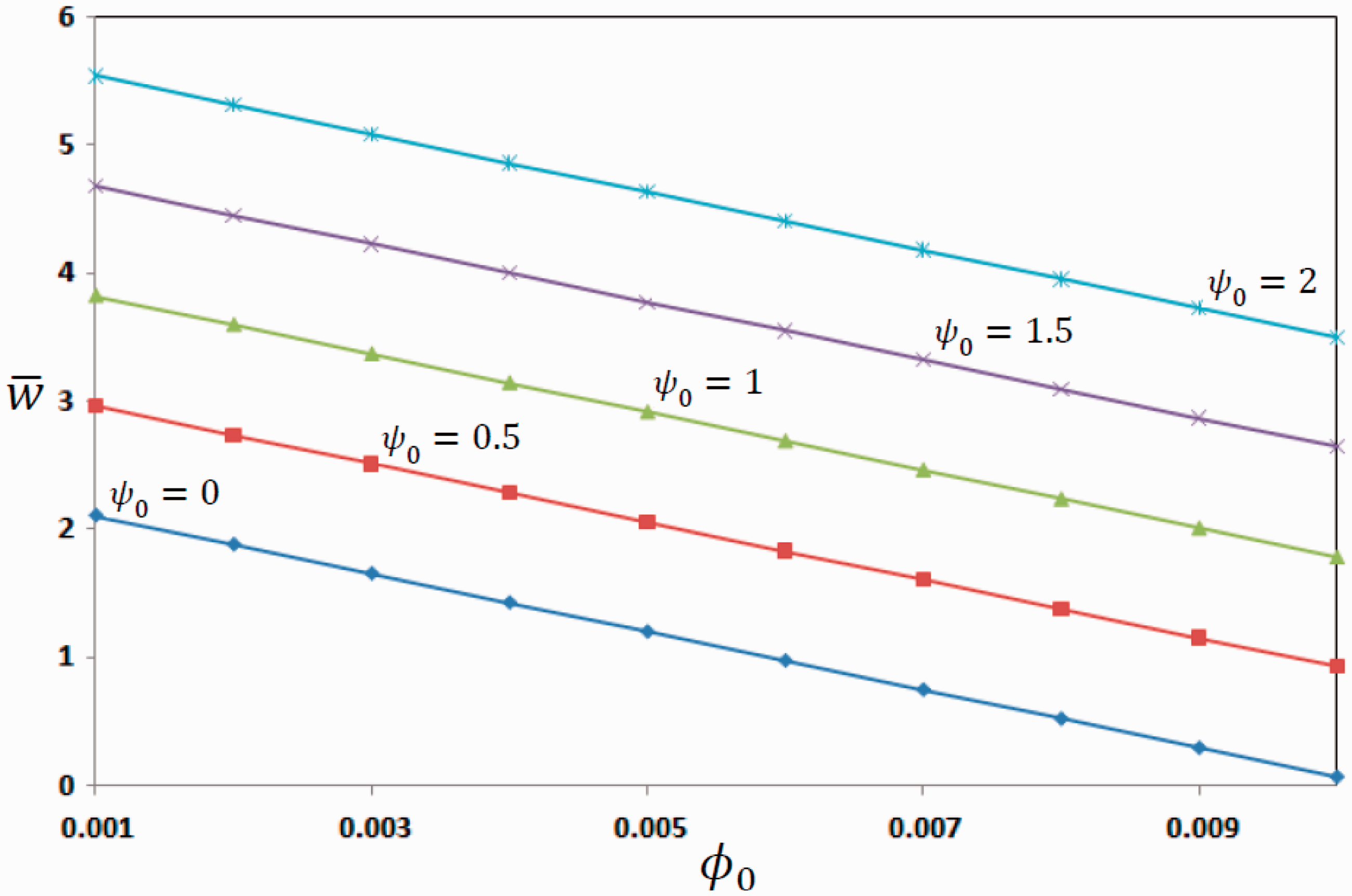
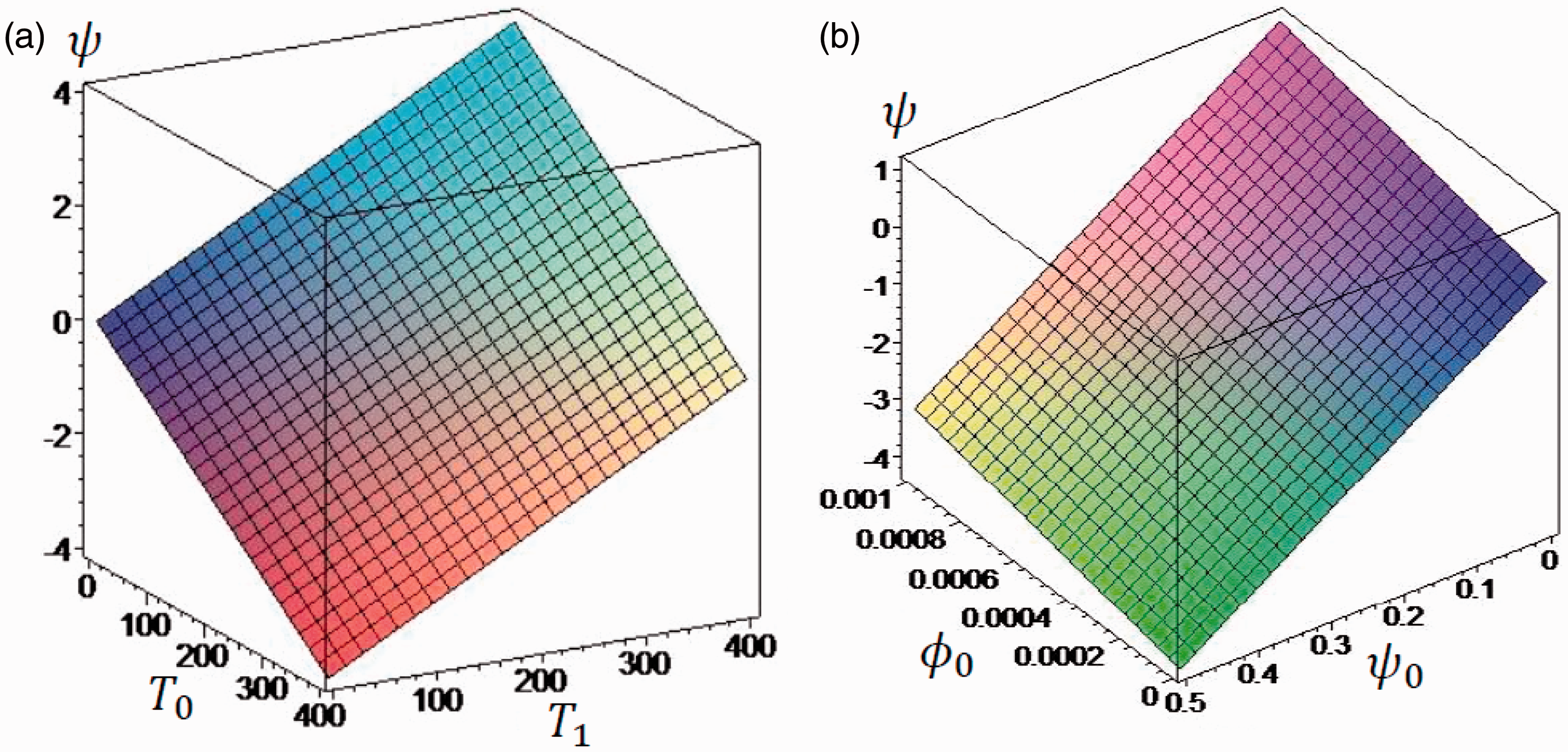
To investigate the effect of temperature rising on the distribution of magnetic potential, Figure 4 shows the distribution of maximum magnetic potential in terms of temperature-rising parameters T0 and T1. With the increase of T0, maximum magnetic potential through the thickness of face-sheets is increased while the increase of T1 leads to the decrease in maximum magnetic potential. Based on Figure 5, it can be concluded that the increase of applied magnetic potential Distribution of maximum magnetic potential along the direction of thickness of nanoplate in terms of T0 and T1. Distribution of maximum magnetic potential of nanoplate in terms of applied electric and magnetic potentials Distribution of maximum electric potential along the direction of thickness of nanoplate in terms of T0 and T1. Distribution of maximum electric potential of nanoplate in terms of applied electric and magnetic potentials 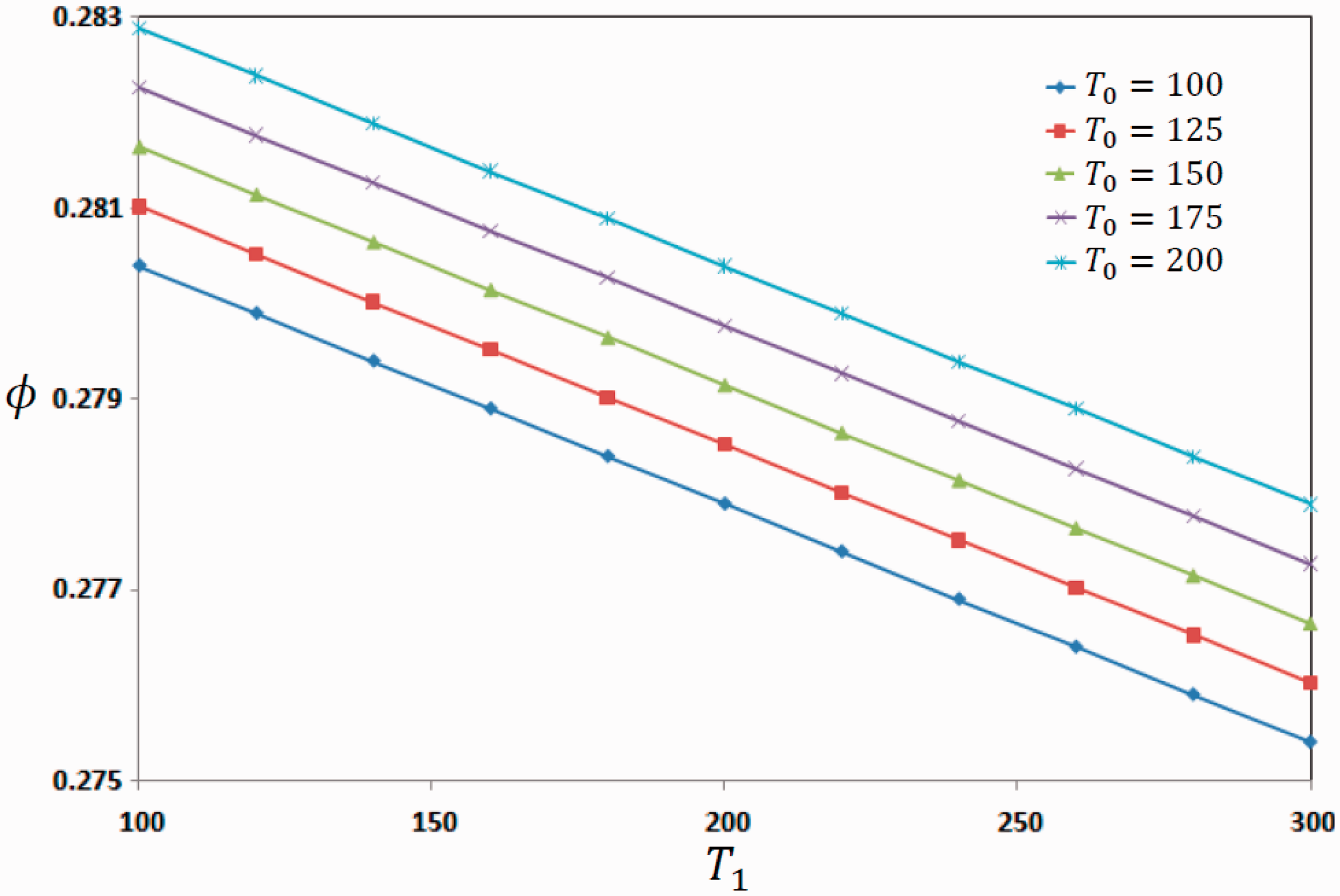
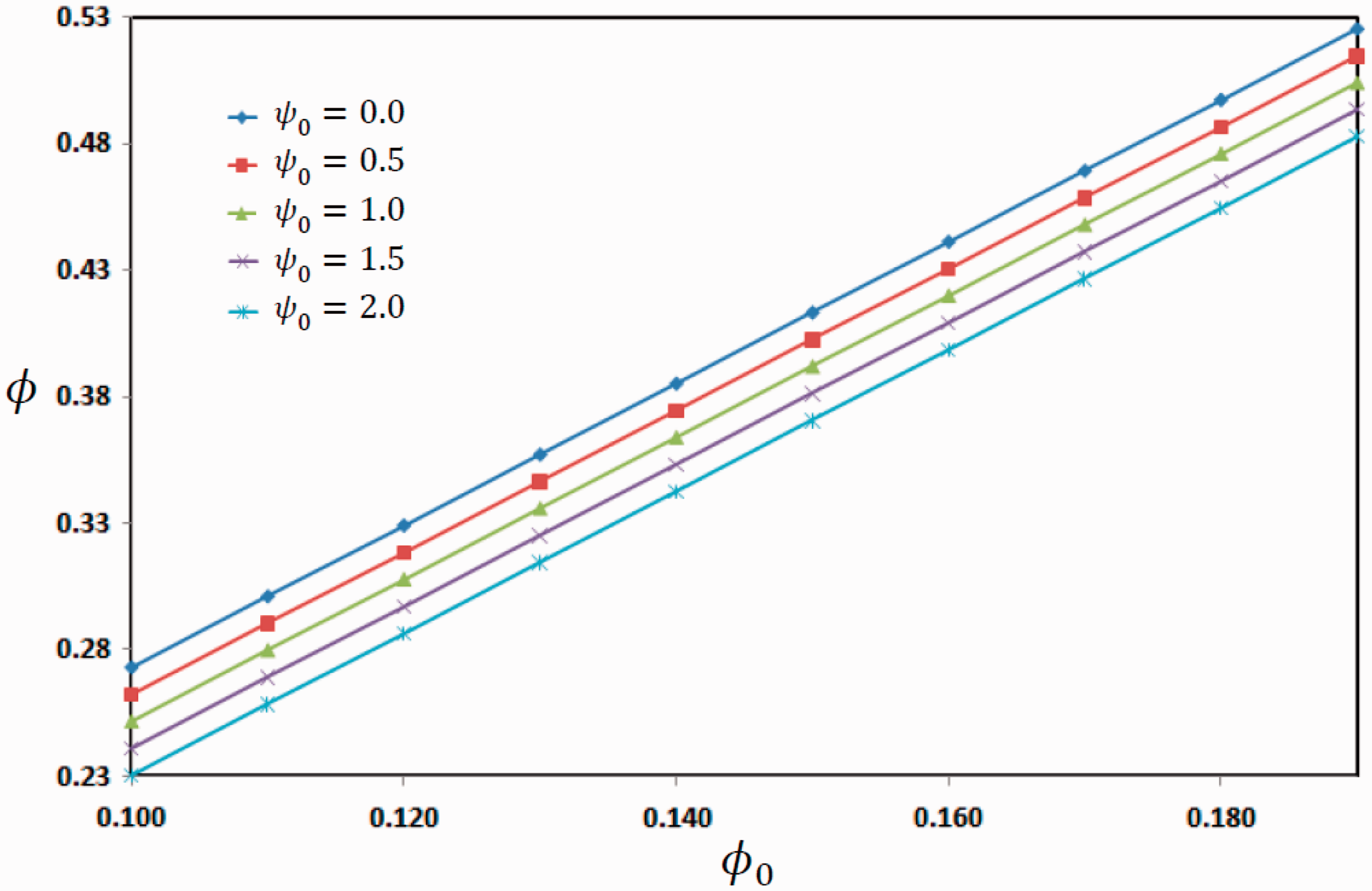
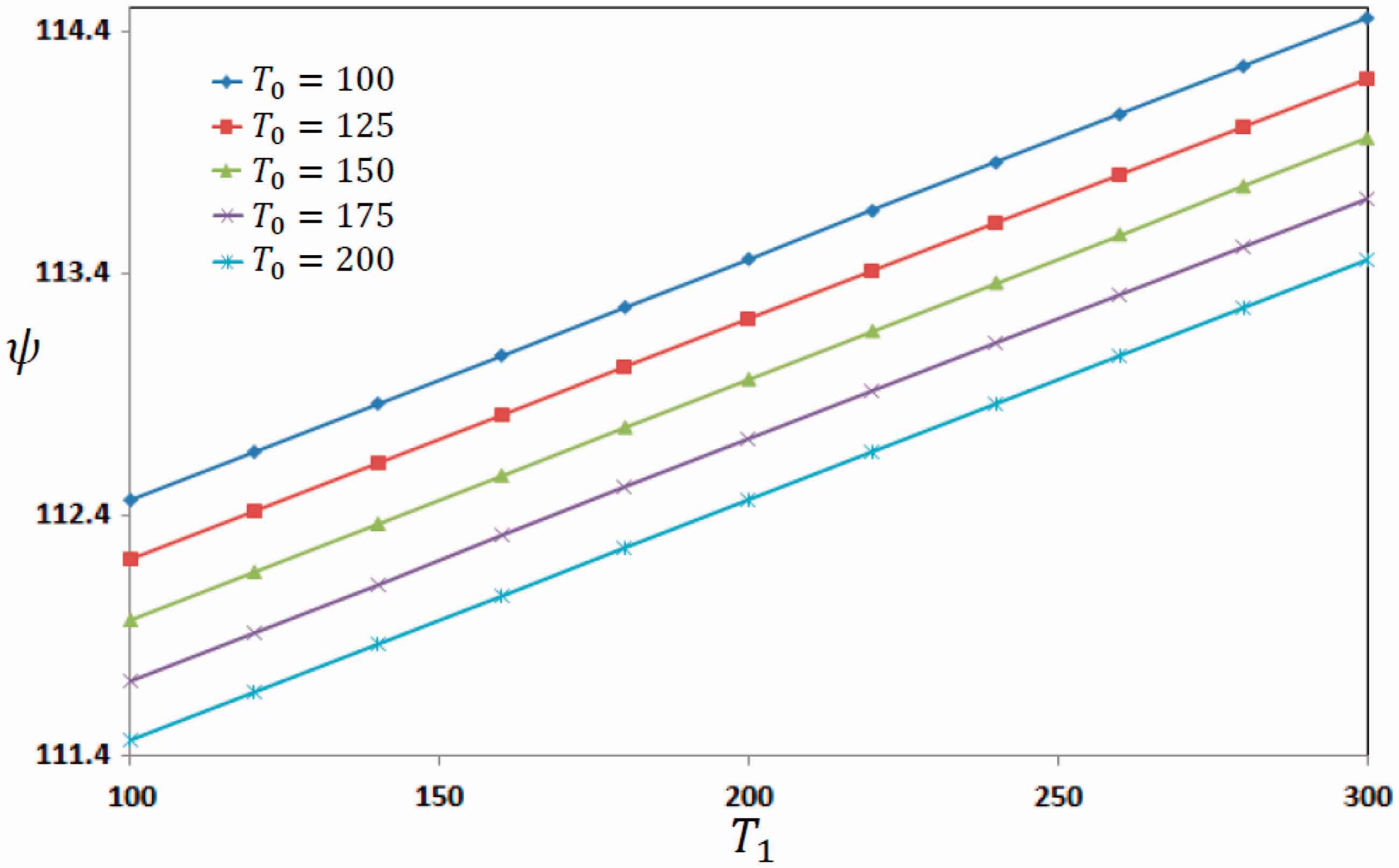
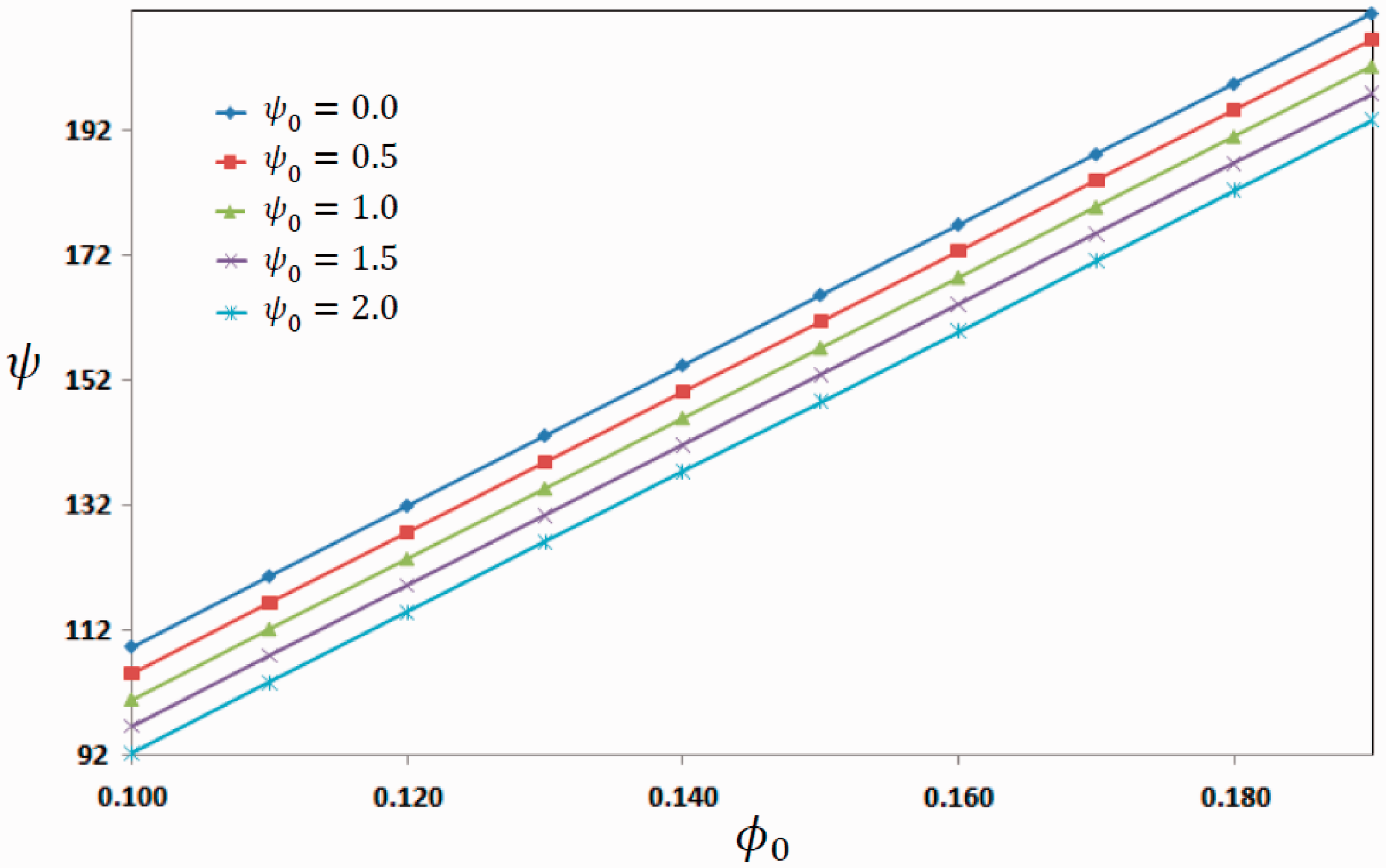
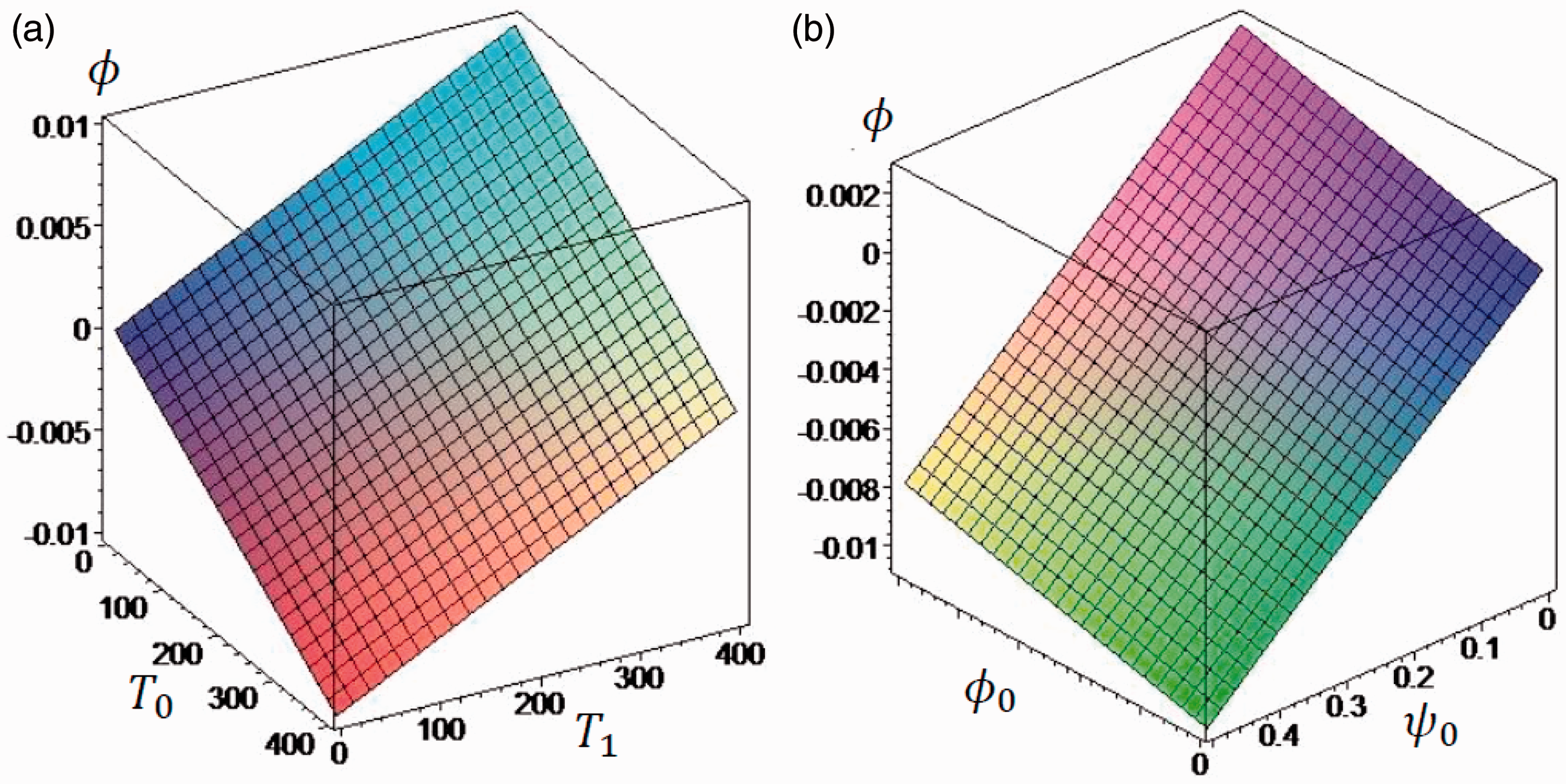
Figure 6 shows the variation of maximum electric potential in terms of two parameters of temperature rising T0 and T1. Decreasing the first parameter T0 and increasing the second parameter T1 of temperature rising lead to increase in electric potential. Furthermore, based on the presented results in Figure 7, an increase in applied magnetic potential
The effect of nonlocal parameter of nanoplate will be investigated in our future study. In Figures 8 and 9 the distribution of maximum dimensionless deflection of nanoplate Distribution of maximum dimensionless displacement in terms of nonlocal parameter for different values of applied electric potential for Distribution of maximum dimensionless displacement in terms of nonlocal parameter for different values of applied electric potential for 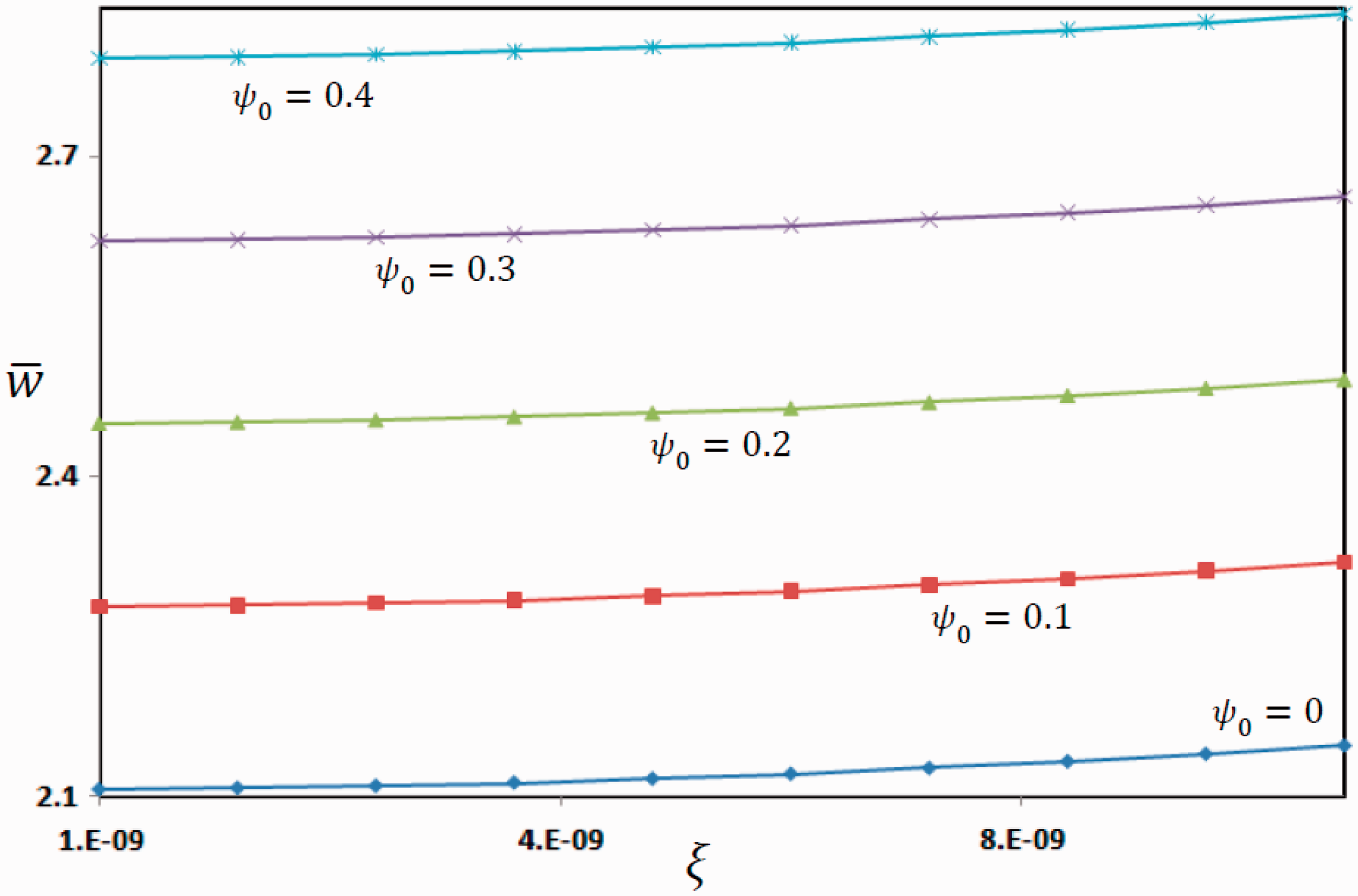
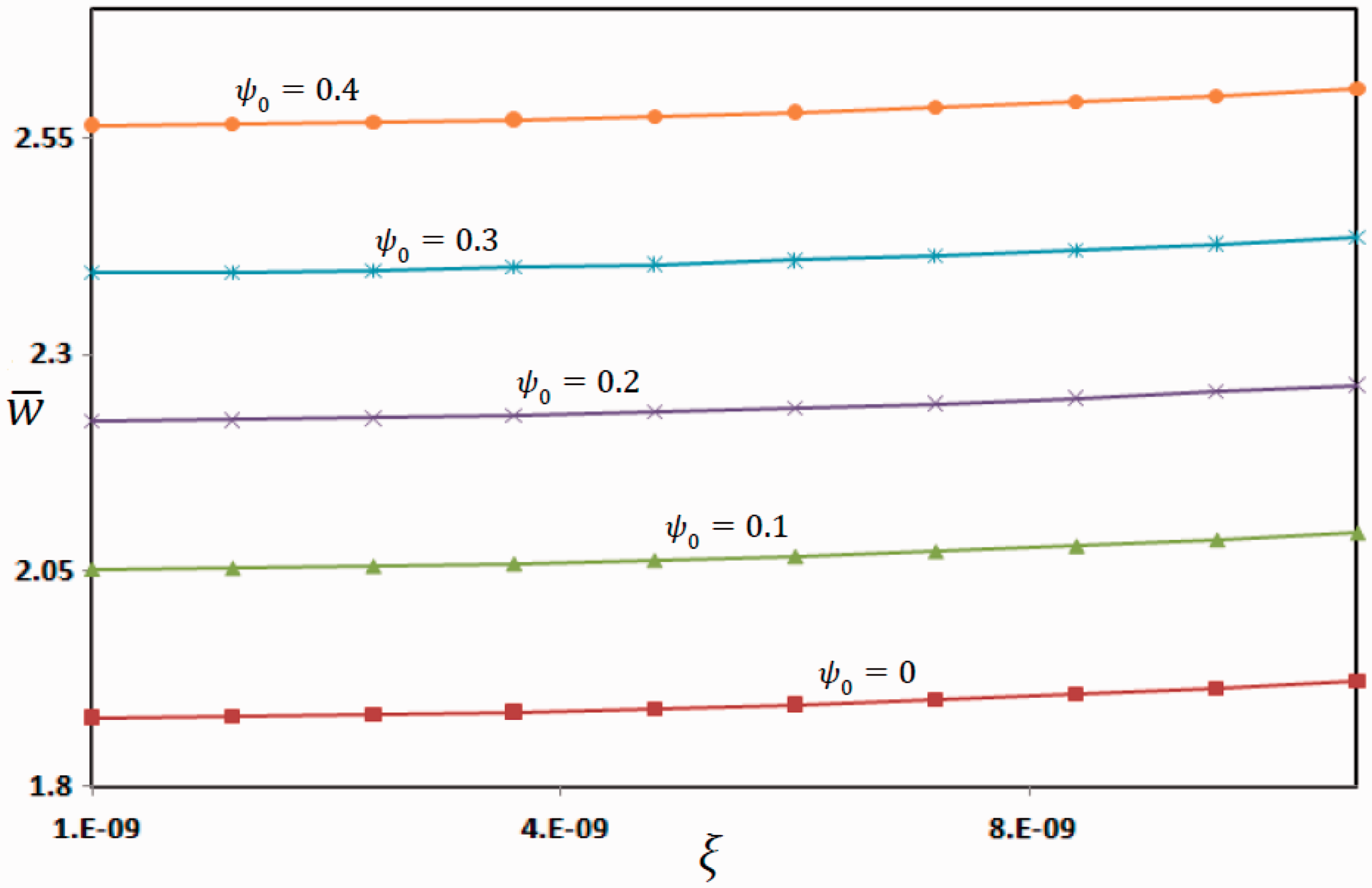
Figures 10 and 11 show the distribution of maximum dimensionless deflection of nanoplate Distribution of maximum dimensionless displacement in terms of nonlocal parameter for different values of applied magnetic potential for Distribution of maximum dimensionless displacement in terms of nonlocal parameter for different values of applied magnetic potential for 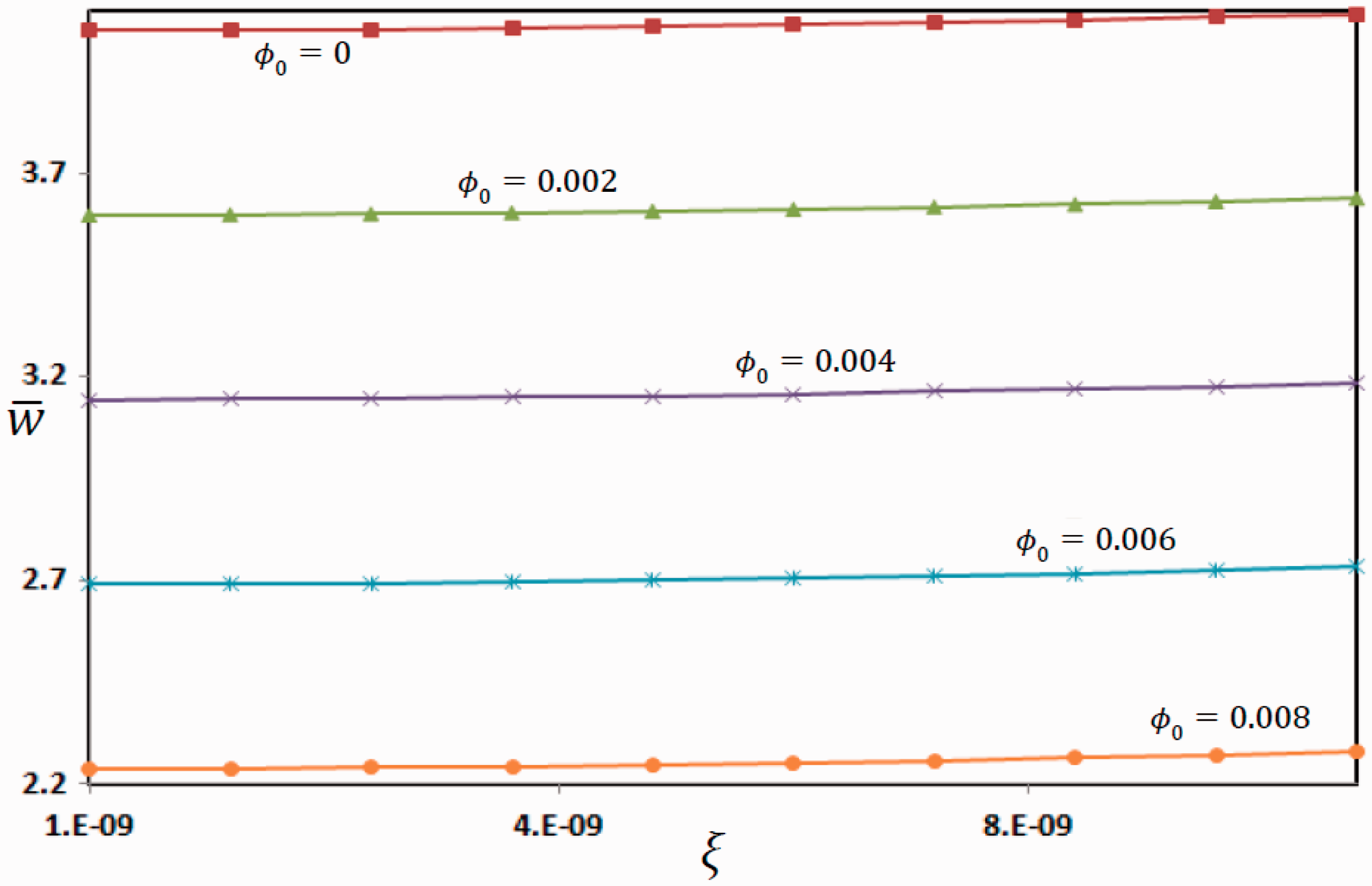
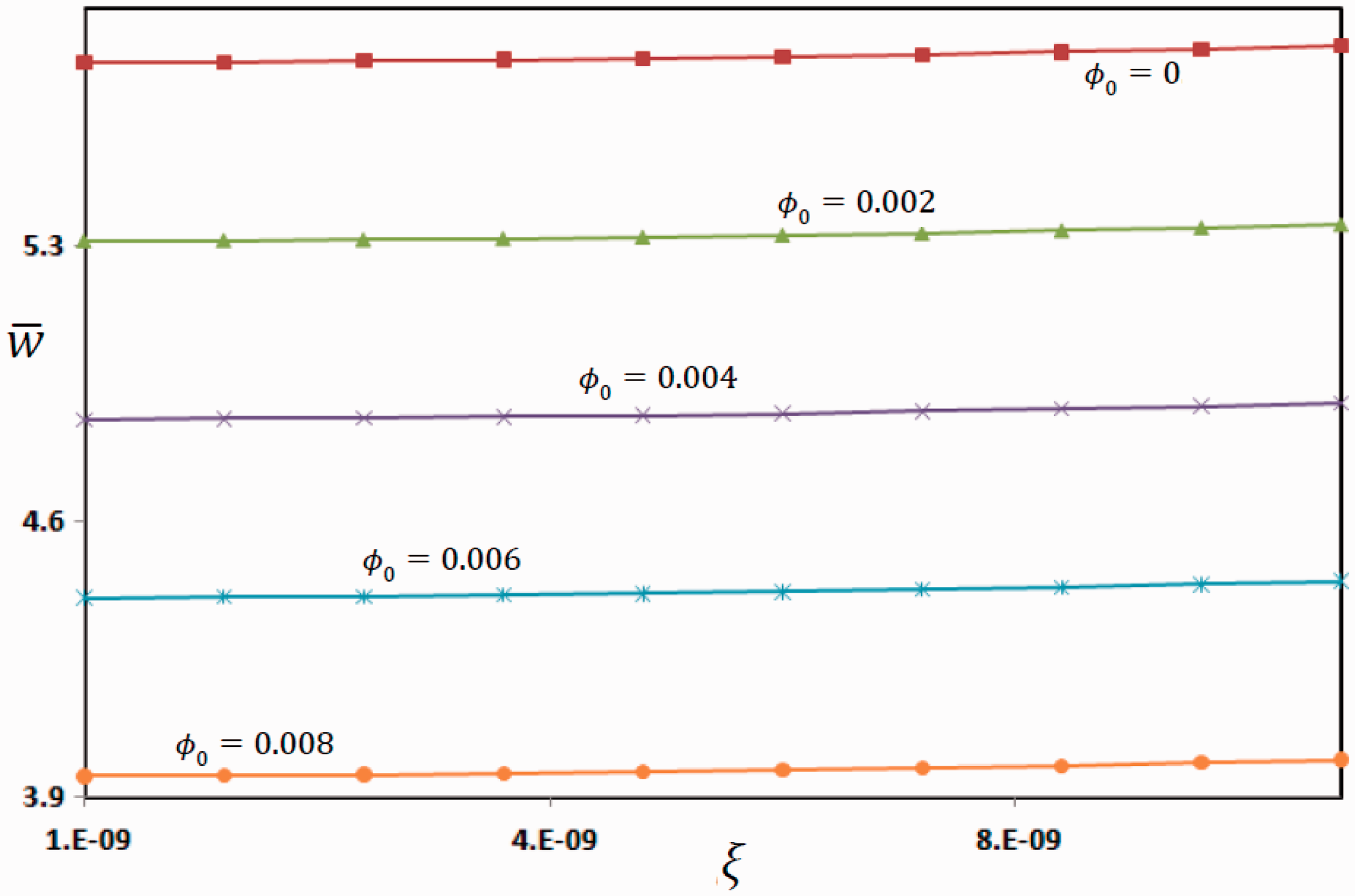
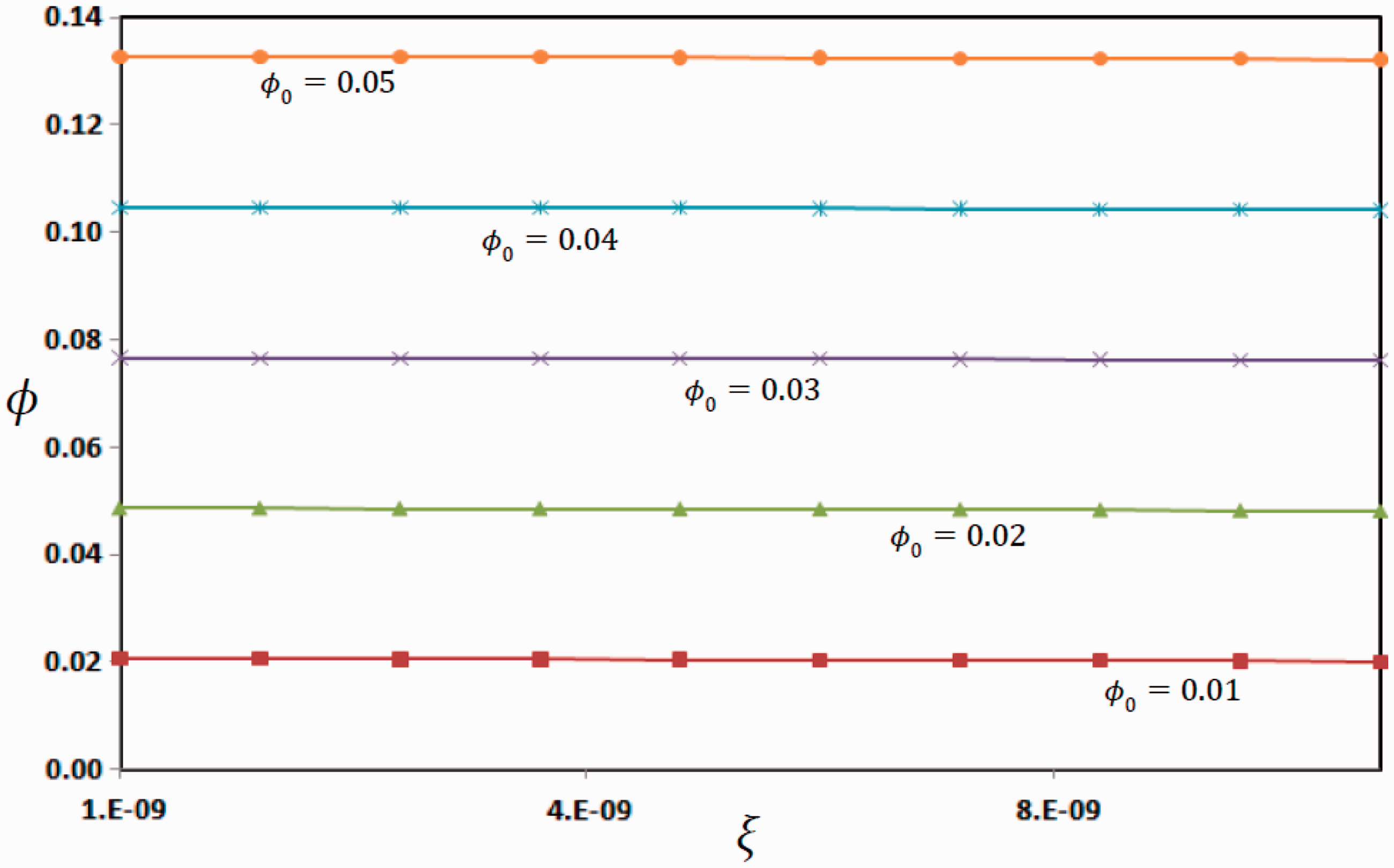
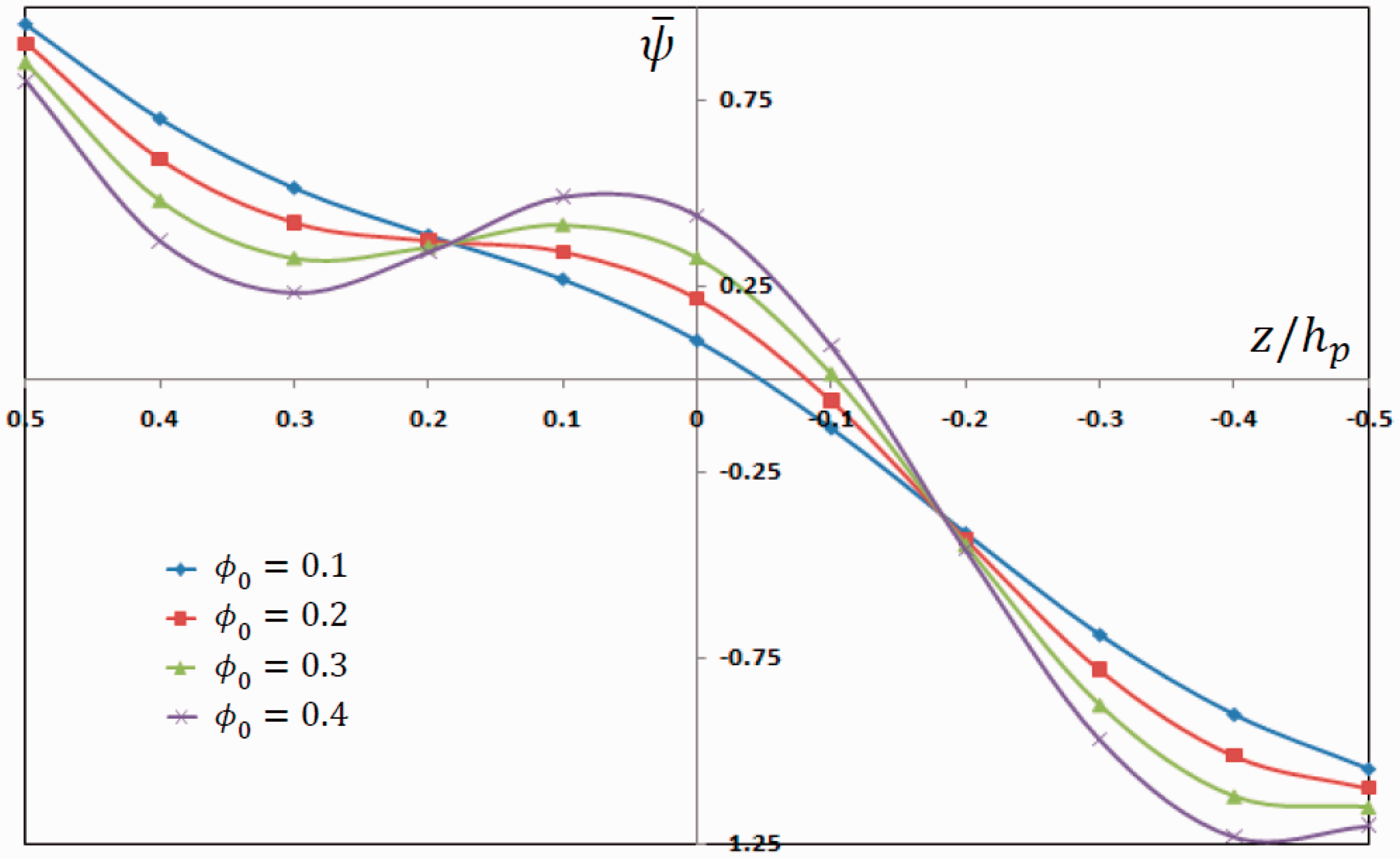
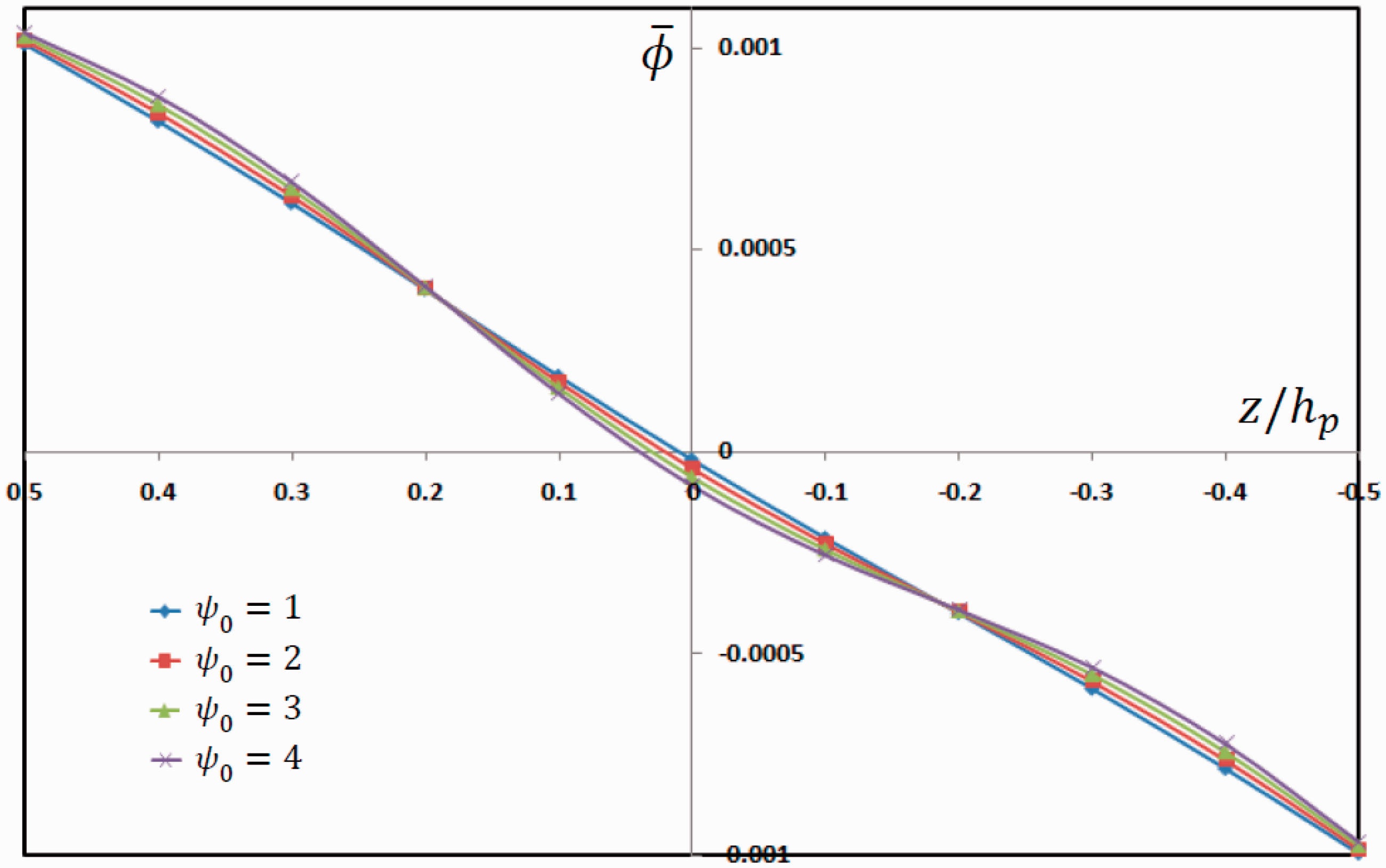
The effect of nonlocal parameter of nanoplate on the maximum distribution of electric and magnetic potentials is presented in Figures 12 and 13, respectively. The numerical results indicate that by increasing the nonlocal parameter, both electric and magnetic potentials are decreased slightly. Distributions of electric and magnetic potential along the direction of thickness of piezo-magnetic face-sheets are presented in terms of applied magnetic Distribution of maximum electric potential in terms of nonlocal parameter for different values of applied magnetic potential. Distribution of maximum magnetic potential in terms of nonlocal parameter for different values of applied magnetic potential. Distribution of electric potential along the direction of thickness in terms of applied magnetic potential. Distribution of magnetic potential along the direction of thickness in terms of applied electric potential.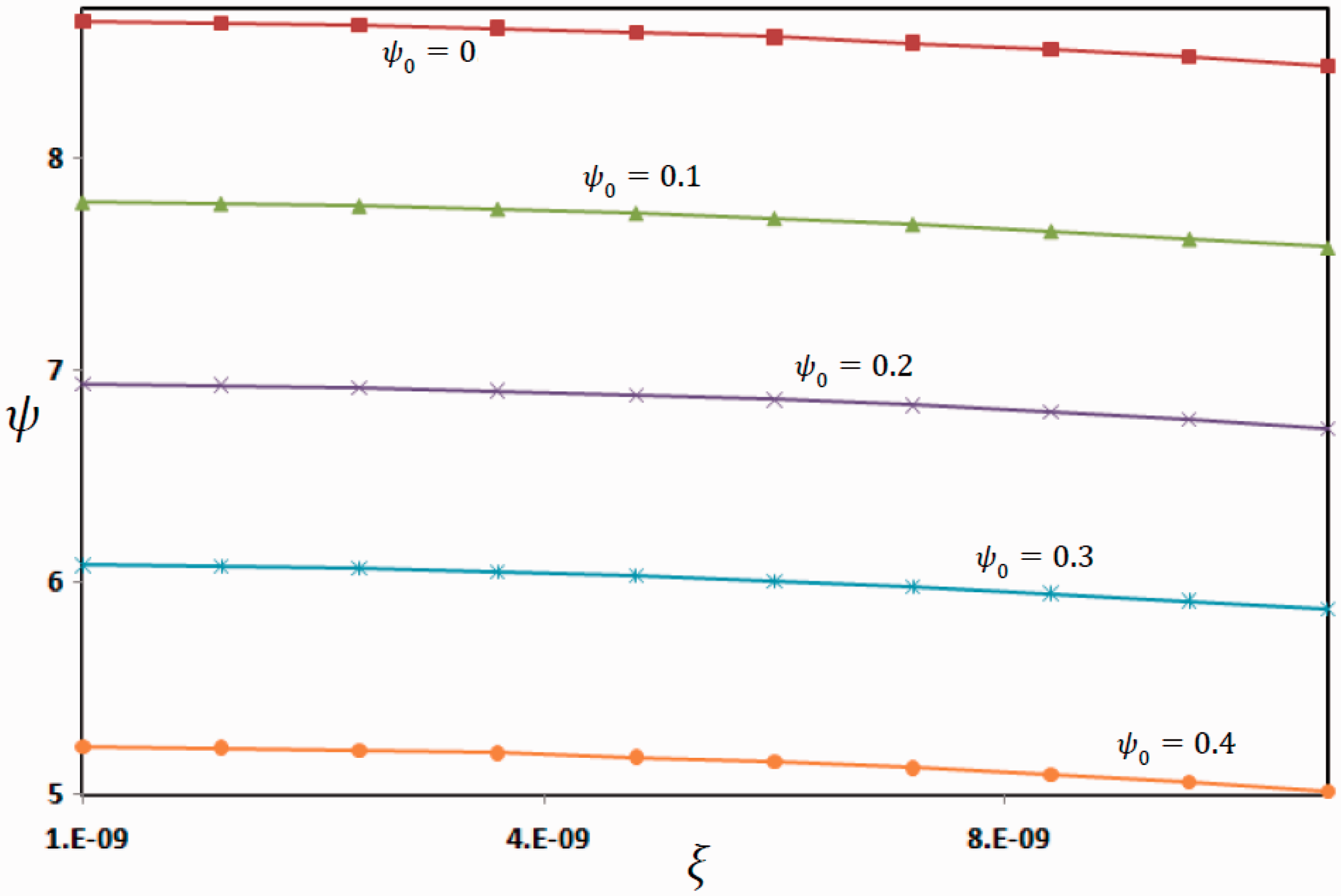
Two-dimensional distribution of dimensionless deflection of nanoplate Distribution of maximum dimensionless displacement in terms of: (a) two parameters of temperature rising and (b) applied electric and magnetic potentials. Distribution of maximum electric potential in terms of: (a) two parameters of temperature rising and (b) applied electric and magnetic potentials. Distribution of maximum magnetic potential in terms of: (a) two parameters of temperature rising and (b) applied electric and magnetic potentials.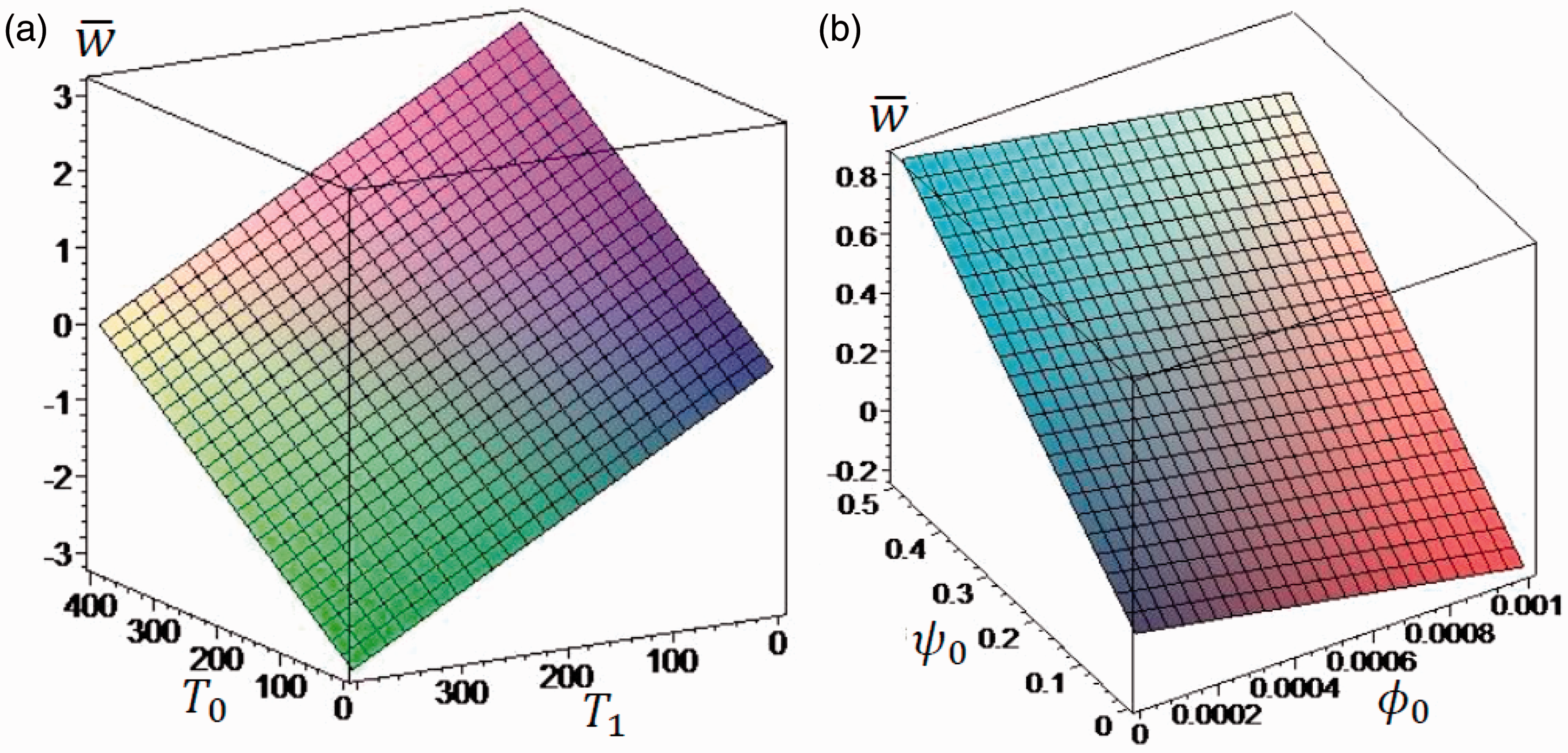
Conclusions
The thermo-magneto-electro-mechanical analysis of a three-layered nanoplate was studied in this paper. The plate was loaded with thermo-magneto-electro-mechanical loadings. The sinusoidal shear-deformation plate theory was used for description of displacement field. Cosine distribution of magnetic and electric potential along the direction of thickness with an applied magnetic and electric potential was applied on the nanoplate. The important results of this study are classified as:
Temperature raising parameters T0 and T1 have considerable effects on the deflection and electric/magnetic potentials. The numerical results indicate that with the increase in T0, deflection and magnetic potential are increased while electric potential is decreased. Furthermore, increasing the second parameter of temperature rising T1 leads to increase in electric potential and decrease in deflection and magnetic potential. Applying the electric and magnetic potentials at top and bottom of piezo-magnetic face-sheets The nonlocal parameter of nanoplate ξ can lead to drastic changes in the deflection, electric, and magnetic potentials. The numerical results indicate that by increasing the nonlocal parameter, the dimensionless deflection of nanoplate is increased considerably. This behavior is due to this fact that by increasing the nonlocal parameter, the stiffness of the plate is decreased and consequently the deflection of plate is increased. Unlike the deflection of nanoplate, the maximum electric and magnetic potentials of nanoplate are decreased with the increase in nonlocal parameter.
Footnotes
Declaration of Conflicting Interests
The author(s) declared no potential conflicts of interest with respect to the research, authorship, and/or publication of this article.
Funding
The first author(s) disclosed receipt of the following financial support for the research, authorship, and/or publication of this article: the University of Kashan (Grant Number: 574613/5) and the Iranian Nanotechnology Development Committee.