







Abstract
A semi-analytical approach to investigate the nonlinear vibration axisymmetric analysis of functionally graded sandwich shallow spherical caps under external pressure resting on elastic foundation in thermal environment is presented. The governing equations are derived by using the first-order shear deformation theory taking into account von Karman geometrical nonlinearity and Pasternak’s two-parameter elastic foundation. The motion equations are determined by Galerkin method and the obtained equation is numerically solved by using Runge–Kutta method. Results of nonlinear dynamic responses show the effects of foundation, material, geometric parameters, and temperature change on the nonlinear vibration of shells.
Keywords
Introduction
Shallow spherical caps (shallow spherical shells) constitute an important portion in many engineering structures, for example, the aircraft, missile and aerospace components. As a result, the problems relating to mechanic behaviors bring major importance in the design of this type of shell structure and have attracted attention of many researchers.
Uemura [1] studied axisymmetric nonlinear buckling of isotropic shallow spherical caps with initial deformation and subject to uniform pressure is analyzed based on the finite-deformation theory. Nonlinear vibration of orthotropic axisymmetric shallow spherical caps was investigated by Varadan and Pandalai [2]. Numerical solutions based on a two-term mode shape, uniform pressure, and free vibrations are obtained. Xu [3] presented nonlinear buckling of axisymmetrically laminated spherical caps, a Fourier–Bessel series solution is proposed with four types of boundary conditions. Sathyamoorthy [4] investigated nonlinear vibrations of shallow spherical caps by using first-order shear deformation theory (FSDT). Dynamic behavior of shell is obtained by using Galerkin method and the Runge–Kutta method. Based on Timoshenko–Mindlin kinematic hypothesis, the shallow shell theory is extended to include the transverse shear deformation; Cheung [5] studied nonlinear static and dynamic behavior for moderate thick laminated, annular, and spherical caps. Nie [6] proposed the asymptotic iteration method to analyze nonlinear buckling of isotropic shallow spherical caps with various boundary conditions and on nonlinear elastic foundation subjected to external pressure. Static and dynamic nonlinear axisymmetric analysis of thick shallow spherical and conical orthotropic caps was studied by Dube et al. [7] using Galerkin method and the FSDT. Eslami et al. [8] studied non-shallow thin spherical shell by using deep and shallow shell theories with Sanders’s nonlinear kinematic relations. Shahsiah and Eslami [9] investigated the buckling behavior of imperfect isotropic shallow spherical caps under thermal and mechanical loads based on Donnell–Mushtari–Velasov theory. By using the updated iteration method, Li et al. [10] investigated nonlinear stability of isotropic shallow spherical caps including the effects of transverse shear deformation with two types of boundary conditions. Thermoelastic response of symmetric simply supported spherical shells subjected to external pressure for mechanical loading and uniform temperature rise and radial temperature difference for thermal loadings is presented by Islam et al. [11]. Wen et al. [12] studied autofrettage and shakedown of an internally pressurized thick-walled spherical shell based on two strain gradient plasticity solutions.
Functionally graded materials (FGMs) are advanced composite material, consisting of two different constituent materials, have properties varying smoothly through the thickness and become popular in engineering design. Many author focused on the static and dynamic behavior of many type of FGM structures. However, a not many reports of FGM spheres are obtained in open literature.
Shahsiah et al. [13,14] analyzed the thermal instability of FGM shallow and deep spherical caps, respectively. Based on shear deformation theory and geometric nonlinearity in von Karman sense, Ganapathi [15] and Prakash et al. [16] investigated the nonlinear dynamic stability of axisymmetric FGM shallow spherical caps. The dynamic buckling pressure is obtained by using the sudden jump in the maximum average deflection criterion. Fu et al. [17] reported nonlinear transient response of functionally graded shallow spherical caps subjected to time-dependent thermomechanical load. Based on the classical shell theory and the Sanders nonlinear kinematics equations, axisymmetric nonlinear buckling of FGM shallow spherical caps surface-bonded piezoelectric actuators subjected to thermo-electro-mechanical loads was investigated by Boroujerd and Eslami [18].
Nonlinear buckling and vibration of axisymmetric and un-axisymmetric functionally graded thin shallow spherical caps under uniform external pressure including temperature effects are analyzed by Bich et al. [19–22] and Duc et al. [23,24]. In these papers, classical shell theory, stress function method, and Galerkin method were used to investigate nonlinear behavior of shell. By using FSDT, nonlinear axisymmetric thermomechanical static stability of FGM shallow spherical caps resting on elastic foundations were studied by Tung [25,26] and Anh and Duc [27].
Advanced sandwich plate and shell structures have been mentioned in many studies in recent years and these structures may be placed in an elastic medium described by different elastic foundation models [28–33].
In this paper, functionally graded sandwich materials are combination of many layers of FGM and isotropic materials. The nonlinear vibration axisymmetric analysis of shear deformable functionally graded sandwich shallow spherical caps resting on Pasternak’s elastic foundation is investigated by a semi-analytical approach. Governing equations of spherical caps are established by using the FSDT. Then, these equations are specialized for axisymmetrically deformed shallow spherical caps taking into account geometric nonlinearity and initial geometrical imperfection. By using the Galerkin method, the motion equation of dynamic response is obtained. The nonlinear dynamic responses are found by using Runge–Kutta method. The results show that the foundation, volume–fractions exponent, initial imperfection, and temperature change strongly influence to the vibration behavior of shells.
Functionally graded sandwich shallow spherical caps
Consider a functionally graded sandwich shallow spherical cap with radius of curvature
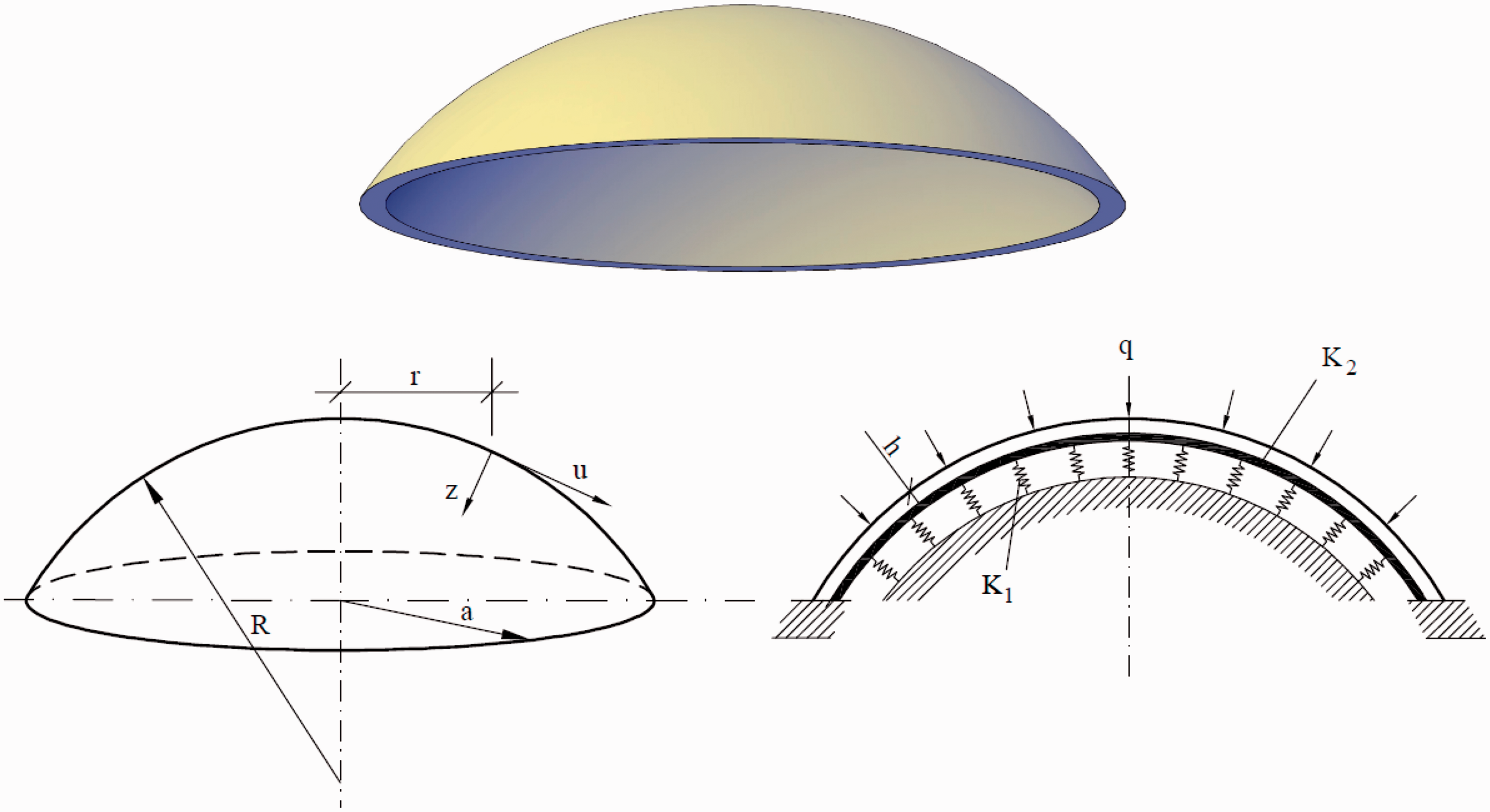
Geometry and coordinate system of a FGM sandwich spherical cap.
This paper used a Sigmoid law distribution FGM and assumed that the effective properties of FGM sandwich spherical caps, such as the modulus of elasticity
With model 1A, Material composition of upper layer is smoothly varied along the thickness direction from ceramic-rich surface ( Contrary, with model 1B, Material composition of upper layer is smoothly varied along the thickness direction from metal-rich surface (
Effective properties
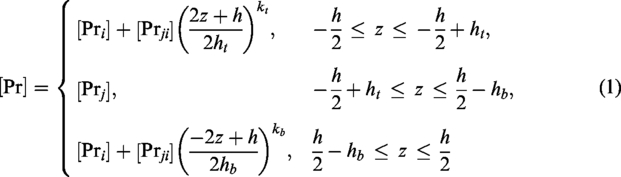

The subscripts m and c refer to metal and ceramic constituents, respectively.
b. With model 2A, upper and lower layers are full ceramic and full metal, respectively. Core layer is functionally graded material. Material composition of FGM layer is smoothly varied along the thickness direction from ceramic-rich surface ( With model 2B, upper and lower layers are full metal and full ceramic, respectively. Core layer is functionally graded material. Material composition of FGM layer is smoothly varied along the thickness direction from metal-rich surface (
Effective properties
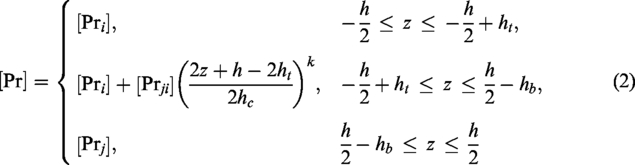
In this paper, the material properties dependent are not only space-dependent, but temperature-dependent. The material properties of FGM’s constituents are usually expressed as [21–25]

Governing equations
The FSDT is used in this paper to obtain the equation of motion of nonlinear dynamic response of FGM sandwich spherical caps. For a shallow spherical cap, it is convenient to introduce a variable r referred to as the radius of parallel circle and defined by
The shallow spherical cap is assumed to be axisymmetric deformation and displacement components in
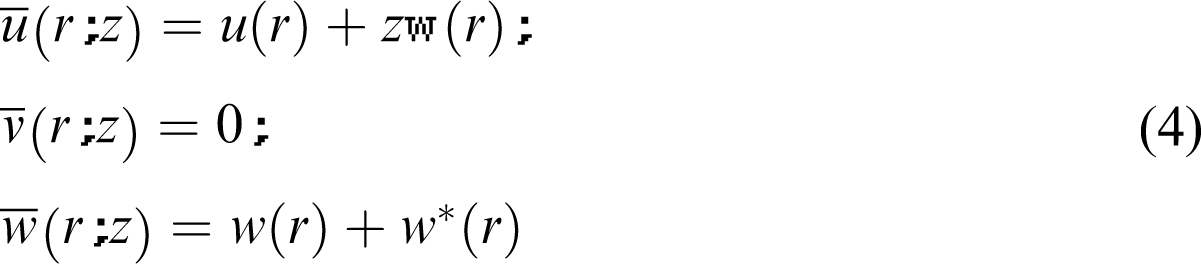
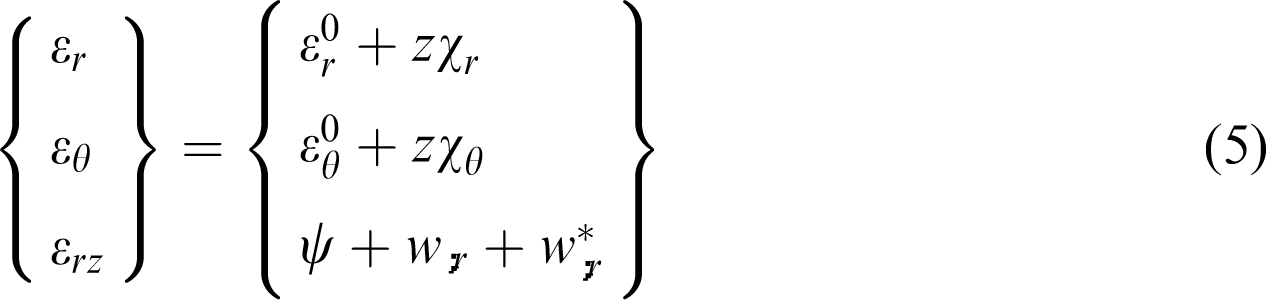
The nonzero strain components of the shallow spherical cap are defined as [9,25,26]

Hookian law for sandwich FGM taking into account the temperature effect [19,20] is

Environment temperature is assumed to be uniformly raised from initial value
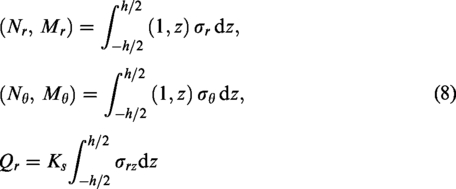
The force and moment are determined by
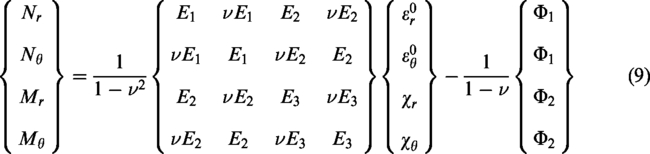
Substituting equation (5) into equation (7), and then substituting the resultant equations into equation (8), the force and moment expressions are obtained


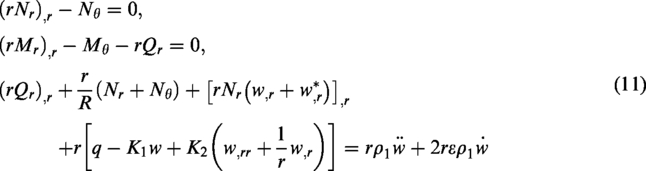
The nonlinear equations of motion of an imperfect shallow spherical cap resting on an elastic foundation based on the FSDT with neglecting the inplane and rotational inertia, lead to [10]
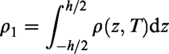
Substituting equation (6) into extension force, moment, and shear force expressions (9) and (10) then substituting the resultant into equation (11) and neglecting the higher order infinitesimals, the motion equation system is rewritten by
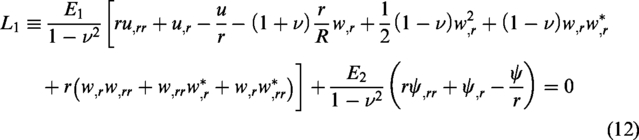
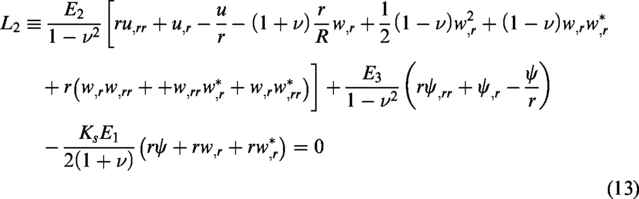
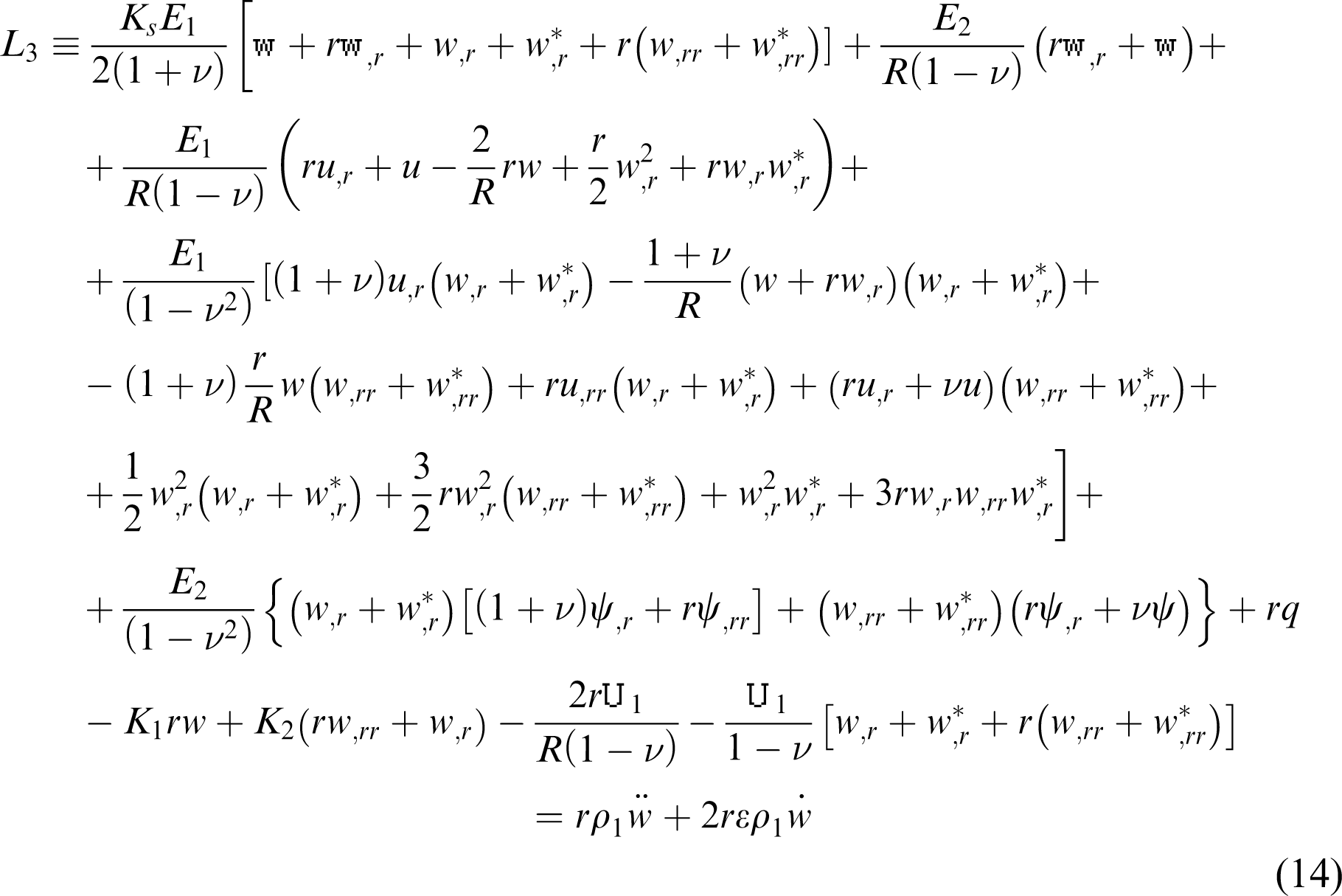
Equations (12)–(14) are the basic equations used to investigate the nonlinear vibration axisymmetric stability of functionally graded shallow imperfect spherical caps in thermal environment.
Solution problems
In this paper, the FGM sandwich spherical caps are assumed to be clamped and immovable along the periphery, subjected to external pressure uniformly distributed on the outer surface of the shells and axisymmetric displacement condition. The boundary conditions are written by

The following approximate solution for the displacement component and rotations is assumed [25,26]
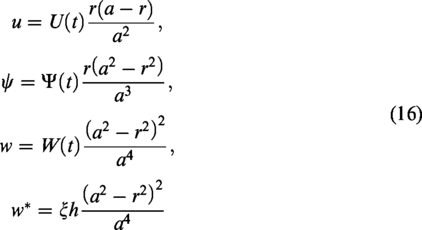
Substituting solution (16) into motion equations (12)–(14) and applying the Galerkin method in full surface area of shell, i.e.





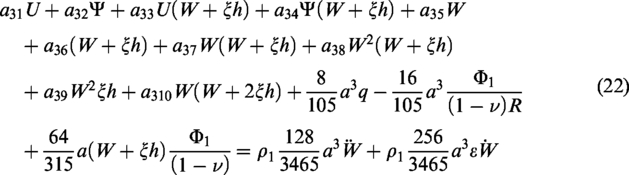


Substituting equations (23) and (24) into equation (22), leads to
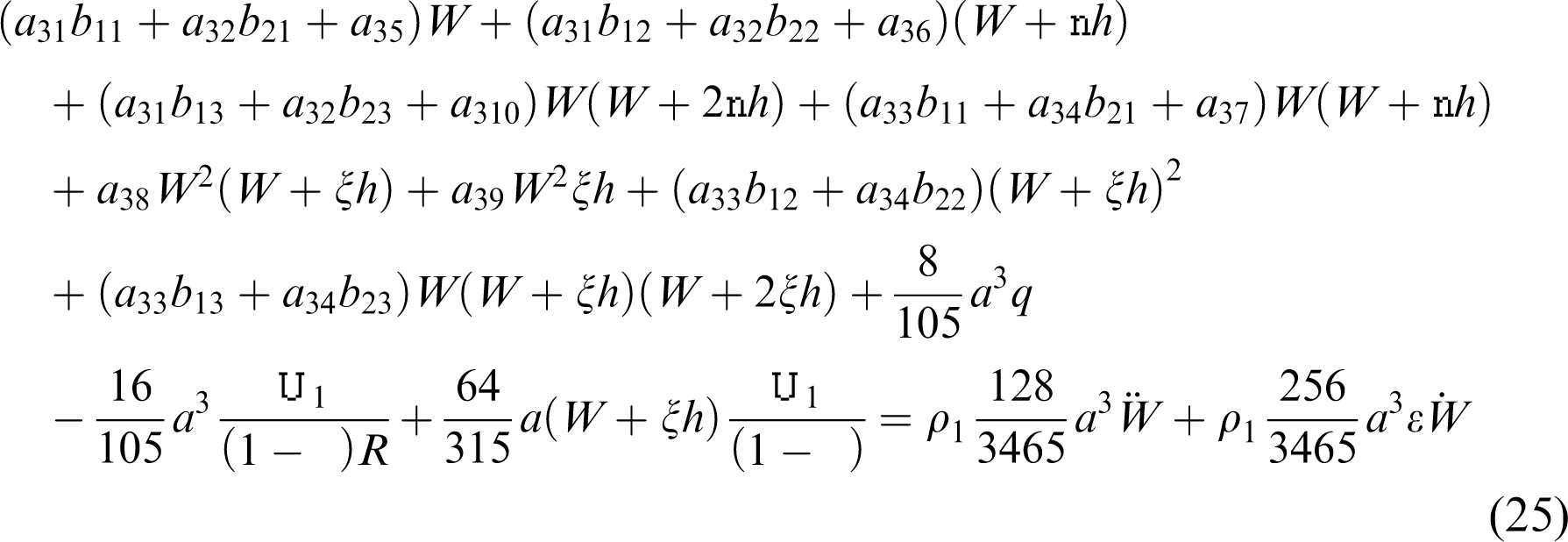
Equation (25) is second-order differential equation with time dependent to investigate the nonlinear vibration of axisymmetric FGM sandwich spherical caps resting on two-parameter elastic foundation and subjected to external pressure and temperature.
In the case of free, linear, and without damping vibration, equation (25) reduces to

From equation (26), the explicit expression of fundamental frequency of shell is obtained

Consider a sandwich FGM spherical cap subjected to harmonic external pressure
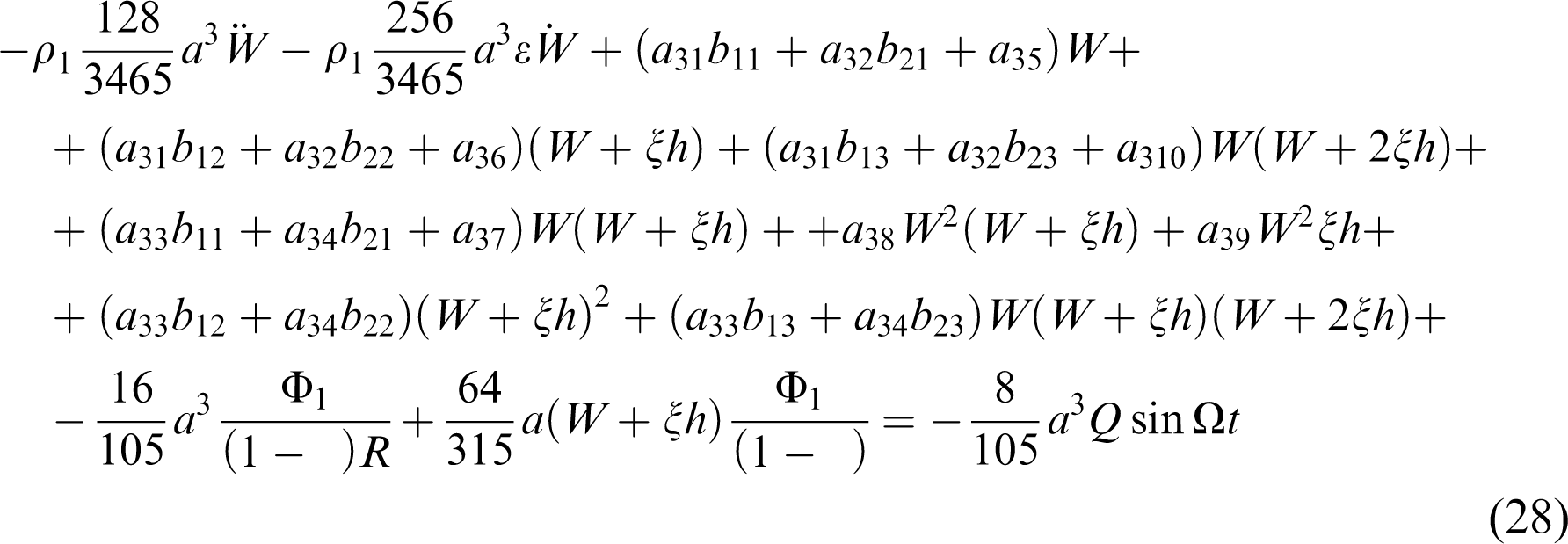
Equation (28) is solved by Runge–Kutta method to obtained the nonlinear forced vibration of shell with the initial condition
In the case of linear force vibration, equation (28) is reduced by neglecting nonlinear terms, leads to
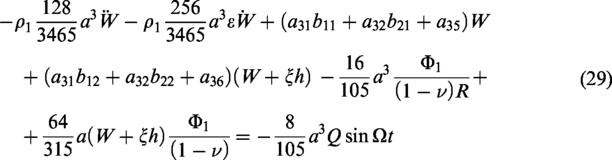
For free vibration case,
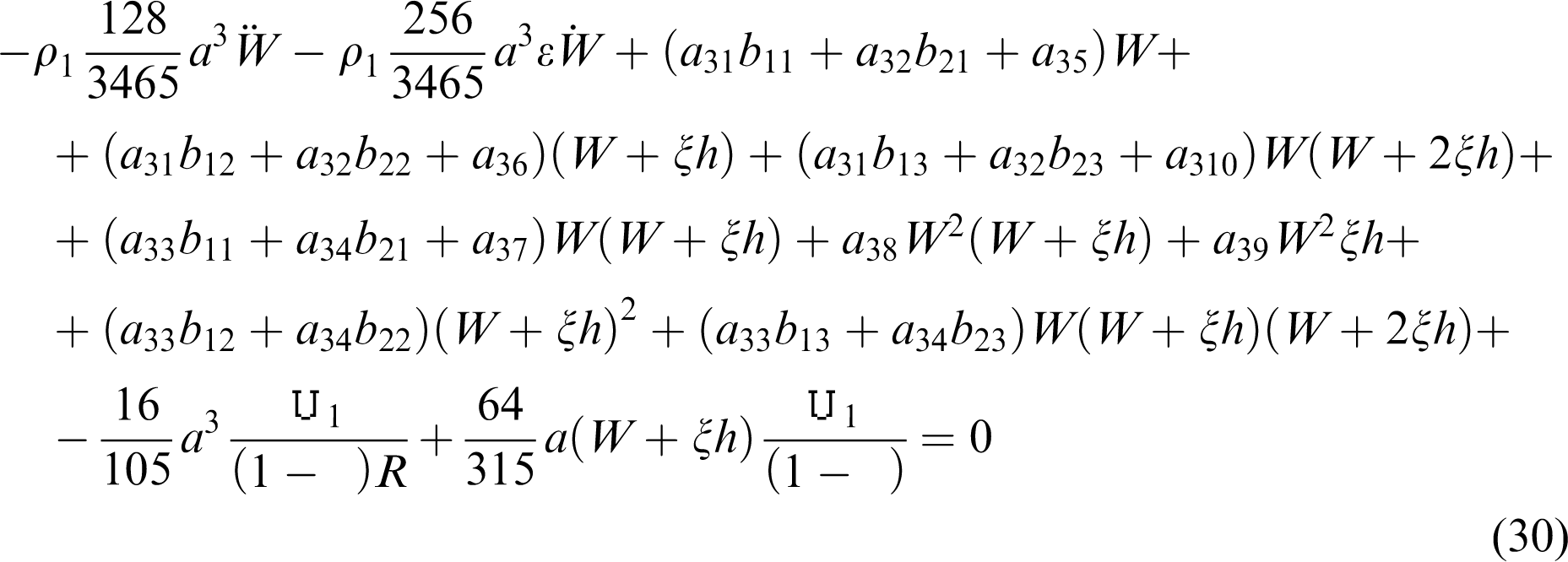
Equation (30) is solved by using fourth-order Runge–Kutta method to obtain the nonlinear free vibration response of sandwich FGM spherical caps.
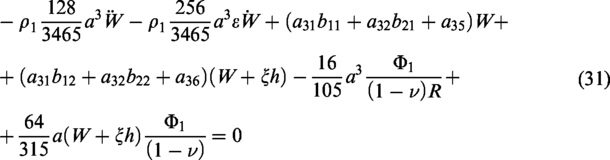
Similarly for linear free vibration case, equation (29) becomes
Numerical results and discussions
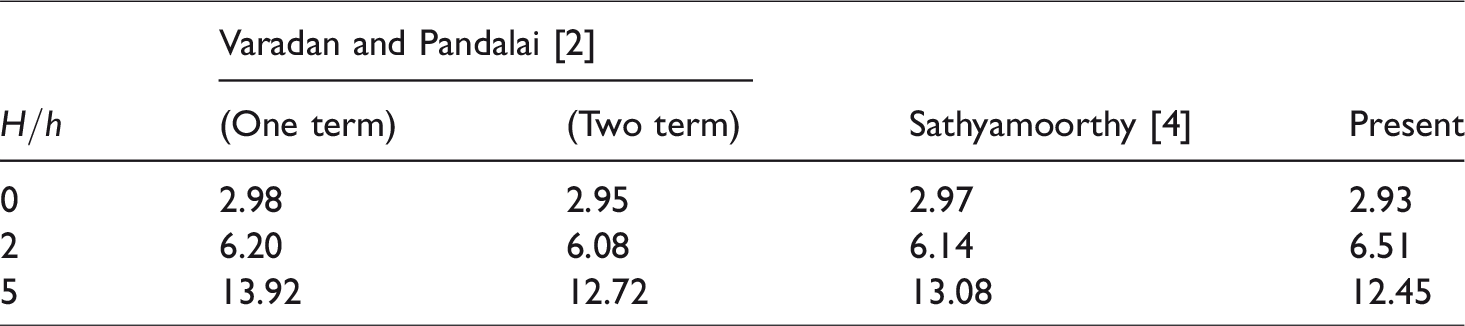
To validate this proposed approach, the fundamental frequency parameters given by the present analysis are compared with the results given by Varadan and Pandalai [2] and Sathyamoorthy [4] in Table 1. As can be observed, a good agreement is obtained in this comparison study.where
Comparison of linear frequency parameter
Fundamental frequencies
In this section, the sandwich FGM spherical cap is considered with geometrical parameters as:
Temperature coefficients for constituent of Si3N4 and SUS304 [25].
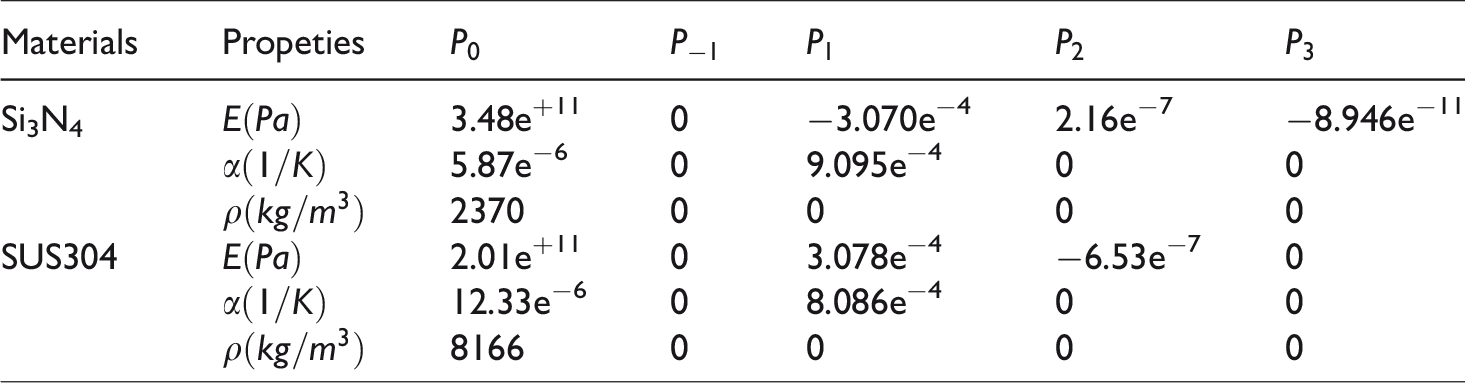
Table 3 investigated fundamental frequency of four models of the sandwich FGM spherical cap with difference volume fraction exponent. As can be seem, fundamental frequency of model 1B spherical caps is the largest. Contrary, fundamental frequency of model 1A spherical caps is the smallest. Furthermore, volume fraction exponent strong influence to the fundamental frequency of shell. Fundamental frequency of shell increases when volume fraction exponent increases with models 1A and 2A, the opposite phenomenon are obtained with models 1B and 2B.
Fundamental frequency of four material distribution models of shell (×103 rad/s) (

Effect of temperature change on the fundamental frequency of Sandwich FGM shallow spherical cap with model 1A is presented in Table 4. Clearly, when
Effect of temperature change on the fundamental frequency of sandwich functionally graded material (FGM) shallow spherical cap (×103 rad/s) (

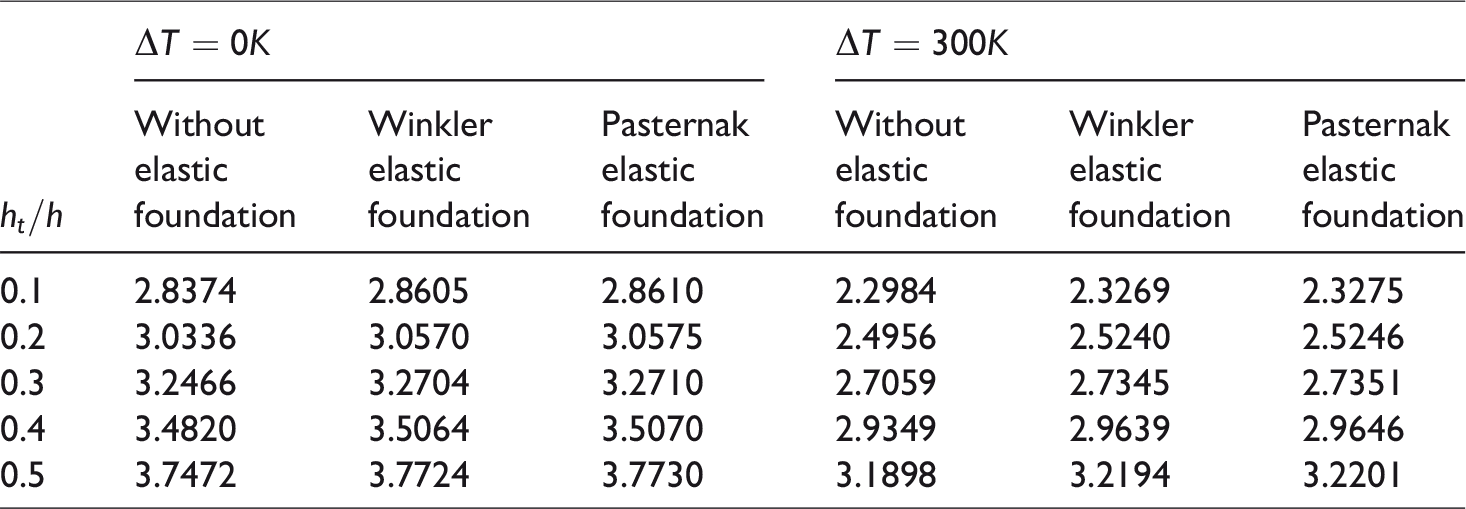
Table 5 shows effect of
Effect of thickness of FGM layer (
Dynamic response behavior
Linear and nonlinear free vibration
Figures 3 and 4 investigate dynamic responses of sandwich shallow spherical caps of undamped free vibration in two cases: linear and nonlinear vibration theories with initial deflection
Figures 5 and 6 present deflection–velocity curve of sandwich shallow spherical caps of undamped and damped free vibration, respectively. Figure 5 shows that deflection–velocity curve is a closed circular curve with linear vibration and is a closed uncircular curve with nonlinear vibration. It means that undamped vibration is harmonic with two cases of nonlinear and linear vibration. Contrary, deflection–velocity curve in Figure 6 of damped vibration is unclosed curve and is inharmonic response.
Linear and nonlinear forced vibration
Comparison of dynamic response of nonlinear forced and free vibration of shell is presented in Figure 7. Unlike the free vibration, dynamic response of forced vibration is an irregular curve. Similar free vibration case, amplitudes of linear theory are larger than ones of nonlinear theories. Figure 8 also shows the harmonic beat phenomenon when excitation frequency is near to fundamental frequency of shell. As can be seen, amplitude and length of beat of linear theory are larger than one of nonlinear theory.
Effect of temperature change on the dynamic response of sandwich FGM spherical cap is studied in Figure 9. Clearly, vibration amplitude increases when temperature change increases. Effect of imperfection on the dynamic response of sandwich FGM spherical cap is presented in Figure 10 with
Comparisons of dynamic response of shell of four models are investigated in Figures 11 and 12 (1A and 2A in Figure 11, 1B and 2B in Figure 12). The obtained results show that amplitude of model 1A is larger than one of model 2A and amplitude of model 2B is larger than one of model 1B.
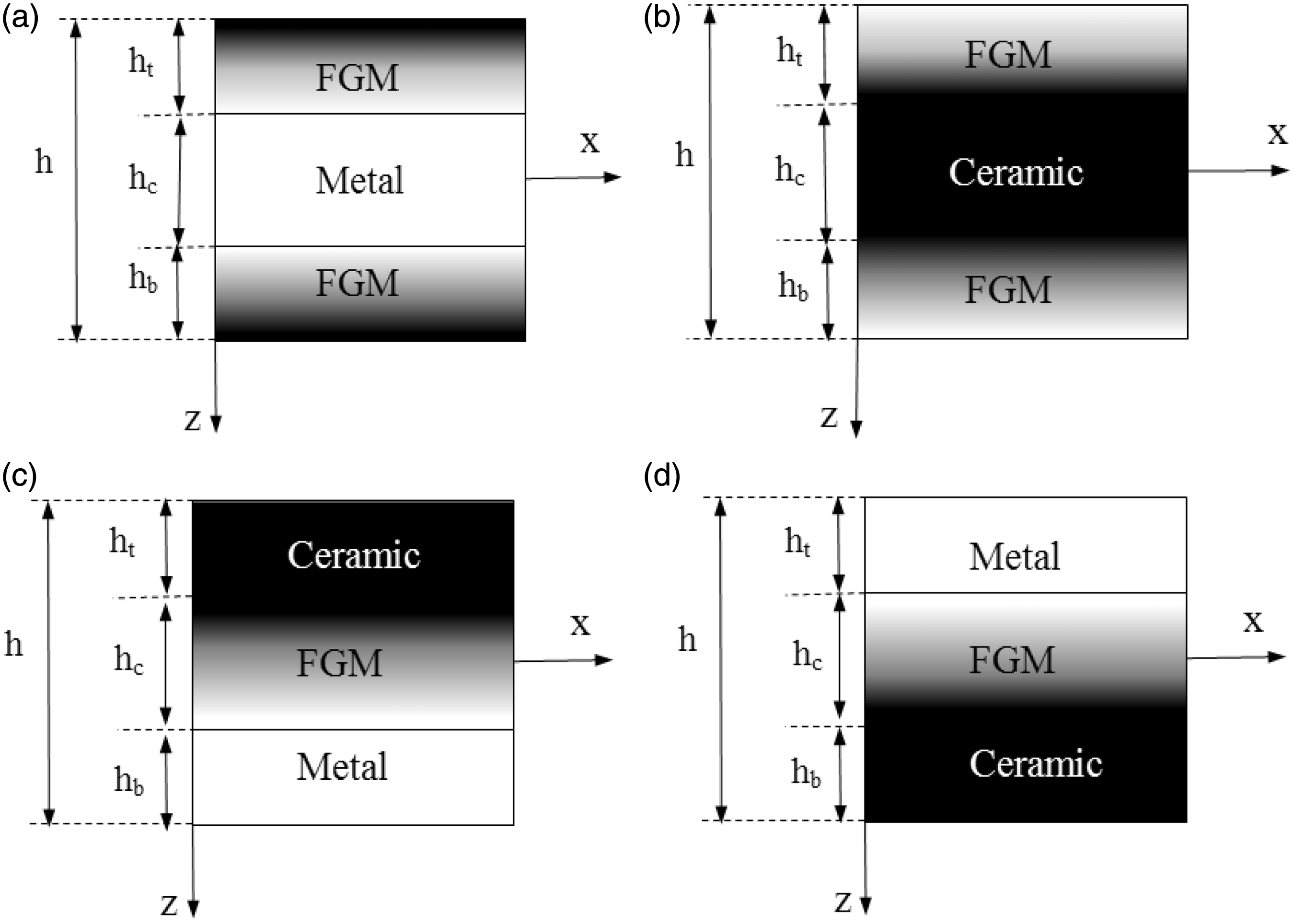
Material models of sandwich functionally graded spherical caps. (a) Model 1A, (b) Model 1B, (c) Model 2A, (d) Model 2B.
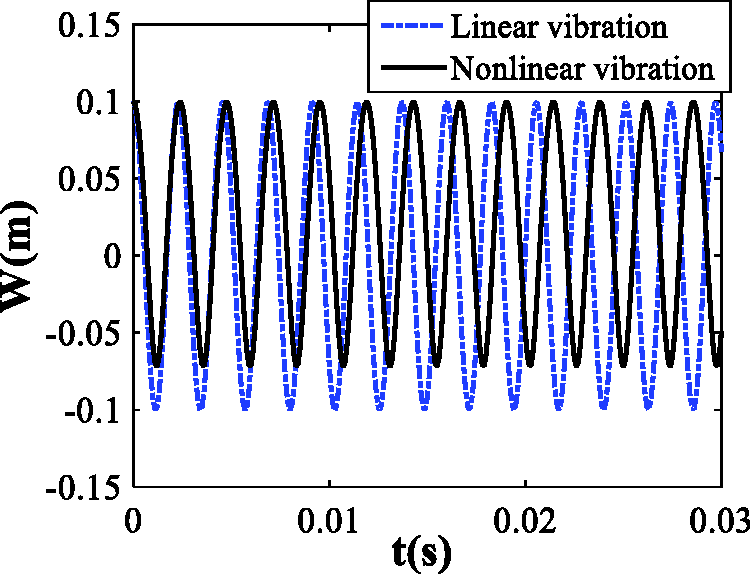
Dynamic responses of sandwich shallow spherical caps of undamped free vibration (
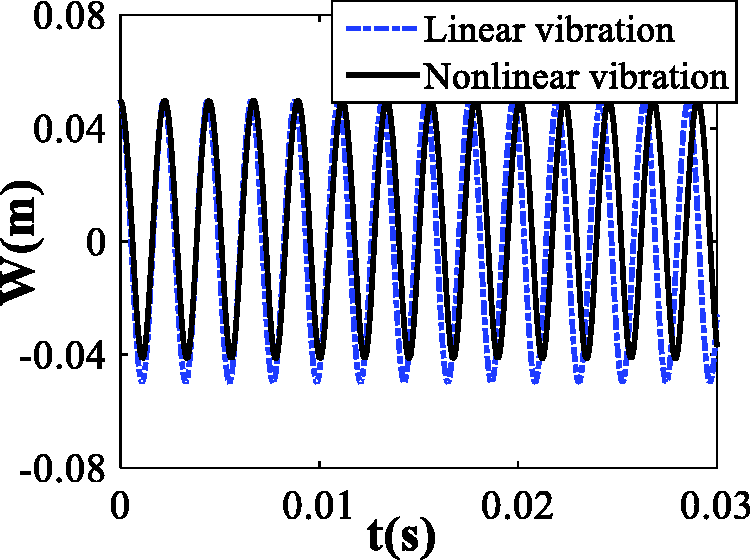
Dynamic responses of sandwich shallow spherical caps of undamped free vibration (
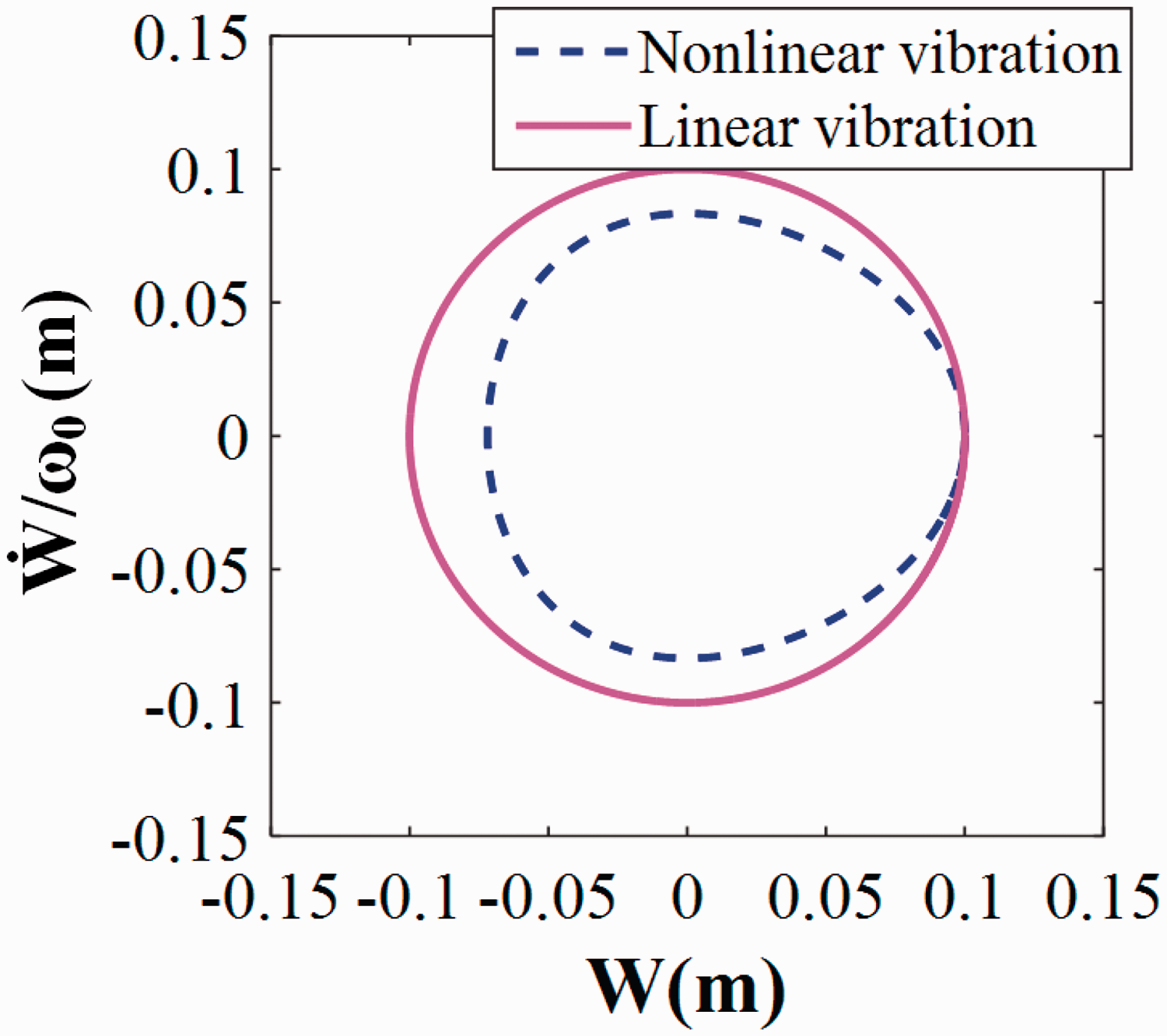
Deflection–velocity curve of sandwich shallow spherical caps of undamped free vibration (
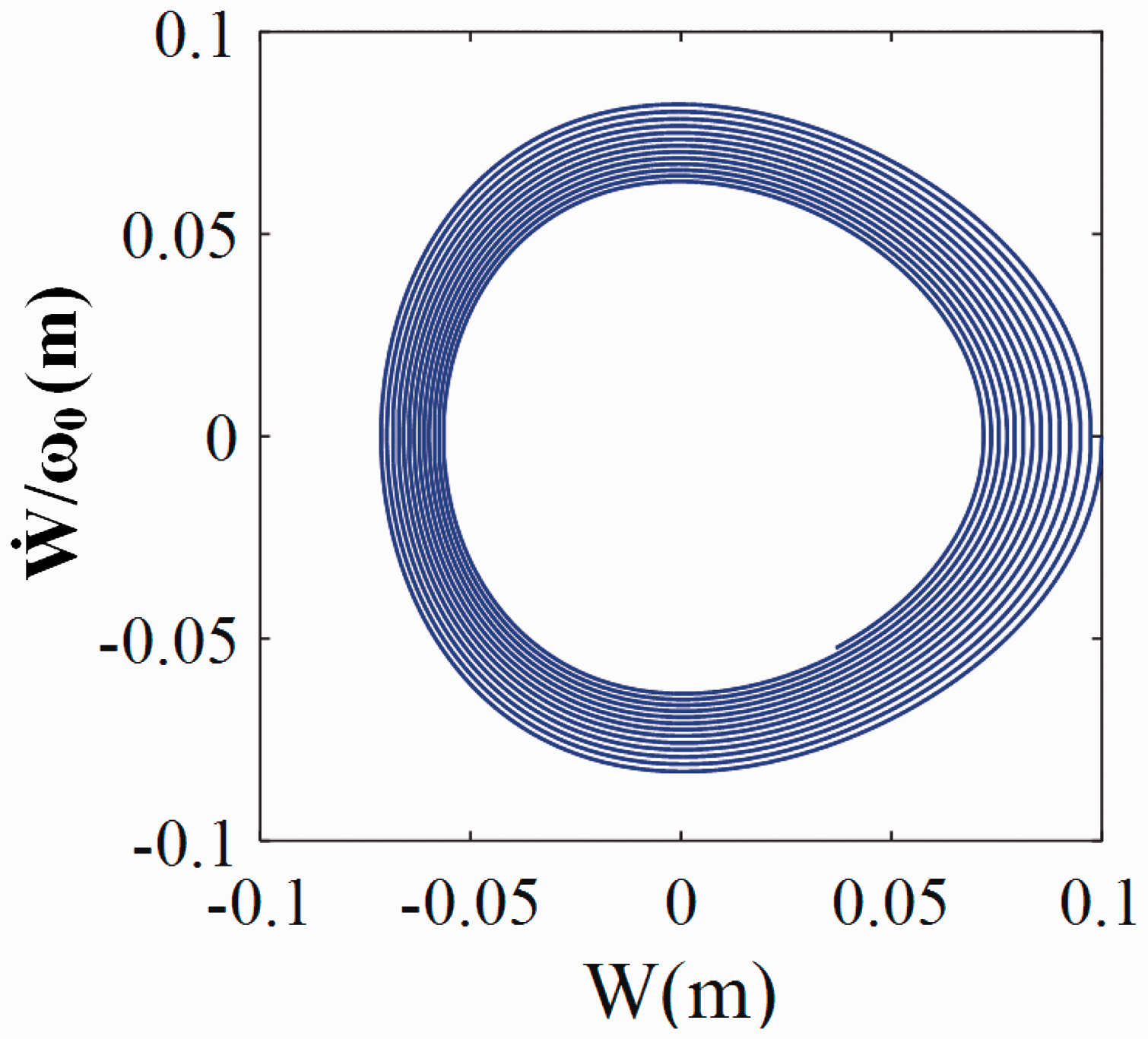
Deflection–velocity curve of sandwich shallow spherical caps of nonlinear damped free vibration (
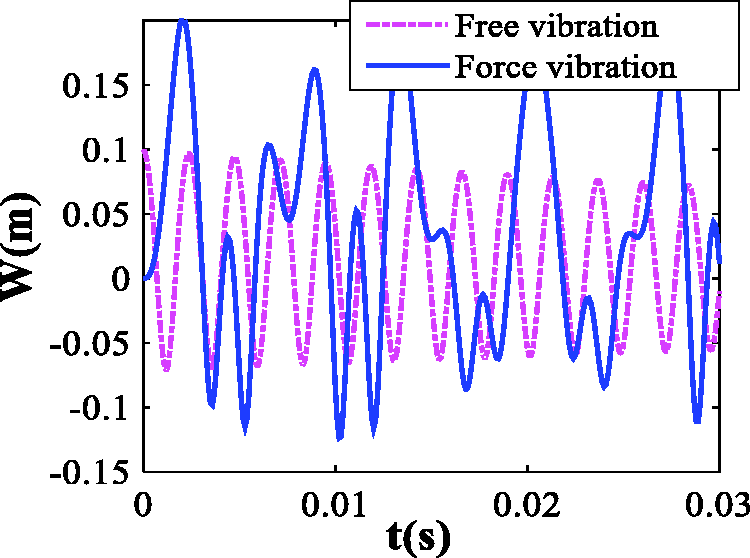
Comparison of dynamic response of nonlinear forced and free vibration of shell (
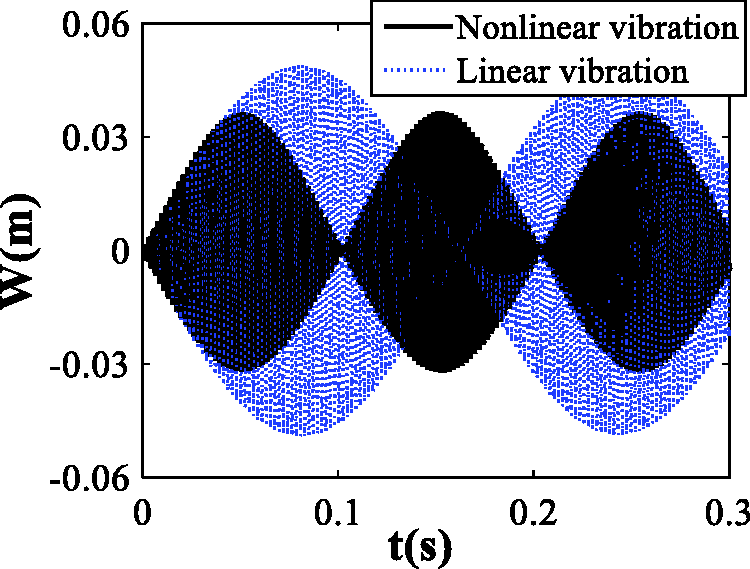
Comparison of dynamic response of linear and nonlinear forced vibration theories of shell (
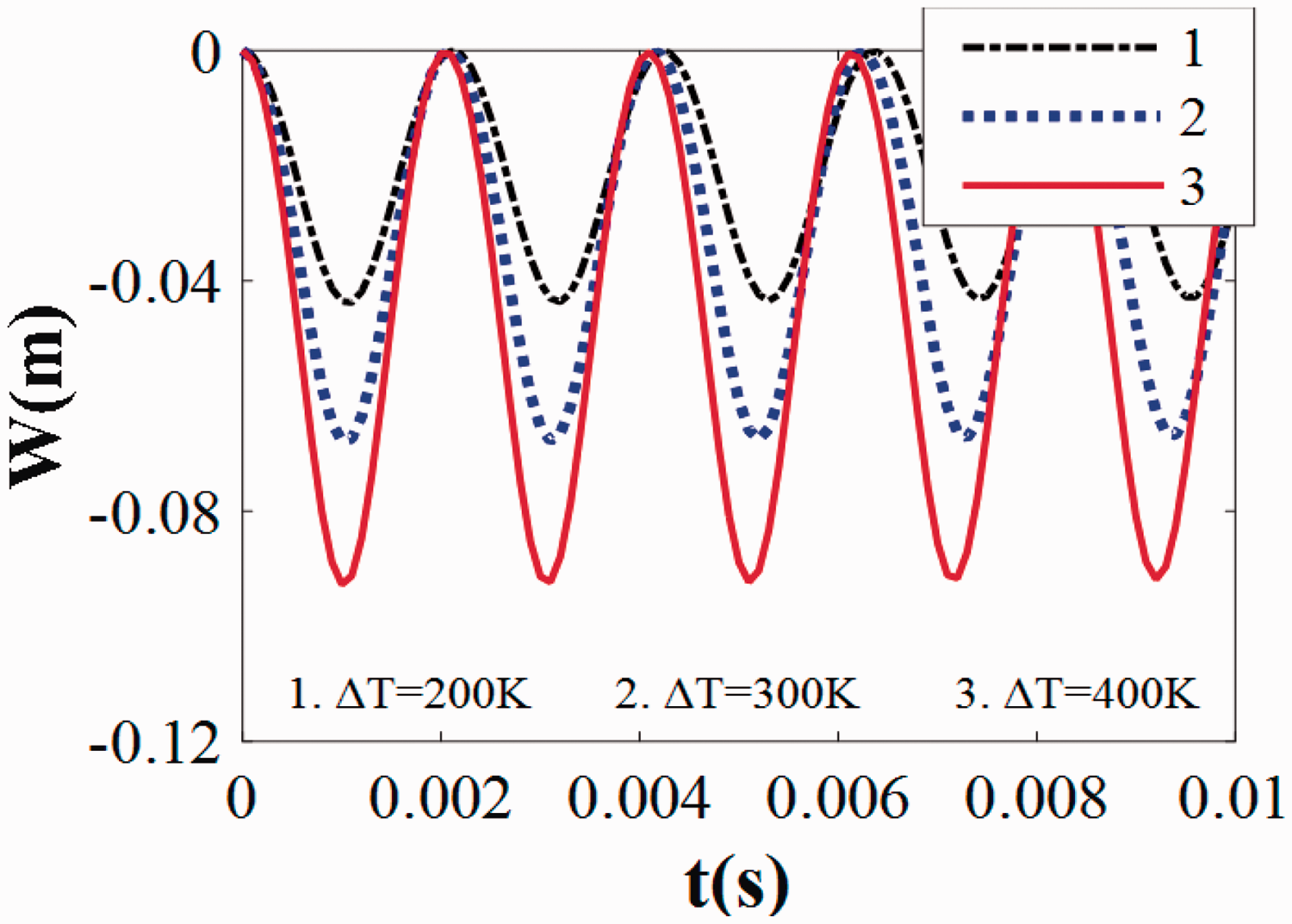
Effect of temperature change on the dynamic response of sandwich FGM spherical cap (
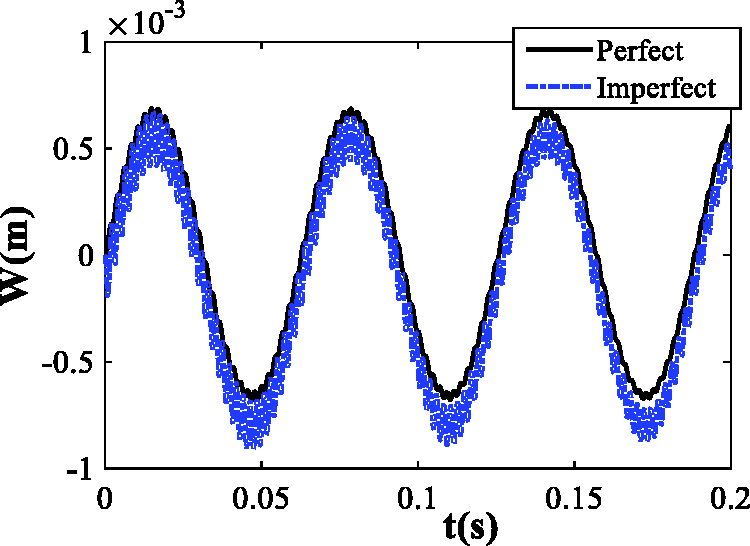
Effect of imperfection on the dynamic response of sandwich FGM spherical cap (
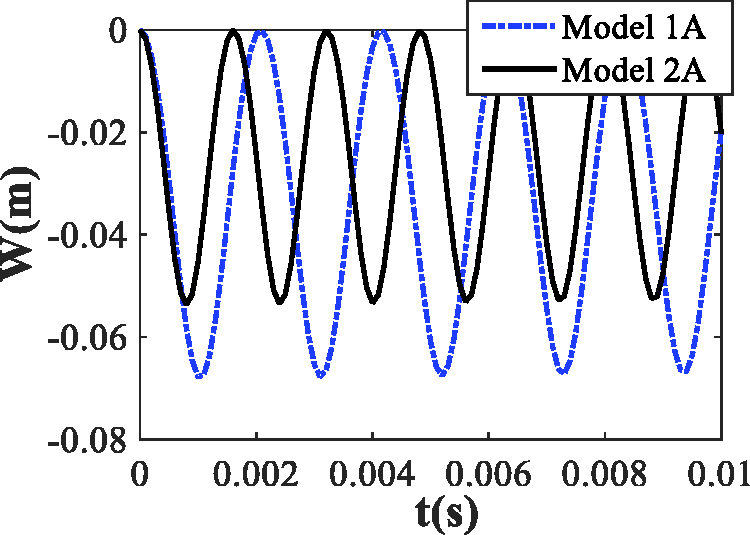
Comparison of dynamic response of shell of models 1A and 2A.
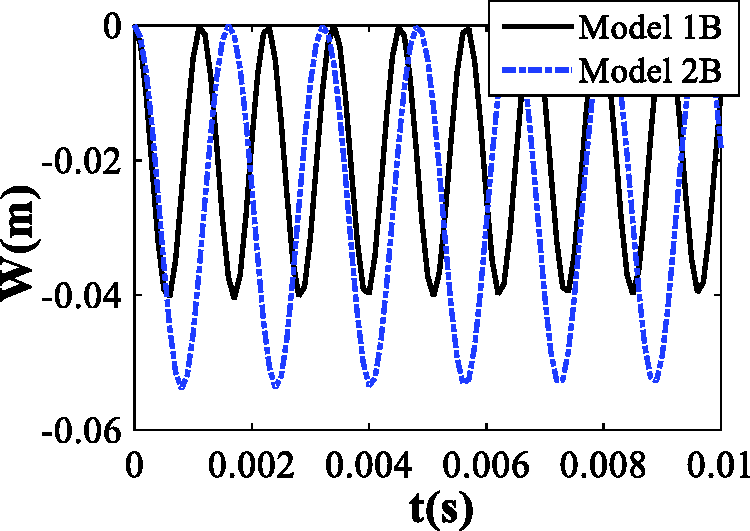
Comparison of dynamic response of shell of models 1B and 2B.
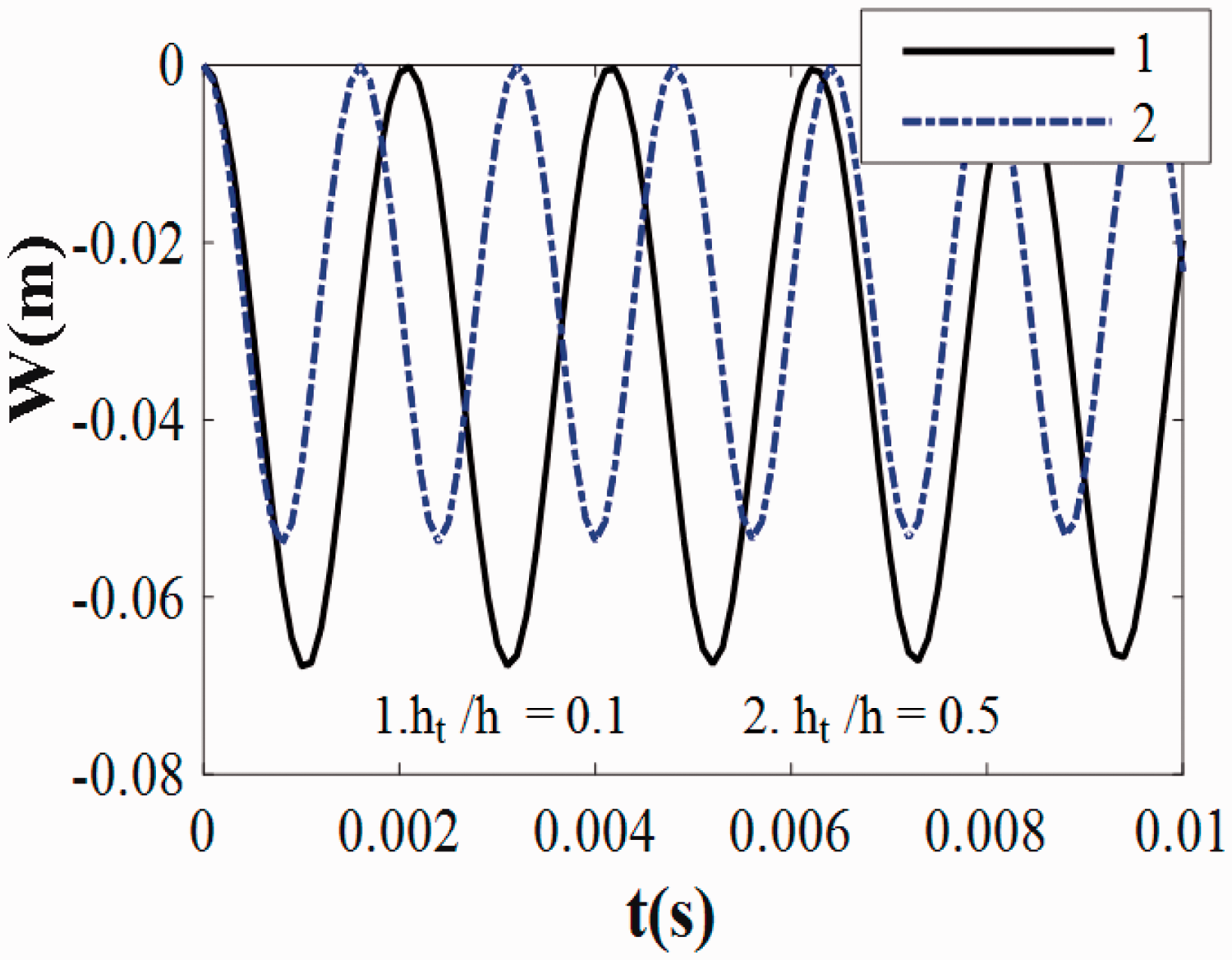
Effect of FGM thickness (
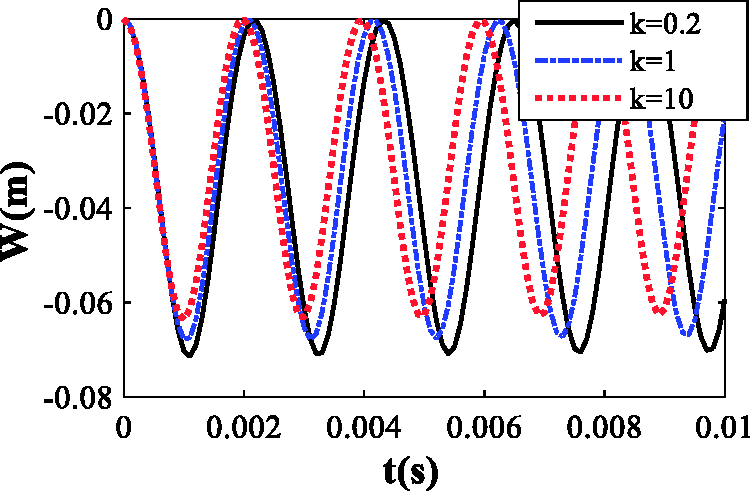
Effect of volume fraction exponent on the dynamic response of sandwich FGM spherical cap (
Effect of FGM thickness, volume fraction exponent, curvature (
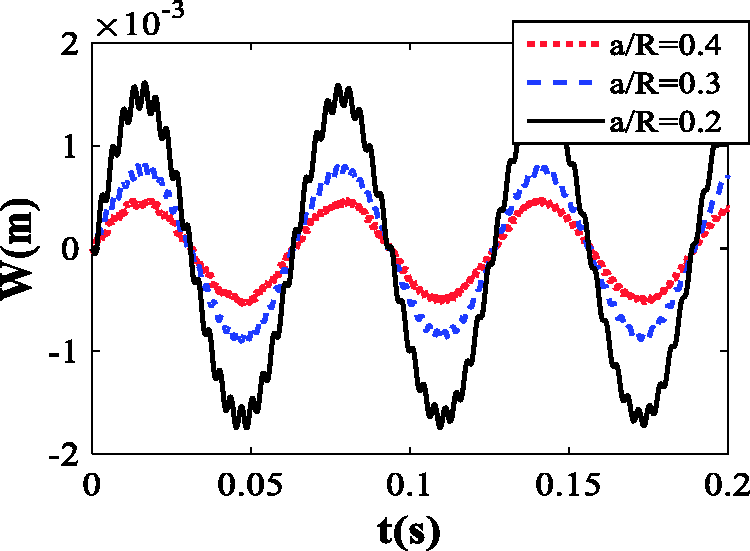
Effect of
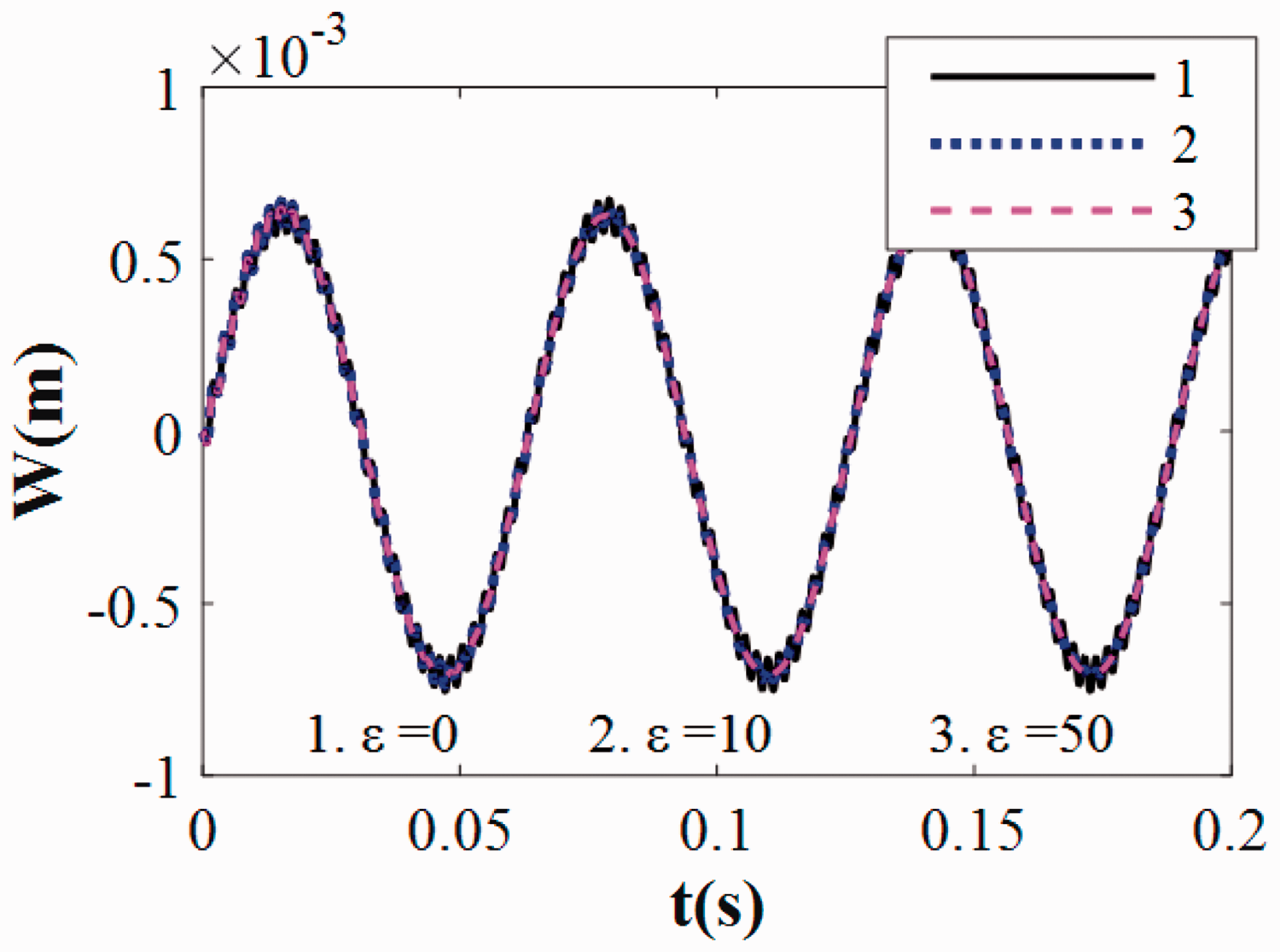
Effect of damping coefficient on the nonlinear vibration of sandwich FGM shell (
When the excitation frequency is near to fundamental frequency, the harmonic beat phenomenon is observed in Figure 17. The vibration amplitude rapidly increases when the excitation frequency approaches the fundamental frequency. Strong effect of excitation amplitude on the dynamic response is shown in Figure 18.
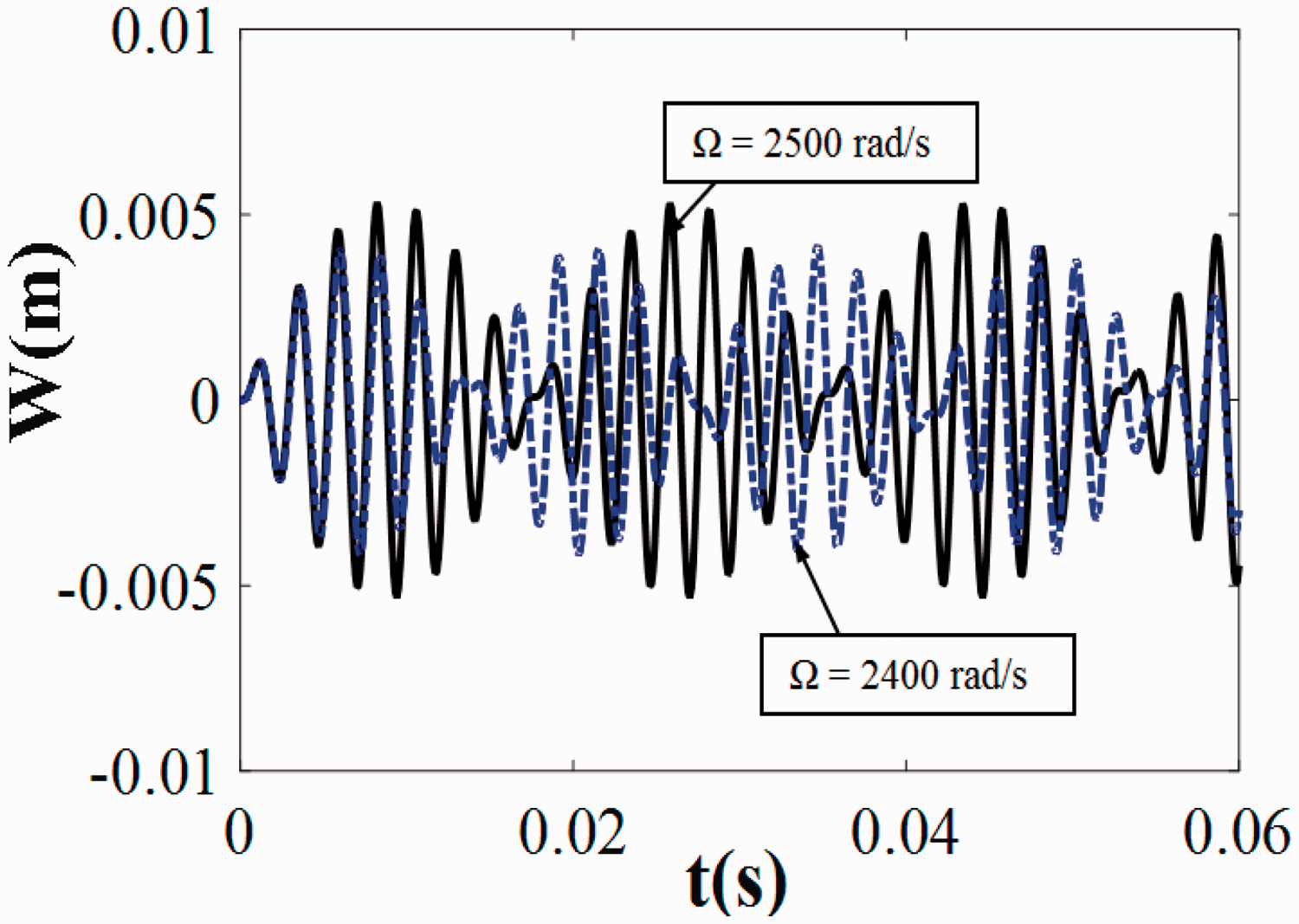
Effect of excitation frequency on the harmonic beat phenomenon of sandwich FGM spherical cap (
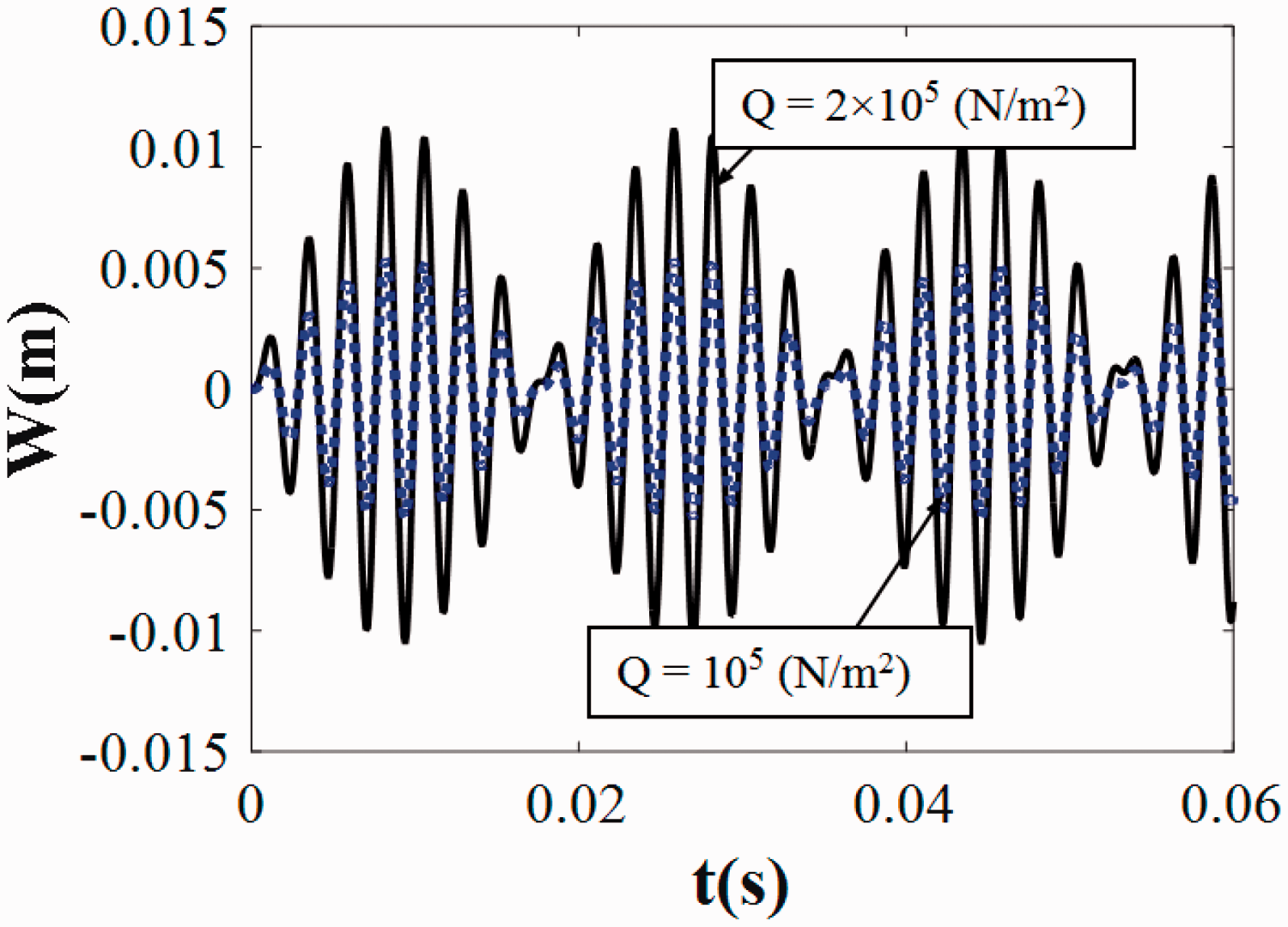
Effect of excitation amplitude on the harmonic beat phenomenon of sandwich FGM spherical cap (
Deflection–velocity curve of a beat period of nonlinear forced damped and undamped vibration is presented in Figures 19 and 20, respectively. Clearly, vibration is harmonic after each period of beat with undamped case and is inharmonic with damped case.
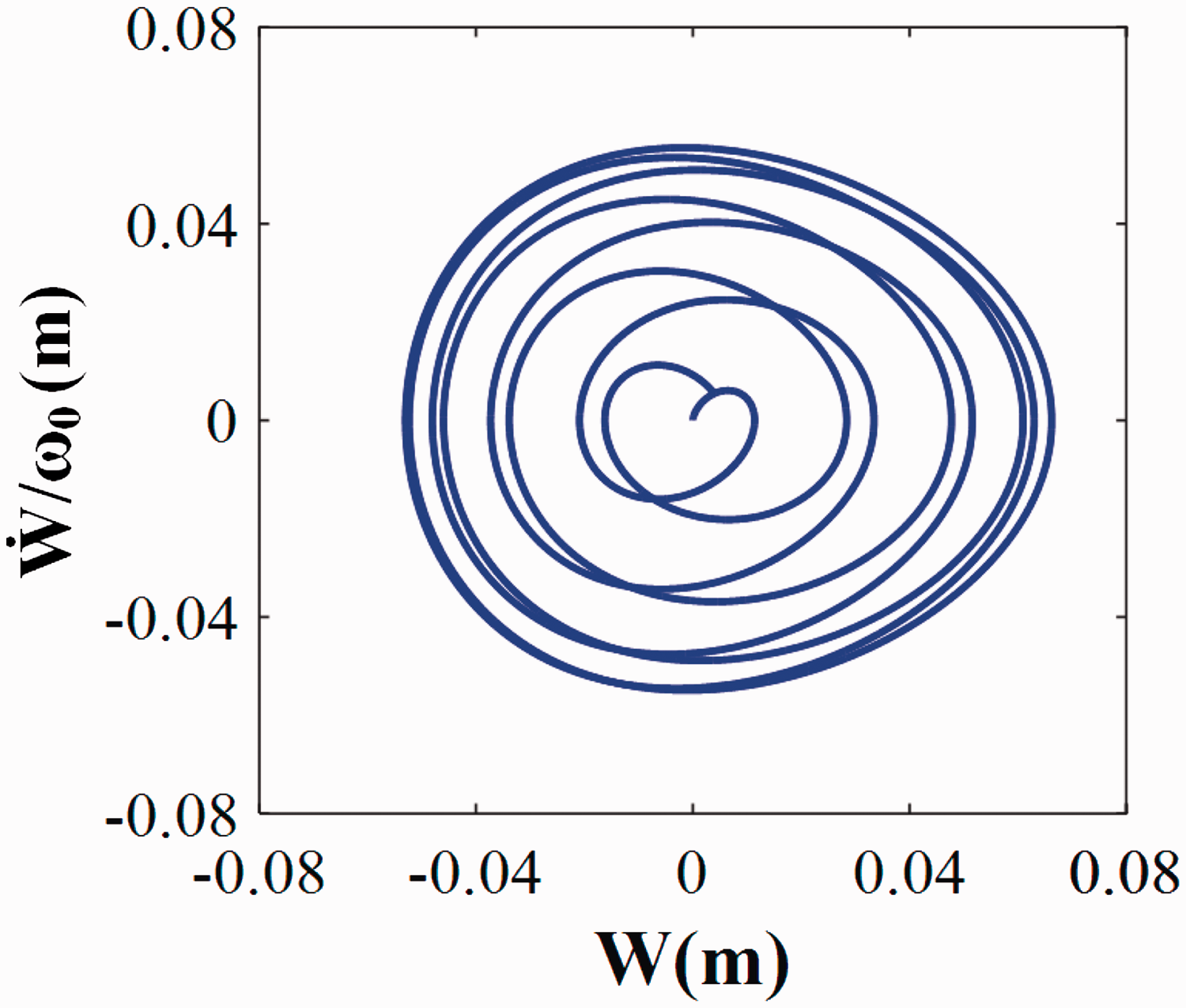
Deflection–velocity curve of sandwich shallow spherical caps of undamped forced vibration (
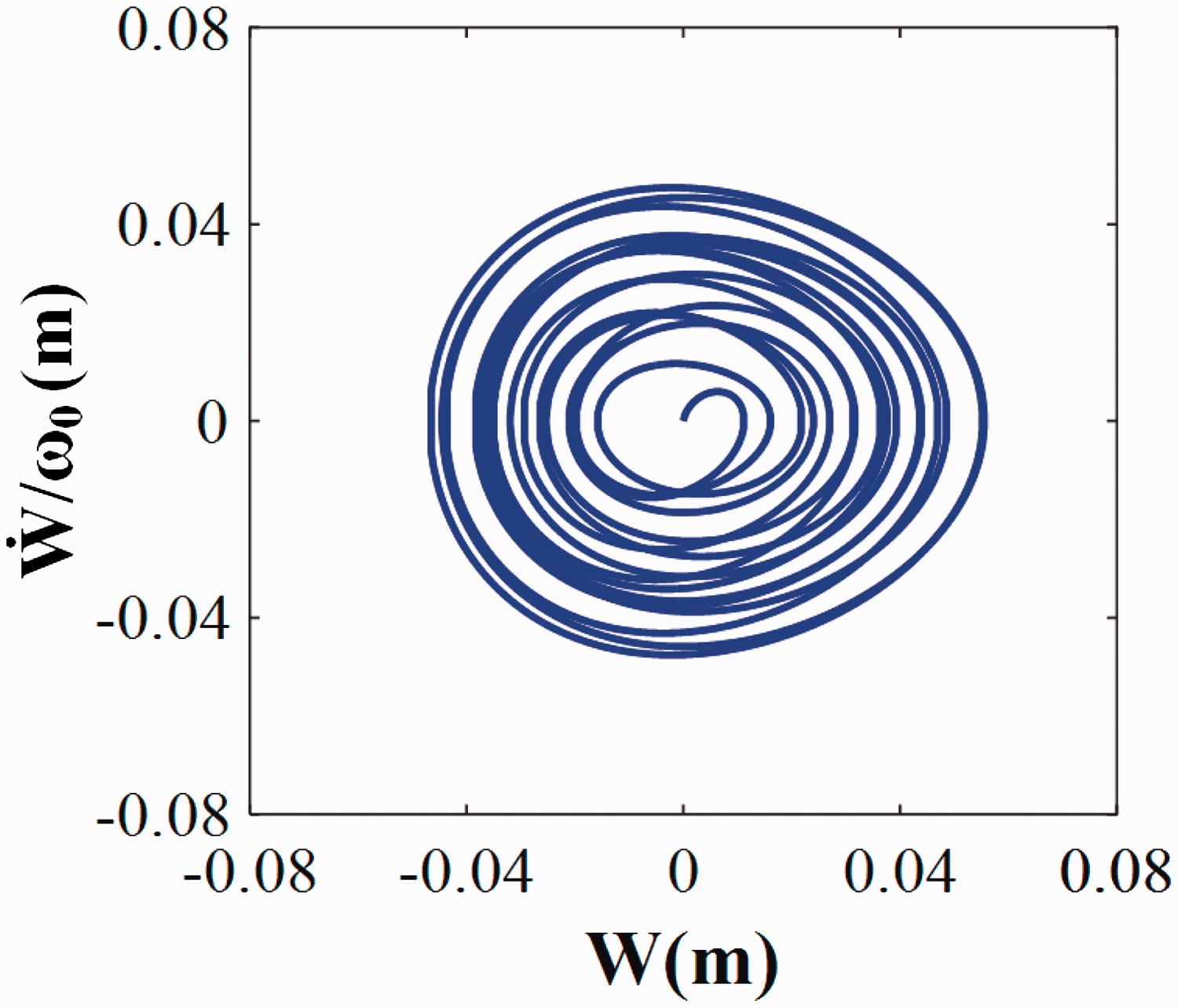
Deflection–velocity curve of sandwich shallow spherical caps of damped forced vibration (
When the excitation frequencies are far from fundamental frequency (Figures 21 and 22), the complex deflection–velocity curves are obtained. When the excitation amplitude is very far from fundamental frequency of shell (Figures 23 and 24), the deflection–velocity curves become disturbed curves.
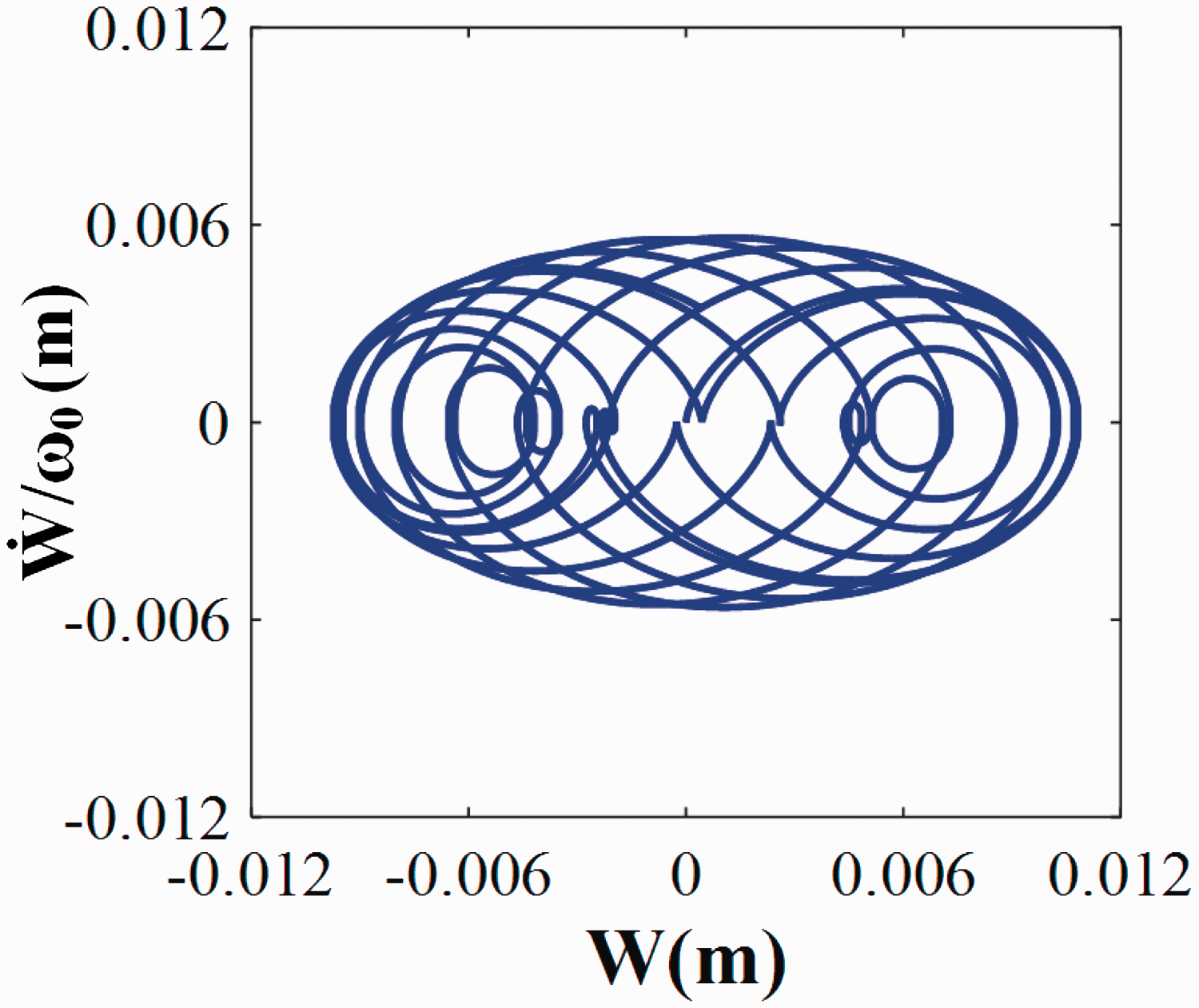
Deflection–velocity curve of sandwich shallow spherical caps of undamped forced vibration (
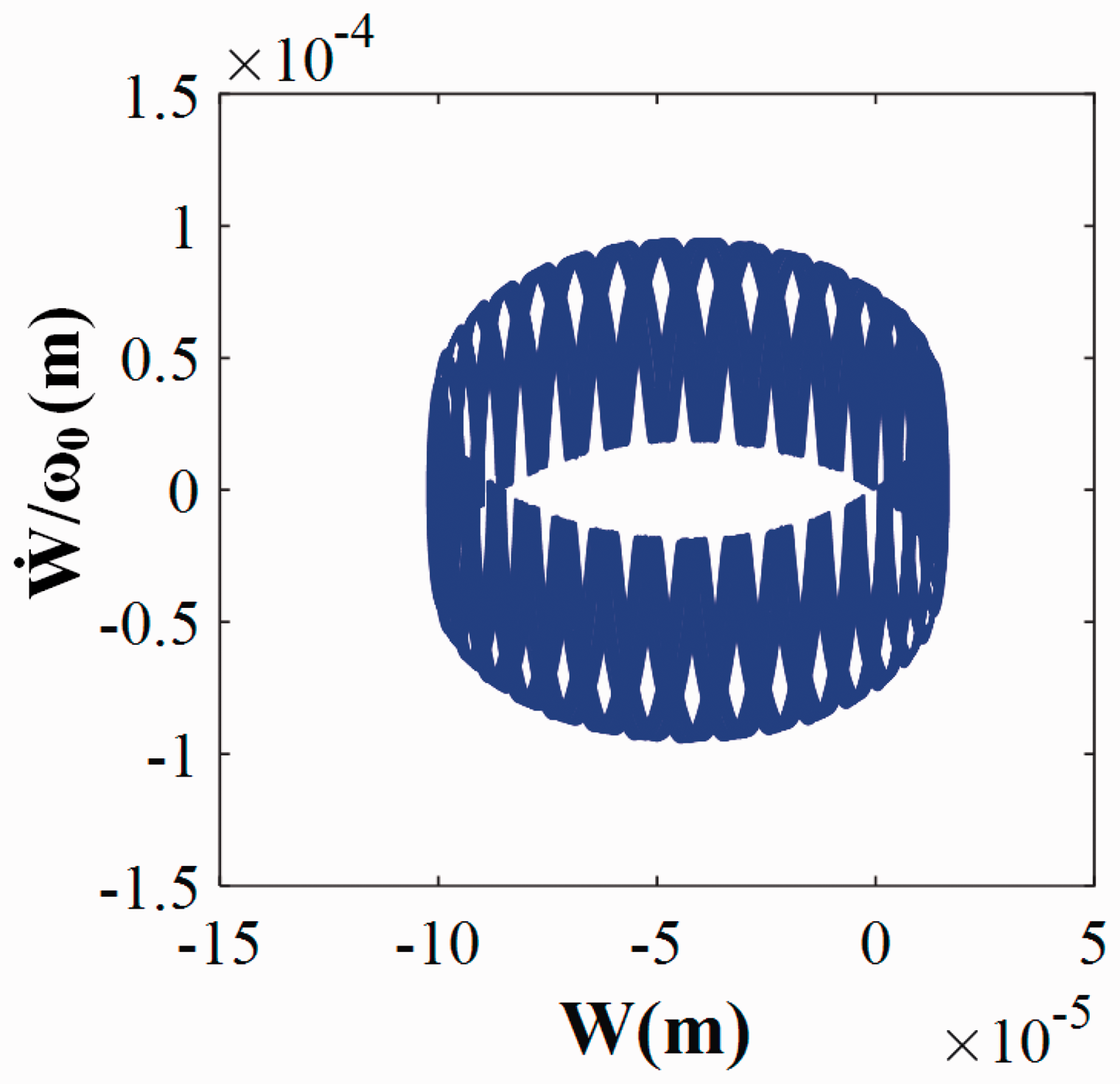
Deflection–velocity curve of sandwich shallow spherical caps of undamped forced vibration (
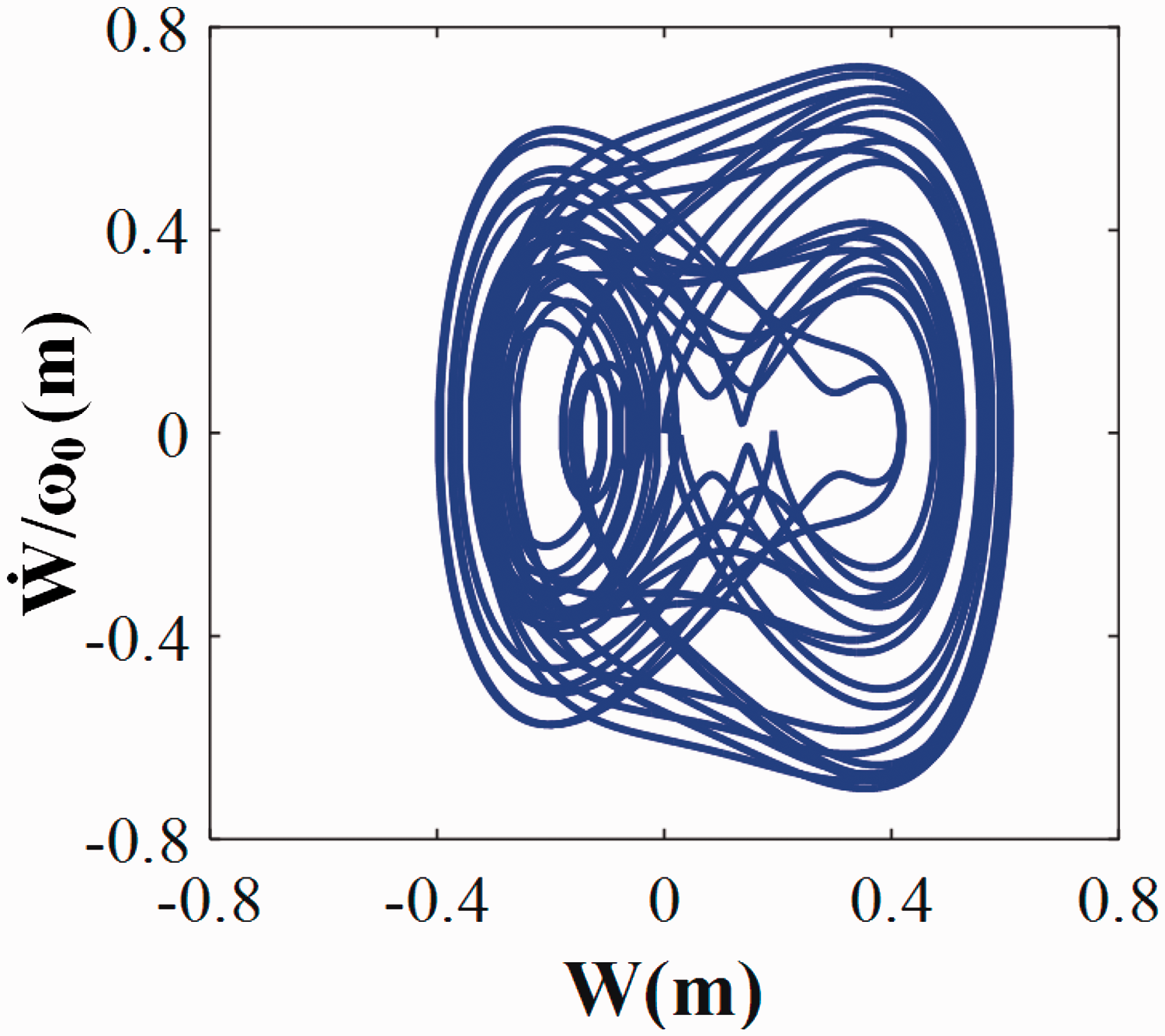
Deflection–velocity curve of sandwich shallow spherical caps of undamped forced vibration (
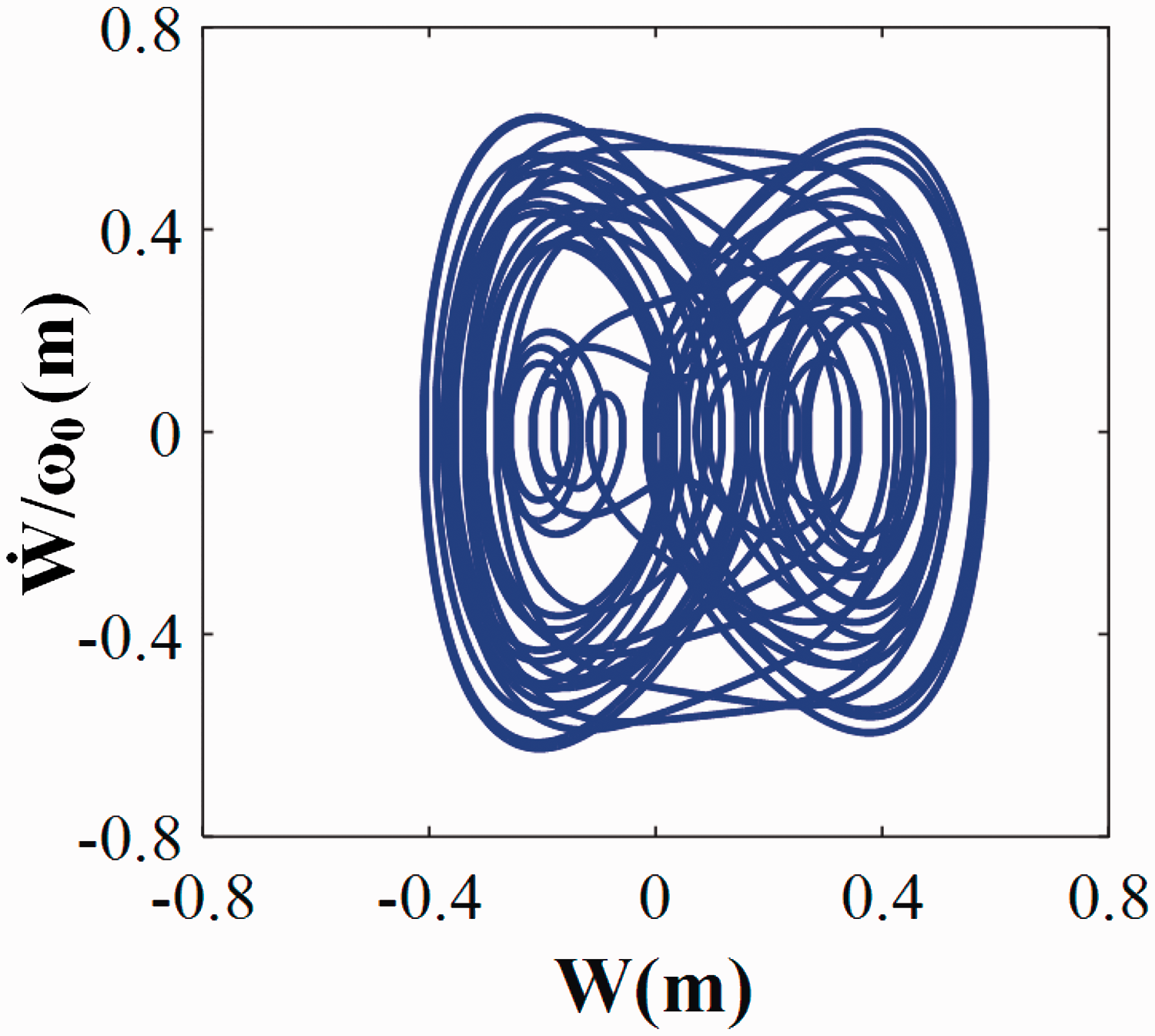
Deflection–velocity curve of sandwich shallow spherical caps of undamped forced vibration (
Conclusion
A semi-analytical approach to investigate the nonlinear vibration axisymmetric of four FGM sandwich models spherical caps subjected to uniform external pressure is proposed in this paper. The spherical caps are assumed to be axisymmetric deformation in the circumferential direction and the FSDT is used to obtain the equation system of motion of shell with geometrical nonlinearity in von-Karman sense and initial geometrical imperfection. This equation system is solved by using Galerkin method and fourth-order Runge–Kutta method is applied to investigate linear and nonlinear vibration behavior of structure in numerical form. Effect of excitation force, geometrical nonlinearity, geometrical imperfection, and temperature change on the dynamic response and deflection–velocity curve were investigated in details.
Footnotes
Declaration of Conflicting Interests
The author(s) declared no potential conflicts of interest with respect to the research, authorship, and/or publication of this article.
Funding
The author(s) disclosed receipt of the following financial support for the research, authorship, and/or publication of this article: This research is funded by Vietnam National Foundation for Science and Technology Development (NAFOSTED) under grant number 107.02–2017.11.