







Abstract
A new theoretical model based on the extended high order sandwich panel theory is established to predict the mechanical response of sandwich panels under static loads with the bilinear constitutive stress–strain relation in the core. The constitutive relations of normal stresses related to the longitudinal and vertical normal strains in the bilinear isotropic hardening core are first formulated. The influence of the in-plane rigidity on the elastoplastic response of sandwich structures is analyzed. An in-plane loaded sandwich structure with the bilinear core is first studied based on extended high order sandwich panel theory, and the effect of the bilinear ratio on the mechanical response is evaluated. The governing equations are derived from the principle of minimum potential energy, and a Ritz-based half-analytical method is applied to get the solutions. The plastic response is acquired by an iterative procedure along with the convergence criteria. The results reveal that the local effect can be captured when the axial rigidity of the core is considered. The bilinear characteristic of the core decreases the maximum normal stress with an increase of the average value. The equivalent plastic region extends with the increase of the bilinear ratio when the sandwich structure is loaded in plane. By comparison with open literatures and finite element results, the present theoretical model is proved to be effective and efficient.
Keywords
Introduction
Sandwich structures composed of two thin face sheets and a thick core have been increasingly applied in naval, aeronautical, and aerospace industries due to their high strength- and stiffness-to-weight ratios and excellent energy absorption capacity. Especially, face sheets applied in ship vessels are commonly made from metallic materials like 304 stainless steel, and the core materials with lightweight and flexibility can be metallic lattice, balsa wood, or polymeric foam, which are generally characterized by the typically bilinear material responses in application [1,2]. These properties of the core significantly affect the structural behaviors of sandwich panels when they are exposed to intense loads and the material nonlinearity in the core occurs.
Various models have been proposed to investigate the mechanical properties of sandwich structures with bilinear cores. Mostly, the material nonlinear behavior of the sandwich beam is studied within the framework of classical sandwich beam theory or equivalent single-layer (ESL) theories [3–5], which assume infinite rigidity through the thickness of the core for simplification. In 1999, Lei and Mercado [6] provided a modification to the classical sandwich beam theory to account for the added shear load carried by the face sheets for a perfectly plastic core. Li et al. [7] proposed an elastic–plastic model to predict the dynamic response of a simply supported sandwich beam by introducing a simplified relation between the bending moment and the rotation angle of a bending hinge. Liu et al. [8] developed an analytical model to assess the elastic–plastic dynamic response of fully backed sandwich plates under localized impulse loads by modeling the core as an elastic-perfectly plastic foundation. The literature survey reveals that the classical or ESL theory for the core may be adequate for sandwich structures with extremely stiff cores, but unsuitable for flexible ones in both static and dynamic responses [9].
By considering the transverse compressibility and shear effects in the core, Frostig et al. [10] established a high order sandwich panel theory (HSAPT) which shows the superior accuracy for sandwich structures with extraordinarily soft cores. Based on HSAPT, the elastic–plastic behavior of sandwich structures with bilinear cores has been studied by some researchers. Frostig et al. [11] presented a close-form high order theory for the analysis of sandwich panels with bilinear constitutive relations of the shear and vertical normal stresses and found that the nonlinear behavior of the core is associated with large displacements and stress-relaxation when the bilinear ratios decrease. Rezaeifard et al. [12] presented a new nonlinear model for sandwich beams with transversely flexible cores based on HSAPT and derived the governing equations by Galerkin weighted residual method. As a progressive step, Salami et al. [13, 14] presented the elastic–plastic response based on the combination of bilinear constitutive relations for the vertical normal and shear stresses in the core, and the first-order shear deformation plate theory was adopted for the face sheets. However, the axial rigidity of the core is still neglected in HSAPT owing to the complexity of kinematic equations. When the sandwich panel with moderate core is extremely impacted, or loaded in-plane, the effect of the in-plane rigidity in the core should not be ignored, and HSAPT is invalid in predicting the mechanical behavior of the sandwich structures [9].
To eliminate the error caused by simplification, Phan et al. [9] introduced a new theoretical model, named extended high order sandwich panel theory (EHSAPT), in which the axial rigidity of the core is involved based on HSAPT. This theory has been verified to have the superior accuracy in predicting displacements and stresses both in static or dynamic analyses for a wide range of core materials, no matter highly soft or extremely stiff cores [15–19]. To date, however, there is no published work based on EHSAPT investigating the elastoplastic behavior of sandwich panels with bilinear cores, due to the difficulty of obtaining the constitutive relation of the vertical normal stress associated with the vertical and longitudinal normal strains in plastic regions when the stress–strain curve is acquired from the vertical uniaxial compression test [14]. Here, this issue is investigated and the constitutive relations of normal stresses in terms of the longitudinal and vertical normal strain are first formulated, and the axial rigidity could be included in the constitutive relations. Hence, it is possible to acquire the in-plane response of sandwich structures with bilinear cores of arbitrary rigidity based on EHSAPT.
In this paper, the sandwich structure with bilinear isotropic hardening core under static loads is studied based on EHSAPT. The bilinear constitutive relation for the shear stress, vertical, and longitudinal normal stresses in the core is first presented associated with the different stress states that may exist within the core. The governing equations are derived from the principle of minimum potential energy. The Ritz-based method associated with the modified Newton–Raphson iteration technique is coded to obtain the solutions. The plastic response of the sandwich beam is acquired by an iterative procedure along with the convergence criteria. A sandwich structure with bilinear soft core under transverse load is analyzed to assess the different simplification and assumptions based on HSAPT, and the influence of axial rigidity on the mechanical response of sandwich structures is estimated. Besides, the sandwich structure with bilinear core subjected to an in-plane load is first investigated based on EHSAPT, and the effect of the bilinear ratio on the elastoplastic behavior is studied. A set of MATLAB program based on symbolic operations suitable for arbitrary boundary conditions is developed. Comparisons with results from literature and finite element calculation are performed to validate the present model.
Basic equations
A sandwich beam with span length a and width b under arbitrary loads is depicted in Figure 1(a). The thicknesses of the face sheets and core are denoted as f and 2c, respectively. Relevant material constants are Young’s modulus E, secant elastic modulus Es, shear modulus G, secant shear modulus Gs, and Poisson’s ratio μ. A two-dimension Cartesian coordinate system oxz is established at the left side of the beam with its origin o at the center of the core. The superscripts t, c, and b correspond to the layers of top-face sheet, core, and bottom-face sheet, respectively. Besides, the subscript 0 refers to the midface of the corresponding layer, and the subscripts
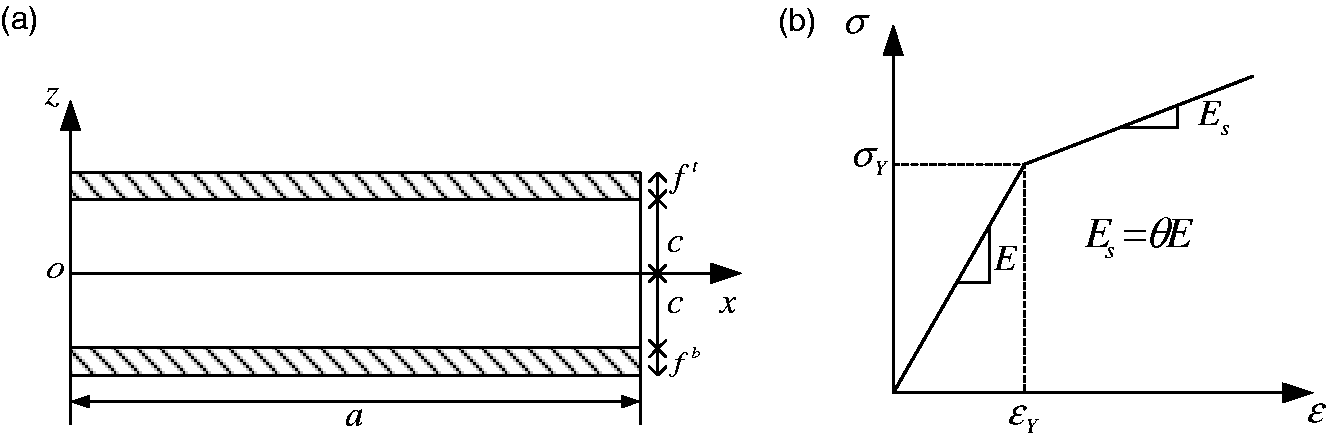
(a) Sandwich beam configuration (b) bilinear stress–strain diagrams.
Euler–Bernoulli assumptions are employed for the linear elastic face sheets with negligible shear strain.
A two-dimensional bilinear isotropic hardening model is used for the core with vertical and longitudinal rigidities. The stresses in the core, including shear stress, vertical, and longitudinal normal stresses, follow the bilinear constitutive relation, as seen in Figure 1(b). The entire yield surface expands uniformly during plastic flow.
The face sheets and the core are perfectly bonded with no delamination occurring.
The entire structure is at small deformation.
According to EHSAPT [9], the displacement fields of the top/bottom face sheets and core are written as
The stresses in the thin face sheets based on the linear elastic assumption are obtained by
When the isotropic core is in elastic, the stress–strain relation is described as follows
The bending moment resultants in face sheets are given by
Numerical formulation
Most of the analytical solutions based on various sandwich beam/plate theories are only obtained in the case of simply supported boundaries. Usually, there is no analytical solution when more complex boundary conditions are considered. Recently, numerical solutions have been explored by adopting the Ritz method based on EHSAPT or HSAPT. The accuracy of the Ritz method strongly depends on the choice of trial functions, including power series [13] or polynomial series [12]. These theoretical models seem relatively slow in convergence. A finite element model (FEM) built on EHSAPT and developed by Yuan [20] has been approved for high precision. Learning from the finite element form of EHSAPT, a Ritz-based half analytical model is imposed here by dividing the sandwich beam into multiple elements and expressing the displacement in each element by polynomial interpolation technique.
First, the sandwich beam is divided into n elements with (n + 1) nodes along the x-axis. As one may conclude, there are 9 unknowns in equations (1) to (4), and thus each node could be assigned 9 variables, which is written as
The midface displacement in the ith element,
Thus, the governing equations can be derived from the principle of minimum potential energy as below
To solve equation (17), a modified Newton–Raphson method is utilized here
When
Bilinear isotropic hardening plasticity
When the bilinear isotropic hardening core yields, the stress–strain relation in equation (10) is invalid and needs to be corrected. According to the three stresses ( All the stresses are in the linear status ( Only one stress is above the yielding stress ( Two in the three are beyond the yielding stresses ( The core yields in all the directions (
To illustrate the derivation of the stress–strain relation in plastic deformation, the material behavior in the core yielding in all the directions is discussed here. Thus, the strains in the core can be obtained as follows
From the bilinear isotropic hardening assumption, it is concluded that (1) the bilinear ratios of elastic and shear moduli are equal, that is
It is observed that, when θ = 1, the core is purely elastic and equation (23) reduces to equation (10). Similar analysis needs to be done to get the strains when the core is in other deformation modes.
According to the previous analysis, the constitutive relation for the bilinear isotropic hardening core differs in the plastic and elastic deformation. To get the strain energy of the whole structure, the material behavior of each element should be confirmed first. Here, each element is assumed in the same deformation pattern with the center point of the element. When the stresses at the centroid are larger than the yielding ones, the entire element yields. As seen in Figure 2, the two-dimensional sandwich panel is divided into n × m elements. An iteration technique to assess the material nonlinear response is illustrated as below:
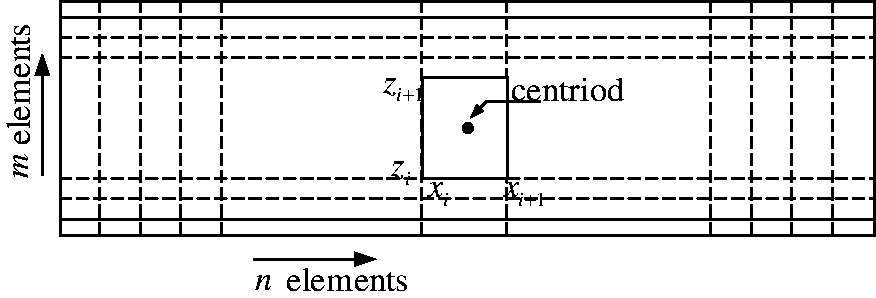
Illustration of the division on the sandwich beam.
The structure is assumed to be completely elastic, and the fully linear governing equations are solved to obtain the linear displacement response.
The stresses
The step 2 is repeated until the difference of displacements obtained by two consecutive iterations is less than 10–3.
Results and discussion
Validation
To validate the present Ritz-based method, the fully linear responses of a sandwich beam under simply supported boundary, with no accounting of material nonlinearity, are compared with the analytical results of EHSAPT. The geometry and materials follow the example in [16]. The geometrical parameters are length a = 152.4 mm, face thickness ft = fb = 5 mm, and core thickness 2c = 38 mm. The face sheets are made of E-glass vinyl-ester composite with Young’s modulus
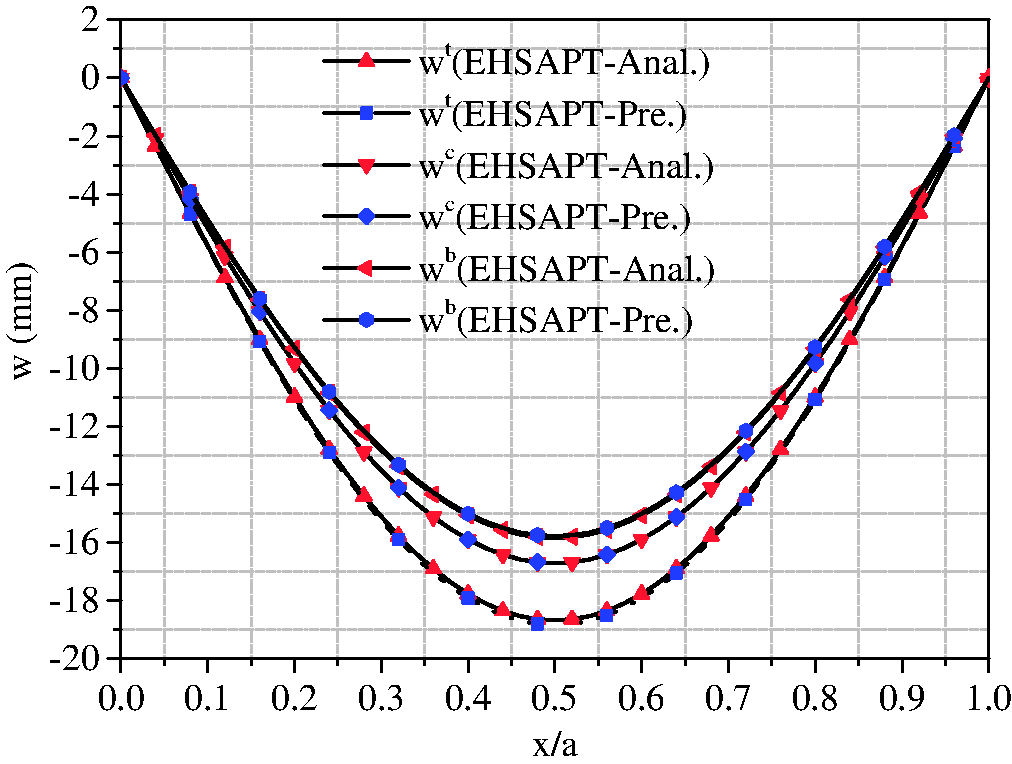
Comparisons of the present Ritz-based solutions with the analytical results of EHSAPT.
To validate the bilinear stress–strain relation for all the shear and normal stresses in the core, the present theoretical solutions are compared with the experimental results from [14], and a finite element calculation is accomplished to validate the theoretical model further.
The experimental stress–strain curve is obtained from the three-point bending test on sandwich beams with spring steel face sheets and soft polymeric cores. The material properties of face sheets and the foam core are listed in Table 1. The geometrical parameters of specimens are total length
Material properties of sandwich beams under three-point bending test.

Figure 4 shows the load–displacement response at the midspan of the upper face sheet, where the EHSAPT solutions are based on bilinear normal and shear stress–strain relations of the core. In the linear region, the elastic modulus of EHSAPT is relatively lower than the experimental one due to the ordinary panel theory assumptions for the face sheets with negligible shear strain, and thus the entire structure in EHSAPT seems softer than the experimental counterparts. Once the core yields, there is a difference between EHSAPT and experimental curves over the increase of the applied load. It can be interpreted that the core is made of a typical elastomeric foam, polyurethane foam, which exhibits different characteristics in tension and compression. Only at small strain case, the linear-elastic modulus of the foam in tension is the same as that in compression. Thus, the small deformation assumption may lead to discrepancy when the applied load is so sizeable that the nonlinear response in tension may occur in the core. As seen in Figure 4, even though the simplifications and assumptions are implemented in EHSAPT, the present theoretical curve is still close to the experimental one to some extent. Additionally, the finite element solution agrees very well over the linear behavior range and slightly deviates over the nonlinear range. Therefore, the present bilinear model considering the normal and shear stresses in the core is effective in predicting the static mechanical response of sandwich beam.
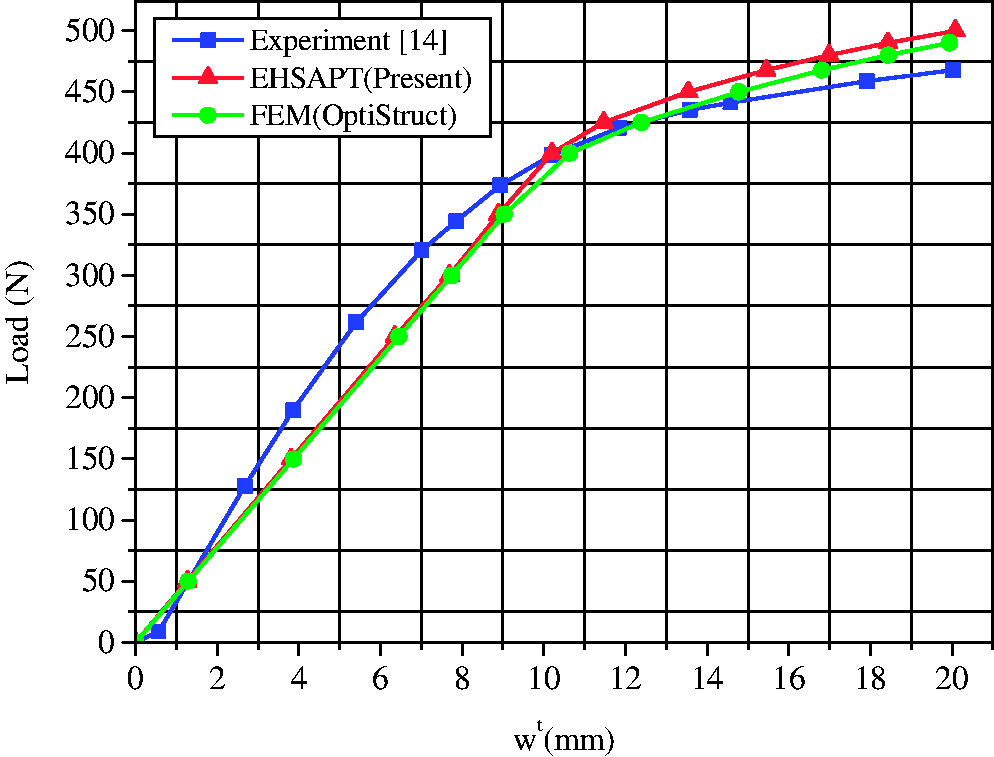
Comparisons of experimental, numerical and present results of load–displacement response at the midspan of the top face sheet for three-point bending test of sandwich beam with spring steel face and polyurethane foam core.
Transverse load
To assess various simplified theoretical models based on HSAPT and the influence of the axial rigidity on the static mechanical response of sandwich panel under transverse load, a simply supported case is considered here to compare with the results of [12]. The geometry and materials are shown in Table 2, which are identical to the example in [12] or [11]. A line load
Geometrical and mechanical properties of sandwich beams.

Note: the geometrical data are in mm; moduli data are in GPA;
The distribution of shear stress in the midface of the soft core along the
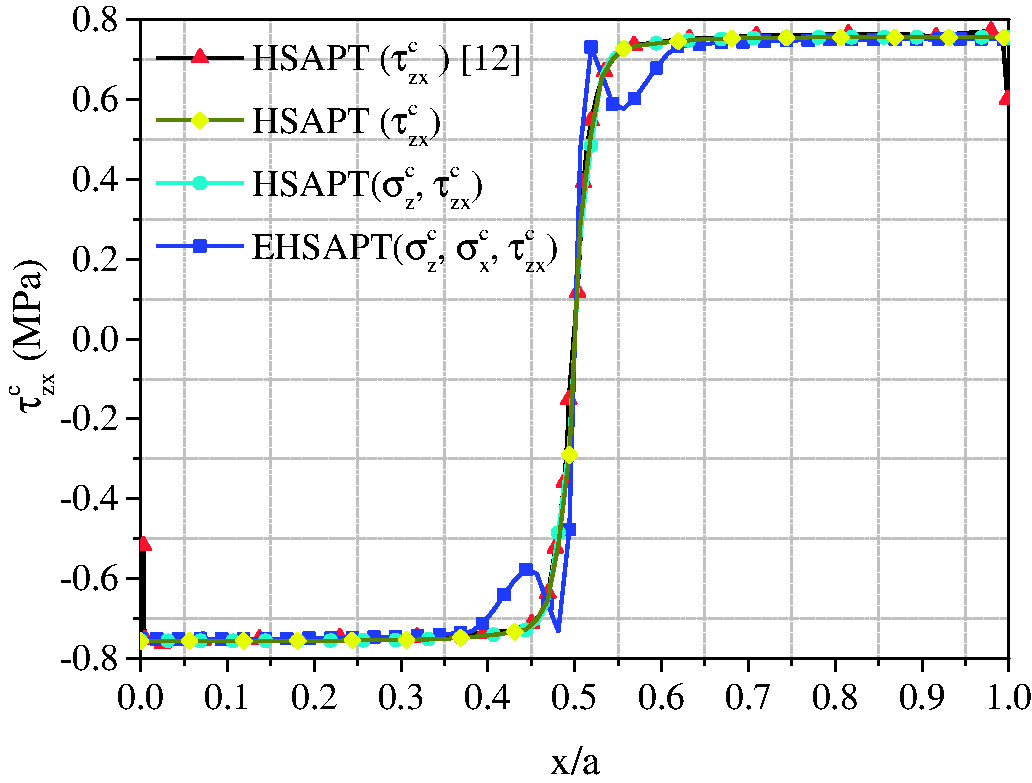
Shear stress in the core in case of bilinear stress–strain constitutive relation for different combinations of concerning stresses in transverse loading
When the bilinear stress–strain relation for the vertical normal stress is applied, the curve of HSAPT (
The absolute values of the vertical displacements at the upper and lower face sheets are displayed in Figure 6. Different combinations of stresses have very close results. It suggests that the sandwich beam in the current analysis is mainly subjected to shear load, and little contributions are made to the displacement response from the vertical and longitudinal normal stresses. And the local effect in transverse deflection (local dimpling at the loading application) is well captured on the top face sheet when the axial rigidity is considered.
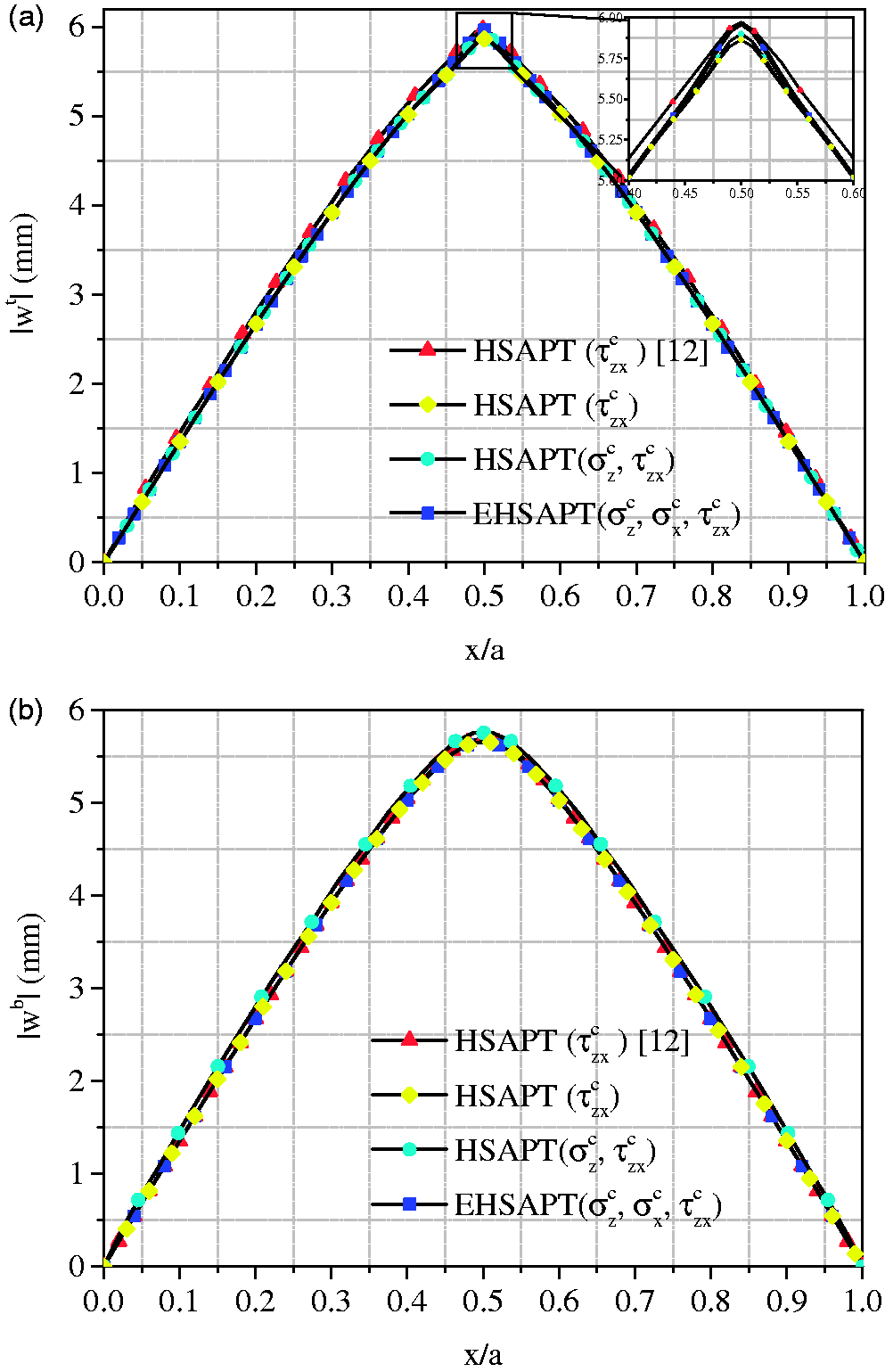
Vertical displacements in the face sheets in case of bilinear stress–strain constitutive relation for different combinations of concerning stresses in transverse loading
The variations of vertical normal stresses at the upper interface along the longitudinal direction are shown in Figure 7. The present HSAPT (
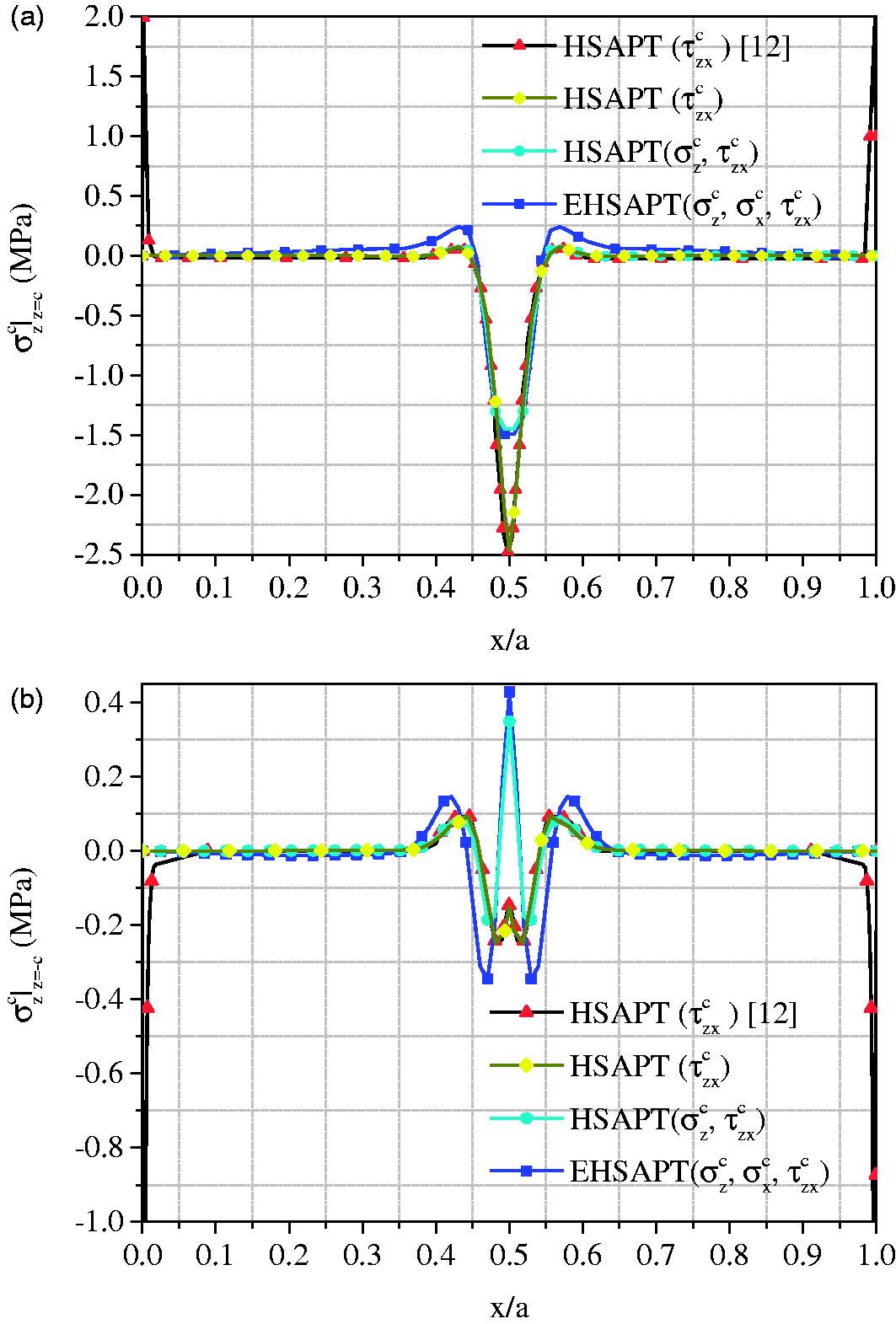
Vertical normal stresses in the core in case of bilinear stress–strain constitutive relation for different combinations of concerning stresses in transverse loading
At the interface of
The bending moment resultants at the top and bottom face sheets are shown in Figure 8. As seen, the curves of different theoretical models are very close to each other and are in good agreement with [12] except the regions in the vicinity of boundaries. Since the core mainly undergoes the small and localized shear load, the displacement response and the deformed curvature of the beam are in proximity whenever bilinear assumptions are used to normal stresses or not, and whenever the longitudinal normal stress is considered or not. Therefore, the bending moment resultants of face sheets are approximate in these simplified models.
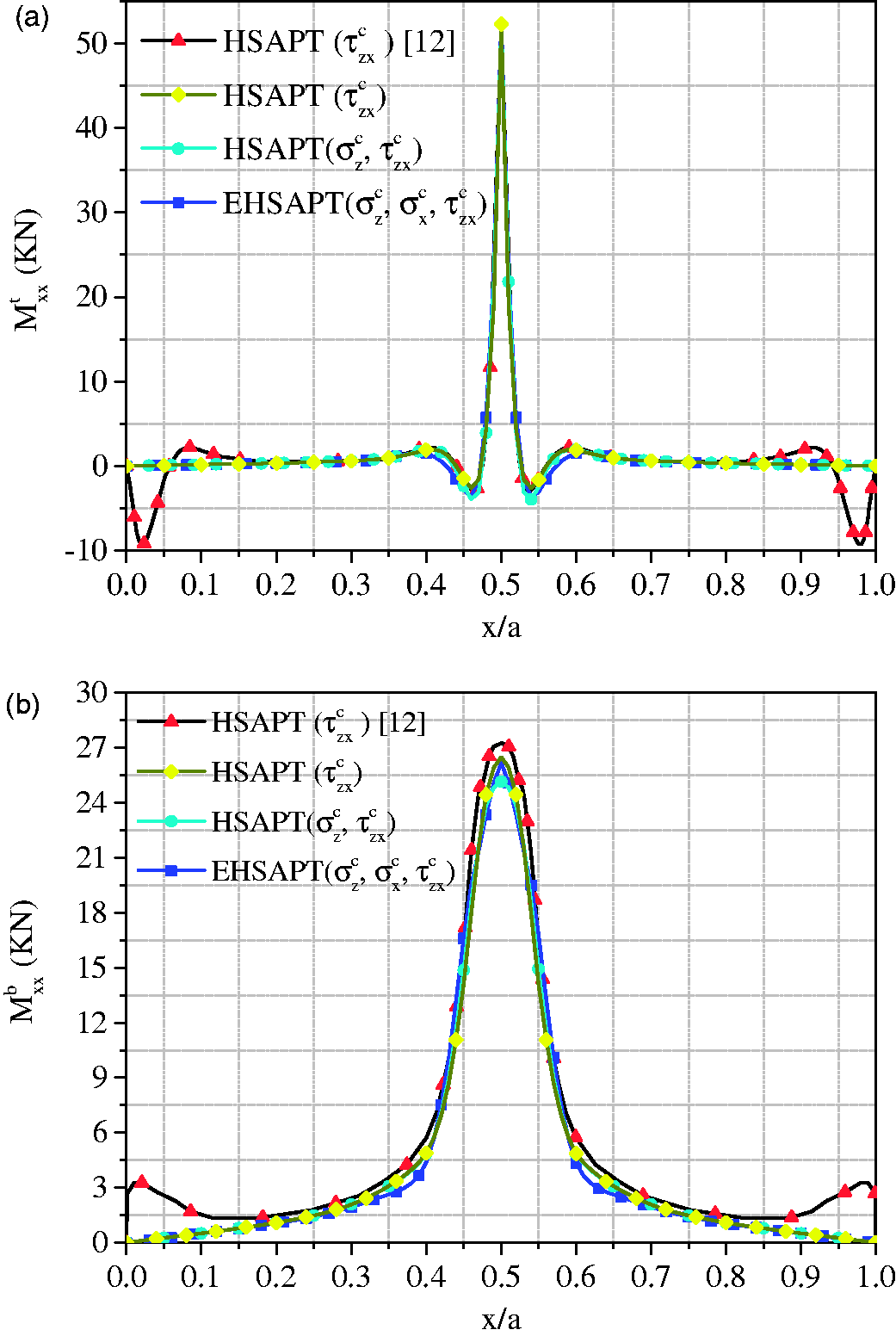
Bending moment resultants in the face sheets in case of bilinear stress–strain constitutive relation for different combinations of concerning stresses in transverse loading
It is concluded that the HSAPT that ignores axial rigidity in the core and linear assumption for the vertical normal stress seems acceptable when the sandwich structure with soft core is subjected to the localized transverse load at small deformation. The local effect can be well captured when the axial rigidity is considered. The bilinear characteristic decreases the maximum vertical normal stress, with an increase of the average value in the core.
In-plane load
The problem of in-plane collision loading of sandwich structures has been of interest in industry. For example, when low-energy ship–ship collisions or collisions with floating objects happen in application, local in-plane loadings are produced to the structural members like decks, stringer decks and longitudinals [22]. The cutting problem, which is the penetration of a rigid wedge into a deck, has been of concern to many researchers. However, most of the open literatures about the cutting problem are focusing on the monolithic plates and no published papers on sandwich panels with bilinear-characterized cores. Most of sandwich beam theories predict the deformation on the structure in transverse loading well but lead to errors in the case of in-plane loading due to the assumption of neglecting in-plane rigidity for simplification. In the present work, the EHSAPT based on bilinear constitutive relations for shear stress, vertical, and longitudinal normal stresses are utilized to predict the mechanical response of sandwich panels under static in-plane loading. The geometry and materials follow the example in the previous analysis on the three-point bending test. The sandwich beam is clamped at the left side, and two line-loads
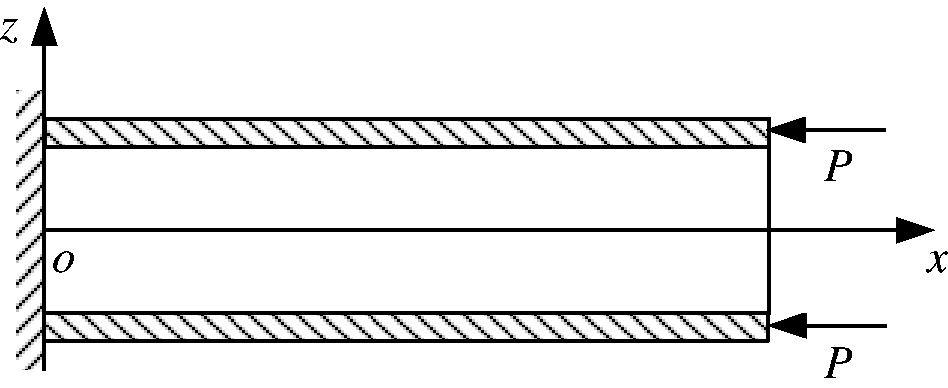
Sandwich configuration with in-plane loading.
The longitudinal displacements at the midfaces of top face sheet and core along the panel are given in Figure 10. Owing to symmetrical loading and boundaries, the longitudinal displacements at the bottom face are identical to the top ones and so not given here. As seen, both the EHSAPT results of
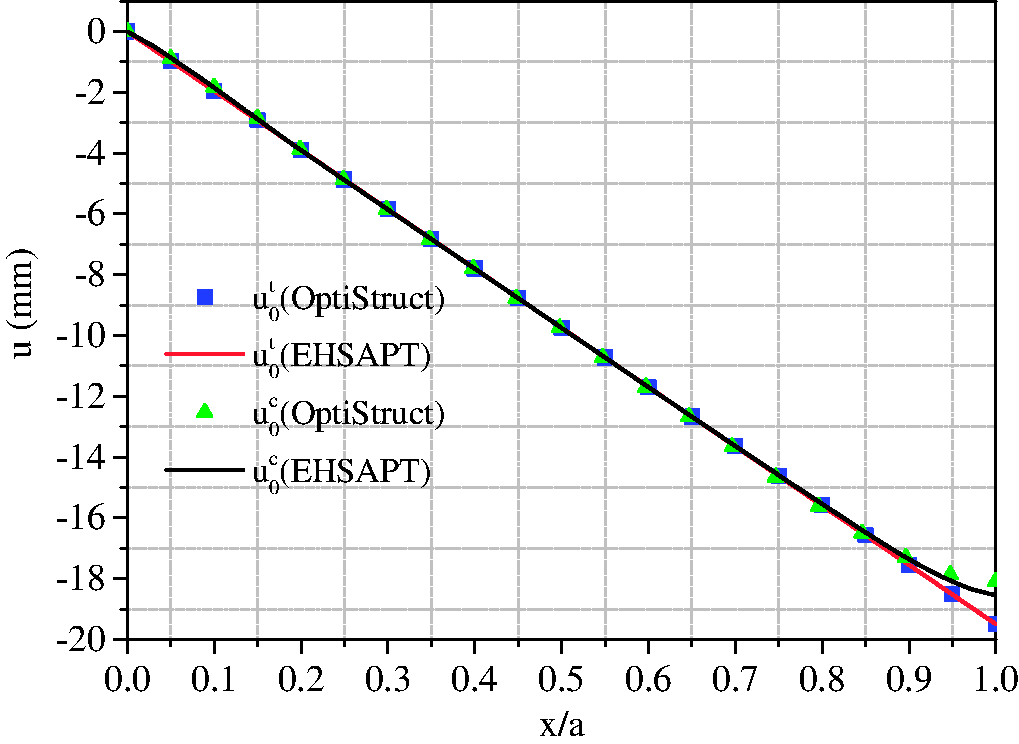
Displacement response of EHSAPT and FEM in the midface of different layers.
The variations of vertical normal stresses at the midface of the core along the panel with different value of θ are plotted in Figure 11. When q = 0.02, the plastic region (
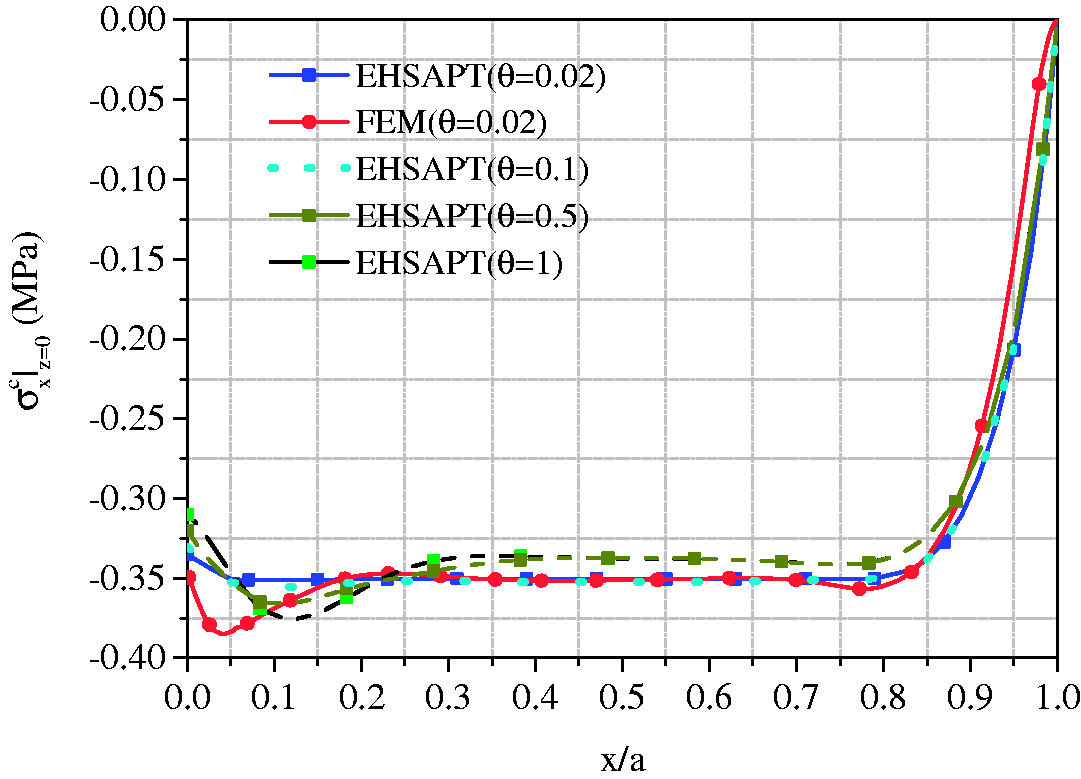
Variations of the longitudinal normal stress at
The variations of the vertical normal stress at z = c along the x-axis with different value of θ are displayed in Figure 12. The difference between the EHSAPT and FEM near the right side is due to the stiffer face sheets in FEM and smaller vertical displacement than EHSAPT, and thus lower vertical normal stresses are obtained. Furthermore, as one may conclude, the greater θ leads to a larger elastic vertical normal stress along the most part of the core. It reveals that the vertical normal stress is contributing more to the total strain energy of the core with the increase of θ.
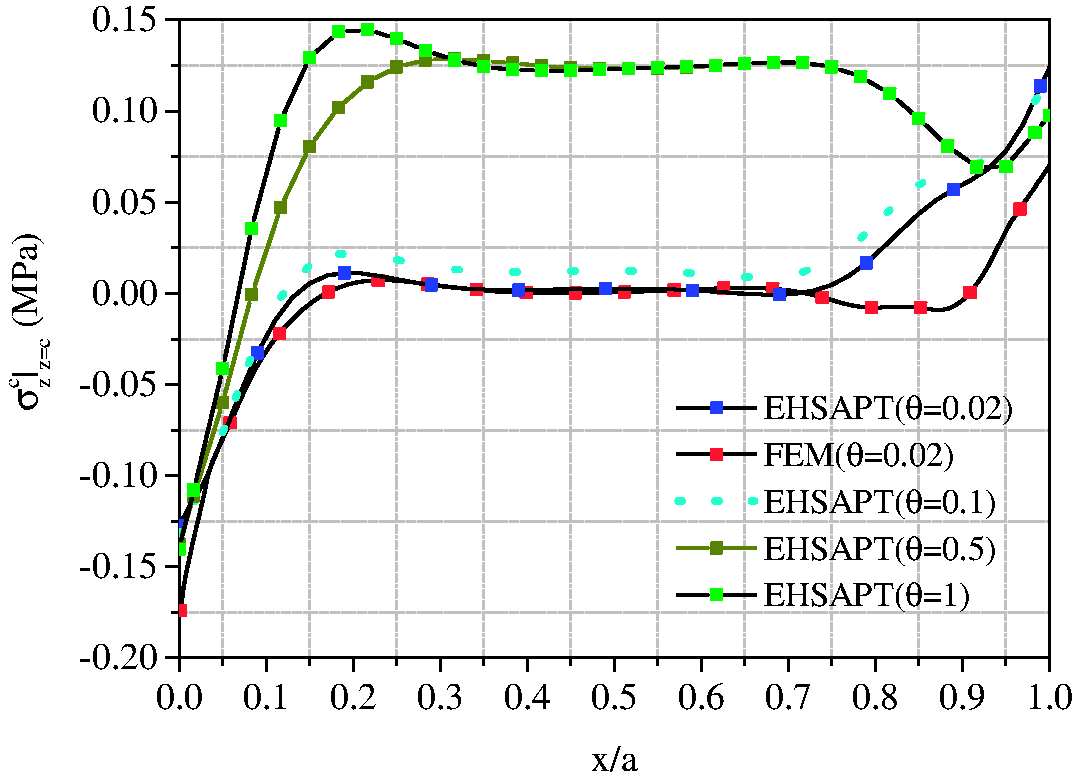
Variations of the vertical normal stress at
The variations of the shear stress at z = c along the x-axis with different value of θ are shown in Figure 13. The curves of EHSAPT and FEM are in good agreement. When θ increases, the elastic shear stress near the clamped end slightly increases. It reveals that the contribution from shear stress to the total strain energy of the core is increased partly.
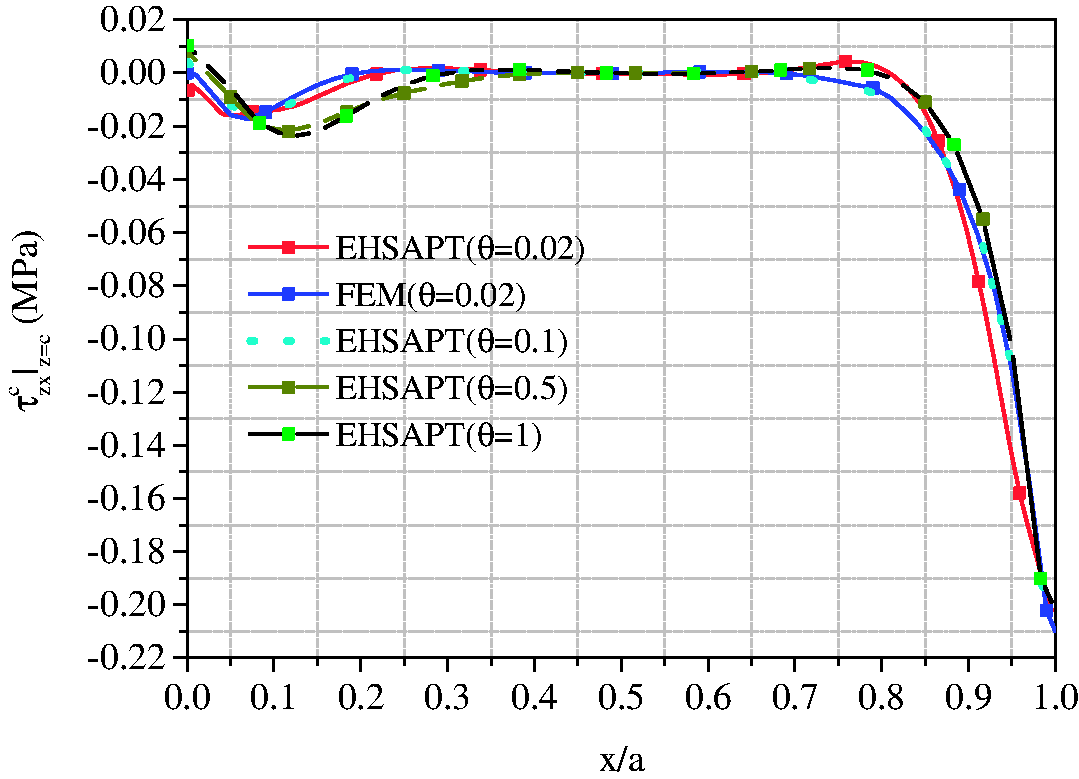
Variations of the shear stress at
The borders of the plastic region in the core, where the Von Mises stress is equal to the yielding stress, can be drawn in Figure 14. It can be found that when
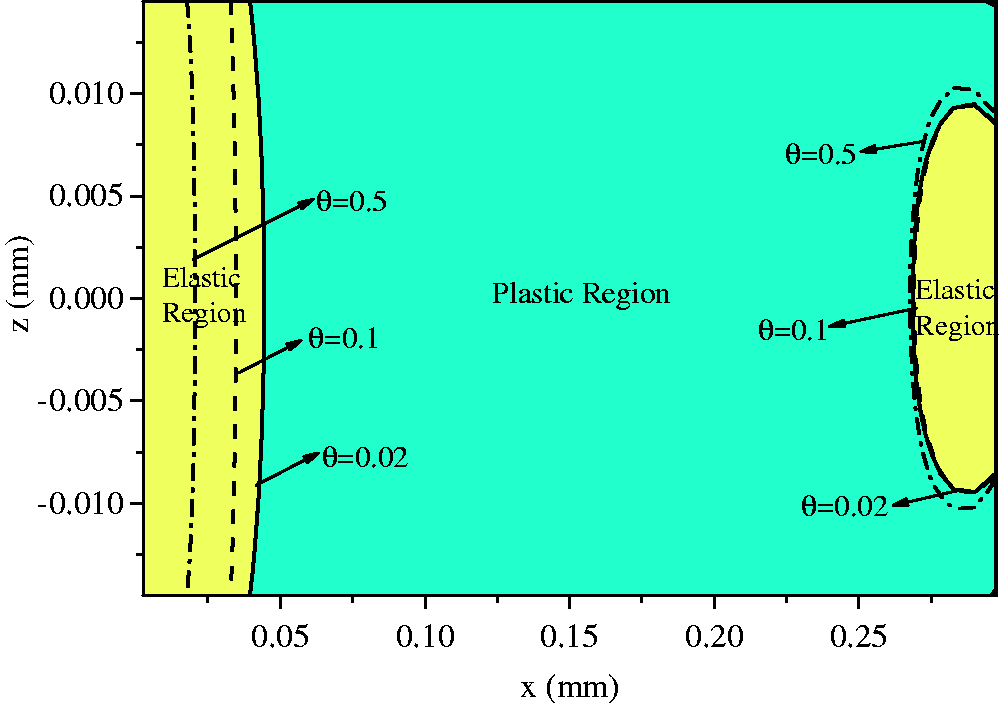
Illustration of the elastic and plastic regions of the core with different value of
Conclusion
In this paper, the mechanical static response of sandwich panels with bilinear cores based on EHSAPT is investigated. The bilinear constitutive relation of stress–strain is applied to the shear stress, vertical, and longitudinal normal stresses in the core. In previous literature, various simplifications are made based on HSAPT with no accounting of the axial rigidity. These simplifications are evaluated in this paper. Especially, since the axial rigidity is involved in the present EHSAPT, its effect on the mechanical response is estimated, and the mechanical response of sandwich structures subjected to in-plane loads is investigated. Comparison with the three-point bending test and finite element calculation verifies the validity of the present theoretical model.
A simply supported sandwich beam with bilinear isotropic core under transverse loads at the midspan of the top face sheet is analyzed. Three simplified models are derived and compared to analyze the response of displacement, shear stress, vertical, and longitudinal normal stresses, bending moment resultant. The analyzed example reveals that these simplifications have similar results at small and localized transverse loads, where the core is mainly subjected to shear load, and the plastic responses of the vertical and longitudinal normal stresses are not significant. Only when the axial rigidity is considered, the local effect in shear stress can be captured. The bilinear characteristics decrease the plastic stress. A cantilever sandwich beam with an in-plane load is analyzed. Comparisons with finite element results verify the validation of EHSAPT. When the bilinear ratio decreases, the longitudinal normal stress becomes lower with an extension of the plastic region. Meanwhile, the vertical normal stress and shear stress decrease with fewer contributions to the total strain energy, and the longitudinal normal stress plays an even more important role in the finial response. When the Von Mises yield criterion is applied, the equivalent plastic region extends with the increase of the bilinear ratio. In conclusion, the EHSAPT-based theoretical model performs well in predicting the elastoplastic behaviors of sandwich structures with bilinear stress–strain relations for the shear stress, normal, and longitudinal stresses in the core when the structure is subjected to in-plane loads.
Highlights
The constitutive relations of normal stresses related to the longitudinal and vertical normal strains in the bilinear isotropic hardening core are first formulated. An in-plane loaded sandwich structure with the bilinear core is first studied based on the EHSAPT. A Ritz-based half-analytical method associated with an iterative procedure along with the convergence criteria is applied to get the solutions. Good correlations were achieved by comparing the analytical predictions with the results of finite element method and experiments.
Footnotes
Declaration of conflicting interests
The author(s) declared the following potential conflicts of interest with respect to the research, authorship, and/or publication of this article: No conflict of interest exits in the submission of this manuscript and manuscript is approved by all authors for publication. I would like to declare on behalf of my co-authors that the work described was original research that has not been published previously and not under consideration for publication elsewhere, in whole or in part.
Funding
The author(s) disclosed receipt of the following financial support for the research, authorship, and/or publication of this article: The present work is supported by National Science Foundation of China (Grant No. 11432004).