







Abstract
This paper deals with the free vibration response of rectangular functionally graded material sandwich nanoplates with simply supported boundary conditions. The material properties of the FGM layers are temperature-dependent and supposed to be graded continuously along the thickness direction. A simple power-law distribution in terms of the volume fractions of the material constituents is employed to obtained the effective material properties. Eringen’s nonlocal elasticity model is incorporated in order to take into account the small size effects. Two types of functionally graded material sandwich nanoplates are considered: a sandwich with functionally graded material face layers and homogeneous core, and a sandwich with homogeneous face layers and functionally graded material core. The equations of motion of the functionally graded material sandwich nanoplates are derived by using the higher shear deformation theory and the Hamilton’s variational principle, and solved using the Navier’s solutions. Several numerical results indicate the influence of the power–law index, the nonlocal parameter, the geometrical parameters of the nanoplate, and the temperature variation on the free vibration response are presented.
Keywords
Introduction
With the rapid development of nanotechnology, increasing attention has been devoted to the nanostructures due to their outstanding electronic, physical, chemical, and mechanical properties.
In nanostructures applications, small scale effects are often observed. These effects can be captured using size-dependent continuum mechanics such as nonlocal elasticity theory [1], strain gradient theory [2], the surface elasticity theory [3], modified couple stress theories [4]. Among these theories, the nonlocal elasticity theory of Eringen is the most commonly used theory.
In recent few years, functionally graded materials (FGMs) are taken into account in the nanostructures devices and systems. A number of investigations dealing with dynamic response of functionally graded nanostructures had been studied in the scientific literature extensively. Using the finite element method (FEM), Natarajan et al. [5] employed Eringen’s differential theory to analyze vibration behavior of functionally graded nanoplates based on first-order shear deformation theory (FSDT). Hosseini-Hashemi et al. [6] proposed an analytical approach in combination with Mindlin and nonlocal elasticity plate theories to study free vibration response of thick circular/annular FGM nanoplates under various boundary conditions. Resonance of FGM micro/nanoplate by considering the nonlocal elasticity theory, strain gradient theory, and the small-scale effects is investigated by Nami et al. [7]. The same authors [8] developed an analytical solution for vibration analysis of FGM rectangular nanoplates. Nguyena et al. [9] proposed quasi-3D theory for free vibration, bending, and buckling analysis of FGM nanoplates taking into account the thickness stretching effect and by using an efficient computational approach. Hosseini and Jamalpoor [10] analyzed dynamic behavior of double-FGM viscoelastic nanoplates in thermal environment and resting on Pasternak elastic foundation by considering surface effects. Based on three-dimensional (3D) nonlocal elasticity theory, free vibration of exponential FGM simply supported micro/nanoplates is investigated by Salehipour et al. [11]. They have also [12] used modified couple stress to investigate free vibration response of FGM micro/nanoplates. Salehipour et al. [13] proposed a modified nonlocal theory for vibration analysis of FGM simply supported rectangular micro/nanoplates using FSDT and 3D nonlocal elasticity theory. Zare et al. [14] developed an analytical method to study vibration response of FGM rectangular nanoplates with various boundary conditions. Belkorissat et al. [15] proposed a new nonlocal refined four variable theory for temperature-dependent free vibration of FGM nanoplates. A sinusoidal deformation plate theory in combination with nonlocal elasticity theory is used by Mechab et al. [16] to investigate the small-scale effects on vibration response of FGM nanoplate. Daneshmeh et al. [17] analyzed vibration behaviors of the FGM nanoplate using higher order shear deformation plate theory (HSDT). Ansari et al. [18] presented new solution method (variational differential quadrature) based on 3D nonlocal elasticity theory for bending and free vibration of two types of functionally graded nanoplates. Barati and Shahverdi [19] reported an analytical solution for thermomechanical vibration of FGM nanoplates under different thermal loadings using four-variable plate theory and by considering neutral surface position. The effect of surface stress and thermal loading on the buckling and vibration of FGM nanoplates is carried out by Ansari et al. [20] using a developed nonclassical plate model. Bessaim et al. [21] proposed a nonlocal quasi-3D trigonometric plate theory to investigated micro/nanoscale FGM plates with considering thickness stretching effects. A zeroth-order shear deformation theory is presented by Bounouara et al. [22] to studied free vibration behavior of FGM nanoscale plates resting on elastic foundation. Differential cubature and quadrature–Bolotin methods are used by Kolahchi et al. [23] to study the dynamic stability response of embedded piezoelectric nanoplates subjected to an applied voltage using visco-nonlocal-piezoelasticity theories. Panyatong et al. [24] developed a second-order shear deformation plate theory (SSDT) for vibration analysis of power law, sigmoid, and exponential FGM nanoplates with temperature-dependent material properties. Mechab et al. [25] employed two-variable refined plate theory to investigate free vibration of porous FGM nanoplate resting on Winkler–Pasternak elastic foundations. Nonlinear vibration analysis of piezoelectric nanoplates under thermoelectric loads and various boundary conditions using the differential quadrature method (DQM) is adopted by Liu et al. [26]. Hosseini et al. [27] studied the effect of thermomechanical loads and small-scale effects on double viscoelastic FGM nanoplate system surrounded by an elastic foundation. The same authors [28] investigated thermomechanical vibration response of multi nanoplate system. Jandaghian and Rahmani [29] proposed an analytical solution for free vibration of FGM simply supported piezoelectric nanoscale plates using Eringen’s nonlocal Kirchhoff plate theory. Sobhy and Radwan [30] used a new quasi-3D nonlocal hyperbolic plate theory to analyze buckling and free vibration of FGM nanoplates considering the thickness-stretching effects. Vibration analysis of three-layered exponentially FGM nanoplate with piezomagnetic face layers is discussed by Arefi et al. [31] using the FSDT. Shahverdi and Barati [32] developed a nonlocal strain-gradient elasticity model to examine the vibration characteristics of porous FGM nanoplates under hygrothermal loading. Barati [33] carried out dynamic of nanoplates constructed from porous FGM and metal foam materials considering the effects of both stiffness softening and stiffness hardening using Galerkin’s method. Natural frequencies analysis of rotating circular two directional FGM nanoplate is reported by Mahinzare et al. [34] by employing the modified couple stress theory based on the FSDT. Arefi et al. [35] employed two-variable sinusoidal shear deformation theory to study vibration response of a sandwich FGM nanoplate with FGM core and piezoelectric face layers. Norouzzadeh and Ansari [36] analyzed free vibration response of FGM rectangular and circular nanoplates using a new matrix–vector form of the governing equations of motion. Using isogeometric finite element approach, nonlinear transient response of FGM nanoplate with porosity-dependent material properties under effect of transverse dynamic loads is carried out by Phung-Van et al. [37].
The purpose of the present work is to investigate the free vibration behavior of simply supported functionally graded sandwich nanoplates due to heat conduction. The variations of material properties along the thickness direction are temperature-dependent and vary according to a power function. The temperature distribution solution takes into account the thermal conductivity, the volume fraction index, and the sandwich scheme. Governing equations are derived from the Hamilton’s variational principle combined with the Navier’s solutions for simply supported FGM sandwich plates. Closed form solutions for free vibration of sandwich nanoplates are obtained in this paper taking into account the strain energies due to the applied thermal loads and the generalized higher order shear deformation theories.
FGM sandwich plates
Consider a functionally graded sandwich nanoplate as shown in Figure 1. The nanoplate is composed of three layers. The top face of the nanoplate is at
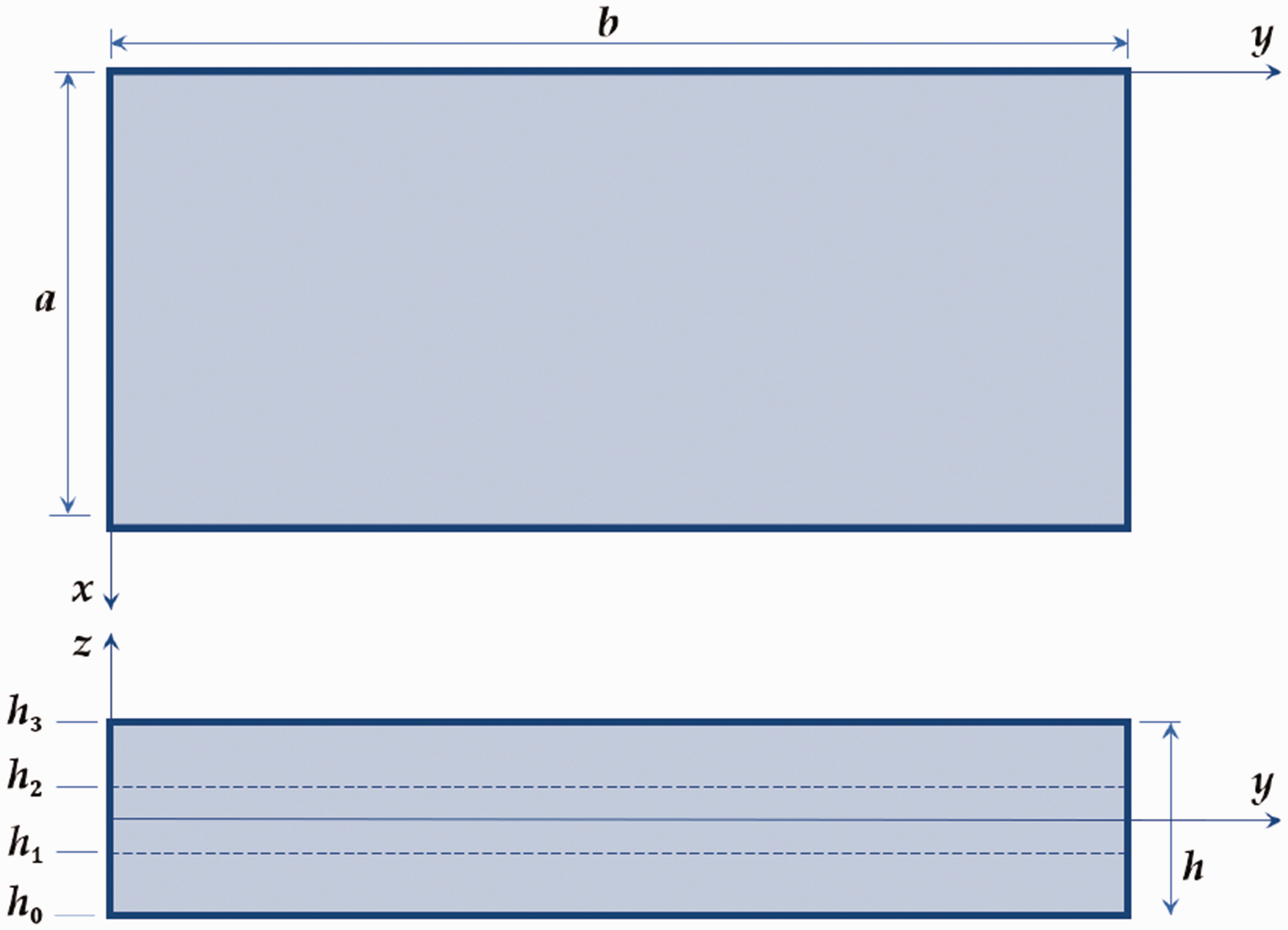
Configuration of functionally graded sandwich nanoplates.
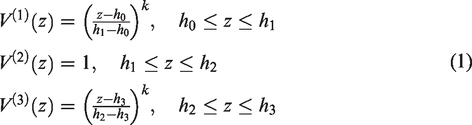
FGM-A: sandwich nanoplates with FGM faces and ceramic core
The sandwich nanoplate FGM-A is composed of three sheets, a ceramic core and two functionally graded sheets graded from metal to ceramic. The volume fraction of the nanoplate face sheets varies according to a power–law function along the thickness direction as
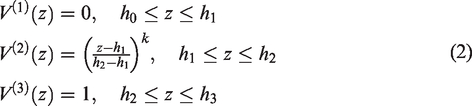
FGM-B: sandwich nanoplates with FGM core and homogeneous faces
The bottom layer in this sandwich is fully metal and the top layer is fully ceramic, while the core is graded from metal to ceramic
The material properties of sandwich nanoplate

Temperature field
Consider an FGM sandwich nanoplate in high temperature environment. The temperature field assumed to be uniform over the sandwich surface. The temperature of the bottom and the top sandwich surfaces is

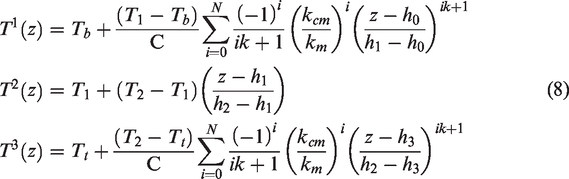
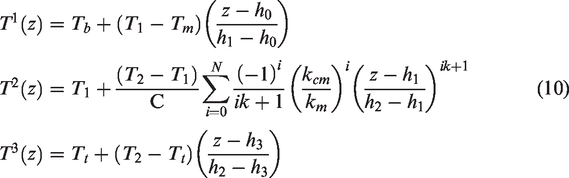
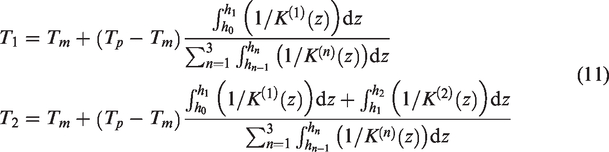
The variation of temperature through the thickness is obtained by solving the steady-state heat transfer equation as [39]

To solve this problem, the boundary conditions

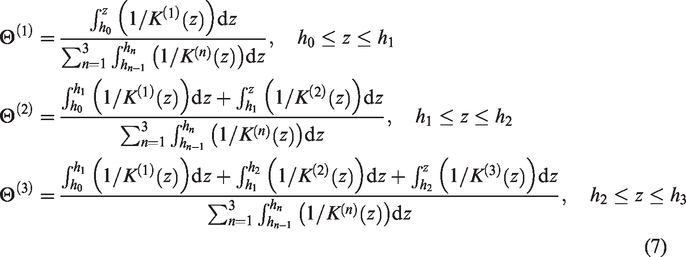
For the sandwich nanoplate FGM-A, the solution of the previous equation can be expressed by means of polynomial series as

Theory of nonlocal elasticity
The nonlocal elasticity theory of Eringen [1], it is assumed that the stress tensor at a point is function of the strain tensor at all the points of the continuum. Hence the nonlocal constitutive equation can be defined by the following relation as [41]

Displacement field
Based on the higher order shear deformation plate theory, the generalized displacements field of a material point located at
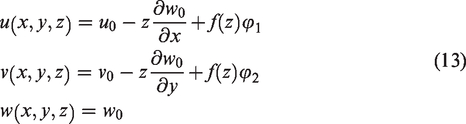

The displacement field of the classical thin plate theory (CPT) is obtained by setting
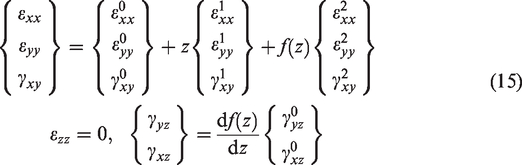
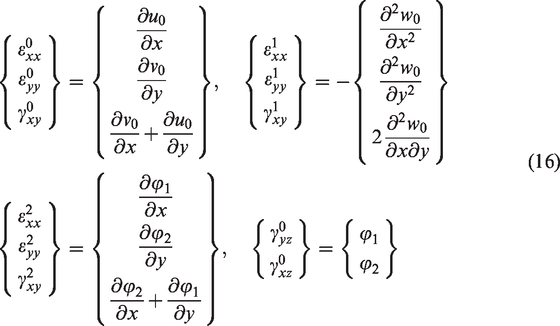
The linear strain components associated with the displacements can be expressed as
Stress–strain relations
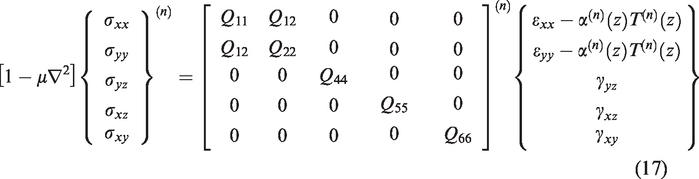
In order to capture the effect of small scale, the constitutive relations based on nonlocal elasticity theory can be defined as

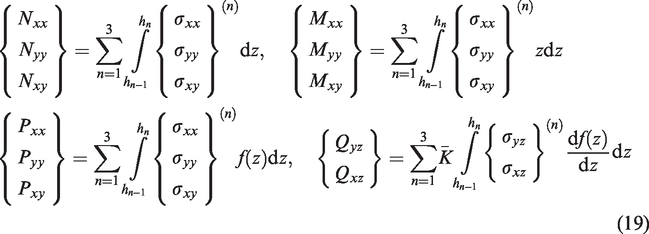
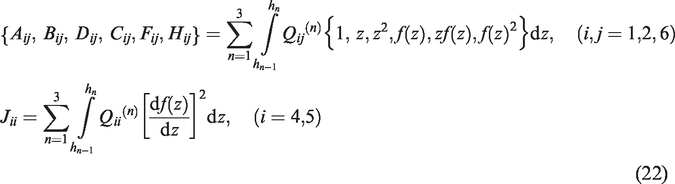
The membrane force


The coefficients
Variational statements
The Hamilton’s principle is used to obtain the equations of motion of the FGM sandwich nanoplate

The total strain energy of FGM sandwich nanoplate can be written as

The variation of the strain energy of the nanoplate is written as

The strain energies due to the thermal load can be expressed as


The initial stresses can be expressed as


The kinetic energy of the sandwich nanoplate at any moment can be written as

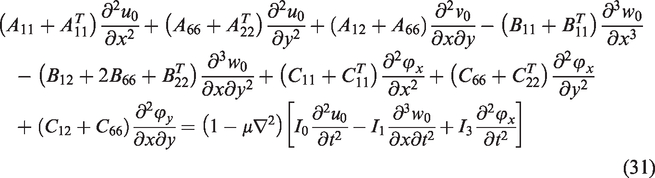
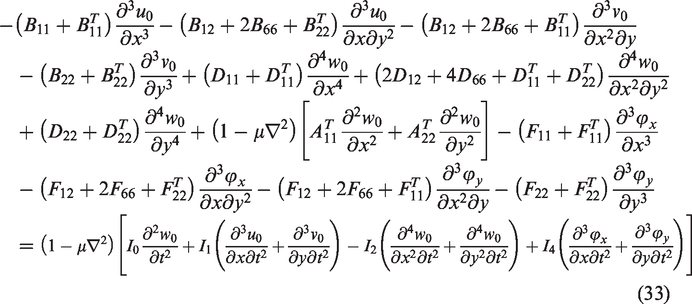
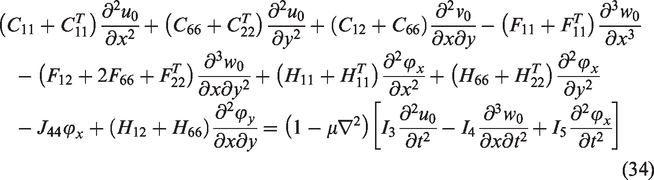
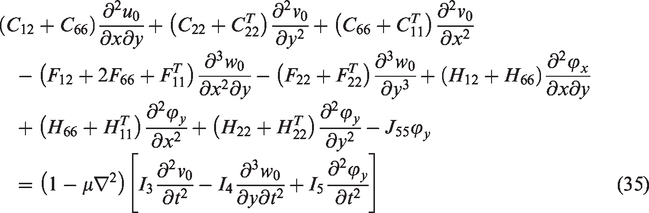
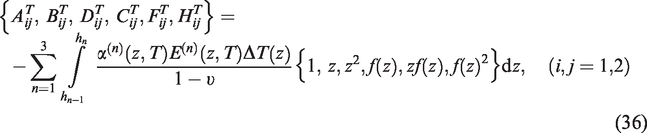
By inserting equation (24) to (30) into equation (23) and applying equations (25) and (27), equations of motion for FGM sandwich nanoplate can be obtained as follows

Solution procedure
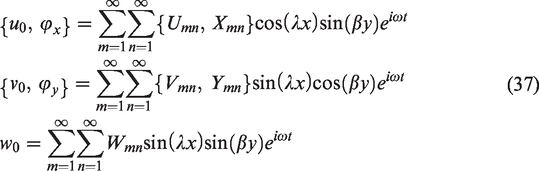
The functions of the displacements field that satisfy simply supported boundary conditions are developed as Fourier series as follows
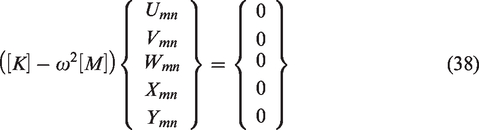
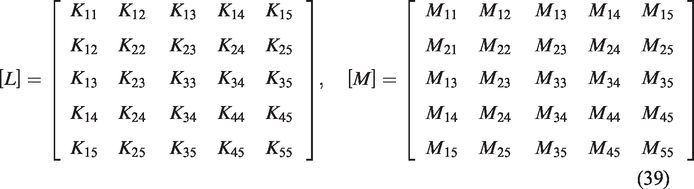
The elements of the matrix [K] and [M] are given as
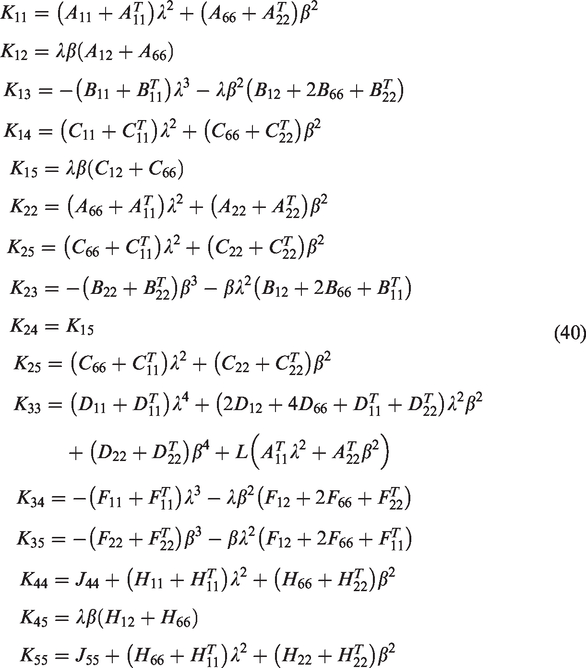
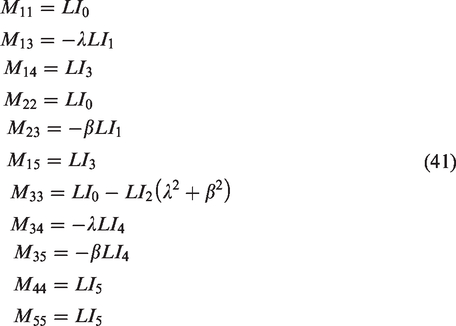

Results
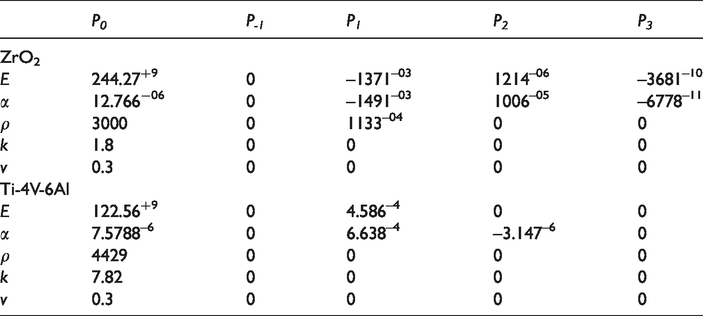
In the present article, numerical results are obtained to investigate the influence of high temperature on vibration of functionally graded sandwich nanoplates. The equations of motion are performed based on generalized higher order shear deformation plate theory. The considered sandwich nanoplate is simply supported. The material chosen is a mixture of Titanium alloy Ti-6Al-4V as metal and Zirconia ZrO2 as ceramic (Table 1). Two types of FGM sandwich nanoplates with different schemes are used. The (1–1–1) FGM sandwich nanoplate
Temperature-dependent coefficients of elastic modulus
The dimensionless natural frequency can be expressed as

To validate our formulations, a comparison study is performed between the dimensionless natural frequencies
Comparison of dimensionless natural frequency
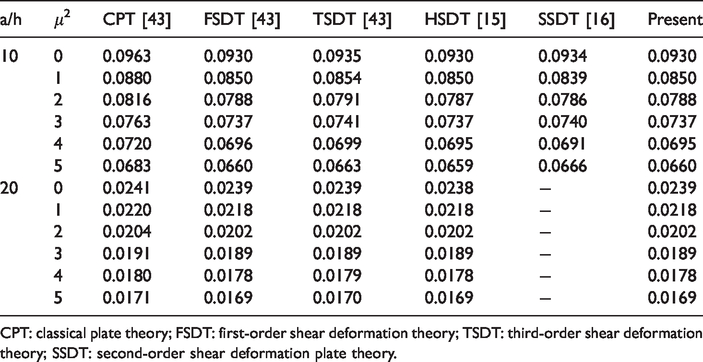
CPT: classical plate theory; FSDT: first-order shear deformation theory; TSDT: third-order shear deformation theory; SSDT: second-order shear deformation plate theory.
In Table 3, dimensionless natural frequencies
Comparison of dimensionless natural frequency
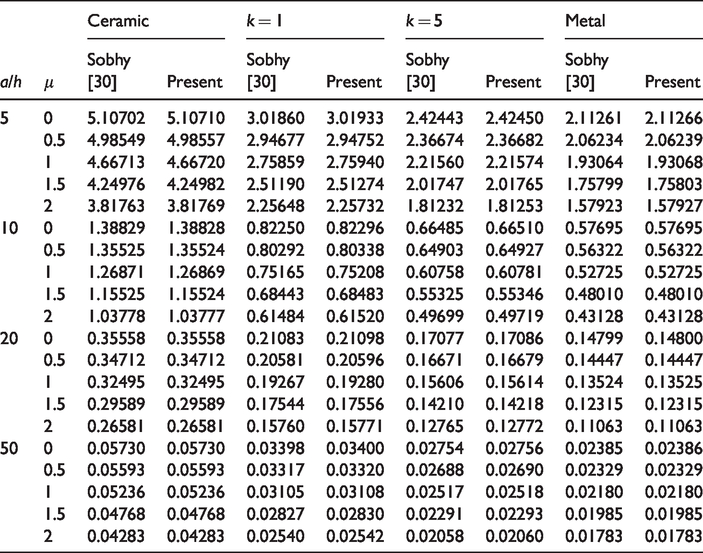
In Table 4, dimensionless natural frequencies of FGM plate with temperature-dependent material properties (Table 1), obtained using present theory are compared with the previously published results of Huang and Shen [44] based on TSDT and Shahrjerdi et al. [45] based on SSDT for different values of volume fraction index. The results have been found by considering the geometric values
Comparison of dimensionless natural frequency
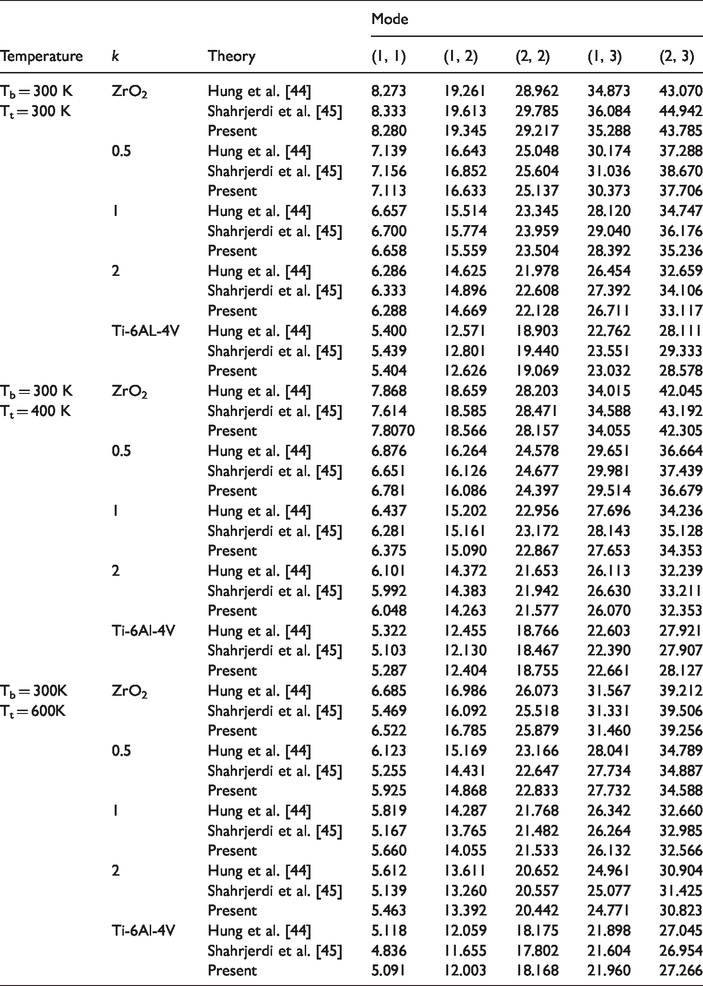
Dimensionless natural frequency
Dimensionless natural frequency
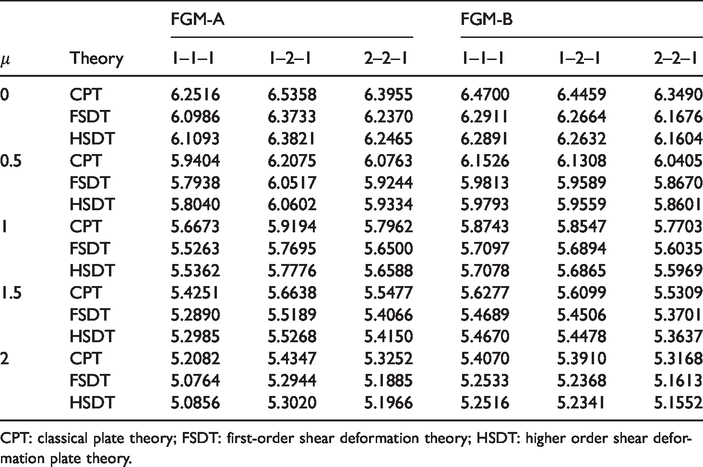
CPT: classical plate theory; FSDT: first-order shear deformation theory; HSDT: higher order shear deformation plate theory.
Dimensionless natural frequency
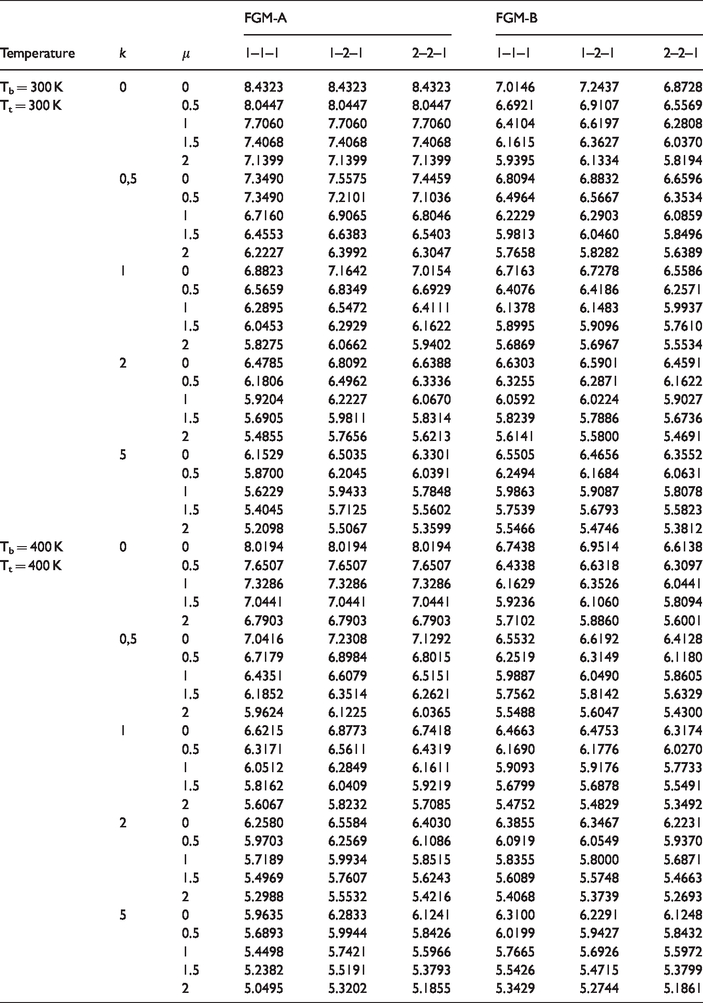
For more details, the effect of temperature, the power law index
Dimensionless natural frequency
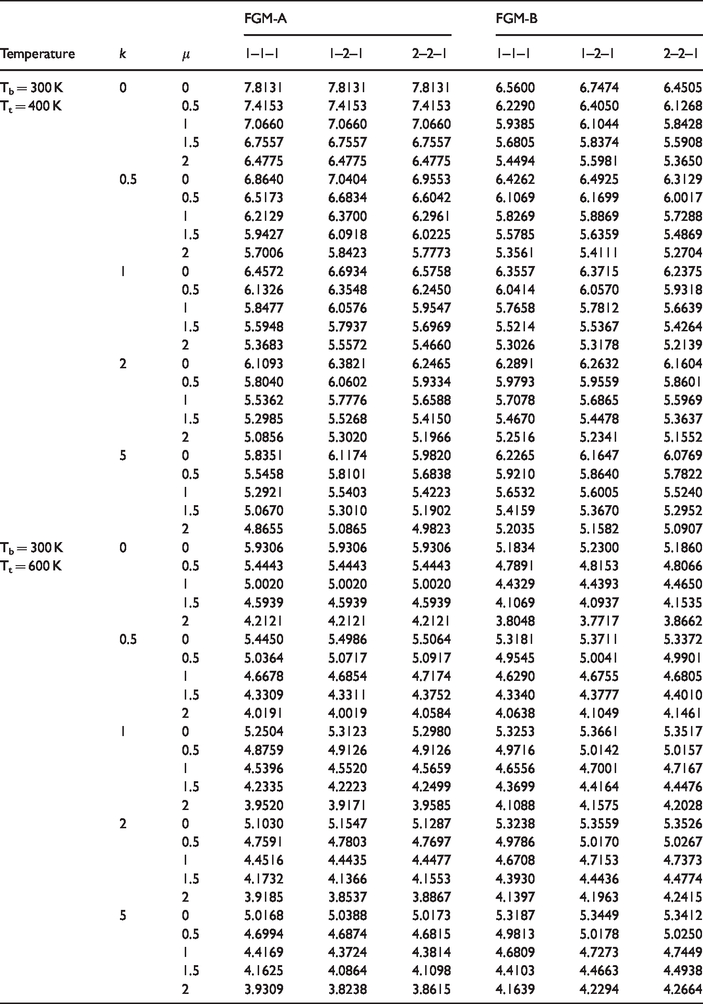
Figure 2 describes the effect of temperature on the variation of Young’s modulus along the sandwich nanoplate thickness. The temperature of the bottom surface is constant
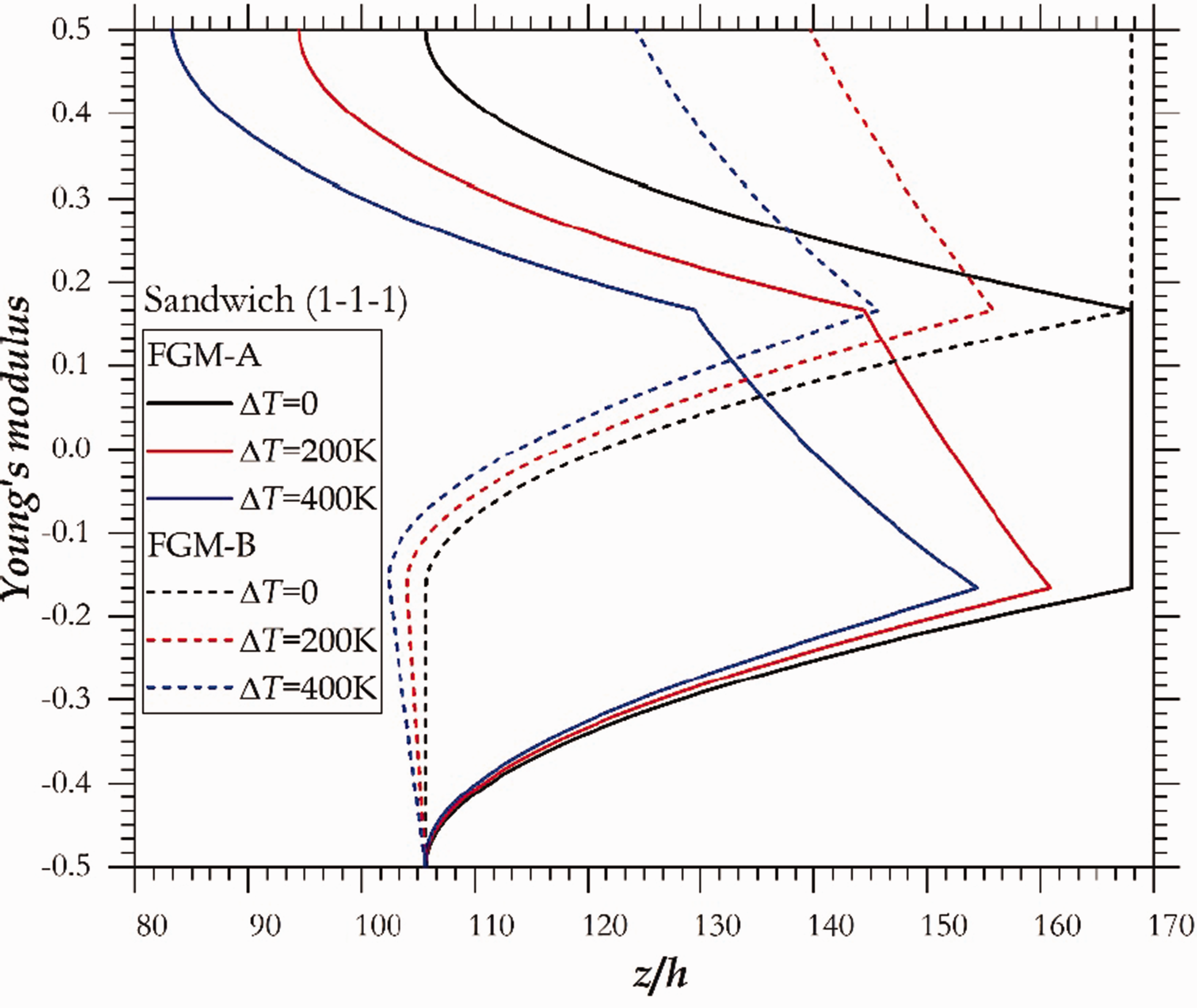
Young’s modulus variation through the FGM sandwich nanoplate thickness.
The influence of nonlocal parameter
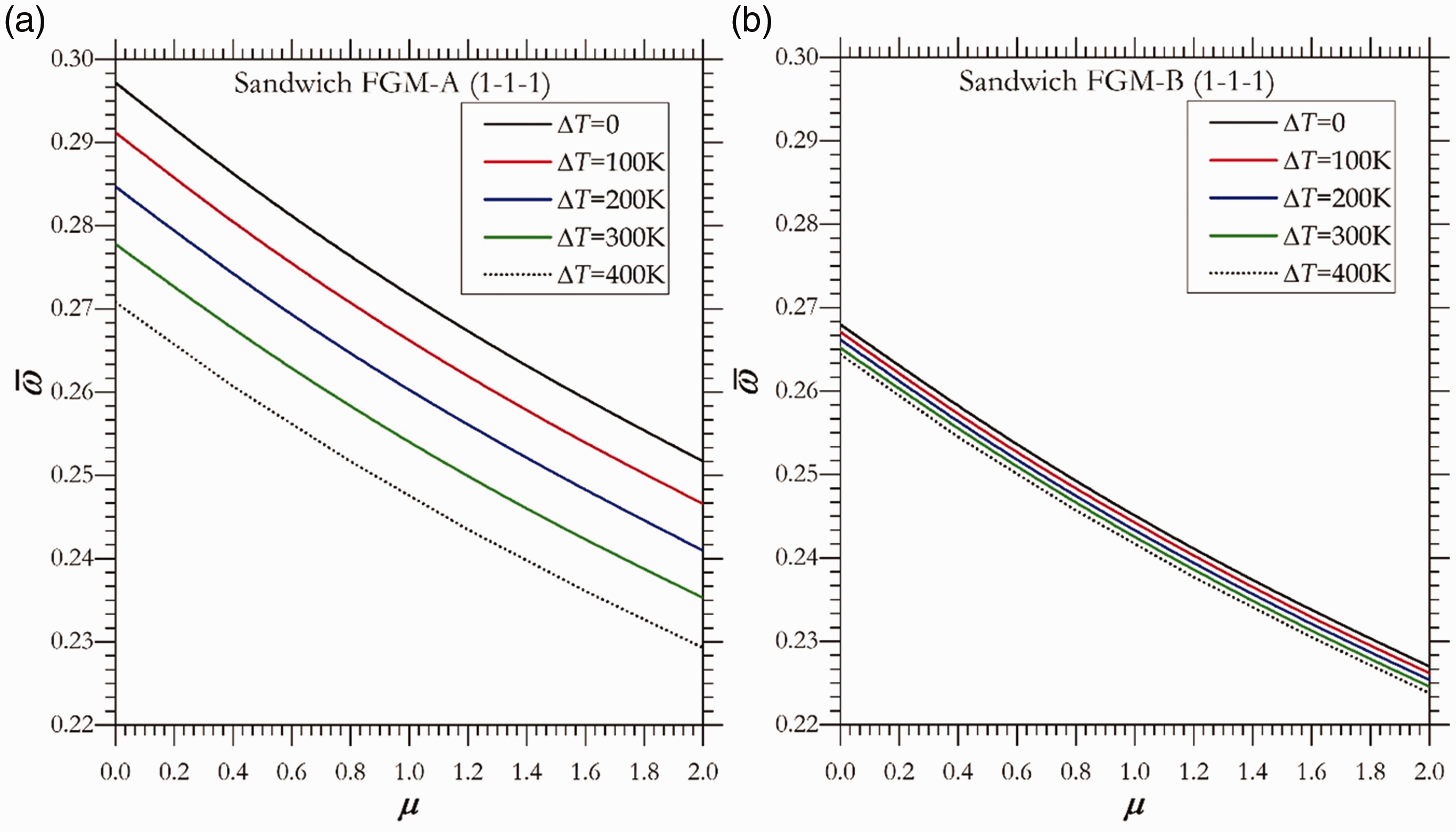
Effect of nonlocal parameter
Figure 4 demonstrates the effects of power law index
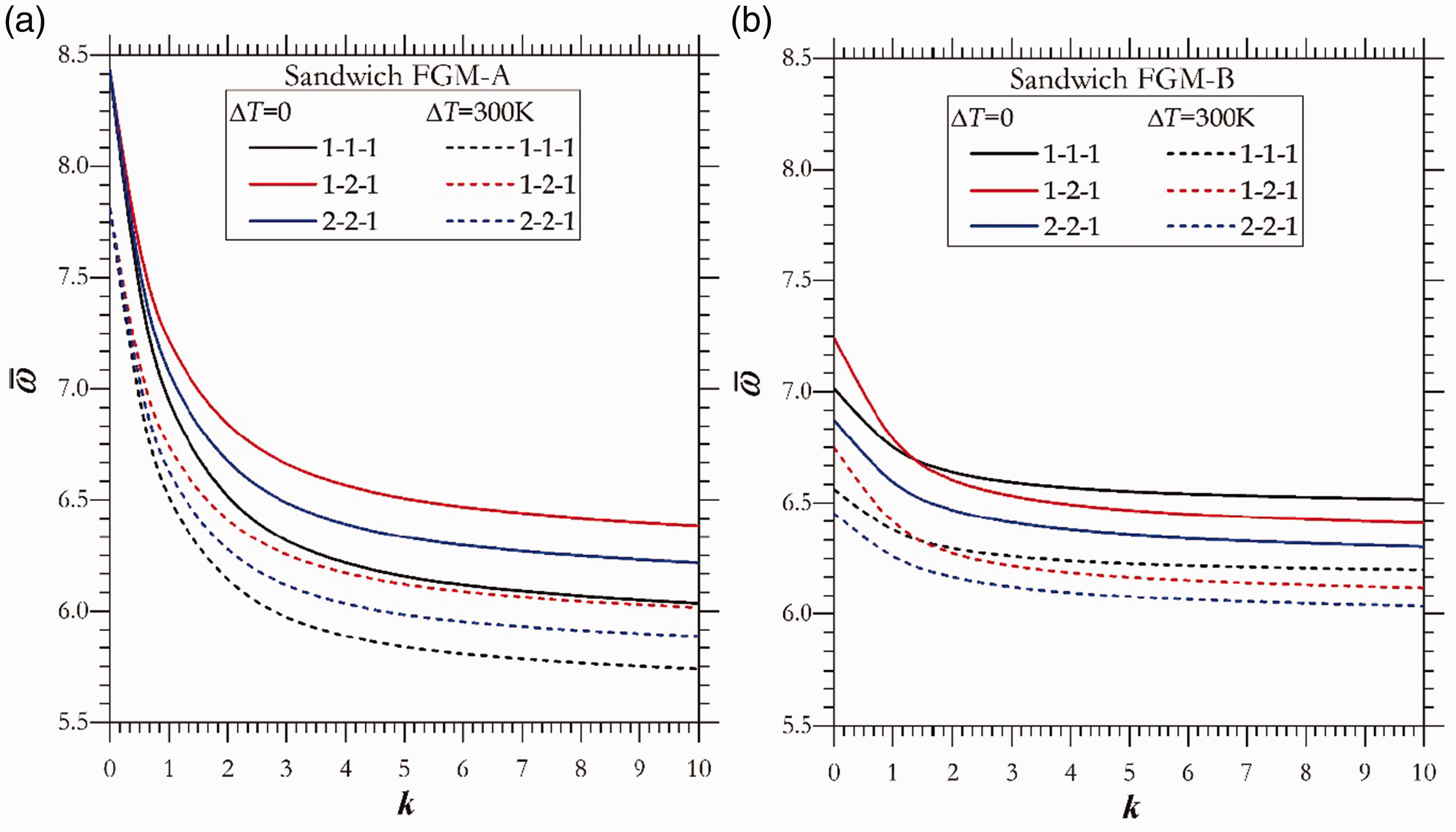
Effect of power law index
The dimensionless natural frequencies
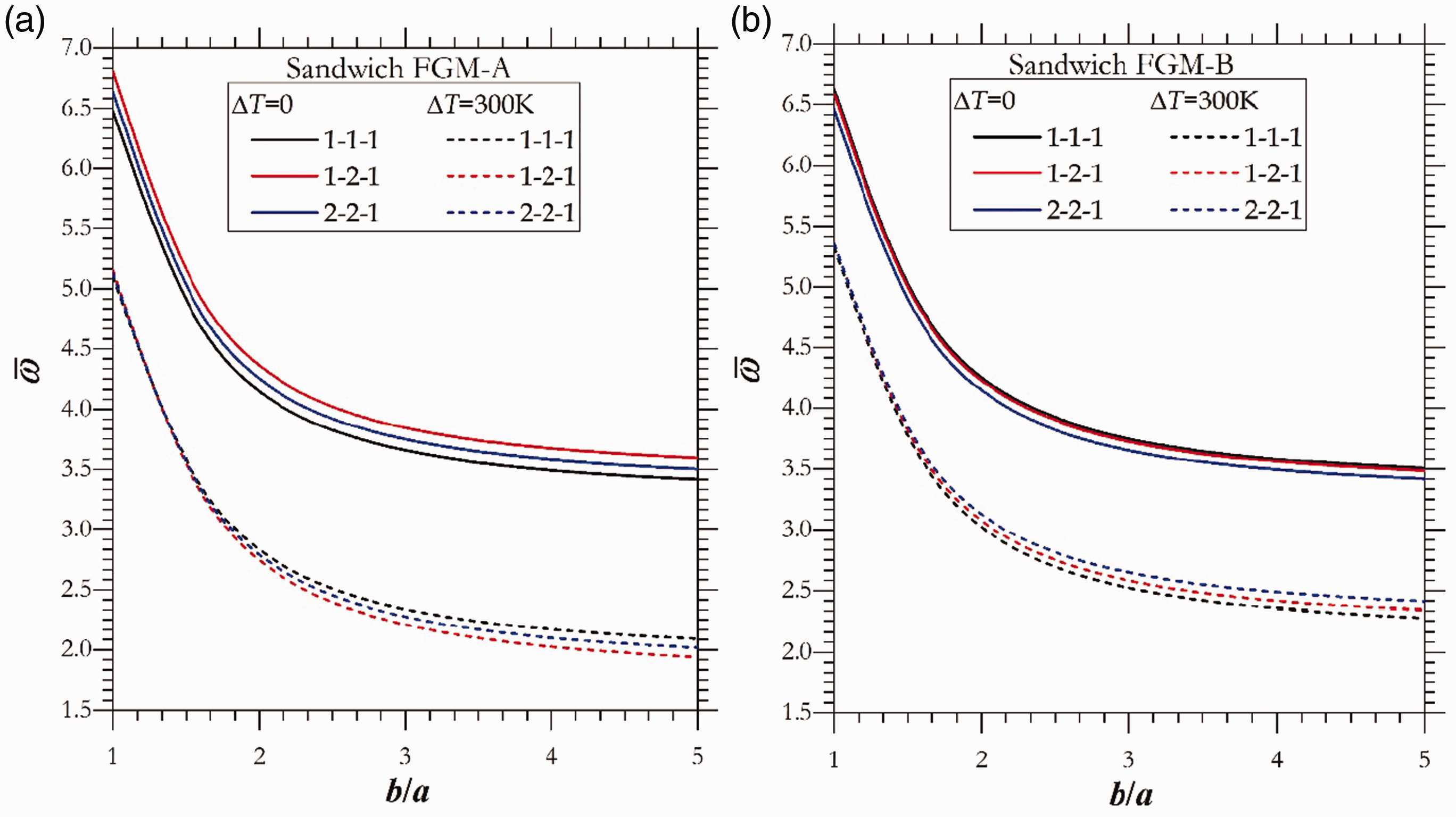
Effect of geometric parameter
Figure 6 presents the dimensionless frequency
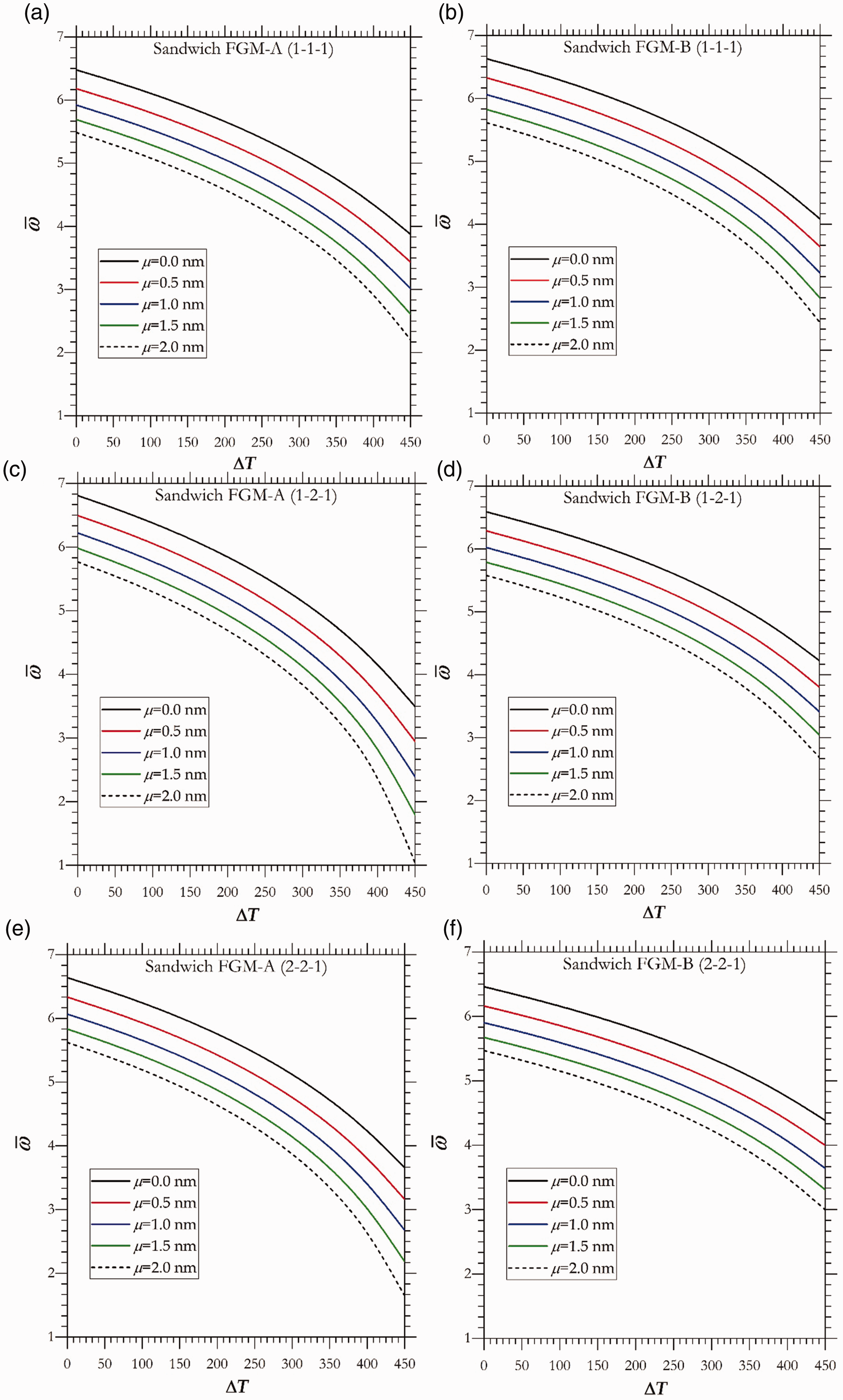
Effect of temperature difference
Conclusion
This paper presents an analytical solution for free vibration of functionally graded sandwich nanoplates. Material properties of FGM layers are assumed to vary continuously along the thickness direction according to a simple power–law distribution. Several types of FGM sandwich nanoplates are used. Hamilton’s principle in conjunction with the Navier’s solution was employed to calculate the free vibration frequencies of FGM sandwich nanoplates based on generalized higher order shear deformation plate theory and by considering the strain energies due to the thermal loading. An exact solution for the nonlinear temperature variation across the thickness direction of the sandwich nanoplate is proposed in this research taking into account the thermal conductivity, the power law index, and the sandwich scheme.
As a result, the dimensionless frequency of FGM sandwich nanoplates is significantly influenced by temperature field, power low index distributions, the nonlocal parameter, and geometric of the plate. The numerical examples show that:
The ceramic nanoplate (FGM-A with The inclusion of size effects leads to the reduction of the stiffness of the FGM sandwich nanoplates. Thus, the dimensionless frequencies decrease with increasing of nonlocal parameter μ. The existence of high temperature demotes the stiffness of the FGM sandwich nanoplate. Therefore, increasing the temperature leads to decrement of dimensionless frequencies. Temperature difference has more significant impact on the FGM-A plates than the FGM-B plates. The dimensionless frequencies decrease by increasing of the geometric parameter
Footnotes
Declaration of Conflicting Interests
The author(s) declared no potential conflicts of interest with respect to the research, authorship, and/or publication of this article.
Funding
The author(s) received no financial support for the research, authorship, and/or publication of this article.
