






Abstract
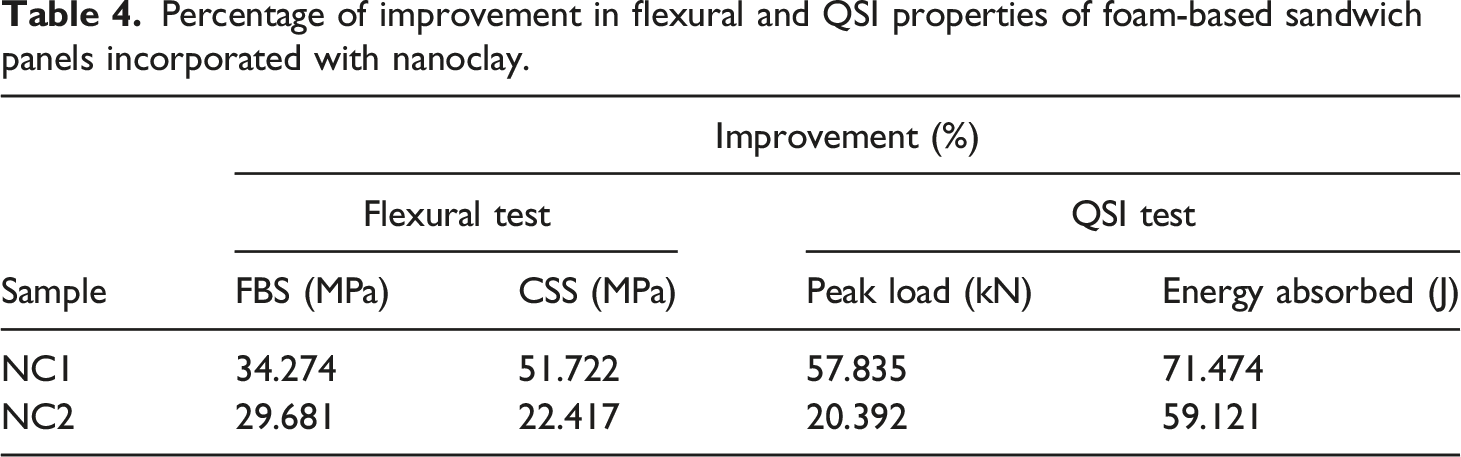
It has been reported that the properties of a foam-based sandwich panel can be enhanced by incorporating nanoclay into the facesheet or foam core. In this study, an attempt was made to disperse nanoclay into the epoxy adhesive so as to bond the facesheet with the core. The sandwich panel in this study was fabricated using a basalt/epoxy laminate as the facesheet and polyvinyl chloride foam as the core material. The characterisation results through flexural and quasi-static indentation tests revealed that the infusion of nanoclay led to an increase of up to 34% in the bending strength, 51% in the core shear strength, and 72% in energy absorption. In addition, the nanoclay-reinforced sandwich panel showed a slightly higher sound absorption coefficient than the control specimen without nanoclay. Another interesting observation from the flexural and quasi-static indentation tests was that the addition of nanoclay also influenced the failure behaviour and the size of the damaged area. The superior energy and sound absorption characteristics make the foam-based sandwich panel a potential material for structural applications requiring acoustic insulation.
Introduction
Over the last decades, composite materials have become indispensable components for various structural applications.1,2 Among various fibre types, glass fibre has been the most extensively used reinforcement owing to its high mechanical strength and low-cost characteristics. 3 The advancement in composite materials has led to the development of composite sandwich panels. A composite sandwich is highly suitable for structural applications in the transportation, construction and building industries, mainly because of the inherent ability of the foam core to absorb sound energy, its low thermal conductivity, customisable density, and excellent ductility. 4 The addition of soft and light materials as the core can enhance the overall performance of the sandwich structure. 5 However, debonding at the core-skin interphase region is one of the primary failure modes of the sandwich materials. Thus, the core-skin interphase, which is an area of polymeric resins typically spanning a few hundred microns, can lead to complicated and time-dependent mechanical properties. 6 In other words, the overall performance of the composite sandwich materials is highly dependent on the facesheet/core bond strength. 7 Two different approaches can be employed to improve the bonding characteristics of sandwich materials: (1) The first approach involves the incorporation of nanoclay during the synthesis of the foam, and (2) The second approach involves modifying the facesheet matrix, whereby nanoclay is mixed into the matrix before the facesheet is cured.
Significant improvements in compression properties, flexural strength, fracture toughness and impact performance of sandwich panels incorporated with nanoclay have been reported in the literature. Saha et al. 8 investigated the debond fracture toughness of sandwich materials based on polyurethane foam core with varying nanoclay concentrations of 0.5 wt.%, 1 wt.% and 1.5 wt.%. They concluded that polyurethane foam cores incorporated with 1 wt.% showed the highest debond fracture toughness, which was 69% higher than neat foam cores. Robinson et al. 9 also reported that adding 0.5 wt.% and 1 wt.% of nanoclay could improve the compression and flexural properties of low-density polyurethane foams. Nasirzadeh et al. 10 studied the high-velocity impact performance of glass fibre/polyurethane foam sandwich panels incorporated with varying amounts of nanoclay. The findings showed that the composite sandwich panels consisting of polyurethane foam core incorporated with 0.5 wt.% possessed superior energy absorbing ability when subjected to ballistic impact. Aside from the core materials, encapsulating nanoclay into the facesheet or skin of composite sandwich materials has also been proven beneficial to the overall structural performance. Anbusagar et al. 11 investigated the effect of nanoclay on the flexural and impact properties of composite sandwich materials consisting of glass fibre/polyester as the facesheet and polystyrene foam as the core. They revealed that 4 wt.% of nanoclay provided the composite sandwich materials with the highest flexural and impact properties. Ávila et al. 12 also obtained positive results where the addition of nanoclay up to 5 wt.% in the glass fibre/epoxy facesheet could offer the highest impact properties to the glass fibre/polystyrene composite sandwich materials.
The polymer foams that are used in the construction of foam-based sandwiches are usually made from materials such as polyethylene terephthalate (PET), polyvinyl chloride (PVC), polyurethane (PU) and polymethacrylimide (PMI). The mechanical properties of a composite sandwich depend not only on the core material but are also strongly influenced by the strength of the interfacial bonding between the facesheet and the core. 13 Despite the progress that has been made in improving the performance of sandwich materials containing nanoclay-incorporated foam and nanoclay-incorporated facesheets, the use of nanoclay in the core-skin interphase region of the sandwich composites that affects the mechanical properties and failure modes has yet to be attempted and explored. Localised damage can be caused, for example, when tools are dropped during repairs, when loadings are prolonged, when high heels are worn on footbridges, or by furniture supports on building floors. The energy absorption, deformation characteristics and failure behaviour with slow loading can be obtained from a quasi-static indentation (QSI) test, which simulates the above loading conditions. Thus, the load-bearing ability and energy absorption characteristics can be assessed from a QSI test.
This paper focuses on examining how the inclusion of nanoclay in the resin at the core-skin interphase region affects the sound absorption ability, the bending strength of the facesheet, and shear strength of the core under a three-point bending load, and the load-bearing ability and energy absorption characteristics under a QSI test as well as the failure modes of the sandwich composite. The results obtained from the experimental investigation are further evaluated, and analysis is performed to provide an in-depth understanding of the topic.
Materials and methods
Materials
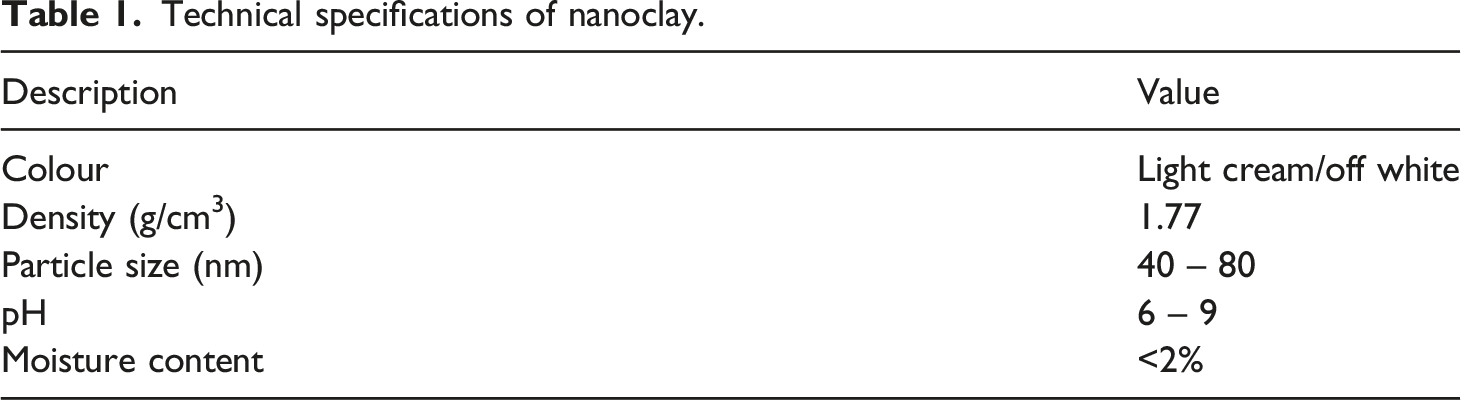
Technical specifications of nanoclay.
Fabrication method
Compression moulding was used to fabricate the sandwich in two steps, as elucidated in Figure 1. Initially, the facesheet was fabricated using basalt fabric and a mixture of epoxy resin and hardener. The epoxy resin and hardener were mixed at a ratio of 10:1 in a glass container. Then, the epoxy-hardener mixture was applied to 6 layers of basalt fabric placed inside a mould and cured at room temperature for 24 h. The weights of the fibre and resin were fixed at a ratio of 50:50. After that, an ultrasonicator was employed to mix the epoxy resin with nanoclay at the concentrations of 1 wt.% and 2 wt.%. The resin containing nanoclay was then spread across the top and bottom layers of the closed-cell PVC foam, followed by the placement of the bottom facesheet, foam core and top facesheet in the mould. The setup was then cured at room temperature under a pressure of 5 MPa for a minimum of 2 h, as recommended by the resin manufacturer. Composite sandwich panels with nanoclay concentrations at 1 wt.% and 2 wt.% are referred to as NC1 and NC2, whereas NC0 refers to composite sandwich panels without nanoclay. A schematic of the composite sandwich fabrication process.
Characterisation
Flexural test
The flexural test was carried out with reference to the ASTM C393 standard. Five specimens with the dimension of 200 mm x 75 mm were subjected to a 3-point bending load (Figure 2) using M-100 universal testing machine. The crosshead displacement rate was fixed at 1 mm/min, and a span-to-depth ratio of 20:1 was fixed in the flexural test. The load-displacement curves of the foam-based sandwich panel were obtained at the end of the test. In addition, the core shear ultimate strength and facing bending strength were also identified. Setup of the flexural test.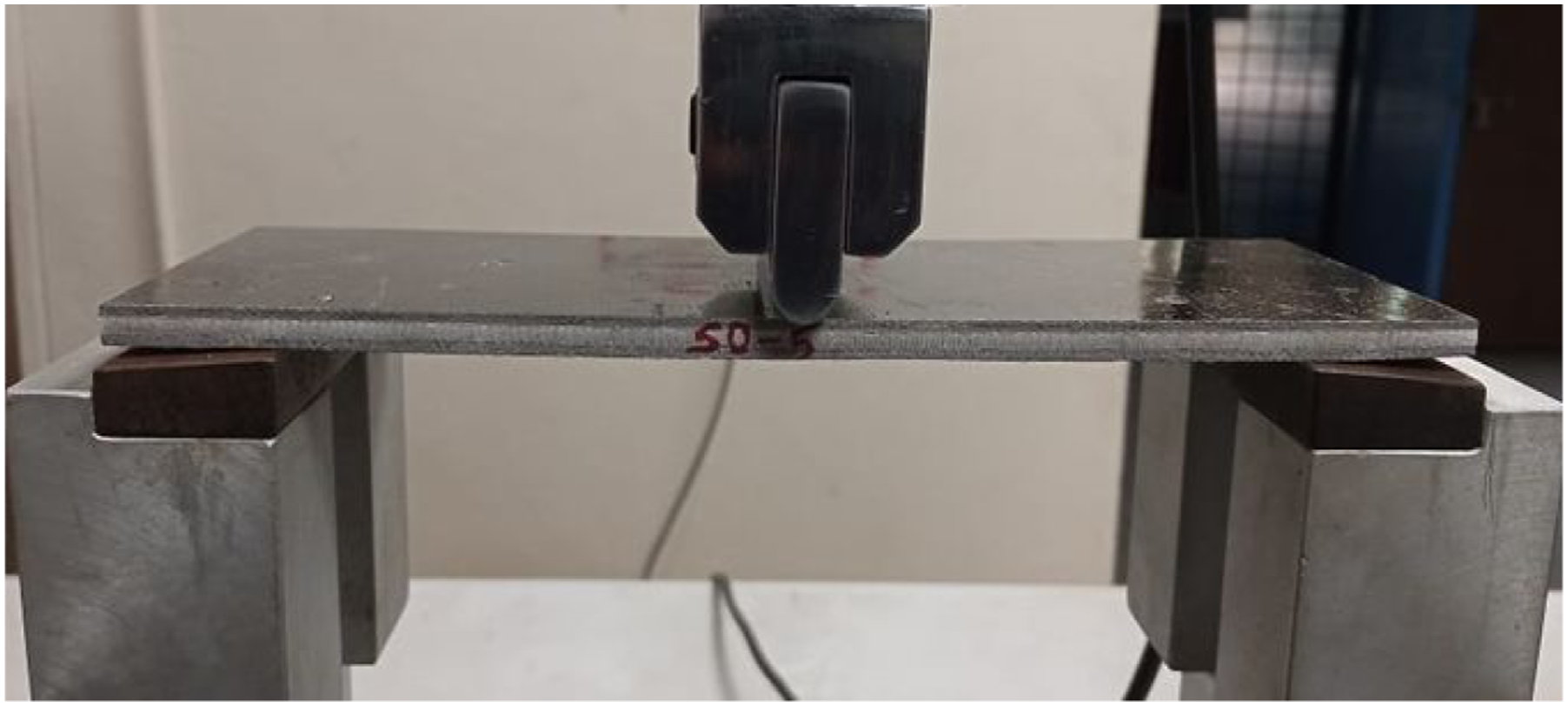
The core shear ultimate strength (CSS) of the foam-based sandwich panel can be determined using equation (1).
The facing bending strength (FBS) can be identified in accordance with equation (2).
Quasi-static indentation test
A QSI test was performed on a single square-shaped specimen measuring 100 mm at each side according to ASTM D6264 standard. A crosshead displacement rate of 1 mm/min was fixed throughout the test. The test was performed using an M-100 universal testing machine with a particular fixture, as shown in Figure 3. The machine was equipped with an indenter with a diameter of 12.7 mm and a supporting base plate with a clamp mechanism to hold the specimen during the test. The load-displacement curves, peak load, and maximum displacement were obtained from the QSI tests. Setup of QSI test.
Sound absorption test
A sound absorption test was carried out according to ISO 10534 on a single specimen with a diameter of 100 mm using the impedance test setup, as shown in Figure 4. The test was carried out within the frequency range of 250 Hz to 2000 Hz (mid-frequency range), beyond which, the human ear could incur an induced hearing loss. Sound absorption test (a) impedance tube test setup and (b) sound absorption mechanism.
The impedance tube is a straight, rigid, and smooth tube consisting of a speaker, known as the sound source, at one end, from which a plane wave is generated to the other end, where the sample with the required diameter is placed. Two microphones were placed away from the sound source to capture the incident and reflected waves in the impedance tube. The acoustical transfer function was used between the microphones to compute the sound absorption coefficient (SAC), represented by α, of the test sample.
The measurement of the frequency in the impedance tube depends on the diameter of the tube and the spacing between the microphones. Thus, the frequency can be varied by changing the tube diameter and spacing. Initially, the sound waves were generally incidental to the sandwich structure and reflected away from it. The reflection factor, r, was then determined using the transfer function, H12, of the spacing between the two microphones in the impedance tube near the sample.
The incident pressure
and
The pressure at two microphones
The transfer function at incident wave HI can be defined by equation (7).
Likewise, the transfer function at reflected wave HR is denoted by equation (8).
By rearranging H12, the reflection coefficient R, as shown in equation (10), is obtained.
From reflection coefficients, the absorption coefficient can be demonstrated in equation (11).
Results and discussion
Flexural properties
The load-displacement curves of the sandwich specimens with varying nanoclay concentrations obtained from the 3-point bending test are shown in Figure 5. Incorporating nanoclay in the epoxy resin positively impacted the load-bearing ability of the sandwich specimens when they were subjected to bending. NC1 and NC2 with 1 wt.% and 2 wt.% of nanoclay, respectively, failed at loads that were higher than in NC0. Load-displacement curves of composite sandwich panels with varying nanoclay concentrations under flexural load.
Flexural properties of composite sandwich panels with varying nanoclay concentrations.
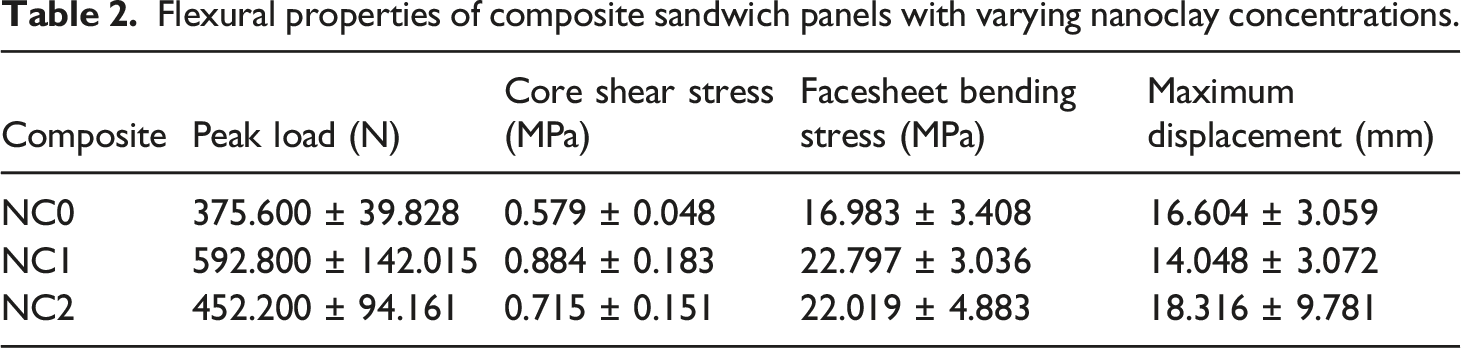
However, the FBS and CSS of NC2 decreased slightly in magnitude compared to NC1. Also, the maximum displacement was in the order of NC2 > NC0 > NC1. The superior performance displayed by the sandwich specimens infused with nanoclay in terms of the peak load, CSS and FBS indicated the effectiveness of the nanoclay as a potential additive for foam-based sandwich structures.
Figure 6(a)–(c) illustrate the SEM images of a transverse section of the sandwich specimens subjected to bending. The sandwich structure under a bending load was analogous to an I-beam being subjected to bending, where the upper flange experienced compression, the lower flange experienced tension, and the web resisted shear.
14
Thus, the shear cracks in the core region and facesheet-core debonding were the acceptable failure modes as per the ASTM C393 standard. In this study, NC1 and NC2, as shown in Figure 6(b) and (c), exhibited core shear failure, where a transverse crack perpendicular to the direction of the applied load could be detected in the core region. In the case of NC0 (Figure 6(a)) and NC2 (Figure 6(c)), debonding between the facesheet and foam core could also be observed, which was representative of adhesive failure. In contrast, debonding was not observed in NC1 (Figure 6(b)). Instead, only the failure occurred in the form of transverse cracks in the core region of NC1. The absence of debonding indicated a cohesive failure, and it could be interpreted as an improvement in the wettability or interfacial bonding between the facesheet and foam core. It is worth mentioning that the localised shear cracks were also observed in NC0. Failures in the sandwich panels (a) NC0, (b) NC1, and (c) NC2.
Another interesting observation was noted in the case of NC0. As the specimen underwent bending, a transverse crack was initiated in the core region near the roller support on the right side (Figure 7), which then propagated into a shear crack at an angle of 45° for a short length, after which the crack continued to propagate as a transverse crack along the remaining length of the specimen. This failure behaviour was identical to the failure reported by Ayorinde et al.
15
on a PMI foam core sandwich, where the failure was captured using a high-speed camera during a 4-point bending test. Crack propagation in the NC0 sandwich panel.
Quasi-static indentation properties
Figure 8 presents the load-displacement curves of composite sandwich panels with varying nanoclay concentrations under QSI load. The sandwich specimens, NC0 and NC1, subjected to indentation load had similar load-displacement curves with identical slopes. However, there was a notable difference in the slope between NC1 and NC2 with regard to the load-displacement characteristics. This signified a change in the stiffness between the panels due to the addition of different weight proportions of nanoclay. Load-displacement curves of composite sandwich panels with varying nanoclay concentrations under QSI load.
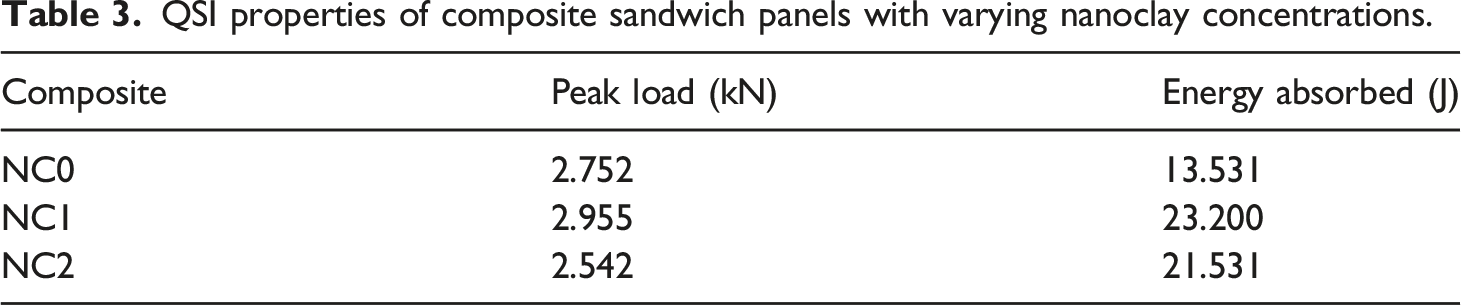
The damage sequence from the beginning of the indentation to the complete perforation can be discussed from the visual inspection of the failure during the QSI test. Initially, the damage started as a micro-crack in the matrix when the indenter penetrated the specimen. In this instance, there was a slight drop in the load, marked by a small inflection point in the load-displacement curve. Each inflection could be related to the piercing of the indenter into the facesheet, which consisted of 6 layers of basalt fabric, followed by progression into the foam core and further into the bottom facesheet until its perforation. It was noted that the load-displacement curves were characterised by multiple numbers of load drops before and after the peak load. NC1 and NC2 were able to withstand a higher load than NC0 before the initial load drop. However, NC2 failed at a lower load than NC1 and NC0.
QSI properties of composite sandwich panels with varying nanoclay concentrations.
A significant difference in the damaged area between the front and back faces of the facesheets can be noticed in Figure 9(a)–(f). The damaged area was characteristically circular due to the indentation in the front face. The presence of foam and the larger thickness of the material beneath the indenter offered superior resistance to the deformation. Hence, the damage was confined to the area around the indenter. However, at the back face, the indenter only had to penetrate through the bottom facesheet, and thus, it had less resistance to deformation. Thus, the failure propagated rapidly beyond the diameter of the indenter, and the damage occurred as a petal-like structure in the back face. During the indentation, a larger area of the back face was susceptible to loading, which caused the formation of a petal-like structure on the complete perforation. Hence, the damaged zone at the back face was considerably larger than at the front face. Furthermore, there was a dull appearance in the vicinity of the damaged area. According to Garrido et al.,
18
the dull appearance around the damaged area could be due to delamination in the facesheet of the sandwich. The failure behaviours of sandwich panels post-quasi-static indentation test (a) front and (b) back faces of the NC0, (c) front and (d) back faces of the NC1, (e) front and (f) back faces of the NC2.
The damaged area of composite sandwich panels with varying nanoclay concentrations obtained quantitatively from the J-image processing software is shown in Figure 10. The damaged area in the front face showed an increasing trend, whereas, at the back face, NCI and NC2 had a smaller damaged area than NC0. The variation in the damaged area at the back face between the NC1 and NC2 panels provides insight into the significance of the weight percentage of the nanoclay and its dispersion characteristics. It is a well-known fact that obtaining a uniform dispersion of higher proportions of a filler into the resin is quite challenging. At higher weight percentages, fillers tend to form an aggregation zone in certain regions. This could lead to an uneven distribution of the load within the material, thereby affecting the load-bearing ability of the material, leading to premature failure at lower loads. Damage areas of composite sandwich panels with varying nanoclay concentrations obtained via ultrasonic C-scan assessment.
Sound absorption coefficient
Figure 11 depicts the SAC as a function of the frequency. Each sample was calibrated at least three times, and the average SAC was considered the final result. The sandwich panels fabricated with nanoclay possessed a better SAC at the mid-frequency level. NC0 possessed the lowest SAC value among the sandwich specimens. NC2 had a superior sound absorption ability, as evidenced by its SAC value of 1, between frequencies of 1000 Hz to 1250 Hz. The general observation was that the infusion of nanoclay into the resin used for bonding the facesheet and foam core played a vital role in improving the SAC of the sandwich panels. According to Moradi et al.
19
and Bahrambeygi et al.,
20
the presence of nanoclay in the resin helps to increase the SAC in the following ways: (a) physical and chemical bonds formed by nanoclay with the polymeric chain of the epoxy converts the acoustic energy from the sound waves into thermal energy, leading to increased damping of the sound waves; and (b) the larger specific surface area and small aspect ratio of the nanoclay create more friction between the incident sound waves. Thus, more sound energy is absorbed and scattered away, leading to a higher SAC. It can also be observed from Figure 11 that the SAC dropped significantly above 1250 Hz. Thus, a decline in SAC with further increases in frequencies above 2000 Hz can be expected. SAC of composite sandwich panels with varying nanoclay concentrations.
Percentage of improvement in flexural and QSI properties of foam-based sandwich panels incorporated with nanoclay.
Conclusions
In this work, nanoclay was dispersed into the epoxy adhesive for the bonding of sandwich panels. The results highlighted that the sandwich panels infused with nanoclay showed substantial improvements in the facesheet bending strength and core shear strength under flexural load, superior energy absorption, and a smaller damaged area under a QSI load. The outstanding performance of the nanoclay-dispersed composite sandwich over the composite without nanoclay was primarily due to the improvement in the interfacial bonding between the facesheet and foam core, which was evident from the core shear failure of the former rather than the core-facesheet debonding of the latter. The sandwich panel infused with nanoclay also showed excellent sound absorption properties. The primary conclusion of this work is that the performance of a foam-based composite sandwich can be improved by dispersing nanoclay into the resin used for bonding the facesheet with the foam core. However, there was a slight drop in performance when 2 wt.% of nanoclay was used, which could have been due to the uneven filler dispersion. Thus, future studies will involve an assessment of the dispersion characteristics and their influence on the performance of the composite sandwich. In addition, facesheet bending strength and core shear strength of the composite sandwich panels will be performed through the numerical simulation method.
Footnotes
Acknowledgements
The authors would like to thank the Hindustan Institute of Technology & Science for the continuous support to this research project. The authors also wish to express their gratitude to Universiti Teknologi Malaysia (UTM) for providing the Professional Development Research University Grant (Q.J130000.21A2.05E45).
Declaration of conflicting interests
The author(s) declared no potential conflicts of interest with respect to the research, authorship, and/or publication of this article.
Funding
The author(s) disclosed receipt of the following financial support for the research, authorship, and/or publication of this article: This work was supported by Professional Development Research University Grant (Q.J130000.21A2.05E45) from Universiti Teknologi Malaysia (UTM).
