






Abstract
Micro- and nano-scale laminated composites are central to MEMS, soft robotics, and 3D-printed systems, yet their reliability hinges on accurately predicting size-dependent responses to coupled thermo-mechanical loads. This paper introduces a unified formulation that integrates the Enhanced Refined Zigzag Theory (ERZT) with the New Modified Couple Stress Theory (NMCST) for the thermo-mechanical bending of these structures. The proposed framework captures both the through-thickness zigzag displacement pattern and the size effect for cross-ply, angle-ply, and sandwich laminates. A characteristic feature of the model is the post-processing of the transverse shear stresses through the 3D equilibrium equations, which guarantees interfacial continuity. The governing equations are derived from the principle of virtual work and solved by Navier’s method for simply supported boundary conditions. In the classical limit (l/h → 0) the model is validated against the 3D thermal-elasticity solutions from existing literature, showing excellent agreement for displacements, in-plane stresses, and transverse shear stresses. Parametric studies then illustrate the size-dependent stiffening predicted by the NMCST, quantifying how the aspect ratio a/h and the dimensionless length-scale ratio l/h jointly govern the deflection and stress amplitudes. This model couples ERZT kinematics with NMCST under combined transverse mechanical and through-thickness thermal loads, capturing for the first time the size-dependent thermo-mechanical bending of cross-ply, angle-ply, and sandwich micro-/nano-laminates. The resulting tool is computationally efficient and provides a robust methodology for the design of high-performance micro/nano-structured components in aerospace and biomedical applications.
Keywords
Introduction
Laminated composite plates are widely recognized for their exceptional strength-to-weight ratio, specific stiffness, and durability, making them essential components in a multitude of engineering fields, including aerospace, automotive, marine, and civil infrastructure. A key advantage of these advanced materials is the ability to tailor their stiffness and thermal response, rendering them ideal for applications that demand customized performance under severe thermal and mechanical conditions. The structural behavior of laminated composites, conventionally modeled as shells and plates, has been the subject of intensive research, particularly concerning their response to thermo-mechanical loading. 1
The study of laminated structures under thermal loading has a rich history. The foundational contributions of Tauchert2,3 established the groundwork for understanding the thermoelastic conduct of laminated plates. Subsequently, Reddy and Hsu 4 developed comprehensive analytical frameworks for thermal stresses in laminates, while Reddy and Khdeir5,6 furthered these investigations by incorporating the effects of various shear deformation theories on thermal buckling and vibration. A primary challenge in this domain is accurately predicting thermal stresses, which are complicated by mismatches in the thermal expansion coefficients of adjacent layers, leading to heightened interfacial shear stresses and the well-known zigzag effect. 7 The evolution of nanoscience and nanotechnology has ushered in a new paradigm in material design, leading to the development of nanostructures like nanobeams, nanoplates, and nanoshells that possess extraordinary mechanical, physical, and electronic properties. Representing a fusion of micro- and nanoscale engineering, micro-nano laminated composite plates offer significantly enhanced mechanical and functional performance over their traditional counterparts. These structures—often possessing thicknesses on the order of micrometers or nanometersare formed by meticulously layering metals, polymers, or ceramics to achieve unique strength-to-weight characteristics and customizable electrical, thermal, and magnetic behaviors. Consequently, they are critically important in MEMS/NEMS devices, soft robotics, sensors, electronics, energy harvesting, and biomedical implants, where they are commonly exposed to substantial thermal gradients and mechanical forces.
However, when the characteristic dimensions of laminated composites reduce to the micro- and nano-scales, classical structural and thermoelasticity theories fail to accurately predict their behavior owing to significant size-dependent effects. Consequently, non-classical continuum models are integrated with plate theories to capture these scale-dependent phenomena. Eringen’s nonlocal elasticity theory 8 distinguishes itself by capturing long-range interatomic interactions, while strain gradient theories9,10 account for microstructural stiffening through higher-order spatial derivatives. Additionally, the Modified Couple Stress Theory (MCST) 11 provides a robust framework for depicting size effects using a singular material length scale parameter. To extend MCST to the inherently anisotropic response of fibre-reinforced laminates, Chen and co-workers subsequently proposed the New Modified Couple Stress Theory (NMCST),12–14 in which a single material length-scale is retained while the constitutive law is generalized to anisotropic elasticity, making the theory directly applicable to the analysis of microscale laminated composite plates.
Conventional models, including Classical Plate Theory (CPT)15,16 and First-Order Shear Deformation Theory (FSDT),17–22 assume smooth through-thickness variations of displacement fields and are therefore unable to adequately capture significant transverse shear deformation, abrupt changes in material and thermal properties across layer interfaces, and the associated thermo-mechanical bending behavior. In multilayered laminates, the continuity of in-plane displacements combined with mismatched layer stiffnesses gives rise to piecewise-linear slope variations through the thickness, leading to characteristic kinked displacement profiles known as the zigzag effect. 7 This phenomenon becomes particularly pronounced in thick, highly anisotropic laminates subjected to thermal gradients.
To overcome these limitations, more advanced formulations such as Refined Zigzag Theory (RZT)23,24 and various higher-order shear deformation theories (HSDTs)25–30 were developed to more accurately represent layerwise kinematics and thermal stress distributions in laminated and sandwich structures. Recent work has further refined zigzag-based formulations to capture interlaminar continuity and through-thickness stress recovery in sandwich plates with strong skin-to-core stiffness contrast,
31
and earlier benchmark studies have established the performance of these refined models for the static analysis of laminated composite plates of arbitrary lay-up.
32
Seminal contributions by Lekhnitskii33,34 Murakami,
35
Di Sciuva,36–39 and Cho and Parmerter
40
explicitly incorporated zigzag functions into the displacement fields, enabling realistic modeling of interlaminar behavior while maintaining computational efficiency. Subsequent advancements aimed to enhance the fidelity of RZT, notably by including transverse stretching effects (
A significant drawback of the standard RZT was its inability to model angle-ply laminates accurately, where adjacent plies have opposing orientations. This critical deficiency was addressed by Sorrenti and Di Sciuva, who proposed the Enhanced-RZT (ERZT), which introduced the necessary coupling effects to extend the applicability of standard RZT models to angle ply layouts. 46 Nezami 47 extended the Enhanced Refined Zigzag Theory (ERZT) to multilayer laminates (3–15 layers) and symmetric angle-ply sandwich plates (5 layers), comparing its performance against equivalent single-layer (ESL) theories, including CLPT,15,16 FSDT,17–22 TSDT,25–30 and Murakami’s zigzag theory. 35 Results showed that linear zigzag theories produce overly stiff predictions for laminates with nine or more layers, while TSDT performs better in such cases. However, for 5-layer symmetric angle-ply sandwich configurations, Sorrenti’s zigzag approach yields excellent accuracy, whereas Murakami’s theory and other ESL models prove inadequate. Nezami and Akhtar 48 further applied ERZT under thermo-mechanical loading for static bending analysis, validating results against 3D elasticity benchmarks.
Despite these structural advancements, a distinct challenge arises at the micro- and nano-scales: size-dependent behavior. Even sophisticated higher-order shear deformation theories (HSDTs) and refined zigzag models, including ERZT, remain rooted in classical continuum mechanics and lack an intrinsic length scale in their constitutive relations. Consequently, they fail to capture scale effects that dominate in nanostructures, where both thermal transport and mechanical responses become inherently size-dependent. Classical thermoelasticity similarly neglects these phenomena. To overcome this limitation, non-classical continuum theories have been developed, including Eringen’s nonlocal elasticity,49–51 strain gradient theory, the Modified Couple Stress Theory (MCST), 52 and its anisotropic generalization, the New Modified Couple Stress Theory (NMCST), developed for composite laminated beams and plates by Chen and co-workers.12–14 The physical relevance of these small-scale effects is well-supported by experimental observations and atomistic/multiscale simulations,53–57 emphasizing the necessity of departing from traditional frameworks when analyzing micro/nano-laminated structures.
A growing body of recent literature has pursued the integration of higher-order shear deformation and zigzag theories with non-classical models to study complex systems under thermal environments. This includes size-dependent analyses of functionally graded (FG) materials, porous laminates, and reinforced composites subjected to thermal gradients, often using quasi-3D, refined zigzag, or MCST-based formulations.58–62 Key investigations have examined the coupled influences of porosity distribution,63,64 elastic/viscoelastic foundations,65–69 and nanofillers such as carbon nanotubes (CNTs) or graphene nanoplatelets (GPLs),70–72 which significantly modify thermomechanical properties. Advanced HSDT variants—employing hyperbolic, trigonometric, or higher-order kinematics—have effectively captured nonlinear thermal effects, temperature-dependent buckling, and vibration responses.73–83 More specifically, recent studies have focused on thermal buckling in micro-scale structures with advanced compositions, such as FG GPL-reinforced composite microplates using MCST to account for size effects, 84 GPL-reinforced smart microplates on elastic foundations under thermal loads, 85 neural network predictions for piezoelectric microplates, 86 and size-dependent buckling of porous FG microplates. 87
Despite these valuable contributions, a critical gap remains in the literature: the lack of a unified, integrated formulation that simultaneously captures the intricate zigzag interlayer kinematics of arbitrary lamination schemes (particularly angle-ply configurations) and the size-dependent thermo-mechanical behavior under coupled loading. Existing models typically prioritize either structural (zigzag/ESL) accuracy or scale effects, but rarely combine both in a single coherent framework suitable for general cross-ply and angle-ply laminates, sandwiches, and thermal gradients. This limitation is especially pronounced for angle-ply layouts, where ERZT is essential for accurate in-plane coupling, yet has not been synergistically merged with size-dependent theories for thermo-mechanical analysis.
The present study addresses this fundamental gap by extending the recently published mechanical NMCST + ERZT framework of Nezami and Nazlim
88
to coupled thermo-mechanical loading. The novelty of the present work over Ref. 88 is therefore twofold: (i) the inclusion of through-thickness thermal gradients via the layer-wise thermal strains αᵢⱼΔT inside the off-axis constitutive law (equation (8)), and (ii) the derivation of the resulting thermal force/moment resultants of all three orders — in-plane, bending and zigzag — which are integrated into the size-dependent equilibrium equations through the principle of virtual work.
22
The mechanical and couple-stress part of the formulation, including the kinematic equations (1)–(7), is reproduced from
88
solely for completeness and is not claimed as new. The resulting hybrid framework yields precise predictions of the thermo-mechanical bending response of cross-ply, angle-ply, symmetric/anti-symmetric and sandwich laminated composite plates subjected to transverse mechanical loads and through-thickness thermal gradients, in particular as the dimensionless length-scale ratio
Micro-laminated composite plate’s mathematical formulation (thermal approach)
The mathematical foundation for the mechanical component of this model — encompassing the ERZT kinematics and the size-dependent constitutive relations of the New Modified Couple Stress Theory (NMCST) — was fully derived and validated in a previous study. 88 In the NMCST framework, the classical strain energy density is augmented by a higher-order couple stress term proportional to the symmetric part of the curvature tensor, scaled by a single material length scale parameter l. This introduces a size-dependent stiffening that the classical MCST captures through both symmetric and antisymmetric curvature components; the present NMCST retains only the symmetric part, reducing the number of independent length-scale parameters to one.52,88 The present study extends this verified mechanical framework to coupled thermo-mechanical loading by incorporating the layer-wise thermal strains αᵢⱼΔT into the off-axis constitutive relations (equation (8)) and by deriving the corresponding thermal force/moment resultants and equilibrium equations (equations (15)–(33)). The full derivation of the NMCST kinematic and mechanical equations is not reproduced here; the reader is referred to Ref. 88 for the complete expressions. The thermal extension that constitutes the novelty of the present paper begins with equation (8) and ends with equation (33).
Background from Ref. 88. The mechanical part of the present formulation is taken without modification from the recently published NMCST + ERZT model of Nezami and Nazlim, 88 which itself builds on the New Modified Couple Stress Theory originally proposed by Chen and co-workers12–14 as an anisotropic extension of the classical Modified Couple Stress Theory of Yang et al. 11 The salient elements of, 88 summarized here so that the present figures can be read without consulting the original paper, are: (i) Symmetric curvature tensor. Following Yang et al., 11 Chen and Li 12 and Arefi & Zenkour, 52 the displacement gradient ∇u of the ERZT field (equations (1)–(7)) is decomposed into a strain part ε and a rotation part ω = (1/2) (∇u − (∇u)ᵀ). The curvature tensor is then χ = (1/2) (∇ω + (∇ω)ᵀ). The NMCST retains only the symmetric part of this curvature, hence a single material length-scale parameter l replaces the two parameters l1, l2 of the original couple-stress theory of Mindlin & Tiersten. (ii) Couple-stress constitutive relation. The higher-order constitutive relation of the theory takes the form m = 2 μl2χ, where μ is the shear modulus, l is the material length-scale, and χ is the symmetric curvature tensor. Hence the couple-stress moments Mᵢⱼ and mᵢⱼ entering equations (27)–(33) are linear in μl2 and in the curvature gradient. Consequently, the size effect enters the equilibrium equations as an additional bending stiffness proportional to l2, which explains the monotonic increase in structural stiffness with growing l/h observed throughout Figures 2–6. (iii) Physical role of micropolar (couple-stress) elasticity. In classical Cauchy elasticity, the stress state at a material point depends only on the local strain, with no dependence on the rotation or curvature of neighbouring material points. Micropolar and couple-stress theories generalise this by introducing higher-order stress measures (couple stresses) that are work-conjugate to the material curvature. In the context of laminated composite plates,12–14 this enrichment is physically motivated by the fact that at the micro- or nano-scale the fibre diameter, fibre spacing, and inter-laminar resin layer thickness are all of the same order as the characteristic structural dimension, so that the local deformation of each material element is influenced by the deformation gradients of its neighbours. The couple-stress framework captures this interaction through the length-scale parameter l: when l → 0 the classical Cauchy theory is recovered, whereas for l/h > 0 the couple-stress contributions stiffen the laminate response in a manner consistent with the experimentally observed size-dependent behaviour of micro- and nano-structured materials.53–57 (iv) Validation and consistency with Ref. 88. In Ref. 88 the same monotonic stiffening with l/h that is reported in the present figures was obtained under purely transverse mechanical loading, with excellent agreement against the three-dimensional elasticity benchmark of Kant-3D 89 in the classical limit. The present paper extends 88 from the purely mechanical case to coupled thermo-mechanical loading and recovers the same stiffening trend with l/h — thereby confirming that the size effect is a constitutive feature of the laminate that is independent of the type of applied loading. This consistency across loading conditions provides additional confidence in the correctness of the implementation.
Within the framework of the Enhanced Refined Zigzag Theory (ERZT),46,88,91 the displacement field of any layer k of an N-layered laminate is decomposed into a smooth equivalent-single-layer (ESL) contribution and a piecewise-continuous zigzag correction. The ESL part is described by the mid-plane displacements u (x,y), v (x,y), w (x,y) and the bending rotations θ1 (x,y), θ2 (x,y); the zigzag correction is governed by the additional kinematic amplitudes ψ1 (x,y), ψ2 (x,y), which represent the fine-scale through-thickness warping. The associated layer-wise displacement field is given in equation (1):







In equation (2), φ(ᵏ) (z) is the 2 × 2 zigzag matrix of layer k, defined explicitly in equation (3). The auxiliary quantities entering equations (3)–(7) are: Qt(ᵏ) (equation (4)) the 2 × 2 transverse-shear stiffness matrix of layer k expressed in the off-axis frame; St(ᵏ) (equation (5)) the corresponding compliance matrix obtained by inversion of Qt(ᵏ); G (equation (6)) the laminate-averaged transverse-shear stiffness, weighted over all N layers and constructed so that the zigzag rotations vanish at the bottom interface z = z_(B); and β(ᵏ) (equation (7)) the layer-wise slope of the zigzag function with respect to z. Equations (1)–(7) are taken from our previous work 88 and are reproduced here only for completeness; the novelty of the present paper concerns the thermal extension of the constitutive equations introduced from equation (8) onwards.
The formulation is based on a laminated plate constructed from a discrete number of anisotropic, linear-elastic layers. Each lamina has its own set of mechanical and physical properties (see Figure 1), and a perfect bond is maintained between adjacent layers to inhibit any potential for delamination or slippage at the interfaces. The displacement field is modeled according to the Sorrenti ERZT Kinematics.46,80,91 In this framework, h
k
(k = 1,2,…,N) is the thickness of the k
th
layer and Laminated composite plate drawing.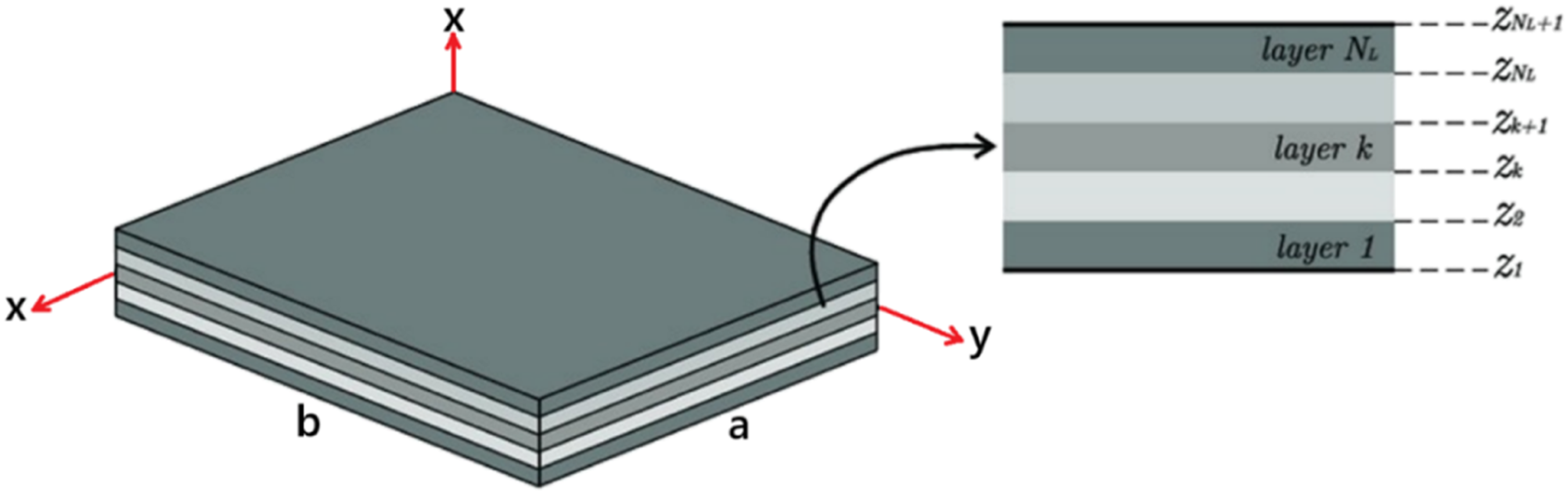
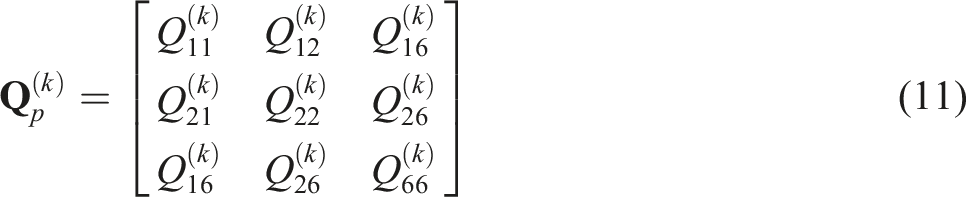
The constitutive relations for the off-axis coordinate system (x, y, z) are obtained using a standard transformation based on the direction cosines of the fiber orientation. The resulting equations are written as in equations (8)–(11):



Material length scale and the size-effect parameter l/h
Within the NMCST framework, the classical strain-energy density of the lamina is augmented by an additional contribution proportional to the symmetric part of the curvature tensor χ11,12,52,88, which is formulated as UNMCST = (1/2) ∫ (σ:ε + 2μl² χ:χ) dV, where μ is the matrix shear modulus and l is the single intrinsic material length-scale parameter that is constitutive of the lamina, not of its geometry. Physically, l represents the size of the smallest microstructural feature whose deformation gradient cannot be neglected at the continuum scale (e.g. fiber radius, polymer-chain mean free path, or grain size). The product 2 μl2χ:χ introduces a stiffening proportional to the square of the curvature, hence the name “size-dependent stiffening”.
When the laminate is characterized by its overall thickness h, the dimensionless ratio l/h plays the role of a normalized scale parameter. Three regimes can be distinguished: (i) l/h → 0 corresponds to a macroscopic plate (h ≫ l). The couple-stress term vanishes and the model degenerates to the classical ERZT thermo-mechanical formulation. This is the limit used to validate the present model against the Kant-3D
89
and Bhaskar
90
benchmarks (Figures 2–6, curves labelled l/h = 0). (ii) l/h ≈ 0.1–1 corresponds to a typical micro-plate (e.g. an MEMS membrane of thickness 1–10 μm built from a polymer with l ≈ 1 μm). The couple-stress contribution becomes comparable to the bending stiffness, and the figures show a clear monotonic reduction of the deflection and of all stress amplitudes. (iii) l/h ≳ 1 corresponds to a deeply nano-scale regime (e.g. a 100-nm-thick laminate with l ≈ 100 nm). The couple-stress term dominates the bending response, and the model predicts strong stiffening, consistent with the experimental and atomistic evidence reviewed in Refs. 53–57. The displacements found by deriving the equilibrium equations for Symmetric cross-ply three-layer laminated plate (a and b). The normal and shear stresses are shown in (c and d), and the transverse shear stresses are shown in (e and f). (a/h = 4) Validation reference: Kant-3D
89
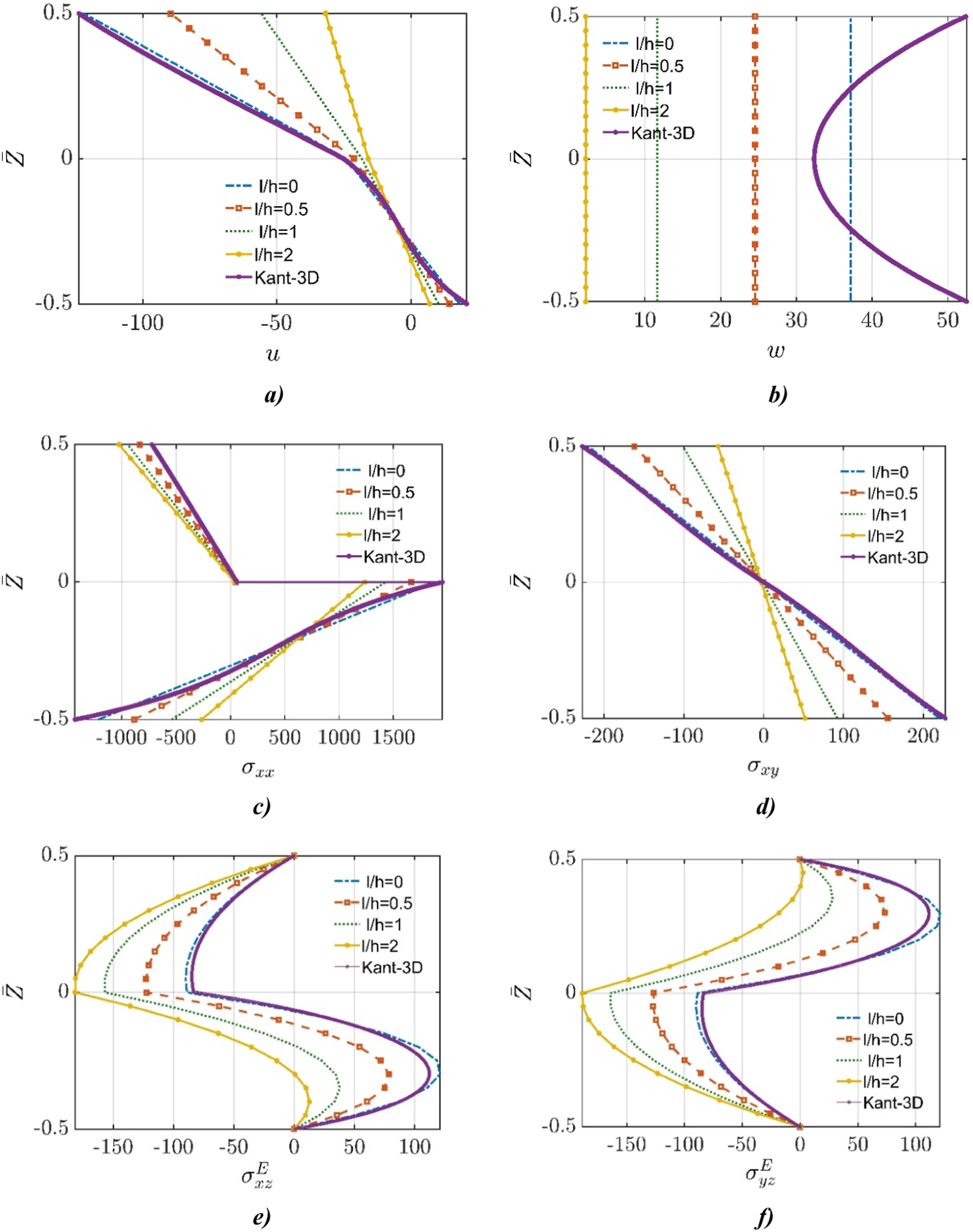
. The displacements found by deriving the equilibrium equations for Anti-symmetric cross-ply two-layer laminated plate (a and b). The normal and shear stresses are shown in (c and d), and the transverse shear stresses are shown in (e and f). (a/h = 4) Validation reference: Kant-3D
89
. The displacements found by deriving the equilibrium equations for symmetric Angle-ply four-layer laminated plate (a and b). The normal and shear stresses are shown in (c and d), and the transverse shear stresses are shown in (e and f). (a/h = 4) Validation reference: Bhaskar 3D Elasticity
90
. The displacements found by deriving the equilibrium equations for Anti-symmetric angle four-layer laminated plate are (a and b). The normal and shear stresses are shown in (c and d), and the transverse shear stresses are shown in (e and f). (a/h = 4). The displacements found by deriving the equilibrium equations for the symmetrically crossed five-layer sandwich plate are (a and b). The normal and shear stresses are shown in (c and d), and the transverse shear stresses are shown in (e and f). (a/h = 4).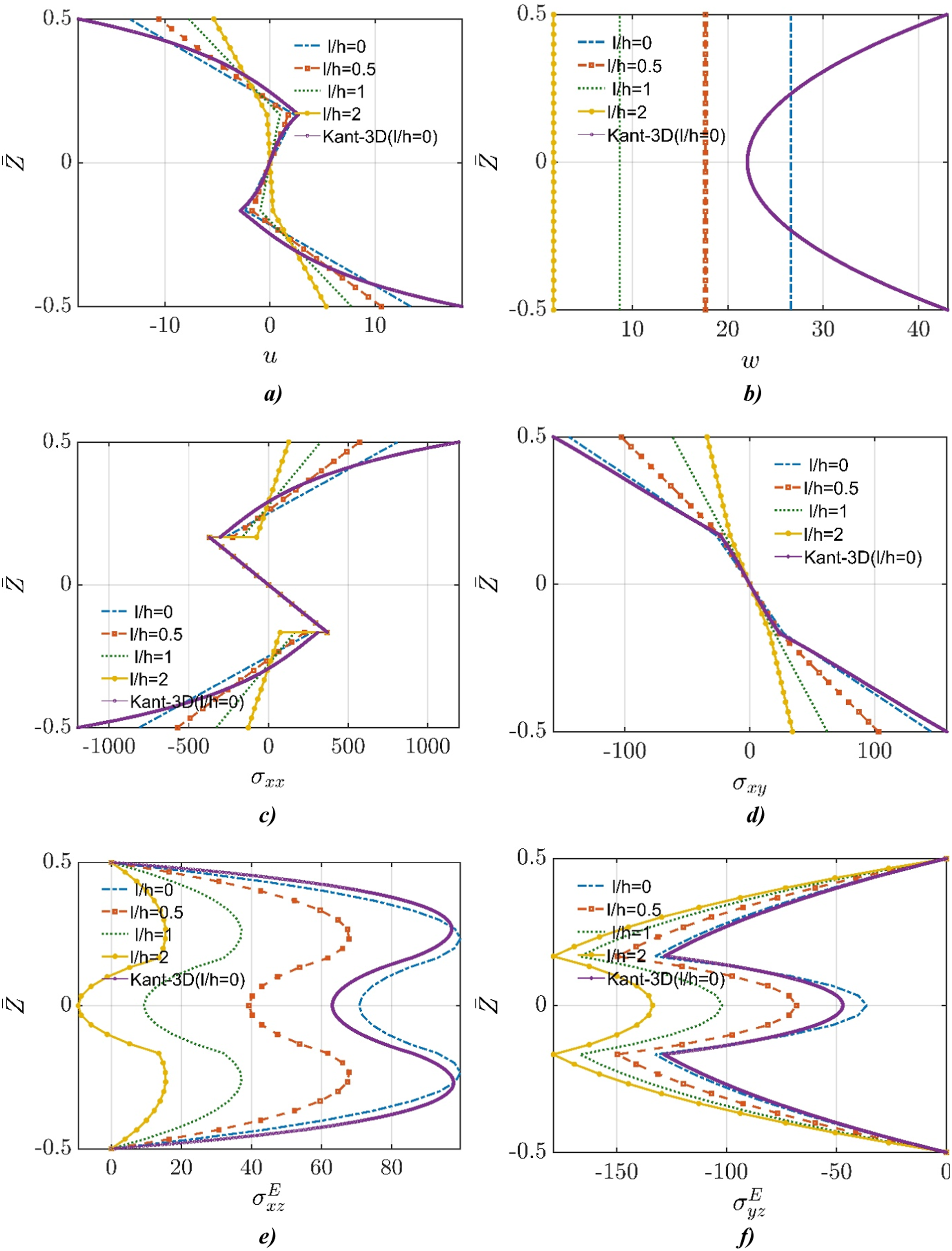
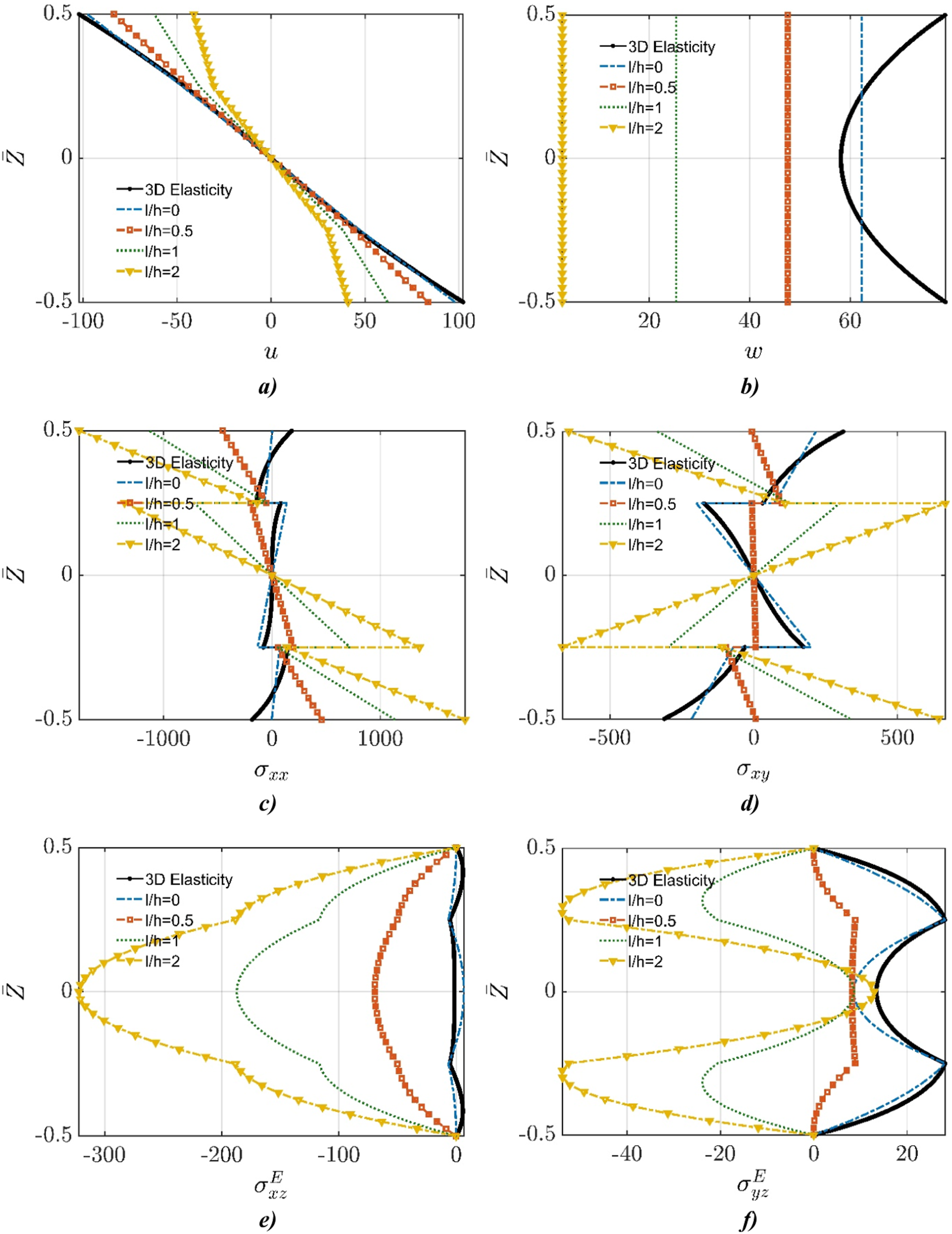
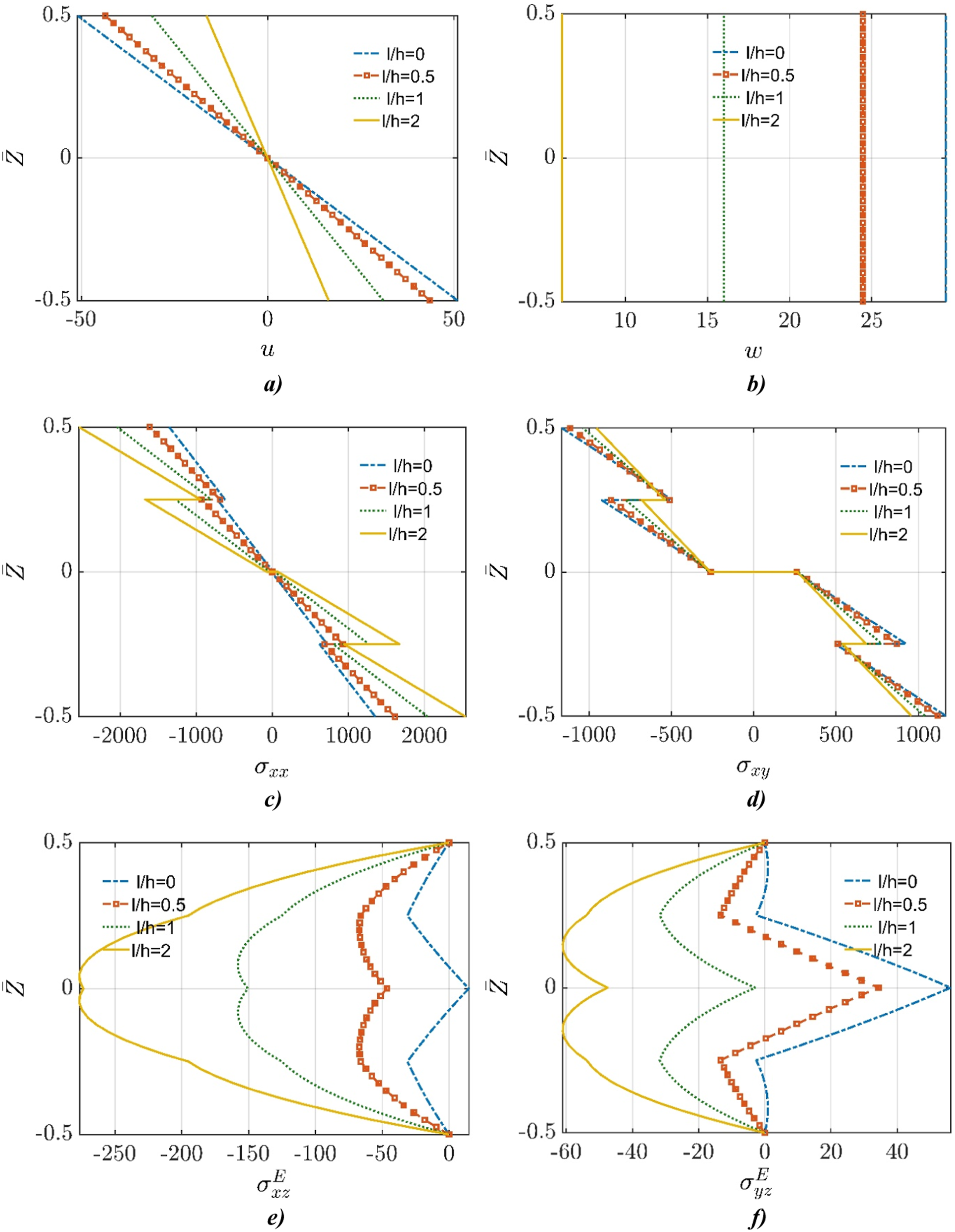
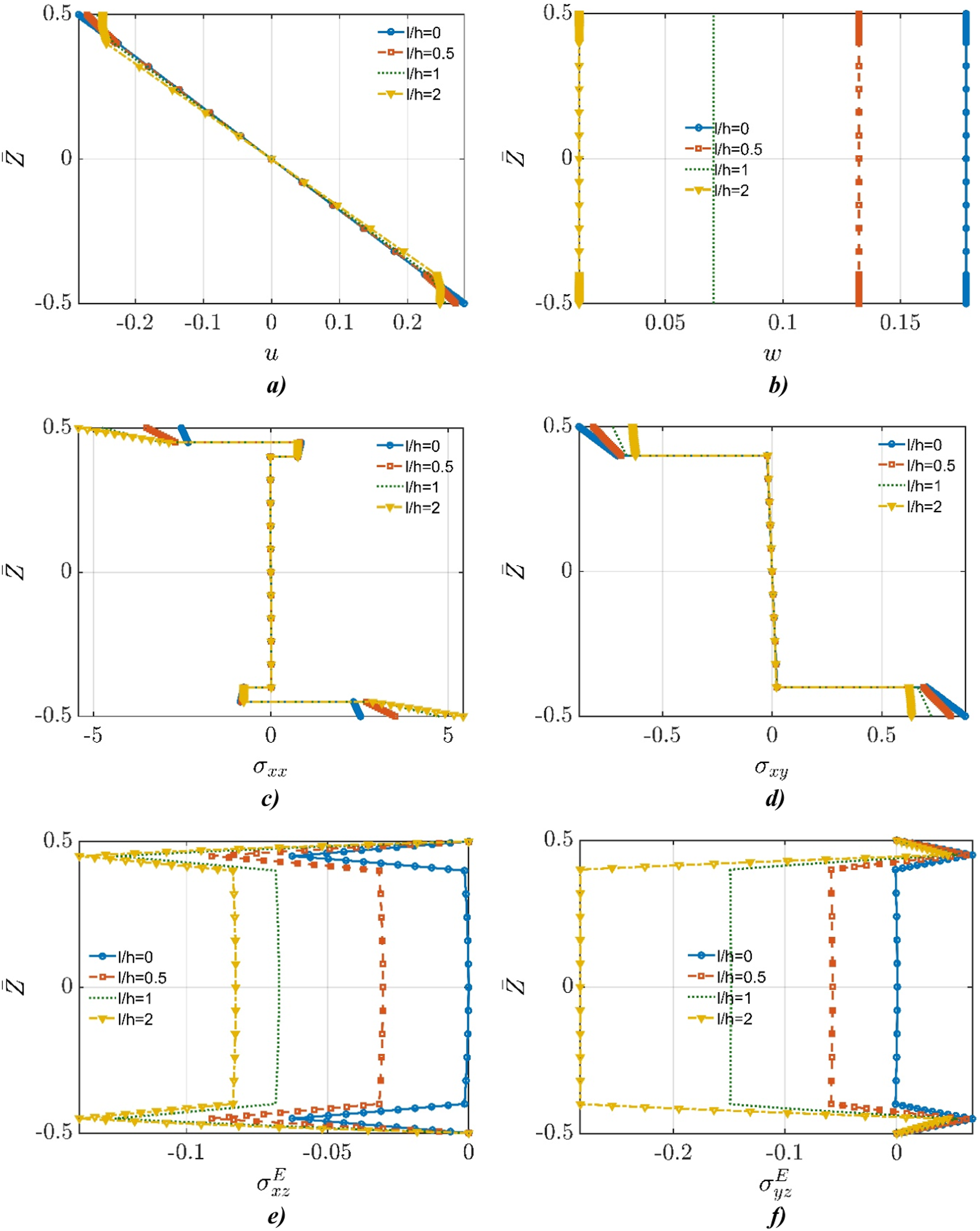
In all numerical examples of Section 3, l/h is varied through the discrete set {0, 0.5, 1, 2}. Each curve in Figures 2–6 corresponds to one of these four ratios; the qualitative trend — a monotonic reduction of |u|, w, |σxx|, |σxᵧ|, |σxᵧᴯ| as l/h grows — is the size-dependent stiffening predicted by the NMCST. The parameter l is not introduced explicitly in mm but in dimensionless form l/h, which is the only parameter that survives the non-dimensionalization of equations (37)–(41) and is therefore the only parameter that needs to be reported in a benchmark study.
Because the thermal-strain field is naturally expressed in the lamina principal coordinates (1, 2, 3) but the constitutive law in equation (8) is written in the laminate (x, y, z) frame, the principal coefficients α11 and α22 must first be rotated by the fiber-orientation angle θ of layer k. The standard tensor transformation yields (with c = cosθ, s = sinθ):



In equations (12)–(14), αxx and αᵧᵧ are the in-plane normal coefficients of thermal expansion in the global frame, while αxᵧ is the engineering shear coefficient generated by the rotation of an orthotropic ply with α11 ≠ α22.
Once the thermal strains αᵢⱼΔT (x, y, z) have been substituted into equation (8), the thermal stresses can be integrated through the laminate thickness h to obtain stress resultants conjugate to each kinematic variable of the ERZT field. The thermal stress resultants and moments of all three orders are defined as:





Here, N0, thermal collects the in-plane thermal forces conjugate to (u, v); N1, thermal collects the bending thermal moments conjugate to (θ1, θ2); and Nʰ,thermal collects the higher-order zigzag thermal couples conjugate to (ψ1, ψ2). The kernel of the higher-order term in equation (16) is the zigzag-weighted matrix Gb(ᵏ) (z) = Q(ᵏ)β(ᵏ), evaluated layer-wise.
Substituting the thermal load vectors of equations (15)–(19) into the principle of virtual work
22
and identifying the right-hand-side terms produced by the through-thickness thermal gradient yields the thermal contribution to the seven equilibrium equations of the model:







Equations (20)–(26) isolate only the thermal contribution fᵢ,thermal to the seven equilibrium equations of the model. To obtain the full governing equations, the thermal vectors above must be combined with the mechanical strain resultants of the ERZT47,88 and with the size-dependent couple-stress moments Mᵢⱼ and mᵢⱼ arising from the symmetric curvature tensor of the NMCST.12,52,88 It should be emphasised that the Euler–Lagrange equations of the coupled problem are not postulated independently; they are obtained naturally through the application of the Principle of Virtual Work.
22
In the present formulation, the internal virtual work and the external virtual work are balanced, and integration by parts is then applied to the resulting variational expression to yield the governing equations in Euler–Lagrange form. Up to this stage of the derivation, no specific boundary conditions are imposed. Consequently, the equations remain general and can be combined with different solution techniques and boundary conditions: Navier’s method may be used for fully simply supported plates, Levy-type solutions may be employed when two opposite edges are simply supported while the remaining edges are clamped or free, and Ritz-type methods may also be applied for arbitrary boundary conditions such as fully clamped plates. The complete Euler–Lagrange equations of the coupled NMCST + ERZT thermo-mechanical problem, obtained as described above and after grouping of the conjugate stress resultants, are given in equations (27)–(33). These are the equations that are actually solved by Navier’s method in Section 3; the Mᵢⱼ and mᵢⱼ terms are responsible for the size-dependent stiffening at l/h > 0 reported in Figures 2–6.







Case studies and validation
This part evaluates the efficiency of the proposed enhanced NMCST to simulate the size effect phenomenon. The issue is solved for cross ply and angle ply composite laminates and sandwich plates with thermo-mechanical loading. To accurately capture the deformation of thick and highly anisotropic plates, the NMCST-based formulation is fully integrated with the Enhanced Refined Zigzag Theory.
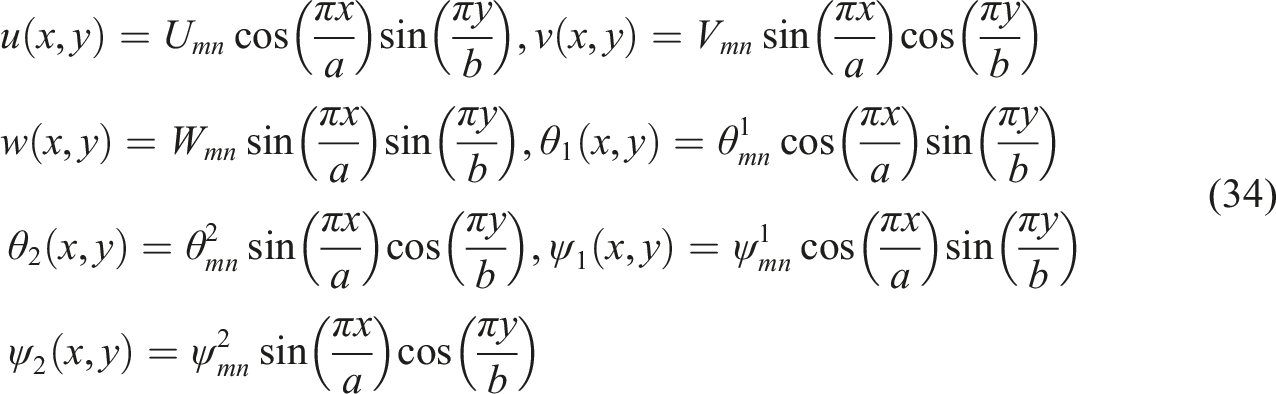
For an all-edge simply supported (SS-1) symmetric cross-ply orthotropic plate subjected to a bi-sinusoidal transverse mechanical load q (x, y) = q0 sin (πx/a) sin (πy/b) and a through-thickness sinusoidal thermal load T (x,y,z) = T0 (2z/h) sin (πx/a) sin (πy/b), a closed-form solution is obtained using Navier’s method. The following solution functions, given in equation (34), satisfy both the equilibrium equations and the simply supported boundary conditions of the problem:
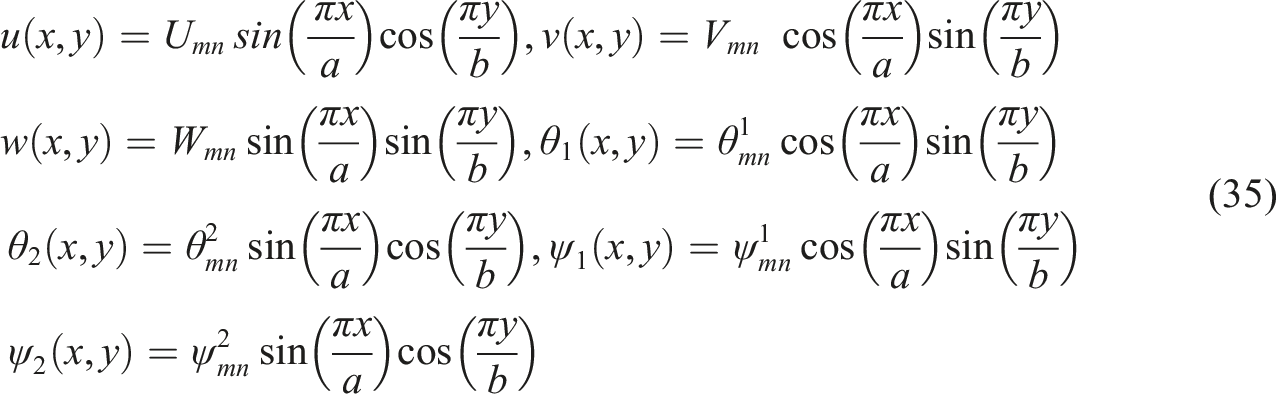
For an all-edge simply supported (SS-2) anti-symmetric angle-ply rectangular plate subjected to the same bi-sinusoidal mechanical and thermal loads, the following solution functions, given in equation (35), satisfy the equilibrium equations and the simply supported boundary conditions of the problem:
For a symmetric angled laminate that is infinite in the y-direction and simply supported on its two opposite edges in the x-direction, subjected to the transverse sinusoidal load q (x, y) = q0 sin (πx/a), the following solution functions, given in equation (36), satisfy both the equilibrium equations and the boundary conditions of the problem:

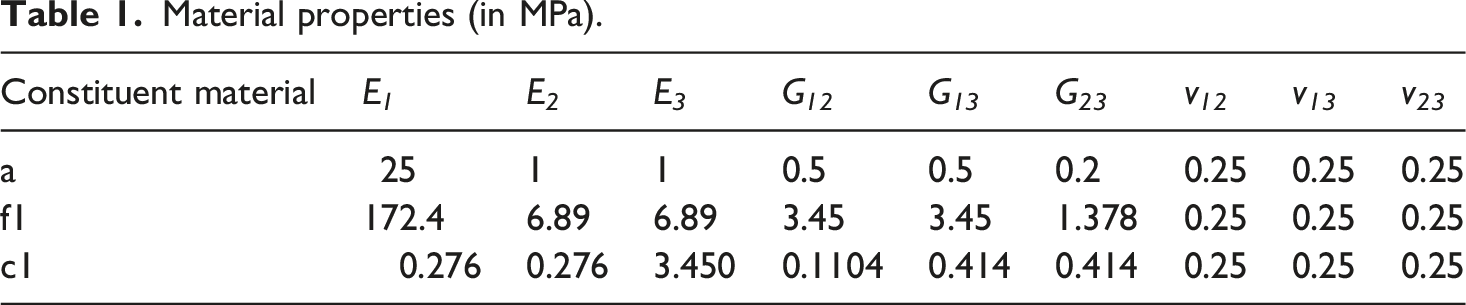
To enable a direct comparison of the present results with published 3D-elasticity benchmarks, the displacements and stresses are reported in non-dimensional form. For the laminated plates, the in-plane and transverse displacements (ū, v̄, w̄) are normalized with respect to a reference deflection that scales as q0a4/(E3h3); the in-plane stresses (σ̄xx, σ̄ᵧᵧ, σ̄xᵧ) with respect to q0 (a/h)2; and the transverse-shear stresses (σ̄xᵧ, σ̄ᵧᵧ) with respect to q0 (a/h), as detailed in equation (37). Here a and b are the in-plane plate dimensions, h the total thickness, q0 the amplitude of the bi-sinusoidal mechanical load, and E3 the transverse Young’s modulus of the lamina material listed in Table 1. Laminated Plates’s Normalized Values Material properties (in MPa).

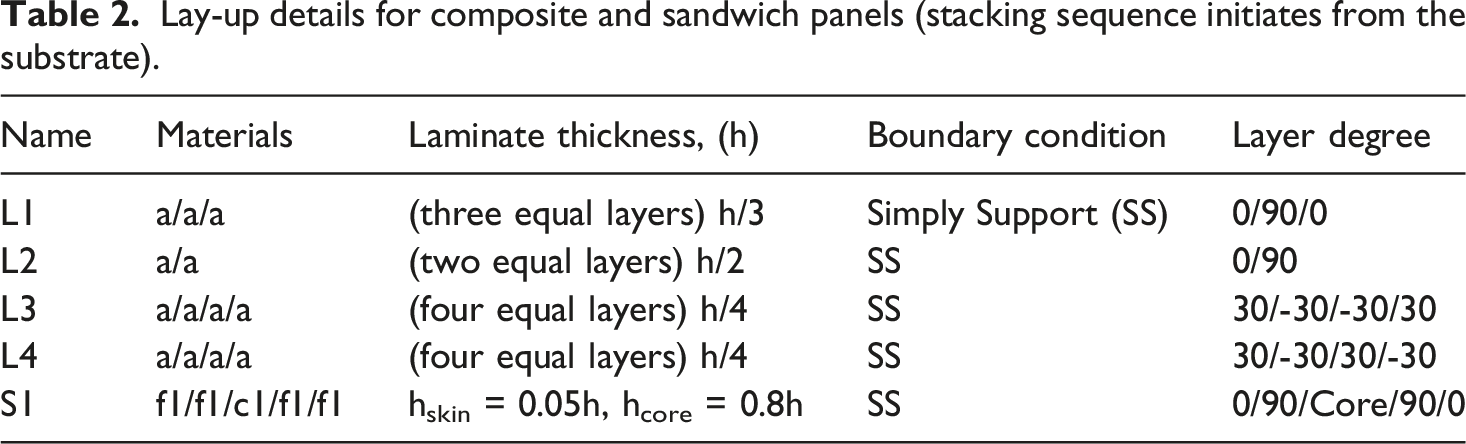
Sandwich Plates’s Normalized Values Lay-up details for composite and sandwich panels (stacking sequence initiates from the substrate).




For the sandwich configuration S1, the dominant load is thermal and a stiffness ratio of more than two orders of magnitude exists between the face sheets and the soft core. Under these conditions the laminated normalization of equation (37) is no longer suitable. Following standard practice,9,52 the displacements and stresses are therefore non-dimensionalized with respect to the in-plane principal thermal expansion of the face material (α11) and the temperature amplitude T0, as expressed in equations (38)–(41). The aspect-ratio factor S = a/h appears explicitly so that the dimensionless deflection w̄ collapses onto a single curve when a/h is varied. The factor ll2 ≫ lm2 used in the laminate analysis reflects the well-known transverse isotropy of the fiber bundle and the comparatively small intrinsic length scale of the matrix; under this physically motivated assumption, lm2 is set to zero in the laminate cases (a/a/a, a/a, a/a/a/a), while the full pair (ll, lm) is retained for the sandwich case S1.
Case 1
The composite plate designated as L1 in Table 2 was subjected to coupled thermomechanical loading to evaluate the influence of microstructural scale effects. The results presented herein correspond to a plate with aspect ratio a/h = 4 and square in- plane geometry (b = a).
The symmetric cross-ply (0/90/0) three-layer laminate L1 of Table 2 is analyzed under the bi-sinusoidal transverse mechanical load q (x,y) = q0 sin (πx/a) sin (πy/b) and the through-thickness sinusoidal thermal load T (x,y,z) = T0 (2z/h) sin (πx/a) sin (πy/b), with aspect ratio a/h = 4 and square in-plane geometry (b = a). The dimensionless length-scale ratio l/h is varied through the discrete set {0, 0.5, 1, 2}. Figure 2 reports the through-thickness profiles of the in-plane displacement u (Figure 2(a)), the transverse displacement w (Figure 2(b)), the in-plane normal and shear stresses σxx and σxᵧ (Figure 2(c) and (d)), and the transverse shear stresses σxᵧᴯ and σᵧᵧᴯ recovered from the 3D equilibrium equations (Figure 2(e)–(f)). Validation in the classical limit: At l/h = 0, where size effects are switched off, the curves predicted by the present model coincide with the Kant-3D semi-analytical thermo-elasticity solution 89 for all six field variables. The agreement is excellent for both the displacements and the stresses, including the kinks of σxx at the layer interfaces (which are a signature of the zigzag effect) and the parabolic shape of the recovered transverse shear stresses (which is a signature of the equilibrium-based post-processing). This validates the basic accuracy of the present model in the macroscopic regime. Size-dependent stiffening: As l/h is increased to 0.5, 1 and 2, all displacement and stress amplitudes are reduced monotonically. The magnitude of the reduction is significant: at l/h = 2 the central deflection w drops by approximately a factor of three with respect to the macroscopic limit, while the in-plane stresses are reduced by a similar factor and the transverse shear stresses by a slightly larger one. This is the size-dependent stiffening predicted by the NMCST through the term 2 μl2χ:χ of equation, which becomes increasingly important as l/h grows. Two further observations: (a) the zigzag character of the displacement and of σxx is preserved at all l/h, confirming that the ERZT kinematic richness is not lost when the couple-stress contribution is activated; and (b) the recovered transverse shear stress σxᵧᴯ satisfies the traction-free boundary conditions on the top and bottom faces of the laminate at all l/h, confirming the consistency of the equilibrium-based post-processing of equations (4)–(6) of the original mechanical formulation. 88
Case 2
The sample L2 (as defined in Table 2) was subjected to coupled thermomechanical loading to examine microstructural scale effects. Results in Figure 3 are presented for a plate with aspect ratio a/h = 4 and square in-plane dimensions (b = a).
The anti-symmetric cross-ply (0/90) two-layer laminate L2 of Table 2 is analyzed under the same bi-sinusoidal mechanical and thermal loads as L1, with aspect ratio a/h = 4 and square in-plane geometry (b = a). The dimensionless length-scale ratio l/h is varied through the discrete set {0, 0.5, 1, 2}. Figure 3 reports the through-thickness profiles of the in-plane displacement u (Figure 3(a)), the transverse displacement w (Figure 3b), the in-plane normal and shear stresses σxx and σxᵧ (Figure 3(c)–(d)), and the transverse shear stresses σxᵧᴯ and σᵧᵧᴯ recovered from the 3D equilibrium equations (Figure 3(e)–(f)). Validation in the classical limit: At l/h = 0 the curves predicted by the present model coincide with the Kant-3D semi-analytical thermo-elasticity solution 89 for all six field variables. The agreement is excellent for both the displacements and the stresses, with the characteristic zigzag kink of σxx correctly captured at the single 0/90 interface. The agreement confirms the ability of the model to work well also for anti-symmetric configurations, in which a bending–extension coupling is induced by the asymmetric stacking. Size-dependent stiffening: As l/h is increased to 0.5, 1 and 2, all displacement and stress amplitudes are reduced monotonically. The reduction trend is similar to L1, confirming that the size effect predicted by the NMCST is a generic feature of the laminate, independent of the stacking-sequence symmetry. As in L1, the recovered transverse shear stress σxᵧᴯ satisfies the traction-free boundary conditions on the top and bottom faces at all l/h.
Case 3
Thermomechanical Analysis of Composite Sheet L3 with Microstructural Scale Effects The composite sheet designated as L3 in Table 2 was subjected to coupled thermomechanical loading to investigate the influence of microstructural scale effects. The configuration considered corresponds to an aspect ratio of a/h = 4 and square plate geometry (b = a). The results are presented in Figure 4.
The symmetric angle-ply (30/-30/-30/30) four-layer laminate L3 of Table 2 is analyzed under the bi-sinusoidal mechanical and thermal loads of equation (34), with aspect ratio a/h = 4 and square in-plane geometry (b = a). The dimensionless length-scale ratio l/h is varied through the discrete set {0, 0.5, 1, 2}. Figure 4 reports the through-thickness profiles of the in-plane displacement u (Figure 4(a)), the transverse displacement w (Figure 4(b)), the in-plane normal and shear stresses σxx and σxᵧ (Figure 4(c)–(d)), and the transverse shear stresses σxᵧᴯ and σᵧᵧᴯ recovered from the 3D equilibrium equations (Figure 4(e)–(f)). Validation in the classical limit: At l/h = 0 the curves predicted by the present model coincide with the exact 3D thermo-elasticity solution of Bhaskar et al. 90 for all six field variables. This is the most demanding benchmark of the present study, because the angle-ply stacking introduces a strong in-plane shear coupling between σxx and σxᵧ which the ERZT must capture accurately through the off-axis transformation of the constitutive matrix (equations (12)–(14)). The excellent agreement confirms that this transformation is correctly implemented in the present formulation. Size-dependent stiffening: As l/h is increased to 0.5, 1 and 2, all displacement and stress amplitudes are reduced monotonically with the same trend reported for L1 and L2, confirming that the size effect is independent of the stacking-sequence orientation. The shear stress σxᵧ is reduced at the same rate as σxx, showing that the NMCST stiffening acts isotropically in the laminate plane.
Case 4
The sample represented by L4 in Table 2 was subjected to thermomechanical loading, and the scale effects of the microstructure were observed. Results for the composite sheet L4 in Table 2 with a/h = 4 and b = a in Figure 5.
The anti-symmetric angle-ply (30/-30/30/-30) four-layer laminate L4 of Table 2 is analyzed under the bi-sinusoidal mechanical and thermal loads of equation (35), with aspect ratio a/h = 4 and square in-plane geometry (b = a). The dimensionless length-scale ratio l/h is varied through the discrete set {0, 0.5, 1, 2}. Figure 5 reports the through-thickness profiles of the in-plane displacement u (Figure 5(a)), the transverse displacement w (Figure 5(b)), the in-plane normal and shear stresses σxx and σxᵧ (Figure 5(c)–(d)), and the transverse shear stresses σxᵧᴯ and σᵧᵧᴯ recovered from the 3D equilibrium equations (Figure 5(e)–(f)). The anti-symmetric stacking induces a bending–extension coupling that is superimposed onto the in-plane shear coupling of the angle-ply, which makes this case the most challenging of the laminate set in terms of kinematic richness. Size-dependent stiffening: As l/h is increased to 0.5, 1 and 2, all displacement and stress amplitudes are again reduced monotonically with the same trend reported for L1, L2 and L3, confirming that the size effect persists also in the presence of the combined extension–bending and in-plane-shear couplings. The zigzag character of the displacement and of σxx is preserved at all l/h, and the recovered transverse shear stresses satisfy the traction-free boundary conditions on the top and bottom faces of the laminate.
Case 5
The sample represented by S1 in Table 2 was subjected to thermomechanical loading, and the scale effects of the microstructure were observed. Results for the composite sheet S1 in Table 2 with a/h = 4 and b = a in Figure 6 .
The symmetric five-layer cross-ply face/soft-core sandwich plate S1 of Table 2 (0/90/Core/90/0) is analyzed under the bi-sinusoidal mechanical and thermal loads, with aspect ratio a/h = 4 and square in-plane geometry (b = a). The face thickness is h_skin = 0.05h and the core thickness is h_core = 0.8h, so that the stiffness ratio between the skins and the core exceeds two orders of magnitude. The dimensionless length-scale ratio l/h is again varied through the discrete set {0, 0.5, 1, 2}, with the laminate-style normalization replaced by the thermal normalization of equations (38)–(41) (factor α11T0, aspect-ratio factor S = a/h). Figure 6 reports the through-thickness profiles of u (Figure 6(a)), w (Figure 6(b)), σxx and σxᵧ (Figure 6(c)–(d)), and σxᵧᴯ and σᵧᵧᴯ (Figure 6(e)–(f)). Strong zigzag effect: At l/h = 0 the in-plane stress σxx shows the characteristic kinks at the two skin/core interfaces; the magnitude of these kinks is much larger than in the laminate cases L1–L4 because the skin/core stiffness ratio is much larger than the inter-ply contrast of a conventional laminate. This is the most demanding test of the zigzag capability of the model, and the present formulation captures it cleanly. The transverse shear stress σxᵧᴯ is essentially constant through the soft core and almost zero in the stiff skins, which is the well-known core-dominated transverse-shear behavior of a sandwich. Size-dependent stiffening: As l/h is increased to 0.5, 1 and 2, all displacement and stress amplitudes are reduced monotonically; the reduction is in fact larger than in the laminate cases at the same l/h. This is the natural consequence of the dominance of the soft core in the transverse-shear response: when the core is stiffened by the couple-stress contribution, the entire sandwich response is stiffened. The present results confirm that the NMCST + ERZT framework is also fully applicable to sandwich plates with a high skin-to-core stiffness ratio, opening the way to the size-dependent design of MEMS and biomedical sandwich devices.
Results and discussions
The five benchmark cases L1, L2, L3, L4 and S1 cover the full range of laminate kinematics relevant to engineering practice: symmetric and anti-symmetric stacking, cross-ply and angle-ply orientation, and a soft-core sandwich. In the classical limit (l/h = 0), the present model is validated against the Kant-3D semi-analytical solutions 89 for cross-ply layups (L1, L2) and against the exact 3D thermo-elasticity solutions of Bhaskar et al. 90 for angle-ply layups (L3, L4), with excellent agreement for all six field variables (u, w, σxx, σxᵧ, σxᵧᴯ, σᵧᵧᴯ) in every case. As the dimensionless length-scale ratio l/h is increased from 0 to 2, all displacement and stress amplitudes are reduced monotonically across all five cases, demonstrating that the size-dependent stiffening predicted by the NMCST is a constitutive feature of the laminate, independent of stacking sequence, fiber orientation, and loading type. The reduction is largest for the sandwich case S1 because the soft core dominates the transverse-shear response and is, in turn, dominated by the couple-stress contribution. Across all cases, the ERZT zigzag character of the displacement and of σxx is preserved at every l/h, and the transverse shear stresses recovered from the 3D equilibrium equations satisfy the traction-free boundary conditions on the top and bottom faces of the plate. Taken together, these observations confirm that the NMCST + ERZT framework provides an accurate, computationally efficient, and physically consistent description of the size-dependent thermo-mechanical bending of micro- and nano-scale laminated and sandwich composites.
A thorough numerical study is conducted in this section to both validate the proposed Sorrenti zigzag theory and showcase its effectiveness in modeling microstructural scale effects. The analysis covers five unique laminate configurations from Table 2, subjected to thermo-mechanical loading. For each configuration, the results are provided as non-dimensional displacements and stresses (in-plane and transverse shear), emphasizing the impact of the scale parameter l/h. All results are generated using MATLAB-based implementations. The 3D elasticity theory, Kant–3D theory, and other reference models employed in this study are first verified against existing literature and subsequently extended to the present thermo-mechanical framework, which constitutes an additional novelty of this work.
Validation and scale effects in symmetric cross-ply laminates (L1)
Figure 2 presents results for a symmetric cross-ply (0/90/0) three-layer laminate under sinusoidal thermo-mechanical loadings. As an initial check on the theory predictions at l/h = 0, where scale effects are ignored, we compared them with well-respected Kant-3D semi-analytical solutions 89 for macro-plates. As evident from Figure 2(a)–(f), this comparison shows an excellent correlation for all of the field variables, i.e., displacements, in-plane stresses, and transverse shear stresses derived from the equilibrium equations. This excellent correlation verifies the basic accuracy of the zigzag model for macroscopic applications.
Lastly, we examined scale effects through a controlled variation of the l/h ratio. The trend was clear and consistent: with higher l/h ratio, all values of displacement and stress monotonically decrease. This is clearly due to the increased stiffness by the newly introduced NMCST. These findings provide robust evidence that the proposed formulation can be used as a general macroscopic theory (for l/h = 0) as well as a size-dependent model, capturing well the size-dependent stiffening in symmetric laminates.
Comparison of anti-symmetric cross-ply laminates (L2)
To further test the precision of the model, we compared a two-ply anti-symmetric cross-ply (0/90) laminate. Solutions, presented in Figure 3 for l/h = 0, once more indicate good agreement with the Kant-3D solutions. 89 This again confirms the ability of the model to work well for anti-symmetric setups that exhibit coupling behavior under load. After introducing the scale parameter, a dramatic reduction of the size of all displacements and stresses was observed (Figure 3(a)–(f)). This finding validates the microstructural effect as a widespread characteristic well-described by the present theory, from symmetric layups to symmetric angle-plies and the laminates with coupling effects.
Thermo-elastic behavior of symmetric angle-ply laminates (L3)
The model’s performance in pure thermal loading was investigated using a four-layer symmetric angle-ply laminate (30/-30/-30/30). For this configuration, calibration was achieved by comparing the output of the model with the exact 3D thermo-elastic solutions of Bhaskar et al. 90 As Figure 4 demonstrates, the current theory results at l/h = 0 perfectly match this exacting benchmark, highlighting the model’s ability to accurately reproduce complex thermo-elastic deformations in angle-ply laminates. Consistent with the increase in stiffness seen in the cross-ply samples, the scale effects analysis showed a systematic decrease in displacement and stress levels as l/h increased. This means that the scale effect is a generic effect that can be seen in any orientation of fibers and modes of loading.
Scale effects in anti-symmetric angle-ply laminates (L4)
The effect of the l/h ratio was analyzed separately for a four-ply anti-symmetric angle-ply laminate (30/-30/30/-30) loaded thermo-mechanically. In the absence of any known 3D exact solution for the current problem, the study relied on the internal consistency of the results presented in Figure 5. The plots follow a consistent pattern, with response magnitudes decreasing smoothly with the scale parameter. This trend is entirely in line with the results above, providing conclusive evidence that the model correctly describes the size-dependent behavior of complex, anti-symmetric angle-ply configurations.
Scale effect in sandwich plates (S1)
The paper concludes with a numerical example of symmetric five-layer sandwich plate with cross-ply face sheets on a soft core. As demonstrated in Figure 6, the results indicate a very significant scale effect for this setup. The significant contrast in material properties between stiff skins and compliant core leads to even modest increases in the l/h ratio to cause considerable decreases in displacements and shear stresses. This observation points towards a significant size-dependent stiffening in sandwich structures. The Enhanced-RZT model presented herein is more than capable of capturing this complex phenomenon, with numerical stability, and with accuracy duplicating through-thickness stress distributions, particularly the significant transverse shears in the core. This success attestates the model’s potential for the analysis of sophisticated sandwich structures where microstructural phenomena are important.
Conclusions
This paper has presented an extensive numerical analysis of scale effects for laminated composite and sandwich plates based on an enhanced zigzag theory and NMCST. Five judiciously chosen benchmark examples are investigated, allowing the following to be concluded:
Verification and accuracy
The new Sorrenti zigzag theory was verified with well-known 3D elasticity solutions (Kant-3D, Bhaskar’s Exact-3D) for macroscopic plates (l/h = 0). Its reliability and accuracy are confirmed through the excellent agreement achieved for displacements, in-plane stresses, and transverse shear stresses in a wide range of symmetric/anti-symmetric, cross-ply/angle-ply laminates submitted to both mechanical and thermal loads.
Effective capture of scale effects
The model can effectively capture the scale effects of the microstructure by means of the l/h parameter. In all the cases taken into account, as the l/h ratio grew, it led to a systematic reduction of stresses and displacements. This finding is in agreement with the predicted stiffening trend by the NMCST, showing that the model can unify macroscopic and micro-mechanical plate theories.
Generality of the model
Uniform accuracy of the model over a wide variety of laminate types—symmetric and anti-symmetric, cross-ply and angle-ply, and both conventional composites and soft-core sandwich plates—thus proves its generality of application and reliability for a wide variety of advanced composite structures.
Strong effect in sandwich plates
The article highlighted that the scale effect is most pronounced for sandwich plates with a high skin-to-core stiffness ratio. This is a crucial consideration for micro- and nano-scale design and analysis of sandwich structures, where such size-dependent stiffening can substantially affect the mechanical behavior.
In summary, the Enhanced zigzag theory integrated with NMCST is a solid and trustworthy approach to performing thermo-mechanical analysis of sandwiches and laminated composites. It is capable of predicting both small-scale effects and macroscopic response, therefore providing a solid platform for engineering and improving the next generation composite structures in which small-scale effects cannot be ignored.
Footnotes
Acknowledgements
The authors would like to acknowledge the institutional support provided by the Indian Institute of Technology Kharagpur, Aliah University, and Biruni University.

Author contributions
CRediT: Aamir Anwar Nezami: Writing – original draft, Methodology, Supervision, Formal analysis, Data curation, Conceptualization; Sunny Akhtar: Methodology, Formal analysis, Data curation, Conceptualization; Oguzhan Nazlim: Methodology, Data curation, Writing – review & editing, Visualization, Investigation.
Funding
The authors received no financial support for the research, authorship, and/or publication of this article.
Declaration of conflicting interests
The authors declared no potential conflicts of interest with respect to the research, authorship, and/or publication of this article.
Data Availability Statement
The data that support the findings of this study are available from the corresponding author upon reasonable request.
Human and animal welfare statement
This study is a theoretical and computational investigation. It does not involve any experiments with human participants or animals performed by any of the authors.