






Abstract
Introduction:
Patients in intensive care units (ICUs) are at high risk of unfavorable outcomes. Considering the role of vitamin D (Vit D) in cardiovascular and immune functions, Vit D deficiency could affect ICU patients’ outcomes. This study aimed to evaluate Vit D status and its predictive value for outcome in ICU patients.
Patients and Methods:
A total of 169 ICU patients were followed during ICU stay. Primary outcome was the occurrence of at least one major adverse event; secondary outcomes were organ failure, septic shock, ICU-acquired infection, other adverse events, and ICU mortality. Plasma 25-hydroxyvitamin D (25(OH)D) was assessed by immunoassay. Multivariate Cox regression analyses were performed to test the associations of low 25(OH)D levels with poor outcomes.
Results:
Around 75% of patients had 25(OH)D levels <12 ng/ml. During their ICU stay, 114 patients experienced a major adverse event, 85 patients presented an ICU-acquired infection, and 22 patients died. Plasma 25(OH)D levels <12 ng/ml were associated with higher risk of major adverse events, Hazard ratio [95% CI], 4.47 [1.77, 11.3], p = .020, and ICU-acquired infection, 2.67 [1.01, 7.42], p = .049, but not with increased risk of ICU mortality.
Conclusions:
Hypovitaminosis D is very common in ICU patients. Results of the present study show that low plasma 25(OH)D levels are associated with increased risk of unfavorable outcomes in these patients. Additional research is needed to investigate the impact of Vit D status and effect of Vit D supplementation in ICU patients.
The intensive care unit (ICU) is an environment intended for the care of seriously ill and unstable patients. ICU patients suffer from serious, but potentially reversible, comorbidities, often have multiple organs affected, and are at high risk of death. They are under intensive observation and may need respiratory, circulatory, or neurological support using indwelling devices (Backes et al., 2015). ICU patients are subject to many complications such as device-associated infections, pulmonary embolism, septic shock, and organ failure (Reardon et al., 2018). They are also at higher risk of developing malnutrition due to illnesses and hypermetabolic state (El-Regal et al., 2016). ICU patients are often deficient in micronutrients (i.e., trace elements and vitamins) that are essential for the metabolism of carbohydrates, proteins, and lipids; immune and antioxidant defense; endocrine function; cell signaling; and DNA synthesis and gene repair (P. Singer et al., 2019). Consequently, nutritional adjuvant therapy, which can attenuate the development of malnutrition and promote better recovery, has become an essential component of ICU patients’ care (Weissman, 1999).
Vitamin D (Vit D) is a secosteroid hormone that exerts myriad biological functions essential for health (Holick, 2007). It plays an important role in modulating immune, endothelial, cardiovascular, and neurologic functions (Adams & Hewison, 2010). Vit D deficiency is highly prevalent in ICU patients (Alizadeh et al., 2015; Amrein et al., 2014; Ardehali et al., 2018; Kvaran et al., 2016; Lucidarme et al., 2010; Quraishi et al., 2014; Shojaei et al., 2019; Vassiliou et al., 2018). Holick (2007) reported that it was associated with cardiovascular, pulmonary, and infectious diseases and increased risk of mortality, which are common in ICU patients. Thus, Vit D status could have an impact on ICU patients’ outcomes.
Findings regarding the association of Vit D status with adverse events in ICU patients have been inconsistent, however. This inconsistency may be due to the differences in strategies researchers have used, mainly the use of different thresholds for defining deficiency (Endocrine Society, 2012; Institute of Medicine [IOM], 2011). Previous studies have tested Vit D status as a predictor of individual adverse events (e.g., septic shock, organ failure, mechanical ventilation, sepsis, or mortality) in ICU patients. In addition, studies have generally defined Vit D status according to a single criterion. We believe that investigating whether Vit D status predicts patients’ overall outcomes (favorable or unfavorable) could be more useful than exploring its ability to predict specific adverse event. Accordingly, in the present study, we investigated whether low Vit D, defined according to different criteria, predicts an unfavorable outcome in ICU patients.
Materials and Methods
Participants
In this prospective cohort study, we included consecutive patients admitted to the medical ICU at Rabta Hospital (Tunis, Tunisia) from January 2016 to December 2018. We excluded patients who were under 18 years of age; had sepsis, cancer, kidney, or liver failure; had undergone surgery within 3 months; had taken immunotherapy or vitamin supplements within 6 months; or were pregnant or lactating. We also excluded from the analyses patients who were discharged from the ICU or died within 48 hr of admission.
Procedure
We collected sociodemographic characteristics, medical history, and the reason for ICU admission from the medical charts. ICU staff conducted a physical examination with anthropometric, physiological, and biological assessments. Within 24 hr of ICU admission, ICU staff evaluated severity of illness using the Acute Physiology and Chronic Evaluation II (APACHE II) score. Throughout the ICU stay, ICU staff calculated the Sequential Organ Failure Assessment (SOFA) score. We followed patients until the 15 days after ICU admission if the stay extended beyond 2 weeks or until hospital discharge or death, whichever occurred first. During this period, we monitored patients daily and collected data on adverse events.
The primary study outcome was the occurrence of at least one of the following major adverse events (combined MAE): the need for a central venous catheter (CVC), organ failure, or septic shock. Secondary outcomes were the occurrence of at least one ICU-acquired infection (combined ICU-AI), septic shock, organ failure, other individual adverse events, and ICU mortality. Almost all participants (96.4%) needed mechanical ventilation during their ICU stay; thus, we did not include this condition in the variable MAE. We defined septic shock as persisting hypotension requiring vasopressors to maintain a mean arterial pressure of ≥65 mm Hg and a serum lactate level >2 mmol/L despite adequate volume resuscitation (M. Singer et al., 2016) and organ failure as an acute change in SOFA score of 2 points or greater secondary to infection (M. Singer et al., 2016). For the definition of ICU-AI, we followed the criteria of the Centers for Disease Control and Prevention and the National Healthcare Safety Network (Horan et al., 2008) and included catheter-related infection, ventilator-associated pneumonia (VAP), urinary tract infection, or bloodstream infection occurring more than 48 hr after ICU admission.
We conducted this study in accordance with the Code of Ethics of the World Medical Association (Declaration of Helsinki) for experiments involving humans. The Ethics Committee of Rabta Hospital approved the study protocol, and we obtained written informed consent from patients or family members.
Plasma 25-Hydroxyvitamin D (25(OH)D) Analysis
ICU staff collected fasting blood samples at ICU admission and discharge in heparin-containing tubes. Research staff separated the plasma and stored it at −80°C until analysis (within 6 months). As we were recruiting patients into the study throughout the year, we categorized the time of blood sampling for each participant as high-sunshine season (May to October) or low-sunshine season (November to April). To measure plasma 25(OH)D concentrations, we used a competitive chemiluminescence immunoassay on a Liaison analyzer using a specific reagent kit (DiaSorin Inc., Stillwater, MN). We categorized Vit D status according to the most recent IOM (2011) guidelines: deficiency (<12 ng/ml, 25(OH)D concentration), insufficiency (12–19.99 ng/ml, 25(OH)D concentration), and adequacy (≥20 ng/ml 25(OH)D concentration).
Statistical Analysis
We analyzed data using SPSS for Windows Version 18.0 (SPSS Inc., Chicago, IL). To examine continuous variables for normality, we used the Kolmogorov–Smirnov test. We have expressed continuous variables as mean ± SD or median (25th–75th percentile) and compared them using independent-samples t test or Mann–Whitney U test, as appropriate. We have expressed categorical variables as percent and compared them using the χ2 test. We used multivariate Cox regression analyses to test the associations of plasma 25(OH)D concentration expressed as clinical categories (IOM criteria), season-specific tertiles, and Evaluate Cutpoints outcome-specific thresholds. Evaluate Cutpoints is an application developed using the R language for optimization of cut points in biomedical research (R Foundation for Statistical Computing, Vienna, Austria). We used this application to detect the optimal cut point of plasma 25(OH)D concentration for the prediction of each outcome (i.e., MAE, CVC, septic shock, organ failure, ICU-AI, and death), defining optimal cut point as the point with the most significant split based on the standardized log-rank test (Ogłuszka et al., 2019). We calculated season-specific tertiles based on the distribution of plasma 25(OH)D concentration in all ICU patients and combined into the same variable. The models were adjusted for age, body mass index and APACHE II score (continuous variables), gender (male/female), skin phenotype (fair/brown + dark), and season of blood draw (high sunshine/low sunshine). The model for season-specific tertiles was adjusted for the same variables minus the season of blood draw.
Results
Of 209 eligible ICU patients, we enrolled 169 participants (Figure 1). These patients had been admitted to the ICU directly from the emergency room (n = 99) or after a stay in another department (n = 70). The most common reasons for admission into the ICU were respiratory distress and altered consciousness. Most patients (73%) had Vit D deficiency, and 16.4% had insufficiency. Table 1 shows the baseline characteristics of ICU patients enrolled.

Flowchart of the study participants.
Baseline Characteristics of Patients at ICU Admission.

Note. N = 169. Data are expressed as mean ± SD, median (25th–75th percentile), or percent. 25(OH)D = 25 hydroxyvitamin D; APACHE II = Acute Physiology and Chronic Evaluation II; BMI = body mass index; BP = blood pressure; ICU = intensive care unit; SOFA = Sequential Organ Failure Assessment.
During the follow-up period, we excluded 17 patients due to discharge or death within the first 48 hr (n = 8) or lack of clinical data or blood sample (n = 9), leaving only 152 patients for the final analyses. Table 2 shows the main adverse events that occurred during ICU stay. Plasma 25(OH)D concentrations at admission were significantly lower in patients who had combined MAE, CVC, septic shock, organ failure, or ICU-AI compared to patients with no adverse events. However, we found no significant differences in plasma 25(OH)D concentration at admission between patients with other adverse events or death and those with no adverse events (Figure 2). For patients who were discharged from the ICU within 15 days (n = 88), ICU stay was longer in those with plasma 25(OH)D deficiency (8.18 ± 2.65 days vs. 6.75 ± 2.45 days, p = .034) than in those without. In multivariate Cox regression models, patients with the lowest plasma 25(OH)D classes had an increased risk of combined MAE, but not of ICU mortality, regardless of the criterion used to identify low Vit D status (Table 3). When we defined Vit D status using the clinical criteria, risk of CVC and ICU-AI was significantly higher in patients with either Vit D deficiency or insufficiency than in those with adequate levels, but risk of organ failure and septic shock was significantly higher only in patients with a Vit D deficiency. We found no association between 25(OH)D season-specific tertiles and occurrence of any individual adverse event (Table 3). According to the Evaluate Cutpoints application, the best plasma 25(OH)D cut points to predict combined MAE, organ failure, CVC, and ICU-AI were set at 12.8, 7.94, 16.3, and 20.7 ng/ml, respectively. Patients with 25(OH)D below the appropriate threshold had 2- to 3-fold higher risk of combined MAE, organ failure, CVC, and ICU-AI than patients with concentrations at or above the threshold. No other individual adverse event showed an association with Vit D status regardless of the classification considered (data not shown). Survival curves for combined MAE, CVC, septic shock, organ failure, ICU-AI, and ICU mortality by plasma 25(OH)D clinical category (i.e., IOM criteria) are illustrated in Figure 3.
Primary and Secondary Outcome Measures.

Note. N = 152. ICU = intensive care unit.
a Frequency for combined variables indicates the number of participants who experienced at least one of the relevant events.

Comparative distribution of plasma 25-hydroxyvitamin D (25(OH)D) in intensive care unit patients (N = 152) according to selected outcomes. Note. The ends of the box are the first and third quartiles and the band inside the box is the median. The ends of the whiskers are the lowest and the highest values. *p < .05. **p < .001 (compared to patients with no adverse events).
Multiadjusted Hazard Ratios (95% CI) for Poor Outcomes by Categories of Plasma 25-Hydroxyvitamin D (25(OH)D) Concentrations Defined According to Different Criteria.

Note. ICU = intensive care unit; MAE = major adverse event.
a Hazard ratio adjusted for age, gender, body mass index, skin phenotype, season of blood draw, and Acute Physiology and Chronic Evaluation II score. b Compared to 25(OH)D ≥ 20 ng/ml. c Hazard ratio adjusted for the same variables minus season of blood draw: Plasma 25(OH)D (in ng/ml) tertiles (T) were T1 < 5.08, T2 = 5.08–9.22, and T3 > 9.22 for low-sunshine season (November to April) and T1 < 6.22, T2 = 6.22–12.5, and T3 > 12.5 for high-sunshine season (May to October). d Compared to third tertile. e 25(OH)D threshold for combined MAE, organ failure, need for central venous catheter, and ICU-acquired infection were 12.8, 7.94, 16.3, and 20.7 ng/ml, respectively. f Compared to ≥specific threshold.
*p < .05. **p < .001.
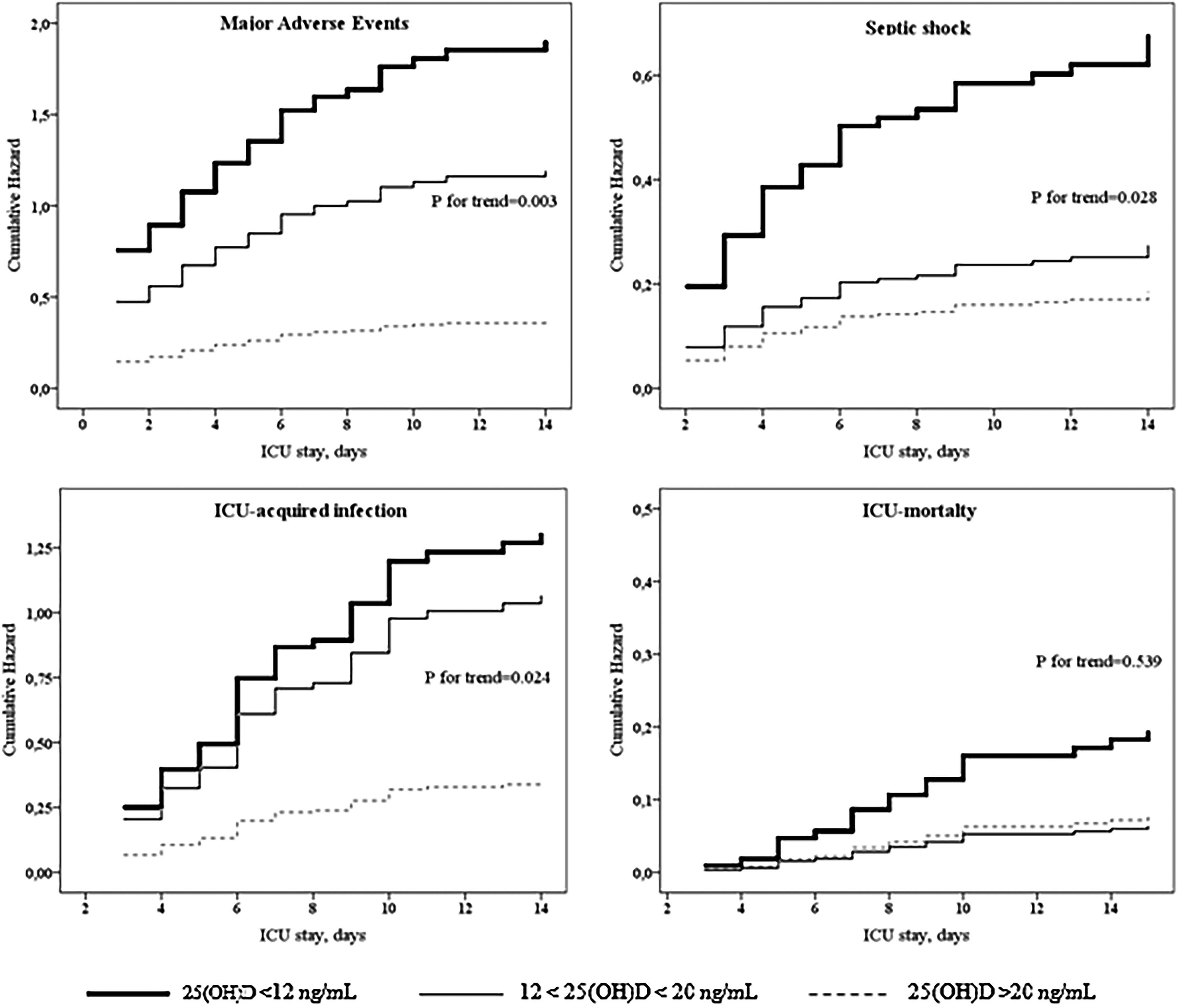
Multivariate Cox regression model hazard risk curves for combined major adverse event, septic shock, intensive care unit (ICU)-acquired infection, and ICU mortality by plasma 25-hydroxyvitamin D concentration clinical criteria. Note. Hazard ratios are adjusted for age, gender, body mass index, Acute Physiology and Chronic Evaluation II score, skin phenotype, and season of blood draw.
Discussion
In the present study, we found that a large majority of the ICU patients in our sample (89.4%) had Vit D deficiency/insufficiency. This finding is consistent with the reported high prevalence of hypovitaminosis D in the general population in Tunisia (Meddeb et al., 2005) and in ICU patients worldwide (Alizadeh et al., 2015; Amrein et al., 2014; Ardehali et al., 2018; Kvaran et al., 2016; Lucidarme et al., 2010; Quraishi et al., 2014; Shojaei et al., 2019; Vassiliou et al., 2018). The main causes of low Vit D status in these patients are advanced age, immobilization, and lack of adequate sunlight exposure for adequate endogenous Vit D synthesis (Holick, 2007). Malnutrition; obesity; hepatic, renal, and gastrointestinal dysfunctions; and frequent fluid replacement are additional reasons for the deficits (Krishnan et al., 2010).
Our findings also showed that low plasma 25(OH)D levels at admission were associated with higher risk of combined MAE, organ failure, septic shock, need for CVC, and ICU-AI but not with ICU mortality. Mechanisms by which Vit D could influence outcomes in ICU patients are multiple. Vit D induces expression of cathelicidin antimicrobial peptide gene and genes involved in autophagy and phagosome maturation, all of which are involved in the intracellular destruction of pathogens and promotion of an anti-inflammatory response. Cathelicidins produced by cells in direct contact with external pathogens play a key role in protection against infection (Gallo, 2005). Vit D also has anti-inflammatory effects by increasing production of anti-inflammatory mediators (Trongtrakul & Feemuchang, 2017) and preventing excessive production of pro-inflammatory cytokines, as well as weakening activation of p38 mitogen-activated protein kinases and nuclear factor κ B and decreasing concentrations of matrix metalloproteinases (Calton et al., 2015). Vit D inhibits vasodilatation of the vascular endothelium induced by lipopolysaccharide (Bukoski & Xue, 1993), a primary structural component of bacteria responsible for initiating the sepsis inflammatory response (Sweet & Hume, 1996). Vit D also affects cardiovascular function by mediating calcium homeostasis, inducing antioxidant properties, and downregulating the rennin–angiotensin–aldosterone system (Thompson et al., 2015). Accordingly, hypovitaminosis D can increase the risk of cardiovascular dysfunction, inflammation, and infection, thus contributing to unfavorable outcomes in ICU patients.
The literature regarding the role of Vit D status in ICU patients reports conflicting findings. Researchers have reported that low plasma 25(OH)D at admission predicts unfavorable outcomes such as need for mechanical ventilation (Ardehali et al., 2018; Ebenezer et al., 2016), organ failure (Braun et al., 2011), septic shock (Ala-Kokko et al., 2016; Moromizato et al., 2014), acute/severe sepsis (De Pascale et al., 2016; Lucidarme et al., 2010), systemic bloodstream infection (Amrein et al., 2014; Braun et al., 2011), ICU-AI (Ebenezer et al., 2016; Quraishi et al., 2013), VAP (De Pascale et al., 2016; Vassiliou et al., 2018), and all-cause mortality (Braun et al., 2011; Moraes et al., 2015; Moromizato et al., 2014) in critically ill patients. However, others studies have shown no significant association of plasma 25(OH)D with unfavorable outcomes such as organ failure (Ala-Kokko et al., 2016), septic shock (Ratzinger et al., 2017; Shojaei et al., 2019), acute/severe sepsis (Ala-Kokko et al., 2016), systemic bloodstream infection (Moraes et al., 2015), ICU-AI (Ala-Kokko et al., 2016; Flynn et al., 2012; Kempker et al., 2015; Vosoughi et al., 2016), VAP (Flynn et al., 2012), and all-cause mortality (Alizadeh et al., 2015; Barnett et al., 2014; Cecchi et al., 2011; Kempker et al., 2015; Kvaran et al., 2016; Ratzinger et al., 2017; Vassiliou et al., 2018; Vosoughi et al., 2016) in critically ill patients. Likewise, researchers have reported that length of stay was (Alizadeh et al., 2015; Amrein et al., 2014; Ardehali et al., 2018; Ebenezer et al., 2016) or was not (De Pascale et al., 2016; Kvaran et al., 2016; Vassiliou et al., 2018; Vosoughi et al., 2016) associated with Vit D status in patients in the ICU. Studies that have tested the effects of Vit D supplementation in ICU patients have also reported conflicting findings. Recent meta-analyses have concluded that Vit D supplementation corrects the deficit but does not improve clinical outcomes in ICU patients (Christopher, 2015; Langlois et al., 2018, 2019).
The discrepancies in findings are likely due to the heterogeneity of studies. ICU patients can differ by the type and severity of illnesses, age category, ethnicity, geographical location (latitude), and vitamin supplementation practice. Methodological differences including the selection of patient subgroups, choice of end points, study duration, ICU length of stay, definition of Vit D status and its variation during ICU stay, and adjustment for confounders are additional sources of variability. Moreover, ICU patients generally experience more than one adverse event. For example, septic shock is generally accompanied by ICU-AI and/or the need for CVC, and thus, the result for one outcome could be confounded by other outcomes.
Our findings in the present study corroborate some of the discrepancies in findings reported in the literature. Indeed, the predictive power of 25(OH)D varied according to the outcome and criterion used to define Vit D status. While plasma 25(OH)D concentration in the present study predicted combined MAE regardless of the criterion used to define Vit D status, results varied for individual events depending on these criteria. Specifically, we found that season-specific 25(OH)D tertiles had no predictive value for individual events. Also, the specific threshold (detected by the Evaluate Cutpoints application) that discriminates between favorable and unfavorable outcomes is dependent on the outcome. The inconsistency in findings in both the present study and the literature suggests that if Vit D concentration has an impact on outcome in ICU patients, the effect should be modest. Rather, ICU patient outcome may depend on a combination of interrelated factors, including baseline Vit D status, patient’s immune status, type and severity of illness, adverse events, and quality of care.
Vit D levels at the time of discharge were lower than the baseline levels in the present study; however, the difference was not significant. The decrease was likely due to a lack of sunlight exposure and a reduction in dietary intake during the ICU stay. It is unlikely to have been due to medication because only five patients received dexamethasone or rifampicin, either of which can reduce plasma Vit D concentration (Gröber & Kisters, 2012). While most patients received multivitamin supplements by enteral or parenteral pathways, Vit D doses supplied were too low to cause an increase in plasma levels.
While we did not find consistent associations between Vit D status and individual adverse events or ICU mortality across all criteria for categorizing Vit D status, we did find a consistent association between Vit D status and overall outcome (i.e., combined MAE). We would argue that predicting overall outcome is more relevant than predicting specific events. Results for ICU-AI and ICU mortality were also consistent across criteria for defining low Vit D status. The Tunisian population among which we conducted the present study is characterized by a high rate of hypovitaminosis D. Furthermore, vitamin supplementation is uncommon in this population. Our sample could be called homogeneous in the sense that most of the participants were mechanically ventilated. We adjusted data for potential confounders that could affect prognosis or Vit D status. We set follow-up duration to a maximum of 15 days, thus reducing between-patient variability in length of stay. Patients’ Vit D status remained stable during their ICU stay, with 25(OH)D levels at the time of discharge not differing significantly from those at admission. Finally, the study has good completeness and detailed clinical information. These strengths increase the trustworthiness of the findings. However, the sample size was relatively small, which could have reduced the statistical power for individual adverse events.
ICU patients are at high risk of Vit D deficiency. In the present study, we found that lower plasma 25(OH)D levels are associated with increased risk of unfavorable outcome and longer ICU stay but not of ICU mortality. These findings suggest that there may be value in screening ICU patients for hypovitaminosis D and correcting deficits. Further research is needed, however, to assess the safety and efficacy of Vit D supplementation in ICU patients.
Footnotes
Acknowledgments
The authors thank all participants and the medical staff who assisted in the study for their support.
Author Contributions
Dhouha Maamer contributed to acquisition, analysis, and interpretation; drafted the manuscript; critically revised the manuscript; gave final approval; and agreed to be accountable for all aspects of work ensuring integrity and accuracy. Ahlem Trifi contributed to conception and acquisition, drafted the manuscript, gave final approval, and agreed to be accountable for all aspects of work ensuring integrity and accuracy. Mohamed Kacem Ben Fradj contributed to design and analysis, drafted the manuscript, gave final approval, and agreed to be accountable for all aspects of work ensuring integrity and accuracy. Foued Daly contributed to acquisition, critically revised the manuscript, gave final approval, and agreed to be accountable for all aspects of work ensuring integrity and accuracy. Mohamed Bassem Hammami contributed to analysis, critically revised the manuscript, gave final approval, and agreed to be accountable for all aspects of work ensuring integrity and accuracy. Sami Abdellatif contributed to conception and interpretation, critically revised the manuscript, gave final approval, and agreed to be accountable for all aspects of work ensuring integrity and accuracy. Moncef Feki contributed to conception and design, analysis, and interpretation; critically revised the manuscript; gave final approval; and agreed to be accountable for all aspects of work ensuring integrity and accuracy. Salah Ben Lakhal contributed to conception, critically revised the manuscript, gave final approval, and agreed to be accountable for all aspects of work ensuring integrity and accuracy.
Declaration of Conflicting Interests
The author(s) declared no potential conflicts of interest with respect to the research, authorship, and/or publication of this article.
Funding
The author(s) disclosed receipt of the following financial support for the research, authorship, and/or publication of this article: This work was supported by the Ministry of Higher Education and Scientific Research of Tunisia, Research Laboratory (Grant number LR99ES11).
