






Abstract
Introduction
Parents function in an essential role influencing their child’s overall development (Bowlby, 1969; Carter, 2005; Schore, 2000); therefore, parent mental health is critically important. Yet, the mental health of parents may not be adequately addressed when infants are born with critical congenital heart disease (cCHD) and admitted to a pediatric cardiac intensive care unit (PCICU) for neonatal cardiac surgery (Re et al., 2013; Rempel et al., 2013). Very few studies have tested interventions to reduce stress of parents of infants in the PCICU to improve parent mental health in cCHD (Kasparian et al., 2019). Novel approaches to research, including strategies for enhanced precision in measurement, are needed (Sood et al., 2021).
According to the PCICU Parental Stress Model (Lisanti et al., 2017b), stressors can arise from the infant, parent, and hospital environment, and these stressors combine to generate a stress response that can be both psychologic and physiologic. Psychologic stress responses can include symptoms of anxiety, depression, acute stress disorder, and post-traumatic stress (Franich-Ray et al., 2013; Lisanti et al., 2021b; Segre et al., 2014). Yet, there has been a lack of exploration of the potential links between the psychologic and physiologic manifestations of stress to identify biomarkers in this group of highly stressed parents. Self-report measures may not provide the greatest understanding of the impact of stress on parents.
The hypothalamic-pituitary adrenocortical (HPA) axis is known to activate in response to stress, resulting in glucocorticoid production, primarily cortisol (Sapolsky et al., 2000). Biomarkers from the HPA axis, such as cortisol, may provide more sensitive information about the physiologic stress response of parents of infants with cCHD. Cortisol has a diurnal pattern, with high awakening levels, a dramatic increase in the first 30 minutes after awakening, then gradually declining throughout the day with a nadir around midnight (Adam & Kumari, 2009). Evaluation of cortisol can include an examination of diurnal parameters such as cortisol slope (CS) and area under the curve with respect to the ground (AUCg). AUCg provides a measure of the total output of cortisol over the day, whereas the CS provides the amount of change from morning to evening (typically awakening to bedtime). Flatter CS has been associated with poor psychological outcomes (Adam et al., 2017). Cortisol awakening response (CAR) and Cortisol Index, a derivative of CAR, reflect the degree of change between awakening and 30-minutes after awakening and are thought to indicate the body’s mobilization of resources in anticipation of the coming day’s demands (Fries et al., 2009; Wilhelm et al., 2007). Research suggests that a relationship exists between the degree of change during the awakening period, both higher and blunted responses, with psychological symptoms such as anxiety and depressive symptoms (Adam et al., 2010; Fries et al., 2009; Halligan et al., 2007; Harris, 2000; Kuhlman et al., 2017; Wessa et al., 2006). Our hypothesis was these cortisol measures may be important biomarkers to examine in parents of infants in the PCICU. Examination of cortisol in research needs to include sex as a biological variable because sex differences exist in HPA axis functioning between men and women across the life span (Andiarena et al., 2017; Carpenter et al., 2017; Gifford & Reynolds, 2017; Rutherfurd-Markwick et al., 2017; Sherman et al., 2017; Van der Voorn et al., 2017). Studies on parental stress in cCHD have also shown that mothers and fathers perceive stress and react to stressors differently (Hoffman et al., 2020; Sood et al., 2018).
Little is known about the psychologic and physiologic manifestations of stress and their impact on parent mental health of both men and women in the setting of the PCICU. We previously reported significant differences between mothers and fathers on measures of perceived stress and psychologic stress responses of anxiety and depressive symptoms across mother–father dyads in the PCICU (Lisanti et al., 2021c). Examining cortisol would provide a greater understanding of the role of physiologic stress on outcomes for parents of infants with cCHD. We hypothesized that the perceived infant, parent and environmental stressors identified by the PCICU Parental Stress Model would elicit a physiologic stress response as measured by salivary cortisol. We also hypothesized that parent physiologic stress response of cortisol would be associated with parent psychological stress responses, but that differences may exist across mother–father dyads. The primary objective of this exploratory, feasibility study was to examine the relationships of self-reported perceived stressors and psychologic stress responses with measures of the biomarker cortisol in parents of infants hospitalized after neonatal cardiac surgery for cCHD (Figure 1). The PCICU Parental Stress Model: Variable Selection for Study Aims.
Aim 1: To describe and compare differences in the physiologic stress response of cortisol measures (CS, AUCg, CAR, and CI) between mothers and fathers.
Aim 2: To examine whether associations exist between psychologic stress response (anxiety and depressive symptoms) and physiologic stress response (cortisol measures) in parents.
Aim 3: To examine the relationship between perceptions of stressors according to the PCICU Parental Stress Model on physiologic stress response of cortisol in parents.
Materials and Methods
A convenience sample of 56 parents representing 28 biological mother–father dyads of infants with cCHD were screened and approached consecutively between August 2018 and October 2019 from all families admitted to the PCICU at one free-standing children’s hospital in the Northeast region. This sample met the minimum recommended size for pilot feasibility studies (Hertzog, 2008). Mother–father dyads were specifically enrolled so that data analysis could account for differences in stress based on sex as a biological variable. Parents were approached at least 24 hours after their infants’ cardiac surgery if parents were 18 years of age or older, able to read and speak English, and their infants met the following inclusion criteria: (a) <30 days of age (b) ≥36 weeks gestational age (c) birth weight ≥2500 g. Parents were excluded if they were taking the following medications: steroid preparations, sedatives, anti-anxiety or other psychotropic drugs or if their infants were (a) diagnosed with other congenital syndromes or anomalies (b) listed for a cardiac transplant, or (c) receiving end of life care. This study was approved by the hospital’s institutional review board and all subjects provided their informed consent to participate in the study.
Physiologic Measures
Salivary Cortisol
Cortisol is naturally present in saliva and reflects approximately 5% of the circulating levels in the blood (Turpeinen & Hamalainen, 2013). To measure salivary cortisol, saliva samples were collected by passive drool method using SalivaBio Cryovials by Salimetrics® with Saliva Collection Aids. Since the feasibility of collecting saliva from parents during the very stressful postoperative period was unknown, parents were provided two opportunities to obtain saliva samples with the goal of obtaining at least one evaluable set of samples during the infant’s postoperative recovery from cardiac surgery. Parents first attempted saliva collection within one week of their infant’s surgery and were provided a second opportunity after the first week postoperative. These two study visits were offered to parents if their infants were still hospitalized during the second attempt at saliva collection. During sample collection, parents provided three daily samples of saliva (wake up, 30 minutes after awakening, and immediately before sleeping at night) for two consecutive days (Kraemer et al., 2006). Parents were instructed to obtain the first saliva sample as soon as they were “aware of being awake for the day and will not go back to sleep” (Adam & Kumari, 2009). Subjects maintained a diary log and recorded the exact time the sample was provided (Tu et al., 2006). Although sleep dysfunction has been shown to affect basal cortisol secretion, research has shown that this effect arises from pathological sleep issues and not sleep disruption occurring in the early postpartum period (Tu et al., 2006). Parents were asked to abstain from smoking, eating, or drinking anything but water for 60 minutes before salivary collections. Mothers were additionally asked to refrain, if able, from mechanical breast pumping or breastfeeding for 60 minutes before collecting a sample due to its acute impact on salivary cortisol levels (Gonzalez et al., 2009). Salivary cortisol was measured by competitive cortisol immunoassay (Expanded Range High Sensitivity Salivary Cortisol Enzyme Immunoassay Kit, Salimetrics®) according to the manufacturer’s directions. Samples were assayed in duplicate, relative to a standard curve. Intra-assay coefficient of variability was calculated to be 4.2%; inter-assay coefficient of variability was calculated to be 9.3% for high (1.0 µg/dL) and low (0.1 µg/dL) controls.
Psychological Measures
The following measures were completed on day one of saliva sample collection from parents at their first and second attempts in the postoperative period.
Parental Perception of Stressors
The Parental Stressor Scale: Infant Hospitalization (PSS: IH) is a 22-item instrument with excellent validity and reliability that measures parental perception of stressors, including the infant’s appearance and behavior, parental role alteration, and the sights and sounds of the hospital environment (Miles and Brunssen, 2003).
Parental Anxiety
The State Trait Anxiety Inventory (STAI) is a well-established, valid, and reliable research instrument that has been used by researchers for more than 30 years. The tool is comprised of 2, 20-item subscales: the State-Anxiety scale and the Trait-Anxiety scale (Spielberger et al., 1983). The State-Anxiety scale measures how subjects are feeling at this current moment and has been frequently used to measure anxiety symptoms as a psychological stress response (Franck et al., 2005; Lisanti et al., 2017a; Melnyk et al., 2004; Rychik et al., 2013; Turan et al., 2008). Trait anxiety scale measures one’s tendency towards becoming anxious as has been used as a personal factor influencing perception of stress according to the PCICU Parental Stress Model (Lisanti et al., 2017a, 2021a, 2021c).
Parental Depressive Symptoms
The Center for Epidemiological Studies-Depression (CES-D) is a 20-item instrument that asks subjects to rate on a 4-point Likert scale how often they have experienced depressive symptoms in the past week. The CES-D has established validity and reliability and has been used across a range of populations (Radloff, 1977).
Quality of Partner Relationship
The Dyadic Adjustment Scale (DAS) is a self-report instrument that measures the quality of the relationship between partners (Spanier, 1989). The scale consists of 32 items that make up the total score; the range of total scores is from 0 to 151. A lower score indicates lower marital adjustment. The DAS has yielded a test-retest reliability above .90 and has been shown to successfully discriminate between distressed and non-distressed spouses in general and clinical samples (Eddy et al., 1998). The DAS has also been used in studies to identify covariates within couples of young children on salivary cortisol levels (Saxbe et al., 2015).
Perceived Severity of Illness
According to the PCICU Parental Stress Model, perceived severity of illness of the infant may contribute to the stress experience for parents. Parents were asked to answer the question, “How sick or fragile do you believe your baby is today?” by rating on a visual analogue scale (VAS) from not at all on the far left to very much so on the far right. Parents’ responses were then converted to a score from 0 to 100 based on their marking on the VAS, where a value of zero was given to the start of the VAS on the left and a value of 100 was given to the far right of the VAS. This VAS has been used in previous research (Lisanti et al., 2021a, 2021c).
Statistical Methods
Summary statistics were computed for participants’ demographic and clinical characteristics and presented as means and standard deviations for continuous measures, and as frequency and percentage for categorical measures. Cortisol data availability was summarized using frequencies and percentages, and raw cortisol values were summarized using means and standard deviations. All raw cortisol values were summarized to provide an overview of data availability, but the analyses of associations and sex differences used only the first available evaluable data from parents. Parent characteristics were compared between mothers and fathers using Chi-squared tests and t-tests for categorical and continuous measures, respectively.
Cortisol values were first aggregated by computing the mean across the two subsequent days for each timepoint (wakeup, 30 minutes, bedtime) within each study visit of sample collection attempts. Aggregate cortisol measures (CS, AUCg, CAR, and CI) were computed for each participant for each study visit. Cortisol Slope (CS) was computed by subtracting bedtime cortisol value from the wakeup cortisol value, and dividing by the duration of time (hours) between wakeup and bedtime (Adam & Kumari, 2009). Cortisol Area Under the Curve (AUCg) with respect to the ground was computed using the trapezoid formula (Pruessner et al., 2003). Cortisol Awakening Response (CAR) was computed by subtracting the 30-minute post-awakening sample value from that of the awakening sample (Adam & Kumari, 2009). Cortisol index (CI) was computed by dividing each CAR value by the respective awakening cortisol value (Angelhoff et al., 2019). For the analysis and summary of each cortisol measure (CS, AUCg, CAR, and CI), we used the first available evaluable data. If errors or missingness were found from a parent’s first attempt at collection, their second attempt was evaluated for completeness and accuracy and used. When second attempt values were utilized, corresponding self-report questionnaire data for those days were utilized as well. Cortisol values greater than 3 standard deviations from the mean are expected in approximately 1% of all samples, considered outliers, and were removed from analysis (Adam & Kumari, 2009; Elverson et al., 2012; Saxbe et al., 2015; Stalder et al., 2016). Distributions of continuous outcome variables were assessed using histograms and normality plots. The effect of each predictor of interest (sex, perceived stress measures, and physiologic stress responses) on each physiologic stress response measure (CS, AUCg, CAR, and CI) was assessed using linear mixed effects models to analyze the fixed effects of all predictors and covariates, while accounting for within-dyad variance using an unstructured covariance matrix. All models were adjusted for the following potentially confounding factors, as identified in the literature: BMI, race, financial strain, tobacco use, sex, and age (Adam & Kumari, 2009; Champaneri et al., 2013). The significance level was set as alpha = 0.05, and all results are considered exploratory. Statistical analyses were conducted using SAS 9.4 for windows.
Results
Sample Characteristics (n = 56 parents of 28 dyads).
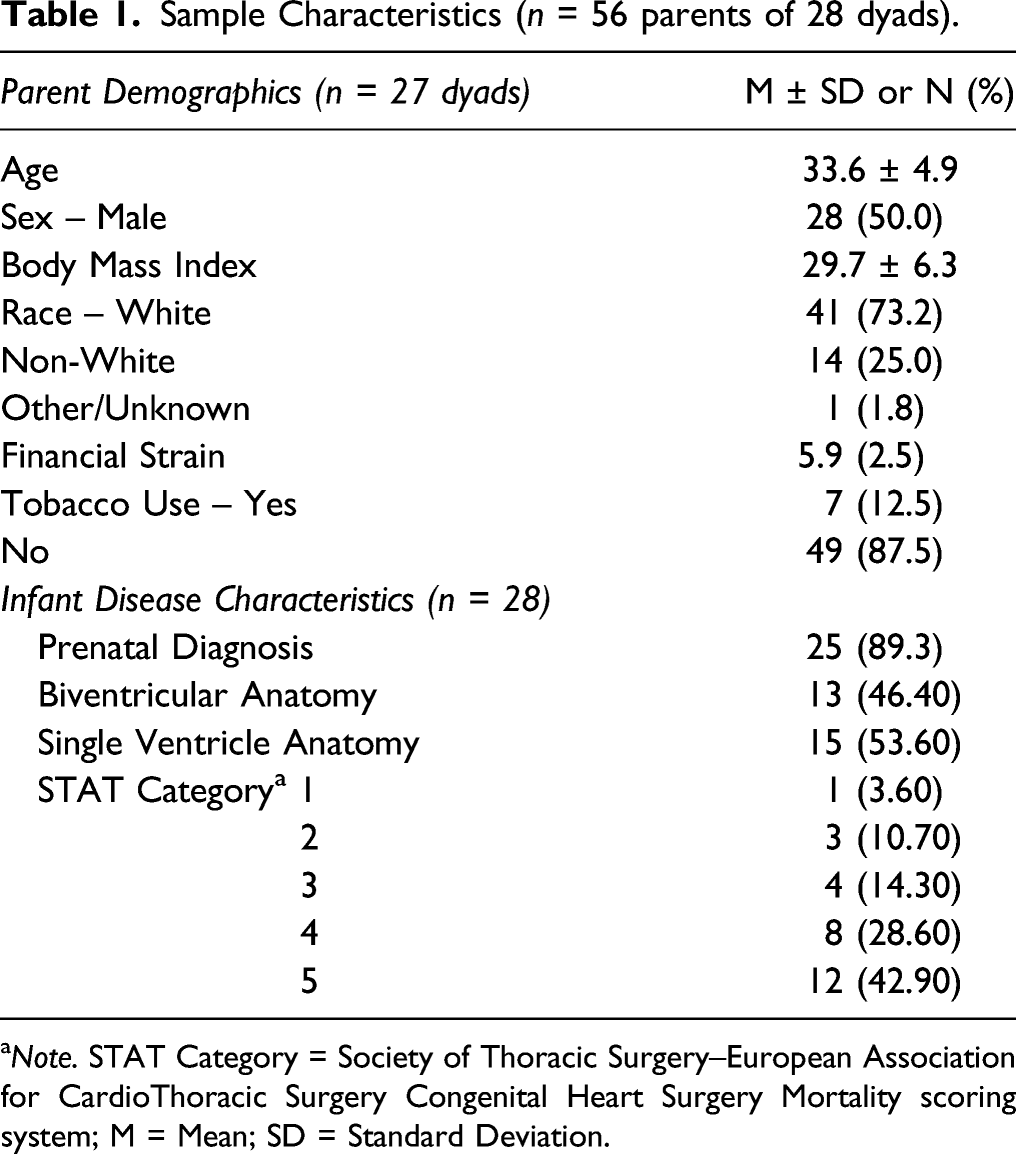
aNote. STAT Category = Society of Thoracic Surgery–European Association for CardioThoracic Surgery Congenital Heart Surgery Mortality scoring system; M = Mean; SD = Standard Deviation.
Out of the total possible 336 samples from parents’ first attempt at saliva collection, we obtained 320 samples (95.24%), of which 297 samples (88.39%) were evaluable. Out of the possible 336 samples from parents’ second attempt, we obtained 205 samples (61.01%), of which 187 (55.65%) were evaluable. These provided samples for 27 of the 28 dyads enrolled in the study. The missing samples were due to parents forgetting or their child being discharged prior to performing the second attempt at saliva collection. A total of 41 samples were not evaluable. Of these, we dropped eight samples due to having sample value greater than 3 standard deviations from the mean (Adam & Kumari, 2009; Stalder et al., 2016). Nine samples were dropped for mechanical breast pumping at the time of saliva collection. The rest of the unevaluable samples were dropped due to errors in sample collection, such as using the incorrect tube, losing tubes, or not recording the time of sample collection. Among the remaining 484 samples, mean wakeup value was 0.31 (SD = 0.16, n = 168), mean 30-minute-post-wakeup value was 0.37 (SD = 0.19, n = 161), and mean bedtime value was 0.10 (SD = 0.10, n = 155). Parents demonstrated an increase in cortisol 30-min after awakening and a nadir at bedtime. Subsequent results and summary statistics pertain to the first available evaluable cortisol measurements, which were obtained between 2- and 19-days post-operation, with a median of six days post-operation.
Aim 1 Results
Raw and Calculated Cortisol (µg/Dl) Measures Compared across Mother–Father Dyads.
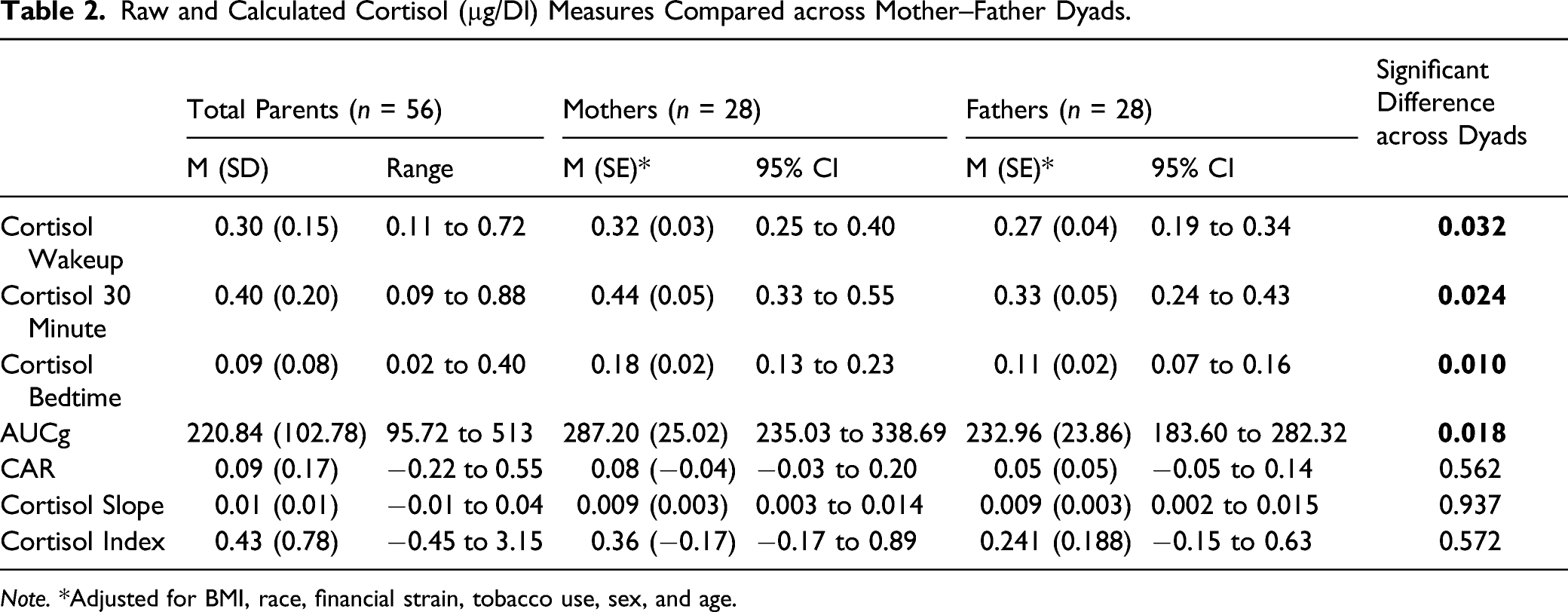
Note. *Adjusted for BMI, race, financial strain, tobacco use, sex, and age.
Aim 2 Results
Associations Between Anxiety and Depressive Symptoms with Cortisol Measures.
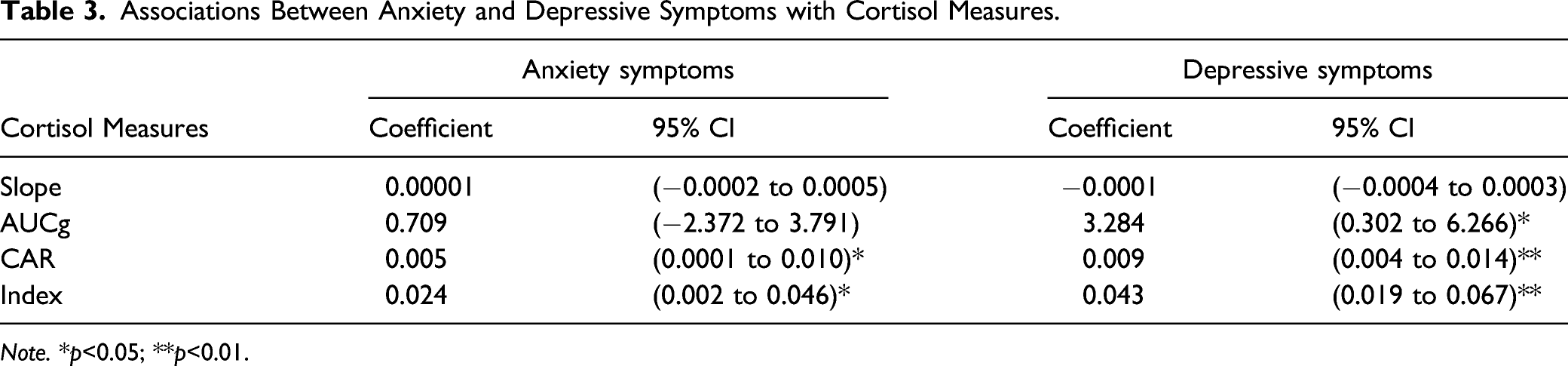
Note. *p<0.05; **p<0.01.
Aim 3 Results
Associations of Parent, Infant, and Environmental Stressors on Cortisol Measures.

Note. *p < 0.05; **p < 0.01.
Discussion
This study evaluated the relationship of awakening and diurnal cortisol measures as biomarkers of physiologic stress with perceived stressors and psychological stress responses in parents in the critical period after their neonate with cCHD undergoes cardiac surgery. We found significant, positive relationships of anxiety and depressive symptoms with both CAR and CI. We also found significant, positive relationships with depressive symptoms and AUCg. These findings support the use of diurnal measures of cortisol in research examining stress and mental health. A strong relationship was found between depressive symptoms in parents, regardless of sex, with several measures of cortisol, including both CAR and CI, as well as diurnal cortisol measures of AUCg. In a study of parents of children with chronic illness, AUCg was also found to significantly correlate with depression (Ljubicic et al., 2020). Associations between discrete cortisol levels and depressive symptoms in postpartum mothers with premature infants in the NICU have also been demonstrated (Howland et al., 2011). Furthermore, elevations in cortisol have been demonstrated in major depressive disorder (Islam et al., 2018; Xu et al., 2018). We also found an association of anxiety symptoms with CAR and cortisol index. Studies exploring these associations have been mixed, with some research demonstrating associations and others not (Caulfield & Cavigelli, 2020).
The perceived stressor of infant appearance and behavior was significantly associated with CAR. Other studies have demonstrated that parental role alteration significantly predict both anxiety and depressive symptoms in mothers and fathers in the PCICU (Lisanti, Allen, et al., 2017; Lisanti et al., 2021a, 2021b). Interestingly, while parental role alteration seems to influence psychologic stress response in parents, infant appearance and behavior was shown to influence a physiologic stress response. More research is needed to examine the influence of perceived stressors on both the psychologic and physiologic manifestations of stress.
Our study demonstrated significant differences in the raw values and total cortisol output (AUCg) between mothers and fathers, which is not surprising considering all the mothers were in the early weeks postpartum. Cortisol is known to be elevated during pregnancy and takes several months to normalize to pre-pregnancy levels (Stickel et al., 2021). More research is needed to determine whether the significant elevations in raw and total (AUCg) cortisol resulted from increased stress experienced by mothers. If this were true, we would have expected to also see differences in the other cortisol measures. But interestingly, because the diurnal measures of slope and index and the awakening measure of CAR were not significantly different, they have enhanced utility as a biomarker in the study of parent stress in the neonatal period for both mothers and fathers. Research on parents in neonatal intensive care units have also found no differences in diurnal cortisol patterns in mother–father pairs of premature infants (Garfield et al., 2018).
Importantly, we demonstrated feasibility of having highly stressed parents provide saliva samples for two consecutive days in the immediate postoperative period. Nearly 90% of saliva samples were evaluable that were collected by parents within one week of their neonate’s open-heart surgery. From a methodological perspective, it was helpful to offer a second opportunity in the postoperative period for parents to provide saliva samples. This increased our ability to utilize data from all but one mother–father dyad in our sample. It also allowed parents to have a second attempt at sample collection when they had samples that could not be used for reasons such as accidentally lost samples or lactation/mechanical breast pumping prior to sample collection. To ensure the accuracy of the associations we assessed, it was important to have parents complete the psychologic stress response measures again at the time of the second attempt at saliva sampling. Another methodological strength is that parents collected saliva samples two days in a row, allowing us to use the mean values across days to enhance accuracy of measurement. It has been noted that weaknesses in recent studies have relied upon a single measure of cortisol, without repeating days or taking multiple measures each day to account for the diurnal pattern (Adam & Kumari, 2009; Ryan et al., 2016; Stalder et al., 2016). Finally, we followed recommendations by Adam and Kumari (2009) and by Ryan and colleagues (2016) to include multiple parameters of cortisol measurement that encompasses the cortisol awakening response and the diurnal decline (cortisol slope and area under the curve). This provides a more robust picture of HPA axis activity. These methodological considerations should be included in future research studies examining saliva biomarkers in parents of infants in the immediate postoperative period after cardiac surgery.
Although we examined cortisol measures as outcome variables in this study, the results cannot be interpreted with causality but only as associations. Adam and colleagues (2017) have proposed possible explanations for the associations between cortisol and health outcomes including direct causality, reverse causality, or shared causality from another factor such as underlying inflammation, genetics, or sleep, and cascading effect. For example, we do not know whether depressive symptoms resulted in elevated CAR levels or whether increased depressive symptoms resulted from elevations in CAR. Future studies should include a longitudinal assessment of perceived stressors, psychologic stress responses, and HPA axis activity to determine the intricacies of these relationships. Research suggests that cortisol secretion may influence long-term mental and physical outcomes (Caulfield & Cavigelli, 2020). Furthermore, future interventional studies should consider incorporating cortisol as an objective outcome measure. For example, a minfulness-based stress reduction intervention with parents of children with developmental delays demonstrated a reduction in parenting stress and CAR (Roberts et al., 2020).
Limitations
We acknowledge the limitation of enrolling only mother–father dyads for this study to include sex as a biological variable for our analysis. Future studies should include single parents, same sex couples, foster or adoptive parents, or caregivers representing other family structures. Future studies should also include parents with more diverse race, ethnicity, and socioeconomic status. We minimized bias by enrolling consecutively and including objective measures of stress with cortisol. We did not control exact saliva sampling times or use objective methods to obtain sampling times. Although use of a diary log has been described by a majority of studies measuring cortisol and has been reported to be sufficiently accurate (DeSantis et al., 2010), objective measurement would strengthen future research (Stalder et al., 2016). We did not require strict awakening and bedtimes. This was due to the expected limitation of new parents with a neonate in the PCICU to adhere to strict times. We did, however, anchor the cortisol values to awakening times and included reported collection times and awake/bedtimes into our analysis, as recommended (Adam & Kumari, 2009; Pruessner et al., 1997; Ryan et al., 2016; Wilhelm et al., 2007). We did not take into consideration seasonal differences, although we enrolled across an entire calendar year (Miller et al., 2016), and we did not assess sleep quality, which could influence cortisol secretion (El Mlili et al., 2021; Labad et al., 2020). We also did not enroll a control group of postpartum parents with healthy infants, which would have allowed us to complete comparative analysis. Larger prospective studies should consider including these variables into their design. Finally, these were exploratory analyses using pilot study data; thus, results were not adjusted for multiple comparisons. The estimates presented will be helpful to inform power calculations for future, larger studies. Despite these limitations, our exploratory analyses suggest that cortisol may be an important biomarker in the examination of parent stress in the PCICU, serving as a foundation for future study in this area. Furthermore, we have provided preliminary evidence of feasibility of including saliva collection in studies of highly stressed parents in a challenging environment.
Footnotes
Acknowledgments
We would like to thank Dr. Fangong Dong for her feedback on this manuscript. We are also very grateful to the parents who participated in this study.
Declaration of Conflicting Interests
The author(s) declared no potential conflicts of interest with respect to the research, authorship, and/or publication of this article.
Funding
The author(s) disclosed receipt of the following financial support for the research, authorship, and/or publication of this article: This work was supported by a grant from the Cardiac Center at Children’s Hospital of Philadelphia. Dr. Lisanti was also supported by NINR T32NR007100.
Data Availability
Deidentified individual participant data will be made available upon request to researchers who provide a methodologically sound proposal for use in achieving the goals of the approved proposal. Proposals should be submitted to
