






Abstract
Background
Apolipoprotein E ε4 (APOE ε4) was shown to be a risk factor for mild cognitive impairment (MCI) and Alzheimer’s disease (AD) dementia. When coupled with sleep disturbance, APOE ε4 posed additional risks to cognitive impairment. But the literature on the association between sleep disturbance and the APOE ε4 status of persons who are cognitively impaired has not yet been systematically examined.
Objectives
To explore and synthesize the relationship between sleep disturbance and APOE ε4 status of adults with MCI and AD.
Methods
An integrative review was guided by Whittemore and Knafl’s methodology. Systematic searches identified studies with multiple sources published before May 20, 2021. A matrix and narrative synthesis was employed to organize and synthesize the findings. Joanna Briggs Institute (JBI) Critical Appraisal tools (2020) were used to evaluate the quality of the selected studies.
Results
A total of 7 studies were included. APOE ε4 was associated with poor sleep quality in terms of the deterioration of nighttime total sleep time, 24-hour total sleep time, rapid eye movement, sleep efficiency, sleep latency, and wake after sleep onset in a population with MCI or AD. The interacted and adjusted relationship between sleep disturbance and APOE ε4 on the progression of cognitive decline was inconsistent.
Conclusions
There is evidence to support an association between sleep disturbance and APOE ε4 in individuals with cognitive impairment, but a further examination of the relationship between sleep parameters and APOE ε4 is warranted, especially as the causal or dose–response relationship remains unclear.
Introduction
According to statistics in 2019, there around 50 million people had dementia globally, and Alzheimer’s disease (AD) is the most common form of dementia, accounting for 60%–70% of dementia cases worldwide (World Health Organization, 2020). Mild cognitive impairment (MCI) is a transitional stage between normal and dementia in the progression of cognition impairment, and the prevalence rate of MCI for every 5 years between 65–84 years of age was approximately 8%, 10%, 15%, and 25% (Petersen et al., 2018). Patients affected by MCI generally have a higher progression rate, and about 15% of adults over 65 years old with MCI progressed to dementia within 2 years (Gao et al., 2018). Since there are no treatments available for dementia, the use of modifiable risk factors to prevent dementia is critical.
Sleep disturbance is a major clinical problem in MCI and AD (Guarnieri & Sorbi, 2015). It is also one of the potentially modifiable risk factors for MCI and AD (Bubu et al., 2017; Burke et al., 2018; Hu et al., 2017; Miller, 2015). Compared with the cognitively normal group, MCI individuals were over 3 times more likely to exhibit poor sleep (Palmer et al., 2018). In the population, about 15% of the AD cases could be attributable to sleep problems (Bubu et al., 2017). A meta-analysis concluded that insomnia patients showed cognitive function impairment, such as episodic memory, working memory, executive functioning, and so on (Fortier-Brochu et al., 2012). Since sleep disturbance was one of the affective symptoms of AD and MCI, and the expression of affective symptoms in the cognitively impaired population was always heterogeneous, this might be related to genetic variability (Banning et al., 2019).
Approximately 95% of the AD population were affected by sporadic AD, and apolipoprotein E ε4 (APOE ε4) was the most potent genetic risk factor related to sporadic AD (De Oliveira et al., 2014; Serrano-Pozo et al., 2021). APOE ε4 was identified as a risk factor for the transition from normal cognition to MCI (Brainerd et al., 2013). About 15%–25% of the population were carrying an APOE ε4 allele, and 2%–3% were homozygous carriers (Wilkins et al., 2021). APOE ε4 heterozygotes had 2.03 to 3.96 times the risk of dementia than those who did not have an APOE ε4 genotype, while homozygous carriers had more than 8 times the risk (Corder et al., 1993).
Currently, however, there is no therapy with which to treat APOE ε4 directly (Serrano-Pozo et al., 2021). Therefore, developing specific prevention strategies for the high-genetic-risk population is paramount. The APOE genotype, itself, is a nonmodifiable risk factor but sleep disturbance is modifiable. Thus, sleep could be seen as a viable target for preventing AD in those who are at risk due to genetics (Palpatzis et al., 2021).
In cognitively intact elders, APOE ε4 had a modulatory effect between the sleep-wake cycle and β-amyloid (Aβ) accumulation (Hwang et al., 2018). Nonetheless, in subjects with MCI and AD, the relationship between sleep disturbance and APOE ε4 remains unclear. To date, only one other review has examined this problem. Banning et al. (2019) reviewed the association between the APOE genotype and affective symptoms in MCI and AD patients. Their research was based on 8 studies and demonstrated no association between APOE ε4 carriership and the presence of sleep disturbance (odds ratio [OR] 0.89, 95% confidence interval [CI] 0.68–1.18). Banning and colleagues focused on sleep disorders and their evidence was compelling. What’s more, sleep disorder is a diagnosis whereas a sleep disturbance requires no diagnosis (Zhu et al., 2018). Thus, there remains the need for a review to examine the association between sleep disturbance and APOE ε4 in adults with MCI and AD.
This integrative review aims to generalize and synthesize current evidence to determine whether sleep disturbance, defined as poor sleep quality or sleep of abnormal duration, is related to APOE ε4 in adults with MCI and AD. The findings will address the gaps in research and methodology, and provide further evidence about the relationship between sleep disturbance and APOE ε4 in individuals living with MCI and AD.
Methods
An integrative review synthesizes the work of other researchers on a specific problem, even if those findings are dispersed in studies of tangential topics or from the viewpoint of other disciplines. This integrative review followed the 5 stages suggested by Whittemore and Knafl (2005): identifying the problem, a bibliographic search or a survey of the relevant literature, a quality appraisal of the works found, data analysis of the findings, and a presentation of the synthesis.
Problem Identification
The aim of this integrative review is to summarize and report on the association between sleep disturbance and APOE ε4 in individuals living with MCI or AD. In our study, sleep disturbance is defined as poor sleep quality or sleep of abnormal duration. The specific research questions were: (i) Is there evidence that sleep disturbance is associated with APOE ε4 in MCI and AD patients? (ii) What are the implications of these findings, if any, for nurses?
Literature Search and Study Selection
Search strategies were implemented systematically in accord with the PRISMA guidelines 2020 (Page et al., 2021) (Figure 1). A preliminary search was conducted to confirm the gap in the literature that our study would fill. We then performed a systematic search in the following databases: PubMed, Cumulative Index to Nursing and Allied Health Literature Plus (CINAHL Plus), Web of Science, PsycINFO, Embase, Scopus, and Cochrane, using each database’s inception and May 20, 2021 as temporal parameters. Our bibliographic searches focused on 3 subjects: (i) sleep OR insomnia; (ii) APOE ε4 OR apolipoprotein E ε4 allele; and (iii) MCI or AD. We used the first 2 search terms to ensure the search was not too limited. Medical Subject Headings (MeSH) and a series of non-indexed keywords were used to establish the search strategy. For example, the search strategy in PubMed was: ((("Apolipoprotein E4" [MeSH Terms]) OR (APOE ε4 [Title/Abstract]) OR (apolipoprotein E ε4 allele [Title/Abstract])) AND (("Sleep Wake Disorders" [MeSH Terms]) OR (sleep [Title/Abstract]) OR (insomnia [Title/Abstract]))). Multiple sources were used to identify relevant documents. We searched ClinicalTrails for registered research, and OpenGrey and ProQuest Dissertations and Theses for grey literature. To discover relevant literature not captured by these search strategies, we manually searched the footnotes, references, and bibliographies of relevant publications. PRISMA flow diagram of systematic search and study selection.
This integrative review included original studies of adults with MCI or AD. Our study population was restricted to adults with MCI and AD because cognition status, sleep and APOE ε4 status vary among individuals. Our study only included works published in English. Studies on subjects other than populations afflicted with MCI or AD were excluded. We also excluded studies at the full-text level that lacked the appropriate content, for example, neither sleep disturbance nor APOE ε4 status was specified in the results or discussion sections of the publication. Publications that focused on sleep disorders other than insomnia, such as sleep apnea, sleep-movement disorder, sleep-disordered breathing, and periodic leg movement disorder were also excluded. Publications identified at the title and abstract level were excluded if they were books, conference abstracts, comments, reports, editorials, reviews, or legislation. Publications were also excluded if their focus was on therapeutic approaches, treatment trials, or preventions. Additionally, the decision whether to include studies developed from the same database or trial was made based on redundancy, i.e., studies that contained duplicate information were disregarded.
The PRISMA flowchart was used to guide the selection of studies. The initial screening was performed by one reviewer (the first author) at the title and abstract level. Then the full texts of potential studies were independently reviewed by two reviewers (the first and second author). Discrepancies during screening were discussed until the reviewers arrived at a consensus, and the corresponding author resolved any final discrepancies.
Quality appraisal
Joanna Briggs Institute (JBI) Critical Appraisal tools (2020) (Moola et al., 2020) were used to appraise the quality of each study’s methodology as well as any possible bias due to study design. These tools are checklists of questions, with 4 options given for each answer (Yes, No, Unclear, Not Applicable). The JBI Critical Appraisal Checklist for analytical cross-sectional studies was used to appraise 2 studies. Five studies were examined using the JBI Critical Appraisal Checklist for cohort studies. Each study was appraised independently by 2 reviewers (the first and second author). Disagreements were resolved by the third reviewer (the corresponding author). However, these tools have no scoring criteria. As a result, studies that satisfied all items on the checklists were defined as being of good quality. Following the guidance of Whittemore and Knafl (2005), no studies were excluded based on the quality appraisal.
Data analysis
For each of the selected studies, data were extracted in a table matrix, including data about the author, year, country, relevant aim(s), design, setting and participants, sample size, cognition measurement, sleep measurement, APOE genotype measurement, relevant vital findings, and covariates. Discrepancies and similarities between studies were clustered and compared. Then, the narrative synthesis was used to manage and summarize the relationship between sleep disturbance and APOE ε4 in adults with MCI or AD.
Results
The results of the literature searches are shown in Figure 1. The initial search of databases and registers yielded 708 studies. After removing 325 duplicate citations, 383 remained for the title and abstract screening. Of these, 354 were excluded as they did not meet the eligibility criteria. Then, the 29 remaining studies were subjected to full-text screening and 7 were included. Otherwise, 2 studies identified from citation searching and OpenGrey were eligible after exclusion. At this point, there were 9 studies.
Of these, 4 studies (Burke et al., 2016a; 2016b, 2018, 2019) used the same database by the same first author, which may lead to bias. Although their standpoints differed, 3 of the publications (Burke et al., 2016a; 2016b, 2019) overlapped in the data analysis on the impact of sleep disturbance and APOE ε4 on the development of probable AD. Thus, we excluded 2 of the 3 publications by Burke et al. (2016a, 2016b). This review is based on the 7 remaining studies.
Study Characteristics
Study Characteristic and Main Findings.
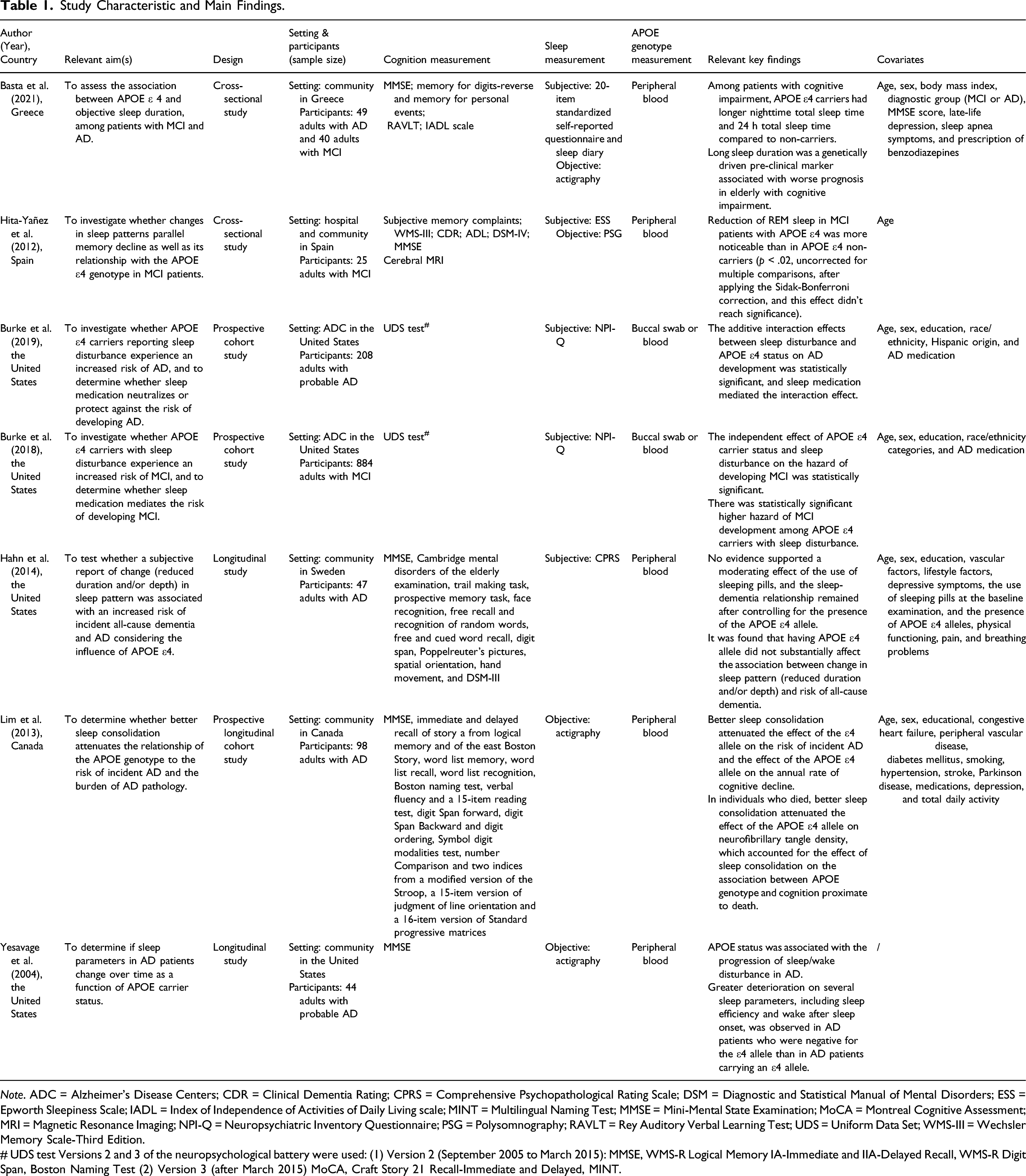
Note. ADC = Alzheimer’s Disease Centers; CDR = Clinical Dementia Rating; CPRS = Comprehensive Psychopathological Rating Scale; DSM = Diagnostic and Statistical Manual of Mental Disorders; ESS = Epworth Sleepiness Scale; IADL = Index of Independence of Activities of Daily Living scale; MINT = Multilingual Naming Test; MMSE = Mini-Mental State Examination; MoCA = Montreal Cognitive Assessment; MRI = Magnetic Resonance Imaging; NPI-Q = Neuropsychiatric Inventory Questionnaire; PSG = Polysomnography; RAVLT = Rey Auditory Verbal Learning Test; UDS = Uniform Data Set; WMS-III = Wechsler Memory Scale-Third Edition.
# UDS test Versions 2 and 3 of the neuropsychological battery were used: (1) Version 2 (September 2005 to March 2015): MMSE, WMS-R Logical Memory IA-Immediate and IIA-Delayed Recall, WMS-R Digit Span, Boston Naming Test (2) Version 3 (after March 2015) MoCA, Craft Story 21 Recall-Immediate and Delayed, MINT.
Participant Characteristics
Five studies recruited community-dwelling populations, and two studies collected participants’ information from Alzheimer’s Disease Centers (ADC) where patients may have been enrolled due to clinician referral, self-referral by participants or family members, active recruitment through community organizations, and so on. Furthermore, participants of two studies were specified as being MCI patients, while four studies had populations that contained AD patients, and one study sample focused on persons with cognitive impairments (i.e., MCI and AD). In those studies that reported the participants’ age range, the average age of the AD population was between 71.8 and 84.6 years old, while the average age of the MCI population ranged from 70.5 to 77.3 years old.
Study Quality
Quality Appraisal of Cross-Sectional Studies.
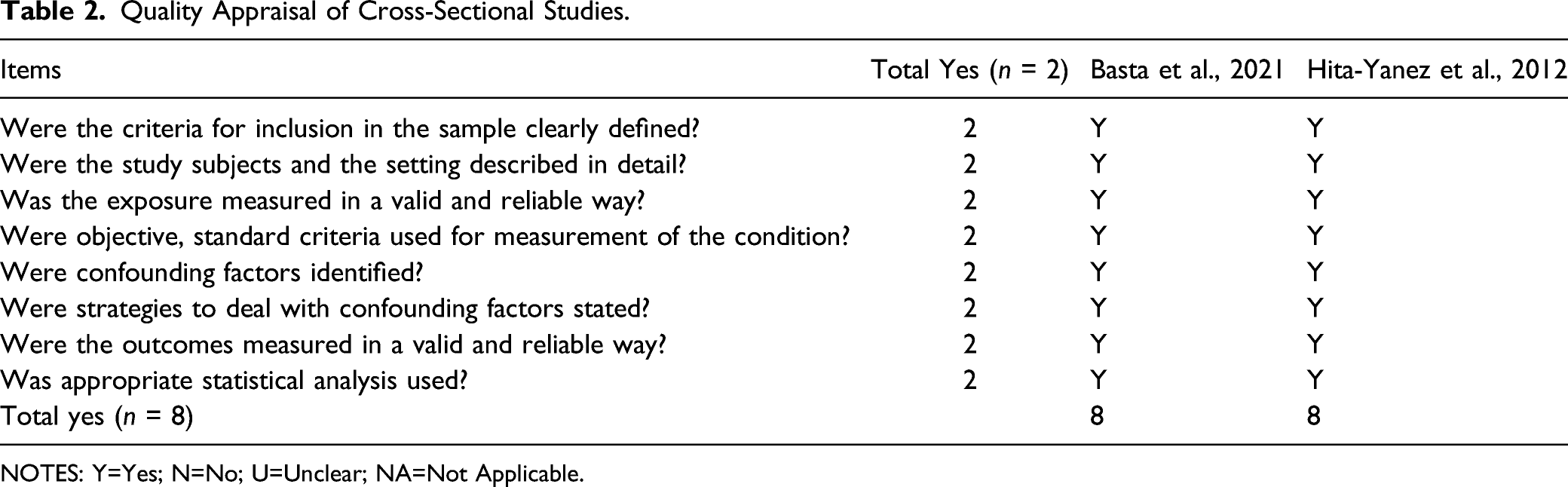
NOTES: Y=Yes; N=No; U=Unclear; NA=Not Applicable.
Quality Appraisal of Cohort Studies.
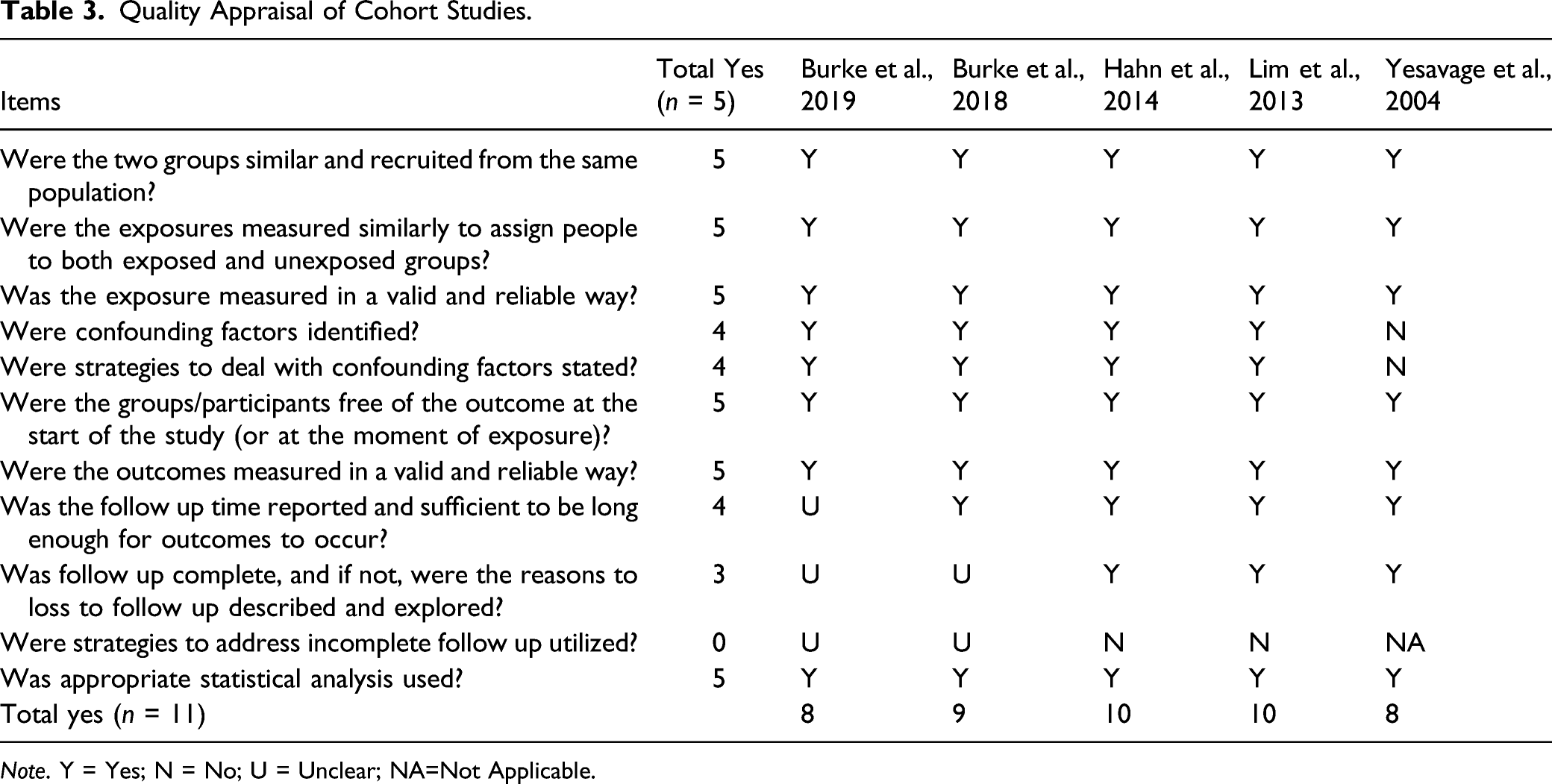
Note. Y = Yes; N = No; U = Unclear; NA=Not Applicable.
Relationship Between Sleep Disturbance and APOE ε4 in Cognitively Impaired Population
Three studies that explored the relationship between objective sleep quality and APOE ε4 found a significant association, and the cognitively impaired population with APOE ε4 showed poor objective sleep quality with aggravated sleep parameters. In persons with cognitive impairment (i.e., MCI and AD), APOE ε4 carriers showed longer objective nighttime total sleep time (nTST) and 24-hour total sleep time (24h TST) than did non-carriers (Basta et al., 2021). Furthermore, rapid eye movement (REM) worsened in MCI patients (Hita-Yanez et al., 2012), while in AD patients with APOE ε4, sleep efficiency (SE), sleep latency (SL), and wake after sleep onset (WASO) deteriorated at baseline (Yesavage et al., 2004). Nevertheless, after at least two MMSE stages [Mini-Mental State Examination staging system (Kraemer et al., 1998)] of cognitive impairment during follow-up, AD patients with APOE ε4 had less deterioration on several sleep parameters, including SE, SL, and WASO, than those without APOE ε4 (Yesavage et al., 2004).
Interaction and adjustment between sleep disturbance and APOE ε4 on the progression of cognitive decline
Findings were inconsistent across four studies, which showed interaction and adjustment between sleep disturbance and APOE ε4 on the progression of cognitive decline. The additive interaction for MCI and AD differed, and the adjustment between sleep disturbance and APOE ε4 on the risk and progression of AD were conflicting.
The additive interaction effect for MCI development between self-reported sleep disturbance and APOE ε4 status was not statistically significant (Burke et al., 2018), while the additive interaction effect for AD development was statistically significant. Additionally, the effect was eliminated in the general AD medication group (Burke et al., 2019).
Compared to APOE ε4 carriers without sleep disturbances, APOE ε4 carriers with sleep disturbances experienced an increased risk of AD (Burke et al., 2019). Conversely, better sleep consolidation lowered the risk and progression of incident AD in APOE ε4 carriers and attenuated the neurofibrillary tangle affected by APOE ε4 allele (Lim et al., 2013). However, Hahn et al. (2014) indicated that the association between self-reported sleep problems and AD risk was not substantially affected by the APOE ε4 allele.
Discussion
This review addresses the association between sleep disturbance and APOE ε4 in persons who are cognitively impaired. Overall, we concluded that cognitively impaired individuals with APOE ε4 had a lower quality of sleep quality than did those who were not APOE ε4 carriers. Nonetheless, the interacted and adjusted relationships between sleep disturbance and APOE ε4 on the progression of cognitive decline were inconsistent.
Our findings on the relationship between sleep disturbance and APOE ε4 are consistent with the current evidence. From the perspective of pathology, the sleep-wake cycle regulated cerebrospinal tau (Holth et al., 2019), and APOE ε4 possibly affected tau aggregation independently of Aβ (Long & Holtzman, 2019). Additionally, insomnia was related to an elevated Aβ production (Chen et al., 2017), while the APOE protein was one of the amyloid scavengers, and APOE ε4 was associated with less Aβ clearance and more Aβ deposition (Castellano et al., 2011; Long & Holtzman, 2019). Thus, APOE ε4 allele carriers with sleep disturbances might affect ongoing neurodegenerative pathology and contribute to the deterioration rate of dementia, which happened in cognitively impaired seniors (Chen et al., 2017). Furthermore, from the perspective of population research, Baril et al. (2022) confirmed the moderating role of the APOE genotype between insomnia and neurodegeneration in participants aged 44–84 years old. In our review, there is an association in cognitively impaired individuals. However, the effects of sleep quality and duration on incident dementia in middle-aged individuals were similar across all APOE genotypes (Palpatzis et al., 2021). It reminds us that the relationship between sleep disturbance and APOE ε4 might be due to changes linked to cognitive impairment or the progression of dementia (Palpatzis et al., 2021).
Based on this conclusion, we could summarize the process among sleep disturbance, APOE ε4, and cognitive function as a vicious circle. First, individuals with APOE ε4 suffer a higher risk of cognitive impairment (Brainerd et al., 2013; De Oliveira et al., 2014; Serrano-Pozo et al., 2021). Second, sleep disturbances are common in those who are cognitively impaired or experience a worsening cognitive function or accelerating cognitive decline (Mander et al., 2016). In this way, the sleep disturbance would be aggravated. In addition, the association between sleep disturbance and APOE ε4 in people with cognitive decline has been concluded in this review. Conversely, better sleep consolidation could attenuate the neurofibrillary tangle affected by APOE ε4 allele (Lim et al., 2013). Therefore, it is necessary to focus on sleep screening and intervention, suggesting that sleep assessment could be a relatively inexpensive and cost-effective way to stratify APOE ε4 carriers. Additionally, improving sleep quality might be an intervention for individuals exposed to an APOE ε4 genetic risk of AD.
However, this integrative review is inconsistent with a previous study relating to this topic. Banning et al. (2019) concluded that there was no relationship between APOE ε4 and sleep disturbance, which is theoretically close to a sleep disorder, in the cognitively impaired population. Different definitions might be at the root of the disparity; the terms sleep disorder and sleep disturbance were used interchangeably in Banning’s review. In contrast, only insomnia, which is a kind of sleep disorder, was included in our review. Other sleep disorders like sleep apnea, sleep-movement disorder, sleep-disordered breathing, and periodic leg movement disorder were excluded. Regarding the precise terms used for and definitions of sleep disturbance in publications on the cognitively impaired elderly, no certainty can be had. Terms used to describe sleep disturbance are inconsistently used in publications on populations with MCI or AD. Zhu et al. (2018) clarified the concept of sleep disturbance in people with diabetes, indicating that it encompassed poor sleep quality and abnormal sleep duration. These terms have subtle but significant distinctions. Thus, incorrectly used and undefined terms may have led to different results, reminding us of the necessity of clarifying our definition of sleep disturbance when discussing the cognitively impaired population.
Sleep disturbance and APOE ε4 are critical issues that greatly influence the development of MCI or AD. Persons with MCI were at a high risk of AD, and their cognitive decline rate and risk of dementia were much higher than older adults without MCI (Ward et al., 2012), while AD influenced the ability of the elderly to engage in daily living and social activities, reduced their quality of life and brought a heavy burden to the person’s family and community (Livingston et al., 2020). The importance of healthy sleep, especially in cognitively impaired persons with APOE ε4, remains underappreciated. This review adds to the current evidence and reveals the possible adverse effect of sleep disturbance on the cognitive performance in APOE ε4 carriers with MCI or AD.
This integrative review has implications for education, research, and clinical practice in nursing. In nursing education, it is necessary to raise nurses' awareness of the importance of sleep for populations with MCI and AD, especially those with APOE ε4. Beyond that, geriatrics nurses should be made competent to screen for sleep disturbance in cognitively impaired individuals with APOE ε4. Simply put, nurses need to be provided with genomic practical skills (Dagan et al., 2021). Regarding research and clinical practice, there is an urgent need to expand high-quality research, and it is necessary to act on a better translation from beachside to bedside. In this process, nurses play an essential role in promoting and strengthening the sleep of patients (Pellatt, 2007). Therefore, it would be plausible for nurses to understand modifiable risk factors and their interaction with nonmodifiable factors, which has been proven critical in the design of precision interventions (Eid et al., 2019). Thus, multidisciplinary collaborations among nurses, sleep specialists, geneticists, neurologists, and researchers are needed to better study and manage sleep disturbance in cognitively impaired persons with APOE ε4.
This integrative review identifies obvious limitations in the literature. First, several studies measured sleep by the Neuropsychiatric Inventory (NPI). However, the NPI only has one item about sleep status. In addition, only two studies used multiple sleep measurements that combined objective and subjective tools. Thus, future studies should use both objective and subjective sleep assessments since they evaluate different aspects of sleep, including validated and reliable questionnaires or scales and sleep diaries. If possible, consider objective measures, such as polysomnography, actigraphy, and single-channel electroencephalography. Second, the studies we included divided groups dichotomously into APOE ε4 non-carriers and carriers of based on at least one APOE ε4 allele. However, the dose-effect of the APOE ε4 allele, namely the heterozygosity and homozygosity, might be noticeable to study.
This integrative review, itself, has several limitations. First, conference abstracts, which may summarize relevant upcoming findings, were excluded. Second, the causality between sleep disturbance and APOE ε4 cannot be determined, and future research could use Mendelian randomization, which may focus on a causal effect. Third, this integrative review was based on integration because of the heterogeneity of original research, and future studies could shed more light on decreasing the heterogeneity by, for example, using subjective and objective sleep measurements, focusing on the rigorous selection of covariates, and raising the diversity of controlled covariates (Yeh et al., 2018).
Conclusion
The evidence supports a potential relationship between sleep disturbance and APOE ε4 in the cognitively impaired population. This finding indicates that the genetic risk factors of AD could be modified, and their adverse effects could be attenuated and even neutralized by better sleep consolidation or the improved management of poor sleep quality. Still, further research designed to test the causal relationship between sleep disturbance and APOE ε4 would contribute more to this area of medicine, and it allows us to identify practical measures that could be taken to slow deterioration of sleep quality and cognitive decline, which helps nurses to be more competent in preventing AD. Thus, much more research needs to explore the causal or dose-response association between sleep disturbance and APOE ε4 in the cognitively impaired population.
Footnotes

Declaration of Conflicting Interests
The author(s) declared no potential conflicts of interest with respect to the research, authorship, and/or publication of this article.
Funding
The author(s) received no financial support for the research, authorship, and/or publication of this article.