







Abstract
Purpose:
To evaluate the awareness of ophthalmologists about assessing the mental health of patients and usefulness of the Patient Health Questionnaire (PHQ-9) and Generalized Anxiety Disorder (GAD-7) survey.
Methods:
This web-based survey was performed in 2020 at an eye hospital in Saudi Arabia. Participants included ophthalmologists and physicians. Participants were queried on the need to assess mental health of patients, usefulness of the screening tool, and barriers to assessment. Their responses were graded on a Likert scale and Rasch analysis was performed.
Results:
Of the 100 participants, 72 were aware of assessing mental health of eye patients and 82 expressed about limited skills for such assessment. The median score for perceived usefulness of the PHQ-9 as screening tool to suspect depression was −1.0 (inter quartile range, −1.0: 0.0) [Mean Rasch score = −0.735]. The median score of perceived usefulness for the GAD-7 as screening tool to suspect anxiety was −1.0 (inter quartile range, −1.0: 0.0) [Mean Rasch score = −0.695]. The PHQ-9 related score was significantly correlated to “30–39 years” age group (Kruskal Wallis p = 0.04) and non-Saudi professionals (Mann Whitney p = 0.005). The GAD-7 related score was significantly correlated to non-Saudi professionals (Mann Whitney p = 0.04). The mental health related score was significantly and negatively correlated to the “40–59 years” age group (Kruskal Wallis p = 0.04).
Conclusions:
Although awareness of mental health assessment was high, eyecare professionals felt with inadequate training for performing the screening. PHQ-9 seems to be more acceptable to screen for depression than GAD-7 for screening anxiety.
Introduction
Mental and physical health are interconnected. Systemic or local chronic disease negatively affects the mental health of an individual. 1 Co-existing mental and physical diseases can diminish quality of life and increase the duration of illness resulting in worse health outcomes, 2 potentially causing anxiety or depression. Anxiety and depression can result in poor compliance of the medical regimen for long-term treatment and care. Long-term anxiety and depression represent an economic and societal burden due to lost productivity and increased use of health services. Hence the issue of mental health should be addressed to provide comprehensive and effective care to patients with chronic eye diseases.2,3
In industrialized countries, family physicians understand the need for mental health care for patients with chronic illness. 4 Up to 60% of discussion between a family physician and a patient with chronic diseases is related to health promotion and counseling regarding the condition. 5 Thus, the attending caregiver must be aware of the role of mental health in treating chronic conditions and its impact on ongoing treatment.
Although assessing mental health of eye patients with chronic diseases is crucial sending each patient to a psychologist or psychiatrist is untenable. Hence, simple screening tests to determine the mental health of patient can be useful to eyecare providers.
The Patient Health Questionnaire (PHQ-9) is a test with good validity used for patients and the general population.6,7 It has nine questions related to depression scale of a patient with chronic health ailment. It is validated and a powerful tool not only to assist clinician to suspect depression but also evaluate the treatment response on level of depression. For anxiety associated with somatic disorders, the Generalized Anxiety Disorder (GAD-7) is a good reliable and quick tool. 8 Although it can be administered by non-clinical staff, the responses should be interpreted by a trained clinician. This questionnaire can also be used telephonically to evaluate patients with chronic diseases.
To the best of our knowledge, the level of awareness among eyecare professionals regarding the need for assessing the anxiety and depression among patients with chronic eye diseases and usefulness of PHQ-9 and GAD-7 for screening mental health has not been evaluated.
We present the rate and determinants of the awareness among eyecare professionals regarding the need for evaluating anxiety/depression of patients with chronic eye disease and their perception on the utility of PHQ-9 and GAD-7 as screening tools.
Methods
This study was approved by the Institution Research Board (1958-P). The study population consisted of all eyecare professionals (consultants, fellows, residents) affiliated to the King Khaled Eye Specialist Hospital (KKESH). Those who agreed to participate and signed a written informed consent document were included in the study. Those with more than 50% of incomplete responses to the main questionnaire or refusing to participate in the study were excluded. To maintain participant anonymity, the personal identity of the participant was delinked to the responses at the time of analysis.
Open epi software 9 was used to calculate the sample size for a cross sectional survey of the study population of 250 individuals with an assumed rate of awareness of 59%. 4 To achieve 95% confidence interval, 10% acceptable error margin, and 1.5 factor for the study design, 102 randomly selected participants were required.
A web-based questionnaire with nine questions was sent to the participants using the Google platform with a request to complete and submit the survey to the study investigators. All efforts were made to minimize the rate of dropouts and non-participation.
Data were collected on patient demographics including, gender, age group, nationality, duration of work, and place of work. The participants responded regarding their practice of paying attention to mental health of eye patients. If the response was negative, the reasons were queried. The participants were asked if they were trained in the task of assessing mental status. The participants also responded regarding their perception of PHQ-9 and GAD-7 as screening tools for assessing anxiety and depression in their patients with chronic eye diseases. Their responses were graded on a Likert scale (Supplemental Appendix 1). The response options of last two questions were related to PHQ-9 and GAD-7 as screening tools and they were graded as fully agree, agree, neutral, disagree, and fully disagree.
The data from web-based survey were transferred to Statistical Package Social Studies (SPSS 25) (IBM Corp., Armonk, NY, USA). The awareness of the need for assessing mental health and use of screening tools are presented as numbers and percentages. Logit value of PHQ-9 and GAD-7 related responses for each participant was generated for performing Rasch analysis. The mean and standard deviation of the utility of mental health assessment screening tools as perceived by eyecare professionals were correlated to demographic determinants. p < 0.05 was considered statistically significant.
Results
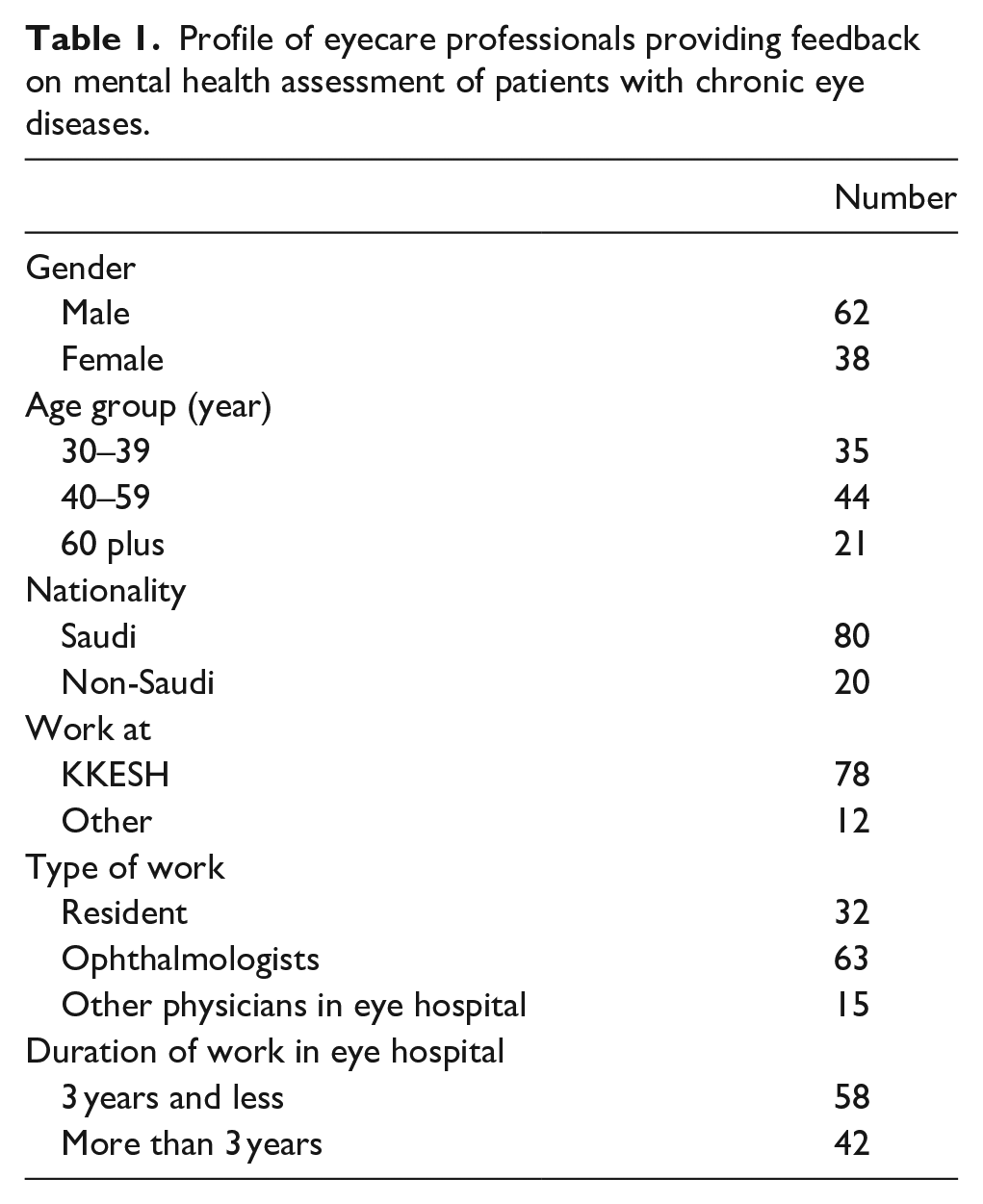
The study sample was comprised of 100 eyecare professionals. Table 1. Three-fourth of participants were from one institution. One third of participants were resident ophthalmologists while one in eight were physicians working in the eye hospital.
Profile of eyecare professionals providing feedback on mental health assessment of patients with chronic eye diseases.
Seventy-two participants replied that they pay attention to the mental health of their eye patients. The reasons for not paying attention to the mental health of the patients included not part of their training (5), not knowing the consequences of non-adherence to the prescribed therapy (2), not having qualified manpower within the institute to assess/address mental health (8), and combinations of above issues (20).
Among eye care professionals, 82 believed that they were not professionally qualified to assess and address the mental health status of their patients with chronic eye diseases.
The median score of the perceived usefulness of PHQ-9 form as a screening tool to suspect depression among patients was −1.0 (inter quartile range −1.0: 0.0) [Mean Rasch score = −0.735]. The median score of the perceived usefulness of GAD-7 as a screening tool to suspect anxiety among patients was −1.0 (inter quartile range −1.0: 0.0) [Mean Rasch score = −0.695]. The median score was −0.5 (IQR −1.0; 0.0) (mean Rasch score −0.715) for the usefulness of both the PHQ-9 and GAD-7 to assess mental health of patients with chronic eye diseases.
The overall Rasch score was correlated to different determinants (Table 2). The PHQ-9 related Rasch score was significantly correlated to 30–39 years age group (Kruskal Wallis p = 0.04), Non-Saudi (Mann Whitney p = 0.005). The GAD-7 related Rasch score was significantly correlated to Non-Saudi (Mann Whitney p = 0.04). The mental health related Rasch score was significantly and negatively correlated to the 40–59 years age group (KW p = 0.04).
Eyecare professional perceived usefulness score of screening tools to suspected depression, anxiety and mental health of patients with chronic eye diseases by determinants.
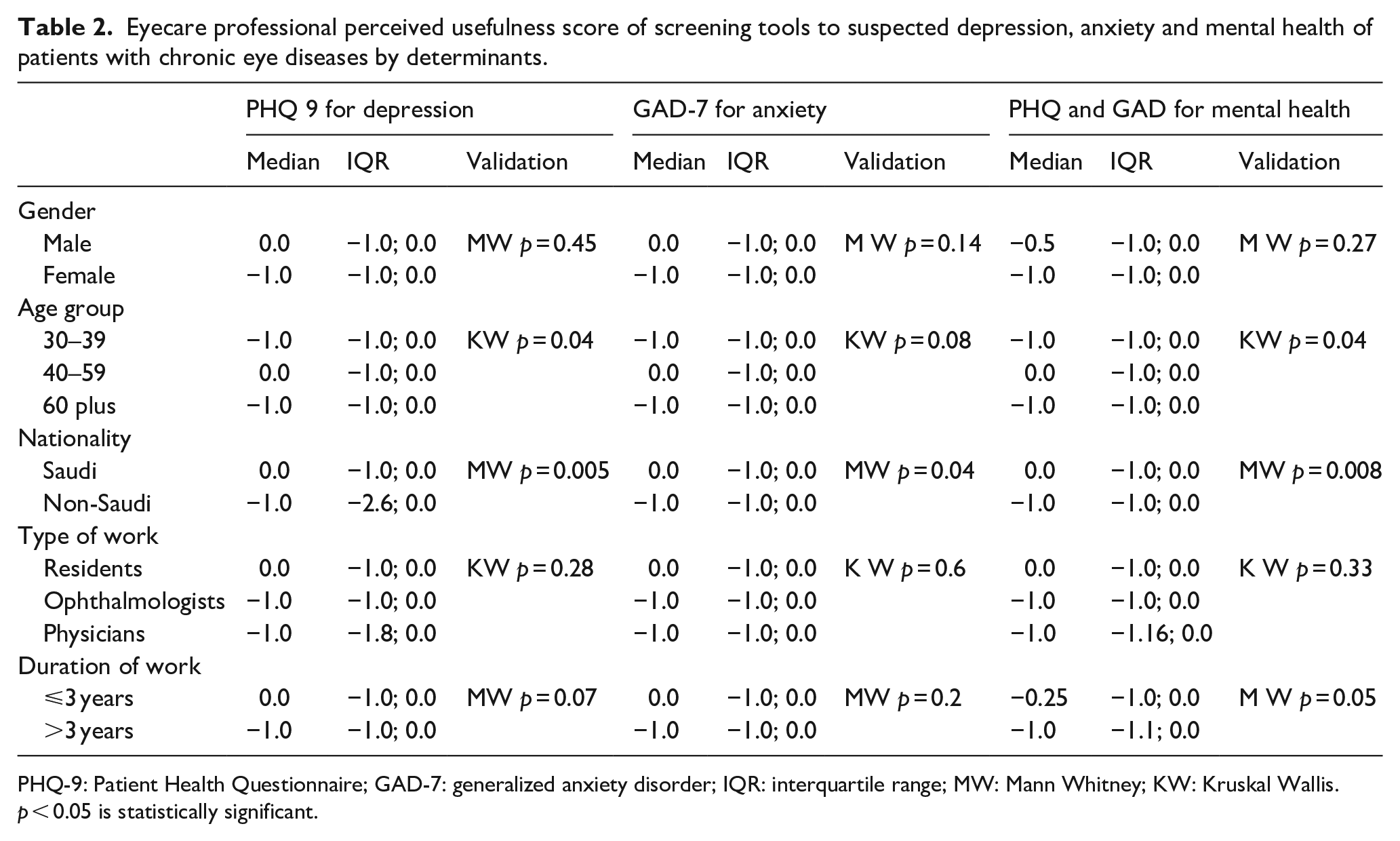
PHQ-9: Patient Health Questionnaire; GAD-7: generalized anxiety disorder; IQR: interquartile range; MW: Mann Whitney; KW: Kruskal Wallis.
p < 0.05 is statistically significant.
Discussion
The majority of eyecare professionals at a tertiary eye hospital in Saudi Arabia were in agreement for the need to assess the mental health of patients with chronic eye diseases. However, they expressed their inability to review the mental status of their patients due to lack of skills and non-availability of expert manpower at their institutes. Both PHQ-9 and GAD-7 were perceived as useful screening tools for mental health status in patients with chronic eye diseases. PHQ-9 was perceived as more useful to screen for depression than GAD-7 for screening anxiety. The perception of usefulness of these screening tools varied by nationality and age groups of eyecare professionals.
Mental health issue in patient with chronic eye diseases is closely linked to the age related blinding diseases and thus they both cannot be separated. Previous studies have indicated that there is insufficient specialized care providers to assess and manage mental health in geriatric populations even in industrialized countries. 10 With increasing life expectancy globally this will be a major health challenge. 10 Hence, there will be a significant need for task shifting and rapid assessment tools for identifying vulnerable people with mental health issues among patients with chronic eye disease. There is a need to train eyecare professionals to suspect mental health issues in early stages and refer them for management in a timely fashion. Evidence on the current level of awareness among eyecare professionals will be useful for identifying the areas the need to build capacity and to evaluate the impact of such strategies in the study area.
In gynecology, addressing mental health issues of females with polycystic ovarian syndrome was a useful adjunct to conventional treatment. 11 Similarly family physicians have addressed depression while adopting a holistic approach for diabetic patient care. 12 Cancer patients responded better when the healthcare provider included psychotherapy along with oncology care. 13 Thus eyecare also need to incorporate a combined strategy to deal with mental health issues in patients with chronic eye disease.
Anxiety and depression among adult patients with visual impairment has been previously documented. 14 Huang et al. 15 demonstrated that glaucoma negatively impacted the mental health of patients. In Brazil, depression was associated to posterior segment diseases 16 Stress management is also linked to preventing progression of eye disease and improved visual recovery 17
A German study reported that the PHQ-9 and GAD-7 in evaluating anxiety and depression among patients with rare chronic diseases was successful at detecting mental health issues. 18 A study used these questionnaires for assessing glaucoma patients. 19 Although several survey tools are available such as SCID-IV, 20 Geriatric depression scale, 21 Depression inventory, 22 we elected to use the World Health Organization (WHO) recommended GAD-7 because it is simple and user friendly. Similarly an array of tools are available to assess anxiety in patients like COPD-Anxiety-Questionnaire (CAF), 23 Zung Self Rating Anxiety Scales (SAS). 24
The awareness among non-Saudi eye care providers was significantly greater than Saudi participants. However, all the younger participants were Saudi nationals studying ophthalmology and subspecialties, the difference in curriculum focusing on mental health issues could be the reason for differential awareness rather than nationality. The effect of age was also an independent predictor of awareness among eyecare providers. Future studies are needed to investigate this relationship.
There were few limitations of this study. This study was a part of multicenter study and was supported by the “Prevention of Blindness” unit of the World Health Organization. Due to circumstances arising from the Covid-19 pandemic, each center’s data were reviewed separately. Thus, the study outcomes were negatively affected by the subsample size and therefore would be useful at the local study area level instead of globally. This survey was administered using web-based platform. Hence, al health staff may not have equal opportunity to participate and hence extrapolation of the study results to all eye care professionals should be done with a caution.
The importance of assessing mental health while treating chronic eye diseases as reported by three fourths of eyecare providers in this study is an encouraging trend. However, the barriers of insufficient training and insufficient time should be considered while formulating the policy of incorporating mental health care of patients with chronic eye diseases. Additionally, the outcomes of this study will aid in developing a future management plan that can be applied to residency training programs in Saudi Arabia and worldwide in order to avoid unnecessary consequences.
Supplemental Material
sj-pdf-1-ejo-10.1177_11206721211044634 – Supplemental material for Ophthalmologists perceived usefulness of Patient Health Questionnaire (PHQ-9) and Generalized Anxiety Disorder (GAD-7) for evaluating the mental health of patients with chronic eye diseases
Supplemental material, sj-pdf-1-ejo-10.1177_11206721211044634 for Ophthalmologists perceived usefulness of Patient Health Questionnaire (PHQ-9) and Generalized Anxiety Disorder (GAD-7) for evaluating the mental health of patients with chronic eye diseases by Samar Swaillam, Stefania Fortini, Anwar Ahmed, Silvio P Mariotti, Sami Shahwan and Rajiv Khandekar in European Journal of Ophthalmology
Footnotes
Acknowledgements
We thank Dr Sarah Hilali, Ms. Maha AlQahtani, and Dr. Enmar AlMazyad for assisting in recruitment and improving participation rate of this study. We thank all ophthalmologists for their whole hearted support through participation in this study.
Author contributions
Samar: Planning, logistic support, finalization of manuscript. Anwar: Planning, field part, data management, draft manuscript. Stefania: Concept, final inputs in the manuscript. Silvio: Concept, final inputs in the manuscript. Sami: Planning, logistic support, finalization of manuscript. Rajiv: Planning, field part, data management, analysis, and manuscript writing.
Declaration of conflicting interests
The author(s) declared no potential conflicts of interest with respect to the research, authorship, and/or publication of this article.
Funding
The author(s) received no financial support for the research, authorship, and/or publication of this article.

Supplemental material
Supplemental material for this article is available online.
References
Supplementary Material
Please find the following supplemental material available below.
For Open Access articles published under a Creative Commons License, all supplemental material carries the same license as the article it is associated with.
For non-Open Access articles published, all supplemental material carries a non-exclusive license, and permission requests for re-use of supplemental material or any part of supplemental material shall be sent directly to the copyright owner as specified in the copyright notice associated with the article.
