







Abstract
To the Editor,
We read with interest Jasani et al.'s manuscript demonstrating significant reduction in the presentation of rhegmatogenous retinal detachments (RRDs), and increase in the proportion of macula-off RRDs and proliferative vitreoretinopathy cases at three tertiary Centres in North-West of England during the Coronavirus disease 2019 (COVID-19) lockdown when compared to a pre-lockdown cohort. 1
We conducted a similar, retrospective analysis of all vitreoretinal procedures undertaken at Royal Hallamshire Hospital, Sheffield, between March 21, 2020 (beginning of the lock-down period in the UK) and May 16, 2020, and compared this to a comparative cohort between March 23, 2019 and May 19, 2019.
Royal Hallamshire Hospital provides a tertiary referral service for patients with vitreoretinal conditions and emergencies, including those with complex medical needs in Sheffield and South Yorkshire region, serving a combined population of 2.5 million patients.
The baseline characteristics of our cohorts are presented in Table 1. The overall decrease in vitreoretinal workload compared to the correspondent period in 2019 was of 48.6%, and 34.1% in the presentation of RRDs, similarly to previous reports.1,2 We demonstrate a reduced number of vitreoretinal lists (−39.4%) and of procedures performed in each list (−15.5%), an increased duration of each theatre session (p = 0.00001), increased number of days between onset of symptoms and presentation to Vitreoretinal Unit (p = 0.025), increased proportion of macula-off RRDs (+20%) and increased use of local anaesthetic during the pandemic (+9.5%) (Figure 1). Notably, the duration of vitreoretinal procedures and the number of days between onset of symptoms to vitreoretinal surgery did not change significantly (p = 0.426 and p = 0.456 respectively), in spite of the increased time spent in wearing personal protective equipment and in patients’ turnover in theatre, and of reduced theatre sessions available (Figure 1). Interestingly, although we recorded a difference in presenting mean visual acuities of patients with macula-OFF RRDs during the 2019 (1.54 ± 1.37 logMar) and 2020 (1.77 ± 1.36 logMar), this was not significant (p = 0.24 – Table 1), contrary to previous reports.2−4
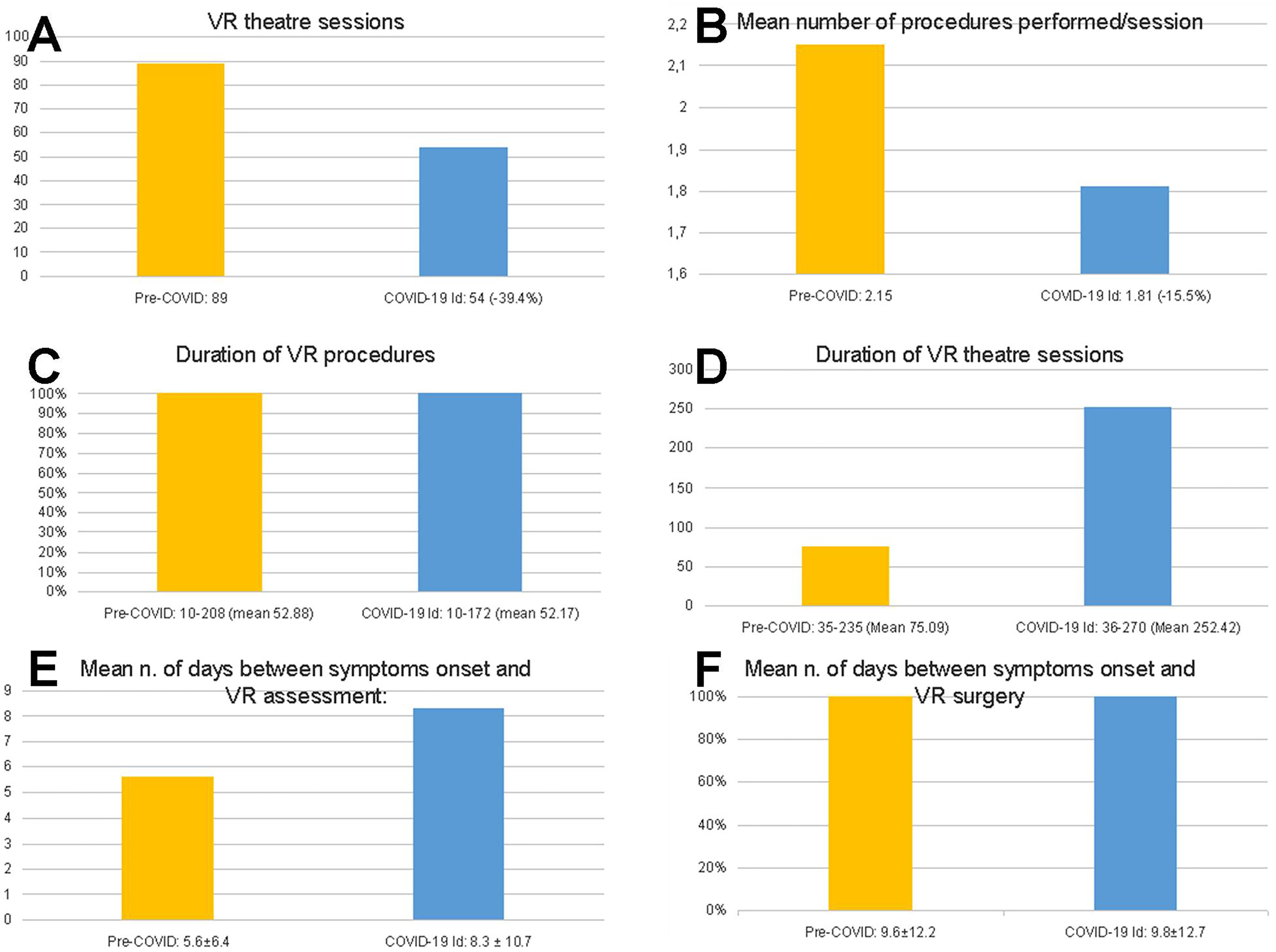
Comparison between 2019 and 2020 cohorts.
Cohort characteristics.
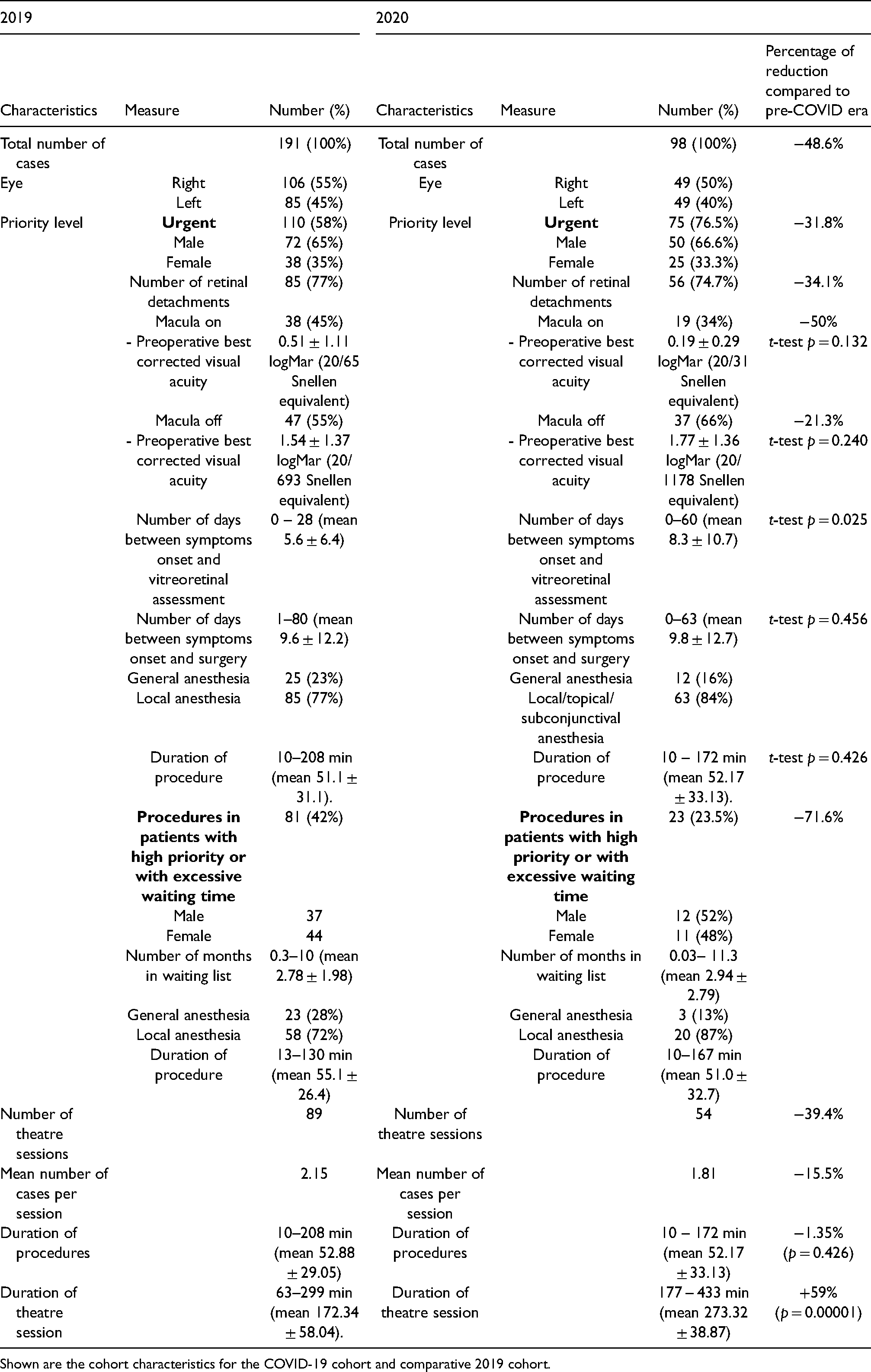
Shown are the cohort characteristics for the COVID-19 cohort and comparative 2019 cohort.
Our results pose important implications also on the vitreoretinal surgical training, having the surgical case volume decreased by almost 49% compared to pre-COVID period and being the overall efficiency of operating lists reduced. This is in line with previous studies which reported the significant effects of COVID-19 on general ophthalmology and subspecialty vitreoretinal training.5
We therefore suggest significant changes to the vitreoretinal practice of a busy tertiary referral centre in response to COVID-19 restrictions. Changes in management include reduced surgical case volume and efficiency of operating lists, prioritisation of urgent activities, longer turnover time in between cases, judicious use of general anaesthetic and reduced surgical teaching opportunities.
Footnotes
Declaration of conflicting interests
The author(s) declared no potential conflicts of interest with respect to the research, authorship, and/or publication of this article.
Funding
The author(s) received no financial support for the research, authorship and/or publication of this article.
