






Abstract
Introduction
Healthcare contributes 4–6% of global CO2 emissions due to energy use, pharmaceuticals, and waste. Ophthalmology plays a significant role, particularly in managing dry eye disease (DED), which is a leading cause of eye care visits. DED affects up to 50% of people worldwide, with its incidence increasing with age, climate-related factors, and screen use. This study aims to gather insights from DED experts on their opinions toward sustainability in ophthalmic care.
Methods
An online survey was distributed to attendees of the European Dry Eye Society conference, running from June to September 2024. The survey consisted of 10 questions related to sustainability practices in DED management. Data on demographics were collected and analyzed using percentages.
Results
Of the 372 respondents, 83.7% expressed concerns about global warming, and 78.5% believed that ophthalmic care produces excessive waste. Most respondents (79.7%) considered that single-use preservative-free vials generate significantly more waste than multidose alternatives. Additionally, 89.2% supported recycling methods. Ophthalmologists also recognized the rising impact of digital eye strain and saw potential in using apps to manage DED more sustainably.
Conclusions
The survey highlights a strong consensus among DED experts about the need for more sustainable practices in ophthalmology. Key findings include concerns about waste, especially from single-use vials, and the potential for digital solutions to improve sustainability in DED management. The results suggest an opportunity to integrate environmentally friendly actions into ophthalmic care.
Keywords
Introduction
The carbon footprint of healthcare accounts for approximately 4–6% of global carbon dioxide emissions, driven by energy consumption, pharmaceutical manufacturing, transportation, infrastructure, and healthcare-related waste. 1 Ophthalmology contributes to and is affected by this environmental burden, given the high volume of outpatient consultations, chronic treatments, procedures, and surgeries. 2
Dry Eye Disease (DED) is the third most common reason for visits to eye care professionals,3,4 affecting approximately one in eleven people globally, with reported prevalence ranging from 5% to 50% depending on population and diagnostic criteria.3,5 The incidence of DED increases with ageing 6 and is influenced by environmental and behavioural factors, several of which are linked to climate change and modern lifestyles. 7 As a result, the sustainability of DED management has emerged as a relevant and timely issue. 8
Most sustainability-related surveys in ophthalmology have focused on surgical settings, particularly cataract surgery and operating theatre waste.9,10 While these studies have provided important insights, they do not address the environmental impact of chronic, long-term ophthalmic conditions that require repeated consultations, continuous topical therapy, and large-scale pharmaceutical use. DED represents a different sustainability challenge, characterised by high treatment frequency, long-term use of preservative-free formulations, cumulative packaging and distribution waste.
By specifically surveying DED specialists, this study provides new knowledge on sustainability perceptions. The value of this work lies in highlighting how sustainability considerations are perceived in chronic eye care, identifying areas of tension between clinical effectiveness, patient safety, and environmental responsibility. Rather than establishing clinical recommendations, the study aims to inform future research, policy discussions, and the development of more sustainable models of care for Dry Eye Disease.
Methods
An online survey was emailed to all attendees of the European Dry Eye Society annual conference on June 27, 2024, and remained open until September 30, 2024. The reply to the questionnaire was required to obtain credits from the Continuous Professional Development of the European Dry Eye Conference. Responses were deidentified for analysis. Participants were asked about their gender, age, and location. The survey consisted of 10 questions about relevant aspects of sustainability and DED management (see Addendum 1).
The questionnaire was developed by the authors based on current literature on sustainability in ophthalmology and on clinical experience in DED management. The survey was designed to capture expert opinion rather than to serve as a diagnostic or outcome-measuring instrument.
Most items were assessed using a 5-point Likert scale with the following response options: Very much, A lot, Neutral, A little, and Not at all. For reporting overall levels of agreement or concern, responses of Very much and A lot were aggregated and expressed as a combined percentage of respondents, reflecting high agreement or high concern. This aggregation approach was used consistently across all relevant analyses and figures.
Given the ordinal nature of Likert-scale data, results are primarily presented as descriptive statistics. In addition to aggregated percentages, measures of central tendency appropriate for ordinal data were examined, including the median (as an indicator of the central response) and the mode (as the most frequently selected response), to better characterize group consensus.
Data examination and analysis were performed using Microsoft Excel (Microsoft Corp., Redmond, WA, USA). Results are presented descriptively, with percentages used to illustrate the distribution of responses across predefined categories.
Results
Of the 611 attendees, 372 (61%) responded to the questionnaire. 51% were women, and 49% men. The age distribution was 38% below 40 years, 56% between 40 to 65 years and 6% above 65 years. The participants came from Europe, 82%; Asia, 8%; America, 5%; and Africa, 5%.
The opinions of the respondents are shown in Figure 1 including details in addendum 2, the results are statistically significant. Most ophthalmologists, 83.7%, are worried about global warming, and 78.5% believe that the waste produced in ophthalmic care is excessive. The responders identify ophthalmic treatment (45.5%) and lifestyle (44%) as areas that offer the most room for improvement in terms of sustainability. Many DED experts, 79.7%, agree that unidose preservative-free single disposable vials generate 4 times more waste than non-preserved multidose with the same efficacy and results. 69.8% are aware of environmental concerns regarding forever chemicals like polyfluorinated alkanes, and there is a growing interest in limiting their use in treatments to reduce long-term environmental harm. Most ophthalmologists (89.2%) consider recycling a useful step towards reducing waste. Adjuvant treatments are considered by 77.2% of ophthalmologists as an effective way to reduce dependency on eyedrops. Ophthalmologists are aware that the growing prevalence of digital eyestrain may increase resource use and waste, as it leads to higher demand for treatments such as artificial tears (85.5%) and see potential in using apps and other digital approaches for DED (72.6%). Ophthalmologists widely (87.4%) agree that sustainability decisions will become increasingly important in the future, as healthcare providers strive to balance high-quality patient care with reducing their environmental impact.
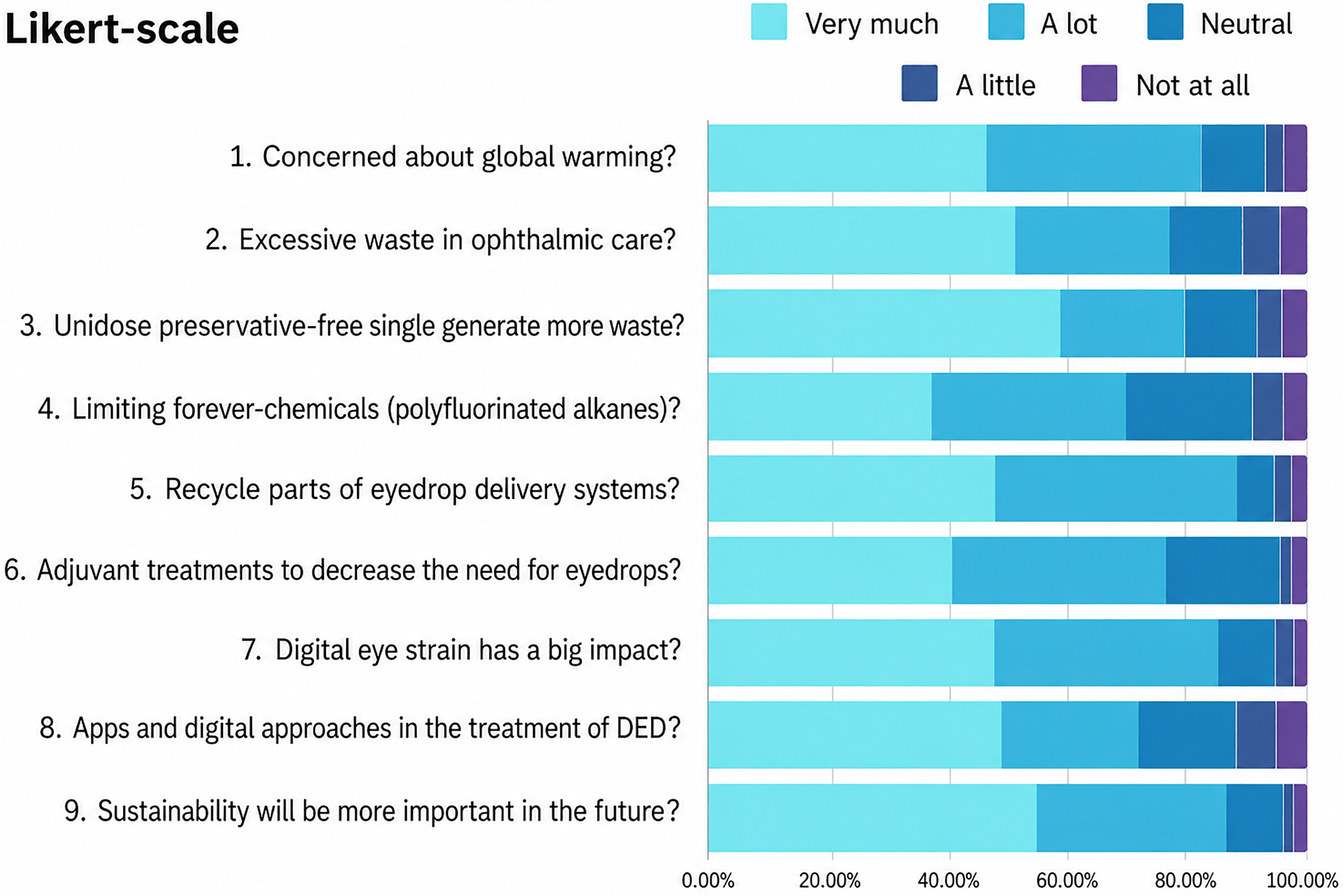
Responses to the sustainability survey to the dry eye disease specialists.
Exploratory subgroup analyses according to age, gender, and geographic region did not reveal statistically significant differences in the main opinions expressed, and overall trends were consistent across groups.
Discussion
This survey provides insight into how ophthalmologists specialists in DED perceive sustainability and environmental responsibility in daily clinical practice. Overall, the responses indicate a high level of awareness of environmental issues and a recognition that sustainability is becoming an important consideration in ophthalmic care. Although concern about global warming was substantial, it appeared slightly lower than that reported in previous surveys among cataract surgeons.9,10 This difference may reflect the perceived environmental footprint of different ophthalmic subspecialties, with surgical settings traditionally associated with greater visible waste generation than outpatient management of chronic conditions such as DED. In DED management, long-term, high-volume treatment may represent a less perceived environmental challenge than single procedures. In this context, respondents highlighted treatment strategies and lifestyle-related factors as areas with potential for improvement. Lubricant eye drops, which are commonly prescribed and often used chronically, represent a cumulative source of waste. Clinicians perceived single-use preservative-free vials as less sustainable than multidose preservative-free alternatives. Previous studies have shown comparable clinical efficacy between these formulations while documenting substantial differences in plastic waste generation.8,11–13 However, the present survey reflects clinician perceptions rather than direct comparative clinical outcomes. Nevertheless, the adoption of multidose preservative-free systems may represent a relatively accessible strategy to improve sustainability in routine practice.8,12,14
Most respondents reported awareness of environmental concerns related to polyfluorinated alkanes. This result highlights growing clinician sensitivity to broader environmental issues associated with pharmaceutical components. However, this topic requires careful interpretation, as the available evidence on long-term toxicity primarily concerns systemic or environmental exposure, and data specific to chronic ophthalmic use remain limited. In contrast, the environmental and ocular toxicity profile of benzalkonium chloride is better documented, including its persistence and potential ecological impact.15–21
Recycling emerged as a widely supported strategy among respondents, consistent with previous surveys in ophthalmology. 10 However, while recycling is often proposed as a practical solution, its real-world impact in healthcare remains uncertain. Plastic waste continues to represent a significant component of ophthalmic materials, and global recycling rates remain limited.12,22 These findings therefore reinforce the importance of systemic approaches involving manufacturers, healthcare institutions, and policymakers rather than relying solely on individual clinician behaviour.
Lifestyle factors and digital eye strain were also highlighted as major contributors to the growing burden of DED. The high and increasing prevalence of DED among screen users23–25 suggests that demand for treatment, and therefore resource use, is likely to rise further. Digital health solutions and behavioural interventions aimed at reducing the burden of DED have been proposed13,23,26 and may represent promising, more sustainable approaches to disease management.
Sustainability is increasingly recognised by DED-focused ophthalmologists as an important dimension of clinical decision-making. Climate change, pollution, and other environmental stressors are expected to further contribute to DED prevalence,27–31 underscoring the need for forward-looking strategies. Ophthalmologists play an important role as prescribers and educators and can contribute to sustainability efforts, but meaningful change will require collaboration with industry, regulators, and professional societies.32–36 Initiatives such as Eyesustain and previously established protocols to reduce topical drug waste in ophthalmic surgery demonstrate that coordinated action is feasible. 37 Despite these initiatives, the transition towards more sustainable pathways in dry eye care remains in its early stages.8,33,36,38,39
Several limitations related to study design and sampling must be acknowledged. First, the study population was restricted to conference attendees with a specific interest in DED, which introduces selection bias. Participants are likely to be more engaged, subspecialised, and potentially more aware of sustainability issues than the broader ophthalmology community. Second, the requirement to complete the survey in order to obtain Continuing Professional Development credits may have introduced response bias, as some participants may have responded primarily to fulfil administrative requirements rather than to express strongly held views. This may have influenced response patterns and the depth of engagement with survey questions. Third, the questionnaire was not formally validated, and no prior reliability or construct validity testing was conducted. This lack of formal validation may affect the precision and reproducibility of the findings. Finally, the conference-based sampling limits the generalisability of the findings. For these reasons, the findings should be interpreted as exploratory and hypothesis-generating, reflecting the perceptions of a selected group of DED specialists rather than definitive conclusions applicable to all ophthalmic practices.40,41
Conclusion
This survey demonstrates a high level of concern among Dry Eye Disease specialists regarding global warming and waste generation in ophthalmic care. The results highlight perceived sustainability challenges in the management of a chronic medical eye condition. This work identifies areas requiring further research, including comparative lifecycle analyses of topical formulations, evaluations of recycling strategies, and assessments of digital and lifestyle-based interventions. Collaborative efforts between clinicians, industry, and professional organisations will be essential to develop evidence-based, sustainable models of care for Dry Eye Disease.
Footnotes
Acknowledgements
Thanks for the technical assistance and support of Europa Group, especially Sylvie DI MAGGIO.

Funding
The authors received no financial support for the research, authorship, and/or publication of this article.
Conflict of interest statement
Francesc March de Ribot: no commercial interests.
Jose M Benitez Del Castillo: Thea, Santen, Alcon, Brill, Angelini, Esteve, Horus, Farmamix, Sifi.
Gerd Geerling: TheaPharma, SunPharma, Bausch & Lomb, Sifi, Allergan, Med1Ventures, Novaliq.
Elisabeth M Messmer: Alcon/Novartis, DMG Pharma, Dompé Farmaceutici, Kala Pharmaceuticals, Allergan/AbbVie, Santen, Shire/Takeda, Sun Pharmaceutical Industries Ltd, Sifi, Théa Pharmaceuticals, TRB Chemedica AG, VISUfarma.
Christophe Baudouin: Bausch&Lomb, Horus Pharma, Inject Sense, Oculis, Santen, Thea