






Abstract
Introduction:
The optimal treatment of patients with a displaced intracapsular femoral neck fracture remains controversial. We utilised a national database of Medicare patients to determine if there was any difference in complications and reoperation rate of patients undergoing total hip arthroplasty (THA) or hemiarthroplasty (HA) for femoral neck fractures.
Methods:
This study utilised the PearlDiver Patient Records Database, a national for-fee database of Medicare patient procedure and diagnosis records from 2005 to 2012. Outcome procedures and diagnoses including revision, dislocation, infection, and cardiovascular events that occurred during the study time period were also identified over the entire study period as well as 90 days and 2 years.
Results:
We identified 275,439 patients with femoral neck fractures who underwent HA and 26,017 patients who underwent THA, respectively. Patients undergoing HA had significantly lower rates (p < 0.0001) of revision 2.48% versus 3.85% (OR = 0.633; 95% CI, 0.592–0.678), dislocation 1.76% versus 3.39% (0.512; 0.476–0.551), infection 3.44% versus 4.87% (0.694; 0.657–0.737). There was no statistical significant difference in 2-year cardiac morbidity (p = 0.252). However, when controlling for age, patients 65–69 years showed no significant difference in infection or revision over the study period or at 2 years.
Conclusions:
In this study, patients who underwent THA for femoral neck fractures had a higher rate of dislocations, infections and increased rates of repeat surgery than those who underwent HA but this difference was not significant in patients 65–69 years. Hemiarthroplasty may result in fewer complications in older Medicare patients although this difference may not be present in younger Medicare patients.
Introduction
The optimal treatment of elderly patients with displaced intracapsular femoral neck fractures remains controversial.1–26 For younger patients, options include internal fixation as well as arthroplasty given a greater potential for healing.27–29 However, for patients >65 years, higher complication and failure rates with internal fixation have lead most providers to recommend arthroplasty for displaced femoral neck fractures in the elderly.3–5,12,13,25,30,31 Both hemiarthroplasty (HA) and total hip arthroplasty (THA) have been described as viable treatment options for these patients but the optimal procedure for an elderly patient with a displaced femoral neck fracture is not clear.2,8,10,17,18,21–23,26,32–34 Advocates for HA cite decreased revision rates, dislocations, and lower perioperative morbidity in some studies,8,12,15,23,26 while advocates for THA cite studies that demonstrate better clinical outcomes and equal perioperative complications.2,4,17,35 This discrepancy has led to a debate over proper treatment with subjective opinions of patient activity level, health and physician comfort in the procedure becoming the major driving factors in the determination of surgery type. Despite the abundance of literature regarding this debate, it is difficult to evaluate given the low frequency of events such as dislocations or conversion surgery as well as the variance in reported outcomes in the literature. Therefore, a large volume of patients is needed to evaluate the outcomes of these 2 procedures and control for individual patient characteristics. In order to obtain a large sample of patients, this study utilised a national for-fee database of Medicare patients to determine if there was any difference in complications and reoperation rate of patients undergoing THA or HA for femoral neck fractures. Despite the limitations of administrative databases including errors of coding and completeness, this method allows for the capture of a large volume of patients with low complication rates. The hypothesis was that THA patients would have higher rates of dislocations and the HA patients would have higher rates of reoperation.
Materials and methods
This study utilised the PearlDiver Patient Records Database (www.pearldiver.com, PearlDiver Inc., Fort Wayne, IN, USA), a national for-fee administrative database of patient procedure and diagnosis records. The database includes both private payer and Medicare data, with the Medicare database being used exclusively for this project. PearlDiver Inc. operates on a commercial basis and the authors leased access to the proprietary database. The study was exempt from IRB review due to the use of deidentified data. The data for this study encompassed 2005–2012 and includes all inpatient and outpatient records, allowing for longitudinal tracking of individual Medicare billing records.
International Classification of Diseases, 9th Revision (ICD-9) procedure and diagnosis codes were used to identify patients that underwent THA or HA for a diagnosis of femoral neck fracture (Table 1). This was performed by querying the database for all patients with an above listed procedure and listed diagnosis at the same point of time. Displaced fractures could not be differentiated from nondisplaced fractures and therefore a large percentage of patients with femoral neck fractures did not undergo either procedure and were likely treated nonoperatively or with internal fixation and were not included in the data. Complication ICD-9 procedures and diagnoses associated with revision, dislocation, cardiac morbidity, and deep infection that occurred during the study time period were also identified (Table 1). Complications including dislocations, infections and cardiac events were determined by diagnosis codes associated with a patient encounter. Revision complications were identified with a procedure code for the particular revision and were not associated with any particular indication. Conversely, diagnoses codes did not require a procedure to be associated.
ICD-9 procedure and diagnoses codes used during the study. Comparable ICD-10 translations for diagnoses are listed for reference.

The patients were then stratified by age (<65, 65–69, 70–74, 75–79, 80–84 years), gender (male, female), and year (2005–2012). A small percentage of patients did not have known ages and were excluded (Table 2).
Age demographics of patients undergoing HA or THA for femoral neck fracture.

HA, hemiarthroplasty; THA, total hip arthroplasty.
Complications were then compared within age group and examined by time period following the indicated procedure including 90 days, 12 months and 24 months). For HIPAA compliance, PearlDiver limits output of data to categories with at least 11 patients. Laterality was not recorded.
Odds ratio (OR) and 95% confidence intervals (CI) were calculated for effect size and proportions were evaluated with a chi-square test and evaluated for statistical significance (p < 0.05). Multivariate analysis was not possible due to individual patient data being inaccessible through PearlDiver. Statistical analysis was completed using SPSS, version 23 statistical software (IBM, Armonk, NY, USA).
Results
Between 2005 and 2012, 499,016 patients received a diagnosis of a femoral neck fracture within the PearlDiver database. 275,439 patients were identified with a concurrent diagnosis of femoral neck fractures who underwent an HA and 26,017 patients who underwent THA. Coding did not allow for separation of displaced versus nondisplaced fractures and the remaining 197,560 patients likely included nondisplaced fractures treated with internal fixation and patients treated nonoperatively. The percentage of procedures remained fairly consistent over the study period with HA representing between 90–92% of arthroplasty procedures during each year. Patient demographics of the 2 groups showed increased utilisation of HA with increasing age (Table 2). Gender demographics did not show a significant difference. There was no significant difference in postoperative myocardial events between groups overall, however, more cardiac events were seen in the HA group under the age of 70 years and more cardiac events in the THA group over 80 years (Table 3).
Percent of patients in each group with a cardiac event ICD-9 code within 2 years after their initial procedure.

THA, total hip arthroplasty; HA, hemiarthroplasty; OR, odds ratio; CI, confidence interval.
significant value.
When evaluating dislocations over the study period HA demonstrated a lower rate of dislocation at 90 days, 2 years and over the entire study period (Table 4).
Percent of patients in each group with a dislocation event ICD-9 code after their initial procedure.
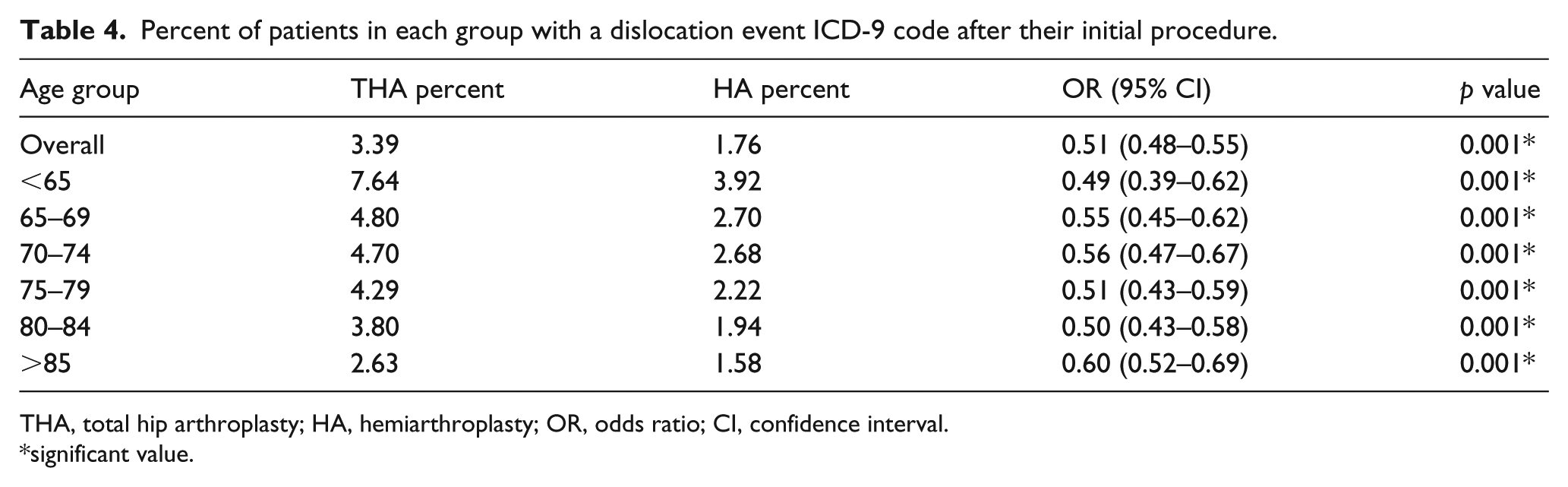
THA, total hip arthroplasty; HA, hemiarthroplasty; OR, odds ratio; CI, confidence interval.
significant value.
This difference was maintained when controlling for age (other than 70–74 at 90 days).
Examining revision rates also showed a significant difference when evaluating the overall study group across all time periods (Table 5).
Percent of patients in each group with a repeat surgery event ICD-9 code after their initial procedure.

THA, total hip arthroplasty; HA, hemiarthroplasty; OR, odds ratio; CI, confidence interval.
significant value.
However, when revisions were controlled for timing and age group the difference was maintained at longer follow-up and older age groups over the study period but showed less difference at 90 days follow-up and in the 65–69 age group.
Infection rates showed a similar relationship as revision rates with greater difference noted in the older age groups and longer follow-up with patients in the 65–69 age and at 90 days follow-up showing no significant difference (Table 6).
Percent of patients in each group with an infection event ICD-9 code after their initial procedure.

THA, total hip arthroplasty; HA, hemiarthroplasty; OR, odds ratio; CI, confidence interval.
significant value.
Discussion
In Medicare patients with femoral neck fractures treated with HA versus THA, patients undergoing HA had a lower rate of complications including dislocations, infections and revisions than patients undergoing THA when evaluating all ages. This difference was maintained in the overall study group over 90 days, 2 years and over the entire study period. However, when controlling for age, these differences were less apparent in the younger Medicare patients.
The increased incidence of dislocations in patients undergoing THA is not surprising and has been demonstrated in several previous studies.2,23,26,35 There are also several studies that have noted higher rates of revision or repeat surgery in patients undergoing THA that match our study results.8,15,23 However, this finding is more controversial, as many studies have pointed to an increased rate of repeat surgery as a downside of HA.2,26,35,36 This study adds further data to this question but some consideration should be given to the fact that when controlling for age, differences in infections and revisions were not significant in patients aged 65–69 years.
These results could reflect several factors related to differences in the patient population of young and older patients undergoing HA. The low demands of patients in older age groups may make them less likely to require revision surgery. It is also possible that older patients have decreased expectations for surgical results and are more likely to not seek out treatment for complications or have physicians who are more likely to treat them conservatively. It is also possible that younger patients undergoing HA were more prone to a selection bias and increased complications given pre-existing medical factors as demonstrated by their higher rate of cardiac events. However, although this trend would be expected throughout each age group it may have been more pronounced in younger patients. It is also possible that patients undergoing HA in older groups were more likely to die prior to having a complication therefore reducing the percentage of events. However, this does not seem to be reflected by the increased rate of cardiac events in patients over 80 undergoing THA. It may also be fair to say if a patient dies early prior to having a complication, the less invasive procedure, in this case HA, should be preferred given the longevity advantages of a THA will not be realised. This should be further emphasised given the higher rate of cardiac events in older patients undergoing THA and the possible impact of a more morbid procedure.
This study has several limitations that should be considered when evaluating these results. The study involved the use of administrative data, which has inherent limitations. We were unable to evaluate individual outcomes and our data is prone to errors related to administrative data entry including coding errors and inaccurate reporting. Clinical aspects such as approach or specifics of outcomes such as infections that required antibiotics could not be identified. It is possible that patients treated with these procedures were not coded with our predetermined procedures or outcome measures and were not included. Laterality differences may have affected our results if procedures on both limbs occurred during the time frame. It is also possible that patient mortality affects the outcome measures in patients of this age demographic. Patients treated with hemiarthroplasty may have been prone to a selection bias leading to more patients with higher morbidity risk or lower demands.
This could have reduced the complication rate in HA if patients reached mortality prior to sustaining a complication. This was potentially true when evaluating the 65–69 demographic where HA patients showed a higher perioperative medical morbidity. This may be an explanation for our results showing no significant difference in infections and revisions in this age group if hemiarthroplasty patients were more prone to complications given their medical status. However, given the similarity in cardiac events overall and higher rates in older patients undergoing THA this did not appear to be a consistent bias. It is also possible that given their age, providers may have been more likely to be aggressive about postoperative revisions while patients in the older demographic may have been more likely to have nonoperative treatment recommended based on age or other medical factors. Functional, radiographic, and clinical outcome of these patients or any differences in their activity level or return to function could not be evaluated. It is also a limited timeframe and later complications could not be captured. Further research is needed to determine if clinical differences outweigh the increased risk of complications in these patients.
Conclusion
In this study, patients who underwent THA for femoral neck fractures had a higher rate of complications and increased rates of reoperation than those who underwent HA, although this was not seen in patients 65–69 years. This matched the study’s hypothesis that the THA patients would have higher rates of dislocations but rejected the assumption that reoperations would occur more in the HA group. This database review is limited in that functional outcomes and pain level could not be assessed but does recommend caution in the assumption that THA will result in lower reoperation rates. It should also demonstrate the importance of age in selecting the appropriate arthroplasty procedure where younger patients may benefit more from the longevity of THA and older patients benefit from the lower morbidity of HA. Further research is needed to determine the cause of these results, and if there is a significant functional advantage in THA over HA to outweigh the potential increase in complications and revision.
Footnotes
Declaration of conflicting interests
The author(s) declared the following potential conflicts of interest with respect to the research, authorship, and/or publication of this article: DJDG: is a paid consultant for SPR Therapeutics, Orthalign, Pacira and Depuy and is on the speaker’s bureau of Cadence Pharmaceuticals, and has received research support from Reflection Health, Pacira, Orthalign, Stryker, Zimmer, and Biomup.
All other authors declare that there is no conflict of interest.
Funding
The author(s) received no financial support for the research, authorship and/or publication of this article.