






Abstract
Aim:
This study was conducted to determine the association between nursing students’ self-confidence in peripheral intravenous catheter (PIVC) insertion and their academic self-efficacy.
Methods:
This descriptive, cross-sectional and correlational study was conducted with 336 nursing students enrolled in the Department of Nursing, Faculty of Health Sciences at a university. Data were collected using the Demographic Characteristics Form, the Nursing Student PIVC Insertion Self-Confidence Scale and the Academic Nurse Self-Efficacy Scale. Descriptive statistics, Pearson correlation analysis and simple linear regression analysis were used for data analysis.
Results:
The mean PIVC insertion self-confidence score of students was 3.83 ± 0.78 (scale range: 1-5), and the mean academic self-efficacy score was 52.23 ± 9.86 (scale range: 14-70). A strong, positive and statistically significant association was found between PIVC insertion self-confidence and academic self-efficacy (r = 0.642, p < 0.001). According to the regression analysis results, it was determined that nursing students’ academic self-efficacy levels had a significant and positive effect on PIVC insertion self-confidence (β = 0.638, t = 15.064, p < 0.001). It was found that the independent variables included in the model explained 43.5% of the total variance in PIVC insertion self-confidence (R2 = 0.435, F = 63.752, p < 0.001).
Conclusion:
Nursing students’ academic self-efficacy is a significant correlate of their PIVC insertion self-confidence. In light of the findings, it is recommended that interactive educational models be integrated into the nursing curriculum.
Keywords
Key findings
Academic self-efficacy is strongly associated with PIVC insertion self-confidence.
Study design: Cross-sectional correlational study.
Sample size: N = 336 nursing students.
Study period: 5 June–5 July 2025.
Setting: Department of Nursing, Faculty of Health Sciences, Kırıkkale University.
GPA and grade level are significantly linked to clinical self-confidence.
The model explains 43.5% of the total variance in self-confidence scores.
Gender does not significantly influence self-confidence in PIVC procedures.
Interactive education models are recommended for nursing curricula.
Introduction
Nursing education encompasses cognitive, affective and psychomotor domains, preparing students through theoretical and practical training to confidently fulfil professional roles.1–3 Among these competencies, peripheral intravenous catheter (PIVC) insertion is a fundamental clinical skill requiring both technical knowledge and practical experience.4,5 In alignment with the contemporary nomenclature established by the NAVIGATE project, this research specifically focusses on the short peripheral catheter (SPC)-defined as a device <6 cm in length-which represents the primary vascular access device utilised by the nursing students in this study. 6 Given its widespread clinical application, nurses have significant responsibilities in initiating, maintaining and terminating SPC procedures, which are critically important for asepsis, complication prevention and patient safety.7–9 Within this context, students’ self-confidence and self-efficacy regarding such invasive procedures directly influence their clinical success.10,11 According to Bandura’s social cognitive theory, self-efficacy refers to an individual’s belief in their capacity to successfully perform specific tasks, directly affecting motivation, effort, perseverance and success. 12 Self-confidence influences willingness and decision-making in performing clinical procedures.12–14
Adequate self-efficacy and confidence levels are critical for patient safety, practice quality and professional development.15,16 Students with high self-efficacy demonstrate stronger clinical decision-making skills and stress-coping abilities,17,18 whereas those with low self-efficacy may show reluctance or unsuccessful performance despite adequate theoretical knowledge. 19 Academic self-efficacy is particularly important for monitoring student success and facilitating improvement throughout nursing education.20–24
The literature indicates that confidence and self-efficacy develop positively with increased practice.12,14,25 Evaluating nursing students’ confidence and self-efficacy in procedures such as SPC insertion is essential for reviewing educational strategies and planning supportive interventions.26,27
The primary objective of this study was to examine the association between nursing students’ self-confidence in peripheral intravenous catheter (PIVC) insertion and academic self-efficacy levels. The secondary objectives were to determine the differences in these variables according to demographic characteristics (year of study, clinical experience, gender, GPA) and to evaluate the degree of association between self-efficacy and confidence while controlling for these factors.
Methods
Aim of the study
The primary aim of this study was to examine the statistical association of academic self-efficacy on nursing students’ self-confidence in peripheral intravenous catheter (PIVC) insertion.
Research Questions:
Is academic self-efficacy significantly associated with PIVC insertion self-confidence?
Does academic seniority significantly influence PIVC insertion self-confidence?
Is GPA positively and significantly correlated with PIVC insertion self-confidence?
Does PIVC insertion self-confidence differ significantly by gender?
Design, study population and sample
This research was conducted as a descriptive, cross-sectional and correlational study. The population consisted of all nursing students in the Department of Nursing, Faculty of Health Sciences, at a university (n = 411). Since the aim was to reach the entire population, no sampling method was applied. A total of 336 students who agreed to participate and completed instruments fully constituted the sample. Inclusion criteria: actively enrolled nursing students who had completed at least one clinical practice period and voluntarily agreed to participate. Forty-five students were unreachable due to absenteeism, clinical practice or leave, and 30 students with incomplete or careless responses were excluded. A post-hoc power analysis was performed using G Power 3.1.9.7. With a final sample size of 329 and an effect size (f2) of 0.15, the statistical power (1 − β) was calculated as >0.99 at an α level of 0.05, confirming that the sample size provided high statistical power for the regression model and ensured adequate detection of the observed effects.
Data collection instruments
Demographic Characteristics Form
This researcher-developed form, based on literature,10,15,16 consists of eight questions covering demographic characteristics and variables potentially affecting PIVC insertion self-confidence and academic self-efficacy.
Nursing Student PIVC Insertion Self-Confidence Scale
The scale, developed by Marchionni et al. 28 and Turkish-validated by Ozbay et al., 29 measures confidence in learning and performing PIVC insertion. It comprises 15 items across three subscales: Cannulation Confidence (seven items), Preparation and Securement Confidence (four items) and Learning Confidence (four items). The five-point Likert scale ranges from 1 (strongly disagree) to 5 (strongly agree), with no reverse-scored items. Subscale and total mean scores range from 1 to 5; higher scores indicate greater confidence. Cronbach’s alpha was 0.93 originally and 0.97 in this study.
Academic Nurse Self-Efficacy Scale (ANSES)
The scale was developed by Bulfone et al. 24 to determine the academic self-efficacy of nursing students studying at the undergraduate level. The Turkish validity and reliability study was conducted by Altay and Gonener. 30 The scale, consisting of 14 items in total, has four subscales: Internal Emotion Management (items 1, 2 and 3), Self-Control/Automated Controlled Behaviour (items 4, 5, 6 and 7), External Emotion Management (items 8, 9, 10 and 11) and Sociability (items 12, 13 and 14). The scale presents a five-point Likert-type evaluation (1 = I do not trust myself at all and 5 = I trust myself very much) seeking answers to the question, “How much do you trust yourself?.” There are no reverse-scored items on the scale. The lowest and highest scores that can be obtained from the subscales of the scale vary between 3 and 15 for Internal Emotion Management, 4 and 20 for Self-Control, 4 and 20 for External Emotion Management and 3 and 15 for Sociability. The lowest score that can be obtained from the total of the scale is 14, and the highest score is 70. As the scores obtained from the scale increase, students’ academic self-efficacy perceptions increase. The Cronbach’s alpha value of the original scale was reported as 0.84, and in this research, the Cronbach’s alpha value was calculated as 0.93.
Data collection procedure
The research data were collected by the primary researcher through a face-to-face survey method between 5 June and 5 July 2025. Prior to the data collection process, all necessary institutional permissions and ethical approval were obtained. The researcher provided a comprehensive explanation to the students regarding the aim and voluntary nature of the study. Written informed consent was obtained from each participant. The instruments were administered in a quiet classroom environment after sessions to allow for immediate clarification. The completion took ~20 min.
Data analysis
Data obtained from the research were analysed using the SPSS 25.0 package programme. Descriptive statistics of the data (number, percentage, mean, standard deviation, minimum–maximum) were calculated. Independent t-test and one-way ANOVA test were used to determine differences in confidence and self-efficacy levels according to demographic characteristics. Pearson correlation analysis was applied to examine the relationship between measured variables. Simple linear regression analysis was applied to determine the association effect of academic self-efficacy on PIVC insertion confidence. The significance level was set at p < 0.05 for all tests. 31 In interpreting correlation coefficients, the range of 0.00–0.29 was accepted as low, 0.30–0.70 as moderate and 0.71–1.00 as high-level relationship. 32
Ethical approval
Approval was obtained from Kırıkkale University Non-Interventional Research Ethics Committee (meeting number: 2025/09; decision number: 2025.05.55) before research commencement.
Results
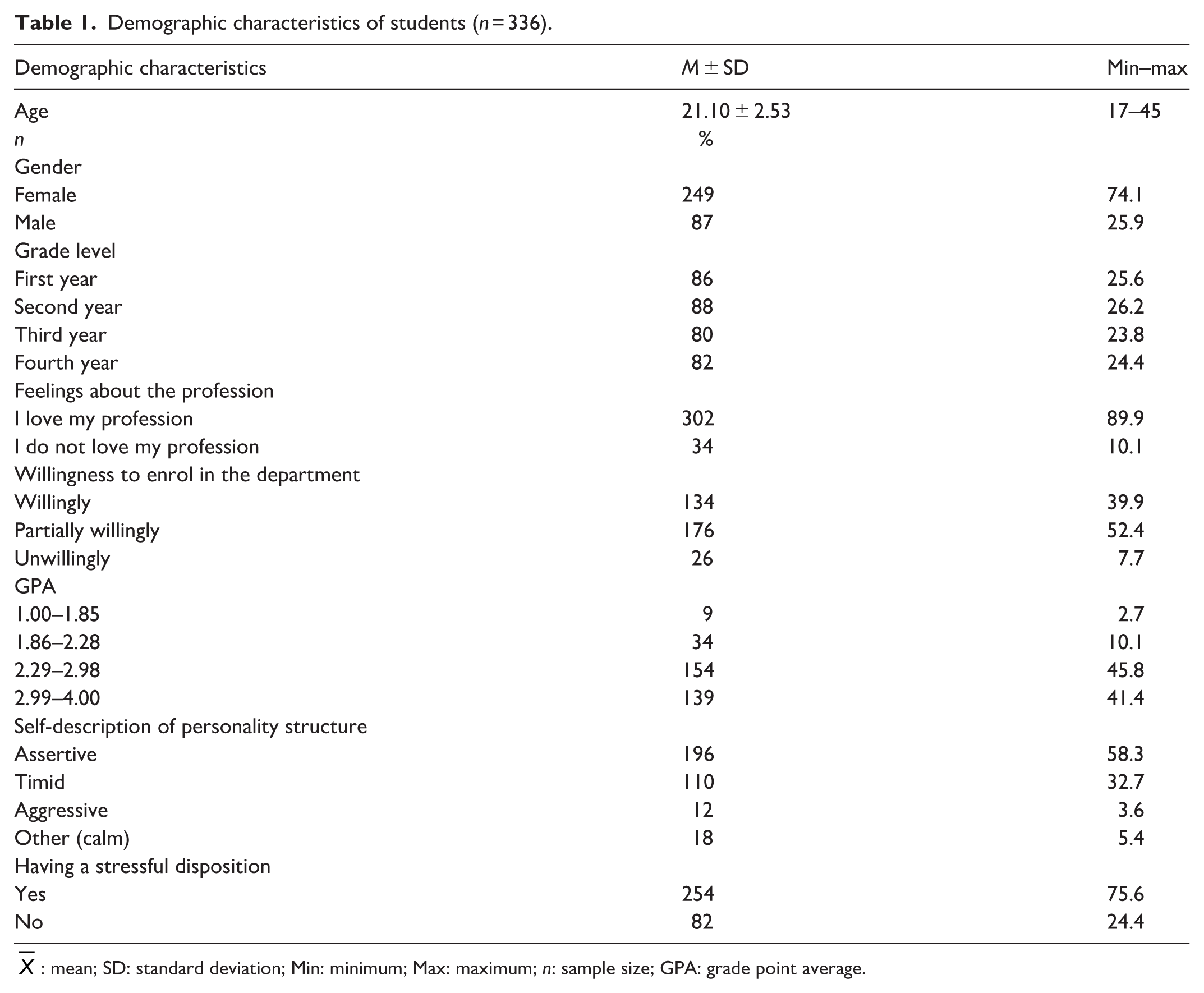
Table 1 shows the descriptive characteristics of the students participating in the research. The mean age of the students participating in the research was 21.10 ± 2.53, and it was determined that 74.1% were female, and 26.2% were second-year students. It was determined that 89.9% of the students participating in the research loved their profession and 52.4% enrolled in the department partially willingly. It was found that 45.8% of the students had a grade point average in the range of 2.29–2.98, 58.3% described their personality structure as assertive and 75.6% had a stressful disposition.
Demographic characteristics of students (n = 336).
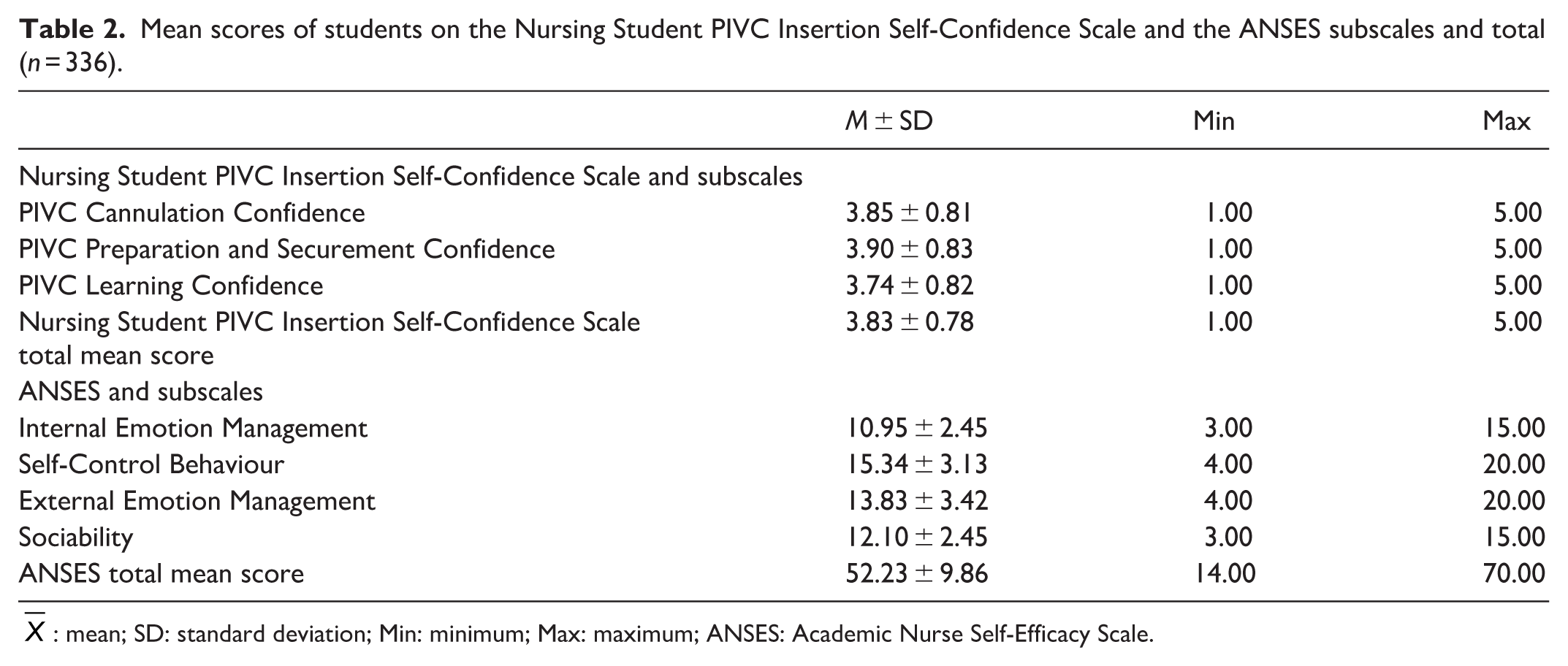
It was determined that nursing students scored 3.85 ± 0.81 on the PIVC Cannulation Confidence subscale, 3.90 ± 0.83 on the PIVC Preparation and Securement Confidence subscale, 3.74 ± 0.82 on the PIVC Learning Confidence subscale and scored 3.83 ± 0.78 on the Nursing Student PIVC Insertion Self-Confidence Scale. It was determined that nursing students scored 10.95 ± 2.45 on the Internal Emotion Management subscale, 15.34 ± 3.13 on the Self-Control Behaviour subscale, 13.83 ± 3.42 on the External Emotion Management subscale, 12.10 ± 2.45 on the Sociability subscale and scored 52.23 ± 9.86 on the Academic Nurse Self-Efficacy Scale (Table 2).
Mean scores of students on the Nursing Student PIVC Insertion Self-Confidence Scale and the ANSES subscales and total (n = 336).
Positive and significant relationships were found between PIVC Cannulation Confidence and Internal Emotion Management (r = 0.564, p < 0.001), Self-Control Behaviour (r = 0.559, p < 0.001), External Emotion Management (r = 0.493, p < 0.001), Sociability (r = 0.534, p < 0.001) and ANSES total score (r = 0.622, p < 0.001). Positive and significant relationships were found between PIVC Preparation and Securement Confidence and Internal Emotion Management (r = 0.553, p < 0.001), Self-Control Behaviour (r = 0.551, p < 0.001), External Emotion Management (r = 0.457, p < 0.001), Sociability (r = 0.535, p < 0.001) and ANSES total score (r = 0.599, p < 0.001). Positive and significant relationships were determined between PIVC Learning Confidence and Internal Emotion Management (r = 0.539, p < 0.001), Self-Control Behaviour (r = 0.545, p < 0.001), External Emotion Management (r = 0.506, p < 0.001), Sociability (r = 0.534, p < 0.001) and ANSES total score (r = 0.615, p < 0.001). Positive and significant relationships were also found between Nursing Student PIVC Insertion Self-Confidence Scale total score and Internal Emotion Management (r = 0.574, p < 0.001), Self-Control Behaviour (r = 0.579, p < 0.001), External Emotion Management (r = 0.510, p < 0.001), Sociability (r = 0.559, p < 0.001) and ANSES total score (r = 0.642, p < 0.001) (Table 3).
Relationship between nursing students’ PIVC Insertion Self-Confidence and ANSES scores (n = 336).
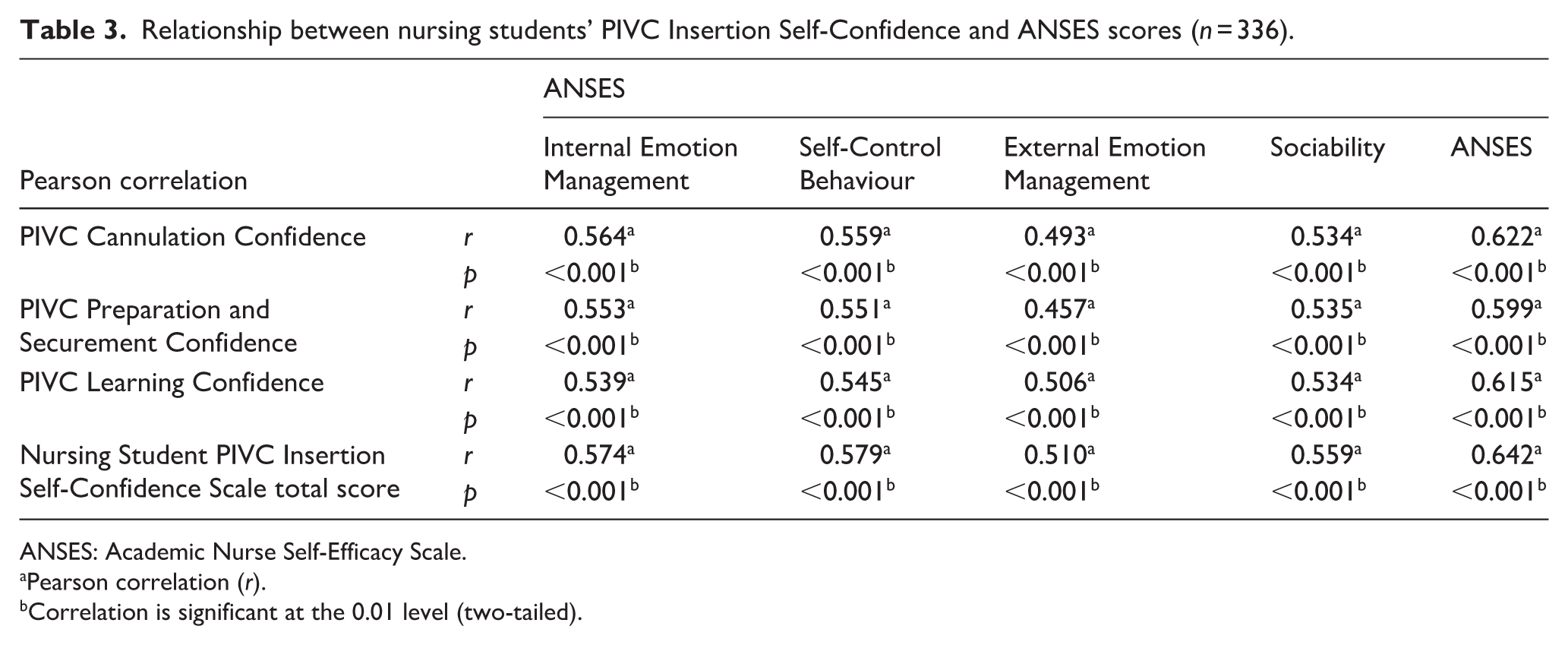
ANSES: Academic Nurse Self-Efficacy Scale.
Pearson correlation (r).
Correlation is significant at the 0.01 level (two-tailed).
Nursing students’ academic self-efficacy levels (independent variable/predictor) have a significant and positive association on PIVC insertion self-confidence (dependent variable/predicted) (B = 0.051, β = 0.638, t = 15.064, p < 0.001). Additionally, it was determined that grade point average (B = 0.114, β = 0.108, t = 2.514, p = 0.012) and grade level (B = 0.060, β = 0.086, t = 1.997, p = 0.047) also have a significant and positive association on PIVC insertion self-confidence. However, gender was not found to have a significant association on PIVC insertion self-confidence (B = 0.074, β = 0.041, t = 0.967, p = 0.334). It was determined that the independent variables participating in the research explained 43.5% of the variance in PIVC insertion self-confidence and this statistical association was statistically significant (R = 0.660; R2 = 0.435; F = 63.752; p < 0.001; Table 4).
Multiple regression analysis of factors associated with PIVC insertion self-confidence (n = 336).
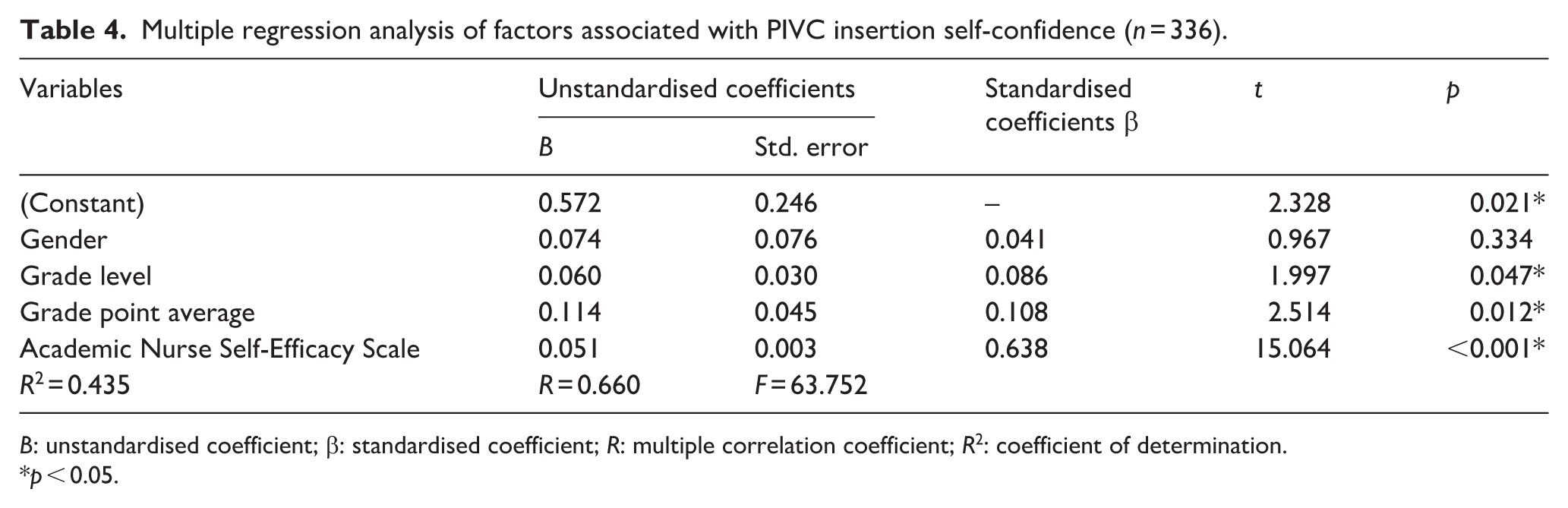
B: unstandardised coefficient; β: standardised coefficient; R: multiple correlation coefficient; R2: coefficient of determination.
p < 0.05.
Discussion
Students demonstrated a high level of PIVC insertion self-confidence. Among the subscales, they felt most competent in preparation and securement, whereas learning confidence was identified as the lowest-rated domain. In the Chinese adaptation of the scale, it was stated that students’ confidence levels might be affected by cultural and educational system differences. 33
Higher preparation scores may suggest easier acquisition of foundational knowledge, while lower learning confidence could reflect perceived challenges during the transition to practical application. In a randomised controlled study, it was found that the knowledge, skill and confidence levels of students who received PIVC insertion training with the peer mentorship model were significantly higher than the control group. 34 This finding emphasises the importance of structured educational models in transforming theoretical knowledge into practice.
Students in this study demonstrated high academic self-efficacy. Similarly, in a study conducted in Italy, academic self-efficacy was reported to follow a positive trajectory, suggesting that these perceptions tend to evolve and improve throughout the educational process. 35 When the subscales were examined, it was determined that the highest mean was in the Self-Control Behaviour subscale, while the lowest mean was in the Internal Emotion Management subscale. In one study, it was found that nursing students’ self-efficacy perceptions were related to their performance of invasive nursing interventions. 36 The above-average academic self-efficacy levels observed among students indicate that targeted educational strategies should be developed and implemented to further strengthen self-efficacy perceptions throughout the educational process. In light of these findings, integrating simulation-based learning for safe mastery, alongside structured mentorship and positive feedback, is recommended.12,37,38 Furthermore, cognitive-behavioural interventions and self-reflection sessions may foster self-efficacy by enhancing students’ stress-coping and emotional management skills. 39
While elevated self-control scores might indicate competence in academic responsibilities, lower internal emotion management scores suggest room for development in students’ emotional regulation. Literature confirms that emotion management is positively linked to self-efficacy and negatively to stress. 40 Consistently, the moderate association between self-efficacy and catheter care performance further corroborates the connection between academic self-efficacy and clinical proficiency. 41
A moderate-level positive relationship was observed between PIVC confidence and academic self-efficacy, particularly self-control, indicating that students’ self-regulation might play a role in strengthening clinical confidence. Such findings appear consistent with South Korean evidence showing that self-efficacy directly enhances intravenous injection confidence through the mediating role of nursing professionalism. 41 This also aligns with Bandura’s theory, where internal beliefs are thought to fundamentally influence performance. 12
Regression analysis indicated that the independent variables may have a significant positive effect on PIVC insertion self-confidence, explaining 43.5% of the total variance. These findings suggest that as self-efficacy perceptions improve, students’ confidence in invasive procedures could potentially increase. Aligning with existing literature, this result implies that academic self-efficacy is a key predictor of clinical confidence,42,43 suggesting that targeted educational strategies might enhance students’ performance in complex tasks. 44
Regarding demographic characteristics, higher GPA and seniority (grade level) were found to bolster SPC confidence. This likely reflects a maturation of clinical assurance, as fourth-year students may have accumulated more theoretical knowledge and practical experience through simulation workshops and real clinical practice compared to first-year students.45,46 Consequently, limited prior practical exposure might contribute to a lower sense of self-confidence in earlier academic years. Furthermore, our collected data demonstrated that gender did not significantly influence SPC confidence. Unlike Bulfone et al., 35 who noted gender-related patterns in academic self-efficacy, our findings suggest that clinical assurance in this sample may be gender-independent and potentially more driven by structured educational progress and cumulative practice. 35
Literature highlights that educational strategies such as simulation, peer mentorship and video-assisted self-evaluation may effectively bolster PIVC confidence and proficiency.7,47 Specifically, tools like structured video feedback and near-infrared vein finders could significantly enhance student performance and self-belief.7,47 Adopting these approaches might potentially improve educational quality and patient safety.
Limitations
This study has limitations. First, participants were from a single university’s nursing programme, limiting generalisability to other universities and countries; different curricula, teaching methods and cultural differences may affect confidence and self-efficacy. Second, self-reported measurements may introduce social desirability bias; objective performance measurements were not conducted, preventing determination of confidence-performance correspondence.
Conclusion
In the study, it was found that students’ PIVC insertion self-confidence score (3.83 ± 0.78) and academic self-efficacy total score (52.23 ± 9.86) were at a high level. This study revealed that there were moderate-level positive and significant relationships between nursing students’ PIVC insertion self-confidence and academic self-efficacy, and that academic self-efficacy is a significant correlate of PIVC insertion self-confidence. In line with these findings, the integration of evidence-based instructional methods-such as simulation-based learning, peer mentorship and video-assisted self-evaluation-into the nursing curriculum is strongly recommended.
Footnotes
Acknowledgements
The authors acknowledge and thank all nursing students who kindly participated in the study by completing the questionnaires. We also thank the Department of Nursing leadership for facilitating data collection.
Author contributions
GK: conceptualization, methodology, formal analysis, investigation, data curation, writing – original draft and visualization. HÖ: conceptualization, methodology, writing – review and editing, supervision and validation.
Declaration of conflicting interests
The authors declared no potential conflicts of interest with respect to the research, authorship and/or publication of this article.
Funding
The authors received no financial support for the research, authorship and/or publication of this article.
Ethical approval
The study was carried out in accordance with the ethical standards of the Declaration of Helsinki. Ethical approval was obtained from the Kırıkkale University Non-Interventional Research Ethics Committee prior to data collection. Meeting number: 2025/09. Decision number: 2025.05.55.

Data availability statement
The datasets generated and analysed during the current study are available from the corresponding author upon reasonable request.
Authorship statement
We confirm that: All listed authors meet the authorship criteria for the journal. The manuscript represents original work that has not been published or submitted elsewhere. All authors have reviewed and approved the final version of the manuscript. All authors are in agreement with the content and findings of this manuscript.