







Abstract
Teachers who have refugee students in their classrooms may experience professional inadequacies in adapting these students to the classroom. Reasons such as language problems, psychological reasons and host students’ perspectives on refugees are factors that make the school adaptation process of refugee students difficult in the country they go to. The current research developed a positive perspective of host students towards refugee students in the classroom where they receive education. In this context, interactive reading activities were carried out with children’s picture books about refugees in order to help host students gain skills such as empathizing with and respecting refugee students. In this study, which was conducted as an action research, data were collected through a sociometric form, a semi-structured interview questionnaire and student products. As a result of the study, it was observed that host students developed social skills such as respecting and empathizing with refugees, and thus the adaptation process of refugee students developed positively.
People have to migrate to different places for reasons such as recently increased wars, disasters, etc. In this context, when we look at the World Migration Report (2020) prepared by the International Organization for Migration, the presence of 272 million refugees draws attention. Among them, the number of refugees under the age of 20 is 37.9 million. In this context, it was mentioned that 13.9% of the group are child refugees. Children who migrate to a new country forcibly may encounter mental, behavioural and emotional problems (Derluyn & Broekaert, 2007; Fazel & Stein, 2002). Schools are an important tool in avoiding these problems and helping refugee children adapt to the region in which they live in (Taylor & Sidhu, 2012). School is where children’s secondary socialization takes place. In this context, it has an important role in socializing refugees and their children (participating in society). This is because school, by nature, reflects the culture of the region it is in. In this regard, it is possible to see school as a society on a microscale. Therefore, it is important for refugee children to adapt to school well in order not to disrupt their education processes and for them to integrate into the country they go to. This is one of the first priorities of organizations that evaluate international migration policies as well.
‘Education gave me the strength to carry on. I wouldn’t be here without it.’ These words belong to Syrian refugee Muzoon Almellehan, a UNICEF Goodwill Ambassador. This statement shows that while education is essential even under normal conditions, it is even more important for refugee children. According to the Migrant Integration Policy Index-MIPEX, education is the biggest weakness in the integration policies of most countries (Solano & Huddleston, 2020). This is because most refugee children receive very little support in finding the right school or the right classroom or in ‘catching up’ with their peers. Most countries leave the solving of cultural problems (or making them worse) to the general educational system. In this respect, the Migrant Integration Policy Index-MIPEX, which is financed by the Barcelona Centre for International Affairs-CIDOB and The Migration Policy Group-MPG, in particular has been evaluating the policies of 56 countries, including European countries, towards refugees in the context of eight main titles of application, which are labour market mobility, health, permanent residence, family reunion, education, anti-discrimination, political participation and access to nationality. As one can see, one of them is education.
The schooling rates in the countries that refugee students go to are not at the desired level. In this context, in The United Nations Refugee Agency (UNHCR, 2023) report, it is stated that refugee children fall behind their non-refugee peers in accessing quality education. In addition to this, while 67% of the refugee children go to school during the primary school period, this rate drops to 36% for middle school. Considering the stated numbers, it is clear that the enrollment rate of refugee pupils is insufficient and there is no consistency in school attendance. As a result, even if they begin education, refugee students eventually drop out for various reasons. Al-Hroub (2014) stated that refugee students drop out of school due to job searching, low academic success or marriage in the country they went to. While preventing refugee children from dropping out of school due to job searching or early marriage is more in relation to politics, academic success is directly related to school and education.
One of the obstacles to the academic success of refugee students is in relation to their mental health. Refugee students with depression or anxiety disorder may fail academically (Noam et al., 2014). On the other hand, a well-formed school and classroom climate affects both attendance to the school and the academic success of refugee children positively (Behtoui & Neergaard, 2016; Zengaro et al., 2016). As a result, it is necessary to create a supportive school and classroom climate in order for refugee students to continue their education life in a good way. This is because school plays a key role in the adaptation of refugee children to the society they go to (Fandrem et al., 2024). Considering this key position of schools, the school climate, school management and teachers should be facilitators for refugee children to like and attend school. In particular, teachers need to be aware of their responsibility in adapting refugee students to society (Jokikokko & Uitto, 2017) and create a classroom environment suitable for this. While creating the necessary classroom environment, teachers should work not only for refugee students but also with the whole class, so as to encourage and facilitate student interaction and in-class respect (Biasutti et al., 2020), because the attitudes of students in the host country towards refugee students are also an important variable in adaptation (Hamilton, 2003). Adaptation to school is a two-way process that occurs as a result of positive interactions between the refugee and host students. In this context, teachers need to change the perspective of host students towards refugee students to a positive one. Spencer-Rodgers and McGovern (2002) stated in their study that host students have negative attitudes towards students who come from outside and communicate less with them. Therefore, teachers should help host students gain social skills such as cooperation with refugee students, empathy towards refugee students and socializing with them. However, studies have indicated that efforts by teachers with refugee students in their classrooms are still not sufficient (e.g., Aalto, 2019; Lundberg, 2019). In this regard, it is necessary to support the professional development of teachers or future teachers in the context of inclusive education for refugee students’ adaptation processes in their classrooms. As Moralı (2020) stated, the classroom environment, in which the refugee students are, includes different characteristics. This classroom environment has a multi-layered structure that reflects the understanding of inclusive education.
Theoretical framework
In his sociocultural theory, Vygotsky stated that the construction of knowledge occurs not in the mind but through the social interaction of a less knowledgeable person and another, more knowledgeable person (Lantolf, 2008). According to Vygotsky, the basis of learning and development is social interaction with apprenticeship and internalization processes (Walqui, 2006). Therefore, it can be said that teacher–student interaction is an important part of learning. During this interaction, the teacher should guide students correctly to teach them how to learn and how to think. In this process, the correct use of learning tools comes into play (Wang et al., 2011), because Vygotsky (1986) stated that with the correct use of learning tools, the higher-order thinking skills of the learners will develop.
The zone of proximal development is a concept that Vygotsky discussed under the title of sociocultural theory. Vygotsky (1978) stated that the zone of proximal development is when one reaches the potential level of development through a peer or an adult above one’s level. In this context, in order for the individual to reach the potential development level in the zone of proximal development, the adult or peer needs to build a scaffold. Building a scaffold is accomplished with support such as dividing the targeted purpose into smaller parts, specifying instructions, attracting the interest and attention of students, and guiding the child by asking questions (McDevitt & Ormrod, 2002). In this way, students can acquire the targeted behaviour through scaffolding and become competent in that behaviour (Winne & Hadwin, 2001). Scaffolding is vital not only for enhancing children’s academic performance but also for developing high-level cognitive skills. Through scaffolding established with a correct system, the child will be involved in the active learning process, and in this way, they will be able to learn difficult subjects or phenomena that are at the potential developmental level (Crandall & Kaufman, 2002). Consequently, this process needs to be designed correctly and in a qualified way for the children’s potential development level through the scaffolding. Silver (2011) stated that while scaffolding is being built, the readiness of the student about the target learning outcome should be checked first. If their readiness is at a sufficient level, second, they need to associate the content with tools that students can understand and be interested in. Third, it is important to provide intermittent feedback to students during the process and to present the content in smaller tasks. Finally, the teacher should verbally give small hints and directions to the students in terms of guidance. As a result, with a well-constructed scaffold, children can reach their potential development level even in difficult concepts or phenomena. Another variable for the scaffolding process to be qualified is the tools used.
Books are one of the important tools used in children’s learning. Children relate to the characters and the emotions of those characters in the books they read and gain the skills they need to gain by empathizing with them (Aurélio et al., 2021). On the other hand, children’s books help children to better understand themselves and others, and thus help students in the classroom become a harmonious community (Britt et al., 2016). In order to benefit from the stated benefits of children’s books, qualified books should be selected. Otherwise, children may obtain some bad traits from the books (Boutte et al., 2008). In this context, it is important to examine the language, subject and illustrations used in the selected books before the child reads them and to choose appropriate books as content. Consequently, the structure of the books and the methods used by the teacher while reading them play a key role so that children can perceive the books that are being read correctly. It has been stated that the illustrations in children’s books have a positive effect on understanding the messages intended to be conveyed in the books correctly (Strouse et al., 2018). Integrating the illustration and the text with the illustrated children’s books both visually supports the learning of the students and improves their observation skills (Carr et al., 2001). On the other hand, illustrated children’s books contribute to the children’s mental development by providing a strong bridge between their old and new information through the books’ characters and plots and, from a psychosocial viewpoint, by developing a different perspective on events through the topics the books deal with (Mantzicopoulos & Patrick, 2011). Another important factor for children to understand the books and acquire the targeted gains is the method used. In this sense, the interactive read-aloud method comes into prominence. McGee and Schickedanz (2007) stated in their study that only reading orally passivizes the student and it is not enough to understand the book. Reading aloud becoming interactive will be effective for children to be active and understand the book.
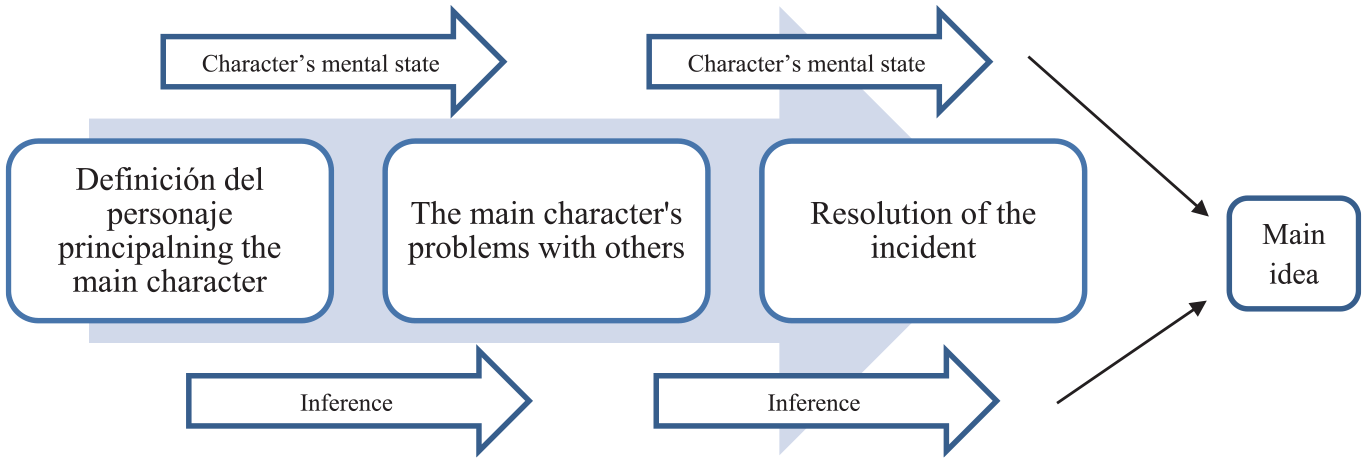
In the process of reading a book interactively and orally, students enter the learning process through unplanned and natural interactions with their peers, the teachers and the text that is being read, and in this respect, interactive read-aloud is similar to instructional speeches (Barrentine, 1996). In interactive read-alouds, teachers and students have the opportunity to examine the book in depth and have a discussion about it. These discussions will help the children understand that beyond making a single meaning out of the text, there may be more than one meaning, and they will analyse the text better in their later readings (Sipe, 2000). On the other hand, after interactive readings, students find the opportunity to associate the story with their own lives and teachers have the opportunity to observe these connections established by the students (Peterson & Eeds, 1990). Therefore, the teacher will be able to determine to what extent the students have achieved the targeted skills. This is because with interactive reading, children have the opportunity to share their ideas with each other and listen to different perspectives (Lennox, 2013). In addition, children’s participation in the discussion along with the questions prepared to create interaction will help them to understand the main idea of the text, and these discussions will facilitate the understanding of concepts that are difficult for children (Laman & Henderson, 2018). Thus, the children will be able to develop skills such as mutual communication, respect and empathy. In interactive read-alouds, children’s understanding of the mental states of the characters in the book is essential for reading comprehension because the mental states of the characters direct the structure of the narratives in the book being read (Lynch et al., 2008). Therefore, in interactive reading, children will both empathize with the character and receive the targeted message in the book being read. Kelly and Barber (2021) showed, in Figure 1, how children’s social skills are developed through stories.
Developing social skills through stories.
When Figure 1 is examined, it is seen that the process consists of three main structures. First, defining the main character, then the main character’s problems or the main character’s problems with other characters, and lastly, resolution of the incident. Kelly and Barber (2021) stated that in this process, understanding how the character thinks and making inferences between the chapters are important to understand the text correctly. The book selected in this research was The Suitcase. The protagonist of the book is an animal who has to migrate from somewhere. Three animals live in the place where he goes to settle, and when the main character walks up to them, they approach him with suspicion. The problem between the main character and other characters in the text occurs here. In the final part of the book, the case is resolved after the other characters empathize with the main character and understand his situation. The main idea that the author wants to convey in this text is respect, tolerance and kindness. In the book Bienvenus, the main characters are polar bears. When the glaciers they live on begin to melt, they try to find a place to live before they melt completely. In this process, they demand to settle on different islands, but the inhabitants of the islands do not accept it. In the last episode, things are resolved. The main idea that the author wants to convey in this text is that we should have a positive perspective on refugees.
Method
The teacher, who had refugee students in her class, believed that the host students had negative attitudes towards refugees, which hindered their adaptation to the classroom. She felt professionally inadequate because she had not received any training, during either her undergraduate education or in-service training, on how to address the challenges faced by refugee students. The aim of this study was to improve the host students’ perspectives on refugee students and thus the refugee students’ school integration processes. Based on this context, the researchers designed this study as an action research. Mills (2007) defined action research as educators improving practices in the educational process or solving the problems encountered. In this regard, the study’s focus was on refugee students, and the context was the classroom environment in which refugee students continue their education. The steps of action research for implementing improvements are outlined by Norton (2019), as shown in Figure 2.

Action research steps.
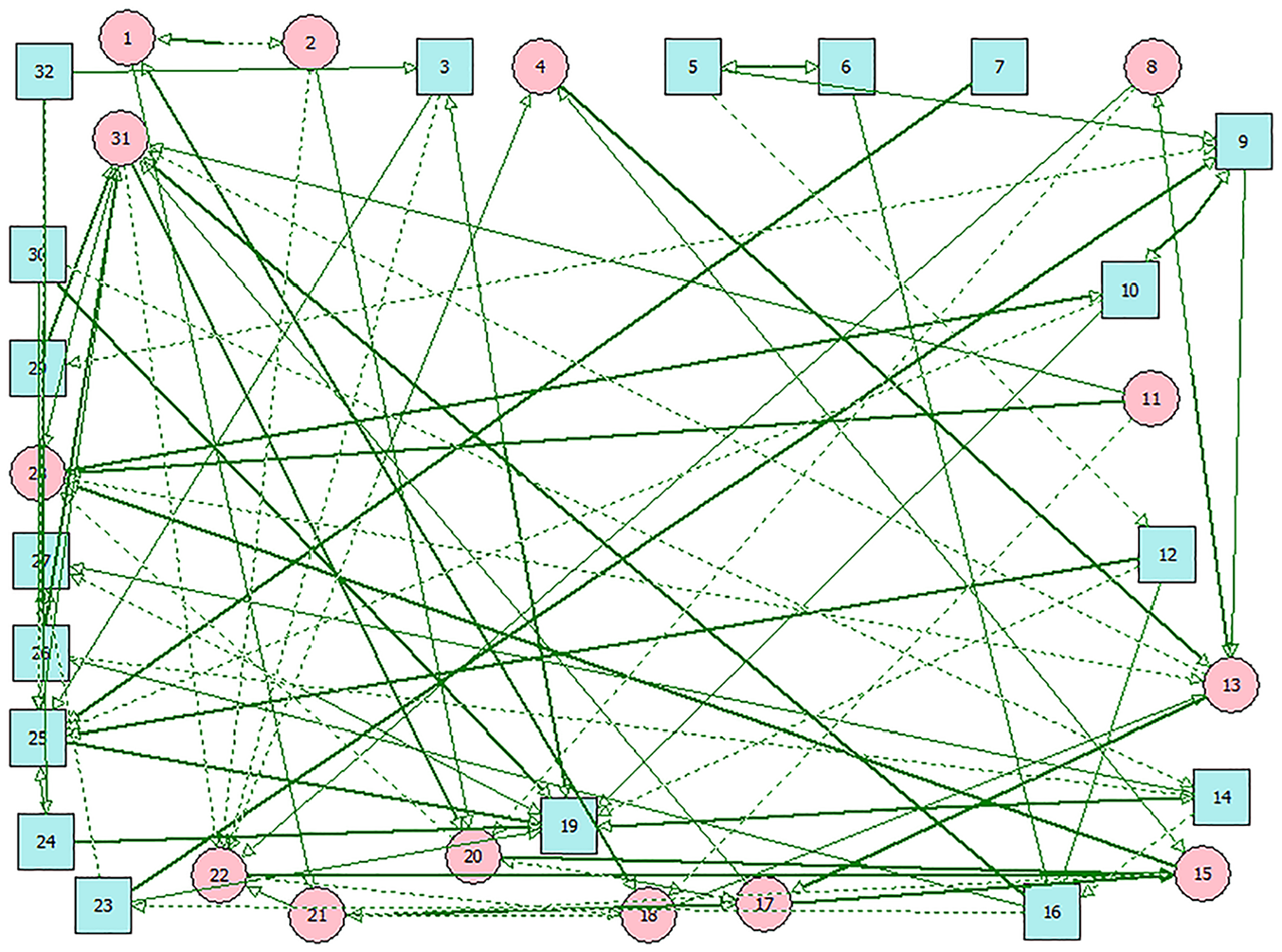
Identifying the problem: the teacher of the class in which the study was conducted stated that there are two Syrian students in their class and that these students could not adapt to the class. The teacher stated that they could not find a solution to this problem and consulted the first researcher. The first researcher shared this situation with the second researcher, and it was decided to implement the sociometry tool to the related class to determine the problem. In this context, the students in the class were asked to write the first three friends they wanted to play with in the classroom on a piece of paper in order of importance. The sociogram formed as a result of the answers collected from the students is shown in Figure 3.
Pre-implementation sociogram.
In the figure, the arrow with a thick line indicates the first choice, the arrow with a thin line indicates the second choice and the arrow with a dashed line indicates the third choice. Numbers 5 and 6 in the sociogram represent the Syrian students. When Figure 3 is examined, it is seen that the Syrian students prefer each other as their first choice. In addition, while student number 5 preferred students number 9 and 12, student number 5 was not preferred by them. And while student number 6 preferred student number 16 in second place, they were not preferred by student number 16. As a result, it was concretely revealed that the Syrian students experienced adaptation problems with other students. After this stage, the researchers started to work on a solution to the problem and prepare the action plan.
Action plan to solve the problem: at this stage, the researchers first made a literature review by considering the conditions for the solution of the problem. First-grade students are busy with learning how to read and write and developing these skills throughout the academic year. Therefore, the researchers decided to use the interactive reading method to solve the adaptation problem, taking this situation into consideration in order not to disrupt the usual course of the class. After the researchers decided on interactive reading, they decided to choose the books. When choosing the books, the researchers decided that the contents should be suitable for inclusive education. With books that have inclusive content, it is aimed that the situation of the refugee students will be understood by the host students. In this context, the researchers chose the books The Suitcase, Bienvenus and Stepping Stones. Written by Chris Naylor-Ballesteros, The Suitcase is a book about the relationship of an animal migrating to a new place with its suitcase, with the animals found at the destination, and it contains core values written about love, tolerance, hope and goodness. Bienvenus, written by Barroux, tells the adventure of three polar bears who are looking for a new place to live on a broken glacier. Ruurs (2016) wrote a book titled Stepping Stones, which tells the life of a family forced to migrate through the eyes of a child. A 4.5-week interactive read-aloud process was planned with the selected books.
Implementation: the plans prepared in this stage were conveyed to the teacher. The first author informed the teacher of what to pay attention to during its implementation. Each book was read three times, at one day apart. The reading plans were designed as activities to be done before, during and after reading. In the first reading, activities and questions were asked to understand and get to know the book. For example, questions like ‘Why might he have taken the road?’ and ‘What could be in his suitcase?’ were asked regarding the animal showing up with his suitcase in his hand. In the second reading, questions were asked to empathize with the protagonist of the book. For example, the students were asked, ‘Has anyone moved before? How did you feel in the new place you went to?’ In the third reading, questions were asked to deepen empathy and understanding. For example, the students were asked, ‘Why do you think a cup and a photo are so important to our hero?’ Parallel reading plans were arranged for Bienvenus and Stepping Stones as well.
Evaluation of the implementation: in this part, studies were conducted to determine whether there was a difference after the research and whether the adaptation problem showed a tendency to improve or not. For this purpose, after the interactive reading activities were completed, the sociometry tool was implemented again. In addition, the classroom teacher was interviewed.
Research environment and participants
The school at the centre of this study has 1,519 students, 77 teachers, 31 classrooms, a library and two science laboratories. Situated in the city centre, it is located in an area with a higher concentration of the Syrian population compared to other regions.
There are two Syrian and 30 Turkish students in the class that was accepted as the environment of the research. The seating arrangement of the class is consecutive, and two students sit side by side in the school desks. The Syrian students are shown as 5 and 6 in the sociogram. The Syrian students were born and raised in Turkey and their families had been living in Turkey for 10 years. For the sake of integrity in the research, the students are shown as numbers in this part as well. The speaking and listening skills of both Syrian students are at a sufficient level in terms of communicating in Turkish. The classroom teacher stated that they changed the seating of both students from time to time to seat them with the Turkish students in order for them to adapt. The teacher has seven years of professional experience and has been working at the school for three years.
Data collection tools and analysis of data
In the research, the data were collected with the sociometry questionnaire, semi-structured interview questionnaire and student products. In the sociometry questionnaire, the students were asked to write the names of three of their friends from the classroom that they wanted to play games with in order of importance. The program called GroupDynamics was used to transform the collected questionnaires into sociograms. After the questions in the prepared sociometry questionnaire and the answers of the students were entered into the GroupDynamics program, the answers of the students were visualized according to their order of preference. Another data collection tool was the semi-structured interview questionnaire. After the implementations were completed, an interview about the process was held with the classroom teacher. Finally, student products formed during the activities were included in the process as data. The data obtained from the interview with the teacher and the student products were analysed by content analysis.
Validity and reliability
In the analysis of the data, both researchers carried out the process separately, and then the results were compared. Therefore, it was attempted to ensure the validity of the study by researcher diversification (Christensen et al., 2014). This was also important for the reliability of the research (Merriam & Tisdell, 2016). Reliability was ensured by displaying exact quotes from the data, while validity was ensured by gaining participant confirmation from the teacher. Applying several applications to the target population during the research process is one of the elements that jeopardize the research’s external validity. In the current study, only interactive read-alouds were employed to shift students’ attitudes regarding refugee kids. Finally, the data-gathering procedure for internal reliability and consistency was described in full.
Findings
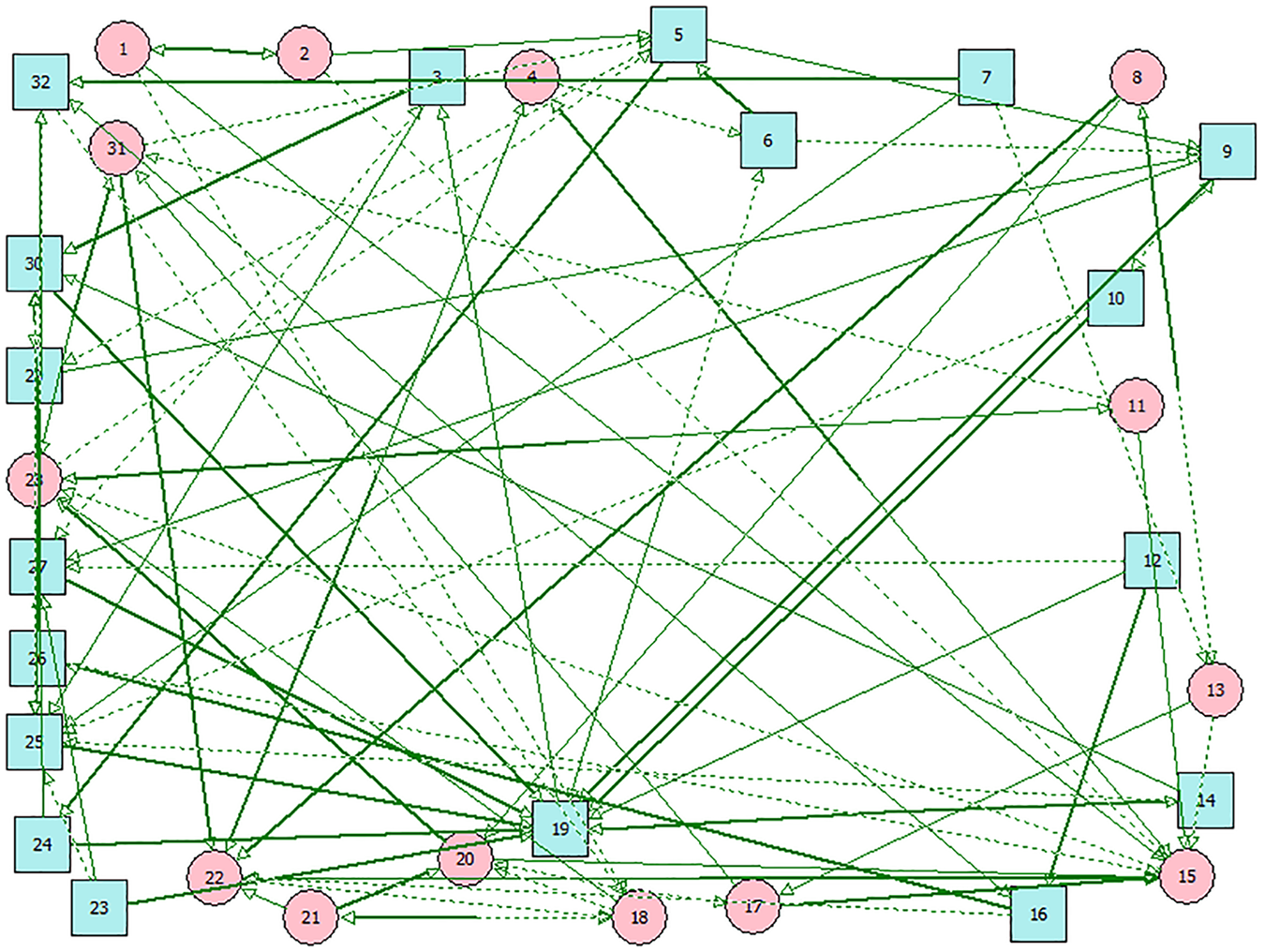
In the research, the findings obtained from the sociometry tool, the interview with the classroom teacher and the student products are presented in this section. First, the sociogram created with the sociometry data made after the implementation is presented in Figure 4.
Post-implementation sociogram.
In the figure, the arrow with a thick line indicates the first choice, the arrow with a thin line indicates the second choice and the arrow with a dashed line indicates the third choice. Numbers 5 and 6 in the sociogram represent the Syrian students. When Figure 4 is examined, it is seen that the first choice of student number 5 was the other Syrian student before the implementation, but he preferred student number 24 after the implementation. What is remarkable is that student number 5 was not preferred by anyone except the other Syrian student before the implementation, but after the implementation, he was preferred in the second or third place by four students in the class. Similarly, student number 6 was not preferred by the students in the class, except for the other Syrian student, before the implementation, but was preferred by two students in the third place after the implementation.
Interview and student products
The themes obtained from the interview with the teacher and the student products were determined as ‘the process’ and ‘the message’.
The process
In the interview with the teacher after the research, it was revealed that the visuals in the books were effective in the students’ understanding of the messages intended to be conveyed in the book. In addition, another matter that emerged was that the visuals increased the children’s interest in the book, so they listened to the book more carefully.
The visuals were very effective for the students to answer and for answers to be correct. In general, the children showed interest in the book and were curious about its content.
It was determined that guiding students with questions during the interactive reading process was important for them to understand the book correctly. The teacher stated that the children understood the books better with the interactive read-aloud.
Asking questions during the interactive read-aloud guided the children in the right direction. They understood the book better with this practice.
She stated that with interactive reading activities, students recognized and gained the abstract skill of empathy in a concrete way.
In my classes, I always emphasize the importance of empathy to the students. It is important that this is further reinforced in the books we read in order for children to understand the other side while communicating.
The message
In regard to the children receiving the message intended to be conveyed in the book, the teacher stated that the students liked the part where the polar bears accepted and had fun with the monkeys who were looking for a place to live after the polar bears found an empty island to live on, after not being accepted by the other animals in the book, called Bienvenus.
The part where the polar bears were looking for a place to live and the ending stuck with them.
Similarly, for the book titled The Suitcase, it was stated by the teacher that the students understood the message that the book wanted to convey and that they realized that they needed to help people who needed help at the end of the implementations.
The students did get the overall message. They were conscious of the need to help those in need.
The teacher stated that the book Stepping Stones was useful in conveying the experiences of Syrian students in her class to the host students in a concrete way.
There are many Syrian students in the classrooms. It is difficult to explain this situation to Turkish students, especially at a young age. The book Stepping Stones was useful for Turkish students in my class to understand their Syrian friends concretely.
At the end of the third interactive readings, the students were asked to write down what they understood from these books and which parts they liked most. In this context, it was attempted to determine the opinions of the students about whether they received the desired messages or not. Within the framework of this activity, the students wrote that they liked the last parts of both of the books.
The lesson I learned from the book is the last part.
In another example, in the book The Suitcase, the animals living there built the house in the photograph, which came out of the suitcase, to apologize after breaking the suitcase of the animal that came as a migrant. After seeing this, the animal who came as a migrant stated that in addition to the cup she brought in her suitcase, they also need cups to drink tea together in her new home. Some of the students liked this part. This can be shown as a good example of them understanding the message intended to be conveyed in the book.
The part of the book I like is ‘we need three glasses’.
On the other hand, one of the prominent messages understood by the students was that prejudiced and selfish thinking is a negative thing.
They just looked at their outward appearance and only cared about their own enjoyment.
Some of the students wrote one-word responses indicating that they understood the message that was being conveyed. The visual created from the responses is shown in Figure 5.

Students’ responses.
Looking at the answers given to these specific books, in the book titled The Suitcase, the suitcase of the animal that came as a migrant is opened without permission. In this context, the students learned that they should not go through other people’s belongings without permission, no matter what. For example, a student expressed this as follows: ‘We should not touch someone’s stuff without permission.’ Another student stated that it is important for friendship not to open other people’s belongings without permission.
Friendship, and we should not open other’s belongings without permission.
The messages taken from the book Bienvenus stand out both in terms of inclusivity and morality. In the book, polar bears whose glacier pieces break off are looking for an area where they can live. Other animals that live in the area where they go lie when they do not want them to live there. Affected by this situation in the book, the children first realized that lying is a wrong behaviour. In addition to this, another important message learned by the students was that people who come because of migration should not be treated badly.
We should not lie to friends. We should not mistreat them. I learned not to mistreat people. I learned not to go into a place without asking for permission from someone.
Other values learned from the book called Bienvenus stood out as helping and sharing. In addition, the host students were able to empathize with the refugee students through interactive reading. As an example of this, one of the students stated that it was important to help the refugee students by stating that they might face a similar situation.
If we don’t help someone, it will happen to us too.
In terms of helping, the host students, based on the characters in the book, realized that they had migrated for compulsory reasons and stated that they had learned that it was important to help and share with those in difficult situations.
We should help in difficult situations. To share everything.
Some of the students stated that the family was travelling in difficulty after the book Stepping Stones and that a similar situation could happen to them, so they should understand them.
They had a hard journey. We could have been in the same situation.
Finally, it was not only a positive view of refugees that was taken from the book Bienvenus. In the book, the glaciers where the polar bears live have melted and the bears are in search of a home for themselves. Therefore, the negative aspects of global warming were another message that the children learned from the book.
If we don’t take someone into our home, they will not take us either. We should not pollute the atmosphere, or our animals will have no place to live.
Conclusion and discussion
Education is the most effective tool that enables refugees to integrate into the country they are in. The adaptation of refugees, especially at the age of education, to the host society will determine not only their own future but also the future of the host society (Ham et al., 2020). On this point, Coninck (2020) stated that refugees may be exposed to different attitudes about integration due to their various characteristics (socio-economic status, having the same or different ethnic origin, coming from Europe or other countries, etc.). In the current study, the teacher, who had refugee students in their class, stated to the researchers that they could not adapt to the classroom, and cooperative action research was carried out on this problem. In the research conducted to determine the origin of the adaptation problem, it was seen that the problem was not due to their lack of knowledge of Turkish but mostly due to the fact that the host students did not accept the refugee students. However, integration is a two-way process that occurs through the adaptation of both immigrants and the host society to new situations as a result of their interaction with each other (Martikainen, 2004). At the root of this problem is the fact that Syrian refugee students come from a different ethnic background and are subjected to widespread disinformation, particularly in the media, portraying them as having certain advantages as refugees. As a result, they are not fully accepted by Turkish society. Studies have shown that there is a gradually increasing serious negative view towards Syrian refugees (Erdoğan, 2015; Özdemir & Öner-Özkan, 2016; Ünal, 2014). When the density of refugees in a neighborhood or a place is added to this, the negative attitude shown at the macro level is also reflected in the schools at the micro level. As is often emphasized (Çelik & İçduygu, 2018; Hamilton, 2003; Madziva & Thondhlana, 2017), it is important for refugee children to enroll in school in the country they go to and continue their formal education life. In this context, it is known that variables such as school climate, teacher competencies and host children’s attitudes towards refugees are effective in the educational integration applied to continue the formal education of refugee children. In this context, illustrated children’s books that deal with the concept of refugees that can help them to better understand refugees were selected in order to change the negative perspectives of the host children towards the refugees. The selected books were read interactively and audibly by the teacher in the classroom. As a result of the research, it was seen that the children grasped the main ideas in the books and started to accept the refugee students.
During interactive read-aloud, the teacher conducts the process with the children and gives them the opportunity to learn how to think and how to conduct their own learning processes (Barrentine, 1996; Kesler et al., 2020). In this regard, interactive oral reading contributes to the learning of the subject to be taught and the development of language skills. On the other hand, children’s books are an important tool for children to gain different perspectives, experience different events with the characters in the book and gain skills like recognizing differences and accepting them (Prater & Dyches, 2008). In this research, it was attempted to make the children understand what is important to the protagonist of the book The Suitcase. The protagonist never lets go of his suitcase, even under very difficult conditions, and in this context, it was aimed to make the children understand that we should be respectful to refugees and how things that may seem unimportant to us can be important for them. In addition, it was aimed to make the children feel the conditions that the people are in when they become refugees. These important messages the book wants to convey are fundamental for the host children to understand the refugee students (Ostrosky et al., 2013). And indeed, it was revealed in the findings that the children received these messages.
Developing abstract and complicated social skills such as empathy, gaining diverse perspectives and respect for migrants is a challenging subject in primary school. Türk et al. (2018) stated that children with high emotional empathy skills will be more likely to form friendships with children from different ethnic groups, as they gain an emotional perspective and show compassion towards other ethnic groups. While teaching such skills, it is necessary to direct children to think correctly and for children to experience these skills with examples. The nature of interactive read-aloud provides opportunities for students to develop their complex thinking and learning while they create meaning together about the text being read (Copenhaver-Johnson et al., 2009). In this study, it was seen that the interactive read-aloud was beneficial for the first-grade students to gain skills such as empathizing with and showing respect to refugee students. Similar to this research, in her study with first-grade students, Panteleo (2007) concluded that interactive read-aloud was effective in children’s discussion with each other about the text being read, in using their high-level thinking skills and in correctly understanding the message that is being conveyed in the text.
In classrooms where refugees are present, it is important for the teacher to prepare the classroom environment and plan the education by considering them, so that the refugees receive quality education. There teachers should prevent behaviours such as intolerance and disrespect towards refugee students that can develop among host students (UNESCO, 2005), because mutual tolerance and respect among students is one of the critical steps in creating a positive climate in an inclusive classroom. If teachers cannot create such a classroom climate, inequality and discrimination may occur (Castagno, 2008). However, there are not many studies aimed at increasing the professional competence of teachers in classrooms with refugee students (Goodwin, 2017). As a matter of fact, as stated in the introduction of the research, it was stated in the Solano and Huddleston (2020) report that teachers receive training in this direction in only eight of the countries where refugee students are located. Considering the important role of teachers in the adaptation of refugee students to school, it is necessary to ensure their professional competencies in terms of inclusion. Therefore, teachers should first accept these differences in terms of inclusive education, and similarly, they should help the host children gain this perspective and diversify and enrich their educational activities in this context (Goodwin, 2017).
Implications
In the current study, the classroom teacher felt professionally inadequate against the problem of the host students not accepting the refugee students. With this study, professional development was provided by the interactive read-aloud method in the sense of providing the host students with social skills such as empathizing with refugee students and respecting them. In this context, the continuation of the adaptation problem of Syrian refugee students, who began to enter the country in 2011, necessitates a series of measures to be taken again or reviewed. In this context, considering that the existence of immigrant students will continue for a long time, it is recommended that the education system be designed to meet the needs of immigrant children from pre-school education, to receive additional support to prevent drop-outs due to adaptation, that teachers be trained on the intercultural approach, that all students be taught how to live together in a different society, that the educational content (curriculum) be created in the context of multiculturalism and that the existing practices should be reviewed.