







Abstract
We argue on the role played by tools of mediation in scientific concept formation as an important issue to develop conceptual and scientific thinking and to make students aware of phenomena and socioscientific issues. Different forms of semiotic materialization of actions carried out in external and internal planes of human activity can improve students’ learning, intellectual development and constitution of personality. In the external plane, actions can be guided by a Scheme for a Complete Orienting Basis of an Action (SCOBA) to make mediation between content and forms of the object, involving logical, necessary and essential procedures to organize the teaching and learning process. In the internal (mental) level, these actions turn into signs, symbols and tools of mediation, as senses expressed by the students, that face socially shared meanings for scientific concepts, engaging them in a meaning-making process. Actions and discourses are mediators leading students to engage in activities and develop skills that favour awareness and learning processes, involving three moments: orientation for actions, execution of actions and control/regulation of learning.
According to the cultural-historical approach proposed by L. S. Vygotsky and his collaborators, scientific (theoretical) concept formation is one of the essential elements for the mastery of scientific culture. Learning these concepts in school provides students with psychological tools of thinking, also allowing them to organize intellectual and educational activities, which contributes to building a scientific worldview.
For Vygotsky, scientific concepts are tools of conceptual and scientific thinking, and school instruction becomes necessary to the development of students’ personality and awareness of the world. Vygotsky (Vygotski, 1995) argued that conceptual thinking is a superior level of intellectual activity closely related to language, which represents a dialectical leap in human psyche development. For him, scientific concepts substantially modify the content of thinking, revealing a deep view on what underlies reality and allowing us to know the relationships between ‘things’ and their inner essence. Thus, we could better understand reality, other individuals and ourselves as we think by concepts.
P. Ya. Galperin, following up Vygotsky’s ideas, also ascribes special importance to scientific concept learning at school in the psychological development of students. In his theory on the formation of mental actions and concepts, Galperin (2002) argues that this process is carried out through special intellectual actions in which the concepts are included, initially materialized in the external plane, then later by acquiring mental forms.
Students must perform activities mediated by linguistic and symbolic means of the scientific language to learn scientific concepts. Their ability to consciously use signs and symbols is a necessary condition to performing operations and mental actions, which contribute to: (a) the meaning-making process and mastery of scientific concepts; and (b) using concepts for analysis, explanation, prediction and generalization of phenomena and socioscientific issues. In other words, the symbolic language of science mediatizes meanings attributed to concepts, phenomena and situations, enabling the students to understand and to interact/act in the world.
Theoretical framework
In this paper, we intend to discuss the use and role of some sign-symbolic tools for scientific concept formation based on the perspective of the Theory of Planned Stage-by-stage Formation of Mental Actions (PSFMA Theory), proposed by P. Ya. Galperin, distinguished psychologist of the cultural-historical school founded by L. S. Vygotsky. This theory can be considered as a dialectical continuity of Vygotsky’s ideas on the mediatization of cultural tools for the development of conceptual thinking and their implications in scientific education at school.
Theory of Planned Stage-by-stage Formation of Mental Actions by P. Ya. Galperin
According to Galperin (2017), learning a new scientific concept is related to the teacher creating conditions to the internalization of this concept content as a component of the structure for general action orientation that is internalized by the students in their zone of proximal development (ZPD). Each general action performed by a student to learn the concept represents a complex system that includes three moments: orientation, execution and control/regulation. The orientation moment refers to a mental image or representation of what to do for learning, and under what conditions, that is, an operational model of thinking, which allows students to plan, perform and regulate the actions necessary to learn, in this specific case, scientific concepts. The author idealizes a basis of orientation for action that must be complete not only for specific situations but relative to a set of tasks that can be performed to develop a thinking with scientific concepts. The execution moment consists of the realization of the actions to transform the object into a given product, considering the proposed orientation, and the control moment aims to monitor the results of the activity, making necessary corrections and contributing to the expected learning. For Galperin, these three moments are part of a whole process, in which the main role is played by the orientation moment, or the Orienting Basis of Actions (OBA), as named by the author.
Reshetova (2017) points out that Galperin departs from the fundamental principle of cultural-historical psychology for the guiding function of the psyche in human activity and establishes that learning should be considered as an intentional process, performed by students, guided by OBAs that should represent a way of approaching and mastering the scientific concept. This scientific concept is formed through the activity, in which the teacher must determine and structure the general action and the conditions under which it should be carried out by the students to solve a set of problem situations using the concept. A mental action must be formed including the concept, materialized in a theoretical reference model (orientation) supported by several sign/symbolic resources that organize the internalization process from the external, interpsychological plane to the formation of action in the mental, intrapsychological plane (thinking).
In this sense, learning is considered as a cycle to form the scientific concept constituted by the following stages: (1) elaborating the Scheme for a Complete Orienting Basis of an Action (SCOBA); (2) solving problem situations with support of SCOBA in a materialized way (for instance, study cards); (3) solving problem situations using SCOBA in the form of external language; and (4) solving problem situations already in the mental plane (internalized SCOBA), as an act of thinking without the support of external language or materialized orientation. These stages represent qualitatively different forms of thinking. In each of these stages, sign-symbolic resources perform different semiotic functions, such as mediating the psychological processes of internalization of the concept content, for instance, the orientation action in which the use of the scientific concept allows thinking towards the solution of determined tasks. In this case, the conscious domain of the concept content at the mental level allows the students to orient themselves for conceptual thinking. The process of internalization of the concept content, from the external to the mental plane, is mediated by different sign-symbolic resources, initially as concrete or materialized tools, then as symbolic tools of thinking to solve specific problems.
A prior moment to the stages proposed by Galperin is the diagnosis of the students’ knowledge about the concept content and their domain on the action (and its operational structure) necessary for the concept assimilation. Diagnosis data come from the orientation model to be elaborated by the students, which includes a demand to master the concept to propose solutions for typical situations. Besides, these data should give clues about the students’ skills with using signs and symbols, such as coding/decoding/schematizing, among others, necessary for the concept learning. Then, the stages for the learning process are followed, as described below.
Stage 1. Elaborating the Scheme for a Complete Orienting Basis of an Action (SCOBA)
In Stage 1, the students must become familiar in practice with the general and appropriate action to be performed which involves the concept to be learned, being aware on their understanding, as well as the conditions in which they can perform it; thus, they must plan, execute and perform the control of learning, which represents the initial understanding of the activity for learning the scientific concept. The students and the teacher widely discuss the initial diagnosis results to elaborate the SCOBA, in which they put together the action image, the conditions to perform it and the concept content (the essential characteristics). According to Galperin (2002), SCOBA is a mediating tool to learn the concept as an object of assimilation (internalization) in the process.
SCOBA allows students to understand the dialectical link between knowledge and actions as they refer to concrete practical issues related to the problem situation, avoiding the exclusive formalism of theoretical knowledge and the false theory–practice dichotomy, as Talyzina (1988) has discussed: knowing the content and always knowing what to do with it.
In this dynamic process, the teacher led the students to engage in a negotiation of senses and meanings. They should get a definition for the scientific concept, establishing its content and structure, according to a dialectical logic that reveals the essence of it, which is typical of scientific concepts and necessary to develop theoretical thinking. The relationship between the word, as a symbolic resource, and the expression of the concept content in a scientific view is highlighted, and the objects and phenomena are included in the concept definition. In turn, the structure of the general action to be carried out for the assimilation of the concept is established.
As a result of this step, the students will receive a guidance model or the orientation action that they should plan on a study card. This scheme is a general method leading the students to a typical movement from the concrete to the abstract, then to the concrete, particular situations believable to be solved, which exposes the essence of the possible solutions for a group of problem situations, constituting an operational scheme of thinking, a tool for a qualitatively different learning, which enhances the intellectual development of the students.
According to Núñez (2009), in elaborating this scheme (SCOBA), the students should become aware of its structure and its functions for learning, considering that schematization is a sign-symbolic activity of a given object of knowledge. We point out the importance of the correlating signs, words, with the objects they represent, understanding that there is no relationship of identity between them.
The use of the study card is noteworthy and a necessary condition for the students’ knowledge of the concept content and the proposed actions that must be carried out to solve problems in the materialized stage, without prior memorization. This resource for mediation of learning contributes to the correct performance of the action, avoiding unnecessary and long attempts and errors performed by the students in relation to the concept content or its definition. As Galperin (2002) said, the study card is an external tool, a materialized sign, for the action of thinking in the process of scientific concept formation. Sálmina (1988) points out that, in terms of semiotic content, study cards can be of three types: (1) cards that reflect the signs and structure of objects combined in a concept; (2) cards that indicate the structure of operations to perform an action; and (3) cards that reflect the elements of the concept content and the operational structure of the action. The last type is the most used when it comes from a third-type orientation (OBA III).
For Sálmina et al. (2019), certain requirements for the presentation of the content of the study card should be considered. It is necessary to concisely present information and make it easily visible. The form of presentation of information on the study card is preferably determined by the nature of the action in training, the content of the concept, the moment to proceed to this stage and the students’ age. Although they can be represented in different ways, Sálmina (1988) justifies that the schematic form of a tree is usually the most efficient.
At the end of this stage, the students must have a schematized (materialized) orientation for the action as symbolic support to perform the learning activity, understanding that it allows them to consciously learn and regulate their learning.
Stage 2. Solving problem situations with support of SCOBA in a materialized way
In Stage 2, the students collaboratively (interpsychological level) solve the proposed problem situations that require a scientific concept domain, using the SCOBA schematized on a study card (materialized action) and real objects (material) or their materialized representations according to the possible symbolic resources these cards can offer. Thus, the orientation is based on the materialized actions but also on the material and/or materialized resources with which the students interact towards the object, seeking solutions for the problem situations.
Galperin (2009) and Sálmina (2010) discuss the relevance of this form of action and the use of signs as mediators in the process of forming a scientific concept based on a general orientation, highlighting serious difficulties of the students when it is disregarded in the learning process.
At the beginning of the materialized stage, it is important to present all structural components of the SCOBA detailed on the study card supported by the verbal language, contributing to the students’ awareness of the actions to be performed and the concept content. Language constitutes part of the processes experienced by students when they seek to carry out the proposed actions on the study card and verbalize the results, doubts and acquisition of knowledge that emerge from these actions. In this process, the students should consolidate meanings for the expected results and/or (re)signify unrealized expectations. At this point, the SCOBA can be reworked, confirming its dynamic nature.
The actions and interactions between the students, at this stage, depend on several factors, in particular the material and symbolic resources, especially the study card, used to perform each action, the nature of the task (discrimination, transformation, construction of an object) and the type of support the most experienced students or teacher provide to the less experienced students, in the ZPD level, based on the guidance drawn up as a reference.
Talyzina (1988) draws attention to something relevant in the choice and use of didactic resources as mediators. The object in question is differentiated from the object of the action. The object in question, in its material form, concrete, sometimes does not express the essence of the scientific concept to which it is related. The object of the action, on the other hand, is the representation of the essence of the concept related to the object in question. It expresses the necessary and sufficient characteristics, the essence of the concept that constitutes the definition of the concept. Consequently, the object of the action is not any concrete object, image or representation that can be suitable for the assimilation of a scientific concept.
In the materialized stage, following Zankov (2011), it is necessary to raise awareness of the relations between object representations and verbal language, that is, between the represented objects to be used, the external language and the content of the concept to be learned. Thus, the scientific language, spoken or written, in articulation with the material and/or materialized support of objects and the SCOBA used to guide the execution of the tasks, becomes indispensable in the learning process of concepts.
At the end of this stage, after solving the tasks, the students no longer need the study card and can move on to the next step, focused on reflection and discussion about the actions performed, especially in the external language plane.
Stage 3. Solving problem situations using SCOBA in the form of external language
This stage is a transition between the materialized form of action and the mental action, which comprises thinking, carried out without external support. It is about thinking and communicating. The task is solved in such a way that the actions are performed using the sign-symbolic resources in oral or written language to make the process understandable to any collaborators and students.
At this stage, special attention is paid to the students’ awareness about the activity they are performing and the concept content. The students solve the tasks in a collaborative way, preferably in pairs (interpsychological plan). Galperin (2009) relates the formation of scientific concepts as forms of mental reflection that enhance the students’ awareness on their processes. In this direction, to understand the signs and symbols of the scientific language is an important condition for learning and the development of conceptual and scientific thinking. The students write and reflect aloud about the actions that are being performed, in which the content of the concept is approached, interact with colleagues and the teacher creating opportunities for new elaborations and (re)elaboration of ideas, to the extent that they can solve problem situations. The use of external language, spoken or written, as a mediator of the process contributes to the control and self-regulation of learning.
The sign-symbolic tools are now focused to ensure the processes of verbalization, interactions with peers and teachers, reflection, elaboration and (re)elaboration of ideas and consequently to form awareness of the structure of the orientation action and the object of study. Thus, the mediatization made through resources, signs and symbolic language acquires a prominent role in this stage and operates from different modes of mediatization that raise the levels of consciousness and the development of conceptual thinking. Then, it is necessary to use more codified, less detailed symbolic resources, in relation to the SCOBA.
At the end of this stage, when the students can solve problem situations in which the concept is used and no longer need to verbalize the solution as part of their thinking, they can move on to the next stage, the mental one, which is related to thinking about the SCOBA without materialized external support or external language, operating in the intrapsychological plane.
Stage 4. Solving problem situations already in the mental plane (internalized SCOBA), as an act of thinking
The orientation action (SCOBA) allows planning, executing and controlling learning activities, and it is performed ‘by oneself’ on the mental plane. In this plane, the structured thinking concentrates language in the communicative function and its role as a symbolic tool of mental activity is enhanced. The generalization of the orientation action and the reduction of the concept content occur more intensely, and the students should respond to the activities with intellectual autonomy, individually. The didactic resources must support the realization of actions in the plane of thinking. The signs operate at the mental level, acting and interacting in the internal level without necessarily detaching the individuals from the interactive experiences and exchanges lived in the previous stages. Tasks are also used to transfer or apply the concept to new situations, which requires some creativity.
We emphasize that the learning stages process for scientific concepts, referred to in Galperin’s theory, does not represent a linear sequence of an algorithmic nature but a heuristic orientation of how the internalization of external orientation actions and their mental formation can be understood, considering moves in the ZPD. Students do not need to go through all the stages, but, in general, when they are faced with the assimilation of a new scientific concept and they do not have the initial cognitive symbolic resources formed in the mental plane to gain an appropriate orientation, it is convenient to follow the logic of these stages.
In the learning process, the effectiveness of sign-symbolic tools, in particular SCOBA and its different forms, is related to their function in the orientation action to be formed, which has a double determination: firstly, it is associated with the characteristics of the signs themselves; and secondly, it depends on the place of symbolic tools in the student’s activity; that is, the functions of the signs, the object of assimilation and other conditions for the optimal introduction of symbolic tools are associated with the organization of the learning activity.
The above discussion can be illustrated in the following example of an activity involving the teacher and students as they address the concept of a triangle in mathematics classes. Here, our intention is to help the teacher in reflections about the students’ learning on the concept in focus, but this is not a ready or complete procedure for immediate application.
Triangles. Mathematics.
Children in Elementary School, Third Grade.
Identify triangles.
The follow task presented by the teacher.
Shows a mosaic of geometric figures fixed on the wall (see Figure 1) and asks children to paint yellow in those spaces with shapes of triangles. The task involving a problem can bring motivation due to the students’ need and interest in solving it.
Which parts should be painted yellow?
Must discuss the task and talk about the interest of solving it to the learning.
You can ask the following questions:
(1) What is requested in the task? What should you look for?
(2) We want to know what a triangle is. It is necessary to search for this information in the textbook.
(3) A triangle is a three-sided polygon. Are these the characteristics necessary for a shape to be a triangle?
(4) What should you do to identify a triangle in a group of different shapes?
(5) Let’s develop a scheme that can help us to identify triangles without necessarily memorizing the information from the textbook.
(6) In the scheme, you must answer the following questions, in two parts: Part 1: What is a triangle? Part 2: How do you identify (step by step) a triangle?
(7) We will discuss the scheme you have elaborated, that we can name study card and which will be used as support in solving the task.
(8) Do you understand what to do to identify triangles?
Participates by answering the questions posed by the teacher and by elaborating the scheme or study card.
Encourages the students to solve the proposed task. She/He monitors the students’ learning according to the conditions established in the elaborated scheme (SCOBA) and guides the method of carrying out the actions in this plan, providing the necessary help.
Collaboratively solves the task and questions that require identifying triangles as part of the solution, with the support of the study card.
In pairs, she/he solves the problem posed in the task according to SCOBA, verbalizing in detail what she/he does and why, with attention to the essential properties that characterize the triangles. The student and her/his partner follow SCOBA in the same way and, if necessary, both can suggest corrections to be made in a negotiated manner. They can alternatively play distinct roles in the pair, for example, firstly one conducts the activity and the other follows her/his actions, then, in the next activity, they can reverse their roles in the duo.
They solve several types of identification tasks: positive response (+), negative response (−) and indeterminate responses, supported by different representations of triangles, all of them with the mastery of the essential characteristics of the concept and its insertion in new networks of concepts.
Solves the new tasks without the support of the materialized SCOBA, whose content is now represented in the form of the language as mediator and object of assimilation. She/He reflects and becomes aware of the activity involving the content of the concepts that she/he must learn.
Reinforces the role of language in the processes of reflection and awareness. She/He organizes and suggests possibilities for the solution of tasks in pairs, searching for increased autonomy of the students. She/He monitors the students’ learning according to the conditions established in the SCOBA and the methods of carrying out the actions in this plan, providing the necessary help.
Solves with autonomy problems that require the application of the concept of triangle, which could demonstrate the degree of its domain.
Creates opportunities for the solution of tasks that require learning transfer, which stimulates the creativity of students. She/He evaluates, in interaction with the students, the mastery that they reach for the concept of triangle.
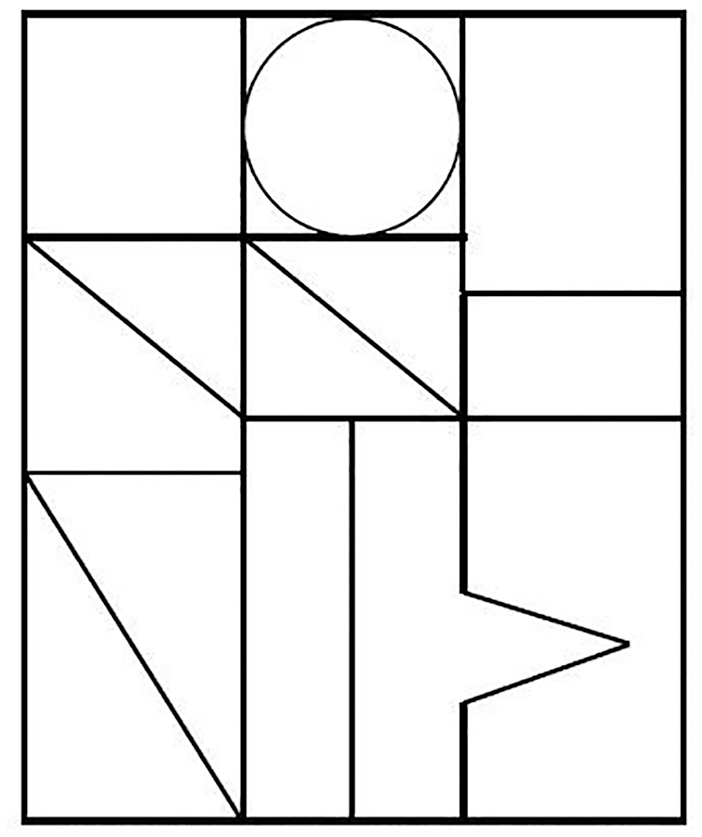
Mosaic of geometric figures.
Conclusions
We agree with Sálmina et al. (2019) on the essential role of didactic resources as symbolic mediators in scientific concept learning and on the importance of teachers having psychological references regarding their use in this process. The use of symbolic tools for learning can have a positive effect on students’ motivation and success. As Zankov (2011) explains, these resources are mainly associated with the awakening of interest and attention, the implementation of practical actions, the assimilation of substantially new knowledge. The ideal tools are aligned with the understanding of the material, the logic of reasoning, the culture of speech, the development of intelligence. There are no clear boundaries between the spheres of influence of material and ideal tools: often, both affect, together, the formation of certain qualities of the students’ personality. Núñez et al. (2021) draw attention to the fact that the logic of the stages proposed by Galperin’s theory does not apply to any scientific concept, considering it is a complete orientation, and the concepts must be those characterized by their universality and wide scope, which allows them to comprise other specific concepts.
From the perspective discussed in this paper, the activities that students must perform to learn scientific concepts differ substantially from those provided by traditional teaching and other perspectives, such as learning considered as a construction of knowledge. The stages of concept formation are part of a model pedagogically structured by the teacher (not natural or spontaneous), based on activities and mediated by processes that enhance the students’ psychic development. Special attention is paid to the conditions (the orientation) that favour the concept learning in terms of the actions to be carried out with them, without separating the formation from its application.
We emphasize the need for studies and reflections on the mediating role of language in the teaching and learning processes of scientific concepts. Nowadays, we live in a world envisioned, impregnated with the strength of the media and exponential technological resources for teaching, and it is demanded that teachers act much more as users of these resources, often without reflecting on them as cultural products, and without analysing the pertinence and bonds they establish with represented content. We propose a reflection on these technological resources relating them to the objects of learning and using them for the development of conceptual and scientific thinking.