







Abstract
According to Vygotsky, play is marked by a fundamental inversion in the order of dependencies of meaning regarding the object and the action. In play, objects lose their impelling force and action is born out of thinking, bringing meaning to the fore. The child’s relationship to the world from the immediate in the concrete situation at early childhood becomes mediated in the imaginary situation at preschool age. However, a close study of the concept of meaning in Vygotsky’s 1933/1922 essay has revealed a number of aporias in the argument (Moro, 2022a). Based on work revisiting the concrete situation through the executive functions articulated to the study of the genesis of the will, we show that the inversion referred to above is first present in early childhood, resulting in reconsidering the conditions of emergence of pretend play and the status of the imagination at its beginnings. Our argument is based on writings from the final period of Vygotsky’s work (e.g., Vygotsky, 1935/1993), some of which have recently come to light in Vygotsky’s Notebooks (2018).
Introduction
Pretend play is of special importance in early development. Taken by Vygotsky to be a harbinger of the imagination at preschool age, play frees the child from situational constraints. We consider that the conditions of its emergence are no less important, as much for normal as for pathological 1 development (to take up the Vygotskyan terminology). In particular, we ask ourselves the question of whether we can continue to affirm that the child in play would succeed a passive child in acting subservient to the object according to the characterization produced by Vygotsky. This question is related to the construction of the personality at the first stages of psychological development which we (re)investigate here within the framework of the executive functions, linked to the genesis of the will. Approaching the concrete situation in this new way presupposes reconsidering it in connection with material culture, the reality that the child faces in early childhood following Vygotsky, who specifies that “every age has its “environment” (1934/1994).
This paper is divided into four sections. The first describes Vygotsky’s approach to play and its aporias; the second is devoted to the theoretical position of the present study; the third section presents the concrete situation as it is re-envisioned through the executive functions, with a re-problematizing of perezhivanie; finally, in concluding thoughts, we draw the consequences concerning the status of imagination in the concrete situation vs. pretend play.
Part I: Play in Psychological Development According to Vygotsky
In his 1933 essay, Vygotsky asks himself about the origins and genesis of pretend play, as well as the role of this activity in preschool development. Vygotsky (1933/2016) insists on the need for play to be investigated “from the standpoint of fulfillment of the child’s needs, his incentives to act, and his affective aspirations” (p. 6), unlike intellectualistic theories which do not make it possible either to apprehend the transition from one age to another or to characterize the specificity of play. To do this, Vygotsky proposes a problematic opposition of two theoretical constructs: the imaginary situation vs. a concrete situation, the first “relying on internal tendencies and motives” (Vygotsky, 1933/2016), the second “on motives and incentives supplied by external things” (p. 11).
The Conditions of Emergence of Play
The imaginary situation marks play “as the leading line of development in the preschool years” (Vygotsky, 1933/2016, p. 6), that in which meaning becomes predominant. Affect or motivation to play in an imaginary situation involves the transformation of the primary, immediate affects or “individual, affective reactions” (p. 8) of the concrete situation into mediated and “generalized” affects (p. 8), that is, “indefinite 2 generalized affective tendencies”.
In the concrete situation, the child being constrained by the situation and the field in which he/she finds him/herself, the activity is marked “by the tendency to immediate fulfillment of desires” (Vygotsky, 1933/2016, p. 7). Here, Vygotsky (1933/2016) takes up Lewin’s proposition concerning the situational constraint “on the motivating nature of things” (Vygotsky, 1933/2016, p. 11), that is, “that things dictate to the child what he must do: a door demands to be opened and closed, a staircase to be run up, a bell to be rung” (Vygotsky, 1933/2016, p. 12). Perception in the concrete situation is a stimulus for activity, closely related to affective and motor activity, reducing objects to stimuli and the child to a passive subject.
According to Vygotsky, play is what permits the transition from the concrete situation to the imaginary situation. How does Vygotsky explain this? By the differentiation of the semantic field from the visual field, that takes place first in the imaginary situation, by means of an object, the stick in the example of the hobby horse, established as a “fulcrum” [“point d’appui” in French translation (Vygotsky, 1933/2022, p. 310) vs. “pivot” in English translation (Vygotsky, 1933/2016, p. 13), allowing the child to separate “the meaning of horse from a real horse” (Vygotsky, 1933/2016, p. 13)]. At this critical moment, the relationship between object and meaning is reversed, and the semantic factor becomes dominant. The relationship between action and meaning is likewise reversed: “Action according to rules begins to be determined by thought, not by objects themselves” (p. 13).
Thus, the essential attribute of play is a rule that has become an affect. “An idea that has become an affect, a concept that has turned into a passion”:—this ideal of Spinoza’s finds its prototype in play which is the realm of spontaneity and freedom. To carry out the rule is a source of pleasure. The rule wins because it is the strongest impulse. (Cf. Spinoza’s adage that an affect can be overcome only by a stronger affect). Hence it follows that such a rule is an internal rule, that it, a rule of inner self-restraint and self-determination (Vygotsky, 1933/2016, pp. 15–16).
The Aporias of the Vygotskian Model and the Question of the Object
The concrete situation and the imaginary situation derive from two antagonistic epistemological models of meaning (see our critique in Moro, 2022a). In the concrete situation, Vygotsky invokes Gestaltism and Lewin’s field dynamics. In the imaginary situation, the instrumental approach developed in The History of the Development of Higher Mental Functions (Vygotsky, 1928–1930/1987) prevails. In both cases, the vision of the psyche that imposes itself has a thing-based, ahistorical, anti-genetic logic, contrary to the Vygotskian spirit and to its dialectical logic (Sève, 2014). In the first case, the object is reduced to its perceivable reality, without consideration of the other reality which defines it just as much: its semantic reality, that which relates it to human activity which constitutes it as such, one not immediate but yet to be built. In the second case, with the logic of a “fulcrum,” the spearhead of the instrumental approach (Vygotsky, 1928–1930/1987, p. 61), only the “critical point” (Vygotsky, 1933/2016, p. 13) is considered, that is, only the moment when one object replaces another (that is, the stick in the case of the hobby horse); there is no consideration of the process leading up to it. As for the object that is at the heart of the process, its meaning is ignored and reduced to that of word meaning, which the stick realizes as the separating gesture between visible reality and semantic reality. All in all, the question arises as to what meaning (and thought) is in the model proposed by Vygotsky, especially given the absence of any semiotic analysis. This, all the more so, as one cannot but remark on a certain eclecticism in his examples. What, exactly, is there in common between those cited under the concrete situation where language is in no way involved and the example of Goldstein and Gelb, 1925, as quoted in Vygotsky (1933/2016, p. 12), which does imply it, and which Vygotsky relates to the concrete situation prior to his demonstration? If it’s not an identification of the meaning of the object and the meaning of the word, explicitly indicated elsewhere. In this way, the object is tendentially considered in its entirety. However, as we have shown (Moro, 2022a), it is the “point of view that creates the object,” to use a well-known expression (De Saussure, 1916/1985, p. 23). In other words, when it comes to the material object, the objectified human activity that it conceals has momentarily lost its psychological form, that is, its meaning per se (Sève, 2004, as quoted in Brossard, 2014, p. 298), which the child must now reconstruct. It is with the aim of filling these different gaps that we pose the need to revisit the concrete situation, and in consequence, to question the construction of the human personality occurring in contact with material culture, and the preconditions of pretend play.
Part II: The Vygotskian Conceptual Bases of Our Theoretical Position
Consciousness as a Dynamic Semantic System
The study that we propose below bases itself on the works of Vygotsky’s late period. In the middle of 1932, Vygotsky achieves a major breakthrough with the introduction of the principle of the semantic structure of consciousness which Zavershneva (2010, p. 35) describes as follows:
The principle of a systemic approach set forth at the end of 1930 (the paper “On Psychological Systems”) as well as the internal logic of the development of the idea of semiotic mediation led in 1932 to the emergence of a new theory of consciousness as a dynamic semantic system. All previous achievements were reviewed in light of this new vision. 3
The main works relating to this period cited by Zavershneva (2014, p. 75) are the following:
First, the problem of the dynamics of consciousness is in broad strokes outlined in the final chapter of Thinking and Speech (1934). Second, the so-called “internal conferences” of Vygotsky’s closest associates held in 1932-1934. The notes of one such meeting in December 1932 were subsequently published under the title “The Problem of Consciousness” (Vygotsky, 1997). Third, “The problem of mental retardation” (1935) [. . . major writing of the period]. Fourth, (. . .) Pedology of the Adolescent, vol III (Vygotsky, 1931) and his Thinking and Speech (Vygotsky, 1934/1987). Fifth, and finally, an important addition to this corpus (. . .) is [Vygotsky’s] personal notes that are stored in the Vygotsky family archive.
Vygotsky lays out the “six basic propositions” 4 of a semic method for his approach of consciousness as a dynamic semantic system (Vygotsky, 2018, p. 292), centered on language, which “penetrates mind and creates humans’ meaningful relationship to the world and to themselves [. . . where] the word plays a central role (. . .) in the whole of consciousness”. (Zavershneva & Van Der Veer, 2018, p. 291).
In this conception of consciousness, there is a major concern for openness to possibilities, for the question of freedom articulated with real action, with the aim of building the human personality (Vygotsky, 2018, p. 292). This approach constitutes a magisterial contribution, with strong heuristic potential, “where Vygotsky’s paper ‘The Problem of Mental Retardation’, which was published posthumously [1935], may be considered the manifesto of the final version of his approach” (Zavershneva & Van Der Veer, 2018, p. xx).
“The Will (The Central Idea)” 5
The question of the will is at the heart of this manifesto. How does Vygotsky approach this crucial point in the last phase of his work? The 1935 text allows us to deepen his theoretical foundation. Let us follow his thought in its most mature form of methodological reflection, through those authors who mark out his argument, namely Lewin and Spinoza.
Lewin: An Approach to the Will Reduced to Elementary Forms
First of all, we consider Lewin—“probably the most serious adversary of Vygotsky’s life, someone of equal strength” (Zavershneva, 2010, p. 36)—whose lectures in Moscow in spring 1933 6 offered Vygotsky the opportunity for new reflections (Vygotsky, 2018; Yasnitski, 2016). In his quest for a new path in his psychology, the global preoccupations of the monists of the Berlin School, which are embodied for Lewin in the dynamic conception of the total field (Mueller, 1976, p. 395, italics by the author), held real attraction for Vygotsky. He was distinguished by his contribution to the study of the common foundations between affective activity and human volitional activity (Vygotsky, 1932/2011) and “the notion of the unity of intellect and affect” (Vygotsky, 1935/1993, p. 229), which Vygotsky recognized. Vygotsky nevertheless expresses a number of reservations, considering that by reducing cognitive processes to affective processes, Lewin’s dynamic theory does not pose or solve intellectual and affective problems in a dialectical way. In this sense “[Lewin] does not know the dialectical rules which state: During development, the cause and the effect change places” (Vygotsky, 1935/1993, p. 231). This prevents him from grasping the reciprocal influence that affect exerts on the intellect, as well as the transformations which follow, and forces him to de facto abandon any possibility of historical and developmental understanding of psychic phenomena. Lewin, in defining the nature of the intellect in Köhler’s work on anthropoid apes, is not able to account for human intelligence in its highest and most developed forms, any more than he can distinguish in the dynamic sphere between needs of an instinctive nature and will (cf. Köffka’s criticism of Köhler which consequently applies to Lewin [Vygotsky, 1935/1993]).
With Spinoza: The Acmeist Approach and the Will as Freedom (“Free Will” 7 )
In 1935, this dialectical approach based on Spinoza constitutes both a response to the shortcomings of Lewin’s dynamic theory and an opening of psychology toward the future, toward the peak of development. Vygotsky would thus have laid the foundations of an acmeist psychology (cf. his 6th proposal of the “semic method,” where Vygotsky [2018] equates “acmeist psychology” with “height psychology” [p. 292]). “‘Acmeist’ is etymologically derived from the Greek word άκμή, meaning ‘peak’ or ‘zenith’” (Kölbl, 2021).
According to Vygotsky (1933), as quoted in Zavershneva and Van Der Veer (2018, p. xviii and p. 375):
Spinoza’s theory implicite contains the whole Acmeist psychology, the whole theory of concepts, affects and volition, the semantic and systemic structure of consciousness which we explicite developed. Spinoza has the idea of man, which can serve as a model for human nature: this makes his theory of the passions the prolegoma of man. (author’s italics)
By positing with Spinoza that “the relationship between soul and body (life [affect] and intellect) is not absolute and immutable but changeable” (Zavershneva, 2016, p. 110) and that their evolution depends on the change of their interfunctional relationships (Vygotsky, 1935/1993), Vygotsky opens the way to overcoming Lewin’s ahistorical approach and thus makes possible a genetic access to higher forms of conceptual thought. “Spinoza had already defined affect as that which increases or decreases our body’s ability to act, and as that which forces thought to move in a specific direction. Thus, dynamic conditionality is inherent in thought and action alike” (Vygotsky, 1935/1993, p. 234).
This conditionality is expressed in
(. . .) three phases [which] correspond to three fundamental problems in affective dynamics: (1) the transformation of the dynamics of a psychological field or of a situation into the dynamics of thought; (2) the development and unfolding of the dynamic process of thought itself; and (3) its return transformation into the dynamics of action” (Vygotsky, 1935/1993, p. 235)
Thereby, “if in the activity of real actions we observe dynamic mobility and fluidity, it is always characterized by the tendency of thought to participate in the process of our external activity” (Vygotsky, 1935/1993, p. 236).
The relation to action could refer to the concrete psychology of Politzer, a great reader of Marx and Lenin (Vygotsky, 2018), with whom Vygotsky had been familiar ever since 1929 (Sève, 2014), allowing him to avoid “a solipsist closure of mind” (Kölbl, 2021).
Vygotsky’s approach in 1935 tends toward recalling his earlier reflections on the formation of concepts articulated dialectically to action, according to a focus more particularly dedicated to the relationship between imagination and reality, which is expressed through the metaphor of the zigzag (Schneuwly, this volume). Schneuwly shows that from his reading of Lenin’s Philosophical Notebooks, to which one of his notes is testimony, written around 1930, Vygotsky is led to completely revise his conception of the imagination in its relationship to reality, as evidenced by his analysis of the adolescent.
This formulation of consciousness as a dynamic semantic system in conjunction with a psychology of experience (Zavershneva & Van Der Veer, 2018, p. xvii) constitutes the basis of the study presented below, whose broadly Vygotskian formulation suggests a possible application to the concrete situation, which we propose to revisit using executive functions.
Part III: Toward a Historicized Approach to the Conditions of the Beginnings of Play in Early Childhood
We set out below the central premise of the principle of our work. Our work has long been revisiting early development with the possibility of a renovated approach to the concrete situation. Then we will present the projected study, that of the executive functions, reconfigured according to a historical and genetic approach, allowing us to revisit the concrete situation. Finally, we exemplify our proposal using the analysis of Matteo’s 8 developmental trajectory at eight, 12 and 16 months.
The Pragmatics of the Object: Anchoring Development Before Language in Material Culture
The Pragmatics of the Object, based on works initially located in the semiotic wake of Thinking and Speech (1934/1997), demonstrates a completely different complexity of acting, compared to the concrete situation theorized by Vygotsky. The central premise on which these works are based is that the object, without excluding its physical dimensions (Moro, 2014), is re-envisaged as an artefact 9 belonging to material culture. This reflects on the definition of reality that the young child faces before pretend play. The object presents itself as two-faced, physical and semiotic in its canonical uses, and invites two types of categorization, perceptual and conceptual, that is, “what the objects look like” and “what they do” (Mandler, 2004; Rodríguez & Moro, 2008, p. 92), which raises the central question of the transition from the first to the second form of categorization. The Pragmatics of the Object has especially endeavored to demonstrate the existence of this second dimension, this invisible reality which initially implies sustained intervention by the adult to ensure its unveiling. It is on the basis of the methodological distinction between the object and the use that the first works of the Pragmatics of the Object were initiated, which initially aimed at the study of the triadic interaction itself, that is to say, the doing together. Thus, the “ordinary objects” (Vygotsky, 1933/ 2016, p. 14) which are part of everyday reality are defined according to this double belonging. More fundamentally, the object as a product of human activity belongs to the human world, a new plane of reality historically constituted of objectified human activity (Brossard, 2014, pp. 297–298 citing Sève, 2004) of which the child must reconstitute the psychic form. The object, like any work, “[is a] condensing [of] psychological thinking” (Kölbl, 2021), harboring meanings per se via its uses and, first and foremost, its canonical use.
Let us recount those advances in these works which are the principle of the study below, demonstrating the existence of a cultural-historical and semiotic development before articulated language:
the social and semiotic nature of knowledge through the transmission-appropriation of the canonical use of the object and its meanings, attested in the doing together of the triadic adult–child–object interaction between seven and 13 months, the child then being an interpreter of other people’s signs (primarily non-linguistic, demonstrations, ostensions, pointings, etc.) (e.g., Moro & Rodríguez, 1997, 2005; Rodríguez & Moro, 1998);
the abstraction by reconstruction of the meanings relating to the canonicity of objects (conceptual categories) by the child him/herself, between eight and 20 months, testifying to a preliminary detachment of the object vis-à-vis the initial doing together through the pivotability of the sign of ostension, which has become self-ostension (ostension toward oneself) where the meaning appears in condensed form; the focus on semantics involving a suspension of action in favor of attention, the child then being him/herself producer and receiver of signs (e.g., Dupertuis, 2020; Moro, 2016, Moro, Dupertuis, Fardel & Piguet, 2015);
the social and semiotic nature of the executive functions resituated in the cultural-historical perspective where the child regulates his own action on the world (Moro, 2012), revealing the first forms of the emancipation of the psychic (in children between eight and 20 months) via a double movement of detachment vis-à-vis the initial doing together: from the abstraction of meanings (conceptual categories) in a movement going from action to psyche; and from the generalization of these same meanings in their redeployment in the world in a movement going from the psyche toward the action, the child assigning goals, making strategic choices relative to the parts actually concerned of the object where to act with regard to the meanings mobilized. This double movement attests to an inversion in the order of dependencies, the doing of the child becoming autonomous from the initial doing together, from the object and from others, prior to pretending (Moro, 2024).
The advances related above (points 2 and 3) involve to varying degrees the sign of self-ostension, the action being then suspended and the use inactivated, attention becoming dominant (e.g., Dupertuis 2020; Moro et al., 2015). This sign, oriented toward oneself, can be considered as a variation of the ostension sign first identified in communication with others (Eco, 1992). What is important to point out for the rest of our study is that this sign is the principle of the first forms of consciousness in communication with oneself, opening up reflexive possibilities from an early age (e.g., Moro, 2022b). Reflexive processes are indeed present in the reconstruction of meanings but also during the redeployment by the child of meanings in the world via the executive functions, the action being able to occasionally be interrupted and give rise to moments of reflexivity, to then resume, attesting to great flexibility via constantly changing dominance relationships between psychic functions, a flexibility that tends to generalize to all functions (Moro, 2018). The decisive role of the sign of self-ostension is apprehended through the dialectical process of Aufhebung, which Sève (2008, p. 325) still describes in an instrumental logic, but reinterpreted within the framework of the Pragmatics of the Object according to semantic logic.
The Approach to the Concrete Situation Through Executive Functions
A brief reminder first about executive functions. In the literature, these functions, present in a large number of situations of daily life, focus the cognitive processes, allowing the adaptation of the action to the goal. Their study falls under cognitive psychology and experimental neuropsychology. We consider that the executive functions, in the triadic design imagined from the Pragmatics of the Object, make it possible to revisit the concrete situation under the new dialectical life-thought focal point proposed by Vygotsky in 1935, making it possible to bring to light the existence of a (new) doing mastered and informed about the world, that is, exercised by an emancipated subject before pretend play.
Here we take a further step by approaching the executive functions again through the different movements going from action to the psyche and back, aiming to detect the different transformations that operate dialectically in the dynamic conditionality of thought and action according to the three phases put forward by Vygotsky (1935/1993).
To do this, we reinterpret in terms of a cycle,
10
deploying in as many ontogenetic iterative loops (Moro & Zampieron, 2022) as there are canonical uses to be accomplished in the close environment (see method), or possibly ideal forms reachable by the child in the span concerned (8–16 months) from the initial doing together until the return of a new doing in the world, operated by the child him/herself. Each of these loops involves the three fundamental phases of affective dynamics, described by Vygotsky. But, and this is central, we posit that the dynamics glimpsed under this new focal point need to be coupled with the study of the sign-meaning dialectical process (cf. proposition no 1 of the “semic method”) in order to be able to reach genetically the development of meaning (i.e., of thought). In this way, we attempt to respond to the aporias raised in the theorization of the concrete situation. Thus, the following formula of Vygotsky (1935/1993, p. 235) is applicable to the approach of the concrete situation as newly envisaged via the executive functions:
An action reflected through the prism of thought has already been transformed into a different action, one that is meaningful, conscious, and consequently free and voluntary; that is, it stands in a different general relationship to the situation from action which is directly conditioned by the situation and which has not gone through the direct and reverse transformation of dynamics.
Vygotsky (1935/1993) stresses that “freedom is characteristic of a cultured person” (p. 235). But what of the young child? On this subject, let us recall that we have shown that the meanings relating to the canonicity of the object constituted both a gateway to (material) culture and the possibility for the child to construct the first forms specifically human of his/her psychological development. But they also confer “new possibilities for free and rational action” (Vygotsky, 1935/1993, p. 236), acting to emancipate him/her from perceptual reality and from the doing together, that is, operating by the child him/herself, before the beginning of pretend play.
Method
The data that we examine below come from research carried out as part of a PhD (Dupertuis, 2020) aimed at studying the forms of consciousness occurring in contact with material culture via the child’s reconstruction of meanings of objects between eight and 20 months old. Six children participated in the initial study, which involved three objects that were given separately to the mother-child dyad, in controlled order, during sessions filmed using a single camera. The instruction given to the adult is as follows: “Play together as you usually do.”
The selected object for the present study is a cat tower (see Figure 1). It was tested in a previous study focusing specifically on executive functions (Moro, 2012). This object is interesting in that it includes a finite number of canonical uses, that these uses are not completely semiotized over the span concerned, 8–20 months, which allows us to follow their genesis tied to different relevant meanings. The cat tower has different uses of increasing complexity such as laying the base of the tower flat, embedding the base of the axle in the base, threading a flattened mouse with a hole in the center along the vertical axle and embedding it in the base, embedding the tail of the mouse in the hollow of the base provided for this purpose, threading the rings along the axle by performing a seriation or not, depositing the cat’s head at the top of the axle. The cat tower requires that strategic choices be made by the child concerning the intended uses, depending on the meanings available (and their differentiation if necessary). These we qualify as prioritized meanings, in reference to the work of Gaux and Boujon (2007) on executive control, and their multi-component model, reinterpreted in cultural-historical and semiotic terms (Moro, 2012).
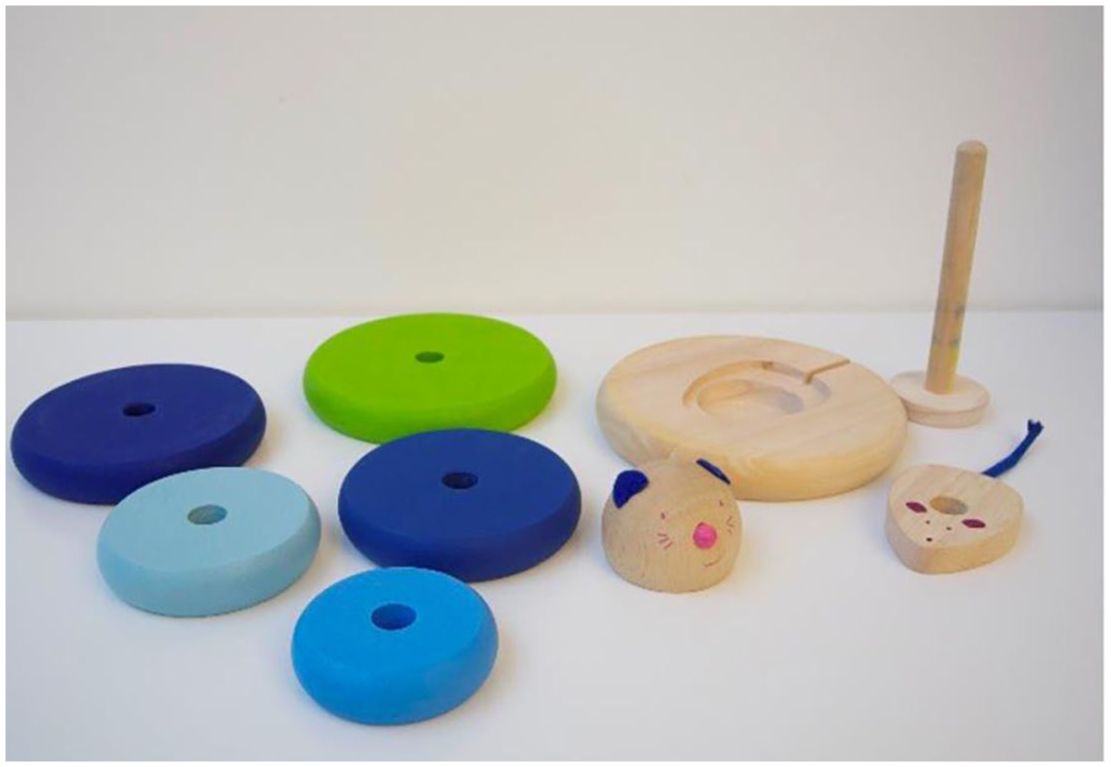
The cat tower.
The analysis was of the micro-genetic type. The analysis of the data was carried out using the ELAN software (ELAN—EUDICO Linguistic Annotator, 2011), which allows coding of the filmed sessions image by image down to the infra-second. Without going into the details of the (complex) coding, let us point out that the coding was organized around the detection and identification of the sign of self-ostension—a key sign in the analysis of our data—followed by the cutting into thematic units of the triadic interaction (adult–child–object) in which these signs were located. This was done in order to grasp the context of their occurrence and the subsequent activity that might occur. We also proceeded to the identification of the other signs made by the two protagonists within these same units. The choice to relate genesis in terms of developmental trajectory was essential, the development of subjectivity being by definition specific to each subject, even if there were strong inter-trajectory recurrences.
Analysis of Matteo’s Developmental Trajectory at Eight, 12 and 16 Months 11
As a preamble, let us recall (1) that the analysis of executive functions below does not concern triadic interaction, that is, the doing together (the subject of our very first work, cf. point 1 above), but the process of the emancipation of the psychic in the child, which aims precisely to move away from the doing together; (2) that the chosen object is in no way semiotized in all its canonical uses during the span of the longitudinal study concerned (8–20 months): it is the process of construction, that is, genetic and historical, which interests us and not the fossilized behaviors, as Vygotsky would say.
Observation 1
Transcript (henceforth A for adult, C for child)
[Situation: C is trying to grab the cat’s head sitting on top of the axle, the rings threaded underneath. A helps C to grab it, half disengaging the tower from the base, and applauds as C grabs it and directs it to his mouth]. C, with the cat’s face in the mouth, A says, “Mmh, it’s good,” while laughing. C takes it out of his mouth, presents the face to himself
Analysis
[C’s attraction to the cat’s head
12
is supported by A in helping the child to grasp it]. C buries the cat’s head in his mouth (non-canonical use). A supports C’s action by laughing and saying, “Mmh, it’s good,” however, being doubtful about the action performed by C, “Are you sure it’s good?” While C
Observation 2
Transcript
Having previously inserted a few rings along the axle with the help of A, C grabs the axle with the mouse and two inserted dark blue rings and disengages the base of the axle from the base of the tower. Next, with the green ring in his right hand, C puts the tower back, and with the other hand seizes the cat’s head and presents it to himself, the cat’s face facing his own face
Analysis
After inserting a few rings along the axle with the help of A and briefly giving interest to dismantling the tower, C, the green ring in one hand, grabs the cat’s head with the other hand,
We note in the child a tendency to complete a complete loop, that is, until the movement of return of the thought in the world, even if the action does not succeed for lack of a sufficient differentiation of canonical meanings of the two objects, and that A allows C to act except in the event of difficulty, where A intervenes with the use of a multiple immediate pointing, 15 for the sake of transmission but also with the aim of reducing the tension generated in C by childish failure as well as observed in a first study on executive functions (Moro, 2012).
Observation 3
Transcript
[Situation: the mouse, the green ring and the two dark blue rings are threaded along the axle]. A grabs the cat’s head, places it at the top of the axle and says, “Look, if we put on the head / how will you put on the others?” C removes the cat’s head from the axle while A says, “No, you can’t put the head down, you have to put on the two that remain,” touching the light blue ring and the azure ring on the ground with the index finger. During this time, the cat’s head slides to the ground. C takes the azure ring and tries to thread it along the axle, without success. Meanwhile, A says, “Hey, you’re only wrong by one piece, Doudou,” raising one finger to represent the number 1. A continues, “Yes, you’ve got it right; that’s good.” C presents the azure ring to himself and touches the orifice of the ring with his finger
Analysis
This observation reveals two moments of strength, a first moment where A attempts to orient C’s action and a second where C emancipates himself from this tutelage.
First moment: A makes use of many mediations which, due to their complexity and also to their tardiness with regard to C’s actions which pass by with rapidity, appear ineffectual. A begins with a demonstration with the absurd, by placing the cat’s head at the top of the axle, and saying not committing to do so (which is not without a contradictory character for a child of this age). What does C do then? He grabs the cat’s head. A, before any action on the part of C with the cat’s head, hastens to say, “No, you can’t put the head down, you have to put on the two that remain,” signaling by immediately pointing 16 the light blue ring and the azure one on the ground. Then C seizes the azure ring and tries to put it on without success while A continues his comment concerning the cat’s head, reinterpreting his statement with an abstract pointing signifying 1 (a particularly complex gesture, again difficult to interpret for a child of this age). Finally, A states, “Yes, you’ve got it right; that’s good” (contradictory again since it is the right ring but the use has failed). A continues with: “You just have to turn it over / Should I?” (an unclear mediation).
Second moment. C,
Observation of Matteo at 16 months testifies to an inversion in the order of dependencies of meaning with regard to the perceptual reality of the object and the initial doing together where the differentiation of attention and action becomes more and more flexible, while extending to other functions. The language medium at 16 months also allows Matteo to diversify his possibilities of communication with others (not without risks, of course), alternating, as we have been able to observe, with communication with himself always very present through self-ostensions, articulated with the production of other signs such as the self-pointing of the ring.
In this particularly complex observation, where the mediations of A can tend to have a distracting effect, we see that the doing in the world for Matteo at 16 months is guided by the meanings of threading the ring on the axle and depositing the cat’s head at the top of the axle (rules in the sense of semiotic inference, cf. Peirce 18 , 1931-1958, vol. 2, p. 228), which is shown in the child’s determination to redeploy these meanings in the world, until the achievement of a (new) transformed doing, successful due to being informed. The effort of the child to persevere in his being (Jaquet, 2004, p. 159) is particularly evident in this last observation, where the child “must deal with external causes likely to reinforce as well as to thwart his efforts” (p. 160). The dynamogenic effect is no longer the result of external powers as in observation 1 but comes from an internal dynamogeny under the impulse of rules (i.e., inferential meanings: IF ring THEN thread it along the axle; IF cat’s head THEN deposit it at the top of the axle) internalized and transformed into will. The rule becoming internalized, the dynamogeny, from being inscribed in the perceptual reality at the start, moves into internal dynamogeny, allowing a return to the world of meanings in a now emancipated doing.
Here we join Vygotsky (1935/1993), who declares that not only does the thought of the child change “but also, above all, it represents a change in his dynamics” (p. 235). The emancipated doing of the child is not only moved by the meanings, reconstructed in a movement going from the action to the psyche, that is, of meanings relating to the canonicity of the object or “adequate idea” (Sévérac, 2022, p. 74), but also manifests “new possibilities of movement” [reprinted from the French version (Vygotsky, 1935/1993, p. 226)], which, according to Vygotsky, is organized in a “contrary movement consist[ing] of a transformation of the dynamics of thought into a stable dynamic system of real action” (p. 226)]. Thus, articulating thought and affect in their reciprocal dialectical transformation, which are not opposed (cf. the criticism that Vygotsky addresses to Lewin, “[who] separates the problem of dynamics from the problem of intellect” [Vygotsky, 1935/1993, p. 235]). Here, Sévérac’s analysis (2022, p. 70) is enlightening and useful for understanding Vygotsky’s argument:
Freedom consists not only in understanding the logics, or the properties through which things (starting with oneself) necessarily act, or through which one can act on them. To be free is also to experience the affects that arise from this understanding.
Thus, “these new possibilities for free and rational action” (Vygotsky, 1935/1993, p. 236) are now expressed in new possibilities of emancipated doing, driven by meaning (as a conceptual category relating to the canonicity of the object), which, transformed into will (cf. above Vygotsky, 1935/1993, p. 235), endows the child with a new power to act on the world before pretending.
In the end, microgenetic analysis of dialectical processes under the new focal point of the dynamic conditionality of thought and action, articulated with the study of the internal face of the sign between eight and 16 months—which makes it possible to reach the genesis of meaning (and therefore thought)—brings a formal refutation to the supposition of child passivity and to the subservience to the object that Vygotsky posits in the way that he theorizes the concrete situation, from which he can then declare that it is through pretend play that the inversion of meaning vis-à-vis the object and the action appears for the first time. The facts brought to light here and the analysis produced not only lead to a questioning of the concrete situation but also of the beginnings of play, which is itself based on the theorization of the concrete situation.
Part IV: Concluding Thoughts
Voluntary and free action (Vygotsky, 1935, p. 226) is considered by Sévérac as the expression of the “understanding of necessity” (2022, p. 71). The statement made by Vygotsky according to which “the word makes the human free” (Vygotsky, 1933/2022, p. 326, point 23) can therefore be extended to the meanings relating to the canonicity of the object in the sense that the meanings “mobilize the emotions and function as a kind of dynamo that generates affective states and vice versa” (Sawaia et al., 2022, p. 493). The first affects are transformed into “intelligent will” (Sévérac, 2022, p. 69), which are then transformed into a dynamic of action on a return to the world, allowing the child to accomplish emancipated doing. This doing is presented as an active “re-creation,” occurring after prior discretization of meanings from the “stream of experience” (Zittoun, 2021, p. 753). Meaning as a historically constituted human activity, concealed in the object of which the child is brought to gradually take hold, can be considered as crystallized imagination called to incarnate (newly) in reality. In this, our analysis joins the imagination–reality dialectic and the metaphor of the zigzag as analyzed by Schneuwly (this volume). There is a dialectical focus, which articulates consciousness and experience, through the two movements previously highlighted: (1) abstraction of meanings relating to the canonicity of the object corresponding to conceptual categories which are elaborated in a movement of liberation from perceptual reality, which can be related to a flight away from this reality (zig); (2) generalization, that is, the reverse movement where meanings return to the world, with a view to the achievement of a new concreteness henceforth infused with thought (zag). This allows us to attest to the existence of the imagination at a stage prior to that of pretending, constituting the first forms of historical subjectivity in young children. In this, we agree with Lenin’s assertion (cf. Vygotsky’s note dating from around 1930 according to Schneuwly): “[E]ven in the simplest generalization, in the most elementary general idea (the ‘table’ in general), there is a certain amount of fantasy” (Vygotsky, 2022, p. 339, quoting Lenin, 1914/1971).
But then what, based on these new findings, can we say about pretend play? We consider (e.g., Rodríguez & Moro, 2002) that from the canonical use of the object, accomplished by the child in a (new) emancipated doing, understood as generalization, pretend play is a generalization of a generalization. How can we affirm this? By the fact that the meanings now liberated can be applied to other objects so that pretend play can now be redefined as symbolic use. Thus, symbolic use testifies to a (re)opening of the polysemy of the object which rearranges the current canonical world, while canonical use is synonymous with a reduction of polysemy, considered by Sève (2014, p. 42) as “stationary [and] relative invariant,” hence momentarily stable in the sense described above by Vygotsky. Elsewhere, we have shown that it is necessary for new agreements to be made between the adult and the child to bring about these symbolic uses or to pretense, inaugurated within the framework of new iterative loops (according to our (re)definition of the cycle above).
To return to our initial questioning concerning the concrete situation, reinterpreted via the executive functions, we affirm that it is the principle of a power to act, allowing the advent of a subjectivity, still little studied, that is linked to material culture. This power to act potentially contains within it other powers to act, as the results of the studies we have carried out show, which unfold toward other ideal forms and toward the imagination in the sense of creation.