







Abstract
Many examples from Guam’s historiography demonstrate women’s influence in Chamorro society, ranging from cosmological accounts of a creator goddess to failed legislation in the early 1900s that sought to restrict occupations available to women. This article examines the representation of women, as well as indigenous Chamorros, in the five Guam History textbooks published since 1964. The findings reveal that the textbooks, including those written with a specifically “islander-centered” approach, teach Guam’s history in comprehensive chronologies that privilege men of political and military power. This telling consequently obfuscates the historical agency of any women, particularly Native ones. This article suggests that a move away from the standard political framework commonly found in textbooks would better assure the recognition of women’s contributions to society. Such a reframing of the historical lens could serve as a vehicle toward the decolonization of textbooks.
In 1937, members of the Guam Congress entertained a motion to ban Chamorro women from working in bars (Guam Congress, 1937). This item had been brought to the Congress by the island’s Naval Governor, Benjamin McCandlish, who aimed to define the place of Chamorro women in society in ways that mirrored the treatment of women in the USA at that time. Although early 20th century American feminist activism had led to passage of the 19th Amendment to the US Constitution, granting women the right to vote, succeeding decades had witnessed a backlash. The 1930s and 1940s have been considered by some scholars as a period of “Feminist Void,” a time during which time the fervor of the suffrage movement diminished (Moran, 1989, p. 1; Nekola & Rabinowitz, 1987, p. ix). In part due to the austerity of the 1930s Depression, putting unemployed and underemployed men, but not women, into the workforce became the national imperative, and issues of women’s rights were largely marginalized (Buhle, 2009, p. 121).
In Guam, on 4 September 1937, a joint session of both houses of the bicameral Guam Congress, the House of Council and House of Assembly, convened. Twenty-nine members attended on that day, all men, 11 of them from the capitol of Hagåtña and the rest from different villages throughout the island: two each from Asan, Inarajan, Merizo, Sinajaña, Talofofo, and Yigo, and one each from Barrigada, Dededo, Piti, Sumay, Umatac, and Yoña. Some of those present are household names in Guam History, including Baltazar J. Bordallo, Francisco Baza Leon Guerrero, Francisco Q. Sanchez, and Eduardo T. Calvo. Indeed, it was a veritable “who’s who” of prewar Guam politics (PSECC, 1995).
Debating on the island’s barmaid issue, members of the Congress raised a variety of considerations and perspectives. Barrigada Congressman Jose S. Aflague, for example, said, “In the olden days . . . all bars in Guam were manned and operated by men folks,” and, anyway, “men folks make better bartenders than girls” (Guam Congress, 1937, p. 8). Hagåtña Congressman Francisco M. Camacho stated, “these girls are in constant association with undesirable men in saloons, and needless to say, [this] might result in some indecent practice” (Guam Congress, 1937, p. 8). The discussion also included some amount of finger-pointing as to whether or not the Guam Congressmen had personally visited these bars and eye-witnessed the so-called indecent practices, or if they were simply reporting on gossip overheard from their constituents.
Later, in the discussion, Camacho added, “a girl can find other industry for her sex. Take for example, the weaving industry . . . or do some embroidery at the home, for sale, or some laundry work” (Guam Congress, 1937, p. 8). This comment reflected the Navy’s own view of women, demonstrated in the Guam school curriculum that focused female education on classes in sewing, weaving, baking, and cooking. Thus, similar to US Depression-era debates concerning women in the workforce, notions about preserving the supposedly proper and traditional domestic spaces for women were vocalized among some of the Guam Congressmen.
Others, however, opposed the motion. Congressman Gaily R. Kamminga from Piti expressed his view that “girls and men have equal right to work for a living, and I don’t see any reason why a girl shouldn’t be given employment or make her choice of profession” (Guam Congress, 1937, p. 8). Dededo Congressman Manual Ulloa added, “These women folks have the same suffrage as we men and they shall be given a chance to earn their living in this world” (Guam Congress, 1937, p. 11). The vote was called. Thirteen voted in favor of the ban, but 16 rejected it, and the motion thus failed (Guam Congress, 1937, p. 11). This was thus an unsuccessful piece of legislation; it resulted in no changes, big or small, and is an episode that has been forgotten from history. Despite its failure as a piece of legislation, it can nonetheless serve as a useful sign of the power wielded to Guam’s women. By voting against the bill, the all-male Guam Congress demonstrated a centuries-old respect for women in Chamorro society, regardless of political or socioeconomic position.
The deference paid to barmaids by Guam’s elite men reflects broader patterns of female power and authority, yet this perspective has been obscured in many written histories. Part of the ongoing struggle for self-determination, in fact, includes a critical examination of this silencing, described by Linda Kahaleole Hall (2009) as part of the “strategies of erasure” that render women virtually invisible within the experience of colonialism (p. 17). Moreover, as J. Kehaulani Kauanui (2008) points out, not only processes of colonialism but also contemporary nationalist projects have perpetuated the silencing of women (p. 282). This article examines the representation of women, as well as indigenous Chamorros, in the five Guam History textbooks published since 1964. The findings reveal that the textbooks, including those written with a specifically “islander-centered” approach, teach Guam’s history in comprehensive chronologies that privilege men of political and military power. This telling consequently obfuscates the historical agency of any women, particularly Native ones.
This particular telling of history carries special significance because of the pedagogical weight of textbooks themselves. Within the broad range of curriculum resources, textbooks have been pinpointed as especially powerful carriers of dominant-culture ideologies. Commeras and Alvermann, for instance, emphasize that textbooks do far more than simply deliver facts. Rather, “Writers, editors, and publishers with a variety of viewpoints consciously and unconsciously convey messages in textbooks that reflect their own understanding of how the world works, what counts as knowledge, and whose knowledge counts” (Commeras & Alvermann, 1994, p. 268). Textbooks, indeed, serve as “cultural artifacts that reflect the norms, values, and biases of the discipline as well as society” (Bryne, 2001, p. 299). As such, they wield tremendous power as “professionally sanctioned” writings that “construct impressions and illustrations that later become students’ explanations, beliefs, and understanding, of the world” (Bryne, 2001, p. 299). This study of Guam’s history textbooks pays homage to Linda Tuhiwai Smith’s (2012) sentiment that “the need to tell our stories remains the powerful imperative of a powerful form of resistance” and remains part of the “unfinished business of colonialism” (p. 36). It suggests that a move away from the standard political framework found in history textbooks would better assure the recognition of women, as well as non-elite members of society. Such a reframing of the historical lens could serve as a vehicle toward the decolonization of textbooks.
Guam: an overview
Located in the northwestern Pacific, Guam is the southernmost island in the Mariana Island archipelago. Discovered approximately 4000 years ago by Oceanic seafarers hailing from Islands Southeast Asia, the island chain became the ancestral home of the indigenous Chamorro people. They developed a matrilineal system, enabling for a balanced division of labor and sharing of power between men and women (Cunningham, 1992, p. 173). Visiting French explorer Louis Claude de Freycinet described in 1819, When Europeans first arrived in the Marianas, women generally took a considerably more active part in the hard work of running a household than men did. This remains true, among the natives, despite the opposite example that is provided by most settlers and Creoles. (p. 117)
He concluded that “It is our view that in former times the two sexes worked together and shared the tasks of fishing and agriculture” (p. 117).
Precolonial society was divided along the lines of caste and class, but gender was not a determiner of rank (Cunningham, 1992, p. 173). Rather, claims to rank and status, as well as the inheritance of land and other forms of wealth were accorded along maternal lines (PSECC, 1994, p. 6). Allegiance to one’s mother and her extended family network took precedence whether in times of plenty or scarcity or in periods of peace or war (Garcia, 2004, p. 172; Morales & le Gobien, 2016, p. 115). Clan leadership recognized the authority of both female and male chiefs, the maga’haga (literally, leading daughter) and maga’lahe (literally, leading son) (Cunningham, 1992, p. 91). Both genders shared spiritual authority, apparent in the existence of both female and male traditional healers, referred to as kakahna. While men predominated in certain positions of power as navigators and warriors, women shared authority by virtue of their command over clan resources, including land, labor, and the products of the family (Freycinet and de Freycinet, 2003, p. 117).
In 1521, Western intrusion into Oceania began with Magellan’s landing on Guam, and formal Spanish colonization would take place the following century. Driven by a particularly fervent, intolerant brand of Catholic missionary zeal, Spanish colonizers subjected Chamorros to warfare and epidemic diseases that reduced the indigenous population by approximately 90% at the end of a 30-year conflagration. The survivors, numbering fewer than 4000 in the 1710 census, forcibly pledged allegiance to Spain’s monarchs. Catholicism took root and became absorbed into the cultural patterns of Chamorro life.
A European patriarchy replaced the ancient matrilineal system, including the chiefly maga’haga and maga’lahe. Female positions of power within the colonially defined public domain vanished in favor of male governors, male military leaders, and male church officials. Two exceptions to the male monopoly of power, however, are noteworthy: the continued gender-neutral position of traditional healer, now named the suruhana (female) and suruhanu (male), rather than kakahna, a reference to the Spanish cirujano (surgeon), and the newly created position of the techa, a Catholic prayer leader. The Chamorro techa is typically an elderly female who serves the church in a lay capacity, outside the bounds of official Catholic Church scrutiny (Solis, 2014, p. 49). This role constructed a space of female empowerment, in effect expressing Chamorro resistance to colonial patriarchy. The female suruhana and techa continue to practice in the Mariana Islands today, receiving the enduring respect of the masses.
Thus, despite the dramatic depopulation of the Mariana Islands during the Spanish era and the formal eradication of the matrilineal system of descent and inheritance, Chamorro cultural practices continued to reflect a respect for women and men as partners in society. Although Spanish and Church officials privileged men as the head of households and villages, the powerful role of women as mothers persisted, along with the primacy of the maternal family line (Souder, 1992, p. 59). The extended family, rather than the nuclear one, continued to serve as the locus of social life, and subsistence activities on ancestral lands continued to be the center of economic productivity through the end of the 1940s.
Spanish colonial rule would end in 1898 with the conclusion of the Spanish-American War. Easily defeated by the USA, Spain had little choice but to divest itself of its remaining colonies. In its treaty negotiations with the USA, Spanish diplomats realized that American interest in the Mariana Islands focused solely on Guam and so used this opportunity to sell the remaining islands to Germany (Farrell, 1994). Thus in 1898, Guam was politically split from its sister islands in the Marianas archipelago, a division that persists today. The Treaty of Paris between the USA and Spain established the central role of the US Congress in determining the civil and political rights of the native inhabitants of Guam, Puerto Rico, and the Philippines. Congress, however, failed to take definitive action, enabling American President William McKinley to assign this role to the country’s Navy. Arriving on Guam in 1899, Navy officers began the task of creating an American colony as they saw fit. Not compelled to grant any civil or political rights to Guam’s people, the Navy established a dictatorial military government that excluded Chamorros from participating in their island’s political system. Instead, a Navy officer served as the Governor of Guam and held complete executive, legislative, and judicial power.
Beginning in 1901, Chamorros protested this disenfranchisement formally through petitions and hearings, but the Navy’s authoritarian rule prevailed until 1950 when a civilian Government of Guam was created by US Congress (Hattori, 1995, p. 24). To appease local dissent, in 1917, Navy governor Roy Smith created the bicameral Guam Congress. Its role was to be strictly advisory, and, at the onset, its members were appointed by the naval governor, although in 1931, the Navy allowed Chamorros to elect its members.
Barmaids, mermaids, and other Chamorro women of power
The first law passed by an American governor of Guam created a limited liquor prohibition on the island, intending primarily to prevent its distribution to members of the military newly stationed on Guam. On 16 August 1899, Navy Governor Richard Leary passed General Order No. 1, stating that “It is prohibited to sell, issue, or in any way to dispose of any intoxicating spirituous liquors in the island of Guam . . . to any person who was not a resident of this island prior to August 7, 1899,” that date marking the arrival of the first American military colonists to the island (Farrell, 1986, p. 177). This prohibition order was lifted 4 years later, replaced by General Order No. 63 that established licensing requirements for those manufacturing, importing, purchasing, selling, or disposing in any way of intoxicating liquors (Naval Executive Orders, 1903, p. 1). By 1914, General Order No. 180 began the practice of taxing “all clubs, agencies, associations, hotels, restaurants, cafes and other engaged in the sale of liquor and alcoholic beverages” (Naval Executive Orders, 1914, p. 1). By the time of the failed barmaid legislation 23 years later, the availability of liquor was apparently widespread.
Although few, if any, written documents detail the early history of bars on Guam, anecdotal accounts describe them as primarily catering to American military men stationed on the island, although some welcomed Chamorro patrons (J. Viernes, personal communication, 24 October 2017; S. Murphy, personal communication, 2 September 2017). The bars stood as a strand of nondescript wooden structures outside the navy’s harbor town of Sumay in southern Guam (J. Oelke, personal communication, 17 November 2010). Yet despite their seeming physical and social marginality, in 1930s Guam, bars represented one of the few public spaces open to women who sought employment in the cash sector.
Other than a limited variety of skilled labor positions open to women as teachers and nurses, the vast majority of Chamorro women worked in domestic labor both in and outside of the household (Thompson, 1947, pp. 352–353). The island’s 1930 census reports “gainful employment” for only 15.9% of Guam’s females over 10 years of age, compared with 73.8% for males over 10. For Chamorro women, “gainful employment” in 1930 translated to positions as cooks, domestic helpers, weavers, seamstresses, and farmers (82%), with teachers occupying the next largest position at 7%, and nurses/midwives at 6% (Thompson, 1947, pp. 352–353). The remaining occupations included jobs as salespersons, telephone operators, and clerks.
According to the testimonies of Guam’s congressmen, Chamorro women working in saloons took on employment in a sector previously monopolized by men, bartending. Census data demonstrate that they pursued jobs at a time when employment for women outside the domestic sphere was limited, particularly for women without much schooling or professional training. Furthermore, these women entered a space—the bar—that was not socially or culturally sanctioned, as reflected in comments from some of the congressmen and in anecdotal accounts. Bars were generally understood by Chamorros to be male spaces, and the mere presence of women, particularly as customers, would have been considered socially unacceptable, if not immoral (F. Hattori, personal communication, 7 July 2017; E. Perez, personal communication, 3 September 2017). Since these were the days of chaperones for unmarried women, these women were, in an additional sense, social transgressors. Even in the Navy hospital, for example, the military hired a chaperone for the female nurses and nursing students (Hattori, 2004, p. 112).
Chamorro barmaids thus stand out, not only as being among the small percentage of Chamorro women who worked outside of the home, but also as among the fewer than 20% of women who worked in the public sphere, away from domestic or household labor. They, moreover, pursued employment in a space that was not only unchaperoned but also typically filled by men, again defying the social and cultural norms of their time.
While contributing to their family’s coffers, their actions make a strong statement about the role of Chamorro women. The barmaids would be considered “ordinary” by historical standards, among the masses of women who were not mannakhilo, not the wealthy and educated elites of the island. This Guam Congress episode thus suggests that “ordinary” status was not an impediment to being respected and exercising power in society. Yet one on-going problem within the historical discipline is that both women and men outside of elite society are typically ignored in textbooks (Tuhiwai Smith, 2012, p. 34).
We do not have to dig deeply into obscure records to find evidence of the importance of women in Marianas History, since our oral histories are rich with such accounts. In fact, the gender equity demonstrated in the Chamorro matrilineal system finds its origins in cosmological narratives that describe women and men working collaboratively in the first and most significant of tasks, the creation of the world. In the Chamorro genesis story, a female goddess, Fu’una, works alongside her brother, Puntan, using her supernatural power to dismantle his body and bring life to the universe. She takes one of his eyes to form the sun, the other the moon; from his eyebrows, she forms rainbows, and from his body she creates the earth. This exemplary gendered sharing of power later becomes replicated in the broader social structure of the Chamorro people, most notably in the pre-colonial matrilineal political system that included both female and male chiefs, maga’haga and maga’lahe.
Aside from the superhuman power of our creator goddess, women of ordinary rank are also portrayed in Chamorro folklore as significant players in island society. Two well-known pieces of Chamorro folklore are especially noteworthy in this regard: the legend of the women who saved the island from a fish and the account of Sirena, Guam’s mythological mermaid. The first tells of a gigantic fish that began nibbling away at the island, so much so that island residents feared catastrophe. After groups of fishermen failed to defeat the predator, a group of women gathered together and, sacrificing their long hair to weave a giant net, captured the beast and saved the island from destruction. In scholar Keith Lujan Camacho’s reflection of the legend, “the net made of women’s hair accounts for the cooperative and reciprocal power of women in Chamorro society” (Quoted in Bevacqua & Bowman, 2016, p. 84). This notion of power as “cooperative and reciprocal” suggests that the crux of Chamorro woman’s power is not necessarily dependent upon a personal rise to political, economic, or social status. In this way, “ordinary” women are capable of extraordinary achievement, particularly when working in communion with other women. The namelessness of the heroines, like the anonymity of Guam’s barmaids, speaks to a “significant Chamorro sociopolitical agency” granted to women collectively, not solely as noteworthy individuals (Bevacqua & Bowman, 2016, 70).
The power held by ordinary women in Chamorro society is likewise demonstrated in the legend of Sirena, the mermaid of Guam. This folkloric piece tells of a young girl who repeatedly disobeys her mother’s instructions to complete domestic chores, instead preferring to swim in the village of Hagåtña’s Minondo River. In one written version of the story, “Her mother tried to teach her to sew, to cook, to sweep, to wash and to do other dutiful duties that a girl her age should know in order to become a good wife and mother” (Camacho, 1986, p. 1). On one final occasion, after opting to go swimming rather than complete her household chores, Sirena is cursed by her mother to a lifetime in the ocean. At the same time, however, her godmother claimed power over half the girl’s body, and their dueling curses resulted in a half fish, half woman creation. The popular mermaid story has been memorialized orally and in virtually every written anthology of Chamorro myths and legends, as well as in monument form, located in the island’s capitol.
Semester after semester, University of Guam undergraduate students in my History of Guam classes readily retell the Sirena tale, much more effortlessly than any other legendary account. They also easily acknowledge the moral of the story—the importance of obedience to one’s mother. The presence of the Christian godmother handily serves to originate this account temporally within Guam’s Spanish colonial era, as does the lead character’s Hispanic name, Sirena. The litany of colonial-era chores and notions of domesticity adds further evidence to the Spanish-era timeline, lending Guam’s Sirena story to a comparison with European notions of mermaids.
A perusal into the cross-cultural mermaid historiography yields a “bewildering array of related figures, including archaic Sumerian, Babylonian, and Greek figures” (Sax, 2000, p. 52). Sax (2000) asserts that the mermaid serves as “the most important mythological figure of the late Middle Ages and Renaissance” (p. 52). While the array of accounts from around the world understandably deviate in their particularities, certain motifs recur. Mermaids, for example, are frequently represented as physically beautiful creatures with bewitching singing voices. Typically sexually aggressive and dangerous, they attempt to lure young men away from their ships through erotic means and cause floods or other disasters if offended (Mermaid, 2007, p. 1, 2016, p. 1; Sax, 2000, p. 47). In her examination of medieval church art, Fraser (2014) likewise describes mermaids as “icons for the temptations of the flesh” (p. 247), noting, furthermore, that “in the sixteenth and seventeenth centuries, ‘mermaid’ was a slang word for ‘prostitute’” (p. 247).
This pervasive imagining of mermaids as seductresses can be traced to antiquity in maritime societies around the world. In one way, the Chamorro mermaid story suggests that it might subscribe to the same trope—the name, Sirena. The word itself is nonindigenous, deriving from the Spanish word for mermaid, “sirena,” a word itself resulting from the Greek “Seiren.” In Greek mythology, the siren was a half bird, half woman creature whose sweet singing lured sailors to their death (Cartwright, 2015, p. 1). Although not a mermaid in the Greek cosmology, the overlapping characteristic of dangerous female sexuality is notable. Contemporary dictionaries define “siren” as a dangerously fascinating woman, a temptress who lures men to their death with her enchantingly sweet singing (Siren, 2012, p. 1).
Yet the Marianas mermaid story is uniquely not about female seduction. Rather, it is a story that speaks specifically to the importance of obedience to one’s mother, and more, to the immense powers of motherhood. Sirena’s mother acts out the ancient Chamorro proverb, “Yangen siña hao hu fañagu, pues siña ha’ lokkue hu dispone hao” (L. Taitingfong, personal communication, 26 October 2012), roughly translated “I gave you birth, I can kill you” (Underwood, n.d., p. 16), referring figuratively to the enormous power wielded by women. The great dissimilarity between the Chamorro Sirena story of obedience to one’s mother and the seductive mermaid stories found elsewhere reveals part of the uniqueness of Mariana Islands history—that a woman can be both an ordinary mother and an extraordinary source of power.
In addition to the creation goddess Fu’una, the women who saved Guam from destruction, the mermaid Sirena, and Chamorro barmaids, numerous modern day examples exist of women who have likewise carved a place for themselves as historical sources of power and influence. One such woman is the late Clotilde “Ding” Castro Gould (1930–2002). Gould was a storyteller and a teacher who channeled some of her interests to organizations that advocated for the cultural, linguistic, and political rights of the Chamorros (Tolentino & Varias, 2009, p. 1). Through political activism, including a public protest by more than 800 people in the early 1980s of the Pacific Daily News’ English-only advertisement policy, she brought to fruition the Juan Malimanga Chamorro-language comic strip, as well as the Fino’ Chamorro daily language lesson, beginning in 1981. Both continue to be published in the local newspaper, each day from Monday through Friday.
Gould was a fun-loving character who carried her passion for all-things Chamorro with her wherever she went, from classrooms to conference rooms and from parties to protests. Despite having passed on more than 10 years ago, she is still remembered on Guam for her ardent love of the Chamorro language and the playfulness of its words, songs, and stories. In sum, she is fondly recollected for having made poetic use of the Chamorro language, summoning the insights of one Spanish missionary from the 1700s who wrote, “Among the Chamorros, a poet is a miraculous person, and the title of Poet makes one respected by the entire nation” (Delgado, 1912, p. 2). The specific example of Clotilde Gould reiterates the notion that Chamorro women hold power in society and are worthy of historical attention. Well-known and highly respected women have included persons such as midwife Tan Marian Dogge,’ folklorist Carmen Iglesia Santos, community organizer Candelaria Taitano Rios, and techa Rosita Suzuki Perez, to name but a few. Yet if one were to read through the past half-century of Guam history textbooks, it would be hard to come away with this message. Indeed, textbooks tell a vastly different version of Guam history, one virtually devoid of female agency.
Textbooks and Guam History
Today, all of the public high schools require a Guam History course for graduation, as do two of the island’s 14 private high schools, Academy of Our Lady of Guam and Father Duenas Memorial High School. Over the past three decades, I have taught Guam history courses at both secondary and university levels and was a curriculum writer for one textbook, I Ma Gobetna-ña Guam: Governing Guam, Before and After the Wars (PSECC, 1994). Along with other teachers of the subject, I have become keenly aware of some of the deficiencies in the available textbooks, yet few systematic assessments of Guam history textbook content have been conducted, much less so drawing specific attention to representations of women. One existing work evaluates existing textbooks, workbooks, and other curriculum supplements, but focuses primarily on teachers’ responses to the range of available pedagogical resources (Kautz, 2002).
Pedagogy has long been assessed by critical theorists as contested terrain. Giroux (2016) writes, Pedagogy is always about power, because it cannot be separated from how subjectivities are formed or desires mobilized, how some experiences are legitimated and others are not, or how some knowledge is considered acceptable while other forms are excluded from the curriculum. (p. 60)
In the case of colonized societies, the matter is even more problematic since curriculum invariably becomes “a site of contestation between imported and indigenous knowledge” (Ismailova, 2004, p. 251). In a study about decolonizing curriculum in post-Soviet Kyrgyzstan, Ismailova (2004) identifies history as the most “ideologically laden” of all school disciplines, reflecting and transmitting “the political values, economic interests and cultural priorities of dominant groups, who exert hegemony over other groups and are in a position to influence what gets taught in schools” (p. 251).
A large body of scholarship has identified textbooks and other curricular resources as guilty of frequently ignoring, misrepresenting, or degrading Native cultural experience and ways of knowing (Hawkins, 2005; Moore & Clark, 2004; Ninnes, 2001; Stanton, 2014, p. 650). Much of this research, particularly within the US context, demonstrates that history textbooks have remained largely conservative, perpetuating a “business as usual view” that reinforces a dominant culture historical narrative that oppresses, silences, or eliminates diversity (Stanton, 2015, p. 181). Stanton’s 2014 study of Native American representations in US History textbooks surmises that “little has changed in terms of textbook discourse surrounding Native peoples,” despite decades-long efforts at curriculum reform (Stanton, 2014, p. 664). Rather, today’s curriculum materials continue to “privilege Eurocentric narratives and perspectives through omission of Native accounts and/or over-reliance on settler values” (Stanton, 2015, p. 182).
In addition to the marginalization of Native peoples in history textbooks, research has also established the significant under-representation of women in what are persistently androcentric publications (Commeras & Alvermann, 1996, p. 48; Schmidt, 2012; Schocker & Woyshner, 2013, p. 23; Trecker, 1971, p. 707). Since the 1971 publication of Trecker’s influential paper on gender disparities in textbooks, scholars have advocated not simply for greater inclusion of women, but rather for a new approach to history itself–one that treats men and women as partners in society (p. 260).
For this research, I reviewed the five Guam History textbooks designed over the past 50 years specifically for Guam History classes, the first one published in 1964 and the most recent in 2011. These textbooks offer comprehensive overviews of the entire time span of Guam history, beginning with ancient Chamorro society before moving on to Spanish colonization (1521–1898), American pre-war naval administration (1898–1941), Japanese wartime invasion (1941–1944), and postwar American government (1944-modern). This analysis examines them in two separate categories—first, three textbooks constitutive of Guam’s canonical, colonial history and second, two islander-centered publications. For each textbook, I examined the volume’s Index, logged any individual mentioned by name, and categorized each person according to gender and ethnicity. In the case of one un-indexed volume, Pedro Sanchez’s (1989) Guahan Guam: The History of Our Island, I selected the section from 1899 to 1941 as a representative sample of the entire text, read through it to note mention of each named individual and identified the person as male or female and indigenous or non-Native. What follows is an analysis of these findings.
As Guam’s first history textbook, Paul Carano and Pedro Sanchez’s (1964) A Complete History of Guam itself ranks as a historical document. Written by two professors at what was then the College of Guam (now the University of Guam), this textbook presided over high school and university courses in Guam History for more than 20 years. Pedro Sanchez’s sole-authored Guahan Guam: The History of Our Island supplanted it in 1989 and began its own lengthy tenure as the textbook reigning over Guam’s high school and university Guam History students. The initial 1995 publication of Robert Rogers’ (1995, 2011) Destiny’s Landfall: A History of Guam replaced the Sanchez volume in some of the high school classes, as well as at the University, although many of Guam’s schools continued to use the Sanchez book into the 21st century (Kautz, 2002, p. 61). As of this writing, all of the University of Guam instructors have discontinued use of textbooks altogether, opting instead for hand-picked readings accessible to students either through the institution’s online platform or for purchase as a photocopied course reader.
The three aforementioned textbooks represent the canonical historiography of Guam in a number of ways. Each in their eras served as the singular textbook used in secondary and post-secondary courses. Members of the general public could readily purchase these books from the island’s two book vendors, Faith Bookstore and Bestseller. Moreover, these history publications are the only locally written textbooks in any of the school subjects that have been adopted by the public and private school systems. That is, with the exception of Guam History, all other school subjects on Guam are taught using standard US-approved textbooks from well-entrenched educational publishers such as Houghton Mifflin Harcourt and McGraw-Hill.
Given their status as sole source textbooks that held monopolies over the Guam History classes for extended periods of time, each of the three have enjoyed positions of pedagogical power. They establish in the minds of island children the general framework for approaching and understanding Guam’s past, normalizing the terms of historical significance and agency. Each applies a linear framework that follows the chronology of shifts in government, thus showing primary concern with Guam’s revolving door of colonizers. The textbooks, in fact, devote little attention to history prior to Euro-American contact, conquest, and colonization. Carano and Sanchez’s A Complete History of Guam dedicates only 32 of its 452 pages, or 7 per cent of its text, to the 2500-year history of Chamorro society prior to colonization, while Sanchez’s Guahan Guam devotes even less at 26 out of 450 pages (5.8%). Most egregious in this regard is the most recent publication, Rogers’ Destiny’s Landfall: A History of Guam, which dedicates none of its chapters to the island’s precolonial epoch, beginning instead in Chapter 1 with European contact. In their very opening pages, all three textbooks begin already marginalizing Chamorro families, clans, and villages.
As their chapters read, first the Spanish (1521–1898) and then the Americans (1898–current) bring to Guam the supposed gifts of the colonizer, particularly Christianity, literacy, democracy, and capitalism. Guam’s overarching story is told as one of slow but sure progress toward modernity, starring a litany of colonial governors, priests, and other officials who pave the way. Few women appear within their thousands of pages of text, undoubtedly due in part to two centuries of extraordinarily androcentric Spanish historical documents that mention no more than a handful of women by name (Figure 1). Nonetheless, textbook authors have had access for decades to an extensive body of research that highlights women’s contributions to Guam history (Bamba, Souder, & Tompkins, 1977; Cruz, 1997; DeLisle, 2008, 2015; Hattori, 2004; Johnson, 1980; Poehlman, 1979; Souder, 1985, 1992).
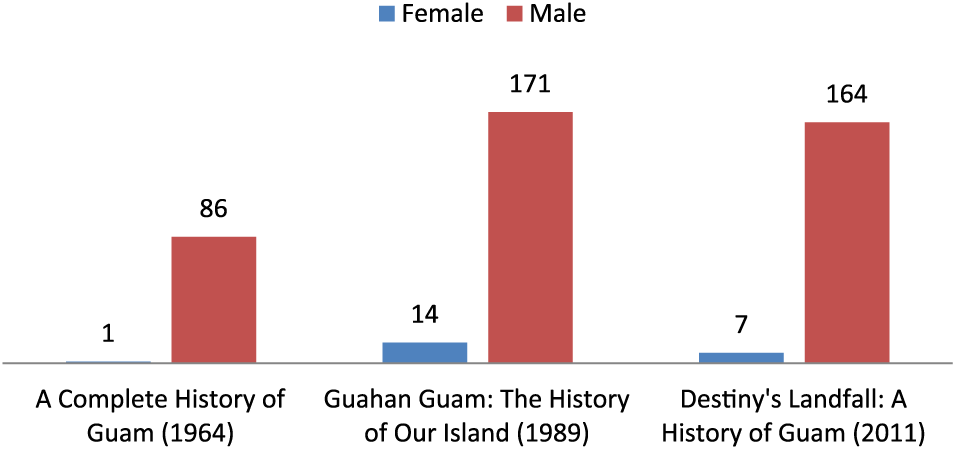
Count of women and men in Guam’s canonical history textbooks.
The earliest of the textbooks, Carano and Sanchez’s 1964 A History of Guam, “enjoys the distinction of being the first attempt to write a modern, comprehensive, chronological narrative of the history of Guam” (Diaz, 1994, p. 33). Preeminent Guam scholar Vicente M. Diaz (1994) has described A Complete History of Guam as “a remarkably unreflective and Eurocentric piece of historiography” (p. 33). This Eurocentrism is in part demonstrated by the overwhelming androcentrism of the text, mentioning only one woman by name—Mariana de Austria, the queen of Spain who backed the 1668 Catholic mission and, by extension, the colonization of the islands named in her honor. By comparison, the volume cites 86 men, for a ratio of 1.1% women to 98.9% men. Among the men, only 16, or 18.4%, are indigenous Chamorro, receiving mention as a result of public achievement in the fields of politics, religion, business, or the military.
Twenty-five years later, Chamorro educator Sanchez published Guahan Guam: The History of Our Island, in its US Naval Administration (1899–1941) section naming 14 women, compared to 185 men, for a ratio of 5.1% women to 94.9% men. Half of the women named are Chamorros, four of them in their capacity as educators: teachers Josefa Aguon Perez (weaving), Ana Gay (baking), and Jane Gutierrez (cooking), as well as Agueda Iglesias Johnston, a well-known Chamorro school administrator of the 1930s–1940s whose legacy has been embedded in the island’s collective memory with the naming of a school in her honor. The presence of women as educators reflects the prestigious role attributed to the teaching profession among Chamorro women of the early 20th century, although it is noteworthy that their subject matter centered on the domestic topics of weaving, cooking, and baking. These directly reflect the limited coursework available to female students under the Navy’s patriarchal rule. Nonetheless, among the limited range of occupations available to Native females in the prewar era, the teaching profession was most influential in enhancing women’s authority and social status. Besides the four educators, the other three Chamorro women named in Sanchez’s Guahan Guam enter the narrative in their capacity as wives of prominent local men, rather than for their personal contributions to island society.
The most current of the island’s history textbooks, Destiny’s Landfall: A History of Guam, Second Edition (2011), names only seven women, compared to 164 men, for a 4.1 to 95.9 female-to-male ratio. This Second Edition deviated little in gender representation from the original 1995 textbook; in that earlier volume, the female-to-male ratio was 4.4% to 95.6%. In addition to the low 4% inclusion of women in Rogers’ text, perhaps even more surprising for a 21st century so-called “post-colonial” production is that of the seven women, only two are of Chamorro descent, comprising a paltry 1.2% of the book’s historical figures. Dr. Katherine B. Aguon receives mention in her capacity as former Director of Educator, along with educator Agueda Iglesias Johnston, cited also in Guahan Guam. Compared with the two Chamorro women named by Rogers, indigenous men fare better with 38 Chamorro men mentioned by name (Figure 2).
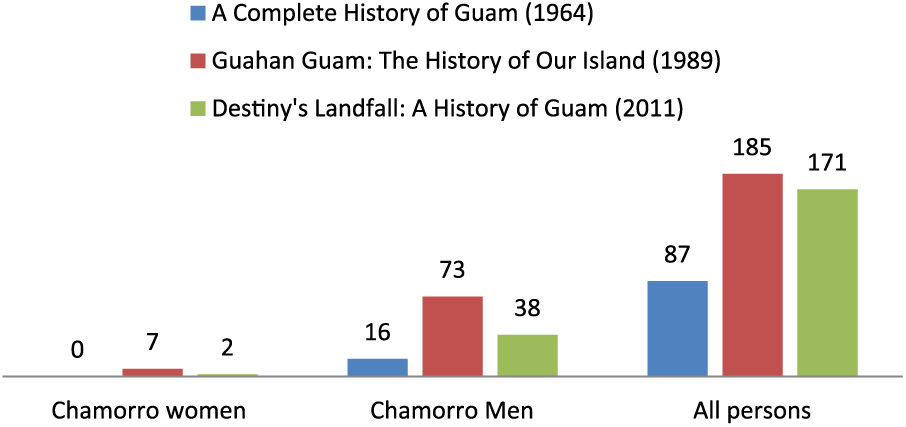
Count of Chamorro women and men in Guam’s canonical history textbooks.
This analysis demonstrates that, over the past half-century, all of the adopted textbooks have virtually ignored the significance of women in Chamorro society. The best textbook includes less than 5% women, and one of them excludes Chamorro women entirely. This issue of women’s invisibility in history is part of a larger problem in the Pacific, that being the relative invisibility of most islanders, male or female, in Oceania’s written histories. Certainly, the three textbooks also minimize their mention of Chamorro men in Guam’s past, ranging from 19% to 23%. Since the 1970s, Pacific Historians have actively agitated against the conservative Eurocentric, colonial approach to history that privileges the stories of white explorers, settlers, missionaries, traders, and militaries. The 1970s heyday of Pacific decolonization movements was accompanied by an intellectual activism that demanded “Islander-Centered” histories to accompany new islander-centered decolonized governments. The clarion call had been for histories that showcased the complexity of Pacific cultures, as well as the vibrancy of Islanders’ value systems and indigenous ways of knowing the world. An Islander-Centered historiography, by integrating Oceanic traditions of sailing, singing, dancing, healing, and others aspects of life in Island villages, could frame Pacific history as something more than the typically elite, white, male-dominated sphere of politics.
For our part, beginning in 1992, the Government of Guam created the Political Status Education Coordinating Commission (PSECC) for the specific purpose of producing pedagogical material written from a Chamorro perspective. For a decade, the PSECC published books under the Hale’-ta (“Our Roots”) series, works that explicitly acknowledged cultural resilience and survival. Showing the importance placed upon the re-telling of Guam’s past, the first two Hale’-ta publications were history textbooks written explicitly for classroom use. The first was written for elementary school children, Hestorian Taotao Tano: The History of Our People (PSECC, 1993). A year later saw the publication of the high school volume, I Ma Gobetna-ña Guam: Governing Guam, Before and After the Wars (PSECC, 1994). Although the Guam Governor’s Office underwrote the writing and publication of the textbooks, the local Department of Education did not procure funds to purchase the books (Kautz, 2002, p. 99; L. Davis, personal communication, 15 November 2017). The backstory of the beleaguered Hale’-ta series goes beyond the scope of this paper, involving local government and cultural politics.
The grade school volume, Hestorian Taotao Tano, was the first island-centered history textbook written specifically for this young audience. It took an important step forward in infiltrating a curriculum that had long privileged the likes of George Washington and Abraham Lincoln. Hestorian Taotao Tano opens by telling students that “history stories help us understand our beginnings, our roots. They help us discover who we are, where we came from and why we live the way we do” (PSECC, 1993, p. iii). In subtle language, the volume suggested its indigenous perspective and the value of including Chamorro history in the elementary school curriculum. By comparison, the high school textbook voiced a more explicit articulation of the islander-centered approach, stating in its preface that Unfortunately, we have spent more time in our past studying about people who are not Chamorros, and from perspectives that are not ours . . . . By looking at Guam history from the viewpoint of the Chamorro people, we will gain a better understanding of our past and thus a better understanding of our present. (1993, p. iv)
Given the overt purpose in both Hale’-ta textbooks of presenting the indigenous experience and viewpoint, one would expect that representations of indigenous Chamorro men and women would be more pronounced than that found in the canonical colonial histories of the island.
Hestorian Taotao Tano: The History of Our People includes powerfully worded depictions of the role of women, particularly after colonial conquest. For example, in its section describing the survival of native culture after Spanish conquest, its authors write, Chamorro women remained the life force of the Chamorro people. As wives, mothers and homemakers they became the anchor for the Chamorro family. Chamorro mothers taught their children the Chamorro language and how to be Chamorro. They preserved the importance of the familia [family] in Chamorro society by maintaining powerful roles as decision makers in family matters. They taught family members about family and community obligations and responsibilities, and about how to behave properly and how to be good adults . . . . It was in these leadership roles that women ensured the survival of present day Chamorros and their culture. (PSECC, 1993, p. 85)
Yet despite the strongly worded paragraph that refers to Chamorro women as leaders and decision makers, the entire textbook includes mention of only two women by name, while citing 29 men, for a female-to-male ratio of 6.5%–93.5%. Even its proportion of indigenous agents is weak, with only one of the women being indigenous—the creation goddess Fu’una—and 9 of the 29 men (Figure 3). Of the nine Chamorro men, four are folkloric characters from cosmological and legendary accounts; these include the creator god, Puntan; the god of fire, Chaifi; and two men of legendary strength and cunning, Gadao and Malaguana. Four other men feature prominently in Chamorro interactions with Spanish missions in the late 1600s—Aguarin, Hurao, Kepuha, and Mata’pang. In the chapters covering Guam’s history after Spanish conquest, only one native is named: Padre Jose Palomo, the first Chamorro ordained as a Catholic priest. Despite its islander-centered intentions, once colonization occurs in 1668, Chamorro men and women largely fade from view, replaced instead by non-native men as explorers, missionaries, governors, and military captains (Figure 4).
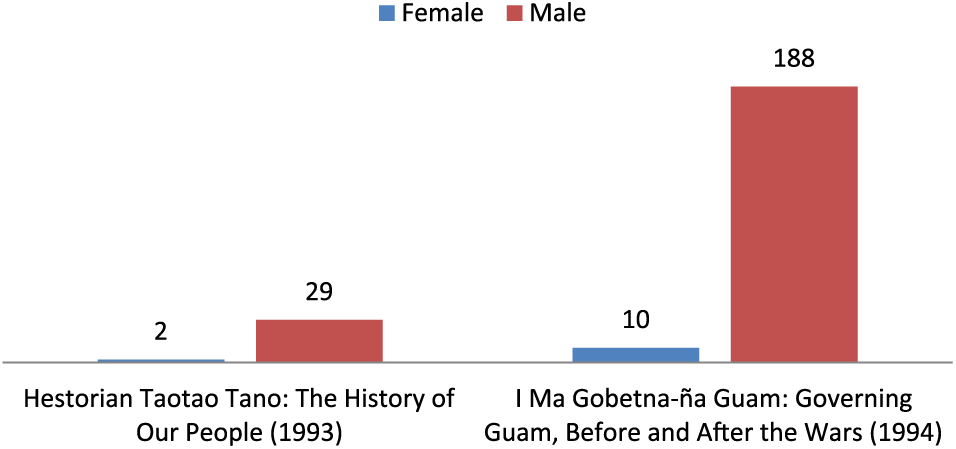
Count of women and men in islander-centered Guam history textbooks.
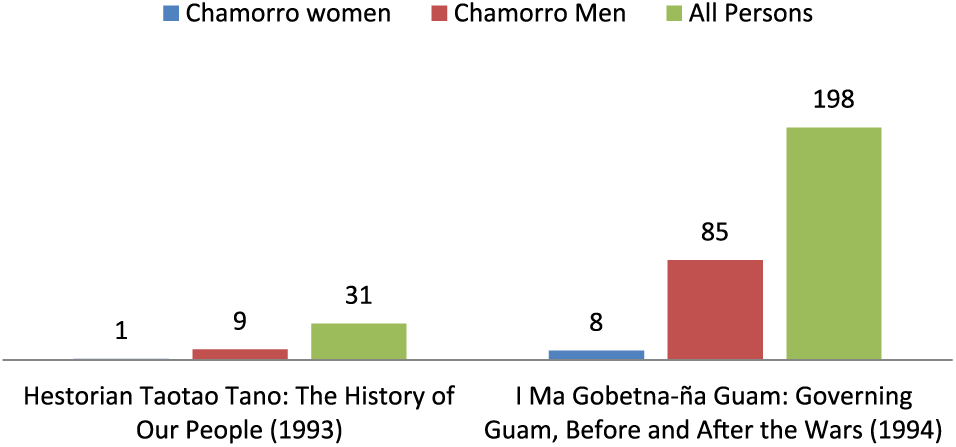
Count of Chamorro women and men in islander-centered Guam history textbooks.
A similar paucity of female agency accompanies the 1994 Hale’-ta high school textbook, I Ma Gobetna-ña Guam: Governing Guam, Before and After the Wars (PSECC, 1994). It makes mention of 10 women, compared to 188 men, for a ratio of 5.1%–94.9%. Of the 10 females mentioned, 8 are indigenous Chamorro, while 85 of the 188 men are Chamorro, representing 4.0% of the text’s references as Chamorro female and 42.9% as Chamorro male. Five of the eight Chamorro women named enter the narratives either as elected political leaders (Rosa Aguigui, Cecilia Bamba, and Cynthia Torres) or as academics with significant scholarly contributions to Guam’s historiography (Penelope Bordallo and Laura Torres Souder). Another, Beatrice Perez Emsley, is cited for her valor in World War II, although by comparison, more than 20 Chamorro men are similarly named. Mirroring the earlier Hale’-ta text, this book includes mention of women’s collective importance, its authors writing, “As wives, mothers and homemakers, Chamorro women played a key role in the survival of Chamorros and their culture to the present day” (PSECC, 1994, p. 35). Both of the islander-centered textbooks draw attention to the collective power of “ordinary” women as the “life force” and “the anchor” of the indigenous race. Despite being nameless, in the vein of Sirena’s mother and the women who saved Guam from the fish, women are credited as powerful agents in Guam’s history. Nonetheless, at 3.2% and 4.0%, neither incorporates specific indigenous women as historical actors to any substantial degree. This deficiency matches the findings of Schocker and Woyshner in their study of African American women’s representations in a black high school history textbook. Their data revealed that “black women are not represented by a greater percentage in the African American history textbook than they are in mainstream American history textbooks” (Schocker and Woyshner, 2013, p. 23).
The underrepresentation of Chamorro women stems in large part from the book’s specific framing of Guam history in political and military terms. The title of the book itself makes this clear, I Ma Gobetna-ña Guam: Governing Guam, Before and After the Wars, and 47, or 87%, of the Chamorro men named in the textbook either served the island in political office or distinguished themselves heroically during the Second World War. Despite a title that clearly emphasizes government and politics, its preface suggests a more expansive view of history, expressing that the textbook will demonstrate ways in which “Chamorros responded, reacted, and adapted to the circumstances surrounding them” (PSECC, 1994, p. vi). The underlying theme of Chamorro cultural resilience and survival infuses the chapters with subsections such as “Chamorro values” (PSECC, 1994, p. 9), “A New Challenge to Chamorro survival” (PSECC, 1994, p. 45), and “Chamorro Responses” (PSECC, 1994, p. 77). Moreover, the book is driven by the premise that “the spirit and dignity of the Chamorro people are reflected in the decisions they made and the actions they took over the centuries” (PSECC, 1994, p. iv). Yet notwithstanding its pronounced interests in broader social and cultural change over centuries of history, the Gobetna-ña textbook invariable focuses on men of political and military note.
While it is perhaps surprising that the Hale’-ta books fail to incorporate women’s contributions in its pages more so than other textbooks, this analysis also demonstrates Tuhiwai Smith’s (2012) poignant critique that indigenous scholars and authors have been “complicit” in perpetuating Western forms of history, albeit while attempting to be subversive of those very systems (p. 34). As one of the contributors to the Ma Gobetna-ña Guam textbook, I can still recall the enthusiasm we brought to the project and our deep and earnest desire to present a Chamorro-centered view of our island’s past. Yet as our work demonstrates, even Guam’s most intently islander-centered textbooks remain trapped within the confines of a Western historical tradition that largely privileges men’s contributions to society and history. These continue to correspond with Tuhiwai Smith’s (2012) description of history in the Western tradition as ultimately about people in power and the stories of how they became powerful (p. 7, 34). Indeed, as David Hanlon (2003) notes, “Local histories can themselves be expressive of power and privilege” (p. 29), and our textbooks certainly showcased primarily elite Chamorro women and men. Class issues, in all five of the textbooks, are mentioned only peripherally, if at all. Even under native authorship, Guam’s history textbooks have perpetuated the Western model of history as a patriarchal, nation-state story of progress and development. Historical changes within island’s families and villages are marginalized in place of the trials and tribulations of a litany of colonial governors, military officers, church leaders, and business executives.
Yet, the calls to rectify these Eurocentric histories and decolonize Pacific historiography are decades old. In Albert Wendt’s 1985 keynote speech at the 5th Pacific History Association Conference, he bemoaned the situation in which most Pacific Islanders know little of their histories and are typically excluded as important actors within the colonially dominated texts (p. 20). Not only are Pacific Islanders typically absent within their own island histories, but their cultural ways are often ignored. Specifically addressing the need to decolonize Pacific research and writing, scholar Konai Helu Thaman wrote in 2003 that “western educational legacies . . . for nearly 200 years have not fully recognized the way Oceanic peoples communicate, think, and learn” (p. 2). She thus urged the reclamation of Pacific perspectives, calling for the decolonization of formal education by “accepting indigenous and alternative ways of seeing the world” (Thaman, 2003, p. 10). Writing textbooks that reflect indigenous ways of seeing the world and that respectfully and fairly incorporate the lived experiences of both Pacific men and women continue to challenge us as we make our way through the 21st century.
Gender as a vehicle for decolonizing Pacific history
Returning now to the 1937 Guam Congress barmaid issue, its failure speaks to the power of ordinary, yet extraordinary women. But its outcome also reveals something about the men of our islands. Rather than using this as a golden opportunity to flex their muscles and “put women in their place,” they instead demonstrated their acknowledgment of women’s power. The mutual respect and cooperation between the genders is, in fact, an important theme in Mariana Islands history, beginning with the very creation of our universe. This cultural dynamic can be read in the stories of Guam’s barmaids, mermaids, and women from all classes of society. This recognition of gender collaboration deserves to be incorporated into a research framework that respects “indigenous cultural values, protocols, knowledge processes and philosophies” (Nabobo-Baba, 2008, p. 144). As scholar Unaisi Nabobo-Baba (2008) theorizes in her advocacy for the creation of decolonized Pacific research frameworks, reporting or writing should be guided by indigenous “values and protocols of knowledge” (p. 147).
More than two decades ago, David Chappell (1995) described historiography as “the last colonial frontier” (p. 303). Trends in Pacific History since then have consistently made reference to decolonizing our history, decolonizing our methodologies, and identifying indigenous epistemologies or indigenous ways of knowing and understanding the world. Yet the Eurocentric and androcentric norms embedded within the Western historiographical tradition have proven to run deep. Thus decolonizing our history in the 21st century will necessarily entail distancing ourselves from these “lingering Eurocentrism[s]” (Chappell, 1995, p. 327). It will mean re-evaluating, and maybe even rejecting, the conservative historical tradition that defines history as the story of building nations, militaries, and economies. Rather than simply identifying more and more elite women to add to the text, it may require us to approach history from a social or cultural perspective. This shift would also allow for the greater inclusion of both female and male non-elites who made important contributions to island history yet remain silenced by the hordes of those holding official political and economic power. Such a shift could bring in stories of the Clotilde Goulds who shifted public attitudes about the Chamorro language so that it could be taught in public school classrooms and accepted in newspaper columns, cartoons, and advertisements. Stories of midwives and native nurses could teach students about indigenous notions of health and the body, as well as transitions to modern medicine. Stories of techas in history could be instrumental in discussing varying forms of native resistance, compliance, and appropriation in the face of colonialism and missionization. These few examples suggest that textbook authors could integrate indigenous narratives of history, while still conveying lessons about colonial rule, government power, and economic change. Such moves away from the enduring political standard within textbooks would entail a virtual paradigm shift, but anything less may simply be incapable of both decolonizing history textbooks and acknowledging women’s historical agency.
Decolonizing our history textbooks may mean privileging indigenous sources and texts over non-indigenous ones, described by Susan Miller (2008) in “Native America Writes Back” as “[p]robably the most contentious practice of Indigenous methodology” (p. 18). It will mean going beyond the comforts of government archives to tap into sources that better capture indigenous perspectives, including the ever-growing library of online resources and oral history projects. Decolonizing our textbooks can enable us to appreciate the joint struggles of ordinary women and men doing extraordinary things to serve their families, villages, and communities. In the process, perhaps we can come closer to remembering and honoring history as they did and do—not conforming to a chronology of governors, but according to the events that impacted their daily lives, including typhoons, earthquakes, epidemics, feasts, famines, marriages, births, and deaths. Decolonizing our textbooks means capturing the laughter and songs, as well as the disputes and debates that are part of our history as Islanders. It means making space alongside the congressmen for barmaids, mothers, techas, and suruhanas.
Footnotes
Funding
The author(s) declared receipt of the following financial support for the research, authorship, and/or publication of this article: Research and travel support from the University of Guam College of Liberal Arts and Social Sciences.
