







Abstract
Across the Central American region, several groups received political autonomy by the end of the 20th century. By granting autonomy to these groups, countries like Nicaragua acknowledged certain populations as members of distinct ethnic groups. This was not the case for every country or group in the region, and the lack of effective ethno-racial policy-making considerations across Central America has led to language attrition, loss of land and water rights, and commodification of historic communities. This article focuses on Honduras and Belize as unique sites of ethno-racial and socio-cultural policy making, group identity making and unmaking, and group rights for the Garinagu. Specifically, this work forwards a re-examination of national ethno-racial policy and a critical assessment of political models based on ethno-cultural collective rights intended to combat racial discrimination.
One of the people groups unique to Central America and the Caribbean is the Garinagu (also called the Garifuna or Black Caribs; Anderson, 2009; Coelho, 1955; Grizzle Huling, 2004). The Garinagu arrived in Central America after being forcibly removed from the isle of their ethnogenesis, St. Vincent, in 1797 by the British who arrived around 1763 and “who used blackness as a weapon to deny Garifuna native status” (Anderson, 1997, 2009, p. 3). European colonizer’s notions of “who was deemed indigenous” played out often across the Caribbean during this time and in much later years (Forte, 2013, p. 173). In St. Vincent, it was the identification and separation of “yellow/red” and “Black” Caribs; the “color” of the people was considered a marker for cultural and political difference among the Garinagu in the eye of European invaders (Anderson, 1997, p. 26).
The Garinagu ethnogenesis is unique: a group of marooned kidnapped African people who were meant to be enslaved in the 15th century came to the shores of St. Vincent and intermingled with the Arawak and Carib people, creating a new culture, a new language, and new ethnic group (Anderson, 2009; Grizzle Huling, 2004; Lopez, 2014). Some accounts list their forced removal from St. Vincent as taking place in 1795 following the particularly violent battles between the Garinagu and the English over land during the British invasion of the Caribbean (Anderson, 2009; Bonner, 2001; Matthei & Smith, 2008; Palacio, 1998; Woods et al., 1997). Prior to the English invasion and since their forced exodus from St. Vincent, the Garinagu have continued to struggle with creating and validating their racial, ethnic, and political identity; “the deportation signified not only a tragic loss of homeland and traumatic alteration of livelihood, but a change in status in the eyes of the West” (Anderson, 1997, p. 23).
As this article will make the case for a specific kind of ethno-racial policy making, for this discussion, the nature of their ethnogenesis in St. Vincent and subsequent expulsion from their home is less consequential than the understanding of the Garinagu as a group of people who are of both African and Indigenous (Arawak and “Carib”) descent. They are neither/nor, either/or, but both. For this reason, they—along with other similar populations in Latin America—exist outside of the conceptualizations of race and ethnicity in public policy, straddling both Indigenous and Afro-descendant racial and ethnic boundaries defined and established under colonialism. Palacio (1998) expands on the pertinence of these boundaries, pointing to “biological and cultural fusion,” “the continuous process of self-re-definition,” “the strength of the consanguineal bond in kinship and household formation,” and “the transcendence of bonds between migrants” from this people group (p. 52). Salient to the Garinagu sociopolitical positioning is the fact that the Garinagu were not enslaved in St. Vincent and rebelled against the English colonization process on the island (Matthei & Smith, 2008, p. 223). This makes central the question policy makers wrestle with for the Garinagu and other similar populations—that of “nativist assertions and diasporic affiliations” (Anderson, 2009, p. 7).
Across the Central American region, several groups received political autonomy by the end of the 20th century. By granting autonomy to these groups, countries like Nicaragua acknowledged certain populations as members of distinct ethnic groups (Banton, 1996). This was not the case for every country or group in the region, and the lack of effective ethno-racial policy-making considerations across Central America has led to language attrition, loss of land and water rights, and commodification of historic communities. This article focuses on Honduras and Belize as unique sites of ethno-racial and socio-cultural policy making, group identity making and unmaking, and group rights for the Garinagu. Specifically, this work forwards a re-examination of national ethno-racial policy and a critical assessment of political models based on ethno-cultural collective rights intended to combat racial discrimination.
Why Honduras and Belize?
Since their expulsion from St. Vincent, the Garinagu have made community in both Central and North America; cities like Los Angeles and New York as well as coastal communities in Nicaragua and Guatemala have relatively large Garinagu populations (Anderson, 2009; Grizzle Huling, 2004). The country foci of this article are (1) Honduras: because of the dearth of information on the highly concentrated Garinagu population there (the largest in all of Central America), and (2) Belize: because although there is considerably less information on the Garinagu population of Belize, there are still issues pertinent to the analysis of ethno-racial policy making in this article. Since Honduras and Belize are separated only by a relatively small expanse of water, Amatique Bay and Bahia de Omoa, it is important to understand how the policies for the same population have diverged based on the nation in question when in such close proximity. This work is not exhaustive or finite but a review for the purposes of developing a more nuanced understanding of a broader research area, Black Indigeneity.
Why Garinagu and not Garifuna?
I must expand on the various terms that will be used throughout this article. Over the years, there have been many attempts to Westernize the understanding and identification of the Garinagu with terms like Black and “Indian,” something Anderson (1997) covers extensively in his earliest literature. More recently, Grizzle Huling (2004) notes there are multiple ways to identify and describe the population discussed in this article. She states, According to group members, 1. The group name is Garinagu, 2. An individual is a Garifuna, 3. The language is garifuna, 4. And the culture is referred to as Garifuna when used as an adjective. (Grizzle Huling, 2004, p. 1)
Although these terms are often used interchangeably, the distinction is drawn throughout this article unless it appears as part of a cited text within the work. Most frequently, researchers, journalists, and policy makers alike use the term Garifuna as a catch-all for the group, the individual, the language, and the culture (Anderson, 2009; Bonner, 2001; Brondo, 2010; Greene, 2002; Lakhani, 2017). To best honor the self-identification of the group, the use of the term Garinagu is meant to (1) encourage the use of the name of the population across the literature and (2) most accurately represent this people group according to their own terms (Grizzle Huling, 2004; Lopez, 2014).
Why Black and not “black”? Indigenous and not “Indian”?
There is an almost historic struggle among academics concerning the use of the term “Black” to describe any group or individual. The concerns levied are valid and should be discussed. However, this work will utilize framework for Black, blackness, and antiblackness presented by Dumas (2016) who names Black as a uniting term for a group of people to represent “a specific set of histories, cultural processes, and imagined and performed kinships” (pp. 12–13). He continues, . . . I write blackness and antiblackness in lower-case, because they refer not to Black people per se, but to a social construction of racial meaning . . . (Dumas, 2016, p. 13)
Dumas (2016) takes studies of antiblackness in Afro-pessimism a step further to posit that antiblackness reflects on the fact that Black bodies are not only an Other but “other than human,” which thereby pushes understandings of antiblackness to include general acceptance of violence and contempt against Black people (p. 13); this repositions the disenfranchisement of Black populations as natural since Black bodies are not counted as human from the Afro-pessimist standpoint.
The same rule guides the use of Indigenous, indigeneity, and indianness in this article with the exception of the term “Black Indigeneity” as this describes a burgeoning research field, identity, and political positioning (much like the “d” in Democrat is capitalized). Indigenous refers expressly to a group of people with the same kinds of histories, cultures, and kinships, whereas indigeneity and indianness are often superimposed on Indigenous groups as “real.” Similarly, I actively avoid the term “Indian” in my work to describe people groups who are not of South Asian descent. Forbes (1995), with heavy-handed humor, said, But are any of us (who are of indigenous American descent) really Indians anyway? Should we fight over a name which is claimed by the more than 700,000,000 people of India, by their government, and by millions of Indians living overseas from South Africa to Britain? (p. 54)
Indianness is a colonial model used to qualify groups of people by arbitrary racial lines for the purposes of segregating and delimiting rights to land and culture. Definitions for what is Indian “enough” “are about not only meaning, but also control, and the power to define the conditions of being of others” (Forte, 2013, p. 5). These definitions rarely acknowledge the indigeneity of past and present-day peoples on the African continent. Furthermore, these notions of indianness are often pantomimed in film and sports for the sake of perpetuating a specific image of Indigenous communities but fail to recognize and account for the complexities of nationhood, identity, and socio-cultural realities; accusations of “playing Indian” in these ways are commonly directed at people of apparent African descent (Naylor, 2006); this is also a direct contradiction to the fact that enslaved African peoples were also indigenous to Africa, and their progenies, though removed from the continent, are also indigenous. Questions to validate indianness belie the racism inherent to the idea and the arbitrary determinations about a group of varied and complex ethnic identities and sociopolitical positions. The purpose of determining the “real Indians” through notions of indianness—including the antiblackness employed to separate Black and “yellow” Caribs in the political imaginary in St. Vincent (Anderson, 1997, 2009)—is to destroy communities through inconsistent constructs, continuing to impose distinctions between blackness and indigeneity (Forbes, 1995).
Method
My doctoral research focused on racial identity formation in Brazil at the Steve Biko Cultural Institute in Pelourinho (Salvador, Bahia, Brazil) which has dedicated itself to increasing the number of Afro-descendant students in universities in the country. I wrote on the racial identification processes students who attended the institute and studied through the formal curriculum Black Consciousness and Citizenship (Cidadania e Consciência Negra, CCN) underwent while enrolled at the institute. Drawing from my dissertation and work done in graduate school, I sought an understanding of Black Indigenous groups’ racial identification defined on their own group terms and others concerned with naming and defining Black Indigeneity like Anderson (2009) in Central America and Limes-Taylor Henderson (2019) whose treatise on Black Indigeneity for Afro-descended people in the United States articulates the frustration most Black Americans have with a lost ancestry. These notions of Black Indigeneity harken to a belonging and identification with specific locations and also include language and cultural identities in the making of blackness and indianness.
This article is an exploratory multiple-case study of Honduras and Belize as unique sites of ethno-racial policy making for the Garinagu (Baxter & Jack, 2008; Tellis, 1997). Although the case study typically precedes medical research according to Baxter and Jack (2008), there are four specific situations that call for exploratory research through a case study named in their article: . . . a case study design should be considered when: (a) the focus of the study is to answer “how” and “why” questions; (b) you cannot manipulate the behaviour of those involved in the study; (c) you want to cover contextual conditions because you believe they are relevant to the phenomenon under study; or (d) the boundaries are not clear between the phenomenon and context. (p. 545)
Through an analysis of existing documentation and research, this article reviews the literature to examine ethno-racial and socio-cultural policy making in Honduras and Belize and to assess the ethnic and racial aspects that shape that process in each country. This analysis meets three of the four criteria named above for a case study. The article answers “how” and “why” questions through a brief exploration of how language attrition contributes directly to cultural loss and why land and water rights are being taken from the Garinagu. In addition, it examines how matters of group self-identification (which are personal and cannot be manipulated) directly contribute to policy. All of this is done to “cover contextual conditions” which are “relevant” to make clear the form of racial discrimination employed in policy making to infringe on Garinagu rights (Baxter & Jack, 2008, p. 545). Authors cited in this article, particularly Anderson (1997, 2007, 2009), have written extensively on this topic from various perspectives before including the way the Garinagu are racialized, their claim to indigeneity, and their positioning in socio-racial hierarchies. The aim of this article is to look specifically at how those aspects Grizzle Huling (2004) notes as critical to the self-identification of the Garinagu are often overlooked—how their blackness delegitimizes their indigeneity—through policy.
Honduras
In Honduras, the Garinagu were not accounted for in the politics that emerged in the nation in the late 1800s and the early 1900s at the advent of mestizaje (Chambers, 2006). Alongside several Latin American countries, Honduras attempted a national identity “based on a homogenous Honduran mestizo race and excluding . . . the Indigenous north coast Garifuna populations” (Euraque, 1998, 152; Chambers, 2006). In the earliest days of Honduran history, Zambos, as mixed Black and Indigenous people were called, were “inferior” and “dangerous” (Euraque, 1998, 162); the Caribs, specifically, were labeled “retarded” and “dangerous” as well (Euraque, 1998, p. 162). Grizzle Huling (2004) argued that “Black” is an inappropriate racial label for the Garinagu. However, in Honduras, Black was the term applied to Garinagu as they were grouped with other Afro-descendant Hondurans and Caribbean migrants (Anderson, 1997, Brondo, 2006; Chambers, 2006); as was the case on St. Vincent, their being identified nationally as Black stripped them of their indigeneity.
In addition, although they positioned themselves politically as Indigenous to Honduras, lived, and worked there for well over a century, the Garinagu did not receive “titles of occupation” for the land they occupied until 1992 (Brondo, 2006, 2010, p. 174); specifically, “the administration of land titles of dominio pleno (definitive titles of ownership) . . . were delivered between 1993 and 2002” to 48 Garinagu communities (Brondo, 2010, p. 174). The lack of rights to land, coupled with the building national mestizo identity of the early 1900s, was a political and economic tool to exclude Afro-descendant populations as reflected in the immigration laws implemented in 1929 and 1934 (Brondo, 2006; Chambers, 2006; Euraque, 1998). In addition to legislation implemented between 1923 and 1925 (also designed to exclude Black Hondurans from the workforce), the government completely changed the ethnic categories on the census by 1930, “declaring that the majority of the population was Mestizo” (Brondo, 2006, p. 59; Chambers, 2006). This was a policy measure employed to reassert themselves against all foreign influence (by immigration and economic takeover); they created an imaginary national identity to produce a Honduras for “Hondurans” irrespective of the preexisting racial or ethnic categories (Chambers, 2006; Euraque, 1998). The effect of this ethnic “cleansing” is reflected in the census counts: the 1910 census counted negros (which included the Garinagu and are listed as 19,176 or 3.4% of the population) and mulatos (as 18,274 or 3.3%) who subsequently disappear the 1930 census count. Through these changes in legislation and the census, Honduras joined the rest of the Americas in establishing “common frameworks spelling out ideas of nationality and citizenship . . . which tended to work against indigenous difference, casting it as a ‘problem’ to be solved” (Forte, 2013, p. 16).
The Garinagu or Black Caribs were mostly employed by banana companies in Honduras alongside other Caribbean people (Chambers, 2006; Euraque, 1998). They were engaged in various forms of trade and employment from the point of arrival to the present, through the Honduran fight for independence. When they arrived at the Honduran Bay Islands, they moved inland to Trujillo, a town near what would become a “center of operations” for the United Fruit Company (Chambers, 2006; Euraque, 1998, p. 156). It was in Trujillo, as early as the 1790s, that the Garinagu “not only supplied their own demands, but also sold surpluses to the town of Trujillo” (Euraque, 1998, p. 156). However, the economic benefit felt by these enterprises was insufficient and unsupportable since “the Honduran ‘species’ or ‘race’ could not be—black or mulato” (Euraque, 1998, p. 158). This anti-Black racism was legalized and institutionalized through the 1929 immigration law which promoted “white immigration” to Honduras (Chambers, 2006).
The crux of the political problem for Garinagu in Honduras, then, is much the same as it is now in that the national politics has been continually reductionist in its thinking about the Garinagu (as has Belize, Guatemala, and Nicaragua, the other countries to which Garinagu were displaced; Brondo, 2010). Recent protests in Honduras are further evidence of the infringement on Garinagu rights and the rights of other Indigenous groups in the country (Lakhani, 2017, 2020) In the last 20 years, Garinagu have mobilized in significant ways through non-governmental organizational efforts like Organizacíon Fraternal Negra de Honduras (OFRANEH) which “was formed in 1977” and officially recognized in 1980 (Brondo, 2006, p. 31). The group Organizacíon de Desarollo Étnico Comunitario (ODECO), formed in 1992 and officially recognized in 1994, which also represents Garinagu interests, focuses more on the Afro-descended aspect of their sociopolitical identity, while OFRANEH has assumed a distinctly Indigenous politic, particularly when it comes to land rights (Anderson, 2007; Brondo, 2006).
Belize
There are few countries that exist in such geo-social limbo as Belize, an English-speaking nation settled both in Latin America and in the Caribbean (but belonging to neither; Bolland, 1986). Established east of Mexico and Guatemala (and forcefully annexed from the latter), Belize served as a former British colony (Bolland, 1986; Enriquez, 2017; Robey, 1993). Most of the population are descendants of the English colonizers and kidnapped and enslaved African people (Bolland, 1986). However, there are Indigenous populations in the area, including Mayans, as well as people from neighboring countries, primarily arriving from El Salvador, Guatemala, Honduras, and Mexico (Bolland, 1986, 1999; Bonner, 2001; Woods et al., 1997). The uniquely Belizean identity that might have been developed over time is now marked by several phenotypes, languages, and cultural groups because of considerable emigration to the country (Woods et al., 1997). In addition, the relative “age” of the country (Belize gained independence in 1981) means that the process of developing the national identity has been partially hindered (Bolland, 1986; Cunin & Hoffmann, 2013). Languages spoken in Belize include, but are not limited to, the lingua franca English Creole, Spanish, and garifuna. Among the ethno-racial groups represented in the country are the Maya-Q’eqchi’ (or “Kekchi”; Bolland, 1986; Cunin & Hoffmann, 2013, p. 47), Afro-Belizean/Creole, and the Garinagu people (Bonner, 2001; Greene, 2002; Grizzle Huling, 2004; Lopez, 2014; Palacio, 1998; Woods et al., 1997). The result is a citizenry that is more mixed than blended and is becoming increasingly Spanish-speaking and Latin American in nature (Bolland, 1986; Bonner, 2001).
The Garinagu have lived in Belize in the way a free Black population might have during the colonial era in the United States, and they were an important facet of the labor provided for mahogany trade to Europe (Anderson, 1997, Andrews, 2004; Enriquez, 2017). When the Garinagu population arrived in Roatan, then a British colony, between 1799 and 1802, they did so with “some government assistance” (Enriquez, 2017, p. 3; Robey, 1993). The Garinagu were often contrasted with the “‘troublesome’ Creoles of Belize” in the early years of their time in the country (Anderson, 1997 p. 29). Over time, however, this perspective of the Garinagu began to shift with the policy making that dictated usage of space in Belize, particularly for tourism; though websites like CNN and BBC tout the local culture and encourage tourism to the area, there are a number of factors that negatively impact land usage and Garinagu rights in Belize (Brandes, 2018; Girma, 2013). A key problem inherent to “marketing indigenous difference as a tourist attraction” (Forte, 2013, p. 16) is that this process is “particularly essentialist and focused on authenticity, continuity, and visible forms of difference” (Forte, 2013, p. 17). Forte (2013) continues, . . . recognition [of this kind] seems to admit Indigenous difference into national discourse, yet simultaneously also limits and contains it, so that the act of dispossession [particularly, land dispossession] is never far from the scene. (p. 17)
The term I choose to use to describe the Belizean identities is ethno-racial “to mark the very fluidity of the categories [race and ethnicity] as they are mobilized through language, since qualities of ‘race’ and ‘ethnicity’ do not reside in the groups themselves but are constituted through indexicality” (Santiago-Irizarry, 2003, p. 177). However intentionally imprecise the definitions generated for this anthropological term, I feel it best encompasses the aspects of my central discussion—the oscillation of Garinagu positionality in Belizean social structures over time. Race and ethnicity are not static categories. For example, during the implementation of the Alcalde system from 1858 to 1969, Garinagu had equal political power to the Mayan groups but were a social step above most other Afro-descendant people, the cause noted as being both ethnic and racial (Anderson, 1997, Moberg, 1992). Ethnic difference is apparent in discussions about everything from the garifuna language and culture being sub-par to English Creole and Spanish (Bonner, 2001) to the class differences developed in the hierarchy that positioned and repositioned the Garinagu, Creole, Indigenous, and “Spanish” populations of the country over centuries (Cunin & Hoffmann, 2013).
As an example of the intersection between race and ethnicity, in recent years, young Garinagu children have been unwilling to communicate in garifuna because of two key factors: 1) the fact that other Belizean people speak English Creole and this language is prioritized over garifuna (mostly, by those who identify ethnically as Creole) and 2) the “high rates of immigration of Spanish speakers” from other Central American countries. (Bonner, 2001, p. 82)
These differences point to reasons why some Garinagu in Belize believe that to be Garinagu is “a matter of individual conceptualization rather than a formula of descriptive ideals based on biological descent, the ability to communicate in the Indigenous language, or participation in the cultural activities and rites of passage” (Greene, 2002, p. 201). If the language does not persist, it will be self-identification alone that makes a Garinagu population.
While participation in the aforementioned aspects of culture undoubtedly lends credence to the claim of Garinagu identity, they may be performed from a passive place and still present as resistance when accompanied by spoken garifuna. In a treatise for Black Indigeneity in the United States, Limes-Taylor Henderson (2019) writes, Domination of language means the domination of the universe of the colonized, what can and cannot exist, how one can relate to the world, another person, and oneself. This domination, in essence, recreates the colonized groups’ stories about their own existence and frames the entire universe using the perspective and knowledges of the colonizer. (p. 52)
The Garinagu have an opportunity to counter the varied forms of domination they experience through the active speaking of garifuna and other Garifuna cultural practices. Yet, the changes in Belizean demographics are dramatically shifting the prospects of language retention in the country. As was the case in St. Vincent, the Garinagu of Belize are dangerously close to language attrition as well as the loss of “stories about their own existence” and the framework through which their presence and resistance in Belize are understood.
Dangriga—formerly Stann Creek (Enriquez, 2017) “by 1841, the major Garifuna settlement. . . reported to be a flourishing village” (Woods et al., 1997, p. 70)—is now dominated by tourism; as is the case for many countries in this area, “the tourist industry is the primary economic force driving black peasants off their land” (Andrews, 2004, p. 193). Though I have been assured by a Belizean family friend that Garinagu are still working in this newly established tourist area, the fact that the area has now been lost to the local population is an indication of the class relationships and power differentials that exist between the Garinagu, other Belizeans, and the Belizean government (Woods et al., 1997).
Over the centuries, there have undoubtedly been tensions between the Garinagu and the Creoles (the descendants of English and kidnapped and enslaved African persons) as well as other groups migrating to the country from Central America and the Caribbean for work. However, “it is virtually impossible to identify Garinagu from creoles in Belize” apart from language, cultural practices, and location (Lopez, 2014, p. 6). Conceptualizations of racial identity and “ethnic consciousness” in Belize typically come from the United States through media, tourism, and emigration. In this way, US hegemony permeated the country’s racial identity. Unlike Honduras, these were a few of the driving factors in representation for darker skinned people. In the 1920s when the United Negro Improvement Association was active in the country, a “black consciousness” movement emerged that lasted well into the 1960s in Belize (Bolland, 1999, p. 573). Importantly, the pluralistic relationship of both Garinagu and Creole identities is important to discussions about power or portrayals of power, particularly in history. Whether the Garinagu and Creole populations are indistinguishable from one another as Lopez (2014) asserts is moot in consideration of political power and recognition. For example, Belizeans celebrate the Baymen, a group of British colonizers, as the founders of the country (commemorated as St. George’s Caye Day), but this “elides the significance of Maya and Garifuna peoples to the historical development” of the country (Johnson, 2000, p. 223). It is important to acknowledge that, despite all this, the Garinagu are the “one and only” group in the country “for which a national holiday is established”; there is no official recognition of Mayan groups who were in the region prior to colonization (Lopez, 2014, p. 2). However, a national holiday and official policy recognition through the distribution of land and water titles are not one and the same.
Relationships with other communities in Belize—including the burgeoning tourist populations—and the “Latinamericanization” of the country through the flight of their Central American neighbors to the county have drastically changed the nation’s image. The continuation of Garinagu culture despite various factors negatively impacting relationships between them and other ethno-racial groups in Belize will ultimately be determined by a policy understanding of the complex nature of Afro-descendancy and the acceptance of Black Indigeneity.
Discussion
As a preface to the discussion of blackness, indigeneity, and Black Indigeneity for the Garinagu, it is important to frame two things: (1) Black Indigeneity is still flawed as a term to identify a “racial” or “ethnic” group and (2) Black Indigeneity is difficult, if not impossible, to account for in highly racially and ethnically polarized policy-making circles that impose the choice of one identity or the other. To the latter point, racial identification is as much about political positioning as it is about power and “one cannot ‘unsettle’ the ‘coloniality of power’ without a redescription of the human outside the terms of our present descriptive statement of the human” (Wynter, 2003, p. 268). That is to say, disrupting the power dynamics of a racialized human other—particularly a Black Other—requires a new identification for Black people; this stands for the Indigenous Other, as well. It is necessary to move away from colonial constructs and categories. In this way, Black Indigenous as an identity reframes the Garinagu as both, racially and ethnically; although this identifier relies on Western and outsider terms, it more fully encompasses the identities possible within and across groups. The key difficulty with the term is the persistent repositioning of blackness as Other (than human; Dumas, 2016).
Through her deconstruction of the use of the term “Black” to describe a Garinagu population in Los Angeles, Grizzle Huling (2004) argues that “the racial label ‘Black’ discounts cultural variances and obscures . . . distinguishing regional variations and diverse histories” (dissertation abstract). Later on in her dissertation, she articulates that “existing cultural and race theories generate an inappropriate description of the Garinagu whose identity is based upon their long odyssey in exile and their strong desire to retain their cultural traits” (Grizzle Huling, 2004, p. 32). It is these distinguishing variations and histories that are worth probing as national policies undermine and overlook the unique and specific identities of Afro-Indigenous ethnic groups in Central America (Brondo, 2006). Anderson (2007) asserts the common association of ethnicity and cultural difference with indigeneity and race and racism with blackness not only marginalized most Afro-Latinos in Latin America from collective identity rights, but that regimes of cultural rights fail to address structural racism effecting indígenas and blacks. (Anderson, 2007, p. 387)
Therefore, in a policy space:
We see the value of the positioning of the Garinagu as Indigenous in the successes of the organization OFRANEH having gained land rights for the community in Honduras in partnership with the Inter-American Commission on Human Rights (IACHR) in 2015 (Lakhani, 2020). Here, we should turn to the notion of “salience” (Dei, 2008): The notion works with the ideas that racial groups exist within hierarchies of power . . . Although not a claim to a hierarchy of oppression, race offers a structural perspective through which to see and challenge power imbalance. (Dei, 2008, p. 82)
Indigenous identity has a degree of salience in policy making as most nations have turned to recognize the “original” peoples of the lands they occupy, typically under the guidance of the United Nations and other such international governing organizations (Banton, 1996). The salience of indigeneity was the impetus for change in this specific example and would likely lend itself to future efforts for the Garinagu and other Black Indigenous groups seeking to make tangible change in their communities through policy. After all, it is typically the political imaginary of indianness that drives such decision making on local and national levels. How this repositions the undeniable Afro-descendent aspects of the Garinagu, however, is another discussion.
The issue of belonging for the Garinagu in the African Diaspora is complex and varied. It would be reductionist to resort to an assignation of the term Black to this ethno-racial group just as it would be to identify them as Indigenous; by virtue of the ethnogenesis of the Garinagu, they are both and have been shaped to be a racial Other because of it in every land of their exile. They are atypical of the other Afro-descendant groups in Latin America because of their equally Indigenous lineage; they were not enslaved and enjoyed a modicum of judicial and political privilege during the colonial era. They are Black Indigenous, and their identification as both is pertinent to understanding not only their sociopolitical position but also their identities across racial and ethnic lines.
Conclusion
To date, over 120 activists have been murdered in Honduras since 2009, and many of them were Garinagu; in defense of their land against tourism, ecological degradation, and other development projects, these protestors are consistently being “persecuted by the government” and evicted (Lakhani, 2017). Other perpetrators against the community in Honduras include drug traffickers and “palm oil magnates” (Lakhani, 2020). Honduran failure to comply with the aforementioned IACHR ruling in 2015 to “compensate Garifuna for stolen land,” which issued legally binding land titles to prevent further forced evictions and was largely made possible by OFRANEH, has led to more protests and the subsequent abduction and disappearance of protestors (Lakhani, 2020). All appears quiet in Belize although tourism has systematically displaced Garinagu from their lands in exchange for employment and Garinagu youth refuse to speak Garifuna in public (Bonner, 2001). The survival of territorial and cultural rights will be pivotal to the creation and maintenance of agency. Activist models engaged by these groups, based on ethno-cultural collective rights intended not only to combat racial discrimination but also to create a politically legitimated identity for the Garinagu people, must produce a strong (Figure 1) Indigenous identity validated by the state to survive.
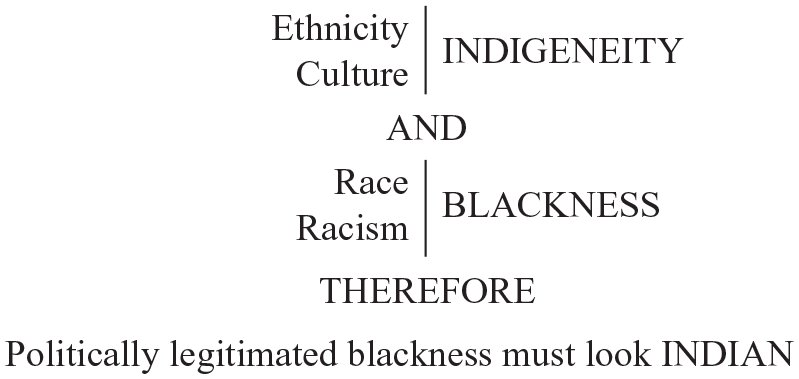
Politically Legitimated Blackness Must Look Indian.
This is not the final word on the Garinagu as a Black Indigenous group but a critical, historical overview of two countries as unique sites of ethno-racial and socio-cultural policy making, group identity making and unmaking, and group rights. That ethnic and social location must be determined by each Garifuna in some ways and through ethno-racial ascription for the Garinagu in others. It is necessary to understand the Garinagu as an important part of the political conversation for members of settler colonial systems. Black Indigeneity as a framework presents opportunities for the oppressed to re-examine national ethno-racial policy and to offer a critical assessment of the nations that govern. Invariably, work on Black Indigeneity will produce a language for ethno-cultural collective rights and the development of a model for people who are seeking to reframe the stories of their people.
Footnotes
Declaration of conflicting interests
The author(s) declared no potential conflicts of interest with respect to the research, authorship, and/or publication of this article.
Funding
The authors disclosed receipt of the following financial support for the research, authorship, and/or publication of this article: The Latin American and Iberian Institute and the Center for Southwest Research for the Greenleaf Fellowship.
