







Abstract
The long history of mistreatment faced by the Orang Asli (Indigenous Peoples of Peninsular Malaysia) raises concerns about how state institutions, including the media, shape public perceptions of the Orang Asli, particularly during health crises such as the COVID-19 pandemic. Given the media’s role in reproducing social power and reinforcing dominant narratives, this study employs critical discourse analysis (CDA) to investigate how the Orang Asli were represented in COVID-19 vaccination-related coverage. Sixteen news articles by BERNAMA (Malaysian National News Agency), a government-owned news agency, were analysed. The findings revealed discourses of positive framing of officials in contrast to the Orang Asli, a focus on the Orang Asli’s behaviour over social determinants of health, and the strong community-centric values held by them. The findings call for addressing systemic barriers to their health. In addition, a review of cultural sensitivity is warranted to ensure future engagement involving the Orang Asli that is based on respect.
Introduction
The [newspaper] title itself has pictured a thousand words about Orang Asli itself. When I saw this title, I chuckled and one word came out from my mouth which is “idiot.” If I as [an] Orang Asli can detect this, how about others who read this article? (Quote by OA1 in Jamal & Naghmeh-Abbaspour, 2020, p. 66)
Indigenous peoples are defined as distinct groups holding strong ancestral links with their traditional land and natural resources (World Bank, n.d.). In Peninsular Malaysia, the Indigenous peoples are known as the Orang Asli, which directly translates to “original people” in the Malay language. Meanwhile, the Indigenous groups, including those in East Malaysia, are collectively known as the Orang Asal (National Human Rights Commission of Malaysia [SUHAKAM], n.d.). Focusing on the former, the Orang Asli is a minority population documented to face challenges surrounding indicators of development (Khor & Shariff, 2019). During the COVID-19 pandemic, reports by the United Nations Development Programme (UNDP) and the World Health Organization (WHO, 2021) featured the difficulties in vaccinating the Orang Asli, as they self-isolated deeper into the forests (Khalid, 2021). While the vaccination uptake caught up eventually, it was not before there were disproportionately high rates of cases and deaths from COVID-19 among the community in comparison to the wider Malaysian population (Nicholas, 2021). Considering the disparity beyond vaccination uptake and in multiple health outcomes of the Orang Asli compared to national rates (Nicholas et al., 2010), research to address actionable areas for improvement for future health crises is necessitated. A relevant research area is discourse analysis, examining how text and talk contribute to social inequality, including in health (Lupton, 1992). In the current study’s context, particular attention is placed on government-sponsored news messages, given the historic relationship between the state, health care workers, media and the Orang Asli (Y. S. Wong et al., 2019).
Hence, this study aims to critically analyse the discourse produced by the Malaysian government-controlled news media while framing the Orang Asli’s response to COVID-19 vaccination. The context is first set by reviewing the literature on the Orang Asli in Malaysia, followed by summarising the state of health of the Orang Asli, including during COVID-19, and what was documented of their response to the vaccination programme. The conceptual framework of discourse analysis is presented, with a review of past discourse analyses of newspapers covering the Orang Asli. The methods section, comprising how the data is sampled and analysed, will be outlined, in addition to a statement on ethics and reflexivity. The results section revolves around three main discourses, which are the dichotomy of Orang Asli attributes versus officials, the precedence of individual responsibility over social determinants of health, and community-centred persuasion. Given the interpretivist paradigm of this study, the findings are integrated with their interpretation. Meanwhile, the discussion section will complement the results by elaborating on the findings’ implications, methodological limitations and future research recommendations before the study is concluded. The following literature review begins by describing the background of the Orang Asli in Malaysia.
Literature Review
The Orang Asli of Peninsular Malaysia
The Orang Asli make up 0.7% of the Malaysian population (Jabatan Kemajuan Orang Asli [JAKOA], 2023). They are not homogeneous but consist of the tribes of Aboriginal Malays or Proto-Malays, Negrito, including Semang, and Senoi, branching out to over 18 subgroups (Masron et al., 2013; Nicholas, 2022). As the earliest settlers in Malaysia, since 5,000 years ago, the Orang Asli have long been subject to observation by researchers from colonial countries, including Charles Darwin’s naturalist counterpart Alfred R. Wallace (1865), with publications on the Orang Asli by anthropologists found from as early as 1847 (Masron et al., 2013; Nagata & Dallos, 2001). Unfortunately, the Orang Asli were documented in discriminatory language by colonial-period British journals (Bourien, 1865). As such, the undermining of the Orang Asli was not the only negative remnant from the colonial period that is carried over until today.
Challenges faced by the Orang Asli are all-encompassing, especially regarding their autonomy, land rights, education and health. For example, the displacement of the Orang Asli from their traditional homes and lands was under the directive of the British during their colonial rule of Malaysia preindependence in the 1950s, to quell communist insurgents (Devaraj, 1999). In recent times, the practice of dispossession of the Orang Asli’s Native customary land which is their source of livelihood is enabled by the Malaysian government in the name of development, with areas they are relocated to often lacking in infrastructure, electricity and clean water supply, in addition to not being accessible to schools and health services (Khor & Shariff, 2019; Masron et al., 2013). Consequently, the well-being of the Orang Asli community is severely impacted, with the Twelfth Malaysia Plan outlining them as the most impoverished community at a 33.6% poverty rate (Economic Planning Unit [EPU], 2021). In perpetuating this cycle of disadvantage, the literature highlights systemic issues contributing to the mistreatment of the Orang Asli.
There exists legislation and government agencies set up to safeguard the interests of the Orang Asli. The Aboriginal Peoples Act was passed in 1954 (Hassan & Nordin, 2021) to protect the Orang Asli’s rights and is the present-day guide when it comes to Orang Asli affairs. In the same year, the Department of Orang Asli Affairs (Jabatan Hal Ehwal Orang Asli, JHEOA), currently known as the Department of Orang Asli Development (JAKOA), was established to oversee the Orang Asli development, although its conception by the British was initially intended to gain the community’s loyalty amid communist insurgency in Malaysia (Masron et al., 2013). However, the act and department have been criticised for their formalisation of the state’s overruling power over the community, undermining their autonomy and right to self-determination (Devaraj, 1999; Nicholas et al., 2010; Wook et al., 2022). For instance, the act allows state authorities to declassify reserved Orang Asli gazetted land whenever they wish (Devaraj, 1999). In addition, JAKOA had been likened by the community to beasts and selling out the Orang Asli, with attempts to erase their rich culture and identity through involuntary assimilation to the majority Malay population and Islamic proselytisation (Dentan, 2008; Nicholas, 2000; Nobuta, 2008). Despite Malaysia’s public agreement to adopt the United Nations Declaration on the Rights of Indigenous Peoples, outlining the rights of Indigenous Peoples to be recognised, development or policies affecting them are often drafted without their awareness or consultation, with the rare inclusion of the community to be a case of tokenism instead (Nicholas et al., 2010; Wook et al., 2022). Hence, in alignment with the principles of structural and social determinants of health (Greenwood et al., 2018; WHO, n.d.), the sociopolitical context potentially influences the Orang Asli’s health and response to the state’s national vaccination initiative during the pandemic.
Health and COVID-19
Several authors have highlighted the linkages between the Orang Asli’s economic deprivation, loss of land rights and autonomy with their declining physical and mental health (Devaraj, 1999; Khor & Shariff, 2019; Looi, 2016; Nicholas et al., 2010). A systematic review of studies between 2017 and 2021 found a greater prevalence of diseases among the Orang Asli compared to the general population, especially malnutrition and soil-transmitted parasites commonly affecting poor communities (Mahmud et al., 2022). This aligns with reports made by the Center for Orang Asli Concerns that the majority of malaria cases in Malaysia were found among the Orang Asli, while up to 80% of the children were undernourished and afflicted with parasitic and dental infections (Nicholas et al., 2010). Thus, more recent and robust data on the Orang Asli’s health are still needed. Therefore, the first national Orang Asli health data survey, which was only launched in 2022, was welcomed (Mat Arif, 2022). Meanwhile, a correspondence to the BMC Public Health journal expressed disappointment with the Orang Asli’s health issues being overlooked in publications spotlighting low-income populations (Khor & Shariff, 2019). Greater attention to assessing the Orang Asli health status at the national and global levels will bring useful insights.
Culturally sensitive and community-centric health promotion strategies for Indigenous communities globally should be emulated in Malaysia. Across the world, researchers have advocated for Indigenous-led, ecological-based health interventions for Indigenous communities that are strength-based rather than deficit-based approaches perpetuating colonialism (Barnabe, 2021; O’Keefe et al., 2022; Reilly et al., 2011). Regionally, a systematic review of Southeast Asian Indigenous communities found cultural and community elements to be a protective factor for them in enhancing their well-being (Chua et al., 2019). This is in line with qualitative studies conducted among the Malaysian Semai and Temiar Orang Asli tribes reporting their resilience against suffering deriving from their communal ties (Chua et al., 2021; Thong et al., 2025). While Malaysia has one designated Orang Asli hospital with Orang Asli health care workers meeting patients’ needs better (Nicholas & Baer, 2009), the wider national response has been less understanding. Orang Asli’s health issues are often blamed by the authorities to be a consequence of their decisions and lifestyle (Nicholas & Baer, 2009; Y. S. Wong et al., 2019). Y. S. Wong and colleagues (2019) justified the Orang Asli’s frequent behaviour of avoiding state health officials as a byproduct of their distrust of the latter’s actions in undermining and being condescending towards the Orang Asli. Hence, similar patterns were observed in response to the pandemic.
During the COVID-19 pandemic, the Orang Asli’s vulnerable status became a concern. The Malaysian Ministry of Health (MoH) released a statement acknowledging that Orang Asli communities are at greater risk of infection because they live in the interiors (MoH Malaysia, 2020). However, the nationwide lockdown imposed exacerbated many of the Orang Asli’s living and economic conditions as their income sources involving selling agricultural products were restricted (Idrus et al., 2021). It was reported that the majority of the Orang Asli COVID cases originated from the rural-urban border, where the communities ventured out for work opportunities (Khalid, 2021; Nicholas, 2021a). To protect themselves, Orang Asli communities set up barricades to restrict entrance by outsiders into their villages and performed special rituals and prayers in line with their traditional views of diseases (Idrus et al., 2021). In addition, it was widely documented that the Orang Asli across Malaysia isolated themselves by moving deeper into the forests (Abdullah, 2021; Idrus et al., 2021; WHO, 2021). Subsequently, official broadcasts of the latest updates on Malaysia’s COVID-19 outbreak were not accessible to remote areas with limited telecommunication services available (Tan et al., 2020). This was a concern as vaccination information was mainly disseminated to the public not only through mainstream media but also through social media and text messages. However, before going further into vaccine hesitancy among the Orang Asli community, it is also important to situate this issue within the broader landscape globally and locally to set the context that vaccine hesitancy may not be unique to the Orang Asli but part of a wider pattern observed across different populations.
Public Perceptions of Vaccination Globally, in Malaysia, and Among the Orang Asli
Vaccine hesitancy, which is defined by the WHO’s Strategic Advisory Group of Experts (SAGE) as intentionally not accepting vaccines immediately or even rejecting them even when they are available (MacDonald & SAGE Working Group on Vaccine Hesitancy, 2015), is a complex and context-specific phenomenon shaped by sociocultural, political, and individual factors. It is not a country-income-group-specific issue, as studies reveal that vaccine hesitancy cuts across both developed and developing contexts (Coustasse et al., 2021). Higher vaccine acceptance was found in countries with greater trust in government, such as China, Singapore, and South Korea (Lazarus et al., 2021), whereas distrust and misinformation were identified as contributors to vaccine hesitancy in the UK and Canada (Griffith et al., 2021; Paul et al., 2021). Vaccine hesitancy was also not just tied to those without the knowledge, as similar patterns of hesitancy were present among health care workers (Madran et al., 2024; Qunaibi et al., 2021), reflecting wider trust deficits within health communication and governance.
In Malaysia, these global patterns are mirrored in state-level disparities. The national vaccination programme in Malaysia started in February 2021 and was jointly managed by a committee under the MoH and the Ministry of Science, Technology, and Innovation (Khalid, 2021). The lowest vaccination registration rates nationwide were found to be in East Malaysia, as youths in Sabah reported scepticism, low trust in authorities, and pervasive misinformation influencing their decision (Dollah et al., 2022). Similarly, Yusoff and Sarifin (2022) observed mixed public perceptions towards the government’s vaccination campaign, shaped by political distrust and safety concerns. The Ministry of Communications and Multimedia Malaysia (2021) later established its Quick Response Team, established to counter such misinformation. Overall, vaccine hesitancy in Malaysia and globally reflects intersecting issues of trust, communication, and sociopolitical context rather than simple knowledge deficits.
Vaccine hesitancy among the Orang Asli shares some of these broader patterns of mistrust and misinformation, yet carries distinct nuances rooted in their sociohistorical relationship with the state and health institutions, as mentioned earlier. The UNDP outlined barriers to Orang Asli vaccination, including demand-side factors such as hesitancy from concerns about vaccines being painful, fear of adverse effects, misinformation on their effectiveness, and mistrust of modern medicine. This is besides the access factors encompassing inaccessibility from remote locations and the online applications for vaccination registration being inconvenient to the Orang Asli (Khalid, 2021). In addition, qualitative data by Nungsari and colleagues (2022) revealed the communication gap between the government and Indigenous communities in containing COVID-19. Recommendations towards the government to increase the Orang Asli’s vaccine uptake, with insights from the Malaysian Institute for Health Behavioural Research include amplifying the benefits of vaccination in ensuring one’s family’s well-being, enlisting the help of Orang Asli’s spokespeople such as their leaders, spotlight vulnerable Orang Asli populations taking the initiative, having Orang Asli health care workers, together with leveraging on positive emotions and peer pressure (Khalid, 2021; WHO, 2021). Altogether, the available literature suggests the delicate relationship between the Orang Asli and the state in the health context, calling for further probing.
Discursive Power and the Portrayal of the Orang Asli in the Media
In the realm of health research, how health inequities are enacted and reproduced, especially when involving social and political contexts, was found through discourse analysis (Capper et al., 2023; Evans-Agnew et al., 2016; von Brömssen et al., 2024; Yazdannik et al., 2017). One relevant public health area for discourse analysis would be the discourse of government-sponsored health messages through news media (Lupton, 1992). Through mass-circulated media such as newspapers, discursive power is evident as established news brands hold the ability to introduce and amplify topics to be deemed important for a large audience (Jungherr et al., 2019). Tying it together with the concept of social power, van Dijk (1995) asserts that powerful social actors within the news field spread the agenda of their vested interests by determining who gets a say, in what way and to whom. This is aligned with Lukes’ (2005) argument that one way power shows up to gain the compliance of dominated groups is when the powerful can control the means of communication and thus project their interpretation as the norm. Social power is thus defined as the capacity of dominant groups to shape discourse in ways that normalise their authority and marginalise alternative voices.
The Orang Asli have lamented over how they are represented in Malaysian mass media (Jamal & Naghmeh-Abbaspour, 2020; Y. S. Wong et al., 2019). In a qualitative study by Jamal and Naghmeh-Abbaspour (2020), contradicting perceptions were found between JAKOA representatives, newspaper journalists and the Orang Asli themselves about how the latter is represented in newspapers. The authors reported opposition and denial from journalists and JAKOA personnel that discrimination for the Orang Asli exists in publications, while Orang Asli interviewees who read newspapers expressed frustration over news reports depicting them as uneducated and always needing help. These grievances are backed up by multiple discourse analysis studies revealing how mainstream Malaysian news media framed the Orang Asli as disempowered communities, in constant need of help and to be blamed for their condition (Baharun & Ismail, 2022; Ismail et al., 2020; Jamal & Abdul Manan, 2016; K. C. Wong & Jamal, 2023a, 2023b). The authors contrasted this depiction with the higher number of quotes featuring government authorities and agencies that were glorified as saviours speaking on behalf of the Orang Asli. This pattern of estranging the Orang Asli from mainstream society by the Malaysian media has been criticised for three decades (Mustafa, 1994). Thus, the Malaysian media being used as a tool to reproduce discursive power in undermining the Orang Asli is evident based on the literature.
Given these long-standing critiques of how Malaysian media reproduces unequal power relations, it becomes crucial to employ an analytical approach that can expose such dynamics. Critical discourse analysis (CDA) provides this framework, grounded in the understanding that discourse is not neutral but constitutive of social relations and inequalities (Fairclough & Wodak, 1997). van Dijk (2001) describes CDA as the study of how dominance and inequality are enacted and reproduced through language, while Fairclough (2012) emphasises the dialectical relationship between discourse and social structures. Fairclough’s three-dimensional framework, which comprises text, discursive practice, and social practice, has been widely applied to connect linguistic detail with wider ideological work. In health communication, CDA has revealed how policy discourse excludes marginalised voices (Evans-Agnew et al., 2016) and how media narratives reproduce inequities (Lupton, 1992; Yazdannik et al., 2017). This framing justifies the selection of CDA as an appropriate tool for examining the portrayal of the Orang Asli in government-controlled media.
The Present Study
This study is centred on the discourse produced by a Malaysian government news agency on the Orang Asli in response to the national COVID-19 vaccination programme. Considering the documented vaccine hesitancy and general tension between health workers, the state and the Orang Asli, leading to disparity in Orang Asli health compared to other Malaysians, there needs to be research pinpointing actionable areas for improvement for future health crises. It is theorised by the literature that the sociohistorical context plays a role when it comes to the Orang Asli’s health and their responses to health services, while the media, especially news articles, reproduce the discourse of the Orang Asli as communities lacking in self-determination and being reliant on the government, shunning them away from essential health services. These are key points that are looked for to inform the current study’s data analysis. To date, no study has attempted to analyse the discourse specific to the Orang Asli’s health, nor is there any analysis focused on discourse produced by government-controlled newspapers, given the link between the state and the Orang Asli today. Hence, the present study attempts to answer the research question of what discourse is uncovered in the Malaysian government-owned news agency while framing the Orang Asli’s response to COVID-19 vaccination.
Methods
A qualitative approach was selected for this study due to its utility in understanding social meanings and conditions that are unquantifiable, with rigour achieved through transparent and explicit reporting of the research process (Hammarberg et al., 2016). Drawing on this study’s aim, CDA is deemed the appropriate research design. The notion of discourse is argued by Foucault to construct and define knowledge, governing how a topic is talked about (Hall, 1997; Taylor, 2013). Through CDA, the way social power and inequality are enacted and reproduced in text and talk are studied (Fairclough, 2012; Fairclough & Wodak, 1997; van Dijk, 2001).
The CDA rests on the key premises of discourse shaping and is being shaped by society, discourse being historically situated, and discourse working ideologically to maintain or challenge dominance (Fairclough, 2012). In this study, CDA was applied through Fairclough’s three-dimensional model. The dimensions first consist of textual analysis of vocabulary, metaphors, and evaluative language through identification of word choices such as “reluctant” and “hesitant,” modality, and metaphors in framing the Orang Asli. Another dimension examines discursive practices, which focus on the processes of news production and intertextual references, including which voices were quoted and patterns of inclusion versus exclusion. The third dimension interprets the discourses within the broader sociohistorical context of state–Orang Asli relations, the legacy of colonial paternalism, and health inequities reproduced through the media. This three-tiered approach allowed the analysis to move from the microlevel of linguistic detail to the macrolevel of structural inequalities in health communication.
In integrating the justification derived from the literature review to uncover how health inequities are reproduced through discourse in news media, the following method for this study’s CDA of the Malaysian government-owned newspaper’s representation of the Orang Asli in response to the COVID-19 vaccination programme is outlined.
Data Sampling
As per previously published discourse analyses of the depiction of the Orang Asli in Malaysian newspapers (Jamal & Abdul Manan, 2016; K. C. Wong & Jamal, 2023a, 2023b), purposive sampling was utilised. The selected news agency source is the Malaysian National News Agency (Berita Nasional Malaysia, BERNAMA), a Malaysian government-owned agency releasing news to be disseminated by the local press since 1968 (Ibrahim et al., 2011; Salman, 2010). Each news article released is available in the four main languages spoken in Malaysia, which are Bahasa Malaysia (Malay), English, Mandarin and Tamil, thus ensuring broad nationwide readership from various cultural backgrounds.
In selecting the articles, the ideal strategy to ensure transparency and reduce bias would be an adaptation of Cochrane’s guide to systematically identify relevant articles from databases based on a set of inclusion and exclusion criteria (Lefebvre et al., 2021). However, feasibility concerns limited the current project’s search strategy. The official online news portal search engine only allowed access to news published in the latest 1 month, whereas official archives from the BERNAMA Library and Infolink Service were not financially accessible at a monthly subscription fee of 1,000 Malaysian Ringgit, equivalent to ~$224 (BERNAMA, n.d.). Thus, manual purposive selection of articles through mainstream search engines was conducted, as justified in the qualitative research field to identify information-rich cases with limited resources (Emmel, 2013; Lang & Alejandro, 2024; Patton, 2002).
A total of 29 news articles published by BERNAMA concerning the Orang Asli’s response to the national COVID-19 vaccination programme in 2021 were initially identified, with 2021 chosen due to it being when Malaysia initiated its COVID-19 vaccination programme (Khoo et al., 2024). Relating to the current study’s focus, the articles were narrowed down to 16 articles as summarised in Table 1, which included direct quotations from the Orang Asli community themselves. This narrowing was deliberate, as in discourse analysis, the focus is on the richness and depth of meaning conveyed in texts, rather than volume (Emmel, 2013; Hammarberg et al., 2016). The CDA aims to uncover how language reproduces power and inequality through in-depth engagement with a limited number of texts that do not require a broad numerical representation as a prerequisite (Fairclough, 2012; Wodak, 2002).
News Report Codes and Headlines.
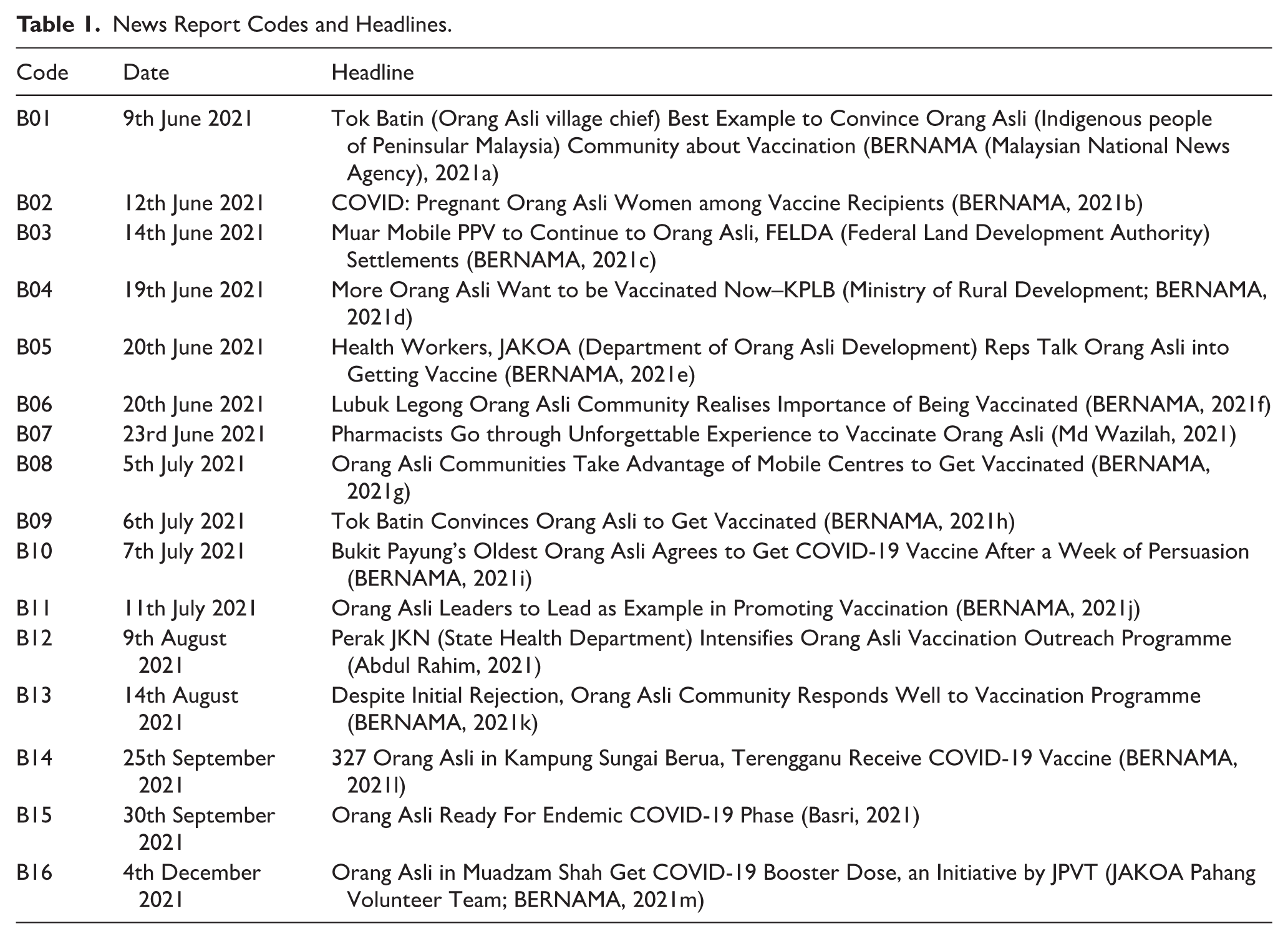
Sample size adequacy in qualitative research is guided by the principle of saturation, or the point at which no new information or themes emerge from the data (Ahmed, 2025). In this study, thematic and discursive saturation was reached with the 16 articles analysed, as no new patterns emerged beyond this set. This range aligns with established practice in discourse analysis, where recommended sample sizes typically fall between 15 and 30 texts (Fairclough, 2003; Wodak, 2002). Larger data, while possible, may dilute analytical clarity and hinder transparency (von Brömssen et al., 2024). Thus, the final sample size is considered sufficient to capture the dominant discursive patterns surrounding the Orang Asli and the COVID-19 vaccination programme. All of them were published under the ‘General’ section.
Data Analysis
Steps outlined by researchers proficient in discourse analysis were referred to for adaptation (Alejandro et al., 2023; Lang & Alejandro, 2024; Taylor, 2013). The data analysis followed an iterative process. First, each article was read in full, and sections directly referencing Orang Asli responses to COVID-19 vaccination were highlighted. Immersion of material was done through multiple readings of the articles with an open mind and a conscious attempt at removing preconceived ideas and biases. In a process called “making strange,” this process is crucial to avoid missing out on independent formation and linkages of patterns from available data due to assumptions made (Gasper, 2022).
Selected sections of the articles that were highlighted were coded inductively for recurring linguistic patterns, metaphors, and evaluative framings. The codes were grouped into broader discursive strategies, compared across articles, and situated within Fairclough’s three-dimensional model (Fairclough, 1989, 1995). As Figure 1 illustrates, analysis is done wholly, including the surface-level linguistic choices of the text, the production and interpretation of the text used, in addition to the sociohistorical context shaping the discourse. Through this approach, analyses were done through multiple entry points (Janks, 1997). This process was done iteratively, with the generation of new patterns and discursive strategies made apparent and taken note of through the process of coding. This iterative movement between text, context, and interpretation reflects the hermeneutic cycle common in CDA (Taylor, 2013). Discourse analysis was selected over other qualitative approaches, such as thematic analysis, because of the study’s objective to not only document perceptions but to critically interrogate how language reproduces structural inequalities. The CDA is particularly suited to this aim, as it links microlevel textual choices to macrolevel relations of power (Evans-Agnew et al., 2016; van Dijk, 2001).
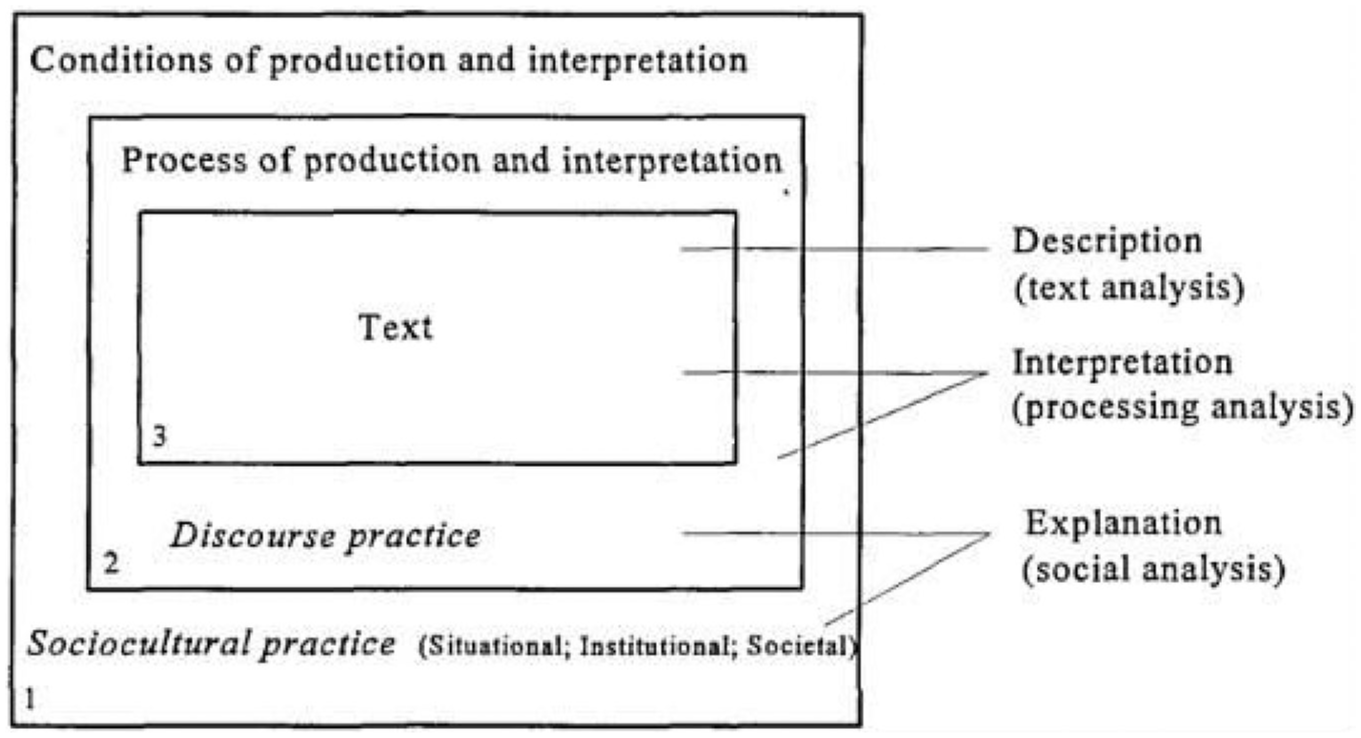
Fairclough’s three-dimensional model for critical discourse analysis (Janks, 1997).
The usage of NVivo, a computer-assisted qualitative data analysis software, reduced the burden linked to manual coding by allowing systematic organisation of codes and texts used, contributing to efficient retrieval of relevant texts as reference (Zamawe, 2015). Finalised outcomes of the analysis were organised to answer this study’s research question. The findings and interpretation are presented below, following the disclosure of reflexivity to be made aware of.
Ethics and Reflexivity
This project was confirmed to not require ethics approval by the author’s academic institution’s ethics review submission system, as there are no human participants and informed consent is not required. In acknowledging reflexivity and positionality when conducting qualitative research, the author is aware of the risk of researcher bias derived from her characteristics while doing this discourse analysis.
Previously, the author was a research assistant for a year interviewing Orang Asli individuals in their villages across Malaysia on their health care, thus getting a glimpse of their livelihoods and systemic barriers to access health in their own words and observing academic discourse. In addition, she had experience writing for a daily national Malaysian newspaper as a school student journalist and intern. Thus, the author kept in mind that while these experiences provided useful insights, a level of detachment was still needed to address the possibility of preconceived assumptions shaping the analysis. These included tacit scripts about how the Orang Asli are typically represented in Malaysian media, as well as normative expectations about government–community relations.
In addition, as a person of ethnicity that makes up the majority of the Malaysian population, with most national policies benefitting her, the author is aware that her understanding and perception of marginalised backgrounds is limited. Ultimately, the Orang Asli are the experts of their own lives and, thus, should have their voices amplified instead of having their experiences spoken over.
Recognising these risks, additional deliberate steps were taken to mitigate bias. One key strategy was the previously mentioned application of Gasper’s (2022) technique of “making strange.” This method involves approaching texts as though they are unfamiliar and consciously setting aside assumed meanings for ideas often taken for granted. As Gasper explains, our minds tend to interpret texts through familiar mental scripts and may overlook contradictions, stereotypes or silences. By estranging the text through reading both with and against it (Janks, 1997), the analysis examined how language choices, metaphors, and framing devices constructed particular narratives while suppressing others. For example, recurring lexical patterns that appeared natural on first reading were interrogated for the implicit assumptions they carried, and then reread comparatively against what might have been said instead. This technique helped to challenge initial interpretations and prevent premature closure in coding.
Additional strategies were adopted to strengthen reflexivity and minimise bias. Multiple readings of each article were conducted with an open mind before coding, ensuring immersion in the data while resisting early categorisation (Taylor, 2013). Fairclough’s (1989, 1995) three-dimensional model that provides multiple analytical entry points (Janks, 1997) contributes to reducing the likelihood of privileging one interpretive lens over others. The NVivo software that was employed to systematically organise codes also helped in improving transparency and allowing for iterative checking of emergent patterns (Zamawe, 2015).
Results and Interpretation
This section summarises the CDA findings across textual, discursive and social dimensions. In answering the research question aiming to uncover the discourse produced by the Malaysian government-owned news agency in framing the Orang Asli’s response to COVID-19 vaccination, the findings can be structured into these three structures: dichotomy of Orang Asli representation versus officials, shifting blame of misinformation over systemic barriers, and legitimisation of community influence. The coding scheme is attached in Supplementary Material 1.
The Dichotomy of Orang Asli Attributes Versus Officials
Analysis of the selected BERNAMA news articles found a clear pattern of reproducing the social position of the Orang Asli within mainstream society through the adjectives attributed to them. When it comes to challenges surrounding vaccination, featured attributes of the Orang Asli include “gullible” (B13, para. 4) and “don’t know how to read” (B06, para. 6). Although this study is not quantitatively driven as per content analysis studies, it is worth mentioning that the majority of the selected articles (68.8%) alluded to the Orang Asli being fearful of vaccines, thus, the fear being the main barrier influencing vaccine uptake. The portrayal of the fearful Orang Asli, as exemplified below, mirrors past critical discourse analyses that identified frequent disempowering depictions of the Orang Asli (Jamal & Abdul Manan, 2016; K. C. Wong & Jamal, 2023a).
Before this, the number of Orang Asli settlers who agreed to get vaccinated had been very low because many are afraid of needles and they believe more in traditional medicine. (Quote by P1, male, doctor, in B05, para. 4) We should get vaccinated, don’t be afraid, be brave. (Quote by P2, male, 47 years old, in B08, para. 6)
As seen in the first quote, the Orang Asli’s hold of their tradition is combined with their fear of needles as part of the “problem” in not agreeing to be vaccinated, dismissing the importance held by Indigenous communities of their traditions in navigating challenges (Chua et al., 2019, 2021; Thong et al., 2025). In addition, there is a strategic placement of a member within the Orang Asli community itself with the first-person pronoun “We” in B08, commenting on the community’s fear, hence, “legitimising” the attribution. Drawing on Bacchi’s (2009) approach in interrogating policies, the onus of the “problem” in vaccination of the Orang Asli is represented by BERNAMA to rest more on the Orang Asli’s attitudes and practices, further stigmatising them. This framing aligns with global studies that often attribute vaccine hesitancy to individual psychology, such as fear or complacency (MacDonald & SAGE Working Group on Vaccine Hesitancy, 2015; Troiano & Nardi, 2021). Subsequently, the discourse of the Orang Asli being vaccine-resistant solidifies stereotypes in health care workers themselves, already anticipating the Orang Asli to be less receptive during vaccination outreach programmes (Md Wazilah, 2021).
In contrast, the efforts and details of officials in ensuring the vaccination of the Orang Asli are magnified. Increased uptake in vaccines is directly credited to efforts made by state officials and health authorities who selflessly “made a personal contribution by giving his salary” to vaccination efforts (B03, para. 6) and showed “commitment and determination” (B14, para. 1). Emphasis is placed on the Orang Asli expressing gratitude to the government’s contributions.
Thanks to the government for the vaccine. (Quote by P2, male, 47 years old, in B08, para. 6) Sungai Berua Village Development and Security Committee (Jawatankuasa Kemajuan dan Keselamatan Kampung, JPKK) chairman . . . said he was grateful to the government for not forgetting them in the implementation of the National COVID-19 Immunisation Programme. (B14, para. 3)
Hence, the discursive power of news media is exemplified through powerful social actors having control over their positive self-framing, thus securing the compliance of dominated groups (Lukes, 2005; van Dijk, 1995). Indeed, development of narratives in strengthening trust in authorities is deemed an important strategy, as Lazarus et al. (2021) found that trust in government was a strong predictor of vaccine acceptance across 19 countries. This section is closed by noting BERNAMA, magnifying the efforts carried out by health workers in vaccinating the Orang Asli.
Carrying heavy loads, travelling along torturous roads and river crossing is definitely not something routine for pharmacists . . . but they went through them all the same to ensure an Orang Asli community received COVID-19 vaccination. (B07, para. 1)
The events are framed as tribulations that health workers would go through for the sake of the Orang Asli, even though it is a one-off occurrence. It is not highlighted as a systemic challenge that the Orang Asli go through daily in accessing health care, as will be elaborated in the next subsection.
Precedence of Individual Responsibility Over Social Determinants of Health
Social determinants of health contribute to 30% to 55% of health, with evidence that they influence vaccination uptake negatively, especially among vulnerable groups (Vardavas et al., 2023; WHO, n.d.). In the selected sample, scarce examples of identified barriers to accessibility to being vaccinated, relevant to social determinants of health, include having the nearest centre to be as far as 40 km away by muddy trail (B11), having no transportation to bring them to the vaccination centre (B12), and not having a smartphone to register on the vaccination application (B16).
The challenge started when we had to travel over a road pitted with potholes and strewn with puddles for an hour. Then we crossed a river by boat for about 10 minutes . . . we trekked up a small hill. (Quote by P3, female, pharmacist, 26 years old, in B07, para. 4)
There were no further elaborations on these challenges from the Orang Asli featured, nor any comments given in addressing these, except for outreach programmes conducted. As mentioned previously, these descriptors were merely used as a tool to illustrate the efforts made by health care workers in vaccinating the Orang Asli. These structural challenges concerning their living conditions are not only barriers to accessing vaccines (EPU, 2021; Khor & Shariff, 2019) but may also affect the Orang Asli’s access to education and sources of income, thus circling back to contributing to poor health outcomes as per the principles of social determinants of health.
Instead, the discourse amplified by the articles was of the Orang Asli being believers of misinformation spread through social media they have access to, such as WhatsApp, on the negative effects of the COVID-19 vaccine, as exemplified below:
Meanwhile, P4, 23, said she was misinformed by untruths about COVID-19 vaccines that had been circulating on social media apart from gossip about the alleged effects of the vaccines, causing her to refuse to take the vaccine. (B13, para. 7) Previously, many Orang Asli were afraid of getting vaccinated because they feared they would die after reading inaccurate information on WhatsApp. (B14, para. 4)
While the discourse unintentionally frames the Orang Asli as a community frequently believing in unverified information online, several other implicit inferences are made. First, social media’s discursive power in influencing people’s beliefs (Hall, 1997) is evident based on the articles attributing vaccine hesitancy to it, consistent with a past systematic review (Cascini et al., 2022). This finding resonates with the broader Malaysian context in which negative perceptions towards the national immunisation programme were strongly linked to communication failures and distrust in information sources (Dollah et al., 2022; Jafar et al., 2024). Next, it is deduced that information transmission through nonofficial channels was more accessible for the Orang Asli, affirming the findings by Nungsari et al. (2022) on the information gap between the government and Indigenous communities to contain COVID-19. Furthermore, it is evident that information disseminated among the Orang Asli was deemed as more trustworthy, which will be discussed in the next subsection.
Community-Centred Persuasion
In the UNDP’s recommendation for the government to create targeted vaccine campaigns for the Orang Asli (Khalid, 2021), there is a strong emphasis on leveraging the Orang Asli’s social networks to increase their acceptance. As such, even before the UNDP publication, community-centric narratives have been highlighted by BERNAMA, whether intentionally or not and explicitly or implicitly. For example, the influential role of family members is evident as the Orang Asli are quoted to be vaccinated after being persuaded by family members or having seen them being vaccinated, in addition to wanting to protect their family members:
My children said there is nothing to be afraid, and after thinking about the safety of my children and grandchildren, I decided to get the vaccine. (Quote by P5, female, villager, 62 years old, in B10, para. 8) The village Tok Batin (village chief), P6, 57, said initially most of the villagers feared getting the vaccine but their attitude changed after seeing that he has remained healthy after his vaccination. (B12, para. 3)
These quotes are consistent with past findings of Chua et al. (2019), in addition to Nicholas and Baer (2009) asserting that the welfare of each person in the Orang Asli community was a shared responsibility of the whole community. As BERNAMA’s content is disseminated widely to other local news outlets with its audience including the Orang Asli themselves (Jamal & Naghmeh-Abbaspour, 2020; Salman, 2010), it is expected that these community-centric narratives will be featured to further amplify the incentives of being vaccinated.
Given the sociopolitical context leading to distrust of the intentions of non-Orang Asli individuals (Y. S. Wong et al., 2019), BERNAMA seems to acknowledge the importance of featuring Orang Asli voices to advocate for getting vaccinated. For instance, at-risk populations within the Orang Asli community that were vaccinated were interviewed, including a 6-months pregnant woman (B02), the oldest resident in a village who is more than 100 years old (B10), an elderly person with high blood pressure and asthma, as well as a wheelchair-bound mother of eight (B12). In addition, important figures in advocating for getting vaccinated are the community leaders, the Tok Batins, who are featured in over half of the selected articles, examples include:
Tok Batin Best Example to Convince Orang Asli. (B01 headline) 40 Tok Batins in Perak, were recently selected to be the first to be vaccinated in their villages to convey to their communities the true benefit and encourage them to get the vaccine. (B11, para. 3)
However, the involvement of the Tok Batins necessitated further probing. While they hold the leadership role and act as the reference point for Orang Asli matters (Nicholas, 2021b; I. J. Wallace et al., 2022), multiple Orang Asli witnesses were reported, accusing their Tok Batin of making detrimental decisions without consulting the community beforehand (SUHAKAM, 2013). As they were appointed by JAKOA, who were also responsible for paying them a monthly stipend, the Tok Batins are suspected to be submissive to requests made by the government (Parti Sosialis Malaysia, 2022; SUHAKAM, 2013). Hence, the portrayal of Tok Batin as an example set by the government is a display of power by the government in directing the village heads to perform their duty of being vaccinated amid fear felt by the rest of the community.
Discussion
The current study aimed to critically analyse the discourse produced by a Malaysian government-owned news agency, BERNAMA, on the Orang Asli in response to the COVID-19 vaccination programme. Utilising CDA on a sample of 16 newspaper articles in 2021, the study attempts to fill in the gap of analysing the health discourse of the Orang Asli while examining how social power is reproduced by the government. For this study, social power is operationalised through the analysis of whose voices are granted greater visibility, the linguistic strategies used to frame the Orang Asli, and the broader sociohistorical narratives into which these representations are embedded. This operationalisation provides the lens through which the present CDA examines how government-controlled news media reproduced unequal power relations during the COVID-19 vaccination campaign. Thus, this section complements the previous section, considering the current study’s interpretivist paradigm of weaving the results with its specific interpretation.
The discourses that emerged around the Orang Asli’s response to COVID-19 vaccination by BERNAMA are: (a) the dichotomy of Orang Asli attributes versus officials, (b) precedence of individual responsibility over social determinants of health and (c) community-centred persuasion. When it comes to the framing of Orang Asli, the current study’s findings are consistent with previous discourse analyses of mainstream newspapers glorifying authorities while portraying the Orang Asli to be disempowered and reliant on the former (Baharun & Ismail, 2022; Ismail et al., 2020; Jamal & Abdul Manan, 2016; K. C. Wong & Jamal, 2023a, 2023b). The report by Nicholas and Baer (2009) posited the paternalistic approach in Orang Asli health care to be a remnant of the British colonial state, whereby official health workers had self-credited their “sacrifice” out of “pity” for the community, similar to the current narrative done by BERNAMA. Hence, the produced discourse embodies the arguments by van Dijk (2001) and Taylor (2013) that privileged members of the society hold greater control over public discourse in determining what or who is attributed with negative valuing through ‘bad’ examples.
Next, the analysis demonstrated that greater weighting was placed on Orang Asli’s behaviour over social determinants of health when attributing the initial poor response to the COVID-19 vaccination, consistent with past studies analysing discourse on health inequality (Capper et al., 2023; Evans-Agnew et al., 2016; von Brömssen et al., 2024). The amplification of the narrative of Orang Asli to believe in misinformation spread through social media shifts the attention towards their behaviour as needing to be ‘fixed’, while obfuscating inequalities present in the Orang Asli’s socioeconomic and living infrastructure. The government’s influence in producing this narrative through BERNAMA is an example of the demonstration of power determining what is discussed, whereby certain grievances are prevented from being expressed further (Lukes, 2005). However, it is interesting to note that the Orang Asli are active users even with the limited number of social media applications. Hence, they managed to optimise the limited resources, contrary to the challenges and delays in providing wider telecommunication service coverage to the Orang Asli villages (Tan et al., 2020).
Moreover, the findings revealed the government’s awareness of the Orang Asli’s strong community networks’ importance in increasing the uptake of COVID-19 vaccination. The discourse illustrating the Orang Asli’s trust and concern placed first and foremost among members from their community is well known, as illnesses are considered a concern for the whole community, in which resilience in coping with adversities is drawn from their social connection (Chua et al., 2019, 2021; Nicholas & Baer, 2009; Thong et al., 2025). Drawing on Fairclough and Wodak’s (1997) argument of examining the historical, societal, and cultural context in analysing discourse critically, mistrust of Orang Asli of outsiders can be traced back to historical events whereby diseases were brought into their villages from encroaching non-Orang Asli individuals, resulting in deaths of entire villages (Nicholas & Baer, 2009). This historical mistrust mirrors the pattern of vaccine hesitancy in Canada as a response to the legacy of systemic marginalisation by health care institutions there (Griffith et al., 2021). In addition, Tok Batins’ appointed role in persuading the Orang Asli community to be vaccinated is visible in the articles, although a past survey from 312 Orang Asli individuals on vaccination acceptance revealed that the Tok Batins’ endorsement did not moderate their acceptance of vaccines (Denan et al., 2023). Perhaps, the Orang Asli perceived their community leader as promoting and supporting programmes organised by government agencies out of obligation (Nicholas et al., 2010). Nevertheless, policymakers and government stakeholders should draw upon this current study to reflect the role of government-sponsored media in contributing to the current trajectory of Orang Asli’s health.
Applying Fairclough’s three-dimensional framework enabled the analysis to move beyond description of stereotypes towards showing how language and representation reproduce relations of power. For instance, the privileging of officials’ voices at the discursive level illustrates van Dijk’s (2001) argument that access to public discourse is unequally distributed, while the repeated emphasis on Orang Asli “fear” at the textual level reiterates deficit-based interpretations of Indigenous health practices. At the level of social practice, these discourses sustain narratives of governmental benevolence and Indigenous dependency.
Further Implications
This study corroborates the existing literature on both studies on Orang Asli’s health and discourse analysis on how the media perpetuates inequality. Considering the greater prevalence of diseases among the Orang Asli, including leprosy, malaria and tuberculosis compared to the wider Malaysian population (Y. S. Wong et al., 2014), existing public health strategies in place need reviewing, especially in disseminated media that contribute to reproducing health inequity. Presently, discourse coproduced by the Malaysian government-owned news agency places little attention on discriminatory societal arrangements but instead shifts the responsibility of health disparities onto the Orang Asli’s behaviour. Thus, systems that contribute to health inequity escape scrutiny and are not held accountable. Future efforts must explicitly address structural and systemic barriers to the Orang Asli’s health, especially the marginalisation faced by them. This is especially so with global research showing the vicious cycle of those most vulnerable to COVID-19 deaths, such as those from marginalised backgrounds, often holding more negative attitudes towards vaccines (Paul et al., 2021). Active consultation and inclusion of Orang Asli individuals in every step of the development and implementation of health policies is non-negotiable in ensuring equitable outcomes, as they know best what is needed. Inspiration can be drawn from initiatives coproduced with Indigenous communities in Australia, Canada, New Zealand and the USA (Barnabe, 2021; O’Keefe et al., 2022). These findings also suggest that CDA can illuminate not only the content of health communication but also the ideological work it performs in legitimising state actors, individualising structural problems, and framing Indigenous populations in ways that limit alternative narratives.
Limitations
For those unfamiliar with qualitative research or discourse analysis, the small sample size and usage of newspaper articles as sources of data may raise suspicion of bias in data selection and interpretation. However, qualitative research does not seek statistical representativeness but rather analytical depth, contextual interpretation, and transparency of process (Hammarberg et al., 2016; von Brömssen et al., 2024). In establishing better transparency and credibility, the current study attempts to describe the analytical process and provide the source material as thoroughly as possible. In addition, given the financial limitations in accessing official databases, the execution of research requiring greater resources and a more thorough analysis had to be forgone.
Another limitation arises from the use of newspapers as primary data sources. Media texts are not neutral accounts of reality but socially constructed through journalistic norms, editorial agendas, and institutional interests (Kiyimba et al., 2018; Shepherd, 2024). News coverage often spotlights more sensationalised narratives and, in the case of government-controlled media, privileges official perspectives while underrepresenting marginalised voices (Galeazzi et al., 2024). As Barranco and Wisler (1999) caution, newspapers face persistent validity and reliability problems. This imbalance influences the discourses identified, reflecting how the state frames Orang Asli health responses rather than providing a direct account of community perspectives. While systematic biases are inevitable, their stability over time makes them analytically useful for examining patterns in how institutions and authorities frame issues.
These limitations mean that the findings should be understood as an analysis of how discursive power is exercised through government-owned media, rather than a comprehensive account of Orang Asli perspectives on vaccination. Nevertheless, this focus remains valuable for highlighting how official framings contribute to the reproduction of health inequities. In this study, credibility is enhanced not by the number of articles but by the systematic approach taken to purposive sampling, the justification of selection criteria, and the clear documentation of analytical steps. Regardless, the following subsection elaborates on how future research could build on the present work.
Future Research
Potential future research concerning Orang Asli’s health includes a comparison discourse analysis of government-owned newspapers versus nongovernment-owned newspapers publishing news on the Orang Asli such as Malaysiakini, a popular Malaysian news portal asserting to have an independent voice but with past investors including George Soros’ Open Society Foundation and US-based National Endowment for Democracy (Carrington, 2015), especially in the realm of global health whereby its actors transcend state borders. Past studies of contrasting different newspapers on other global issues have produced insightful results reflecting actions in the editorial world in maintaining the stakeholders’ interests (Teo & Xu, 2021; Yu & Zheng, 2022). Other possibilities include integrating other research methods, such as content analysis for assigning relative weightings of discourse identified and for longitudinal tracking of weighting changes in discourse over the years (Feltham-King & Macleod, 2016), or visual discourse analysis of images used in eliciting the reader’s response and reproducing the discourse of the Orang Asli (Rose, 2022). Furthermore, given the turbulent relationship of authorities with the Orang Asli, CDA of speeches and interviews of authorities about the Orang Asli’s health and well-being are worth conducting. This is so since vulnerable populations are often exploited for research contexts, yet studies of elites who are in privileged positions of policymaking decisions also offer a better understanding of how social problems or policies came about (Li, 2022).
Conclusion
In conclusion, this study explored the discourse produced by the Malaysian government-owned news agency BERNAMA on the Orang Asli’s response to COVID-19 vaccination. Through CDA, it was uncovered that prominent discourses of positive framing of officials in contrast to the Orang Asli attributes, focus on the Orang Asli’s behaviour over social determinants of health, and the strong community-centric values held by the Orang Asli were reproduced through the selected news articles. The findings call for review by policymakers and health authorities on how the media, especially those owned by the government, contribute to wider health disparity. However, it should be made clear that this study alone is insufficient in forming judgements of the full extent of the discourse surrounding the Orang Asli and their health, nor of the stakeholders involved. The Orang Asli themselves are ultimately the ones with lived experience, having the best understanding of their health needs and barriers, thus, warranting their voices to be amplified instead of being spoken over. Nevertheless, it is hoped that the existing literature and findings from the current study provide a foundation for further discourse research in advocating for better health outcomes for the Orang Asli in Malaysia based on respect for their identity and culture.
Supplemental Material
sj-docx-1-aln-10.1177_11771801261445672 – Supplemental material for COVID-19 Vaccination and the Orang Asli: A Critical Discourse Analysis of a Malaysian Government-Owned News Agency
Supplemental material, sj-docx-1-aln-10.1177_11771801261445672 for COVID-19 Vaccination and the Orang Asli: A Critical Discourse Analysis of a Malaysian Government-Owned News Agency by Durrah Sharifah Ahmad Azlan in AlterNative: An International Journal of Indigenous Peoples
Footnotes
Acknowledgements
First, the author would like to acknowledge the Orang Asli communities in Gombak, Segamat and Gerik, from whom she had the privilege of working and learning about the systemic health care utilisation barriers they faced in the years preceding this study. The author also recognises the Center for Orang Asli Concerns for their long-standing advocacy for Orang Asli rights and their contributions to knowledge production in this field. The author is grateful to Dr. Rocco Friebel and Dr. Catherine Jones for their guidance in shaping the early ideas of this work during her Master’s programme and to Dr. Justin Parkhurst for encouraging its development into a journal article. Appreciation is also extended to Dr. Andrian Liem and Dr. Durriyyah Sharifah Hassan Adli for their careful proofreading and feedback on earlier thesis drafts. The author is also indebted to Dr. Rachel Ting Sing-Kiat, Dr. Raphael Susewind, Dr. Justine Thong Jian Ai and Dr. Ryan Chua Yumin for their teaching and insights on qualitative research, particularly on working with Indigenous communities and emphasising the importance of reflexivity and positionality. Finally, the author expresses gratitude to Allah S. W. T. and acknowledges the inspiration drawn from the  calls for justice, particularly in solidarity with Palestine, which resonated during the writing of this paper.
Author’s Note
Ethical Considerations
This project was confirmed to not require ethics approval by the London School of Economics and Political Science Research Ethics Review Board, as there are no human participants and informed consent is not required.
Funding
The authors received no financial support for the research, authorship and publication of this article.
Declaration of Conflicting Interests
The authors declared no potential conflicts of interest with respect to the research, authorship and publication of this article.
Data Availability Statement
Supplemental Material
Supplemental material for this article is available online.
Glossary
Bahasa Malaysia The Malay language
Berita Nasional Malaysia (BERNAMA) Malaysian National News Agency
Jabatan Hal Ehwal Orang Asli (JHEOA) Department of Orang Asli Affairs
Jabatan Kemajuan Orang Asli (JAKOA) Department of Orang Asli Development
Jawatankuasa Kemajuan dan Keselamatan Kampung (JPKK) Village Development and Security Committee
Malaysiakini a Malaysian news portal
Orang Asal Indigenous Peoples in Malaysia, encompassing groups in Peninsular and East Malaysia
Orang Asli Indigenous Peoples of Peninsular Malaysia
Semai Orang Asli tribe
Semang Negrito subgroup of the Orang Asli
Senoi Orang Asli subgroup
Sungai Berua village name
Suruhanjaya Hak Asasi Manusia (SUHAKAM) National Human Rights Commission of Malaysia
Temiar Orang Asli tribe
Tok Batin Orang Asli village chief
References
Supplementary Material
Please find the following supplemental material available below.
For Open Access articles published under a Creative Commons License, all supplemental material carries the same license as the article it is associated with.
For non-Open Access articles published, all supplemental material carries a non-exclusive license, and permission requests for re-use of supplemental material or any part of supplemental material shall be sent directly to the copyright owner as specified in the copyright notice associated with the article.
