







Abstract
This qualitative research aims to empower Indigenous-led, self-determined transformative social change to liberate Aboriginal and Torres Strait Islander children from oppressive, racially discriminatory, and harmful incarceration practices. Using Indigenist and decolonising ontology, transformative epistemology, and participatory action research, data were collected through yarning interviews and analysed using reflexive thematic analysis. Eighteen participants included Elders, community members and stakeholders from Queensland, Australia. Six themes were identified, which addressed historical and socio-political issues, and racialised health and justice systems driving disparity and inequity impacting these children. The themes highlight ways to reduce punitive punishment and criminalisation of complex health and support needs by instilling healing, holistic, child and family-focused approaches. By identifying children’s strengths and challenges during crucial developmental periods, this research offers stories that inspire resistance to child incarceration, and empower hope, healing and freedom.
Keywords
Introduction
The current discourse surrounding tough-on-crime policies in Australia needs to be reevaluated, and the politically motivated and racially discriminatory incarceration of Aboriginal and Torres Strait Islander children demands sustained critique; respectfully referred to as Indigenous Australian children henceforth (Hollonds, 2024). In 2024, statistics revealed a stark disparity in the incarceration rates of Indigenous and non-Indigenous Australian children. Data demonstrated that Indigenous Australian children were detained at a rate 27 times higher than Australian children of other descent. Furthermore, despite making up only 6.6% of the Australian population aged between 10 and 17, Indigenous Australian children accounted for an average of nearly 60% of the daily youth detention population (Australian Institute of Health and Welfare, 2024). Tougher policing, stricter bail laws, criminalisation of childhood and hyper-incarceration practices fail to address the underlying causes of offending behaviour. It is necessary to highlight widespread systemic disadvantage, complex support needs, disability, inadequate and inflexible support services and disproportionate and state-controlled punitive measures upon the lives of Indigenous Australian children as young as 10 years old (Australian Human Rights Commission, 2024; Baldry et al., 2018; Blakemore et al., 2019; Martensen, 2020; McCausland & Baldry, 2023; Walsh & Fitzgerald, 2022). To disrupt colonial power that enforces racially discriminatory incarceration practices, it is necessary to underpin research approaches within critical Indigenous and decolonising ontological worldviews.
Methods
Indigenist Ontology
An Indigenist worldview rejects egocentrism, embracing balanced and sustainable living, valuing collective well-being, and celebrating individual diversity and strengths, as upheld in Aboriginal lore for millennia (Graham, 1999). Indigenist research respects the interconnection of the dreamtime and ancestral creator beings with spiritual and sacred connections to land, and reciprocal relationality with one another, animals, and the natural world (Graham, 1999). Indigenist ontology, like penal abolition and critical disability studies, emphasises addressing historical and social injustices, such as white supremacy, racial capitalism, and settler colonialism (Rowe & Dowse, 2021). It critiques harmful penal systems and the marginalisation of Aboriginal and Torres Strait Islander peoples, advocating for prioritising their voices in resisting colonial dominance and disrupting the social control exerted by the carceral state (Martensen, 2020; Rowe & Dowse, 2021; Rowe et al., 2022). In addition, an Indigenist research approach emphasises the ancestral strength of Indigenous ways of being (ontology), knowing (epistemology), doing (axiology), and learning and teaching (pedagogy; Parter & Wilson, 2021). Decolonising and Indigenist ontology align by encapsulating liberating notions of emancipation to counter the subjugation imposed by the carceral state (Martensen, 2020; Rix et al., 2019).
Decolonising Ontology
To appreciate the need for decolonising ontology, it is crucial to acknowledge the ongoing violence against Aboriginal and Torres Strait Islander peoples by colonisers, which persists in contemporary Australia (Paradies, 2020; Smith, 2021). This work engages with decoloniality by resisting colonial logics that oppress Indigenous people through hyper-surveillance, over-policing, and over-incarceration, manifestations of colonial institutionalisation (Paradies, 2020; Smith, 2021). Embedding decolonising ontology in research challenges inequitable power struggles and centres the voices of Aboriginal and Torres Strait Islander peoples. Smith’s (2021) portrayal of decolonising methodologies acknowledges the colonial atrocities committed against Indigenous people globally, leading to social and political inequalities. Smith moves beyond deficit paradigms, which disempower Indigenous communities, towards a strengths-based approach that centres on Indigenous diversity and capabilities.
Decolonising approaches envision a future where all Aboriginal and Torres Strait Islander children can thrive, resisting structural racism and the power dynamics of the dominant imperial culture. Culturally responsive ways of understanding and caring for Indigenous children should promote Indigenous sovereignty, strength, and self-determination, in alignment with the United Nations Declaration on the Rights of Indigenous Peoples (Smith, 2021; United Nations, 2007). As Moreton-Robinson (2015) asserts, Indigenous sovereignty is not granted by the state but is embodied through ontological belonging to Country. In this way, Rigney’s (1999) Indigenist research principles affirm self-determination as a living, intellectual resistance to colonial domination, asserting the right to speak, define, and act from within sovereign knowledge systems.
Study Aim
The study aims to explore and understand the socio-political and historical Australian landscape, as well as the complex health and support needs of Aboriginal and Torres Strait Islander children exposed to child justice systems from the perspectives of Elders, community members, and stakeholders. In this study, “complex health and support needs” are understood not as singular diagnoses or individual deficits, but as the overlapping and cumulative impacts of neurodevelopmental disability, mental health challenges, trauma, social disadvantage, and system involvement. Prior research demonstrates that such complexity is produced through the interaction of individual experiences with fragmented, inflexible, and often culturally unsafe service systems, resulting in heightened criminalisation of unmet support needs rather than effective care or intervention (Baldry et al., 2018; Dowse et al., 2014). To the authors’ knowledge, no other qualitative research has centred Indigenous and community-led knowledge to inform culturally responsive early intervention and diversionary alternatives aimed at reducing the disproportionate incarceration rates of Indigenous Australian children.
Research Question
Transformative Epistemology and Participatory Action Research
Transformative epistemology positions knowledge as inherently political and action-oriented, grounded in the lived experiences of marginalised communities, and explicitly oriented towards exposing power, challenging injustice, and generating social change rather than merely describing social conditions (Omodan, 2020; Romm, 2015; Smith, 2021). In this study, transformative social change does not refer to changing the behaviour or character of children. Rather, it denotes a fundamental shift in the social, political, and institutional conditions through which children are governed, supported, and responded to, particularly where punishment has become a routine response to unmet complex support needs. Consistent with critical disability and justice scholarship, the criminalisation of children is understood as an outcome of fragmented, exclusionary, and culturally unsafe systems that fail to provide coordinated and appropriate supports across health, education, child protection, and community domains, rather than a consequence of individual deficit or pathology (Baldry et al., 2018; Dowse et al., 2014).
From this perspective, the management of unmet complex support needs through surveillance, exclusion, and incarceration reflects broader carceral logics in which punishment substitutes for care and support. Such logics disproportionately impact Aboriginal and Torres Strait Islander children, reinforcing cycles of criminalisation and harm rather than addressing the underlying structural conditions that shape children’s lives (Baldry et al., 2018; Martensen, 2020). Grounded in Indigenous and community knowledge, transformative social change is therefore realised through re-designing systems towards prevention, early intervention, and community-led support pathways that uphold children’s rights, nurture strengths, and enable thriving, rather than merely managing risk, enforcing compliance, or containing harm.
Furthermore, transformative epistemology and participatory action research (PAR) align with an Indigenist and decolonising worldview, serving as a dynamic means to activate social justice change. These research approaches address marginalisation and disparities of disadvantaged groups of young people who are oppressed and subjugated by society, and whose complex support needs are often managed through social exclusion and punitive measures (Martensen, 2020; Romm, 2015; Smith, 2021). Transformative PAR ensures Elders, community members, and research participants are central to the inquiry, providing collaborative reflections of lived experiences and priorities (Baum et al., 2006). Indigenist, decolonising, and transformative perspectives similarly position truth within the contextual reality of historical factors external to an individual’s mind (Omodan, 2020). Therefore, the researchers must critically examine “sociality, power and politics in the quest for reality” (Omodan, 2020, p. 37). Authentically seeking the truth requires learning generated by deep listening. In this context, this is achieved through culturally safe yarning methods (Bessarab & Ng’andu, 2010).
Research Team Characteristics
This research was conducted by a multidisciplinary team comprising both Aboriginal and non-Indigenous researchers. The first author (L.H.) is an Aboriginal woman and a Research Fellow with clinical and research experience in nursing, Indigenous health, public health, and child health. The team includes an Indigenous scholar (M.T.) with expertise in Indigenous health and suicide prevention; a non-Indigenous counsellor (C.L.) with paediatric health experience; a clinical psychologist and researcher (N.R.) with a focus on child development, neurodevelopmental conditions, and foetal alcohol spectrum disorder (FASD); and a public health academic (AS) with expertise in Indigenous health and harm reduction strategies, particularly in justice settings.
Context
Participants were recruited from North and Southeast Queensland through youth justice community transition programmes, justice reinvestment groups, independent Indigenous and alternative schools, health and social service roles, and community settings.
Sampling Strategy
Following community engagement and liaison with staff from community and educational organisations, a purposive sampling method was utilised to recruit research participants (Palinkas et al., 2015). Participants were eligible if they were of Aboriginal and or Torres Strait Islander descent or non-Indigenous Australian allies who have provided educational, health, social and welfare prevention strategies, and/or provided culturally responsive diversion and healing programmes to Indigenous Australian children exposed to police engagement, police custody, court hearings, child criminal justice legal matters or incarceration.
Ethical Considerations
Ethical approval was obtained from the University of Queensland’s (UQ) Human Research and Ethics Committee (HREC) 2021/HE002741. First author (L.H.) engaged with communities and built rapport for 3 to 6 months before commencing the research to ensure it was beneficial and aligned with culturally responsive practices and protocols. Communities received introductory letters, information sheets, and consent forms detailing the research and participation expectations. Several community organisations in North and Southeast Queensland provided formal approval letters, which were submitted to UQ HREC.
Before the yarning interviews, participants received an introductory letter, information sheet, and consent form. Questions were addressed, and consent forms were signed and verbally confirmed before starting the interviews. Participants received a AUD $50 store voucher as compensation for their time. Follow-up occurred the day after the interview to check on participants’ social-emotional well-being, adhering to ethical research practices and the study’s cultural resilience distress protocol. The audio recordings were deleted following transcription.
Data Collection Methods
Research participants were interviewed for approximately 1 hour, in a quiet and private location at a mutually convenient time for the researcher and interviewee or focus group. Data collection occurred over a 2-year period, from August 2022 to July 2024. All yarning interviews were audio-recorded and transcribed verbatim by the first author (L.H.) and a professional transcription service. Initially, 17 yarning interviews were conducted with 18 Indigenous and non-Indigenous participants. Follow-up interviews with four research participants were not possible due to limited availability or changes in employment or residence. For the other 14 research participants, availability ranged from one to three further follow-up yarning interviews.
Yarning as a Data Collection Method
Yarning, an Indigenous data collection method, ensures culturally safe communication with Aboriginal and Torres Strait Islander participants. It fosters equal relationships by building trust, engaging in deep listening, and facilitating authentic knowledge exchange through various yarning styles: social, research topic, therapeutic, and collaborative (Bessarab & Ng’andu, 2010). Yarning enhances cultural safety by allowing reciprocal introductions at the first interview, embracing cultural differences and diversity, and respectfully positioning both the researcher and participants within their unique cultures, Country, and place (Koptie, 2009).
Data Processing
Participants were informed that all provided information would be de-identified to ensure confidentiality and privacy, with a participant number allocated to their data. However, Research Participant 6, Minjerribah Moorgumpin Elder Dale Ruska (Stradbroke Island, Queensland), requested and consented to have his data identified. Dale Ruska did not want anonymity because his people have few opportunities to have their stories heard. Therefore, his words are acknowledged by name and participant number throughout this paper. All participants received a de-identified copy of their transcript after their yarning interview to ensure content accuracy and sufficient deidentification.
Data Analysis and Techniques to Enhance Trustworthiness
“Reflexive thematic analysis” (TA) values researcher subjectivity, positionality, mindfulness, and critical inquiry (Braun & Clarke, 2022). The application of reflexive TA included six phases: (1) dataset familiarisation (reading and re-reading yarning interviews); (2) data coding (colour coding transcriptions line by line and extracting codes into an excel sheet); (3) initial theme generation (grouping similar codes to create themes); (4) theme development and review (iteratively developing themes to reflect participants’ expressions and stories); (5) theme refining, defining, and naming (with input from participants and the research team); (6) writing up (iteratively performed with feedback from participants and the research team) (Braun & Clarke, 2022). The first author (L.H.) conducted all interviews and data analysis. Follow-up yarning interviews allowed deeper exploration of synthesised and coded data and collective refinement of themes. Aligned with a PAR approach, participants were involved in the data analysis process.
Results
Participant Characteristics
Eighteen participants were recruited for this study. To maintain confidentiality, participants are identified by broad professional categories and age brackets rather than individual identifiers such as gender. This approach supports deidentification while preserving the integrity of demographic insights. Age ranges were grouped in 5-year brackets (e.g., 30–35, 55–60) to further protect participant anonymity. These broad categories and age groupings were intentionally applied to ensure confidentiality while enabling a meaningful analysis of the diverse perspectives represented in the study. Participants included Elders, Youth Workers, Educators, Community Members (including youth justice advocates and Indigenous police liaison officers), and Health Professionals (including nurses, social workers, speech pathologists, and psychologists). The participant age ranged from 24 to 82 years, with an average age of 50; see Figure 1.
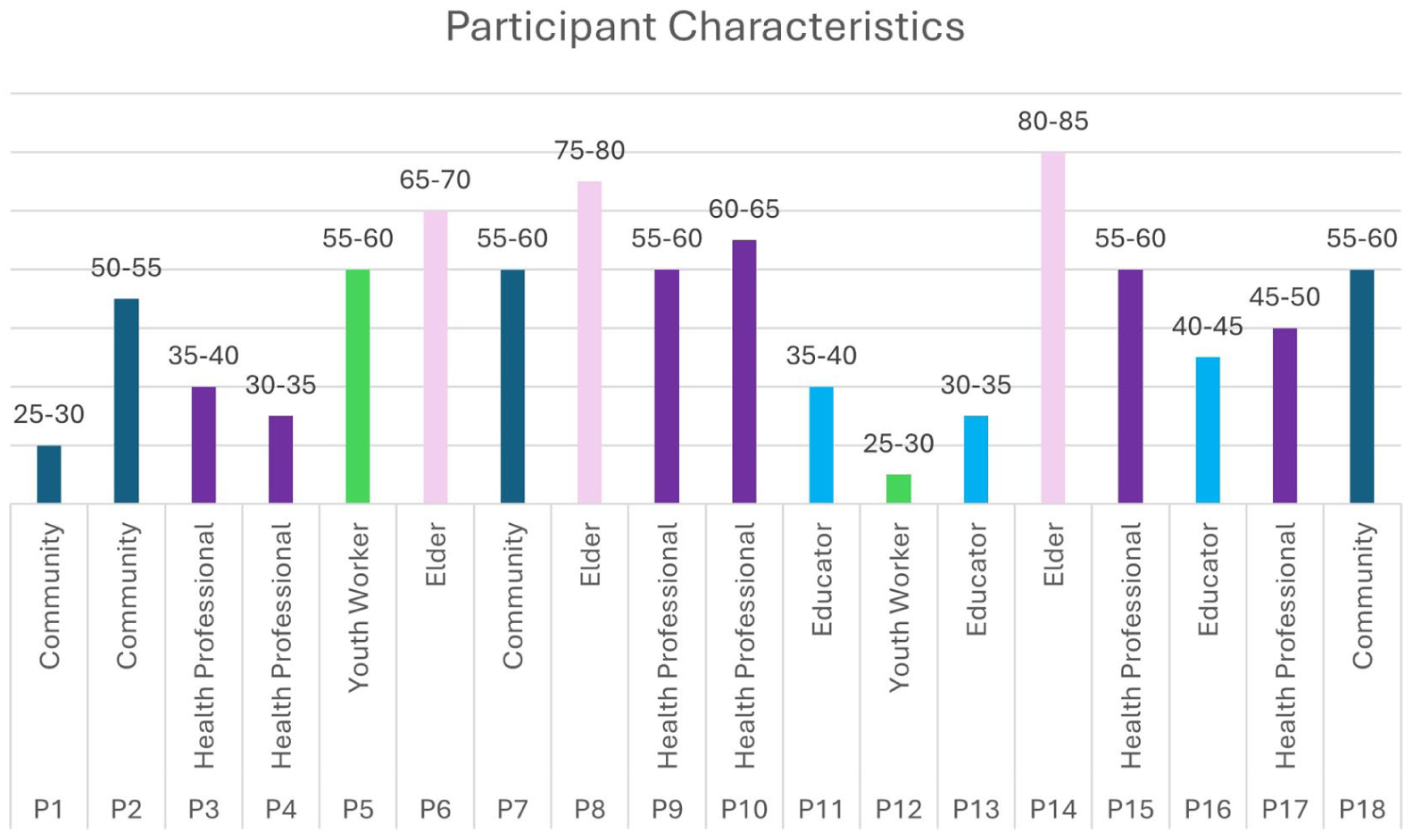
Participant characteristics.
Themes
Six themes were developed from the knowledge shared through the yarning interviews. These stories identified prioritised needs, culturally responsive prevention approaches, and protective factors across the life course. They also highlighted perceptions of systemic and structural barriers and ways to address these issues. To contribute to transformative social change, the following six themes were identified:
“The settler colonial project” – systemic barriers to freedom
“You don’t want young people in the system” – recognising need and promoting compassion within Australian society.
“I actually don’t know if it’s effective in any situation” – abstaining from child incarceration practices to uphold child rights
“Because we know it’s trauma” – advocating for holistic and healing-informed child- and family-focused approaches
“You have to be connected to the community in which you are working” – asserting cultural authority, community empowerment and collaboration
Resisting the “prison industrial complex” – awareness, understanding, identity, and belonging
Theme 1: “The Settler Colonial Project” – Systemic Barriers to Freedom
This theme underscores systemic and institutional barriers driving hyper-surveillance and hyper-incarceration of Aboriginal and Torres Strait Islander children, particularly for minor crimes. The elevated rates of imprisonment and deaths in custody were perceived by research participants as a direct outcome of persistent historical injustices, including dispossession, subjugation, and oppression, perpetuated through colonial practices entrenched in racist and discriminatory state and federal health, education, social and justice policies. A health professional reflected on the enduring legacy of colonialism: The way this is all connected and the way that this is built against us, it’s quite baffling until you start to get a very real understanding about the Settler Colonial project. And that this place was predicated on the erasure of black fellas. The slavery that they got from us was just a convenient by-product. It was very much about the erasure of black fellas. So, we just see things change over the last 230 years, but it’s trying to produce the same outcome, and that’s to erase black fellas. (P17: health professional)
This account reflects the depth of anger and despair expressed by participants in response to ongoing institutional impunity. Another health professional described the embedded racism in institutional practices: When I think of the superiority of organisations to manage and control, that comes from a superior viewpoint. It’s like, if there isn’t an issue, I will find an issue. If you tell me that you’re not guilty, my whole job is to find you guilty. It’s none of that neutral ground . . . And in all that is all the complexities of racism, in all that is the complexities of the dominant paradigm of Western viewpoint over Indigenous viewpoint. (P3; health professional)
Participants shared stories of how Aboriginal and Torres Strait Islander children are disproportionately confronted by the police. Children are questioned, intimidated, harassed and feel threatened and fearful due to hyper-surveillance and hyper-policing via regular patrols of the streets. A youth worker described the fear experienced by children under constant surveillance: Our kids are so threatened, so frightened. And if you think about some of the situations they’ve been in, every time, nearly every single time, there’s a police officer. Even if it’s with mental health, there’s a police officer. Walking the streets . . . (P12: youth worker)
Participants observed numerous instances where young people entered the criminal justice system for minor infractions, for example, a young person travelling on public transportation without a valid ticket. The criminalisation of poverty was highlighted by a health professional: Countless times, I’ve seen young people enter the criminal justice system for something as minimal as riding a train without a ticket. It becomes a warrant because they give a bogus address or ignore the mail. Then it’s a bench warrant for not appearing before the magistrate—for a train going to the city anyway. Poverty impacts. They get picked up on a Saturday going into or out of town, sent to the watch house, and if the magistrate’s unavailable until Thursday, they might end up in detention for a few days. (P10: health professional)
Participants highlighted that the Royal Commission into Aboriginal Deaths in Custody handed down its recommendations in 1991. However, 30 years on, Australia has failed to implement these recommendations, resulting in continued deaths in custody and an environment of neglectful custodial practices. This lack of accountability exists for those responsible for contributing to loss of life in police custody and during imprisonment. “Look at the Royal Commission into the Aboriginal deaths in custody and all of their recommendations . . . We have had over 500 deaths in custody since. They’re still dying in custody. None of the recommendations are being implemented” (P6: Elder, Dale Ruska). Another participant expressed their outrage expressing frustration at the lack of accountability: Not one arrest, not one charge, has ever faced any consequences from those deaths. And that is not changing. So, when we are talking about police and that intersection, the justice system, and how the justice system impacts on us as a First Nations people. (P10: health professional)
While some scholarship has suggested that the recommendations of the Royal Commission into Aboriginal Deaths in Custody (RCIADIC) were substantially implemented and have aged beyond relevance (Weatherburn, 2014), this remains contested, particularly in relation to self-determination and structural reform (Cunneen, 2020; McCausland & Baldry, 2023). Participants’ accounts in this study indicate that the conditions RCIADIC sought to address—namely, the criminalisation and the management of unmet support needs through custody, and the marginalisation of Indigenous peoples—remain persistent, positioning the Commission’s recommendations as unfinished business rather than settled history.
Theme 2: “You Don’t Want Young People in the System” – Recognising Need and Promoting Compassion Within Australian Society
The theme seeks to persuade a dispassionate Australian society to recognise that children are developmentally immature and have complex health needs. One health professional used strong metaphorical language to describe the policy environment and the need for systemic reform and upstream investment: We have to go upstream. We’re too far downstream—too reactive, not proactive. At some point, we’ve got to look at what’s pushing young people in. Look at the environments they’re raised in, the resources their parents are given. There’s a war on young people in Queensland. It feels like the Wild Wild West, and a lot of the blame is on young people, not the government shaping these societies. They’re not creating environments where parents can raise healthy children. We’ve got to look at housing, education, health—all of it’s connected. (P17: health professional)
Participants highlighted that prioritising prevention strategies for Aboriginal and Torres Strait Islander children’s health and well-being is often undermined by media’s agenda. The media shapes public opinion with relentless negative stereotypes of young people and crime, sensationalising an out-of-control youth crime epidemic. This feeds a political tough-on-crime narrative, instilling fear and leading to punitive measures instead of rational, moral responses aimed at reducing crime and protecting all members of society fairly. Participant 16, an educator expressed: “And when the media portrays them, the community is like, ‘Well, lock them up. Get rid of them. Get them out of our community. We don’t want them’.” A youth worker further supported this feeling: Youth and the crime at the moment is all media-driven anyway . . . . it’s right on the screen every night, on the media, TV, and everything else about young people doing this and that . . . Because it’s fear. Fear drives everything these days. That’s the way it is. (P12: youth worker)
Participants’ accounts of fear and moral panic surrounding youth offending reflect broader patterns of punitive populism, where political and media narratives amplify perceived threats and justify increasingly harsh youth justice responses despite their incompatibility with children’s rights and needs (Dickson, 2025).
Participants articulated the cycle of disadvantage that exists for children who have experienced trauma and are disproportionately represented in unstable and unsafe residential care and youth justice environments. They discussed how out-of-home care processes frequently fail to achieve positive results and pointed out the many gaps in therapeutic support services: You don’t want young people in the system. And it’s like, well, why can’t we make a society that isn’t so harsh, that parents can thrive, that parents can have access to support, that parents can create warm homes to raise their children in, that parents do have the patience, the time, the skillset to role model appropriate behaviours. (P17: health professional)
While Theme 2 provides participants’ accounts of confected fear and moral panic surrounding youth offending, these observations are also at odds with empirical crime data. National statistics consistently demonstrate that youth offending in Australia has remained stable or declined over time, including a recent decrease in the number of young people proceeded against by police (Australian Bureau of Statistics [ABS], 2026). Criminological scholarship similarly highlights that public anxiety about youth crime is frequently amplified through media and political discourse, despite long-term downwards trends in offending (Richards & Lee, 2018; Wilson, 2024). Such moral panics obscure the role of social disadvantage and unmet support needs in shaping police contact and justice system responses, reinforcing punitive policies that are disproportionate to actual crime trends and misaligned with evidence-based approaches to community safety.
Theme 3: “I Actually Don’t Know If It’s Effective in Any Situation” – Abstaining From Child Incarceration Practices to Uphold Child Rights
This theme reflected research participants advocacy for children’s rights to grow in loving and nurturing home environments. They questioned the efficacy of detaining children, and highlighted the criminalisation of complex needs, particularly for those with multifaceted histories. Ethically, they argued that compassion and empathy are more appropriate than punitive measures, noting the difficulty in judging children’s actions without understanding their specific life circumstances: I actually don’t know if it’s effective in any situation, especially with young people who’ve got complex histories. And just as a person, isn’t love and kindness always a better response than punitive measures? I don’t think I’ve ever met anyone I’d put my hand on my heart and say, “You deserve this because you’re just pure evil.” There are so many factors. How do we know? I don’t know what it feels like to be that person or what they’ve been through. I can put myself in their shoes to some degree and have empathy—but to have lived their life, who am I to judge? (P16: Educator)
Participants proposed raising the age of criminal responsibility from 10 to at least 14 to 16 years. They argued this change could reduce negative outcomes like disengagement from school, family, and community, and lower the risk of adult imprisonment. They urged Australia to follow international examples, as it currently lags in implementing evidence-based practices and providing necessary support services for this change: But then putting them in juvey as young as ten in Queensland, just makes things rapidly worse and increase their likelihood of all of the worst things ending up in prison, being disconnected from parents . . . destructive family causes, disengaging from education, all the things you don’t want. So, the early intervention thing, medical intervention, and don’t do things that are immediately going to undo the good work that medication and intervention does- like putting them in a box, a steel box that disconnects them, for hours a day. They need to be cared for as humans. (P7: community)
Theme 4: “Because We Know It’s Trauma” – Advocating for Holistic and Healing Informed Child and Family-Focused Approaches
This theme evolved from participants identifying complex needs and prioritising collective healing pathways to address intergenerational trauma among Aboriginal and Torres Strait Islander peoples. They discussed harmful environments marked by child maltreatment, family breakdown, substance abuse, loss, grief, and suicide. Participants stressed the importance of prioritising social and emotional well-being for children and families by healing from trauma through intensive wrap-around services. Participant 6, Dale, an Elder, shared: “There’s no emphasis put on the need for our healing, moral healing, physical healing.” A youth worker Participant 5 shared this view: “Because we know it’s trauma, we know what’s happened in the past, we know all about the stolen generations. And these things are still happening; kids are still getting taken without looking at next of kin.” Other participants expressed the need for trauma to be identified and appropriate support and healing ways needs to be offered: So, we see a lot of our young people with executive function deficits that are intersecting the criminal justice system going in with trauma and coming out with a conduct disorder diagnosis and a substance misuse diagnosis not a trauma diagnosis and not a treatable pathway from a mental health perspective. (P10: Health professional) So, I think it really all does come back to that healing. If we do have therapeutic healing centres for children, then ensuring that they are community run, that they are home-like environments, that they still enable young people to have connections with their family. And this would all be supported by the literature of like the diagrama model in Spain and those sorts of things. (P1: community) Take them out bush, away from the city. Even if they’re urban or rural, take them back out bush, run a program. There’s all this funding for drug and alcohol, substance misuse, mental health. I always believed in it. I did it as a young fella—on school holidays we’d go out bush with 50 other Aboriginal and Torres Strait Islander kids and learn our ways again. (P5: youth worker)
A participant highlighted the historical role of hostels in Indigenous communities as places of refuge, therapeutic care, and cultural continuity. Participants emphasised the need for alternatives to ineffective government-run residential care. They suggested pooling resources to establish Indigenous and community-led hostels offering stable home environments, parenting support from Indigenous couples, Elder leadership, educational help, transport, health and welfare coordination, family connection, and reintegration support: If you had that safe haven for these fellas to sit back and relax . . . not worry about food, violence, or peer pressure . . . all those things affect a young person. I’ve seen it with my own eyes. Most of them come from trauma-impacted families, trauma in themselves. (P5: youth worker)
Instead of removing children from families and managing complex support needs through imprisonment, participants suggested promoting healing through community-led therapeutic and wrap-around programmes that include the child and their family. They emphasised identifying needs and providing appropriate support to empower families to manage their own lives: There’s a lot of research around therapeutic approaches and the cost efficiency of, especially speech pathology, compared to having a kid in detention—it’s thousands and thousands of dollars. And they often come back. They’ll be put back in again and again. It’s hugely expensive. I think they might swing it that way to the media, that it’s better for them to be, but it’s actually costing so much more when they could be investing in, yeah, therapeutic approaches. (P4: health professional) So it’s about working with the whole family, the holistic approach. That’s budgeting food, your health, everything, substance misuse, that’s all within that family . . . And you should see the empowerment of what that family feels once they get there and start kicking on with it. (P5: youth worker)
A participant shared the success of organisations collaborating to benefit children and their families. Intensive wrap-around services were well-coordinated and tailored to needs, with flexible durations from weeks to a year. Support included help with appointments, funerals, emergencies, food security, and counselling: There were programs that we developed in collaboration with clusters of primary schools in a geographical area and an NGO that were intensive family support services. So, the school focused on the student and the NGO focused on the wraparound and working with the family. It was voluntary. (P15: health professional)
Theme 5: “You Have to Be Connected to the Community in Which You Are Working” – Asserting Cultural Authority, Community Empowerment and Collaboration
This theme highlighted the burden on Aboriginal and Torres Strait Islander communities caused by barriers to children’s advocacy and freedoms. These barriers undermine efforts towards social justice and equality. Participants recommended prioritising strong Indigenous leadership in justice, health, education, housing, and service delivery to address the drivers of crime. They also emphasised the importance of culturally responsive diversion programmes. As one community member shared, Well, there actually needs to be really strong relationships built with the traditional owners or traditional custodians and First Nations people within that community . . . “Nothing about us without us,” so I think that there isn’t a genuine commitment to self-determination and cultural authority for First Nations people to lead place-based, local decision-making responses to crime, but also to all of the other areas that impact people in their community and the drivers of offending. (P1: community)
Participants emphasised the critical need for recruiting Indigenous people into leadership positions within harmful systems to create transformative social change. Effective Indigenous leadership may influence others to adopt more culturally responsive approaches towards marginalised Aboriginal and Torres Strait Islander children: They started this school up in a mostly Indigenous-identified community, and you don’t have a liaison officer here. Why not? Our school has more than 50% of First Nations kids here and they don’t have that role. The challenges are just the workload on one person, and then that person having to do a million jobs in one day, community, friends, family, young people, organisations. Sometimes when you look at it, it’s a fun challenge, but then when it’s all the time, it’s a lot. (P12: youth worker)
However, the successful recruitment and retention of Indigenous staff in leadership positions was described as being difficult to achieve with a limited pool of applicants, as one participant stated, Do you know, this all stems back to it’s a workforce issue. So, I would love to say, “When you’re working with Indigenous clientele, we should have Indigenous nurses and so forth working there.” But it’s a workforce issue. We’re a dime a dozen. I don’t know what the saying is, but we’re few and far between. (P3: health professional)
One participant strongly suggested that to ensure accountability in identified Indigenous positions, individuals employed within these roles need to be willing to engage deeply with families’ struggles, listen attentively, and give voice to those living on the margins. They should also seek regular validation from community Elders or recognised members of community to confirm their connection and involvement in celebrations and sorry business: If someone identifies and applies for a position and it is an identified position, they need to understand that that identified position came as a result of a lot of community struggle and loss, and grief and pain. So, they need to be accountable to it. You have to be connected to the community in which you are working to be able to carry that voice. (P10: health professional)
The same participant suggested that cultural safety courses could heighten cultural awareness to improve culturally safe and responsive health care approaches by non-Indigenous people. However, they noted that resistance to education and Indigenous knowledge still exists: The consultant (deidentified) said to me, that I don’t have to. I was doing the cultural awareness training at the time. I said have you done the cultural awareness training, he said “I know everything I need to know about Aboriginal people and that is good enough for me.” That was his exact words. (P10: health professional)
Theme 6: Resisting the “Prison Industrial Complex” – Awareness, Understanding, Identity, and Belonging
This theme expressed a strong desire for social change to prevent youth detention through early screening, assessment, support, and community-led programmes. Participants advocated for a holistic, family-centred approach that embeds cultural identity and belonging, emphasising the need to heal together. They stressed the importance of fostering a pro-social identity, rather than one tied to offending or imprisonment. One participant summarised the critical age for intensive support to prevent justice system involvement: I think that from 10-14 is a pivotal age to capture and connect with young people before they get too embedded with the child justice system . . . But if we are going to capture them at that age, we need to scaffold family and community. Building community capacity, connecting families to try and heal some of that trauma . . . (P9: health professional)
Participants discussed multiple factors contributing to children’s involvement with the criminal justice system. They suggested that strategies to prevent youth involvement should consider all age groups across the life course. This includes prenatal considerations, such as the impact of foetal alcohol spectrum disorder (FASD) and implementing educational initiatives to inform communities about the risks of prenatal alcohol exposure on young people’s brain development, particularly in areas related to decision-making capabilities: If we’re considering how do we prevent young people from coming into contact with the criminal injustice system, if we’re thinking about age groups, I would think about all age groups. I’d think about when they’re in the tummy, the impact of FASD—fetal alcohol spectrum disorder. We’d think about the educational components, addressing people in Black communities about the dangers of FASD and how that impacts the capacity for young people to develop healthy brains, and how FASD impacts the area of the brain that addresses our good decision-making stuff. (P17: health professional)
Participants expressed that many young people could potentially benefit from access to appropriate health care for the treatment of mental illness, addiction and other undiagnosed conditions. These conditions may influence their behaviour and attitudes, increasing the risk of having their needs criminalised: Oh, and we know that, particularly in this country, we don’t treat mental health or addiction the way we should—we criminalise. That speaks to the prison industrial complex, where people profit from locking others up, even though many in these institutions could benefit from healthcare to treat mental health and undiagnosed conditions impacting their behaviour and attitudes. (P17: health professional)
Research participants shared stories of the benefits of well-being programmes and outdoor adventure-based learning programmes.
I guess it’s unintentionally therapeutic in our outdoor spaces. Adventure-based learning is so powerful—you’re canoeing, camping, abseiling. (De-identified child) had birds and a wallaby eat from his hand. For a lad who’d never go near water, the power of those experiences—and the connection you build through them—opens everything up, including the curriculum. It’s so powerful. (P11: educator)
Many participants asserted the need for culturally responsive neurodevelopmental assessments to appropriately understand children’s unique strengths and challenges: Yeah, because you want funding for the kids, but a lot of the assessments aren’t culturally appropriate. So yeah, it’s about getting as much cultural consultation as possible. Speech pathology is becoming more prioritised—making sure kids aren’t labelled with a language disorder when they’re just speaking home talk or Aboriginal English. We’re really trying to educate younger speech pathologists about that. But yeah, there’s really limited assessment at the moment. (P4: health professional)
Many children who had experienced custodial sentences had numerous expulsions or frequent moves to different schools. For example, one participant, through a designated project, was requested to count how many independent and state schools a child had attended and who was involved in the youth justice education programme: “There was some horrific stuff. I was like, ‘How can you go to 14 different schools under the age of 15?’ That’s horrid” (P16: educator). Research participants also advocated for the need for mentoring to support stability and emotional regulation as expressed by a youth worker: And a lot of the young people, they’re just young fellas lost . . . So, imagine if you did stabilise them, make sure you had that connection, bring in cultural awareness for them to be grounded again, I think that would change a lot of things, and it’d stop the recidivism of jail. (P5: youth worker)
Participants emphasised the importance of holistic, consistent, flexible, and welcoming educational environments. Effective education provides stability, reduces vulnerability and discrimination, acknowledges trauma, and offers pathways away from crime. It supports positive behaviour and lifelong protective factors. One participant, teaching in an alternative school, shared the success of using flexible curricula and individualised learning plans to engage students with diverse needs: So, we aim not to make the classes any bigger than 15, with two staff, a youth worker and a teacher. Traditionally, we would plan to the curriculum and assess to ACSF, the Australian Core Skills Framework, which they use in tertiary and adult education as well. Before the end of term, I ask the young people, “What would you like to learn about next term? What do you want to do?” (P11: educator)
Collectively, these themes do not merely critique the failures of the child justice system but articulate a coherent set of community-led solutions. Participants consistently identified diversion from formal justice processes, early identification of health and neurodevelopmental needs, trauma-informed and culturally grounded therapeutic supports, and connection to Country, culture, and family as effective and humane alternatives to incarceration. These approaches were described as already operating within communities, albeit under-resourced and inconsistently supported, and were viewed as central to preventing further criminalisation of Aboriginal and Torres Strait Islander children.
Discussion
This Indigenous and community-led research project makes a unique contribution to the qualitative research evidence in Australia, supporting efforts to find alternatives to child incarceration practices through culturally responsive early prevention and diversion programmes and healing pathways. The study explored children’s prioritised needs, ways to enhance and improve quality of life and well-being, perceptions of protective factors, social capital, and barriers to staying out of trouble with police from the perspectives of Elders, community members, stakeholders, nurses, youth workers, allied health professionals, social workers, and educators. Consistent threads were interwoven within all the synthesised themes, collectively resisting the incarceration of children. Stories of children’s rights violations were evident when yarning about the criminalisation of complex support needs of children as young as 10 years of age and the inadequate support within harmful systemic structures.
The findings of this study are consistent with other qualitative research evidence findings, including that challenges and gaps exist in youth service provision. Current inadequate responses fail to address underlying needs and risk factors leading to youth offending. There is an urgent need for holistic, community-based and early intervention and prevention programmes. There is also an urgent need for early diversion at the stage of police contact to avoid child incarceration. The findings under Theme 6 invite a more critical interrogation of diversion as it is currently conceived and implemented. While diversion is often framed as a mechanism of early intervention, evidence suggests that many diversionary programmes fail to meaningfully divert Aboriginal and Torres Strait Islander children from harmful criminal legal system contact because access to these options is mediated through discretionary policing powers that are racialised and unevenly applied (Cunneen et al., 2021). As such, diversion frequently operates as an extension of criminalisation rather than its interruption. This stands in direct opposition to community development and justice reinvestment approaches described by Allison (2022), which conceptualise early intervention and prevention as structural processes grounded in Aboriginal community control, local decision-making, and the redirection of resources away from punitive systems and towards social, cultural, and developmental supports across the life course. When situated within this broader structural context, the findings suggest that responsibility lies not with communities for the perceived failure of diversion, but with governments for sustaining policing-led, discretionary models that undermine prevention. Shifting towards legislated, community-designed reinvestment mechanisms is therefore essential to realising the preventive, healing-centred responses articulated by participants.
In addition, there are unacknowledged negative impacts of disability and disadvantage and there are influences of community and families that are protective or detrimental to children’s well-being (Baldry et al., 2018; Blakemore et al., 2019; Walsh & Fitzgerald, 2022). In addition, participants’ emphasised the impact of contemporary political “tough-on-crime” policies and sensationalised media reporting of a supposed youth crime epidemic, which fosters societal indifference towards children’s rights and obscures the need to reform the child justice system in Queensland (Lynch & Liefaard, 2020; Martensen, 2020). As a synthesis of the themes, the findings point to urgent opportunities for justice reform through the expansion and rigorous evaluation of diversionary models, particularly those that integrate mental health, disability, and social and emotional well-being supports. Participants described these approaches as more developmentally appropriate, cost-effective, and culturally responsive than detention, reinforcing the need for further research that trials and evaluates community-led diversion and healing programmes in partnership with Aboriginal and Torres Strait Islander organisations.
Participants discussed oppressive industrial warehouses and carceral systems of harm that punitively manage and socially control children with complex support needs. Research demonstrates that these measures only serve to exacerbate trauma and fail to reduce recidivism (Martensen, 2020). Evidence demonstrates that an increased risk of incarceration, poor education outcomes, poor employment outcomes, recent violence involvement, recent inpatient hospital care, chronic health conditions, and low mental well-being and life satisfaction have been reported among adults with high adverse child experience (ACE) scores compared to those with no ACEs (Bellis et al., 2014; Felitti et al., 1998; Metzler et al., 2017). A study by Fox and colleagues (2015) further revealed ACEs to increase the risk of serious, violent and chronic criminal behaviour with each ACE experienced in childhood increasing an individual’s risk by more than 35%. To reconcile this issue, advocacy for the recognition of adverse childhood experiences was voiced and the need to provide culturally appropriate assessments and healing pathways for children and families across the life course to prevent incarceration practices was discussed.
Participants shared stories of families burdened by poverty, cycles of intergenerational trauma, and systemic failures, which impact effective parenting and nurturing of children. Decades of evidence substantiate that in western democracies, including Australia, a significant proportion of people exposed to criminal justice processes come from severely disadvantaged backgrounds (McCausland & Baldry, 2023). Furthermore, the current justice system in Australia functions in ways that are neither just nor equitable for Aboriginal and Torres Strait Islander children. The hyper-criminalisation and over-representation of Aboriginal and Torres Strait Islander children incarcerated is a consequence of systemic discrimination and inequality based on “race, class, disability, geography and intergenerational inequality” (McCausland & Baldry, 2023, p.38). Quantitative research by McCausland and Baldry (2023, p. 45) illustrate these issues through a conceptual model, the “Social Determinants of Justice,” which outlines the overarching “social, economic, environmental and political context” that influence early exposure to violence and trauma, restricted employment opportunities, lack of housing, limited education, out-of-home residential environments, and ongoing culturally unsafe and inaccessible health and social services. This conceptual model was highly aligned with the findings of this research study.
Finally, research participants demanded that political leadership reflect morally responsive decision-making and policy formulation that can withstand scrutiny from child rights advocacy groups and Indigenous peoples. They emphasised the need to prioritise funding towards justice reinvestment strategies that strongly opposes hyper-policing, hyper-incarceration, the continued deaths in custody and the expansion of prison infrastructure (Cunneen, 2020; Cunneen et al., 2009). Participants advocated for youth justice reform that is child-rights and evidence-based, supported by a well-equipped workforce in education, legal, health, and welfare sectors. This should centre on the health and well-being of Aboriginal and Torres Strait Islander children, families and communities, empowering transformative social change.
Strengths and Limitations
The strength of this study lies in prioritising the voices of Elders and community members who support Aboriginal and Torres Strait Islander children in child justice systems. By collecting stories from diverse urban, rural, and remote communities in Queensland, the study captures a wide range of experiences and perspectives. The study’s emphasis on community-led insights and culturally responsive methodologies underscores the necessity of incorporating Indigenous knowledge and leadership into policy and practice. However, despite careful foundational work with Elders and community members, the purposive sampling approach may not fully represent the entire scope of needs, challenges, strengths, and strategies understood by those working with Indigenous Australian children in child justice systems. This limitation highlights the importance of ongoing research and engagement with a broader spectrum of voices to ensure a comprehensive understanding of the issues at hand.
Conclusion
Indigenist and decolonising ontological worldviews embedded within this qualitative research have empowered the voices and perspectives of Aboriginal and Torres Strait Islander Elders, community, stakeholders, nurses, allied health clinicians, social workers, youth workers and educators. These perspectives inform culturally responsive prevention strategies aimed at disrupting incarceration practices. Creating sustainable Indigenous and community-led transformative social change requires the abolition of punitive punishment and its replacement with educational, health, social and welfare prevention strategies, as well as culturally responsive early intervention and healing diversion programmes away from detention. This transformation can be achieved by identifying strengths and challenges and prioritising children’s needs during crucial life and developmental periods. The unique and insightful stories shared by research participants provide resistance to the incarceration of children and offer hope of healing pathways that nurture children and empower freedom. These narratives highlight the importance of addressing the underlying causes of offending and promoting the well-being of Aboriginal and Torres Strait Islander children and their families through Indigenous-led community development and prevention initiatives.
Footnotes
Acknowledgements
On behalf of The University of Queensland, the authors respectfully acknowledge the Traditional Custodians of the lands, skies, and waters across the many Countries on which this research was conducted and written. We honour the Ancestors who have cared for these lands since time immemorial, and the Elders past and present whose wisdom, strength, and cultural knowing continue to guide community, scholarship, and practice. We recognise Country as a living presence—holding memory, resistance, and renewal—and we acknowledge the enduring connections of Aboriginal and Torres Strait Islander peoples to their lands, cultures, and law.
We respectfully acknowledge the late
We extend our respect and gratitude to the Aboriginal and Torres Strait Islander children, families, and communities who shared their knowledge, experiences, and truths in the spirit of collective well-being. This work seeks to resist colonial traditions of extraction and silencing by centring Indigenous sovereignty, relational accountability, and community-led knowledge. It stands as an expression of refusal—of deficit narratives, of carceral logics, and of research practices disconnected from Country and community.
May this work walk gently, ethically, and responsibly on Country, guided by truth, healing, and the enduring spirit of transformative justice.
Authors’ note

Ethical considerations
Ethical approval was obtained from the University of Queensland Ethics Committee (2021/HE002741).
Consent to participate
Information sheets and consent forms were provided and signed by research participants.
Consent for publication
All participants provided informed consent for the publication and dissemination of this research. We acknowledge and thank participants for their generous contributions and for approving the sharing of their knowledge and experiences.
Author contributions
All authors contributed to the conceptualisation and design of the study. Lorelle Holland conducted the data collection. All authors contributed to analysis and interpretation of the data. Lorelle Holland drafted the manuscript. All authors provided critical editing and revisions of the manuscript. All authors have approved the final manuscript for submission.
Funding
The authors disclosed receipt of the following financial support for the research, authorship and publication of this article: Lorelle Holland acknowledges the financial support provided to her as a recipient of a National Health and Medical Research Council (NHMRC) Postgraduate Scholarship and the Australian Academy of Science Douglas and Lola Douglas Scholarship in Medical Science during her PhD studies (Grant number 2014148). Lorelle has also received funding from the National Tertiary Education Union Joan Hardy Scholarship Award. Lorelle’s current Research Fellow position is funded by the ARC Centre of Excellence for Indigenous Futures at the University of Queensland (Grant number CE230100027), and the final drafting and completion of this manuscript occurred during her appointment in this role.
Declaration of conflicting interests
The authors declared no potential conflicts of interest with respect to the research, authorship and publication of this article.