






Abstract
The Intergovernmental Panel on Climate Change (IPCC) has historically underrepresented Indigenous Knowledges (IK) and scholars in its Assessment Reports. This marginalisation overlooks the valuable insights IK offers for managing ecosystems, freshwater systems, food security, and community health in the face of climate change. Here, we highlight contributions from Indigenous-gathered advice to the Australian Government, showcasing IK’s role in climate monitoring, adaptation, and mitigation. We describe existing research that involved Indigenous-led ‘yarns’ with 70 knowledge holders with cultural connections to 43 traditional Countries and/or language groups from across most states and territories in Australia. In March 2025, the IPCC’s call for author nominations for Assessment Report 7 included a deliberate focus on IK and Indigenous Lead Authors. This shift, driven by internal and external advocacy, marks a significant step towards inclusivity and, more importantly, a deeper understanding of global climate science that sets a promising precedent for the United Nations Framework Convention on Climate Change (UNFCCC) COP30 in Brazil.
Keywords
Introduction
An Australian Aboriginal knowledge holder was asked in 2023 about his community’s knowledge and concerns regarding climate change. His response was sceptical:
there is limited recognition regarding First Nations’ peoples other than relegating us to ‘vulnerable communities’ in the context of climate change. This disregards our over-65,000 years of sustainable practices and customary knowledge of the natural environment and thus our significant contribution to policy. First Nations need a voice.
Addressing this deficiency requires ensuring that Indigenous voices and scholarship are included in key global climate change science and policy documents. One critical platform where Indigenous Knowledges (IK) and perspectives need to be included is the Intergovernmental Panel on Climate Change (IPCC) reports. These reports are regarded by scientists and Governments as definitive assessments of climate science and by the United Nations Secretary-General as providing a fact-based, science-grounded path out of the climate crisis (Myers et al., 2021; United Nations [UN], 2023).
In this Commentary, we focus on the Australian context to privilege First Nations’ Knowledges and Sciences on climate change – including Aboriginal and Torres Strait Islander Peoples – with a particular focus on the risks to health and wellbeing from a rapidly changing climate. We draw on existing Indigenous-led advisory processes and describe research undertaken by Aboriginal and Torres Strait Islander scholars, IPCC Lead Authors, and researchers with skills in cultural competency. This includes research and experience from Aboriginal and Torres Strait Islander scholars who bring cultural Knowledges and diverse Country representation to this group – Professor Bradley Moggridge (Kamilaroi and IPCC AR7 Lead Author), Adjunct Professor Sandra Creamer AO (Waanyi Kalkadoon), Dr Vinnitta Mosby (Meriam Nation), and Lillian Ireland (Melukerdee). Professor Gretta Pecl and Associate Professor Nina Lansbury – both non-Indigenous – are IPCC AR6 and AR7 Lead Authors, and Dr Geoffrey Evans – non-Indigenous – has worked for many years in collaboration with Aboriginal organisations in the community; they worked alongside the Aboriginal and Torres Strait Islander team as allies.
Not All Climate Knowledge is Considered Equal
IPCC Assessment Reports (ARs) do not play a ‘value neutral role’ (Ford et al., 2016). Instead, the IPCC writing process involves significant curation, and the final report text is influenced by the positionality and disciplinary background of the reviewers (Ford et al., 2016). As such, IPCC processes marginalise knowledge systems – Indigenous and Local Knowledges – that are often viewed as incompatible with western scientific qualifications and approaches (Carmona et al., 2023; Ford et al., 2016).
To guard against this, the 2023 United Nations Permanent Forum on Indigenous Issues explicitly recommended that the next IPCC AR cycle (AR7) prepare a specific Indigenous report led by Indigenous academics, scientists, and Traditional Knowledge holders to ‘assess the opportunities for and threats against Indigenous Peoples in the areas of adaptation, mitigation, and loss and damage’ (United Nations [UN], Economic and Social Council [ESC], 2023).
Our majority Indigenous author team agrees with the UN Permanent Forum’s call from our personal and professional experience. Two of our authors were IPCC AR6 Working Group II Lead Authors (LAs) in Chapter 11 on vulnerability and adaptation climate issues for Australia and Aotearoa New Zealand (Lawrence et al., 2022). Like most other IPCC chapter author teams, our chapter did not have any Indigenous Lead Authors appointed from our countries of focus. We subsequently invited several Indigenous scholars into the IPCC drafting and assessment process as Contributing Authors (CAs). However, in the strict IPCC authorial hierarchy, CAs are not nominated by any government nor invited by the IPCC Bureau, and so our CA colleagues did not have the same level of access to, or authority over, the whole chapter or report as we did as LAs (Lansbury et al., 2023). When the IPCC AR6 report was released, we also published a joint critical commentary, stating:
Like most other IPCC [AR6] chapters, the Australasian chapter did not include Indigenous lead authors. Our inclusion could have contributed ways of thinking, knowing and understanding that would have strengthened and deepened the report . . . (Moggridge et al., 2022)
Diverse forms of climate data, as well as appropriate author diversity to gather and assess these data, were described in the 62nd session of the IPCC as a new ‘challenge’ as they responded to ‘calls to extend the knowledge base on which the assessments are based to include, for example, Indigenous Knowledge (IK) systems, local knowledge and practitioner knowledge’ (IPCC, 2025). These words belie the long-term tensions within the IPCC that have occurred between western scientific processes and other knowledge systems (Carmona et al., 2023). These have been described by the IPCC as prioritising ‘peer-reviewed scientific, technical and socio-economic literature if available, but recognises that other sources provide crucial information’ (IPCC, 2025).
A New Look for IPCC AR7
The call for nominations for IPCC Lead Authors for AR7 closed in April 2025. In this round, there was a key difference: the chapter outlines for AR7 mentioned the term ‘Indigenous’ – both Knowledges and Peoples – 18 times (IPCC, 2025). In contrast, ‘Indigenous’ was mentioned in the chapter outlines for AR6 only once (in Working Group II; IPCC, 2017). An IPCC workshop to inform the AR7 Lead Author Meetings was required to consider:
what systems of knowledge can be accessed and assessed by the IPCC . . . the means by which such knowledge systems can be assessed . . . [and] the extent to which such means of synthesis and assessment may be conducted by the IPCC itself or by the knowledge holders and research communities that generate the literature on which the IPCC relies. (IPCC, 2025)
Specific countries have begun to realise the importance of inclusion of Indigenous voices; in Australia, the government agency that hosts the IPCC focal point for the country commissioned advice from our Aboriginal and Torres Strait Islander-led consortium on how the Australian Government can enhance Aboriginal and Torres Strait Islander Peoples’ ‘voices’ in the IPCC (Lansbury et al., 2023). In its subsequent call for Australian IPCC Lead Author nominations, that agency stated that, in addition to seeking specific expertise and experience, they would:
also consider the following priorities which support a greater breadth of expertise and experience in the author teams [including] enhanced representation of Indigenous researchers and Knowledge holders in IPCC processes . . . We particularly welcome applications from First Nations researchers working on caring for country in the context of a changing climate. (DCCEEW, 2025)
IK Are Relevant to Climate Change Research
The IPCC adopted the definition of IK from the United Nations Educational, Scientific and Cultural Organization (UNESCO) and the Intergovernmental Science-Policy Platform on Biodiversity and Ecosystem Services (IPBES) of ‘social and ecological knowledge practices and beliefs pertaining to the relationship of living beings, including people, with one another and with their environments. Such knowledge can provide information, methods, theory and practice for sustainable ecosystem management’ (IPBES, 2025). This definition indicates there are numerous valid ways to convey knowledges and qualify the expertise of knowledge holders (Lansbury et al., 2023).
In Australia, Aboriginal and Torres Strait Islander Peoples have lived for thousands of generations (The Australian Institute of Aboriginal and Torres Strait Islander Studies [AIATSIS], 2025). Knowledge on how to manage Country (traditional lands) to ensure ecosystem health, thriving water systems, food security, and healthy peoples through climatic changes has been passed down through generations, often through oral traditions. In remote locations, Country can be exposed to extreme and changing conditions under climate change, including increasingly frequent and severe cyclones, sea level rise, and extended heatwaves (Lawrence et al., 2022).
To provide the commissioned advice to the Australian Government, we undertook Indigenous-led ‘yarns’ – an Indigenist method of interviewing (Bessarab & Ng’andu, 2010) – to inform survey responses. Our final sample comprised 70 knowledge holders, 74% of whom are Aboriginal and Torres Strait Islander peoples with cultural connections to 43 traditional Countries and/or language groups from across most states and territories in Australia.
The knowledge holders we consulted shared insights on how to monitor, adapt, and mitigate the changes occurring, now and into the future, under climate change (Lansbury et al., 2023). On monitoring changes, a Kamilaroi Aboriginal Knowledge holder from northwest New South Wales identified how seasonal changes on Country are having a harmful impact on river health and traditional foods and medicines:
I have seen the changing flow regimes of my rivers and water quality diminish at a great rate. Native fish populations are struggling to survive, changing temperatures of the water. Our traditional foods supplies are under threat and our native vegetation that provides our traditional medicines are becoming more and more scarce, in fact have completely gone. My Elders are saying that the seasons are changing, and we know we have six seasons not four and this too has changed significantly.
A Melukerdee Aboriginal Knowledge holder from Tasmania explained how changes in biodiversity are culturally monitored:
I have seen changes in the patterns of seasons all around. Flowers bloom too early, crops are lost from summers that are too warm and too long, uncontrollable fires that are too hot ravage Country and leave animals homeless, the abundance of special cultural species reduces, and diseases take out many key species of different ecological areas which have previously long stood resistant. (Lansbury et al., 2023)
On adaptation, leaders from the Torres Strait Islands identified the need for timely planning and supporting capacity to potentially include:
. . . planned relocation to higher grounds in preparation for rising sea levels. This planning needs to continue and be supported by governments . . . . This can reduce conflict over lands when planning for relocation. (Lansbury et al., 2023)
On mitigation, the Aboriginal Carbon Foundation focuses on Indigenous-led fire management in Northern Australia and has resulted in fewer carbon emissions and greater carbon storage while simultaneously supporting Indigenous peoples on their Country to engage in cultural stewardship practices – and in turn also supporting adaptation (Hales et al., 2021, Healthy Environments and Lives Network [HEAL] Network, Centre for Research Excellence in Strengthening Systems for Indigenous Health Care Equity [CRE-STRIDE], 2021).
How Indigenous Authors Enhance IPCC Reports
In our advice to the Australian Government, one of our Indigenous authors emphasised the access that Indigenous scholars have to gather appropriate data, stating:
Hear from the real and authentic voices. These ‘invisible people’ can be hard to access, and the Government cannot reach them. But trusted Aboriginal people can reach them through their networks . . . through having Indigenous peoples like us leading this research we are getting the right conversations, concerns, and solutions that the Government would not get otherwise . . . This is how effective consultation works. (Lansbury et al., 2023)
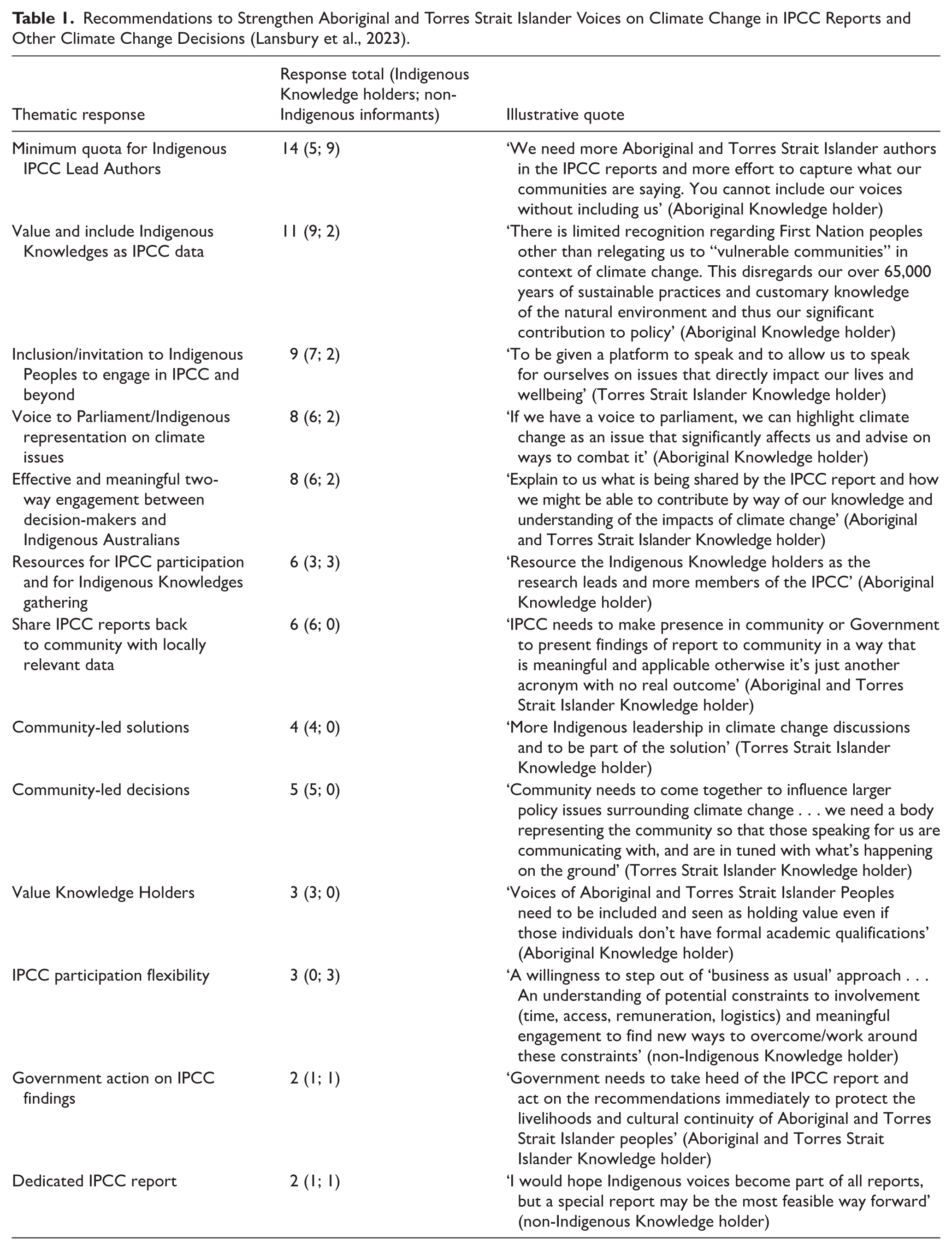
We asked our Knowledge holders what they thought was needed that would enable Aboriginal and Torres Strait Islanders to have a strong voice in the IPCC and other climate change processes. This open-ended question resulted in a diversity of responses, displayed in Table 1 in order from most frequent and with an illustrative quote for each. The three priorities were for a minimum quota for Indigenous IPCC Lead Authors, to value and include IK as IPCC data, and for inclusion/invitation to Indigenous peoples to engage in IPCC and other climate change discussions (Lansbury et al., 2023). The calls for IPCC Lead Author nominations in March 2025 reflected the latter two priorities (DCCEEW, 2025; IPCC, 2025).
Recommendations to Strengthen Aboriginal and Torres Strait Islander Voices on Climate Change in IPCC Reports and Other Climate Change Decisions (Lansbury et al., 2023).
Going Forward
Changing the concept of, and respect for, diversity in research data can be a slow process and requires many influences to achieve change. For many years, there have been calls for the IPCC to broaden its author diversity and sources of climate data from both LAs within the IPCC (Lansbury et al., 2023; Moggridge et al., 2022) and from external critics (Carmona et al., 2023; Ford et al., 2016; UN ESC, 2023). Our engagement with the Australian Government, which then took its national-level advice to the international IPCC fora (DCCEEW, 2025; IPCC, 2025), has been one influence on this ‘new look’ AR7 that considers IK and will likely appoint Indigenous scholars as Lead Authors.
The IPCC’s new positioning is timely, as IPCC reports provide scientific information and guidance to the United Nations Framework Convention on Climate Change (UNFCCC) Conference of the Parties (COPs). Ahead of the COP30 held in November 2025, in Belem, Brazil, Indigenous leaders called for the talks to ‘focus on the Indigenous voices and wisdom, not as token gestures but as equal partners in shaping the future’ (Minniecon & Latukefu, 2025). COP30 had a strong and visible presence of Indigenous peoples in attendance, with their platform supported by Brazil’s Minister for Indigenous Peoples, Sonia Guajajara, herself an Indigenous woman. Minister Guajajara stated in April that COP30 will aim to ‘show the role of Indigenous territories as the main part of the fight against the climate crisis’ (COP30, 2025).
To ensure Indigenous voices are integral to climate change discussions, we have cited priorities articulated by Indigenous knowledge holders; these include recommendations to value and include IK as core IPCC data, actively invite Indigenous peoples to engage in IPCC processes, and establish a minimum quota for Indigenous IPCC Lead Authors. As diversity in statistics alone does not equate to genuine inclusion (Maharaj et al., 2026), once Indigenous authors are involved within the IPCC, sufficient support will be essential to avoid the ‘minority tax’ (Sherpa et al., 2026), including the burnout from isolation, tokenism, and the burden of representing and educating non-Indigenous colleagues. These steps will not only enhance the inclusivity and diversity of climate science but also provide richer, more comprehensive insights for global climate policy. By embracing these recommendations, the IPCC can lead the way in integrating diverse knowledge systems, ultimately fostering a more equitable and effective response to the climate crisis.
Footnotes
Acknowledgements
The authors wish to thank the goodwill, generosity, and honesty of all Knowledge holders who participated in this research. We understand that Traditional Knowledge holders, Indigenous scholars, and non-Indigenous climate change allies have significant requests of their time, knowledge, and wisdom – particularly those who are Aboriginal and Torres Strait Islander Peoples, and this involves an associated cultural load. The author team is committed to maintaining our focus on achieving greater visibility and helping to ensure there is appropriate focus on the value of IK and voices in climate change research and decisions, including through the IPCC processes.
Authors’ Note

Ethical Considerations
This research, including the survey and yarning circle processes used to gather data, has been approved as part of the University of Queensland Project titled: Living On Country: Aboriginal and Torres Strait Islander Peoples Navigating Their Health In A Global Warming-Affected Future (Project Number: 2022/HE002188).
Consent to Participate
Consent from participants was provided verbally.
Author Contributions
B.M., G.P., V.M., S.C., and N.L. contributed to conceptualisation. G.P., V.M., and N.L. contributed to methodology. V.M., S.C., L.I., and G.E. contributed to investigation. B.M., G.P., V.M., S.C., and N.L. contributed to funding acquisition. G.E. and N.L. contributed to project administration. B.M., V.M., S.C., G.E., and N.L. contributed to supervision. B.M. and N.L. contributed to writing – original draft. B.M., G.P., V.M., S.C., L.I., G.E., and N.L. contributed to writing – review & editing.
Funding
The authors disclosed receipt of the following financial support for the research, authorship and publication of this article: financial support from the Australian Government (Department of Climate Change, Energy, the Environment and Water) for commissioned advice (CEW000686).
Declaration of Conflicting Interests
The authors declared the following potential conflicts of interest with respect to the research, authorship, and publication of this article: B.M. is a member of the Wentworth Group of Concerned Scientists and a Governor of WWF Australia; N.L. and G.P. were Lead Authors; B.M., V.M., and S.C. were Contributing Authors to the Intergovernmental Panel on Climate Change Assessment Report 6 (Working Group II, Chapter 11: Australasia); and N.L. is a Coordinating Lead Author and BM and GP are Lead Authors to the Intergovernmental Panel on Climate Change Assessment Report 7.
Data Availability Statement
The primary data gathered for this research were based on a predominantly qualitative survey. The raw data are not provided due to confidentiality of the participants’ identity, as per the ethical permissions.
Diversity,Equity,Ethics,and Inclusion
Our seven-author team includes three Aboriginal authors (B.M., S.C., and L.I.) and one Torres Strait Islander author (V.M.). The lead author is a Kamilaroi Aboriginal scholar (B.M.). This majority-Indigenous author team led the project in terms of contractual terms, cultural guidance, and engagement with Indigenous Knowledge holders during data gathering. Five of the seven authors are women.
Writing Assistance
No writing assistance nor third-party submissions were received. No AI was used.