







Abstract
Cyanine dyes possessing carboxylic acid groups have been used in many different fields of study. The acid groups can act as handles for bioconjugation or as metal chelators. Several pentamethine cyanine dyes with propionic acid handles were synthesized and their optical properties were studied to determine their usefulness as fluorescent probes. The optical properties studies performed include the absorbance and emission maxima values as well as the calculation of quantum yield and molecular brightness levels. Molecular models were also calculated to help analyze the dyes’ behavior and were compared with similar dyes with varying alkyl chain lengths replacing the acid moieties.
Introduction
Since the discovery of a blue carbocyanine compound in 1856, 1 the cyanine class has been studied extensively for various applications, such as in vivo imaging,2–6 ex vivo imaging (pH sensing and DNA stains),7,8 blood spatter analysis, 9 and solar energy conversion.10,11 The interest in the use of these dyes for the treatment and imaging of cancer and other diseases has increased in the past few decades. Dyes, and in particular polymethine cyanine dyes, can be relied on during tumor detection of many cancers with techniques such as magnetic resonance imaging (MRI) and positron emission tomography (PET), as well as intraoperatively in real time. 12 Increasingly, there is an interest in using near-infrared (NIR) dyes for imaging carcinomas due to the many distinctive properties of the cyanine dye family. A cyanine dye molecule consists of 2 nitrogen-containing heterocycles connected by an elongated, unsaturated carbon chain. The carbon chain contributes to the overall shape of the molecule being linear. 13 The length of this chain determines the wavelength at which the dyes absorb and fluoresce light. If the length of the polymethine bridge is extended by 1 double bond, the absorbance and fluorescence maxima red shift by about 100 nm. 5 This places the wavelengths of the dyes in what is called the NIR window. The NIR window lies between about 650 and 900 nm, and it is an important criterion to design dyes within this wavelength range for in vivo imaging. Body tissue will autofluoresce light at wavelengths lower than 650 nm, whereas water absorbs light above 1000 nm; the region between these 2 extremes is very valuable for tissue imaging. The cyanine dye class is also highly modifiable, with examples of substitution on every position existing in the literature. 2 Another beneficial property of cyanine dyes is their relatively narrow excitation band from S0 to S1. 14
Cyanine dyes featuring alkyl carboxylic acids have been previously explored extensively for both dye-sensitized solar cells and conjugation of other groups onto the dye.15–19 Researchers have taken advantage of several key properties of the acid group(s) incorporated onto the chromophore: (1) the water-soluble nature of the acid groups, as this allows for the exploration of larger, bulkier groups elsewhere on the dye and for aqueous in vivo studies 20 ; (2) the pH sensitivity of the acid groups 21 ; (3) the metal-binding ability of the acid groups, which is utilized in dye-sensitized solar cells to anchor the dye onto a metal surface 22 ; and (4) the ability of the acid groups to be functionalized as a link to other targeting ligands. 23 Even though dyes containing alkyl acids exist and have been used for varying applications, there is an extreme lack of published material available when it comes to the optical efficiency of these dyes. The current literature has not yet answered whether the carboxylic acid groups affect the shape of the dye or the overall optical properties of the dyes if they are outside the conjugated system. Furthermore, lead chromophores that utilize the COOH handle for further ligand conjugation have been completely ignored when studying their optical properties. Herein, a set of 6 cyanine probes was synthesized and their optical efficiency was studied. To achieve this task, the absorbance and fluorescence spectra were obtained. From these data sets, the molar absorptivity (ε), quantum yield values (ϕ), and molecular brightness values are derived. These values are crucial for the implementation of the dyes as they show the overall efficiency and usefulness of the lead probes. The molecular brightness is, in this case, the product of the 2. By setting a lower-end acceptable threshold for these 3 optical properties, potential compound candidates for in vivo studies can be effectively filtered from unacceptable molecules. Molecular brightness, as the product of molar absorptivity and quantum yield, allows quick comparison of the relative fluorescence of 2 or more dyes. After the analysis of the probes, a decision to utilize the probes in vivo or other applications can be made based on the outcomes of these experiments. The goal when designing fluorescent dyes is to achieve high molar absorptivity as well as a high quantum yield. However, the acceptable window of quantum yield values is quite large and can tolerate small values if the molar absorptivity is large enough. One factor that affects the optical properties of the dyes is functional groups. Synthesizing dyes that have electron-withdrawing or electron-donating effects on the conjugated system can lead to the overall stabilization of the molecule. 13 This study utilizes propionic acid groups stemming from the nitrogen on the indolenine end units of the pentamethine cyanine dyes to collect their optical property data that could influence further research on NIR applications. Although the carboxylic acid groups are not directly involved in the excitation-relaxation process of the fluorescent dye, their presence may have an effect on the optical efficiency of the dye. To analyze this further, Spartan ‘14 molecular modeling was used to determine the role of the carboxylic acid group in the dye geometry.
Experimental
Instrumentation
Absorbance spectra were measured using a Cary 50 spectrophotometer (Varian, Palo Alto, CA, USA) interfaced to a PC, with a spectral bandwidth of 2 nm. Fluorescence spectra for the pentamethine cyanine dyes were obtained using a Shimadzu RF-1501 Spectrofluorophotometer (Shimadzu Scientific Instruments, Columbia, MD, USA) interfaced to a PC, with the spectral bandwidths for both excitation and emission set to 10 nm and the sensitivity set to high.
Stock solutions
Stock solutions of the dyes were prepared by weighing the solid on a 5-digit analytical balance directly into a brown glass vial and adding dimethyl sulfoxide (DMSO) (99.9% for spectroscopy; Acros Organics, Bridgewater, NJ, USA) via a class A volumetric pipette (Kimble/Kontes, Vineland, NJ, USA). The contents of the vial were vortexed for 20 seconds and then sonicated for 5 minutes to ensure complete dissolution. The stock solutions were protected from light and stored in the freezer when not in use.
Method for determining molar absorptivity
Stock solutions were used to prepare serial dilutions in ethanol or phosphate-buffered saline (PBS) ranging from 0.8 to 16 µM. Samples were prepared in 5.00 (±0.02) and 10.00 (±0.02) mL volumetric flasks using a 5- to 50-µL Micropipette 821 and a 200- to 1000-µL Pipetman (P1000) micropipette (Gilson, Inc., Middleton, WI, USA). The absorbance spectrum of each sample was measured using the Cary 50 spectrophotometer (Varian, Palo Alto, CA, USA), and the absorbance at the wavelength of maximum absorbance (λmax AB) was determined. The absorbance values (A) of each sample at λmax AB were plotted as a function of dye concentration (C), and the linear regression equation using Microsoft Excel was computed.
Computational methods
The structure of each compound was first optimized using the Hartree-Fock Density Functional Theory (HF-DFT) method with the hybrid exchange-correlation functional B3LYP/6-31G* basis set using Spartan ‘14 (Irvine, CA, USA). The torsional angles from the quaternary nitrogen to the α-carbon on the alternate heterocycle were restricted to obtain the calculated absorbance values and highest occupied molecular orbital (HOMO) and lowest unoccupied molecular orbital (LUMO). The electrostatic potential maps and the calculated HOMO and LUMO orbitals were obtained using a restricted hybrid HF-DFT self-consistent field in vacuum performed with B3LYP/6-31G* basis set.
Method for determining quantum yield
Standards were chosen with wavelengths of maximum emission within 10 nm of those of the unknowns to prevent errors resulting from wavelength-dependent variation in fluorimeter response. Samples of the dyes and their respective standards were prepared from stock solutions such that their absorbance at λmax AB was less than 0.1 (to prevent the inner filter effect in fluorescence measurements). The absorbance and fluorescence spectra of each sample were obtained concurrently to minimize experimental error from photobleaching and potential solubility issues, and for all scans, the standard was run both prior to and following the unknowns (to ensure no change in instrumental response over the course of the runs). For the pentamethine dyes, duplicate absorbance scans were obtained and the absorbance values at both λmax AB and λex were averaged. The emission spectra of the pentamethine dyes were measured in triplicate using the RF-1501 fluorimeter with the excitation wavelength set to 620 nm. The area under each fluorescence curve was calculated and corrected for the Rayleigh peak area (if necessary). The average fluorescence peak areas were then calculated for each sample.
General
All chemicals and solvents were of American Chemical Society grade or HPLC (high-performance liquid chromatography) purity and were used as received. All chemicals were purchased from Fisher Scientific (Pittsburgh, PA, USA), Sigma-Aldrich (Saint Louis, MO) and Acros Organics. Melting points (mp, open Pyrex capillary) were measured on a Thomas Hoover apparatus. 1H and 13C nuclear magnetic resonance (NMR) spectra were recorded on Bruker Avance (400 MHz) spectrometer.
Synthesis
The aim of this study was to evaluate the optical properties of 6 carboxylated cyanine dyes. A brief synthesis is provided; however, a much more comprehensive set of compounds that include the current 6 compounds with complete characterizations will be published elsewhere. As outlined in Scheme 1, all dyes underwent the same synthetic route which began with the corresponding phenyl hydrazine salts being refluxed in the presence of 3-methyl-2-butanone under acidic conditions to give indolenines

The synthetic route used to obtain compounds
Results and Discussion
Optical properties and molecular modeling
The optical properties of compounds
The optical property data collected from compounds

Abbreviations: EtOH, ethanol; PBS, phosphate-buffered saline.

The absorbance spectra and r2 spectra and value for each dilution of compound
A high Stokes shift value can allow for a clear distinction between excitation light and fluoresced light. A Stokes shift value of about 10 to 12 nm is considered adequate for in vivo applications. In ethanol, the studied dyes approached a 20-nm Stokes shift, leading to a clear distinction in the absorbed light and the emitted energy. Although the values in buffer are lower than in organic solvent, they still remain above the standard for fluorescent in vivo probes. The quantum yield values show a few unique trends. Compounds
Another unique observation from the molecular modeling is the conformation of each atom on the pentamethine bridge. Usually, as is the case with pentamethine cyanine dyes not featuring acid groups stemming from the indole nitrogens, the gamma hydrogen points down, away from the dimethyl groups, the beta hydrogens point up, and the alpha protons point down. However, after minimization using a Hartree-Fock force field, the hydrogens at each position on the bridge can be seen to be pointing in the opposite direction from what is expected. This phenomenon may be another consequence of the COOH groups dimerizing; because the propionic acid groups dimerize “under” the bridge, there is less room “under” the molecule. This is especially apparent when looking at the minimized calculation of compound

The highest occupied molecular orbital (HOMO)/lowest unoccupied molecular orbital (LUMO) electron cloud distribution for compound
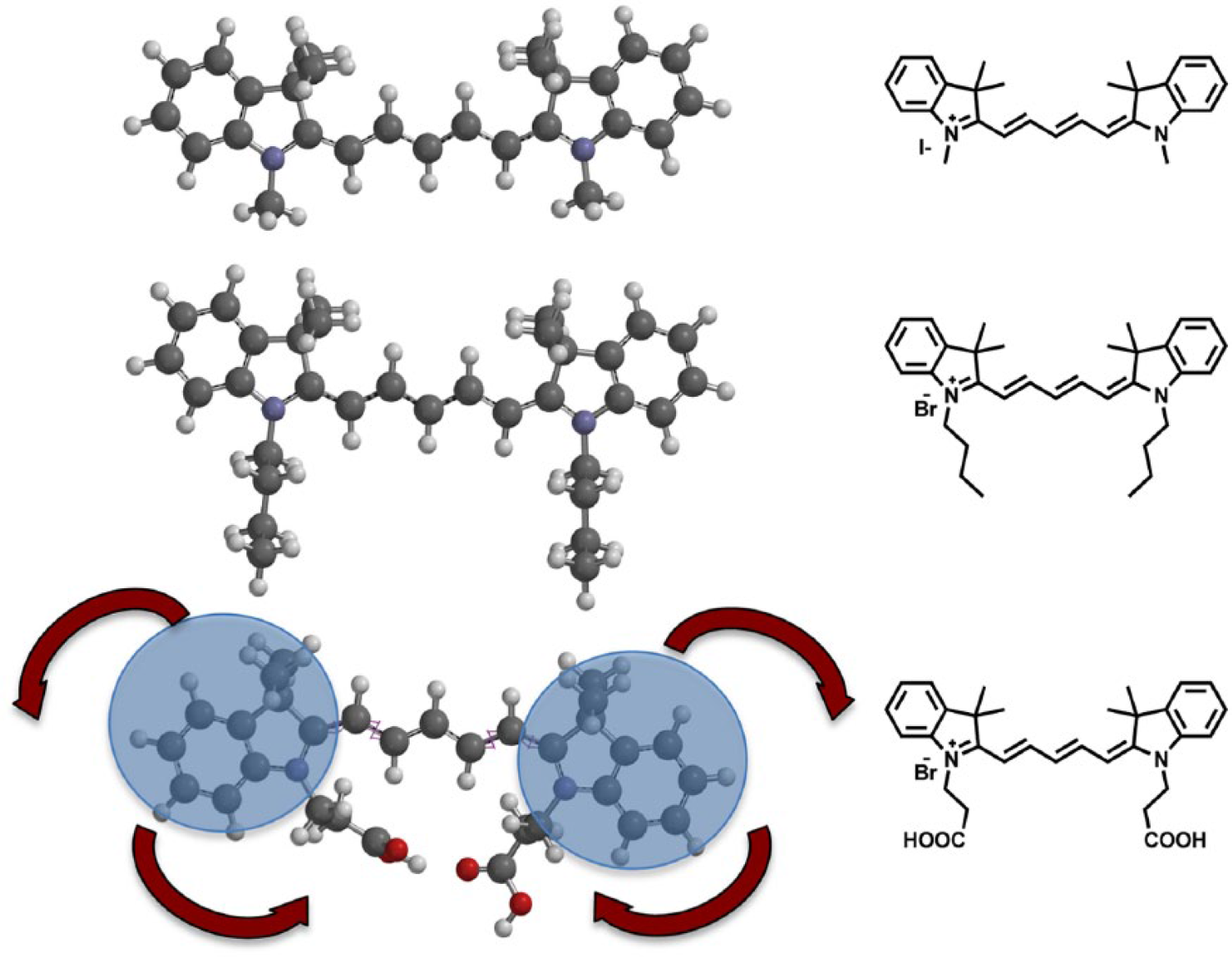
The minimized structures of compounds with varying N-groups: methyl (top), butyl (middle), and propionic acid (bottom) to visualize the puckering displayed by the acid compounds.

A minimized calculated structure comparison of 2 pentamethine cyanine dyes that show the difference in the alpha, beta, and gamma substituents on the polymethine bridge.
Conclusions
The optical properties of cyanine dyes featuring carboxylic acids remain unstudied and unpublished. In this study, 6 cyanine compounds,
Footnotes
Peer review:
Six peer reviewers contributed to the peer review report. Reviewers’ reports totaled 1339 words, excluding any confidential comments to the academic editor.
Funding:
The author(s) disclosed receipt of the following financial support for the research, authorship, and/or publication of this article: MH wishes to thank the Brains and Behavior Grant, the Health Innovation Grant and the Georgia Research Alliance Grant Ventures Phase 1 Grant for their financial support.
Declaration of conflicting interests:
The author(s) declared no potential conflicts of interest with respect to the research, authorship, and/or publication of this article.
Author Contributions
MH conceived and designed the experiments. MH, TLD, and MTG analyzed the data. MH agrees with manuscript results and conclusions. TLD and MH wrote the manuscript, jointly developed the structure and arguments for the paper, and made critical revisions and approved the final version. All authors reviewed and approved the final manuscript.
Disclosures and Ethics
As a requirement of publication author(s) have provided to the publisher signed confirmation of compliance with legal and ethical obligations including, but not limited to, the following: authorship and contributorship, conflicts of interest, privacy and confidentiality and (where applicable) protection of human and animal research subjects. The authors have read and confirmed their agreement with the ICMJE authorship and conflict of interest criteria. The authors have also confirmed that this article is unique and not under consideration or published in any other publication, and that they have permission from rights holders to reproduce any copyrighted material. Any disclosures are made in this section. The external blind peer reviewers report no conflicts of interest.