







Abstract
Enterococcus species are part of normal microbiota but can cause severe infections, especially among hospital-adapted strains. In Ghana, data on their dynamics, including prevalence and resistance patterns, remain limited. This systematic review and meta-analysis is the first to assess the current scope and identify gaps in One-Health research on Enterococcus. We searched PubMed/MEDLINE, Scopus, and Web of Science following PRISMA 2020 guidelines for studies published up to October 24, 2024 (search conducted October 12–24, 2024). A random-effects model with restricted maximum likelihood was used to pool prevalence and antimicrobial resistance. Sixty-nine studies met the inclusion criteria with nineteen eligible for meta-analysis. The pooled prevalence of Enterococcus was 6.76% (CI: 1.19–16.39, I2 = 99.3%, p < 0.0001) while adjusted vancomycin-resistance isolates was 0.06% (CI: 0.00–27.86; I2 = 99.4%, p < 0.0001). Antibiotic resistance rates were comparable across human and animal studies, often higher in animals. Ciprofloxacin showed the lowest resistance (1.30%), while cloxacillin had the highest (17.46%). This review underscores the one-sided focus on humans, limiting understanding of transmission within the One-Health spectrum. We advocate integrating genomic approaches, particularly environmental genomics, into One-Health frameworks to resolve transmission pathways, inform policy, and strengthen antimicrobial resistance control in Ghana.
Plain Language Summary
Enterococcus bacteria usually live harmlessly in humans and animals but can cause serious infections and drug resistance. We reviewed studies from Ghana and found limited, human-focused data. Our results show similar resistance across humans and animals, highlighting the need for environmental and genomic approaches within One Health surveillance.
1. Background
Enterococcus species are ubiquitous bacteria that serve as commensals in the gut of humans and animals and are capable of causing severe infections.1-3 These infections include endocarditis, bacteremia, urinary tract infections and wound complications.4-6 Among the genus, Enterococcus faecalis (E. faecalis) and Enterococcus faecium (E. faecium) are more clinically relevant. 7 Due to the surge in antimicrobial resistance (AMR), Enterococcus is increasingly becoming a global public health threat, with vancomycin-resistant Enterococcus (VRE) now designated as a high-priority pathogen by the World Health Organization (WHO).8,9
Aside humans, animals and the environment also serve as important sources for the spread and evolution of Enterococcus species. Fecal contaminated water from humans and animals may enter the food chain, providing a route for the transmission of antimicrobial resistance genes10-13 Findings in two studies have established the potential of transmission of resistance strains, including multi-drug resistant strains resistant to daptomycin, a last-resort antibiotic for treating multi-drug resistant Enterococcus12,13 clearly highlighting the role of the environment as a potent contributor to the spread of multi-drug resistant Enterococcus species.
The pathogenicity of Enterococcus is driven by its resilience and adaptability, exhibited in its ability to acquire and lose mobile genetic elements to quickly adapt to new environments. 14 The bacteria can persist in harsh environments, form biofilms, and acquire resistance genes through mobile genetic elements such as plasmids and transposons, making it thrive in clinical settings.14-16 This ecological plasticity makes Enterococcus a key vector in the dissemination of AMR within the One-Health framework, which recognizes the interconnected health of humans, animals, and the environment. 17
In sub-Saharan Africa, including Ghana, the AMR crisis is compounded by systemic issues such as limited healthcare resources, antibiotic misuse, and inadequate sanitation.18-20 Despite these challenges and the need to combat AMR, research on Enterococcus in Ghana remains limited, particularly studies that utilize cutting-edge tools such as sequencing to investigate its prevalence, resistance mechanisms, circulating clones and reservoirs across clinical, animal and environmental domains. This knowledge gap hampers the development of targeted interventions and policies to mitigate the spread of resistant strains, as limited data restricts effective scientific communication that necessitates policymaking.21,22 Furthermore, the global focus on pathogens with higher mortality burdens, such as Mycobacterium tuberculosis and Streptococcus pneumoniae, has often relegated Enterococcus to a lower priority in many national agendas. 7
This systematic review and meta-analysis, conducted according to the Preferred Reporting Items for Systematic reviews and Meta-Analyses (PRISMA) 2020 guidelines, addresses this critical knowledge gap by synthesizing evidence on Enterococcus in Ghana. 23 The study evaluates the pathogen’s prevalence, antimicrobial resistance patterns, reservoirs, including clinical, environmental (with a focus on water and food sources), and animal settings, as well as findings from experimental and drug discovery studies. It further explores the distribution of Enterococcus species, their resistance profiles, diversity, and concentrations in water systems, while evaluating the experimental methodologies applied in Ghana-based research.
Despite Enterococcus being listed among the 12 deadly bacterial pathogens and linked to 100,000 –250,000 deaths annually, 7 its study remains underdeveloped. Focused investigations are urgently needed to generate data on its epidemiology, resistance trends, circulating strains, and environmental reservoirs. Such evidence is vital to inform integrated surveillance systems that are critical to understanding transmission events, which can guide national AMR strategies and support global efforts in combating the threat of drug-resistant pathogens.
2. Methods
This systematic review and meta-analysis conformed with the guidelines of the Preferred Reporting Items for Systematic Reviews and Meta-analyses (PRISMA) 2020 (Table SM1, Supplemental Sheet 1) (23). The protocol was registered on the Open Science Framework (OSF) on March 4, 2025 (DOI: 10.17605/OSF.IO/8M2JW).
2.1. Eligibility Criteria
2.1.1. Inclusion Criteria
Studies were included if they provided original data on Enterococcus in Ghana and/or included a Ghanaian author from clinical, environmental, animal, or experimental settings. Eligible study designs comprised observational studies (cross-sectional, cohort, case-control), case reports, and laboratory-based (in vitro) experimental investigations. Studies were included if they met one or more of the following domains: 1. Prevalence Data: Studies reporting the prevalence of Enterococcus from human, animal, or environmental sources. 2. Antibiotic resistance: Studies assessing antimicrobial resistance patterns of Enterococcus from human, animal, or environmental sources. 3. Environmental concentration: Studies quantifying the concentration of Enterococcus in water sources to understand their distribution in the environment and their niches. 4. Experimental interventions: Experimental studies evaluating the efficacy of crude plant extracts or adjunctive agents in combating Enterococcus resistant strains.
2.1.2. Exclusion Criteria
Studies were excluded if they were: not conducted in Ghana or did not involve Ghanaian authors, if they were non–peer-reviewed reports, unclear methodology, duplicated data, or insufficient event reporting. For synthesis, studies were grouped by setting (human, environmental, animal or experimental). Studies that included Ghanaian data but inseparable from other countries were also excluded from the study.
2.2. Information Sources and Search Strategy
Between October 12 and October 24, 2024, a comprehensive search was conducted by one of the authors in PubMed/Medline, Scopus, and Web of Science to identify original articles in peer-reviewed journals. The search covered the period from the databases inception to October 24, 2024 utilizing the search terms, “Enterococcus” and “Ghana”, incorporating articles published in English. Using the advanced search and the default settings, searches were done on PubMed, Scopus and Web of Science (Table SM2; Supplemental Sheet 2). The EBSCOhost platform with its advanced and default settings, was also used to search the Medline database hosted on the platform.
2.3. Selection Process
All citations identified were exported as comma-separated values (CSV) files and efforts were made to additionally screen the reference list to add relevant references. These were then merged into a master list. Using Python v.3.12.2 and Pandas v.2.2.2, duplicates were removed based on titles and later digital object identifier of the studies. Prior to the final search, a pilot study was conducted to refine research questions and develop a standardized Excel-based data extraction form. This pilot phase enabled the authors to address disagreements and establish clear definitions for key metrics, for instance, defining sample size as the total number of participants sampled rather than the number ultimately included at the start of the study. The study selection was conducted in two phases by reviewers: firstly, title/abstract screening to remove those not related to Enterococcus or Ghana, followed by full-text review. Following the title or abstract screening, data from the full-text review were extracted independently by two reviewers using a standardized extraction form. The data collected included study characteristics, primary outcomes (e.g., prevalence, resistance profiles or environmental concentrations), and other relevant variables such as sample size, setting, and methodology. Disagreements were resolved through discussion with a third reviewer.
2.4. Data Collection Process
For each study, data were collected on primary outcomes and other variables. Primary outcomes included the prevalence of Enterococcus, antimicrobial resistance patterns, species and/or concentrations in water sources. Secondary variables included a range of study characteristics and methodological details such as study design, setting (clinical, environmental, animal, experimental), assays used, time points, item sampled, sample population, region and sampling location, year of publication, identification and isolation method, sample size, number of Enterococcus isolated, media used for the culture, date of sampling, resistance genes detected, and species of Enterococcus isolated. Predefined assumptions guided the handling of missing data where studies without any of the primary outcomes were excluded while those with incomplete secondary variables or incomplete information were flagged during quality assessment.
2.5. Risk of Bias Assessment
Having carried out a two-stage screening for the study selection, all the studies that passed our eligibility criteria were then assessed using the Joanna Briggs Institute (JBI) tool. Two independent reviewers assessed the risk of bias and disagreements were resolved with a third reviewer. The risk of bias ratings did not influence a study’s inclusion or omission, sensitivity analyses or weighting in the meta-analysis. The Joanna Briggs Institute (JBI) critical appraisal checklist was used for the various study designs encompassing analytical cross-sectional studies, prevalence studies, cohort and case-control studies and case reports24,25 (Table SM3-7, Supplemental Sheet 2). For experimental studies, an in-house developed checklist was used to capture indicators (Table SM7; Supplemental Sheet 2). Studies with a score between 80 – 100%, 50 – 79% and < 50% were classified as low (high quality), moderate or high (poor quality) risk respectively.
2.6. Effect Measures
For each outcome, effect measures were defined as follows. For prevalence outcomes, pooled prevalence estimates with 95% confidence intervals were calculated based on the proportion of samples testing positive for Enterococcus relative to the total sample size. For resistance profiles, pooled resistance with 95% confidence intervals were calculated based on the proportion of samples resistant to an antibiotic or calculated using the resistance percentages provided relative to the total sample size. For resistance proportions used for meta-analysis, pooled estimates were calculated from studies that isolated more than one Enterococcus strain, provided resistance data for at least one isolate, and reported on antibiotics examined in two or more studies. For environmental concentration outcomes, mean values (with standard deviations or ranges) were used, with appropriate conversions performed when necessary.
2.7. Synthesis Methods
Meta-analysis was conducted using the meta package (v 8.0-2) in R (v4.4.3). A random-effects model was used throughout, based on the inverse variance method. The between-study variance (τ2) was estimated via restricted maximum likelihood (REML) method. The Hartung-Knapp adjustment was applied to improve the reliability of confidence intervals given the high heterogeneity. The event rates were transformed using the arcsine square root transformation to stabilize variance across studies. Pooled event rates were expressed as events per 100 observations, along with 95% confidence intervals (CIs). Additionally, prediction intervals were calculated using a t-distribution to provide an estimate of the expected range of effects in a future similar study. Heterogeneity among studies was evaluated using Cochran’s Q test, the I2 statistic, and the H statistic. Subgroup analyses (themes with 10 or more studies) and meta-regression (themes with 10 or more studies) were performed to explore potential sources of heterogeneity, and sensitivity analyses were conducted to assess the robustness of the synthesized results. Results were visually displayed using forest plots and tabulated using summary tables.
2.8. Reporting Bias Assessment
Reporting bias was assessed by visually inspecting forest and funnel plots, performing sensitivity or influential analysis, performing statistical tests for funnel plot asymmetry using Egger’s regression test (themes with 10 or more studies) to assess publication bias and applying the trim and fill method (themes with 3 or more studies) to explore the potential impact of publication bias. These methods allowed for the evaluation of potential missing results due to reporting biases, which were considered in the interpretation of the overall findings.
2.9. Certainty Assessment
The certainty of the evidence for each outcome was evaluated using the Grading of Recommendations, Assessment, Development, and Evaluation (GRADE) approach. This process involved a systematic evaluation of five key domains: risk of bias (assessed using established tools for comprehensive risk assessment), inconsistency (evaluated through data pooling and heterogeneity analysis), indirectness (based on the alignment of study characteristics with the review’s eligibility criteria), imprecision (considering the width of 95% confidence intervals for pooled prevalence estimates), and publication bias (assessed using Egger’s regression test for bias).
3. Results
3.1. Study Selection and Risk of Bias
Characteristics of Studies that Passed Eligibility Criteria
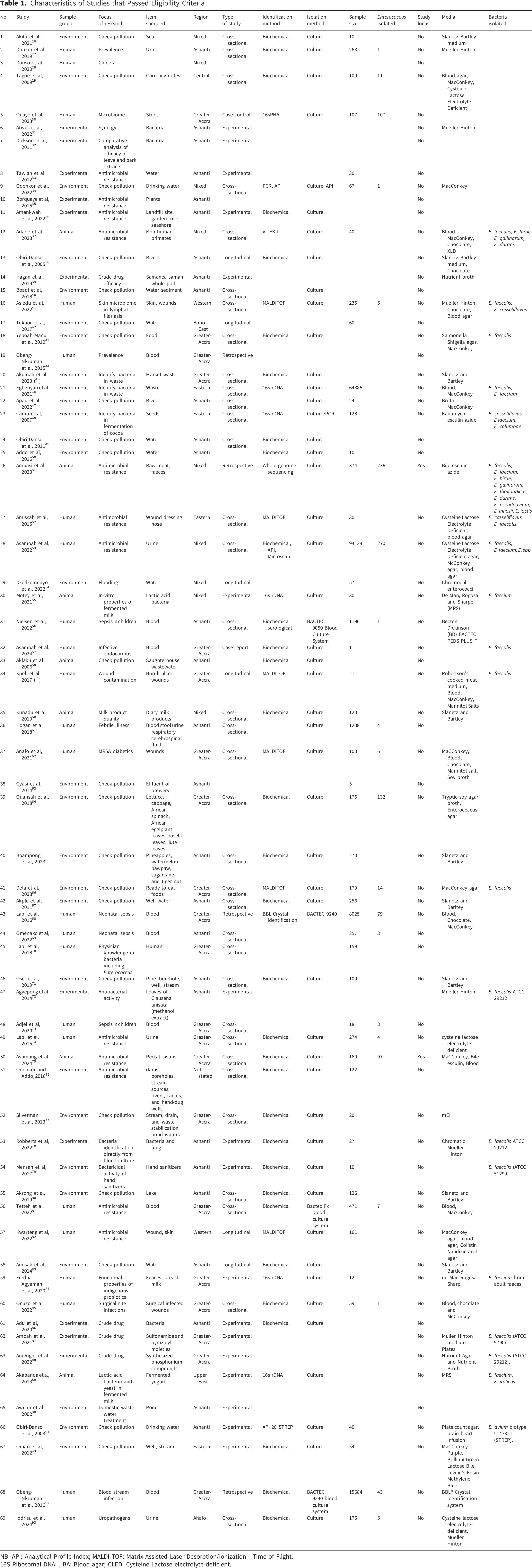
NB: API: Analytical Profile Index; MALDI-TOF: Matrix-Assisted Laser Desorption/Ionization - Time of Flight.
16S Ribosomal DNA: , BA: Blood agar; CLED: Cysteine Lactose electrolyte-deficient.
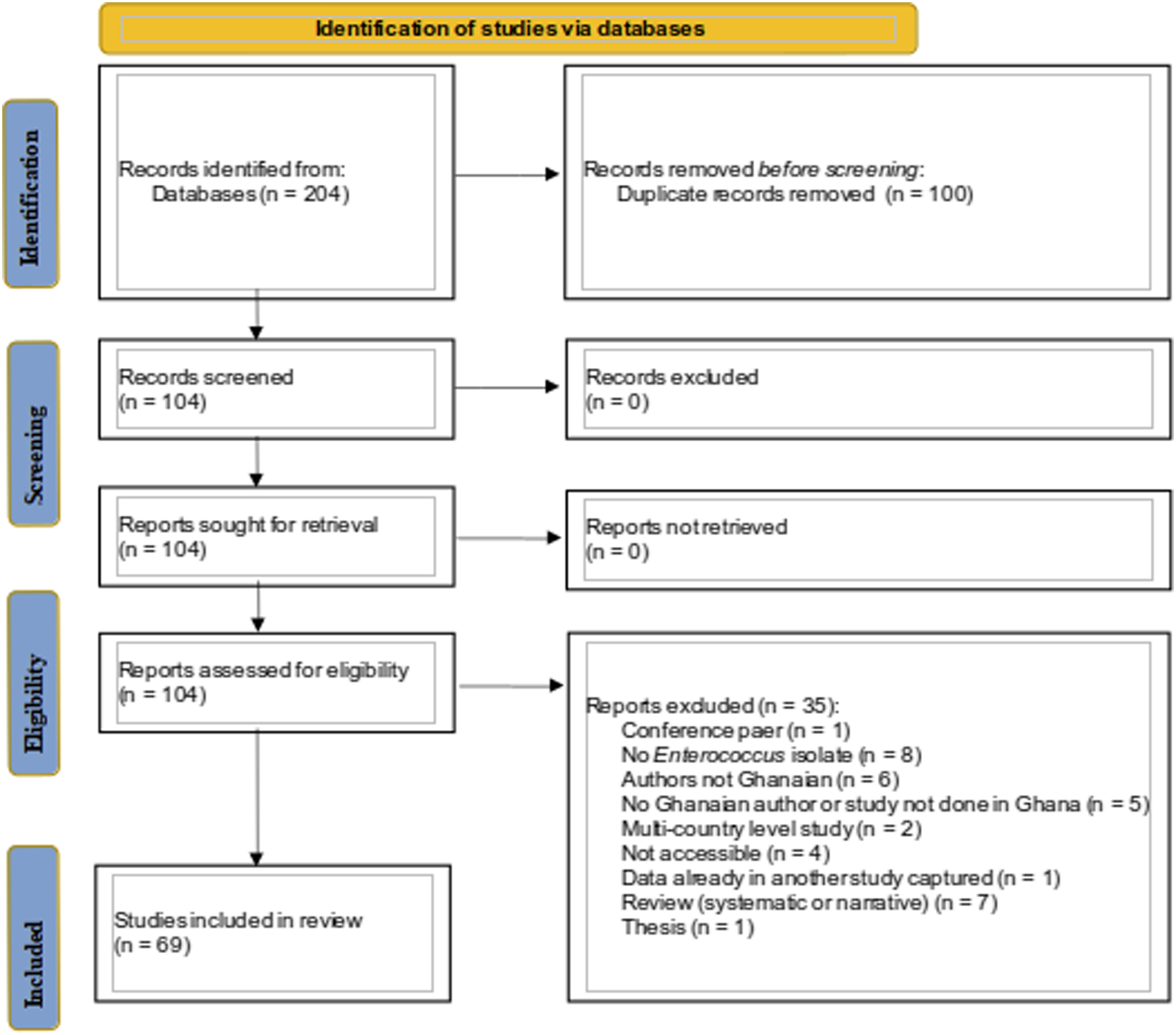
PRISMA flowchart of study identification and selection
3.2. Overall Study Characteristics
These included studies focused on human subjects (n = 23), animals (n = 7), environmental sources (n = 28) and experimental or drug discovery-related investigations (n = 11). In terms of the geographic distribution, studies were conducted in the following regions: Ashanti (n = 28), Greater-Accra (n = 21), Eastern (n = 4), Western (n = 2), Ahafo (n = 1), Central (n = 1), Bono East (n = 1), and Upper East (n = 1). Nine studies (13.04%) were conducted in more than one region while in one study, the location was not stated. Notably, there has been a three-fold increase in the research output involving Enterococcus isolates/strains in the last decade (2014–2024), with 56 studies compared to only 13 studies (18.84%) from the preceding decade (2003-2013). In the last two decades, most of the studies focused on understanding the microbial quality of water (n = 7) while the rest (n = 6) constituted studies on lactic acid bacteria, antibacterial activity of Glyphaea brevis, biological treatment of slaughterhouse waste, bacteriological quality of ready to eat foods and incidence of bacteremia among rural children (Table 1; see Table SM9, Supplemental Sheet 2). In contrast, recent studies (2014-2024) have increasingly focused on AMR themes (n = 30), including physician knowledge, antibacterial screening and prevalence assessments, highlighting a shift in national research priorities toward understanding and combating AMR in Ghana.
3.2.1. Characteristics of Included Human Studies
Among the included human studies (n = 23), diverse population groups were represented. Four studies focused on neonates,56,68,69,81 while another four investigated patients with neglected tropical diseases, lymphatic filariasis and Buruli ulcer.41,52,59,82 Two studies each were conducted among inpatients and outpatients27,53 and diabetes patients,62,93 respectively. The remaining studies covered a variety of populations: outpatients suspected of cholera 28 ; children with gastroenteritis 30 ; cancer patients 44 ; an individual with infective endocarditis 57 ; febrile children aged ≥30 days and ≤15 years co-infected with malaria 61 ; physicians assessed on their knowledge of AMR bacteria 70 ; children with sickle cell disease and acute febrile illness 73 ; pregnant women attending antenatal clinic (assessing bacteriuria) 74 ; women with infected post-caesarean surgical wounds 85 and a general population cohort exploring the functional properties of indigenous probiotics 84 (Table 1; See Table SM10, Supplemental Sheet 2). Regarding study designs, the majority were cross-sectional (n = 14), followed by retrospective (n = 3) and longitudinal studies (n = 2). One study each employed a case-control and a case report design.
In terms of sample type, blood samples were the most analyzed (30.43%, n = 7/23), followed by studies involving multiple sample types or body sites (n = 4), urine (n = 4), and wound swabs (n = 3) (Table 1, see Table SM10, Supplemental Sheet 2). A diverse array of culture media was employed across studies to isolate Enterococcus species and other bacterial organisms. The most frequently used media included Mueller-Hinton agar, blood agar, and MacConkey agar. Chocolate agar was often used in combination with blood agar to enhance recovery of fastidious organisms.
The studies reported the isolation of various Enterococcus species, with E. faecalis being the most frequently identified across multiple datasets (Table SM8, Table SM10, Supplemental Sheet 2). Other species identified included E. casseliflavus and E. faecium. Notably, E. casseliflavus and E. faecium were occasionally isolated alongside E. faecalis, reflecting the co-occurrence of different species in diverse samples. E. faecalis ATCC 29212 was utilized as a reference strain for quality control. Furthermore, E. faecium was explicitly identified from adult fecal samples, supporting its association with human gut microbiota. The consistent identification of E. faecalis across studies underscores its prominence as a key pathogen within the Enterococcus genus.
3.2.2. Characteristics of Included Animal Studies
Seven studies with over 724 samples focused on animal-related topics, examining Enterococcus species isolated from various sources (Table 1; Table SM11, Supplemental Sheet 2). These included archived isolates from cattle, goats, pigs, poultry, sheep and animal products such as brisket, flank/mid-loin of beef, chevon and mutton. 51 Other samples were derived from fermented milk products, 55 slaughterhouse wastewater from treatment plant, 58 oral and rectal samples from non-human primates (Erythrocebus patas, Papio anubis, Chlorocebus sabaeus and Cercopithecus mona), 37 dairy milk product, 60 faecal samples from slaughtered chicken 75 and taxonomic and molecular characterization of lactic acid bacteria and yeast in a fermented milk product (Nunu) 89 (Table SM11, Supplemental Sheet 2). Two of the studies were experimental studies that employed 16s rDNA for typing of Enterococcus species. The remaining studies utilized a combination of cross-sectional (n = 3), retrospective and other experimental designs, relying on biochemical testing (n = 2), VITEK II (n = 1) or whole genome sequencing for identification. While a study 58 identified Enterococcus as part of wastewater samples, E. faecium was found in four studies. Others identified E. italicus in nunu (a fermented milk product) while E. faecalis, E. hirae, E. gallinarum, E. thailandicus, E. durans, E. pseudoavium, E. innesii and E. iactis were identified in samples from animals.37,51,89 In the study assessing wastewater treatment quality, mean Enterococcus count was 3.20×10⁵ per 100 mL, ranging from 1.02 x 10⁴ per 100 mL to 6.3 x 10⁵ per 100 mL.
The only study that performed whole-genome sequencing reported resistance genes (including streptogramins (lsa(A)) and virulence genes associated with biofilm formation and adhesin encoding genes. 51 Out of the 16 distinct plasmid replicons identified, repUS43 was the most common. In terms of sequence types (STs), E. faecalis belonged to STs 32, 1052, 1295, 1297, 16, 81, 1306, 245, 300, 4, 480, and 86 while E. faecium belonged to STs 86, 1442, 2269, 2237, 94, 12, 2268, 1216, 158, 1939, 1980, 32, 361, and 416, whereas Enterococcus lactis was identified as ST94.
3.2.3. Characteristics of Included Environmental Studies
A total of 1,813 samples were collected from various environmental sources including sea water, 26 bank notes, 29 river sediments, 40 brewery effluents, 63 leafy green vegetables, 64 fresh-cut ready-to-eat fruits, 65 swabs from alcohol-sanitized hands, 79 cocoa seeds, 48 ready-to-eat foods sold around University of Ghana 94 and by vendors in Accra, 66 market crop waste, 45 solid medical and household waste 46 and diverse waste and environmental sites34,38,42,43,47,49,50,54,67,71,76,77,80,83,90,91 (Table 1; Table SM12, Supplemental Sheet 2). Most studies (n = 16) sampled water sources, three came from waste, two from ready-to-eat foods and miscellaneous sources like cocoa seeds, sea water, bank notes, river sediments, brewery effluents, leafy green vegetables, fruits and swabs. Species uniquely identified from these studies included Enterococcus columbae and Enterococcus avium biotype 5143321 (STREP), species not previously found in either human or animal studies. E. faecalis (ATCC 51299) served as a control in some experiments (Table 1; Table SM9, Supplemental Sheet 2). Among the 28 studies, 50% (n = 14) reported colony-forming units per 100 mL, expressed as either arithmetic, log, or geometric means (Table SM12, Supplemental Sheet 2). Most studies (n = 20) were cross-sectional, while others were experimental (n = 4) or longitudinal (n = 4). Regionally, 50% (n = 14) were conducted in Ashanti, followed by Greater Accra (n = 5), Eastern (n = 3), multiple regions (n = 3), and a few in Bono East, Central, or with unspecified locations.
3.2.4. Characteristics of Included Experimental Studies
Characteristics of Experimental Studies on Enterococcus

While pyrazolyl-sulfonamides and their palladium complexes showed no activity against Enterococcus strains, other extracts and compounds exhibited minimum inhibitory concentrations (MIC) ranging from 500 ug/mL (Glyphaea brevis) to 20 mg/mL (Clausena anisata (Willd) Hook) (Table 2). Most of the studies (n = 9) were conducted in the Ashanti region, two in Greater-Accra. While one study exclusively used E. faecalis strain in testing the efficacy of extract, others utilized typed strains of E. faecalis (ATCC 51299, 29212 or 9790) (Table 2).
3.3. Risk of Bias in Studies
The risk of bias was assessed using JBI critical appraisal checklists for analytical cross-sectional studies (Table SM2, Supplemental Sheet 2), prevalence studies (Table SM3, Supplemental Sheet 2), cohort studies (Table SM4, Supplemental Sheet 2) and case reports (Table SM5, Supplemental Sheet 2), as well as an in-house checklist for experimental studies (Table SM6, Supplemental Sheet 2). Overall, all studies were assessed to be of low risk of bias, with quality scores ranging from 83.33% to 100% (Tables SM3-7, Supplemental Sheet 2). For analytical cross sectional studies (n = 37), most met key methodological criteria (Table SM2, Supplemental Sheet 2). However, only 2 studies explicitly addressed confounders or described strategies to manage them, as this was deemed not applicable for the majority. Among the experimental studies (n = 11), ethical clearance was required in only one case, with the rest considered exempt due to their study design. Three studies had unclear reporting regarding whether replicates were performed, and two studies did not provide standard errors or confidence intervals, which limits the precision of their reported outcomes.
Assessment of methodological quality identified few recurrent limitations across included studies. Among cross-sectional studies, one study did not adequately describe participant characteristics and study setting, while two studies provided insufficient detail to confidently ascertain whether exposure variables were measured appropriately. In laboratory-based studies, two did not report conducting experimental replicates, and two failed to provide measures of dispersion such as standard deviations. These methodological shortcomings may affect internal validity and comparability across studies although the overall risk of bias was low. In particular, insufficient exposure characterization and lack of replication or variability estimates may introduce measurement imprecision, which could potentially contribute to heterogeneity in pooled estimates.
3.4. Focused and Incidental Enterococcus Isolation in Ghana
Among the studies reviewed, focused investigations on Enterococcus were limited (Table 1). Only 3 out of 30 human and animal studies (10.00%) were specifically designed to isolate Enterococcus species, representing 4.35% (n = 3/69) of all studies included. Of these, one focused on mixed samples from various animals, including cattle, goats, pigs, poultry, and sheep, while the other exclusively examined samples from slaughtered chickens, accounting for 28.57% (n = 2) of the animal studies reviewed.51,75 In contrast, the only human-focused study, a case report, identified E. faecalis as the causative organism in a renal transplant recipient who developed infective endocarditis with metastatic infections, representing 4.35% (n = 1) of the human studies reviewed. 57 In contrast, 27 of the 30 human and animal studies (90.00%) incidentally isolated Enterococcus, often as part of a broader microbiological survey. In these cases, Enterococcus was not the primary target organism, and data on antimicrobial resistance or species-level identification were frequently lacking.
3.5. Prevalence of Enterococcus in Human, Animal and Environmental Studies
3.5.1. Prevalence of Enterococcus in Humans
Out of 23 eligible studies identified, 13 were included in the random-effects meta-analysis because they were based on population samples and tested for Enterococcus species (Table SM13, Supplemental Sheet 2). The pooled prevalence of Enterococcus in human samples was estimated at 0.92% (CI: 0.39-1.65) (Figure 2). High heterogeneity was observed across studies (I2 = 89.5%; τ2 = 0.002; τ = 0.04; H = 3.09; Q = 114.57, p < 0.001). Individual prevalence estimates ranged from 0.08% to 6.0%. Influence analyses demonstrated that no single study excessively skewed the overall results, with pooled prevalence estimates remaining within a similar range (0.81–1.03%) when individual studies were excluded (see Figure SM1, Supplemental Sheet 2). Although the funnel plot showed only slight asymmetry (Figure SM2, Supplemental Sheet 2), Egger’s regression test revealed evidence of asymmetry (t = 2.53, df = 11, p = 0.03). After applying the trim and fill method, six (6) studies were added, resulting in an adjusted pooled prevalence of 0.36% (CI: 0.04–1.02; I2 = 88.8%; H = 2.98; τ2 = 0.006; τ = 0.07; Q = 160.27, df = 18, p-value > 0.0001) (Figures SM3- SM4, Supplemental Sheet 2). Pooled prevalence of Enterococcus species in humans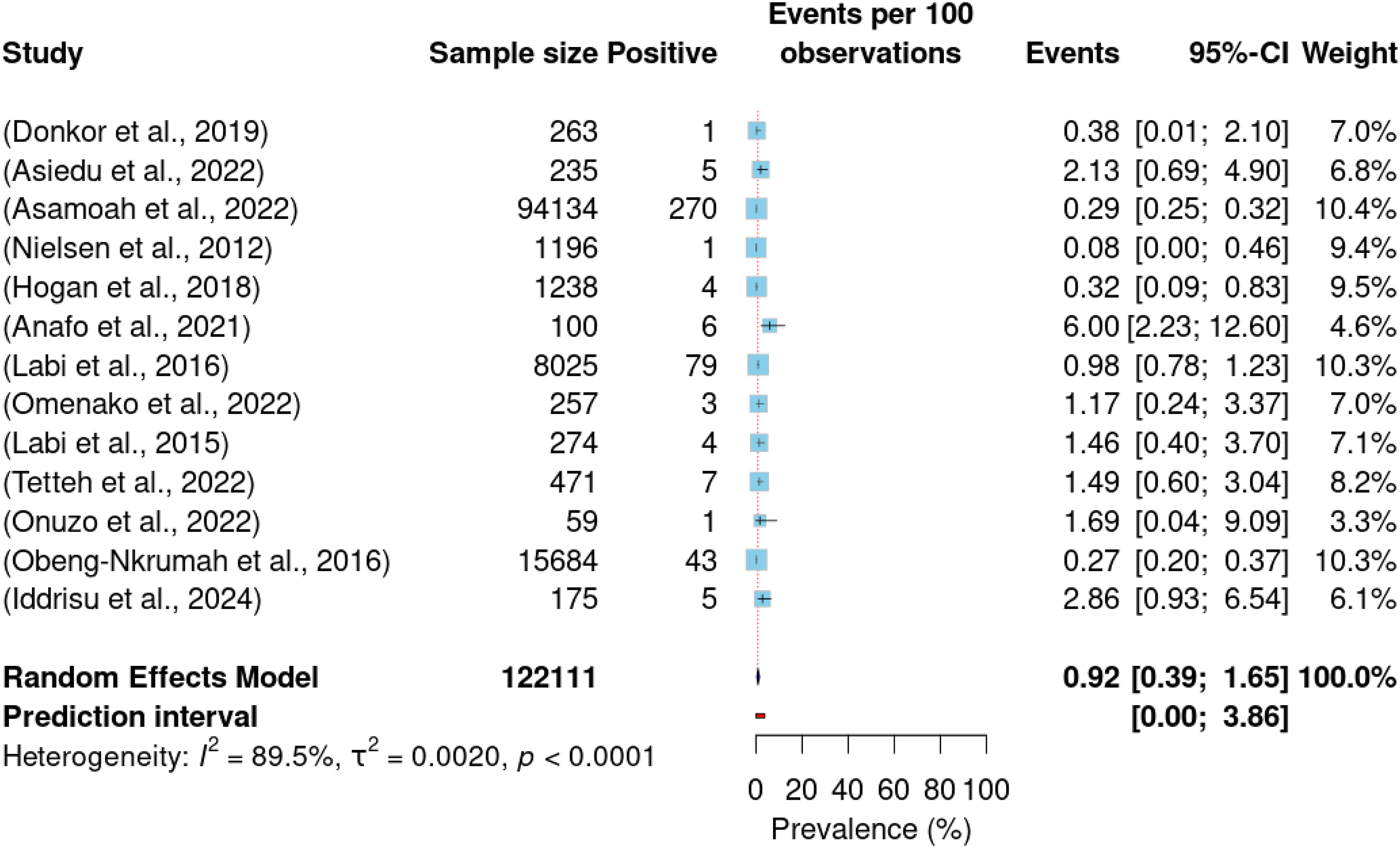
Due to high heterogeneity, subgroup analyses were conducted based on sample type (urine, mixed samples, blood, and wound), sample population, and the geographical region. Among the different sample types, blood samples exhibited the lowest pooled prevalence of Enterococcus species at 0.61% (CI: 0.09–1.61) with an adjusted pooled prevalence of 0.41% (CI: 0.05–1.09) (Figures SM5-SM6, Supplemental Sheet 2).
In contrast, wound samples recorded the highest pooled prevalence at 3.81% (CI: 0.00–64.56). Prevalence estimates from urine, blood, and mixed sources were statistically significant (p-value < 0.01), with a similar significance observed in the adjusted prevalence estimates for blood and urine samples (Figures SM5-SM7, Supplemental Sheet 2).
When grouped by sample population, subgroup analysis showed that studies involving mixed-patient populations had the lowest pooled prevalence (0.29%; CI: 0.23–0.35), while studies focusing on diabetes recorded the highest prevalence (4.02%; CI: 0.00–40.23) (Figures SM8-SM9, Supplemental Sheet 2). This finding indicates that the sample population significantly moderates the prevalence of Enterococcus (p value < 0.0001). Regional subgroup analysis revealed that the Ashanti region had a pooled prevalence of 0.31% (CI: 0.01–1.07), and the Greater-Accra region exhibited a higher and statistically significant prevalence of 1.33% (CI: 0.28–3.13) (Figure SM10, Supplemental Sheet 2). After accounting for publication bias, the pooled prevalence of Enterococcus for Ashanti and Greater-Accra regions were respectively 0.19% (CI: 0.00–0.71) and 0.59% (CI: 0.00– 2.24%) (Figures SM11-SM12, Supplemental Sheet 2). Subgroup analysis by age group revealed statistically significant differences (Q = 82.00, df = 4, p < 0.0001), indicating that age significantly explained between-study variability. While mixed-age populations and adult-only studies demonstrated negligible heterogeneity (I2 = 0%), neonatal studies yielded substantial heterogeneity (I2 = 86.80%) (Figure SM13). Subgroup differences were not statistically significant when assessing differences between invasive and non-invasive studies (Q = 1.43, df = 1, p = 0.2325), indicating that invasive classification did not significantly explain between-study variability (Figure SM14).
Mixed-effects meta-regression was conducted to explore sources of variability in the reported proportions of Enterococcus isolates based on region, item sampled, isolation method and sample population. Across all models, residual heterogeneity remained high, with I2 values ranging from 77.71% to 92.36%, highlighting considerable unexplained variability. None of the individual models reached statistical significance (p-value > 0. 05), suggesting that no single moderator fully accounted for the observed heterogeneity. Among the moderators tested, sample population explained the largest proportion of between-study variability, accounting for 44.42% of the heterogeneity. Furthermore, interaction models assessed the joint influence of sampling item and study region revealed that studies conducted across multiple regions had a lower pooled prevalence of Enterococcus (β = -0.1163; p = 0.08).
3.5.2. Prevalence of Enterococcus in Animals
With 534 observations and 333 events, the pooled prevalence estimate of Enterococcus was 62.36% (CI: 47.65–75.99) (Figure SM15, Table SM14, Supplemental Sheet 2). No heterogeneity was observed across the studies (I2 = 0.0%; τ2 = 0.0; τ = 0.0; H = 1.00; Q = 0.29, p < 0.59). Influential analysis and funnel plot showed that omitting either 51 or 75 led to a pooled prevalence estimate of 60.62% (CI: 52.96–68.04) and 63.10% (CI: 58.15–67.92) respectively (Figures SM16-SM17, Supplemental Sheet 2).
3.5.3. Pooled Prevalence of Enterococcus in the Environment
A meta-analysis of four studies (n = 4) involving 521 observations and 158 events estimated the pooled prevalence at 18.94% (CI: 0.00–84.00). After adjusting for publication bias, the prevalence increased to 29.27% (CI: 0.02–81.80) (Figures SM18-SM19, Table SM15Supplemental Sheet 2). Heterogeneity was exceptionally high across studies (I2 = 99.0%;; τ2 = 0.17; τ = 0.41; H = 9.89;; Q = 293.62, p < 0.001) with a similar trend observed after adjustment (I2 = 98.9). Individual prevalence estimates ranged from 1.49% (CI: 0.04–8.04) in study 34 to 75.43% (CI: 68.36–81.61) in another study. 64 Omitting study 64 decreased the prevalence to 6.29% (CI: 0.00–24.93), whereas excluding study 66 produced an estimate of 23.47% (CI: 0.00–100). The influential analysis indicated that study 64 significantly skewed the pooled estimate, as evidenced by differences observed when it was omitted.
3.5.4. Overall Pooled Prevalence of Enterococcus
A total of 19 studies, comprising 123,166 observations and 920 events, were included in the meta-analysis (Figure 3; Table SM16, Supplemental Sheet 2). The pooled prevalence of Enterococcus was estimated at 6.76% (CI: 1.19–16.39). Heterogeneity among studies was substantial (I2 = 99.3%;; τ2 = 0.10; τ = 0.32; H = 11.58;; Q = 2415.09, p = 0.0001). While influential analysis showed that no single study disproportionately affected the pooled estimate (4.72–7.37%) (Figure SM23, Supplemental Sheet 2), publication bias was observed and Egger’s linear regression analysis (t = 2.82, df = 17, p-value = 0.01) confirmed the presence of bias (Figure SM24, Supplemental Sheet 2). The trim-and-fill method was applied, resulting in the imputation of nine studies and an adjusted pooled prevalence of 0.44% (CI: 0.00–5.53) (Figures SM25-SM26, Supplemental Sheet 2). Overall pooled prevalence estimate of Enterococcus species in Ghana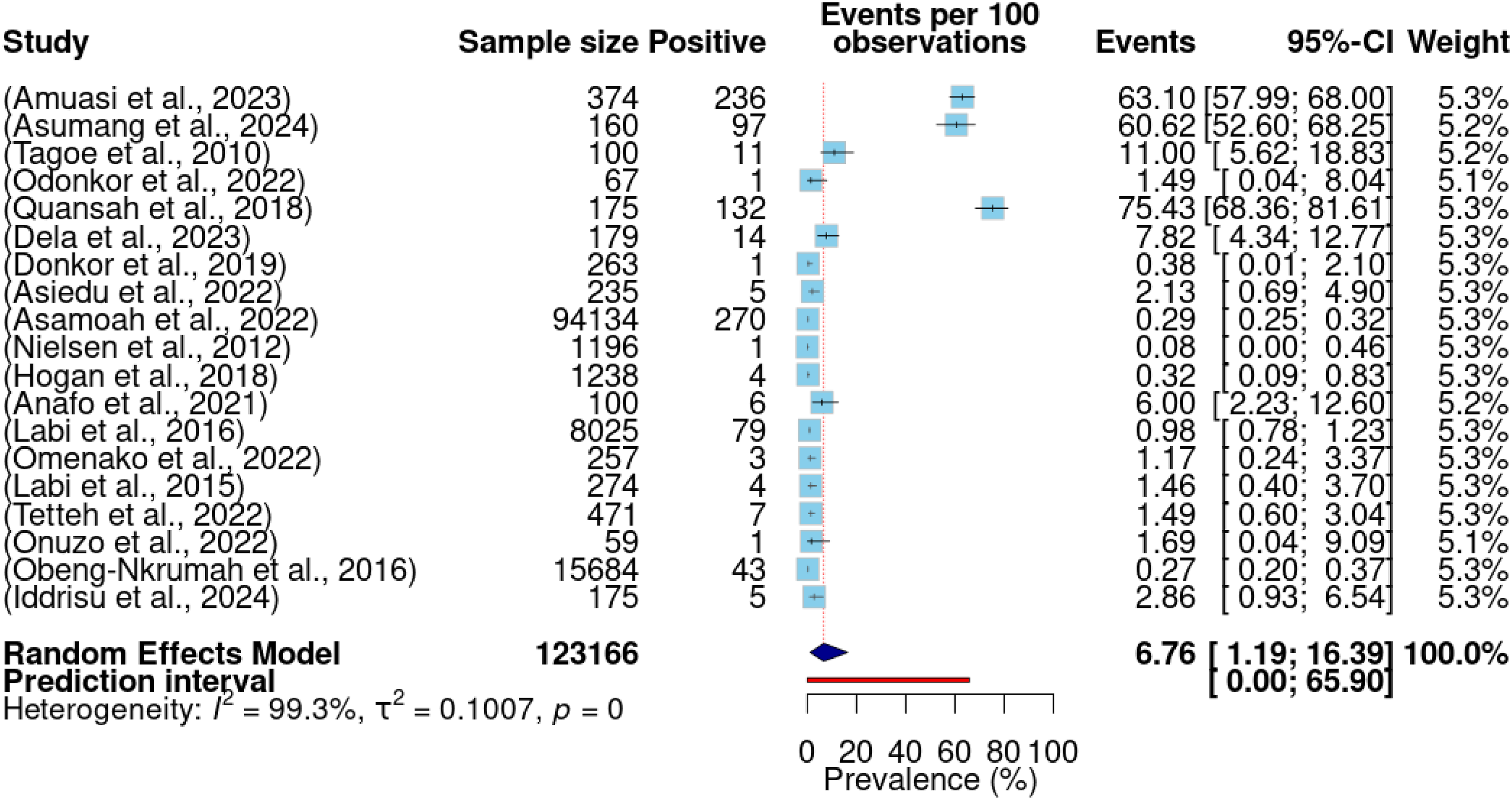
Subgroup analysis based on the source of sampling (environmental, animal, or human) revealed variability (I2 = 99.3%, p-value = 0), as expected given the unique characteristics of the three continua (Figure SM27, Figures SM3-SM4, SM19-SM22, Supplemental Sheet 2). Another sub-group analysis examining study focus also found significant difference between studies that focused solely on Enterococcus (62.36%, CI: 47.65–75.99%; p-value = 0.60; Q = 874.65) and those with a broader focus that included Enterococcus as part of a wider investigation (3.45%; CI: 0.41–9.27, Q = 0.29) (Figure SM28, Supplemental Sheet 2). The adjusted pooled prevalence in studies not focused on Enterococcus was 0.42% (CI: 0.00–3.75) (Figures SM29-SM30, Supplemental Sheet 2).
Regional subgroup analysis indicated statistically significant differences across geographical regions (p-value < 0.0001). The Ashanti region recorded the lowest prevalence at 0.31% (CI: 0.01–1.07), while Ahafo region recorded the highest at 25.65% (CI: 0.00–100.00). Studies covering multiple regions yielded a prevalence of 12.77% (CI: 0.00–99.99) (Figure SM31, Supplemental Sheet 2). Adjusted pooled estimate for regions with three or more studies were as follows: Ashanti (0.19%, CI: 0.00–0.71), Greater-Accra (0.55%, CI: 0.00–10.34) and Mixed regions (0.49%, CI: 0.00–8.60) (Figures SM32-SM37, Supplemental Sheet 2). Subgroup analysis based on four-year intervals (2009-2012, 2013-2016, 2017-2020 and 2021-2024) revealed no significant difference across time periods (p-value = 0.13).
Pooled prevalence estimates for Enterococcus were as follows: 3.20% (CI: 0.00–100.00), 0.73 % (CI: 0.00–2.87), 14.43% (CI: 0.00–100.00) and 8.23% (CI: 0.67–23.00), respectively (Figure SM38, Supplemental Sheet 2). Adjusted prevalence estimates were: 0.27% (CI: 0.00–1.50) for 2013-2016, 14.43% (CI: 0.00–100.00) for 2017-2020 and 0.49% (CI: 0.00–8.60) for 2021-2024 (Figures SM39-SM44, Supplemental Sheet 2). Subgroup analysis by guideline used for breakpoints determination revealed statistically significant differences (Q = 72.20, df = 2, p < 0.0001) among Clinical and Laboratory Standards Institute (CLSI), European Committee on Antimicrobial Susceptibility Testing (EUCAST) and studies in which the guideline was not stated (Figure SM45). Studies using CLSI guidelines, those in which the guideline was not stated, and the single study using EUCAST respectively yielded pooled prevalence estimates of of 4.56% (CI: 0.08–15.31), 5.86% (CI: 0.00–25.29), and 60.63% (CI: 52.96–68.04). However, there was no statistically significant difference between studies that used CLSI and those that did not report the guideline used (Q = 0.04, df = 1, p = 0.84) (Figure SM46). Among the 10 studies that used the CLSI guidelines, each reported using a unique variant of the guidelines 10, 53 21, 56 22, 44 26, 85 27, 66 29, 41 30, 62 31, 51 32 81 and 34 93 editions, therefore, the pooled estimate was not computed.
A mixed-effects meta-regression analysis to assess the contribution of individual factors (region, year group, source and study focus) to the observed heterogeneity was performed (Supplementary Sheet 3-6). The most significant contributor to heterogeneity was the One-Health continuum (human, animal or environment), which accounted for 68.19% of the heterogeneity, and study focus, which explained 48.23% (Table SM1-6, Supplemental Sheet 3). In terms of interactions, the combined effect of source and year group explained the majority of the variability across studies (R2 = 98.20%) (Table SM1-SM8, Supplemental Sheet 4). Year group did not account for any heterogeneity although the trend showed a decline in Enterococcus prevalence during 2013–2016 (β = -0.09; p = 0.77), followed by a gradual increase between 2017–2020, and a slight decrease during 2021–2024 period (Table SM8, Supplemental Sheet 4). When interactions among three variables were considered, the following combinations accounted for most of the observed heterogeneity: region, source and year group (R2 = 99.06%), source, year group and study focus (R2 = 98.20%) and region, year group and study focus (R2 = 97.92%) (Table SM1-6, Supplemental Sheet 5).
3.6. Antibiotic Rates in Human and Animal
3.6.1. Antibiotic Resistance in Human
Antibiotic resistance data were reported in seven studies involving a total of 24,876 participants and 143 Enterococcus isolates (Tables SM17-SM18, Supplemental Sheet 2). A cross-sectional study 27 on the prevalence of antibiotic use prior to laboratory testing in two Ghanaian hospitals, reported an Enterococcus positivity rate of 0.38% (n = 1/263). A case report on infective endocarditis 57 also contributed resistance data. Similarly, a neonatal study 69 reported Enterococcus positivity rate of 1.17% (n = 3/257). Another study, 92 which retrospectively examined bloodstream infections in both paediatric and adult patients found an Entercoccus positivity rate of 0.27% (n = 43/15684). In a study 93 which investigated uropathogens in diabetics patients (positivity rate of 2.86%, n = 5/175), resistance rates were reported for levofloxacin (0%), tetracycline (40%), chloramphenicol (60%), ampicillin-sulbactam (40%), norfloxacin (40%) and nitrofurantioin (60%). Another study focused on the susceptibility of current antibiotics recommended for neonatal bloodstream infections and examined the effectiveness of combination therapies. 68 The pooled resistance estimates were as follows: ciprofloxacin (0.54%; CI: 0.19–1.08), gentamicin (0.69%; CI 0.10–1.79), ampicillin (0.60%; CI: 0.00–20.66), penicillin (0.69%; CI: 0.00–25.42) and vancomycin (0.33 %; CI: 0.00–31.74), as presented in Figures SM47-SM51 (Supplemental Sheet 2). Additionally, the adjusted pooled resistance rate for ciprofloxacin was 0.42 % (CI: 0.19–1.06) (Figure SM52, Supplemental Sheet 2).
3.6.2. Animal Studies
Only two studies51,75 reported AMR data from animals with a positivity rate of 63.10% (n = 236/374) and 60.63% (n = 97/160) respectively (Table SM19, Supplemental Sheet 2). In meat samples, the positivity rate was 33.5% (n = 76/200), whereas live animal samples had a rate of 97.04%. 51 The pooled resistance in animals were for the following antibiotics: tetracyline (32.86%; CI: 0.00–100.00), erythromycin (17.52%; CI: 0.00–73.35) and vancomycin (17.65%; CI: 0.00–100.00) (Figures SM53-SM55, Supplemental Sheet 2).
3.6.3. Overall Pooled Resistance of Enterococcus
Data from seven studies involving human and animal sources were analyzed (Table SM20, Supplemental Sheet 2). Pooled resistance were as follows: ciprofloxacin (1.30%; CI: 0.00–5.73%), gentamicin (1.61%; CI: 0.00–10.24), cotrimoxazole (5.21%; CI: 0.00–100.00), ampicillin (0.69%; CI: 0.00–2.91), chloramphenicol (1.89%; CI: 0.13–5.64), tetracycline (8.39%; CI: 0.00–39.62), cloxacillin (17.46%; CI: 0.00–100.00), erythromycin (9.99%; CI: 0.00–50.35), penicillin (10.96%; CI: 0.00–97.81), vancomycin (5.94%; CI: 0.00–56.59) (Figures SM56-SM65, Supplemental Sheet 2). After adjusting for publication bias, resistance rates were: ampicillin (0.26%; CI: 0.00–1.46), tetracycline (0.24%; CI: 0.00–16.99), erythromycin (1.27%; CI: 0.00–23.61), penicillin (0.27%; CI: 0.00–46.20), vancomycin (0.06%; CI: 0.00–27.86) (Figures SM66-SM70, Supplemental Sheet 2).
4. Discussion
This systematic review highlights a growing body of research on Enterococcus in Ghana, with increasing diversity in study focus, population, and regional coverage. Notably, publications rose significantly from 13 (2003-2013) to 56 (2014-2024), with recent studies51,75 focusing exclusively on Enterococcus rather than reporting it incidentally. Regionally, most studies are concentrated mainly in Ashanti and Greater Accra, likely due to larger populations, better infrastructure, and proximity to research institutions. Underrepresented regions such as Bono East exclusively contributed only one study 1.45% (n = 1), though 13.04% (n = 9) of studies spanned multiple regions. This disparity indicates a need for broader geographic coverage to ensure a comprehensive national understanding of Enterococcus dynamics in Ghana. While patterns of regional concentration95,96 have been observed to account for heterogeneity in other systematic reviews on AMR, this concentration of studies in few regions defeat the purpose of tackling surveillance as it leaves unique factors that may augment the Ghana national plan on antimicrobial use and resistance.
Notwithstanding the concentrated efforts at the human continuum and some regions in the country, it offers a compelling argument on what the current dynamics are in terms of Enterococcus research. Earlier studies (2003–2013) predominantly focused on assessing microbial water quality (53.85%, n = 7). In contrast, research from 2014–2024 shifted toward AMR, with 53.57% (n = 30) of studies addressing antimicrobial resistance-related topics (Table 1). This reflects an adaptive research landscape responding to emerging global health priorities, as highlighted by organizations such as the WHO.7-9,97,98 While the studies showcased a variety of research designs including prospective, retrospective, longitudinal, case control and experimental,99-103 greater integration of data across sources and diversification of sample types will be essential for illuminating transmission pathways. This is particularly important within the One-Health framework, where humans, animals, and the environment are interconnected reservoirs that may facilitate the circulation and persistence of Enterococcus species and antimicrobial resistance determinants. Consequently, surveillance efforts that focus predominantly on clinical settings may underestimate the ecological complexity and transmission dynamics of Enterococcus in Ghana.
The pooled prevalence across the human continuum was 0.92 % (adj. 0.36%). This was lower than the 10.9% observed in the WHO European region and may be due to factors such as differences in population diversity or the higher burden of Enterococcus in high-income countries.104,105 This estimate in our study, highlight the burden of Enterococcus in clinical settings in Ghana, as majority of the studies were hospital-associated. The main cause of heterogeneity observed in the human estimate stemmed from demography as it explained most of the variability (R2 = 44.42%). The prevalence in environmental studies was 18.94% (adj. 29.27%) and was sensitive to omission of studies, indicating the need for more studies in this area to better make a more confident prediction. The relatively high prevalence observed in environmental studies is normally the case and suggests that environmental reservoirs such as wastewater, surface water, and other contaminated ecological niches may play an important role in the maintenance and dissemination of Enterococcus species and their associated resistance determinants. In Ghana, the discharge of untreated domestic, agricultural, and hospital waste into water bodies may create selective pressure that promotes the persistence and spread of resistant Enterococcus strains across the human-animal-environment interface. In contrast, animal studies estimate (62.36%) was robust which may be attributed to the focused nature of both studies, which specifically targeted Enterococcus isolation (Figure SM13). The prevalence observed among animal studies also raises important concerns regarding the zoonotic and food-chain transmission potential of Enterococcus species. The use of antimicrobials in livestock production may contribute to the emergence and maintenance of resistant strains that can spread through direct animal contact, food products, or environmental contamination, reinforcing the need for integrated surveillance across sectors.
Overall, the pooled prevalence of Enterococcus was estimated at 6.76% (adj. 0.44%) (Figures 2 and 3, Figures SM25-SM26, Supplemental Sheet 2). The unadjusted prevalence reflects the diversity of sources within the One Health continuum as compared to the adjusted estimate, that risk under-representing high-burden but low-study-count areas such as animals and the environment. Moreover, many human studies that informed the adjustment were not specifically designed to detect Enterococcus, making their results incidental. The unadjusted estimate therefore preserves the magnitude of effect across sectors, providing a more realistic and actionable reflection of the overall burden of Enterococcus. This position is particularly important because our review included all published studies from Ghana, and the under-representation of animal and environmental domains reflects the state of the national evidence base, not omissions in our methodology. Thus, interpreting the burden of Enterococcus solely from a clinical perspective may overlook the contribution of environmental and animal reservoirs that continuously interact with human populations. A One-Health interpretation therefore provides a more comprehensive understanding of the epidemiology and transmission ecology of Enterococcus species in Ghana.
Heterogeneity across studies was considerable (I2 = 99.3%), with a wide prediction interval (0.00–65.90%), indicating substantial variability in prevalence estimates across settings and reinforcing the need for moderator analyses. Although the unadjusted pooled estimates reflect the diversity of sources within the One Health continuum, the risk of bias assessment revealed methodological differences, particularly in laboratory procedures and sampling approaches, which may have contributed to between-study heterogeneity. While low heterogeneity was observed in environmental and human samples, variability within human studies was largely influenced by regional differences, population studied, and age group, with no evidence that invasive versus non-invasive sampling contributed to heterogeneity. For instance, neonatal studies exhibited significant within-subgroup heterogeneity (I2 = 86.8%), with notable differences in effect sizes compared to mixed populations. Overall, source along the One Health continuum and study focus were the primary contributors to the observed heterogeneity, whereas breakpoints were not. Meta-regression further confirmed that source along the One Health continuum significantly explained a substantial proportion of between-study heterogeneity (R2 = 68.19%, p < 0.001), while study focus accounted for 48.23% (p = 0.0007). In contrast, region and publication year group were not significant contributors. Given that all studies were assessed as having low risk of bias, the overall study quality supports the robustness of the synthesized findings.
The emergence of AMR in Enterococcus poses significant challenges to treatment, particularly in hospital settings where it is a leading cause of nosocomial infections.53,57,106 Our analysis of human and animal studies reveals contrasting resistance trends across the two domains, with human studies generally reporting lower resistance rates compared to animals, a pattern that mirrors the prevalence rates. In human studies, resistance rates ranged from 0.33% for vancomycin to 0.69% for both penicillin and gentamicin while it ranged from 17.52% for erythromycin to 32.86% for tetracycline. Based on this systematic review, the results suggest that the most effective antibiotics for treating human and animal Enterococcus infections are vancomycin and erythromycin respectively, due to their relatively lower resistance patterns. However, these trends should be monitored to curb the upsurge in resistance to these antibiotics.
The variability in resistance rates across studies reflects the differences inherent in the One-Health sectors. For example, while vancomycin resistance in human studies was low (0.33%), it was substantially higher in animal studies (17.65%). One plausible explanation for this trend is the higher likelihood of isolating Enterococcus gallinarum and Enterococcus casseliflavus from animals compared to humans. These species possess intrinsic, chromosomally encoded resistance to vancomycin (via the vanC gene cluster), which may account for the elevated rate observed in animal study in which the isolates were not typed into their species. 75 While a 2020 study 107 did not find any study in Ghana, our study presents the first estimate of the overall VRE at 0.06 %, which is higher than Nigeria (0.03 %) but lower than South Africa (0.75 %), that has the highest VRE prevalence in Africa. Furthermore, although some animal studies reported resistance to linezolid, no human studies tested or reported this, suggesting a potential surveillance gap (68). This disparity underscores the need for more targeted research to type Enterococcus species and understand the drivers of antibiotics resistance in animals and its potential spillover into human populations. The findings further support the hypothesis that antimicrobial resistance in Enterococcus should be considered an ecological and One-Health problem rather than one confined to hospitals alone, as resistant strains and resistance determinants may circulate between animals, humans, food products, and contaminated environmental sources. Also the findings warrant a robust antimicrobial stewardship programs in Ghana, which should promote rational antibiotic use and support the development of alternative therapeutic strategies for treating resistant Enterococcus infections. 108
The results from the eleven experimental studies investigated various agents, including andrographolide in combination with existing antimicrobials, plant extracts from Glyphaea brevis and Clausena anisata (Willd) Hook, and synthesized compounds such as naphtholic azo dyes, pyrazolyl-sulfonamides, and phosphonium salts. While pyrazolyl-sulfonamides and their palladium complexes did not exhibit antibacterial activity, other agents showed varying degrees of efficacy, with minimum inhibitory concentrations (MICs) ranging from 500 µg/mL (Glyphaea brevis) to 20 mg/mL (Clausena anisata extracts). Collectively, these findings highlight the promise of natural products and synthetic compounds in managing Enterococcus infections. However, the variability in efficacy and the limited geographic representation of the studies underscore the need for broader research utilizing clinically relevant isolates109. Future work should also incorporate typing of Enterococcus strains to deepen understanding of resistance mechanisms and contextualize susceptibility profiles. Genomic-level insights will be essential for elucidating the biological activity of these compounds beyond phenotypic assessments.
5. Research Gaps
Despite valuable contributions, key research gaps remain. Animal studies are notably underrepresented, limiting our understanding of the zoonotic potential of Enterococcus. Geographic coverage is also limited, with most studies concentrated in a few regions (Greater-Accra and Ashanti), leaving large parts of the country underexplored. Environmental studies, though relatively common, often fall short in linking environmental reservoirs to the spread of AMR. Few studies have attempted to trace clinical isolates back to environmental or animal sources, an essential step in mapping transmission pathways. Another significant issue is the continued reliance on culture and biochemical based-methods for typing, which constrains the identification of resistant clones circulating in Ghana. Only one study has employed WGS to explore the genomic characteristics of Enterococcus in Ghana, limited to archived samples from animals and their products. This creates a major blind spot in our current understanding, particularly regarding the evolution and spread of resistant strains over time. As of now, Ghana lacks comprehensive genomic surveillance data on dominant Enterococcus clones in clinical settings. This gap hampers efforts to improve treatment outcomes and hinders effective antimicrobial stewardship. Bridging this knowledge deficit through the implementation of advanced genomic techniques and a One-Health approach will be essential for improving health outcomes and informing public health policy.
6. Limitations
The high heterogeneity (I2 up to 99.3%) across included studies suggests substantial variability. Some included studies used older CLSI breakpoints, and changes in CLSI criteria over time may influence reported resistance rates. This should be considered when comparing studies and interpreting pooled estimates although each of the 10 studies that used CLSI guidelines reported different editions. Publication bias was explored unless in cases where the number of studies were not enough to assess bias. There were uneven distribution of data across the One Health domains. While human studies predominated, only a modest number of animal and environmental studies were suitable for meta-analysis. However, this is not a shortcoming of the review process itself but rather reflects the true state of the scientific evidence base in Ghana. All eligible studies published to date were systematically included, and for the meta-analysis, only studies contributing two or more Enterococcus isolates were considered to ensure statistical validity. Geographical and temporal biases also warrant attention. The majority of studies originated from the Ashanti and Greater Accra regions, with a concentration of research published after 2013. Despite these limitations, this review and meta-analysis provides the most comprehensive synthesis to date of Enterococcus prevalence and antimicrobial resistance in Ghana, offering an important foundation for integrated surveillance and policy action under the national AMR action plan.
7. Conclusion
This systematic review and meta-analysis highlights the characteristics of studies conducted in Ghana, encompassing human, animal and environmental sources, as well as the prevalence and resistance pattern of Enterococcus species. This is the first study reporting a reported 6.36% prevalence of Enterococus with a VRE prevalence of 0.06% The findings underscore the critical importance of targeted surveillance and tailored interventions to address the growing threat of antimicrobial resistance. Continued research that leverages the One-Health framework and incorporates genomic approaches will be crucial for shaping effective public health strategies and enhancing patient outcomes in Ghana.
Supplemental Material
Supplemental Material - A One-Health Perspective on Enterococcus in Ghana: A Review and Meta-Analysis
Supplemental Material for A One-Health Perspective on Enterococcus in Ghana: A Review and Meta-Analysis by Bill Clinton Aglomasa, Patience Sarkodie-Addo, Grace Semevor and Eric Sampane Donkor in Environmental Health Insights.
Supplemental Material
Supplemental Material - A One-Health Perspective on Enterococcus in Ghana: A Review and Meta-Analysis
Supplemental Material for A One-Health Perspective on Enterococcus in Ghana: A Review and Meta-Analysis by Bill Clinton Aglomasa, Patience Sarkodie-Addo, Grace Semevor and Eric Sampane Donkor in Environmental Health Insights.
Supplemental Material
Supplemental Material - A One-Health Perspective on Enterococcus in Ghana: A Review and Meta-Analysis
Supplemental Material for A One-Health Perspective on Enterococcus in Ghana: A Review and Meta-Analysis by Bill Clinton Aglomasa, Patience Sarkodie-Addo, Grace Semevor and Eric Sampane Donkor in Environmental Health Insights.
Supplemental Material
Supplemental Material - A One-Health Perspective on Enterococcus in Ghana: A Review and Meta-Analysis
Supplemental Material for A One-Health Perspective on Enterococcus in Ghana: A Review and Meta-Analysis by Bill Clinton Aglomasa, Patience Sarkodie-Addo, Grace Semevor and Eric Sampane Donkor in Environmental Health Insights.
Supplemental Material
Supplemental Material - A One-Health Perspective on Enterococcus in Ghana: A Review and Meta-Analysis
Supplemental Material for A One-Health Perspective on Enterococcus in Ghana: A Review and Meta-Analysis by Bill Clinton Aglomasa, Patience Sarkodie-Addo, Grace Semevor and Eric Sampane Donkor in Environmental Health Insights.
Supplemental Material
Supplemental Material - A One-Health Perspective on Enterococcus in Ghana: A Review and Meta-Analysis
Supplemental Material for A One-Health Perspective on Enterococcus in Ghana: A Review and Meta-Analysis by Bill Clinton Aglomasa, Patience Sarkodie-Addo, Grace Semevor and Eric Sampane Donkor in Environmental Health Insights.
Supplemental Material
Supplemental Material - A One-Health Perspective on Enterococcus in Ghana: A Review and Meta-Analysis
Supplemental Material for A One-Health Perspective on Enterococcus in Ghana: A Review and Meta-Analysis by Bill Clinton Aglomasa, Patience Sarkodie-Addo, Grace Semevor and Eric Sampane Donkor in Environmental Health Insights.
Footnotes
Acknowledgments
We acknowledge all the authors that have made it possible to understand Enterococcus in the Ghanaian population, essentially feeding into the global epidemiology of the organism.

Author Contributions
Conceptualization, BCA, ESD; Methodology, BCA, PS-A, ESD; Software, BCA; Validation, BCA, PS-A, GS, ESD; Formal analysis, BCA; Investigation, BCA, PS-A, GS, ESD; Resources, ESD; Data curation, BCA, PS-A, GS; Writing-original draft preparation, BCA; Writing-review and editing, BCA, PS-A, GS, ESD; Visualization, BCA; Supervision, ESD; Project administration, ESD; Funding acquisition, ESD. All other authors revised the report critically for important intellectual content. All authors have read and approved the final version of the report.
Funding
This review paper was supported by the Fogarty International Center of the National Institutes of Health through the Research and Capacity Building in Antimicrobial Resistance in West Africa (RECABAW) Training Programme hosted at the Department of Medical Microbiology, University of Ghana Medical School (Award Number: D43TW012487). The content is solely the responsibility of the authors and does not necessarily represent the official views of the National Institutes of Health.
Declaration of Conflicting Interests
The authors declared no potential conflicts of interest with respect to the research, authorship, and/or publication of this article.
Data Availability Statement
All data are available within the paper, its supplementary and additional materials.
Supplemental Material
Supplemental material for this article is available online.
Appendix
References
Supplementary Material
Please find the following supplemental material available below.
For Open Access articles published under a Creative Commons License, all supplemental material carries the same license as the article it is associated with.
For non-Open Access articles published, all supplemental material carries a non-exclusive license, and permission requests for re-use of supplemental material or any part of supplemental material shall be sent directly to the copyright owner as specified in the copyright notice associated with the article.
