







Abstract
Background:
Soaring drug prices pose a significant obstacle to affordable and equitable access to medicines in high-income healthcare systems. This study compares two leading reform tool families, Most Favored Nation (MFN)/international reference pricing (IRP) and value-based contracting (VBC), across the United States, Canada, and the United Kingdom, with attention to cost containment, value-linked incentive design, equity of access, and implementation feasibility. U.S. policy developments (CMS Innovation Center’s GENEROUS, GLOBE, and GUARD models) extend international benchmark-based design options beyond the 2020 MFN rule.
Methods:
Guided by institutional and governance theories, we conducted a structured comparative policy analysis using a four-dimensional trade-off matrix. Cases from the United States, Canada, and the United Kingdom were selected using a most-different-systems design. Documents from 2007 to 2025 were coded for cost containment, value-linked incentive design, equity, and implementation feasibility. To reduce subjectivity, scores were assigned using prespecified rubric anchors, conservative scoring rules for borderline cases, and a sensitivity check of adjacent-score judgments. Design-stage U.S. benchmark-based model materials assessed on March 5, 2026, were incorporated descriptively and not considered as outcome evidence.
Results:
The United Kingdom model, centered on the National Institute for Health and Care Excellence (UK NICE) and the Voluntary Scheme for Branded Medicines Pricing, Access and Growth (VPAG), was most consistently aligned across all four dimensions (design-feature alignment). Canada’s Patented Medicine Prices Review Board (PMPRB) supports affordability and baseline access, with implementation variation across provinces and more limited adoption of outcomes-based contracting. U.S. MFN/IRP initiatives and VBC pilots show lower alignment on equity and feasibility in a multi-payer environment characterized by contested authority and variable data/contracting capacity. Emerging CMS Innovation Center proposals (GENEROUS, GLOBE, GUARD) indicate continued federal interest in benchmark-based designs, but empirical impacts remain to be evaluated.
Conclusions:
MFN/IRP anchoring and VBC are implementation-intensive tools whose performance depends on institutional fit. A hybrid approach, using international benchmarks as inputs for negotiations and expanding value-linked agreements where measurement and governance prerequisites are met, may offer a more feasible U.S. pathway. This study provides a repeatable framework for assessing drug pricing reforms and illustrates how institutional alignment conditions the implementability of tools. Design-feature scores reflect policy design and governance capacity, not realized outcomes.
Plain Language Summary
Prescription medication prices are often high, making it difficult for people to access the medicines they need. This study examines how three countries, Canada, the United Kingdom, and the United States, attempt to control prices while supporting fair access and workable implementation. We focus on two main approaches: using international price benchmarks to inform pricing (international reference pricing/MFN-type designs) and paying based on a drug’s clinical value or outcomes (value-based care/value-based contracting). We found that countries differ mainly because their health systems are organized differently. The United Kingdom’s centralized structure supports more consistent policy implementation, while the United States’ multi-payer structure creates greater legal, administrative, and data challenges. Canada shows strong price regulation and baseline access, but policies vary across provinces and outcomes-based contracting is less common. Newly assessed March 5, 2026, U.S. proposals (GENEROUS, GLOBE, GUARD) suggest continued federal interest in international benchmark-based approaches, but these are recent and do not yet have outcome evidence. We suggest a combined approach in the United States: use international benchmarks to strengthen negotiations and expand value-linked contracts only where measurement and coordination are feasible.
Keywords
Introduction
In August 2024, the Centers for Medicare and Medicaid Services (CMS) publicly disclosed, for the first time, the negotiated prices for high-cost drugs under the Medicare Drug Price Negotiation Program for the 2026 coverage year. 1 Simultaneously, its UK counterpart introduced a reformed voluntary scheme for brand medicine pricing, access, and growth (VPAG), tightening revenue limits and easing access flexibility. 2 With these reforms, a turning point has occurred in pharmaceutical policy in high-income countries, as governments face rising expenditures while aiming to preserve innovation and protect equitable access and financial protection.
Despite increasing investments in biomedical research, costly medicines continue to widen access gaps and strain public resources.3,4 Policymakers face the difficult challenge of balancing drug affordability and fairness without stifling innovation or overwhelming administrative systems.
The two pricing reform strategies in both countries are the Most Favored Nation (MFN) pricing, which bases domestic prices on international standards, and Value-Based Care (VBC), which aligns payments with clinical outcomes.5,6 MFN can result in short-term budget cuts but may reduce innovation and lead to litigation challenges. VBC can support long-term cost reduction while delivering value, but it depends on strong infrastructure, clear metrics, and payer cooperation. 7 CMS Innovation Center model designs have advanced international benchmark-based approaches through GENEROUS (Medicaid) and proposed mandatory models for Medicare Part B (GLOBE) and Part D (GUARD); these initiatives are at the design stage and require future evaluation of realized effects.8-10
This study compares the MFN/VBC functioning in three institutional environments: Canada, the United Kingdom, and the United States. Canada’s centralized pricing oversight through the PMPRB supports cost control, but system performance is constrained by inter-jurisdictional processes and negotiated coverage pathways that can reduce transparency and slow access to new medicines.11,12 In the United Kingdom, the approach combines cost-effectiveness with outcome-linked pricing under NICE and the reformed VPAG program within its centralized National Health Service (NHS) system.2,13 Meanwhile, U.S. reforms are hindered by fragmented payers, disputed authority, and underdeveloped infrastructure.
Using a trade-off matrix within a structured framework, we evaluated the performance of the MFN and VBC models across four policy goals: cost containment, value-linked incentive design, equity of access, and implementation feasibility. This research is guided by institutional and governance theories, highlighting how health system design influences the implementation of reform.14,15
This study contributes (1) a cross-contextual framework for comparing pricing instruments, (2) an institutional account of why tool performance varies across governance settings, and (3) a hybrid U.S. pathway that combines international price anchoring with value-linked reimbursement calibrated to implementation constraints.16-19
Knowledge Gap and Contribution
Existing research on international/external reference pricing and performance- or outcomes-based agreements often evaluates these tools within individual jurisdictions and emphasizes observed price effects, coverage decisions, or implementation experience in specific systems rather than comparative institutional fit. 20 Less attention has been given to how governance capacity, legal authority, administrative/analytic capability, and data/coordination infrastructure, conditions whether these tools can be implemented at scale and aligned with cost containment, value-linked incentive design, equity of access, and implementation feasibility. 7 Drawing on institutional and governance theories15,18 and policy-capacity concepts, 21 , this study applies a rubric-anchored trade-off matrix to assess policy design features across the United States, Canada, and the United Kingdom. In doing so, it shifts the focus from whether a pricing tool is attractive in principle to whether it is institutionally workable across contrasting governance configurations.
This research addresses a critical policy moment: as the U.S. begins Medicare drug price negotiations under the Inflation Reduction Act (IRA) and the UK reorganizes VPAG, a comparative study of institutional pricing tools is both timely and essential. Our trade-off matrix offers a conceptual and practical framework to guide these reforms.1,2 Accordingly, this study makes three contributions. First, it provides a structured cross-national framework for comparing two major families of pharmaceutical pricing tools. Second, it explains why tool performance may vary across governance settings even when similar pricing concepts are invoked. Third, it offers a more institutionally realistic interpretation of U.S. reform options by considering when benchmark-based pricing and value-linked contracting may function as complements rather than stand-alone solutions.
Conceptual Framework and Methodology
Conceptual Approach: Pricing Tools as Institutional Design Choices
This study employs a structured comparative policy framework to evaluate the institutional alignment of MFN pricing and value-based care (VBC) models across four interconnected policy dimensions: cost containment, incentive design, equity of access, and implementation feasibility. These dimensions are derived from the value-based pricing literature,7,22 institutional and governance theories of health policy (which emphasize how policy outcomes are shaped through institutional channels linking authority, financing, and coordination),14,15,18, as well as cross-national research on pharmaceutical regulation.19,23
We examine pharmaceutical pricing as a set of institutional trade-offs that depends on the structure of the health system and public policy capacity. Policy capacity is defined as the combination of analytical, operational, and political skills at the system, organizational, and individual levels. 21 These factors shape the introduction, negotiation, and maintenance of reforms. From this perspective, governance structures, rather than technical evaluations alone, condition how pricing tools are designed and implemented. These assumptions guided our development of a four-component trade-off matrix to compare MFN/IRP and VBC tool alignment across countries.
Case Selection: Contrasting Governance Regimes (U.S., Canada, U.K.)
We intentionally sampled three nations, the United States, Canada, and the United Kingdom, each representing distinct institutional frameworks: a market-disintegrated system (United States), a mixed public-private system (Canada), and a centrally coordinated single-payer system (United Kingdom). This research design helps examine how institutional logic influences the implementation and effects of pricing tools across diverse institutional contexts.14,24 This “most-different systems” sampling is intended to test institutional fit (governance capacity and integration) rather than to represent the full diversity of high-income pricing governance.
Data Sources: Policy, Regulatory, and Institutional Documents
Our review analyzed 37 documents published from 2007 to 2025, including peer-reviewed articles, government white papers, reports from government agencies, and grey literature. The primary sources examined were CMS advisories and policy documents on MFN and related pricing models,1,5 PMPRB guidelines, 11 and NICE appraisal updates. 13 We performed a structured document search across PubMed, JSTOR, Google Scholar, and policy repositories, including CMS, DHSC, OECD, and WHO IRIS. Selection followed PRISMA guidelines; 25 were included based on relevance to pricing models, regulatory tools, and outcome-based contracting. Search terms, inclusion/exclusion criteria, and the final document list are provided in Appendix.
Documents were included if they directly described pricing tool design features, governance arrangements, implementation requirements, or institutional constraints relevant to MFN/IRP-type pricing or value-linked contracting in the United States, Canada, or the United Kingdom. Documents were excluded if they addressed pharmaceutical pricing only indirectly, focused narrowly on clinical efficacy without relevance to pricing or governance, or duplicated information already captured in a more authoritative primary policy source. The document sample was purposively selected to support a focused comparative policy analysis of institutional design alignment, rather than an exhaustive, systematic review of all pharmaceutical pricing literature.26,27
Analytical Strategy: Trade-Off Matrix for Institutional Design
Documents were analyzed using deductive content analysis. Extracts were categorized into four predefined groups: (1) mechanisms of cost containment, (2) incentive design, (3) equity of access, and (4) implementation feasibility. We rated alignment in each category for each country-policy pair (eg, MFN/IRP-United States; VBC-Canada) on a 1 to 5 scale. Ratings were based on documented policy design features rather than realized outcomes and were calibrated through within-case synthesis and cross-case comparison. This matrix approach aligns with comparative policy methods in health system research.23,24
To strengthen transparency and reduce subjectivity, the 1 to 5 scores were assigned using pre-specified rubric anchors for each dimension (Appendix), and each cell score is accompanied by a brief justification and a mapped evidence set (policy primary sources plus supporting peer-reviewed or synthesis sources). When evidence supported adjacent scores, a conservative rule was applied (the lower score) unless multiple independent sources supported a stronger alignment. Scoring emphasizes implementability-related design features (eg, legal authority, administrative/analytic capacity, and data/coordination infrastructure) rather than claimed or expected effects.
A sensitivity analysis was conducted by re-examining borderline cells under a stricter interpretation of the scoring rubric. In practical terms, this involved reassessing cases in which adjacent scores were plausible, such as whether the United States should receive a 2 rather than a 3 on cost containment, or whether Canada should receive a 3 rather than a 4 on implementation feasibility. The overall comparative pattern remained unchanged: the United Kingdom continued to show the most consistent institutional alignment across dimensions, while the United States remained lowest on equity and feasibility. Divergences were therefore resolved through rubric-guided reassessment and conservative scoring rather than ad hoc preference. 28
As shown in Figure 1, the United Kingdom demonstrates the most consistently high institutional alignment across the four dimensions. The matrix summarizes comparative alignment for cost containment, value-linked incentive design, equity of access, and implementation feasibility, illustrating how governance capacity and institutional configuration condition the implementability of MFN/IRP anchoring and value-linked contracting approaches.1,2,11,13 Scores reflect coded policy design features rather than realized outcomes (Appendix).
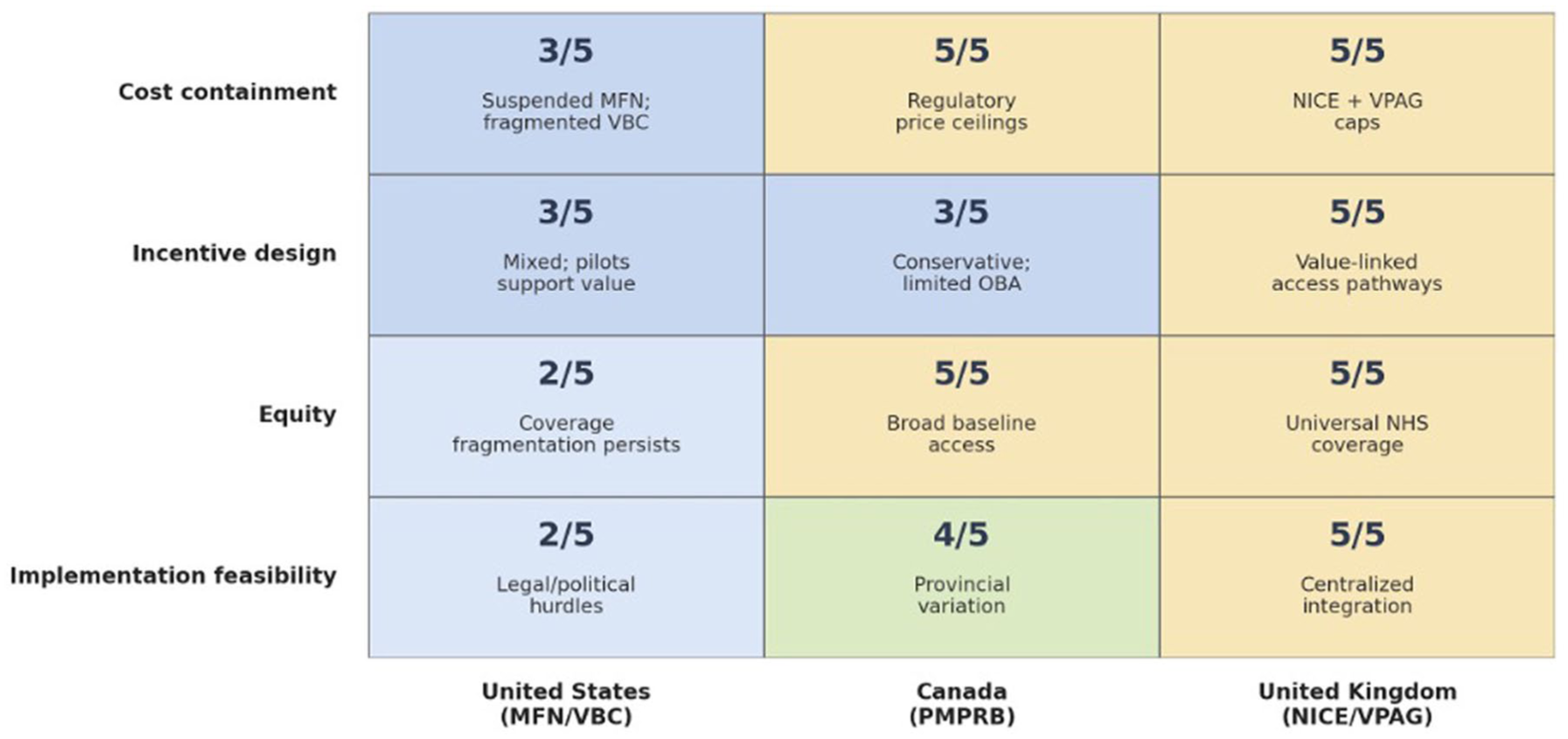
Institutional alignment heatmap for MFN/VBC-related pricing governance (1-5).
Scope and Design Constraints (Non-Outcome-Based Assessment)
We did not aim to measure health or economic outcomes. Stakeholder perspectives and implementation timelines vary by country and are not directly evaluated. Ratings reflect relative policy design rather than effectiveness. We also recognize variation in how VBC is defined and implemented, complicating direct comparisons across contexts. 29 Accordingly, high alignment scores should not be interpreted as superior realized outcomes, and outcome performance may diverge from design alignment.
Results: Comparative Trade-Offs Across Systems
We used the trade-off matrix to evaluate the performance of MFN and VBC models across four key dimensions in the United States, Canada, and the United Kingdom: cost containment, incentive design, equity of access, and implementation feasibility. Table 1 summarizes these scores based on institutional characteristics and published policy tools, rather than outcome measures.
Comparative institutional alignment scores across three pharmaceutical pricing systems.

United States: MFN-Style Proposals and Fragmented VBC Infrastructure
The U.S. MFN pricing experiment under the CMS 2020 interim final rule highlights the difficulty of applying international benchmarks within a politically contested system. Although it was projected to save $85.5 billion over 7 years, legal challenges were quickly filed against the rule, leading to its eventual suspension.5,16 Value-based care models, including those associated with the CMS Innovation Center, remain underutilized, with only four of 50 demonstrations yielding net savings. 17 Structural barriers, such as weak interoperability of outcome data, dispersed payer alignments, and misaligned provider incentives, continue to obstruct scaling value-based care.6,21
CMS Innovation Center model designs have also advanced international benchmark-based approaches through the GENEROUS model (Medicaid) and proposed mandatory models for Medicare Part B (GLOBE) and Part D (GUARD).8-10 These initiatives remain largely at the design stage and therefore provide limited empirical evidence of realized impacts.
Furthermore, MFN-type approaches target prices directly but face legal unpredictability and implementation risk. 5 VBC aligns payment with clinical outcomes but relies heavily on stable governance, usable endpoints, and enabling infrastructure. 7 These tool families have not eliminated persistent inequities in drug access in the United States, particularly across payer types and among uninsured or underinsured populations. 3
Canada: PMPRB-Based Price Regulation and Limited Outcome-Linkage
Canada’s pricing system, primarily overseen by the Patented Medicine Prices Review Board (PMPRB), demonstrates strong cost control through reference-based approaches and regulatory measures. 11 Public coverage plans and risk pooling support baseline access, although equity is challenged by provincial formulary differences and coverage levels. 12
Incentive design remained moderate. Although national Canada’s Drug Agency (CDA) endorse Health Technology Assessment (HTA) and reimbursement recommendation processes support value-based assessments, pricing, and coverage arrangements have not consistently shifted toward outcomes-based contracting. The latest PMPRB guidelines (2025-2026) emphasize procedural transparency but do not institutionalize performance-linked pricing at scale. Political feasibility is also moderate: federal pricing tools operate within a federal/provincial landscape, and jurisprudential rulings have constrained some price-formula mechanisms. 11
United Kingdom: NICE/VPAG and Integrated Value-Based Design
UK alignment scores were consistently high across all four areas. NICE appraisal processes are integrated into coverage decisions, while VPAG governance includes revenue controls and mechanisms that can support access arrangements.2,13 The NHS single-payer structure enhances feasibility through centralized reimbursement management, coordinated implementation, and standardized access pathways.15,18 To avoid conflating institutional design with performance, these scores reflect governance integration and documented policy design features rather than realized outcomes in innovation, access, or population health equity. 29
Cross-System Comparison: Institutional Fit and Relative Design Strengths
Table 1 summarizes institutional alignment scores across the four dimensions. Overall, the United Kingdom demonstrates the most consistent alignment, reflecting centralized integration of HTA, pricing, and coverage tools. Canada shows strong alignment on cost containment and equity, with feasibility moderated by provincial implementation variation and a more conservative posture toward value-linked contracting. The United States shows comparatively lower alignment on equity and feasibility, reflecting fragmented coverage and contested authority; while MFN/IRP and VBC elements exist, implementation has been episodic and difficult to scale.5,11,18,21
The United Kingdom aligns most consistently; Canada is strong on cost containment and equity, with feasibility moderated by provincial variation; the United States is lowest on equity and feasibility due to fragmented coverage and contested authority.5,11,18,21
Discussion: Institutional Fit, Design Trade-Offs, and Policy Implications
This analysis indicates that institutional design—not only the selection of pricing tools, but also the conditions under which pharmaceutical pricing reforms can plausibly align with cost containment, equity of access, incentive design, and implementation feasibility. While MFN/IRP anchoring and VBC arrangements are often presented as competing strategies, the cross-system comparison suggests they are modular tools whose performance depends on compatibility with governance structures and policy capacity.18,21
Figure 2 shows the governance-to-tool pathways that drive these differences. Institutional coherence, especially the coordination of regulatory authority, purchasing power, and evaluation functions, determines how pricing tools lead to expected trade-offs across the four dimensions.

Governance-tool pathway model.
The UK case illustrates the advantages of centralized integration: NICE appraisal processes are closely linked to coverage decisions, and VPAG governance provides system-level mechanisms relevant to price control and access arrangements.2,13 In contrast, the United States operates within contested authority and fragmented purchasing, making MFN-type approaches and broad VBC scaling vulnerable to litigation risks, stakeholder resistance, and uneven infrastructure, constraints that can delay implementation and reduce feasibility.5,16,21 The UK’s “high alignment” reflects governance integration and policy design features; it should not be interpreted as evidence of superior realized equity or innovation outcomes.
Canada falls between these poles. The PMPRB provides structured ceiling-setting and supports affordability objectives, but adoption of outcomes-linked payment at scale remains limited and heterogeneous across provincial coverage contexts.11,12 These patterns underscore the difficulty of layering new instruments onto existing structures without complementary investments in infrastructure, contracting capability, and inter-jurisdictional coordination.11,12,21
For U.S. policymakers, the findings suggest that relying on MFN/IRP anchoring or VBC arrangements as stand-alone reforms is unlikely to succeed without parallel investments in authority clarity and implementation capacity. A sequenced hybrid approach may be more workable, using international benchmarks as negotiation inputs while expanding value-linked agreements in contexts where endpoints, data infrastructure, and contracting mechanisms are sufficiently mature.6,7,21
However, the CMS Innovation Center’s GENEROUS model and the proposed GLOBE (Part B) and GUARD (Part D) models reflect continued federal interest in international benchmark-based designs beyond the 2020 MFN rule.8-10 Because these initiatives are recent and largely at the design stage, future evaluation will be required to assess realized impacts on affordability, access and equity, administrative burden, and incentive effects.
This interpretation is consistent with the National Academies’ emphasis on combining pricing leverage with implementation-realistic purchasing strategies. 4 It also aligns with findings from a switching-behavior analysis in competitive insurance markets, which show that price and value signals influence decisions only when consumers are presented with credible alternatives. 24 As Bardach and Patashnik 30 argue, successful reform frequently depends less on selecting a single “best” tool than on assembling feasible combinations that can pass through institutional bottlenecks.
Accordingly, U.S. reforms should not assume a straightforward transfer of UK or Canadian mechanisms; rather, the most defensible approach is selective adaptation (eg, VPAG-type governance levers or PMPRB-type comparator structures) calibrated to U.S. legal authority, payer fragmentation, and data/contracting constraints.18,21 Finally, beyond the U.S. case, the trade-off matrix offers a structured approach to assess whether proposed pricing reforms are institutionally implementable and aligned with stated policy goals across governance contexts. This framework is intended as a diagnostic of institutional alignment and implementability, not a direct measure of realized health, equity, or innovation outcomes.18,21
Limitations of a Design-Focused Comparative Approach and Directions for Future Research
This research was limited by its document-based analysis, without stakeholder interviews or process tracing. Trade-off scores measure institutional design rather than realized outcomes. In particular, VBC models are defined and implemented differently across contexts, complicating direct comparison. Additionally, the analysis considers only three high-income countries, limiting transferability to middle-income settings or decentralized systems. Importantly, UK “high alignment” scores should not be interpreted as evidence of superior realized equity or innovation outcomes; outcome performance may diverge from design alignment.
Future research should broaden this framework to include additional governance archetypes and mixed-payment systems, incorporate perspectives from payers and industry, and apply process tracing to observe implementation dynamics over time. It should also examine how a U.S.-specific value assessment framework could help define the policy endpoint of MFN-type pricing reforms, rather than relying only on external price benchmarks. 31 Comparative stakeholder-focused research and ethnographic methods may help explain how actors manage tensions among affordability, incentive design, and equitable access.
Conclusion and Recommendations: Designing Feasible, Value-Oriented Pricing Regimes
Pharmaceutical pricing reform involves more than selecting a tool; it requires aligning policy design with governance capacity. This cross-case comparison indicates that MFN/IRP anchoring and VBC approaches vary in institutional alignment depending on legal authority, administrative capacity, and payer/data infrastructure.18,21 Because the UK’s centralized architecture integrates HTA and pricing governance, it can more readily support routinized appraisal-linked reimbursement and access governance. The United States and Canada, by contrast, illustrate the constraints of implementing similar tool designs in fragmented or partially coordinated systems.15,18
For the United States, the findings support a mixed approach grounded in institutional realism and sequenced implementation. Three practical steps follow:
Use international benchmarks as negotiation reference points for public purchasers (not strict ceilings), to strengthen bargaining leverage and transparency while reducing legal vulnerability through clear statutory and operational guardrails.1,5
Expand value-linked/outcome-based contracts selectively, tied to measurable endpoints, auditable data, and feasible contracting capacity, rather than broad mandates that outpace infrastructure.7,17
Invest in enabling infrastructure and coordination as prerequisites for tool transfer, including real-world evidence capability, contracting standards, and payer-provider coordination mechanisms.4,21
These recommendations align with the principle that feasible combinations of reforms often outperform single-tool solutions when policy change must pass through institutional bottlenecks.
In general, the trade-off matrix offers a reproducible approach for assessing institutional alignment and implementability of pharmaceutical pricing reforms across governance contexts. Future research should extend the framework to additional high-income archetypes and incorporate stakeholder evidence to characterize implementation pathways over time.
Footnotes
Appendix: Scoring Rubric,Coding Anchors,and Evidence Map
Abbreviations
CMS: Centers for Medicare and Medicaid Services
MFN: Most Favored Nation (pricing model)
VBC: Value-Based Care (value-based contracting/value-linked payment approaches)
PMPRB: Patented Medicine Prices Review Board (Canada)
NICE: National Institute for Health and Care Excellence (UK)
VPAG: Voluntary Scheme for Branded Medicines Pricing, Access and Growth (UK)
NHS: National Health Service (UK)
HTA: health technology assessment
IRP: international reference pricing
OBA: outcomes-based agreement (ie, a contract where payment/price is linked to outcomes)

Ethical Considerations
This study used only publicly available documents and did not involve human participants or identifiable private information. Institutional review board approval was not required.
Author Contributions
Conceptualization: Kola Adegoke. Methodology: Kola Adegoke; Abimbola Adegoke. Data curation and analysis: Kola Adegoke; Abimbola Adegoke; Adeyinka Adegoke. Software and validation: Kola Adegoke. Investigation and interpretation: Kola Adegoke; Olajide Alfred Durojaye. Writing—original draft: Kola Adegoke. Writing—review and editing: Olajide Alfred Durojaye; Abimbola Adegoke; Adeyinka Adegoke. Supervision: Kola Adegoke. Project administration: Kola Adegoke.
Funding
The authors received no financial support for the research, authorship, and/or publication of this article.
Declaration of Conflicting Interests
The authors declared no potential conflicts of interest with respect to the research, authorship, and/or publication of this article.
Data Availability Statement
Supplemental Material
Supplemental material for this article is available online.