







Abstract
Introduction
Adolescent electronic cigarette use is a significant public health concern due to its potential for negative health effects and prevalence among youth. The primary aim of the current study is to examine the moderation effect of perceived harm (i.e., low versus high) on the relation between passive and active social media use and past 30-day adolescent e-cigarette use. We hypothesized that the relation between type of social media use and e-cigarette use would be contingent on the level of perceived harm.
Aims and Method
This study was conducted via secondary data analysis with the public use files from the 2023 National Youth Tobacco Survey that provides a nationally representative sample (N = 22,069) of youth in the United States. The primary analysis consisted of logistic regression that accounted for complex survey sampling and missing data; primarily testing for a moderation effect.
Results
We found a significant omnibus interaction, F(2,37) = 3.83, p = 0.0307, confirming that high versus low perceived harm moderated the relationship between social media use type and past 30-day e-cigarette use. The difference in probabilities between levels of perceived harm for using e-cigarettes was significantly larger for those reporting high active social media use (i.e., Pr = 0.214) compared to those reporting passive social media use (i.e., Pr = 0.084).
Conclusions
We found that high versus low perceived harm moderated the relationship between passive and active engagement with e-cigarette-related social media content and past 30-day e-cigarette use for a nationally representative sample of adolescents in the U.S. Based on these findings, prevention strategies targeting adolescent e-cigarette use may be enhanced through tailoring educational messaging that focus on the potential effects of exposure to e-cigarette related social media content in conjunction with the known effects of using e-cigarettes on one’s health.
Implications
Examining the moderating effects of variables provides a greater understanding of the ways multiple factors interplay and influence adolescent e-cigarette use. The results of the current study demonstrated that differences between perceived levels of harm occurred at each category of social media use, while these differences were most pronounced between the passive use and the high active use social media categories. Prevention strategies targeting adolescent e-cigarette use may be enhanced through tailoring educational messaging and teaching strategies that focus on the potential effects of exposure to e-cigarette related social media content in conjunction with the known biological effects of using e-cigarettes on one’s health.
Keywords
Introduction
Adolescent electronic cigarette (i.e., e-cigarette) use is a significant public health concern due to its potential for negative health effects and prevalence among youth. 1 Nicotine is the most reported substance used by adolescents in e-cigarettes followed by cannabis, and to a lesser degree flavored liquids.2,3 Recent data from the National Youth Tobacco Survey indicate that approximately 3.5% of adolescents in middle school and 7.8% in high school report the use of e-cigarettes in the past 30 days. 4 Many of the products used in e-cigarettes contain chemicals that have the potential for harming adolescents’ physical health including glycols, formaldehydes, and leads that pose risk for cardiovascular disease and cancer.5,6 During the period of adolescent development, these health risks are especially important to consider because of the potential negative effects on brain development.7,8 Understanding variables that are associated with adolescent e-cigarette use is an important area for enhancing prevention efforts that aim to mitigate this behavior.
In recent years, more evidence has associated social media exposure and adolescent substance use, including e-cigarettes.9,10 Exposure to social media can be differentiated into passive use, such as browsing or scrolling, or active use that includes behaviors such as liking, sharing, or commenting.11,12 For example, higher rates of e-cigarette use in youth are associated with higher levels of passive social media exposure or simply viewing e-cigarette content11,13 Additionally, higher levels of e-cigarette and tobacco use are associated with greater exposure to tobacco-based social media content.13,14 The research on adolescent active social media use for e-cigarette-specific content suggests that forwarding content to another person is associated with increased e-cigarette or tobacco use. 15 In fact, Li and colleagues 11 found that higher levels of passive and active social media use for adolescents was associated with higher e-cigarette use through a mediator of perceived risk. In other words, the perception of risk adolescents have for using e-cigarettes may be a mechanism through which exposure to social media influences use of the substance.
Perceived harm is a second important variable to consider in relation to adolescent e-cigarette use. The health belief model (HBM) suggests that if an individual believes there is personal harm to engaging in a certain behavior, then said individual will be less likely to engage in the behavior. 16 The HBM is relevant for adolescents because lower perceived harm of using e-cigarettes is associated with higher e-cigarettes use as well as the inverse.17-19 Although several factors may influence the perceived harm of e-cigarettes by adolescents, social media is a central source of health-related information among youth and young adults20,21 and e-cigarette companies implement social media based marketing campaigns to sell their products. 22 A recent poll in the United States suggests that more than 50% of youth spend almost 5 hours a day engaging with social media content. 23 Thus, the influence that perceived harm has on adolescent e-cigarette use in connection with social media exposure is another important angle of investigation.
The succinct review above of the associations between adolescent social media exposure, perceived harm, and e-cigarette use indicates connections between these variables.10,11,17 To date, Li and colleagues 11 are the only researchers who have investigated the interrelation of these three variables for youth within the same study. Specifically, these researchers conducted path models to examine the differences between passive and active social media exposure on adolescent e-cigarette use (i.e., ever used and past 30-day use) as mediated by perceived harm using a large national survey sample for youth in the U.S. They found that active social media use, compared to passive, was associated with higher odds of adolescent e-cigarette use while perceived risk mediated the relation for active, but not passive social media exposure and e-cigarette use. This type of investigation aids in understanding a mechanism through which social media and adolescent e-cigarette use may be occurring; that is, via the mediator of perceived risk. Left unanswered, however, is for whom the relation between social media use (passive versus active) and adolescent e-cigarette use changes across levels of perceived harm; that is, moderation.
A primary aim of the present study is to investigate for whom the relation between adolescent social media use (i.e., passive or active) and e-cigarette use is moderated by levels of perceived harm in a nationally representative sample of youth in the United States. For this study, we defined passive social media use as the exposure to social media without engaging in the following type of behaviors: liking, commenting, or sharing content related to e-cigarettes. In contrast, we defined active social media use as engaging in the aforementioned behaviors; our definitions are similar to prior research.11,12 First, we hypothesize that higher exposure to social media will be associated with higher probabilities of e-cigarette use for adolescents.11,13 Second, and more importantly, we hypothesize that the relation between type of social media use (passive versus active) and adolescent e-cigarette use will be contingent on the level of perceived harm (low versus high). The inclusion of perceived harm as a moderator between adolescent social media use and e-cigarette use extends research on the interaction these variables have and may provide suggestions for prevention efforts targeting adolescent e-cigarette use.
Methods
Design and Participants
This study was conducted via secondary data analysis with the public use data files from the 2023 National Youth Tobacco Survey. 24 The NYTS is an annual, cross-sectional survey administered online by the Center for Disease Control and Prevention (CDC) for the purposes of evaluating tobacco risk, usage, and exposure among adolescents. 25 The 2023 survey employed a complex, three-stage, six-step sampling approach to generate a nationally representative dataset of students in grades 6-12. Schools were selected through stratification across 17 strata based on the cross-classification of racial and urban/rural locational densities. This complex sampling design resulted in the selection of 416 eligible schools, with a 43% school-based response rate for a total of 179 public and private schools. Among students enrolled in participating schools, 70.9% completed the survey, yielding a final sample of 22,069 participants and an overall response rate of 30.5%. 25 The survey contained 149 questions addressing demographics, current and past use of 12 different tobacco products, and tobacco-related sentiments. 24 A structured skip-pattern logic was implemented, where students’ responses regarding ever-use and current-use of tobacco products determined which follow-up questions they received. 25 Of these 149 questions, 34 specifically pertained to nicotine-based e-cigarettes.
Measures
Covariates
Demographic Variables. Demographic variables were included in the model as covariates based on prior research demonstrating their associations with adolescent e-cigarette use and social media engagement.4,9 Specifically, covariates included sex (SEX) coded in accordance with the binary format of the survey, female and male, whereas sexuality (SEX_ID) was categorized by eight levels: Heterosexual, Gay/Lesbian, Bisexual/Pansexual/Queer, Asexual, Not Sure/Questioning, Not Listed, or Confused by Question. The race variable (RACE_M) was re-coded by survey administrators to include combined race and ethnic categories responses: Non-Hispanic White, Non-Hispanic Black, Hispanic, Non-Hispanic Asian, Non-Hispanic American Indian or Alaska Native, Non-Hispanic Native Hawaiian or Other Pacific Islander, or Multiple Races. Finally, the grade variable (QN3) was categorical representing the seven levels from 6th to 12th grade.
Independent Variable
Passive or Active Social Media Use. To measure passive or active social media use we utilized the survey question (QN125), “When you use social media, how often have you liked, commented, or shared posts or content (pictures, videos, or text) related to e-cigarettes?” Participant responses included “Never,” “Less than monthly,” “Monthly,” “Weekly,” or “Daily.” Thus, participants indicated a range of exposure to e-cigarette related content from none to daily. To create categories of passive and active social media use, we re-coded the variable response options of “None” to Passive Use, “Less than Monthly” to Low Active Use, and “Daily” “Weekly” or “Monthly” to High Active Use. Our coding scheme for this variable is consistent with prior recoding of this variable in other studies to assess passive or active engagement.11,15,19
Moderating Variable
Perceived Harm of E-Cigarettes. To measure the perceived harm of e-cigarettes, we utilized the survey question (QN116), “How much do you think people harm themselves when they use e-cigarettes some days but not every day?” Participants were provided with response options of “No Harm,” “Little Harm,” “Some Harm,” and “A Lot of Harm.” Like prior research,26,27 we re-coded the perceived harm variable into two levels consisting of Low Harm (i.e., No Harm and Little Harm) and High Harm (i.e., Some Harm and A Lot of Harm) categories.
Dependent Variable
Use of E-Cigarettes in Past 30 Days. Participants were asked, “During the past 30 days, on how many days did you use e-cigarettes?” A re-coded variable (CELCIGT) based on this question was provided by survey administrators indicating use or no use during the past 30 days. We included this variable and coded it as “Yes” (1) or “No” (0) to represent a binary variable indicating if participants reported any e-cigarette use in the past month.
Analytical Plan
Binary Logistic Regression – Complex Survey Sample. We conducted a binary logistic regression model with an interaction term to analyze the association between independent and dependent variables. All statistical analysis was conducted with Stata v19.0
28
utilizing the svy commands to appropriately account for clusters, strata, and weighting of the complex survey sample. Because hypotheses were specified a priori and consisted of a single omnibus interaction test, post-hoc corrections for multiple comparisons were not applied to the contrast tests
Missing Data. The demographic variables sex, race, and grade contained missing data that was imputed by the survey administrators prior to the publishing of the public dataset. 25 However, there was missing data for other variables in our model, and it ranged from 0.56% to 19.03% (M = 6.69%, SD = 7.71%). To address the missing data, we utilized multiple imputation via Stata’s mi function specifying the interaction term 29 and created 10 datasets that were used to conduct the primary analysis for this paper.
Results
Demographics and Sample
Demographics: Unweighted and Weighted Estimates

Note. Unweighted estimates were calculated from the survey sample; weighted estimates were calculated to approximate the finite population.
Binary Logistic Regression With Interaction
Logistic Regression for Passive/Active Social Media Use by Perceived Harm for Past 30-Day E-Cig Use

Note. Race/Ethnicity: AI/AN = American Indian/Alaska Native, NHOPI = Native Hawaiian or Other Pacific Islander, Multiple = more than one race or ethnicity reported. Passive/Active Social Media Use: Passive Use = no social media use related to e-cigarette content, Low Active Use = less than monthly social media use related to e-cigarette content, High Active Use = daily/weekly/monthly use of social media related to e-cigarette content. Perceived Harm Level: Low Harm = no harm or little harm, High Harm = some harm or a lot of harm.
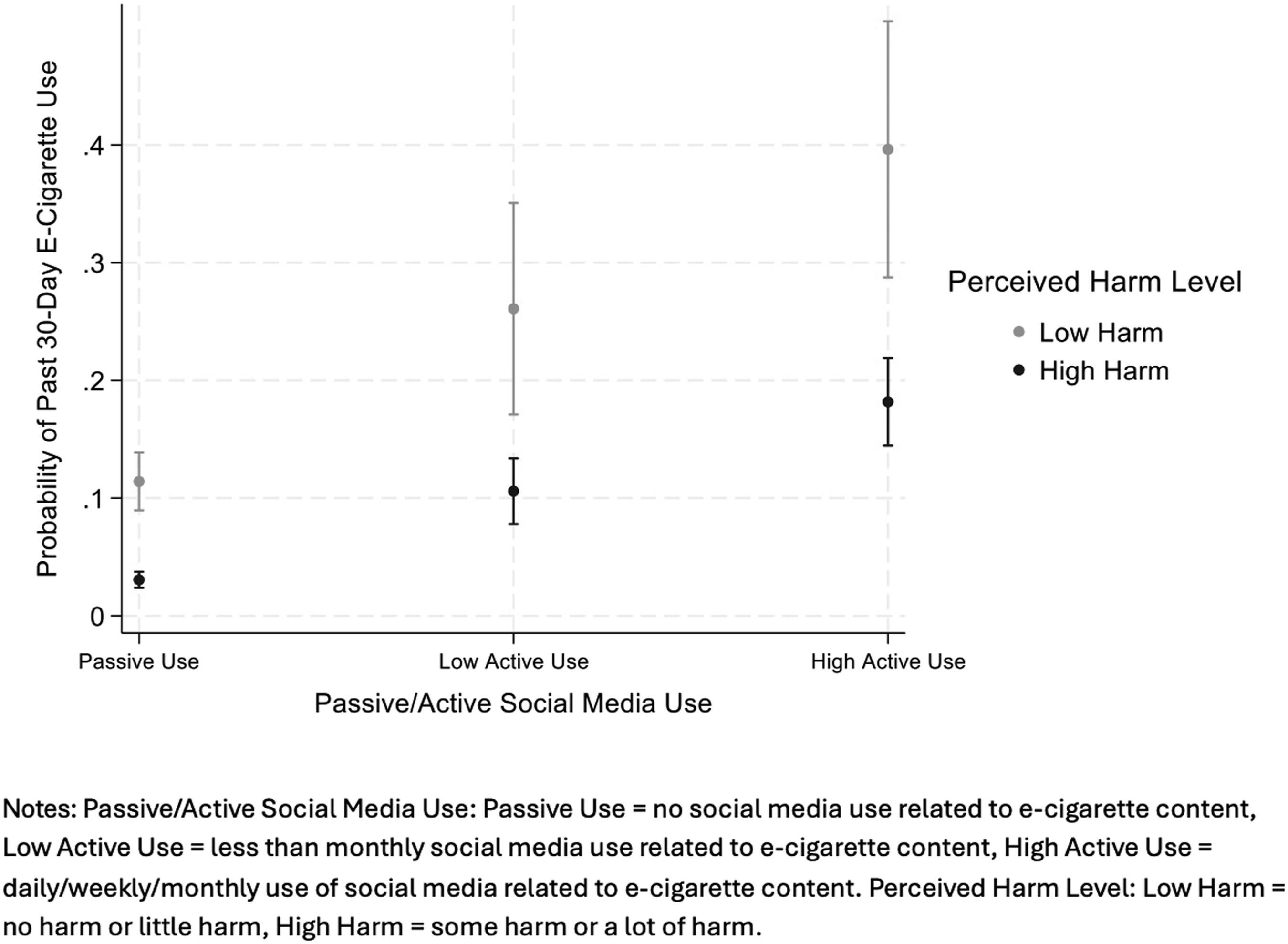
Passive/Active Social Media Use on Probability of Past 30-Day E-Cigarette Use Moderated by Perceived Harm Level
Passive and Active Social Media Use and Perceived Harm Level
Probability of Past 30-Day e-Cigarette Use by Passive/Active Social Media Use and Harm Level: Marginal Effects of Harm Level and Differences in Effects of Harm Across Social Media Groupings
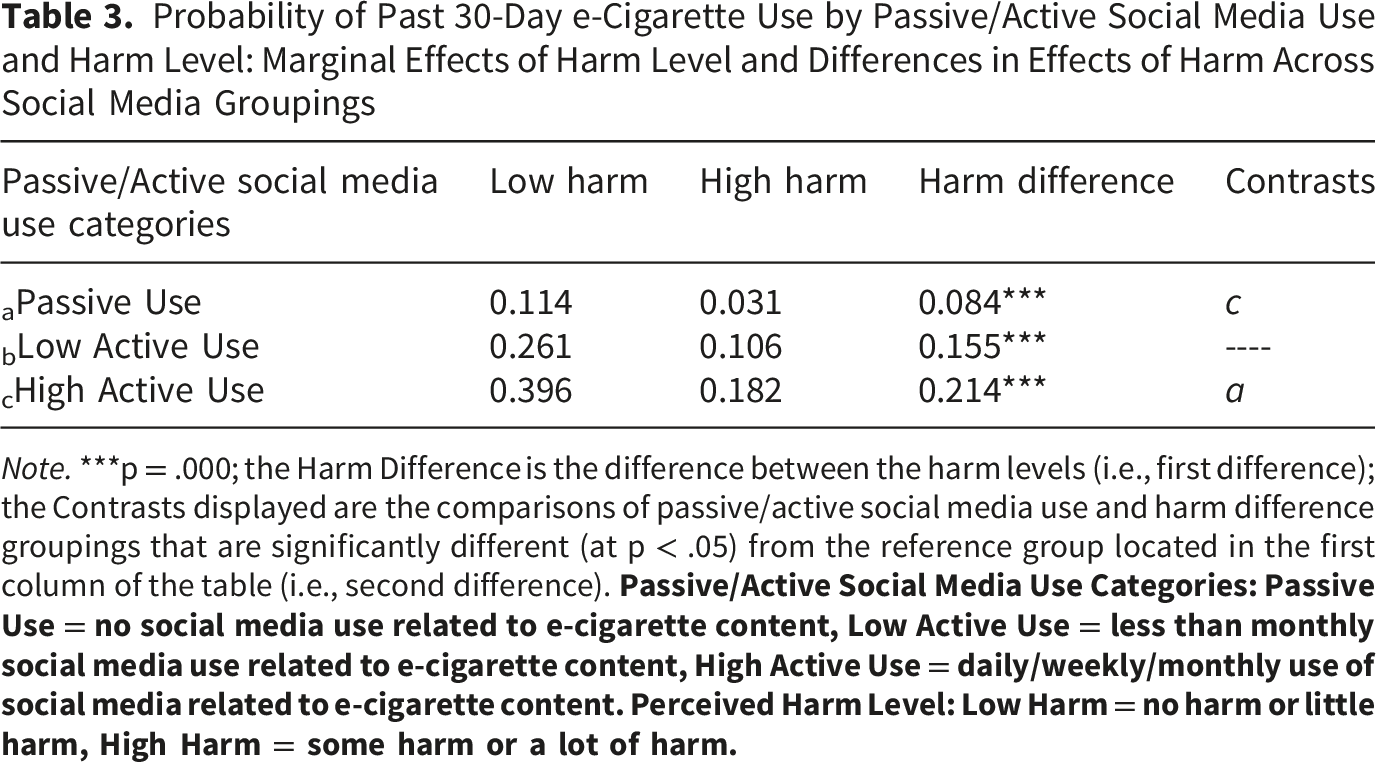
Note. ***p = .000; the Harm Difference is the difference between the harm levels (i.e., first difference); the Contrasts displayed are the comparisons of passive/active social media use and harm difference groupings that are significantly different (at p < .05) from the reference group located in the first column of the table (i.e., second difference).
Post-Hoc Sensitivity Analysis
Respondent Characteristics by Perceived Harm Coding Group: Primary Analysis (Low vs. High Harm) and Post-hoc Sensitivity Analysis (No Harm vs. Any Harm)

Note. Unweighted estimates were calculated from the survey sample; weighted estimates were calculated to approximate the finite population. Race/Ethnicity: AI/AN = American Indian/Alaska Native, NHOPI = Native Hawaiian or Other Pacific Islander, Multiple = more than one race or ethnicity reported. Passive/Active Social Media Use: Passive Use = no social media use related to e-cigarette content, Low Active Use = less than monthly social media use related to e-cigarette content, High Active Use = daily/weekly/monthly use of social media related to e-cigarette content. Perceived Harm Level: Low Harm = no harm or little harm, High Harm = some harm or a lot of harm. Post-hoc analysis conducted for harm-level group comparisons. The sensitivity analysis coding (No Harm vs. Any Harm) is supplementary to the primary analysis.
Discussion
The purpose of the present study was to investigate if the relation between passive and active social media use and e-cigarette use was moderated by levels of perceived harm in a nationally representative sample of youth in the United States. First, we found that levels of perceived harm (i.e., low vs. high) significantly differed within each social media use category; that is, low perceived harm was related to higher probabilities of e-cigarette use as well as the reverse. More importantly, we found that the relation between categories of passive and active social media use and past 30-day use of e-cigarettes was contingent upon levels of perceived harm; that is, a significant interaction existed that supported our main hypothesis. To our knowledge, this is the first study to evaluate perceived harm as a moderator of passive and active social media use and past 30-day e-cigarette use. Our findings provide insight into the nuanced relationship between passive and active social media use, perceived harm, and e-cigarette use and suggest for whom more targeted adolescent prevention strategies for e-cigarettes may be considered.
In the current study, adolescents reporting lower levels of perceived harm had a significantly higher probability of using e-cigarettes in the past 30 days within each of the passive and active social media use categories, compared to adolescents reporting higher levels of perceived harm. These findings are not surprising as lower levels of perceived harm is generally associated with higher rates of adolescent e-cigarette use in prior research.17-19 Overall, adolescents with the highest probability of using e-cigarettes were those reporting lower levels of perceived risk, regardless of the passive and active social media use category.
Our second, and main, finding showed that the relation between adolescent passive and active social media use and the probability of e-cigarette use in the past 30 days was contingent upon the level of perceived harm. In other words, the differences in level of perceived harm (low vs. high) were significantly different between the passive use and high active use social media categories. For example, adolescents with high active use of social media and lower perceived harm had a significantly higher probability of using e-cigarettes in the past 30 days compared to those with passive social media use and low perceived harm. These findings extend the prior research i.e., 11 by indicating for whom the association between passive and active social media use and e-cigarette use changes based on levels of perceived harm; further, suggesting which adolescent groupings are least and most at risk for using e-cigarettes in the past 30 days.
Implications
Findings from the current study provide ideas for enhancing prevention efforts targeting adolescent e-cigarette use. For example, there may be a threshold at which the level of social media use related to e-cigarette content interacts with levels of perceived harm to influence the probability of using e-cigarettes. In the present study, that threshold appeared to be somewhere between passive use and high active use of social media as the low active use category was not significantly different in level of perceived harm compared to the other two categories. These findings suggest that the level of social media use (passive and active) and level of perceived harm may be considered in tandem, rather than separately, for e-cigarette prevention strategies. For example, a first approach may be to target adolescents’ perceptions of harm for the use of e-cigarettes as well as the engagement of social media content related to e-cigarettes. In general, adolescents want to know about the biological effects of using substances32,33 and direct teaching approaches may help youth not only in increasing their accurate knowledge but in informing their attitudes and perceptions 34 as well as subsequently making less risky decisions. 35 As for social media platforms, it is clear that adolescents spend a lot of time on them 23 and receive much of their health-related information from them, 20 including e-cigarette related content. 22 Prevention strategies that rely on passive adolescent exposure to anti-tobacco messaging (including e-cigarettes) may not be sufficient, as some prior literature suggest a paradoxical effect that anti-tobacco messaging exposure on social media may increase the probability of e-cigarette use for individuals with lower levels of perceived harm. 36 Rather, providing adolescents with direct and accurate information on the effects of e-cigarettes and social media exposure is especially important as their brains are still developing and strengthening its ability to make informed decisions.34,37
Our findings also underscore the importance of recent focus on regulating social media access and content, such as age verification, content moderation or bans, and advertising restrictions.22,38 Understanding the influence of active engagement with social media content, one such strategy might be to regulate incentive-based engagement strategies, such as giveaways tied to shares or likes. Such engagement strategies may be especially effective in targeting both influencer- and advertiser-driven campaigns, as youth report high exposure to e-cigarette content from brands and advertisers as well as influencers and celebrities.22,39,40 Considering that our study indicates an inflection point may exist in level of perceived harm as e-cigarette-based social media content exceeds monthly exposure, targeting interventions for this population might be a more efficient strategy in reducing overall levels of e-cigarette usage. As such, an argument may exist for greater regulation on such content, including algorithmic de-prioritization of e-cigarette content designed to generate higher levels of engagement among youth.22,41 In other words, if certain e-cigarette social media content is related to high engagement with adolescents, then limiting how often that content is displayed to youth may mitigate the risk of e-cigarette use in more vulnerable adolescents, particularly those who perceive the use of e-cigarettes as less harmful to their health.
Limitations
While our study contributes meaningful insights about the associations between passive and active social media use, levels of perceived harm, and past 30-day e-cigarette use, some limitations exist. First, the measures of social media engagement related to e-cigarette content were limited in the present study. For example, the measure grouped liking, commenting, and sharing e-cigarette content into a single frequency measurement and did not allow for more detailed analysis of engagement type. Considering this, we suggest that future research consider how varied types of engagement (e.g., liking, commenting) may be differentially related to the use of e-cigarettes. Second, the passive use category in this study is based on participants who responded “Never” to a question about liking, commenting, or sharing e-cigarette content (QN125), which was asked of all social media users. Specifically, this means that passive users included those who had no exposure to e-cigarette-related content on social media as well as those who were exposed but did not engage with the content. Collapsing both the opportunity to engage and the decision to engage into a single construct may limit the interpretation of these findings. Future research would benefit from measures that first confirm exposure to e-cigarette content before assessing engagement.
Additionally, as reported in our post-hoc sensitivity analysis, a large majority of adolescents endorsed some level of harm, with only 3.7% of adolescents endorsing no harm. This constrains the range of alternative harm coding that could be meaningfully evaluated. Although post hoc analysis confirmed that the direction of the effects was consistent across coding schemes, the highly skewed distribution under the alternative No Harm versus Any Harm coding substantially reduced statistical power, potentially failing to reflect a true absence of moderation. Future research would benefit from samples with greater variability in harm perceptions or from continuous harm measurement approaches to allow for more flexible sensitivity testing across a wider range of coding thresholds.
Further, the survey questions in the current study did not allow for temporal or content-related analysis, such as the amount of time spent interacting with promotional e-cigarette content versus public health-related content. We suggest that such variations in time and content may be related to differing e-cigarette outcomes and should be a focus for future research. Third, this current study was based on cross-sectional data, which limits the ability to draw inferences about changes in the relation between social media engagement, perceived harm, and e-cigarette use across time. Thus, we suggest that future research focuses on longitudinal data that can enhance our understanding of the relation between these variables during adolescent development. Finally, other variables beyond those included in the current study are associated with adolescent e-cigarette use such as peer influence, mental health symptomatology, and age of first use for tobacco-based products. Although our study did not address these variables in the analysis, we suggest that examining the moderating effects of competing models with differing independent variables in the same study may be a fruitful avenue for additional research in this area.
Conclusion
In the present study, we found that high versus low perceived harm moderated the relationship between passive and active engagement with e-cigarette-related social media content and past 30-day e-cigarette use for a nationally representative sample of adolescents in the U.S. This interaction was especially notable when comparing adolescents who reported passive versus high active social media use. Based on these findings, prevention strategies targeting adolescent e-cigarette use may be enhanced through tailoring educational messaging and teaching strategies that focus on the potential effects of exposure to e-cigarette related social media content in conjunction with the known biological effects of using e-cigarettes on one’s health. This type of knowledge may be especially important to learn during adolescence as development of the brain continues to unfold and is tied to establishing beliefs and trying out new, and potentially risky, behaviors. Future research may benefit from evaluating how content type, such as engaging with promotional vs. educational e-cigarette posts, is differently associated with perceived harm and e-cigarette use behaviors.
Footnotes
Acknowledgements
The authors have no acknowledgements to report.

Ethical Considerations
This study was reviewed by the Institutional Review Board at the University of Utah (IRB_00189414) institution and determined on 6/19/2025 to not meet the definition of Human Subjects Research under Federal regulations and that IRB oversight was not required.
Consent to Participate
This study involved secondary analysis of a publicly available, de-identified dataset with no interaction with or identification of individual participants.
Author Contributions
Funding
The authors received no financial support for the research, authorship, and/or publication of this article.
Declaration of Conflicting Interests
The authors declared no potential conflicts of interest with respect to the research, authorship, and/or publication of this article.