






Abstract
Background:
Knee osteoarthritis (KOA) is frequently accompanied by quadriceps weakness. Resistance training is recommended, but high-intensity resistance training (HIRT) may be poorly tolerated in some patients, whereas low-intensity resistance training (LIRT) may yield smaller strength gains. Low-intensity blood flow restriction training (LIBFR) has been proposed as a low-load strategy to stimulate muscle adaptations; however, the evidence base has been summarized in multiple systematic reviews with variable conclusions.
Objective:
To synthesize and appraise the evidence on the efficacy and safety of LIBFR in individuals with KOA through an overview of systematic reviews.
Methods:
We searched MEDLINE, EMBASE, Cochrane Database, Web of Science, CINAHL, SPORTDiscus, PEDro, Epistemonikos, and gray literature (ProQuest, Global ETD) for systematic reviews of randomized clinical trials comparing LIBFR with LIRT and/or HIRT. Reviews were eligible if they evaluated supervised exercise-based LIBFR delivered ⩾2 to 3 sessions/week for ⩾4 weeks. Two reviewers independently screened, extracted data, and assessed methodological quality (AMSTAR 2). Certainty of evidence was appraised using Grading of Recommendations Assessment, Development, and Evaluation (GRADE) based on KOA-specific quantitative syntheses, applying a hierarchical approach in the presence of overlap across reviews.
Results:
Eighteen systematic reviews (57 randomized trials; 5656 participants) were included. Compared with LIRT, LIBFR was associated with greater improvements in quadriceps strength (standardized mean difference [SMD] = 0.75; 95% confidence interval [CI] = [0.40 to 1.10]) and muscle hypertrophy (SMD = 0.81; 95% CI = [0.10 to 1.52]), although certainty of evidence was very low. Compared with HIRT, LIBFR was associated with fewer adverse events (risk ratio [RR] = 0.26; 95% CI = [0.09 to 0.72]).Across comparisons, effects on pain and functional outcomes were generally similar, and between-group differences were not consistently observed.
Conclusions:
The LIBFR may improve quadriceps strength and hypertrophy relative to LIRT and may have a more favorable adverse-event profile than HIRT, but confidence in these estimates is limited by low-/very low-certainty evidence and variability in protocols and reporting. Well-designed, longer-term randomized trials with standardized LIBFR parameters and robust safety reporting are needed to clarify patient-important outcomes.
Keywords
Background
Osteoarthritis (OA) is the most prevalent form of arthritis worldwide, affecting approximately 302 million people and imposing a major public health and economic burden. 1 Knee osteoarthritis (KOA) is among the leading causes of disability in older adults. 1 Osteoarthritis is a complex, chronic, degenerative joint disease that involves not only cartilage but also multiple joint tissues, including subchondral bone, synovium, ligaments, and periarticular musculature.1,2
Clinically, KOA is commonly characterized by pain and stiffness (often after inactivity), reduced range of motion, effusion, and muscle weakness, contributing to reduced function, participation, and quality of life (QoL).3,4 Knee osteoarthritis is also associated with impaired balance/proprioception and increased fall risk. 5 Risk factors include non-modifiable factors (age and female sex) and modifiable factors such as obesity, low physical activity, persistent joint overload, muscle imbalances, and reduced lower-limb muscle mass and strength.6-8
Current management is multimodal and typically combines pharmacological and non-pharmacological strategies. 9 In advanced cases, total knee arthroplasty may be considered when conservative care fails to provide adequate symptom relief or functional improvement. 10 Due to limited long-term benefits of medication and the need to address functional limitations, guidelines increasingly emphasize non-pharmacological approaches such as education, self-management, weight loss (when appropriate), and structured exercise.9,11,12 Progressive resistance training is strongly recommended because quadriceps weakness is a consistent clinical finding and is associated with knee pain and disability in OA.13-15 Accordingly, resistance exercise is frequently endorsed as a first-line non-pharmacological therapy. 16
High-intensity resistance training (HIRT; ~60-85% of 1-repetition maximum [1RM]) is traditionally recommended to optimize hypertrophy and strength gains in healthy populations. 17 However, in KOA, higher external loads may be poorly tolerated due to pain, symptom exacerbation, or concerns regarding mechanical stress. 18 Low-intensity resistance training (LIRT) is often more tolerable but typically produces smaller hypertrophy/strength gains than HIRT.19,20 Low-intensity blood flow restriction training (LIBFR) has emerged as a potential strategy to elicit strength and hypertrophy adaptations with low external loads. 18 Several systematic reviews have examined LIBFR in KOA, but conclusions remain inconsistent and/or uncertain regarding effectiveness and safety.4,18,21-24 Therefore, an overview of systematic reviews (review of reviews) may help consolidate the evidence, clarify consistencies and discrepancies across reviews, and provide a more accessible synthesis for clinicians and stakeholders.25,26 Overviews can serve as a pragmatic entry point to the literature by integrating findings from multiple systematic reviews into a single synthesis and supporting evidence-informed decision-making.25,27
Objective
This overview of systematic reviews evaluates the evidence on LIBFR for KOA, comparing it to standard low-intensity and high-intensity protocols. The goal is to clarify whether LIBFR offers unique benefits or poses distinct risks regarding pain, muscle strength, hypertrophy, physical function, self-reported function, QoL, and adverse events. It also examines the methodological quality of the included reviews and assesses the overall certainty of the evidence using established frameworks.
Methods
Registration Protocol
This overview of systematic reviews adhered to recommendations provided in the Cochrane Handbook for Systematic Reviews of Interventions. 28 The report was prepared following the Preferred Reporting Items for Systematic Reviews and Meta-Analyses (PRISMA) guidelines (Supplemental Appendix 1). 29 The study protocol was registered in the International Prospective Register of Systematic Reviews (PROSPERO): CRD42022367209. Adherence to these standards ensured transparency, reproducibility, and methodological rigor.
Inclusion Criteria for Systematic Reviews
Types of Systematic Reviews
We searched for both Cochrane and non-Cochrane systematic reviews that evaluated randomized controlled trials (RCTs) and quasi-randomized trials (quasi-RCTs). The Quasi-RCTs were considered because, in certain contexts, the allocation process—while not strictly randomized—may still provide meaningful comparative data relevant to our research questions, in accordance with guidance from the Cochrane Handbook. Eligible systematic reviews had to present a clearly defined search strategy, explicit inclusion and exclusion criteria, and a synthesis of included studies (quantitative or qualitative). Reviews were required to provide a critical appraisal of the included studies, including risk of bias assessment. In addition, reviews that reported the certainty of evidence, for instance, by using the Grading of Recommendations Assessment, Development, and Evaluation (GRADE) approach, were considered more informative. Narrative reviews without systematic methods, diagnostic/prognostic reviews, economic evaluations, or other non-systematic review types were excluded. If a systematic review included non-randomized studies but allowed separate extraction of RCT data, it remained eligible.
Types of Participants
This overview included systematic reviews of individuals over 40 with KOA diagnosed by clinical criteria or imaging. The Knee Osteoarthritis Outcome Score (KOOS) and Western Ontario and McMaster Universities Osteoarthritis Index (WOMAC) helped characterize symptom severity but were not the sole diagnostic methods.30-32 Participants underwent LIBFR. Reviews covering other populations (eg, postoperative patients, athletes) were excluded unless KOA data were reported separately, ensuring greater homogeneity. This approach accounted for differing rehabilitation protocols in postsurgical or athletic groups compared with standard KOA management, thus maintaining a more consistent clinical profile within the included populations.
Types of Interventions
We considered systematic reviews evaluating LIRT (20-40% 1RM) with blood flow restriction (BFR) vs conventional low- or high-intensity exercise in KOA. Both open and closed kinetic chain exercises were included at least twice weekly for at least 4 weeks. The BFR typically involves using pneumatic cuffs on the proximal leg to partially occlude venous return, enhancing the training stimulus at lower loads.
Types of Outcomes Measured
Primary outcomes were pain, muscle strength, hypertrophy, and physical function. Pain used validated scales (visual analog scale [VAS], WOMAC Pain, KOOS Pain); strength used isometric or isokinetic dynamometry; hypertrophy used magnetic resonance imaging (MRI) or ultrasound; and function used performance-based tests (Time Up and Go [TUG], gait speed, 6-Minute Walk) plus self-reported scales (WOMAC Function, KOOS Function). Follow-ups (4-12 weeks) may limit long-term inferences, especially for hypertrophy or QoL. Secondary outcomes were intervention formats, adverse events, and QoL. Although QoL (Short Form-36 Health Survey [SF-36], 5-level EQ-5D version [EQ-5D]) is critical, it was secondary to streamline data synthesis. Results were grouped by intervention type and follow-up duration, noting short follow-ups might not reveal full improvements or harms.
Exclusion Criteria
We excluded (1) non-systematic reviews (eg, narrative reviews, expert opinions) or reviews without a reproducible search strategy; (2) reviews not primarily synthesizing RCTs/quasi-RCTs; (3) reviews in which the target population was not KOA or where KOA data could not be isolated; (4) interventions not matching LBFR (eg, BFR applied without exercise, aerobic-only BFR, or non-rehabilitative modalities); (5) interventions delivered <2 sessions/week and/or <4 weeks, because these doses are less likely to capture training-related adaptations and would increase clinical and statistical heterogeneity; (6) reviews without patient-relevant outcomes of interest (pain, strength, hypertrophy, or function); and (7) conference abstracts, protocols, and duplicate publications.
Data Sources and Research Strategy
Under the guidance of an experienced librarian (FRAS), 2 independent reviewers (FAM, GJA) conducted a comprehensive search of the following databases:
PubMed (via MEDLINE OvidSP) (searched May 15, 2023).
EMBASE (OvidSP) (searched May 17, 2023).
Cochrane Database of Systematic Reviews (Cochrane Library) (searched May 18, 2023).
Web of Science Core Collection (SCI-EXPANDED) (searched May 24, 2023).
CINAHL & Sports Discuss (via EBSCO host) (searched July 11, 2023).
PEDro (searched June 8, 2023).
Epistemonikos (searched July 19, 2023).
Gray literature via ProQuest: Brazilian Digital Library of Theses and Dissertations (BDTD), Global ETD Search (Networked Digital Library of Theses and Dissertations) (searched July 19, 2023).
Although we explored theses and dissertations, other potentially relevant sources of gray literature—such as trial registries or preprint repositories—were not systematically searched, which may limit the identification of recent or unpublished studies. We employed a search strategy based on the PICOS framework (Population, Intervention, Comparator, Outcome, Study design), using both MeSH terms and non-indexed keywords to capture a broader range of literature. Boolean operators (AND, OR, NOT) were applied to refine the search (see Supplemental Appendices 2 and 3). No date or language restrictions were imposed. Additionally, we performed backward citation searching of reference lists in eligible reviews and consulted experts in the field to identify any overlooked sources.
Data Collection and Analysis
Search results were exported to the Rayyan platform (http://rayyan.qcri.org) for deduplication and screening. Two independent reviewers (FAM, GJA), blinded to each other’s decisions, screened titles and abstracts. Disagreements were resolved by consensus or by involving a third reviewer (WRM). The full texts of potentially eligible reviews were then obtained for further assessment based on the predefined inclusion/exclusion criteria. The PRISMA flowchart was used to document each stage of the selection process.
Data Extraction and Management
We used a standardized data extraction form to ensure consistency and extracted the following from each included review:
Review Features: Objectives, inclusion criteria, participant details, interventions, comparators, outcomes, databases searched, dates, and language restrictions.
Primary Study Characteristics: Study design, sample sizes, participant demographics, intervention details, outcome measures, and bias assessments.
Results: Effect estimates (mean or standardized mean differences [SMDs], risk ratio [RRs]), confidence intervals (CIs), heterogeneity (I2), and any GRADE ratings.
Additional Details: Protocol registration, funding sources, conflicts of interest, and relevant methodological data.
Two reviewers (FAM, GJA) performed data extraction independently, resolving discrepancies by discussion or a third reviewer (WRM). No vital information was missing, so no authors were contacted.
Because overlapping primary studies can affect overviews, we mapped all trials from each review and calculated the Corrected Covered Area (CCA). 33 The degree of overlap was noted in tables, described in section “Results,” and considered in section “Discussion” to inform conclusions. This step aimed to minimize bias from duplicated data across multiple reviews.
Assessment of Methodological Quality of Included Reviews
We used the “A Measurement Tool to Assess Systematic Reviews” (AMSTAR 2) 34 to evaluate the methodological quality and risk of bias of the included reviews. Two authors (FAM, GJA) independently scored each review on AMSTAR 2’s 16 items. Discrepancies were resolved by consensus or via a third reviewer (WRM). Following AMSTAR 2 guidelines, we did not generate an overall score but instead classified the confidence in each review’s findings as high, moderate, low, or critically low.
Data Synthesis
We prespecified that systematic reviews including mixed clinical populations would be retained for descriptive mapping of LIBFR implementation (eg, variation in cuff width, pressure prescription, load, and frequency), provided they included a KOA component. However, quantitative synthesis and GRADE were restricted to effect estimates derived from KOA participants only, using reviews that conducted KOA-specific meta-analyses or reported KOA subgroup data that were clearly separable from other conditions.
We employed a narrative synthesis, with summary tables and figures to present findings. When effect estimates were available, we reported means, SMDs, and 95% CIs. Heterogeneity was assessed using the I2 statistic; high heterogeneity prompted subgroup analyses and potential outlier exclusion to explore variability. 33 We documented evidence quality with GRADE, relying on reviews’ assessments or performing our own. Because multiple reviews addressed similar topics with overlapping primary studies, we prioritized Cochrane reviews, then the most recent, highest-quality (AMSTAR 2), and most comprehensive. Sensitivity analyses evaluated how selection priorities affected conclusions, ensuring robustness despite possible overlap.
Subgroup Analysis and Heterogeneity Assessment
We examined predefined subgroups, such as comparisons of LIBFR vs LIRT and LIBFR vs HIRT, as well as sex differences. Where subgroup data were not explicitly reported in the systematic reviews, we relied on available subgroup analyses or attempted to extract and interpret the data narratively.
Sensitivity Analysis
We performed sensitivity analyses to investigate the robustness of effect estimates when applying our hierarchical criteria for selecting representative data from overlapping reviews. The purpose was to determine whether different priority approaches led to different interpretations of the findings.
Summarizing the Evidence and Grading of Recommendations Assessment, Development, and Evaluation
For GRADE assessments, we evaluated certainty only for comparisons and outcomes informed by KOA-specific data. Consequently, indirectness was not downgraded due to mixed populations in reviews retained for descriptive purposes, because those reviews did not contribute non-KOA data to pooled effects or to GRADE.
We used GRADE to assess the certainty of evidence across the included systematic reviews. The GRADE approach considers risk of bias, inconsistency, indirectness, imprecision, and publication bias. 35 We generated evidence summary tables using GRADEpro GDT software (https://www.gradepro.org/). When reviews did not report GRADE, we conducted our own GRADE judgments following standard guidelines and using the information reported by the systematic reviews.
Results
Selection of Reviews
The database searches identified 251 records: 10 from PubMed via MEDLINE, 15 from EMBASE, 46 from the Cochrane Database of Systematic Reviews, 12 from Web of Science, 7 from CINAHL and Sports Discuss, 26 from PEDro, 37 from Epistemonikos, and 98 from gray literature sources. After removing 35 duplicates, 216 references remained for screening. Following the title and abstract review, 198 records were excluded, leaving 18 full-text systematic reviews that met the inclusion criteria (Figure 1—PRISMA flowchart).
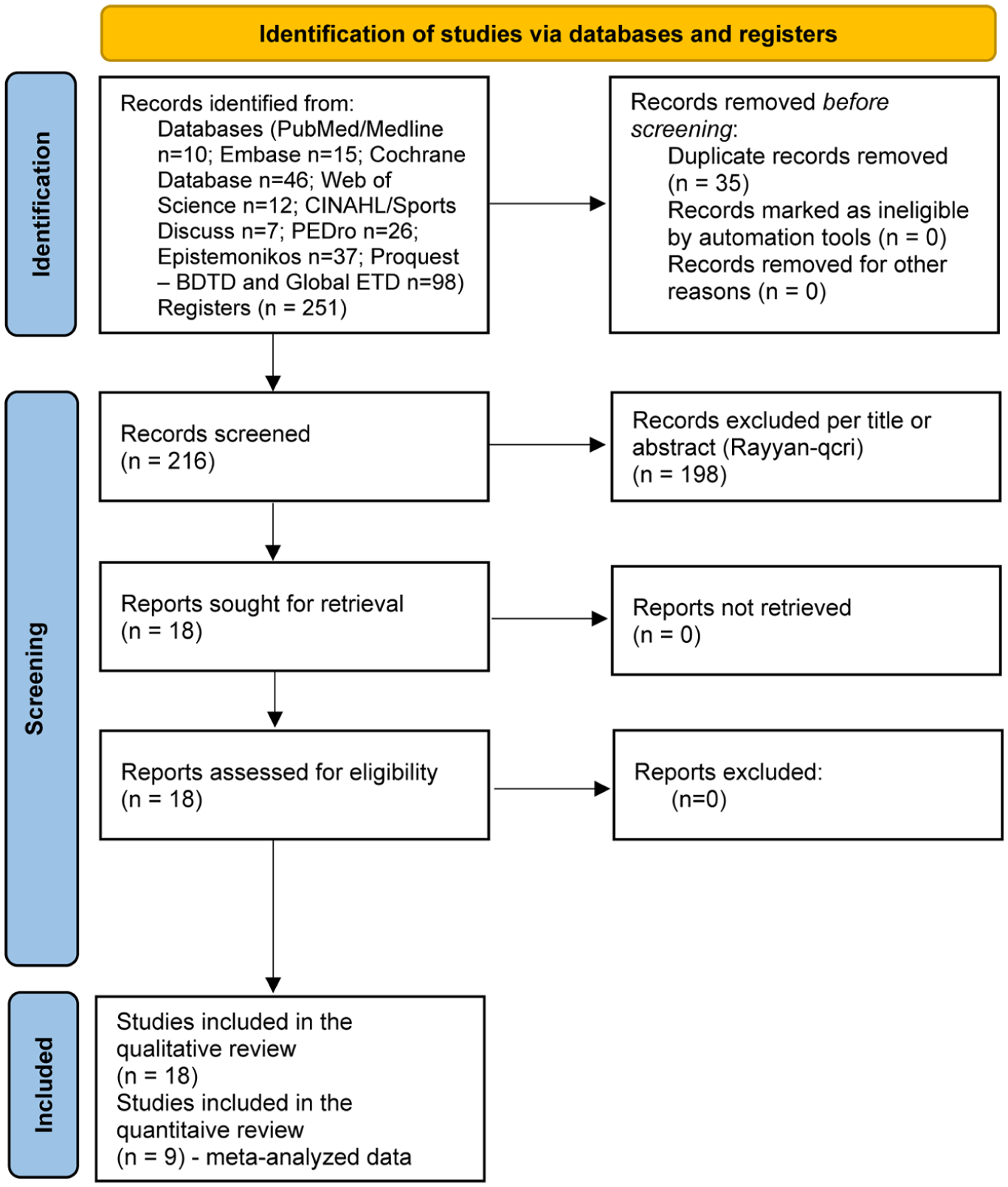
PRISMA 2020 flow diagram for new systematic reviews, which included searches of databases, registers, and other sources.
Description of Included Reviews
We included 18 systematic reviews investigating LIBFR in individuals with KOA or including it as a subgroup, summarizing their characteristics in Table 1. Most reviews comprised RCTs and compared LIBFR with LIRT or HIRT. The interventions lasted 4 to 12 weeks at frequencies of 2 to 3 sessions per week. Overall, these reviews covered 5656 participants. The earliest review is dated to March 2016 and the latest to October 2022.36,37
Summary of Characteristics of Systematic Reviews Evaluating Blood Flow Restriction in Knee Osteoarthritis..
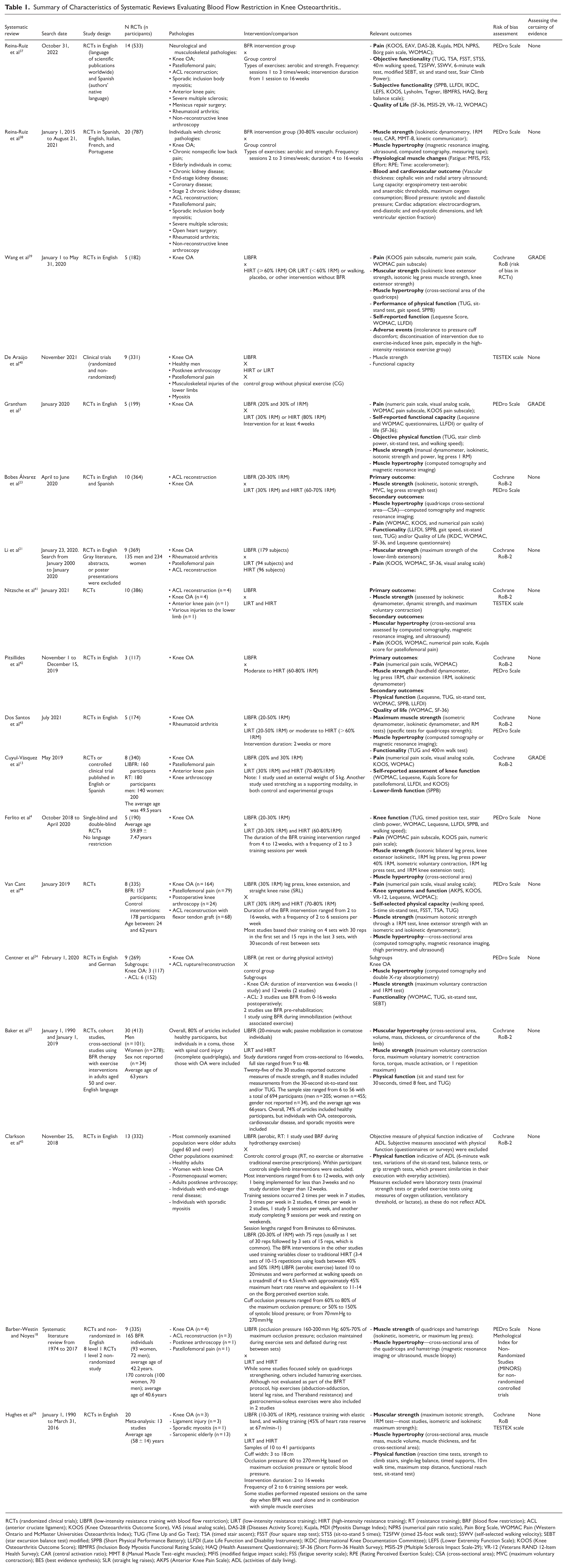
RCTs (randomized clinical trials); LIBFR (low-intensity resistance training with blood flow restriction); LIRT (low-intensity resistance training); HIRT (high-intensity resistance training); RT (resistance training); BRF (blood flow restriction); ACL (anterior cruciate ligament); KOOS (Knee Osteoarthritis Outcome Score), VAS (visual analog scale), DAS-28 (Diseases Activity Score); Kujala, MDI (Myositis Damage Index); NPRS (numerical pain ratio scale), Pain Börg Scale, WOMAC Pain (Western Ontario and McMaster Universities Osteoarthritis Index); TUG (Time Up and Go Test); TSA (timed stair ascent); FSST (four square step test); STS5 (sit-to-stand 5 times); T25FW (timed 25-foot walk test); SSWV (self-selected walking velocity); SEBT (star excursion balance test) modified; SPPB (Short Physical Performance Battery); LLFDI (Late Life Function and Disability Instrument); IKDC (International Knee Documentation Committee); LEFS (Lower Extremity Function Scale); KOOS (Knee Osteoarthritis Outcome Score); IBMFRS (Inclusion Body Myositis Functional Rating Scale); HAQ (Health Assessment Questionnaire); SF-36 (Short Form-36 Health Survey); MSIS-29 (Multiple Sclerosis Impact Scale-29); VR-12 (Veterans RAND 12-Item Health Survey); CAR (central activation ratio); MMT 8 (Manual Muscle Test–eight muscles); MFIS (modified fatigue impact scale); FSS (fatigue severity scale); RPE (Rating Perceived Exertion Scale); CSA (cross-sectional area); MVC (maximum voluntary contraction); BES (best evidence synthesis); SLR (straight leg raises); AKPS (Anterior Knee Pain Scale); ADL (activities of daily living).
Several included systematic reviews addressed LIBFR across broader clinical populations.22,37,38 These reviews were retained to illustrate the breadth and variability of LIBFR application and were appraised with AMSTAR 2. Importantly, they were used for descriptive synthesis only and did not contribute to the quantitative meta-analyses or to the GRADE certainty ratings, which were informed exclusively by KOA-specific data.
Initially, these reviews examined various populations (eg, patellofemoral pain, anterior cruciate ligament (ACL) reconstruction, multiple sclerosis, sarcopenia, rheumatoid arthritis). To reduce heterogeneity and concentrate on KOA, they conducted separate meta-analyses for KOA only, excluding data from other populations. As a result, individuals with distinctly different conditions were omitted, ensuring that findings more accurately reflect the efficacy and safety of interventions for KOA. Any remaining heterogeneity within the KOA subgroup was also assessed and reported.
Of the 18 reviews, only 4 focused solely on KOA, with 3 performing meta-analyses.3,4,39 Most studies evaluated outcomes related to pain, muscle strength, muscle hypertrophy, physical function, QoL, and adverse events. In several cases, we performed further meta-analyses (using Review Manager) to refine the data and remove results combined with other pathologies, maintaining focus on KOA populations.
In total, these reviews included 57 primary studies. Although many searched multiple languages, English prevailed, with fewer studies reported in Spanish, German, French, Italian, and Portuguese.
Divergent Recommendations Across Reviews
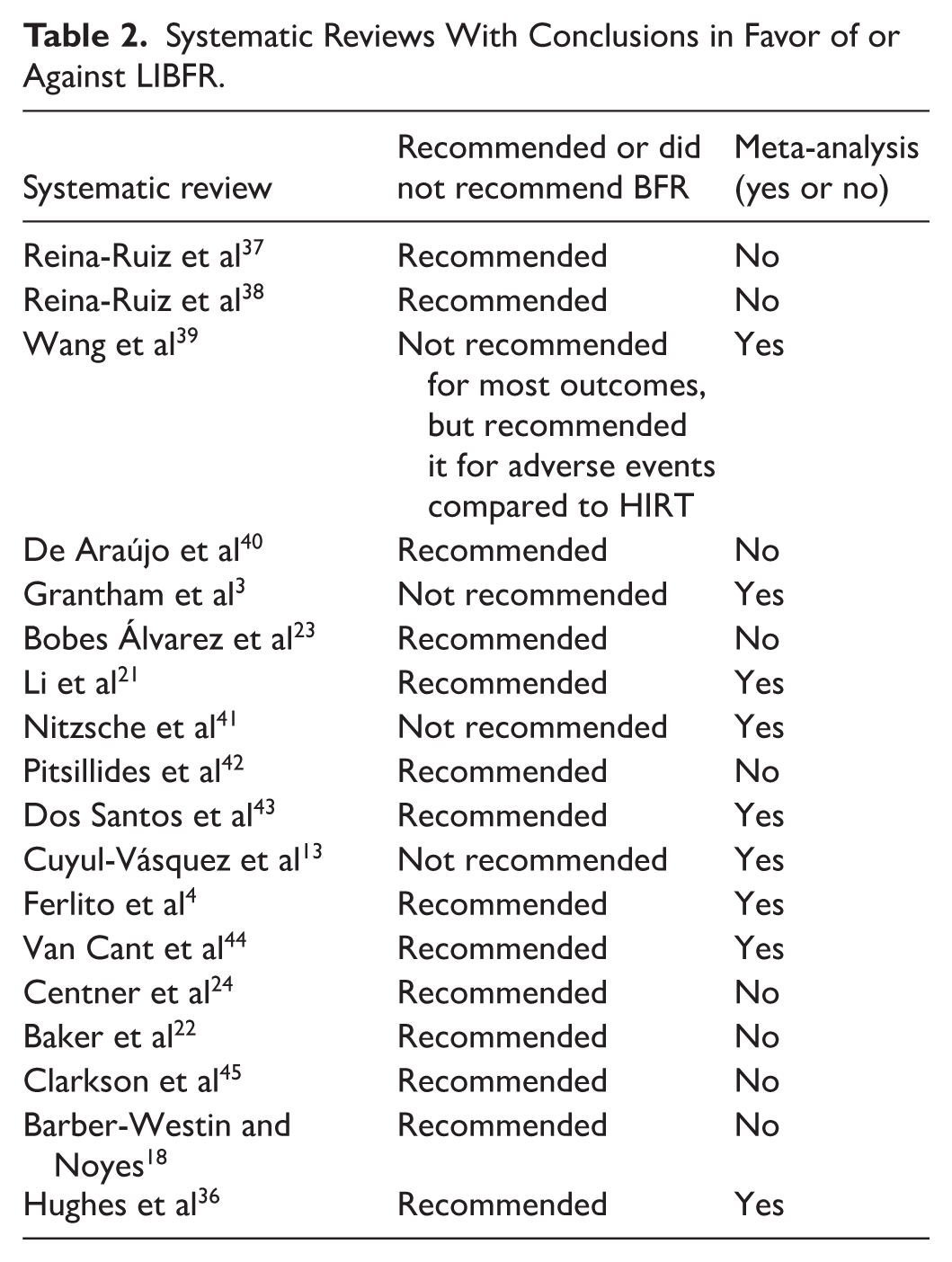
We observed disagreements among the included reviews regarding the clinical recommendation for LIBFR. Of the 18 reviews, 14 (77.7%) suggested LIBFR as a beneficial intervention, while 3 (16.6%) found no advantage. One review 39 did not recommend the use of LIBFR for most outcomes but highlighted that LIBFR might be safer compared with HIRT regarding adverse events. Interestingly, the reviews that did not recommend LIBFR tended to be those that performed meta-analyses, whereas those favoring the approach relied more on narrative syntheses. Table 2 summarizes these findings and highlights the differences in recommendations and the presence or absence of meta-analytic data.
Systematic Reviews With Conclusions in Favor of or Against LIBFR.
Conflicts of Interest and Funding
Among the 18 reviews, 16 reported no conflict of interest, while 2 did not report on this issue. Four reviews documented independent funding sources through university grants, government research bodies, or strategic academic partnerships.21,38,39,45 The remaining reviews either lacked funding or did not report funding sources. Table 3 presents these details.
Conflict of Interest and Funding Source for Systematic Reviews.

Overlap of Studies
We observed moderate overlap among primary studies in these systematic reviews (overlap = 57.8%; CA = 14.9%; CCA = 9.9%). Five core trials were repeatedly cited in KOA-focused analyses, possibly skewing overall conclusions.16,46-49 To mitigate this, we used a hierarchical approach, prioritizing (1) the most recent 39 and (2) the most comprehensive 3 reviews when reporting estimates, and also applied AMSTAR 2 to confirm the robustness of heavily repeated trials. This strategy helped assess whether frequently cited studies distorted conclusions, examine methodological quality, and preserve potentially relevant evidence. Although prioritizing recency and comprehensiveness reduces duplication, we remain mindful of unique insights from other reviews and acknowledge the potential impact of overlap.
Methodological Quality of Included Reviews (AMSTAR 2)
We judged the methodological quality of each included review using AMSTAR 2. The overall confidence ratings were as follows:
Table 4 provides a narrative summary of our AMSTAR 2 judgments. Reviews with moderate confidence generally provided a more accurate and comprehensive summary of the evidence. Those rated as low or critically low had methodological shortcomings that limited the reliability and interpretability of their findings.
AMSTAR 2 Summary for Reviews Evaluating Blood Flow Restriction in Knee Osteoarthritis.
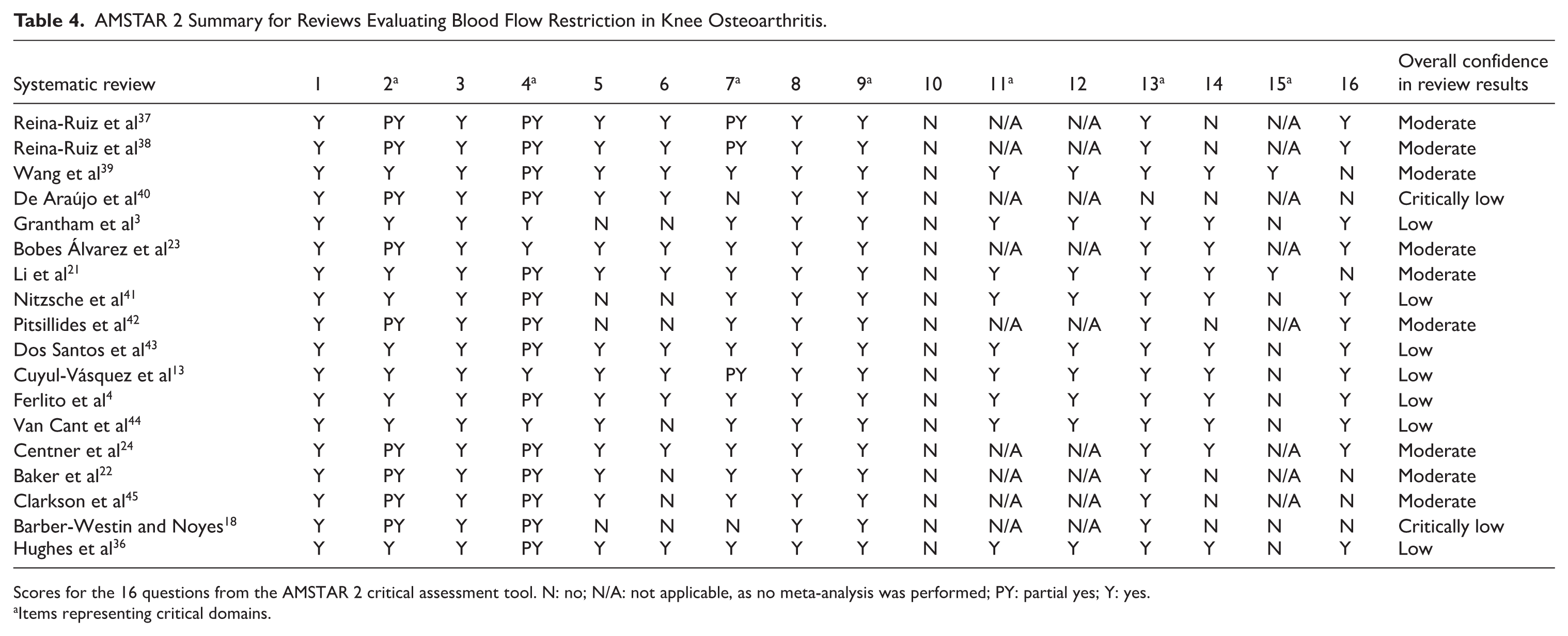
Scores for the 16 questions from the AMSTAR 2 critical assessment tool. N: no; N/A: not applicable, as no meta-analysis was performed; PY: partial yes; Y: yes.
Items representing critical domains.
Risk of Bias of Prioritized Reviews
Since we prioritized both Grantham et al 3 and Wang et al 39 for meta-analysis results, we carefully examined the risk of bias in their included primary RCTs (Figure 2). Across both reviews, the risk of bias ranged from very low to moderate, indicating that no trial reached a critical level of concern. Nonetheless, some domains—particularly blinding and selective outcome reporting—showed moderate risk, which may influence the direction or magnitude of the estimated effects.

(A) Summary of risk of bias in the included studies. (B) Risk of bias as percentages across all included studies.
In Grantham et al, 3 sensitivity analyses and subgroup analyses were conducted to explore heterogeneity and evaluate the robustness of findings, specifically comparing LIRT, HIRT, and LIBFR, as well as differences by gender (male vs female). Although these subgroup analyses provide insights into potential effect modifiers, the presence of moderate-risk studies still calls for cautious interpretation of pooled results. 3
Overall, the variability in methodological quality across the included RCTs underscores the need for well-designed, high-quality trials in future research. Such studies, combined with further sensitivity analyses (eg, excluding lower-quality data), would enhance our understanding of the true impact of these interventions on KOA outcomes.
Effects of the Interventions
Primary Outcomes
Pain
Pain measurement tools used in the primary studies included numerical rating scales, visual analog scales, and the pain subscales of WOMAC and KOOS. All systematic reviews performing meta-analyses, including Grantham et al 3 and Wang et al, 39 concluded that there were no statistically significant differences in pain reduction between LIBFR and either LIRT or HIRT in KOA. The certainty of the evidence ranged from low to moderate. Overall, LIBFR did not appear superior to conventional resistance training for reducing pain in individuals with KOA.
Muscle Strength
Muscle strength was assessed via handheld or isokinetic dynamometry and 1RM testing. In general, the included reviews reported no significant differences between LIBFR and LIRT or HIRT for strength gains. The certainty of the evidence varied (very low, low, moderate). However, 1 review 21 found that LIBFR led to greater strength gains compared with LIRT (SMD = 0.75; 95% CI = [0.40 to 1.10]; I2 = 56%; 3 studies; 139 participants) with low-certainty evidence. This isolated finding suggests that, under some conditions or specific protocols, LIBFR may provide a strength advantage over low-load exercise without BFR.
Functionality/Physical Function
Functionality outcomes included performance-based tests such as the TUG, 400-m walk test, gait speed tests, sit-to-stand tests, and stair-climbing tasks. The meta-analyses showed no significant differences between LIBFR and LIRT or HIRT for improving these functional metrics. The certainty of evidence was classified between very low and moderate. Thus, from an overall perspective, adding BFR to low-intensity exercises did not yield clear functional performance improvements beyond those achieved with standard approaches.
Self-Reported Function
Scales such as WOMAC, Lequesne, SF-36, and the Late Life Function and Disability Instrument (LLFDI) were used to evaluate self-reported function. Neither Wang et al 39 nor Van Cant et al 44 identified notable differences between LIBFR and traditional resistance training approaches for self-reported functional improvement. Certainty of evidence was low to moderate. Thus, patient-perceived improvements in their functional status were not significantly altered by the addition of BFR.
Muscular Hypertrophy
Muscle volume and cross-sectional area assessments were conducted via imaging techniques such as computed tomography or MRI. Van Cant et al 44 observed that LIBFR produced greater muscular hypertrophy compared with LIRT (SMD = 0.81; 95% CI = [0.10 to 1.52]; I2 = 52%; 2 studies; 72 participants), with very low-certainty evidence. Dos Santos et al 43 also reported increases in muscle mass in both HIRT (+8%; P < .0001) and LIBFR (+7%; P < .0001). These findings suggest that when hypertrophy is a key target, adding BFR to low-load training might enhance muscle growth to a degree that is more comparable to high-load training.
Secondary Outcomes
Quality of Life
None of the included reviews conducted a meta-analysis specifically for QoL outcomes in KOA. Thus, evidence regarding LIBFR’s impact on QoL remains sparse and inconclusive.
Adverse Events
Wang et al 39 reported 4 primary studies noting participant exclusions due to adverse events, with the most common being exercise-induced knee pain. Pooled analyses (RR = 0.45; 95% CI = [0.20 to 1.01]; P = .05; I2 = 0%) indicated no significant difference in the rate of adverse events between LIBFR and traditional exercise interventions. However, when comparing LIBFR with HIRT specifically, some data suggest fewer adverse events in the LIBFR group, possibly due to lower mechanical stress on the joint. 39
Certainty of Evidence—Grading of Recommendations Assessment, Development, and Evaluation
Of the 9 systematic reviews with meta-analyses, 3 applied GRADE.3,13,39 For the other 6, we conducted our own GRADE assessments.4,21,36,41,43,44 The GRADE analyses frequently downgraded the certainty due to inconsistency (heterogeneity in results), imprecision (small sample sizes), and publication bias. None of the included evidence sets were downgraded for indirectness, as the populations and interventions generally matched our inclusion criteria. The certainty of evidence according to GRADE, together with the sensitivity analysis of LIBFR in knee osteoarthritis, is summarized in Table 5.
Summarizing the Evidence (GRADE) and Sensitivity Analysis of LIBFR in Knee Osteoarthritis.
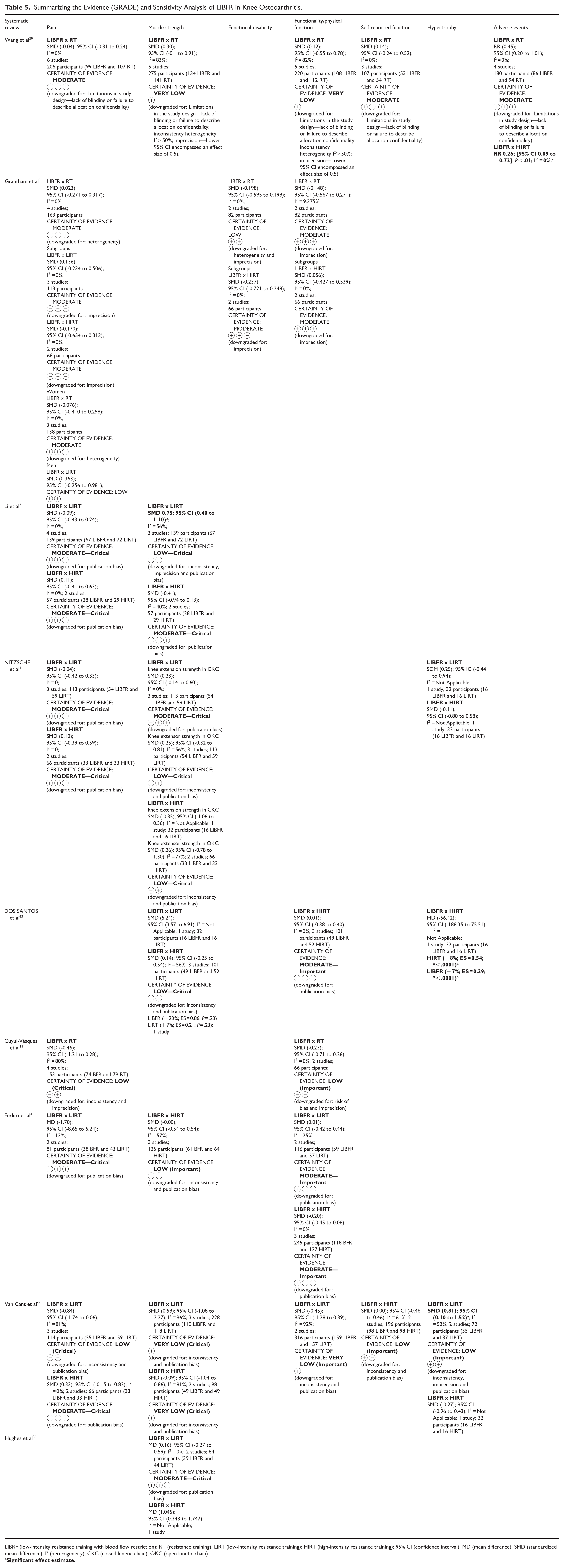
LIBRF (low-intensity resistance training with blood flow restriction); RT (resistance training); LIRT (low-intensity resistance training); HIRT (high-intensity resistance training); 95% CI (confidence interval); MD (mean difference); SMD (standardized mean difference); I2 (heterogeneity); CKC (closed kinetic chain); OKC (open kinetic chain).
Significant effect estimate.
Subgroup Analysis
We relied on Grantham et al 3 for more comprehensive subgroup assessments. Comparing LIBFR and LIRT or LIBFR and HIRT revealed no differences in pain, functional disability, or mobility/balance outcomes. The evidence ranged from low to moderate certainty. Similarly, no differences by sex were observed, although the data were limited. In both women and men with KOA, LIBFR did not differ significantly in pain reduction when compared with other forms of exercise. 3
Sensitivity Analysis
Sensitivity analyses comparing Grantham et al 3 and Wang et al 39 against other reviews found that most effect estimates aligned with these 2 key reviews. Differences in selected primary studies or weighting did not significantly alter the conclusions. Removing outlier studies 48 affected heterogeneity but did not change the direction or statistical significance of results.
While some reviews21,44 demonstrated more favorable outcomes of LIBFR on muscle strength and hypertrophy compared with LIRT; Grantham et al 3 and Wang et al 39 reported more neutral effects. For adverse events, Wang et al 39 suggested fewer complications in LIBFR compared with HIRT.
Discussion
Summary of Main Findings
This overview synthesized evidence from systematic reviews evaluating LIBFR in individuals with KOA. Across reviews, LIBFR generally appeared feasible and capable of producing measurable improvements in muscle-related outcomes—particularly quadriceps strength and, in some contexts, hypertrophy-related proxies—when compared with LIRT. In contrast, the superiority of LIBFR over comparator exercise approaches for pain relief and functional outcomes was not consistently demonstrated. The overall interpretability of these findings is constrained by heterogeneity in intervention protocols, short intervention windows in many primary trials, variability in review methods and eligibility criteria, and incomplete harm reporting.3,4,39,44
Interpreting the Dissociation Between Strength Gains and Pain/Function Outcomes
A key clinical and methodological observation is the recurrent dissociation between more responsive strength outcomes and less consistent pain and function outcomes. This pattern is plausible because muscle capacity is a proximal physiological target of LIBFR, whereas pain and disability in KOA are multifactorial and influenced by joint irritability, peripheral and central sensitization processes, psychosocial context, sleep and mood, habitual activity patterns, and overall load tolerance. Consequently, LIBFR may generate neuromuscular adaptations that are detec on objective testing (eg, dynamometry) without necessarily modifying the broader determinants that sustain pain and functional limitation.1,3,4,39
In addition, functional outcomes are task-dependent. Improvements in quadriceps strength assessed under controlled conditions do not guarantee transfer to activities such as stair negotiation, sit-to-stand, or prolonged walking unless training includes task-specific progression, graded exposure to functional loading, and concomitant gains in confidence and movement tolerance. Where comparator programs are well structured, pain and function may improve in both arms due to shared “active ingredients” of exercise participation, leaving limited room for incremental between-group differences. Finally, patient-reported outcomes typically show higher within-person variability and contextual influences, which—combined with heterogeneous LIBFR protocols—can dilute between-group contrasts even when objective physiological changes are present.
Short Intervention Duration and Timing Effects
Many KOA exercise trials—and therefore the reviews that summarize them—use relatively short intervention periods. This timing may favor detection of early changes in strength (including neural adaptation and test familiarization) while underestimating changes in pain, disability, and performance-based function that may require sustained reductions in irritability, improved load tolerance, and repeated successful exposure to meaningful tasks. Longer-term trials with adequate follow-up are essential to determine whether strength gains with LIBFR translate into durable functional improvements, reduced symptom fluctuations, or improved participation-level outcomes.3,4,39
Protocol Variability and Challenges in Defining “Optimal” Parameters
Substantial variability in LIBFR protocols remains a central barrier to synthesis and clinical translation. Reviews differ in how occlusion pressure is prescribed and reported, cuff width and materials, continuous vs intermittent occlusion, exercise selection, set-rep schemes, progression rules, supervision, and total training dose. Such heterogeneity limits the ability of an overview of reviews to infer “optimal” parameters, particularly when underlying trials are small and diverse. Rather than supporting a single best protocol, the current evidence more reliably supports a pragmatic conclusion: LIBFR can be used to deliver a meaningful muscle stimulus at low external loads, potentially appealing when higher-load resistance training is poorly tolerated. Future work should prioritize consensus around a minimum reporting set, enabling dose-response analyses and more coherent pooling across studies.36,44,50
Heterogeneity Across Systematic Reviews and Implications for Confidence
Between-review heterogeneity also contributes to inconsistent conclusions. Reviews often differ in KOA case definitions, disease severity, co-interventions, comparator selection, outcome selection and time points, and risk-of-bias handling. Differences in review methods can lead to apparently conflicting findings despite a partially shared primary-trial base. To manage this, our synthesis separated aims: reviews with mixed clinical populations were retained for descriptive mapping of protocol implementation, whereas meta-analyses and GRADE were informed by KOA-specific data only. This approach minimizes indirectness in the core inferences relevant to KOA while still capturing how the broader literature applies LIBFR across clinical contexts.3,4,39
Safety, Tolerability, and Limitations of Adverse-Event Reporting
Safety reporting remains an important limitation in the evidence base. While several reviews describe LIBFR as generally well tolerated, harms are often reported inconsistently, and cuff-specific adverse events are not uniformly defined, captured, or linked to occlusion pressure and cuff characteristics. Across KOA-specific trials, reported events were predominantly musculoskeletal (exercise-induced knee pain) and tolerability-related (cuff discomfort/intolerance), and LIBFR was associated with fewer adverse events than HIRT. Serious thrombotic or major hemodynamic events were not signaled; however, higher-risk patients are typically excluded and rare events cannot be ruled out. This limits the ability to evaluate pressure-tolerability relationships and to establish safety margins across different protocols. More rigorous harm reporting is needed, including standardized definitions, systematic collection, and transparent reporting by group and by pressure prescription.39,50
Implications for Practice
From a clinical perspective, the current evidence supports LIBFR as an option to facilitate strength-oriented training at low external loads, which may be relevant when patients cannot tolerate heavier loading. However, given that superiority for pain and function is not consistently observed and overall certainty is frequently low, LIBFR should be viewed primarily as an alternative dose-delivery strategy rather than a universally superior approach for symptom control. When LIBFR is used, clinicians should emphasize individualized prescription, careful monitoring of discomfort and cuff-related symptoms, and integration with task-specific functional training and graded exposure strategies aimed at improving load tolerance and participation-level function.1,3,4,39
Implications for Research
Future trials should extend intervention duration and follow-up; standardize and transparently report LIBFR parameters; improve adverse-event collection and reporting (including cuff-specific events and tolerability by pressure level); and examine clinically relevant subgroups using adequately powered designs. Harmonized reporting standards would substantially improve the ability of future syntheses to address protocol optimization and safety margins.39,50
Limitations
This overview is limited by the low to very low certainty of evidence for most outcomes, driven by risk of bias, imprecision, and inconsistency across primary trials summarized within the included systematic reviews. Although some included reviews enrolled mixed populations, we minimized indirectness in our core inferences by restricting quantitative synthesis and GRADE to KOA-specific data; thus, mixed-population reviews primarily informed the descriptive mapping of protocol variability rather than the certainty of pooled effects in KOA. Primary-study overlap across reviews was moderate (CCA), which may reduce the independence of the evidence base and can overstate the impression of replication at the review level. Intervention protocols varied substantially (eg, cuff width, pressure prescription/reporting, load, and progression), limiting any ability to define optimal parameters. Finally, adverse events—particularly cuff-specific events and pressure-related tolerability—were inconsistently reported, constraining conclusions regarding safety and dose-response relationships.33,39,50
Conclusion
Low-intensity blood flow restriction training may improve quadriceps strength in individuals with KOA. Effects on pain and physical function appear broadly similar across low-intensity exercise with or without blood flow restriction and higher-intensity resistance training, but confidence in these estimates is limited by low- or very low-certainty evidence and substantial heterogeneity in protocols and populations. Compared with HIRT, LIBFR may be associated with fewer adverse events, largely reflecting less exercise-induced knee pain, although cuff discomfort can occur and evidence is insufficient to exclude rare serious events. Future trials should use standardized and transparently reported blood flow restriction parameters, consistent adverse-event definitions, and longer follow-up to clarify patient-important benefits and safety.
Supplemental Material
sj-docx-1-amd-10.1177_11795441261446451 – Supplemental material for Effects of Blood Flow Restriction Therapy in Individuals With Knee Osteoarthritis: Overview of Systematic Reviews
Supplemental material, sj-docx-1-amd-10.1177_11795441261446451 for Effects of Blood Flow Restriction Therapy in Individuals With Knee Osteoarthritis: Overview of Systematic Reviews by Felipe A. Machado, Gustavo J. Almeida, Francisco R. A. Santos, Graziella F. B. Cipriano, Gerson Cipriano, Jefferson R. Cardoso and Wagner R. Martins in Clinical Medicine Insights: Arthritis and Musculoskeletal Disorders
Supplemental Material
sj-docx-2-amd-10.1177_11795441261446451 – Supplemental material for Effects of Blood Flow Restriction Therapy in Individuals With Knee Osteoarthritis: Overview of Systematic Reviews
Supplemental material, sj-docx-2-amd-10.1177_11795441261446451 for Effects of Blood Flow Restriction Therapy in Individuals With Knee Osteoarthritis: Overview of Systematic Reviews by Felipe A. Machado, Gustavo J. Almeida, Francisco R. A. Santos, Graziella F. B. Cipriano, Gerson Cipriano, Jefferson R. Cardoso and Wagner R. Martins in Clinical Medicine Insights: Arthritis and Musculoskeletal Disorders
Supplemental Material
sj-docx-3-amd-10.1177_11795441261446451 – Supplemental material for Effects of Blood Flow Restriction Therapy in Individuals With Knee Osteoarthritis: Overview of Systematic Reviews
Supplemental material, sj-docx-3-amd-10.1177_11795441261446451 for Effects of Blood Flow Restriction Therapy in Individuals With Knee Osteoarthritis: Overview of Systematic Reviews by Felipe A. Machado, Gustavo J. Almeida, Francisco R. A. Santos, Graziella F. B. Cipriano, Gerson Cipriano, Jefferson R. Cardoso and Wagner R. Martins in Clinical Medicine Insights: Arthritis and Musculoskeletal Disorders
Supplemental Material
sj-docx-4-amd-10.1177_11795441261446451 – Supplemental material for Effects of Blood Flow Restriction Therapy in Individuals With Knee Osteoarthritis: Overview of Systematic Reviews
Supplemental material, sj-docx-4-amd-10.1177_11795441261446451 for Effects of Blood Flow Restriction Therapy in Individuals With Knee Osteoarthritis: Overview of Systematic Reviews by Felipe A. Machado, Gustavo J. Almeida, Francisco R. A. Santos, Graziella F. B. Cipriano, Gerson Cipriano, Jefferson R. Cardoso and Wagner R. Martins in Clinical Medicine Insights: Arthritis and Musculoskeletal Disorders
Footnotes
Acknowledgements
The authors thank the information specialist/librarian (FRAS) for guidance on the search strategy. The authors also thank colleagues who provided methodological feedback during protocol development.

Ethical Considerations
This study is an overview of previously published systematic reviews and did not involve the collection of primary data from human participants. Therefore, ethics approval was not required.
Informed Consent
Not applicable. This study did not involve direct contact with human participants or the collection of individual-level participant data.
Consent for Publication
Not applicable.
Author Contributions
Funding
The authors received no financial support for the research, authorship, and/or publication of this article.
Declaration of Conflicting Interests
The authors declared no potential conflicts of interest with respect to the research, authorship, and/or publication of this article.
Data Availability Statement
All data extracted and synthesized in this overview are available within the article and its supplementary materials.
Systematic Review Registration
PROSPERO CRD42022367209.
Supplemental Material
Supplemental material for this article is available online.
References
Supplementary Material
Please find the following supplemental material available below.
For Open Access articles published under a Creative Commons License, all supplemental material carries the same license as the article it is associated with.
For non-Open Access articles published, all supplemental material carries a non-exclusive license, and permission requests for re-use of supplemental material or any part of supplemental material shall be sent directly to the copyright owner as specified in the copyright notice associated with the article.
