






Abstract
In an increasingly digital and fast-paced policy environment, the rise of online and web-based survey methods offers significant potential for strengthening evidence-based policymaking. This commentary critically explores the methodological opportunities and inherent limitations of these digital data-collection approaches, particularly within policy domains such as health and social governance. While online surveys provide notable advantages in terms of speed, scalability, adaptability, and cost efficiency, they also present substantial methodological and ethical challenges, including coverage errors, selection bias, measurement inconsistencies, and concerns about data integrity. The discussion highlights that the credibility of policy-relevant evidence depends not solely on data volume or immediacy but on methodological robustness, transparent documentation, and careful communication of uncertainty. Integrating digital survey modes with traditional probability-based and administrative data sources is therefore advocated as a balanced and sustainable approach to generating reliable evidence for policy decisions in the digital age. This commentary further argues that a fit-for-purpose approach where survey methods are aligned with the intended policy objective, required precision, and decision context should serve as a central organizing principle for evaluating the appropriateness of digital evidence in contemporary policymaking.
1. Introduction
The principle of evidence-based policymaking relies on having access to timely, credible, and contextually relevant data. The German National Academy of Sciences Leopoldina underscores that policies should be guided by an evaluation of the effectiveness of programs or interventions, and where evidence is lacking, systematic assessment is crucial. 1 However, the Academy also warns that the information available to policymakers is often overwhelming and varies greatly in quality. 1 The recent expansion of digital and online survey approaches has thus garnered increasing interest not only for their potential but also for their inherent methodological challenges. The COVID-19 pandemic further revealed the delicate balance between the urgency of policymaking and the necessity for methodological rigor: while quick data streams were essential, they often came at the cost of data quality, with implications for social and economic outcomes.2,3
This commentary argues that digital survey methods should not be evaluated solely on the basis of speed, scale, or technological innovation, but according to whether they are fit-for-purpose for the specific policy question under consideration. By critically examining the methodological strengths and limitations of online surveys, the paper advocates for hybrid evidence-generation models that balance timeliness with representativeness, transparency, and inferential validity.
This commentary examines how modern survey design and data collection instruments can contribute to building a reliable evidence base for policy. It focuses particularly on digital data collection modes such as online surveys highlighting survey errors, adjustment techniques, and the need to communicate uncertainty effectively to both policymakers and the media.4,5 The discussion is structured to first outline the advantages of online and web-based sampling approaches, followed by their methodological limitations, before presenting implications for evidence-based policymaking.
2. Advantages of Online and Web-Based Sampling
Digital data collection tools offer several benefits for evidence-based governance. First, online surveys enable rapid deployment and completion, allowing policymakers to obtain near real-time insights during crises such as pandemics or economic disruptions.1,2 Second, they offer substantial cost and scalability advantages, reaching large and diverse populations while supporting longitudinal data collection. 3 Moreover, online platforms support adaptive survey designs using skip patterns, multimedia elements, or paradata such as device type or response time to enhance precision and respondent engagement. 4
Online surveys also improve accessibility for individuals often excluded from conventional modes, such as younger, digitally active groups, or participants in remote or mobility-restricted contexts.5,6 Integrating online data with administrative or digital trace datasets further strengthens the empirical foundation for policy analysis.6,7 Collectively, such data sources enhance the capacity of decision-makers to evaluate program effectiveness, monitor behavioral changes, and assess policy outcomes.1,3,6
3. Disadvantages of Online and Web-Based Sampling
Despite their potential, online surveys present several methodological risks. A key concern is the absence of a clearly defined sampling frame in many online surveys, meaning that the full list of individuals in the target population is unknown or not accessible. As a result, participants are often recruited through open calls, social media, or volunteer panels, rather than through probability-based selection methods. This lack of a sampling frame precludes true randomisation, as not all individuals in the target population have a known or non-zero probability of being selected. Consequently, the resulting samples may systematically differ from the underlying population, leading to selection bias and limiting the representativeness and generalisability of findings. 6 As Mercer et al. 6 note, the lack of random sampling challenges representativeness, while Andrade 3 stresses that when the target population is unclear, findings lose generalizability. Consequently, policy decisions may be based on unrepresentative subsets of the population.
Self-administered surveys may also suffer from measurement errors respondents might misinterpret questions, skip items, or engage in superficial answering behavior. However, in many modern online survey platforms, design features can require respondents to complete all questions before submission, thereby reducing item non-response. While this approach improves data completeness, it may also introduce new challenges, as respondents may provide arbitrary or less thoughtful answers simply to progress through the survey, potentially compromising data validity. Device differences (e.g., mobile vs. desktop) add to variability.8,9 As Singh 8 points out, although online surveys are convenient, their validity and reliability must be critically assessed. Mode effects, arising from differences in data collection methods, may further distort responses.5,10
Digital platforms also face data integrity issues such as fraudulent responses, bots, and duplicate entries, which compromise quality assurance. In policy settings, such errors may lead to flawed or even harmful conclusions. 11 To correct these biases, researchers often apply weighting and calibration methods; however, their effectiveness varies. Haddad et al. 12 observed that weighting adjustments sometimes change results only marginally, whereas Ferri-García et al. 13 emphasized the trade-off between bias reduction and increased variance. Thus, statistical adjustments are not a universal remedy and must be accompanied by transparent communication of uncertainty.
Ethical and privacy challenges are also prominent: online surveys may collect sensitive digital traces or geolocation data, complicating informed consent and data security. Policymakers must therefore be informed about data collection methods, limitations, and biases to avoid overconfidence in imperfect evidence.5,7
Importantly, the usefulness of digital evidence should be judged according to a fit-for-purpose framework. In some contexts, rapid non-probability online surveys may provide sufficiently reliable information for short-term situational awareness, behavioral monitoring, or rapid policy adjustment. In contrast, high-stakes decisions requiring precise population estimates or resource allocation demand more rigorous probability-based or hybrid approaches. Recognizing this distinction helps avoid both the overuse and underuse of digital survey evidence in policymaking.
A productive path forward involves integrating digital and traditional modes through mixed-method designs. Probability-based samples can serve as benchmarks for online surveys, and the Total Survey Error (TSE) and TED-On frameworks provide useful structures to assess and communicate uncertainty.10,14 The TSE framework conceptualizes survey quality as the cumulative effect of multiple potential errors including coverage, sampling, nonresponse, measurement, and processing errors thereby encouraging researchers to evaluate total data quality rather than focusing narrowly on response rates alone. The TED-On (Total Error Framework for Digital/Online Data) framework extends this logic to digital environments by emphasizing challenges unique to online and trace-data ecosystems, such as platform effects, algorithmic filtering, device variability, and digital participation inequalities. Together, these frameworks support a more systematic and transparent evaluation of digital evidence for policy use.
At the same time, implementing hybrid and mixed-mode designs is not without challenges. Such approaches often require greater financial investment, technical expertise, inter-agency coordination, and infrastructure for linking survey and administrative datasets. In low-resource settings, or during emergencies requiring rapid evidence generation, policymakers may face practical constraints that limit the feasibility of probability-based recruitment or extensive validation procedures. Acknowledging these realities is essential to developing pragmatic and context-sensitive methodological standards rather than idealized but unattainable models.
To ensure data credibility, survey documentation should include metadata on sampling, recruitment, response rates, weighting, and bias estimation, along with interpretive guidance for policymakers on reading adjusted results. Figure 1 illustrates the key stages involved in the process of evidence-based policymaking. Evidence based policy making steps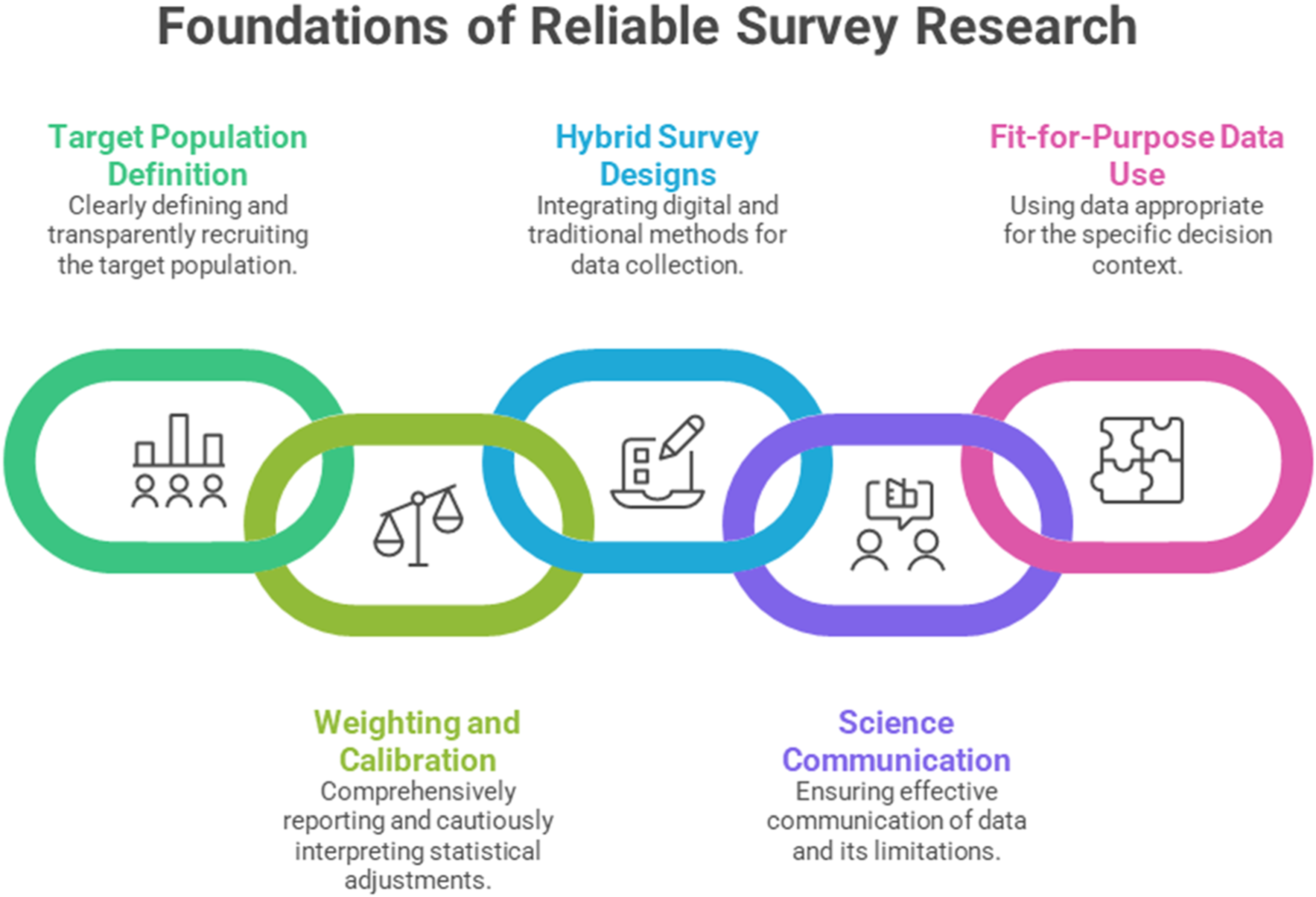
Building on the preceding discussion, several critical implications arise for researchers, statistical agencies, and policymakers responsible for generating and interpreting evidence.
First, survey developers must clearly define their target population and ensure transparency in recruitment and data collection procedures. When using online surveys, it is essential to specify the sampling frame or acknowledge its absence and describe recruitment channels and expected coverage constraints, such as disparities in internet accessibility and digital literacy.1,3,6,9 Failure to provide this level of documentation undermines representativeness and limits the generalizability of findings to the broader population.3,6
Second, any application of weighting or calibration adjustments should be reported comprehensively, with explicit justification and cautious interpretation. As Haddad et al. 12 note, statistical weighting does not inherently improve accuracy, particularly when the auxiliary variables used are only weakly correlated with the outcomes of interest. Researchers should therefore evaluate and disclose how weighting influences point estimates, confidence intervals, and standard errors, while acknowledging potential residual bias that may persist despite adjustment.12-14
Third, in policy-relevant research contexts, hybrid and mixed-mode survey designs offer a more resilient approach to data collection. Integrating rapid digital modes with more robust probability-based sampling or administrative records mitigates bias and strengthens reliability.6,7,10 Statistical agencies should thus invest in infrastructure, standardization, and protocols to operationalize such blended frameworks, ensuring that speed in data production does not come at the expense of credibility.1,2,7
Fourth, effective science communication and data literacy among policymakers, analysts, and media professionals are indispensable. Although digital survey platforms allow for rapid data delivery, the resulting evidence often varies in reliability and comparability.5,8,11 Decision-makers should receive not only headline results but also contextual indicators—such as representativeness metrics, confidence intervals, and known sources of bias—to ensure informed interpretation and prevent misuse of incomplete or unstable findings.2,5,8,11
Finally, the concept of fit-for-purpose must guide data use in evidence-based policymaking. Not every dataset needs to be nationally representative; rather, it must be appropriate for the decision context and research objective.1,10 As emphasized in professional standards such as those of AAPOR and the OECD, each survey’s design should be assessed according to its timeliness, relevance, accessibility, interpretability, accuracy, and coherence.10,11 For example, rapid online “pulse” surveys may be suitable for monitoring short-term sentiment or behavioral shifts but are inadequate for producing precise population-level estimates.3,6,10,13
4. Conclusion
The growing use of online and web-based surveys offers clear advantages for evidence-based policymaking, including speed, scalability, and cost efficiency. However, these benefits are accompanied by important methodological limitations, such as selection bias, coverage gaps, measurement error, and data quality concerns. Digital survey methods should therefore not replace probability-based approaches but be used as complementary tools within an integrated evidence framework. Ensuring transparent reporting, careful interpretation, and alignment with the policy context is essential. Ultimately, a fit-for-purpose approach is critical to ensure that digital data are used appropriately and responsibly in policymaking.
Footnotes

Consent for Publication
All authors have agreed to the publication of the manuscript.
Author Contributions
KS: conceptualization, writing the draft, review and editing the draft.
Funding
The author disclosed receipt of the following financial support for the research, authorship, and/or publication of this article: The publication of this article will be funded by the Qatar National Library, Qatar.
Data Availability Statement
No data has been generated in this study.