







Abstract

To the Editor,
The US manicuring industry boasted 196,900 jobs in 2022, with a 9% annual growth rate and a predicted global evaluation of $23.1 billion by 2031.1,2 However, recent increases in popularity and complexity of nail care compromise hygiene standards and amplify risk. 2 Epidemiological data on manicuring injuries are sparse. Consequently, we investigated the epidemiology of manicuring cases presenting in US emergency departments (EDs) from 2013 to 2022.
The National Electronic Injury Surveillance System (NEISS), which collects data from a nationally representative cohort of 100 EDs, was queried on October 29, 2023, using keywords “manicure,” “manicures,” “manicuring,” “pedicure,” “pedicures,” and “pedicuring” and demographic data were collected. T value tests assessed differences between genders (P < .05).
A total of 893 cases of injuries due to manicures/pedicures were analyzed, with mean age 42 years (range: 23-61), and 85.1% females, 24.4% Whites, and 23.5% Blacks. On average, cases increased by 8.56% annually, with a total 73% overall increase from 2013 to 2022 (Figure 1). White women were injured more often than White men (26.6% vs 12.0%, P < .001), and Black men were injured more often than Black women (32.3% vs 22.0%, P = .018).
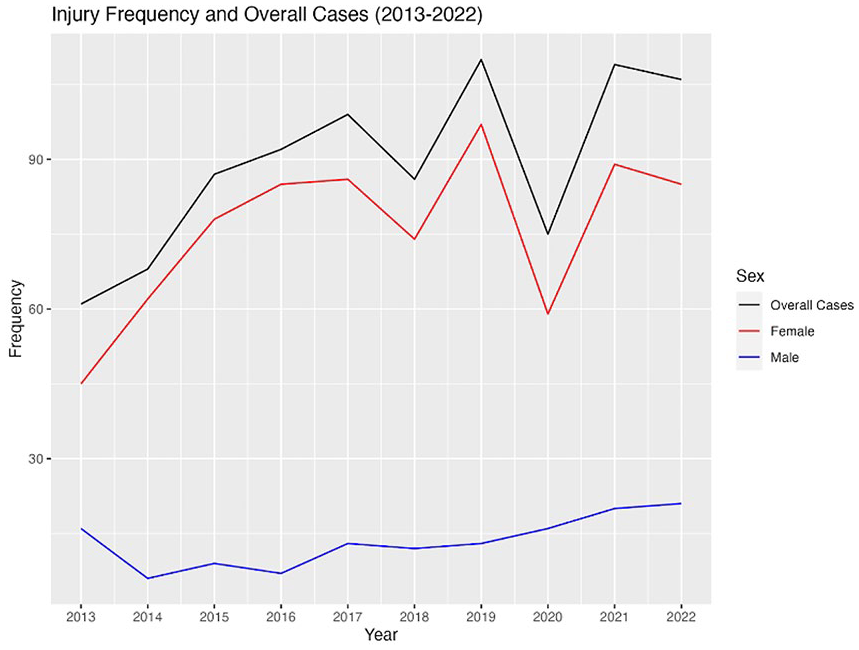
Injury frequency by gender from 2013 to 2022.
The most common diagnoses overall were paronychia, cellulitis, and laceration/avulsion, which had similar proportions across genders (all P > .05). On average, women experienced more severe injuries than men, particularly fractures (4.5% vs 0.0%, P = .045), strain/sprains (1.1% vs 0.0%, P = .0046), and punctures (0.5% vs 0.0%, P = .045). Dermatitis was more common among women versus men (2.6% vs 0.8%, P = .048; Supplemental Table S1).
The toe was the most often injured body part for men and women (44.4% vs 45.9%, P = .74) followed by the finger (24.8% vs 29.9%, P = .22). The foot was the third most often body part injured, with men versus women more often affected (23.30% vs 13.20%, P < .0097).
We found that manicuring injuries requiring ED visits increased by almost 75% over the past decade, with White women and Black men most at risk. Women versus men were more likely to sustain more severe and diverse injuries. In a prospective surveillance study comparing salons having ≥1/40 patients with pedicure-associated nontuberculous mycobacterial furunculosis to control salons from 2005 to 2008, White women most often developed infections (95%) with poorer sanitation (presence of surface biofilms or apparent debris) in implicated versus control salons (P < .05). 3 In a cross-sectional study of 199 subjects (99% women, 83% White) comparing home nail kit users versus people receiving professional manicures, home nail kit users versus nonhome users more often had skin dryness/rashes (38% vs 21%; P = .017). 4 Of the 199 subjects, only 52% received care from a dermatologist, 4 highlighting the key role of dermatologists in recognizing and treating nail injuries.
NEISS does not include patient history, long-term outcomes, or mechanism of injury, limiting our analysis. It only includes cases presenting to EDs, which may overrepresent more severe cases.
In sum, manicuring injuries are on the rise, with White women and Black men at highest risk. Dermatologists are encouraged to enhance patient education on safe nail care and publicize that dermatologists are experts in treating nail injuries sustained from manicuring.
Supplemental Material
sj-docx-1-cms-10.1177_12034754241238700 – Supplemental material for Epidemiology of Manicuring Injuries in the United States Using the National Electronic Injury Surveillance System, 2013 to 2022
Supplemental material, sj-docx-1-cms-10.1177_12034754241238700 for Epidemiology of Manicuring Injuries in the United States Using the National Electronic Injury Surveillance System, 2013 to 2022 by Surya Khatri and Shari R. Lipner in Journal of Cutaneous Medicine and Surgery
Footnotes
Authors’ Note
This work has not been previously published.
Declaration of Conflicting Interests
The author(s) declared the following potential conflicts of interest with respect to the research, authorship, and/or publication of this article: Dr Lipner has served as a consultant for Ortho Dermatologics, Eli Lilly, BelleTorus Corporation, and Moberg Pharmaceuticals.
Funding
The author(s) received no financial support for the research, authorship, and/or publication of this article.

Supplemental Material
Supplemental material for this article is available online.
References
Supplementary Material
Please find the following supplemental material available below.
For Open Access articles published under a Creative Commons License, all supplemental material carries the same license as the article it is associated with.
For non-Open Access articles published, all supplemental material carries a non-exclusive license, and permission requests for re-use of supplemental material or any part of supplemental material shall be sent directly to the copyright owner as specified in the copyright notice associated with the article.
