







Abstract
“Death in Vienna” is intended as an introduction to this themed issue on The Dark Spectacle: Landscapes of Devastation in Film and Photography. Drawing on Susan Sontag’s Regarding the Pain of Others, the articles gathered here address the representation of unsettling subject matter (war, ecological catastrophe, destructive urbanization) in a variety of visual media. The collection’s specific focus is on the important role played by space in the depiction of disturbing events. Do images portraying death and destruction generate documents, or do they create works of art? Does their beauty drain “attention from the sobering subject?” “Death in Vienna” addresses these and other related questions with reference to Yevgeny Khaldei’s photography, specifically a shocking image he took in Vienna during the final days of the World War II. Together with Sontag, this article also questions our “right to look” at images of extreme suffering.
Narratives can make us understand. Photographs do something else: they haunt us.
First Encounter
I first came across Khaldei’s disturbing Vienna shot at a photography exhibit in Moscow in the 1990s, when it had just been released from a private archive. It depicted a group of Soviet officers, their eyes downcast, standing solemnly by a horrific murder scene. The caption read: “Shepilov in a park near the Parliament: Collective suicide of a Nazi family: Vienna, 1945.” The picture stood out for several reasons. It portrays the suffering of the enemy, and not the Russians, which in the 1990s was still a novelty to the Moscow viewer. The photograph also captures the dead overtly, for everyone to see—another unusual aspect, considering the highly restrictive conventions of Soviet war photography, prohibiting the explicit depiction of violence and death. I was surprised as well that this shocking photograph had been taken in Vienna, rather than Berlin, and, moreover, that Vienna remained entirely outside the picture’s frame.
Elena Siemens, San Gal 2012.
A photograph “cannot be simply a transparency of something that happened,” Susan Sontag (2003) writes in Regarding the Pain of Others, her compelling and controversial volume dedicated to the depiction of war and other calamities in photography, and our perception of images of violence. According to Sontag, a photograph is “always the image that someone chose; to photograph is to frame, and to frame is to exclude” (2003, p. 46). Unlike a painting, Sontag continues, a photograph “is supposed not to evoke but to show,” and this explains why photographs “can count as evidence” (Sontag, 2003, p. 47). “But evidence of what?” she asks (2003, p. 47). Sontag refers to Robert Capa’s celebrated image “Death of a Republican Soldier” (1936), which “may not show what it is said to show,” and therefore “continues to haunt discussions of war photography” (Sontag, 2003, p. 47).
The Vienna photograph from the Moscow exhibit also raises some unsettling questions. Soon after attending the show, I published a lengthy essay, in which I attempted to place this unusual photograph within the tradition of Russian and Soviet art. Sontag’s book, which then had just been published, served as both an inspiration and a chief methodological tool. I learned a great deal researching and writing my article, but in the end it still left me wanting. The photograph continued to haunt me, in particular its abbreviated and mundane backdrop contrasting with the horrific crime scene depicted in it. I kept thinking about the picture’s geographical anonymity: The viewer learns it was taken in Vienna only from the caption. Would this photograph be any different if it included a more distinct view of Vienna and the parliament building to which the caption refers? Does a more spectacular backdrop undermine a photograph’s documentary status? And, conversely, does excluding any “trappings of the spectacular,” to use Sontag’s phrase, make a photograph more “honest” (2003, p. 44)?
The Victory Shot
Khaldei is best known for his iconic picture of Soviet soldiers raising the flag of victory over the Reichstag in Berlin, also included in the Moscow exhibit. The two photographs, both taken during the final days of World War II in May of 1945, could not be any more different. In contrast to the disturbing Vienna shot, the Berlin picture is celebratory and romantic, intended as the defining image of Russia’s victory over the Nazis. According to his own account, Khaldei (1999) went to great length to capture the flag-raisers against the spectacular backdrop of Berlin’s skyline in flames: “I wanted Berlin to be clearly visible in the picture” (p. 151).
Elena Siemens, San Gal 2012.
This was not an easy task. According to Khaldei, “there was still shooting going on” at the Reichstag and the top of the building was on fire, making it “impossible to climb up to the cupola when you didn’t want to end up getting smoked” (1999, p. 160). They found a more convenient place just a bit lower. It failed, however, to meet Khaldei’s approval: “The Tiergarten was on the other side and it really wasn’t the right backdrop because you couldn’t see Berlin” (Khaldei, 1999, p. 160). The place that Khaldei finally chose presented an obstacle: There was a pool of blood, “still warm” (Khaldei, 1999, p. 160). Khaldei eventually “went around it and asked the guys to take the flag and raise it” (Khaldei, 1999, p. 160). “That’s how I got that shot,” he concludes his account (Khaldei, 1999, p. 160). When he walked back into the street, he “looked up and got vertigo” (Khaldei, 1999, p. 160).
Like many other iconic war photographs—among them Capa’s “Death of a Republican Soldier,” as well as Joe Rosenthal’s famous shot of American flag-raisers at Iwo Jima (1945)—the Reichstag picture subsequently became the subject of intense scrutiny. The day after he had completed his Reichstag assignment, Khaldei flew directly to Moscow, where the picture was “processed and published immediately” (Khaldei, 1999, p. 151). Several months later, censors noticed that one of the flag-raisers had two watches, one on each wrist, and Khaldei “was assigned to retouch the watch on the right” (Khaldei, 1999, p. 151). The extra watch, Tatiana Tolstaya writes in “History in Photographs,” was in conflict with the picture’s purpose to depict the heroic takeover of Berlin: The courageous soldiers “had obviously been pillaging” (Tolstaya, 2003, p. 205).
According to Sontag, Capa’s photograph aims to capture a “real moment,” and “it loses all value should the falling soldier turn out to have been performing for Capa’s camera” (2003, p. 55). This equally applies to Khaldei’s staged Reichstag image. The practice of doctoring war photography, Sontag writes, became less widespread only with the Vietnam War, when a photographer no longer worked alone and instead had to “compete with and endure the proximity of TV crews” (2003, p. 58). While possibilities for manipulating images are much greater today, staging for the camera, Sontag suggests, “seems on its way to becoming lost art” (2003, p. 58). She adds that with the passage of time, many staged images from the past “turn back into historical evidence, albeit of an impure kind—like most historical evidence” (2003, p. 57).
Remembering and Stipulating
Unlike his celebrated, if “impure,” Berlin picture, which was “processed and published immediately,” the Vienna photograph remained in Khaldei’s family archive for many decades, and was exhibited for the first time only in the 1990s—some 50 years after Khaldei had taken it. Sontag argues that “collective memory is not a remembering but a stipulating” (2003, p. 86). She writes: “Photographs that everyone recognizes are now a constituent part of what a society chooses to think about, or declares that it has chosen to think about” (2003, p. 85). In Russia, or rather the Soviet Union, where World War II was known as the Great Patriotic War, the choice between Khaldei’s two photographs was clear: The patriotic Berlin shot was in, while the shocking Vienna photograph, with its explicit representation of death, was out.
Elena Siemens, San Gal 2012.
In Russia, as was the case elsewhere, the “more transparent” portrayal of the dead appeared only in photographs of atrocities (Brothers, 1997, p. 175). One of the best known images in this category is Dmitry Baltermants’ “Grief” (1942)—another iconic and immediately recognizable photograph depicting a Nazi atrocity in Crimea in 1942. An impressive panoramic shot, it portrays a giant field covered with a multitude of corpses, with the grieving survivors of the massacre searching the dead for their family and friends. In the foreground, there is an elderly woman bent over one of the dead, possibly a relative, weeping. With its ominous dark sky which, according to some sources, was a darkroom addition, this photograph possesses the “quality of epic”—a “hallmark of Soviet war photography” (Cutajar, quoted in Siemens, 2007, p. 170). Its poetic caption—“Grief”—further contributes to the photograph’s “epic quality.”
In contrast, Khaldei’s photograph of the dead Nazi family in Vienna is fragmentary and mundane: no big sky, no lofty backdrop of any kind. Instead, the image depicts an ordinary park corner with a couple of benches and some trees. Its reportage-like caption states matter-of-factly the time and place of filming. The opposite of Baltermants’ “Grief,” as well as Khaldei’s own panoramic Berlin shot, this photograph appears to belong to a completely different genre—more a document than a work of visual art. Still, its documentary intent notwithstanding, it too, upon closer look, reveals a distinct set of framing strategies. In this instance, the framing serves to de-glorify the image, rather than emphasizing its epic scale.
Strange Sight in Vienna
Khaldei stumbled on the scene of the crime in Vienna by surprise. Walking in “the small park in front of the parliament building,” he came across a “strange sight on one of the park’s benches” (Khaldei, 1999, p. 149). There was a dead woman, “killed with two shots in the temple and neck,” a boy of about 15, and a young girl, both “lying on the bench” (Khaldei, 1999, p. 149). Next to them, on the ground, was the dead father, who “had a gold Nazi pin on his lapel, which meant he was a member of the party” (Khaldei, 1999, p. 149). “He did it. Not the Russians,” said a guard, who came running from the Parliament. The Nazi officer, the guard revealed, “pushed the benches together,” and first shot his wife (Khaldei, 1999, p. 149). He then “did the same with the boy and the girl,” the girl cried, pleading “No! No!” (Khaldei, 1999, p. 149). Afterward, the Nazi officer “went off to the side, looked at what he’d done and shot himself” (Khaldei, 1999, p. 149).
Khaldei captured the scene of the crime “in every detail” (Khaldei, 1999, p. 149). In addition to the shot included in the Moscow exhibit, he took several other images depicting the dead from a variety of angles. Reprinted in the catalogue of Khaldei’s retrospective exhibit in Berlin, also held in the 1990s, these photographs appear more rushed and show little concern for matters of composition. With their close-up exposure and unapologetic display of the dead, they resemble police crime photos collected for the purposes of an investigation, rather than public exhibition. In contrast to the rest of the set, the photograph selected for the Moscow exhibit is more polished, as well as less “offensive”: The dead are pictured in the background, while the foreground shows a row of Soviet officers. According to Khaldei, the Soviets led by Political Commissar Shepilov and General Sakhvataev arrived on the scene of the crime some time later. Khaldei quotes the General: “I’ve seen a lot on the way from Stalingrad, but I’ve never seen a tragedy like this one” (1999, p. 149).
Arthur Fellig, better known as Weegee, liked to feature bystanders in his crime-scene photographs taken in New York in the 1930s and 1940s. Weegee’s “signature style,” Mary Warner Marien (2006) writes, “often included an array of human reactions, from shock and grief, to excitement about the chance of getting one’s picture in the newspaper” (p. 345). A similar strategy appears to be in play in Khaldei’s photograph with its row of Soviet officers observing the scene of the crime in Vienna. It too is an attempt to add some emotional color by including the reaction of bystanders. However, Weegee’s objective was to sell his photographs to the tabloids, and the “ghoulish voyeurs,” Warner Marien points out, “acted as surrogates for newspaper readers” (2006, p. 345). In Khaldei’s photograph, the stunned onlookers perform a different function: They are there to demonstrate that the Russians are not to blame for this horrific crime.
Who Is to Blame?
Khaldei’s picture contradicts one of photography’s cardinal rules —“not to evoke but to show” (Sontag, 2003, p. 47). Discussing the difference between hand-made images and photographs, Sontag points out that “artists ‘make’ drawings and paintings while photographers ‘take’ photographs” (2003, p. 46). She argues that Goya’s set of etchings The Disasters of War depicting Napoleon’s atrocities in Spain in 1808 “are meant to awaken, shock, and wound the viewer” (2003, p. 44). Similarly, his “expressive phrases in script” included below the images serve to “badger the viewer” (Sontag, 2003. p. 45). Goya’s inscriptions read: “One can’t look” (No se puede mirar), or “This is bad” (Esto es malo) (Sontag, 2003, p. 45). Photographers, on the other hand, are not expected to supply their images with “expressive” captions, nor do they need to offer “assurances of the image’s veracity” (Sontag, 2003, p. 46).
As required by the medium of photography, Khaldei’s caption is “neutral” and “informative,” detailing the time and place of filming, as well as naming the highest ranking Soviet official present at the scene of the crime. However, this “informative” caption still leaves the viewer puzzled. His Vienna shot from the exhibit does not picture the Nazi officer himself, who remains outside the frame. Instead, the photograph shows only the mother and the children—all dressed in civilian clothes. Their identification as members of a Nazi family provided in the caption comes as a surprise. While stating the nature of the crime (a suicide), the caption does not reveal that the mother and children have actually been murdered, nor does it identify the murderer.
These omissions move Khaldei’s photograph closer to the territory of art—a domain replete with ambiguity. In Goya’s The Disasters of War, Matthew Collings writes, “the direction of the thought is never clear and everything is openended” (1999, p. 73). He adds: “There is no particular sense of righteousness. Evil-doers can be French or Spanish, soldiers or monks, women or men” (Collings, 1999, p. 73). Khaldei’s photograph shares this complexity. While it exonerates the Soviets, whose stunned faces are demonstrative of their innocence, the image does not, in turn, identify any guilty party, as the Nazi officer remains outside the frame. The photograph is thus marked by the open-endedness characteristic of a work of art. Like Goya’s etchings, it leaves the viewer uncertain about who is responsible for the crime, as well as raising some difficult questions about World War II as a whole.
Most Puzzling
The most puzzling aspect of Khaldei’s photograph is its lack of any distinct visual reference to Vienna. This geographical anonymity has a number of important implications. The photograph’s fractured backdrop depicting a corner of some unidentified park takes away the grandeur of the Nazi officer’s death. Having brought his family to the Parliament, he clearly intended to make a statement, wanting, perhaps, to declare his loyalty to Nazi party ideals even in death. This might also explain why he donned his full Nazi uniform for the occasion. With its fractured and mundane backdrop, Khaldei’s photograph negates any notion of a spectacular death against a prominent political and architectural landmark.
The flip side of this is that the photograph’s fragmented backdrop leaves Vienna completely out of the equation, its reputation untarnished by this crime. The mention of Vienna appears only in the caption, its tail end. I remember being startled by it: Vienna? Things like this could happen in Berlin, not in Vienna, the city of the waltz. Khaldei was well aware of Vienna’s romantic image, as reflected in his other photographs of the city from 1945. One of them depicts a group of Soviet soldiers placing flowers on Johann Strauss’s grave. Khaldei comments, “Strauss was known as a composer of operettas in the Soviet Union, but this film [The Great Waltz (1938)] made him really famous” (1999, p. 149). Seeing Strauss’s grave, Khaldei continues, one of the soldiers exclaimed: “Oh, Strauss . . . comrades, can you remember the movie The Great Waltz? Johann Strauss, the composer!” (1999, p. 149).
Khaldei also photographed the fallen bridges over the Danube, and lamented their demise: “That’s the bridge over the Danube, the blue Danube . . . or rather, what’s left of it. The German troops went over to the other side and blew up the bridges” (1999, p. 148). In this respect, Khaldei is the opposite of the ironic narrator of Carol Reed’s film The Third Man (1949), a postwar noir classic set in occupied Vienna. The film’s opening voiceover, delivered by Reed himself, states: “I never knew the old Vienna before the war, with its Strauss music, its glamour, and easy charm. Constantinople suited me better” (cited in Rob White, 2003, p. 7). Commenting on this detached introduction, Rob White writes: “There is, to listen to it, no lamentation here, nor any solemn reflection on the recent carnage—just unsentimental plain-speaking, clipped and fast” (2003, p, 7). This “unsentimental” voiceover, White adds, contrasts with the film’s opening sequence of images, portraying the darker side of occupied Vienna, its once glorious architecture “reduced to rubble” (2003, p. 7).
Khaldei photography is closer to Federiko Garcia Lorca’s poem “Small Viennese Waltz” (1930), loosely translated by Leonard Cohen under the title “Take This Waltz” (1979). In Lorca, as in Cohen, prewar Vienna is a city of both the waltz and death. It is a place where “death comes to cry,” and where the waltz itself, with its “broken waist” and “a clamp on its jaws,” has been “dying for years” (Cohen, 1993, p. 353). Like The Third Man, the poem exhibits a strong contrast between its more cheerful pace (in this instance, the waltz tempo) and dark imagery. However, in contrast to Reed’s ironic film, the poem’s overall mood remains one of sadness and melancholy. In Lorca and Cohen, death is still romantic. In The Third Man, which depicts the immediate aftermath of World War II, death is a fact of life, an everyday occurrence.
Beauty in Ruins
Khaldei’s stark photograph from the Moscow exhibit contrasts sharply with his other images of Vienna, in which death is captured against the remains of the city’s glorious architecture. Sontag writes that in painting it is a commonplace that “a gory battlefield can be beautiful—in the sublime or awesome or tragic register of the beautiful” (2003, p. 75). Photographs, on the other hand, must refrain from showing beauty in war: “To find beauty in war photographs seems heartless” (Sontag, 2003, pp. 75-76). But “the landscape of devastation,” Sontag points out, “is still a landscape. There is beauty in ruins” (2003, p. 76). She cites the example of photographs of the World Trade Centre ruins, many of them taken by prominent photographers. In the months following the attack, most viewers described those images as “surreal”; to call them “beautiful” would “seem frivolous, sacrilegious” (2003, p. 76). However, Sontag insists, “they were beautiful”—not the site itself, which “of course, was anything but beautiful,” but the representation of it in the photographs (2003, p. 76).
Elena Siemens, San Gal 2012.
Photography’s “dual powers” to serve as both a document and a work of art, Sontag continues, “have produced some remarkable exaggerations,” the most common of which is “one that regards these powers as opposites” (Sontag, 2003, p. 76). According to this view, “a beautiful photograph drains attention from the sobering subject and turns it toward the medium itself, thereby compromising the picture’s status as a document” (2003, p. 77). Sontag argues that, contrary to this widespread assumption, the photograph always “gives mixed signals”: “Stop this, it urges. But it also exclaims, What a spectacle!” (2003, p. 77). Khaldei’s photograph of the dead Nazi family sends those mixed signals as well. The opposite of his celebratory Reichstag image, the stark Vienna photograph, with its abbreviated backdrop, aims to de-glorify the horrific crime depicted in it. While pursuing opposite framing strategies, both pictures still maintain the duality characteristic of all photographs, serving at once as documents and works of visual art.
The documentary status of Khaldei’s photograph was further undermined when it became part of the exhibition in Moscow. Sontag writes that when displayed in museums and art galleries, photographs—even the “most solemn and heartrending” of them—inevitably become art (2003, p. 121). Few places, Sontag points out, seem to “guarantee contemplative or inhibiting spaces for anything now” (2003, p. 121). She refers to the Imperial War Museum in London that “offers two replicated environments”: The Trench Experience (the Somme in 1916), and The Blitz Experience (London in 1940); the latter one includes “the simulation of an air raid as experienced in an underground shelter” (Sontag, 2003, p. 121). Today, Sontag concludes, the museum’s primary function is “entertainment and education in various mixes, and the marketing of experiences, tastes, and simulacra” (Sontag, 2003, p. 121).
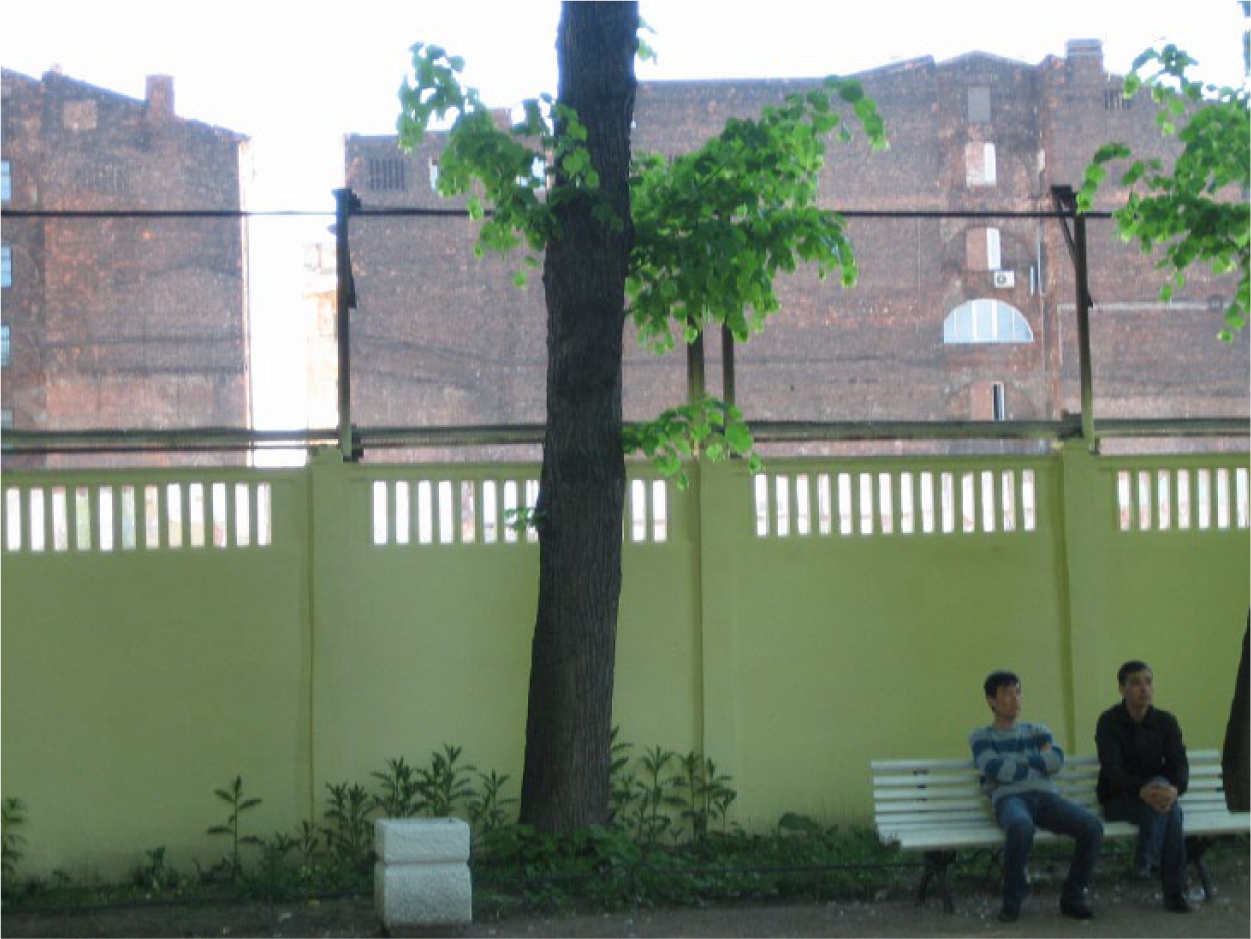
Elena Siemens, San Gal 2012.
The Right to Look
Working on this article, I decided early on not to reproduce Khaldei’s Vienna photograph. Sontag writes that looking at a work of art depicting “a man’s face being chewed off his head” by a dragon is different from looking at a photograph of a soldier whose face was shot away in a battle (2003, p. 41). “An invented horror,” Sontag maintains, “can be quite overwhelming”; photographic horror brings with it both “shame as well as shock” (2003, p. 42). She suggests that “the only people with the right to look” at photographs of extreme suffering should be “those who could do something to alleviate it—say, the surgeons at the military hospital where the picture was taken—or those who could learn from it” (2003, p. 42).
Khaldei’s shocking photograph also raises the issue of “the right to look.” With its fractured and anonymous backdrop, this photograph, like Goya’s etchings, moves the viewer “close to horror” (Sontag, 2003, p. 44). Sontag writes that Goya’s The Disasters of War eliminate all “the trappings of the spectacular” in that his “landscape is an atmosphere, a darkness, barely sketched in” (2003, p. 44). Goya’s predecessors, Sontag points out, depicted various war atrocities with the help of “large scenes with many figures, scenes from history,” and “sententious” captions (2003, p. 43). In Goya, who sets a “new standard for responsiveness to suffering,” the views are no longer “wide and deep,” and the “account of war cruelties is fashioned as an assault on the sensibility of the viewer” (2003, p. 45).
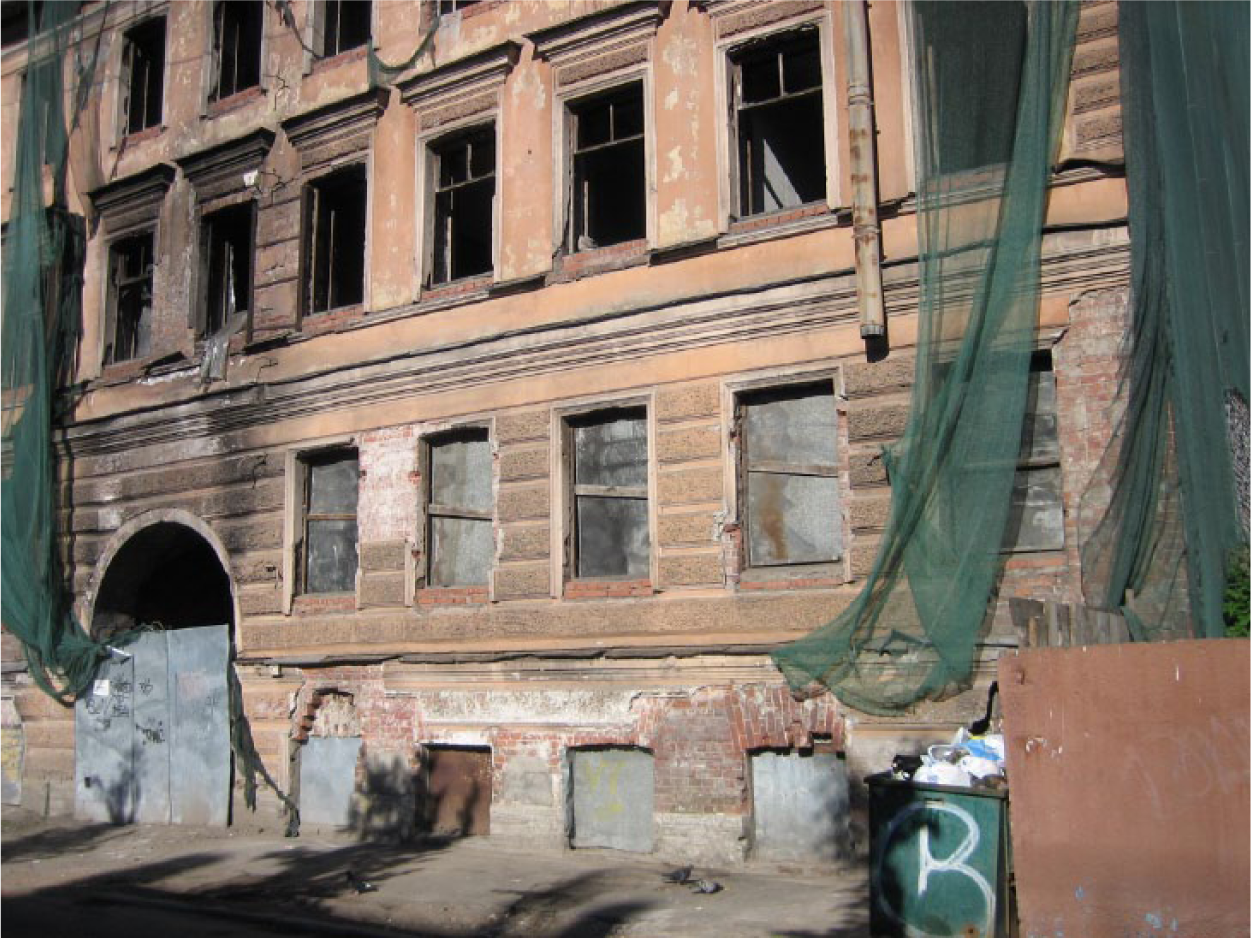
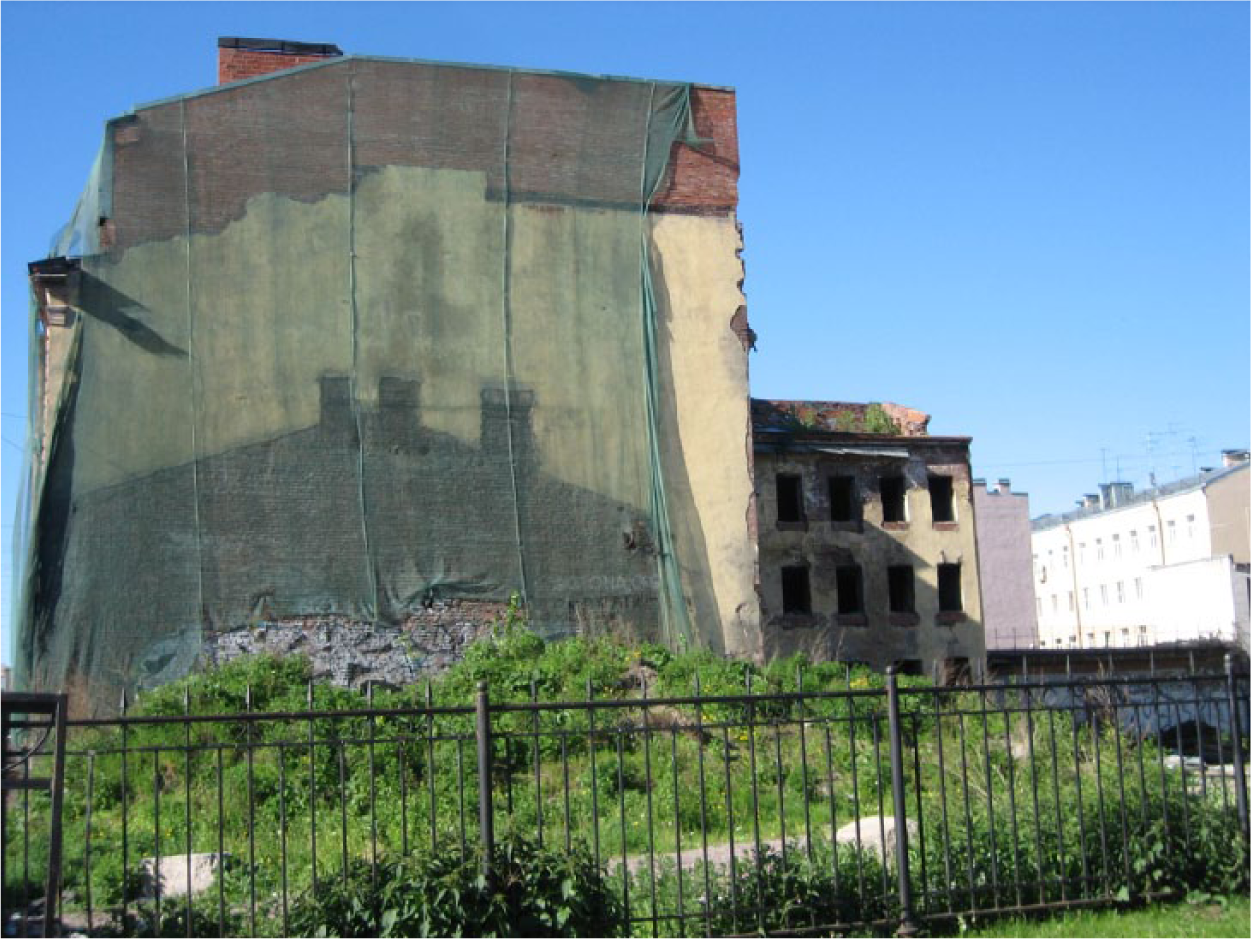
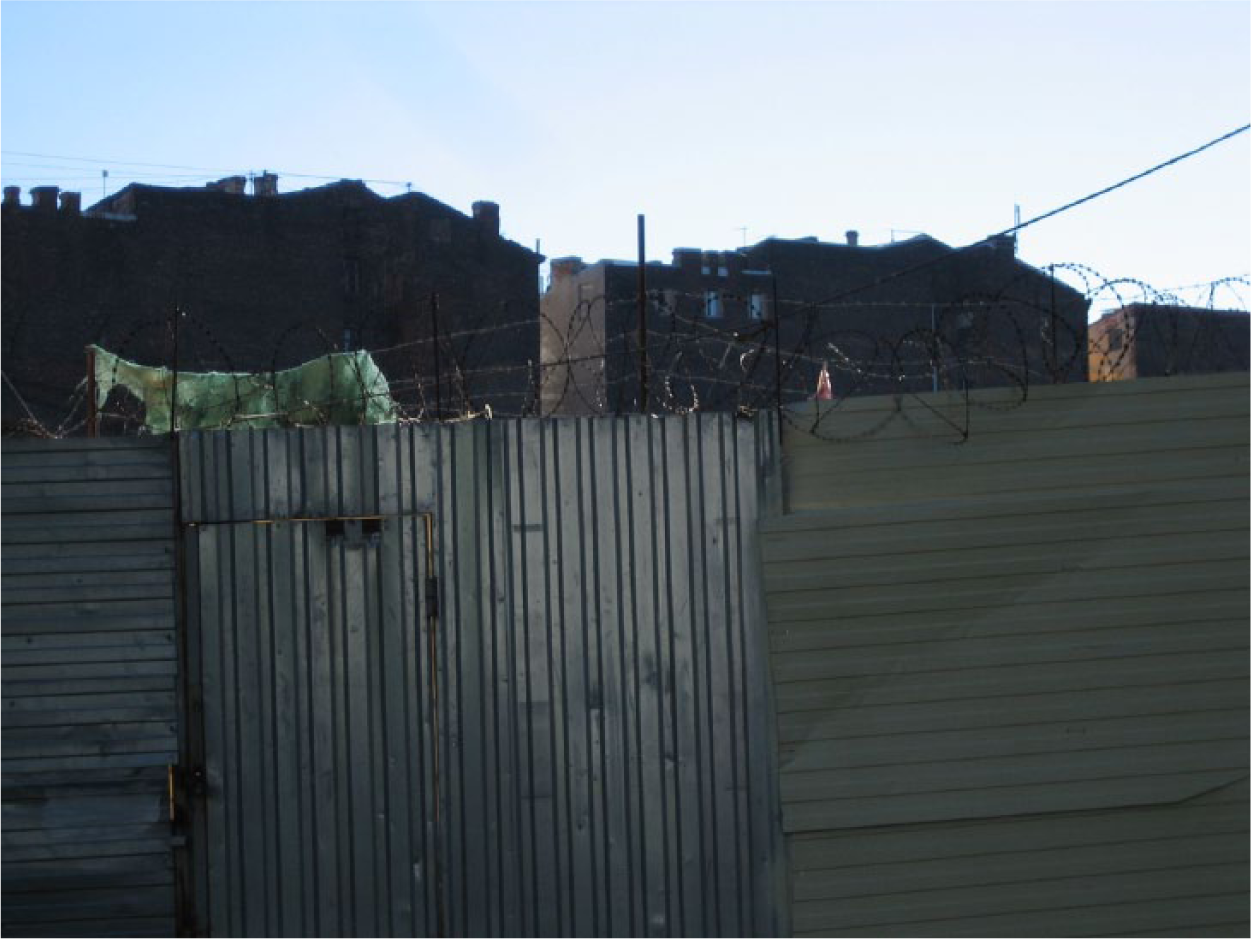
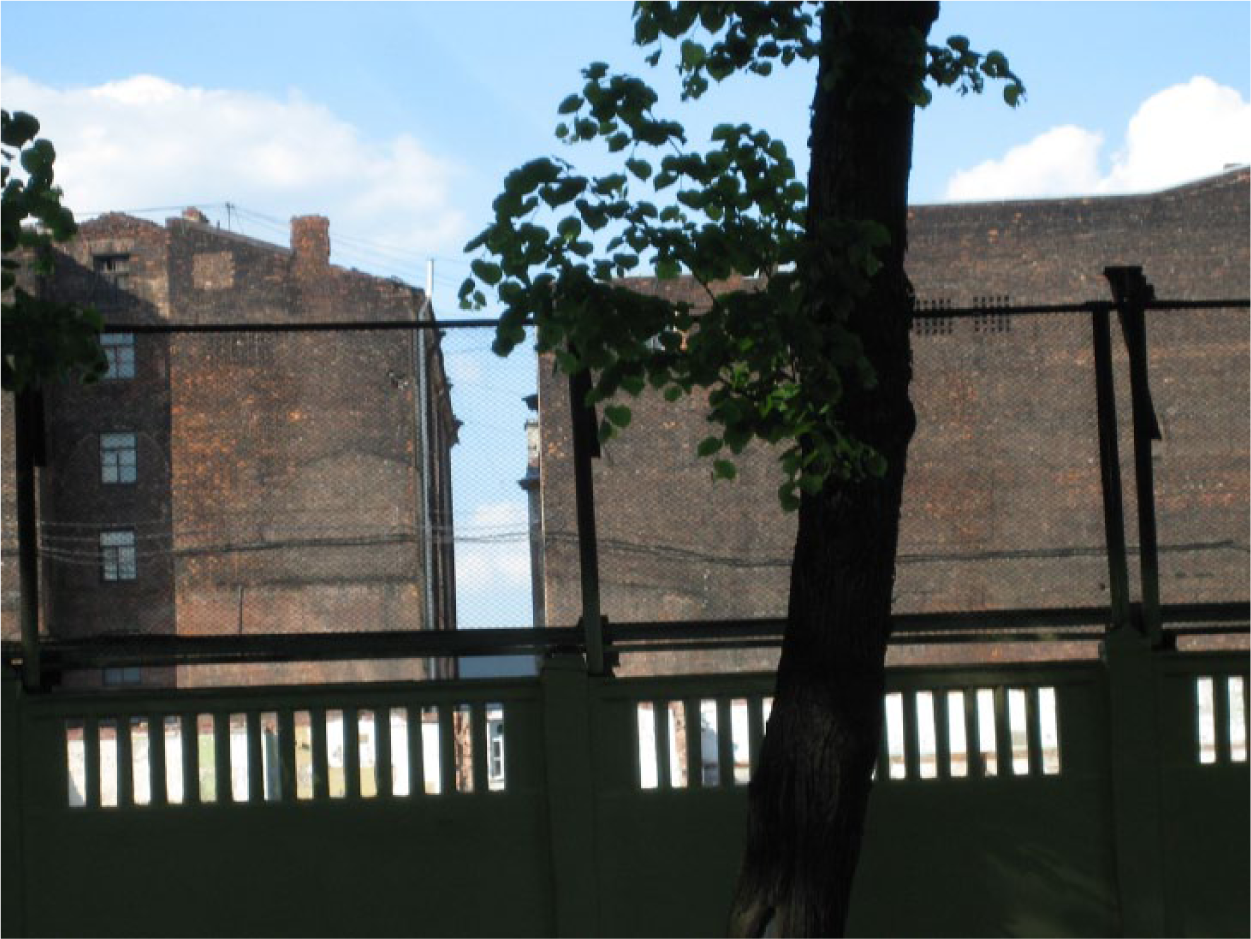
The photographs that I include here are all architectural landscapes. I captured these grim but darkly beautiful views in San Gal Gardens on my recent trip to St. Petersburg. The opposite of Khaldei, they evoke some tragedy, but do not state directly what that tragedy might be. A war? Some natural disaster? A fire? In reality, the architectural devastation depicted in them has to do simply with the gardens’ reconstruction. These images testify to the power of the photographic landscape to stir strong emotions and the capacity to project beyond what is pictured. They also testify to the landscape’s ability to overwhelm the composition of a shot. Khaldei’s photograph, which aims to document the scene of the crime, eliminates the “trappings of the spectacular.” With or without that parliament building in it, this image would still remain both a document and a work of visual art. But with Vienna out, the viewer is left face to face with the shocking crime, a thin line of stunned observers is our only shield.
Footnotes
Declaration of Conflicting Interests
The author(s) declared no potential conflicts of interest with respect to the research, authorship, and/or publication of this article.
Funding
The author(s) received no financial support for the research, authorship, and/or publication of this article.