







Abstract
Time and experience lie at the heart of urban life. While extensive research on the social implications of the spatial transformation of urban landscapes has been undertaken since the 1980s, the discussion of the impact that manifold temporalities and sensory experiences might have in shaping or constraining the physical and social change of a neighbourhood have been limited, however. Existing research has a tendency to focus on a specific period in time within the remaking of a neighbourhood and draws conclusions from this window in time on the impact of the regeneration. By drawing on a longitudinal ethnographic study of the regeneration of el Raval, Barcelona from 1996 to now, this article interrogates how a focus on temporality and experience produce interruptions of power in contemporary urban regeneration processes leading to what I define as a `resistance of place’. While there have been attempts to regenerate el Raval since the early 20th century, most dramatically during the last 20 years to create Barcelona’s new cultural quarter, the neighbourhood has not been gentrified and developed as expected by Barcelona’s city council. I argue that while elements of control, discipline and gentrification are certainly part of global contemporary regeneration strategies, temporal and experiential dynamics destabilise their full implementation so that these elements are only partial in their imposition.
Introduction
On the 21st of February 2012, the new Catalan Film Institute opened its doors in el Raval, one of the most marginal districts of Barcelona. The film institute’s inauguration marked the completion of a 20-year long urban regeneration project that has been slowly transforming Barcelona’s infamous red light district into a “Cultural Quarter.” The Film Institute has been located on the Plaza Salvador Segui, still regarded the core prostitution area of el Raval (Cia, 2012). The Film Institute’s glass entrance reflects the constant activity of sex workers, pimps, and punters minding their daily businesses on the opposite street. As can be gathered from this brief account, the urban regeneration has not played out as expected by the council.
Much research on urban regeneration processes highlights the hegemonic, coercive power structures that many of these schemes implement on the urban realm through neoliberal urban governance (Allen, 2006; Atkinson, 2003; Brenner & Theodore, 2002; Davies, 2013; Harvey, 1989). Less research has focused on the ways in which such processes might not always succeed in their control and domination of the urban space, especially when analyzed over time. The aim of this article is to explore some of the “interruptions of power” in regeneration processes by moving temporal and experiential aspects into the foreground. In particular, I examine why some urban places “resist” urban regeneration processes. Why, as in the case of el Raval, despite years of investment, spatial reorganization and commitment by Barcelona’s city council, the neighborhood has developed its own spatial and social dynamics, rather than producing the outcomes planned by the regeneration strategies.
Partly, what this article is trying to achieve is to question the notion of “resistance” as always linked to the agency of individuals or communities and instead develop the notion of “resistance of place.” I aim to expand Pile and Keith’s (1997), framework of resistance “working through many spatialized relationships” by integrating a temporal experiential dimension. Thus, resistance is operating on a material–temporal level within the fluid dynamics of place making (Massey, 1994, 2005). By focusing on urban change as a long-term process in the case study of el Raval from 1996 to 2012, I reveal this “spatial technology of domination” (Pile, 1997) as an uneven and fractured project. I do so by interrogating how dimensions of temporality and sensory experience might disrupt some of the aims and planned outcomes urban regeneration projects.
The case study chosen is el Raval, which I have been studying since 1998 (see Degen, 2008). Although this article draws on some of the knowledge gained in earlier research, its main focus is research that was conducted from February to May 2012 to evaluate the outcome of the regeneration process. While over 40 interviews were held in that period including local residents, nongovernment organizations, and neighborhood organizations, I focus for the purpose of this article, and due to space constraints, on interviews held with planners, politicians, and architects from municipal offices as well as on my ethnographic vignettes. The data were analyzed through grounded theory approaches and thematic analysis.
The article is structured into three sections. I first discuss the importance of temporality and sensory experience in framing relations of power and resistance in the city. This is followed by a brief overview of the regeneration of el Raval before analyzing through a range of ethnographic vignettes and interview excerpts, how the temporal and sensory–experiential are embedded in the “resistance of place.” Finally, I will offer some thoughts on the implication such thinking has on research on urban change.
Urban Change, Power, and Resistance: Foregrounding Time and the Senses
Most studies analyzing urban change tend to focus on a specific moment in time (see also Degen & Rose, 2012). Much of this work discusses urban restructuring within the framework of spatial technologies of domination, gentrification, and commercialization processes and a general change of their symbolic, cultural, and social associations (Allen, 2006; Atkinson, 2003; Zukin, 1998, 2010). Drawing on Koch and Latham’s (2012) critique of the relatively narrow focus of current literature on regenerated public spaces on issues of exclusion, encroachment, and claim making, I aim to develop over the next few pages an analysis that “draws careful attention to the materialities, modes of inhabitation and atmospheres that shape experiences with [public spaces]” (p. 516). Numerous studies have pointed out the ways in which urban regeneration projects transform a sense of place of an existing neighborhood by creating new frames of reference in the built environment or attracting new and different users and residents to an area (Degen, 2008; Hayden, 1996; Jones & Evans, 2012; Miles & Miles, 2004). Such studies highlight the ways in which urban change works through physical means to alter the character of a place. While elements of control, discipline, and gentrification are certainly part of global contemporary regeneration strategies, I argue that temporal and experiential dynamics destabilize their full implementation, so that they are only partial in their imposition. I draw here on Massey’s (2005) suggestion to conceptualize the production of place in global times as a space–time construction based on multiple spatial practices and various temporal relations. This has implications on how we conceptualize power, namely is less an imposed relationship but one where the local (and its powers and resistances) becomes implicated in the production of the global, and, by extension, implicated in the reframing of its power. For Massey (2005), this should lead to a politics of specificity: a careful differentiation between places, for empirical research that specifies the geometries of power in particular locations—as this study intends to do. While critiques that highlight the commodification, privatization, and control of public spaces are important to understand current dynamics in urban life, city life across the globe cannot be reduced to the logics of privatization and control alone. Indeed, I argue that too much emphasis on these dynamics precludes us from understanding the multiple and ambivalent power geometries at stake and the complex ways in which urban spaces are lived, negotiated, and experienced in everyday life. Hence, as Massey (2005) suggests, if we conceptualize time and space together and therefore imagine space as an “event”—a dynamic, temporal entity that is constituted through practices of interaction—then the power–resistance binary becomes less stable but more of a dynamic relation.
While temporal and sensory dimensions are difficult to disentangle in practice (Lefebvre, 1991, 2004), I briefly separate them for the sake of a theoretical discussion before bringing them back together within the concept of rhythm analysis. Let us first examine broader, structural approaches to time and the senses before focusing on embodied approaches to understand their relevance to the analysis of urban change, power, and resistance.
Temporal dimensions lie at the heart of urban life. The making of space is in many ways a materialization of the passing of time. Architecture, as Harvey (1990) points out is a “spatial construct [. . .] created and used as fixed markers of human memory and of social values in a world of rapid flux and change” (p. 430) and reflecting the regimes of power and social dynamics of any given time. Writers such as Harvey (1985) or Lefebvre (1991) have researched from a Marxist perspective the relationship of space and time as forces that “frame the urban process and the urban experience under capitalism” (Harvey, 1985, p. 1). In this view, time is a source of social power, a resource that supports the accumulation of capital in the city: “A city is an agglomeration of productive forces built by labour employed within a temporal process of circulation of capital” (Harvey, 1985, p. 250). Within this context, regeneration processes are forms of order and control of the urban landscape that need to be delivered within certain timeframes in order to produce social and economic profits. As a study by Raco et al. (2008) of the various discourses that shape the regeneration of Salford City in Manchester highlights regeneration, as a structural process, “is concerned not only with what is constructed but also when particular objectives should be prioritised and at what point(s) of the development [italics added] process different groups and interests could and should have their needs and priorities addressed” (p. 2652). To put it simply: the way in which temporal decisions are framed by social power relations tend to support particular group interests.
It is tempting to view these temporalities as being “imposed” on the local, however as study on landscapes of urban poverty in American cities such as those by Wolch and DeVerteuil (2001) show how multiple temporalities clash in the daily life of the city. They explain how the discrepancy between the different speeds and temporal rhythms of the global economy, national welfare state, and their urban-level institutional policies and time–space activity patterns of urban populations leads to a reconfiguration of poverty landscapes: “the state and larger economy temporally interact to affect the size and circumstances of marginalised populations” (Wolch & DeVerteuil, 2001, p. 160). By analyzing the links between economic cycles and crime figures and mental hospital admissions, they point to a temporal dimension of social problems. However, as Wolch and DeVerteuil explain capitalist landscapes are not fixed, stable places but “‘become’ in a continuous process of transition,” reflecting in their changing materiality the social relations at particular moments. It is in this context that Adams’s (1994) notion of the coexistence of a multiplicity of timeframes is useful to understand how in society there are always a diversity temporal experiences by different social groups overlapping in the making of place. The studies by Wolch and DeVerteuil and Raco et al. (2008) exemplify why a focus on time in urban environments is important as, on the one hand, they highlight the transitory nature of social relations, while simultaneously showing how social relations surrounding the structuring of time–space are underpinned by inequalities of power: “Time is not an abstract process, but is framed through social and institutional practices” (Raco et al., 2008, p. 2655). Let us now examine the importance of sensory experience in urban change.
While urban restructuring is not a new process, critics such as Harvey (1989) identified in the late 1980s a distinct move from urban planning to urban design within urban restructuring processes. Particular to urban design is an increased preoccupation with the visual impact of places and therefore a conscious beautification process expressed in a stylization of the urban environment. Contemporary urban regeneration schemes are distinctive in their conviction that an enhanced physical environment is pivotal in the solution of “urban problems” and in their belief that design encourages and signals to outsiders economic prosperity. Transforming the physical environment is regarded as the first and most important step in erasing the aura of marginality and decline sensuously ingrained in the material textures of places. So when observed closer in such schemes, streets are widened or narrowed, houses demolished or refurbished, new materials used to pave the streets, a square added, or wooden benches get replaced by granite ones. We can see here that the process of physical renewal entails not just visual landscaping but an overall spatial sensuous reorganization of public places. The new environments create a distinct aesthetic in their spatial arrangements, their promotional campaigns, and their sensuous perception: They create new experiential landscapes (see also Degen, 2008, 2014).
A focus on the senses in urban research is important because our engagement in and with public spaces in cities is first and foremost an embodied sensory encounter (Lefebvre, 2004; Simmel, 1997). Our consciousness is an embodied consciousness. The Finnish architectural critic Juhani Pallasmaa (2005) states that “we inhabit the city, and the city dwells in us. When entering a new city, we immediately start to accommodate ourselves to its structures and cavities, and the city begins to inhabit us. All the cities that we visit become part of our identity and consciousness” (p. 143). I suggest here that a focus on the senses offers a way of analyzing the relationship between built form, temporal dynamics, and social relations, as senses provide the framing texture for the material and social bond in public spaces. However, as the anthropologist David Howes (2005) poignantly comments: “it is not only a matter of playing up the body and the senses through evocative accounts of corporeal life, although these can be valuable, but of analysing the social ideologies conveyed through sensory values and practices” (p. 4). The point to stress here is that sensory–temporal experiences are far from natural, but are underpinned by social ideologies and are therefore always linked to relations of power in society.
A different temporal and sensory understanding of place is provided when one moves to the level of everyday urban experience. Here a focus on the bodily and everyday practice has led to what Lefebvre (2004) famously coined as rhythm analysis. Allen (1999) defines rhythms as
anything from the regular comings and goings of people about the city to the vast range of repetitive activities, sounds and even smells that punctuate life in the city and which give many of those who live and work there a sense of time and location. (p. 56, as cited in Amin & Thrift, 2002, p. 17)
The analysis of rhythms attempts to capture the temporal and sensory character of places and thereby “can account for spatial qualities, sensations and intersubjective habits” (Edensor, 2010, p. 1). Thus, rhythmanalysis brings together the subjective experience of place with structural, often normative, rhythms that shape a place such as the opening hours of shops, the daily practices of tourists, locals, or new residents or the changing physical infrastructure of places through urban regeneration. Analyzing the different paces and intensities of rhythms thus can provide an insight into the subtler ways in which power and resistance operate and interact in the daily life of the city (Degen, 2010).
The material expression of multiple temporalities becomes especially poignant in areas undergoing regeneration where the temporality of past decay and future regeneration is mapped onto the urban texture, producing both temporal and sensory juxtapositions. It draws emphasis on “the entangling rhythms that circulate in and outside the body [and] draws attention to the corporeal capacities to sense rhythm, sensations that organise the subjective and cultural experience of place” (Edensor, 2010, p. 5). To understand daily urban life as constituted through a layering and multiplicity of rhythms helps conceive the city as a polyrhythmic ensemble, “the idea of the urban not as a singular temporality but as the site where multiple temporalities collide” (Crang, 2001, p. 189). Moreover, as Crang (2001) argues, the rhythmic city is based on an understanding of time–space relations as continuous folding and unfolding of past and future experiences with the multiple temporalities inscribed in the (sensory) surfaces of the city and its (temporal) social practices. This resonates with Massey’s (2005) conceptualization of space as event, space as a “temporary constellation . . . a constellation of processes rather than a thing” (p. 141). To examine this constellation we need to understand structural and embodied approaches to time, senses, and urban change far from mutually exclusive, but informing each other. The aim of this article is precisely to highlight this instability of space to understand better the “resistances of place” that destabilize processes of spatial control and domination in regeneration processes.
I will now briefly describe how the Raval neighborhood has developed since it was first earmarked for regeneration.
El Raval: A Spatiotemporal Overview
El Raval has always been a marginal neighborhood, its name alone stems from the Moorish word ar-rabad, which means “outside walls.” It was the area outside the first Roman walls of Barcelona where the city kept at bay everything, it did not want to see or experience: hospitals, leper homes, and charity foundations were housed here since the middle ages. It then developed by the 19th century into a dense working class area, as it was squeezed between the city’s 2nd and 3rd walls, and became at the start of the 20th century the densest neighborhood in Europe. Its location near to the port led it to be the city’s “arrival neighborhood,” becoming a “place of transition” as it always hosted the latest newcomers to the city. Its location is also a reason why it became the city’s red light district and most bohemian place in Barcelona, infamously known as the “Barrio Chino.” By the late 1970s with the influx of drugs into Spain, it became a dangerous place shunned by Barcelona’s “respectable” citizens—alongside always being a working-class neighborhood.
Since the 20th century, there has always been a constant attempt to spatially transform el Raval and integrate it to the modern city. It was only in the early 1980s with Barcelona’s democratic urban planning that finally some of these plans started to gain force and were implemented. In the 1980s, the newly democratic Municipality of Barcelona developed Special Plans for Interior Reforms (PERIs) for rundown areas in the city to improve their built environment, social services, public spaces while at the same time promoting tourism and reducing crime (Monnet, 2002). El Raval’s PERI was the one of the biggest in scale in the Old City and involved the demolition of entire rows of buildings to create new public spaces. It is estimated that between 5,000 and 10,000 individuals lost their homes (only a small number were relocated as most residents in el Raval were tenants).
The regeneration of el Raval started in the early 1990s by applying two different regeneration approaches: the north of el Raval was transformed into a Cultural Quarter with a network of museums, cultural research centers, and new public spaces. In the south of el Raval, where the toughest social problems and poorest housing stock was located, a network of social infrastructures was built in the form of old people homes, health care centers, and sport centers as well as bulldozing over in Haussmanian fashion to make space for a new boulevard: La Rambla del Raval. This boulevard was aimed at enhancing access to the neighborhood from the port as well as attracting new commerce, economic activities (Ajuntament de Barcelona, 1995; Clotet, 1981). The key objectives of the regeneration were to provide more public and green spaces in this dense area; the use of existing buildings into public institutions both for locals and the city and to improve the housing conditions in the neighborhood through new public housing and incentives for existing housing so that sanitation standards would improve in el Raval. I do not have the space to go through all the different stages of the 20 years of regeneration here, but it is important to acknowledge that there was a genuine belief that the transformation of physical space would lead to the solution of the social problems in el Raval. However, one could argue that many of these transformations were implemented largely with a view to attract outsiders into this central area of Barcelona. As a planner reflects:
Yes, the square of the MACBA is in all the architectural guides around the world but what is it used for? For skaters, OK, but for anyone else? It is absurd, yes, the city needs to be for everyone. (Planner C, Foment de Ciutat Vella, personal communication, April 2012)
Urban regeneration projects tend to have an implicit assumption that design can directly affect people’s experiences of place (Degen & Rose, 2012). I have showed in previous work (2008) how the spatial practices implemented by the regeneration bodies ultimately aimed at a homogenization of the sensescapes of el Raval to become more similar to the rest of the bourgeois city. This was based on two spatial methods: First, spatially facilitating increased access into the area both physically through “regeneration corridors” that lead to the new cultural areas; and second, recuperating areas of el Raval sensuously for the rest of the city. This recuperation was framed through a discourse of “mixed use” where nonregenerated spaces are constructed as inferior and in need of being “civilized” by new middle-class uses. The sensescapes of regenerated areas were characterized by a “designer heritage aesthetic” creating public landmarks of difference within the neighborhood—based on and infiltrated by sensuous ideologies of order purity and control (for an extended analysis, see Degen, 2008).
This cultural resignification of the northern parts of el Raval has been successful in attracting since the late 1990s, a string of art galleries, restaurants, and designer boutiques that are replacing old neighborhood cafes, brothels, and the neighborhood’s manual industry. The aim of the urban regeneration in el Raval was to substitute its public life by expelling unwanted marginal practices and social groups from el Raval and attract new uses and activities to the area. Most of the regeneration was finalized in 2006 with the relocation of parts of the University of Barcelona in the north of el Raval. Since then as one planner explained to me:
There has been little investment, it has been more a question of maintaining what we did and putting on the finishing touches. (Planner B, Foment Ciutat Vella, personal communication, April 2012)
The last piece of the puzzle has been the opening of the Catalan Film Institute in February in the south of el Raval in 2012 (Figures 1 and 2), next to the last remnants of street prostitution. This was highly locally contested regeneration strategy as it involved the demolition of a large housing stock and took over 5 years to be completed causing lot of controversy among local residents who had to endure living next to a constant building site, as this planner explains:
Yes, this has been a long process, a complicated process. It’s been one of the most crushing ones. It is to sweep through, in quotation marks, a large area; to upset a lot of people, to affect the life of lots of people; and it’s then decided to open it up for the public. This would not be viable financially anymore and I think the mentality has changed so that I don’t think anyone would act like this anymore. (Planner C, Foment de Ciutat Vella, personal communication, April 2012)
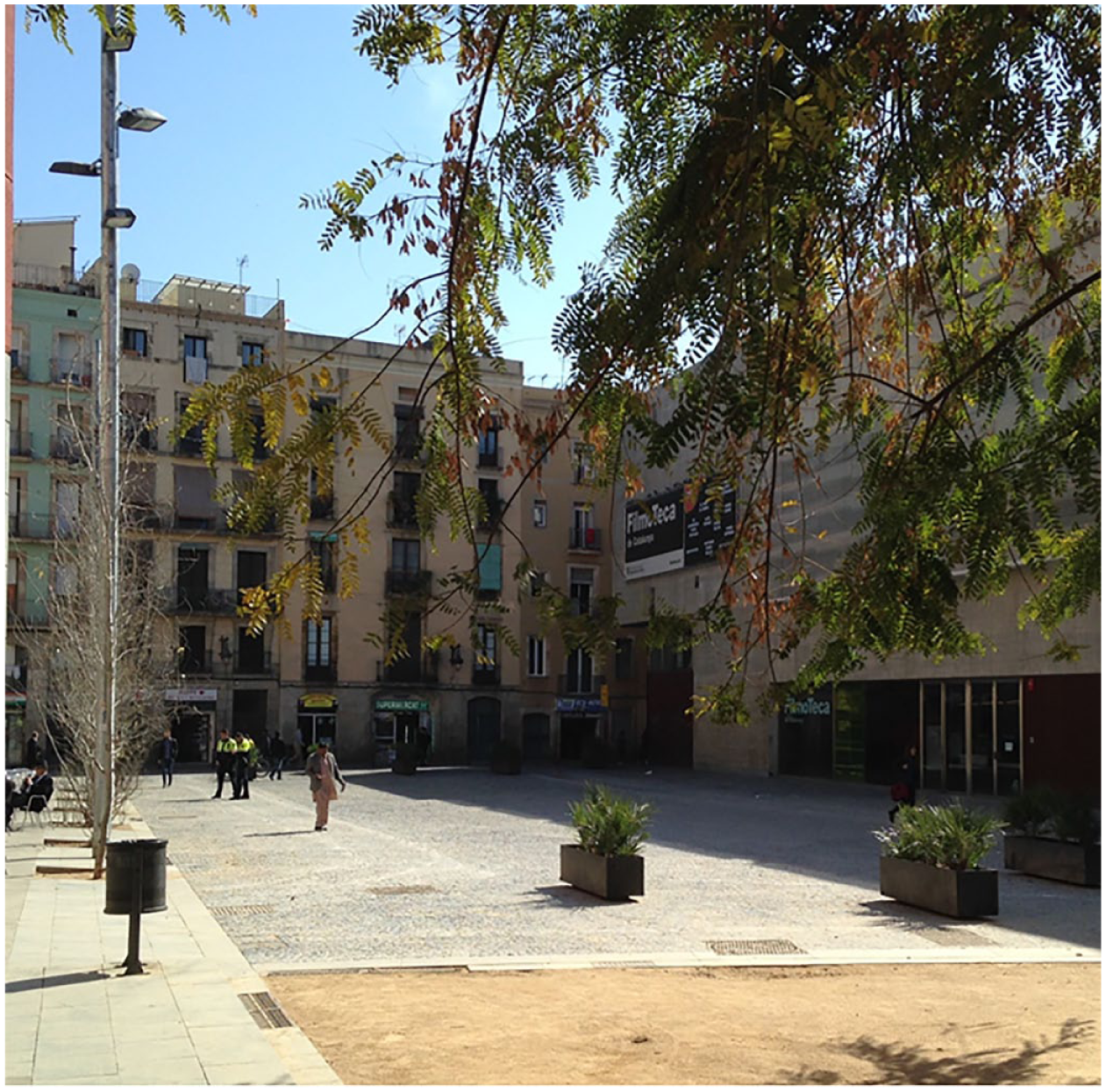
Filmoteca de Catalunya, Plaza Salvador Segui with policemen on the square. 2012, photo.
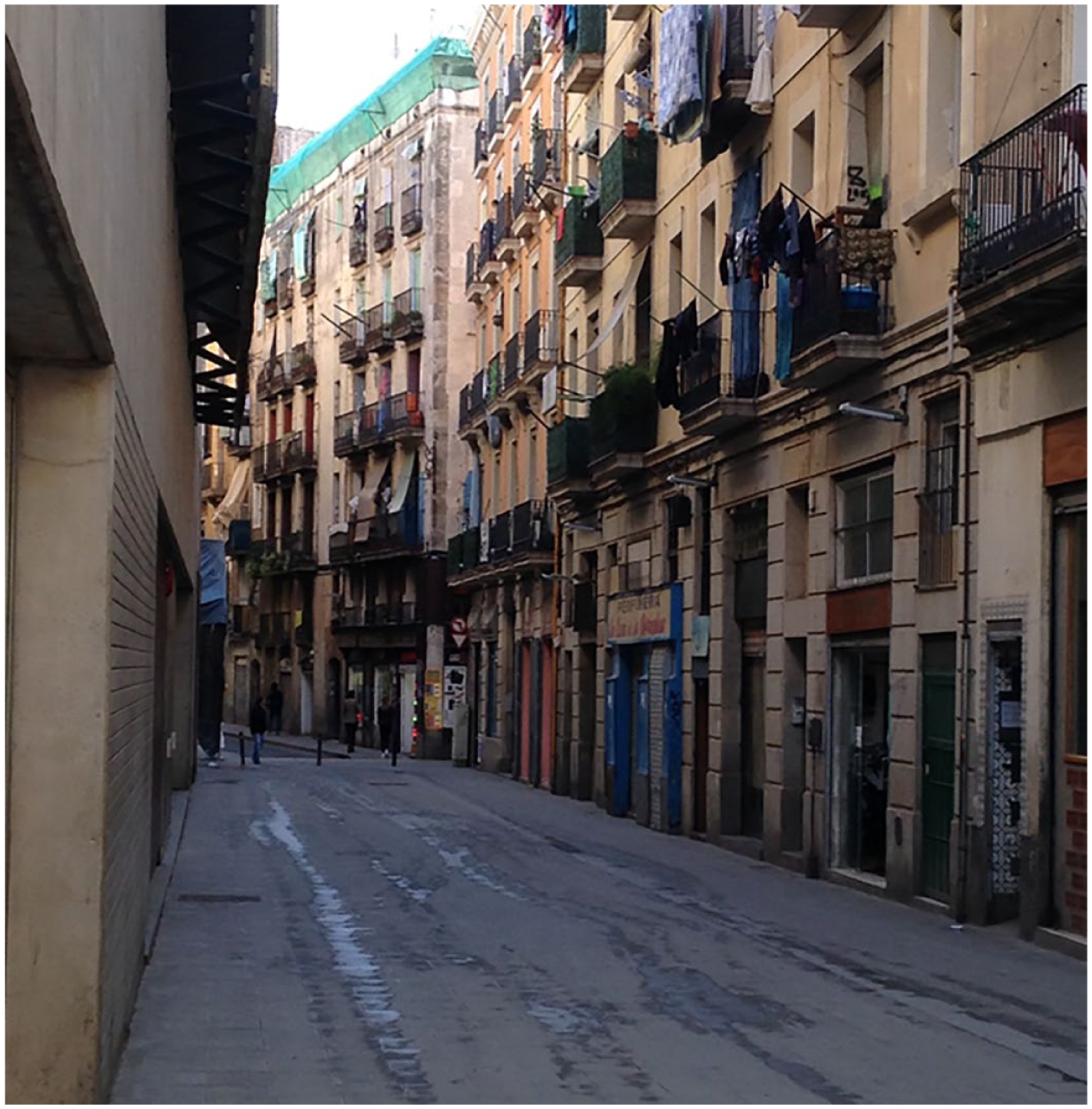
The backstreet of the Filmoteca. 2012, photo.
While the building was heavily criticized for its design and the location of a cultural venue in the most marginal streets of el Raval was questioned by the Spanish press:
The building of the Filmoteca, signed by Josep Luis Mateo, is naked like a rat and of the same colour of grey cement, which is always an impertinent colour because it is not human and it’s the colour of an industrial zone. (Cia, 2012)
it has been a success in terms of attendance numbers and has symbolized the end of the physical regeneration efforts.
This article now turns to exploring how temporality and sensory experience underpin the power relations at stake in the making of regenerated urban places.
Temporality, the Senses, and Instability
Let me now take you for a short walk around the different areas of el Raval (these descriptive evocations based on my ethnographic diaries kept during my fieldwork in 2012). By 2015, the regeneration corridors have become firmly established and are featuring an array of designer clothes shops, trendy bars, ecobreadshops mixed with Pakistani call centers and Filipino corner shops. There is a clear demarcation between the north and the south of the neighborhood, the dividing line still being C/Hospital crossing through the middle of el Raval. The north has the tourist corridors, the universities, the cultural institutions used by the city, and its streets are busy with a steady mix of students, tourists, and locals (Figure 3)). Its backstreets are clearly showing signs of “trendyfication” with new shops at street level opened by bohemian-cool newcomers:
I’m walking down el Raval, crossing it from North to South. In the North narrow busy streets: cocktail bars with outdoor seating, well dressed tourists drinking cava, skaters passing me with headphones on and colourful stencil graffiti on many walls. After C/Hospital the mood changes, empty streets. Hardly any street-life. (Ethnographic diary, March 17, 2012).
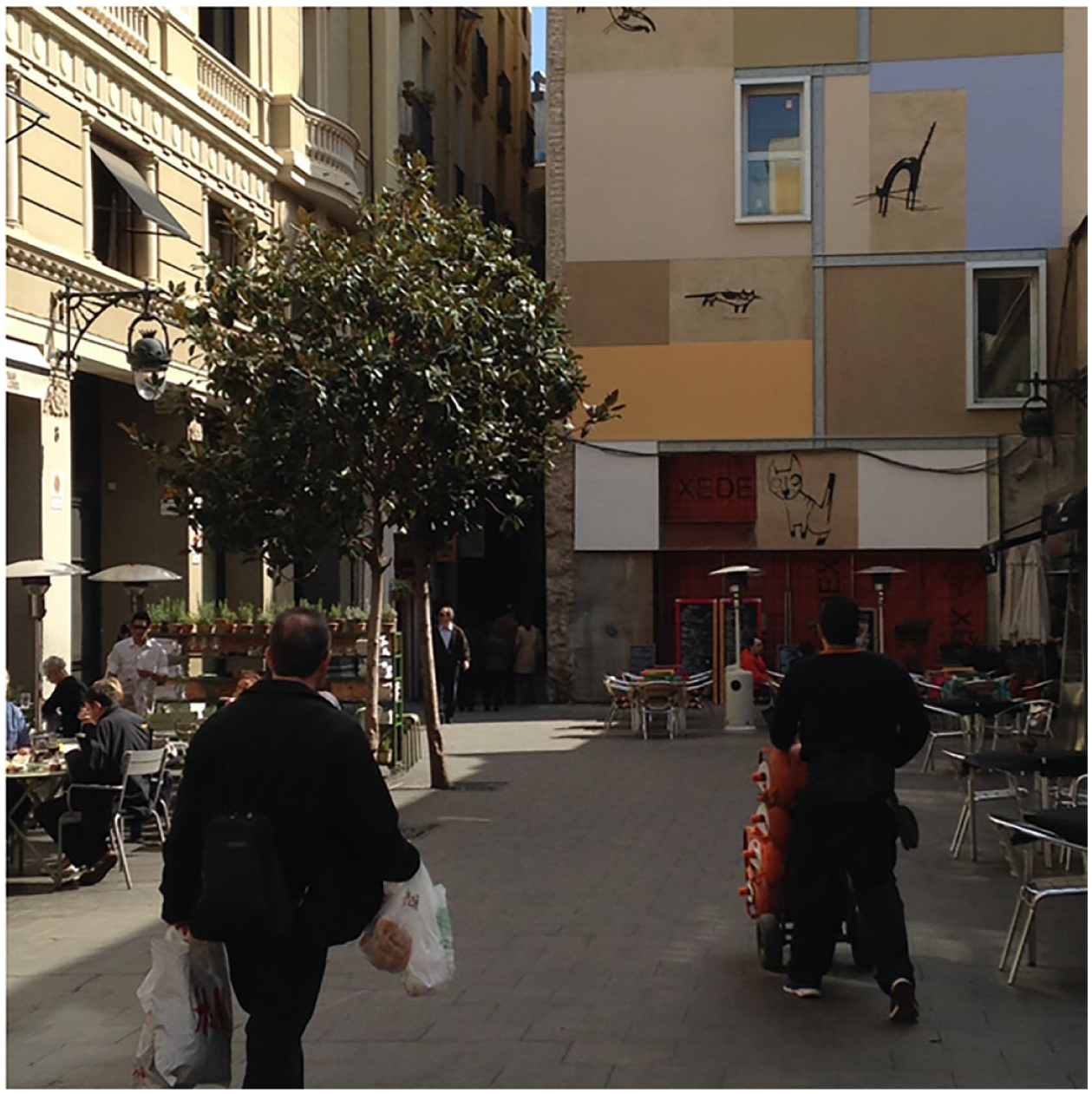
A gentrified street in the north of el Raval with coffee bars and graffiti. 2012, photo.
The south while certainly shaped by the Rambla del Raval used by tourists, “modernillos” (new bohemians) and locals alike, is still a more marginal place once you leave the Ramblas and enter the side streets. Here one encounters narrow, winding streets that, while having benefitted from improvements such as repaving and relighting, attract few outsiders and are lived and used by a mostly local immigrant population (mainly from Pakistani and Rumanian origin). Time seems to be standing still here. As a spokesperson for the main planning body in charge of el Raval remarks:
I suppose there is a moment in which the whole “Old City” develops into a certain direction: el Born develops commercially, the north of el Raval develops its cultural walk and also develops commercially; and the south of el Raval has been left at another rhythm. So despite the urban regeneration of the Rambla del Raval it is true that the south still has very deprived areas and the building of the Filmoteca just went on and on. (Planner C, Foment de Ciutat Vella, personal communication, April 2012)
Raco et al.’s (2008) research on Salford’s regeneration points out how different timescales are invoked in a variety of regeneration discourses and link it to social relations of power. For example, they explain how developers and investors often “try to maximise their returns on investments by shortening investment time frames” (p. 2652). Examining closer the regeneration of el Raval, it similarly brings to light how the needs of different social groups have been prioritized at different times. So, for example as Planner A tells me, before the 1980s in the Plan General Metropolitano, el Raval was earmarked to be cut through several big roads as mobility was the key focus. This was regarded as a “sacrifice in view of the functionality of the rest of the city” (Planner A, Foment de Ciutat Vella, personal communication, April 2012). With the implementation of a democratic planning model in the 1980s the “quality of life” of residents became the key concern in planning discourses and it is against this background that the PERIs were born (Degen & Garcia, 2012).
However, the emphasis on the effects the regeneration would have on the local community in the 1990s is relegated to benefits that were going to be felt sometime in the future and at some unspecified time. Instead, as Barcelona gained global limelight, the guiding emphasis became cultural regeneration focusing heavily on the promotion of culture to attract tourism and expendable income (Degen, 2008), this did not go down well with locals. Since 2005, following global urban planning trends, there has been a focus on the broad term of “sustainability,” which put social needs at the center of the agenda and started to mark specific deadlines to achieve particular social and economic milestones in el Raval.
A reason why the regeneration efforts have not panned out as expected is that while the regeneration was certainly spatially reshaping certain areas of the neighborhood, it was, as planners have told me in recent interviews: “. . . a regeneration of the stone, the human-social aspects of el Raval were not tackled at the time. Social interventions have only become a priority in the last 5 years” (Planner B, Foment Ciutat Vella, personal communication, April 2012), the social problems stayed the same over time. This means that while the neighborhood certainly got a facelift and new city and community infrastructures, the problems that the population were suffering: health, education, and employment were not attended to. So, for example, the latest health report of el Raval (El Periodico, 2013) indicates that the mortality rates in the south of el Raval are 42.8% higher than in Barcelona, meaning that life expectancy is 5 years less than in the rest of the city.
In terms of the regeneration strategy, its aims and priorities get constantly reworked over the long timespan of its duration. As the neighborhood changes spatially and new global urban trend such as the “cultural quarter” approach to inner-city life develops, new approaches are developed and implemented, as this official explains:
This means that in all the 15 years of the strong development of this project, we not only developed the project but also kept redefining it, so that the original project gets adapted to the situation that it is generating, as the urban structure of the neighbourhood changes. [. . .] the idea that we might not need much new public space [. . .] the setting up of big educational institutions. (Planner A, Foment Ciutat Vella, personal communication, April 2012)
Yet, from the interviews held with those in charge of the regeneration, it becomes clear that this planning time is a linear, forward looking and rather inflexible time that is not able to accommodate rapidly enough to the social–global changes that have affected the neighborhood:
It now starts to become clear that the “model Raval” [. . .] was not perfect [. . .] that maybe it was a bit naive because there was a lack of foresight on immigration. In other words that there would be a second wave of illegal migration [. . .] El Raval has become overwhelmed. What has gone wrong is a constant correction/readjustment of the approach. I think that’s the key lesson. You have to create an approach based upon a certain situation and then introduce a tutelage, a following, and a continuous correction of parameters that adjust themselves to the reality [of a place]. (Former councilor of the Old City, personal communication, April 2012)
While the spatial restructuring of el Raval took place in the late 1990s, an unexpected phenomenon happened in Spain and in Barcelona. Attracted by the Spanish boom (now a distant memory) non-European immigration started to arrive in Barcelona. As always, their first stopping point was el Raval, which offered affordable housing. So in 1998, there were 15% non-Spanish residents in el Raval by 2005—40%; nowadays, 46%, leading Time Out (2013) to describe it as “one of the most ethnically diverse places in Europe, with more than 70 nationalities calling it home” (p. 60). This social change has had as much power in framing the daily practices and the sensory make up of el Raval as the new spatial design and regeneration policies themselves.
As Healey (2000) comments, historically urban planning did evolve as a process that ordered a self-contained, internally integrated “uniplex” city—yet this is no longer possible in a globalized, interrelated, “multiplex” world: “Municipalities and their planners have little leverage over the flow of events through which the sociospatial relations of cities are actively being constructed” (p. 518). In el Raval, migrants have actively reshaped public spaces through new rhythms emerging from novel bodily practices and uses of the streets. Thus, new sensescapes are constantly evolving such as the changing soundscapes of music and languages one can hear; or the smellscapes which the aroma of different spices and foods produces; or new tastescapes evolve as Doner Kebab shops become popular among the Barcelona youth or Filipino bakeries offering tempting new sweets. Changing temporal practices further rewrite everyday rhythms of the neighborhood. Migration has actively reshaped the temporal uses of the streetscape by opening businesses that open till late at night and weekends:
The translucent light of money transfer and Internet cafes shines 24 hours onto the streets of el Raval. I have also noticed that Pakistani cornershops are the only ones opened on Sunday’s and Bank holidays while Spanish shops remain closed. Indeed, Pakistani owned mobile phone shops are open till midnight often filled with lively groups of Pakistani men in their dish-dash chatting or standing around at all times of the week, night. (Ethnographic diary, April 28, 2012)
The public life of the neighborhood has not only been reshaped by a new gentrifying public or formally organized events by the city council on the new squares; but new religious festivals by the newly arrived migrants such as the end of Ramadan are now a yearly feature of religious celebrations next to the traditional Fira de Sant Ponc, a medieval medicinal herb fair celebrated in el Raval since the 16th century. Reminding us of Augoyard’s (2007) argument that “inhabited space is articulated according to lived time . . . lived time invalidates the rules of rationally composed space” (p. 165).
Let’s carry on walking across El Raval’s narrow streets. With balconies almost touching each other above, one is quickly sensuously immersed in the local life, having to negotiate the sidewalk with people and beeping mopeds; being assaulted by a cacophony of TV blaring, voices, and hammering tools coming from shops and balconies; and being subjected to the musty smell of the sea nearby mixed with sewage and urine sometimes—and clean laundry or food at other times. And then, suddenly one stands in a vast minimalist square, the Plaça dels Angels, lacking any seating or decoration, yet serving as a visual stage to Richard Meier’s imposing modernist white building. When first built, these new regenerated spaces stood in stark contrast to the rest of the neighborhood: Due to its scale, smells did not linger as readily, sounds seemed to be more muffled, tactility was minimized by the smooth surfaces, no street furniture disrupted their uniformity (Degen, 2008). However, over time, locals have appropriated these spaces, especially the square in front of the Museum of Contemporary Art, and gradually they have become immersed into the sensory rhythms of El Raval:
In the morning dog-walkers let their pets defecate on the square. Groups of homeless set up their belongings for the day and start to play cards, chess or even on their Playstation. I see how the private security guard of the museum greets them. The homeless respond and they have a brief chat. Later, at around midday and early evening the square is buzzing. Young Filipino children are cycling around, some training with cross bikes; groups of skate-boarders take over the ramps of the museum—their rattling rhythms mixing with the chattering voices from young tourists and locals that gather with sandwiches and beers. (Ethnographic diary, 5 May, 2012).
While in its first years of existence, the museum and its surrounding square felt “like a white meteor fallen from the sky” (resident, personal communication, 1998); its overpowering visuality has been diluted by the strength of the other senses, especially sound and tactility. When the other senses subjugate the visual through the practices occurring
[t]he territory suddenly becomes diffuse and takes on an extension incommensurable with any spatial judgement that could strictly be connected with their visual faculty. [. . .] These territorial fluidities [italics added] reveal already a first feature of the dialectical nature of appropriation processes. Anything that one would look for in terms of spatial division and permanent states would mislead us. (Augoyard, 2007, p. 96)
In other words, we can see here how the “resistance of place” is constituted through unwitting acts of subversion and appropriation by local practices and also the passing of time which affects the built environment. Let us analyze this in more detail.
First, material culture in itself is not stable or fixed. It might be stating the obvious but different assemblages of time, materials, and policy keep evolving and changing the materiality of space. As Koch and Latham (2012) explain, public life emerges from a series of political assemblages such as policy interventions in place but also the material configurations of the site: new paving stones, lighting water, electricity, and so on. Time, as I show, adds a further dynamic to that relationship and underpinning the interruptions of power. Let me explain, on the one hand, the physicality of the environment alters by the passing of time. The sandblasted materials show signs of wear, look dirtier, grey rather than white. The museum ramps are chipped and show black markings by the skaters. Sounds rather than being muffled, echo loudly across the square. Furthermore, policies also change over time. Hence, while in the first years of opening the museum many of the homeless were moved away, in recent years, there seems to be a certain permissibility toward them. Hence, if one views place, public life within a temporal framework as a fluid cocreation or coming together of multiple forces such as human actors, materials, policies to mention a few, one can claim following Koch and Latham that “while new configurations or events may create new capacities, rhythms and affordances, and facilitating some new uses and users while restricting (or excluding) others, there is no certainty about what exactly—if anything—will emerge or stabilise [. . .]” (p. 525).
As my case study shows, the sensory and temporal rhythms created in el Raval reflect not just the regeneration efforts but are ignored by some users of space or appropriated for a diversity of practices and, moreover, subverted through the passing of time and the changes of the social, material and political forces at play. As Pile (1997) points out, we might see different expressions of resistance emerging here, where resistance “may well operate between the spaces authorized by authority, rather than simply scratching itself into the deadly spaces of oppression and exploitation” (p. 213). This might not be considered as “resistance” in the classical sense of opposing power but more in terms of resistance as being an alternative mode of living and experiencing which happens alongside normative rhythms and expectations—yet thereby fracture a uniform imposition of experience of place. While parts of el Raval attract new publics such as students, tourists, and a gentrifying public and practices, they have never the monopoly over the use of space. Indeed, a longitudinal study that evaluates the social and urban effects of the regeneration process in this district concludes that while the regeneration has raised the property and rental market, it has simultaneously intensified and reshaped the geography of urban inequality (Arbaci & Tapada-Berteli, 2012). This leads to the constant blending of different people and social classes in its public life and by extension of a multiplicity of spatial practices and living rhythms which confer el Raval its unique character. While at times, some groups might intensively use one area of the neighborhood over another, this use is never absolute. As the former councilor of the Old City states: “It’s an area with different speeds, with different realities. It’s a very rich area, it’s full of nuances [. . .]” (Personal communication, April 2012).
Conclusion
One of my last resident interviewees in el Raval ended an interview in April 2012 by saying: “El Raval se resiste” [El Raval is resisting], implying that there is an inexplicable force in the neighborhood that somehow manages to oppose and resist the global forces of urban regeneration. By foregrounding the dimensions of time and sensory experiences in processes of urban change, I have shown in this article that it is precisely these two dimensions which are aiding to destabilize the expected power relations of global capital and urban governance. Inner city areas such as el Raval are neighborhoods where multiple publics and social groups live and engage and where structural processes of urban change and regeneration interact on the ground with a multiplicity of everyday practices—constantly transforming existing power relations. Hence, the implementation of urban regeneration processes has not an immediate effect but should be studied over time to examine how policies, new spaces, and new publics settle, change, and evolve. As Fitzpatrick (2004) argues, “time is crucial to the implementation, operation and effectiveness of social policies [. . .]” (p. 197), yet simultaneously temporal dimensions, as well as sensory experiences, are prone to destabilize the expected outcomes of social policies.
Adding an explicit focus on the temporal and experiential dimensions of place-making not only destabilize how we view place but, also, how we conceptualize the ways in which power and resistance operate differently and uniquely across places. It reveals power relations emerging in urban change as “entanglements of power” (Sharp, Routledge, Philo, & Paddison, 2000), meaning that expressions of power need to be always seen in relation to, and entangled with, various expressions of resistance and subversion. Yet, academic studies on urban regeneration processes often prioritize one view over the other (see Koch & Latham, 2013, for an extended critique). However, as Sharp et al. (2000) suggest: “[the] strive to binarise power and resistance, tends to become scrambled when striving to provide more grounded commentaries alert to the chaotic muddle of empirical situations” (p. 2). This article has only started to outline some initial understandings of what “the resistance of place” might entail. If we are seriously to follow Massey’s (2005) suggestion of place as an “event” we need to ask different questions about how power and resistance operate in particular places:
There can be no assumption of pre-given coherence, or of community or collective identity. Rather the throwntogetherness of place demands negotiation. In sharp contrast to the view of place settled and pre-given, with a coherence only to be disturbed by “external” forces, places as presented here in a sense necessitate invention; they pose a challenge. (p. 141)
One of the challenges is to engage with the complex ways in which the “soft” attributes of the city such as time and experience interact with “harder” attributes such as urban materialities and space to frame each other, often in messy and unexpected ways. Social scientists have a tendency to aim for clear cut accounts and search for overarching theories to clarify the complexity of social life, yet “societies are much messier than our theories of them” (Mann, 1986, p. 7).
Footnotes
Acknowledgements
I would like to thank those who shared their time while I was studying el Raval. I would also like to thank the anonymous referees for their help in improving the arguments presented in the article.
Declaration of Conflicting Interests
The author declared no potential conflicts of interest with respect to the research, authorship, and/or publication of this article.
Funding
The author disclosed receipt of the following financial support for the research, authorship, and/or publication of this article: This article was supported by a British Academy Mid-Career Fellowship.