







Abstract
Drawing insights from the literature around cultural discourse theory, urban informality, and precarity, this article explores how a group of unlicensed hawkers in Hong Kong engage in a place-making process of precarity. Existing research on precarity has examined the structural change in the labor market in advanced economies and labor unions’ collective resistance. Few empirical studies, however, have explicated how informal workers experience precarity in their everyday life. To contribute to this literature, therefore, this study examines how hawkers in Hong Kong constitute their class identities and the meanings of place while facing legal and spatial ambiguities on a daily basis. While interlocutors articulate different class identities, they constitute themselves as precarious beings through spatial practice. Rather than engaging in collective resistance against precarity, hawkers develop culturally distinctive practices to adapt to the power structure in which they operate. This article highlights the dialectical relationship between spatial practice and precarity as contextualizing precarity in developing Asia.
Interlocutor O: I do not earn much and I am poor. . . . I know that we are not right [in the eyes of the law], but I don’t have money, so I still go there [i.e., night market] to earn a living. (Personal communication, March 14, 2016, Own translation) Interlocutor K: This [night market] is a good place for global business. . . . I do not know when [else] I can do business. (Personal communication, December 4, 2015)
These are the words of two hawkers in an illegal night market in Sham Shui Po, a low-income urban neighborhood in Hong Kong, reflecting on their identities, precarious experience, and the meanings of the place. Though the hawkers feel uncertain about their lives and are scared of being prosecuted by government actors, they have to maintain these uncertainties to make a living. This study is situated in a night market of 50 to 70 individuals and groups of unlicensed hawkers in Hong Kong. To manage hawking in an economical way, since 2001, the Hong Kong government has given the Hawker Control Team (HCT) the power to make daily decisions regarding whether, when, and where unlicensed hawkers can hawk (Hong Kong Legislative Council [HKLC], 2014). This informalized law enforcement can be understood as “informality from above,” through which legal and spatial ambiguities have been constructed to organize and discipline the urban space (Roy, 2009, p. 84). Yet I argue that such precarious working conditions also create room for hawkers to develop culturally distinctive communication practices to construct class identities and spatial meanings.
The purpose of this article is to analyze how unlicensed hawkers in Hong Kong constitute their class identities and meanings of place while facing legal and spatial ambiguities in everyday life. While hawkers articulate different class identities, they construct themselves as precarious beings through communication practices. The present study has three theoretical and practical objectives. First, it aims to contribute to theorizations of informality by exploring the ways in which hawkers build identities and construct places for conducting precarious work and being governed (e.g., Crossa, 2016). Second, it helps contextualize informal workers’ precarious experiences in developing Asia (Arnold & Bongiovi, 2013). Rather than engaging in collective resistance against precariousness, I argue that hawkers develop culturally distinctive practices to legitimize their precarious experiences and adapt to social power structures. Third, in the context of the ongoing debate surrounding hawker policy reform in Hong Kong (HKLC, 2015), this study may impart culturally sensitive insights into how hawkers conceive of their work.
This study has employed cultural discourse theory (CDT) as a major theoretical and methodological lens to examine hawkers’ communication practices, defined as historically transmitted, culturally distinctive, and patterned communicative actions in situated scenes (Carbaugh, 2017). When hawkers interact with others, their practice not only reveals their explicit literal meanings but also produces a meta-cultural commentary about places, identities, relations, actions, and actions (Carbaugh, 2017). The extant research has examined how communication practices construct social spaces of difference (Witteborn, 2011) and senses of place (Carbaugh & Cerulli, 2013). In this study, CDT is particularly analytically promising, as it attends to the matters of place and identity that are significant to hawkers and how they actually engage with these concepts in everyday life. By analyzing how and where hawkers’ communication practices occur and intertwine with their work and cultural premises (Carbaugh, 2017), I focus on the relations between these practices, hawkers’ class identities, and their understandings of the place where they constitute themselves as precarious beings. Here, I conceptualize place as a relational meaning-making process constituted through hawkers’ social practice and relations (Massey, 2005), which reveal where and who they are (Carbaugh & Cerulli, 2013). Class identity emerged as a sensitizing concept when hawkers discussed their work and reflected on who has a legitimate right to hawk. As such, I refer class identity to the lived experience and explore it through its intersectionality with place (Elwood, Lawson, & Nowak, 2015). Specifically, place-making means how hawkers express their selves and their moral values and reproduce social differences in their place of work.
There are other cultural approaches to communication (for a review, see Scollo, 2011). Shi-xu’s (2014) framework of cultural discourse study is particularly helpful in considering the historical and cultural repression embedded in discourses. Shi-xu (2014) has offered a holistic and historical review of Chinese discourse in terms of its assumptions and norms such as the notion of face. In a study of Hangzhou, a tourist city in China, Shi-xu (2014) argues for the need to understand urban development as a discourse that reveals how the city has been historically, culturally, and discursively conceived, planned, and developed by various social actors. This work highlights the constitutive role of communication in making place. Yet as the research goal is to analyze hawkers’ situated communication practices, which treat informality and precariousness as active and meaningful to them, I employ Carbaugh’s (2007, 2017) CDT as my analytical framework. Indeed, this study draws insights from cultural discourse study’s valuable contributions regarding the assumptions of Chinese discourse to grasp the hawkers’ practices and the pertinent power relations between hawkers and government actors in the urban space.
This article begins with a review of the literature around informality and precarious work. Next, the brief history of hawking in Hong Kong and the case are introduced. Then, after discussing the methodology, I examine two cultural terms of class identity that emerged from the hawkers’ practice. The penultimate section discusses the ways in which hawkers conceive of and practice informality. Last, the implications of the findings are discussed.
Street Hawking as Informal and Precarious Work
The study of hawking can be dated back to the discussion of informal sectors in the 1970s. According to Crossa (2016), many of these early works were dominated by a “culture of poverty” approach (p. 288). This approach viewed hawking either as helping the urban poor sustain their livelihoods or as an unplanned result of poor governance (e.g., Bromley, 2000; Hart, 1973). Early research also often presumed hawking to be a survival strategy or resistance against urban governance performed by the working poor (e.g., Smart, 1989).
Recent work in urban studies has reconceptualized informality as the organizing and disciplinary logic of urban space (Roy, 2009; Roy & AlSayyad, 2004; Schindler, 2014). This literature views informality as a spatial process through which government can define “the ever-shifting relationship between what is legal and illegal, legitimate and illegitimate, authorized and unauthorized” (Roy, 2009, p. 80) to govern urban space. Informality has been studied in the framework of neoliberal urban governance: The state tends to create a “gray space” of tolerated illegality to establish a spatial logic that favors the commodification and privatization of urban space (Milgram, 2014; Roy, 2009).
Another prominent approach explores such informality from below, emphasizing the agency of hawkers (e.g., Crossa, 2016; Devlin, 2011; Schindler, 2014). Because informality is lived and practiced through legal and spatial ambiguities, there is room for hawkers to appropriate, evade, and resist state power to live in the informal space and claim their right to the city (e.g., Devlin, 2011). Communication practice is central to informality because, when hawkers engage in informal activities, their particular ways of communicating may reproduce “the same sorts of legitimacy discourses as those produced by the state” (Crossa, 2016, p. 292). Informal workers’ practices may be contingent on their economic and social positioning (Turner & Schoenberger, 2012). In a study of vendors in Hanoi, Turner and Schoenberger (2012) found that the itinerant vendors tended to avoid the police by moving around the city, whereas the fixed traders avoided the police by developing social relationships with other urban citizens. Schindler’s (2014) study in Delhi examined how informality allowed state and nonstate actors to form the multiplicities of governance regimes related to street hawking. Scholars have called for a rethinking of the relations between formality and informality (Crossa, 2016; Schindler, 2014). Specifically, it is vital to explore the multiplicity of ways in which hawkers build identities and conceive of informality in their everyday lives, rather than presuming hawkers to be bounded entities comprising the working poor under governance (Crossa, 2016).
As hawkers operate in an uncertain working environment, the concept of precarity helps frame the relations between their practices and lived experiences. I conceptualize precarity as lived experience constituted through hawkers’ practices, social positions, and relations (Millar, 2014). Much research has explicated precarious work as a form of labor involving economic and social insecurity (Standing, 2011), focusing on structural changes in the labor market (Kalleberg, 2009) and labor unions’ collective resistance against the precaritization of the workplace (Atzeni, 2016). Precarity has long been criticized as a Euro-American-centric concept because most studies have focused too much on structural changes, such as the transition from Fordism to post-Fordism, in the Global North (Arnold & Bongiovi, 2013; Mosoetsa, Stillerman, & Tilly, 2016). Arnold and Bongiovi (2013) have argued that there is a need to contextualize precarity in Asia because, unlike Europe and the United States, Asia has incorporated precarious work into its development. This critique largely focuses on different precarious conditions across the globe: that is, how precarious work is shaped by particular historical and political trajectories (Millar, 2014; Neilson & Rossiter, 2008). Moreover, hawkers can experience precarity in various ways that depend not only on their working condition but also their social positioning (Neilson & Rossiter, 2008). Specifically, much research has shown that workers, particularly in the Global North, have tended to organize collective action against precarity (Atzeni, 2016). By contrast, Millar (2014) demonstrated that wageless labor in Brazil rather sought to achieve for the balance between relational autonomy and flexibility enabled by precarious work. Sun and Magasic (2016) illustrated that Chinese IT programmers were likely to internalize and accept precarity, rather than resisting it, in their cultural discourse of work. In short, existing studies reveal that “there is no singular experience of precarious work” (Liao, 2016, p. 140).
The intention here is to show that communication practice is central to informality and precarity by transforming these abstract ideas into concrete expressions in place. Advancing these studies, this research examines how hawkers develop practices to build their class identities, constitute themselves as precarious beings, and construct spatial meanings.
Street Hawking in Hong Kong
Street hawking was first documented in the 19th century, when Hong Kong was a British colony (McGee, 1973). The term “hawker” refers to any person who trades in a public space, whether it is a fixed stall or the street. This term has often been equated with the urban poor (HKLC, 2015). Since the 19th century, government has considered hawkers to be a nuisance to the formal economy, public health, and security (McGee, 1973). The sovereignty of Hong Kong was transferred to China in 1997. To develop Hong Kong as “Asia’s world city,” the government initially planned to eliminate hawking activities on the street, since these activities could pose unfair competition to the formal economy and produce obstruction to public space (HKLC, 2015). In this vein, the government constructed a moral “yardstick” to exclude hawkers from the formal economy (Lee, 2016). Since late 2001, the economic difficulties caused by the Asian financial crisis have led the government to take “a more tolerant approach in its enforcement actions against unlicensed hawking activities” (HKLC, 2014, p. 6) to maintain fiscal austerity. The HCT, the government actor responsible for managing hawking, has been given the authority to decide whether, when, and how to take enforcement action against hawking activities, thus producing legal and spatial ambiguities.
This study examines how unlicensed hawkers live with ambiguities in one of the largest “hawker black-spots” in Hong Kong. This market comprises 50 to 70 individuals and groups of unlicensed hawkers. I observed that it often operates from 7 p.m. to 12 a.m. each night. Most hawkers are local Chinese and migrants from Pakistan or mainland China. The hawkers use materials collected from the surrounding environment to occupy the workspace. They mainly sell both new and used goods, such as mobile phones and clothes, on the ground (Figure 1) or from trucks or vans (Figure 2). Except for mobile phones (ranging from about HK$500 to HK$1,000; approximately US$65 to US$129), most commodities cost about HK$1 to HK$50 (about US$0.13 to US$6.45). Although hawkers are generally regarded as poor, the monthly incomes of my interlocutors varied from about HK$1,500 to HK$50,000 (about US$193 to US$6,444). That means that some of them earn much more than the average monthly wage in Hong Kong (i.e., US$1,998). The analysis will discuss how this income gap may be pertinent to hawkers’ different class identities and understandings of place.
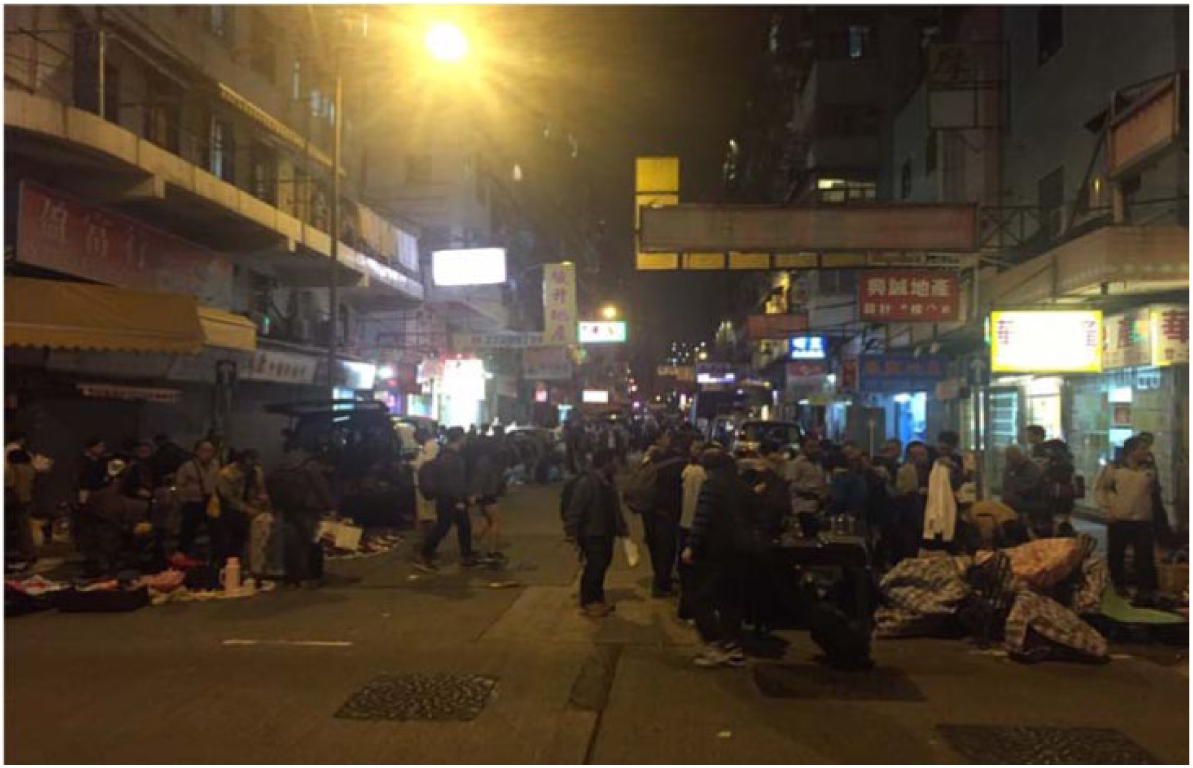
Hawkers operating business on the ground, 2015.
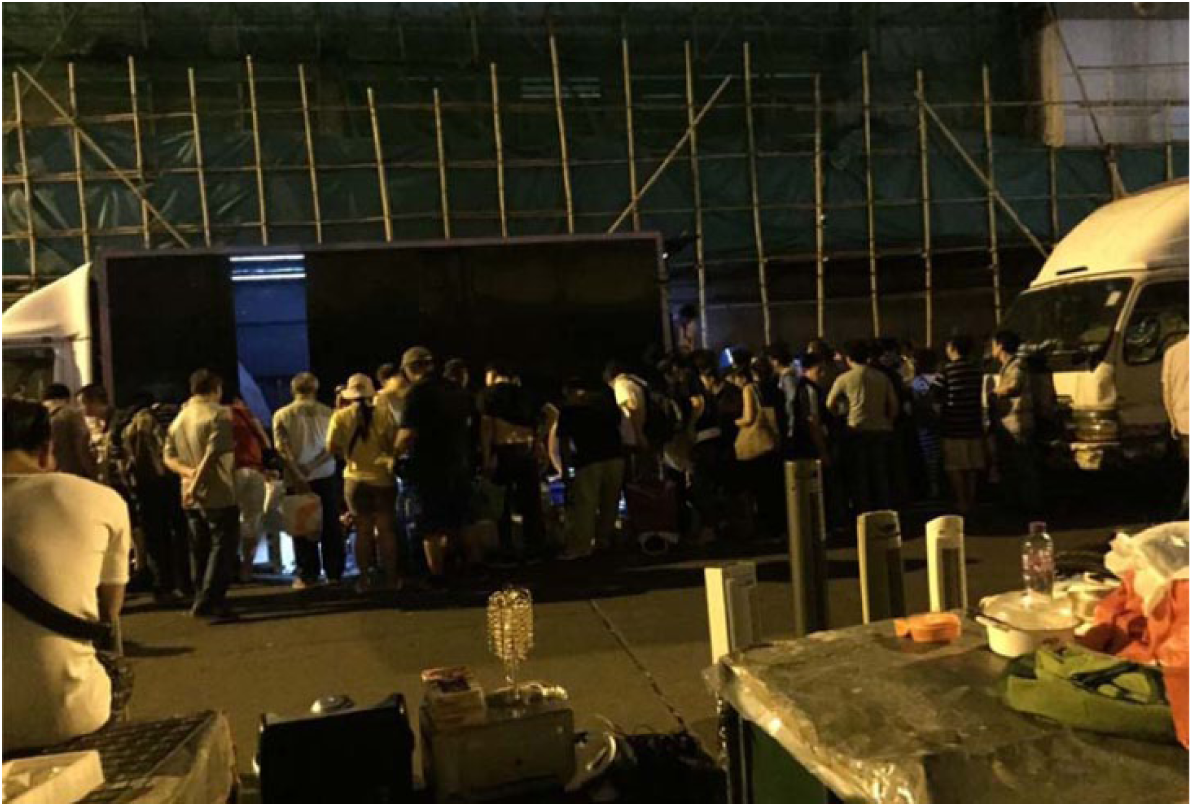
Hawkers operating business from the truck, 2016.
Methodology
Methodologically, CDT focuses on the situated communication practices that are meaningful to hawkers (Scollo, 2011). In line with this, I collected data from two sources: participant observations and semistructured interviews. I conducted participant observations of the market between 2015 and 2016. With the interlocutors’ informed consent, I helped them conduct business and sat with them to observe and participate in the market. This method enabled me to observe and document naturally occurring social interactions (Carbaugh, 2007).
I conducted semistructured interviews (Stewart & Cash, 2003) with 15 hawkers in the night market. I had informal conservations with these interlocutors and other hawkers during my fieldwork. I recruited interlocutors during participant observations based on their hawking times, locations, and means. The demographics of my interlocutors varied across several characteristics. I interviewed seven male hawkers and eight female hawkers, ranging in age from 30 to 86 years. Regarding ethnicity, I interviewed seven local Chinese and eight migrants: two from mainland China, four from Pakistan, one from Sudan, and one from Bengal. Regarding the means of hawking, 5 hawked from trucks or vans, and 10 hawked on the street. Most (13 of the 15) told me that they had been hawking for at least 3 years. The most experienced interlocutor had hawked for more than two decades. During the interviews, I mainly asked the interlocutors to describe their daily lives. To hear their language and meanings, I avoided using terms like “the poor.” The interviews lasted between 20 minutes and 1½ hours. The language of communication was either Cantonese or English, depending on the interlocutor’s choice.
To analyze the materials, I adopted CDT’s descriptive and interpretative modes of analysis (Carbaugh, 2007). The descriptive mode provided a thick description of the use of the cultural terms and communication related to place-making, such as “spatial deixis” (e.g., “here” and “there”), during the interviews and participant observations (Carbaugh & Cerulli, 2013). I identified the two cultural terms of class identifications and the practice of “being smart” because my interlocutors repeatedly talked about them as aspects of their lived experiences in the night market. The descriptive analysis supported an understanding of when, where, how, and why interlocutors communicated in particular ways (Carbaugh, 2007). I then used the interpretive mode to explore, first, what cultural norms these practices might invoke, and second, what identities and meanings about place were presumed for these practices (Carbaugh, 2017). Specifically, when the interlocutors explicitly talked about dwelling (the meanings of place), I searched for implicit expressions of identities and social relations.
I neither claim nor assume that all hawkers employ the practices discussed below consistently or in the same way. This research can only approximate the interlocutors’ perspectives. To ensure the trustworthiness of my interpretation of the data, I paraphrased the information provided by the interlocutors during the interviews and asked them whether the paraphrased information made sense to them. I viewed the participant observations and the semistructured interviews as two distinct ways of social interactions, allowing me to record, identify, and experience multiple instances of the practices in the night market and to triangulate the materials I gathered. These two methods helped inform and revise the cyclical research process.
Being a Hawker in the Night Market: The Interlocutors’ Views
Place emerged in the hawkers’ practice through the hawkers’ efforts to occupy and defend their workspace (Palacios, 2016). When I asked my interlocutors to describe their work, they frequently first pointed to a particular location and told me “This is my own place. I do business here every night.” I observed they started occupying their customary place (Ba Wei) at around 5 p.m. to 6 p.m., claiming the space using different materials such as a suitcase or their van (Figure 3). These materials signified to others that a certain location was occupied. The hawkers did not start hawking until 7 p.m.—the closing time of the nearby fixed market stalls. If they hawked before the stalls closed, the owners of the stalls might complain to the government, thus leading the HCT to enforce the regulations. In this respect, the hawkers’ practice reproduces the government’s discourse: The informal economy should not threaten formal business interests. Moreover, the market itself is a spatiotemporal process, rather than a bounded location (Massey, 2005). Hawkers’ practice of occupying a particular location and time constitutes a makeshift place that groups hawkers together and allows them to build identities.
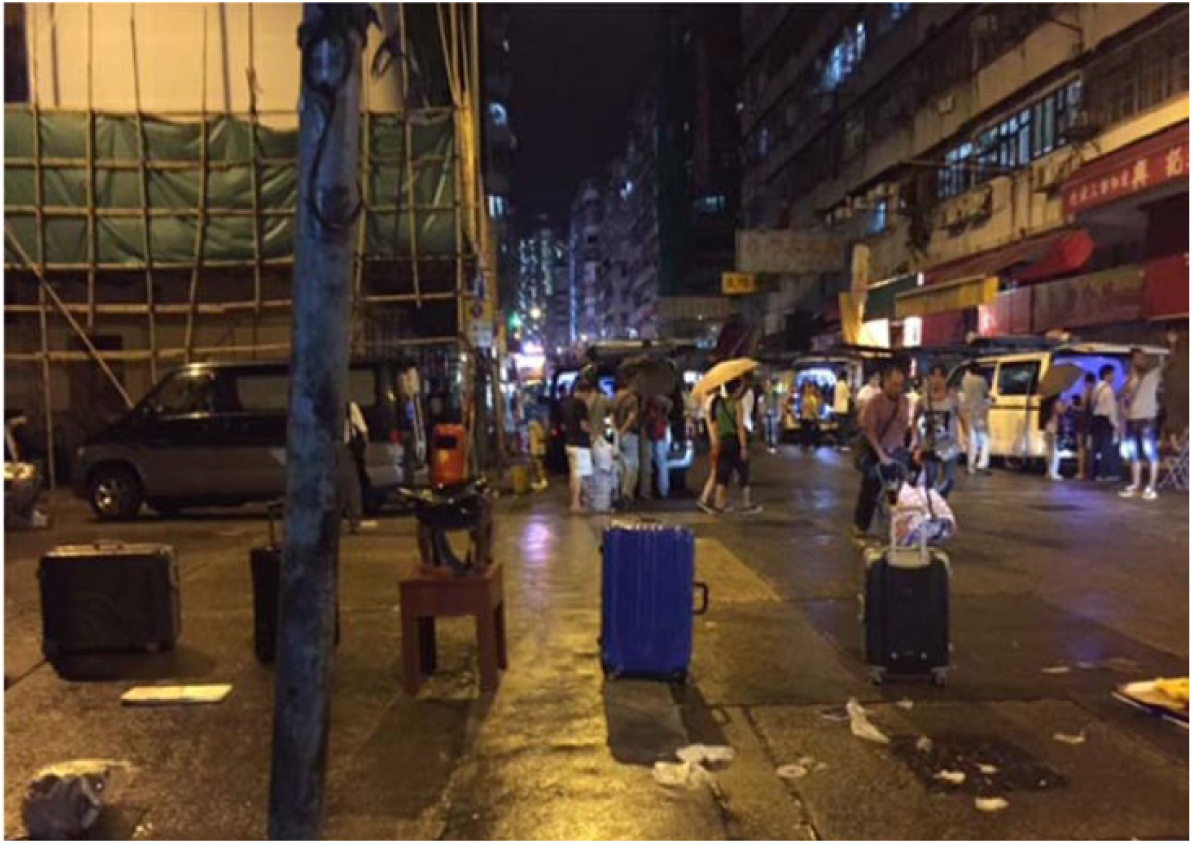
Hawkers occupying the customary place in the market, 2015.
Additionally, hawkers articulated connections with the urban space by discursively claiming certain locations as their livelihood and by narrating their work in the market. Almost every interlocutor emphasized that they were making a living with their efforts. Such expressions consolidate the neoliberal class culture of Hong Kong: Individuals should be responsible for their life trajectories, rather than live on welfare (Lee, 2016). The market becomes a place for hawkers to comply with neoliberal discourse. Yet the hawkers articulated different class identities and meanings of place. Most interlocutors foregrounded one of the two cultural terms: the poor and businessman. These two terms illustrate the hawkers’ concrete expressions that materialize their classed imaginaries of the normative beings in the market and (re)produce social differences of place characterized by who is a legitimate user of a space (Elwood et al., 2015).
A Place for the Poor
The interlocutors who conducted their business on the ground mostly used the self-identification of the poor. Most interlocutors with this identification were Chinese hawkers. They identified themselves as poor not only in terms of economic capital but due to their need to live with uncertainties in the market. Interlocutor O said:
They [the HCT] always bully me and pack my things. . . . I do not earn much, and I am poor. . . . I know that we are not right [in the eyes of the law], but I don’t have money, so I still go there [i.e., the night market] to earn a living. (Personal communication, March 14, 2016, Own translation)
The expressions of Interlocutor O show that income level still matters in constructing the class identity. Her speech constructed hawkers as immoral beings in place due to the illegality of the market; however, she argued that a condition of abject poverty led her to hawk in the market to sustain her livelihood. Moreover, she used the terms “bully” and “pack my things” (the seizure of hawkers’ commodities; see Figure 4) to refer to government actors’ punishments. Several other interlocutors also used these two terms in their spontaneous conservations and interview narratives. They wanted to avoid punishment by government actors; however, due to the precarious working conditions, they could not easily circumvent this punishment. Facing this situation, Interlocutor D said, “We, the poor, have to accept this, and [we have] no solutions.” Such expressions reflect a general belief that hawkers can only survive in informal economies and, thus, must accept the precarious conditions and punishment that go along with these means of living. Informality and precarity are reproduced as conditions that belong to the poor.
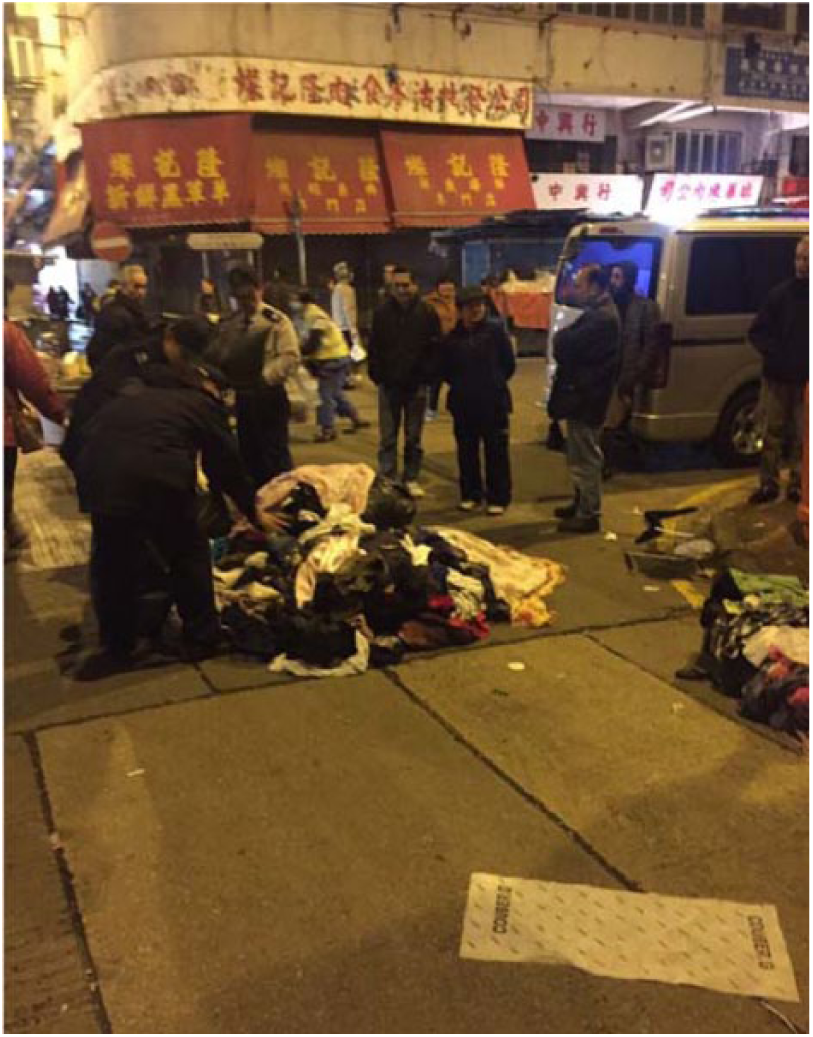
The Hawker Control Team’s seizure action, 2016.
The practices are directed toward the creation of an orderly place where only the Chinese poor can legitimately conduct business. This place-making is deeply relational (Massey, 2005): It simultaneously produces social difference and exclusionary social spaces by delegitimizing others’ rights to hawking, as in this spontaneous conversation about the market’s past and present:
This is a place specifically for the poor to sustain a livelihood. When I came here, there were few people to hawk, and the whole street was us. In the past two to three years, there are more South Asians. They use trucks or vans to occupy the place to maximize profits.
Yes. If you tolerate them, they become more unruly to get all our places. Sigh, it is difficult to sustain a livelihood. (Personal communication, October 20, 2015, Own translation)
For these two interlocutors and others with similar class identities, the market had long been “a place specifically for the poor to sustain a livelihood.” None of the interlocutors had a legal right to hawk in a public space; however, they privatized the market as their property and legitimatized their behaviors through their long-standing practices of hawking. The interlocutors employed a victim perspective to claim that their entitlement to the market was under threat from the activities of the “South Asians.” In this sense, the precarity faced by the poor depends not only on legally uncertain working conditions but also threats posed by the ethnic others. Here, South Asian is an ethnic identity label referring to the Pakistani, nonpoor hawkers, who own economic capital (e.g., trucks or vans) that helps them conduct business. The conversations assume that the Chinese poor have long created an orderly market and that the presence of the South Asian others is disruptive and threatening. The interviews I conducted also pointed to the social differences between the Chinese poor and the ethnic others, including statements to the effect that the latter were “greedy” and “dirty.” This sort of verbal depiction reproduces existing social differences in the media discourse, which associate South Asians with criminality (Erni & Leung, 2014). As such, hawkers intertwined ethnicity with their place-making and class identity, discursively constructing the ethnic, nonpoor others as deviants who excluded from the place.
Such social differences arose from imaginations of how the night market should ideally operate. The poor hawkers expect the market to be a place of care, not only for their survival but also for helping other poor urban dwellers. These hawkers expressed discontentment with the economic logic of the ethnic, nonpoor others. Interlocutor G said:
They [the “South Asians”], this kind of nation, do not know about how to care about the people. Unlike them, we would not maximize profit. This is a place to sell goods to the poor, instead of a place to maximize profit. (Personal communication, March 3, 2016, Own translation)
Again, the use of the grouping terms “we” and “they” consolidate the class boundaries between the Chinese poor and the nonpoor South Asian hawkers, while also reinforcing perceptions of the market as a normative place for the Chinese poor, regardless of hawkers and consumers. Interlocutor G grouped the Chinese poor with the poor customers, excluding the South Asians. The desired market was articulated to be a community for Chinese poor who do not seek profit maximization and are willing to offer care to other deserving poor. Although the South Asians may share similar experiences of uncertainty, the poor interlocutors delegitimized the former’s right to hawking. Because the market was constructed to be a place for the Chinese poor rather than for other ethnic groups, it became a place of ethnic difference.
A Place for the Businessmen
The interlocutors who identified themselves as businessmen conducted their business in trucks or vans. They were mostly Pakistanis. Like the former group, they perceived economic capital as being central to their class identity, as expressed by Interlocutor K:
I do not consider myself poor. I owned a company and I paid tax. I think my tax should include my business in this second-hand market. Do you know the salary of a university graduate? I earn more than most of them and many working-class people. This is a good place for global business. . . . I serve customers from Hong Kong and other different countries like the Philippines, Nigeria, and my home country. (Personal communication, December 4, 2015)
Interlocutor K is a Pakistani migrant who earns HK$40,000 (about US$5,158) monthly. He registered a company license to sell second-hand commodities in and outside this market. While the poor interlocutors constructed the market as a place for them exclusively to make a living, Interlocutor K articulated a vision of local market connecting him with the global marketplace. Such concrete expressions were not unique to Interlocutor K; other interlocutors shared similar expressions that their business connected them with other countries. Their place-making revealed that place is not bounded, but that relational processes are constituted through people’s social interactions and relations (Massey, 2005). The global imaginations of the market problematized “reductionist notions of hawkers as individuals who simply live in and accept a culture of poverty” (Crossa, 2016, p. 297).
Additionally, this group of interlocutors articulated the market as a promising place for entrepreneurship: With enough hard work and knowledge of business, they can make a living and enjoy the flexibility of the market’s informal work. Interlocutor H, a Pakistani migrant with 7 years of hawking experience, was “proud of doing business in the market” and attributed his skills and knowledge to his class identity:
Unlike others, I knew how to select the products and sell them at better prices in this market. Now I am a businessman. Though I can earn more if I work as a construction worker, I love this place because it allows me to have flexibility. (Personal communication, November 23, 2015)
Interlocutor H distinguished himself from others—those hawkers who hawked on the ground—as lacking relevant knowledge. Unlike the poor interlocutors with the Pakistani others, he did not attempt to exclude his competitors from the market. Furthermore, Interlocutor K largely conformed to economic rationality of maximizing profit. He went on to explain knowledge about not only popular commodities but also busy pedestrian avenues and when to occupy these places. His narrative expressed a drive for “flexibility” and becoming a “businessman” rooted in the practice of hawking in the market. Thus, hawkers’ identity was inseparable from the market.
The group of businessman hawkers, however, still experienced uncertain working conditions. Millar (2014) argued that there exists a tension between the “desire for a ‘real’ job with a worker ID” and the “desire for . . . a relational autonomy” (p. 49) in such workers’ precarious experiences. Interlocutor M’s expression exemplified this tension:
I considered myself middle-class because I earned HK$50,000 monthly. . . . I know this is kind of illegal, but I didn’t take any social welfare. I understand they are doing their job, but it is too strict. I just want to do business every night. (Personal communication, February 1, 2016)
Interlocutor M wanted to keep gaining the benefits of the informal status of the night market (e.g., no rent). The precarious working conditions, to a certain extent, led these hawkers to have senses of flexibility and autonomy; however, they had to make compromises to live with uncertainties. Specifically, although he earned much more income than the previous group I discussed, he still did not know whether, when, or where he could hawk. These uncertain working conditions limited how much he and the other businessman hawkers could earn. In this sense, no matter how much hawkers earned, they still experienced uncertainty in their everyday lives. Yet I wish to stress that the two class identifications should not be viewed as a binary state; rather, these identifications reveal the diversity of precarious experience in the market.
Power Dynamics in the Place
An investigation into the interactions and power relations between hawkers and the HCT may facilitate a better understanding of the ever-shifting relations between legitimate and illegitimate uses of urban space (Roy, 2009; Schindler, 2014). Therefore, this section explicates how hawkers conceived of informality through their practice of “being smart” (a term recurrently used by my interlocutors to speak of their interactions with the HCT), which can be understood as the individuals’ tactical performance of adapting to the power structure. This practice foregrounds the norms of Chinese communication (Shi-xu, 2014), which enact informality and constitute hawkers as precarious beings in the place.
The practice of “being smart” involves the communicative acts of asking and giving “face” (Mianzi) to the HCT to avoid being arrested. If hawkers were arrested, they had to pay a fine, and their commodities were confiscated. The HCT could prohibit all hawkers from doing business. The communicative act of asking could thus be seen as an informal collaboration among hawkers to protect individual and collective interests. Nonetheless, social relationships among the hawkers tended to be weak and temporary. Hawkers who operated on the same block often did not even know each other’s names. When the hawkers arrived at the market, they often first asked the other hawkers and dwellers, “Are the HCT here?” If the others told them that the HCT were in the market, the hawkers would not set up their business. By contrast, if the hawkers found that the HCT were not “here,” they started hawking. The fear of being arrested led hawkers to constantly ask the above question of other urban dwellers passing their business to keep alert to the HCT and remained poised for spatial movement. Interlocutor G’s speech associated this communicative act with “being smart”:
It is dangerous to hawk now. So, we need to be smart to evade the HCT. If the HCT is here and we are still hawking, our commodities would be packed [confiscated]. (Personal communication, March 14, 2016, Own translation)
The perceived consequence of not asking about the HCT is the confiscation of commodities. Her speech characterizes the market as a “dangerous” place due to the HCT’s actions. The market is thus constructed as a place of precarity characterized by hawkers’ perpetual state of fear.
Giving face to the HCT is another way of being smart that attempts to overcome the tensions between hawkers and the HCT. The following observed communicative event exemplifies what my interlocutors meant by “giving face.” At around 9 p.m. to 10 p.m. every night, I frequently heard hawkers disseminating the message, “Ah sir, [the HCT] is coming.” This message was followed by hawkers using materials (e.g., a strip of cloth) to cover their commodities or simply closing the doors of their vans and trucks (Figures 5A and B). These practices diverge from existing studies, which have suggested that hawkers need to move around the city to evade government actors’ control (Turner & Schoenberger, 2012). As shown in Figure 5B, even when the HCT and hawkers coexisted in the same location, the former did not enforce the regulations because they recognized that the hawkers had already used the materials to cover their commodities. When the hawkers followed these practices, the HCT rarely confiscated their commodities or prosecuted them. Interlocutor H described this phenomenon, “We give them [the HCT] face, they then give us face” (Personal communication, November 23, 2015).
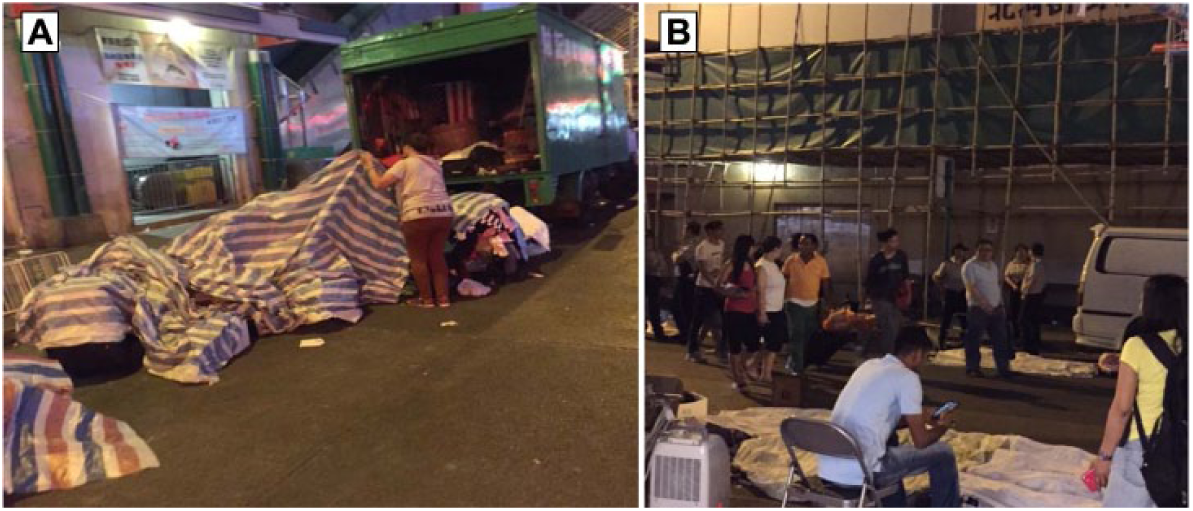
(A, B) The practice of “being smart,” 2015.
The above example highlights the norms of Chinese communication. According to Shi-xu (2014), the notion of face is culturally significant in Chinese culture and is “situated in social communicative practice” (p. 95). Face reveals one’s social position and power dynamics in the process of social interactions (Shi-xu, 2014). In this case, the hawkers communicated with the HCT in an implicit and indirect way by using various materials to cover their commodities. These communicative acts can be understood as a way of manipulating their communication and attitudes to protect the image of the HCT (the authority) at the front-stage (Shi-xu, 2014). Interlocutor H’s above speech highlights that what motivates hawkers to give face to the HCT is grounded in the anticipated norm of reciprocity. Interlocutor M echoed similar sentiments concerning the HCT’s control:
I understand they are doing their job, but it is too strict. I just want to do business every night. . . . They should also show respect to us. (Personal communication, February 1, 2016)
His speech reveals when hawkers showed respect to the HCT, they expected the HCT to reciprocate their respect with permission to hawk in the market or a loose regulation of the urban space. However, the HCT could choose not to comply with this norm, since its members have the authority to govern the market and decide the market’s norms of interaction. Interlocutor D explicitly claimed that the HCT were “the rulers here” and “could decide hawkers’ livelihood” (Personal communication, April 18, 2015, Own translation). Such expressions reflected a belief that hawkers had no choice but to comply with the HCT’s orders. The hawkers legitimated the HCT’s authority and situated themselves in informal places of governance, where they develop practices to self-govern the urban space.
The hierarchical power relations within the place provided discursive resources for some hawkers to blame the “unruly” other in situations when the HCT enforced the regulations. The market was thus imagined to be an orderly place. The interlocutors who mainly operated on the ground believed that the HCT was less likely to enforce regulations when they did not obstruct traffic. Interlocutor B, for instance, criticized those who hawked from vans, claiming that “they occupied many roads and, therefore, the HCT needed to take action [against the illegal hawking]” (Personal communication, April 30, 2015, Own translation). Occupying much public space is viewed as a “defiant” behavior against the HCT’s orders, which could cause the HCT to lose face. This speech presumes that the HCT normally does not want to enforce the regulations, but that, if they lose face, they punish hawkers’ improper actions collectively. Therefore, rather than criticizing the HCT, the hawkers blamed those who challenged the HCT, which then discursively enacted the HCT’s informal regulations.
Moreover, the market was constructed as a place of precarity. Hawkers’ daily lives were characterized by uncertainty and discipline rooted in the tension between the fear of being denied the ability to hawk in the material place and the desire for relational autonomy in making a living. The unequal power relations within the market leads to the following precarious situation: Hawkers can only guess at what the HCT wants them to do, and even if they choose their actions accordingly, they may not achieve their intended result. For example, Interlocutor K sought to “give face” to the HCT by covering his commodities when the HCT came, but still could not eliminate his uncertainty.
This is the nature of fear. I do not know when [else] I can do business. . . . I do not get any money from the government. Instead, I am paying tax for my business here. (Personal communication, December 4, 2015)
This “nature of fear” constitutes the hawkers’ precarious experience in the night market.
Interlocutor K attempted to justify his right to hawking in the night market by stating that he paid taxes to the government and did not receive any social welfare. Such expressions reflect Hong Kong’s neoliberal class culture, in which people value the notion of self-reliance (Lee, 2016) and feel that those who make a living in their efforts (rather than relying on social welfare) deserve recognition. This neoliberal ideology reflects a belief that individuals should be responsible for their life trajectories rather than seeking help from the government (Lee, 2016). Therefore, rather than resisting the informalized techniques of control, my interlocutors only called for the government to impose loose regulations. The interlocutors also tended to maintain a certain degree of precariousness in their working conditions, likely due to the benefits of the market’s informal status. As an informal place, the market allowed the hawkers to evade the HCT’s control in their efforts to make a living, even if this meant living in constant fear of uncertain urban management. If the market became formalized, the hawkers could lose the place where they earned their livelihood. Therefore, they developed the practice of “being smart” to adapt to the power structure and preserve their precarious experiences of the market.
Conclusion
This study has drawn on CDT to examine the ways in which hawkers create and maintain the night market in Hong Kong as a relational place where they could express their identities, produce social differences, and adapt to unequal power relations. By attending to the situated communication practices of these hawkers, this article has provided a more nuanced inquiry into how they live differently with their various legal and spatial uncertainties. The analysis shows that cultural specificities, including the neoliberal ideologies and ethnic boundaries in Hong Kong as well as the Chinese notion of face, contribute to the spatial processes in which informality and precarity are conceived of and practiced by hawkers. Therefore, I argue that, by transforming these abstract values into physically located concrete expressions, communication practice has the potential to produce culturally distinctive place-making and identities. I would make the following points in respect of the specific findings and their implications.
First, examining the two cultural terms—the poor and the businessman—as ways of identifying and relating reveals how class identities and differences are produced and reproduced in a place. I have demonstrated that hawkers’ class identities intertwine with the material place, as their identities not only reflect their socioeconomic position but also who and how people should use and relate to the place (Massey, 2005). Whereas the poor interlocutors constituted the market as a place exclusively for the Chinese poor to make a living and offer care to other poor citizens and excluded the ethnic and nonpoor others, the place-making expressed by the group of businessman interlocutors connected the night market with the global market and feelings of flexibility. The desire to make a living through their effort and also to enjoy flexibility, which reproduced the neoliberal rhetoric of self-reliance, led the hawkers to accept the informal status of the place and their precarious working conditions.
Second, and in keeping with previous research (e.g., Crossa, 2016), this study provides evidence that informal workers can practice informality in multiple ways, even though these practices are shaped by the sociocultural environment around the workers. Linked to this is a practical implication that challenges the government’s current understandings of the market as a place for the poor to survive. In the context of the ongoing debate about hawker policy reform in Hong Kong (HKLC, 2015), the multiplicity of hawkers’ practice provides an insight for the government encouraging it to pursue a more culturally sensitive policy.
Third, the study contributes to theorizing informality from below by looking at the ways in which hawkers self-govern the urban space through the practice of being smart. As numerous authors have argued, informality cannot be understood either as a space dominated by government actors or else as a space where the urban poor are free from urban governance (Crossa, 2016; Schindler, 2014). From a cultural discursive point of view, it may be noted that the hawkers’ practice highlights Chinese communication norms (Shi-xu, 2014), which means that they manipulate their ways of acting in an implicit way in attempting to give face to the authority, the HCT. As there are no fixed rules in the market, hawkers’ interactions with the HCT not only allows them to gain temporary autonomy but also (re)creates the order of the place, which simultaneously constructs the market as a place of urban self-governance. In this process, they constitute themselves as precarious beings in place and internalize their lived experiences of legal and spatial uncertainty.
Fourth, this study of hawkers’ precarious experiences in Hong Kong sheds light on contextualized precarity in developing Asia (Arnold & Bongiovi, 2013). I argue that this precarity as contextualized is situated in the “ambivalence between subjugation and self-empowerment” (Lorey, 2015, p. 13) and disorganizes the collective resistance (Kalleberg & Hewison, 2013). Specifically, the hawkers self-conducting, and their inferior, precarious position and lack of labor rights are normalized. Because my interlocutors wanted to make a living by themselves, independently, they had to accept the precarious working conditions and learn how to adapt and survive in this city (Palacios, 2016). Those threatening the norms of self-governance were regarded as abnormal beings, thus dissolving the class solidarity.
Here, there is a need to address a critical question rooted in studies on precarity (Lorey, 2015): Who benefits from the hawkers’ practice? I understand precarity in terms of a process of defining what is normal and abnormal and who is and is not entitled to a sense of security under neoliberal socioeconomic and political conditions (Lorey, 2015). In Hong Kong, hawkers have long been constructed as a dangerous Other, in contrast to the members of a modern city and formal economy (Leung, 2008). This study found that hawkers’ precarious experience was legitimized in their expressions. Establishing “hawkers” as legitimated precarious beings allows the government to define the appropriate uses of the streets according to the time of day and manage the urban space in a flexible way.
One might question why the hawkers do not self-organize to build a culture of solidarity to resist precarity (Atzeni, 2016). One potential reason is that most hawkers do not know each other before hawking in the market. Hawkers with different class identities do not constitute a steady social network with mutual obligations, likely owing also to the illegality of the market. For the hawkers, a social relationship was an instrument in the workplace, rather than a long-term friendship with mutual trust. Class fragmentation within the informal economy may also generate diverse material interests; therefore, it is difficult for hawkers to be united in their opposition to the government. Additionally, language was relevant to the division between the two groups of hawkers identified. Most hawkers were capable of speaking Cantonese for the sake of doing business, but many of them could not speak it fluently. In contrast, most native Cantonese-speaking hawkers were unable to speak fluent English. The inability of many non-Chinese hawkers to communicate with the Chinese hawkers hampered the construction of collective solidarity. Thus, the hawkers’ fragmentation in terms of class identity and language may inhibit their formation of a class solidarity.
Overall, this study highlights how informality and precarity is a spatial process constituted through people’s culturally distinctive communication practices in place. It should be noted that unlicensed hawkers are just one group in the overall labor force of informal and precarious workers across the globe. Focusing on the case of hawkers in Hong Kong, this study helps broaden our understanding of informality and precarious work by recognizing the constitutive role of communication practice in making places and social differences in the workplace. Further cultural and intercultural examination of relevant communication practices and discourses will be able to unpack the social and cultural values in the process of informalizing the urban space and allow for future research that analyzes emergent possibilities of culturally distinctive resistance in the precarious workplace.
Footnotes
Declaration of Conflicting Interests
The author declared no potential conflicts of interest with respect to the research, authorship, and/or publication of this article.
Funding
The author received no financial support for the research, authorship, and/or publication of this article.