







Abstract
For inpatients who spend a longer time in the hospital, the built environment plays a significant role in their experience. While many hospital boards aim to create a patient-centered hospital, few have a specific idea about what this means in terms of spatial qualities. This creates a major challenge for those involved in designing hospital environments. Therefore, we aimed to identify which elements play a role in inpatients’ spatial experience, and how these elements relate and interact. Patients were followed during transport and afterward interviewed. In this way, we gained insight into their spatial experience, static, and in motion. This experience turns out to be shaped by material, social, and time-related aspects. An analysis of the interactions between these aspects yields a nuanced understanding of how inpatients’ experience of the hospital environment is shaped by the spatial and social organization, movement, and perspective. This understanding should allow informing hospital boards, architects, and staff to start designing hospital buildings in a more patient-centered way.
In conversations about hospital experience, the relation with space is often not the first that comes to mind (Annemans, Van Audenhove, Vermolen, & Heylighen, 2011). When building or refurbishing a hospital, hospital boards (cl)aim to create a patient-centered healing environment (Bromley, 2012). For architects, it is not always clear how to live up to these expectations (Devlin & Arneill, 2003). Therefore, it seems important that architects and boards involved in (re)designing a hospital know how patients experience it. The study reported here aimed to identify which elements play a role in patients’ spatial experience, and how these elements interrelate.
The study started from the observation that architecture is experienced through the senses (Pallasmaa, 2005; Rasmussen, 1964). The specificity of the activities taking place in a hospital context extend this experience: Your relationship with the environment is determined by moving or being moved and by the people accompanying you. As we aim to relate patients’ experience to these context-specific circumstances, we consulted patients who are very familiar with this context, considering them as “user/experts” in relation to the hospital building. Elaine Ostroff (1997) introduced this term to denote “anyone who has developed natural experience in dealing with the challenges of our built environment.” Four dialysis patients admitted to the hospital at the time of the study were followed. By analyzing their verbal and bodily reactions to the environment, we delineate how patients’ spatial experience is determined by material, social, and time-related aspects. We conclude by discussing where and how these aspects come together, intertwine, and shape people’s spatial experience.
Background
As architecture is experienced through the senses (Pallasmaa, 2005; Rasmussen, 1964), architects should pay specific attention to sensory perception, through passive and active reception of stimuli, and how the senses intertwine (Gibson, 1968). The five traditionally known senses are, by themselves, inadequate to account for our (spatial) experience. Ecological psychologist James Gibson (1968) partially bypasses this inadequacy by considering perceptual systems instead of the sense organs. He distinguishes between five interrelated subsystems: the orienting (basic to all others), the auditory, the haptic, the taste-smell, and the visual system, in no particular order. Not prioritizing them does not imply all senses are equal. Regarding spatial experience, a distinction is made between distant and immediate receptors (Hall, 1982). Eyes, ears, and nose can receive stimuli from a distant source; touch is perceived directly through the skin and muscles. Skin sensations can relate to the tactile experience of physical objects—like contact with a wheelchair—or the built environment. These sensations can be perceived directly, through the chair or skin—like wind or heat.
We experience the built environment statically but also while in motion (Latour & Yaneva, 2008). To explore spatial experience in motion, geographer Yi-fu Tuan (1977) extends the five traditionally known senses with kinesthesia (the sense of movement), which, combined with sight and touch, he considers strongly related to space and spatial qualities. In experience in motion, the senses’ intertwining becomes even more important. While you travel along a trajectory, views change, smoothing the boundaries between different places (Ingold, 2000). Additionally, experience in motion closely relates to the control people exercise over how and where they move. Actively moving—walking (Bollnow, 2011; Laurier, 2011; Lorimer, 2011; Lund, 2005 in Paterson, 2009; Sheller, 2004) or using a wheelchair (Winance, 2006)—is completely different from being passively moved as a passenger in a car or train (Bissell, 2010), or being pushed in a wheelchair (Winance, 2006) or bed. Since our kinesthetic organ only registers transitions in movement (accelerations), we are unable to actively experience a uniform motion in a straight line (Gibson, 1968). Therefore, vibrations of an actively moving object (like a train [Bissell, 2010], a wheelchair, or a bed) that transports a static body, can serve as an important point of entrance into experience in motion.
Moving, in a certain direction, at a certain speed, connects space and time (Prior, 1988; Tuan, 1977). The experience of this connection is strongly affected by the body-axis along which this movement occurs. Travel time is associated with movement along a trajectory, going from A to B. To understand the interaction between time, movement, and space, rhythms are essential (Lefebvre, 2004). Philosopher and sociologist Henri Lefebvre (2004) uses rhythms as an analytic tool to examine daily life in relation to the built environment. Rhythms concern repetition (of movements, gestures, action, situations, and differences), interferences of linear and cyclical processes, and phases of life, like birth, growth, peak, decline, and end (Lefebvre, 2004).
Vibrations (Bissell, 2010), taking place while moving along a trajectory or not, can be considered a repetitive rhythm, independent of goal-oriented movement. Multiple factors, that is, speed, location, emotion, touch on our experience of travel time, disconnecting it from measured clock time (Watts & Urry, 2008). Clock time indeed differs from lived time, time as it is experienced (Lefebvre, 2004). Although this insight originates from research on train travel, parallels can be drawn with hospital transport. Here too, the time spent relates to various sociomaterial practices, hospital staff, views, and so on. Under the influence of these rhythms sound, space and time can move to the background (Tuan, 1977), which once again illustrates the intertwining of the perceptual subsystems. Rhythm, in relation to time, can be differently interpreted depending on the scale and process: the cyclical repetitions of days and seasons define the length of a hospital stay, linear series of activities define daily patterns (Edensor, 2011; Lorimer, 2011).
Focusing on sensory sensations, time and movement in relation to the built environment puts forward the need to clarify our role as embodied beings in the world (Pink, 2008). As these sensations cannot be perceived without the body, body-specific and personal elements strongly affect spatial experience. A hurt body perceives the nature and intensity of sensory input differently (Paterson, 2009). People reflect differently on the environment depending on the phase of life they are in (Lefebvre, 2004). A body-in-a-wheelchair uses and perceives space differently than a walking body. The “vehicle” itself, but also the one pushing it, plays a crucial role in how the journey is experienced (Winance, 2010). Therefore, the research subject is not just a “person-in-a-wheelchair,” but a “person-in-a-wheelchair-pushed-by-someone.” In a hospital context, this subject is often supplemented by extra people, be it a trainee, researcher, or passer-by, widening it to a “person-in-a-wheelchair-pushed-by-someone-and-accompanied-by-someone-else.” Each of these actors, whether actively involved in the ongoing action or passively observing at the side, likely plays a role in patients’ spatial experience.
For inpatients, their entire life takes place within one building, where experience in motion is largely restricted to controlled, passive movement. Moreover, the perspective from which patients experience their surroundings is frequently limited to being seated or lying down. Therefore, we decided to explore hospital architecture from this particular angle.
Context and Method
Context
The study was conducted at a middle-scale hospital (610 beds) in a suburban area. At the time of the study, the building had recently undergone major reconstruction works, with parts being refurbished and others added. The dialysis department is situated in a new part of the hospital. As the department moved only a few weeks before the study took place, the memory of the old location was still very fresh. The nephrology ward, where inpatients with kidney problems are admitted, is situated in an older part of the hospital. The route between both takes around 10 minutes, travelling through corridors, taking different elevators and passing different hospital parts. As we are interested in inpatients’ spatial experience, both static and in motion, this was considered as an advantage.
Ethical Considerations
The study passed the hospital’s ethical board. Due to the fieldwork’s nature, it required some creativity to guarantee patients’ privacy while being able to fully inform them and receive informed consent. Patients should be able to participate in the study completely anonymously. However, they should also sign an informed consent form before anything could be recorded or used as data. This obstacle was bypassed by coding each form, and from that moment on using only this code to refer to the particular participant. Signed forms are kept separately from the collected data.
As agreed with the ethical board, the first author (henceforth, referred to as the researcher) was not allowed to enter a room without the patient’s permission. A volunteer from the hospital made the first contact. Only after being introduced by this volunteer, and given permission by the patient, the researcher could enter and provide additional information. Finally, an agreement was made that all data collected during the fieldwork would be made anonymous. Since in a later phase of the research, we would like to use the data to inform hospital designers, destroying the data or keeping them only within the research group was not an option.
Study Setup
As an introduction to the site and fieldwork, the researcher first documented the architectural elements. While she was wheeled from the ward to the dialysis department and back, she made video- and audio-recordings of the route from a lying and seated perspective. As patients have unique experience-based knowledge about their own situation, they are the number one source of information (Wibe et al., 2011). Interaction with them took place over a period of 6 weeks. Each week, the researcher visited the ward and dialysis department on 1 day to be introduced to patients, and returned 2 days later for further observations during the transport and the actual interview. Since participants’ engagement and motivation appeared to be a key factor for the study’s success, special attention was paid to the introduction talk. Also, the administrative procedures needed in the hospital, like fulfilling the informed consent were taken care of at this moment.
On the day of the interview, the researcher walked along when patients were transported from the ward to the dialysis department. During the transport patients were asked to describe what came to their mind. The same was done for the way back. A follow-up interview was conducted during the dialysis, or once the patient had returned to his or her room, depending on personal preferences and practical restrictions. Interviews were semistructured around open questions, which addressed both spatial and time experience. Interviews took between 15 minutes and 2 hours. In some cases, more informal conversations continued to take place in the weeks following the formal interview.
Participants
The route was chosen because of its length and the spaces’ character. Even more important was the profile of the patients frequently taking it. We were specifically looking for patients staying in the hospital for a longer period, already familiar with its organization and building, with the dialysis department, but possibly also with the (nephrology) ward. Over the course of 6 weeks, six people were found meeting these criteria; four of them, one man and three women, were willing to partake in the study. Due to the researcher’s extended contact with them, we believe that these four cases can provide us with significant insights into inpatients’ spatial experience. Apart from all suffering from kidney failure, the four participants—referred to as John, Mary, Jane, and Louise—each provided an added value to the study from their own background and personality.
John is a folksy man in his 70s. At the time of the study, his foot was injured so he could barely walk and even the slightest movement left him in pain. On the day of the interview, he would be discharged from the hospital. He was looking forward to his daughter picking him up after lunch.
Mary had been admitted to the hospital after losing consciousness and falling at her home. At the moment of the interview, she felt almost recovered. Although she lived by herself since her husband died a few years ago, she was now not allowed to go home alone anymore. She was spending some more time in the hospital, while her children were searching for a vacant spot in a care residence.
Jane is the youngest, but due to a lifelong illness, she has been in and out of the hospital multiple times. This time she had been there almost 3 months. She probably is not able to go home anymore. Being only in her 60s, she still feels way too young to go to a nursing home, yet there is not much choice left. Participating in the study was very important to her. It made her feel useful, whereas she normally has to rely on others.
Louise is a retired pharmacy assistant. She suffers from side effects of her diabetes, which make her lose consciousness and fall easily, being in and out the hospital and the revalidation center frequently.
When not admitted to the hospital, all four participants visited the dialysis department by taxi. For John and Mary coming to the department from the ward is rather a new experience, which they became familiar with in the past few weeks. For Jane and Louise, not only the dialysis department but the entire hospital is a familiar place.
Data Analysis
The interviews were all transcribed verbatim. The field notes from the researcher’s exploration of the route and the transcripts were coded first according to the sensory experiences. Then, the coded excerpts were assigned on a map to specific places along the route. However, as we know from literature and earlier research, sensory experience does not entirely cover patients’ experience of a hospital building (Annemans et al., 2011; Annemans, Van Audenhove, Vermolen, & Heylighen, 2014; Pols & Moser, 2009; Watts & Urry, 2008). Therefore, we coded the transcripts also according to aspects that affect experience. These could be of material, social, or time-related nature. In each of these categories, certain attributes of the particular aspect (be it an actual space, person, or aspect of time) were identified and linked to related sensory experiences and ongoing activities.
Initial coding was done on printed transcripts. In a second round, we used qualitative data analysis software (ATLAS.ti) to define interrelations and explain possible missing links. The defined categories were compared across the different transcripts, both in this study as in parallel studies on different patient profiles (Annemans et al., 2014).
The interviews and field notes are in Dutch. Quotes used in this article have been translated to English by the authors.
Findings
As “spatial experience” seems hard to define, most interviews do not provide a straightforward answer to the questions, which elements add to patients’ spatial experience, and how these interrelate. Most closely related to physical space are elements of the material environment, ranging from the building as a whole to individual objects. Most participants considered the interaction with others, the hospital’s social environment, as most important. The experience of time turns out to change due to the context’s specificity and vice versa. Obviously, these three themes closely interrelate, work together and are hard to separate in real-life situations.
Material Aspects
The hospital’s material environment covers different scales. The building as a whole is what defines people’s overall perception when arriving or just passing by. Although “for being a hospital,” the building is generally appreciated, the connotation of a hospital is hard to disconnect from it. Especially, Jane seems sensitive to the feeling the building generates. When introduced to the research topic, she mentioned: “When you enter a hospital, wow, that falls down on me.”
In the interview, she put it even more firmly: “I hate hospitals,” but then nuanced her statement when a nurse seemed surprised: “Not the people, but the hospitals in themselves. Well, I hate being ill, that’s what it comes down to.”
When being used, the hospital building breaks apart in different spaces and places, of which some hold major importance and others do not seem to partake in a patient’s experience. Depending on his or her own specific situation, each patient perceives a slightly different building. Still, similar building elements contribute to this perception. A topic of conversation was the presence or absence of certain spaces in general. The three participating women mentioned the presence of a garden as the most valuable spatial element. The importance of the view from the window was also referred to in the interviews:
I think it’s nicer here. There [in the old dialysis department] I lay at the window. That was downstairs, then you only see a little. There was a wall and then a little further apartments or houses, but I like looking outside, even though there’s no movement, or like here just the tops of the trees. I find that a major advantage.
Actually going outside is obviously even better (Figure 2). Jane later on mentioned the following:
I have the luck that when my daughter comes, every day, I can go sit outside in the evening for half an hour [ . . . ] but when you then come outside, that air, I would bite it, seriously.
Also, Mary and Louise, both capable of going outside independently, spent the afternoon in the garden when possible. Louise explained as follows:
When I don’t have visitors and the weather is good, I go sit outside, with a magazine or so. [ . . . ] Or sometimes I’m sitting there and just enjoy nature. I can enjoy that very much actually.
Jane, who cannot leave her bed without help, would highly appreciate some outside space closer by:
You know what I find the most interesting about the rooms? Some rooms, not many, have a small balcony. [ . . . ] That I’d find luxurious!
Besides outside space participants also mentioned the size of the room (Figure 1), the presence of a (spacious) bathroom with shower and toilet, and the look and feel of the corridors. None of these seem so overly important as the possibility to go outside (Figure 2), however.
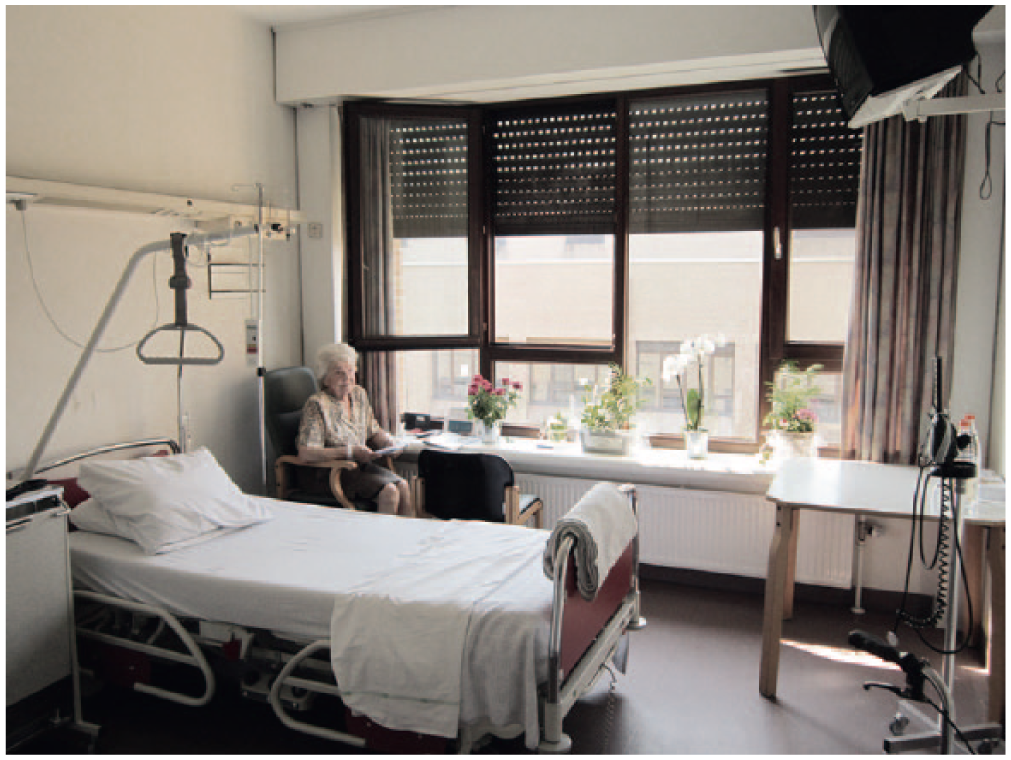
Patient room.
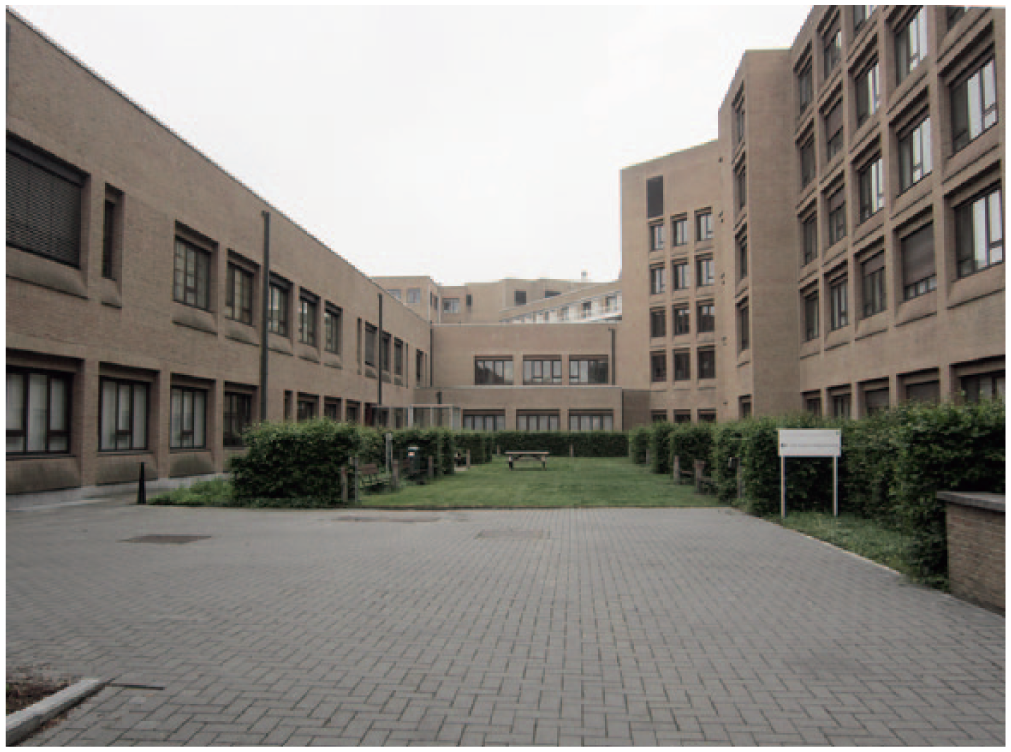
Garden facilitating going outside.
Often participants’ perception of hospital spaces closely relates to more punctual design decisions. Which constructive decisions were taken, or what design solutions were implemented, is often hidden in additional objects, but contributes to people’s perception of the building. Sometimes, small elements can be a source of disturbance. A simple ventilation tube always catches Mary’s eye. It innerves her that she does not know what it is for. On the other hand, participants seemed very forgiving toward situations they do understand. During the study parts of the hospital were still under reconstruction. Although all four mentioned the wood and other materials applied in the corridors, none of them really bothered. Two participants mentioned the number of doors on the route (Figure 3), mostly wondering what was situated behind them. This imagining triggered associations, like Jane reflected the following:
What also impresses me is, like here when you enter, see what a number of doors! How many doors would there be in the hospital? That’s a huge number, I think. [ . . . ] That are a lot, and behind every door there’s a little bit of misery.
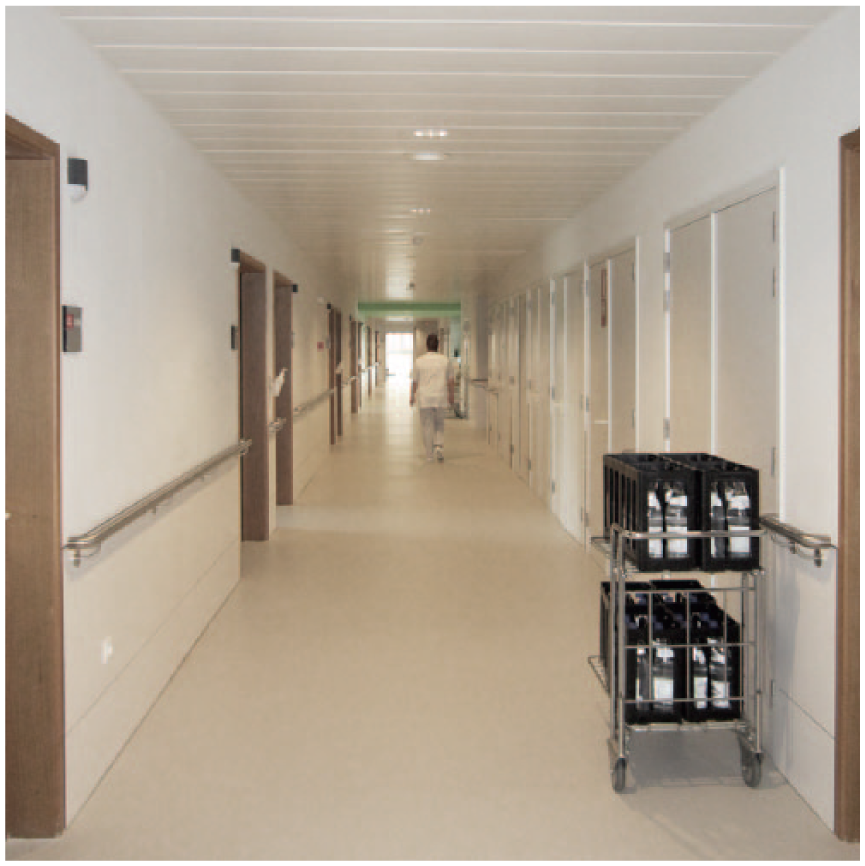
Numerous doors.
Explaining that half of the doors were not entries to rooms but just closets seemed to make their presence somewhat more acceptable to her. When walking through the same corridor again a few days later, Jane explained that half of the doors were not rooms, but closets, and that depending on the color you could identify them (something the logistic assistant had told during a previous walk).
Equally important as the presence of building elements seem to be missing elements. At the former dialysis department, some system of curtains sheltered patients when having to go to the bathroom, in the new department this is still missing. Nurses try to solve this by using a movable screen, however, for patients little things like this influence their experience considerably.
Apart from building elements, spaces are filled with objects that cocreate the material environment. Medical equipment or objects like a wheelchair or walker emphasize patients’ situation of being ill. Both Jane and Louise have a hard time accepting that. Louise said the following:
In the beginning I had a hard time seeing that wheelchair, that walker. Those are all attributes that I don’t like to see, but settled, because I have no choice, but . . .
Many of these objects in themselves consist of multiple objects that mediate between patients and their material environment. At the dialysis department (Figure 4), some patients sit in a chair, others lay in bed. Louise used to have a bed, but is now positioned in a chair, a decision made by the physicians. She prefers the bed, mainly because of the material the chair is made of:
You know what, that [chair] is covered with some kind of plastic. Everything sticks to it. Therefore, I have the sheet completely underneath [my body], otherwise it sticks and if you have to pull loose, it hurts. [ . . . ] I prefer the comfort of a bed, even more because a person rests a lot here and I don’t find it comfortable to try to sleep in such a chair, a bed is much more comfortable.
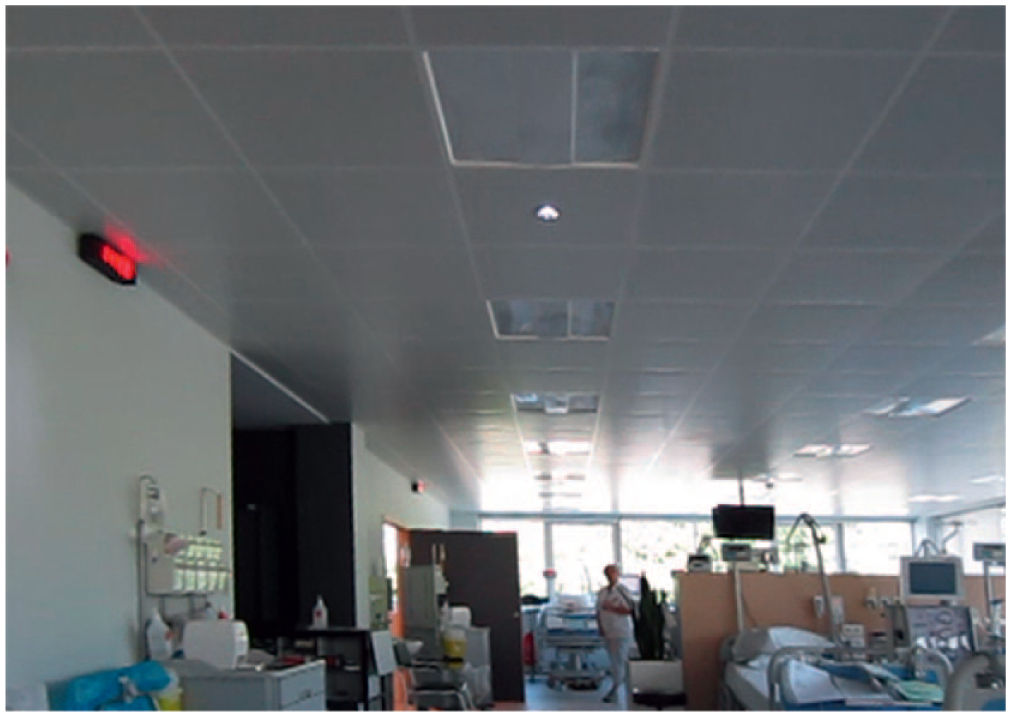
Dialysis department.
Social Aspects
The participating patients unanimously agree it is the people who make the place. Like the material environment, the social environment is not one dimensional either. Many people play a role in how the hospital is perceived. The emphasis participants lay when discussing the environment is influenced by their personality, state of mind, and current situation. At one point, during the fieldwork, Jane just heard she could probably not return home anymore and would need to move to a residential care home. Obviously, this influenced how she looked at the built environment. Letting go of her own things surrounding her, and comparing her situation with that of others of her age made the verdict even harder. However, just at this point she found strength in participating in our study. As she said as follows:
I find it very pleasant to talk to you [the researcher], to have the feeling that I can do something small for someone else. I find that important and often you don’t have that here, because they [family and staff] have to do everything for you.
Also, Louise explained how sometimes she relates differently to the environment than under usual circumstances:
Then [after an operation] you’re so muzzy, yes muzzy let’s say. And you’re only occupied with your pain, trying to do your thing, but that’s not that easy. And then someone comes to do something and then someone else. And that’s sometimes a little annoying.
Patients do not experience the hospital in isolation. Throughout their stay, they get into contact with many others whom they may be more or less familiar with. Close family and friends give their opinion, or tell stories from their own experience, thus shifting patients’ focus to certain aspects of their stay and accommodation. Even though Louise personally does not have any negative experience with it, she highly values the presence of a safe in the room. She recently heard a story of someone whose purse was stolen from the hospital room, leaving her with an uncomfortable feeling on having any valuable or even just personal things in there.
Apart from what people hear, an even more important factor of influence are occurring activities. Visitors make patients use different spaces in the hospital. Think of Jane who could use the garden only when her daughter came and took her outside. Mary and Louise mentioned taking their visitors to the cafeteria, a place where they would not come by themselves. When staying in the room, the space changes due to the presence of outsiders. Jane stated as follows:
What else is important? That, when you have visitors that the atmosphere between people is prior to the room.
Later, she continued as follows:
When you have company, you can forget about the room for a while.
The role of those maintaining a professional relationship with patients may be of a different kind, yet should not be underestimated. Going to dialysis creates a whole network of people around the patient who all contribute to his or her experience of the hospital. Although at the time of the study, participants did not use the taxi service, when asked about the (new) dialysis, they unanimously described the taxi drivers’ parking problems and the lack of space for them to be waiting for the taxi after the dialysis. Now they were admitted to the hospital, the driver’s role was taken over by logistic assistants. They too influence patients’ experience of the hospital. During the journey from the ward to the dialysis department, remarks about the cold corridor were frequently heard, yet it is unclear whether patients actually experienced it as cold or heard the logistic assistants refer to it. What is clear is that the temperature in this corridor was an important topic of conversation during the transport. Contact with staff seemed generally valued; however, to what extent depended largely on the patient. The contact can be just visual and/or auditory or also personal. Mary described how the new dialysis department affects her relation with the nurses:
You see more passage here, the cupboards are here, so they have to come here to get something, but besides that [I have not much contact with the nurses].
Also, John identified this difference with the previous situation:
But there are no walls anymore in between, only half of a wall so the nurses can see each other. [ . . . ] Before they walked from one room to another. They went to help here, they went to help there, but now you don’t have to call for help anymore, or it should be really bad.
Due to the new organization of the department, the staff changes more frequently. Jane explained the following:
Here in the new department, the staff operating the [dialysis] machines changes a lot, the nurses. That has advantages and disadvantages maybe. I’d like to have the same more frequently because, well, I have a more comfortable feeling with that. [ . . . ] On the other hand, change has advantages and disadvantages, like most things.
As she finds some nurses friendlier than others, she is happy that they are not always the same, yet regrets that it cannot always be the nurse she knows since her first dialysis.
Similarly, participants also get in contact with fellow patients. Here too, some feel more need to connect than others. John seemed the most talkative of the four. He really puts an effort in chatting with new patients at the dialysis, even when they are not that interested. Also, when coming and leaving he is the first to say “hi” and “goodbye.” The others mentioned some sporadic contacts, but especially stressed the lack of contact among dialysis patients. Mary said the following:
I’ve been lying at different places [ . . . ] at four different spots, and even then at none of the four people were talking.
Jane saw a relation with the spatial organization, but directly nuanced as follows:
The rooms are in that sense positive, they are not super small. Maybe the old dialysis was a little cozier when you want to talk, but for me that doesn’t count, I like it just as much to lay in silence for 4 hours.
At the ward, none of the participants shared a room. Contact with other patients seemed to be limited so small irritations caused by different people living on a small surface—a TV playing too loud at night or visitors talking with the door open.
Time-Related Aspects
Already when recruiting participants, we considered their hospital stay’s frequency, sequence, and duration as defining elements for patients’ (spatial) experience and thus as a criterion to select them. All these elements are time-related. Also, the participating patients referred to a relation between time-related elements and their hospital experience. Especially, the duration of activities was frequently mentioned as a reason to pay particular attention to space. All four expressed the distance from ward to dialysis department in terms of time. John was the most direct about it, he asked the researcher whether she was in good shape since “it’s a serious journey. You’re on your way for a long time.”
A returning conversation topic between the logistic assistant and the patients was the duration of the dialysis. Participants referred to this duration and the waiting time before and after, as a reason to pay specific attention to the material environment. The same counts for the hospital stay in general. The longer participants have to stay, the more important their room, and the provided accommodation seemed to become. According to Jane, that is, “because you’re constantly lying looking at it.”
Jane sighed about corridors with the enormous number of doors:
( . . . ) and in those corridors, maybe it’s indeed because of the time duration and how often you pass through them.
Besides the duration of the journey, she points at the frequency of getting in contact with certain spaces. Also, the frequency of hospital admissions determines the spatial experience, as Louise told us:
Sequences repeating daily, like the strict routine imposed by the hospital regime, structure patients’ day.
Both Mary and Jane mentioned how sensory perceptions indicate time. Mary stated as follows:
Sometimes it’s more busy in the evening. Then you hear a lot of rumor, they are preparing the food.
For Jane also the smell adds to her experience of the hospital (building):
What is positive is that it doesn’t smell so hospital-like here. And around lunch, in the morning, or at night, I first smell the coffee or the soup or the food. Maybe there are people who don’t find that pleasant, but for me it is.
However, a strict day rhythm also triggers certain expectations, which can cause a shift in perception depending on the time of the day. At a different moment of the day, what someone sees, hears, or smells can be experienced completely differently, although it may be the same scene, number of decibels, or odor. While Louise likes to watch TV herself, she does this to a limited extent, between 7 and 10 O’clock in the evening. She also likes to leave her door open to get some fresh air. Both habits, combined with fellow patients following different rhythms, generate irritations. She explained as follows:
What also bothers me, in the past is was 10 p.m. that there had to be silence. Now the television is still playing there, and there. Then I think, come on, that shouldn’t be possible ( . . . ) we’re actually here to recuperate! Maybe I’m wrong but I don’t want to have to close my door for the sound you hear from outside.
Jane is not so much bothered by her fellow patients, however, the moment of the day defines very much how she feels about the hospital environment. She said as follows:
At night, it’s horrible, really. I can’t sleep hours and hours. I have to wake up once in a while to go to the bathroom, at least twice. Then I find the night horrible, the room most of all, then I wished I was home, at night even more than during the day.
As the biggest difference between night and day, she mentioned the duration of time: during the night everything seems to last longer.
Interactions
Clearly, spatial experience cannot be reduced entirely to material aspects. Social and time-related aspects affect our awareness of space just as much. Moreover, none of the three can be considered without the other(s). Interaction between and within the different aspects is what defines our real-life experience. Our attempt to unravel inpatients’ experience revealed its multidimensionality, but also pointed at how the multiple dimensions interrelate.
Organization is all about interaction. A common practice among architects is to start a design by making an organizational diagram of how different spaces relate to each other (Lawson, 2004). This can be based on functional criteria (e.g., the order of preparation rooms in front of the operation room reflects the sequence of actions taking place there), but also experiential aspects relate to spatial organization. The presence of green on the hospital site, or even within the building is, as illustrated, greatly appreciated by patients. Through certain design decisions this green can be brought closer to patients, changing it from something to look at into something to truly interact with. Spatial organization, or the perception that the building is missing it, affects patients’ idea of the building’s quality. Mary told us in disbelieve:
There used to be chairs [in the corridor] for the people that had eaten, where they could wait before they went to dialysis and they had to be removed. The fireguard had come, and that space was not meant for it. Yes, these chairs are now gone. [ . . . ] The passage was too narrow.
Apart from ordering space, architects can do much more. The material environment affects how social interactions take place and vice versa. As mentioned by Jane, the new dialysis department stimulates even less social interaction than the previous one due to the larger space and less cozy atmosphere. She made this change very concrete:
Before you had more contact with your neighbors because you were lying with 8 or 9 in a room. They could close a curtain when it was needed, but it made it easier to talk to someone next to you, or you’d say a couple things.
At the dialysis, the nurses now pass by more frequently but seem less approachable, John indicated. Also, the organization of the hospital staff influences patients’ spatial experience. As illustrated, the staff at the new dialysis department changes more frequently; for Jane this reduces her acquaintance with the place, which makes the experience less pleasant.
Movement
Moving means travelling a certain distance over time. You move or are being moved toward another place, at a certain speed, which largely affects how you experience the environment. Where you go is important. When leaving the dialysis department, Jane sighed as follows:
It’s a whole relief when I ride away through these doors. That I enjoy that beautiful tree . . . [the first corridor after the dialysis is completely in glass and outside stand big old trees.].
The movement’s passive character, implicating no control over speed or destination, defines her engagement with the environment. “It goes all so very fast,” Louise said about being moved in a bed. She then continued as follows:
Because you’re so, pff, you’re just lying in bed, a little bit apathetically so to say. I don’t call that interesting. Okay, here, I walk around here, or I go look at the paintings, but from the moment you lay in bed, then all of that doesn’t interest me anymore.
While moving, the interaction between different elements of the material environment becomes even clearer. When they are transported in a wheelchair along the corridors, patients feel the building through the chair. The wheelchair mediates between patient and built environment. This experience is coshaped by the person pushing the chair. Many insights concerning spatial experience are hidden in what happens during transport. Although John is not very talkative when it comes to expressing his experiences, his reactions during the trip from ward to dialysis speak for themselves. When leaving the elevator, the logistic assistant by accident hit the side of the door with one of the chair’s wheels. Although not touching John at all, this small bump incited him to curse. Each movement of the chair over an uneven surface, he felt in his hurt foot. Bumping into the door side thus left him in even more pain.
Perspective
A change in perspective also changes the way a building, in particular a hospital building, is experienced, literally and figuratively. Literally, participants identify an important difference between their perception of the environment while lying in bed, being seated in a chair and standing up, both static and while moving. Jane reflected on the difference in what she perceives when travelling in a bed or a wheelchair:
[When being transported in a wheelchair] you look at it [what goes on around you] more. Otherwise [when being transported in a bed] it’s the ceiling and a little bit of the sides, while sitting you have more direction, or more surface.
The researcher suggested that you have a broader viewing angle. Jane agreed that is the best way to express it.
Apart from the view on the environment, Mary, Jane, and Louise agreed that lying in bed versus being seated in a chair makes you feel different as a person. For Jane, the difference lies in the feeling of dependence:
[ . . . ] in the beginning I had to come in bed [to the dialysis] and then it seemed as if I were completely knocked out, put aside. That’s the feeling you have when you’re wheeled in a bed through the corridors. These are my last rides, you know you will die here, I know that, but . . . With the wheelchair it’s more pleasant, the moving space, it seems. Now I have problems keeping my head straight, but when in bed you seem to be more depending on everything.
Louise put a nuance in her explanation, for her it has more to do with control:
Not with a bed, I find it horrible that they put me in a corridor in a bed; no I don’t find that pleasant. With a wheelchair that’s not a problem, no that’s ok because you have control yourself. With a wheelchair you can say a little to this side or to that side.
Indeed, the figurative angle, or the perspective, from which people experience a hospital, largely determines their image of it. Staff certainly perceives the hospital differently than patients, however, as we noticed in earlier studies (Annemans et al., 2014; Annemans, Van Audenhove, Vermolen, & Heylighen, 2012), also among patients, variety in perception exists. Particularly for the participants in this study, the material and social environment gained importance due to the duration of their stay, as illustrated. Patients’ perception of the hospital can concern the built environment as a whole, but just as well focus on particular objects, or be based on social interrelations. We mentioned that Jane said to hate the hospital, but actually meant she hated being ill, using the building as a metaphor for her health. Similarly, a wheelchair or walker in the room constantly confronts Mary, Jane, and Louise with their condition and dependence on assistance, both material and social. Finally, on the opposite side, patients’ perception can also touch on their use of space. Although Jane is an avid smoker, she refuses to go sit in the smokers lounge, because of its location at the entrance of the hospital.
That kiosk at the front, [ . . . ] I don’t want to go sit there, because I find that so ugly. Someone in his pyjamas, with a stick with an infusion, and then smoking, I find that an ugly view really.
Discussion and Conclusion
To explore the specific angle from which inpatients experience space, we combined literature focusing on the experience of the built environment through the senses, expanded the sensory realm with motion, and introduced perspective and time. Although we initially did not focus on rhythms as an analysis tool, the findings’ character resonates with that of Lefebvre’s (2004) rhythm analysis of a Paris junction. Documenting the hospital building with a multisensory focus, combined with closely listening to the participating patients, is very similar to the approach of the envisioned rhythm analyst, who should
be attentive, but not only to the words or pieces of information, the confessions and confidences of a partner or client. He will listen to the world and above all to what are disdainfully called noises, which are said without meaning, and to murmers [rumeurs], full of meaning—and finally he will listen to silences. (Lefebvre, 2004, p. 19)
The richness of the data can indeed be considered a direct result of the researcher spending a considerable amount of time with the patients, talking and being silent in their company, in their room and during transport.
Analyzing the collected data resulted in three themes that offer a basis to inform hospital boards’ decision making and architects’ design process. The material aspects brought forward quite obvious themes, like what you see from the window, confirming the importance of a view on green instead of a building (Ulrich, 1984), but also less straightforward themes were addressed. Poor legibility of building elements, like the numerous doors, led patients to interpret them in their own way.
The social aspects draw attention to patients’ relationship with others. Although we did not address this topic in our background reading prior to setting up the study, we are aware of the literature on patients’ interactions with staff (Hindmarsh & Pilnick, 2002; Mikesell & Bromley, 2012), and fellow patients or relatives (Wilson & Luker, 2006). Each of these topics is worth a study in itself and could form the basis for a specific design challenge. Within this article, we chose to consider them under one common denominator.
Time most definitely affects inpatients’ hospital experience. The link with space is often indirect. Repetitions like the vibrating rhythms (Bissell, 2010), described as time-space–related elements, were mentioned infrequently. Closer related to participants’ lived experience seemed the cyclical rhythm (Lefebvre, 2004) of night and day (Edensor, 2011; Lorimer, 2011), the linear process (Lefebvre, 2004) of the hospital regime, and the difference between clock time and experienced time (Watts & Urry, 2008).
As material, social, and time-related aspects interrelate, the core of our analysis is found in their interactions. Whereas staff organization may not be directly linked with space, spatial organization mediates how people interact. Patients’ entourage shapes their experience of movement and alters their perspective (Winance, 2006, 2010). When studying patients’ experience, staff and (visiting) relatives should not be neglected (Mikesell & Bromley, 2012; Wilson & Luker, 2006).
Designing hospitals with these interactions in mind will be a major challenge for architects and hospital boards. Spatial organization, like sequences of rooms, but also sequences of activities or moments could be considered a starting point, combining material, social, and time-related aspects. How to inform decision and design processes with these insights is subject to future research.
Footnotes
Declaration of Conflicting Interests
The author(s) declared no potential conflicts of interest with respect to the research, authorship, and/or publication of this article.
Funding
The author(s) disclosed receipt of the following financial support for the research, authorship, and/or publication of this article: This research was supported by the Agency for Innovation by Science and Technology in Flanders (IWT 100223) awarded to Margo Annemans and the European Research Council under the European Community’s Seventh Framework Program (FP7/2007- 2013)/ERC Grant Agreement No. 201673 awarded to Ann Heylighen.
