







Abstract
A case study of Vietnamese pagodas operating in Warsaw and its surroundings in the past 25 years shows the strength with which local social and spatial conditions affect adaptation strategies of migrant institutions. Taking into account, the ecological perspective and the discourse of Vietnamese community concerning the role of temples enabled us to answer the question about the role of pagodas in maintaining local and transnational intragroup bonds and interactions with the majority society. This article shows how a process of local social and cultural integration that was beginning to emerge was significantly slowed down by spatial separation of the Vietnamese community and by this community’s transnational connections getting on intensity.
Introduction
This article provides a case study of Vietnamese pagodas operating in Warsaw and its surroundings as examples of religious migrant institutions situated in Poland. We have adopted a classic human ecology perspective (Park, 1936) to examine the location of the first and now closed Vietnamese temple and two presently operating temples. This enabled us to show how accommodation strategies of Vietnamese society were influenced by local processes competing for urban space. Temples, as migrant institutions enabling reproduction of culture and social bonds, are often centers of moral regions within the cities (Thomas & Znaniecki, 1918; Whyte, 1943; Wirth, 1928). Various connections maintained by Vietnamese religious centers, both local ones (bonds with the Polish community) as well as transnational ones (relations with Vietnamese institutions) were analyzed. The relationships between the location of the temples and their surroundings and pagodas’ role in integration with the majority society and cultivation of culture of migrant society are the focal point.
The first issue analyzed in the article is the social and spatial location of the formerly and newly established pagodas. Increased rate of international migrations is often attributed to advancing deterritorialization of many social and cultural processes (Appadurai, 1990; Papastergiadis, 2013). However, we will try to show on the example of the Vietnamese minority in Warsaw that the process of cultural adaptation is heavily conditioned by local ecological context. Spontaneous migration of the Vietnamese to Warsaw and their successful adaptation in the capital city of Poland (and a few other postsocialist cities of former Eastern bloc countries) were, among others, the consequence of specific spatial and economic processes taking place in those cities. We will show how in favorable conditions the migration society was able to exist and for some time successfully play a significant role in the urban system.
The inspiration for the article was the thesis of Park and Burgess (1925), who—describing the ethnic institutions in urban areas—claimed: Every immigrant community will have a religious organizations synagogue, a temple, or a church-with its related, often dependent, mutual aid and welfare organizations. It will have also its own business enterprises, its clubs, lodges, coffee houses, restaurants and gathering places, and a press. Every immigrant community is likely to have its press in America even if it did not have one in the home country. The immigrant colony is frequently nothing more than a transplanted village, for America actually has been colonized not by races or by nationalities, but by villages. (p. 119)
Referring to this classical thesis, we argue that despite the Vietnamese migrant community in Poland is a spatially concentrated group, located first in the city center of Warsaw and currently on its outskirts, their “immigrant colony” is far from being a transplanted village, analogous to the phenomena described by Burgess and Park. Contrary, the shape of its migrant institutions is the result of the transnational network of migration between the diaspora.
Another issue to be considered is the characteristics of relationships created and sustained by pagodas. These relationships may be transnational and pertain to actors and institutions operating beyond the borders of Poland on one hand, and on the other hand they may concern institutions operating within Polish society. We will analyze those linking pagodas with the Vietnamese actors (Buddhist Sangha of Vietnam—Giáo Hội Phật Giáo Việt Nam, governmental institutions of the Socialist Republic of Vietnam, Embassy of the Socialist Republic of Vietnam) and Polish actors (local authorities, neighbors) to look for an answer to the question about the nature of relationships between the global and local aspects of migrant cultural institutions, such as Vietnamese temples in Poland. By analyzing the location of these temples in the network of connections between actors situated in Poland, Vietnam, and other countries of the world, we aim not to limit our investigation by making a hypothesis on the hybrid character of modern culture characterized by difficult to systematize number of flows between various sources of cultural contents (Appadurai, 1990; Hannerz, 1987), but we would like to get exact answer to the question: what institutions are a foothold and a point of reference for the representatives of Vietnamese society initiating the construction of new temples in Poland? On what occasions and in what aspects do the activists turn to Vietnamese institutions located in Vietnam, and in what situations do they choose migrant associations operating in Poland or Polish institutions, such as local authorities or other religious organizations? The answer to these questions will enable us to determine the features and degree of Vietnamese integration with the Polish majority society as well as the extent to which pagodas are those institutions that cultivate the bonds with the culture of the home country and the degree to which they contribute to integration with the local society.
The data obtained in the course of ethnographic field studies conducted from 2014 to 2016 served as empirical basis for this article. When examining religious institutions of Vietnamese migrants—the group considered difficult to permeate by social researchers (Górny, Grzymała–Kazłowska, Kępińska, Fihel, & Piekut, 2007; Wysieńska, 2010), we used the data gathered in repeated observations (conducted during more than 10 field excursions) involving free-form interviews. Another important element of the study was text-based and online research involving the analysis of pagodas’ profiles on Facebook social network, articles and discussions in a magazine for migrants titled Quê Việt, which enabled us to take a closer look into the internal discourse of the Vietnamese society concerning the role of pagodas. Examining the problem from both perspectives—the external one—consisting in the location of both pagodas, and the internal one—the discourse of Vietnamese society concerning the role of the temples—will enable us to answer the question about the role of the facilities in question as regards maintenance of intragroup bonds and interaction with the majority society.
A New Phenomenon After the Fall of Socialism: Immigrants and Transformation of Urban Space: The Example of the 10th Anniversary Stadium
The period directly following the fall of socialist regime in the countries of Central and Eastern Europe is sometimes called the period of wild capitalism (Harper, 2006; Upchurch & Marinković, 2011). What is understood under the notion of wild capitalism is an economic system characterized by lack of unequivocal legal regulations as well as poor adherence to such regulations, which promotes the development of gray economy in the 1990. We argue that the rules of the game for space in postsocialist city centers during transformation were in many aspects analogous to those that governed American cities described by Burgess 90 years ago (Burgess, 1925). The center of the capital city of Poland underwent violent transformation in the 1990s of the past century. The existing balance grounded in the nationalized resources and central planning was disturbed. Gradual and incoherent evolution of legislation—neoliberal reforms, privatization—resulted in increased unemployment rates, violent start of spontaneous processes of spatial segregation and above all, spatial chaos. Opening up the real estate market triggered the rapid spatial recomposition of individuals and institutions which resulted in their palpable segregation called by some Polish sociologists ghettoization (Jałowiecki & Łukowski, 2007). Within Polish reality of that time the term was underlining social consequences of spatial separation among economically diverse segments of urban society which were much less obtrusive within socialist city (Harloe, 1996). The beginning of the 1990s was characterized by the “lability of rules of the game” as old rules were still applicable but not enforced, and new rules had not been clearly defined, yet (Wnuk-Lipiński, 2001).
The Central Business Centre in Warsaw was only beginning to emerge in the proximity of socrealistic Palace of Culture and Science. Among beneficiaries of this period were foreigners with access to goods in their home countries that were in short supply in Poland. With regard to the infrastructure, Warsaw downtown was in a similar crisis as many American cities had been at the end of the fifties in 20th century (Gans, 1962). Material degradation of buildings erected in previous historic eras deepened, which resulted in middle-class inhabitants moving out from the center, while any purposeful revitalization projects were still in the realm of wishful thinking. In the center and at its peripheries, a zone of transition was created flooded by various kinds of foreign and domestic migrants.
The vast areas of the socialist center have been adapted for commercial purposes (Grubbauer & Kusiak, 2012). There were not enough outlets providing services to the citizens and new institutions in the downtown. As a result, considerable fragments of downtown area were seized by a number of informal and ephemeral business actors of different scales and significance. Uncontrolled and often illegal flow of capital materialized in the form of abundance of goods and people who distributed and sold them; the people who became the first scattered capitalist actors in the game for space. Monumental postsocialist buildings and squares were deprived of a number of their symbolic and utility functions and were given new ones as they were gradually filled in with little stalls and ethnic bars in improvised pavilions and trailers.
After systemic transformation in the Central and Eastern Europe, thanks to the breakdown of the existing rules of spatial development, the migrants practically effortlessly filled the central areas of cities that had lost their character. The analogous type of buildings located in the centers of Berlin and Czech Prague was also used for trade purposes (Huewelmeier, 2011, 2015). There, the migrants sold mainly cheap, no name textiles or textiles with fake logos. Within dispersed postsocialist downtown—on the stadium and on the left Vistula River bank, next to the highest Warsaw building—Palace of Culture and Science founded by USSR, an uncontrolled by the state or the city, untaxed trade was taking place. However, from an empirical point of view, so called “urban chaos” is never pure contingency. It is rather a conglomerate of many smaller orders, between which there are opaque and unstable dependencies of power, giving the impression of arbitrariness (Kusiak, 2014; Nazpary, 2002).
The most significant example illustrating this process was the 10th Anniversary of July Manifesto Olympic Stadium—a monumental sports center built in 1955 on the right bank of the Vistula River. This facility quickly became a cost-generating ballast after Poland’s transformation from socialism to capitalism and, as such, required a new and comprehensive reconception, along with a huge amount of renovation work. The Central Sports Centre, a state-financed institution subordinate to the Ministry of Sport and Tourism, secretly rented the stadium to a small private company called Damis, which subleased its premises to vendors, transforming it into the largest bazaar of Europe. In this way, and virtually beyond the control of municipal authorities, a wholesale trade linked to the flow of goods and people from all continents, started to flourish in the heart of Warsaw Praga District, while retail trade led local bazaars to the edge of bankruptcy. The scale of the undertaking made law enforcement services helpless. In the ecological niche so created, on a devastated stadium leased by a private entrepreneur, the Vietnamese took a prominent place. Despite a language barrier and de facto lack of interaction with social surrounding on a greater scale, the Vietnamese developed symbiotic bonds with Warsaw’s residents owing to the goods they sold and attractive traditional cuisine in the decade to follow (Cichomski, 2010; Halik & Nowicka, 2002; Szulecka, 2007).
The former stadium was well connected not only with the rest of the city but also—due to the proximity of a railway station—with more distant centers, which had profound significance for the development of trade. This transitional zone near the center of the capital city could be invaded on the right bank of the Vistula only because the closest stadium surroundings mainly consisted of dilapidated buildings from the times before the Second World War, where new incomers and other outcasts found their place to live. Low-rent charges enabled the Vietnamese migrating for economic reasons and emigrants from other countries to live near their workplaces—“Jarmark Europa.” As a numerous migration community, congested in one place, and maintaining strong internal bonds, they required not only a natural area but also a moral region (Park & Burgess, 1925) where they could satisfy their cultural and religious needs.
Initially, the leaders of Vietnamese society sought a convenient plot to build a new facility near the stadium. Since land prices were too high, they finally chose a lease option. Their attention was drawn to Praga Port of about 40 hectare of area, which played a marginal role in water transport during the times of socialism and was located close to “Jarmark Europa” [Europe Market]. Little interest in earning a ground rent resulted in the creation of a large and forsaken area in the city center. It was here where, on a leased plot surrounded by a solid fence, the first small pagoda Chùa Thiên Việt (Pagoda of the Vietnamese Heaven), located in the grounds of Vietnamese Culture House “Thang Long” (Nhà Vân Hóa “Thăng Long”), was built.
To understand the importance of emergence of Vietnamese migrant community within the limits of Warsaw, it must be remembered that the Polish society, unlike many other European societies, is characterized by considerable homogeneity—both in ethnic and religious dimension. This is primarily the consequence of the Second World War. According to the data of the National Census of 2011, 93.7% of total population declare to be of Polish nationality, and foreigners (non-Polish citizens) constitute only 0.2% of inhabitants of Poland. With regard to official religion, the overwhelming majority of Polish society is Roman Catholic and constitutes, depending on the methodology used to quantify it, from 87.6% to 96% of faith. Additionally, the majority of immigrants in Poland are people coming from countries that are relatively close to Poland in terms of culture, such as Ukraine and Belarus (Urząd do Spraw Cudzoziemców, 2015).
An important element that breaks up the monolith of Polish cultural landscape is Vietnamese society—the most numerous population of non-European cultural background, estimated to embrace from 10,000 (Urząd do Spraw Cudzoziemców, 2015) to 20,000 to 25,000 people (Piłat & Wysieńska, 2012). While the Vietnamese have arrived to Poland as early as in the 1950s (in result to educational migration taking place between the Soviet Bloc countries, more numerous, economically motivated migration took place in the transformation period of early 1990s (Halik, 2006, Halik & Nowicka, 2002; Szymańska-Matusiewicz, 2016). The cultural dissimilarity of Vietnamese community and dominant adaptation patterns have left their mark on the iconosphere of the capital city and a few other cities in Poland. Buddhism (to be more precise—its specific Vietnamese version—Dang, 2007; Pelzer, 1992), which is culturally distant for the majority of Poles and has a small number of followers here, plays a significant role in the spiritual and religious life of most Vietnamese people.
In Poland, the Catholic Church is the second after the State Treasury greatest institutional land owner possessing a vast collection of urban lands of great value, which makes it a powerful player in the game for space. The representatives of minority religions, including Buddhism, which do not own lands or real property in Poland for historic reasons, must now assume the role of a commercial buyer. Their pursuit for access to their own religious centers receives no support from Polish law or Polish society. This results in quite different models of establishing such centers; these models depend on the capital of the minority group on one hand and on the current ecological situation in the city on the other hand. In this case, Robert Park’s words spoken back in the 1920s of the past century are still relevant, as he noticed: In a great city, where population is unstable [ . . . ] It is important that the church, the school, and the family should be studied from the point of view of this readjustment to the conditions of city life. (Park & Burgess, 1925, p. 24)
While in the preindustrial era, temples of new great religions were often built in venues associated with local deities or religious revelations (Jackowski, 2003). In the case of Vietnamese community in Poland, due to the lack of any such associations, the choice of the temple’s location was not constrained by any mythical or historical event. Therefore, apart from an easily accessible plot, it was important to find such elements in the landscape which would allow at least partial recreation of the physical and visual effect generated by the typical location of temples in a park or other natural environment. These elements were found in the Praga Port situated in immediate proximity of the 10th Anniversary Stadium. Physically, centrally located and easily accessible, and socially, forsaken area of the Praga Port constituted an enclave which perfectly suited the purpose. Thanks to these favorable circumstances, a smaller and simplified copy of the famous One Pillar Pagoda (Chùa Một Cột) in Hanoi could be erected.
Unlike Roman Catholic communities, religious minorities in Poland have to make independent decisions supported by transnational environments on where and what kind of religious center they would like to build, and whether and to what extent they would like to go beyond the exclusive circle of their believers. What gives a chance for symbiotic coexistence of their cult centers with broader social surroundings is a cultural offer. In the case of Thiên Việt pagoda, this type of symbiosis was noticeable as the building was situated on the territory of a greater facility—Thăng Long Vietnamese Culture House (Nhà Vân Hóa). When the bazaar was flourishing on the 10th Anniversary Stadium, the seats of Vietnamese associations were located in the center: Vietnamese Social and Cultural Association (seat of Dong Nam restaurant at Marszałkowska Street) and Vietnamese Association in Poland “Solidarity and Friendship” (Mokotowska Street), which despite limited interactions with Warsaw’s residents made the Vietnamese an unquestioned part of urban society.
Despite limited social relationships with the majority society, after 1989, the Vietnamese worked and lived in a busy urban environment and the surrounding society became more and more interested in their culture. The second generation of Vietnamese born in Poland, who spoke perfect Polish, was growing up. The state of new equilibrium turned out to be very fragile, though. After a decade, during which a zone of transition emerged in this part of the Warsaw center to be inhabited by subsequent waves of migrants from Poland and abroad, an insular gentrification of Praga was advancing thanks to urban pioneers engaged in art and entertainment industry (Smith, 1986). This gradually changed the way in which the district was perceived by the public; it began to attract investors. Due to limited capital—both the bridging social capital and the financial one—the territory—only a few minutes’ travel away from the very city center—could not remain in the hands of the Vietnamese. Local authorities mobilized by various environments and institutions fighting with illegal trade, regularly described in press, were more and more efficient. Moreover, Warsaw’s residents started to appreciate the riparian area running past the stadium. The city came also to appreciate its potential as an addition to the panorama, as seen from the city center across the Vistula River. In 2007, the Mayor of Warsaw signed the decision concerning the conditions for development of a sports facility to be built within the premises of the 10th Anniversary Stadium in Warsaw; 3 months later, it was announced that it will be erected next to the former 10th Anniversary Stadium.
Exodus of the Vietnamese From Warsaw: Ghettoization as a result of Imitative Modernization
The primary location of professional and residential life of the Vietnamese in Warsaw along with the nearby location of the center of their religious life was the result of a breakdown of former rules of urban space organization. The collapse of communist system in 1989 led to the withdrawal of many urban functions from the center and its surroundings. This created a gap which was spontaneously filled in with new foreign actors, as market rules would normally require, who after years of economy of shortage (Kornai, 1980) answered to the local demand for cheap goods in Warsaw and postcommunist bloc countries. A zone of transition (Burgess, 1925) was created, which due to its downtown situation became an important element of Warsaw iconosphere of the transformation time. More than 10 years later, new urban regimes forced the Vietnamese to migrate even further—either to within the borders of the city or abroad. City authorities conducted planned revitalization of these areas by means of aesthetic, symbolic, and tourist gentrification. For most of the Vietnamese, it meant forced relocation of their professional lives. The construction of great commercial halls, this time designed mainly for wholesale purposes, outside administrative boundaries of Warsaw, contributed to the transition of a small village near Warsaw situated by European route E77 (leading from Russia through the Central Europe to Hungary) into a massive commercial, business and, later, residential center. It was owing to migrants that the first edge-city (Garreau, 1991) emerged within the Warsaw agglomeration. New temples were also erected along its suburbs, in a hybrid and noncontinuous space impossible to cross on foot, among roads, houses, and fields. On examining the circumstances in which Vietnamese pagodas were established and functioned, we make a point that the functioning of new centers of Vietnamese minority’s social life, and more broadly, the manner in which the Vietnamese adapt to Polish society are heavily determined not only by formal and legal frameworks and cultural factors but also by broader urban processes of ecological nature. We would like to prove that the latter was a significant factor stimulating the development of transnational networks of relationships of Vietnamese community living in Poland.
Imitative modernization is a term used in the context of dependence theory to describe strategy assumed by elites of peripheral and semiperipheral countries aimed at achieving economic growth. For years, imitative modernization has also been understood in Poland as giving economics the priority over politics and treating free-market economic rules as a basic source of rationality (Balcerowicz, 1997). One of side effects of this policy pursued with different intensity by subsequent governments ruling in Poland in the 1990s was the creation of “Jarmark Europa” in the middle of Warsaw. The largest bazaar of Europe, after years of futile declarations, was finally closed down in 2008. A few years later, the National Stadium was erected in its place and new recreational and transport facilities (tube) were built. The city regained control over the surroundings of the stadium and dedicated them to public use. The distribution hub for a global trade of no name, and usually duty-unpaid textiles and other products did not suit the image policy of the city. Other places were also penetrated by investors. After the phase of transition from a socialist city to a capitalist city—a phase during which Chùa Thiên Việt pagoda and “Me Vistula” NGO foundation were established in Praga Port—luxury apartment houses started to appear there.
Faced with a planned construction of the National Stadium, the Vietnamese had to find new places where they could continue their commercial activity; an activity which requires cooperation and common area, and giving a competitive advantage to cheap products from the East. In the case of Vietnamese minority, the most important thing for its social and religious leaders was to choose such venue for the new pagoda that would suit economical and residential strategies of the migrant Vietnamese. The temple had to be located near the greatest concentration of believers. It was important that the location should be easily accessible from the main communication routes. Given that, for the new center of professional life, the Vietnamese chose halls constructed in a small village in a suburban zone, Wólka Kosowska, placed in the proximity of arterial roads near Warsaw, relatively close to the Warsaw airport. It was not the village that attracted the Vietnamese, but its location by national and transnational communication routes. The investment decisions taken by Asian consortia since the 1990s and developed into larger scale in the 2000s (Klorek & Szulecka, 2013) transformed Warsaw suburban zone in one of the first edge-cities in Poland, whose functions have been determined by the proximity of European route E77, good access from the Warsaw center and the airport situated at the same side of the capital. While the open markets—have existed in Warsaw for many decades, those located in the dense quarter, such as including Różycki Bazaar, situated in the proximity of Stadion, did not provide adequate space to conduct wholesale trade, which requires access to large storage magazines. Similarly to American edge-cities, today, Wólka Kosowska is occupied by immigrants, who have their commercial and business district here as well as growing residential area. Even though it hardly resembles a town or village, the Vietnamese created a new social center here, a cultural part of which constitutes a new temple called Chùa Nhân Hóa, built on the other side of the road.
Urban sociologists underline that edge-cities do not have public spaces. Even those social spaces that are designed for public use are of private status. A good example here is a Vietnamese room leased by a Catholic minority in one of indoor markets. Due to high prices of land in the capital city and the Polish state’s obliviousness to the religious needs of incoming population, it was only here that thousands of Vietnamese were able to create their own space in Warsaw after systemic transformation. Our interlocutors often underlined the need of having a center designed not only for religious purposes but also functioning as a meeting place, where the Vietnamese could organize their events.
Both pagodas are situated among typical buildings of villages located near Warsaw that presently undergo suburban processes. They stand in stark contrast to their surroundings as regards their architecture as well as religious and social roles they play. As public transport is invalid here and generally accessible public spaces are in shortage, travelling by car is the best way of getting round. Chùa Thiên Phúc situated 9.5 km away from the commercial center and Chùa Nhân Hóa—3 km away (see Figure 1)—do not form a common space with the Wólka market complex. It is practically impossible to access both temples on foot. Even getting to the nearer of the pagodas would require crossing a dual carriageway and walking along roads without pavements. Therefore, lack of open public spaces is accompanied by extreme fragmentarization of space which manifests itself in much greater social and physical isolation of Vietnamese than it was the case in Warsaw Praga.
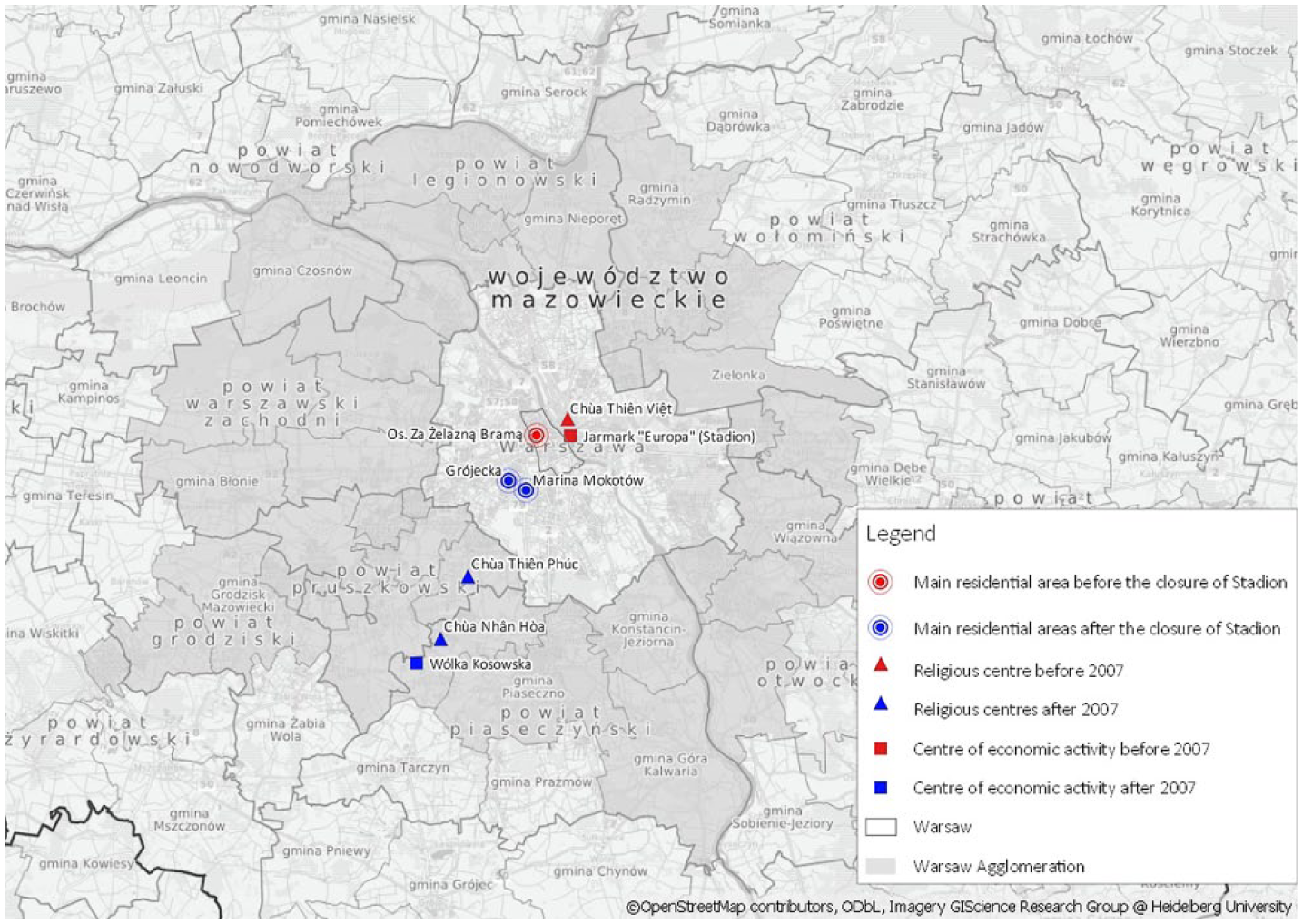
Focal places of Vietnamese migrant community: Warsaw and its surroundings.
Both presently active Vietnamese temples are situated in small villages partly inhabited by farmers and partly by suburbanites. As the plots on which they are placed are quite large, there are many artefacts and religious sculptures arranged around to make the pagodas look more traditional and resemble other garden and temple complexes back in Vietnam.
The first of the temples, Chùa Thiên Phúc (Pagoda of Heavenly Happiness) is in Laszczki village next to Raszyn town. It was built in 2012 within the premises of a privately owned house with a garden that was adapted for religious use. It was financed and created by initiative of Mr. Bùi Anh Thái, a former owner of the Praga Thăng Long culture center which housed Thiên Việt pagoda. The undertaking required enormous commitment from its founder. It took over the role of the Praga center that had been relocated to Wólka Kosowska along with the entire Vietnamese shopping center. The premises situated in the middle of the village have limited potential for spatial development. However, the larger lot enabled more outdoor activities like a common garden run. The second, incomparably greater pagoda, Chùa Nhân Hòa (Peace for Humankind Pagoda), is in Łazy, located slightly further than 100 meters away from Warsaw–Cracow national road. The choice of location for both pagodas was influenced by the proximity of the center of economic and social life of the Vietnamese society—a complex of indoor markets in Wólka Kosowska—a workplace for the majority of representatives of this society.
A wholesale center in Wólka consisting of a range of halls owned in the most part by foreign investors (Chinese, Vietnamese, and Turkish), where a few thousand merchants, restaurant owners, and employees: Poles, Vietnamese, Chinese, and citizens of the former USSR alike, have their workplace, constitutes a specific multicultural enclave on the monocultural map of Poland (Huewelmeier, 2015; Klorek & Szulecka, 2013). Simultaneously, media often describe Wólka Kosowska as a specific ethnic ghetto to which Polish state institutions (including customs, tax services or the police) have a limited access. According to the accounts of nongovernmental activists, the transfer of the center of Vietnamese economic activity along with cultural and social institutions (presently Wólka houses the most important migrant institutions: Vietnamese Association in Poland and Que Viet newspaper) diminished the need of contacting nonethnic social institutions. While working on the Stadium in the city, the Vietnamese relatively more often used Warsaw public spaces such as parks, recreational areas or public transport. Having moved to Wólka Kosowska, deprived many of them of generally available recreational facilities and limited opportunities for wider interethnic contacts. Therefore, it may be assumed that transferring of the center of Vietnamese economic activity as a consequence of imitative modernization brought about the ghettoization of Vietnamese society, unavoidable in such a great spatial isolation, as well as regress of acculturation processes. In this context, the Vietnamese pagodas’ operation and their readiness to cooperate with local communities seems to be very significant not only for the coherence of Vietnamese society and their ability to meet their needs but also for further interethnic relationships.
Vietnamese Pagodas in Poland in the Network of Transnational Connections: Conflicts and Legitimating Strategies
The first Vietnamese temple built in Poland was the already mentioned Chùa Thiên Việt (Pagoda of Vietnamese Heaven) operating within the premises of Thăng Long culture center, located in immediate vicinity to the 10th Anniversary Stadium. The construction of Thiên Việt pagoda was financed by a Vietnamese businessman, Bùi Anh Thái, owner of Thăng Long culture center in response for the demand reported by representatives of Vietnamese society. What is important, the temple was located within a confined complex leased by the businessman. It was guarded by a professional security company and inaccessible for random and unexpected visitors. There was a range of cultural and service institutions to be used by the Vietnamese inside the complex, such as karaoke rooms, a scene where performances such as water puppet theatre were displayed, the seat of Nối Vòng Tay Lớn newspaper as well as shops with aó dài traditional clothing. Therefore, despite the fact that the pagoda was operating in a chaotic space of wild capitalism times (Harper, 2006; Upchurch & Marinković, 2011) characterized by bazaar decor, among buildings of nonsacral characteristics, it was also a part of a greater whole—a center of migrant culture designed to fulfil the needs of Vietnamese society. The temple was built under the management of the Association of Vietnamese Buddhism Enthusiasts in Poland—an organization registered in Poland as an association and not a religious group. In 2007, the Association requested the Buddhist Sangha of Vietnam (Giáo Hội Phật Giáo Việt Nam), an official organization operating within the political system of the Socialist Republic of Vietnam, to delegate a monk who would provide religious services in the pagoda. The organization agreed, but due to the circumstances related to liquidation of the 10th Anniversary Stadium, the temple and the entire culture center ceased to exist.
The immediate cause for which “Jarmark Europa” that had been operating for almost 20 years was closed down was the construction of a new sports center—the National Stadium. Costly investments in monumental, modern sports facilities, whose fundamental (and sometimes also the only one) intended use is connected with international sports event, are categorized into a development strategy called imitative modernization. This strategy, giving the priority to economic goals, is often implemented mainly through material and palpable externals signs of high-economic level. One of its manifestations in the closing years of the transformation was the construction of buildings-icons designed to have important cultural or entertainment functions, not only on the domestic level but also internationally. In the case of the National Stadium, it was primarily designed for UEFA Euro 2012.
After the transformation, the center of the economic and social life of the Vietnamese was transferred to the southern suburbs of Warsaw in the proximity of market halls in Wólka Kosowska. The surroundings of Wólka seemed to be pretty obvious choice for the location of a new pagoda that was to substitute Thiên Việt temple. The reasons why as many as two pagodas were built are, however, less obvious.
Mr. Bùi Anh Thái decided to continue his social activity. During our first visit in the new pagoda, Bùi Anh Thái would repeatedly underline that both the purchase of land as well as the construction of the pagoda were financed from his private funds. When our research was still in progress (2014-2015), the initiator and sponsor of the investment was no longer in Poland; he had returned to Vietnam, where he continued his activity related to the promotion of Buddhist values and opened a vegetarian restaurant. The pagoda remained under the management of a group of activists organizing events and festivals, running the temple’s Facebook profile (and a very active one—a few entries are made daily), preparing meals for various meetings as well as maintaining the area around the pagoda and growing a vegetable garden. Despite the pagoda did not have a resident monk, it was regularly visited by the reverend Thích Minh Trị—a cleric with an honorific title of thượng toạ given to high-rank monks. The reverend Thích Minh Trị is a representative of Buddhist clergy operating within the official organization of Vietnamese Buddhists, the Buddhist Sangha of Vietnam (Giáo Hội Phật Giáo), the only organization of this type recognized by the Social Republic of Vietnam. There is an emblem of GHPG on the building of pagoda just like on the temples in Vietnam, which to some extent legitimizes its belonging to the Vietnamese institutional system. In time, this solution led to the pagoda’s marginalization and exclusion. Despite the fact that the pagoda is less than 10 km away from Wólka Kosowska, to get there, one has to leave European route E77 and drive along local roads not leading to any places important to the Vietnamese.
Furthermore, as one can find out reading posts on the Quê Việt page, Mr. Bùi Anh Thái initiative of building a new pagoda was opposed by the representatives of the Association of Vietnamese Buddhism Enthusiasts, engaged in the operation of the previous temple situated near the 10th Anniversary Stadium. One of matters under dispute was the right to invite monks from Vietnam—representatives of Vietnamese religious institution. The representatives of the Association invoked a letter of 2007 and the decision of the Buddhist Sangha of Vietnam on sending a monk to Poland, claiming that this consent was given to the association having an exclusive right to represent Vietnamese community—and not as a response to private initiative of Mr. Bùi Anh Thái. What is important, the standpoint of the Association won the support of “official” Vietnamese migrant institutions, such as the Vietnamese Association in Poland. It was claimed that pagoda should be built on the community’s rather than private initiative and that Vietnamese society in Poland needed to remain united while such particular initiatives could pose threat to such unity 1 The matter described in Quê Việt newspaper, an official body of the Vietnamese Association in Poland, was widely discussed on Internet forums. Without going into details of this conflict whose roots were probably of personal nature as well as related to complex issues of loyalty to Vietnamese political institutions, it was noticeable that the activists from Thiên Phúc pagoda managed to achieve their goal. The reverend Thích Minh Trí arrived at the pagoda with an official visit, and the ceremony was attended by many guests among whom there were representatives of Polish local governmental institutions—Commune Culture Centre in Lesznowola, which cooperated with the pagoda by organizing cultural projects. In May 2015, Thích Minh Trí was installed as abbot of the temple during an official ceremony.
Meanwhile, another party to the conflict, the Association of Vietnamese Buddhism Enthusiasts in Poland, took an initiative of building a temple on their own. They were going to get funds from European Union programs to build not only a pagoda but also a center of Vietnamese culture. This plan, however, did not work, and eventually, a pagoda called Nhân Hòa was financed from donations made by individuals offering amounts of several dozen to a few thousand zlotys, and business entities, such as market halls in Wólka Kosowska. During one of the visits at the pagoda construction site, we had an opportunity to view a list of sponsors displayed in a prominent spot in the hall. The hosts who showed us round underlined its religious and social role it was going to play in the future for the Vietnamese living in Poland. Quite a large number of rooms and a big kitchen are intended to help fulfil this purpose. The construction works commenced in 2013 took quite a long time—probably due to financial problems generated by the scale of the undertaking (massive, a few story building of original architecture); halfway through 2015, the building was delivered, but it still needs some finishing. Presently, Nhân Hòa pagoda is visited by a Vietnamese monk affiliated with the Buddhist Sangha of Vietnam, who—as it is the case with Thiên Phúc temple—does not reside in the temple but visits it from time to time when he is also a guest of other Vietnamese migrant communities living in countries of former socialist bloc—the Czech Republic and Germany.
Examining transnational connotations between the two temples and Vietnamese institutions, it is noticeable that both pagodas are affiliated with the official religious organization—the Buddhist Sangha of Vietnam, and are regularly visited by Vietnamese monks. The emblems of Giáo Hội Phật Giáo, displayed on both temples as well as the statue of Hồ Chí Minh standing in Thiên Phúc, may be treated as elements legitimizing the existence of both temples: As authentic places liable to be associated with Vietnamese reality as well as organizations loyal to the political system of the Socialist Republic of Vietnam.
It is worth underlying that neither of the two pagodas operating in Poland, which today are situated outside administrative boundaries of the capital, make any reference to movements opposing the authorities of the Socialist Republic of Vietnam, present in the Vietnamese Buddhism. In migrant Vietnamese societies as well as in home country, there are organizations that refused to be subordinated to the Buddhist Sangha of Vietnam established in 1981 by the decision of Vietnamese government aiming at a complete subordination of clergy and Buddhism believers. The most important organization among these rebellious ones is Giáo Hội Phật Giáo Thống Nhất (the United Buddhist Church) with its most prominent representative, Thích Nhất Hạnh, a monk who is well known in the West and who has lived in exile in France since 1966 (Chapman, 2007; Taylor, 2007). The attempt to start cooperation with Vietnamese monks in France did not bring the expected result. This was due to the fact that Vietnamese society living in Poland, whose genesis dates back to the times of Cold War alliance between the countries of the Soviet Bloc, is an example of state-bound diaspora (Sheffer, 2003) maintaining a complex network of bonds and, in general, politically loyal to the country of origin. The case of two Vietnamese pagodas shows, however, that this loyalty—also toward authoritarian state—does not have to necessarily mean unification of actions conducted by migrant society representatives, but it allows a certain field of autonomy.
Going Beyond Vietnamese Reality: Relationships With the Polish Environment
The reality of the country of origin, Vietnam, and the world of Vietnamese society in Poland are not the only points of reference for Vietnamese pagodas operating in Poland. The temples have developed a network of relationships also with the Polish reality, both in an institutional aspect—by means of contacts with local authorities, and informal dimension—by interactions with neighbors. Thiên Phúc pagoda maintains contacts with such institutions as Commune Culture Centre in Lesznowola and Municipal Culture House in Raszyn and invites their representatives to participate in celebrations of religious and social character. As far as noninstitutional relations are concerned, when asked about contacts with Poles interested in taking part in ceremonies in the temple, pagoda’s representatives always declared that Polish guests would be most welcome. Indeed, during many visits at the temple we were always treated with great kindness and hospitality, and were invited to join the meals and given gifts. Non-Vietnamese guests arriving at the temple during the times of festivals were treated similarly. It is worth noticing, however, that such intercultural meetings did not take place very often. During the ceremonies and festivals we had the opportunity to attend, there were never more than several Polish participants, and sometimes we were the only Polish guests. Undoubtedly, language barrier contributes to poor participation of Polish guests—all entries informing of any scheduled events are made only in the Vietnamese language on the pagoda’s Facebook page. Vietnamese is also the language of all inscriptions written on the inner and outer side of buildings and also the official and—often also the only one—language used during events organized in the pagoda. Despite many years of contacts with Poland, the whole furnishing of the pagoda is from Vietnam and except for books about the history of the surrounding towns and villages, there are no signs of making references to any elements of Polish material or artistic culture, nor any attempts to include the same in the temple’s decor.
This poor state of integration of the Chùa Thiên Phúc temple is paradoxically also the consequence of its situation and appearance; and it is not its religious “strangeness” or aesthetic otherness that lies behind it. Apart from the remoteness from the main communication routes, the barrier may also lie in pagoda’s location within the building and a garden, among several dozen other similarly arranged premises. Despite its religious decorations, the temple’s building looks like a typical suburban private property. To enter it, one has to not only overcome cultural barriers but also be open to the idea that such ordinary suburban residential buildings may also play public and sacral roles—the idea most of Poles would find difficult to accept. This stands in contradiction with the Polish cultural pattern of locating temples and the surrounding public spaces in the center, in an organizationally and visually separated space designed for this purpose.
In the case of Nhân Hòa pagoda, any connections with Polish institutions seem to be even less noticeable. The initiators of the pagoda’s construction intended to apply for funds with the European Union and authorities of Mazovian sejmik (local assembly), but this plan was not carried out. Finally, it was built from private funds. The pagoda stands on a far end of a very spacious plot of land, away from the entry to the property, which is bordered by the road from one side and surrounded by undeveloped land from other sides. Unlike the pagoda in Laszczki, Nhân Hòa temple is not exposed to the neighboring buildings or pedestrians. The internal functions of the temple have been designed to accommodate the social needs of the Vietnamese within its walls. Apart from rooms intended for educational, cultural, and business purposes, there is also a large kitchen and utility rooms.
According to declarations of the founding fathers, the pagoda is to serve as the seat of the Vietnamese culture center designed not only for the Vietnamese but also the Polish people—local community wanting to learn something about Vietnamese culture. Presently, it is too early to predict if this is going to happen, as pagoda’s construction has not been completed yet. One may, however, discern certain properties that may hinder non-Vietnamese people from accessing the pagoda: The pagoda’s Facebook page is in Vietnamese language only, all inscriptions at the entry to the pagoda are in Vietnamese, and the very location of the temple on the far end of the plot, away from the road, makes it hardly discernible from the road. Also, the fence conveys a message that it is not a generally available public space.
Analyzing the actions of creators and people responsible for running of the pagoda, one may deduce that these are motivated by the pursuit to underline Vietnamese character of the pagoda—the character that refers to national elements. The assembly of religious, cultural, and national components enabled the pagoda’s founders to create an inclusive space for the Vietnamese having different worldviews and needs, and guarantees its durability and social stability. One may wonder, however, if such a vision could have been realized if Vietnamese society had not been forced to leave the center of Warsaw. Here, in the suburban villages transformed by the Vietnamese into specific edge-cities, spatial isolation makes it possible to avoid the necessity to always translate one’s own culture into the one that would be understandable to the Polish. It also protects the Vietnamese cultural offer against being exoticized and open, and also against commercialization that would be hard to avoid in a typical environment of a big city.
The goal, which is the creation of a Vietnamese center, is being pursued with a range of strategies, such as using predominantly Vietnamese language when communicating with believers and people interested in the operation of the pagoda, including the pagoda within the institutional framework of the Buddhist Sangha of Vietnam, regular cooperation with representatives of Vietnamese clergy, arranging the pagoda in the style closely imitating Buddhist Vietnamese sacral architecture, using elements (sculptures, furniture) imported from Vietnam, or using Vietnamese prayer books and religious literature. Pagoda also organizes celebrations of important Vietnamese festivals, such as Mid-Autumn Festival, which do not have a strictly Buddhist character but are an excellent occasion for practicing folk traditions. One can say that these strategies are successful in this sense—as we could notice—that the pagoda attracts the Vietnamese people more than Polish Buddhists or Poles interested in Buddhism.
Ghettoization as a Product of Imitative Modernization
To sum up, the bazaar was a paradigmatic form of changes within postsocialistic cities (Schlögel, 2010). In the first years following the systemic transformation, the Vietnamese filled a niche of a big city trade. Their presence broke up the monolithic cultural landscape of the capital city center, and their cuisine and culture aroused growing interest among Polish society. Social researchers are not in agreement whether transformation processes and their reflection in the structure of the cities of the former Eastern bloc may be considered analogous to those that took place a century before in capitalist cities and to what extent they were and have been convergent (Harloe, 1996). Nevertheless, the consequence of freeing of the market was that the area of “Jarmark Europa,” and to a lesser extent Praga Port, quickly rose in value: economically, symbolically, and as an important public transport area. After more than 10 years, the city planned a multilayer functional redefinition of these areas, compliant with global trends of urban policies. Their social and symbolic gentrification forced the Vietnamese, dealing mainly in textiles, to move to the outskirts of Warsaw agglomeration. The present location of Vietnamese pagodas outside administrative boundaries of Warsaw, next to a big transport hub and a commercial center, is one of the elements that significantly hindered the process of social and cultural integration that started in Praga District as well as the process of inclusion of Vietnamese cultural elements into the Warsaw iconosphere. The hybrid and fragmentary space containing the market halls and both pagodas does not promote integration with local communities, which results in strengthening of bonds linking Vietnamese organizations attached to the halls and pagodas.
Footnotes
Declaration of Conflicting Interests
The author(s) declared no potential conflicts of interest with respect to the research, authorship, and/or publication of this article.
Funding
The author(s) disclosed receipt of the following financial support for the research, authorship, and/or publication of this article: The research was a part of the project entitled Vietnamese from Poland – Transnational Migrant Community as a Brigde between Poland and Vietnam, SONATA grant no. 2013/09/D/HS6/02675, sponsored by National Science Centre, Poland (NCN).