







Abstract
Between 1950 and 1970, large housing complexes demonstrated contrasting ways of using the “alternate corridor” project technique. Key words such as skip-stop, doorstep, and espace pivot were used to refer to singular spatial devices, responding to different understandings in architecture. Based on certain convictions of the Modern Movement in Architecture, architects were confident in promoting design innovations using this technique, initially aimed to reduce construction costs, in efficient “access distributors” spatial systems. However, some issues arose afterward, mainly concerning the social organization of the “territory,” intending to better connect the diverse “human scales.” Focused on the small scale of intermediate collective spaces, this article proposes a comparative critique of three case studies that share a common building design technique in the alternate corridor: Pruitt-Igoe, Robin Hood Gardens, and Le-Mirail, considered to be great achievements of that time but which nowadays have been put into question or even considered to be complete failures.
Alternate Corridors in the Modern Movement
The term alternate corridor 1 is regularly used to refer to some interior configurations—the result of a conscious or unconscious design process. Being a premise of several paradigmatic Modern Movement’s buildings, the alternate corridors as a technique was promoted under a collective surface–reducing logic, supposedly capable of decreasing construction costs. It was initially received with enthusiasm and subsequently applied in diverse proposals.
In this sense, the Unité de Marseille is one of the most significant achievements in the alternate corridor configuration to have captured the media’s attention. It was explained by Le Corbusier through scale models that boasted a virtuous use of geometry and space. These models inspired other similar solutions and stirred several architects’ imagination toward producing increasingly more complex designs. 2
Before Le Corbusier, some efforts had already been made to understand the numerous alternate corridor configurations. An interesting case had been Narkomfin’s “F unit” (Moscow, 1928), developed under an almost scientific process that compared different alternate corridor models. The F unit was, as such, identified as being better suited and more efficient for the collectivized socialist way of living (Movilla & Espegel, 2013; see Figure 1). Another example of the configuration used before Le Corbusier was the three-two system, first used in the Palace Gate building (London, 1939), which could not only reduce corridors but also attain up to 40 flexible layouts because of its “planning in section” technique, according to Wells Coates (Figure 2). 3
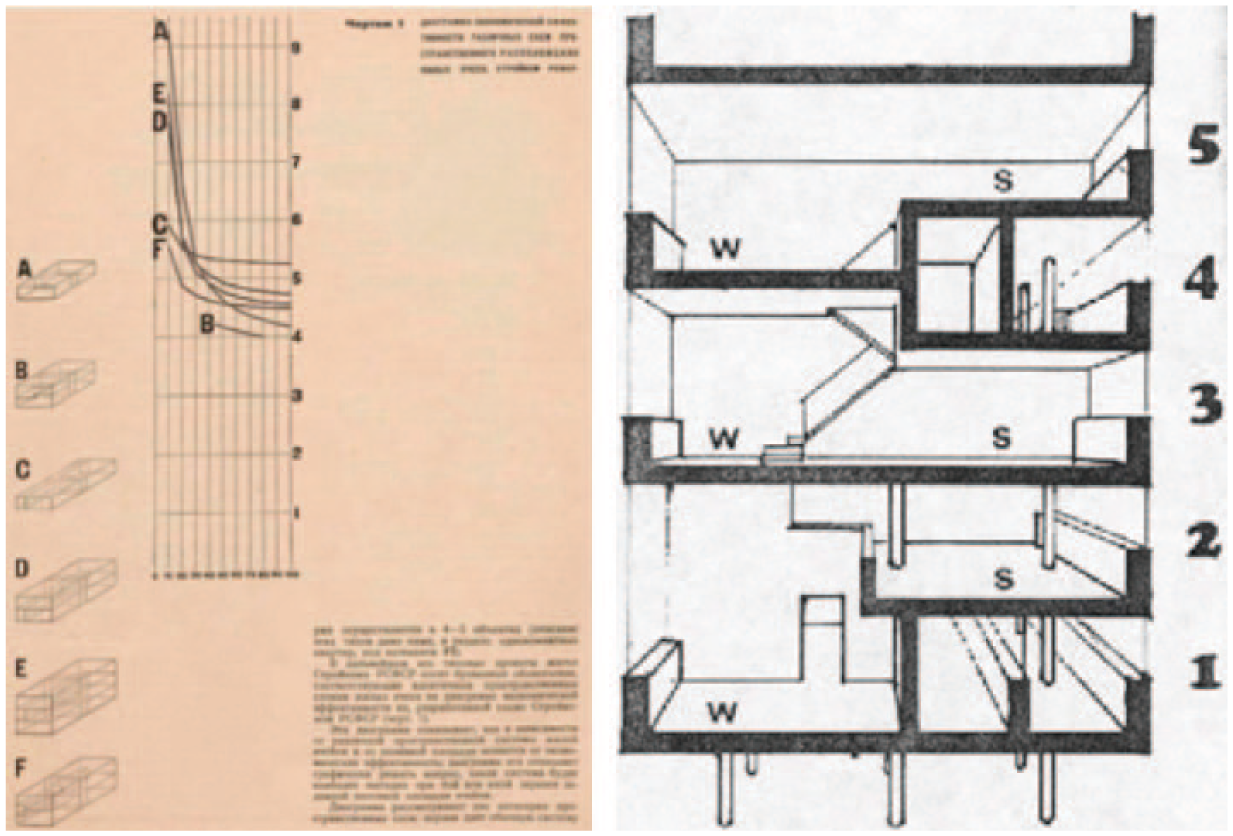
On the left, Ginzburg’s study diagram of alternate corridor models, comparing surface and volume; Narkomfin’s section was the best result of the study, presented on the right.
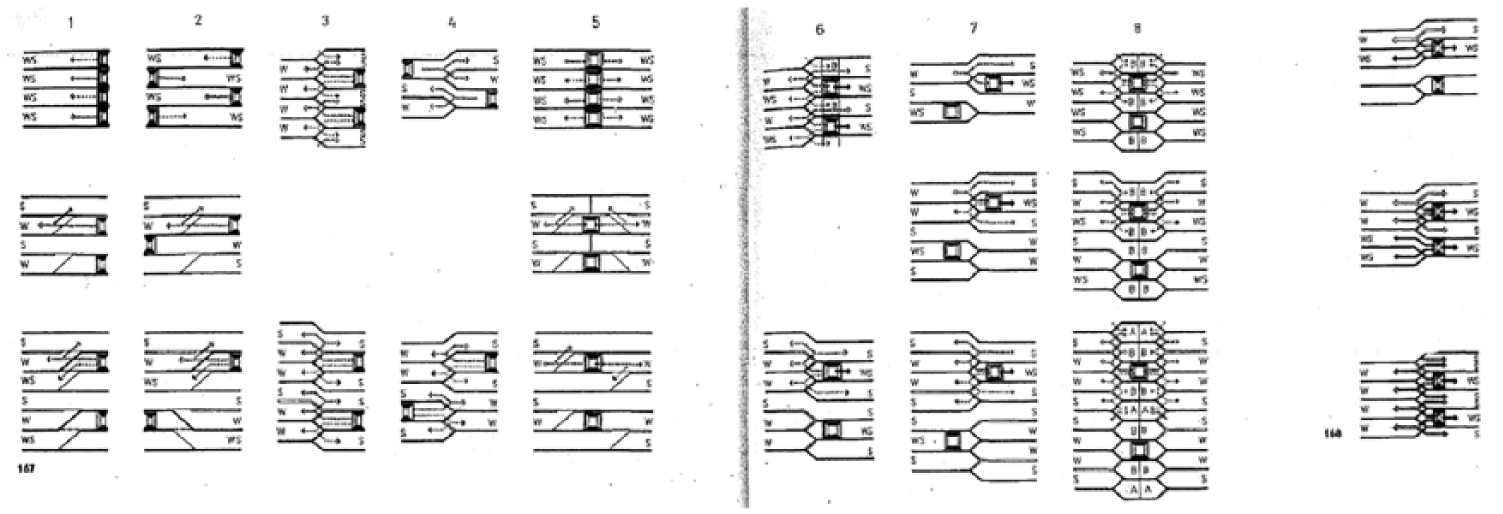
Zumpe’s diagram, explaining different alternate corridor models. Classification was organized considering three aspects: (1) position of the corridor, (2) access to the apartment and private stairs (inside the apartments), and (3) social (w) and intimate (s) areas. In general terms, the chart horizontally arranged the models according to the number of floors between corridors and vertically according to the position of the corridor.
Shortly after these first attempts, some specialized architecture magazines published their models, which were received optimistically—particularly those related to the so-called skip-top 4 technique, which in turn raised speculations of the possibilities in massive social housing. 5 Once it started to be used in large-scale housing complexes, the technique was reappreciated. Modern values, linked to efficiency aspects, were the main interest no more; instead, social and anthropological issues were now being considered. The usage of different split levels appeared, being intended to improve the delimitation of social territories in space.
This led to the identification and classification, in 1967, of a wide variety of sektionshaus models by the German architect Manfred Zumpe—models that had already been built, but in this manner, Zumpe added other possibilities that could be eventually further explored 6 (Figure 3).
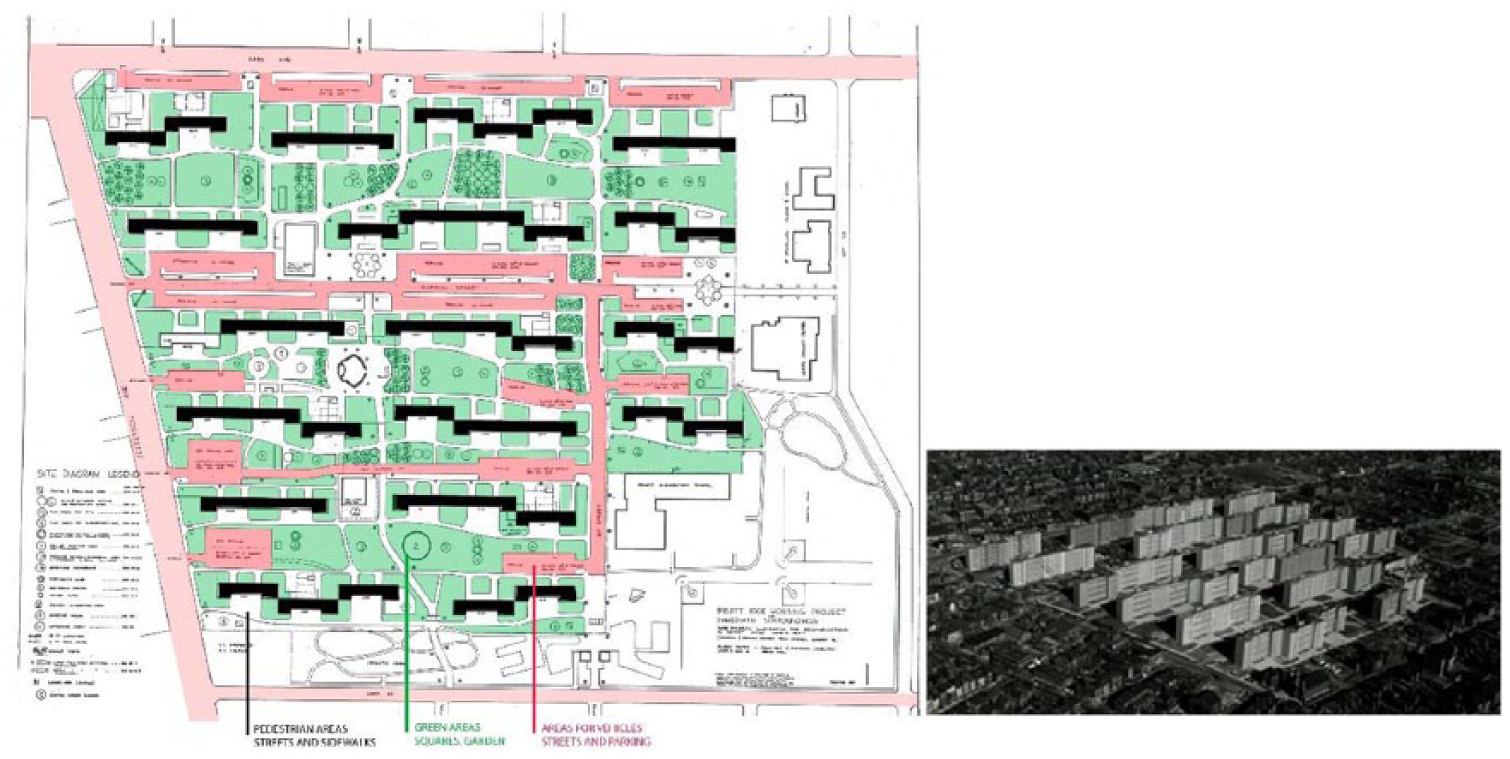
Pruitt-Igoe (St. Louis, Missouri, 1954). Note. Large open spaces were created within an internal street system. Some spaces, such as “space for the elderly” or barbecue area, were scattered somewhat indistinctly between slabs.
Summing up, from today’s perspective, the different alternate corridor models hide an unwritten history of architecture and of the way in which it was thought about. What is also important to observe are the conspicuous space structures inside the models. Having created “access distributors,” the intermediate zone between the building’s exterior and the living unit’s interior became quite atypical. According to some critics, the “intermediate spaces” represent an important, upcoming housing issue. Today’s living unit is in a shrinking process, where an Existenzminimum phenomenon is constantly compacting the interior private space. If the living space in home interiors is vanishing, it should be asked as to where day-to-day activities should take place. The answer is, according to some critics, in all semipublic, semiprivate areas and in all collective spaces within the blocks and buildings—and that’s where new promise should be found (Moley, 2006).
Regarding housing research, intermediate spaces and the alternate corridor buildings could be topics of interest. Famous and infamous study cases can provide strong material for this matter. Therefore, we propose here to revisit three high-impact and well-documented cases, focusing on its halls, corridors, and connections and tracking the project considerations and contrasting those to postoccupancy observations.
The Study Cases
One example is the Pruitt-Igoe housing complex, originally celebrated in Architectural Forum as a clever organization, a praise that clashed with critics from Rainwater’s (1970) Behind the Ghetto Walls two decades later. These critics exposed the frightening daily life within the “project”—as inhabitants called it. Three years later, Oscar Newman (1973) criticized Pruitt-Igoe’s spatial configuration, noting specifically on the obscure and virtually hidden collective space typical of the skip-stop. Architects began to be held responsible for this—a belief exacerbated by Charles Jencks’s devastating comments that contributed to demonize the building as an icon of the modern architectural failure (1977); albeit, more recently, Bristol (1991) identified a mystification process by the mass media, which distorted some of the original events and in turn helped create an architectural cautionary tale, inspiring the documentary film The Pruitt-Igoe Myth (Chandra Ward, 2012).
A comprehensive description of what really happened can be found in Alexander von Hoffman’s (1995) article, where he asked the question as to why Pruitt Igoe was built and why it was designed in that way, suggesting that the failure was caused by a conjunction of different circumstances, not only architectural. However, after von Hoffman, Le Corbusier’s influence and the modern enthusiasm in high-rise housing and its innovations—such as the skip-stop—are important factors.
Today’s question is whether architecture is an alibi or not. Suspicions seem to be raised when looking at other similar housing cases, with similar endings. Le Mirail and Robin Hood Gardens are two other instances, both intended to be developed in an innovative way, as shown by some previous Peter Smithson’s publications in Architectural Design.
Regarding Robin Hood Gardens, other clues of this intention can also be found in Architectural Forum’s detailed description, in 1972, exposing the project’s principles. Just a year later, however, A. Pangaro declared his disapproval of the housing complex, predicting that the corridor configuration would cause trouble. In the 1980s, J. Furse surveyed the complex with interviews, exposing the oppressive environment within the streets-in-the-sky. The complex resurfaced recently as a topic of discussion, when its demolition was made public and well-known architects—such as Rem Koolhaas—arose to defend it as being an architectural piece of historic interest, in spite of its dubious success. Le Mirail is another case recently caught in polemic debates, considering the plans to partially demolish and rebuild it. Even if less documented when compared with the other two case studies, it presents issues relevant to the present discussion, being the most extensive example that organizes its intermediate spaces under an extreme model of efficiency. Strong observations on the intermediate spaces in Le Mirail’s are found in recent authors, such as Moley (2006) and, particularly, Martin Domínguez (2013).
Pruitt-Igoe, Skip-Stop, and the Stigmatization of the Alternate Corridors
Pruitt-Igoe (St. Louis, Missouri, 1950-1954) was composed of 11 floors and 33 slab blocks, settled facing a north-south axis, and occupying a very small area at the ground level. The complex had 2,700 apartments and was capable of housing up to 15,000 people. It was an impressive and bold proposal at the time (Figure 3). The Pruitt-Igoe was among the largest housing projects in the United States to use the skip-stop model. Architectural Forum announced “tremendous savings estimated at about 12% of construction cost”: Elevators stop every three floors, and dwellers on the intervening levels walk up or down to their apartments. This money-saving feature is not new; but combining it with an open gallery on elevator stop floors in these buildings, in order to eliminate hallways and create “neighborhoods” at different floor levels, has already been the subject of so much interest and emulation by other cities’ Public Housing Authorities. . . . the architects’ lawyers has decided it is patentable and has filed. (“Slum surgery in St. Louis,” 1951, p. 130)
Additionally, Pruitt-Igoe’s skip-stop hallways in the middle floor incorporated collective galleries in the south facade so that “summer shade and winter sun by the ratio of gallery depth to height” was a guarantee (Figure 4).
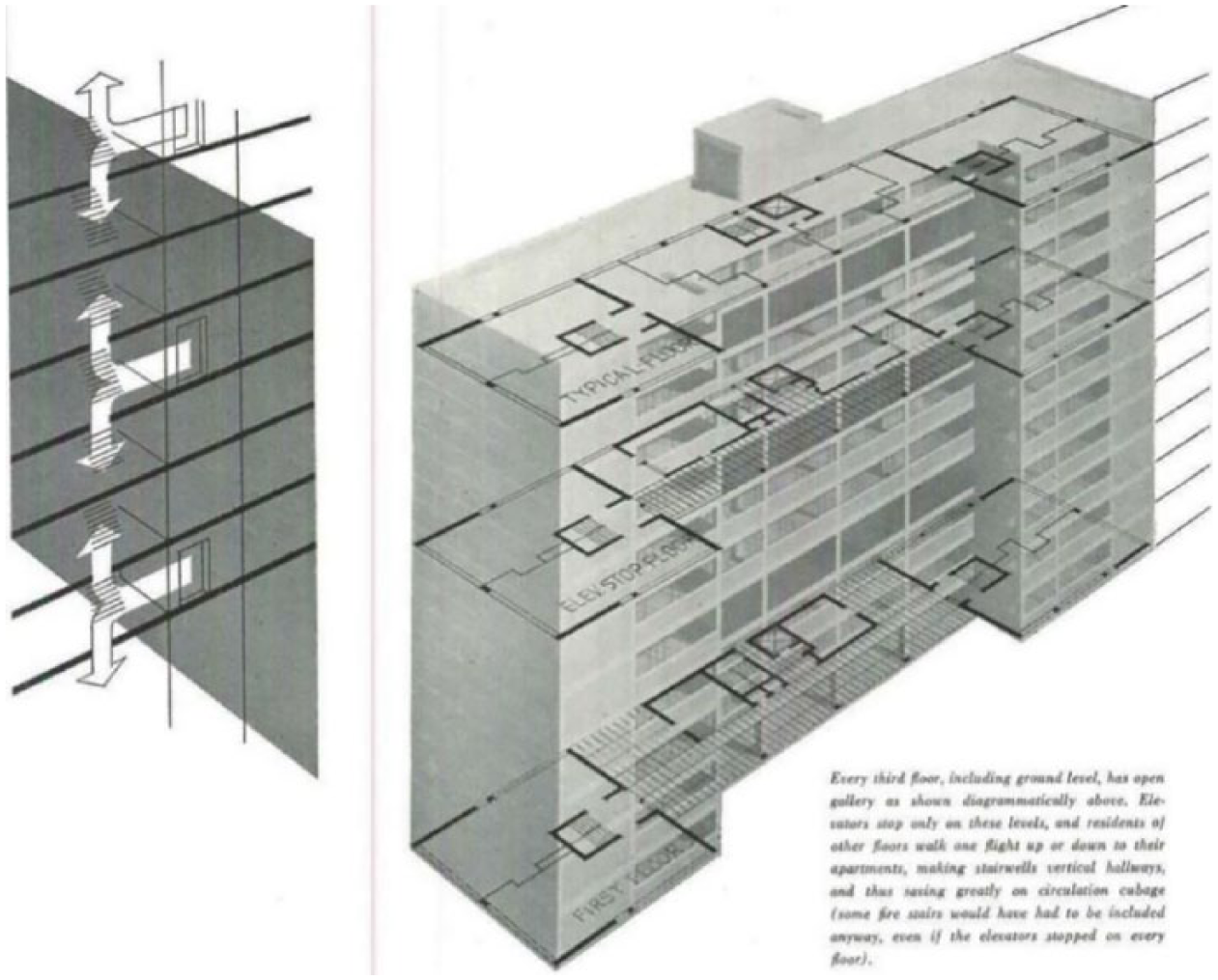
Skip-stop system in Pruitt-Igoe Housing.
Galleries were narrow, at 11 ft × 85 ft (3.3 m × 25 m), but wide enough, in theory, to incorporate a laundry and children’s playing area. The idea was to “move the services upstairs, where they are handier” so that “a mother can be doing laundry within sight and hearing of child playing in the sun. And all this is not too far away from whatever may be cooking on the apartment stove” (“Slum surgery in St. Louis,” 1951, p. 131).
Following Architectural Forum’s description, slab blocks were an improved morphology, “planned harder and tighter” to be capable of “undersell (the cross plan) by 16% without cutting room sizes” (“Slum surgery in St. Louis,” 1951, p. 132). Blocks were built in variations of three different modules to adapt to topography. Apartment units had the entrance door at a collective stairwell—an arrangement derived of fire regulations (Figure 5).
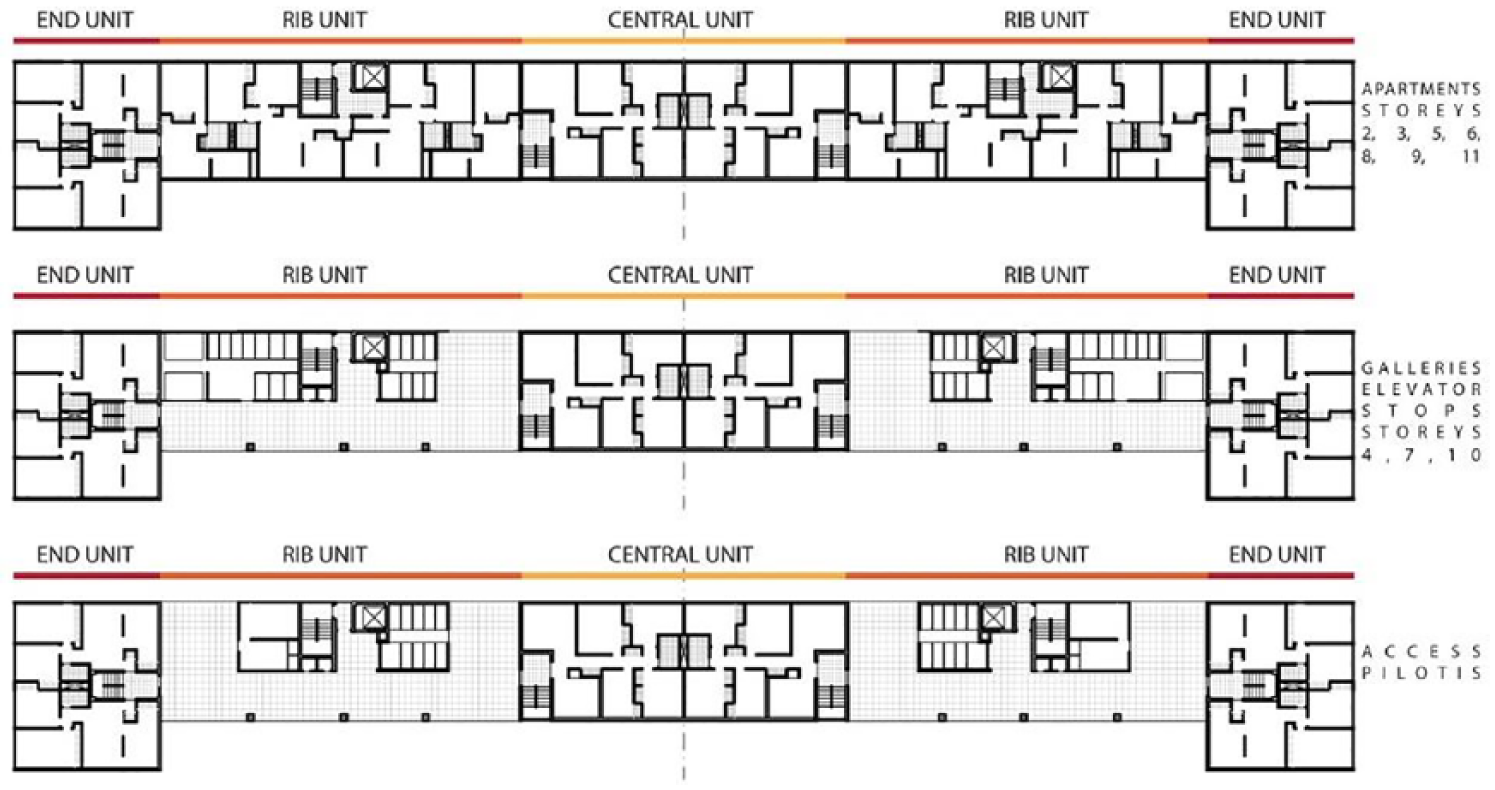
Above, upper and lower plan of the skip-stop organization; in the middle, gallery intermediate plant, on floors 4, 7, and 10, with elevator stop; below, access plan to the slabs.
At the ground level, between the block slabs, there were 200-ft.-wide interstices (60 m), creating a “river of trees . . . a long narrow park, more useful than a square park,” where diverse collective uses were scattered, somewhat randomly: “recreation area,” “seniors,” “skateboard,” and “games” (“Slum surgery in St. Louis,” 1951, p. 135) (see Figure 6).
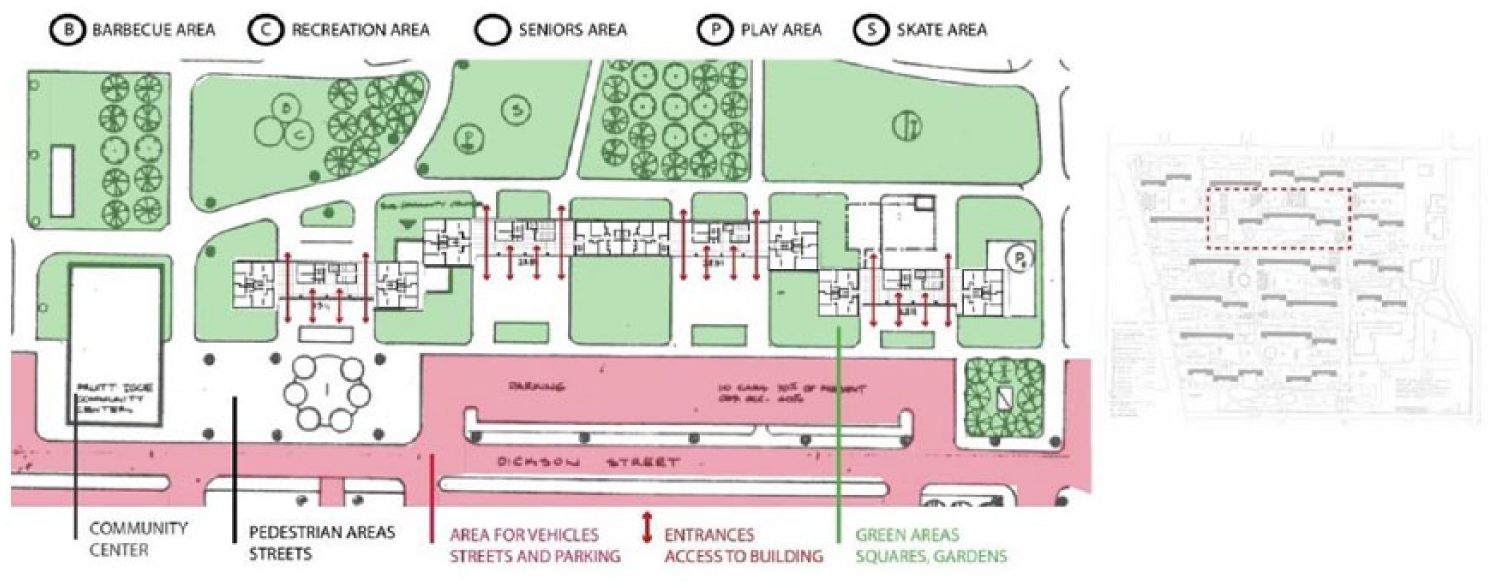
Ground floor of a Pruitt-Igoe slab and immediate surroundings, such as the linear parks and internal streets.
One year before Pruitt-Igoe’s collapse, Rainwater (1970) published his classical sociological study picturing “a community scandal, both because of certain unattractive design features (for example, the elevators stop only on the fourth, seventh, and tenth floors) and because of the wide publicity given to crimes and accidents in the project” (p. 1). Rainwater described the housing complex as surrounded by invisible walls, which confined a harmful environment of poverty and lack of hope, comparing it to a ghetto. A depressive and aggressive space characterized the residents’ daily life, he said, in which vandalism and crime were out of police’s control; it was “a city within a city, and the people make their own laws” (p. 13). Residents identified it as a vast and anonymous area: If I do something on the outside of the project and then run into the project here, I’ll bet you that I can come in here and knock on any of these doors and find somebody who will let me hide. Somebody is always robbing a store or a filling station around here and then running to the project for protection. The police never find them and they’re hiding right in these apartments all the time. (p. 16) Why have they specified or narrowed down one of their victims to come from this project? Because the project is a jungle. I can hide in the project, but I can’t hide outside the project; too wide open. I can go and select a victim, assassinate that victim, and go to anybody’s house in the project that I want to and will be shielded as long as it’s been a white man. (p. 38)
Rainwater (1970) said that the aggressive environment consequently turned all collective areas in feared spaces, encouraging the residents’ reclusion inside the apartment units, a phenomenon that the author strongly identified in women who “particularly find themselves confined to their apartments, by their responsibilities for numerous children and for keeping the house operating, and because of their suspicion of those outside.” The author calculated that “they spend no more than ten hours a week outside the apartment” (pp. 121-122). Loneliness and desolation were apparently frequently mentioned by residents during interviews.
It was said that the oppressive home environment affected children profoundly. Halls, stairways, breezeways under the buildings were of great worry, as Rainwater (1970) explained, Parents often take strong measures to insulate their children from the outside world which they regard as morally dangerous to them. They seek to keep them in their apartments as much as possible, and they worry whenever they are outside but not in school. They seem to assume that if the child can be insulated from the outside world he will manage to grow up without its unrespectable and dangerous potentialities rubbing off on him. (p. 74)
During the two decades, the most admired features of the Pruitt-Igoe, the skip-stop and its intermediate spaces had become not only unpopular but also problematic—a target of residents’ claims: There’s too much broken glass and trash around outside. The elevators are dangerous. The elevators don’t stop on every floor, so many people have to walk up or down to get to their apartments . . . People who don’t live in the project come in and make a lot of trouble by fights, stealing, drinking, and the like . . . Little children hear bad language all the time, so they don’ t realize how bad it is. The laundry rooms aren’t safe: clothes get stolen and people get attacked. The children run wild and cause all kinds of damage. People use the stairwells and laundry rooms for drinking and things like that. A woman isn’t safe in the halls, stairways, or elevators. (p. 4) There’s so much trouble in the laundry room having your clothes taken that you just have to stay there with them all the time. I’ve had overalls, sheets, and pillow cases stolen. You can’t hang nothing up there without them being had to bring up these children myself without the help of a father. (p. 233)
Oscar Newman’s Defensible Space (1973) later critique began to point directly toward the architecture of the project, understanding that modern high-rise structures tended to isolate people in “a clear gesture of retreat and indifference . . . when people care about their own protection, as individuals only and not as a community, the battle against crime is lost” (p. 3). To avoid that phenomenon, this author argued that defensible spaces could be created within semipublic and semiprivate areas, where opportunities for “natural surveillance” could be encouraged and enhanced, overlapping different uses in the nearby entrances. The continued presence of neighbors, especially near entrance areas, could facilitate the detection of intruders, easily identified and indirectly discouraged to enter.
Pruitt-Igoe, however, was, as Newman observed, antisystematic about all collective use positions, spreading them at ground level around slab blocks with no hierarchy or strategic planning. What was worse, access to the blocks at the ground level could happen indistinctly from any side of the slab, in an open hall without doors, which hindered control and prevented any possibility of “natural surveillance.”
One of the most significant problematic spaces Newman observed was on the levels above ground, in the skip-stop system, which pulverized vertical circulations in up to six stairwells (Figure 7).
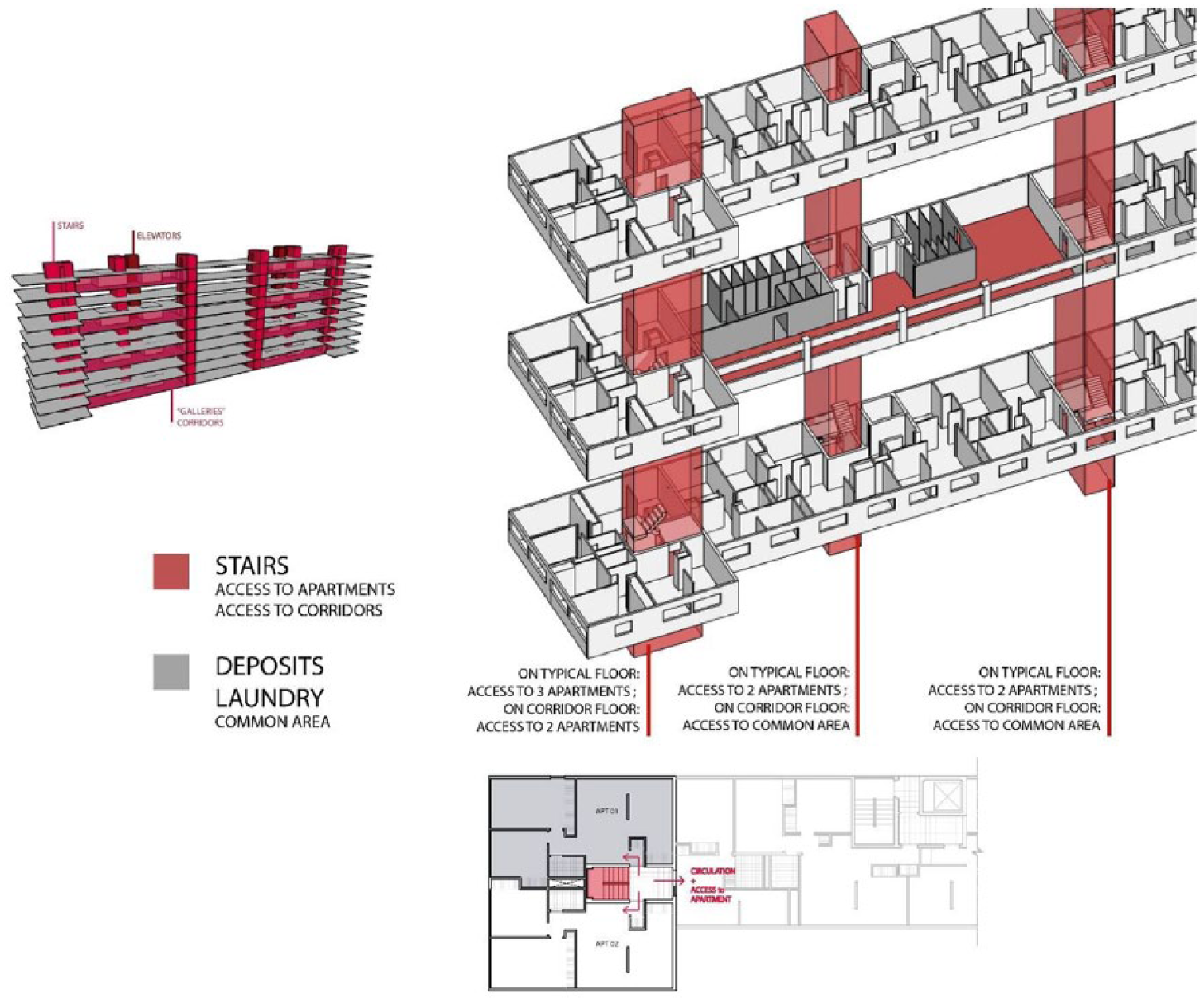
Skip-stop collective circulations in Pruitt Igoe. Intermediate floors connected with stairwells and elevators created a “vertical labyrinth,” facilitating “unwanted behaviors.” Stairs connect the floors vertically, being the main access to apartments.
Passages inside slabs were complex. To get to their apartments, residents needed to go up or down from the intermediate elevator floor, crossing dark stairwells and missing “visual opportunities”—in Newman’s words. There, an enormous number of paths were generated: The labyrinthine access routes and corridors make recognition of neighbors difficult to impossible; there are simply too many people coming and going. Consequently, residents express fear in using the interior corridors. The many access doors to fire stairs provide almost endless opportunities for intruders to make their way through the building. (Newman, 1973, p. 98)
Thus, it was not surprising that collective galleries at the intermediate levels became problematic areas, devoid of inhabitants’ sights; they became an easy target for vandalism and an ideal place for criminal behavior. They were “not used as gathering and sitting areas because they are dissociated from apartment unit entries” (Newman, 1973, pp. 58-59). When maintenance became unsustainable, Pruitt-Igoe was finally imploded in 1972; impacting images of clouds, dust, and destruction were released into the media, creating a myth (Bristol, 1991), an architectural legend, frequently recalled when one speaks of high-rise social housing problems (Samaratunga & O’Hare, 2012).
Based on this, the alternate corridors, which generated the “vertical labyrinths” of the skip-stop system, did not seem to be a good idea. At least, they should have been used differently; this was demonstrated by later attempts.
“New Humanism” and the alternating corridors: Toulouse Le Mirail andL’Espace Pivot
A similar sociological point of view can be found years afterward among Team X members, when the “new humanism” was interpreting the alternate corridor technique 7 differently. As evidence, one can point out to the P. Smithson’s “new principles” of architecture, synthetized in a re-creation diagram of the famous Le Corbusier’s Five Points. There, a third added column suggested some kind of skip-stop system, identifying new alternate corridor potentialities (Figure 8).
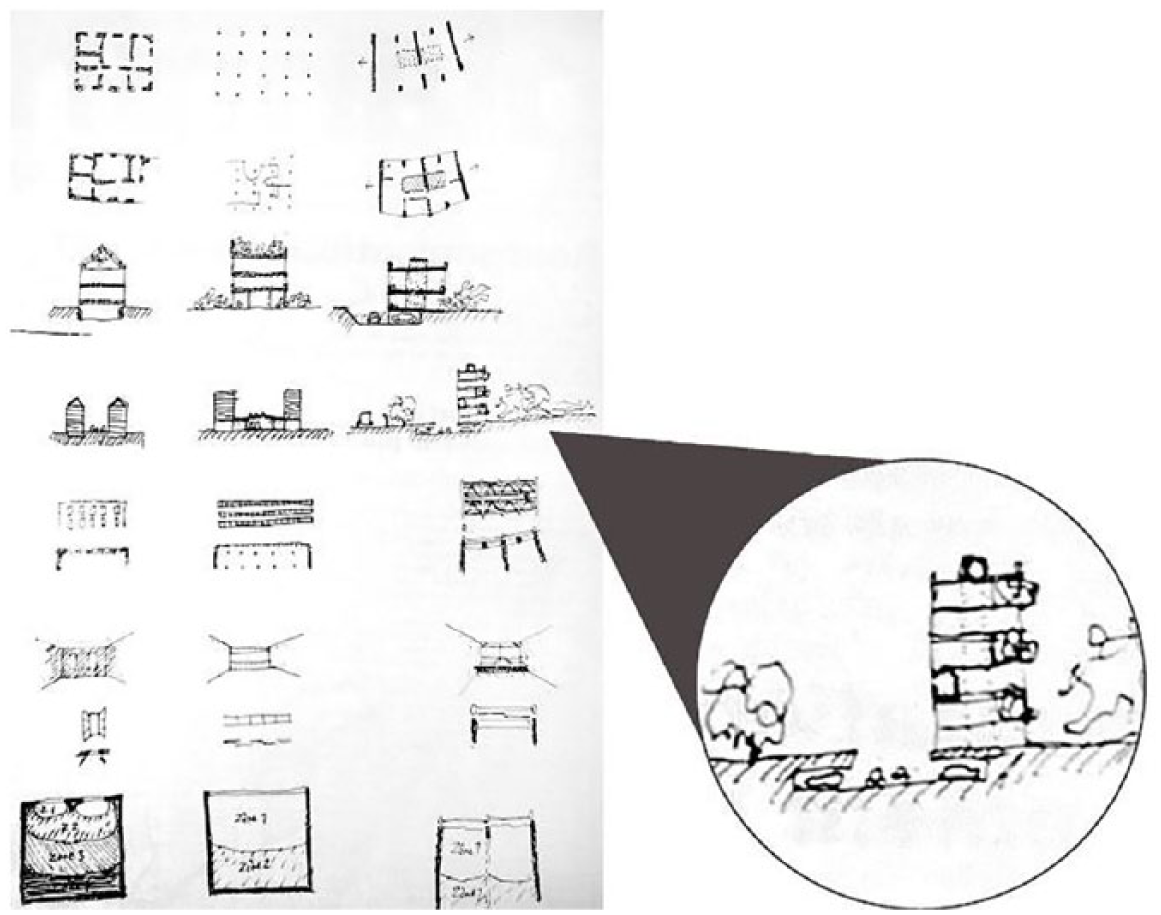
Smithson’s re-creation of the Five Point of Le Corbusier, appearing a third column for the New Humanism. Alternate corridors were a suggestive premise for the new habitat.
At this point, it is interesting to remember P. Smithson’s doorstep notion, an inspiring figure that helped raise awareness in alternate corridor planning on the solutions in intermediate space. A new sensibility was intended to be raised: There’s one more thing that has been growing in my mind ever since the Smiths uttered the word doorstep . . . to establish the in-between is to reconcile conflicting polarities . . . Two worlds clashing, no transition. The individual on one side, the collective on the other. It’s terrifying. Between the two, society in general throws up lots of barriers, whilst architects in particular are so poor in spirit that they provide doors 2 in. thick and 6 ft. high; flat surfaces in a flat surface—of glass as often as not. Just think of it: 2 in.—or ¼ in. It is glass between such fantastic phenomena—hair-raising, brutal like a guillotine. Every time we pass through a door like that we’re split in two but we don’t take the notice any more, and simply walk on, halved. (A. Van Eyck, cited in A. Smithson, 1968, p. 96)
Collective corridors were, in fact, metaphorically renamed as streets-in-the-sky or street-decks, thus being recognized as a place for possibilities of social exchange. The doorstep had the important function of protecting a family’s life inside the living unit from the noise and undesired sights of the outside word.
Years before, during the 1950s, Candilis and Woods had already opened discussions in the same sense for the interior privacy and protection, introducing the “semiduplex” 8 model, which influenced Le Mirail’s slab blocks configurations.
The Le Mirail housing complex (1961) was a four-district ambitious urban plan on the outskirts of Toulouse to house 100,000 inhabitants; however, only half of it was actually built (Bordenave, 2014). Its planning was based on a double layer that separated vehicular traffic from pedestrians (Figures 9 and 10). Vehicles were to remain on the ground level, so that pedestrians could walk on an elevated deck with a geometry that reminded of the figure of a mathematical fractal, with derivations that interconnected different areas of the complex. The elevated deck was later known as the dalle. Commerce and other different social activities were merged and juxtaposed at the first floor of it, intended to reunite and intensify community life (Martin Domínguez, 2013).

On the left, aerial view of Le Mirail (Bellefontaine and Reynerie quartiers); on the right, site plan from the architect: three different typologies were created for the housing complex.
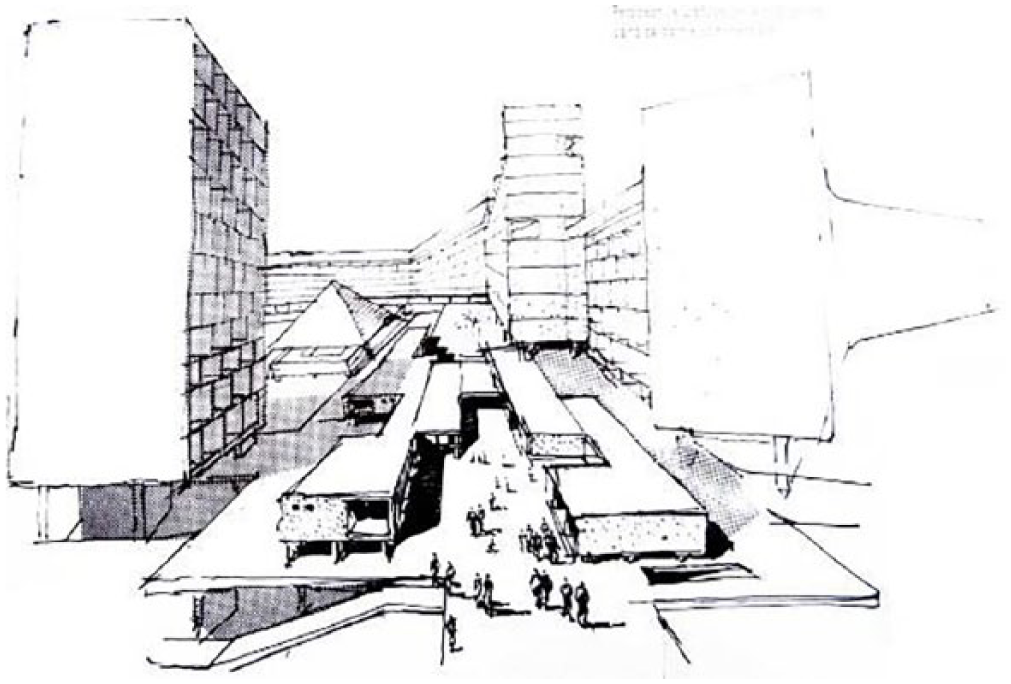
La Mirail’s pedestrian corridor at the first level, the dalle.
Among the other different typologies—patio villas and 2 to 4 floors small blocks—the big blocks were the most visible, organized in a sequence of up to 14 floors of interlocked slabs (Figure 9). For the alternating corridor technique, big blocks were a bold proposal. Elevators and collective stairs were regularly located at slab joints, linking only the 6th, 10th, and 14th floors to long corridors. Additional stairwells were created along the corridors between every two apartments, opening an entrance to other apartments as well (Figure 11).
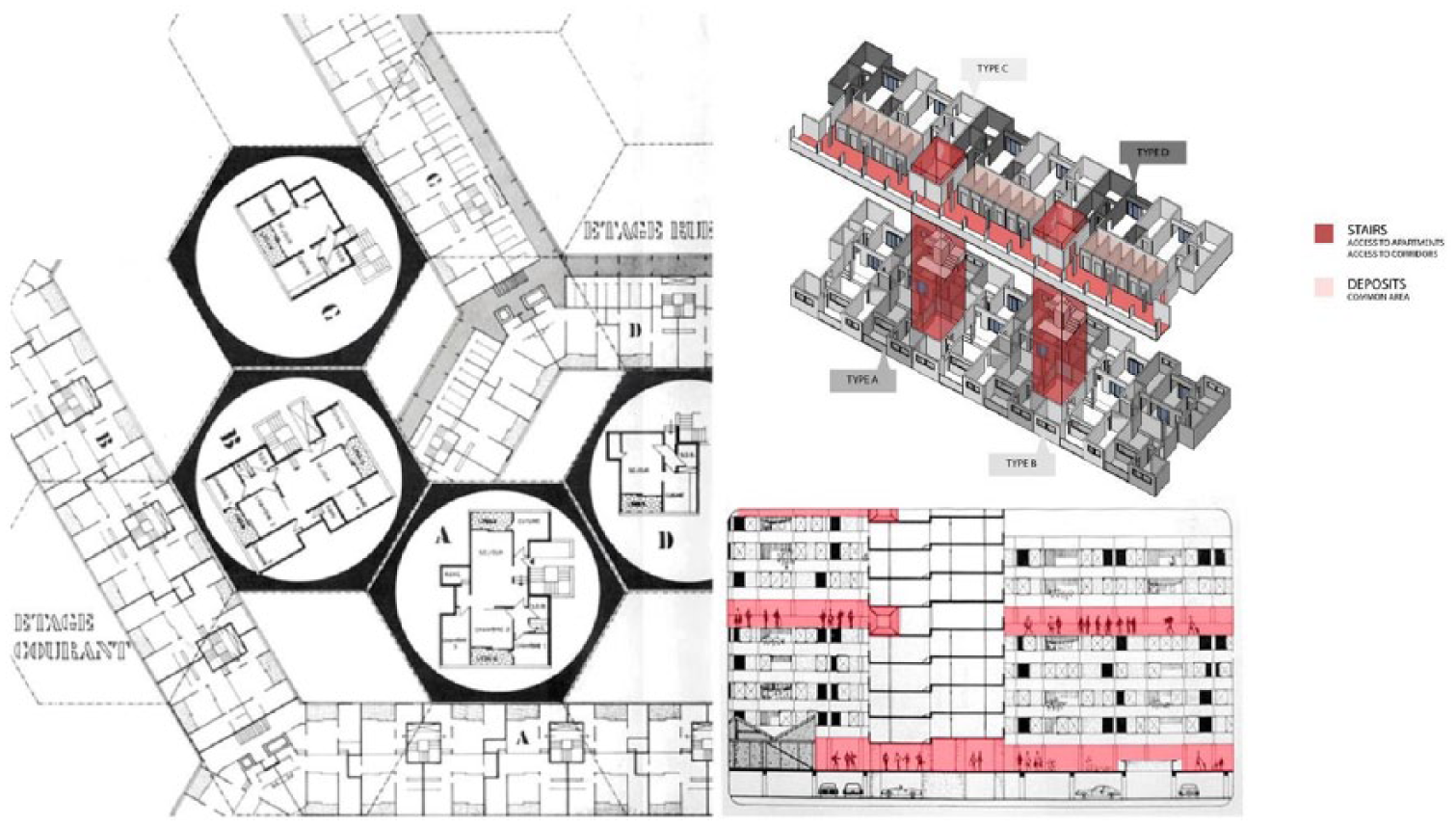
Apartment types A, B, C, and D in the Big Blocks: Big Block perspective view and section with collective corridors and its access.
The building worked as an efficient machine “access distributor,” as Zumpe (1967) said, calling it Verteilergängen system. Comparing it with Pruitt-Igoe’s skip-stop, Verteilergängen system was an extreme version for circulation surface decrease. In all 14 floors, only three corridors were needed, in contrast to the four or more that would be needed in the skip-stop. It represented a cost reduction model in the same line of Narkomfin’s efficiency researches; an issue that was already in Candilis’s concerns as some previous publications show (1965).
However, Le Mirail’s most important innovation was not exactly in the intermediate spaces but in its connection with the living units. Along upper corridors, there were four mirrored typologies. Smaller unit types “C” and “D” were supposed to be delicately planned in relation to its corridors connection. All entrance doors were 23 in. (60 cm) above corridor level, so three steps interposed between interior and exterior areas. A kind of a “porch” was then created for protecting the apartment’s private territory from indiscreet views, a “doorstep” device.
The split level created at the corridors was replicated on the other noncorridor floors, where another innovative model unit appeared. As in Pruitt-Igoe, mirrored “A” and “B” apartment types were only accessed through the stairwells (Figure 12). Its interior was split in two ambits with also a 23 in. (60 cm) level difference. On one side, at the entrance level, was a kitchen, a living room, and a “public balcony.” At the upper opposite side, a disassociated bathroom, one or two children’s dormitories, 9 the parent’s dormitory, and a “family balcony.”
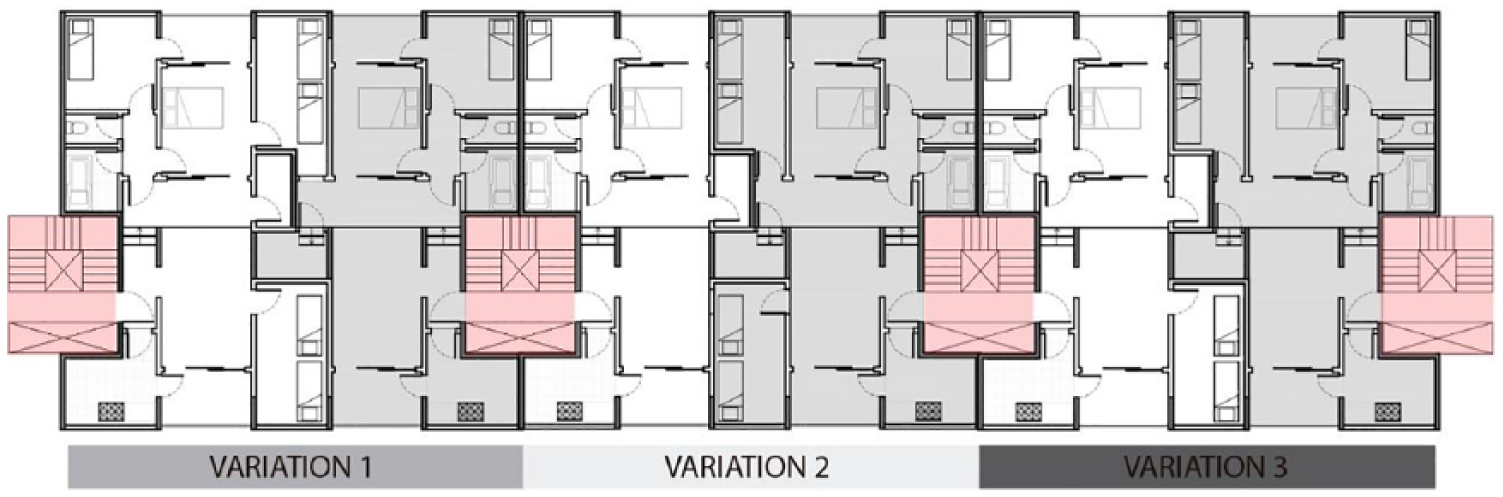
Three possible variations of A and B type apartments, according to habitat évolutif idea.
Split level was, in Candilis’s explanations, a way defining two zones; a “gathering space” and a place to “isolate oneself,” having its epicenters polarized by the two opposed balconies (Figure 13). In the central bay of the apartment, however, a continuum 10 was created. The parents’ dormitory had a sliding door, opening to the elevated platform 23 in. (60 cm) above the living room. It was a sort of mezzanine amid the two ambits, called l’espace pivot.
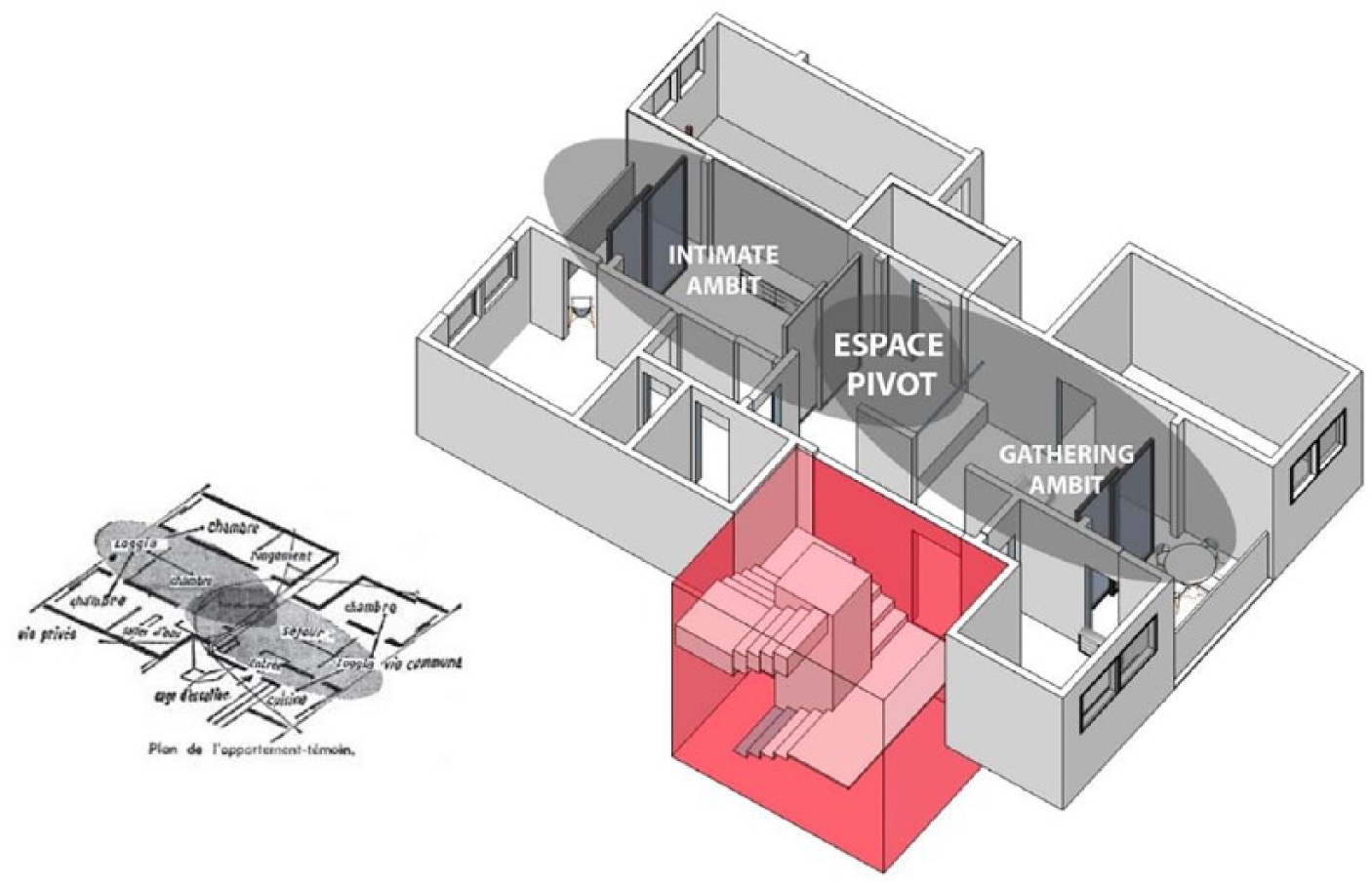
Isometric view of A and B type, indicating l’espace pivot structure. It creates an intermediate space between the intimate and the social areas in the interior of the apartment.
According to Candilis, this curious “kneecap” device bounded the two different realms of the domestic interior and resolved “what is lacking in almost all (traditional) dwellings for harmonizing a family’s daily life” to maintain control over the entire household (Papillault & Lusaac, 2008): It is the heartland between the public part, where one lives together, and the private part, where one needs intimacy. It is the place where the woman can do work without putting a mess in the room where she may receive an unexpected visit. Closing the large sliding door of the parents’ room, the living room is extended in volume. By drawing a curtain between the platform and the living room, the space of the rooms takes on a new dimension.
11
(Candilis, cited in Papillault & Lusaac, 2008, p. 187)
In present times, Le Mirail shows signs of hardship. A recent coverage described deplorable living conditions in the “crazy stairwells, badly-shaped corridors, broken windows, lifts out of order, heating in the harbor, cockroaches” where “tenants of the Varese building at Reynerie are reduced to this unenviable daily life . . . the claims are numerous, which affect the minimal unhealthy of the building as much as the relocation program of the tenants” (Dubois-Chabert, 2007). The dalle, following Martin Domínguez (2013), lost many of its original uses, such as schools and supermarkets, being little by little dehumanized and converted into a “mere footbridge.” On the other side, the excessive dimensions of the dalle weakened its potential for social condensation; “it was never ‘congested enough’, falling to provide enough ‘eyes’ for a natural control” (p. 104).
What was intended to be vital space, with an intense neighborhood life and cohesive community in the dalle, never worked as such. According to Martin Domínguez (2013), the upper corridors created an alternative and competing path to the dalle, reducing its pedestrian traffic and decreasing any kind of social condensation. Today, the dalle is being completely and silently demolished, almost without a proper academic debate for other alternative solutions. Opposed to the dalle failure, inside the living units, l’espace pivot apparently attained inhabitant’s expectations, and Le Mirail’s “A” and “B” apartment configurations are nowadays appreciated by its occupants (Papillault & Lusaac, 2008).
The Robin Hood Gardens and the Doorstep
In a 1959 article, P. Smithson showed excitement about the Le Mirail planning, describing it as an antagonist to Le Corbusier’s Unités “vertical garden cities” that “isolated and desolated” people. In contrast, Le Mirail had a “sense of connection,” considering important issues such as “walking distances.” Still, the innovative project made him express doubts, asking if “the effect of the Saturday and Sunday regional shoppers be nice or nasty for the people who live in Le Mirail all the time?” responding that it was “too early yet to say.”
Robin Hood Gardens (London, 1972) seems to follow similar approaches. It had 213 apartments and accommodated up to 700 residents, a small complex compared with the other two observed study cases, yet equivalent considering the cultural impact, an iconic example capable also of creating an architectural myth. The project was organized in two face-to-face strips formed by concatenated slab blocks, joined in “zig-zagging” angulations. In this way, the monotonous deep perspective, typical of modern corridors, such as Narkomfin’s, was avoided (Figure 14). Intending to protect the apartments, corridors were at the exterior side of the block, opening view to the city streets, but not to an interior central area, where a grass elevation land art piece was placed.
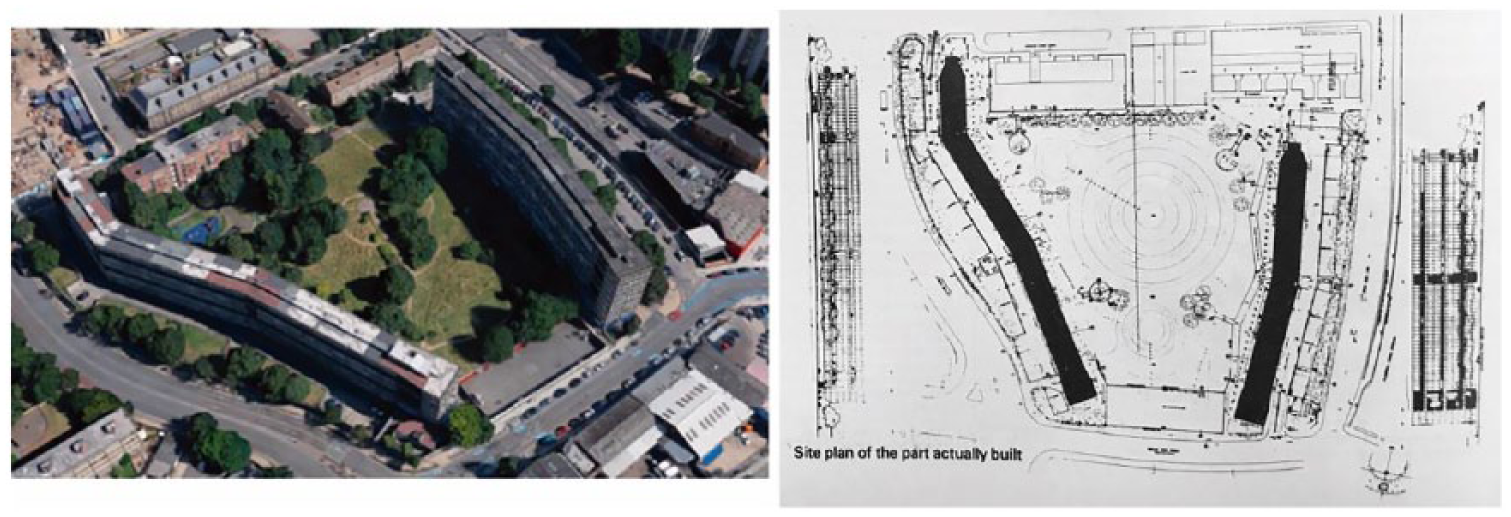
Aerial view of Robin Hood Gardens (London, 1972): On the left, original site plan for the housing project.
In 1972, the same year after its opening, Architectural Design published a comprehensive article about Robin Hood Gardens, revealing one of the project’s premises in the use of “type-form elements” which could “provide a literal separation between the public and private domain . . . an articulation between public deck and private cell” (Einsenman, 1972, p. 588). Apartments in the upper floors were variations of a basic section composed of three levels, having the corridor level in the middle; an alternate corridor model close to Pruitt-Igoe’s skip-stop, but differing in the access system. Robin Hood Gardens had concentrated entrance doors at the intermediate floor, so that pedestrian traffic was canalized in corridors and not on the staircases, reproducing the idea of street-in-the-sky; units were understood as row of dwellings in front of a typical city street. Vitality and social exchange were expected to happen (Figure 15).
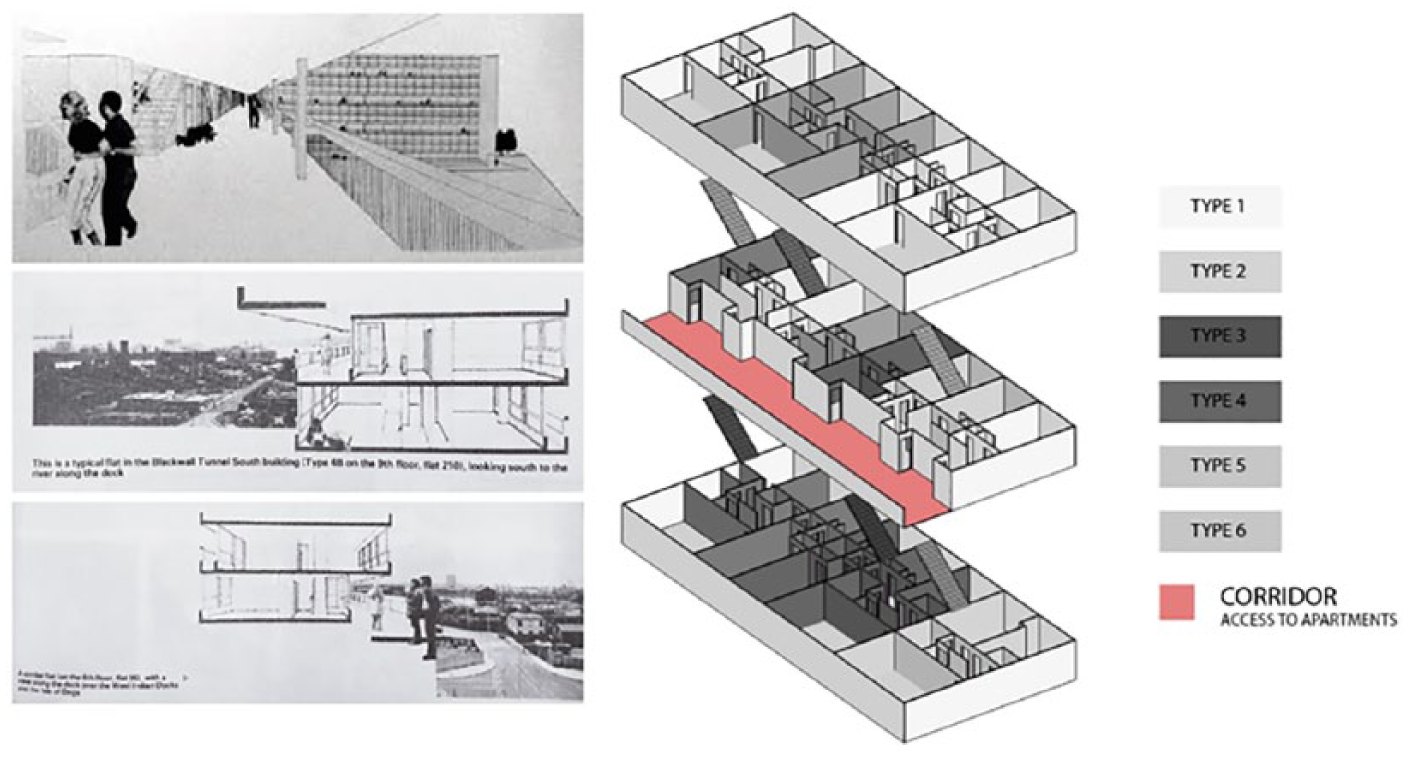
On the right, drawings contemporary to the project, indicating how corridors were supposed to interact with people and its surroundings. On the left, a diagram indicating the different types of apartments and the connections in-between floors, with the corridor only in the intermediate floor.
Inside, apartments incorporated a private staircase that led the rest of the apartment, above or below. Space structure created two well-defined ambits: a public area at the entrance level and an intimate area upstairs or downstairs. 12
One of the features was, precisely, at the entrance doors, a recess in the front; a niche at the corridor level with a particular function is intended [the niche] as shielded “pause places” before entering the house—a stoop rather than a doorstep. These spaces offer themselves naturally for potted plants, flower boxes, etc. . . . they are the equivalent of the yard gardens of the Golden Lane project, providing the identifying elements of the individual dwelling. (Einsenman, 1972, p. 569)
Following the same logic, internal staircases were strategically positioned to elongate social distance, functioning as a filter: [Private stairs] does two things: first, its parallel location [to corridor] creates a space and sound buffer between the public and private zones, second it creates a zone of space in front of the entry, which acts as a transition from public to private. (Einsenman, 1972, p. 590)
Inspired by the doorstep principles, the arrangement worked as a mechanism that met the “real needs of space for family life, especially for children . . . each one needs a little space covered in front of their door, as an extension of their dwelling” (Einsenman, 1972, p. 590).
What is astonishing is that, despite all of P. Smithson’s efforts to delicately organize the social space, improvements never had the desired effects postoccupancy. Few years after its opening, signs of maintenance problems appeared. Inhabitants had not formed an integrated or cohesive community, and complaints of undesired behaviors and even vandalism became more and more frequent. Just 1 year after it was built, A. Pangaro, an architectural critic, precociously criticized those “pause places” as allowing “no definition of private territory or any sense of belonging to individual occupants”: Neither the streets nor the dwellings accommodate activities useful for supervision or socialization. The wide access galleries are primarily circulation spaces and are only incidentally available in a neighborhood exchange. The outdoor areas adjacent to the dwelling units miss their chance to serve as front porches or stoops because they allow no definition of private territory or any sense of public ownership. The dwelling units are all but disconnected from the “street” (imagine the difference if there were only a kitchen window on it, and a real stoop), and turn away from the link to the rest of the estate. (Pangaro, 1973, p. 36)
Ten years later, J. Furse (1982) registered various inhabitants’ testimony’s, observing that the “empty street-decks give us most cause for concern: as we see it this is the fundamental failure of Robin Hood” (pp. 190-191). Instead of being a place of a vital social life, corridors were feared places, especially at night: I know that there are lights—but I still don’t like it out on my own. Don’t really know why—nothing’s ever happened to me, but I feel nervous. It’s not that I . . . it doesn’t frighten me but it’s not . . . I can’t really say why—you know what I mean. (Robin Hood tenant: Female 19, cited in Furse, 1982, p. 155)
The niche solution never got to create a defensible space. Newman would have probably pointed out the lack of a “symbolic language,” such as a real step, important for a clear delimitation of a different territory. In fact, “lack of privacy” was regularly noted: I like to see what’s going on—you can on the inside—look down into the garden across the way. I don’t like to open the front-door to look—the window is no good—can’t lean out. You hear them at night talking—not kids. You can’t see who it is. (Robin Hood tenant: Male 35, cited in Furse, 1982, p. 144)
Furse’s (1982) conclusion was that the streets—the decks—are certainly as the Smithson’s intended, we see them as sensibly conceived but ill-used. . . . they are used as little more than access-galleries: they cannot be viewed as “extensions to the dwelling” in the sense that they were meant to be. (p. 161)
Other practical issues could be also addressed. Corridors at the Robin Hood Gardens were probably wrongly placed; instead of opening the view to the central collective green area, where eye contact would probably promote social encounters, they were situated on the opposite facade. The center grass elevation created a visual obstacle at the ground level, and the distance between the two strips mostly overpassed the 25- to 30-m limit necessary for facial recognition necessary for “natural surveillance.” Even looking from the city street, corridors were not possible to survey. Banisters were made of prefab concrete and textured glass, obstructing clear view (Fernández Per, Mozas, & Ollero, 2013).
Final Discussion
Throughout the early Modern Movement, it is possible to observe significant efforts to understand alternate corridor technique or—using a timely expression—planning in section models. Its use was initially experimental, mostly focused in physical aspects such as efficiency and cost reduction issues. Improvements led to an extensive use in the 1950s and 1960s, applying it in a large scale to massive housing complexes.
“Section” models survived modernity criticisms and, moreover, were used even more intensely, apparently responding to anthropological and social interests, like territories delimitation. The Pruitt-Igoe project was still very tied to modern values as cost reduction was a priority-, but Le Mirail and Robin Hood Gardens were intended to have a different approach. However, the results were all similar. Something went wrong in all cases, or maybe, there are still aspects of the technique and the intermediary spaces configurations that it creates that need to be understood. At first sight, a return to the original intentions seem to be healthy: Smithsons (Robins Hood Gardens) and Candilis (Toulouse-Le Mirail) abused the stem idea, confusing it with endless corridors that advanced like streets-on-the-air, and do not manage to create articulating pieces of the different social scale spaces”
13
(Moley, 2006, p. 121).
Following Moley (2006), Robin Hood Gardens’ “deck-streets, without human scale or true threshold, cannot convince of their social virtues” because they were “unconnected, they also do not constitute an urban structure qualified as stem” 14 (p. 119). Therefore, models used in the study cases should be reobserved.
With opposite results, one could appoint another alternate corridor model, in D. Brody’s Riverbend apartments (New York, 1967), in fact a study case that gained Newman’s attention in his book. It is composed of two face-to-face five floors slab blocs, with duplex units inside—a piggy-back row houses organization (Figure 16). Considering that the distance between slabs did not exceed 82 to 98 ft. (25-30 m)—the limit for facial recognition—the generated patio was a place of intense crossing sights. A wide opening at the corridors, equivalent to two-floor height, facilitated continuous and mutual surveillance from each opposite block (Figure 17).
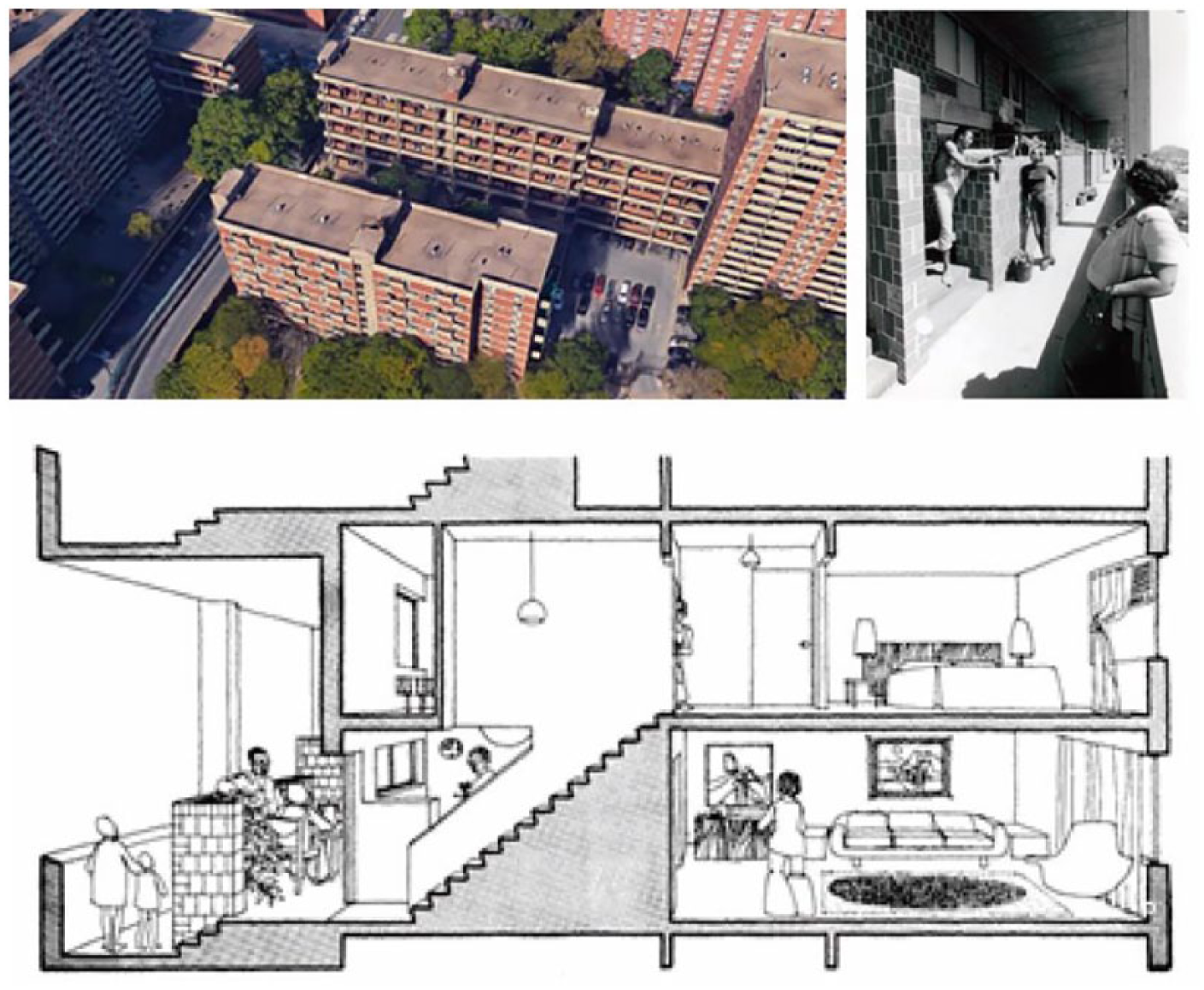
Aerial view of Riverbend Houses, “Zone B,” with slab blocks facing each other. Corridors were meant to be used as social condensers, where collective life and “natural vigilance” was encouraged.
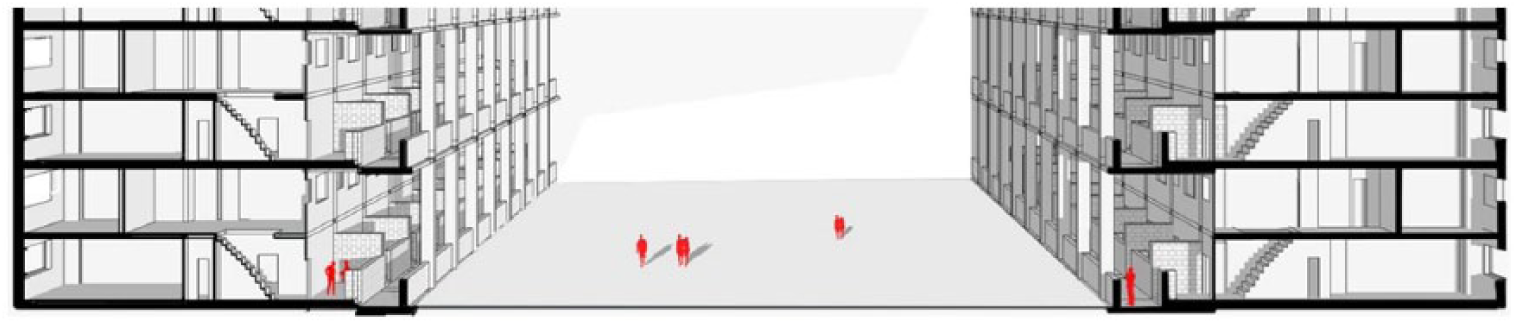
Diagram illustrating the interaction between buildings and between apartments and the corridors.
In front of apartment’s entrances, three steps were interposed, forming a platform that emulated a traditional porch. Steps clearly defined territories: “Anyone ascending the steps and entering the patio space intrudes into the territorial bounds of a particular family; a stranger’s presence in this area requires immediate explanation” (Newman, 1973, p. 124). Another feature was at the entrance recess, where sights from the duplex second floor were allowed. Direct view over the semipublic area contributed toward surveillance: “Anyone entering the courtyard is also easily seen from the interior of the unit” (Newman, 1973, p. 124).
Riverbend Houses showed new possibilities. Intermediate spaces could be constantly monitored though a cleverer arrangement of an alternate corridor model. To Newman, the low crime rates registered in Riverbend were directly related to architecture. From his point of view, other successful organizations should be researched, keeping an eye on all intermediate areas in his view is the only way to understand the alternate corridor technique and its social effects.
Footnotes
Declaration of Conflicting Interests
The authors declared no potential conflicts of interest with respect to the research, authorship, and/or publication of this article.
Funding
The authors received no financial support for the research, authorship, and/or publication of this article.
